by Jochen Markhorst
XVIII Mankind’s spiritual odyssey through life
Key West is under the sun
Under the radar - under the gun
You stay to the left and then you lean to the right
Feel the sunlight on your skin
And the healing virtues of the wind
Key West - Key West is the land of light
 For Nick Hornby, and probably for many of his contemporaries too, the song marks a turning point: when Rod Stewart scored his biggest hit in Europe, “Sailing”, in the late summer of 1975. Until then, Rod Stewart was cool, “the equivalent of loving Oasis in 1994, or The Stone Roses in 1989,” as Hornby explains in his wonderful, semi-autobiographical collection of essays 31 Songs (2002).
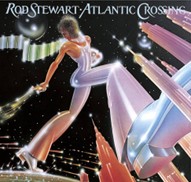
But after Smiler (1974, the album featuring Rod’s brilliant version of “Girl from the North Country” and the forgotten gem “Mine For Me”, written by Paul and Linda McCartney, featuring steel drums and Sir Paul on backing vocals), Rod crossed the Atlantic to record his first American album in New York, Miami and at the Muscle Shoals studio in Alabama, with the not-so-cryptic title Atlantic Crossing (1975). And with the not-so-cryptic, rather hideous cover on which a glittering Stewart takes the giant stride from Europe to New York. Which is the first step towards Sir Rod with his L.A. obsession, with the interchangeable blondes who are, time and again, a new version of Britt Ekland, who sings “Do Ya Think I’m Sexy” and “Ole Ola” and who wears straw boaters and raises champagne glasses on album covers.
Rod Stewart – Ole Ola
But the album that started it all actually still has plenty of tracks that should fall within Nick Hornby’s tolerance threshold; the opener is the solid, Faces-style rocker “Three Time Loser”; the tasteful, elegant cover of Crazy Horse’s timeless ballad “I Don’t Want to Talk About It”; a solid version of the Holland-Dozier-Holland smash hit “This Old Heart of Mine (Is Weak for You)”; the gritty rocker “Stone Cold Sober” which Stewart co-wrote with Stax legend Steve Cropper… but then again, they are all overshadowed by the closing track, the mega-hit “Sailing”.
The original, by The Sutherland Brothers, features an exciting arrangement and has a pleasantly menacing undertone, an attractive sense of doom. Which, incidentally, is a coincidence; “Gav and I did it ourselves; I played the harmonium and Gav played the drums, then we overdubbed the vocals” (Iain Sutherland in ZigZag, December 1975). Unfortunately, Stewart, or rather producer Tom Dowd, smooths out all the rough edges, and as a result, “Sailing” does indeed become rather schmaltzy. Stewart himself, it must be said, wasn’t entirely comfortable with it at the time either:
“I, of course, as with ‘Maggie May’, argued vehemently against releasing it as the album’s first single. I wanted “Three Time Loser” instead. And once more I was proved amusingly wrong, and happy to admit it.”
(Rod Stewart – The Autobiography, 2012)
The song went on to become a massive hit, was adopted by entire football stadiums (one of the most amusing being Millwall Football Club’s chant: “No one likes us, we don’t care”), was covered by everyone and everything from Joan Baez to Richard Clayderman, and became the go-to song at boat events. Not only because of the lyrics, but also thanks to the music videos featuring Rod on a sailing boat – the first recorded in Dublin Harbour, a second in New York Harbour. When Greta Thunberg set off on her sea voyage in 2019, the climate warriors sang “Greta’s Sailing”, and even as the British navy set sail from Portsmouth on the third day of the Falklands War in 1982, the song rang out across the quay. Much to the amusement of songwriter Gavin Sutherland, incidentally; the song isn’t about sailing at all, but about saying goodbye to a life – about dying, in other words:
“The song’s got nothing to do with romance or ships; it’s an account of mankind’s spiritual odyssey through life on his way to freedom and fulfilment with the Supreme Being. Mind you, it doesn’t matter at what level pop fans appreciated the song. They liked it and bought it – and that’s the main thing.”
(Scottish Daily Express, November 1975)
Sutherland Brothers – Sailing:
With the benefit of hindsight, you can indeed recognise the depth Gavin was aiming for, but Gavin has only himself to blame for the widespread misunderstanding. After all, the song opens with
I am sailing, I am sailing
Home again 'cross the sea
I am sailing stormy waters
To be near you, to be free
… the verse with which he also brings the lyrics to a close. The intervening verses do make it clear that “sailing” is meant metaphorically (I am flying like a bird ’cross the sky and Can you hear me thro’ the dark night, and then the outro Oh Lord, to be near you, to be free), but then again – Gavin really should have chosen a less vivid metaphor. Or refer to “sailing” in a more subtle way. For example, as Dylan does fifty years later in “Key West”:
You stay to the left and then you lean to the right
Feel the sunlight on your skin
And the healing virtues of the wind
… with which Dylan, more subtly than Gavin Sutherland, idyllically suggests the sailing journey to The End, to Key West, the land of light.
Dylan’s own “account of mankind’s spiritual odyssey through life on his way to freedom and fulfilment with the Supreme Being” is introduced by a delightfully old-fashioned triplet that takes us back to mercurial days; under the sun – under the radar – under the gun is an associative triad that stylistically echoes the rhythmic, sound-driven 1950s poetry of men such as Ginsberg and Corso, of works such as T.S. Eliot’s The Waste Land and Kerouac’s Mexico City Blues;
Blook on the Mountaintop,
Bleak;
Blake by the Mountainside,
Baah! –
Boom went the Crasher
                                                (159th Chorus)
… sequences of words chosen for the rhythm, sound and the joy of language, rather than for content reasons. Emerging from a technique verging on écriture automatique, which Dylan frequently and gladly employed from roughly “All I Really Want To Do” (1964, I ain’t lookin’ to block you up / Shock or knock or lock you up) right through to the Basement Songs in 1967 – and which we now hear flaring up again, more than half a century later. We have already heard this renewed receptiveness to it a few times on this album, in “I Contain Multitudes” and in “Mother Of Muses”, and here, with under the sun – under the radar – under the gun, it fully realises Kerouac’s ideal:
I want to be considered a jazz poet
blowing a long blues in an afternoon jam
session on Sunday. I take 242 choruses;
my ideas vary and sometimes roll from
chorus to chorus or from halfway through
a chorus to halfway into the next.
                          (“Note”, Mexico City Blues, 1959)
… Kerouac’s ideal of jazz poetry, of ideas that roll on from one chorus to the next. Of a Philosopher Pirate who, jamming to the sounds of a forgotten radio station, sails towards the land of light on the horizon with the healing wind in his sails.
Sir Rod, meanwhile, looks back on his years in L.A. with a due sense of embarrassment;
“In early 1976, we were back in the studio, in Los Angeles this time, making A Night On The Town, which yielded the cover image I so hated: the photograph of me in the straw boater, holding the crystal champagne glass. […] At any point I could have said, “You know what? This is the worst album cover I’ve ever seen. Let’s do something else.” But I didn’t. I don’t know how I got through that and came out the other end. I cringe now every time someone offers me that album to sign.”
To be continued. Next up Key West part 19: The Bare Necessities
Jochen is a regular reviewer of Dylan’s work on Untold. His books, in English, Dutch and German, are available via Amazon both in paperback and on Kindle: 
- Blood on the Tracks: Dylan’s Masterpiece in Blue
- Blonde On Blonde: Bob Dylan’s mercurial masterpiece
- Where Are You Tonight? Bob Dylan’s hushed-up classic from 1978
- Desolation Row: Bob Dylan’s poetic letter from 1965
- Basement Tapes: Bob Dylan’s Summer of 1967
- Mississippi: Bob Dylan’s midlife masterpiece
- Bob Dylan’s Greatest Hits
- John Wesley Harding: Bob Dylan meets Kafka in Nashville
- Tombstone Blues b/w Jet Pilot: Dylan’s looking for the fuse
- Street-Legal: Bob Dylan’s unpolished gem from 1978
- Bringing It All Back Home: Bob Dylan’s 2nd Big Bang
- Time Out Of Mind: The Rising of an Old Master
- Crossing The Rubicon: Dylan’s latter-day classic
- Nashville Skyline: Bob Dylan’s other type of music
- Nick Drake’s River Man: A very British Masterpiece
- I Contain Multitudes: Bob Dylan’s Account of the Long Strange Trip
- Bob Dylan’s Rough And Rowdy Ways – Side B
- Bob Dylan’s High Water (for Charley Patton)
- Bob Dylan’s 1971
- Like A Rolling Stone b/w Gates Of Eden: Bob Dylan kicks open the door
- It Takes A Lot To Laugh, It Takes A Train To Cry b/w Just Like Tom Thumb’s Blues – Bob Dylan’s melancholy blues
- Bob Dylan’s Rough And Rowdy Ways – Side A
- Bob Dylan takes Highway 61 – Seven mercurial songs