by Jochen Markhorst
XIX The Bare Necessities
Wherever I travel - wherever I roam
I’m not that far from the convent home
I do what I think is right - what I think is best
Mystery Street off Mallory Square
Truman had his White House there
Eastbound – westbound - way down in Key West
 A major cultural shift of the twentieth century, at least in the Western world, but increasingly beyond it too, is Disneyfication. The standardisation of consumption, merchandising, the expectation that employees feign certain emotions… the transformation of our society into a theme park, as it were. In the entertainment sector, we can hold Disney responsible for yet another dimension: the practice of makeovers. Stories are simplified, rough edges smoothed away, and negativity eliminated. Although the latter actually began well before the twentieth century, before Walt Disney’s birth in 1901 – as early as the first English translation of the Brothers Grimm’s Fairy Tales, in 1823 by Edgar Taylor, the bloody, cruel originals were watered down. The dénouement of Rumpelstiltskin, for example, is now farcical;
“Can your name be Rumpel-stilts-ken?” said the lady slyly. “Some witch told you that!—some witch told you that!” cried the little man, and dashed his right foot in a rage so deep into the floor, that he was forced to lay hold of it with both hands to pull it out.
… but is in Grimm’s original far more gruesome: “… and in his rage he stamped his right foot so hard into the ground that it sank right up to his thigh; then, in his fury, he grabbed his left foot with both hands and tore himself in two,” ending in a bizarre suicide, that is. Or the fate of Cinderella’s cruel stepsisters. In the watered-down English translation, one sister sacrifices a toe to fit into the glass slipper, whilst the other merely sustains a few bleeding grazes.
The Brothers Grimm have no regard for the delicate child’s soul. Without much fuss, a chunk of the first daughter’s heel is cut off, whilst the second’s toes are chopped off. To no avail; on both occasions, the birds reveal to the prince that there is blood on the tracks, thus exposing the deception. And in the twentieth century, the horror content of the source texts evaporates entirely in Disney’s saccharine adaptations. In the Disney version, the stepsisters, with their feet intact, eventually attend Cinderella and the prince’s wedding and meet two handsome officers there. In the original, the ending is far more gruesome. Stumbling on their mutilated feet, the stepsisters arrive at the wedding.
“When the wedding to the prince was to take place, the false sisters arrived, seeking to ingratiate themselves and share in his happiness. As the bride and groom made their way to the church, the eldest walked on the right and the youngest on the left: there, the doves pecked out one eye of each of them. Afterwards, as they were leaving, the eldest was on the left and the youngest on the right: then the doves pecked out the other eye of each of them. And so, for their wickedness and deceit, they were punished with blindness for the rest of their lives.”
Similarly, smoothed out is one of the biggest Disney hits of the twentieth century, The Jungle Book (1967), as film composer Gilkyson had to experience to his frustration. Terry Gilkyson provided a handful of brilliant songs for the film, but Walt Disney himself intervened: too dark, both the film and the music – screenwriter Bill Peet and composer Gilkyson were sacked, and everything had to be rewritten.
It was Disney’s last major intervention (Walt Disney died in December 1966, whilst the Jungle Book revision was in production), and a textbook example of Disneyfication. Bill Peet and Terry Gilkyson actually had a pretty good sense that the cruelty, the bloodiness and the suspense of Kipling’s source text needed to be filtered, but they left a sinister, ruthless undercurrent intact. In the demos of Gilkyson’s rejected songs, we hear a dark, menacing baritone, real wolf howls and lyrics such as Give us our freedom or soon we die (“Brothers All”), The tiger fears the pack (“The Song of the Seeonee”), All who know me very well / Hate me, hate me, hate me more than tongue can tell (“The Mighty Hunters”), songs in which the deep-voiced wolves, Shere Khan and the hunter Buldeo (a role that was cut entirely) threaten with death, fear, hatred and cruelty. The commission then goes to the most successful songwriting duo in the film world, to Robert and Richard Sherman, the writers of hundreds of great film songs, and above all of the evergreen “It’s a Small World (After All)”.
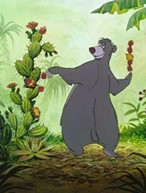
The Sherman Brothers do a fantastic job, treating us to, among other songs, the irresistible “I Wan’na Be Like You (The Monkey Song)”, perhaps the best song that never won an Oscar, and, above all, have the good taste and discernment to rescue one song from Gilkyson: the indestructible “The Bare Necessities”, sung by the equally indestructible Phil Harris. Although “rescue”… the Sherman Brothers are gracious enough to leave the credits with Gilkyson, but in fact they really only rescue the words with the ingrained pun the bare necessities of life from Gilkyson’s original – both the music and the words are otherwise all rewritten. And so they also rewrote the lyrics that in the demo version were still “It’s nice to ponder as we slowly roam / While growing fonder of our jungle home” into the words that we still hear echoing more than half a century later, but now in a Dylan song:
Wherever I wander, wherever I roam
I couldn't be fonder of my big home
The bees are buzzin' in the tree
To make some honey just for me
When you look under the rocks and plants
And take a glance at the fancy ants, then maybe try a few
The bare necessities of life will come to you
They'll come to you!
Louis Armstrong – The Bare Necessities:
Technically less perfect than
Gilkyson’s sketch, but nevertheless providing a blueprint for Dylan’s:
Wherever I travel - wherever I roam
I’m not that far from the convent home
… for the opening of the eleventh verse of “Key West”, then. And with the line that follows, I do what I think is right – what I think is best, he even seems to be alluding to the life motto of the hedonistic Baloo – Disney’s Baloo, that is. Kipling’s Baloo is Mowgli’s strict Teacher of the Law of the Jungle. Very strict indeed. When Bagheera urges him to be a little more careful with the young man cub, Baloo retorts: “Better he should be bruised from head to foot by me who love him than that he should come to harm through ignorance,” after he has taught Mowgli the hard way how to find protection in the jungle – “is not that worth a little beating?” (Ch. 3 Kaa’s Hunting, Rudyard Kipling – The Jungle Book, 1894).
On reflection, I do what I think is right – what I think is best actually fits Kipling’s Baloo perfectly as well.
To be continued. Next up Key West part 20: The girl with the giggle in her voice
Jochen is a regular reviewer of Dylan’s work on Untold. His books, in English, Dutch and German, are available via Amazon both in paperback and on Kindle: 
- Blood on the Tracks: Dylan’s Masterpiece in Blue
- Blonde On Blonde: Bob Dylan’s mercurial masterpiece
- Where Are You Tonight? Bob Dylan’s hushed-up classic from 1978
- Desolation Row: Bob Dylan’s poetic letter from 1965
- Basement Tapes: Bob Dylan’s Summer of 1967
- Mississippi: Bob Dylan’s midlife masterpiece
- Bob Dylan’s Greatest Hits
- John Wesley Harding: Bob Dylan meets Kafka in Nashville
- Tombstone Blues b/w Jet Pilot: Dylan’s looking for the fuse
- Street-Legal: Bob Dylan’s unpolished gem from 1978
- Bringing It All Back Home: Bob Dylan’s 2nd Big Bang
- Time Out Of Mind: The Rising of an Old Master
- Crossing The Rubicon: Dylan’s latter-day classic
- Nashville Skyline: Bob Dylan’s other type of music
- Nick Drake’s River Man: A very British Masterpiece
- I Contain Multitudes: Bob Dylan’s Account of the Long Strange Trip
- Bob Dylan’s Rough And Rowdy Ways – Side B
- Bob Dylan’s High Water (for Charley Patton)
- Bob Dylan’s 1971
- Like A Rolling Stone b/w Gates Of Eden: Bob Dylan kicks open the door
- It Takes A Lot To Laugh, It Takes A Train To Cry b/w Just Like Tom Thumb’s Blues – Bob Dylan’s melancholy blues
- Bob Dylan’s Rough And Rowdy Ways – Side A
- Bob Dylan takes Highway 61 – Seven mercurial songs