by Jochen Markhorst
VI They all jumped out of a rotten potato
Greatest magic trick ever under the sun
Perfectly executed, skillfully done
Wolfman, oh wolfman, oh wolfman, howl
Rub a dub dub – it’s murder most foul
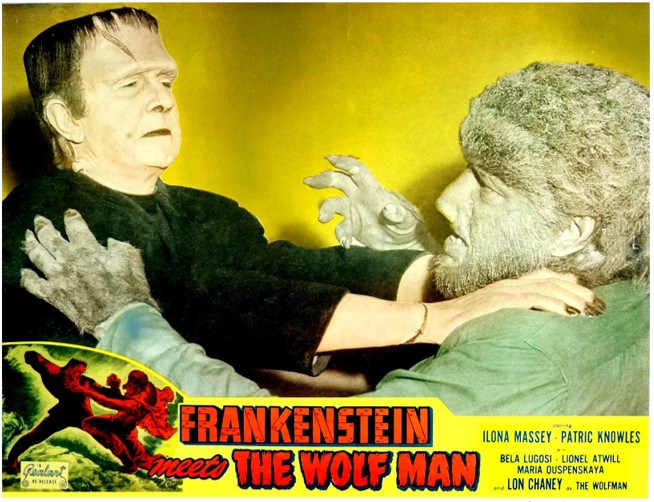 Boris Karloff had already appeared in some 80 films and was a well-paid, well-known actor when his breakthrough to immortality came: Frankenstein (1931). It was a massive hit, cementing Karloff’s reputation as the number one horror actor, and Boris (the stage name of the Englishman William Henry Pratt) accepted, with growing reluctance, to appear as the same character in a series of spin-offs of exponentially declining quality. The Bride of Frankenstein (1935), Son of Frankenstein (1939) … each one worse than the last. He managed to avoid The Ghost of Frankenstein (1942) and Frankenstein Meets the Wolf Man (1943) due to “scheduling conflicts”. A not very reliable excuse; Karloff had a fairly substantial role as a murderous maniac in the play Arsenic and Old Lace, later so successfully adapted for the screen by Frank Capra starring Cary Grant and Peter Lorre. For the black comedy, Boris was given the all-encompassing directorial instruction “to look like Boris Karloff”. But throughout the 1940s there were hundreds, more than thousand even, of performances in which Boris’s role was played by stand-in Bela Lugosi or Erich von Stroheim (between 1941 and 1946 alone, the play was staged nearly 3,000 times – it was a smash hit) – so “scheduling conflicts” may have been a half-truth.
The final straw – for Karloff, at least – was the contractual obligation to appear in House of Frankenstein (1944), his last Frankenstein film – in which, incidentally and rather remarkably, he plays not the monster, but Dr Frankenstein. It is a bizarre mishmash of film monsters: Dracula, the Hunchback, the Mad Scientist, Frankenstein’s monster, of course… and the Wolf Man. This time, Karloff does not let embarrassment get the better of him; he has his contract with Universal Pictures terminated and explains his decision, sympathetically and with style, in an interview in the Los Angeles Times on 12 May 1946:
“When Frankenstein had a son and the series threatened to go on indefinitely, Karloff began to be worried. Finally there was a picture which Karloff refers to as the “monster clambake,” with everything thrown in – Frankenstein, Dracula, a hunchback and a “man-beast” that howled in the night. It was too much. Karloff thought it was ridiculous and said so.”
Neither its box-office success nor his own astronomical fee can sway him; Boris has had enough and is striking out in new directions. We see him, for example, in the Danny Kaye comedy The Secret Life of Walter Mitty (1947), as well as in a Dick Tracy film, an Abbott & Costello film and on television game shows, we hear him on the radio and in a musical; he is back on the stage more often, and does indeed still lend himself to horror from time to time (Voodoo Island, Corridors of Blood and even once more in a Frankenstein film, Frankenstein 1970, in which he is, once again, not the monster, but Dr Victor von Frankenstein), and enjoys commercial success with spoken-word recordings. The most successful of these are aimed at the children’s market and bring us to Dylan’s “Murder Most Foul”: Mother Goose Nursery Rhymes from 1958.
 Mother Goose Nursery Rhymes was strategically released just before Christmas 1958 and is an irresistible collection of 69 old rhymes and songs for children, with a remarkable number of titles echoing in Dylan’s oeuvre: London Bridge, Humpty Dumpty, Little Jack Horner, Hey Diddle Diddle, Who Killed Cock Robin?, Little Miss Muffet and many more. And at the end of Side A, on track 32, we hear Boris Karloff singing:
Rub a dub dub,
Three men in a tub,
And how do you think they got there?
The butcher, the baker,
The candlestick maker.
They all jumped out of a rotten potato,
Was enough to make a man stare.
Boris Karloff – Rub-A-Dub-Dub on 19’56”:
It’s a bit presumptuous to suggest being able to follow the flow of a Nobel Prize-winning poet’s stream of consciousness – but it seems to be on display here. We’ve just heard, on Side A of Rough And Rowdy Ways, Dylan’s Frankenstein song “My Own Version Of You”, the song that conjures up Boris Karloff for every boomer – the man who brings his Frankenstein career to a close in a film full of foul murders and, ultimately, a fatal confrontation with the Wolf Man, before reviving his career with “Rub-A-Dub-Dub”, all of which seems to culminate in the first chorus of “Murder Most Foul”:
Wolfman, oh wolfman, oh wolfman, howl
Rub a dub dub – it’s murder most foul
… in which it’s only a tiny step from Frankenstein’s mortal enemy, the wolf man, to Wolfman Jack and the upcoming list of requests.
Quite apart from that all-too-coincidental cluster of Karloff trivia, we’ve of course long known Dylan’s fondness of bizarre nursery rhymes, and we’ve been hearing echoes of centuries-old nursery rhymes in his songs ever since the early 1960s. A fondness he explicitly pointed out quite early on:
“Folk music is the only music where it isn’t simple. It’s weird, man, full of legend, myth, bible and ghosts. I’ve never written anything hard to understand, not in my head, anyway, and nothing as far out as some of the old songs. They were out of sight. Little Brown Dog, “I bought a little brown dog, its face is all gray. Now I’m going to Turkey flying on my bottle.” And Nottemun Town, that’s like a herd of ghosts passing through on the way to Tangiers. Lord Edward, Barbara Allen, they’re full of myth.”
(Nora Ephron & Susan Edmiston Interview, 1965)
In that respect, an age-old, far out nursery rhyme like “Rub-A-Dub-Dub” (first published in 1798, with traces dating back to the fourteenth century) is a perfectly fitting prelude to the endless list of song references and quotations that follows. With the – presumably unintended, but undoubtedly appreciated – added bonus of a nod to Hank Thompson and his Brazos Valley Boys, who had a hit in 1953 with “Rub-A-Dub-Dub”. Not all that far-fetched; in 1969, in the Newsweek interview with Hubert Saal, Dylan mentions Hank in a remarkable list: “The people who shaped my style were performers like Elvis Presley, Buddy Holly, Hank Thompson,” and whilst one might think the interviewer got it wrong and that Dylan obviously meant Hank Williams (or possibly Hank Snow), when we hear DJ Dylan shine a spotlight on Hank Thompson in his radio show in the twenty-first century (episodes 33 and 65), it becomes clear that Dylan holds the honky-tonk Western swing country star (29 Top 10 hits) in high regard.
“I’ve never written anything as far out as some of the old songs. They were out of sight.”
To be continued. Next up Murder Most Foul part 7:
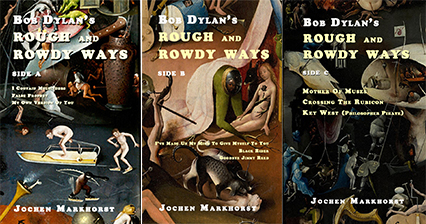
Jochen is a regular reviewer of Dylan’s work on Untold. His books, in English, Dutch and German, are available via Amazon in both paperback and on Kindle:
- *Blood on the Tracks: Dylan’s Masterpiece in Blue*
- Blonde On Blonde: Bob Dylan’s mercurial masterpiece
- Where Are You Tonight? Bob Dylan’s hushed-up classic from 1978
- Desolation Row: Bob Dylan’s poetic letter from 1965
- Basement Tapes: Bob Dylan’s Summer of 1967
- Mississippi: Bob Dylan’s midlife masterpiece
- Bob Dylan’s Greatest Hits
- John Wesley Harding: Bob Dylan meets Kafka in Nashville
- Tombstone Blues b/w Jet Pilot: Dylan’s looking for the fuse
- Street-Legal: Bob Dylan’s unpolished gem from 1978
- Bringing It All Back Home: Bob Dylan’s second Big Bang
- Time Out Of Mind: The Rise of an Old Master
- Crossing The Rubicon: Dylan’s late-career classic
- Nashville Skyline: Bob Dylan’s other kind of music
- Nick Drake’s River Man: A very British masterpiece
- I Contain Multitudes: Bob Dylan’s Account of the Long Strange Trip
- Bob Dylan’s Rough and Rowdy Ways – Side B
- Bob Dylan’s High Water (for Charley Patton)
- Bob Dylan’s 1971
- Like A Rolling Stone b/w Gates Of Eden: Bob Dylan kicks open the door
- It Takes a Lot to Laugh, It Takes a Train to Cry b/w Just Like Tom Thumb’s Blues – Bob Dylan’s melancholic blues
- Bob Dylan’s Rough And Rowdy Ways – Side A
- Bob Dylan takes Highway 61 – Seven mercurial songs
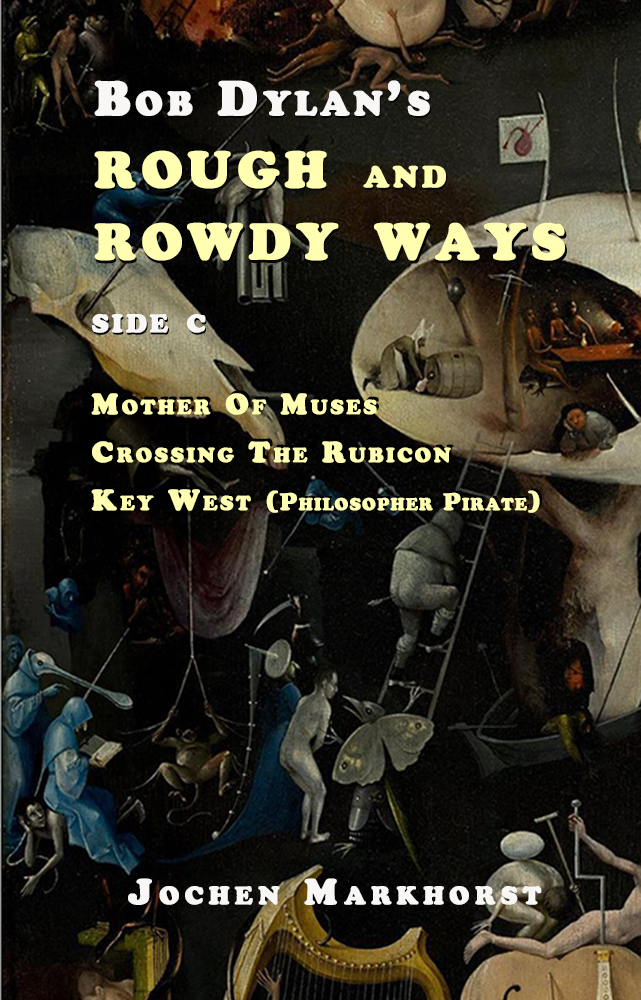
- Bob Dylan’s Rough And Rowdy Ways – Side C