by Jochen Markhorst
V Not even the chair
The day that they blew out the brains of the king
Thousands were watching, no one saw a thing
It happened so quickly – so quick by surprise
Right there in front of everyone’s eyes
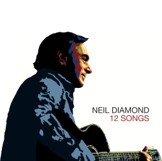 Following the resounding success of Johnny Cash’s American Recordings, producer Rick Rubin works his magic on Neil Diamond, with equally successful results: 12 Songs (2005) is, both artistically and commercially, Neil Diamond’s most successful album in decades. Which is also universally acknowledged by the critics. The effusiveness of the positive reviews reflects a certain rehabilitation sentiment – it is 2005, and by now we can no longer ignore the fact that Diamond’s songs have been propping up the canon for some forty years, that gems such as “I’m A Believer”, “Red, Red Wine”, “Sweet Caroline”, “Cracklin’ Rosie”, “Solitary Man”, “Girl, You’ll Be A Woman Soon” and many, many more have proved indestructible, and that Neil deserves respect. Certainly no mockery or contempt, at any rate, which since the 1970s – since the frilly shirts, Las Vegas and the sing-along housewives – had become commonplace amongst opinion-makers such as Rolling Stone, the New Yorker and Saturday Night Live.
A similar sense of semi-surprised positivity prevails amongst the media outlets that consider themselves as more serious with regard to Neil’s lyrics. “This isn’t easy listening,” writes Rolling Stone appreciatively. “As direct as he’s ever been with his lyrics, which give them an extra poignancy” (Barry Walters, 3 November 2005). The New Yorker is equally complimentary, particularly knowing “Diamond’s tendency to write slightly incomprehensible lyrics,” (Sasha Frere-Jones, 9 January 2006), whilst The Guardian notes with pleasant surprise that Neil has become “a subtle songwriter”, “stripped of kitsch” and “more poignant than ever” (Betty Clarke, 24 February 2006).
Now, even the most ardent Neil fan would have to admit that lyrics aren’t really Neil’s forte. Cracklin’ Rose you’re a store bought woman / But you make me sing like a guitar hummin’. Song sung blue, weeping like a willow / Song sung blue sleeping on my pillow. Kentucky woman / If she get to know you / She goin’ to own you. Clumsy phrases, odd metaphors, distracting filler lyrics, pleonasms… there are hardly any songs in Neil’s extensive catalogue without these sort of cringe-worthy moments. Which is a bit of a mystery: after all, he is capable of writing good lyrics. “Brooklyn Roads” possesses an intimate and moving poetic power; hits such as “Sweet Caroline” and “September Morn” make it to the finish line without any cringy excesses; and Neil does still prove himself capable of something like:
Did you ever read about a frog
Who dreamed of bein’ a king
And then became one
Well except for the names
And a few other changes
If you talk about me
The story is the same one
… the third verse of one of Diamond’s greatest songs, “I Am… I Said” from 1971. A beautiful opening verse, a poignant personal account, a remarkable style (as in this third verse, for example, which is held together by the unexpected, powerful rhyme became one – the same one). But then there is the first chorus:
… in which Neil once again taints one of his best songs with one of his clumsiest lines (all the more remarkable given that Neil reveals that he “spent four months agonising over the lyrics”).
Dylan holds Neil Diamond in high regard. There are a few false rumours circulating about derogatory remarks Dylan is said to have made, but the fact is that Neil made a wonderful contribution to The Last Waltz (1976, “Dry Your Eyes”, the song he co-wrote with his producer Robbie Robertson) and merrily joins in the singing – alongside Dylan himself, amongst others – during the finale, on “I Shall Be Released”; In October 1980, Dylan recorded “Sweet Caroline” (ultimately released in 2021 on the Deluxe 5-CD edition of Springtime in New York: The Bootleg Series, Vol. 16 (1980–1985), and not only that:
Jim Keltner and I later did a session with Neil Diamond and Burt Bacharach and Carole Bayer Sager, the songwriters. We’re standing around sharing a jar. Neil says, “The other day I got this tape from Bob Dylan. He sent me a copy of him singing ‘Sweet Caroline’. It’s great, but I was really surprised to get it in the mail.” Keltner and I both said, “We played on it, man.”
(Fred Tackett in Ray Padgett’s Pledging My Time, 2023)
… and in 2014, a delighted Neil sent out a tweet in which he proudly shares yet another flattering exchange with Dylan, this time following the release of his new album Melody Road:
“Wow, Bob Dylan just called me and said, “If any record connects with me, this one does.” about Melody Road. How cool is that? Thanks Bob!”
(@NeilDiamond, 8 november 2014)
Plus: we know that Dylan tried to be Neil Diamond at least once. In 1978. Something seemed to be bothering Dylan at the time. Financial problems, a divorce, Elvis had died… One of the – rather radical – decisions he made to cope with this came after a visit to Neil’s Las Vegas show and concerned his stage presence: we now categorise 1978 as Dylan’s “Las Vegas period”. Large-scale, revue-style, slick, loose-fitting shirts, an 11-piece backing band including three backing singers, make-up. And to organise all of that, he hired Neil Diamond’s manager, Jerry Weintraub.
And the second time Dylan seems to want to be Neil Diamond is in the present era, in 2020, in the closing lines of the first verse of “Murder Most Foul”. Apparently, shock jockey Dylan is determined to incorporate the gruesomeness of they blew out the brains of the king in his song, but then decides to tone down the horror with three lines of Neil Diamond-esque platitudes, filler and tautologies. Thousands were watching, no one saw a thing is still a defensible antithesis, except that it’s a rather overused classic. And the hyperbole no one saw a thing is also somewhat jarring; we’ve all seen the shot to the head, Jackie’s panic, the futile hustle and bustle of the police officers, the motorbikes and the frozen bystanders, the accelerating Lincoln… there is actually only one single thing we did not see, all the other things we did, in fact, see.
The subsequent line, It happened so quickly – so quick by surprise, is completely pointless filler, and moreover disturbingly trivial. Aside from the dubious grammar, the tautological superfluity is jarring. A fired bullet does go quickly, yes. And if it wouldn’t go quick, it wouldn’t be a surprise either. All in all, the line is on a par with Neil Diamond’s After the day, there comes the night (“Coldwater Morning”, 1970). And Dylan’s closing hurrah Right there in front of everyone’s eyes, finally, is
a) an empty repetition of the line above, of Thousands were watching, and
b) the ten-millionth line of verse in the history of songwriting to rhyme eyes with surprise (Neil Diamond sang the five-millionth in 1993 in “Happy Birthday Sweet Sixteen”).
But then again – let’s not be too critical of every comma in a meditative, stream-of-consciousness-style elegy of 1,408 words. “It’s the sound,” as the master taught back in his Las Vegas year of 1978, “words don’t interfere with it. They… they… punctuate it.” (Playboy interview with Ron Rosenbaum).
Or, as Neil would say: “Song she brang to me / Words that rang in me” (“Play Me”, 1972 – a wonderful song, by the way).
To be continued. Next up Murder Most Foul part 6:
Jochen is a regular reviewer of Dylan’s work on Untold. His books, in English, Dutch and German, are available via Amazon in both paperback and on Kindle:
*Blood on the Tracks: Dylan’s Masterpiece in Blue*
Blonde On Blonde: Bob Dylan’s mercurial masterpiece
Where Are You Tonight? Bob Dylan’s hushed-up classic from 1978
Desolation Row: Bob Dylan’s poetic letter from 1965
Basement Tapes: Bob Dylan’s Summer of 1967
Mississippi: Bob Dylan’s midlife masterpiece
Bob Dylan’s Greatest Hits
John Wesley Harding: Bob Dylan meets Kafka in Nashville
Tombstone Blues b/w Jet Pilot: Dylan’s looking for the fuse
Street-Legal: Bob Dylan’s unpolished gem from 1978
Bringing It All Back Home: Bob Dylan’s second Big Bang
Time Out Of Mind: The Rise of an Old Master
Crossing The Rubicon: Dylan’s late-career classic
Nashville Skyline: Bob Dylan’s other kind of music
Nick Drake’s River Man: A very British masterpiece
I Contain Multitudes: Bob Dylan’s Account of the Long Strange Trip
Bob Dylan’s Rough and Rowdy Ways – Side B
Bob Dylan’s High Water (for Charley Patton)
Bob Dylan’s 1971
Like A Rolling Stone b/w Gates Of Eden: Bob Dylan kicks open the door
It Takes a Lot to Laugh, It Takes a Train to Cry b/w Just Like Tom Thumb’s Blues – Bob Dylan’s melancholic blues
Bob Dylan’s Rough And Rowdy Ways – Side A
Bob Dylan takes Highway 61 – Seven mercurial songs
Bob Dylan’s Rough And Rowdy Ways – Side C