
by Jochen Markhorst
V Creative person meets a muse
I'm falling in love with Calliope
She don't belong to anyone, why not give her to me?
She's speaking to me, speaking with her eyes
I've grown so tired of chasing lies
Mother of Muses, wherever you are
I've already outlived my life by far
 The Balrogs, together with the reptilian “fell beasts” on which the Nazgûl ride, are indeed among the most terrifying monsters Tolkien ever created. Gigantic, flaming demons, shrouded in black smoke, fire and terror. And one of those fearsome Balrogs, Durin’s Bane, is seen attacking Gandalf in the depths of Moria, on the Bridge of Khazad-dûm, armed with a fiery whip with nine tails. Gandalf sacrifices himself. Before he vanishes into the unfathomable depths with the plummeting Balrog, he snarls, clinging to the edge of the abyss, the famous words: “Fly, you fools!”
It is a plot-tilting cliché that Hollywood loves to draw on: the elderly father figure who knows he is nearing the end of his life anyway, and sacrifices himself so that the next generation may live on. Obi-Wan Kenobi, who deliberately lets himself be pierced, well, “lightsabered” by Darth Vader so that Luke can escape; the elderly Clint Eastwood, who provokes his own killing by the local gang so that his young Hmong neighbours can live in peace (Gran Torino, 2008); Bruce Willis taking the place of his future son-in-law and staying behind on the fateful asteroid to detonate the nuclear bomb that saves the Earth from destruction (Armageddon, 1998). Heroic, but still a realistic, human instinct, it would seem, as we saw again in 2011 when hundreds of retired Japanese engineers and professionals volunteered to help with the clean-up operations at the severely damaged nuclear power station in Fukushima.
Remarkably, it is a line of verse that gains even more depth without such a heroic context: “I’ve already outlived my life by far,” a line with the same couleur as “It’s not dark yet, but it’s getting there” or “But I’m already there in my mind / And that’s good enough for now”(from 1997’s “Not Dark Yet” and “Highlands”, respectively): Rilke-like melancholy and Yeats-like drama of decline, resignation to mortality in autumnal hues, the tension of a dry, matter-of-fact observation on the one hand and the emotional weight beneath it on the other. Moving, even without Hollywood context. And indeed without any context at all; there is no connection with the preceding, poignant lines, either emotionally or in terms of content. In fact, any connection between the preceding five lines of verse themselves is just as unclear as any connection with the beautiful, solitary closing line I’ve already outlived my life by far.
For example, the second verse line “She (Calliope) don’t belong to anyone, why not give her to me?” is such an enigmatic, paradoxical line of verse; after all, if she belongs to no one, she cannot be given to the narrator, cannot belong to the narrator. Although, funnily enough, master storyteller Neil Gaiman would understand Dylan’s narrator.
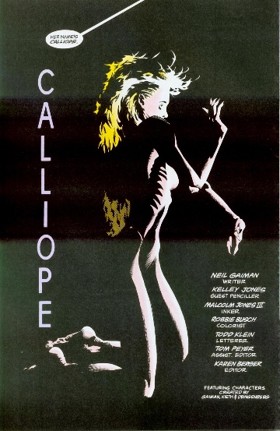
“Calliope” is a highly acclaimed episode (no. 17, 1991) from Neil Gaiman’s graphic novel series The Sandman, adapted for the screen in 2022. Calliope is held captive for decades and cruelly exploited by Erasmus Fry, a successful writer, who, towards the end of his life, having outlived his life, hands her over to Richard Madoc, a young, struggling author. Madoc, too, locks Calliope away and, in turn, exploits her for years – raping her, talking to her, looking into her eyes, and receiving endless, overwhelming bursts of creativity. His sudden, unprecedented literary success brings him fame, wealth and film deals. The exhausted, desperate Calliope directs her pleas to the Roman version of the Mother of the Muses, to the Mothers of the Camenae, who do answer, but are unfortunately unable to help her. Calliope despairs. She has long since stopped believing the promises that she would be set free soon, first from Erasmus Fry, and now from Richard Madoc – I’ve grown so tired of chasing lies. Calliope is eventually – after more than sixty years – freed by the series’ protagonist, the enigmatic, menacing Morpheus – The Sandman.
The story is a poignant allegory about artistic ambition and the toxic dynamics of exploitation, and it seems to make waves; in the twenty-first century, the online magazine for speculative fiction Strange Horizons publishes on its website a sort of warning from the editor to aspiring writers: Stories We’ve Seen Too Often. It is a list of 51 (!) types of stories that the editorial team at Strange Horizons had, at one point, come across far too often – stories centred on themes such as “Someone dies and then wanders around as a ghost” or “Evil, unethical doctor performs medical experiments on an unsuspecting patient”. Number 2 on the list is “Creative person is having trouble creating”, broken down into five apparently overused plot ideas:
a. Writer has writer’s block.
b. Painter can’t seem to paint anything good.
c. Sculptor can’t seem to sculpt anything good.
d. Creative person’s work is reviled by critics who don’t understand how brilliant it is.
e. Creative person meets a muse (either one of the nine classical Muses or a more individual muse) and interacts with them, usually by keeping them captive.
So, in detail, the plot of e is the story of Gaiman’s Calliope. Which Gaiman himself, surprised, also notes:
“Now, I have a fairly good memory, and don’t recall ever reading any captive-muse-for-someone-with-writer’s-block stories before I wrote mine. (I’m not saying there couldn’t have been any, just that it certainly wasn’t around enough to have been any kind of meme, as far as I know.) So I wonder if it’s
a) Calliope just sort of edged out into popular consciousness, or, more likely,
b) In Steam Engine Time People Build Steam Engines, and I just happened to build my particular steam engine first (I knew that if I didn’t write a Serial Killer’s Convention story someone would, for example; it was an idea whose time had come.)”
(Journal Neil Gaiman on neilgaiman.com, 9 May 2004)
Gaiman points out his close relationship with Mnemosyne and then suggests – modestly, indirectly and rather convincingly – that, through his story about the Muse Calliope, he himself may have become a muse for twenty-first-century writers seeking inspiration. It just sort of edged out into popular consciousness.
Incidentally, “Elderly man sacrifices himself to save his friends/children/the planet” is not on the list of 51 Stories We’ve Seen Too Often.
—————–
To be continued. Next up Mother Of Muses part 6: And then Jonah the Baptist started splashing people with water!
Jochen is a regular reviewer of Dylan’s work on Untold. His books, in English, Dutch and German, are available via Amazon both in paperback and on Kindle: 
- Blood on the Tracks: Dylan’s Masterpiece in Blue
- Blonde On Blonde: Bob Dylan’s mercurial masterpiece
- Where Are You Tonight? Bob Dylan’s hushed-up classic from 1978
- Desolation Row: Bob Dylan’s poetic letter from 1965
- Basement Tapes: Bob Dylan’s Summer of 1967
- Mississippi: Bob Dylan’s midlife masterpiece
- Bob Dylan’s Greatest Hits
- John Wesley Harding: Bob Dylan meets Kafka in Nashville
- Tombstone Blues b/w Jet Pilot: Dylan’s looking for the fuse
- Street-Legal: Bob Dylan’s unpolished gem from 1978
- Bringing It All Back Home: Bob Dylan’s 2nd Big Bang
- Time Out Of Mind: The Rising of an Old Master
- Crossing The Rubicon: Dylan’s latter-day classic
- Nashville Skyline: Bob Dylan’s other type of music
- Nick Drake’s River Man: A very British Masterpiece
- I Contain Multitudes: Bob Dylan’s Account of the Long Strange Trip
- Bob Dylan’s Rough And Rowdy Ways – Side B
- Bob Dylan’s High Water (for Charley Patton)
- Bob Dylan’s 1971
- Like A Rolling Stone b/w Gates Of Eden: Bob Dylan kicks open the door
- It Takes A Lot To Laugh, It Takes A Train To Cry b/w Just Like Tom Thumb’s Blues – Bob Dylan’s melancholy blues
- Bob Dylan’s Rough And Rowdy Ways – Side A
- Bob Dylan takes Highway 61 – Seven mercurial songs
“Don’t ever remember reading any captive- muse- for -someone- with- writer’s -block stories …”
Must have missed Bob Dylan And Faith (Part V) in which I quote Emily Dickinson’s “The Wind Tapped Like A Tired Man” ….in her house, she captures the musical breeze as an inspirational muse before it disappears s as quickly as it came.