In case you missed it:
by Jochen Markhorst
II Wait a minute, boys!
Being led to the slaughter like a sacrificial lamb
Say wait a minute boys, do you know who I am?
Of course we do, we know who you are
Then they blew off his head when he was still in the car
 We owe the beauty of Anthem of the Sun, Grateful Dead’s second, successful album (1968), to the angelic patience and cut-and-paste skills of Jerry Garcia and bassist Phil Lesh, and their intention to create a sort of hybrid album; a collage-like blend of studio and live recordings. One of the many problems they encountered, as Phil recounts in his autobiography Searching for the Sound (2005), is the simple fact that the various tapes have different ips (inches per second):
“At the same time Jerry and I were frantically fading out the old tracks and bringing in the new, trying desperately to avoid any taint of the dreaded Chipmunk syndrome.”
Lesh is referring – of course – to “The Chipmunk Song (Christmas Don’t Be Late)”, the massive hit from 1958, written and sung by Ross Bagdasarian, who adjusted the playback speed of the tape to create the high-pitched “chipmunk voices”; the vocals were attributed to “Alvin and the Chipmunks”, a virtual cartoon band consisting of the three cheeky chipmunks Alvin, Simon and Theodore – eventually leading to the subsequent, global success of the Chipmunks franchise.
That annoying, inescapable Christmas song, which lies at the heart of a global phenomenon that has been going strong for over half a century now, still ranks at No. 5 (!) on the New York Times’ Top 100 Christmas Songs Of All Time list in 2020. To put it into perspective: the NYT still deserves every credit for not putting Mariah Carey at number one, but instead choosing Nat King Cole’s “The Christmas Song”, followed by what is truly the best Christmas song of all time, Otis Redding’s “White Christmas”, at number two. On the other hand, The Chipmunks occupy a spot between Elvis at number four and Brenda Lee at number six.
The fact that this silly novelty song from 1958 made it into the Top 5 in 2020, alongside legends such as Elvis, Otis and Bing Crosby, and well above greats such as Sinatra, Ray Charles and Bowie, certainly illustrates that the squeaking rodents have remained popular for 62 years. As do the astronomical sales figures and the countless performances; in 2013, the American Society of Composers, Authors and Publishers calculated that the song ranked 23rd on the list of “Most performed in the 20th century”. That’s just the 20th century, mind you; the success of the 2007 live-action film Alvin and the Chipmunks sparked yet another surge in popularity. And it even seems to have trickled down into a monumental song by a Nobel Prize winner:
Now wait a minute, boys
Yeah, why can’t we sing it again?
Alvin, cut that out
Theodore, just a minute
Simon, will you cut that out? (Let’s sing it again)
Boys!
“Wait a minute, boys” has become so deeply ingrained in American idiom since 1958 that it is one of the very rare phrases to be used twice by Dylan, a self-confessed fierce opponent of repetition:
And Miss Patty Valentine just nodded her head
Cop said, “Wait a minute, boys, this one’s not dead”
So they took him to the infirmary
And though this man could hardly see
They told him that he could identify the guilty men
… in the fourth verse of “Hurricane” (1975), that is.
Alvin and the Chipmunks may not be the first thing Dylan meant to evoke in “Murder Most Foul” – and certainly not in the murder scene – but alienation does seem to be a goal. The whole Western world is familiar with the circumstances surrounding Kennedy’s assassination; we’ve all seen the horrific footage, so we all know that there was no mafia-style dialogue followed by an execution;
Say wait a minute boys, do you know who I am?
Of course we do, we know who you are
Then they blew off his head when he was still in the car
… just as there is no clear consensus as to whether there ever was a “they” in the first place, and just as “still in the car” wrongly suggests that Kennedy was just about to get out or something like that. In short, the narrator fictionalises history – as befits a good storyteller: when the legend becomes fact, print the legend, as newspaperman Maxwell Scott taught us in The Man Who Shot Liberty Valance (John Ford, 1962). Although this particular choice of words seems to stem mainly from Dylan’s intention to make this song – and the album as a whole, for that matter – an ode to songs;
– “blew his head off in a car” appears for the third time in Dylan’s body of work as a tribute to Lennon’s “A Day In The Life”. Following the name-check another day in the life and the quote I heard the news today, oh boy in “Roll On John” (Tempest, 2012) and the same quote in “Key West”, we now have the paraphrase of He blew his mind out in a car;
– “We know who you are” then, might be meant to be a nod to another admired artist: Nick Cave. The world’s biggest fan of Nashville Skyline (“I constantly buy the same record over and over again: I’ve bought so many versions of Nashville Skyline – I must be keeping Dylan in… whatever that is he needs keeping in,” Q, May 1995) experienced a personal highlight when Dylan sought him out at a rain-soaked Glastonbury. In true style, Cave mythologises that encounter in interviews and in his poetic collection of anecdotes The Sick Bag Song (2015), but the gist remains the same, as he explains to a visitor in his irresistible Red Hand Files blog: “He goes ‘I like what you do’ and I’m like ‘I like what you do too’, and then there was this terrible silence, and he just turned and walked back.” And of course we also have a first-hand source: Dylan’s own tweet:
“Saw Nick Cave in Paris recently at the Accor Arena and I was really struck by that song Joy where he sings We’ve all had too much sorrow, now it [sic] the time for joy. I was thinking to myself, yeah that’s about right.”
(@bobdylan, 19 november 2024)
“We No Who U R” is the surprisingly restrained and spellbinding opening track from Cave’s breakthrough album Push The Sky Away (2013), with its ominous chorus
And we know who you are
And we know where you live
And we know there’s no need to forgive
Cave himself does not seem to have noticed Dylan’s use of the words we know who you are. At least, he makes no mention of it. In April 2020, he discusses “Murder Most Foul” at some length, in response to questions from visitors to The Red Hand Files. Nick is enthusiastic: “It is a perplexing but beautiful song and, like many people, I have been extremely moved by it.” He admires the “relentless cascade of song references” and “the perverse daring and playfulness” like in so many truly great Dylan songs, but he fails to realise that one of the many song references might be to one of his own songs. Or perhaps he chooses not to mention it; Cave’s default setting, when discussing admired figures such as Bryan Ferry, Johnny Cash and Bob Dylan, is one of modesty and humility. “I was elated to think Bob Dylan had been in the audience,” writes Nick when he sees that Dylan has tweeted about him, “and since I doubt I’ll get an opportunity to thank him personally, I’ll thank him here. Thank you, Bob!”
It blew his head off, so to speak.
To be continued. Next up Murder Most Foul part 3: Yes, that’s exactly what I mean!
Jochen is a regular reviewer of Dylan’s work on Untold. His books, in English, Dutch and German, are available via Amazon in both paperback and on Kindle:
- *Blood on the Tracks: Dylan’s Masterpiece in Blue*
- Blonde On Blonde: Bob Dylan’s mercurial masterpiece
- Where Are You Tonight? Bob Dylan’s hushed-up classic from 1978
- Desolation Row: Bob Dylan’s poetic letter from 1965
- Basement Tapes: Bob Dylan’s Summer of 1967
- Mississippi: Bob Dylan’s midlife masterpiece
- Bob Dylan’s Greatest Hits
- John Wesley Harding: Bob Dylan meets Kafka in Nashville
- Tombstone Blues b/w Jet Pilot: Dylan’s looking for the fuse
- Street-Legal: Bob Dylan’s unpolished gem from 1978
- Bringing It All Back Home: Bob Dylan’s second Big Bang
- Time Out Of Mind: The Rise of an Old Master
- Crossing The Rubicon: Dylan’s late-career classic
- Nashville Skyline: Bob Dylan’s other kind of music
- Nick Drake’s River Man: A very British masterpiece
- I Contain Multitudes: Bob Dylan’s Account of the Long Strange Trip
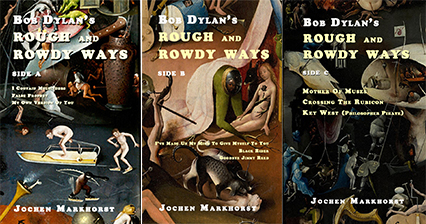
- Bob Dylan’s Rough and Rowdy Ways – Side B
- Bob Dylan’s High Water (for Charley Patton)
- Bob Dylan’s 1971
- Like A Rolling Stone b/w Gates Of Eden: Bob Dylan kicks open the door
- It Takes a Lot to Laugh, It Takes a Train to Cry b/w Just Like Tom Thumb’s Blues – Bob Dylan’s melancholic blues
- Bob Dylan’s Rough And Rowdy Ways – Side A
- Bob Dylan takes Highway 61 – Seven mercurial songs
- Bob Dylan’s Rough And Rowdy Ways – Side C