by Jochen Markhorst
III Yes, that’s exactly what I mean!
Shot down like a dog in broad daylight
‘Twas a matter of timing and the timing was right
You got unpaid debts and we’ve come to collect
We’re gon’ kill you with hatred and without any respect
We’ll mock you and shock you, we’ll grin in your face
We’ve already got someone here to take your place
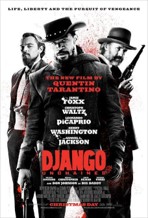 Dr King Schultz (Christopher Waltz) has just, without much fuss, shot down the local sheriff in broad daylight like a dog; he walks back into the deserted saloon with the stunned Django, returns to his beer, and waits, completely unfazed, for the marshal to arrive. A short while later, the marshal stands outside the saloon, accompanied by a crowd armed to the teeth, and loudly orders Dr King Schultz to come out unarmed, hands held high. Dozens of gun barrels are trained on the saloon’s swing doors.
Dr. King Schultz: Wunderbar, Marshall! I have relieved myself of all weapons, and just as you have instructed, I am ready to step outside, with my hands raised above my head. I trust, as a representative of the criminal justice system of The United States of America, I shan’t be shot down in the street, by either you or your deputies, before I’ve had my day in court.
U.S. Marshall Gill Tatum: You mean like you did our sheriff?
Dr. King Schultz: Yes, that’s exactly what I mean! Do I have your word as a lawman, not to shoot me down like a dog in the street?
U.S. Marshall Gill Tatum: Well, as much as we’d all enjoy seein’ somethin’ like that, ain’t nobody gonna cheat the hangman in my town.
(Django Unchained, Quentin Tarantino, 2012)
In his films, Tarantino abundantly quotes, paraphrases and satirises, drawing on the cinematic canon, campy B-films and corny TV series, and is extremely fortunate to have found, in the irresistible Christopher Waltz, an exceptional actor who can imbue the clichés and hollow phrases with exactly the right dose of irony. So that a weird, yet hackneyed Western cliché – shot down like a dog in the street – suddenly lays bare its own absurdity. Absurd, as we hardly know of any films, stories or historical incidents in which dogs are shot in the street – an atrocity one would, in any case, be more likely to associate with a random, spontaneous act by a sadistic bad guy who, on a languid summer’s afternoon, from the boardwalk shoots at an innocent stray dog out of boredom, rather than with a well-considered, coordinated and planned assassination using a sniper rifle from a tall building; yet, in some inexplicable way, shot down like a dog has nevertheless become an established expression.
Anyway, Dylan’s use of the expression illustrates the cinematic approach of his song. The descriptions of the setting, the clichéd dialogue, the stage directions: the entire first verse is cinematic. Which, incidentally, is neither surprising nor particularly original: there are many songs that deal with the assassination of JFK, and usually the songwriter is inspired by what we all – unfortunately – have in mind: the horrific film footage. Lou Reed’s “The Day John Kennedy Died”, “He Was A Friend Of Mine” by The Byrds, Buddy Starcher’s “History Repeats Itself”, Jerry Lee Lewis’s “Lincoln Limousine” with its painfully bad lyrics, “That Was The President” by Dylan’s old comrade-in-arms Phil Ochs… bullets, a car, a waving president and shocked onlookers are the recurring images.
Dylan himself has a striking number of these songs in his repertoire. Kris Kristofferson’s “They Killed Him”, “He Was A Friend Of Mine”, Marvin Gaye’s (or rather Dion’s) “Abraham, Martin And John”, and indirectly even The Killer’s “Lincoln Limousine” (Dylan borrows the opening and chorus riffs for his “Mississippi”). But only a Phil Ochs song has a direct link to “Murder Most Foul”. Not “That Was The President”, remarkably enough, but the song found two tracks further on the same LP: “The Highwayman”.
In Dylan circles, the memory of Phil Ochs has been seriously tarnished by the “limousine incident” – the event in which, during his most notorious year (1965), Dylan threw Ochs out of the car because Phil was not enthusiastic about Dylan’s new single (“Can You Please Crawl Out Your Window”; the fact that it flopped later proved Ochs right). But up until that phase – the phase which his then-girlfriend Suze Rotolo describes in her memoir A Freewheelin’ Time (2008) as “when he was on his telling it like it is truth mission, he could be cruel” – there was mutual respect, healthy competition and a turbulent friendship between Dylan and Ochs. Which was still the case in 1964, when Phil recorded one of his best and most successful records, I Ain’t Marching Any More. The opening title track has, of course, made the record immortal (Ochs’s appealing electric re-recording of the song with Al Kooper’s Blues Project is, incidentally, a very nice folk-rock rendition), followed by ten more strong originals and a fine cover of Ewan MacColl’s “The Ballad Of The Carpenter” as a poignant finale.
Side 1 concludes with “The Highwayman”, the well-known poem set to music here by Ochs. Alfred Noyes’s famous, bloody ballad from 1904 tells the story of the highwayman in love who is lured into an ambush by King George’s redcoats. Bess sacrifices her life to warn her lover, and the distraught highwayman, blinded by grief and consumed by a bloody thirst for revenge, throws himself hopelessly at the redcoats:
Back, he spurred like a madman, shrieking a curse to the sky,
With the white road smoking behind him and his rapier brandished high.
Blood red were his spurs in the golden noon; wine-red was his velvet coat;
When they shot him down on the highway,  down like a dog on the highway,
And he lay in his blood on the highway, with a bunch of lace at his throat.
Perhaps Dylan had already heard the song around the time of the recording (late 1964), and certainly after the delayed release of the LP (August 1965), but in any case well before December 1965, before that dark day when the spiteful Dylan kicked the unfortunate Ochs out of the car with the oft-quoted tirade: “You’re not a folk singer. You’re a journalist!”
Vicious and disingenuous. I Ain’t Marching Any More features plenty of topical songs, such as “Draft Dodger Rag”, a witty monologue by a draft dodger (humour which Ochs then, unfortunately, undermines in the liner notes with a somewhat pedantic explanation and the bitter conclusion “Free enterprise strikes again”), “Here’s to the State of Mississippi” about institutionalised racism in that state and the murder of the three civil rights activists Chaney, Goodman and Schwerner, and “Iron Lady” about the cruelty of the death penalty (the Iron Lady is the electric chair); songs that – admittedly – do possess a certain journalistic quality. Yet a song like “The Highwayman” is a pure, 100 per cent folk song – a murder ballad akin to Dylan’s own “Seven Curses” (1963) or “Tin Angel” (2012) – Phil Ochs truly was a folk singer.
To be continued. Next up Murder Most Foul part 4: These are dangerous times
Jochen is a regular reviewer of Dylan’s work on Untold. His books, in English, Dutch and German, are available via Amazon in both paperback and on Kindle:
- *Blood on the Tracks: Dylan’s Masterpiece in Blue*
- Blonde On Blonde: Bob Dylan’s mercurial masterpiece
- Where Are You Tonight? Bob Dylan’s hushed-up classic from 1978
- Desolation Row: Bob Dylan’s poetic letter from 1965
- Basement Tapes: Bob Dylan’s Summer of 1967
- Mississippi: Bob Dylan’s midlife masterpiece
- Bob Dylan’s Greatest Hits
- John Wesley Harding: Bob Dylan meets Kafka in Nashville
- Tombstone Blues b/w Jet Pilot: Dylan’s looking for the fuse
- Street-Legal: Bob Dylan’s unpolished gem from 1978
- Bringing It All Back Home: Bob Dylan’s second Big Bang
- Time Out Of Mind: The Rise of an Old Master
- Crossing The Rubicon: Dylan’s late-career classic
- Nashville Skyline: Bob Dylan’s other kind of music
- Nick Drake’s River Man: A very British masterpiece
- I Contain Multitudes: Bob Dylan’s Account of the Long Strange Trip
- Bob Dylan’s Rough and Rowdy Ways – Side B
- Bob Dylan’s High Water (for Charley Patton)
- Bob Dylan’s 1971
- Like A Rolling Stone b/w Gates Of Eden: Bob Dylan kicks open the door
- It Takes a Lot to Laugh, It Takes a Train to Cry b/w Just Like Tom Thumb’s Blues – Bob Dylan’s melancholic blues
- Bob Dylan’s Rough And Rowdy Ways – Side A
- Bob Dylan takes Highway 61 – Seven mercurial songs
- Bob Dylan’s Rough And Rowdy Ways – Side C