
by Jochen Markhorst
IX I saw Satan laughing with delight
There’s three bums comin’ all dressed in rags
Pick up the pieces and lower the flags
I’m going to Woodstock, it’s the Aquarian Age
Then I’ll go over to Altamont and sit near the stage
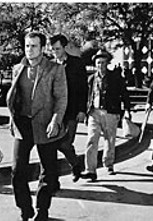 After four lines of verse in which Dylan’s revolving carousel shows a nursery rhyme, Beatlemania and Merseybeat, Dealey Plaza flashes by once more, with a brief reference to the three tramps, the three main figures in one of the many wild conspiracy theories surrounding the assassination of JFK. It’s just a very brief flash; Dylan’s addition all dressed in rags isn’t even a poeticisation of reality – okay, what we see the men wearing in the (many) photographs isn’t exactly haute couture, and the smallest one’s trousers could do with a wash, but they’re not exactly rags either. No, the singer – or the narrator, if you like – has already left Dallas again.
We seem to have reached a point in the lyrics where Dylan hasn’t yet decided to focus on songs, but still wants to write something like A Short History of Nearly Everything in The Sixties. Something like Billy Joel’s “We Didn’t Start The Fire” or, to a certain extent, R.E.M.’s “It’s The End Of The World As We Know It (And I Feel Fine)” – the song where we’ve only really known, since September 2025, what Michael Stipe is singing so obscurely. Apart from the chorus, until then we could really only make out with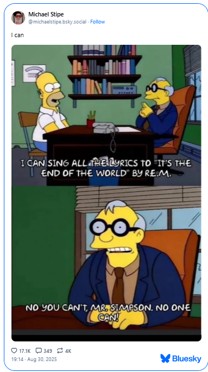 any certainty: “Lenny Bruce”, “Leonard Bernstein” and “Leonid Brezhnev”, which led us to interpret the whole song as a sort of reckoning with the 1960s and 1970s. But then, in 2025, a meme started doing the rounds in which Homer Simpson boasts: “I can sing all the lyrics to ‘It’s The End Of The World’ by R.E.M.”, to which his conversation partner, an administrator, replies: “No, you can’t, Mr Simpson. No one can.” The meme takes off when Michael Stipe himself posts it on his BlueSky account and dryly adds: “I can.” Two days later, it turns out not to be mere boasting: in regular instalments, Michael reveals more and more of those nearly forty-year-old lyrics. “It’s Left of west and coming in a hurry with the Furies breathing down your neck,” for example (@michaelstipe.bsky.social, 1 September 2025)
It turns out that it isn’t really a chronicle of, or a reckoning with, an eventful period. But still, up to a point, comparable to “Murder Most Foul”:
“The words come from everywhere. I’m extremely aware of everything around me, whether I am in a sleeping state, awake, dream-state or just in day to day life. There’s a part in ‘It’s The End Of The World As We Know It’ that came from a dream where I was at Lester Bangs’ birthday party and I was the only person there whose initials weren’t L.B. So there was Lenny Bruce, Leonid Brezhnev, Leonard Bernstein… So that ended up in the song along with a lot of stuff I’d seen when I was flipping TV channels. It’s a collection of streams of consciousness.”
(Michael Stipe, Q Magazine, 1992)
… similar to a technique Dylan often uses, and which also explains why there are such obvious echoes of “Subterranean Homesick Blues”. Which, incidentally, is a second Dylan connection; “It’s The End Of The World As We Know It (And I Feel Fine)”, together with “Knockin’ On Heaven’s Door”, features on the infamous Clear Channel memorandum – the list of song titles deemed “lyrically questionable” in the aftermath of 11 September 2001, which circulated internally amongst radio stations as a recommended blacklist.
Anyway, for the time being, it seems that here, at the start of this second, long (30-line) verse, Dylan has set his sights on a poetic portrayal of the times: I’m going to Woodstock, it’s the Aquarian Age / Then I’ll go over to Altamont and sit near the stage. It’s fairly easy to follow the train of thought; “Woodstock” is just as much an inescapable reference point as the assassination of Kennedy. The three-day festival was held under the banner “3 Days Of Peace & Love & Music” and was billed as An Aquarian Exposition. Not actually in Woodstock, by the way (which would have been roughly in the back garden of Dylan’s home in West Saugerties at the time), but in fact on the land of dairy farmer Max Yasgur in Bethel, some 70 kilometres south-west of Woodstock.
The mental leap to that other epoch-defining music festival of 1969, the Altamont Speedway Free Festival (6 December, some three and a half months after Woodstock), is a small and obvious one. And it is poetic: despite a similar format and taking place in the same era, the festival on the other side of the US, in California, descended into a bloody disaster and – in a decisive respect – became the antithesis of Woodstock, when, during The Rolling Stones’ performance, the already frenzied, aggressive atmosphere culminated in the death of a concert-goer; eighteen-year-old Meredith Hunter walked onto the stage brandishing a pistol and was stabbed to death by Alan Passaro, one of the Hell’s Angels who had been hired to act as a sort of security force.
It lends Dylan’s chronicle-like account of the times a quality that is, admittedly, rather unpleasant but, from a literary point of view, a welcome yin-and-yang contrast; the radiant high point of the counterculture in the summer of ’69 in the same breath as its tragic end, three months later on 6 December 1969 – which, with a touch of dramatic flair, can also be regarded as the end of the 1960s. Dylan’s addition and sit near the stage is a fitting, macabre touch – Hunter is stabbed sixteen times in the head, neck and back right in front of the stage whilst The Stones are playing “Under My Thumb”. Ironically, this happens whilst Mick is singing “I pray that it’s alright”. And after all the commotion – once he had interrupted the concert, called for a doctor and Hunter had been carried away (he died on the spot in the first-aid tent) – the performance resumed, perhaps not in the most tasteful manner, with “Brown Sugar” (Meredith Hunter was a black boy) and concluded with “Street Fighting Man”.
It’s all – including the fatal stabbing – captured with terrifying clarity in Gimme Shelter, the 1970 documentary by brothers Albert and David Maysles. And immortalised by Don MacLean in one of the greatest songs of the twentieth century:
So, come on, Jack be nimble, Jack be quick
Jack Flash sat on a candlestick
'Cause fire is the Devil's only friend
Oh, and as I watched him on the stage
My hands were clenched in fists of rage
No angel born in Hell
Could break that Satan spell
And as the flames climbed high into the night
To light the sacrificial rite
I saw Satan laughing with delight
The day the music died
… in the fifth verse of “American Pie”, the song in which Dylan is also given a poetic dig (the jester sang for the king and queen / In a coat he borrowed from James Dean), Woodstock is referenced (And there we were all in one place / A generation lost in space), as are – presumably – Kennedy and The Beatles. The song in which, half a century before “Murder Most Foul”, Dylan, Woodstock, JFK, The Beatles and Altamont already all come together.
To be continued. Next up Murder Most Foul part 10: His is the voice in the wilderness of your head
Jochen is a regular reviewer of Dylan’s work on Untold. His books, in English, Dutch and German, are available via Amazon in both paperback and on Kindle: 
- *Blood on the Tracks: Dylan’s Masterpiece in Blue*
- Blonde On Blonde: Bob Dylan’s mercurial masterpiece
- Where Are You Tonight? Bob Dylan’s hushed-up classic from 1978
- Desolation Row: Bob Dylan’s poetic letter from 1965
- Basement Tapes: Bob Dylan’s Summer of 1967
- Mississippi: Bob Dylan’s midlife masterpiece
- Bob Dylan’s Greatest Hits
- John Wesley Harding: Bob Dylan meets Kafka in Nashville
- Tombstone Blues b/w Jet Pilot: Dylan’s looking for the fuse
- Street-Legal: Bob Dylan’s unpolished gem from 1978
- Bringing It All Back Home: Bob Dylan’s second Big Bang
- Time Out Of Mind: The Rise of an Old Master
- Crossing The Rubicon: Dylan’s late-career classic
- Nashville Skyline: Bob Dylan’s other kind of music
- Nick Drake’s River Man: A very British masterpiece
- I Contain Multitudes: Bob Dylan’s Account of the Long Strange Trip
- Bob Dylan’s Rough and Rowdy Ways – Side B
- Bob Dylan’s High Water (for Charley Patton)
- Bob Dylan’s 1971
- Like A Rolling Stone b/w Gates Of Eden: Bob Dylan kicks open the door
- It Takes a Lot to Laugh, It Takes a Train to Cry b/w Just Like Tom Thumb’s Blues – Bob Dylan’s melancholic blues
- Bob Dylan’s Rough And Rowdy Ways – Side A
- Bob Dylan takes Highway 61 – Seven mercurial songs
- Bob Dylan’s Rough And Rowdy Ways – Side C
———