by Jochen Markhorst
XI Let me thrill your soul
Put your head out the window, let the good times roll
There’s a party going on behind the grassy knoll
Stack up the bricks and pour the cement
Don’t say Dallas don’t love you, Mr. President
Put your foot in the tank and step on the gas
Try to make it to the triple underpass
Black face singer - white face clown
Better not show your faces after the sun goes down
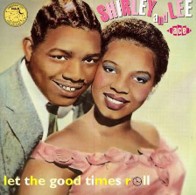 The next track on Dylan’s carousel is a special one – and, unusually enough, a personal favourite: “Let The Good Times Roll”. The 1956 Shirley And Lee song, that is, not one of the many other songs with the same title. In 2020, following the release of “Murder Most Foul”, one might initially have suspected a reference to one of the Founding Fathers: Louis Jordan And His Tympani Five. Louis Jordan scored a massive hit in 1947 with an equally irresistible “Let The Good Times Roll”, his exuberant party song which was rightly granted historic status in 2009 with a Grammy Hall of Fame Award, and has thus since enjoyed the same acclaimed status as “The Times Are A-Changin’”, “Mr. Tambourine Man” and “Like A Rolling Stone” – with slightly less poetic finesse, but still;
Hey everybody, let's have some fun
You only live but once, and when you're dead you're done
So let the good times roll, let the good times roll
Don't care if you're young or old, get together
                            let the good times roll
… on reflection, perhaps a little too irreverent, given the many references to the assassination at Dealey Plaza in this part of “Murder Most Foul”.
In any case, five years later we are able definitively to rule out the supposed reference to Louis Jordan’s hit. In October 2025, Volume 18 of the Bootleg Series is released: Through the Open Window 1956–1963. It is a release that deserves to be described as “archival”: we hear, almost step by step, the transformation of Robert Zimmerman into Bob Dylan. The eight-disc box set concludes with two discs featuring the famous Carnegie Hall concert (New York, 26 October 1963), and before that we are treated to a cross-section of the man’s evolution. Living-room recordings, outtakes from Bob Dylan, The Freewheelin’ and The Times They Are A-Changin’, festival performances (Newport 1963), the very young Dylan’s contributions to Harry Belafonte’s “Midnight Special” and to the Three Kings and the Queen album with Big Joe Williams and Victoria Spivey (1962), live recordings and more. We’re already familiar with most of these recordings, but the opening track certainly stands out straight away.
On Christmas Eve 1956, Robert Zimmerman was fifteen years old when, together with his friend Larry Kegan and his cousin Howard Rutman, he recorded a so-called acetate recording under the name The Jokers at a music shop in St. Paul, Terlinde Music Shop on West 7th Street. It lasts eight minutes and is a medley of eight songs:
1 Let The Good Times Roll (Goodman / Lee)
2 Boppin’ The Blues (Griffin / Perkins)
3 I Want You To Be My Girl (Goldner / Barrett)
4 Lawdy, Miss Clawdy (Lloyd Price)
5 Ready Teddy (John Marascalo / Robert Blackwell)
6 Confidential (Dorinda Morgan)
7 In The Still Of The Night (Fred Parris)
8 Earth Angel (Will You Be Mine) (Belvin / Williams / Hodge)
… a tracklist that suggests the lads had ambitions to become a Top 40 band; they’re all recent hits. We see evidence of the sincerity of Dylan’s written statement (in his high school yearbook) “to join Little Richard” in his choice of “Lawdy, Miss Clawdy” and “Ready Teddy”; we see the seeds of his lifelong fascination with Carl Perkins in “Boppin’ The Blues”; and, above all, we see: “Let the Good Times Roll”, the recording that we are now able to hear almost 70 years later.
We’d had the information since 2001; following his death, Larry Kegan’s personal copy was put up for sale by one of his heirs. On the online auction site eBay (in collaboration with the New York auction house Guernsey’s), the seller set a reserve price of 120,000 dollars, but this figure was not reached and the record remained unsold. The snippet we do eventually get in 2025 on Through the Open Window may well come from Dylan’s personal copy – after all, as we have known since the opening of The Bob Dylan Archive in Tulsa, Dylan is something of a hoarder.
In terms of sound quality, that record shop recording is poor (not surprisingly), and artistically it’s nothing to write home about either (equally unsurprising), but its value in music history is, of course, beyond dispute.
“Let the Good Times Roll” crops up a few more times in Dylan’s career. We hear a reference to it in “New Danville Girl” from 1984 (Like when she sings, ‘Baby, let the good times roll’), that marvellous, fascinating marathon song that Dylan wrote together with Sam Shepard and which would later be reworked into “Brownsville Girl” (with the reference to “Let the Good Times Roll” being dropped), and in 1986 Dylan performed the song four times on stage, accompanied by Tom Petty and his Heartbreakers.
Artistically, it’s still not all that exciting, unfortunately – thirty years after his first attempt, the now 45-year-old Dylan still hasn’t managed to capture the je ne sais quoi of Shirley and Lee, nor the catchiness of Roy Orbison (1961), the urgency of The Righteous Brothers (1963) with the bouncy guitar solo, the charm of The Animals (1965), the cool of Ry Cooder and Taj Mahal (as the Rising Sons, 1966), the energy of Link Wray (1967), the irony of Harry Nilsson (Schmilsson, 1971), nor the wild party atmosphere of the irresistible pub rockers Slade (Slayed?, 1972) – and, thankfully, not the utterly misplaced, melodramatic antics of Barbra Streisand (1974) either.
On the other hand: it’s nice and an honour, of course, all those covers and the song’s enduring popularity – but ultimately, only a Nobel Prize winner can elevate the song to the ranks of the elite. Which is exactly what happens in 2020. Come on baby let the good times roll / Let me thrill your soul.
To be continued. Next up Murder Most Foul part 12:
Jochen is a regular reviewer of Dylan’s work on Untold. His books, in English, Dutch and German, are available via Amazon in both paperback and on Kindle: 
- *Blood on the Tracks: Dylan’s Masterpiece in Blue*
- Blonde On Blonde: Bob Dylan’s mercurial masterpiece
- Where Are You Tonight? Bob Dylan’s hushed-up classic from 1978
- Desolation Row: Bob Dylan’s poetic letter from 1965
- Basement Tapes: Bob Dylan’s Summer of 1967
- Mississippi: Bob Dylan’s midlife masterpiece
- Bob Dylan’s Greatest Hits
- John Wesley Harding: Bob Dylan meets Kafka in Nashville
- Tombstone Blues b/w Jet Pilot: Dylan’s looking for the fuse
- Street-Legal: Bob Dylan’s unpolished gem from 1978
- Bringing It All Back Home: Bob Dylan’s second Big Bang
- Time Out Of Mind: The Rise of an Old Master
- Crossing The Rubicon: Dylan’s late-career classic
- Nashville Skyline: Bob Dylan’s other kind of music
- Nick Drake’s River Man: A very British masterpiece
- I Contain Multitudes: Bob Dylan’s Account of the Long Strange Trip
- Bob Dylan’s Rough and Rowdy Ways – Side B
- Bob Dylan’s High Water (for Charley Patton)
- Bob Dylan’s 1971
- Like A Rolling Stone b/w Gates Of Eden: Bob Dylan kicks open the door
- It Takes a Lot to Laugh, It Takes a Train to Cry b/w Just Like Tom Thumb’s Blues – Bob Dylan’s melancholic blues
- Bob Dylan’s Rough And Rowdy Ways – Side A
- Bob Dylan takes Highway 61 – Seven mercurial songs
- Bob Dylan’s Rough And Rowdy Ways – Side C