by Jochen Markhorst
XV “My two favourite singers are Frank Sinatra and Al Jolson”
Put your head out the window, let the good times roll
There’s a party going on behind the grassy knoll
Stack up the bricks and pour the cement
Don’t say Dallas don’t love you, Mr. President
Put your foot in the tank and step on the gas
Try to make it to the triple underpass
Black face singer – white face clown
Better not show your faces after the sun goes down
 It is one of the compelling anchors of Dylan’s collection of essays, The Philosophy of Modern Song (2022): the exuberant, colourful and infectious words with which Dylan expresses his admiration. “This is Moloch, the cat’s-eye pyramid, the underbelly of beauty, where you take away the bottom number and the others fall” (on Marty Robbins’ “El Paso”); “He’s a teller of tall tales—parts the clouds and drinks nitro” (Johnny Cash). “Carl wrote the incredible mystical lyrics for the song Ebb Tide” (on lyricist Carl Sigman in chapter 49, It’s All-In The Game). It’s endearing, this ability of Dylan’s to show collegial, sometimes even deferential, admiration—and we’ve known it for some time. From the eulogies he delivers as a DJ on Theme Time Radio Hour, to the compliments he bestows in interviews and speeches, and from his “autobiography” Chronicles. In it, a diverse range of artists such as Harry Belafonte, Woody Guthrie and Johnny Cash are once again showered with love, respect and superlatives, but – as is often the case – an almost mystical reverence is reserved for Sinatra;
“I used to play the phenomenal “Ebb Tide” by Frank Sinatra a lot and it had never failed to fill me with awe. The lyrics were so mystifying and stupendous. When Frank sang that song, I could hear everything in his voice — death, God and the universe, everything.”
Dylan seems to have a soft spot for Sinatra’s unrivalled torch song albums – or suicidal mood albums, to put it in somewhat more dramatic terms – from the second half of the 1950s (In The Wee Small Hours, Where Are You?, Sings For Only The Lonely and No One Cares, 1955–59). Eleven of the songs he selects for his own “Sinatra albums” (Shadows In The Night, Fallen Angels and Triplicate, 2015–17) come from those four Sinatra albums, and the song to which he erects a monument in Chronicles, “Ebb Tide”, appears on the second of them, Sings For Only The Lonely. That excessive praise also caught the attention of interviewer Robert Love, whereupon Dylan went one step further:
“I was at somebody’s house, and they had one of Frank’s records, and “Ebb Tide” was on it. I must have listened to that thing 100 times. I realized then that I didn’t know it. I still don’t know it to this day. I don’t know how he did it. The performance hypnotizes you. It’s a spellbinding performance. I never heard anything so supreme — on every single level.”
(AARP The Magazine interview, 2015)
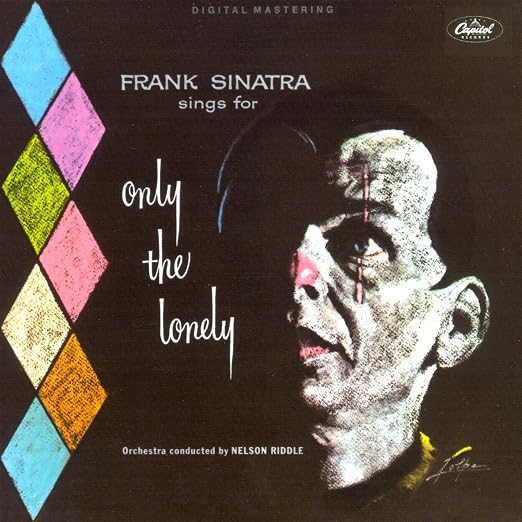
“One of Frank’s records” must have been Sings For Only The Lonely (“Ebb Tide” was never released as a single, nor does it appear on any other album), the one record on which Sinatra is depicted as a white face clown.
The line is a bit alienating; Black-face singer – white-face clown. The line appears after the JFK references triple underpass and Don’t say Dallas don’t love you, and just before the JFK references Elm Street and Don’t ask what your country can do for you, but unlike the earlier “interludes” in Dylan’s carousel, it does not make an overt reference to a song title, an artist or a cultural-historical event. At most, it is somewhat more subtle: a reference to Frank Sinatra, the white-face clown, and – to stay within the same category – to Al Jolson.
Thirty years earlier, Dylan had already mentioned Frank Sinatra and Al Jolson in the same breath, as we know from engineer Malcolm Burn (Bob Dylan Tell Tales Special, Uncut, 2008). In that series of interviews, Burn recounts a curious anecdote set in the run-up to the recording sessions for Oh Mercy. In the days leading up to Dylan’s arrival, whilst Lanois and he were busy with the preparations, they received a music cassette in the post. From Dylan.
“And I thought, Oh, great, we’re going hear some songs. We got this cassette, and it had this little note from Bob: “Listen to this, this’ll give you a good idea of what’s going on.” And so Dan and I and Mark Howard, the other engineer, we sat down to listen to this cassette, and we put it in the machine – and this Al Jolson music started playing.
And we were like, “What the Fuck? Al Jolson?” So, we fast-forwarded it, and it was just a whole tape of Al Jolson. And we looked back at the note, and it said. “Listen to this. You can learn a lot.” So Dan and I sort of looked at each other and – you know, Al Jolson’s great –but we sort of thought it was a bit odd.”
A few weeks later, halfway through the recording sessions, Malcolm remembers that strange remark, and now he at least understands something of it. During a break, Dylan explains how important phrasing is: “You can have really great lyrics, but if you don’t deliver them properly, they’re not gonna mean a thing.” And at some point in that conversation, Dylan says: “My two favourite singers are Frank Sinatra and Al Jolson.”
Al Jolson was, of course, a great singer, and the “world’s greatest entertainer”, as DJ Dylan approvingly confirms (Theme Time Radio Hour, Ep. 23, “California”), but he is nevertheless remembered – perhaps unfairly – primarily as the most famous blackface singer of all time. On Google’s Images page, for example, eight of the top ten results are images of Jolson in blackface. Allowing Dylan to justify referring to Sinatra in such a seemingly disrespectful manner as a white-face clown – the poetic power of the classic black/white antithesis excuses both the unflattering term clown and the painful phenomenon of blackface. Who indeed better not show his face after the sun goes down in the Dallas of 1963, dominated by racial tensions and resistance to integration. In October, a few weeks before JFK, for example, UN Ambassador Adlai Stevenson was attacked and spat on in the centre of Dallas by a right-wing, segregationist crowd. Another dark day in Dallas.
To be continued. Next up Murder Most Foul part 16: One, two, Freddy’s coming for you
Jochen is a regular reviewer of Dylan’s work on Untold. His books, in English, Dutch and German, are available via Amazon in both paperback and on Kindle: 
- *Blood on the Tracks: Dylan’s Masterpiece in Blue*
- Blonde On Blonde: Bob Dylan’s mercurial masterpiece
- Where Are You Tonight? Bob Dylan’s hushed-up classic from 1978
- Desolation Row: Bob Dylan’s poetic letter from 1965
- Basement Tapes: Bob Dylan’s Summer of 1967
- Mississippi: Bob Dylan’s midlife masterpiece
- Bob Dylan’s Greatest Hits
- John Wesley Harding: Bob Dylan meets Kafka in Nashville
- Tombstone Blues b/w Jet Pilot: Dylan’s looking for the fuse
- Street-Legal: Bob Dylan’s unpolished gem from 1978
- Bringing It All Back Home: Bob Dylan’s second Big Bang
- Time Out Of Mind: The Rise of an Old Master
- Crossing The Rubicon: Dylan’s late-career classic
- Nashville Skyline: Bob Dylan’s other kind of music
- Nick Drake’s River Man: A very British masterpiece
- I Contain Multitudes: Bob Dylan’s Account of the Long Strange Trip
- Bob Dylan’s Rough and Rowdy Ways – Side B
- Bob Dylan’s High Water (for Charley Patton)
- Bob Dylan’s 1971
- Like A Rolling Stone b/w Gates Of Eden: Bob Dylan kicks open the door
- It Takes a Lot to Laugh, It Takes a Train to Cry b/w Just Like Tom Thumb’s Blues – Bob Dylan’s melancholic blues
- Bob Dylan’s Rough And Rowdy Ways – Side A
- Bob Dylan takes Highway 61 – Seven mercurial songs
- Bob Dylan’s Rough And Rowdy Ways – Side C