
by Jochen Markhorst
The previous episode is available at The gentle lapping of the music
V Doc Pomus liked my songs
I was born on the wrong side of the railroad track
Like Ginsberg, Corso and Kerouac
Like Louie and Jimmy and Buddy and all of the rest
It might not be the thing to do
But I’m stickin’ with you through and through
Down in the flatlands - way down in Key West
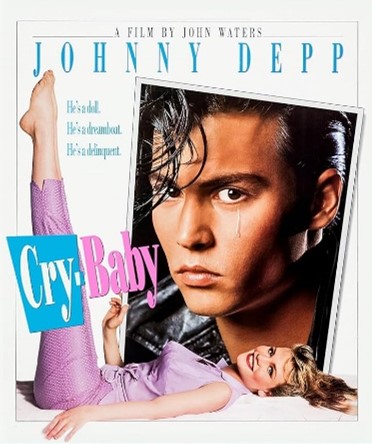 It wasn’t really a success at the time, John Waters’ Cry-Baby from 1990, but over the years, the box office failure has grown into a cult classic, partly thanks to the successful, Tony Award-winning musical that Adam Schlesinger and David Javerbaum turned the film into in 2007 – a musical that has travelled the world and can still be enjoyed in London’s Off West End in 2025. And thanks in part to Johnny Depp of course, for whom Cry-Baby is his first title role (so before Edward Scissorhands, What’s Eating Gilbert Grape and Ed Wood), and who is then retroactively admired by the Pirates Of The Caribbean generation for yet another talent: that of a gifted rockabilly singer. For which John Waters gives him plenty of room; Wade “Cry-Baby” Walker (Depp) steals the show at a dance party with lots of hay on stage and a huge Confederate Battle Flag against the back wall as he performs “King Cry-Baby” in its entirety. Great band, good song, but above all Depp, who sings like a Gene Vincent in top form.
But alas, it’s not Depp’s voice. Depp is an actor, and he’s acting. He perfectly lip-syncs the part sung by rockabilly artist James Intveld. Although, in hindsight, Depp could probably have done it himself, as a still-doubting John Waters reflects more than thirty years later:
“There was talk of it, and Johnny can sing. It’s just that we weren’t sure of that. And maybe I made the wrong decision there. But I didn’t as far as James Intveld, who I think is one of the… Well, he is Cry-Baby in real life! He still is, in a way. I think he’s an excellent, amazing singer. He sang in “A Dirty Shame”, he sang in “King Cry-Baby”… So he was just absolutely amazing. Every time I’m with him, I can barely look at him, I’m so impressed.”
(John Waters in IndieWire, 27 May 2024)
With – coincidentally – a tenuous Dylan connection, we also hear the “excellent, amazing singer” James Intveld on the Gene Vincent song “Important Words”, the song Dylan recorded in 1987 during the sessions for Down In The Groove (1988), but strangely enough did not allow onto the album eventually.
The other Dylan connection is slightly stronger. The sleeve notes of Cry-Baby’s official soundtrack offer a few more subtle moments of revelation, fun facts that justify the suspicion that Dylan might well enjoy putting the record on his turntable:
- Dylan’s old comrade-in-arms Al Kooper produces three songs: James Intveld’s “Teardrops are Falling”; Rachel Sweet’s beautiful version of the doo-wop classic “Teen Age Prayer”, the hit that Gale Storm scored in 1955 between her indestructible “I Hear You Knocking” and “Why Do Fools Fall in Love”; and above all the sultry, compelling R&B stomper “Please Mr. Jailer”, on which Rachel Sweet surprisingly succeeds in matching the unassailable original by Wynona Carr (1956, with Bumps Blackwell’s band).
- On Side Two, Dylan then finds Webb Pierce‘s famous cover of Jimmie Rodgers’ “In The Jailhouse Now”, the cover with which Pierce scored such a huge hit in 1955 (21 weeks at No. 1 in the C&W Charts), the same song that DJ Dylan played in 2006 in the version by the Sir Douglas Quintet;
- “Nosey Joe”, in the original version by Bull Moose Jackson, a typical 1940s/1950s novelty hit written by Leiber & Stoller, Rhythm and Dirty Blues in the tradition of Louis Jordan, The Coasters and Wynonie Harris;
- Original early 1950s songs by dusty old heroes such as Shirley & Lee, Doc Starkes and Nappy Brown;
… … but the lightning already strikes right away with the opening number, Intveld’s “King Cry-Baby”:
IndieWire: “Dave Alvin told me in particular about how much he enjoyed the opportunity to write with Doc Pomus.”
John Waters: “Yeah! The two of them, are you kidding? I mean, I grew up on the music of that era. I mean, “Cry-Baby” by the Bonnie Sisters was the very first record I ever bought in my life, and my parents hated it. And it was white girls singing it, but it was more, “Shooby-dooby-da, doo-wop…” So we did the… Rachel Sweet cover, right? I don’t have every credit in front of me. I should! But all the people who did the original music for the film totally knew where I was coming from. And I greatly respected them and was thrilled that the music supervisor, Becky [Mancuso], got them to do it.”
 Doc Pomus! The man who has a seat on the High Council of Dylan’s personal pantheon, alongside colleagues such as Robert Johnson, Woody Guthrie and Jimmie Rodgers. Dylan pays the most striking tribute to Jerome “Doc Pomus” Felder in 2022, when we see the dedication on page 1 of The Philosophy Of Modern Song: “For Doc Pomus”. The giant to whom we owe The Drifters’ “Save the Last Dance for Me”, “This Magic Moment” and “Sweets For My Sweet”, Elvis’s “(Marie’s the Name of) His Latest Flame”, “Little Sister”, “Can’t Get Used To Losing You”, “Suspicion” and “Surrender”, and all those dozens of other hits for Fabian, Ray Charles, Bobby Darin, Dion, The Coasters, B.B. King, Mink DeVille, Dr. John and everybody else. He is the hero Dylan praises in his MusiCares speech (2015) with particularly rousing words:
“Leiber and Stoller didn’t think much of my songs. They didn’t like ’em, but Doc Pomus did. That was all right that they didn’t like ’em, because I never liked their songs either. Doc’s songs, they were better. “This Magic Moment”. “Lonely Avenue”. “Save the Last Dance for Me”. Those songs broke my heart. I figured I’d rather have his blessings any day than theirs.”
Twenty years before that declaration of love, Dylan had already demonstrated his love musically, through his contribution to the wonderful tribute album Till The Night Is Gone: A Tribute To Doc Pomus (1995). Dylan can be heard in track 2 on Side A, after Los Lobos’ opening, a steamy “Lonely Avenue”, and before Shawn Colvin’s surprising, atmospheric, weird cover of “Viva Las Vegas”; in between is Dylan’s cool, swinging version of “Boogie Woogie Country Girl”. Though if we are honest, the show is stolen by the heart-breaking finale, by Aaron Neville’s “Save The Last Dance For Me”.
And finally, Doc Pomus is also the man who, through James Intveld in 1990, had Johnny Depp sing the words in Cry-Baby that we would hear again thirty years later in Dylan’s “Key West”:
Well, I was born on the wrong side of the tracks
In the backseat of a stolen Cadillac
I had my first cigarette before I could walk
And I was strummin' this guitar before I could talk
… although Dylan uses it metaphorically in his song, of course. Doc Pomus means wrong side of the tracks more literally, expressing that Wade “Cry-Baby” Walker comes from The Poor Side Of Town, from Shantytown, really was born and raised somewhere between Desolation Row and Lonely Avenue. Unlike Ginsberg, Corso and Kerouac, by the way. Neither were Louie and Jimmy and Buddy and all of the rest – nor Bob Dylan, for that matter.
To be continued. Next up Key West part 6: Glitter amongst the chicken feed
Jochen is a regular reviewer of Dylan’s work on Untold. His books, in English, Dutch and German, are available via Amazon both in paperback and on Kindle: 
- Blood on the Tracks: Dylan’s Masterpiece in Blue
- Blonde On Blonde: Bob Dylan’s mercurial masterpiece
- Where Are You Tonight? Bob Dylan’s hushed-up classic from 1978
- Desolation Row: Bob Dylan’s poetic letter from 1965
- Basement Tapes: Bob Dylan’s Summer of 1967
- Mississippi: Bob Dylan’s midlife masterpiece
- Bob Dylan’s Greatest Hits
- John Wesley Harding: Bob Dylan meets Kafka in Nashville
- Tombstone Blues b/w Jet Pilot: Dylan’s looking for the fuse
- Street-Legal: Bob Dylan’s unpolished gem from 1978
- Bringing It All Back Home: Bob Dylan’s 2nd Big Bang
- Time Out Of Mind: The Rising of an Old Master
- Crossing The Rubicon: Dylan’s latter-day classic
- Nashville Skyline: Bob Dylan’s other type of music
- Nick Drake’s River Man: A very British Masterpiece
- I Contain Multitudes: Bob Dylan’s Account of the Long Strange Trip
- Bob Dylan’s Rough And Rowdy Ways – Side B
- Bob Dylan’s High Water (for Charley Patton)
- Bob Dylan’s 1971
- Like A Rolling Stone b/w Gates Of Eden: Bob Dylan kicks open the door
- It Takes A Lot To Laugh, It Takes A Train To Cry b/w Just Like Tom Thumb’s Blues – Bob Dylan’s melancholy blues
- Bob Dylan’s Rough And Rowdy Ways – Side A
- Bob Dylan takes Highway 61 – Seven mercurial songs