
by Jochen Markhorst
VI Glitter amongst the chicken feed
I was born on the wrong side of the railroad track
Like Ginsberg, Corso and Kerouac
Like Louie and Jimmy and Buddy and all of the rest
It might not be the thing to do
But I’m stickin’ with you through and through
Down in the flatlands - way down in Key West
 As we are almost a quarter of the way through, Dylan seems to catch up, step by step, entering the 21st century. At least, one of his personalities is – Dylan the musician continues to draw on the 20th century more than ever, and even further back. But one of his other public manifestations is beginning to form an intriguing, colourful, Dylanesque online personality.
On his Instagram account bobdylan, funny, enigmatic and intriguing posts suddenly appear at irregular intervals. Initially, in the starting year 2018 and the years that followed, the posts were exclusively manufactured by the marketing guys (an announcement of a tour, an excerpt from an upcoming Bootleg Series, an image of Dylan’s graphic work, teasers for The Philosophy Of Modern Song, that kind of thing), and very occasionally a slightly more personal post, usually a eulogy.
Like the first one, dated 20 September 2022. The film poster for Wonder Boys (2000) and an in memoriam: “Today’s the day that Curtis Hanson passed away. He made some great films, and fortunately I was able to write a song for one of them, which was a great honour.” It seems fairly certain that Dylan wrote it himself: the occasion is rather random (Curtis Hanson has been dead for six years on this day), and the message contains a factual inaccuracy – Dylan wrote songs for two Hanson films (apart from “Things Have Changed” for Wonder Boys, he also wrote “Huck’s Tune” for Lucky You, 2007), something that a PR representative would certainly have mentioned. But you don’t go fact-checking the boss, obviously.
This first post seems to trigger something. Gradually, Dylan sprinkles more glitter amongst the chicken feed, and his followers are delighted with his own personal, wondrous posts. An excerpt from The Secret Life of Walter Mitty (1947) with Danny Kaye as a cool riverboat gambler, narrated life stories of Aaron Burr, Frank James, Al Capone and others, obscure clips of forgotten heroes such as The Johnson Mountain Boys and Josh White, and mysterious falsifications. Like the post from 17 January 2026, with the confusing title:
THE ACADEMY
By Larry Morrison
(character from a forthcoming science fiction novel “Fool’s Gold”)
It is a 434-word piece that suggests it is an excerpt – or excerpts – from a novel, in which a first-person narrator settles scores with “The Academy”. His criticism boils down to the fact that The Academy only values and rewards assimilation, and rejects disruption, vision and independence. Which, after the title, is a second hint that Dylan used Kafka’s A Report to an Academy (“Ein Bericht für eine Akademie”, 1917) as a blueprint, the bizarre, satirical report of a civilised monkey, also written in the first person, in which the monkey subtly makes us recognise the travesty of assimilation. Both texts, Kafka’s report and Dylan’s novel fragment, thus express what Dylan the songwriter expresses in far fewer words in this fourth verse of “Key West”: the love for the thing not to do.
Dylan chooses – as he often does – a topographical metaphor to portray the outsider: the wrong side of the railway track. It is certainly not biographical; “Like Ginsberg, Corso and Kerouac” applies at most to Gregory Corso – Kerouac and Ginsberg were both born and raised in affluent circles, on the right side of the tracks, so to speak. However, the three Beat Poets are manifestations of the ideal sought by the narrator of The Academy: their works are disruptive, display courage, willpower and creativity, and provoke the establishment, “The Academy”.
We should therefore look in that direction to identify the following three names: Louie and Jimmy and Buddy. The spelling of “Louie” inevitably brings to mind one of the greatest disruptive innovators of the 1960s: The Kingsmen’s “Louie Louie”, the abrasive, irresistible, magical standard-bearer of pure, unpolished garage rock. Well, actually from the 1950s (Richard Berry wrote the song in the golden year of 1956), but The Kingsmen’s 1963 version is in all of our DNA. “Any idiot could learn it,” as Paul Revere said, who also recorded a version with his Raiders in 1965, “and they all did.” And despite that, or perhaps because of it, a song that would be rejected by The Academy, given how utterly undisciplined, battered, fierce and from the wrong side of the railroad track “Louie Louie” is.
https://youtu.be/CfRZNNyQoF0?list=RDCfRZNNyQoF0
“Jimmy” and “Buddy” are, of course, less easy to identify. On an album full of references to old music heroes, “Buddy” seems to be an affectionate salute to Buddy Holly, the giant whom Dylan mentions in virtually every interview (“He was great. He was incredible. I mean, I’ll never forget the image of seeing Buddy Holly up on the bandstand,” Rolling Stone interview, 1984), and when it comes to “Jimmy”, the Rough And Rowdy Ways listener initially thinks of the song he heard fifteen minutes earlier, the closing track on Side 2, “Goodbye Jimmy Reed”.
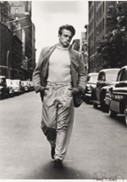
Secondly, he might be led to the patron saint of Key West, Jimmy Buffett, or perhaps to Jimmy Van Heusen, whom Dylan so admires and whose “Deep In A Dream” gets a shout-out in “Murder Most Foul” – but none of these Jimmies seem to fit the “wrong side of the railroad track” profile. At most, James “Jimmy” Dean had that aura – and we know that Dylan has held Dean in high esteem for more than sixty years:
BOB: Oh, you know where I just was?
SAM: Where?
BOB: Paso Robles. You know, on that highway where James Dean got killed?
SAM: Oh yeah?
BOB: I was there at the spot. On the spot. A windy kinda place.
SAM: They’ve got a statue or monument to him in that town, don’t they?
BOB: Yeah, but I was on the curve where he had the accident. Outsida town. And this place is incredible. I mean the place where he died is as powerful as the place he lived.
(Sam Shepard – True Dylan, 1987)
James Dean is an indestructible hero for Dylan. He regularly brings him up, even when not asked, always admiringly. It must therefore have flattered him that journalists and biographers used to compare him to James Dean – a comparison that is officially recorded by Don McLean in the immortal pop monument “American Pie” (1971), in which Bob Dylan appears as the jester:
When the jester sang for the king and queen
In a coat he borrowed from James Dean
When asked in the 2017 Bill Flanagan interview, Dylan is not too pleased with that comparison to a joker (“A jester? Sure, the jester writes songs like Masters of War, A Hard Rain’s a-Gonna Fall, It’s Alright, Ma – some jester. I have to think he’s talking about somebody else. Ask him”). Still – Don McLean is not entirely wrong.
In that conversation with Sam Shepard – though partly constructed, still one of the best Dylan interviews ever – Dylan is quite explicit about the life-changing influence of the actor who died young:
BOB: Naw. The only reason I wanted to go to New York is ’cause James Dean had been there.
SAM: So you really liked James Dean?
BOB: Oh, yeah. Always did.
SAM: How come?
BOB: Same reason you like anybody, I guess. You see somethin’ of yourself in them.
… Dylan sees “something of himself” in Jimmy Dean. The disruption, independence and vision, presumably, the urge not to do the thing to do.
To be continued. Next up Key West part 7: I knew right then and there I was hooked
——————
Jochen is a regular reviewer of Dylan’s work on Untold. His books, in English, Dutch and German, are available via Amazon both in paperback and on Kindle: 
- Blood on the Tracks: Dylan’s Masterpiece in Blue
- Blonde On Blonde: Bob Dylan’s mercurial masterpiece
- Where Are You Tonight? Bob Dylan’s hushed-up classic from 1978
- Desolation Row: Bob Dylan’s poetic letter from 1965
- Basement Tapes: Bob Dylan’s Summer of 1967
- Mississippi: Bob Dylan’s midlife masterpiece
- Bob Dylan’s Greatest Hits
- John Wesley Harding: Bob Dylan meets Kafka in Nashville
- Tombstone Blues b/w Jet Pilot: Dylan’s looking for the fuse
- Street-Legal: Bob Dylan’s unpolished gem from 1978
- Bringing It All Back Home: Bob Dylan’s 2nd Big Bang
- Time Out Of Mind: The Rising of an Old Master
- Crossing The Rubicon: Dylan’s latter-day classic
- Nashville Skyline: Bob Dylan’s other type of music
- Nick Drake’s River Man: A very British Masterpiece
- I Contain Multitudes: Bob Dylan’s Account of the Long Strange Trip
- Bob Dylan’s Rough And Rowdy Ways – Side B
- Bob Dylan’s High Water (for Charley Patton)
- Bob Dylan’s 1971
- Like A Rolling Stone b/w Gates Of Eden: Bob Dylan kicks open the door
- It Takes A Lot To Laugh, It Takes A Train To Cry b/w Just Like Tom Thumb’s Blues – Bob Dylan’s melancholy blues
- Bob Dylan’s Rough And Rowdy Ways – Side A
- Bob Dylan takes Highway 61 – Seven mercurial songs