by Jochen Markhorst
X His is the voice in the wilderness of your head
Put your head out the window, let the good times roll
There’s a party going on behind the grassy knoll
Stack up the bricks and pour the cement
Don’t say Dallas don’t love you, Mr. President
Put your foot in the tank and step on the gas
Try to make it to the triple underpass
Black face singer – white face clown
Better not show your faces after the sun goes down
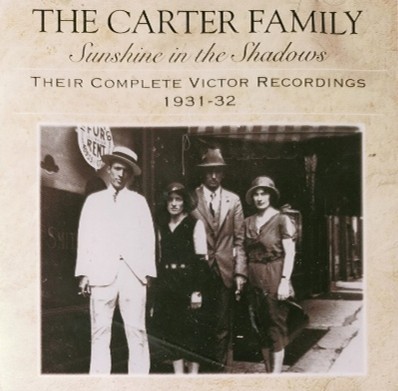 It’s a marvellous photograph, the one on the inner sleeve of Rough And Rowdy Ways. Jimmie Rodgers, looking cool in a light-coloured suit, one hand casually in his pocket, the other loosely holding a cigarette, and next to him the Carter Family: Maybelle (June Carter’s mother), A.P. Carter and Sara, A.P.’s wife (and Maybelle’s cousin). Taken on Main Street in Louisville, Kentucky, on 10 June 1931, the day of their one-off collaboration, whilst they were recording songs (and a few rather corny, staged dialogues such as “Jimmie Rodgers Visits The Carter Family”) for Victor Talking Machine Company – which were re-released in 1996 on the compilation Sunshine In The Shadows, featuring this photograph on the cover.
Dylan’s use of the photograph is a tribute, no doubt. Both to the Carter Family and to Jimmie Rodgers. Not entirely surprising; we’ve known of Dylan’s love for The Singing Brakeman for decades, a love that was most clearly expressed in 1997, when Dylan spearheaded The Songs of Jimmy Rodgers: A Tribute, the first album to be released on his own label, Egyptian Records. He invited colleagues, all of whom contributed to the project. Bono sings a terribly saccharine, yet still successful “Dreaming With Tears In My Eyes”, Willie Nelson reworks “Peach Pickin’ Time Down In Georgia” and, shortly afterwards, chooses this very song to promote Farm Aid on Jay Leno’s Tonight Show (remarkably, duetting with Beck), Van Morrison records a sizzling “Mule Skinner Blues”, Aaron Neville, Dickey Betts, Dwight Yoakam (“T For Texas”), John Mellencamp… apparently, when Dylan calls, you don’t say no. Dylan himself contributes the surprising choice “My Blue-Eyed Jane”, in a modest sixth position. And at number 9 we find Jerry Garcia’s final recording: “Blue Yodel #9 (Standing On The Corner)”, recorded on 16 July 1995, three weeks before Jerry’s death. Dylan takes no part in the song selection, as is evident from the charming, handwritten letter in which he humbly requests a contribution:
“Jerry,
My record company (a very limited one) is doing a Jimmie Rodgers tribute record – you don’t have to yodel – there’s plenty of songs where he doesn’t yodel but if you want to yodel, that’s ok too –
Anyway one of the performers on this record will be me and of course the perfect song for me is Blue Eyed Jane. And it’s included with this letter – Did ya hear my version of “Two Soldiers”? Anyway if it’s not too much to ask, think about a Jimmie song – let me know something in some kind of incalculated amount of time – whatever you decide is ok with me –
All the best
Bob —”
And when we read the liner notes written personally by record executive Dylan in 1997, we realise that the seeds for Rough And Rowdy Ways were sown long before its release in 2020. We can already see unmistakable glimpses of the stylist who, a few years later, would publish his fictionalised memoirs Chronicles and, some two decades after that, the collection of essays The Philosophy Of Modern Song. Wild, poetic metaphors (“He somehow gets to the heart of the mystery of life and death without saying too much; he has some kind of uncanny ability to convey it – he’s like the scent of flowers”); unequivocal superlatives (“He makes everything unmistakably his own and does so with piercing charm”); wondrous aphorisms (“His is the voice in the wilderness of your head,” and “Times change and don’t change”); and the integration of obscure and less obscure quotations from cultural history, such as “he is, as in the Warren Smith ballad, the man who … held your hand and sang you a song” – an insider’s reference to
Somebody saw you at the break of day
Dining and a-dancing in the cabaret
He was long and tall, he had plenty of cash
He had a red Cadillac and a black mustache
He held your hand and he sang you a song
Who you been loving since I been gone
… to Warren Smith’s “Red Cadillac And A Black Moustache”, the song for which Dylan demonstrates just as much missionary zeal as he does for Jimmie Rodgers’ legacy – quoting the song’s title in “I Contain Multitudes”, performing it on stage (1986) and contributing his version to the tribute album Good Rockin’ Tonight: The Legacy Of Sun Records (2001).
A missionary zeal that, in 2020, flares up just as persistently as it did in the decades before, it seems. This is evident not only in the album title Rough And Rowdy Ways, taken from the B-side of a 1929 78-rpm single by Jimmie Rodgers, “My Rough And Rowdy Ways” and later the title track of the album My Rough & Rowdy Ways (1960), and not only in that prominent photograph on the inner sleeve, but also in small, subtle, unobtrusive references such as here in “Murder Most Foul”: with Put your head out the window, Dylan pays a respectful nod to
Ben Dewberry was a brave engineer
He told his fireman don’t you ever fear
All I want is the water and coal
Put your head out the window, watch the drivers roll
Watch the drivers roll watch the drivers roll
Put your head out the window, watch the drivers roll
… to “Ben Dewberry’s Final Run”, the song Jimmie Rodgers recorded in 1927 – a “Casey Jones”-style lament about the engine driver who lost his life in a train crash that took place on 23 August 1908 near Buford, Georgia. Train No. 38, incidentally – the train referred to by Johnny Cash, Hank Snow, Roy Acuff, Woody Guthrie, Pete Seeger and all those dozens of other greats in the opening verse of “Wreck of the Old 97”:
Well, they gave him his orders in Monroe, Virginian,
Said, “Steve, you’re way behind time,
This is not 38, this is Ol’97,
Put her into Spencer on time.”
… that other train disaster song, about the disaster near Danville, Virginia, the song that became the first million-seller in country music.
“All these songs are connected,” as Dylan already told us in his MusiCaresspeech in 2015.
To be continued. Next up Murder Most Foul part 11:
Jochen is a regular reviewer of Dylan’s work on Untold. His books, in English, Dutch and German, are available via Amazon in both paperback and on Kindle: 
- *Blood on the Tracks: Dylan’s Masterpiece in Blue*
- Blonde On Blonde: Bob Dylan’s mercurial masterpiece
- Where Are You Tonight? Bob Dylan’s hushed-up classic from 1978
- Desolation Row: Bob Dylan’s poetic letter from 1965
- Basement Tapes: Bob Dylan’s Summer of 1967
- Mississippi: Bob Dylan’s midlife masterpiece
- Bob Dylan’s Greatest Hits
- John Wesley Harding: Bob Dylan meets Kafka in Nashville
- Tombstone Blues b/w Jet Pilot: Dylan’s looking for the fuse
- Street-Legal: Bob Dylan’s unpolished gem from 1978
- Bringing It All Back Home: Bob Dylan’s second Big Bang
- Time Out Of Mind: The Rise of an Old Master
- Crossing The Rubicon: Dylan’s late-career classic
- Nashville Skyline: Bob Dylan’s other kind of music
- Nick Drake’s River Man: A very British masterpiece
- I Contain Multitudes: Bob Dylan’s Account of the Long Strange Trip
- Bob Dylan’s Rough and Rowdy Ways – Side B
- Bob Dylan’s High Water (for Charley Patton)
- Bob Dylan’s 1971
- Like A Rolling Stone b/w Gates Of Eden: Bob Dylan kicks open the door
- It Takes a Lot to Laugh, It Takes a Train to Cry b/w Just Like Tom Thumb’s Blues – Bob Dylan’s melancholic blues
- Bob Dylan’s Rough And Rowdy Ways – Side A
- Bob Dylan takes Highway 61 – Seven mercurial songs
- Bob Dylan’s Rough And Rowdy Ways – Side C