
by Jochen Markhorst
IX It all floats
Key West is the place to go
Down by the Gulf of Mexico
Beyond the sea - beyond the shifting sand
Key West is the gateway key
To innocence and purity
Key West - Key West is the enchanted land
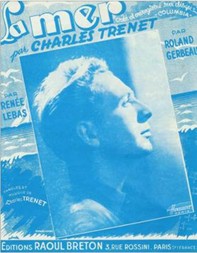 The second French Connection, after that coincidental link with Jean Sablon’s hibiscus and bougainvillea, is much more deliberate. At least, it seems obvious that “beyond the sea” is a conscious tribute to Bobby Darin and his hit “Beyond The Sea”. A case of catching up, presumably. In the twentieth century, we don’t see or hear Dylan paying any particular attention to Darin – it’s one-way traffic from Darin, the first artist to sing “Blowin’ In The Wind” in the studio (July 1962, but not released until later, in 1963), and producing beautiful covers of “Don’t Think Twice, It’s All Right” and “I’ll Be Your Baby Tonight”.
In the 21st century, Dylan finally returns the love. At first rather matter-of-factly, when DJ Dylan plays Darin’s übercool version of the perfect song “Black Coffee” in episode 5 of his Theme Time Radio Hour, Coffee (31 May 2006), the song that Polish Nobel Prize winner Wisława Szymborska had played at her funeral in 2012 (in the version by Ella Fitzgerald, though). The DJ introduces the song with an apocryphal story;
“Walden Robert Cassoto. He changed his name when he saw a sign outside a Chinese restaurant that said ‘Mandarin Duck’. First three letters were burned out, so it just said ‘darin Duck’. And he said, ‘That seems like a good name – Darin Duck.’ Here’s Bobby Darin – Black Coffee.”
… and the lead-out is equally neutral;
“That was Bobby Darin, singing about talking to the shadows from one till four, downing his past regrets in coffee and cigarettes, moonin’ all the mornin’ and moanin’ all the night. From his album This Is Darin. A song written by Sonny Burke and Paul Francis Webster.”
… although both the song and the album should be close to Dylan’s heart. This Is Darin (1960) is Bobby Darin’s most “Sinatraesque” album—perhaps not quite reaching the Olympian heights of In The Wee Small Hours, but certainly on a par with Songs For Swingin’ Lovers!; brilliantly arranged by Richard Wess, with dazzling performances of “Sinatra songs” such as “The Gal That Got Away”, “Guys and Dolls”, and especially Darin’s very Sinatraesque rendition of the classic that Ol’ Blue Eyes himself never ventured to tackle, Duke Ellington’s pièce de résistance “Caravan”.
But in 2022, Dylan makes up for everything, for all the neglect. More than that, in fact: in his collection of essays, The Philosophy Of Modern Song, he devotes two entire chapters to Bobby Darin. Chapter 14 is about Bobby’s biggest hit (and only No. 1 hit) “Mack The Knife”, in which our philosopher uses many respectful words (691, to be precise) mainly to assert, somewhat disrespectfully, that Bobby Darin is not Frank Sinatra. In the second Darin chapter, Chapter 14, “Beyond The Sea” Dylan seems to realize that he perhaps should also highlight Bobby Darin’s merits and achievements. Dylan then reveals himself to be a fan:
“Bobby Darin could sound like anybody and sing any style. He was more flexible than anyone of his time. He could be Harry Belafonte. He could be Elvis. He could be Dion, he could be a calypso singer, he could be a bluegrass singer or a folk singer. He was a rhythm and blues singer. The guy was everybody if anybody. […] Each of his guises he inhabited with verve and gusto and even in repose he just about vibrated with talent.”
Towards the end of the essay, the writer returns to that talent once more and then specifies it. It now becomes clear to the reader in what way Dylan feels an artistic kinship with Darin:
“His phrasing, especially on a pop ballad like this, is the driving wheel of the production. Time and time again, he’ll slip the first few words of a line upstairs into the end of the previous line. He’s very subtle and you don’t realize he’s doing this. But if he sang songs like this straight, it probably wouldn’t reach you. He’s playful. He’s a playful melodist and he doesn’t need words. He keeps it simple even when he’s singing about nothing. The sea, the air, the mountains, the flowers. It all floats. It never touches the ground.”
… with Darin’s phrasing, never touching the ground, that is – not coincidentally also one of Dylan’s greatest singing qualities.
Only in the very last lines does Dylan remember what the essay should actually be about: the song. The essayist is aware of the French Connection. “This is a French song” are the first words of the essay section. Before that, as in most of the 66 essays, we read an impressionistic introduction, the dramatic opening monologue in which the narrator addresses a “you” and shares his associative, colourful, often exalted vision of the expressive power of the song lyrics.
The opening line of the Beyond The Sea-ouverture reveals that Dylan sees his own “Key West” in “La Mer”: “In this song your happiness lies beyond the wide sea, and to get there you have to cross the great unknown” – so your happiness is waiting, as Dylan will repeat in other words in “Key West”, in the paradise divine on the horizon line.
“Beyond The Sea”, or rather the song’s mother, Charles Trenet’s “La Mer”, is one of those extraordinary songs that transcends categories, managing to express precisely that “unreachable paradise” – feeling and, even more, to set it to music. Plus, it has a fascinating extra quality: just like the flexibility that Dylan so admires in Bobby Darin, “Beyond The Sea/La Mer” also has the chameleon-like ability to fit into a variety of contexts. When Robbie Williams sings the song over the closing credits of Pixar’s Finding Nemo (2003), we hear the exuberant joy of a happy ending; Julio Iglesias’ live version over the final minutes of Tinker Tailor Soldier Spy (2011) casts a heart-wrenching, bittersweet, melancholic shine over the smoky images; in Ewan McGregor and Cameron Diaz’s duet in the karaoke bar (A Life Less Ordinary, 1997) the song suddenly has a catchy feel-good vibe; gloomy and surreal in the BioShock video games; light-hearted and sunny in an advert for Irish Ferries; ironic grandeur in ITV’s leader for Euro 2016 football coverage; and so on – the song is often and gladly used by film makers, art directors and other creative types, and always adapts itself.
In short, “Beyond The Sea/La Mer” has a magical quality, and Dylan can only hope that the single name-check in “Key West” will rub some of that magic off onto his song. Dylan’s song certainly has, for one thing, the heart-wrenching, bittersweet, melancholic shine.
To be continued. Next up Key West part 10: What a long strange trip it’s been
Jochen is a regular reviewer of Dylan’s work on Untold. His books, in English, Dutch and German, are available via Amazon both in paperback and on Kindle: 
- Blood on the Tracks: Dylan’s Masterpiece in Blue
- Blonde On Blonde: Bob Dylan’s mercurial masterpiece
- Where Are You Tonight? Bob Dylan’s hushed-up classic from 1978
- Desolation Row: Bob Dylan’s poetic letter from 1965
- Basement Tapes: Bob Dylan’s Summer of 1967
- Mississippi: Bob Dylan’s midlife masterpiece
- Bob Dylan’s Greatest Hits
- John Wesley Harding: Bob Dylan meets Kafka in Nashville
- Tombstone Blues b/w Jet Pilot: Dylan’s looking for the fuse
- Street-Legal: Bob Dylan’s unpolished gem from 1978
- Bringing It All Back Home: Bob Dylan’s 2nd Big Bang
- Time Out Of Mind: The Rising of an Old Master
- Crossing The Rubicon: Dylan’s latter-day classic
- Nashville Skyline: Bob Dylan’s other type of music
- Nick Drake’s River Man: A very British Masterpiece
- I Contain Multitudes: Bob Dylan’s Account of the Long Strange Trip
- Bob Dylan’s Rough And Rowdy Ways – Side B
- Bob Dylan’s High Water (for Charley Patton)
- Bob Dylan’s 1971
- Like A Rolling Stone b/w Gates Of Eden: Bob Dylan kicks open the door
- It Takes A Lot To Laugh, It Takes A Train To Cry b/w Just Like Tom Thumb’s Blues – Bob Dylan’s melancholy blues
- Bob Dylan’s Rough And Rowdy Ways – Side A
- Bob Dylan takes Highway 61 – Seven mercurial songs
Bob Dylan is referring to Lotte Lenya who plays Jenny Diver and sings
” Pirate Jenny” in The Three Penny Opera.
On his radio show about Whiskey, Dylan notes that she uses a singing technique called ‘sprechstimme’.
Says he:
“You know, half-speaking and half- singing. I’ve been known to use that myself.”