
by Jochen Markhorst
VIII Leaving you, Tahiti
I got both my feet planted square on the ground
Got my right hand high with the thumb down
Such is life – such is happiness
Hibiscus flowers grow everywhere here
If you wear one put it behind your ear
Down on the bottom – way down in Key West
 The two months Gauguin spent living with Van Gogh in Arles in 1888 did not really contribute to his well-being or happiness, nor was it particularly successful socially. It did, however, result in a few stunning paintings (Gauguin’s portrait of Vincent, for example, “Le peintre de Tournesols”, The Painter of Sunflowers, and especially Vincent’s hallucinatory “Self-Portrait, dedicated to Paul Gauguin”), but it ultimately cost Vincent an ear and was yet another failure for Gauguin, after forty years of one misfortune after another. Still, the two turbulent months in Arles seem to have been a sort of a turning point for Paul: in 1891, he left for French Polynesia “to escape European civilisation” and remained there – apart from one single last visit to France – until his death in 1903. Not necessarily happier, by the way.
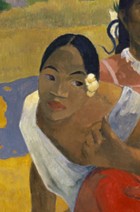
The emigration (Gauguin’s fifth and final emigration) does mark an artistic high point though. The colours, the gazes of the Polynesian women, nature… masterpieces such as “Parau Parau”, “Tahitian Women on the Beach”, “The Yellow Christ”, the monumental “D’où venons-nous? Que sommes-nous? Où allons-nous?” and dozens of others would never have been created without that impulsive flight. Masterpieces with which Paul en passant and unintentionally, establishes an archetypal object in Western art, which we see descending 130 years later in a Dylan song: the hibiscus. Gauguin is quite fond of it. In his portraits of Tahitian and later Marquesan women, they more often than not wear a hibiscus behind their ears. One of the first objects Paul paints in Tahiti is Te Burao, The Hibiscus Tree, and Gauguin receives definitive recognition as a hibiscus evangelist in the 21st century when a new variety is named after him: the Luv Paul Gauguin Hibiscus Plant.
By that time, Gauguin’s missionary work had long since established the hibiscus in Western art as a symbol of exceptional beauty, paradisiacal idyll and detachment. In paintings, wallpaper patterns and jewellery, as well as in song:
Jean Sablon – En te quittant Tahiti:
En te quittant, Tahiti Leaving you, Tahiti
Ainsi que la légende le dit As the legend tells to do
De mon bateau j’ai jeté From my boat I threw
Dans le lagon tous mes colliers All my garlands into the lagoon
Les colliers de frangipaniers Garlands of frangipani
D’hibiscus, de bougainvillées, Hibiscus, bougainvillea
S’ils reviennent vers Tahiti If they return to Tahiti
C’est que j’y reviendrai aussi! It means I will return too!
… as in Jean Sablon’s “En Te Quittant Tahiti” (1958), which coincidentally represents a second botanical connection between Sablon and Dylan (featuring a funny, again coincidental resemblance to Dylan’s “Duquesne Whistle”, by the way). The first botanical connection was “Autumn Leaves” and, admittedly, carries more weight.
In a certain sense, “Autumn Leaves” is an outlier in Dylan’s output from the “Sinatra years” of 2015-17, the years in which he filled five albums and 200+ concerts with his interpretations of songs from the American Songbook. The three albums (Shadows In The Night, Fallen Angels, and Triplicate) contain 52 songs. All of them are songs written by American greats such as Irving Berlin, Van Heusen/Burke, Hoagy Carmichael, and Jerome Kern/Oscar Hammerstein, with only one non-American song: the French evergreen “Les Feuilles Mortes” (in Johnny Mercer’s translation that is, as “Autumn Leaves”). Dylan does have a soft spot for the chanson. He continues to sing it even after the “Sinatra years”, up to and including July 2018 in Seoul, having performed the song 237 times. Perhaps it is not only the enchanting music, but also the story behind it.
The chanson comes from Les Portes de la Nuit from 1946 (Marcel Carné, screenplay by Jacques Prévert), a black-and-white film Dylan will appreciate. We are in Paris in February 1945, the last days of the war. Chaotic Paris has already been liberated, but elsewhere in France the war is still raging. “Le Destin”, a mystery tramp dressed in rags, predicts the death of each of the characters he encounters. He also directs the tragic love affair of the main characters, resistance fighter Diego (Yves Montand) and the unhappily married Malou (Nathalie Nattier), who ultimately cannot escape their fate either.
It is a dark and, alright, somewhat sentimental fateful drama. At most, setting and atmosphere still remain captivating today (and the movie might have been even more fascinating had Marlene Dietrich and Jean Gabin not declined the leading roles), but the film is nonetheless immortal: Prévert also wrote two songs for the film (music by Joseph Kosma), one of which would reach Olympian heights: “Les Feuilles Mortes”. In Les Portes de la Nuit, it is only hummed by the man who would make the song famous three years later, Yves Montand, but it is sung by Nathalie Nattier (Malou), who therefore actually has the first official recording of “Les Feuilles Mortes”, or “Autumn Leaves”, as most of us know the song, to her name. The French legend Cora Vaucaire, “La Dame blanche de Saint-Germain-des-Prés”, recorded a version simplified by Yves Montand in 1948, but the song only became a real hit, a million-seller even, when Yves himself took it on in 1949.
It was not until 2022 that it became apparent that neither Vaucaire nor Montand had been the first: a forgotten recording surfaced. The first professional studio recording of “Les Feuilles Mortes” was sung in the summer of 1947, in New York no less, by that other legend, Jean Sablon, the French Sinatra. When we hear Dylan sing Bougainvillea bloomin’ in the summer and spring four verses later in “Key West”, Sablon appears to have even a third botanical connection with Dylan – “Key West” and “En Te Quittant Tahiti” are probably the only songs in the Occident that are perfumed by both hibiscus and bougainvillea. Both also convey the same symbolic meaning, of course: the longing for the paradisiacal bliss that Dylan’s narrator hopes to find in Key West.
To be continued. Next up Key West part 9: It all floats
Jochen is a regular reviewer of Dylan’s work on Untold. His books, in English, Dutch and German, are available via Amazon both in paperback and on Kindle: 
- Blood on the Tracks: Dylan’s Masterpiece in Blue
- Blonde On Blonde: Bob Dylan’s mercurial masterpiece
- Where Are You Tonight? Bob Dylan’s hushed-up classic from 1978
- Desolation Row: Bob Dylan’s poetic letter from 1965
- Basement Tapes: Bob Dylan’s Summer of 1967
- Mississippi: Bob Dylan’s midlife masterpiece
- Bob Dylan’s Greatest Hits
- John Wesley Harding: Bob Dylan meets Kafka in Nashville
- Tombstone Blues b/w Jet Pilot: Dylan’s looking for the fuse
- Street-Legal: Bob Dylan’s unpolished gem from 1978
- Bringing It All Back Home: Bob Dylan’s 2nd Big Bang
- Time Out Of Mind: The Rising of an Old Master
- Crossing The Rubicon: Dylan’s latter-day classic
- Nashville Skyline: Bob Dylan’s other type of music
- Nick Drake’s River Man: A very British Masterpiece
- I Contain Multitudes: Bob Dylan’s Account of the Long Strange Trip
- Bob Dylan’s Rough And Rowdy Ways – Side B
- Bob Dylan’s High Water (for Charley Patton)
- Bob Dylan’s 1971
- Like A Rolling Stone b/w Gates Of Eden: Bob Dylan kicks open the door
- It Takes A Lot To Laugh, It Takes A Train To Cry b/w Just Like Tom Thumb’s Blues – Bob Dylan’s melancholy blues
- Bob Dylan’s Rough And Rowdy Ways – Side A
- Bob Dylan takes Highway 61 – Seven mercurial songs
Apollo’s misguided discus kills his handsome love interest. The sun-god turns him into a hyacinth flower in order to save him from the Underworld ~becomes a symbol of grief and sorrow.
TS Eliot follows the above mythology.
Athrodite, on the other hand, turns her love interest, handsome mortal Adonis, into a hibiscus flower; he spends only part of the time in Hades ~ becomes a symbol of hope and renewal.