
by Jochen Markhorst
X What a long strange trip it’s been
Key West is the place to go
Down by the Gulf of Mexico
Beyond the sea - beyond the shifting sand
Key West is the gateway key
To innocence and purity
Key West - Key West is the enchanted land
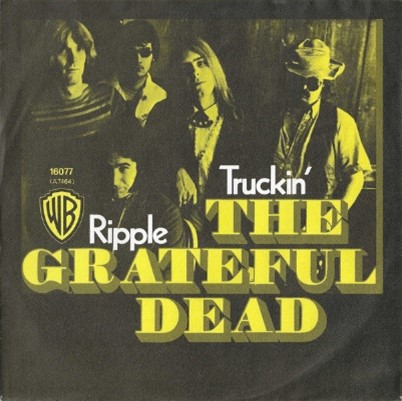 The 66 songs Dylan discusses in The Philosophy Of Modern Song (2022) were by no means all selected because Dylan admires them so much. Sometimes he mainly wants to shine a spotlight on the songwriter (on Elvis Costello in “Pump It Up”, Warren Zevon in “Dirty Life And Times”), other songs seem to be chosen for their anecdotal quality (“Whiffenpoof Song”, “CIA Man”) and sometimes he mainly wants to talk about the vocal performances of a colleague (such as Sinatra and Bobby Darin in “Beyond The Sea” and “Mack The Knife”). And then there are a few songs that Dylan does indeed choose for their intrinsic, distinctive beauty, songs he discusses with collegial envy. Grateful Dead’s “Truckin’” falls into that category.
The admiration is unambiguous. The essayist first devotes three paragraphs to the band, to his admiration for bassist Phil Lesh and drummer Bill Kreutzmann, who, together with the rest of the Grateful Dead, turn the band into a “postmodern jazz musical rock and roll dynamo”, to Bob Weir and lyricist Robert Hunter, and then moves on to “Truckin’”, and pays tribute to the song in more than 300 words;
“This song is medium tempo, but it seems to just keep picking up speed. It’s got a fantastic first verse, which doesn’t let up or fizzle out, and every verse that follows could actually be a first verse. Arrows of neon, flashing marquees, Dallas and a soft machine, Sweet Jane, vitamin C, Bourbon Street, bowling pins, hotel windows, and the classic line, What a long strange trip it’s been. A thought that anybody can relate to.”
… highlighting the quote that Dylan had already internalised decades ago: “It’s not necessary to take a trip to write a song. What a long, strange trip it’s been, however,” Dylan replies to Paul Zollo’s question about whether one place is better than another for writing a song (SongTalk interview, 1991). Or thirty years later, when Douglas Brinkley asks Dylan, in response to a line from “I Contain Multitudes”, whether he often thinks about mortality: “I think about the death of the human race. The long strange trip of the naked ape” (New York Times, 2020).
But Dylan pays his ultimate tribute – naturally – on stage: on 12 April 2023, he surprises his Japanese audience and all bootleg fans worldwide with a performance of “Truckin’”. The band is impressive and Dylan doesn’t seem to have all the lyrics down yet, but eight days later, during the second performance of the song in Nagoya, he has refreshed his memory (or has a cheat sheet on the piano) and delivers a perfect cover. The master is pleased, apparently; Dylan ends up playing the song seven times in 2023. Thus singing seven times:
Truckin' up to Buffalo
Been thinkin', you got to mellow slow
Takes time to pick a place to go
And just keep truckin' on
… with a seemingly rather shaky bridge to the opening of the sixth verse (or the second “sort-of-chorus”, if you will) of “Key West”, the place to go. Less shaky at second glance: we know hundreds of songs with no place to go, dozens of which belong to the canon, but we hardly know any song revealing that there is, in fact, a place to go. “Lady, Be Good” is all revved up, but has no place to go, just like Meat Loaf, Chuck Berry has no particular place to go, in “Backwater Blues” thousands of people have no place to go, just like in “Let It Snow” (so we just stay at home), “Nobody Knows You When You’re Down And Out”, “Lonely Street”, “On The Road Again”, “Early Morning Rain”… for a hundred years, the canon has been trying to convince us that we have nowhere to go – only Jerry Garcia and Bob Dylan offer a more optimistic counterpoint (and, okay, the Beach Boys remember that the beach was the place to go, “Do It Again”).
And the bridge is already becoming a little bit sturdy when we hear the rest of this “verse-chorus”; just like other verses in every song on this album, this verse also consists mainly of cut-and-paste work, and seems to be a manifestation of the dominant motif on Rough And Rowdy Ways, of songs:
– Down by the Gulf of Mexico is just as popular and widespread as no place to go, and Dylan’s jukebox alone undoubtedly contains some twenty songs with this specific geolocation. “Big Bayou”, Howlin’ Wolfs ” Louise”, Hank Williams’ “Seaman’s Blues”, “Rock Island Blues”, “Up On Cripple Creek”, Elvis’ “Guitar Man” of course, “61 Highway”… but on an album in which the prophet Dylan proclaims the gospel of song, he surely pays homage to the chorus of an all-time greatest:
We fired our guns and the British kept a-comin'
There wasn't nigh as many as there was a while ago
We fired once more and they begin to runnin'
On down the Mississippi to the Gulf of Mexico
… the chorus of Johnny Horton’s indestructible “The Battle of New Orleans”. The song that kept Bobby Darin’s “Dream Lover” from reaching number one on the Billboard Hot 100 in 1959, by the way. Any frustration on Darin’s part will have evaporated shortly afterwards though; his next single was “Mack The Knife”, his biggest hit (nine weeks at No. 1). Plus: in the UK, the tables were turned. There, “Dream Lover” held on to No. 1, and Lonnie Donegan’s version of “The Battle of New Orleans” had to settle for second place.
– And even more comforting, obviously, is the name-check that Bobby Darin’s “Beyond The Sea” gets in a monumental Dylan song in 2020.
– “Certain phrases are used over and over in the folk process,” says DJ Dylan in episode 75 of his radio show (2 April 2008, Cold). Demonstrating it exhaustively on this album, and after the place to go, down by the Gulf of Mexico and beyond the sea, he does so again with the shifting sand in this verse.
A first association would be “Shifting Whispering Sands”, one of the “Top 100 Western Songs of All Time” (according to the Western Writers of America), and of which Dylan presumably at the very least has the versions by Johnny Cash, Jim Reeves and Billy Vaughn in his record collection. However, a rather unbearable, corny song, really. But beyond that, it is just as established and over and over used a combination of words as the previous fixed phrases.
Dylan’s regular radio guest Tom Waits sings “And the fog lifting / The sand shifting” in the beautiful song “Shiver Me Timbers” on The Heart of Saturday Night, 1974, the song in which he also name-checks Dylan favourite Captain Ahab from Moby Dick. Grateful Dead bassist Phil Lesh, so admired by Dylan, chooses the image for a moving declaration of love in “No More Do I” (2002);
I will stand by you forever
If you’ll always stand by me
On the shifting sand or water
Take my hand, take my hand
Gordon Lightfoot, John Cale, Jimmy Dean (in “Mile Long Train”, 1963, the song with a devilish man in black), “Yesterday, When I Was Young”, Dylan’s idol George Jones (in “The Rock”), Don Henley in “Shangri-La”… “shifting sands” are as numerous in Dylan’s record collection as grains of sand on the Gulf of Mexico.
“Are you able to listen to music passively,” asks Jeff Slate in the Wall Street Journal interview, December 2022, “or do you think maybe you are always assessing what’s special – or not – about a song and looking for potential inspiration?” Dylan’s answer is crystal clear:
“That’s exactly what I do. I listen for fragments, riffs, chords, even lyrics. Anything that sounds promising.”
To be continued. Next up Key West part 11: Here’s my man, the great David Allan Coe
Jochen is a regular reviewer of Dylan’s work on Untold. His books, in English, Dutch and German, are available via Amazon both in paperback and on Kindle:
-
- Blood on the Tracks: Dylan’s Masterpiece in Blue
- Blonde On Blonde: Bob Dylan’s mercurial masterpiece
- Where Are You Tonight? Bob Dylan’s hushed-up classic from 1978
- Desolation Row: Bob Dylan’s poetic letter from 1965
- Basement Tapes: Bob Dylan’s Summer of 1967
- Mississippi: Bob Dylan’s midlife masterpiece
- Bob Dylan’s Greatest Hits
- John Wesley Harding: Bob Dylan meets Kafka in Nashville
- Tombstone Blues b/w Jet Pilot: Dylan’s looking for the fuse
- Street-Legal: Bob Dylan’s unpolished gem from 1978
- Bringing It All Back Home: Bob Dylan’s 2nd Big Bang
- Time Out Of Mind: The Rising of an Old Master
- Crossing The Rubicon: Dylan’s latter-day classic
- Nashville Skyline: Bob Dylan’s other type of music
- Nick Drake’s River Man: A very British Masterpiece
- I Contain Multitudes: Bob Dylan’s Account of the Long Strange Trip
Bob Dylan’s Rough And Rowdy Ways – Side B
- Bob Dylan’s High Water (for Charley Patton)
- Bob Dylan’s 1971
- Like A Rolling Stone b/w Gates Of Eden: Bob Dylan kicks open the door
- It Takes A Lot To Laugh, It Takes A Train To Cry b/w Just Like Tom Thumb’s Blues – Bob Dylan’s melancholy blues
- Bob Dylan’s Rough And Rowdy Ways – Side A
- Bob Dylan takes Highway 61 – Seven mercurial songs
On his album The Heart Of Saturday Night, Tom Waits also refers to Jack London’s story entitled “Martin Eden” in the song “Shiver My Timbers”.
So does Dylan in Chronicles One:
“I was never really more than what I was – a folk singer who gazed into the
gray mist with tear-blinded eyes.”
Dylan rearranges words taken from the story ‘Sea-Wolf’ by London.