
by Jochen Markhorst
XII Everything is fuzzy and opalescent
I’ve never lived in the land of Oz
Or wasted my time with an unworthy cause
It’s hot down here and you can’t be overdressed
The tiny blossoms of a toxic plant
They can make you dizzy - I’d like to help ya but I can’t
Down in the flatlands - way down in Key West
 Randy Newman does have a point when he wittily and sardonically dismisses America’s evergreen “A Horse With No Name”: “This song about a kid who thinks he’s taken acid.” Randy’s amusing condescension may well have been triggered by – admittedly awkward – lyrics such as “the heat was hot” and the clumsy “there were plants, and birds, and rocks, and things”, but he still could have given some credit. After all, the song is a catchy, beautiful Neil Young imitation, the open-tuned guitars have a melodious jingle-jangle sound, the driving bass and bass lick are irresistible, and the lyrics also contain nice poetic gems such as The ocean is a desert with its life underground and the perfect disguise above, just as the mirroring of desert/ocean skilfully balances the lyrics. And, unlike Dylan, singer Dewey Bunnell hides funny hints to help the determining botanist.
America – Horse With No Name:
“The first thing I met was a fly with a buzz,” reveals the rider on the nameless horse after the empty observation plants, and birds, and rocks, and things – so that fly must have taken off from an epipactis helleborine, the broad-leaved helleborine, a widespread herb from the orchid family. The nectar of a broad-leaved helleborine orchid contains the strongest anaesthetic substances found in nature, comparable to oxycodone, and when insects drink it, they get a – presumably very pleasant – high, a buzz. A hint that we don’t get from Dylan; “tiny blossoms of a toxic plant / They can make you dizzy”… which doesn’t really make it clear; that could be thousands of plants.
Now, Dylan doesn’t exactly have a reputation for being a sophisticated botanist. In the sixty years before Rough And Rowdy Ways, he mentions plenty of plants and flowers, but rarely rises above the expertise of the average kindergardener (the roses in “Love Minus Zero”, violets in “Where Teardrops Fall” and the daisy in “Winterlude”, for example), and are otherwise copied from the canon: all the flowers in “Highlands” (bluebells, honeysuckle) are copied from songs like “Wildwood Flower” and “Honeysuckle Rose”, the orchids and black-eyed Susan in “Moonlight” are quoted from Sinatra’s “American Beauty Rose”, and only the mentioning of Queen Anne’s Lace in “You’re Gonna Make Me Lonesome When You Go” seems to be thanks to that one botany lesson Dylan once received:
“I remember … when we were walking out in the fields somewhere and I found a Queen Anne’s lace, and he didn’t know that that’s what it was called … this was in Minnesota. I would come up there for long weekends and then I would leave. I did say I was planning a trip to Hawaii. And I lived in San Francisco. Honolulu, San Francisco, Ashtabula—to put it in a song is so ridiculous. But it was very touching.”
(Ellen Bernstein in Clinton Heylin’s Behind The Shades, 2001)
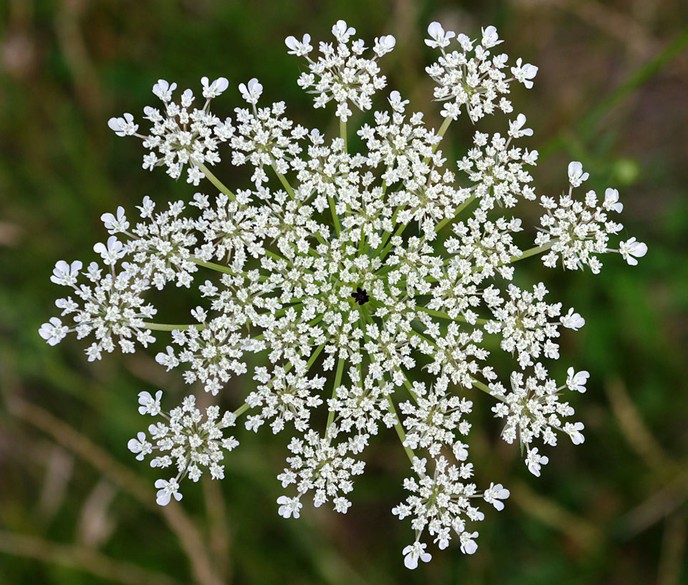
Queen Anne’s Lace, the American, somewhat too majestic name for wild carrot, is therefore a good guess for the identification of tiny blossoms of a toxic plant that can make you dizzy in this seventh verse of “Key West”. The daucus carota does indeed have very small, delicate flowers, is (mildly) poisonous, and has a very poisonous twin sister: spotted hemlock, the poison Socrates took after he was sentenced to death for impiety.
A better guess, however, is that the songwriter is simply making an ambiguous, tongue-in-cheek reference to cannabis. A traveller in Caribbean regions who gets dizzy from the flower buds of a poisonous plant… yes, we are most likely talking about la planta, mi amigo, del sol, as Grace Slick said (“Mexico”, 1970). Fitting with the detached, transitional state of mind our narrator seems to be in here – “another kind of mind,” in the words of Sir Paul (“Got To Get You Into My Life”, 1966). He opens the stanza with I’ve never lived in the land of Oz / Or wasted my time with an unworthy cause, suggesting that until now, he has led a cautious and respectable life, sober, with both feet firmly on the ground. That is now over, apparently: It’s hot down here and you can’t be overdressed is a strange, confused observation. After all, “You can’t be underdressed” would be a more logical complaint from someone suffering from the heat. But then again, he is a little dizzy. From the little flowers of that plant, presumably.
Only the closing line, “I’d like to help ya but I can’t”, shifts the associations away from drug references and back to an otherwise confused mind. The cinema, then, to the somewhat predictable but still moving film The Leisure Seeker (Paolo Virzì, 2017). A perhaps not too spectacular story about the last days of elderly couple John and Ella Spencer, but then again: the leading roles are played by an elderly Donald Sutherland (then 82) and an elderly Helen Mirren, then 72. Elderly or not, the exceptional Sutherland and Mirren could still have played Romeo & Juliet in a compelling and credible way, could even have made Batman & Robin, the worst film of the past thirty years, a must-see.
Anyway, in The Leisure Seeker they play an elderly couple approaching death. Sutherland is a retired professor with dementia, Mirren his terminally ill wife. They decide to escape the patronising care of their well-meaning children, the pointless chemotherapy and the doctors, get into their camper van (“the Leisure Seeker”) and drive south. From Massachusetts to Key West. Sutherland becomes increasingly confused, fiddles with his clothes all the time, is roasting in the sun and dizzy, and Mirren is too sick and weak to help at the end: “You’ll have to excuse me for not helping.” But by then they have already reached their destination, in their camper van at a campsite in Key West. She puts a large dose of Valium in the glass of her childishly merry, clueless husband, waits until he is asleep, and then painfully drags her cancer-ravaged body out of bed:
“She goes to the driver’s seat and starts the motor. She bends down to the floor with a deep sigh to remove the mat that covers the trap door. She rips off the tape. Exhaust fumes begin to spread through the cabin. She joins John in bed and hugs him. The fumes thicken, making everything fuzzy and opalescent.”
They’ve been through the desert in a van with a name, ended way down in Key West and are now crossing the horizon line.
To be continued. Next up Key West part 13: She tears again my bleeding heart
Jochen is a regular reviewer of Dylan’s work on Untold. His books, in English, Dutch and German, are available via Amazon both in paperback and on Kindle:
- Blood on the Tracks: Dylan’s Masterpiece in Blue
- Blonde On Blonde: Bob Dylan’s mercurial masterpiece
- Where Are You Tonight? Bob Dylan’s hushed-up classic from 1978
- Desolation Row: Bob Dylan’s poetic letter from 1965
- Basement Tapes: Bob Dylan’s Summer of 1967
- Mississippi: Bob Dylan’s midlife masterpiece
- Bob Dylan’s Greatest Hits
- John Wesley Harding: Bob Dylan meets Kafka in Nashville
- Tombstone Blues b/w Jet Pilot: Dylan’s looking for the fuse
- Street-Legal: Bob Dylan’s unpolished gem from 1978
- Bringing It All Back Home: Bob Dylan’s 2nd Big Bang
- Time Out Of Mind: The Rising of an Old Master
- Crossing The Rubicon: Dylan’s latter-day classic
- Nashville Skyline: Bob Dylan’s other type of music
- Nick Drake’s River Man: A very British Masterpiece
- I Contain Multitudes: Bob Dylan’s Account of the Long Strange Trip
- Bob Dylan’s Rough And Rowdy Ways – Side B
- Bob Dylan’s High Water (for Charley Patton)
- Bob Dylan’s 1971
- Like A Rolling Stone b/w Gates Of Eden: Bob Dylan kicks open the door
- It Takes A Lot To Laugh, It Takes A Train To Cry b/w Just Like Tom Thumb’s Blues – Bob Dylan’s melancholy blues
- Bob Dylan’s Rough And Rowdy Ways – Side A
- Bob Dylan takes Highway 61 – Seven mercurial songs
Oscar Wilde said “You can never be overdressed…”
Bob Dylan disagrees:
If it’s hot, “You can’t be overdressed”….because you’ll make yourself hotter.
John Donne refers to the mandrake plant which is an hallucinogen, and has a carrot- like root that often looks a human female figure; the poet speaks of impossible things to achieve – like getting the root pregnant.
In another poem, he notes that death awaits everyone, the bell tolls for all of us.
Likewise:
For whom does the bell toll for love
It tolls for you and me
(Bob Dylan: Moonlight )