by Jochen Markhorst
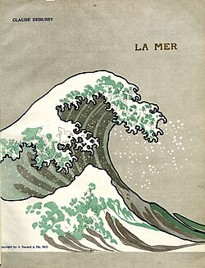 Claude Debussy is quite upset by the review in Le Temps on 25 October 1905. Critic Pierre Lalo, normally a devoted Debussy fan, is not particularly impressed by La Mer: “Je n’entends, je ne vois, je ne sens pas la mer – I do not hear, see or smell the sea.” The reviewer acknowledges that the music is “ingenious”, but dismisses the piece as at most an intellectual reproduction of the sea – and lacking in any emotion. Debussy is so hurt that, unusually, he composes a letter to Lalo that very same day. “I cannot blame you for not liking La Mer,” he writes, “and I am not complaining about that either.” But “perhaps I regret that you do not understand it…”
“J’aime la mer, je l’ai écoutée avec le respect passionné qu’elle mérite. Si j’ai mal transcrit ce qu’elle m’a dicté, cela vous donne le droit d’en accuser mon intelligence, mais pas ma sensibilité – I love the sea; I have listened to her with the passionate respect she deserves. If I have miswritten what she whispered to me, you may criticise my intelligence, but not my sensitivity.”
Just as disappointed, more poetic and far more scathing is Louis Schneider on 24 October 1905 in Le Gaulois, at the time the newspaper of choice for the Parisian elite and high society. The public expected a vast ocean, he writes, “mais ils ont été servis avec de l’eau agitée dans une soucoupe – but they were served a puddle of sloshing water on a saucer.”
Time has proven Schneider and Lalo wrong; La Mer is now regarded as one of Debussy’s absolute masterpieces. And Debussy’s defence holds water; he had no intention whatsoever of “setting the sea to music” or anything of the sort, but rather tried depicting in music the impressions the sea made on him and the associations it evoked in him – although, on the other hand, Claude found it very annoying to be called an “Impressionist”.
Tellingly, he explicitly refrains from calling the work a symphony, but rather “trois esquisses symphoniques pour orchestre – three symphonic sketches for orchestra.”
The dissatisfaction of both reviewers, or “non-understanding”, as Debussy prefers to describe it, is certainly comprehensible. After all, by 1905 we had already been conditioned for a century or so by the many works that evoke the sea. Beethoven’s Meeresstille und glückliche Fahrt (Op. 112, incidentally based on two poems by Goethe that were also set to music shortly afterwards by Mendelssohn-Bartholdy), Rimsky-Korsakov’s irresistible Scheherazade, Mendelssohn’s Die Hebriden, Une barque sur l’océan by Ravel… all beloved works that evoke lapping waves, raging sea storms, crashing surf and vast oceans.
Dylan’s “Key West” seems to find its place somewhere in between Debussy’s impressionism and Beethoven’s portrayal. The first version, the 2020 studio recording, is romantic. Meditative, certainly, but harmonious and still very tonal – for nine and a half minutes we drift around the triad of C, Am and F; all on the white keys, then. “Simple and repetitive,” is how Tony Attwood describes the accompaniment, adding: “I am reminded of waves very gently lapping the shore. Which I guess is the point.”
The colour comes from the hesitant brushstrokes on the snare drum, the unusual sound of Benmont Tench letting his organ play as backing vocals (“background humming” might be a more accurate description) and, above all, the accordion. “It’s a perfect instrument in a lot of ways. It’s orchestrative and percussive at the same time,” Dylan said in 2009 in an interview with Bill Flanagan, and at the time Dylan was of course thinking primarily of David Hidalgo’s contributions to his recently released album Together Through Life. Neither of these descriptions fits the role of the accordion in “Key West” though. Here, the accordion is neither orchestral nor percussive, but primarily decorative. Donnie Herron hangs the fairy lights, half-opens the blinds and switches on the ceiling fan – we are in an empty beach bar at sunset, with the breakers rustling in the distance. A grey-haired waitress sweeps the sand off the floor. It is warm.
But the most important, the dominant and mood-setting element is – naturally – provided by the master himself. The 78-year-old Nobel Prize winner ages like fine wine and reaches new heights with his fascinating blend of singing and recitation on “Key West”, his diction and, above all, his phrasing – that special quality to which Tony Attwood refers when he writes: “The first beat of the first line of the verses is often not sung – we hear the band but no voice – it comes in half way between the first and second beat […] he is reflective, not forcing us to accept his words. This is a time of quiet contemplation.”
As the bard takes the song to the stage, it gradually shifts towards Debussy over the years. At the premiere on 2 November 2021 in Milwaukee, Donnie Herron left his accordion at home and takes his place at the pedal steel guitar. Dylan plays the same two repeating notes on the piano for most of the song; Tony Garnier doesn’t play much more on his upright bass either; The guitarists Doug Lancio and Bob Britt sparingly carry the two opening verses, but then slowly fade into the background. Vocally, Dylan largely opts for declamation or growling in the verses, with the occasional sung line. In the four choruses, that ratio is reversed.
Then, by a year later, on 2 November 2022 in Manchester, Dylan has given the song quite a shake-up. A different key, more chords and suddenly a radical shift in the choruses, a sort of climax – not meandering along, as in the studio version and the early live versions, but explicit, with a different drum part, a distinctive guitar lick and yet another key and tone (on the record from Am to F, in 2022 from F to Dm). The overall mood, however, is still more romantic than anything else.
By 2023, the peaks are smoothed out, the arrangement is further pared down, and the song begins to take on a more atmospheric quality. It can get even sparser, as it turns out in 2024, when Dylan recites virtually the entire lyrics, and the band starts butterflying; rather unstructured and seemingly random notes fluttering here and there, Dylan’s piano very much in the foreground, no drums. By 2025, we’re fully impressionistic. The first verses feature just piano and sparse guitar; we hear nothing from drummer Anton Fig for the time being, and only halfway through do we get some modest, impressionistic, irregular, improvised additions. Occasionally a small roll, then a bit of rustling on a cymbal. Bassist Tony Garnier only wakes up halfway through, and then contributes to most bars no more than one note.
“Key West” is now definitively a symphonic sketch. For a stripped-down orchestra. Performed “with the passionate respect she deserves”. La Mer, meanwhile, is used as the pre-show introduction music on Dylans Rough and Rowdy Ways tour in 2024.
To be continued. Next up Key West part 27: A tapestry of rich and royal hue
——————
Jochen is a regular reviewer of Dylan’s work on Untold. His books, in English, Dutch and German, are available via Amazon both in paperback and on Kindle: 
- Blood on the Tracks: Dylan’s Masterpiece in Blue
- Blonde On Blonde: Bob Dylan’s mercurial masterpiece
- Where Are You Tonight? Bob Dylan’s hushed-up classic from 1978
- Desolation Row: Bob Dylan’s poetic letter from 1965
- Basement Tapes: Bob Dylan’s Summer of 1967
- Mississippi: Bob Dylan’s midlife masterpiece
- Bob Dylan’s Greatest Hits
- John Wesley Harding: Bob Dylan meets Kafka in Nashville
- Tombstone Blues b/w Jet Pilot: Dylan’s looking for the fuse
- Street-Legal: Bob Dylan’s unpolished gem from 1978
- Bringing It All Back Home: Bob Dylan’s 2nd Big Bang
- Time Out Of Mind: The Rising of an Old Master
- Crossing The Rubicon: Dylan’s latter-day classic
- Nashville Skyline: Bob Dylan’s other type of music
- Nick Drake’s River Man: A very British Masterpiece
- I Contain Multitudes: Bob Dylan’s Account of the Long Strange Trip
- Bob Dylan’s Rough And Rowdy Ways – Side B
- Bob Dylan’s High Water (for Charley Patton)
- Bob Dylan’s 1971
- Like A Rolling Stone b/w Gates Of Eden: Bob Dylan kicks open the door
- It Takes A Lot To Laugh, It Takes A Train To Cry b/w Just Like Tom Thumb’s Blues – Bob Dylan’s melancholy blues
- Bob Dylan’s Rough And Rowdy Ways – Side A
- Bob Dylan takes Highway 61 – Seven mercurial songs