
Mother Of Muses part 7
by Jochen Markhorst
VII Spend’st thou thy fury on some worthless song
Take me to the river, release your charms
Let me lay down a while in your sweet, loving arms
Wake me, shake me, free me from sin
Make me invisible, like the wind
Got a mind to ramble, got a mind to roam
I'm travelin' light and I'm a-slow coming home
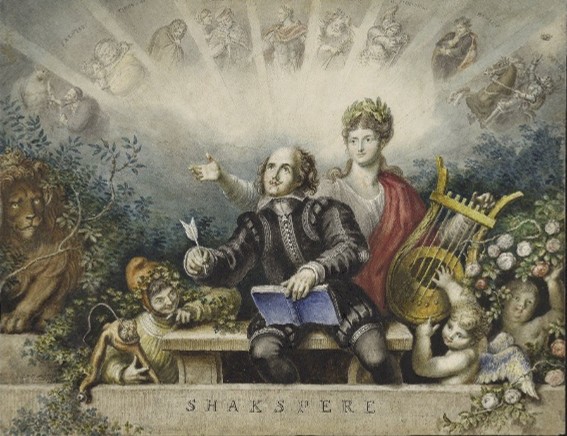 Shakespeare In Love (John Madden, 1999) is a thoroughly delightful, charming film which, in a way, is comparable to the Dylan film A Complete Unknown (James Mangold, 2024): a sort of biopic in which the biographical facts are more or less accurate, but are blended in a collage-like manner, embellished and enhanced, with light-hearted, unobtrusive references to both the artist’s work and life. Shakespeare’s search for his muse, for example. William (Ralph Fiennes) is making no headway with his play Romeo and Ethel, the Pirate’s Daughter, and his patron Henslowe is growing impatient:
HENSLOWE
No, no, we haven’t the time. Talk prose. Where is my play?
WILL
(tapping his forehead and heading out the door)
It is all locked safe in here
HENSLOWE
God be praised!
(then doubt)
Locked?
WILL
As soon as I have found my muse
A brief fling with Rosaline kindles a glimmer of hope in Will (“Are you to be my muse, Rosaline?”), but it is only after meeting Viola (played by Gwyneth Paltrow in her Oscar-winning role), who turns out to be his true muse, that he receives the divine inspiration to rewrite Romeo and Ethel as Romeo and Juliet.
It is one of the film’s charming, unobtrusive references; after all, Shakespeare regularly invokes the muse throughout his entire body of work. The best-known example is probably the opening of Henry V (“O for a Muse of fire, that would ascend / The brightest heaven of invention”), and she also makes frequent appearances in the sonnets. As a motif in itself, it is too generic to be called Shakespearean or to be categorised as a source for Dylan’s “Mother Of Muses” – after all, poets have been invoking the muse ever since Homer – but a few minutes later, in the next song, “Crossing The Rubicon”, we hear unmistakable echoes of Shakespeare’s “Sonnet 100”. In a prop such as crooked knife (“I’ll cut you up with a crooked knife”) and in an aphoristic fragment such as “How can I redeem the time? / The time so idly spent? The words “crooked knife” are the closing words of Shakespeare’s sonnet (“So thou prevent’st his scythe and crooked knife”), and Dylan’s helpless lament about wasted time mirrors the opening of Shakespeare’s second quatrain:
Return, forgetful Muse, and straight redeem
In gentle numbers time so idly spent
In hindsight, it does seem highly likely that “Sonnet 100” served as a trigger for “Mother Of Muses”. Which would draw a connection to that utterly alien phrase, “unleash your wrath” from the preceding couplet of Dylan’s song. After all, in Shakespeare’s opening couplet we find something similar:
Where art thou, Muse, that thou forget’st so long
To speak of that which gives thee all thy might?
Spend’st thou thy fury on some worthless song,
Dark’ning thy power to lend base subjects light?
… the Bard describes the act of inspiring others as “to spend fury”. And he bitterly reproaches the muse for squandering her “fury” on others, on “some worthless song”, and for seemingly forgetting him. That theme of pointing the finger at others also seems to carry over into the final verse of his song, albeit not as disparagingly as Shakespeare – one would be hard-pressed to catch Dylan criticising his peers. “I’m not ever going to disparage another songwriter,” as he says in his MusiCares Speech (2015).
“You know what I’m talking about,” says the narrator in the run-up to the final verse, nonetheless clarifying in this closing verse: the songs that have been allowed to rest in the sweet loving arms of the muse, the songs upon which she releases her charms. “Take Me To The River”, for starters. One of Al Green’s greatest songs, and Dylan undoubtedly recognises that too, but it also happens to serve as a nice bridge to the song that comes 50 seconds after these words, to the song with the unmistakable Shakespearean references, to “Crossing The Rubicon”. The subsequent release your charms is admittedly a break in style from the earlier unleash your wrath, but Dylan evidently feels the need to fall into “the trap of easy rhyme” (as he calls it in The Philosophy of Modern Song) – to re-create the easy, overused rhyme charms-arms with let me lay down in your sweet, loving arms. With, as a bonus, a nod to Muddy Waters’ classic “Rock Me” (1956; I want you to call me daddy, let me lay down in your arms). Seems obvious, as that song is one of the most brilliant gems in a long, long pearl necklace stretching from Curtis Jones’ “Roll Me Mama” to Big Bill Broonzy’s “Rockin’ Chair Blues”, to Arthur Crudup’s “Rock Me Mama”, to Lil’ Son Jackson’s “Rockin’ and Rollin’”, and somewhere along the way to Dylan’s own “Wagon Wheel”. “All these songs are connected,” as Dylan says in that same MusiCares speech in 2015.
Something similar applies to the third line of the verse, Wake me, shake me; “I took a gospel song I knew and rearranged it for a Jewish blues band, and that’s how we started doing Wake Me, Shake Me,” explains Al Kooper in his autobiography Backstage Passes and Backstabbing Bastards, describing the origins of the song for his Blues Project (1966). He is referring to “Wake Me Shake Me” by The Golden Chords featuring Lorraine Ellison, 1963 (which, incidentally, like the Blues Project album in question, Projections, was produced by Dylan’s producer Tom Wilson). Indeed, this was in turn another adaptation of an old gospel song which, just like “Roll Me Mama”, has spawned dozens of adaptations, offshoots and variations. In 1957, for example, The Staple Singers adapted it into “Let Me Ride”; in 1962, Reverend Gary Davis recorded a version entitled “Tryin’ To Get To Heaven In Due Time” (on his album Say No to the Devil); and somewhere along the line, Dylan in turn used that for “Tryin’ To Get To Heaven” (1997). All these songs are connected.
After another little nod, this time to the man who has continued to pop up in Dylan’s body of work and set lists for over half a century, blues pioneer Tampa Red (“Got a mind that ramble, got a mind that roam” certainly seems like a loving nod to Tampa’s 1938 track “Why Should I Care?”: I got a mind to ramble, I got a mind to leave this town) we arrive at the most beautiful, and most moving, surprise on “Mother Of Muses”: the Leonard Cohen tribute in the closing line. At least, that’s what “I’m travelin’ light and I’m a-slow coming home” seems to be.
Leonard Cohen passed away on 7 November 2016, some three and a half years before the release of Rough And Rowdy Ways. When Dylan pays tribute to an admired and/or deceased colleague, he usually does so in a somewhat more explicit way (Lennon in “Roll On John”, for example, or Guthrie in “Song to Woody”), but this is a more elegant way of doing it: “Traveling Light”, “Slow” and “Going Home” are three tracks from Cohen’s last three albums, You Want It Darker, Popular Problems and Old Ideas – and that surely is no coincidence. Just as these song titles and references, like the earlier ones, were not chosen at random, of course. Take me to the river, lay me down, coming home… all autumnal, gentle metaphors for the end of life, interspersed with evangelical-tinged pleas such as free me from sin and make me like the wind – in this single verse, Dylan encapsulates the central theme of the entire album Rough & Rowdy Ways: the mortal artist and his immortal art.
Songs Of Love And Death, as Leonard Cohen probably would have named the album.
To be continued. Next up Mother Of Muses part 8: Boredom! Hail to you, Mother of Muses
Jochen is a regular reviewer of Dylan’s work on Untold. His books, in English, Dutch and German, are available via Amazon both in paperback and on Kindle: 
- Blood on the Tracks: Dylan’s Masterpiece in Blue
- Blonde On Blonde: Bob Dylan’s mercurial masterpiece
- Where Are You Tonight? Bob Dylan’s hushed-up classic from 1978
- Desolation Row: Bob Dylan’s poetic letter from 1965
- Basement Tapes: Bob Dylan’s Summer of 1967
- Mississippi: Bob Dylan’s midlife masterpiece
- Bob Dylan’s Greatest Hits
- John Wesley Harding: Bob Dylan meets Kafka in Nashville
- Tombstone Blues b/w Jet Pilot: Dylan’s looking for the fuse
- Street-Legal: Bob Dylan’s unpolished gem from 1978
- Bringing It All Back Home: Bob Dylan’s 2nd Big Bang
- Time Out Of Mind: The Rising of an Old Master
- Crossing The Rubicon: Dylan’s latter-day classic
- Nashville Skyline: Bob Dylan’s other type of music
- Nick Drake’s River Man: A very British Masterpiece
- I Contain Multitudes: Bob Dylan’s Account of the Long Strange Trip
- Bob Dylan’s Rough And Rowdy Ways – Side B
- Bob Dylan’s High Water (for Charley Patton)
- Bob Dylan’s 1971
- Like A Rolling Stone b/w Gates Of Eden: Bob Dylan kicks open the door
- It Takes A Lot To Laugh, It Takes A Train To Cry b/w Just Like Tom Thumb’s Blues – Bob Dylan’s melancholy blues
- Bob Dylan’s Rough And Rowdy Ways – Side A
- Bob Dylan takes Highway 61 – Seven mercurial songs
“I’m a-slow coming home” brings Homer and Odysseus to mind …
nevertheless Dylan’s “coming” home, moving towards (where there’s light) at the place he came from.
Whereas Cohen sings “going” home, i.e, moving away from where he’s at now – getting away from the darkness.