
by Jochen Markhorst
XVI One, two, Freddy’s coming for you
I’m in the red-light district like a cop on the beat
Living in a nightmare on Elm Street
When you’re down on deep Ellum put your money in your shoe
Don’t ask what your country can do for you
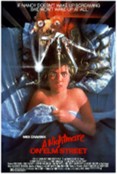 In the October 2015 issue of Rolling Stone, it is one of dozens of fun facts shared by actors, crew members and, above all, by director Wes Craven himself about the making of the classic horror film Nightmare on Elm Street (1984): “Elm Street is the name of the street that ran past the book depository where Kennedy was shot. To me, it was where the innocent world ended.” Adding an extra layer beneath Dylan’s rather obvious association: Dylan is referring to a film whose title, in turn, was already a reference to the fatal shooting – a reference to a reference, as it were. Also carrying the same underlying emotional resonance that Dylan seems to be trying to convey with his song: “To me, it was where the innocent world ended.”
At Wes Craven’s a bit more graphic than in “Murder Most Foul”, obviously. Nightmare on Elm Street is the slasher film centred on the monstrous Freddy Krueger, and is recognised as one of the best horror films ever made – the film has even been selected by the Library of Congress for inclusion in the US National Film Registry because it is “culturally, historically or aesthetically significant” (“cultural” will surely have been the decisive argument in this case). Freddy Krueger has certainly secured his place on the Mount Rushmore of iconic horror monsters, at any rate.
Leaving aside the all-too-obvious association with “Elm Street”, Dylan will appreciate the plot-driving twist in the screenplay; Freddy manifests himself only in nightmares, but within them he is indeed capable of attacking his victims physically and cutting them to shreds – the blood that splatters and spatters in the dream world splashes against walls and ceilings in the real world; the blurring of the boundary between dream and reality is just as oppressive and terrifying for the audience as it is for Freddy’s victims. Which makes the reference – whether by chance or not – fitting at this point in the song; from here, the poet Dylan shifts to the final flickers in the dying president’s mind, to the last jagged images in the brain of a man on the threshold between life and death.
Plus, Dylan may well feel some personal links to the film through a few connections. Nancy’s mother, Marge, is played by Ronee Blakley, for example, who was Dylan’s colleague in the Rolling Thunder Revue. And even more relevant is the connection with Alan Pasqua, one of the pianists on this very song, on “Murder Most Foul”.
We heard Pasqua recently behind Dylan’s voice when he provided the piano tingaling accompaniment in the background for Dylan’s recorded Nobel Prize speech – which apparently earned him enough appreciation to contribute the trickling piano notes on “Murder Most Foul” in 2020.
In 1984, Alan married lead actress Heather Langenkamp (Nancy) and contributed to Elm Street’s soundtrack. The soundtrack was – successfully – written by Charles Bernstein (no relation to Leonard), but Freddy’s theme song, based on the nursery rhyme “One, Two, Buckle My Shoe”, did not yet have a melody. Wes Craven had given the song a fairly prominent role in his screenplay, and had also written the adapted lyrics;
One, two, Freddy's coming for you...
Three, four, better lock your door...
Five, six, grab your crucifix...
Seven, eight, gonna stay up late...
Nine, ten, never sleep again.
… for which Alan – by then already a renowned jazz pianist, session rock musician and former member of Dylan’s band (we can hear him on Street-Legal and on At Budokan) – effortlessly composed a simple little tune that Bernstein gratefully incorporated into the soundtrack, to be sung by the ghostly, skipping-rope girls. So Pasqua no doubt looked up for a moment when he heard Dylan declaiming Living in a nightmare on Elm Street in the studio. And perhaps he also thought briefly of his only hit, the one he scored with his band Giant in 1990, “I’ll See You In My Dreams” (although in that song, quite unlike in the film, the dreams are actually safe and comforting).
Dylan’s next association is just as obvious as the one with Elm Street: “Deep Ellum Blues”. The classic that we know for certain Dylan can relate to;
“When you go down to Deep Ellum keep your money in your socks / Women on Deep Ellum put you on the rocks.” Sing that song for a while and you just might come up with, “When you’re lost in the rain in Juarez and it’s Easter time too / And your gravity’s down and negativity don’t pull you through / Don’t put on any airs / When you’re down on Rue Morgue Avenue / They got some hungry women there / And they really make a mess outta you.”
… the words Dylan chooses in his MusiCares speech (2015) to put the magic of his songwriting talent into perspective (in this case, that of “Just Like Tom Thumb’s Blues”), and on Through The Open Window (Bootleg Series Vol. 18, 2025) we hear that the song was already on his set list as early as 1962. He announces the song at Gerde’s Folk City with a respectful introduction, in a somewhat awkwardly contrived, tough-guy tone and with a geographical inaccuracy:
“Big Joe plays a nine-string guitar. This is one of the songs I learned from him. This is called Deep Ellum Blues. Deep Ellum is a town in Texas. It’s about 45 miles from Abilene.”
Dylan is, of course, honouring Big Joe Williams, who did indeed play a nine-string guitar. But Deep Ellum is not a town in Texas, nor is it situated some 45 miles from Abilene. Deep Ellum is a historic neighbourhood in Dallas, situated some 200 miles from Abilene, and the name is a corruption of – indeed – Elm Street, the neighbourhood’s main thoroughfare, the street where JFK was killed.
Dylan’s 1962 rendition is enthusiastic and infectious, and in the twenty-first century he still occasionally plays it during a soundcheck (Mainz 2015, for example). More cheerful than the somewhat perfunctory Jerry Lee Lewis, less affectionate than Jerry Garcia (who played the song dozens of times with the Grateful Dead and nearly a hundred times with his various side projects), with less historical legitimacy than a Texas legend like ZZ Top’s Billy Gibbons, and certainly less lively than the Rough And Rowdy Hillbillies of the 1930s, the Shelton Brothers (1935).
Undoubtedly, all these versions have a place somewhere in Dylan’s inner jukebox, but today he seems to have Michael Cooney’s 1979 version on his mind;
Her papa's a policeman
And her mama walks the street;
Her papa met her mama
When they both were on the beat.
… the only version featuring a cop on the beat. Still, every version of “Deep Ellum Blues” (or Deep Elm or Deep Elem) explores the same sense of solidarity and community spirit as the Kennedy quote that Dylan cites here: “Ask not what your country can do for you–ask what you can do for your country” (from Kennedy’s Inaugural Address, January 20, 1961).
To be continued. Next up Murder Most Foul part 17: “He called Elvis an ugly name”
Jochen is a regular reviewer of Dylan’s work on Untold. His books, in English, Dutch and German, are available via Amazon in both paperback and on Kindle: 
- *Blood on the Tracks: Dylan’s Masterpiece in Blue*
- Blonde On Blonde: Bob Dylan’s mercurial masterpiece
- Where Are You Tonight? Bob Dylan’s hushed-up classic from 1978
- Desolation Row: Bob Dylan’s poetic letter from 1965
- Basement Tapes: Bob Dylan’s Summer of 1967
- Mississippi: Bob Dylan’s midlife masterpiece
- Bob Dylan’s Greatest Hits
- John Wesley Harding: Bob Dylan meets Kafka in Nashville
- Tombstone Blues b/w Jet Pilot: Dylan’s looking for the fuse
- Street-Legal: Bob Dylan’s unpolished gem from 1978
- Bringing It All Back Home: Bob Dylan’s second Big Bang
- Time Out Of Mind: The Rise of an Old Master
- Crossing The Rubicon: Dylan’s late-career classic
- Nashville Skyline: Bob Dylan’s other kind of music
- Nick Drake’s River Man: A very British masterpiece
- I Contain Multitudes: Bob Dylan’s Account of the Long Strange Trip
- Bob Dylan’s Rough and Rowdy Ways – Side B
- Bob Dylan’s High Water (for Charley Patton)
- Bob Dylan’s 1971
- Like A Rolling Stone b/w Gates Of Eden: Bob Dylan kicks open the door
- It Takes a Lot to Laugh, It Takes a Train to Cry b/w Just Like Tom Thumb’s Blues – Bob Dylan’s melancholic blues
- Bob Dylan’s Rough And Rowdy Ways – Side A
- Bob Dylan takes Highway 61 – Seven mercurial songs
- Bob Dylan’s Rough And Rowdy Ways – Side C
——————–