by Jochen Markhorst
XVIII The second-best white singer in America
Cash on the barrel head, money to burn
Dealey Plaza, make a left hand turn
I’m going to the crossroads, gonna flag a ride
That’s the place where Faith, Hope and Charity died
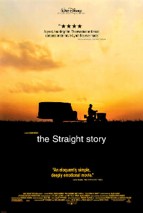 The Straight story is easy to tell: in the summer of 1994, the elderly Alvin Straight travels 240 miles on his lawnmower from north-western Iowa to south-western Wisconsin to visit his ailing brother Lyle. The journey takes six weeks (the lawnmower travels at about 5 miles an hour) and then Alvin arrives at Lyle’s. Lyle has suffered a stroke, but is recovering. Simple, but it proves inspiring enough first for an article in the New York Times (25 August 1994, p. 12), then an opera (The Shoulder, Dan Hurlin, 1997) and finally David Lynch’s much-acclaimed film The Straight Story (1999).
Which is quite a remarkable cinematic fact, incidentally; after all, Lynch is the grand master of oppressive, weird and utterly bewildering films (Mulholland Drive, Lost Highway, Twin Peaks, Blue Velvet and more). But for once, he has created an unusually straightforward gem, a heart-warming, slightly sentimental road movie, told chronologically and fairly faithfully – it is Lynch’s only film with a G rating, “General audiences – All ages admitted” (equivalent to a U rating in the UK). The film was even acquired and released by Walt Disney Pictures (!). Still, Lynch declares, inimitable as ever: “The Straight Story is my most experimental film” (Empire, November 2001).
Alvin, who died in 1996 and therefore never witnessed the artistic impact of his adventure, had always shunned the limelight. He turned down interviews, declined invitations to appear on David Letterman’s and Jay Leno’s shows, and was rarely persuaded to offer his reflections or comments. He did, however, gratefully accept a gift from Texas Equipment Company, Inc.: a brand-new 17 hp John Deere lawnmower. So we never actually heard him explain how he came up with the idea, but it seems obvious that George Jones was an inspiration. By 1994, George Jones’s lawnmower story had long since become an urban legend, which was also revived by DJ Dylan on his Theme Time Radio Show:
“George Jones once had to drive down a freeway on his riding lawnmower. His wife, Tammy Wynette, was sick of his constant drinking. She emptied the house of liquor; she took away his car keys, and made him a virtual prisoner in an attempt to wean him off the booze. One afternoon, alone in the house, George wanted a drink. The house was quite a distance from Nashville, too far to walk. So George hopped on the only vehicle he still had the keys to. You could see George heading down the side of the highway, going towards the liquor store on his riding lawnmower. Here’s George Jones with A Good Year for the Roses.”
(Ep. 11, Flowers, 2006)
“I can hardly bear the sight of lipstick on the cigarette’s there in the ashtray,” the DJ quotes reverently as the final chord fades away.
George Jones is an undisputed country god for Dylan. And not just for Dylan, of course. Keith Richards (“the dude could sing the ingredients off a cereal box and break your heart”), Frank Sinatra (“the second-best white singer in America”), Merle Haggard, Johnny Cash, Dolly Parton… they all tip their hats to The Possum. And perhaps the biggest fan of all is Elvis Costello, who scored a hit in 1981 with “A Good Year For The Roses” and, in his autobiography Unfaithful Music & Disappearing Ink, devotes many words to both his admiration and his encounters and collaboration with his idol (in 1978, Elvis wrote and sang “Stranger In The House” for George’s duets album My Very Special Guests). Costello describes the magic of George’s singing in a slightly more scholarly manner than Keith or Sinatra: “His impossibly fluid singing—the turns and ornaments many imitate but few can equal, and that sudden drop into the bass register.”
Naturally, Dylan admires the quality of the singing too, but he seems above all to be moved by the content of the songs, by their authenticity in particular. George Jones, alongside Dinah Washington, is the most frequently played artist on his radio show (both ten times), and the man who, in Dylan’s eyes, single-handedly keeps true country music alive. “Apart from perhaps George Jones, I didn’t like country music,” he laments in Chronicles, though he is more nuanced as a DJ in the tirade following his play of “Let’s Invite Them Over” (episode 17, Friends & Neighbours, 2006):
“Now, I love country music. But I say: what happened to it? You hear a song like this, and it’s obvious: it’s about real people and real emotions and real problems. That’s all, that’s the country music we learned to love. Nowadays they wanna sweep all the problems under the rug and pretend they don’t exist. But guess what folks – they do exist. And if you try to sweep them under the rug, they just gonna pop up somewhere else. So you might as well just face it and listen to the old style country music, the real country music. You know, about drinking and sleeping around. That’s my kind of country music, and I hope yours. But I digress.”
So whilst George Jones occupies a place somewhere at the very top of Dylan’s personal pantheon, he gets – just like Chuck Berry –a rather short shrug on Rough & Rowdy Ways. A single reference here in “Murder Most Foul” – that’s it. And again, just as with Chuck Berry, the reference isn’t to one of the Very Greatest songs – not to “She Thinks I Still Care” or “He Stopped Loving Her Today” or any of George’s many other number-one hits – but to the more obscure “Money To Burn”, originally a B-side (to the top twenty hit “Big Harlan Taylor”, 1959). At second thought, still an obvious choice though, bubbling up in Dylan’s meandering stream of consciousness through cash on the barrel head; subsequently accepted, as money to burn fits rhythmically and rhymes nicely with Dealey Plaza, make a left-hand turn (historically accurate), but ultimately chosen definitively because the song is the sort that a superfan on a mission would want to shine a spotlight on.
At first glance, on paper, “Money To Burn” is a run-of-the-mill honky-tonk song about the well-worn adage that money doesn’t bring happiness. But when we hear it sung by George, with his impossibly fluid singing, as Costello puts it, we understand why he leaves Keith Richards sobbing next to his speakers, and we empathise with what moves DJ Dylan so deeply – real people and real emotions and real problems. Deep, hidden sorrow that not even the irresistible, bouncy piano playing of Hargus “Pig” Robbins (whom we’ll hear later on Blonde On Blonde) can cheer up.
“I was looking through my records the other night. You know I’ve over 70 George Jones records? If you look at ’em all, it gives you a great history of men’s haircuts. Here’s George in a period of time when he’s just grown out his buzz cut and had a bit of a mutton chop sideburn look going.”
[plays “I Heard You Crying In Your Sleep” — George Jones (1966)]
“We quote a lot of this guy, but who can blame us – he’s one of the best. The kid’s real good.”
(Episode 28, Sleep, 2006)
George Jones, “The Rolls-Royce of Country Music”, died on 26 April 2013 at the age of 81, hailed as “the greatest living country singer”, after a life full of dark chapters. Alcoholism, drugs, adultery, unreliability (which earned him the nickname No-Show Jones), prison, psychiatric institution – you name it. Journalist Nick Tosches sums up his lowest point succinctly: “By February 1979, he was homeless, deranged, and destitute, living in his car and barely able to digest the junk food on which he subsisted. He weighed under a hundred pounds, and his condition was so bad that it took him more than two years to complete My Very Special Guests” (Texas Monthly, “The Devil in George Jones”, July 1994).
George Jones’s life was, in short, hardly a straight story.
To be continued. Next up Murder Most Foul part 19: Hello Satan, I believe it’s time to go
Jochen is a regular reviewer of Dylan’s work on Untold. His books, in English, Dutch and German, are available via Amazon in both paperback and on Kindle: 
- *Blood on the Tracks: Dylan’s Masterpiece in Blue*
- Blonde On Blonde: Bob Dylan’s mercurial masterpiece
- Where Are You Tonight? Bob Dylan’s hushed-up classic from 1978
- Desolation Row: Bob Dylan’s poetic letter from 1965
- Basement Tapes: Bob Dylan’s Summer of 1967
- Mississippi: Bob Dylan’s midlife masterpiece
- Bob Dylan’s Greatest Hits
- John Wesley Harding: Bob Dylan meets Kafka in Nashville
- Tombstone Blues b/w Jet Pilot: Dylan’s looking for the fuse
- Street-Legal: Bob Dylan’s unpolished gem from 1978
- Bringing It All Back Home: Bob Dylan’s second Big Bang
- Time Out Of Mind: The Rise of an Old Master
- Crossing The Rubicon: Dylan’s late-career classic
- Nashville Skyline: Bob Dylan’s other kind of music
- Nick Drake’s River Man: A very British masterpiece
- I Contain Multitudes: Bob Dylan’s Account of the Long Strange Trip
- Bob Dylan’s Rough and Rowdy Ways – Side B
- Bob Dylan’s High Water (for Charley Patton)
- Bob Dylan’s 1971
- Like A Rolling Stone b/w Gates Of Eden: Bob Dylan kicks open the door
- It Takes a Lot to Laugh, It Takes a Train to Cry b/w Just Like Tom Thumb’s Blues – Bob Dylan’s melancholic blues
- Bob Dylan’s Rough And Rowdy Ways – Side A
- Bob Dylan takes Highway 61 – Seven mercurial songs
- Bob Dylan’s Rough And Rowdy Ways – Side C