
Can You Please Crawl Out Your Window? part 4
by Jochen Markhorst
IV “I’m sure that Bob Dylan would dig this version!”
So t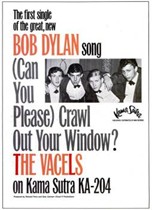 here are no successful covers, and really hardly any that are too impressive either. The garage quality can be approximated, but a decisive quality factor of the song is indeed that crisp, clear organ sound Nick Hornby appreciates so much. And the viciousness, of course – for that, you at least have to be able to get close to Dylan. A second, and perhaps more compelling explanation for the reluctance of colleagues is provided by musicologist Tony Attwood: the musical structure is quite simply weird, weird and weird, which “makes it hard to perform”:
————
It is in conventional 4/4 time (four beats to a bar) but actually consists of 14 bars – I don’t know any other song that does this. 16 is normal. 8 is acceptable. But 14? No.
Then we find that the start of each bar, where we have the extra emphasis, is often not an important word at all – which it normally is in songs. The bold word (below) is the start of each bar and the number at the end of each bar of music for that line.
Plus we have the odd rhyme scheme – lines two and four rhyme but line six ends with the same words as line four -, and it is generally accepted that a word does not rhyme with itself.
Then, on top of all that, there is the curious chord scheme. Lines in pop music end with cadences – made of two chords. The most popular is V – I (so in the key of C major that is G, C. The second most popular is IV – I (F C). There are others, though they are unusual. But Dylan uses:
IV – V (line one)
II – I (line two)
II – V (line three)
II – IV (line four)
No chord change in line five – it is all on V
II – IV (line six – which is not a chord change for an end of a line let alone the end of a verse that I know in any other song. It sounds weird and leaves us hanging….
Out of this collection, only II – V and IV – V are considered acceptable in songs.
It is quite simply weird, weird and weird – and indeed I think Dylan felt it didn’t work because he never tries anything like this again. That weirdness is, I feel, why it took so long to record. The musicians would endlessly be trying to regularise it, rather than actually perform as it is. For example, the urge at the end of line one is to play an extra bar to make it four bars to the opening line.
He sits in your room, his tomb, with a fist full of tacks (3 bars)
Preoccupied with his vengeance (2 bars)
Cursing the dead that can’t answer him back (3 bars)
You know that he has no intentions (2 bars)
Of looking your way, unless it’s to say (2 bars)
That he needs you to test his inventions. (2 bars)
It is a great experiment, but very uncomfortable – which is why I think he never tries again.”
—————-
Remarkable, considering there are some Big Guns who dare to take on a rendition. A few live recordings of Jimi Hendrix circulate, unfortunately of inferior sound quality, but even there Hendrix is nowhere near the level of the original or, for example, his unrivalled “All Along The Watchtower”. The tempo is usually too fast (and fluctuates annoyingly), which seems to compromise the vocals – messy and chaotic, all in all. Much better is the version recorded with more steadiness during a BBC session on 17 October 1967, enthusiastically introduced by Alexis Korner (“I’m sure that Bob Dylan would dig this version!”), but now Jimi suddenly sings dull and uninspired – and in fact plays some of the exact same licks and fills that he also delivers on his version of “Like A Rolling Stone”.
The Jimi Hendrix Experience – Can You Please Crawl out Your Window?:
Jimi is early on it, but he is not the first. The New York band The Vacels were much earlier – remarkably even earlier than Dylan himself. Their single “Can You Please Crawl Out Your Window” b/w “I’m Just A Poor Boy” was released in September 1965 – three months before Dylan’s single came out in December.
The Long Island band had just scored a minor hit with “You’re My Baby” in the Hot 100 (which entered alongside “Like A Rolling Stone” on 24 July; Dylan at 91, The Vacels at 90), and apparently had one of the misprints of “Positively 4th Street” on the turntable, the misprint on which the original version of Can You Please Crawl is accidentally included. It is an all right cover, somewhat overproduced by none other than Richard Perry, with rather intrusive brass but attractive, enthusiastic and energetic vocals.
Record label Kama Sutra believes in it and throws quite a few dollars at marketing. And apparently also pull some strings at Billboard; on 2 October, the single is one of the twenty “Spotlight Singles”. But the Billboard editorial team does not expect it to be a big hit; “Predicted to reach the top 60 of the HOT 100 Chart.” In the same list, Gordon Lightfoot’s “Just Like Tom Thumb’s Blues” is expected to reach the Top 20, while “Mr. Jones (Ballad Of A Thin Man)” by the Grass Roots and Peter Antell’s “The Times They Are-A Changin’” are also estimated not to go higher than the Top 60 (despite the resounding analysis, “The Dylan classic is given a powerhouse treatment by Antell that should hit the charts with solid impact in short order. Strong production work”).
None of the expectations come true, by the way. Still, October 1965 is not a bad month for Dylan, obviously.
Can You Please Crawl drifts away over the Waters of Oblivion, hereafter. Patricia Paay’s resuscitation attempt in 1975 goes unnoticed, and even more unfair is the lukewarm reception Wilko Johnson’s cover on his solo LP Ice On The Motorway in 1980 receives. Wilko is mean and energetic, sounding like Pete Townshend with The Jam as the backing band, but even that is still not enough. Thirty-four years later, he tries again. In 2013, Wilko receives a death sentence from his oncologist.
Despite his impending death, the influential guitarist, a national treasure, the mute Royal Executioner Ser Ilyn Payne in Game of Thrones, and driving force of the 70s Dr. Feelgood, uses eight days of his remaining time for his farewell album Going Back Home (released 2014). He invites The Who’s Roger Daltrey to sing and gives “Can You Please Crawl Out Your Window” a second chance. The men craft a professional, but somewhat too ordinary rock song. To his surprise, Johnson then witnesses the release of the album; only after the recordings does it become clear that the oncologist was mistaken and that Wilko has an operable form of glandular cancer. He survives the major operation in which a three-kilogram tumor is removed, is surprised to see his farewell album becoming his greatest commercial success, and declares in October 2014 that he is free of cancer. He picks up his guitar again, tours and plays and lives, and only passes away eight years later, at the age of 75, at home in Essex.
Wilko Johnson – Can You Please (1980 version):
The song then finally experiences a sort-of-revival after 1985, once Dylan’s five-star, platinum-selling compilation box Biograph has conquered the record shelves. It is, however, not a spectacular resurrection. Most covers mainly lack spark, like that of the hype band Transvision Vamp in 1991 (peroxide showstopper Wendy James still has the song on her setlist to this day) and like the old, weird Americana band Colorblind James Experience (the band that in the 90s annually plays an all-Dylan setlist of over 30 songs around Dylan’s birthday).
The first resuscitation attempt of the twenty-first century has at least a fascinating line-up. And some sort of official license; Carla Olson stepped onto Planet Dylan as a stand-in for Mick Taylor in that first official music video Dylan ever made, the promo video for “Sweetheart Like You” in 1983. Which is a rather unremarkable clip showing Dylan and a band miming the song on a small stage in a bar after closing time. The only audience consists of a cleaning lady who pauses her work and seems to feel addressed.
The band is quite interesting. Clydie King mimics a keyboard part, Robbie Shakespeare imitates his own bass part, the role of drummer Sly Dunbar is played by Charlie Quintana, the drummer of The Plugz whom we know from that remarkable Dylan performance on Late Night with David Letterman in March 1984 and as a member of Dylan’s tour band in 1992 – so he was already moving in Dylan circles in 1983. But we all only think “what’s a sweetheart like you doing in a place like this” at 3’28”, when the camera zooms in on Carla Olson, who accurately and with the correct fingerings syncs Mick Taylor’s solo.
Dylan is apparently content: he gifts Carla a song he still had lying around, an outtake from Infidels, the Chuck Berry-esque rocker “Clean Cut Kid” (of which Carla gratefully makes a beautiful version with her band The Textones for the album Midnight Mission, accompanied by Ry Cooder on slide guitar).
In 2002, Carla then surprises with a fine rocking solo album, The Ring Of Truth, where we find her take on “Can You Please Crawl Out Your Window?” at number 7. The credits are promising: veteran and Dylan confidant John Sebastian on harmonica, veteran and Dylan confidant Mick Taylor on guitar. The contributions of both masters are beautiful enough, the sound is crisp – but despite all the superpower, Carla’s version still does not escape the shadow of the original. Her singing, while leaning towards Chrissie Hynde, simply lacks the bite, the nastiness.
In the end, the most charming cover is provided by a band from Brooklyn, The Hold Steady, with a contribution for the soundtrack of the Dylan film I’m Not There (2007). From start to finish a skilled Springsteen imitation, but what the heck; better well stolen than poorly invented – as the master himself has been demonstrating for more than sixty years now.
The Hold Steady – Can You Please Crawl:
—————–
Jochen is a regular reviewer of Dylan’s work on Untold. His books, in English, Dutch and German, are available via Amazon both in paperback and on Kindle: 
- Blood on the Tracks: Dylan’s Masterpiece in Blue
- Blonde On Blonde: Bob Dylan’s mercurial masterpiece
- Where Are You Tonight? Bob Dylan’s hushed-up classic from 1978
- Desolation Row: Bob Dylan’s poetic letter from 1965
- Basement Tapes: Bob Dylan’s Summer of 1967
- Mississippi: Bob Dylan’s midlife masterpiece
- Bob Dylan’s Greatest Hits
- John Wesley Harding: Bob Dylan meets Kafka in Nashville
- Tombstone Blues b/w Jet Pilot: Dylan’s looking for the fuse
- Street-Legal: Bob Dylan’s unpolished gem from 1978
- Bringing It All Back Home: Bob Dylan’s 2nd Big Bang
- Time Out Of Mind: The Rising of an Old Master
- Crossing The Rubicon: Dylan’s latter-day classic
- Nashville Skyline: Bob Dylan’s other type of music
- Nick Drake’s River Man: A very British Masterpiece
- I Contain Multitudes: Bob Dylan’s Account of the Long Strange Trip
- Bob Dylan’s Rough And Rowdy Ways – Side B
- Bob Dylan’s High Water (for Charley Patton)
- Bob Dylan’s 1971
- Like A Rolling Stone b/w Gates Of Eden: Bob Dylan kicks open the door
- It Takes A Lot To Laugh, It Takes A Train To Cry b/w Just Like Tom Thumb’s Blues – Bob Dylan’s melancholy blues
- Bob Dylan’s Rough And Rowdy Ways – Side A
- Bob Dylan takes Highway 61 – Seven mercurial songs