
By Mike Johnson
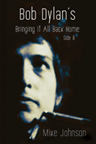 When I started writing articles for Untold Dylan back in 2019, I had no intention of publishing them in book form. Writing about Dylan was a weekend relaxation for me, a means of getting away from my job as Senior Lecturer in Creative Writing at AUT University, Auckland, and my own writing, primarily fiction and poetry. I could kick back on a Saturday, listen to some Dylan and jot down a few ideas. Having them published in Untold Dylan was enough to satisfy me. Big thanks to Tony Attwood!
The publication of my monster series, Bob Dylan’s Never Ending Tour Volumes 1,2 and 3 in 2025 in book form changed all that.
But I still had to be convinced that they could be turned into a book. After all, the articles were there, online, why bother with hard copies?
A little research and advice from friends (big thanks to Jochen Markhorst, prolific writer of books on Dylan and UD contributor) changed my mind. I learned that readers do not assimilate what they read on the screen as well as they do on the page, nor do they enjoy the reading experience as much. Distracting advertisements make it harder to concentrate, not to mention all those other distractions that lie a mere click or two away.
But why this particular focus on side B of Dylan’s fifth album? An album that looks forward to Dylan’s 1960s rock era, with side B looking backwards to his solo acoustic era?
It’s the seminal nature of the four songs there, and their cultural impact, which makes it especially distinctive. Perhaps you have to be an oldie, like Senor Attwood and me, to appreciate the stunning effect ‘Mr Tambourine Man,’ ‘Gates of Eden,’ ‘It’s alright Ma (I’m only bleeing)’ and ‘It’s All Over Now, Baby Blue’ had on us ingenues. Even after ‘It’s A Hard Rain Gonna Fall’ and ‘Chimes of Freedom’ we had no idea what was to hit us when we slung that vinal onto the turntable.
Or perhaps not. Maybe you don’t have to be an oldie to get knocked over by the power and depth of those songs. They still work their magic.
In the book, I describe it this way, talking about ‘It’s Alright Ma’:
‘Now he was rapping out the lyrics at a mind-bending speed. It’s difficult now to convey the stunning effect of this song when it first appeared. I remember as an eighteen-year-old, with friends, clustered around a crappy old portable record player on full volume, staring at each other in astonishment – what the hell was this? There were no lyric sheets. We just had to figure it out, if we could keep up. We played it again and again. It was incomprehensible and hypnotic.’
I asked Tony Attwood if he’d be kind enough to write an introduction to this book, and I think his contribution is worth quoting in full:
‘A lifetime of influence; a lifetime of memories: Being just a few years younger than Bob I have had what I guess I would call “the honour” of being there at the moment each album (after the first) became available.…. His journey, always infinitely more illustrious than mine, always leading the way.
Of course we have lived in different worlds – or at least on different continents. I know him, he doesn’t know me, but always we have been linked by his songs.
Different worlds, different perceptions, different lives… yet somehow, in some curious way, we have travelled along interesting parallels. And if I were to single out one part of Bob which has particularly been eternally close to me during these decades, it is the part of Bob that we all found on side B of “Bringing it all back home”.
Buying that LP upon release I cycled the 12 miles back home and sat in my bedroom playing it over and over before on day two playing along with the songs on my guitar. Day three was taken up with writing arrangements for the keyboard. Day four found me trying to convince the band I played with that we should be playing these songs.
The guys in the band didn’t get it, so I performed “Baby Blue” in the local folk club the following week. The folkies didn’t get it either.
And yet, as it turns out, such things don’t matter. This album, these songs, they are still with us, as they have been since I was 18 years old. Yes of course I have played side one of the album many hundreds of times, but it is side two that got worn through and scratched and required the purchase of a second copy.
If I owe anyone for anything musical, I owe my father for being a both a jazz saxophonist and a classical pianist, and for ensuring that I was brought up in, and still live in, a musical world. And I owe Bob for side two of “Bringing it all back home.” Without those two gentlemen I am not sure what my life could have been, but one thing is certain. It wouldn’t have been half this good.’
Tony’s observations reinforced the importance of the focus I had chosen. It was not just me! There were many of us! We got it! We weren’t sure what it was, but we got it. We were never the same again. We witnessed this decisive cultural moment.
I realised that as far as I knew nobody had ever traced the performance history of these songs, from their first to their last, and told the story of their evolution over time. Taking that on lead me through an exciting and illuminating journey. These songs have a history, there is no final form for a Dylan song, and the changing arrangements reflected Dylan’s own journey as an artist and interpreter of his songs.
Working on the look and feel of the book with our genius designer, Daniela Gast, was another pleasure. I was struck by the stark minimalism of the early performances of the songs, Dylan’s BBC performances in 1965, and, in particular, this performance of ‘It’s Alright, Ma’ from 1965. I’m sure UD readers will be familiar with it:
That stark, black-and-white, noir tinged, image became our guiding aesthetic for the look and feel of the book, reminding me that a book is an artifact. It has a presence in the world. A personality. Its aesthetic can reflect its contents. I’m proud the way it looks, and the way it reflects the personality of the early Dylan. This more than just a trip down nostalgia lane. These songs are as relevant and vital as when they were written, and the story of their performance is inscribed in the history of modern music.
Note that links to sound and video files are in the book as in the UD articles.
Lasavia Publishing is yet to launch its online book store, but in the meantime you can order it via our website here: https://lasaviapublishing.com/bob-dylans-bringing-it-all-back-home-side-b/
Or contact our sales person Meggan Young directly at: meggan@lasaviapublishing.com
Or encourage your local bookshop to stock it! And yes, you can find it on Amazon and other online retailers, but our prices are cheaper.
Our prices: (Prices may vary a little with currency fluctuations)
- United States – $22.90
- United Kingdom – £ 16.99
- European Union – € 19.99
- Canada – $ 32.99
- Australia – $32.99
- New Zealand – $35
If you are a retailer, please ask Meggan for our wholesale prices.
Happy reading!