by Jochen Markhorst
XVII “He called Elvis an ugly name”
Cash on the barrel head, money to burn
Dealey Plaza, make a left hand turn
I’m going to the crossroads, gonna flag a ride
That’s the place where Faith, Hope and Charity died
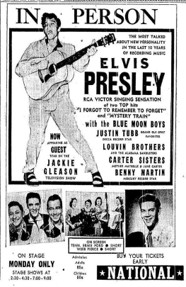 “You’re the devil in disguise,” Elvis would probably have thought, had the incident taken place a few years later. In February 1956, Elvis is on tour with colleagues from Colonel Parker’s stable, Elvis being – obviously – the star of the show. “RCA Victor singing sensation of the two top hits “I Forgot To Remember To Forget” and “Mystery Train” with the Blue Moon Boys” proclaims the concert poster, alongside names such as the Carter Sisters (featuring June Carter), Jackie Gleason and Justin Tubb. A two-hour show, with the matinee starting at 2.30 pm and the evening show at 7.00 pm. Admission 85¢ (children 50¢). And for that, you also get The Louvin Brothers, Charlie and Ira. The alcoholic troublemaker Ira has a problem with Elvis, coming to a head when he catches Elvis backstage singing gospel songs. Elvis is sitting at the piano and tells Ira and Charlie that this is his favourite music. Ira explodes: “Why, you white nigger, if that’s your favorite music, why don’t you do that out yonder? Why do you do that nigger trash out there?” and grabs him by the throat. In 2017, Charlie – who, in 1963, despondently left his impossible, volcanic brother – is interviewed by The Guardian, and he is still loyal enough to tell the sanitised version:
“There was a little rift – Elvis came backstage one day, sat down at the piano and said, ‘This is the kind of music that I like’ and my brother wrongfully said, ‘Why do you do that trash on stage?’ and that was all there was to it.”
Elvis has always been a huge fan of The Louvin Brothers, but following this appalling incident, he will never record or even perform one of their songs again.
Ira’s talent, however, is undisputed and is – naturally – separate from his human failings. He writes most of the songs for the brothers and is blessed with an angelic, crystal-clear high tenor that blends magically with Charlie’s low tenor – without Ira there might have been no Everly Brothers, and by extension no Simon and Garfunkel either, and his influence on the development of country, country-rock and close harmony can be traced right into the 21st century (Gram Parsons was a fan, for example, Kurt Cobain based his heart-wrenching “In The Pines” on Ira’s template).
DJ Dylan also pays tribute to the duo on his Theme Time Radio Hour. Four times he plays a Louvin track and he is unequivocal: “One of the great close-harmony brother acts. The sound of Ira’s mandolin and Charlie’s Atkin guitar making the best of music this side of Heaven – even when singing about Satan” (from the introduction to “Satan is Real” in episode 14, The Devil, 2006). A year later, the DJ also briefly reflects on the Elvis incident, and, just like Charlie, avoids the racism and the nastiest details:
“We told you about Ira Louvin and his hair-triggered temper and how he got in a little dust-up at the Opry – here’s some more facts. He ruined the tour of a young Elvis Presley, who was a devoted Louvin Brothers fan. Ira called Elvis an ugly name and he said that his music was rock ‘n’ roll trash. Way before Pete Townshend he broke his instrument on stage. Audiences didn’t know how to react to an angry drunken man smashing his mandolin. According to people who knew him, he was the kind of drunk that looks possessed.”
(Theme Time Radio Hour, Ep. Dreams, Nov. 2007)
… after which Dylan recounts in detail the rest of Ira’s sad life story, right up to his tragic death in 1965 (Ira and his fourth wife, Anne Young, were killed in a fatal head-on car crash). “The Louvin Brothers recorded many songs about alcohol. It’s a shame that Ira Louvin’s life could be the subject of one of the saddest.”
In 2020 then, Dylan pays tribute to the brothers with this mention in “Murder Most Foul”: Cash on the barrel head. Written by both brothers, originally a B-side (to “You’re Running Wild”, a hit in 1956, during the weeks when Ira had to endure Elvis’s “Love Me Tender”, “Hound Dog” and “Don’t Be Cruel” ahead of him in the charts), but it soon became a signature song and one of the most frequently covered. By Gram Parsons, for example (with Emmylou Harris on Gram’s magnificent swan song Grievous Angel, 1974, featuring Elvis’s guitarist James Burton), Wanda Jackson (2003), Dolly Parton on her back-to-the-roots album The Grass Is Blue in 1999… it’s not just any old people who are moved by “Cash On The Barrel Head”.
The brothers’ repertoire is actually of the hell-and-damnation, fire and brimstone, hard-core Baptist variety, but this particular song happens to be one of their non-evangelical songs, verging on cabaret even. It tells the story of a petty criminal who can’t pay his fine, has no money to make a phone call and, once out of prison, has no money for the bus fare home – because everyone he speaks to demands cash on the barrelhead. Perhaps inspired by the row that the hot-headed Ira has been having with Colonel Tom Parker. The Colonel, who has already imposed a gruelling tour schedule, has overbooked one of the gigs and is pressuring his artists to perform an extra show without pay. Hothead Ira flies off the handle, instigates a full-scale strike and, whilst he’s at it, demands that Elvis be sacked. It costs Parker a sackful of money to calm the waters again. This takes place in February or March 1956, and a few weeks later, May 1956, the brothers record “Cash On The Barrel Head”.
It’s a straightforward, cheerfully swinging honky-tonk number, recorded with a band in which in particular Hank Williams’ steel guitarist Don Helms stands out, sung solo by Ira. With a chorus containing an undoubtedly unintentional reference to the rock ’n’ roll trash of Chuck Berry’s “No Money Down”:
“That’ll be cash on the barrel head, son
Not part, not half, but the entire sum
No money down, no credit plan
‘Cause a little bird tells me you’re a travelin’ man”
… monumental enough, all-in all, to be honoured by a Nobel Prize winner sixty years later.
To be continued. Next up Murder Most Foul part 18: The second-best white singer in America
Jochen is a regular reviewer of Dylan’s work on Untold. His books, in English, Dutch and German, are available via Amazon in both paperback and on Kindle: 
- *Blood on the Tracks: Dylan’s Masterpiece in Blue*
- Blonde On Blonde: Bob Dylan’s mercurial masterpiece
- Where Are You Tonight? Bob Dylan’s hushed-up classic from 1978
- Desolation Row: Bob Dylan’s poetic letter from 1965
- Basement Tapes: Bob Dylan’s Summer of 1967
- Mississippi: Bob Dylan’s midlife masterpiece
- Bob Dylan’s Greatest Hits
- John Wesley Harding: Bob Dylan meets Kafka in Nashville
- Tombstone Blues b/w Jet Pilot: Dylan’s looking for the fuse
- Street-Legal: Bob Dylan’s unpolished gem from 1978
- Bringing It All Back Home: Bob Dylan’s second Big Bang
- Time Out Of Mind: The Rise of an Old Master
- Crossing The Rubicon: Dylan’s late-career classic
- Nashville Skyline: Bob Dylan’s other kind of music
- Nick Drake’s River Man: A very British masterpiece
- I Contain Multitudes: Bob Dylan’s Account of the Long Strange Trip
- Bob Dylan’s Rough and Rowdy Ways – Side B
- Bob Dylan’s High Water (for Charley Patton)
- Bob Dylan’s 1971
- Like A Rolling Stone b/w Gates Of Eden: Bob Dylan kicks open the door
- It Takes a Lot to Laugh, It Takes a Train to Cry b/w Just Like Tom Thumb’s Blues – Bob Dylan’s melancholic blues
- Bob Dylan’s Rough And Rowdy Ways – Side A
- Bob Dylan takes Highway 61 – Seven mercurial songs
- Bob Dylan’s Rough And Rowdy Ways – Side C