
by Jochen Markhorst
VII I knew right then and there I was hooked
I got both my feet planted square on the ground
Got my right hand high with the thumb down
Such is life - such is happiness
Hibiscus flowers grow everywhere here
If you wear one put it behind your ear
Down on the bottom - way down in Key West
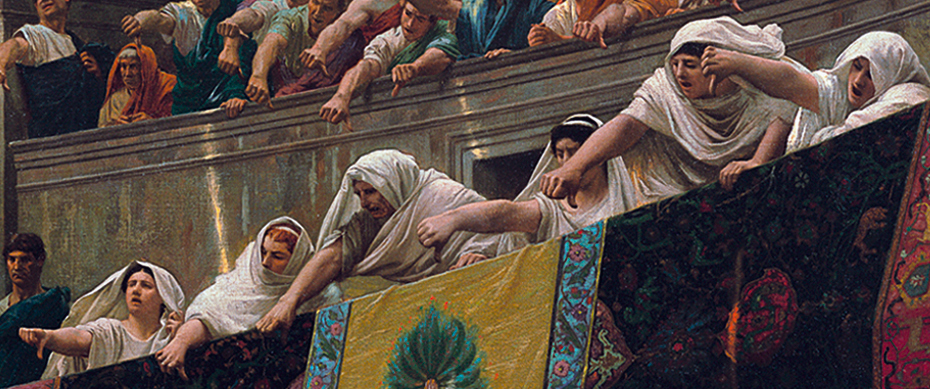
The ambiguous “thumb down” leads to surprisingly academic discussions about the meaning of the gesture on the fringes of discussion forums and fan sites. As classicists know, it is by no means certain that our everyday use of it (thumb up = “good”, thumb down = “bad”) corresponds to its origin, the gesture used by the Romans to communicate life or death in gladiatorial combats in the arenas. The authority on the subject, classicist Professor Anthony Corbeill, has researched it in depth and concluded that we have reversed the gesture: thumbs up meant that the gladiator should be killed, while “a closed fist with a wraparound thumb” meant that he should be spared (Nature Embodied. Gesture in Ancient Rome, 2004).
The confusion stems from the ambiguous name: the Romans called it pollice verso, which simply means “turned thumb”. Not specifying downwards or upwards. Our collective consensus hereon is probably due to the popularity of the 1872 painting Pollice Verso by French neoclassicist Jean-Léon Gérôme – the fanatical, bloodthirsty faces of the Vestal Virgins in the audience with their “thumbs down” communicate their message quite clearly: that defeated gladiator must die. It is this painting that motivated filmmaker Ridley Scott to make Gladiator, he explains in Gladiator: The Making of the Ridley Scott Epic (2000):
“Walter and Doug came by my office and laid a reproduction of the painting on my desk. That image spoke to me of the Roman Empire in all its glory and wickedness. I knew right then and there I was hooked.”
Scott also copies the thumbs-gestures into his film, in the dramatic scenes in which he has the cruel Emperor Commodus (Joaquin Phoenix) decide between death and mercy. It further establishes the image, and it becomes definitively anchored when Facebook introduces the like button in 2009: the raised thumb as a sign of appreciation.
Gladiator – Now We Are Free – Hans Zimmer & Lisa Gerrard:
It does matter for understanding the mental state of Dylan’s narrator, of course – does he signal life or death with “Got my right hand high with the thumb down”? The context does not provide a clear answer either; from the very first line of the song, “death” is a motif, and thematically, the whole song suggests the afterlife, transition, farewell. On the other hand, precisely this verse is lebensbejahend, as our German friends would say, life-affirming: “both feet on the ground”. “Such is life,” “happiness,” “grow”… this verse in particular does not communicate “the end of life”.
Circumstantial evidence seems to suggest that Dylan with thumb down still does want to signal “death”, though. Juvenal, again. On this album, we have already heard quotations and paraphrases from Juvenal’s Satires in two songs (get lost Madam from Satire VI in the opening song “I Contain Multitudes” and the size of your cock won’t get you nowhere from Satire IX in “Black Rider”), so it stands to reason that Dylan also picked up the ancient thumb down from Juvenal. Classics scholars discussing the meaning of a thumb down do indeed cite Juvenal’s Satire III: “verso pollice vulgus cum iubet, occidunt populariter,” which was translated in George Gilbert Ramsay’s 1920 standard work as “[they] win applause by slaying whomsoever the crowd with a turn of the thumb bids them slay”. However, we know that Dylan did not use Ramsay’s translation, but Peter Green’s 1967 translation, which reads:
“They stage gladiatorial games, and at the mob’s thumbs-down will butcher a loser for popularity’s sake.”
In any case, Dylan’s use of it remains somewhat alienating here. It seems to fit poorly between the opening line, “I got both my feet planted square on the ground,” which, atypically enough, seems to be derived from Dylan’s own “Most Of The Time” (1989; Most of the time I can keep both feet on the ground) and the following line, “Such is life – such is happiness.” The empty cliché such is life and the association it seems to impose, the cut-and-paste quote from the Irish classic “Raglan Road” (Oh, I loved too much and by such, by such is happiness thrown away), seem equally difficult to reconcile with thumb down.
“Raglan Road” is a song close to Dylan’s heart, that’s for sure. Both the song itself and its origins: in 1946, a hopelessly enamoured Patrick Kavanagh wrote a poem for Hilda Moriarty, twenty years his junior, entitled “Dark Haired Miriam Ran Away”, which appeared in The Irish Press, and was only published in 1964, with a slight change to the lyrics, as “On Raglan Road” in his Collected Poems. Kavanagh then spent an evening with Luke Kelly of The Dubliners in The Bailey, a pub in Dublin, which proved fruitful. The words the dawning of the day inspire Kelly to use the nineteenth-century Irish folk song “The Dawning of the Day” as a template, and lo and behold: the words of Kavanagh’s poem fit perfectly. After Kelly records it with The Dubliners in 1971, the song’s rapid rise begins. Van Morrison, Mark Knopfler, Ed Sheeran, Sinéad O’Connor, Billy Bragg, Roger Daltrey, Billy Joel… half the premier league has “Raglan Road” in their repertoire, and the song now has the same status as, say, “Whiskey In The Jar”, “The Wild Rover” or “Carrickfergus” – folk songs that the Irish consider part of their heritage and from which they derive their identity.
And, who knows, perhaps a song inspiring Dylan. Apart from the slight similarities in word choice, the stylistic resemblance is certainly striking.
On Grafton Street in November
We tripped lightly along the ledge
Of a deep ravine, where can be seen
The worth of passion’s pledge
… for example – the same tension created by combining the ordinary with the mythical, the poetic-realistic anchoring in specific geolocations, enchantment, elsewhere in the poem the metaphorical use of nature (“let grief be a fallen leaf” or “her own dark hair like clouds over fields of May”) and the allusions to literary and artistic heritage; Kavanagh’s “On Raglan Road” is the older sister of Dylan’s “Key West” – and at least as pretty. Thumbs up.
Sinead O’Connor – Raglan Road:
To be continued. Next up Key West part 8: Leaving you, Tahiti
Jochen is a regular reviewer of Dylan’s work on Untold. His books, in English, Dutch and German, are available via Amazon both in paperback and on Kindle: 
- Blood on the Tracks: Dylan’s Masterpiece in Blue
- Blonde On Blonde: Bob Dylan’s mercurial masterpiece
- Where Are You Tonight? Bob Dylan’s hushed-up classic from 1978
- Desolation Row: Bob Dylan’s poetic letter from 1965
- Basement Tapes: Bob Dylan’s Summer of 1967
- Mississippi: Bob Dylan’s midlife masterpiece
- Bob Dylan’s Greatest Hits
- John Wesley Harding: Bob Dylan meets Kafka in Nashville
- Tombstone Blues b/w Jet Pilot: Dylan’s looking for the fuse
- Street-Legal: Bob Dylan’s unpolished gem from 1978
- Bringing It All Back Home: Bob Dylan’s 2nd Big Bang
- Time Out Of Mind: The Rising of an Old Master
- Crossing The Rubicon: Dylan’s latter-day classic
- Nashville Skyline: Bob Dylan’s other type of music
- Nick Drake’s River Man: A very British Masterpiece
- I Contain Multitudes: Bob Dylan’s Account of the Long Strange Trip
- Bob Dylan’s Rough And Rowdy Ways – Side B
- Bob Dylan’s High Water (for Charley Patton)
- Bob Dylan’s 1971
- Like A Rolling Stone b/w Gates Of Eden: Bob Dylan kicks open the door
- It Takes A Lot To Laugh, It Takes A Train To Cry b/w Just Like Tom Thumb’s Blues – Bob Dylan’s melancholy blues
- Bob Dylan’s Rough And Rowdy Ways – Side A
- Bob Dylan takes Highway 61 – Seven mercurial songs
Hedge your bets
In the Greek Underworld, Tartarus lies to the left, the Elysian Fields to the right.
Mortal Adonis, loved by Athrodite, gets thumbs down, dies, but his blood turns into hibiscus flowers. In this form, he returns to life in the summertime:
Hibiscus flowers they grow everwhere here
If you wear one, put it behind your ear
(Bob Dylan: Key West)