
by Jochen Markhorst
XXII The Big-Lipped Alligator
Twelve years old and they put me in a suit
Forced me to marry a prostitute
There were gold fringes on her wedding dress
That’s my story but not where it ends
She’s still cute and we’re still friends
Down in the bottom - way down in Key West
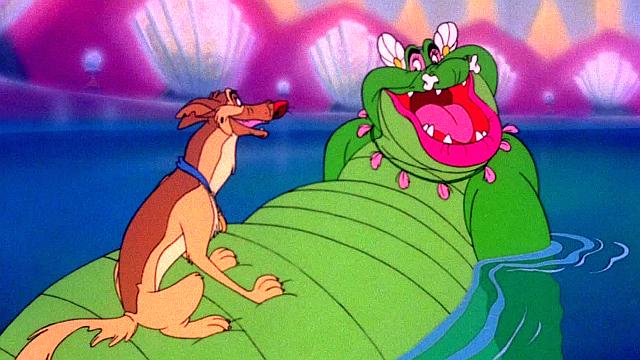 We are about three-quarters of the way through the animated film All Dogs Go To Heaven (1989), which was only moderately successful at the time. Charlie (Burt Reynolds) and Anne-Marie narrowly escape the ambush by Carface and Killer, hide in an empty office block, but suddenly fall through the rotten floor and plummet down into the water. Something lives there…
King Gator: Ahh! You look like a tasty New Orleans canine gumbo!
Charlie: [coughs]
Anne-Marie: Nooooo! Don’t eat him, please!
Charlie: [howls]
King Gator: Ahh! How can you expect me to eat a voice as sumptuous as this?
Ah, thank goodness – the giant alligator with the thick lips is mad about music; he’s completely enthralled by Charlie’s tenor voice and, inspired, doesn’t eat Charlie but strikes up a chanson (“Let’s Make Music Together”). After a moment’s bewildered hesitation, Charlie joins in and escapes death. After that, Anne-Marie and Charlie set off again.
King Gator & Charlie – Let’s Make Music Together:
We won’t see King Gator again; the interlude adds nothing to the plot, nor does it add any depth to the main characters. Yet it does have some effect: we owe it the term that is gradually finding its way into the standard vocabulary of critics: a Big-Lipped Alligator Moment. Introduced by film critic Doug Walker in 2009 as he attempted to articulate what bothered him about a similarly pointless, musical interlude in the film FernGully: The Last Rainforest, which, according to Walker, comes out of nowhere and is completely irrelevant to the story.
Not entirely unusual in films, although a discussed scene often leads to heated debates on forums about whether or not it has relevance. A classic example is the debate over the first Indiana Jones film, Raiders Of The Lost Ark (1981), which has been raging for over twenty years now, after a film critic (Jeffrey Westhoff, Northwest Herald) bluntly claimed in 2003: “My big complaint: Take Indiana Jones out of the story, and nothing changes. The Nazis still find the Ark, still open it, still die,” a debate that flared up again in 2013 when the popular sitcom The Big Bang Theory devoted an episode to this supposed Big Lipped Alligator criticism. Or the Esmarelda Villalobos segment in Pulp Fiction (1994), the female taxi driver who takes Butch (Bruce Willis) from A to B. She appears out of nowhere, has a spectacular name, is colourful and intriguing, delivers a charged dialogue, there is a one-sided erotic tension, and then Butch gets out, unmoved and uninterested, and we never see Esmarelda again.
We see it less often in novels. Plenty of subplots, of course, but writers – or their editors at the publishing house – usually take great care to ensure that the subplot intersects with or influences the main plot, or at least adds some depth to it. For some 24 centuries now, we have been heeding Aristotle’s precept from the Poetics, which prescribes Unity Of Action. Even in monumental, sprawling works such as The Lord of the Rings with its dozens of subplots, or Knausgård’s six-volume Min Kamp, there is always that common thread, that main plot to which every subplot remains connected. “In my novels, a sparrow falling from the roof is never meaningless,” as Dutch writer W.F. Hermans, one of the Big Three, stated in 1964 (in the essay Experimental Novels in the collection The Sadistic Universe), with which the staunch atheist Hermans, incidentally, seems to allow himself a nod to Jesus in one fell swoop (Matthew 10:29: “Not a single sparrow falls to the ground without your heavenly Father knowing it”). Or Hermans considers himself a god, which is more likely.
His Eye Is On The Sparrow – Tennessee Ernie Ford:
And then there is Nobel Prize winner Dylan, who displays a refreshing lack of respect for Aristotle, generally disregarding the unity of time and place anyway, and seeming to regard the unity of action not as a requirement but, at most, as non-binding advice, and who has not a single literary objection to Big Lipped Alligator Moments. In his mosaic lyrics, Dylan has been skirting the dividing line for sixty years, moving in the thin twilight zone between irrelevant interlude and fitting puzzle piece. Well, in the lyrical songs, anyway, that is. Songs such as “Tombstone Blues”, “Shelter From The Storm” and “I Contain Multitudes” – songs without a continuous narrative and with seemingly unrelated verses, yet possessing an overarching, continuous vibe – conveying a human condition (as in “It’s Alright, Ma (I’m Only Bleeding)”), emotion (as in “Every Grain Of Sand”) or a cultural impression (as in “Desolation Row”).
Firmly within Aristotle’s framework, Dylan stays with his epic songs, like “The Lonesome Death of Hattie Carroll”, “Lily, Rosemary and the Jack of Hearts” and “Tin Angel” – songs with a plot and a consistent narrative, without any jarring subplots. Or the portraits such as “Like A Rolling Stone” or “Neighbourhood Bully”; consistent without any Big Lipped Alligator Moments.
But Dylan’s catalogue contains plenty of songs that do indulge in such digressions. Enough, at any rate, to gradually elevate it to a stylistic hallmark. One of the best-known examples is probably the intro to “Idiot Wind” from 1975, the 63 words that form a completely unrelated mini-novella about a murderer who gets away with it;
Someone’s got it in for me, they’re planting stories in the press
Whoever it is I wish they’d cut it out
                              but when they will I can only guess
They say I shot a man named Gray and took his wife to Italy
She inherited a million bucks and when she died it came to me
I can’t help it if I’m lucky
Or the “Boston interlude” in “Highlands” (1997), the seven verses in the middle of the marathon song, largely in the form of dialogue, recounting a complete anecdote. Appearing out of nowhere and then disappearing again without leaving a trace.
Or this twelfth verse of “Key West”, then; a mini-mini-novella with a beginning and an end, and even a melancholic mini-coda (“She’s still cute and we’re still friends”) – with absolutely no connection to anything else in the rest of the lyrics. A stylistic feature, incidentally, for which Dylan expressed his fascination some fifty years ago: “We don’t have to make any connections. None of this has to connect. In fact, it’s better if it doesn’t connect” (spoken to Sam Shepard, recorded by Shepard in the Rolling Thunder Logbook). Dylan is talking there about “a film” he wants to make during the tour, without having the slightest idea what that film should be about, or what Shepard might contribute to it. That eventually became, as we now know, Renaldo & Clara (1978) – the film with probably the highest number of Big Lipped Alligator Moments in the history of cinema. In which, incidentally, an interlude featuring the forced marriage of a twelve-year-old lad to a harlot in a dress with gold fringes would not be out of place either.
It’s better, after all, if it doesn’t connect.
To be continued. Next up Key West part 23: Adieu’s last action
Jochen is a regular reviewer of Dylan’s work on Untold. His books, in English, Dutch and German, are available via Amazon both in paperback and on Kindle: 
- Blood on the Tracks: Dylan’s Masterpiece in Blue
- Blonde On Blonde: Bob Dylan’s mercurial masterpiece
- Where Are You Tonight? Bob Dylan’s hushed-up classic from 1978
- Desolation Row: Bob Dylan’s poetic letter from 1965
- Basement Tapes: Bob Dylan’s Summer of 1967
- Mississippi: Bob Dylan’s midlife masterpiece
- Bob Dylan’s Greatest Hits
- John Wesley Harding: Bob Dylan meets Kafka in Nashville
- Tombstone Blues b/w Jet Pilot: Dylan’s looking for the fuse
- Street-Legal: Bob Dylan’s unpolished gem from 1978
- Bringing It All Back Home: Bob Dylan’s 2nd Big Bang
- Time Out Of Mind: The Rising of an Old Master
- Crossing The Rubicon: Dylan’s latter-day classic
- Nashville Skyline: Bob Dylan’s other type of music
- Nick Drake’s River Man: A very British Masterpiece
- I Contain Multitudes: Bob Dylan’s Account of the Long Strange Trip
- Bob Dylan’s Rough And Rowdy Ways – Side B
- Bob Dylan’s High Water (for Charley Patton)
- Bob Dylan’s 1971
- Like A Rolling Stone b/w Gates Of Eden: Bob Dylan kicks open the door
- It Takes A Lot To Laugh, It Takes A Train To Cry b/w Just Like Tom Thumb’s Blues – Bob Dylan’s melancholy blues
- Bob Dylan’s Rough And Rowdy Ways – Side A
- Bob Dylan takes Highway 61 – Seven mercurial songs
The Big Lipped Alligator is merely the reincarnation of Alfred the Alligator from Walt Kelly’s “Pogo”.
When words are used there can never be a complete disconnect because words themselves are inherently connected to each other.
Saint Augustine was influenced by Atristotle’s concept of ” eudaimonia”- finding fulfillment in the development of one’s artistic potential.
Dylan dreamt that he had killed Saint Augustine but he awoke in anger at the thought.
Not withstanding fragmention, with the help of accompanying music, a determined listener can detect a unity, an emotion and/ or a purpose connected to every Dylan song.