
Mother Of Muses part 1
by Jochen Markhorst
I The lyre and the laurel tree
Mother of Muses, sing for me
Sing of the mountains and the deep, dark sea
Sing of the lakes and the nymphs of the forest
Sing your hearts out, all your women of the chorus
Sing of honor and fate and glory be
Mother of Muses, sing for me
The song title and catchphrase – the punchline, if you will – is a somewhat corny and lazy paradox, but that doesn’t make the song any less popular; “I Forgot To Remember To Forget” was Elvis’s first number one hit (in the country charts, 1955); Buddy Holly loved it (on a recording that has sadly been lost, 1956); Johnny Cash even recorded it twice (1959 and 1981), as did Jerry Lee Lewis (1957 and 1961); The Beatles played it at the BBC in 1964… the entire premier league had “I Forgot To Remember To Forget” in their repertoire. And Dylan played it for the first time in 1967 with his mates in the Basement, and again later during the Self Portrait sessions in 1970. “A little rockabilly,” is how Robbie Robertson describes it in his autobiography Testimony, which is certainly true of Elvis’s version, but Dylan, just like Johnny Cash and Jerry Lee, really does turn it into an unadulterated country tearjerker. The lyrics by songwriter Stan Kesler do indeed suggest that the song was intended as a tear-in-your-beer country ballad, but on the surviving 1955 demo by Charlie Feathers, the demo that Sam Phillips then used to convince Elvis to record the song, we hear Charlie turning it into rock ‘n’ roll (after which Feathers claimed – and received – a songwriting credit for himself, which turned out to be exceptionally lucrative a short while later).
It is the song to which Dylan’s “Mother of Muses” initially leads us. After all, the first thing we see—the title—and the first thing we hear—the opening words—promise something akin to an ode or a plea to the mother of the muses, Mnemosyne. And in Greek mythology, Mnemosyne is, of course, the personification of memory. It seems a red herring, though. Dylan’s narrator continues his invocation with a request to inspire him, to sing to him of mountains and faraway waters, of mystical nymphs in the forest and of honour, fate and glory; in short: to inspire him to invent epic tales. Which is, in fact, a request to the third daughter of the Muses’ mother, to Calliope, the muse of the heroic epic.
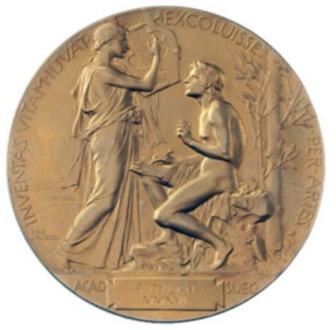
Calliope, whom the narrator will explicitly name-check later in the fourth verse, is, however, not an obvious choice either. Mnemosyne was impregnated nine times over nine consecutive nights by her nephew, Zeus. From this dubious union came her nine daughters, the nine Muses. The muse of tragedy, and of comedy, and of flute-playing and whatnot. The muse whom Dylan’s narrator seems to be referring to is the first daughter, Erato. She is the muse of the hymn, the song and lyric poetry, and moreover, the muse depicted on the reverse of the Nobel Prize in Literature medal, the medal that Dylan studies so intently:
“We chatted for a while about the medal and admired the beautifully crafted reverse – I’d never seen it myself – which depicts a young man sitting beside a leafy laurel tree, writing whilst listening to the muse singing to the strains she draws from her lyre. The inscription is taken from Virgil’s Aeneid, the Roman national epic from the period just before the birth of Christ, and reads Inventas vitam iuvat excoluisse per artes, which in English is usually rendered as ‘it is a joy to see how the inventor’s achievements enrich human life’. Dylan needed no guidance whilst we were looking at it. He quickly recognised the muse, the lyre and the laurel tree – it was clear from his comments.”
(Sara Danius, Om Dylan, 2018)
“Spirits were high. Champagne was had,” Sara Danius adds, then Permanent Secretary of the Swedish Academy, in a blog post from 2017.
Having devoted sixty years to the art of songwriting, and thereby having reached the very highest peaks, including Olympus, it is certainly more plausible that Dylan, through the voice of his narrator, calls upon Erato. All the more so given that we have heard Dylan declare for decades, in interviews and speeches, that he is merely a conduit, a receiver of songs. Recently, in the New York Times interview with Douglas Brinkley, June 2020: “Those kinds of songs for me just come out of the blue, out of thin air. I never plan to write any of them.” Or as he told Robert Shelton over forty years earlier, in 1978: “I’m just the postman. I deliver the songs.” Which is, incidentally, a sentiment widely shared among great songwriters. Sir Paul recounts that “Yesterday” was bestowed upon him in a dream, just as Paul Simon reveals that the songs for Seven Psalms were sent to him by “a voice in a dream.” Or Barry Gibb, who explains in the moving documentary How Can You Mend A Broken Heart (2020):
“It’s a sort of… like a radio transmitter. It’s almost as if somebody’s already written the songs in the air and they’re giving them to us.”
And Coldplay’s songwriter Chris Martin says the same thing in that same documentary, but puts it a little more poetically: “Like surfers with waves. Surfers don’t make the waves. Fishermen don’t make the fish. Songwriters don’t really write songs. You receive songs.” Virtually identical, once again, to Dylan’s words in that Douglas Brinkley interview:
“The songs seem to know themselves and they know that I can sing them, vocally and rhythmically. They kind of write themselves and count on me to sing them.”
All testimonies from great, successful songwriters who identify with that young man on the reverse of the Nobel Prize medal—the laurel-crowned young man who uncritically jots down whatever the lyre-playing Erato sings to him like a radio transmitter.
All in all, it seems that Dylan is not referring to Mnemosyne at all, but is using mother of as a superlative, following the model of Saddam Hussein’s “umm al-ma’ārik”, Mother of all Wars from 1990, which soon became a meme avant-la-lettre; pizzerias advertising the Mother of all Pizzas, car dealers with the Mother of all Deals, and weathermen warning of the Mother of all Storms, and is by now used almost unironically as well: the US military announcing the Mother of all Bombs, the New Zealand government presenting the Mother of all Budgets… and Dylan, on an album that is one big tribute to songs, calling song inspiration the Mother of Muses.
To be continued. Next up Mother Of Muses part 2: To me writing a song was, you know, a miracle
—————-
Jochen is a regular reviewer of Dylan’s work on Untold. His books, in English, Dutch and German, are available via Amazon both in paperback and on Kindle:
- Blood on the Tracks: Dylan’s Masterpiece in Blue
- Blonde On Blonde: Bob Dylan’s mercurial masterpiece
- Where Are You Tonight? Bob Dylan’s hushed-up classic from 1978
- Desolation Row: Bob Dylan’s poetic letter from 1965
- Basement Tapes: Bob Dylan’s Summer of 1967
- Mississippi: Bob Dylan’s midlife masterpiece
- Bob Dylan’s Greatest Hits
- John Wesley Harding: Bob Dylan meets Kafka in Nashville
- Tombstone Blues b/w Jet Pilot: Dylan’s looking for the fuse
- Street-Legal: Bob Dylan’s unpolished gem from 1978
- Bringing It All Back Home: Bob Dylan’s 2nd Big Bang
- Time Out Of Mind: The Rising of an Old Master
- Crossing The Rubicon: Dylan’s latter-day classic
- Nashville Skyline: Bob Dylan’s other type of music
- Nick Drake’s River Man: A very British Masterpiece
- I Contain Multitudes: Bob Dylan’s Account of the Long Strange Trip
- Bob Dylan’s Rough And Rowdy Ways – Side B
- Bob Dylan’s High Water (for Charley Patton)
- Bob Dylan’s 1971
- Like A Rolling Stone b/w Gates Of Eden: Bob Dylan kicks open the door
- It Takes A Lot To Laugh, It Takes A Train To Cry b/w Just Like Tom Thumb’s Blues – Bob Dylan’s melancholy blues
- Bob Dylan’s Rough And Rowdy Ways – Side A
- Bob Dylan takes Highway 61 – Seven mercurial songs