
by Jochen Markhorst
III They’re locked together
Sing of Sherman, Montgomery and Scott
And of Zhukov, and Patton, and the battles they fought
Who cleared the path for Presley to sing
Who carved the path for Martin Luther King
Who did what they did and they went on their way
Man, I could tell their stories all day
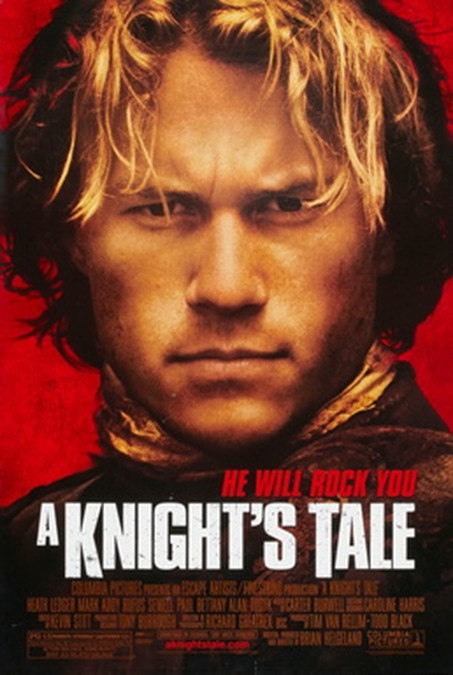 We are somewhere in 14th-century Europe and Sir Ector has passed away. His squires suddenly find themselves without an income and decide on a daring, fraudulent scheme: one of them, William Thatcher (Heath Ledger), dons the armour and enters tournaments, under a false name, as only nobles are allowed to take part in jousting and sword fights. The resourceful Geoffrey Chaucer is a man of letters and has no qualms about forging documents, and so William becomes “Sir Ulrich von Liechtenstein from Gelderland”. Before his entrance onto the tournament field, the crowd is whipped into a frenzy: Queen’s “We Will Rock You” gets everyone fired up. The crowd stamps and claps in time to the beat, soldiers thump their lances, and even in the VIP stand, the nobles sing and clap along.
It is one of the witty scenes in A Knight’s Tale (Brian Helgeland, 2001), the film loosely based on the story of the same name from Chaucer’s Canterbury Tales. Equally alienating and charming is the dance scene; William is challenged to demonstrate a dance from his ‘homeland’ of Gelderland and steals the show with a dance in which the stately, courtly medieval music gradually transforms into Bowie’s irresistible “Golden Years”.
“Caesar, ‘tis strucken eight,” says Brutus in Shakespeare’s Julius Caesar (Act II, Scene 2), some 15 centuries before mechanical clocks with striking mechanisms were invented. Crusaders wearing wristwatches, cowboys firing guns that, at that point in time, were still a long way off from being invented, Lancelot saying “okay” to Percival… mistakes can be funny or irritating, but apart from that, artists have been using anachronisms for centuries to add value. In seventeenth-century paintings, we see biblical figures in seventeenth-century clothing, precisely to avoid alienation and facilitate identification, or to add symbolic meaning (such as a small crucifix above the manger in the nativity scene); in The Flintstones, every episode is one long series of anachronisms, all of which are funny (Wilma vacuuming with a dwarf mammoth, dinosaurs used as excavators); Sherlock exposing a supposed Vermeer as a forgery because he spots the Van Buren supernova in the night sky (an exploding star that could not have been observed until 1858, some two hundred years after Vermeer’s death) – deliberate anachronisms serve many different functions and can be found in every art form.
In the twenty-first century, Dylan too seems to be developing a soft spot for it. On Tempest (2012), for example, we hear All the early Roman Kings in their sharkskin suits (“Early Roman Kings”); He leaned down, cut the electric wire (“Tin Angel”); Jim Dandy and Leonardo DiCaprio are aboard the sinking Titanic (“Tempest”); in a nineteenth-century “Scarlet Town”, barman Joe plays Ernest Tubbs’ “Walking The Floor Over You” (1941) on request for a junkie whore, and more.
Here on Rough And Rowdy Ways, Dylan continues along those lines. The narrator in “Key West” hears on the radio – years before radios even existed – about the assassination of President William McKinley (1901); Dylan brings Anne Frank together, years after her death, in a trio with The Rolling Stones and Indiana Jones; in one verse, a work by William Blake from 1789 is mentioned in the same breath as a French film from 1945… to name but a few of the dozens of examples on the album where linear time seems not to exist; “everything’s flowing all at the same time”, as the narrator says in the opening song “I Contain Multitudes”.
The many anachronisms in Dylan’s later work seem different from the “common” anachronisms we are familiar with from paintings, films and plays, though. At most, Dylan’s are alienating, comparable to the “V-Effekte” – Verfremdungseffekte, the alienation effects in Bertolt Brecht’s plays – but without the function for which Brecht employed them. Brecht seeks to prevent the audience from becoming immersed in the plot, so that they can critically engage with the underlying, usually social, theme. This does not seem to be the case with Dylan. Dylan’s historical inconsistencies seem far more the result of a freely associating poet for whom linear time does not exist, nor intends to respect anything like a distinction between fiction and non-fiction. As his answer to Douglas Brinkley’s question about that baffling trio Anne Frank, Indiana Jones and The Stones does illustrate:
“Somewhere in the universe those three names must have paid a price for what they represent and they’re locked together. And I can hardly explain that. Why or where or how, but those are the facts.”
(New York Times, 12 June 2020)
It is apparently irrelevant that one is fictional and the other historical, or that The Stones were not formed until seventeen years after Anne Frank’s tragic fate and horrific death in Bergen-Belsen – they’re inextricably linked, they’re locked together.
Dylan creates a similar dynamic here in this third verse of “Mother of Muses”. He echoes Homer’s invocation of the Muses, but does not ask the Muse to inspire him by singing of fictional, mythological war heroes like Odysseus and Achilles from ancient Greece, but rather of historical, real war heroes from the modern era; William Tecumseh Sherman, a Union general during the American Civil War, known for his “March to the Sea”; Bernard Montgomery, a highly decorated British field marshal who commanded the Allied forces during the First and Second World Wars; Winfield Scott, a prominent general in the US Army who served for decades during the War of 1812, the Mexican–American War and the early stages of the Civil War; and Georgi Zhukov and George S. Patton, two of the most influential Allied commanders of the Second World War.
Who, according to the muse-inspired narrator, then “cleared the path for Presley to sing” and “carved the path for Martin Luther King”… which, in turn, is another of those strange, Anne Frank & Indiana Jones-style connections requiring quite a bit of mental and intellectual acrobatics to see the suggested cause-and-effect relationship. “They’re locked together. And I can hardly explain that. Why or where or how, but those are the facts.”
To be continued. Next up Mother Of Muses part 4: And of course Henry the Horse dances the waltz
Jochen is a regular reviewer of Dylan’s work on Untold. His books, in English, Dutch and German, are available via Amazon both in paperback and on Kindle: 
- Blood on the Tracks: Dylan’s Masterpiece in Blue
- Blonde On Blonde: Bob Dylan’s mercurial masterpiece
- Where Are You Tonight? Bob Dylan’s hushed-up classic from 1978
- Desolation Row: Bob Dylan’s poetic letter from 1965
- Basement Tapes: Bob Dylan’s Summer of 1967
- Mississippi: Bob Dylan’s midlife masterpiece
- Bob Dylan’s Greatest Hits
- John Wesley Harding: Bob Dylan meets Kafka in Nashville
- Tombstone Blues b/w Jet Pilot: Dylan’s looking for the fuse
- Street-Legal: Bob Dylan’s unpolished gem from 1978
- Bringing It All Back Home: Bob Dylan’s 2nd Big Bang
- Time Out Of Mind: The Rising of an Old Master
- Crossing The Rubicon: Dylan’s latter-day classic
- Nashville Skyline: Bob Dylan’s other type of music
- Nick Drake’s River Man: A very British Masterpiece
- I Contain Multitudes: Bob Dylan’s Account of the Long Strange Trip
- Bob Dylan’s Rough And Rowdy Ways – Side B
- Bob Dylan’s High Water (for Charley Patton)
- Bob Dylan’s 1971
- Like A Rolling Stone b/w Gates Of Eden: Bob Dylan kicks open the door
- It Takes A Lot To Laugh, It Takes A Train To Cry b/w Just Like Tom Thumb’s Blues – Bob Dylan’s melancholy blues
- Bob Dylan’s Rough And Rowdy Ways – Side A
- Bob Dylan takes Highway 61 – Seven mercurial songs
Speaking of anachronisms, writers of the New Testament, though the story of Jesus comes after the Old Testament’s written, claim His birth be foretold in the Old.
However, there is no hard evidence wharsoever in the Old Testament that this is the case.
A specific reference to Jesus ‘per se’ cannot be found therein.
Bob Dylan calls Luke “a snob” (in Tarantula)- Saint Luke compares Jesus to a stubborn ox that’s going to be sacrificed after all its ploughing in the fields – for asserting that Luke himself spoke to eye witnesses, and consulted writings from the Old Testament, that confirm that those written in the New were true.
Speaking of anachronisms, the New Testament claims that the Old Testament confirms that Jesus is coming though there is no evidence whatsoever in the Old Testament that specifically asserts this, that names Jesus outright.