by Jochen Markhorst
IV And of course Henry the Horse dances the waltz
I'm falling in love with Calliope
She don't belong to anyone, why not give her to me?
She's speaking to me, speaking with her eyes
I've grown so tired of chasing lies
Mother of Muses, wherever you are
I've already outlived my life by far
 “We cut the whole record in three weeks,” says Bruce Springsteen in his 2016 autobiography Born To Run about his first album, Greetings from Asbury Park, N.J. (1973). Ten tracks, including great songs such as “Does This Bus Stop At 82nd Street?”, “It’s Hard To Be A Saint In The City” and “For You”, but Columbia Records boss Clive Davis rejects. Not good enough. “No hits. Nothing that’ll get played on the radio.” Bruce isn’t discouraged:
“I went to the beach and wrote “Spirit in the Night”, came home, busted out my rhyming dictionary and wrote “Blinded by the Light”, two of the best things on the record. […] I never wrote completely in that style again. Once the record was released, I heard all the Dylan comparisons, so I steered away from it.”
The Boss isn’t particularly proud of “Blinded By The Light”, apparently – even though it is his only number one hit. Admittedly, in Manfred Mann’s Earth Band’s version (1976), but still. Rhyming dictionary, just something he’d whipped up off the cuff, sounds too much like Dylan… and in the documentary Letter To You (Thom Zimny, 2020), Bruce reveals what the final nail in the coffin was:
“They were just the way I wrote back then. A lot of words. Matter of fact, Clive Davis, the man who signed me to Columbia Records with John Hammond, called me briefly after our record Greetings from Asbury Park was released and said someone had called him and told him if I wasn’t careful, I was going to use up the entire English language. And he said that that was Bob Dylan. Now, Bob was always my mentor and the brother that I never had, so I took these words quite seriously.”
Dylan’s criticism smacks of the pot calling the kettle black, and Springsteen is a little too dismissive. The lyrics of “Blinded By The Light” may be verbose, but they are above all irresistibly playful, rhythmically strong, less vacuous than critics think, and decidedly different;
Some silicone sister with a manager mister
Told me I got what it takes
She said, "I'll turn you on, son, into something strong
Play the song with the funky break"
… underneath all that frenzied, Cole Porter-esque rhyming fun, the wild alliterations and mad imagery (“Go-kart Mozart”, “Some brimstone baritone anti-cyclone rolling stone preacher from the East”) Bruce paints a recognisable, lyrical and moving coming-of-age self-portrait of the struggles of an ambitious young man – Bruce’s very own version of Dylan’s “My Back Pages”, all in all.
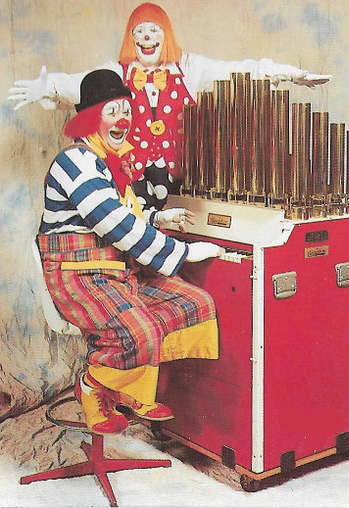
And we hear an echo of those fierce images here in Dylan’s song: “The calliope crashed to the ground.” A completely different calliope, however, from Dylan’s Calliope (with a capital C); Springsteen is referring to that marvellous nineteenth-century invention, the loud, mechanical “American patented steam piano”, as its inventor Joshua C. Stoddard called it – a steam organ in which the pipes have been replaced by dozens of steam whistles. Showmen with a greater sense of flair, such as circus director P.T. Barnum, christened the monstrous contraption the “calliope”, presumably for marketing reasons, to lend the beast a touch of elegance and distinction. A false pretence, of course; we associate the calliope solely with fairground clamour, merry-go-rounds and circus chaos – not with concert halls or refined compositions. Consequently, we very rarely hear it on records. Throughout the entire twentieth century, presumably only in “Being For The Benefit Of Mr. Kite!”, although George Martin does cheat a bit there:
“John had said that he wanted to smell the sawdust on the floor, wanted to taste the atmosphere of the circus. I said to him, ‘What we need is a calliope.’ ‘A what?’ ‘Steam whistles, played by a keyboard.’ Unable to find an authentic calliope, Martin resorted to tapes of calliopes playing Sousa marches. ‘[I] chopped the tapes up into small sections and had Geoff Emerick throw them up into the air, re-assembling them at random.’”
(The Beatles Recording Sessions, Mark Lewisohn, 1988)
It would then be another few decades before we hear a calliope featured by a top-tier artist; in the early twenty-first century, Tom Waits becomes fascinated by the infernal monstrosity and plays it on three tracks for his album Blood Money (2002). Fully acknowledging that he is not using it for lyrical expressiveness or melodic beauty: “There’s an old expression, ‘Never let your daughter marry a calliope player.’ Because they’re all out of their minds. Because the calliope is so bloody loud,” he explains to GQ Magazine’s interviewer Elizabeth Gilbert in June 2002. But he still did buy one, and is rather proud of it at that:
“It’s got 57 whistles. The sound is incomparable. You can scream right at the keyboard of a calliope and not be heard… There’s a motor in another room. Actually, a background in car repair is gonna help you more in working on a calliope than a background in music… I’m not allowed to play it around here. I have neighbours. It’s like a car up on blocks right now.”
So it’s rarely played, but as a set piece, the calliope pops up often enough in songs. Apart from its appearance in “Blinded By The Light” in Michael Jackson’s “Carousel”, for example, it features in Harry Belafonte’s “Mark Twain”, Warren Zevon’s “Tule’s Blues”, and remarkably often in rap and hip-hop circles; our rapping friends seem charmed by the inherent euphony, rhyming potential and rhythm of the word “calliope”. As is – and there’s the Dylan connection – Grateful Dead’s lyricist Robert Hunter.
Robert Hunter is the man with whom Dylan has collaborated regularly since the 1980s (two songs on Down In The Groove, almost all the songs on Together Through Life and “Duquesne Whistle”) and whom Dylan regards as an equal: “We could probably write a hundred songs together if we thought it was important or the right reasons were there,” he said in a 2009 Rolling Stone interview. And Hunter is one of the rare colleagues who not only features Calliope the Steam Organ, but also Calliope the Muse. In the old fan favourite “St. Stephen” from 1969:
Fortune comes a-crawling, Calliope woman
Spinning that curious sense of your own
Apart from that, Hunter seems just as receptive to the euphony of words as our rapping friends; in the Dead songs “Cosmic Charlie” and “The Music Never Stopped”, “calliope” appears as a steam organ. Which can be read in David Dodd’s brilliant 2005 book The Complete Annotated Grateful Dead Lyrics, featuring an extensive, fascinating foreword by Robert Hunter. In it, he indirectly articulates his artistic kinship with Dylan, as he reflects essayistically on the essence of songwriting, the magic of metaphors, scatology (“Tracking the spoor of the song, detecting borrowings, influences, and/or outright thefts”) and ontology (“The examination of causative factors, of intent. What was the impulse that seemed to require certain images to be duly expressed?”), and “poetics, the land of measured feet, onomatopoeia, and rhythmic accent,” culminating in the assertion with which Hunter brings his and Dylan’s oeuvre under a single umbrella:
“Copyright is an interesting and fairly new idea, but I don’t think it’ll ever rule the creative sphere where all things interpenetrate and cross-fertilise.”
… an academic and most elegant way of paraphrasing T.S. Eliot’s credo “mature poets steal”. To which Hunter adds: “Successful linkage is a gift of the moment’s Muse—it comes out of the blue or it doesn’t come.”
It is a wonderful, revealing, captivating and lengthy essay (well over 7,000 words). Clearly inspired by Calliope, the muse of eloquence. And, in passing, Robert Hunter explains why Dylan shouldn’t seeks Calliope’s love, but rather the more obvious Erato, the muse of song and lyric poetry: “Words are no longer strictly necessary, they have done their duty toward the primary evocation; rhythm and tonality alone prolong the experience.”
Or, as Dylan says the same in his Nobel Prize acceptance speech: “It sounds good. And you want your songs to sound good.”
To be continued. Next up Mother Of Muses part 5: Creative person meets a muse
Jochen is a regular reviewer of Dylan’s work on Untold. His books, in English, Dutch and German, are available via Amazon both in paperback and on Kindle: 
- Blood on the Tracks: Dylan’s Masterpiece in Blue
- Blonde On Blonde: Bob Dylan’s mercurial masterpiece
- Where Are You Tonight? Bob Dylan’s hushed-up classic from 1978
- Desolation Row: Bob Dylan’s poetic letter from 1965
- Basement Tapes: Bob Dylan’s Summer of 1967
- Mississippi: Bob Dylan’s midlife masterpiece
- Bob Dylan’s Greatest Hits
- John Wesley Harding: Bob Dylan meets Kafka in Nashville
- Tombstone Blues b/w Jet Pilot: Dylan’s looking for the fuse
- Street-Legal: Bob Dylan’s unpolished gem from 1978
- Bringing It All Back Home: Bob Dylan’s 2nd Big Bang
- Time Out Of Mind: The Rising of an Old Master
- Crossing The Rubicon: Dylan’s latter-day classic
- Nashville Skyline: Bob Dylan’s other type of music
- Nick Drake’s River Man: A very British Masterpiece
- I Contain Multitudes: Bob Dylan’s Account of the Long Strange Trip
- Bob Dylan’s Rough And Rowdy Ways – Side B
- Bob Dylan’s High Water (for Charley Patton)
- Bob Dylan’s 1971
- Like A Rolling Stone b/w Gates Of Eden: Bob Dylan kicks open the door
- It Takes A Lot To Laugh, It Takes A Train To Cry b/w Just Like Tom Thumb’s Blues – Bob Dylan’s melancholy blues
- Bob Dylan’s Rough And Rowdy Ways – Side A
- Bob Dylan takes Highway 61 – Seven mercurial songs