by Jochen Markhorst
VII And now and then a white elephant
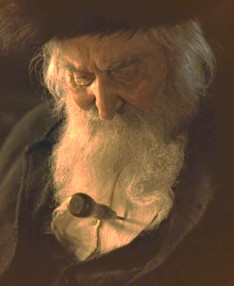 It does have something of the opening scene in A Serious Man, the somewhat unjustly overlooked Kafkaesque film by the Coen Brothers from 2009. We are somewhere in the nineteenth century, in a snow-covered shtetl* in the far east of Austria-Hungary, near Lvov, in what is now western Ukraine. The language spoken is Yiddish. Velvel comes home in high spirits. “I’ve been expecting you for hours,” says his wife Dora gruffly, whilst chipping away at the ice with an ice pick. Velvel explains that he’s had a bit of bad luck; one of the wheels on his cart came off – but luckily, a passer-by came to his aid. “Someone you know,” he says to Dora: “Traitle Groshkover!” Dora suddenly stops chopping. Alarmed, she glances briefly at Velvel, who enthusiastically continues to recount the encounter, but Dora’s gaze wanders off into the distance, and she says, more to herself: “God has cursed us.”
Velvel
What?
Dora
Traitle Groshkover has been dead for three years.
Laughter erupts from the man but, as his wife continues to stare at him, he strangles on it.
Quiet.
Wind whistles under the eaves.
Velvel
Why do you say such a thing! I saw the man! I talked to him!
Dora
You talked to a dybbuk. Traitle Groshkover died of typhus in Pesel Bunim’s house. Pesel
told me – she sat shiva for him.
They stare at each through a silence broken only by the sound of the quickening wind. A rap at the door. Neither immediately responds.
Dora [to Velvel]
Who is it?
Velvel
I… invited him here. For some soup, to warm himself.
The wind moans.
He helped me, Dora!
Old Traitle strides in cheerfully. Dora doesn’t buy it. This is a dybbuk, the soul of a dead person that has taken possession of a body, and she says so. When her husband then begins to apologise on his wife’s behalf, she stabs, without further ado, the ice pick into Traitle’s chest. Velvel lets out a scream, but Traitle, after a moment of bewilderment, looks at the ice pick in his chest and bursts out laughing. “What a wife you have!” he roars with good humour. Then he becomes more serious, struggles to rise from his chair and leaves the cottage. “One knows when one’s not wanted.” The ice pick is still protruding from his chest; blood is slowly staining his shirt red.
The screen goes dark, the opening credits roll across the screen, and when the light returns, it is 1967 and we are in Minnesota, in a classroom where a pupil, wearing an earpiece connected to a small transistor radio, is secretly listening to Jefferson Airplane.
Nothing from that weird, macabre 7-minute prologue reappears in the film. No reference, not a single name, no mirror scene, nothing. The main character, Larry Gopnik, and his family are also Jewish – that’s about it.
——————–
Dylan tried his hand at such an unrelated prologue one single time. In “Idiot Wind”, one of the ten highlights on Blood On The Tracks (1975), the song opening with a man accused of murder and fleeing to Italy.
Part 1 of the four-part “Murder Most Foul” (if, for the sake of convenience, we regard the chorus lines containing it’s murder most foul as the closing section of a part, the lyrics consist of four parts) is 20 lines long and focuses in every line – sometimes factually, sometimes sketchily, impressionistically – on the assassination of JFK. It then, in Part 2, seemingly leaves the assassination and the crime scene behind with a sudden detour to The Beatles and Gerry and the Pacemakers, moving a year on and a continent away. Seemingly, as now references to the assassination pop up, irregularly and unpredictably – eight times in the thirty lines of Part 2 for example, in the thirty lines of the second “verse”.
It is an original, unsettling and mesmerising narrative device. Not like A Serious Man or “Idiot Wind”, where the opening simply fizzles out, nor like films such as Magnolia (1999), Pulp Fiction (1994) and Coffee and Cigarettes (2003), or songs such as “The Cuckoo Is A Pretty Bird”, “Life On Mars?” and “A Day In The Life”, or novels such as Milan Kundera’s The Book of Laughter and Forgetting (1978) and Georges Perec’s fascinating Life: A User’s Manual, also from 1978: works of art consisting of unrelated or only very loosely related parts, which have a snapshot-like quality, and are held together at most by something as transcendent as a theme or décor. Which is a form that Dylan, incidentally, often and gladly chooses (“Tombstone Blues”, “Goodbye Jimmy Reed”, “Changing Of The Guards” and dozens more).
But that isn’t what “Murder Most Foul” is either – each of the three parts following that bloody prologue is a patchwork of unrelated impressions, musings, images and requests, in which references to the murder keep recurring at irregular intervals, some more sketchy than others.
It is a rather unique poetic form. At most, it is comparable to a poem such as Rilke’s “Das Karussel”, one of his most perfect Dinggedichte, written in the Jardin du Luxembourg in 1906. It is a dizzying, hypnotic masterpiece in which Rilke lyrically expresses his impressions of a spinning carousel. Horses, an angry red lion, laughing children, a deer with a saddle, red, green and grey, a girl in blue… und dann und wann ein weißer Elefant (“And now and then a white elephant”); the poet interrupts the cascade of images at irregular intervals with that one recurring observation and now and then a white elephant – much as Dylan interrupts his wildly swirling stream of impressions, sighs, images and requests at irregular intervals with recurring references to JFK.
It actually seems like a fitting way to describe a work of art like “Murder Most Foul”: a carousel. A snapshot of an era, a mosaic blurred by movement, partly reduced to colours and details, in which one returning constant continues to pop up: the assassination of JFK.
*A small town with a Yiddish speaking Jewish population to be found in Eastern Europe prior to 1939.
To be continued. Next up Murder Most Foul part 8: “I can only hope I can be as influential”
Jochen is a regular reviewer of Dylan’s work on Untold. His books, in English, Dutch and German, are available via Amazon in both paperback and on Kindle:
- *Blood on the Tracks: Dylan’s Masterpiece in Blue*
- Blonde On Blonde: Bob Dylan’s mercurial masterpiece
- Where Are You Tonight? Bob Dylan’s hushed-up classic from 1978
- Desolation Row: Bob Dylan’s poetic letter from 1965
- Basement Tapes: Bob Dylan’s Summer of 1967
- Mississippi: Bob Dylan’s midlife masterpiece
- Bob Dylan’s Greatest Hits
- John Wesley Harding: Bob Dylan meets Kafka in Nashville
- Tombstone Blues b/w Jet Pilot: Dylan’s looking for the fuse
- Street-Legal: Bob Dylan’s unpolished gem from 1978
- Bringing It All Back Home: Bob Dylan’s second Big Bang
- Time Out Of Mind: The Rise of an Old Master
- Crossing The Rubicon: Dylan’s late-career classic
- Nashville Skyline: Bob Dylan’s other kind of music
- Nick Drake’s River Man: A very British masterpiece
- I Contain Multitudes: Bob Dylan’s Account of the Long Strange Trip
- Bob Dylan’s Rough and Rowdy Ways – Side B
- Bob Dylan’s High Water (for Charley Patton)
- Bob Dylan’s 1971
- Like A Rolling Stone b/w Gates Of Eden: Bob Dylan kicks open the door
- It Takes a Lot to Laugh, It Takes a Train to Cry b/w Just Like Tom Thumb’s Blues – Bob Dylan’s melancholic blues
- Bob Dylan’s Rough And Rowdy Ways – Side A
- Bob Dylan takes Highway 61 – Seven mercurial songs
- Bob Dylan’s Rough And Rowdy Ways – Side C