Singer/singwriter Bob Dylan makes use of the word ‘door’ as a rhyme in at least twenty of his songs.
Including in the following one about a “Peeping Tom”:
Standing on your window, honey
Yes, I've been here before
Feeling so harmless
I'm looking at your second door
(Bob Dylan: Temporary Like Achilles)
The alliterative song lyrics below take a poke at the Deconstructionists who claim that a word, whose meaning depends upon its relation to other words, can never adequately describe that which the word signifies – feelings of ‘lust’ and ‘love’, for example:
Searching for my double, looking for
Complete evaporation to the core
Though I tried, and failed at finding the door
I must have thought that there was nothing more
Absurd than that love is just a four letter word
(Love Is Just A Four Letter Word ~ Bob Dylan)
As Edgar Poe shows, as the Bible shows, and as Bob Dylan shows, the word ‘door’, as well as being easy to rhyme, signifies the separation, and, at the same time, the connection between the physical and spiritual aspects of the human being –‘door’ be more than just a four letter word.
Accompanied by music, written or spoken words in their context, as Dylan demonstrates, can come close enough to expressing what they signify – as the hyperbolic verse below illustrates:
If not for you
Babe, I couldn't even find the door
Couldn't even see the floor
(Bob Dylan: If Not For You)
Bluesmen are particularly fond of the metonymic door – employed to depict the physical side of human nature.
Expressed with sadness in the lyrics below:
Don't drive this wolf from your door
Oh, have mercy darling
If God forgive me
I won't let you make me howl no more
(Howling Wolf: The Wolf Is At Your Door)
Upbeat in the lyrics of the song below:
The call of the wild is
Forever at my door
Wants to fly like an eagle
While being chained to the floor
(Bob Dylan: You Changed My Life)
Then down again in the following:
Well, the sun went down on me a long time ago
I've had to pull back from the door
I wish I could have spent every hour of my life
With the girl from the Red River shore
(Bob Dylan: Red River Shore)
Humorously expressed in the following:
I even got a hole in her bedroom floor
I got twenty-nine ways to make it to my baby's door
But if she needs me bad, I can find about two or three more
(Willie Dixon: Twenty-Nine Ways)
And very sorrowfully emoted in the Poe-like verse beneath:
Forgetful heart
Like a walking shadow in my brain
All night long
I lay awake, and listen to the sound of pain
The door has closed forevermore
If indeed there ever was a door
(Bob Dylan: Forgetful Heart ~ Dylan/Hunter)
Untold Dylan
We now have over 2000 articles on this site. You can find indexes to series linked under the image of Dylan at the top of the page and some relating to recent series on the home page.
Although no one gets paid for writing, publishing or editing Untold Dylan, it does cost us money to keep the site afloat, safe from hackers, n’er-do-wells etc. We never ask for donations, and we try to survive on the income from our advertisers, so if you enjoy Untold Dylan, and you’ve got an ad blocker, could I beg you to turn it off while here. I’m not asking you to click on ads for the sake of it, but at least allow us to add one more to the number of people who see the full page including the adverts. Thanks.
As for the writing, Untold Dylan is written by people who want to write for Untold Dylan. We welcome articles, contributions and ideas from all our readers. Although no one gets paid, if you are published here, your work will be read by a fairly large number of people across the world, ranging from fans to academics. If you have an idea, or a finished piece send it as a Word file to Tony@schools.co.uk with a note saying that it is for publication on Untold Dylan.
We also have a very lively discussion group “Untold Dylan” on Facebook with around 8500 active members. Just type the phrase “Untold Dylan” in, on your Facebook page or follow this link And because we don’t do political debates on our Facebook group there is a separate group for debating Bob Dylan’s politics – Icicles Hanging Down
Peter Krauth translated Key West into Hungarian, (quite a task to undertake) but found a few troubling phrases in Dylan’s original that caused him a few difficulties. Tony wrote a review in which he too picked up certain phrases that puzzled him – finding in fact that sometimes American English, doesn’t easily translate into English English.
Peter and Tony then had this exchange of thoughts by email, on some of the phrases. With Peter’s permission, Tony has taken that email exchange to create the article below, in the hope that one or two readers on Untold might find this exploration of meaning interesting…
Throughout, please do remember that Peter’s first language is not English, and that for Tony, American English is often quite different from English English.
Peter: In the song, there is a reference to “Budapest” on which you commented as “I am not familiar with the history of pirate radio in Hungary; maybe it’s just that Budapest rhymes with Key West.”
I agree with the latter sentence, and unfortunately I do not know of any pirate radio in Budapest either, although I have been living in Budapest for 66 years. However, I have an idea what the meaning of this reference could be.
In 1974, one of the most famous Hungarian rock groups (Locomotiv GT – or LGT) made a tour in US and recorded an album under the direction of Jimmy Miller (Rolling Stones’ production manager on some of their albums). I think it was the first rock group from Eastern Europe to make a tour in US. In 1974, Locomotiv GT‘s Locomotiv GT (Dunhill Records 811) album was released with the slogan “Radio Budapest Loves You!”. A couple of articles appeared in rock magazines lamenting that “the next.wave of rock n roll might come from the Eastern block” which could lead to the singer saying at concerts in the USA, “… you know guys, we travelled ten thousand miles away, to play some fuckin’ communist rock n roll to you!”
Gabor Presser who was a songwriter with the group and played synthetizer, is the only member of the group still alive. The other three members were: Tamas Barta – guitar (shot dead years later in US), Joseph Laux – drums (became a music producer/manager in the USA, died 2-3 years ago) and Tamas Somlo – (bass and trumpet, also died 2-3 years ago).
I have no information why this slogan was used in marketing the album and what its real meaning is. Gabor Presser can still be contacted to get information on this, but I guess that the slogan and magazine articles might have reached Dylan, and at that time (or in retrospective) it might have been considered by him as potential source of “inspiration”. It is also interesting that the word “love” is in the slogan and this word appears also in the verse containing the reference of “Budapest”.
Tony: I’ve got two other theories about Radio Budapest. One is irony, the other is that there may be no meaning here at all.
We all know of Radio Luxembourg which broadcast from the principality to England, when England had no popular music stations. During the 2nd world war the long wave transmitter was taken over by Germany for broadcasting propaganda by William Joyce, while post-war the medium wave transmitter broadcast in German and Dutch through the day and played English and American pop music at night.
Radio Luxembourg always aimed to be a lively upbeat station; in wartime William Joyce’s use of swear words and his commentaries in general were not only anti-UK but also utterly different from the stiff middle class language generally heard on the BBC, which is one reason why he gained such an audience. After the war there were no commercial stations in England, and the radio programmes (apart from a few comedy series) generally remained very formal. Radio Luxembourg played the latest pop and rock records – which could not be heard on British radio.
So Radio Luxembourg was lively and teenager base, and I think Radio Budapest being under communist control was found to be anything but that. So the notion that Radio Budapest could be a hip, exciting station was ironic. It would be a bit like calling the House of Lords (the very formal upper chamber of the British parliament) a hip swinging joint where the honourable members let it all hang out.
The other point comes back to an issue I’ve raised a few times – that not every line Dylan writes has a meaning. So the reference to “Radio Budapest” perhaps was indeed basically selected because of the rhyme with “Key West,” and nothing more than that.
Peter: What are boondocks?
Tony: This is where American readers are going to fall about laughing. Of course people from England and the USA understand each other, but we do have a lot of words that exist only in one of those countries not the other. So with questions like this I am going to guess, and hope that American readers might help clarify points, as there will be a lot of other people who don’t understand. I think it is an isolated or remote area,
Peter: Philosopher pirate?
Tony: I would guess he is a thinker whose thoughts are radical enough to mean that applying them would take one outside the law. Or maybe a law breaker who is also a deep thinker. Or again, just two words that when put together are fun because they are so unexpected. In short, an oxymoron. Indeed if we accept that Dylan enjoys oxymorons, lots of phrases suddenly become easier to understand.
Peter: “Under the radar under the gun.”
Tony: “Under the gun” is not a phrase I’m familiar with in English English, but I think in America it refers to being under pressure. As in Trump was under pressure to condemn the demonstrators at the Capitol. “Under the radar” means arriving unnoticed. Here I suspect Bob may have just liked the two phrases that start “under the” and used them together, without any specific meaning.
Peter: “China blossoms”
Tony: I think they are cherry blossoms that grow in China, but horticulture is not my subject!
Peter: Does “You stay to the left, and then you lean to the right” refer to the approach to Key West from the mainland?
Tony: I have no idea. I interpreted it as a comment about a person who changes his/her mind a lot, as in having left wing (ie tending to socialist) views, but in a discussion then supporting right wing ideas (as in Conservative in England). But it could be an Elvis single…
Peter: Does”not that far from the convent home” reaffirm his religious commitment?
Tony: I really have no idea! Please, someone who lives in the USA, help me out!
Peter: “I heard your last request” is potentially a reference back to the opening McKinley scene?
Tony: I guess it could be. I just heard it as a phrase that sounds good. Indeed onomatopoeia and alliteration are perfectly respectable devices within poetry. So a cuckoo is called that because it makes a sound like that (onomatopoeia). Alliteration also links the sound of words and what they describe (“the buzzing of innumerable bees” when said, sounds bit like the buzz). So it is possible to have phrases that in a more abstract way seem to have a meaning, but we don’t know what it is. (Is there a word that describes such a phrase? If so will someone please tell me what it is!!!)
Peter: How can we interpret “hot down here, and you can’t be overdressed”? If it is hot then you will be overdressed in any case. I would expect “under-dressed”.
Tony: “Hot” can describe actual temperature, but also in slang describes somewhere that is exciting, a great place to be, or it can be somewhere where trouble is brewing. A situation which is described as hot, could mean that a crime is being committed and the police are on their way. The use of hot in that way was later replaced by “cool” which is rather confusing! Under-dressed means being dressed too informally (wearing a t-shirt at a wedding) – the opposite of overdressed, not meaning too many clothes but actually meaning being too formally attired. I think Bob is playing again with multiple meanings. We have no idea which one he is referring to, and that is part of the fun.
Peter: “Playing both sides against the middle”
Tony: In England (if nowhere else) I think we are more likely to say, “Playing both ends against the middle” meaning trying to get two opposing factions to fight it out, so a third faction can move in and take control. The third faction positions themselves by implication, as the reasonable, balanced people in the middle, who are not extremists and so not involved in the fighting.
Peter: Would you think that the line “I’m so deep in love that I can hardly see” in the second verse is a forward reference to “Fly around, my pretty little Miss I don’t love nobody, give me a kiss” to the affair with the “friendly” prostitute in the last verse?
Tony: I think that is possible, but I really don’t know. My view of Bob is that he is very skilled at finding these phrases that can mean many different things, and he doesn’t seem to explain them.
To give one example: where I sit and write each day I look out onto the English countryside, and above and beyond I can see the sky. Today it is a beautiful blue, which in English romantic literature is associated with warm weather, going out in a t-shirt and shorts, relaxing in the sun. But in fact I write this in January, the depth of the English winter, and I know that if I want to go out I am going to need a very warm coat, and a hat covering my ears, thick socks… The exact opposite of how I will dress in July.
So the world is often misleading, just as words are often misleading, just as people are often misleading.
Thus if I had to give one key explanation of Bob’s lyrics it would be that the world is not as it appears. We have multiple questions all day long, but the obvious answers are often not the right answers. So “the answers are blowing in the wind” does not mean, the answers are out there if you would only look, but rather that the answers are changing all the while because nothing is clear and nothing is fixed. The answers are being blown around by the wind and we can’t grab them.
Footnote: Because I (Tony) am responding to Peter’s enquiries, I have had the last word throughout, and have thus constructed the debate around my thoughts. Peter, if (as I suspect) I have taken your thoughts and questions down a route you did not intend, please forgive me. As ever, my enthusiasm for words and language has got the better of me, and I have just let my imagination take over. But I am most grateful for your email, because I found unravelling some of the phrases you mentioned a really interesting and challenging job.
And do remember, I’m English, and Bob is American. We don’t speak the same language.
We now have over 2000 articles on this site. You can find indexes to series linked under the image of Dylan at the top of the page and some relating to recent series on the home page.
Although no one gets paid for writing, publishing or editing Untold Dylan, it does cost us money to keep the site afloat, safe from hackers, n’er-do-wells etc. We never ask for donations, and we try to survive on the income from our advertisers, so if you enjoy Untold Dylan, and you’ve got an ad blocker, could I beg you to turn it off while here. I’m not asking you to click on ads for the sake of it, but at least allow us to add one more to the number of people who see the full page including the adverts. Thanks.
As for the writing, Untold Dylan is written by people who want to write for Untold Dylan. We welcome articles, contributions and ideas from all our readers. Although no one gets paid, if you are published here, your work will be read by a fairly large number of people across the world, ranging from fans to academics. If you have an idea, or a finished piece send it as a Word file to Tony@schools.co.uk with a note saying that it is for publication on Untold Dylan.
We also have a very lively discussion group “Untold Dylan” on Facebook with around 8500 active members. Just type the phrase “Untold Dylan” in, on your Facebook page or follow this link And because we don’t do political debates on our Facebook group there is a separate group for debating Bob Dylan’s politics – Icicles Hanging Down
Everyone’s favourite obscure track, “To fall in love with you” has been reviewed over and again on this site, but nothing compares, in my opinion, with Jochen’s wonderful point that,
“Dylan tackles this song as he will later weld his large, metal gates: a fixed fillet and a strong framework, filled with an explosion of erratic, alienating objects.”
The point about the song, for me, is that having created the chord sequence and melody, but not been able to find the lyrics, Bob then didn’t go back and pick up what for many lesser songwriters would have appeared to be a masterpiece in waiting.
He didn’t go back, I think, because it didn’t quite fit the type of song he wanted to write at the time. Not because it wasn’t right, but because it wasn’t right for that moment.
So he just leaves it. The lyrics are unfinished, but the music is there ready, waiting, like a child outside the school gates when all the other children have been picked up and taken home. Forgotten, alone, until some kindly strangers come along to the rescue.
But there was something very strange going on here because this was not a period like the early parts of Dylan’s writing career where songs were just pouring out of him day by day. The song was recorded at the end of August 1986, so I think it is fair to take it that since it is unfinished the melody and chord structure were created just before the recording. Here are the antecedents.
To my ear this quite a collection of songs that have enormous potential. I won’t go through the whole list because they are all reviewed on this site, but I would single out “Rock em Dead” (which I have on my list as a possible contender for this imaginary “Obscuranti album). Likewise “Had a dream about you baby” is also not a song to be cast aside quite so readily as Bob did, in my opinion. Not as magical as
But this was a time when Bob was playing other people’s songs full-time, and it maybe that he was searching for something that simply wasn’t there – searching for an ideal song in such a way that anything that didn’t reach the pinnacle of what he was seeking was simply cast aside.
For maybe he realised how influenced the song is by all the cover songs he had been singing of late. Indeed as Jochen pointed out,
“The tears also flow in “Crying In The Rain”, in “That Lucky Old Sun”, and in Ricky Nelson’s “Lonesome Town”, for example, the rhyme right and night Dylan also sings in “Justine” and in John Lee Hooker’s “Good Rockin’ Mama”, mind and find in “What Becomes Of The Broken Hearted” and in “So Long, Good Luck And Goodbye”, it is also dark in the daytime in “Trying To Get To You” by Elvis, in Ray Charles’s “Lonely Avenue” and in Johnny Cash’s “I Still Miss Someone” and so on – one can find almost the entire vocabulary of “To Fall In Love With You” including matching rhyme in those fifty covers Dylan sang over the previous months.
“Characteristic of the poet’s artistry is that from all those pieces welded together a coherent image emerges nevertheless; that of some pitiful fellow who is kept afloat by that one bright spot in his life, by his crush on a you, a Don Quixote that conquers all setbacks because there is a Dulcinea. And along the way a few Dylanesque oneliners pop up too. I see it in your lips, I knew it in your eyes for example, and The day is dark (or: done), our time is right; enthralling, poignant verse lines of poetic beauty.”
And there is the point that as all of us who did this hunting around to try and understand what Bob was up to have noted, the song is not even listed on BobDylan.com – which is interesting given the endless debates there have been about Bob and co protecting his copyright, while nicking other people’s lines.
Indeed in the light of the recent sale of all of Bob’s copyrights for multiple millions of dollars, I wonder if “To Fall in Love With You” was included in the list (or whether they cheated and added “and any other songs Bob wrote which we have forgotten to include” to the bill of sale).
It is also strange because no one tries to cover it either.
What is it that stops everyone having a go at the song? I must say I don’t really know, but then given that I am writing this at a time when I am forbidden from going out of my house except for essential purposes (like buying food or taking a walk for the purposes of exercise) I ask myself why, just for my own amusement, don’t I have a bash at recording the piece.
And the answer is, well, actually, I wouldn’t know quite where to begin. There is something about it, musically, that is really odd, and which needs resolving. It’s not that I don’t feel able to fill in the words and make a recording which could be put up on this site, it is rather I don’t feel I could even play it on guitar or piano.
There is indeed something very strange lurking in the midst of this piece, which I can’t explain. That is why we need it on this album. It is haunting, it is strange, it is unfinished.
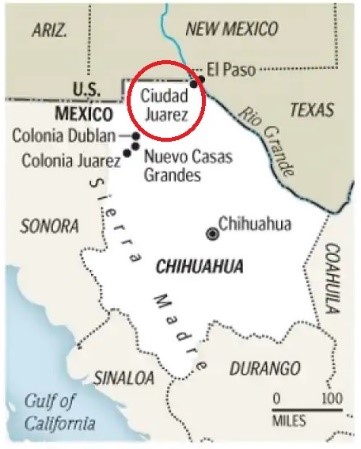
When you’re lost in the rain in Juarez
And it’s Eastertime too
And your gravity fails
And negativity don’t pull you through
Don’t put on any airs
When you’re down on Rue Morgue Avenue
They got some hungry women there
And they really make a mess outta you
Easter Day falls on the first Sunday after the first full moon of spring, and can therefore only fall between 22 March and 25 April. Precisely the two months that it is driest in Juarez, which already is so dry as it is; the average rainfall in both months is 0.2 inches (5 mm). That is virtually nothing. Meaning, you really must have quite a serious form of water phobia to feel lost in those few droplets of virtually nothing.
In short, we can assume that the poet here is not trying to communicate his travel impressions from a holiday trip. The less critical minds who see drug references in every sixties song do seem to have a point this time; a poetic reference to marijuana use is more obvious than a clinical travel review with weather reports, indeed. “Rain” as a metaphor for marijuana is perhaps not too common, but at least since “Rainy Day Women # 12 & 35” (“Everybody must get stoned”) it has acquired that nudge-nudge-wink-wink-angle. The Beatles’ “Rain” doesn’t escape that interpretation (“It’s just a state of mind”) either, and the brilliant Nick Drake, a recognised pothead, writes in his ode to marijuana “The Thoughts Of Mary Jane” (1969):
Who can know
The thoughts of Mary Jane
Why she flies
Or goes out in the rain
Where she’s been
And who she’s seen
In her journey to the stars
Despite Dylan’s denials that Rainy Day Women is a drug song, by the way. The same Dylan who has been quoted stating: “Marijuana isn’t a drug like the others” (Philip Adler interview, 1978).
Still, the song is not necessarily an impression of Dylan’s own drug use, obviously. As in many places on Highway 61 Revisited, traces of Jack Kerouac also do appear in “Just Like Tom Thumb’s Blues”. Dylan has just devoured Desolation Angels, and impressions thereof descend into “Desolation Row”. “Her sin is her lifelessness” comes almost literally from Kerouac’s work, for example, just like “the perfect image of a priest”.
In Tom Thumb we come across the literal quote Housing Project Hill, but before that, in these opening lines, Kerouac’s Desolation Angels already echoes through. Kerouac, or rather his alter ego Jack Duluoz, is also in Juarez, marijuana fumes throughout the book, even at Easter; “When we got to the top of the Pyramid I lit up a marijuana cigarette so we could all examine our instincts about the place. Not to mention your Easter bunny” (and later on, in Paris, it is Eastertime again). And gravity is apparently a thing for Kerouac as well (“Here I sit upside-down on the surface of the planet earth, held by gravity, scribbling a story,” to quote just one of the examples).
On Blonde On Blonde, Dylan’s next album, Desolation Angels resounds too. We come across the rainman from “Stuck Inside Of Mobile” in the last chapter of Part I (“Desolation In Solitude”), for example, as well as the peculiarity of identifying drugs as medicine. Dylan’s travelling companion Allen Ginsberg plays a fairly prominent supporting role in the book (as “Irwin Garden”), which probably triggered Dylan’s receptiveness to the work.
The lock to the stream of consciousness is now open. The poet Dylan freely allows fragments, paraphrases and half quotes from high and low culture to flow in. Rue Morgue Avenue comes of course from Edgar Allan Poe, from The Murders In The Rue Morgue (1841), the first modern detective story, the hungry women there paraphrases “Kansas City” and don’t put on any airs is perhaps an echo of Fiddler On The Roof (from the highlight “If I Were A Rich Man”; I see her putting on airs and strutting like a peacock). The musical premiered a few months before Tom Thumb’s conception, has already conquered Broadway and just won a Tony Award; the hit is inescapable in the days when Dylan writes his song. Incidentally, based on the story Tevye And His Daughters by Sholem Aleichem, the father of Dylan’s art teacher in 1974, Norman Raeben.
The comments often refer to Malcolm Lowry’s masterpiece Under The Volcano. Which is mainly triggered by something as elusive as a similar atmosphere, a similar mood – this protagonist is lost, too. Although the work is set in Mexico, Juarez is not a decor, nor are marijuana, rain or Easter mentioned, let alone a Melinda or a Saint Annie.
Content does not seem to be too important – the lyricism all the more so. The poet apparently wants to convey a sense of detachment, desolation, loss, and apart from otherwise unrelated images – instinctively, presumably – opts for a particularly unusual, very fitting metrum: the five-footed anapest (da da dum times five).
As is often the case, the layout of Dylan’s lyrics in official publications (on the site and in Lyrics, for example) hides the “actual” form. Officially the song consists of six eight-line verses, but rhyme scheme, Dylan’s recitation, chord scheme and the metre reveal: four-line verses, rhyme scheme aaaa, anapestic pentameter:
When you’re lost in the rain in Juarez and it’s Eastertime too
And your gravity fails and negativity don’t pull you through
Don’t put on any airs when you’re down on Rue Morgue Avenue
They got some hungry women there and they really make a mess outta you
The musician Dylan does feel when he has to break the rhythm with, for example, a spondee (two stressed syllables, like put-on) or an inserted third unstressed syllable (they got some), but the basis, that five-fold da da dum, is unmistakable.
It is a brilliant way of making slow-flowing time tangible, and rather unusual in the art of song. Leonard Cohen’s “Sisters of Mercy” (Oh the Sisters of Mercy, they are not departed or gone) comes to mind, but there are not many more examples. Eminem sometimes resorts to the anapest (“The Way I Am”, for instance; I sit back with this pack of Zig-Zags and this bag), but his verses have the more usual four-footed metre – as do many of Dr. Seuss’ nursery rhymes, by the way.
Dylan will not extend it throughout the whole song either – the trap – sedating, monotonous droning – is almost inescapable. But it does set the tone. The gravity fails.
To be continued. Next up: Just Like Tom Thumb’s Blues part III: Annie & Melinda
———
Jochen is a regular reviewer of Dylan’s work on Untold. His books are available via Amazon both in paperback and on Kindle:
We now have over 2000 articles on this site. You can find indexes to series linked under the image of Dylan at the top of the page and some relating to recent series on the home page.
Although no one gets paid for writing, publishing or editing Untold Dylan, it does cost us money to keep the site afloat, safe from hackers, n’er-do-wells etc. We never ask for donations, and we try to survive on the income from our advertisers, so if you enjoy Untold Dylan, and you’ve got an ad blocker, could I beg you to turn it off while here. I’m not asking you to click on ads for the sake of it, but at least allow us to add one more to the number of people who see the full page including the adverts. Thanks.
As for the writing, Untold Dylan is written by people who want to write for Untold Dylan. We welcome articles, contributions and ideas from all our readers. Although no one gets paid, if you are published here, your work will be read by a fairly large number of people across the world, ranging from fans to academics. If you have an idea, or a finished piece send it as a Word file to Tony@schools.co.uk with a note saying that it is for publication on Untold Dylan.
We also have a very lively discussion group “Untold Dylan” on Facebook with around 8500 active members. Just type the phrase “Untold Dylan” in, on your Facebook page or follow this link And because we don’t do political debates on our Facebook group there is a separate group for debating Bob Dylan’s politics – Icicles Hanging Down
Both Edgar Allan Poe and Robert Allen Zimmerman know well the verses of the Holy Bible; therein the word ‘door’ often serves as a figurative entrance separating the physical plane from the spiritual plane.
Without much effort, biblical verses containing the word ‘door’, as translated in the King James version, can be transformed into verses that rhyme.
Thusly, below ~ ‘door’, and ‘before’:
Verily,  verily, I say unto you, I am the door
Of the sheep
All that ever came before
Me are thieves, and robbers
(John 10: 7:8)
Likewise below ~ ‘door’, and ‘four’:
No, not so much as about the door
And He preached the word unto to them
And they came unto Him, bringing one sick of the palsy
Which were borne of four
(Mark 2: 2,3)
Some more transformated Bible verse ~ ‘door’, and ‘for’:
For
A greal door
And effectual
Is opened unto me
(I Corinthians 16: 9)
And further more:
Furthermore
When I came to Troas to preach Christ's gospel
And a door
Was opened unto me of the Lord
(II Corinthians 2:12)
And so on ~ door’, and ‘before’:
Grudge not one against the other, brethren
Lest ye be condemned
Behold, the judge standeth before
The door
(James 5:9)
And so forth ~ ‘door’, and ‘therefore’:
Be zealous therefore
And repent
Behold, I stand at the door
And knock
(Revelations 3: 19, 20)
Again from the Bible transformed:
I know thy works
Behold, I have set before
Thee an open door
And no man can shut it
(Revelations 3: 8)
Above ~ ‘before;’ and ‘door’; and then ~’before’ and ‘door’ in the song lyrics below:
Blowing like she never blowed before
Blowing like she's at my chamber door
(Bob Dylan: Duquesne Whistle)
Now back to the Bible transformed – a rhyme that’s off a bit ~ ‘doors’, and ‘parlour’:
And behold, he opened not the doors
Of the parlour
Therefore they took a key, and opened them
And behold, their lord was fallen down dead on the earth
(Judges 3: 25)
The rhyme somewhat fixed up by the single ‘door’ in the song lyrics below ~ ‘door’, and ‘parlor’:
I ran right through the front door
Like a hobo sailor does
But it was just a funeral parlor
And the man asked me who I was
(Bob Dylan: 115th Dream)
Untold Dylan
We now have over 2000 articles on this site. You can find indexes to series linked under the image of Dylan at the top of the page and some relating to recent series on the home page.
Although no one gets paid for writing, publishing or editing Untold Dylan, it does cost us money to keep the site afloat, safe from hackers, n’er-do-wells etc. We never ask for donations, and we try to survive on the income from our advertisers, so if you enjoy Untold Dylan, and you’ve got an ad blocker, could I beg you to turn it off while here. I’m not asking you to click on ads for the sake of it, but at least allow us to add one more to the number of people who see the full page including the adverts. Thanks.
As for the writing, Untold Dylan is written by people who want to write for Untold Dylan. We welcome articles, contributions and ideas from all our readers. Although no one gets paid, if you are published here, your work will be read by a fairly large number of people across the world, ranging from fans to academics. If you have an idea, or a finished piece send it as a Word file to Tony@schools.co.uk with a note saying that it is for publication on Untold Dylan.
We also have a very lively discussion group “Untold Dylan” on Facebook with around 8500 active members. Just type the phrase “Untold Dylan” in, on your Facebook page or follow this link And because we don’t do political debates on our Facebook group there is a separate group for debating Bob Dylan’s politics – Icicles Hanging Down
In this series we look at songs that have an identical title to one of Bob Dylan’s works…
Time for episode 4…this time One More Night.
Aaron: Yet another in a long line of song titles that everyone seems to use.
Tony: But before we take a look at a couple, may I be so egocentric as to quote myself in terms of this song by Dylan. Here’s a little bit from the original review on this site:
“…what makes it interesting is just how completely Dylan does that country music thing of utterly detaching the meaning of the lyrics from the music – something he never did in any of his earlier years of writing. Compare and contrast for example with “Like a Rolling Stone” where you just feel the meaning of the lyrics via the music from the very start.
“But for this approach Dylan needs country music. Although it is possible, of course, that Dylan is making fun of country music which so often seems to deliver lyrics that revolve around appalling and awful situations (being in prison, death, suicide, losing a lover…) with that same inevitable happy spring in the musical accompaniment, I don’t think this was in his mind at all. I think he wanted to write a standard country song.”
So now to move on
Aaron: This first couldn’t be farther from Dylan’s use of the title. It’s German experimental rock band CAN. (We have another of those situations where the link that Aaron can use in the United States, doesn’t work for Tony in England. So two links are on offer…)
Aaron: This comes from the hugely influential 1972 album Ege Bamyasi. The track has a decent groove but, for me, it goes on too long and becomes monotonous. Maybe that’s the point, maybe I just don’t understand the genre, but it’s not for me!
Tony: For once I am the positive one out of the two of us. Immediately I hear a track like this I can lose myself in it, sometimes by imagining how I might choreograph it, sometimes by thinking of an additional musical accompaniment I might find. That’s not to say that it would be a brilliant dance routine, or that my extra line of music would add that much (or indeed anything), but I find the whole thing stimulating and engaging, I guess because I can get “inside” the music. I want to be part of it. And I think that is what the band (who I don’t know at all) were doing.
Aaron’s score : 1 out of 5
Tony’s score : 4 out of 5
Next we have the Phil Collins’ US number 1 hit.
It’s a surprisingly restrained performance from Phil, very soulful vocal and minimalist backing track, using just a shaker and a synth. Thematically it covers much the same ground as Bob’s track. I love it, and I don’t care who knows it!
Tony: Phil Collins has a very special place in my life, and I have always loved the fact that his brother and sister have made such a contribution to life, one being an ice skater the other a cartoonist. Collins himself was an actor playing in Oliver! in the West End. Quite a talented bunch. And he worked with Brian Eno on Taking Tiger Mountain which is as good as it gets in my wider musical world.
I still have all the Genesis albums, and even play some of them occasionally… so yes I am hopelessly biased. Except… although the guy has been a part of my life through all the ups and downs, the later solo career didn’t do so much for me, and it seems to do even less now.
But that is probably me just moving on. But sitting here playing a few tracks while I write this really does give me a little lift in what are difficult times (you may have heard we have something of a lockdown in Britain at the moment – when you live on your own and are hardly allowed out, music is rather important I find.)
Going back to Phil Collins this morning I must admit it doesn’t give me the same buzz any more, which is probably just me getting old. Or being old. But still, it’s nice to look back and it really does make me want to dig out those Genesis tracks again.
Aaron’s score : 5 out of five
Tony’s score : 3 out of five.
Tony’s PS
I love that.
Untold Dylan
We now have over 2000 articles on this site. You can find indexes to series linked under the image of Dylan at the top of the page and some relating to recent series on the home page.
Although no one gets paid for writing, publishing or editing Untold Dylan, it does cost us money to keep the site afloat, safe from hackers, n’er-do-wells etc. We never ask for donations, and we try to survive on the income from our advertisers, so if you enjoy Untold Dylan, and you’ve got an ad blocker, could I beg you to turn it off while here. I’m not asking you to click on ads for the sake of it, but at least allow us to add one more to the number of people who see the full page including the adverts. Thanks.
As for the writing, Untold Dylan is written by people who want to write for Untold Dylan. We welcome articles, contributions and ideas from all our readers. Although no one gets paid, if you are published here, your work will be read by a fairly large number of people across the world, ranging from fans to academics. If you have an idea, or a finished piece send it as a Word file to Tony@schools.co.uk with a note saying that it is for publication on Untold Dylan.
We also have a very lively discussion group “Untold Dylan” on Facebook with around 8500 active members. Just type the phrase “Untold Dylan” in, on your Facebook page or follow this link And because we don’t do political debates on our Facebook group there is a separate group for debating Bob Dylan’s politics – Icicles Hanging Down
There is a full index to the series which traces Bob’s work in the order in which it was composed, here.
————-
By Tony Attwood.
The songs that Bob Dylan wrote in the run up to composing “Isis” and the remaining songs composed for “Desire” were, I would submit, by and large of the highest quality – with the possible exception of “Money Blues” which is a straightforward 12 bar composition. It’s not a bad song, just not a great song.
But otherwise these are remarkable works, and if one had a remarkability chart (or come to that if “remarkability” were actually a word, and one could judge each song that way) we might note a rise in just how extraordinary each song from this period was, as we progress through the timeline that brought us One More Cup of Coffee,Golden Loom,Oh Sister and Abandoned Love.
But it is most certainly fair to say that even so, nothing, but nothing, prepared us for Isis.
But what makes “Isis” such a great song? Indeed, what sort of song is Isis?
It can be argued that the lyrics mean something as a story in their own right. Alternatively “Isis” could be an individual the composer knows. Or the song might just be about Egypt, or it might not. On the other hand it could be just a set of interesting lines strung together with a great beat, and fine melody and a bass guitarist who really understands what it is all about.
But out of these points, for the moment I want to focus on one of them: the interesting lyrics. And here I think it is time to ask if a set of interesting but random phrases which are simply strung together, can be rated as part of the creation of a great piece of music? Does it matter if the lyrics of Isis (or indeed any other song) are actually about anything coherent at all? Does it matter if the story in Isis (if there is one) is truthful or coherent or both, or not? In short, can a great song be created out of lines which are often disconnected from each other?
And moving on from there, does it even matter if any set of lyrics in a song are truthful or even coherent?
In my country we have a highly patriotic song, “Rule Britannia” which I suspect most British citizens know at least the first and last two lines of:
Rule, Britannia! Britannia, rule the waves!
Britons never, never, never shall be slaves.
It is obviously untrue and irrelevant in today’s world, being as it is a piece of music that celebrates the days of the British Empire, but it is sung with the same sort of gusto as “If you want me to, Yes!” in Isis. And it is still sung by a lot of people at an event (The last night of the Proms) each year – or at least each year when there is no pandemic.
These are questions I could have asked from the very start of this series of articles, or indeed anywhere in this blog, because from the very start Dylan and a truthful representation of the world around him have not gone hand in hand. Take “I was young when I left home,” which was the last song written by Bob in 1961, and as far as we can tell, the 15th song he wrote and kept.
I was young when I left home
But I been out a-ramblin’ ‘round
And I never wrote a letter to my home
To my home, Lord, to my home
And I never wrote a letter to my home

It was just the other day
I was bringing home my pay
When I met an old friend I used to know

Said your mother’s dead and gone
Baby sister’s all gone wrong
And your daddy needs you home right away
Of course it’s not true at all. But has anyone ever worried about that? I don’t think so. Indeed, the next song composed, at the start of 1962, (Ballad for a friend) is just as fanciful, as far as we know. There was no friend; there was no death. Certainly on the recording where Bob explains why he sang the verses out of sequence his voice doesn’t sound as if he is singing about a lost friend. But does any of that matter? It seems not.
And indeed it appears that no one seemed to mind much about such issues early in Dylan’s career. For example when he wrote
I’m out here a thousand miles from my home
Walkin’ a road other men have gone down
I’m seein’ your world of people and things
Your paupers and peasants and princes and kings
in 1961, I don’t think anyone bothered to check the mileage (although yes New York is over 1000 miles from Duluth) nor how many princes and kings Bob had met by then (probably none).
But ten years later when Bob wrote George Jackson arguments raged about whether Jackson was an innocent victim or not. So it seems the issue of truth (or if you prefer “accuracy”) only matters sometimes, and it is the critics who want to decide when it matters.
Of course issues of accuracy are considered important sometimes when a newspaper or website which purports to be presenting the news, sets out “information” which others believe is completely false. Indeed at the moment I am writing this, this debate over the corona-virus vaccines falls into this category. Such matters are dealt with by recourse to factual evidence and science; some deny the validity of both evidence and science.
But mostly through history we have not treated works of art in the same way as newspaper reports. By and large we don’t demand that art is a strict factual representation of the truth – for it is were, it would just be history. Which is why individual passport photographs are not normally called art while photos in other circumstances can be called art. Art in all its forms, from symphonies to poetry, is not normally seen as a truthful representation of a person or situation or group of people. It is “art” – it sees things from a new direction, it exaggerates, it twists reality, it gives a new perspective and creates new worlds. That’s the point.
As a result art can often “say” one thing but be interpreted as meaning another, or indeed it may have no meaning at all but instead just be. In this regard, in this series and elsewhere, I’ve often cited the large Jackson Pollock and Bridget Riley reproductions hanging in my house. They have no meaning I can express in words, but they hang in my house as each provide me with meanings that cannot be expressed in other means.
What’s more, even if there is meaning in an artwork it can often be the case that the meaning the creator intended is not the meaning perceived by the critics or indeed when it comes to popular music, the fans. The lyrics of “Times they are a changing” observe the everyday fact that the world and society keeps changing. Not always for the better not always for the worse and certainly not always at our behest. Stuff happens, things change. The music expresses this relentless change through its plodding beat which goes 1 2 3 1 2 3 1 2 3 over and over, symbolising the slowly ever-changing reality.
Does it matter if a lot of people take this to mean not that the world just simply changes all the time (which is what the lyrics say), but rather that we can rise up and change this world and make it better? Does it matter that musician Tony Glover looked at the lyrics of “Times” and allegedly said, “What is this shit?” to which Dylan apparently replied “it seems to be what the people want to hear,” when in fact many people took the song to suggest that Dylan himself believed that change could be effected by the protests of the masses and that he would be there leading the charge?
And then what about the John Wesley Harding songs – does it matter that the hero’s name is spelled wrong, and that the hero of the song bears no resemblance to the character of the same name without the “g” in real life? Or that songs such as “Drifter’s Escape” makes no sense at all unless one bends and twists the meanings, ignores certain lines and makes a whole load of assumptions?
Pulling this theme together, as we approach “Isis” we find ourselves in a situation in which we must know (if we have been paying any attention) that Dylan’s songs are by and large fanciful, playing with reality, re-writing history, mixing fiction and fact, while allowing the mists to shroud any certainty as to the “real” meaning, all to such a degree that there is no “real” meaning any more. If there are meanings, there are only the meanings we, the listeners, impose.
Unfortunately, many critics of and commentators upon Dylan’s work fail to see that many Dylan songs are self-evidently not based on fact, but still try and find links between Dylan’s lyrics and reality, when it fact it is much easier to examine, consider and enjoy Dylan’s work without that battle.
Indeed as Jochen has so recently pointed out when Dylan talks about the writing of his songs, he doesn’t cite events, movements, beliefs etc (with the exception of his short period of writing only overtly Christian songs) he cites the musical antecedents.
So, to return (at long last) to Isis, my point is that when Bob Dylan wrote Isis he was already well established as a writer of fiction in songs, and by far the easiest way to see Isis is as both fiction, and also lines that are not necessarily connected (as can be the case in an abstract painting).
Thus within Isis the two writers bring in a fictionalised person into a fictionalised account of a very unclear set of events, which is simply another way of writing. For its effect and success it depends on a clear and solid beat, an unusual time signature (for popular music), a very energetic accompaniment and exclamations in the vocal line (as in “If you want me to, Yes”). There’s no need to try and see Isis as a real person; indeed to do that takes us into a wholly different world without any evidence at all, and almost certainly gives a wholly false reading of the lyrics.
Likewise there is also no need to try and link anything in the song with the Egyptian myth of Isis (which involves the resurrection of her husband, and helping the dead enter the afterlife, while also befriending all those at the edge of society – slaves, workers, the poor. Isis gave the disenfranchised hope – but not hope of working harder for salvation. Simply hope). Yes of course that could accord with Bob’s visions of the world, and one could work out a whole set of meanings starting, “I found hope on the 5th day of May”. But then, where does it go? Nowhere better. Sticking with Isis, it’s more fun, so that’s what they do.
Thus the simplest interpretation of this song and indeed most songs by Dylan, is that he has made up a story and/or people and/or a situation, and embellishes it with interesting words and phrases. Thus the songs are not clearly “about” anything in particular, even if they appear to be about something.
Such a view of Dylan’s work, in cases like Isis, is that it not only offers an explanation as to what is going on in the lyrics, it also allows us to enjoy the phraseology of the song as we are drawn along by the music, rather than spending time pondering phrases such as “pyramids all embedded in ice.” True, we do get the full Egyptian bit with the breaking into the tomb, the casket being empty and all that. But it is not related to anything real.
And as it happens, in this case, I write as one who has been right inside the Great Pyramid and can concur with the comment on Travel Trips USA that “the reality rarely lives up to fantasy, and a trip into the heart of one of the great pyramids might not be as glorious as you imagine.” Very true, so it is fortunate that I have this song as well.
Moving on, just as the people in songs don’t have to be real, so there is nothing that says the story has to make sense – exactly as we found when we contemplated the JWH songs. They can be the antithesis of making sense in the style of Kafka or simply disconnected irrational images moving from one episode to another.
Yet as humans we do wish to find meaningful sequences, because that is what our brains do – we make sense of the world to try to control it. What we have to do however is let go and just accept that “I gave him my blanket; he gave me his word” says something which cannot be translated into any other words, which when one thinks about it, is quite a trick.
Indeed there is something wonderfully playful about
The wind it was howling and the snow was outrageous
When he died I was hoping that it wasn't contagious
which considering it is about death, is quite a trick to pull in a set of lyrics.
Indeed ever since I first heard that line I have kept the notion of outrageous snow with me. I have no idea what it means, but that doesn’t matter. I just love “outrageous snow” on a level that has nothing to do with meaning.
Thus in this approach words and music become playthings, just as they were when James Myers changed his name to Jimmy De Knight and then co-wrote “Rock Around the Clock” with Max C. Freedman. It’s not really saying that people should try and dance for 24 hours solid and then start all over again. It is just there for the fun.
This notion of exaggeration and the removal from reality is part of popular music and folk music. Sometimes the songs tell fictional stories, but even then they generally exaggerate in order to make the stories interesting.
When as children some of us (in England at least) learned
It was Friday morn when we set sail,
And we were not far from the land
When our Captain he spied a mermaid so fair
With a comb and a glass in her hand.
we knew it wasn’t really true – or at least if we didn’t know that straight away, we were soon told. Fantasy, in short, has forever been part of songwriting. It might be a story, or it might just be a collection of images. Either way it is not there to describe the truth.
Indeed even the great folk song tradition so beloved of Ewan MacColl as part of the heritage of the English working classes were not truthful portrayals of the past, but an interpretation.
Now I’ve written this little tirade of mine at this point because having written Isis, the two composers sat down and penned “Joey”. Which in turn annoyed a lot of people who wanted to tell us that Dylan was glorifying someone who most certainly didn’t do what’s in the song. But seen in the context of the songs Dylan was writing, that is hardly relevant.
Rolling Stone made the point that, “When Bob Dylan sings about historical figures, he often gets a lot wrong. “Hurricane” is riddled with errors, and “The Lonesome Death of Hattie Carroll” is almost worse.”
But that is only a relevant comment if Dylan the songwriter is setting himself up to be a chronicler of the truth. Yet clearly he is not. He’s never claimed to be, and having had the experience of a very simple song like “Times they are a changin” being utterly misunderstood why would he ever think he could be?
What makes this debate interesting to me is that in other art forms this naive desire to relate the art to truth doesn’t happen. No one is bothered because Guernica by Picasso doesn’t reflect the actual scene of desolation (although I sometimes wonder what would happen if some renowned Dylan scholars took up art criticism).
Visual artists regularly take people, situations, artefacts, landscapes and anything else, and distort them. So do novelists. Do we worry that in writing Hamlet, Shakespeare didn’t get the 13th century Danish story right? (If anyone does, I must have missed that debate). So why do songwriters have to answer to a different set of commands which require accuracy and realism in their story telling?
Perhaps it is because the critics of popular music feel that it has to be judged against different criteria from that used in other art forms, and that telling the truth (as the individual critic perceives it) is vital.
Maybe, but why would anyone ever think such a thing? Why would anyone ever assume that folk music or popular music would portray the world accurately, any more than contemporary art seeks to do this?
In fact, artists do the reverse. Artists challenge and change reality. It is also what cartoonists do; it is what songwriters do. Truth matters if you are discussing something from the point of view of historical accuracy, but not when handling the subject as an artist. Nor come to that, does it matter in religion. Do we worry that Jesus may not have looked as he is portrayed in uncountable pictures, suffering on the cross?
I do find this strange. While other creative people are expected to manipulate reality within their creations, Bob Dylan is expected to stick to the facts.
Untold Dylan
We now have over 2000 articles on this site. You can find indexes to series linked under the image of Dylan at the top of the page and some relating to recent series on the home page.
Although no one gets paid for writing, publishing or editing Untold Dylan, it does cost us money to keep the site afloat, safe from hackers, n’er-do-wells etc. We never ask for donations, and we try to survive on the income from our advertisers, so if you enjoy Untold Dylan, and you’ve got an ad blocker, could I beg you to turn it off while here. I’m not asking you to click on ads for the sake of it, but at least allow us to add one more to the number of people who see the full page including the adverts. Thanks.
As for the writing, Untold Dylan is written by people who want to write for Untold Dylan. We welcome articles, contributions and ideas from all our readers. Although no one gets paid, if you are published here, your work will be read by a fairly large number of people across the world, ranging from fans to academics. If you have an idea, or a finished piece send it as a Word file to Tony@schools.co.uk with a note saying that it is for publication on Untold Dylan.
We also have a very lively discussion group “Untold Dylan” on Facebook with around 8500 active members. Just type the phrase “Untold Dylan” in, on your Facebook page or follow this link And because we don’t do political debates on our Facebook group there is a separate group for debating Bob Dylan’s politics – Icicles Hanging Down
You’d have written that too. There’s nothing secret about it. You just do it subliminally and unconsciously, because that’s all enough, and that’s all you know. That was all that was dear to me. They were the only kinds of songs that made sense. “When you go down to Deep Ellum keep your money in your socks / Women on Deep Ellum put you on the rocks.” Sing that song for a while and you just might come up with, “When you’re lost in the rain in Juarez and it’s Easter time too / And your gravity’s down and negativity don’t pull you through / Don’t put on any airs / When you’re down on Rue Morgue Avenue / They got some hungry women there / And they really make a mess outta you.” All these songs are connected.
(Dylan, MusiCares speech, 2015)
It is and remains a beautiful speech, the speech that Dylan surprisingly delivers when he receives the MusiCares Person Of The Year 2015 Award. One of the highlights is the passage in which he tries to put his exceptional talent, or at least his craftsmanship, into perspective. “These songs didn’t come out of thin air,” he says by way of introduction, and then lists seven examples of classics that have given him the format. If you’d sung “John Henry” as many times as I have, you’d get to “Blowin’ In The Wind” too, Big Bill Broonzy’s “Key To The Highway” automatically leads to “Highway 61 Revisisted”, “Sail Away Ladies” to “Boots Of Spanish Leather”.
Charming and modest. And, as is often the case with Dylan, not entirely enlightening. “Sail Away Ladies” starts with It ain’t no use to sit and cry, and thus seems to be an inspiration for “Don’t Think Twice, It’s All Right”. A connection between “John Henry” and “Tell Me, Momma” is easier to see than a connection with “Blowin’ In The Wind”, and that Key-Highway 61 linkage doesn’t actually go much deeper than that one word “highway”.
Comparably blurred is the alleged bridge from “Deep Ellum Blues” to “Just Like Tom Thumb’s Blues”. All right, there is a similarity between when you go down to Deep Ellum and when you’re down on Rue Morgue Avenue, and both songs warn of certain women, but on a literal level “Kansas City” is a better candidate:
They got some crazy little women there
And I'm gonna get me one
… versus Dylan’s
They got some hungry women there
And they really make a mess outta you
… from Wilbert Harrison’s “Kansas City”, which gets such an unambiguous tip of the hat in “High Water” (“Twelfth Street and Vine”).
None the less, the thrust of Dylan’s argument remains intact, the argument he builds around the hypothesis that he is just a link in the chain, that he only builds on what others have come up with before him – the Isaac Newton argument, as it were (“If I have seen further it is by standing on the shoulders of Giants”, from Newton’s letter to Robert Hooke, 1675). Still, it is remarkable that only five years later, in the New York Times interview with Douglas Brinkley, June 2020, Dylan claims the exact opposite with exactly the same choice of words:
“On the album “Tempest” you perform “Roll on John” as a tribute to John Lennon. Is there another person you’d like to write a ballad for?”
“Those kinds of songs for me just come out of the blue, out of thin air. I never plan to write any of them.”
On that track there are more exceptionally talented songwriters, when they try – out of false modesty, sheer cluelessness or otherwise – to put their exceptional talent into perspective. In the beautiful Bee Gees documentary How Can You Mend A Broken Heart (2020) Barry Gibb puts it in a similar way:
“It’s a sort of… like a radio transmitter. It’s almost as if somebody’s already written the songs in the air and they’re giving them to us.”
Practically identical to Dylan’s words in that Douglas Brinkley interview:
“The songs seem to know themselves and they know that I can sing them, vocally and rhythmically. They kind of write themselves and count on me to sing them.”
And Coldplay’s brilliant songwriter Chris Martin says the same thing in the same documentary, but expresses it a little more poetically:
“Like surfers with waves. Surfers don’t make the waves. Fishermen don’t make the fish. Songwriters don’t really write songs. You receive songs.”
Entirely in line, again, with the words of Dylan in 2020, who does try to define it a little more mystically, though (“It’s one of those where you write it on instinct. Kind of in a trance state”), but all still contradicting Dylan’s much more down-to-earth words in 2015, “These songs did not come out of thin air.”
For the sake of convenience, we can assume that in 2020, Dylan means “The subject of a tribute song comes out of thin air”. So: “John Lennon”, or “Jimmy Reed”, or “Lenny Bruce”… I’m not planning to write a song about, say, Lenny Bruce, Dylan apparently means, but somehow that name swirls down into my mind. Still, the words he writes around this swirled down name are traceable, do not come out of thin air – as Dylan so aptly analyses in 2015. That goes for the songs on Tempest, and on Rough And Rowdy Ways, for that matter, and similarly more than half a century before that, for the songs on Highway 61 Revisited. Like for “Just Like Tom Thumb’s Blues”.
To be continued. Next up: Just Like Tom Thumb’s Blues part II: The Thoughts Of Mary Jane
————–
Jochen is a regular reviewer of Dylan’s work on Untold. His books are available via Amazon both in paperback and on Kindle:
We now have over 2000 articles on this site. You can find indexes to series linked under the image of Dylan at the top of the page and some relating to recent series on the home page.
Although no one gets paid for writing, publishing or editing Untold Dylan, it does cost us money to keep the site afloat, safe from hackers, n’er-do-wells etc. We never ask for donations, and we try to survive on the income from our advertisers, so if you enjoy Untold Dylan, and you’ve got an ad blocker, could I beg you to turn it off while here. I’m not asking you to click on ads for the sake of it, but at least allow us to add one more to the number of people who see the full page including the adverts. Thanks.
As for the writing, Untold Dylan is written by people who want to write for Untold Dylan. We welcome articles, contributions and ideas from all our readers. Although no one gets paid, if you are published here, your work will be read by a fairly large number of people across the world, ranging from fans to academics. If you have an idea, or a finished piece send it as a Word file to Tony@schools.co.uk with a note saying that it is for publication on Untold Dylan.
We also have a very lively discussion group “Untold Dylan” on Facebook with around 8500 active members. Just type the phrase “Untold Dylan” in, on your Facebook page or follow this link And because we don’t do political debates on our Facebook group there is a separate group for debating Bob Dylan’s politics – Icicles Hanging Down
The year 2020 will not be fondly remembered by the world, that much is quite clear. However, one ray of light for many music fans in 2020 was the release of Bob Dylan’s 39th studio album, Rough and Rowdy Ways. It was Dylan’s first batch of original songs since 2012’s Tempest.
The album contains the sort of extraordinary array of breath-taking intertextuality as well as historical and cultural references and illusions which have come to characterise much of the singer’s work since 1997. A couple of the references that jumped out most for me came on Goodbye Jimmy Reed, where Dylan references “Where the Jews and the Catholics and the Muslims all pray” and My Own Version of You, in which Dylan sings of studying “Sanskrit and Arabic to improve (his) mind.” These references to the three Abrahamic faiths and the Arabic language drew my mind to the Middle East, a region which I studied closely as a postgraduate. These references made me think of some of the other times Dylan has referenced the Middle East and more specifically, its politics. And that is what I will be discussing here.
Sheikhs walkin’ around like kings
There can be little doubt that Dylan and the Middle East is a strange cross-section and one that not many people are aware of. There are two songs that most spring to my mind in which Dylan speaks explicitly and at any great length about the region.
The first of those comes on his first Born Again Christian album Slow Train Coming, released in 1979. On the song Slow Train, Dylan appears to bemoan the way in which countries like Saudi Arabia were able to hold the USA to ransom after the oil price crisis that came about earlier in the decade following the Yom Kippur War of 1973. “All that foreign oil controlling American soil/ Look around you, it’s just bound to make you embarrassed/ Sheikhs walkin’ around like kings, wearing fancy jewels and nose rings/ Deciding America’s future from Amsterdam and Paris.”
Without doubt, the narrator takes a very definite and one-sided view of this situation. The lyrics paint a broadly economic nationalist or realist view of international relations. It could be argued that Dylan’s words are tinged with some degree of orientalism. However, it should be highlighted that Dylan is speaking about a very specific class within a specific set of Arab societies. The lyrics are not, as Yo Zushi refers to them in a New Statesman article from 2017, about “Arabs” as a whole group. The use of the word “sheikhs” demonstrates Dylan’s desire to show frustration the ruling class within the Gulf monarchies. Thus, it is not as simple as Dylan “punching down”. In fact, it might even be the case that one could place these lyrics within the long tradition of Dylan taking aim at those who are in positions of power.
On the whole, the lyrics perfectly portray a genuinely popular political perspective which questions US reliance on Gulf oil. However, let there be no doubt that these words, powerful as they are, pay no mention to what those countries exporting that “foreign oil” were trying to achieve through their actions. Dylan’s foray into the Israel-Palestine debate was to arrive the following decade.
Infidels’ Outlier
By far Dylan’s most explicit piece of work looking at the region came four years after Slow Train Coming, on the 1983 album Infidels. I have a strong affection for this record after playing it countless times in the music section at the Champs Libres library while living in Rennes. I think that seven of the eight songs on the record range from good to brilliant. Though, that leaves one outlier, Neighborhood Bully.
This is a controversial song, even by Dylan standards, and one which is seemingly dedicated to defending Israel. It’s a curious case for me, as it is for a great many Dylan fans. Here I should say I have a tremendous amount of sympathy for my friends and people in general who “don’t get” Dylan. The mere thought of not being able to appreciate Dylan’s work terrifies me. And yet, Neighborhood Bully is that one song that I just can’t get on. Suddenly, for almost five whole horrifying minutes, I become one of those people who just don’t get it.
For a little context, Infidels is commonly regarded as Dylan’s first “secular” album since 1978’s Street Legal and came on the back of three Born Again Christian records, the aforementioned Slow Train Coming (1979), Saved (1980) and the criminally overlooked Shot of Love (1981). While some listeners claim that Infidels hasn’t aged particularly well, it received a decent level of praise at the time of its release with many music critics expressing their relief at Dylan’s supposed loss of interest in the Gospels.
Aside from Neighborhood Bully, there are a handful of other songs on the album which could be regarded as somehow political. Across those songs, some broad themes emerge, namely the corruption of political leaders, man’s greed and vanity, the old warning of a wolf in sheep’s clothing (or Satan coming as a man of peace), a profound scepticism towards neoliberalism and free-trade, warnings over American decline and even some supposed eye-rolling at trade unions in the USA. According to the understanding of many commentators, there is an underlying anger at the presidency of Ronald Reagan as well, especially on the opening song, Jokerman.
A great many of those other songs, however, are vague and couched in metaphor. Neighborhood Bully, on the other hand, is a straightforward defence of Israel’s right to exist and more so its right to defend itself. In many other articles touching on the song, a lot is made of Dylan’s connections to Israel and figures within Israeli politics. I have no interest in Dylan’s alleged political affiliations, so, will only be looking at the song.
Timing
Perhaps one of the most troubling aspects of the song is its timing. Infidels was released in 1983, just one year after the Sabra and Shatila Massacre, part of a wider operation in Lebanon in which the Israeli Defence Force (IDF) sought to eradicate the Palestinian Liberation Organisation. During the massacre, the IDF (at best) stood by and allowed a paramilitary group close to the Lebanese Christian Kataeb Party to slaughter hundreds (more likely thousands) of Palestinian refugees and Lebanese Shiites. The massacre received plenty of condemnation in Israel itself and marked something of a change in Western coverage of Israel’s foreign policy which up until that point had been largely unquestioned. Hence, when one acknowledges this timing, the song comes to feel ill-judged.
Though, it shouldn’t be seen as altogether surprising. Dylan is no stranger to the controversial. After accruing a legion of adoring folk fans during the early 1960s, Dylan distanced himself from the “protest” scene with the song My Back Pages (1964), before “going electric” during the Newport Folk Festival of 1965. He further angered significant sections of his core audience in 1979 with his decision to put out Christian music (Heylin, 2017). Then, in 1985 during the first ever round of Live Aid concerts, Dylan took to the stage and questioned whether a fraction of the money raised for those starving in Africa could be re-allocated to farmers who were struggling in rural America. In 1991, shortly after George H. W. Bush’s decision to go to war in the Gulf, Dylan performed a barely recognisable version of his 60s classic, Masters of War.
Neighborhood Bully
Turning our attention to the actual song, what is it like? Dylan uses sarcasm to address much of the negative press that Israel was receiving at the time and personifies the country as a neighbourhood bully in the region. Its snarling tone (which is common in much of Dylan’s best work), musical arrangement and even its (AABB) rhyme scheme are rather reminiscent of the superior Property of Jesus which appeared on Dylan’s previous album, Shot of Love. However, while I know some people would discount both tracks as filler, I feel that Neighborhood Bully lacks the conviction of Property of Jesus. And that’s the first problem for me. The usual passion and verve seem to be lacking. It’s probably worth noting here that, according to Dylan’s own website, he has never bothered to play this song live which may allow us to question the extent to which he rated the song, himself.
The second issue is that lyrically the song is some way off the rest of the album, especially the stronger songs, I and I and Jokerman. The lyrics are so straightforward, lacking in the way of Dylan’s usual use of literary devices and is also overtly political. This is the biggest disappointment for me, as if anyone could make a strong song either defending Israel or espousing its virtues, it would be Dylan. Of course, one doesn’t have to totally agree with a song’s message to appreciate its beauty. My former landlord, a very firm atheist, spent many an evening listening to Dylan’s Born-Again Christian music with me, which he regarded as some of Dylan’s best work. I’m no American patriot but as stated above, I have a great appreciation for Dylan’s ability to articulate a position on the Oil Crisis of the 1970s.
Equally, one doesn’t have to be of a certain land to appreciate the beauty of another person’s writing about it. A great many of my favourite songs explore a singer’s adoration for a land that isn’t my own, Dougie McClean’s Caledonia, La Complainte du Partisan (Anna Marly), This Land is Your Land (Woody Guthrie), Un Canadien Errant (Antoine Gérin-Lajoie), Petit Pays (Gael Faye) and any number of the subtle songs that Dylan has written depicting the wonder of his America. When one also considers the quiet beauty of the picture on the Infidels’ inner sleeve of Dylan examining the soil of Mount Olive with Jerusalem behind him, it feels as though the stage was set for him to put forward a subtler piece of art depicting his feelings towards Israel or the idea of a Jewish homeland. ****
However, what we get is a song that does not match the sweetness of the photograph. There are one or two instances where the song does a neat enough job of exploring the historical persecution of the Jewish people which it then seeks to tie into the fortunes of Israel. Indeed, for the most part, the lyrics of Neighborhood Bully take a scattergun approach to its defending of Israel, putting forward a plethora of talking points that one would associate with neo-conservative thinking. An article by Gabe Friedman in the Times of Israel recollecting the song states some of the lyrics sound like they could have been taken from a Benjamin Netanyahu speech.
The overarching narrative of the song is that Israel is a tiny country constantly under threat of being attacked by much larger neighbours (with little made of its military and technological superiority or its allies, “He got no allies to really speak of/ What he gets he must pay for, he don’t get it out of love”). At this point it’s probably worth remembering that Israel is the USA’s top ally in the region and currently receives around $4billion in aid annually. Even at the time Dylan composed the song, the level of aid per year from the US to Israel was into the billions. The song also makes a further common neo-conservative argument, that Israel has performed something of a miracle by turning almost empty desert land into a near paradise while also generating incredible developments in medicine, “He took the crumbs of the world and he turned it into wealth/ Took sickness and disease and he turned it into health”. This is, of course, a feat that was made somewhat easier by the aforementioned levels of financial support.
However, as grating as some of these lyrics may seem, there is no explicit advocacy of offensive conflict by Dylan. Therefore, the lyrics when taken on their own don’t necessarily go against Dylan’s previous messaging. Rather, the writer bemoans what he sees as Israel being told that it doesn’t have the right to defend itself, “He’s not supposed to fight back, he’s supposed to have thick skin/ He’s supposed to lay down and die when his door is kicked in”. There’s no advocation of Israeli expansionism, the illegal settlements (as categorised by the UN) or occupations. Equally, they aren’t condemned or questioned, or mentioned at all, in fact.
The main point of contention, as I see it, is the issue of what Dylan refers to as “fighting back”. This actually gets to the heart of a lot of the debates on Israel’s foreign (and even domestic) policy. What is fair fighting back? This is where the historical context may be of some importance. Were Israel’s actions in Lebanon merely “fighting back”? For many people, many of their actions during the 1980s were disproportionate, as they were in 2014 siege of Gaza. Of course, there’s some irony in the fact that the IDF was involved in a great deal of doors being “kicked in” as it ravaged southern Lebanon and Beirut in pursuit of PLO fighters.
Last Thoughts on Neighborhood Bully
So, how does one look at this song? I’ve listened to it about half a dozen times while writing this article and it has actually helped me realise that it isn’t quite as hysterically pro-Israel or anti-Palestinian as I remembered it. A song defending Israel doesn’t necessarily have to be considered an endorsement of every policy of the most militaristic governments the country has seen, be they in the 1980s or the current administration. While there are refutable claims and significant factors ignored during the song, the lyrics in their own right seem to be about giving Israel a fair chance to defend itself militarily.
My unease with the song largely stems from its timing which can have a massive impact on how one interprets it. It has certainly led some observers, such as Nima Shirazi to question Dylan’s “progressive” credentials. I think it’s very misguided to try and box Dylan in politically as this will likely always push him to defy the conventional wisdom. Though, at the same time, Dylan’s contribution to progressive causes through song should never be doubted (whether they were intentional or otherwise).
From an artistic point of view, many Dylan fans struggle to relate to Neighborhood Bully. From my point of view, it isn’t focused enough and doesn’t have the romantic sensibilities or subtility which speak to me so profoundly when he writes about his own country. For those reasons, Neighborhood Bully is one of a handful of Dylan songs that I don’t consider to be good. Its convenient historical inaccuracies and its unwelcome timing are even enough to make it bad. That said, it doesn’t make a dent in what Dylan brought us with his words over the course of nearly six decades, it also shouldn’t detract from the strength of Infidels as a piece of work.
Neighborhood Bully
WRITTEN BY: BOB DYLAN
Well, the neighborhood bully, he’s just one man
His enemies say he’s on their land
They got him outnumbered about a million to one
He got no place to escape to, no place to run
He’s the neighborhood bully
The neighborhood bully just lives to survive
He’s criticized and condemned for being alive
He’s not supposed to fight back, he’s supposed to have thick skin
He’s supposed to lay down and die when his door is kicked in
He’s the neighborhood bully
The neighborhood bully been driven out of every land
He’s wandered the earth an exiled man
Seen his family scattered, his people hounded and torn
He’s always on trial for just being born
He’s the neighborhood bully
Well, he knocked out a lynch mob, he was criticized
Old women condemned him, said he should apologize.
Then he destroyed a bomb factory, nobody was glad
The bombs were meant for him. He was supposed to feel bad
He’s the neighborhood bully
Well, the chances are against it and the odds are slim
That he’ll live by the rules that the world makes for him
’Cause there’s a noose at his neck and a gun at his back
And a license to kill him is given out to every maniac
He’s the neighborhood bully
He got no allies to really speak of
What he gets he must pay for, he don’t get it out of love
He buys obsolete weapons and he won’t be denied
But no one sends flesh and blood to fight by his side
He’s the neighborhood bully
Well, he’s surrounded by pacifists who all want peace
They pray for it nightly that the bloodshed must cease
Now, they wouldn’t hurt a fly. To hurt one they would weep
They lay and they wait for this bully to fall asleep
He’s the neighborhood bully
Every empire that’s enslaved him is gone
Egypt and Rome, even the great Babylon
He’s made a garden of paradise in the desert sand
In bed with nobody, under no one’s command
He’s the neighborhood bully
Now his holiest books have been trampled upon
No contract he signed was worth what it was written on
He took the crumbs of the world and he turned it into wealth
Took sickness and disease and he turned it into health
He’s the neighborhood bully
What’s anybody indebted to him for?
Nothin’, they say. He just likes to cause war
Pride and prejudice and superstition indeed
They wait for this bully like a dog waits to feed
He’s the neighborhood bully
What has he done to wear so many scars?
Does he change the course of rivers? Does he pollute the moon and stars?
Neighborhood bully, standing on the hill
Running out the clock, time standing still
Neighborhood bully
I hope I can be forgiven if any words of mine offend.
References
Heylin, C., 2017. Trouble in Mind: Bob Dylan’s Gospel Years: what Really Happened. Lesser Gods.
Editors footnote: Because of past experience with comments on this song, I’m continuing the policy that comments which consist of political, religious or economic assertions without evidence will not be published. That’s not the case elsewhere on this site, but seems to be necessary in relation to this song.
Gothic poet Edgar Allan Poe is noted for his influence on the French Symbolists. And, at least by me, also for his fondness for the metonymy* of the word ‘door’:
As in the lyrics below:
Some tomb from out whose sounding door
She never shall force an echo more
(The Sleeper)
And again in:
I reached my home - my home no more ...
I passed from out its mossy door
(Tamerlane)
And again in:
Whose shadows fall before
Thy lowly cottage door
(To Isadore)
And again in:
From the open cottage door ....
And the dying sycamore
(The Village Street)
And…
By the lowly cottage door ....
Broken-hearted evermore
(The Village Street)
And again in:
Was the fair palace door ...
And sparkling evermore
(The Haunted Place)
And:
Through the pale door ....
And laugh - but smile no more
(The Haunted Door)
And again in:
Over many a quaint and curious volume of forgotten lore ...
As of someone gently rapping, rapping at my chamber door
(The Raven)
And:
Thrilled me - filled me with fantastic terrors never felt before ...
'Tis some visitor entreating entrance at my chamber door"
(The Raven)
And:
Sir, said I, or madam, truly your forgiveness I implore ...
And so faintly you come tapping, tapping at my chamber door
(The Raven)
And:
Perched upon a bust of Pallas just above my chamber door
Perched, and sat, and nothing more
(The Raven)
And:
Though its answer little meaning - little relevancy bore ...
Ever yet was blessed with seeing bird above his chamber door
(The Raven)
And:
Straight I wheeled a cushioned seat in front of bird and bust and door ...
What this grim, ungainly,  gaunt, and ominous bird of yore
(The Raven)
And:
Take thy beak from out my heart, and take thy form from off my door
Quoth the Raven, 'Nevermore'
(The Raven)
Singer/songwriter/musician Bob Dylan shows Poe’s influence to the core:
Blowing like she's never blowed before ...
Blowing like she's at my chamber door
(Bob Dylan: Duquesne Whistle)
In the transmutation teachings of the ancient alchemists, the Raven represents the human mind’s initial passing through the doors of perception to encounter the inner soul.
*Editor’s note: This word in Larry’s script caught me out, and I had to look it up. In case it is a noun you are not familiar with here’s the Merriam-Webster definition: “a figure of speech consisting of the use of the name of one thing for that of another of which it is an attribute or with which it is associated (such as “crown” in “lands belonging to the crown”).” Other examples would be “turf” for horse racing, and “suit” for person working in businesses which still adopt formal procedures, such as banking. Now at least I know. Everyone else I am sure was already fully familiar.
We finish this survey of Dylan’s monumental 1994 year with a brief look at his treatment of some of his 1980s songs. We start with ‘Lenny Bruce’ from Shot of Love, 1981, the third album in Dylan’s Christian trilogy. It’s not a particularly Christian song at all, rather a celebration of the life of the great comedian, Lenny Bruce, whose hard hitting comedy routines Dylan admired.
The song itself however is not that much admired, however, and some of the loose, prose-like lyrics attracted adverse comment,
‘Never robbed any churches nor cut off any babies' heads,
He just took the folks in high places
    and he shined a light in their face.’
These may not be Dylan’s finest lyrics, but they do provide us with an insight into those qualities Dylan admired that Christ and Lenny Bruce shared:
‘He was an outlaw, that's for sure,
More of an outlaw than you ever were.’
And,
‘They said that he was sick 'cause he didn't play by the rules
He just showed the wise men of his day to be nothing more than fools
They stamped him and they labeled him like they do with pants and shirts’
I have argued that what drew Dylan to Christ was Christ’s outlaw status, and that’s what draws him to Lenny Bruce. A man who, like Dylan himself, refused to be stamped and labelled.
What makes this performance attractive is the easy pace it sets up. This is the case with many 1994 performances of Dylan’s setlists. He often finds a rhythm, a forward, driving beat that carries the song along. (St Louis, April 10).
Lenny Bruce
Moving on from Shot of Love to Infidels (1984), we come to the opening track on that album, ‘Jokerman’. Jokerman is clearly a major song, with some wonderful lyrics, but somehow I haven’t been able to develop a tight connection to the song. I’m made curious, and in some awe at the lyrics, but remain unmoved.
I sense that the song registers Dylan’s movement away from the Pentecostal Christianity with which he had engaged.
'Sheddin’ off one more layer of skin
Keepin' one step ahead of the persecutor within’
This sounds more like the Dylan of old, and in the repeated chorus there is the sensation of liberation and flight.
‘Jokerman dance to the nightingale tune
Birds fly high by the light of the moon
Ohh, ohh, jokerman‘
And it’s still the same old bad-ass world out there:
‘Nightsticks and water cannons, tear gas, padlocks
Molotov cocktails and rocks behind every curtain
False hearted judges
Dying in the webs that they spin
Only a matter of time
'Til night comes steppin' in’
Starting to sound like our world again. At the same time it’s shot through with imagery from the Old Testament mixed with scenes from Hieronymus Bosch. Truly a magical mix. Don’t really know why I can’t get with it.
There are two performances of the song in 1994 worth listening to. The first is from Krakov (7/7) and the second is from Portland (August 10)
Jokerman Krakov
Jokerman Portland
Also from Infidels we have ‘I and I’, another song that seems to celebrate a liberation from Pentecostal restrictions:
‘Been so long since a strange woman has slept in my bed
Look how sweet she sleeps, how free must be her dreams’
It is a complex, melancholy song, behind which lurks some Old Testament ferocity:
‘I and I
in creation where one’s nature neither honours nor forgives
I and I
one said to the other no man sees my face and lives’
The song also contains outstanding lines that belong with the very best of Dylan:
‘Someone else is speaking with my mouth
but I’m listening only to my heart’
What better way of expressing a fundamental alienation of the self, a split between the I and I?
To my ear, this song reached peak performance in 1993 (See 1993 part 1 – Tangled up in guitars). This 1994 performance sounds post peak to me, but still magnificent. Like ‘Man in the Long Black Coat’, there’s a sense of grandeur in the song.
I and I
Next we move to Oh Mercy (1989) and some of the songs from that album that Dylan cultivated in performance. Most notable of these is the aforementioned ‘Man in the Long Black Coat’. This song is undergoing a change from a swampy ghost story into a cosmic drama. When we come to 1995, and the Prague performance, we’ll have a useful comparison. In the meantime, this performance shapes up well enough, although I find Mr Guitar Man’s work a little busy; too much being jammed in doesn’t allow the song to breathe. This brings us back to the issue of Dylan’s electric guitar playing and what it might contribute or fail to contribute to the song.
Dylan is working hard during these guitar breaks. He’s packing the field with dark sounds, dark and always sounding a little off key, as if, as I have suggested before, he’s playing under the note. The last half of this performance is a good example. This is not classic blues or rock guitar at all. It’s more akin to jazz, but above all, it’s Dylan’s own distinctive sound.
Man in the Long Black Coat
Back in part 2 of this 1994 series, we heard Dylan singing ‘Hard Rain’ in Japan with full orchestra backing in a concert called “The Great Musical Experience.” That was a truly remarkable and memorable performance, but to my mind ‘Ring Them Bells’ is better suited to that full orchestral treatment given the grandeur of those chord changes. And of the words. On the surface it seems like a throwback to the Christian period (1979 -81), but for me it works emotionally on a deeper level that’s difficult to explain. The command to ‘ring them bells’ is not as a call to prayer, or a celebration, but as a warning:
‘Ring them bells Saint Catherine from the top of the room
Ring them bells from the fortress for the lilies that bloom
Oh the lines are long
and the fighting is strong
And they're breaking down the distance between
right and wrong’
(my own line arrangement, as I hear it sung)
Ring them Bells
From July 4th, Besançon, France, we get a brooding, powerful performance of ‘What Good Am I?’ While I like Dylan’s piano versions of this song, I have to say that as soon as I heard this performance it immediately became my favourite. Arguably a peak performance of this wonderful piece of self-questioning. It’s Dylan’s vocal that won me over. You can hear Mr Guitar Man at his quiet and intricate best, but it’s that cry-of-the-heart vocal that does the job.
The song has a political implication or dimension, questioning our indifference to the sufferings of others. When introducing the song in 1999, he dedicated to the ‘rain forests’, suggesting an environmental dimension, but for me the most telling verse is personal:
‘What good am I while you softly weep
And I hear in my head what you say in your sleep
And I freeze in the moment like the rest who don't try
What good am I?’
What good am I
‘Everything is Broken’ is a fast beaty number from Oh Mercy. It’s a foot-tapper, but it shows Dylan re-evoking the spirit of protest. Everything is indeed broken. For me, however, the lyrics are a little unfocused. It’s a kind of scatter-gun approach listing all those broken things.
‘Broken hands on broken ploughs,Broken treaties, broken vows,Broken pipes, broken tools,People bending broken rulesHound dog howling, bull frog croaking,Everything is broken’
The song doesn’t have the coherence or the punch of ‘Subterranean Homesick Blues’.
This is another MTV Unplugged outtake. Just think, we could have had an amazing double album.
Everything is broken
On Under the Red Sky (1990), we find a modest little ballad called ‘Born in Time’. Perhaps because the album was not well received, this little gem got overlooked. Like many of Dylan’s great songs, it is steeped in fate. Love and destiny haunt the song, but something more too, a message: the more powerful love becomes, the more that love will test you. Here are the last three verses of the song:
‘On the rising curve
Where the ways of nature will test every nerve,
You won't get anything you don't deserve
Where we were born in time.

You pressed me once, you pressed me twice,
You hang the flame, you'll pay the price,
Oh babe, that fire
Is still smokin'.
You were snow, you were rain
You were striped, you were plain,
Oh babe, truer words
Have not been spoken or broken.

In the hills of mystery,
In the foggy web of destiny,
You can have what's left of me,
Where we were born in time.’
To be ‘born in time’ is to be born into love and suffering, a place where we ‘hang the flame’. The song goes beyond complaint to surrender. The last two lines are devastating. ‘You can have what’s left of me’ is hardly a come on line, but strips us back to the emotional core.
I can’t know why Dylan neglected this song and so rarely performed it. It’s a little melancholy masterpiece. Dylan blurs a line or two, but these last verses are sung with such agony and passion!
Born in time
So that brings to a close our trip through 1994, and what a trip it has been. Perhaps because he was not writing new material, he had to re-invent his back list. I can see that the NET tour itself has been on a rising curve since 1991 as Dylan found his voice and the band came together as a solid unit.
However, that curve is still on the rise and, I would argue, reaches its peak in 1995. I’m keen to try to prove that argument when I return to tune into that year.
Kia Ora.
Untold Dylan
We now have over 2000 articles on this site. You can find indexes to series linked under the image of Dylan at the top of the page and some relating to recent series on the home page.
Although no one gets paid for writing, publishing or editing Untold Dylan, it does cost us money to keep the site afloat, safe from hackers, n’er-do-wells etc. We never ask for donations, and we try to survive on the income from our advertisers, so if you enjoy Untold Dylan, and you’ve got an ad blocker, could I beg you to turn it off while here. I’m not asking you to click on ads for the sake of it, but at least allow us to add one more to the number of people who see the full page including the adverts. Thanks.
As for the writing, Untold Dylan is written by people who want to write for Untold Dylan. We welcome articles, contributions and ideas from all our readers. Although no one gets paid, if you are published here, your work will be read by a fairly large number of people across the world, ranging from fans to academics. If you have an idea, or a finished piece send it as a Word file to Tony@schools.co.uk with a note saying that it is for publication on Untold Dylan.
We also have a very lively discussion group “Untold Dylan” on Facebook with around 8500 active members. Just type the phrase “Untold Dylan” in, on your Facebook page or follow this link And because we don’t do political debates on our Facebook group there is a separate group for debating Bob Dylan’s politics – Icicles Hanging Down
In “Don’t Look Back”, a documentary of Dylan’s 1965 tour of the UK, Baez is shown in one scene singing a fragment of the then apparently still unfinished song in a hotel room late at night. She then tells Dylan, “If you finish it, I’ll sing it on a record”. It turned up on the album “Any Day Now”, as well as on a compilation album and a live album.
Dylan never released a version of his song, and, according to his website, he has never performed the song live – but then given the way the music goes, I suspect he, like 99% of other singers would struggle with the range.
The lyrics that Joan Baez sings have only a passing resemblance to the lyrics on the official website although it starts off in the same direction. So I guess Dylan did some re-writing.
However Joy of Cooking are more on track with the lyrics. But they go a step further musically exploring every possible harmony that could be introduced. This works particularly well for this unusual song with line after line. They also add the fifth verse that the Dylan site ignores.
It is so hard to perform, and both sing accurately and yet bring something fresh to the score that very few have performed it. Those who have, have either made a mess of a beautiful piece, or been true and straightforward in their interpretation. All credit to anyone who has done that because it is so hard to perform.
John Winn however is amazing, not just for taking it on but actually giving a very fine rendention.
And here’s another thing. Dylan wrote this in 1965 straight after “Farewell Angelina” (which he also never recorded.” And after that he wrote… “Subterranean Homesick Blues.”
Quite a varied approach to song writing he had that year.
If I really were putting an album together (and Aaron has said that this is certainly possible on our You Tube channel, ) then it is the Joy of Cooking version I’ll have, because of those wonderful harmonies. I am really sure, no one has ever before or since made harmonies like that. Just how long did it take them to rehearse that?
Seems like only yesterday
I left my mind behind
Down in the Gypsy Café
With a friend of a friend of mine
She sat with a baby heavy on her knee
Yet spoke of life most free from slavery
With eyes that showed no trace of misery
A phrase in connection first with she I heard
That love is just a four letter word
Untold Dylan
We now have over 2000 articles on this site. You can find indexes to series linked under the image of Dylan at the top of the page and some relating to recent series on the home page.
Although no one gets paid for writing, publishing or editing Untold Dylan, it does cost us money to keep the site afloat, safe from hackers, n’er-do-wells etc. We never ask for donations, and we try to survive on the income from our advertisers, so if you enjoy Untold Dylan, and you’ve got an ad blocker, could I beg you to turn it off while here. I’m not asking you to click on ads for the sake of it, but at least allow us to add one more to the number of people who see the full page including the adverts. Thanks.
As for the writing, Untold Dylan is written by people who want to write for Untold Dylan. We welcome articles, contributions and ideas from all our readers. Although no one gets paid, if you are published here, your work will be read by a fairly large number of people across the world, ranging from fans to academics. If you have an idea, or a finished piece send it as a Word file to Tony@schools.co.uk with a note saying that it is for publication on Untold Dylan.
We also have a very lively discussion group “Untold Dylan” on Facebook with around 8500 active members. Just type the phrase “Untold Dylan” in, on your Facebook page or follow this link And because we don’t do political debates on our Facebook group there is a separate group for debating Bob Dylan’s politics – Icicles Hanging Down
But biographical lines can be drawn to more ladies. Mavis Staples, for instance, would be another educated guess. As a young lad Dylan had already fallen in love with her voice (she was the youngest of the gospel group The Staples Singers), the impact of “Uncloudy Day” he still feels almost 60 years later, he says in the AARP interview in March 2015:
“One night I was lying in bed and listening to the radio. I think it was a station out of Shreveport, Louisiana. I wasn’t sure where Louisiana was either. I remember listening to the Staple Singers’ “Uncloudy Day”. And it was the most mysterious thing I’d ever heard. It was like the fog rolling in. I heard it again, maybe the next night, and its mystery had even deepened. What was that? How do you make that? It just went through me like my body was invisible. What is that? A tremolo guitar? What’s a tremolo guitar? I had no idea, I’d never seen one. And what kind of clapping is that? And that singer is pulling things out of my soul that I never knew were there. After hearing “Uncloudy Day” for the second time, I don’t think I could even sleep that night.”
… and he also remembers the youthful conviction one day you’ll be standing there with your arm around that girl as he stares at her picture on the cover of the eponymous LP from 1959. And sure enough, one day he is standing with his arm around Mavis. Hardly three years later. In the scene he meets The Staples Singers, the admiration is mutual. Besides “Blowin’ In The Wind” the sisters and “Pops” sing five more Dylan songs, and a Dylan in love even asks for the hand of Mavis. Years later, Mavis does have some regrets that she refused at the time, but they remain friends. And according to Mavis they still had an amorous period, in those years. But getting married, no. Also because, as Mavis says, she thought that Rev. Martin Luther King wouldn’t like it if she married a white man.
A link to Ramona is in line with this: the pitying making you feel that you must be exactly like them. And with some pushing and pulling, there could more biographical traces to Mavis be found, but it really is not that important – neither is all too convincing. Dylan the Poet probably composes poems like most poets do; bits and pieces, an impression here and an association there, and from the mosaic thereof he constructs a coherent, poetic image of a fading relationship.
Lyrically, it is quite obvious that “To Ramona” is not so much a work of reason as of rhyme. The sought-after inner rhymes (breathlike – deathlike, a dream babe – a scheme babe, hype you – type you), the successful alliterations (magnetic – movements, from – fixtures – forces – friend), the flowing assonances (pangs of your sadness – pass at your senses): all stylistic figures from which above all love for playing with language speaks.
The music is enchanting. Completely unoriginal, of course, but who cares. A waltz, the melody follows traditional Mexican folk clichés and resembles a hundred other songs. “The Last Letter” by Rex Griffin, for example, Leadbelly’s “Goodnight Irene”, and with some tolerance you can even hear “Que Sera, Sera” in it (unless you consider the breath-taking version of the phenomenon Marcus Miller the standard, that is).
The accompaniment is as sober as all the songs on the record, the vocals are remarkably enough close to sneering, although the lyrics are content-wise partly quite tender. Dylan does not let go of the song either. To this day he continues to play it with some regularity, sometimes excessively arranged (and very successful; during the 1978 tour, for example), more often bare and acoustic, and always the master remains faithful to the waltz rhythm.
This also applies to most covers. There are plenty of them; “To Ramona” has been popular with colleagues since its release. And the song, like “Not Dark Yet” for example, almost always retains its power – you can hardly miss the mark, apparently. The Flying Burrito Brothers deliver a beautiful version in 1971, David Gray still regularly performs an intense “To Ramona”, Lee Hazlewood, Humble Pie and even the pounding These United States: all beautiful. Above all towers the superior, affectionate version that another old master recorded half a century ago: the one by Alan Price, that is.
Rivalling Price is only a brilliantly orchestrated interpretation by the young Irish Sinéad Lohan from 1996. The very talented, dreadlocked singer/songwriter from Cork is a bright comet to the firmament, around the turn of the century, and disappears just as suddenly. Reportedly dedicating herself to motherhood full-time, back home in Cork.
Pity, because her two albums, Who Do You Think I Am from 1995 and No Mermaid from 1998, suggest that she has many more wonderful songs up her sleeve. Which is recognised. By Joan Baez, for instance, who records two of her songs (both title songs, for Gone From Danger, 1997) and the Californian newgrass trio Nickel Creek, who recorded Lohan’s “Out Of The Woods” for their platinum debut album.
About that particular song, Sinéad has mixed Dylan feelings, by the way. She tells how relaxed it was, back then, recording her second album in New Orleans. Everything was so laid-back, she says;
“No pressure at all. And I really was going to call this Time Out of Mind because that is a line in one of the songs, “Out of The Woods”. But then I opened a paper and said ‘My God! Bob Dylan has stolen my line. The cheeky git!’ So I had to change it!”
At first it sounds like the unworldly gibberish of an ingenue with a somewhat inflated self-image, and at second glance like a clumsy joke, but then one notices the name of her producer: Malcolm Burns. Burns is Dylan’s technician on both Oh Mercy and Time Out Of Mind – and for the latter album he works with Daniel Lanois and Dylan right after the recording of No Mermaid, also in New Orleans. Suddenly it’s not so far-fetched anymore, the idea that Dylan might have heard what Malcolm Burns was working on, two weeks ago, and that Dylan heard Sinéad singing:
I rollercoaster for you
Time out mind
Must be heavenly
It's all enchanted and wild
It's just like my heart said
It was going to be
In the interview with Joe Jackson for Hot Press, March 2001, Lohan does not laugh it off completely, in any case. And it has spoiled the fun of Dylan’s new album as well:
“I think people just got excited because it was Bob Dylan, making that album. So after all the hype, I was disappointed. I wanted songs that get to me. And that long one at the end (‘Highlands’) just made me go, ‘Bob, what are you doing?’ It just goes on and on! So, a lot of it is just too much. I prefer to listen to his older albums, like Another Side of Bob Dylan, which is where I got ‘To Ramona’, that was a single here for me a while ago.”
Which gives her much better Dylan feelings. Her American manager Mark Spector is an acquaintance of Dylan’s manager Jeff Rosen, who says that he played Dylan Sinéad’s cover:
“Dylan apparently heard it and said he wanted his ‘sentiments expressed to the singer’ that he ‘liked’ the version I did. That’s a nice compliment, I guess. If it’s true.”
Well, it just might be true. Sinéad’s layered, undercooled, veiled and hazy rendition is one of the most delightful covers of “To Ramona”, and that is saying something, in a playing field with The Flying Burrito Brothers, Joan Baez, Lee Hazlewood and Freddy Fender… to name but a few.
”I’ll come and be cryin’ to you”… bizarrely, it is never sung more poignantly than by some 25-year-old lass with dreadlocks from Cork, Ireland.
————
Jochen is a regular reviewer of Dylan’s work on Untold. His books are available via Amazon both in paperback and on Kindle:
We now have over 2000 articles on this site. You can find indexes to series linked under the image of Dylan at the top of the page and some relating to recent series on the home page.
Although no one gets paid for writing, publishing or editing Untold Dylan, it does cost us money to keep the site afloat, safe from hackers, n’er-do-wells etc. We never ask for donations, and we try to survive on the income from our advertisers, so if you enjoy Untold Dylan, and you’ve got an ad blocker, could I beg you to turn it off while here. I’m not asking you to click on ads for the sake of it, but at least allow us to add one more to the number of people who see the full page including the adverts. Thanks.
As for the writing, Untold Dylan is written by people who want to write for Untold Dylan. We welcome articles, contributions and ideas from all our readers. Although no one gets paid, if you are published here, your work will be read by a fairly large number of people across the world, ranging from fans to academics. If you have an idea, or a finished piece send it as a Word file to Tony@schools.co.uk with a note saying that it is for publication on Untold Dylan.
We also have a very lively discussion group “Untold Dylan” on Facebook with around 8500 active members. Just type the phrase “Untold Dylan” in, on your Facebook page or follow this link And because we don’t do political debates on our Facebook group there is a separate group for debating Bob Dylan’s politics – Icicles Hanging Down
Here’s an illustration of a Post-Modern ‘cut- up’ song that I created; as the ‘composer’ thereof, I get to make the final cut; Bob Dylan And Robert Hunter get co-credits; and so does whoever sets it to music:
The Door Song


Open the door, Richard
I've heard it said before

I'll show you up to the door
I've seen this movie before

Now I'll cry tonight like I cried the night before
And I'm 'leased on the highway, but I dream about the door

You know I never seen him before
You forgot to close the garage door

Blowing like she never blowed before
Blowing like she's at my chamber door

From behind the curtain, he crossed the floor
He moved his feet, and he bolted the door

Lean up against your velvet door
Who crawls across the your circus floor

Your lover who just walked out the door
Has taken all his blankets from the floor

If not for you, babe, I couldn't find the door
Couldn't even see the floor

I could be learning, you could be yearning to see behind closed door
But I'll always be emotionally yours

Throw my troubles out the door
I don't need them anymore

The National Guard stands around his door
I ain't gonna work on Maggie's farm no more

We can hear it from the door
While the jury cried for more

I can't shoot them anymore
Feels like I'm knocking on Heaven's door

The door has closed forevermore
If indeed there ever was a door

Someone to open each and every door
It ain't me you're looking for, babe

Was a friend to the poor
He opened many a door

Outside my cabin door
Except the girl from the Red River shore

I ran right through the front door
But it was just a funeral parlor

Smoke pouring out of a boxcar door
In the final end he won the war
The song above makes sense with a little help from the readers thereof, does it not?
Footnote from Tony: I might be tempted to have a go at the music.
Untold Dylan
We now have over 2000 articles on this site. You can find indexes to series linked under the image of Dylan at the top of the page and some relating to recent series on the home page.
Although no one gets paid for writing, publishing or editing Untold Dylan, it does cost us money to keep the site afloat, safe from hackers, n’er-do-wells etc. We never ask for donations, and we try to survive on the income from our advertisers, so if you enjoy Untold Dylan, and you’ve got an ad blocker, could I beg you to turn it off while here. I’m not asking you to click on ads for the sake of it, but at least allow us to add one more to the number of people who see the full page including the adverts. Thanks.
As for the writing, Untold Dylan is written by people who want to write for Untold Dylan. We welcome articles, contributions and ideas from all our readers. Although no one gets paid, if you are published here, your work will be read by a fairly large number of people across the world, ranging from fans to academics. If you have an idea, or a finished piece send it as a Word file to Tony@schools.co.uk with a note saying that it is for publication on Untold Dylan.
We also have a very lively discussion group “Untold Dylan” on Facebook with around 8500 active members. Just type the phrase “Untold Dylan” in, on your Facebook page or follow this link And because we don’t do political debates on our Facebook group there is a separate group for debating Bob Dylan’s politics – Icicles Hanging Down
We’d be very happy if you would like to join in either by writing a whole piece or just selecting a song or two which has the same title as a Dylan song. Oh yes and the picture on the left is Bernie Taupin, but you knew that didn’t you?
And now is it the turn of Shooting Star…
https://www.youtube.com/watch?v=qv5jpnWbhlE
Similar to Forever Young, Shooting Star is one of those ubiquitous song titles that everyone seems to use, from the Mamas And The Papas, to Poison, to Cliff Richard!
In fact, so many have used it that I thought we could take a listen to three for this episode, rather than the usual two (although that is also a way of stopping Tony meandering down his own personal memory lanes).
First up, probably the most well known track with the title is Bad Company’s 1975 track.
The track appeared on the album Straight Shooter. The album was a massive success all over the world, due to tracks like Shooting Star and Feel Like Makin’ Love. Bad Company’s take on the title imagines a young man with ambitions of musical fame, takes us through his successes and on until his death from an overdose of whiskey and pills.
Aaron’s score : 4 out of 5
Tony’s score : 5 out of 5
Tony: I really do love this beat and chord sequence and the way that it morphs into “Don’t you know that you are a shooting star” – I think I actually used it with my daughters many years later when they were having a difficult day at school and losing faith in themselves.
Next up it’s Lou Reeds take on the title
I’m not sure about this one. It does appear on my favourite Reed album, Street Hassle, although this is one of the lesser tracks on the album. The most interesting thing about it is that it was recorded using the Binaural recording technique – which is when they implant 2 microphones into the ear sockets of a mannequin head!
Aaron’s score : 3.5 out of 5 (half point extra for the image of Lou singing at a mannequin head)
Tony’s score: 2 out of 5.
I’ve always had an up and down feeling about Lou Reed – “Walk on the Wild Side” and particularly “Perfect Day” and this one has some of the moments, but nothing utterly special that would make me want to play it twice. “You’re just a shooting star” is a bit, well, obvious and ordinary and the semi-avant garde clashing lead guitar just sounds very dated now.
Last, but not least it’s Elton John
This was released on one of those handful of albums he made without Bernie Taupin, A Single Man in 1978. It’s not the best song (or indeed album), but it takes a different angle that you might expect from an Elton John. This time Elton is watching from the crowd at the shooting star on stage.
Aaron’s score : 2 out of 5
Tony’s score : 2 out of five
Tony: Innocuous I think is the best word for this piece. Bernie Taupin however is interesting, at least if the tales are to be believed. Wiki says, “In 1967, Taupin answered an advertisement placed in the UK music paper New Musical Express by Liberty Records, a company that was seeking new songwriters. Elton John responded to the same advertisement and they were brought together, collaborating on many projects since.”
I guess the one Elton John song I really liked was Rocket Man, and indeed I can still remember hearing that for the first time, and thinking, hey they guy who wrote these lyrics really does know how to step outside the standard “love, lost love, dance” subject matter. It is a love song of sorts (the first line says so), but this really is an alternative way of approaching what Dylan has so often done: going to places in lyrics where no one else would ever go.
“It’s just my job five days a week” I’ve always liked that.
Untold Dylan
We now have over 2000 articles on this site. You can find indexes to series linked under the image of Dylan at the top of the page and some relating to recent series on the home page.
Although no one gets paid for writing, publishing or editing Untold Dylan, it does cost us money to keep the site afloat, safe from hackers, n’er-do-wells etc. We never ask for donations, and we try to survive on the income from our advertisers, so if you enjoy Untold Dylan, and you’ve got an ad blocker, could I beg you to turn it off while here. I’m not asking you to click on ads for the sake of it, but at least allow us to add one more to the number of people who see the full page including the adverts. Thanks.
As for the writing, Untold Dylan is written by people who want to write for Untold Dylan. We welcome articles, contributions and ideas from all our readers. Although no one gets paid, if you are published here, your work will be read by a fairly large number of people across the world, ranging from fans to academics. If you have an idea, or a finished piece send it as a Word file to Tony@schools.co.uk with a note saying that it is for publication on Untold Dylan.
We also have a very lively discussion group “Untold Dylan” on Facebook with around 8500 active members. Just type the phrase “Untold Dylan” in, on your Facebook page or follow this link And because we don’t do political debates on our Facebook group there is a separate group for debating Bob Dylan’s politics – Icicles Hanging Down
A list of all the episodes of “All directions at once” can be found here.
In the last episode of All Directions at Once I pondered Bob’s dilemmas in taking on the task of writing an album that would be the follow up to what fans and critics alike were calling his greatest album ever. We considered the opening compositions of the new year: Money Blues, One More Cup of Coffee, and Golden Loom.
The next song Bob wrote was Oh Sister and although this is credited as a co-written song with Jacques Levy, I strongly suspect that the main impetus for the song came from Bob, and whatever Jacques Levy did it would have been a case of helping to sort out some of the lyrics after the main theme and the music had been sorted. If that.
And I should add that if you are totally familiar with the song you may enjoy the Live at Nippon Budokan Hall version of this song – the whole album is on Spotify if you don’t have or can’t borrow a copy.
In “Oh sister” we can hear the same sort of reflective moodiness that there is in One More Cup of Coffee which was written just before this song. But the main point that makes me think there’s not much Levy here is that this song is part of the musical duel that was emerging at the time between Bob Dylan and Joan Baez.
Joan Baez wrote “Diamonds and Rust” in November 1974, and now in 1975 Bob replied with this song: “Oh Sister”. Although I gave a link to the song in the last episode, here’s another one, in case you missed it.
I’ve chosen this version because it was recorded soon after writing, and because it starts with the comment “by far the most talented crazy person I ever worked with” which appears to be a note to the effect that the song is about Dylan.
And it ends with this verse, which I really do think is a masterpiece within the folk pop genre…
Now you’re telling me you’re not nostalgic
Then give me another word for it
You who are so good with words
And at keeping things vague
Because I need some of that vagueness now
It’s all come back too clearly
Yes I loved you dearly
And if you’re offering me diamonds and rust
I’ve already paid
Dylan performed his response at the John Hammond concert in September before a specially invited audience, including Joan Baez.
Dylan introduced the song (which you can hear on the video below) with the line “I want to dedicate this to someone out there watching tonight I know, she knows who she is”
Here’s the video
The song ends
Oh, sister, when I come to knock on your door
Don’t turn away, you’ll create sorrow
Time is an ocean but it ends at the shore
You may not see me tomorrow
Now that might be enough of an interchange for most people, but no, Baez came back with “O Brother!” on “Gulf Winds” the only album she created which was entirely written by herself. She says in her autobiography, “And a voice to sing with” that for the most part the songs were written while on tour with the Rolling Thunder Revue with Bob Dylan.
The song is available here, but it is not a perfect recording.
You’ve got eyes like Jesus
But you speak with a viper’s tongue
We were just sitting around on earth
Where the hell did you come from?
With your lady dressed in deerskin
And an amazing way about her
When are you going to realize
That you just can’t live without her?

Take it easy
Take it light
But take it
And just in case you are not convinced this is a riposte to the earlier songs, consider this…
Your lady gets her power
From the goddess and the stars
You get yours from the trees and the brooks
And a little from life on Mars
And I’ve known you for a good long while
And would you kindly tell me, mister
How in the name of the Father and the Son
Did I come to be your sister?
But this is not Baez being all nice and saying its all ok
You’ve done dirt to lifelong friends
With little or no excuses.
Who endowed you with the crown
To hand out these abuses?
Your lady knows about these things
But they don’t put her under,
Me, I know about them, too
And I react like thunder
I love this song (although not by the lead guitar accompaniment), not just because it sounds good but because Baez gets into the meat of the fight between two artists in a way that rarely happens – and certainly never happens when a journalist toddles along and asks inane questions. This is good, insightful stuff.
I know you are surrounded
By parasites and sycophants
When I come to see you
I dose up on coagulants
Because when you hurl that bowie knife
It’s going to be when my back is turned
Doing some little deed for you
And baby, will I get burned
I won’t go on and quote it all through to the end, but consider this as a reply to Dylan:
My love for you extends through life
And I don’t want to waste it
But honey, what you’ve been dishing out
You’d never want to taste it
Dylan played the song in concert for a while (67 performances between October 1975 and July 1978) but then let it go, even though it got a good reception when played.
The copy of the lyrics supplied on the official Dylan web site has Father with the capital F, and His later, to suggest he is talking about God’s blessing on the relationship.
Oh, sister, am I not a brother to you
And one deserving of affection?
And is our purpose not the same on this earth
To love and follow His direction?
When we consider the direction of these lyrics, perhaps with the blessing of the Almighty on their combined creative talents, the power of Baez’ reply is overwhelming. For Dylan the truth is mystical…
We grew up together
From the cradle to the grave
We died and were reborn
And then mysteriously saved
Baez however wanted nothing to do with that or with Dylan’s taunt is that that he might not be there in the future – a sort of “you’re gonna miss me when I’m gone” taken up to a spiritual level…
Oh, sister, when I come to knock on your door
Don’t turn away, you’ll create sorrow
Time is an ocean but it ends at the shore
You may not see me tomorrow
For if Baez knows anything she certainly does know who she is.
The Rolling Stone review of the album of which “Oh, Sister” was to be a part of, suggested that “the bulk of the songs are nightmares, visions of a man on the run from something he can’t define, or else stories about the fear of having nowhere to turn (as in “Oh, Sister” and “One More Cup of Coffee”).”
But watching the performance of the song with Baez in the audience I don’t get the feel of that at all. But I am with the commentator on “Countdown kid” who says, “I have the distinct feeling that this is the one song on Desire where Levy’s contributions amounted to little more than exclaiming ‘Beautiful!’”
In the end I think Dylan is saying, “hey lady we were ok,” and she’s saying “no man, you were awful, don’t kid yourself.”
As for the music, on “Oh, sister” Dylan uses a musical trick he developed on the last two albums of using the classic chord structure of non-blues popular song (in this case G, B minor, C, G) but then in the middle 8 using the much more blues orientated F, C, G combination, ending with the powerful held “saved” on D. And because that’s a technique Dylan has used before, again I see Levy’s input as small or non-existent.
Through the music and the lyrics Dylan is excusing past behaviour by wrapping the song up in symbolic suggestions without very clear meaning. And this feeling continues with the next composition: Abandoned Love.
In his review on this site for the song Jochen tells the tale:
“It is a beautiful story, even though it is a true story. On a Thursday evening in July 1975, Dylan visits a performance by his old Greenwich Village buddy Ramblin’ Jack Elliott, playing in the famous nightclub The Bitter End (which is briefly called The Other End in those days) on Bleecker Street. Elliott spots him, starts playing “With God On Our Side” and asks after a few lines if Bob might want to assist him. Pleasantly surprised, the hundred-headed audience sees Dylan taking the stage, grabbing a guitar and playing along with “Pretty Boy Floyd” and “How Long Blues”.
“He seems a little nervous, declines a first invitation to sing something, but then he exchanges his rattling guitar (he has troubles adjusting the capo) with Ramblin’ Jack’s and then starts to sing. “After a couple of lines, we realized he was performing a new song,” eyewitness Joe Kivak writes, “with each line getting even better than the last. The song was Abandoned Love, and it still is the most powerful performance I’ve ever heard.”
“Someone in the audience is so thoughtful as to make a sneaky recording that soon becomes extremely popular in bootleg circles, proving that Kivak hardly exaggerates; it is an enthusiastic, sparkling performance of an extremely beautiful song. It really must be the highlight of the upcoming LP.”
Dylan did record a studio version later, but it never made the album…
This song is bouncing along, and no matter what the words say it is hard to find it “yearning” or full of “grief” with such a musical background. It seems to owe more to some Irish folk songs in which the subject is death, doom, destruction, poverty etc, and yet the whole piece sounds rather jolly.
The opening line of the studio version (not included in the live version) tells us exactly what is going on….
My heart is telling me I love you still…
OK, that is yearning, but then we are off both in terms of the lyrics.
I can hear the turning of the key
I’ve been deceived by the clown inside of me
I thought that he was righteous but he’s vain
Oh, something’s telling me I wear the ball and chain
Right, that is clear – he has been fooling himself, in love with the notion of being in love, upset by the parting, not by the loss, tied to the past by his own false visions – but with the implication that IT’S NOT MY FAULT and we are seeing expressed across several songs.
By the end of the song Bob has concluded that she should put on her disguise, come down from on high and let him experience her beauty and love before he walks away forever.
So step lightly darling near the wall
Put on your heavy make up wear your shawl
Wont you descend from the throne where you sit
Let me feel your love one more time before I abandon it.
Although by the time of the studio recording we have
We sat in an empty theatre and we kissed
I asked you please to cross me off your list
My head tells me it’s time to make a change
But my heart is telling me I love ya but you’re strange
So there it is. An utterly superb piece of music in my humble opinion, but not the portrayal of a very nice person. The best I can say is that because the next song Dylan wrote was Isis, we can see a theme relating to the power he is vesting in women. Indeed we could say Isis is almost here in this song, on the throne, ruling, controlling. It’s just we can’t see her – she’s next on stage. I suspect she had to wait for Levy to give her the extra umph to make it all work.
So that is where we are at this point in Bob’s life. A complex song with an unusual chord sequence and rhythmic structures aimed to make one feel slightly off centred, after a song with Jacques in the wings. Now enter at last Jacques centre stage to take where Bob had got to up to another level.
Bob turned the corner away from those unusual chord sequences, enticing melodies and unexpected rhythms, and instead we get three chords over and over, a four-square thump thump beat, and Bob out hunting for a mysterious dead body, the discovery of which brings ever lasting love.
It’s good to know things are getting to be more straightened out.
Untold Dylan
We now have over 2000 articles on this site. You can find indexes to series linked under the image of Dylan at the top of the page and some relating to recent series on the home page.
Although no one gets paid for writing, publishing or editing Untold Dylan, it does cost us money to keep the site afloat, safe from hackers, n’er-do-wells etc. We never ask for donations, and we try to survive on the income from our advertisers, so if you enjoy Untold Dylan, and you’ve got an ad blocker, could I beg you to turn it off while here. I’m not asking you to click on ads for the sake of it, but at least allow us to add one more to the number of people who see the full page including the adverts. Thanks.
As for the writing, Untold Dylan is written by people who want to write for Untold Dylan. We welcome articles, contributions and ideas from all our readers. Although no one gets paid, if you are published here, your work will be read by a fairly large number of people across the world, ranging from fans to academics. If you have an idea, or a finished piece send it as a Word file to Tony@schools.co.uk with a note saying that it is for publication on Untold Dylan.
We also have a very lively discussion group “Untold Dylan” on Facebook with around 8500 active members. Just type the phrase “Untold Dylan” in, on your Facebook page or follow this link And because we don’t do political debates on our Facebook group there is a separate group for debating Bob Dylan’s politics – Icicles Hanging Down
It is actually a rather innocent, charming scene in Dont Look Back, the ’67 Pennebaker documentary recording Dylan’s 1965 tour of the UK. It’s crowded in a dressing room-like chamber. Dylan sits against the wall and plays some incoherent blues figures on his guitar, Alan Price rummages around on a piano. Price starts in Dave Berry’s “Little Things” and laughs. “Have you seen that on television? Dave Berry? He does all this slow actions. He’s like the human sloth,” then imitating with good-natured mockery Berry’s indeed somewhat peculiar stage act, turns to the piano again and plays the song. A girl sings along.
Dylan and manager Grossman are amused. After the first chorus Dylan asks: “Hey, what’s The Animals doing for a piano player now?” He is clearly interested in Price’s answer (“Well, they got one, a good friend of mine”) and wants to know more: “Aren’t you playing with them no more?”
Price answers quickly and a little softer (“No. Finished”), mumbles something like “well that’s how things go,” collects himself and turns to the piano again to play along with Dylan, who in the meantime has started yet another worn-out blues lick on his guitar.
In historiography, the scene is rather pumped up. Dylan is said to have “rudely” interrupted a song by Price and his inquiries about The Animals would have caused an “awkward” moment. On some sites the scene is even catalogued under “Dylan being a dick” or similar qualifications.
None of this is really the case. Dylan is friendly, and even seems to have something of an awe for the man who is co-responsible for – arguably – the very first folk rock song, for The Animals’ version of “House Of The Rising Sun”. In fact, in the band biography Animal Tracks (Sean Egan, 2012) drummer John Steel claims:
“He said he was driving along in his car and the song came on the radio and he pulled the car over and he stopped and listened to it and he jumped out of the car and he banged on the bonnet. That gave him the connection – he could go electric.”
Granted, not too credible, but Dylan saying something friendly about “House Of The Rising Sun” is probably true. Approving recognition may at least have triggered Dylan’s sympathy. After all, guitarist Hilton Valentino, singer Eric Burdon, Steel and Alan Price… at some point every band member reveals that they based their arrangement on Dylan’s version – who in turn stole it from Dave Van Ronk, of course. With some scruples, though.
By the way, the Dave Berry song, “Little Things” is a lovely song, but a fairly faithful copy of Barry Goldsboro’s original, from November 1964. The most beautiful version is Goldsboro’s re-recorded version in stereo:
Alan Price’s spontaneous improvisation in Dylan’s dressing room seems to get a sequel; after giving his Dave Berry imitation, he goes back to playing the song on the piano, and clearly starts enjoying it. The boogie-woogie-like pattern he now plays can be heard a few years later in “Rosetta”, the hit he scores with Georgie Fame (with almost the same notes; “Rosetta” is in D, “Little Things” in D major’s twin sister, in B minor).
The divorce from The Animals in May ’65, in the same days that Dylan makes that “awkward” remark in Don’t Look Back, works out pretty well for Price. His relaunch with The Alan Price Set almost immediately results in three Top 10 hits (“I Put A Spell On You”, “Simon Smith And The Dancing Bear” and “The House That Jack Built”). And Dylan is honoured on his second album, A Price On His Head (1967), with one of the uttermost beautiful covers of “To Ramona”:
“To Ramona” is one of those wonderful songs on Another Side Of Bob Dylan (1964), a record filled with delightful songs, at least half of which have become timeless classics, thanks in part to covers by big guns like Johnny Cash and The Byrds.
At the time, however, the album was not received with undivided enthusiasm. The first criticisms are already getting loud, about the 23-year-old icon betraying the “cause”. A deliberate attempt to sabotage his unwanted role as spokesman of the protest generation, betrayal of the folk scene, tasteless… there’s no holding back on Big Words. Half a century later, the bellowing is somewhat difficult to follow. It really isn’t all that different. The Times also features songs like “Boots Of Spanish Leather” and “One Too Many Mornings”, from The Freewheelin’ a-political songs like “The Girl From The North Country” and “Don’t Think Twice” have become classics. Dylan himself doesn’t fully understand the commotion either, and 50 years later he will still – quite credibly – claim: “Last thing I thought of was who cared about what song I was writing. I was just writing them. I didn’t think I was doing anything different.”
The album’s title, yes – he hated it, as he declares in 1978. Forced upon him by the marketing boys of Columbia and according to Dylan too corny, too old-fashioned, and perhaps too conflict-seeking as well. Still, songs like “All I Really Want To Do”, “Spanish Harlem Incident” or “To Ramona”… sure, the sour political critics do have a point: no trace of social criticism, nothing more than lyrical reflections on nice ladies.
But corny it is absolutely not. The lyrics are both poetic and sharp – the protagonist does not worship uncritically. Maybe he is in love, but he is not blindly in love. Her weaknesses, such as her conformism, her hollow talk and her naive idealism, the narrator sees very sharply despite his pink glasses. And he is able to express these observations in moving poetic terms;
But it grieves my heart, love
To see you tryin’ to be a part of
A world that just don’t exist
It’s all just a dream, babe
A vacuum, a scheme, babe
That sucks you into feelin’ like this
… for example – just as wonderful as the continuation I can see that your head / Has been twisted and fed / With worthless foam from the mouth. Or the unbridled brio of
From fixtures and forces and friends
Your sorrow does stem
That hype you and type you
Making you feel
That you gotta be exactly like them
The key seekers who are so eager to decode every Dylan song and find encrypted diary entries have field day, this time: Joan Baez, obviously.
Joan Baez herself goes along therewith. Anyway, in her autobiography she reveals that she is at the very least an inspiration. She quotes a letter she writes to her mother in the summer of 1964 from Woodstock, where she then spends some summer days in love with Dylan, accompanied by sister Mimi and Richard Fariña:
I mean like he was still sayin “hey c’mon, c’mon” but then also too now he started reciting poetry. like it was about the time I was scratching an trying t bend his elbow off he started calling me ramona. i swear at first i thought it was some game. he kept sayin things like “no use tryin” an words like “exist” an mummy i swear he even mentioned something about crack country lips.
And in the p.p.s:
mummy, i’m fine.
dont worry about me please
everything passes everything changes
Baez quotes the letter in 1987. When the pangs of the sadness have long passed.
To be continued. Next up: To Ramona part II: Whatever will be
—–
Jochen is a regular reviewer of Dylan’s work on Untold. His books are available via Amazon both in paperback and on Kindle:
We now have over 2000 articles on this site. You can find indexes to series linked under the image of Dylan at the top of the page and some relating to recent series on the home page.
Although no one gets paid for writing, publishing or editing Untold Dylan, it does cost us money to keep the site afloat, safe from hackers, n’er-do-wells etc. We never ask for donations, and we try to survive on the income from our advertisers, so if you enjoy Untold Dylan, and you’ve got an ad blocker, could I beg you to turn it off while here. I’m not asking you to click on ads for the sake of it, but at least allow us to add one more to the number of people who see the full page including the adverts. Thanks.
As for the writing, Untold Dylan is written by people who want to write for Untold Dylan. We welcome articles, contributions and ideas from all our readers. Although no one gets paid, if you are published here, your work will be read by a fairly large number of people across the world, ranging from fans to academics. If you have an idea, or a finished piece send it as a Word file to Tony@schools.co.uk with a note saying that it is for publication on Untold Dylan.
We also have a very lively discussion group “Untold Dylan” on Facebook with around 8500 active members. Just type the phrase “Untold Dylan” in, on your Facebook page or follow this link And because we don’t do political debates on our Facebook group there is a separate group for debating Bob Dylan’s politics – Icicles Hanging Down
In the previous three blogs for 1994, I considered Dylan’s loving and adventurous treatment of his 1960 foundation songs. He brings that same inventiveness and passion to the 1970s material, which I’ll look at in this blog.
As we have seen, 1994 was a strong year for the NET, perhaps the strongest yet, at least since 1990, and his treatment of his 1970s songs doesn’t disappoint. We don’t often hear much of the songs from Planet Waves (1974) as those songs were somewhat cast into the shade by the grandeur of Blood on the Tracks (1974), but we can find love songs on Planet Waves that come very close to the songs on the later album, and may prefigure them.
‘Hazel’ is a good example. It lacks the cutting edge of the Blood on the Tracks songs, but has a warmth and expresses desire without the ambivalences of the later songs. This is another outtake from Dylan Unplugged, and has a rich, sumptuous sound. If the Dylan Unplugged album had only included such wonderful performances as this, it would have been a real treat. Remember that Dylan added an organ to the lineup for these performances, which helps create that ‘orchestral’ effect.
Hazel
Of course Blood on the Tracks provides most of the seventies songs performed that year, with the old favourites leading the charge. ‘Tangled Up In Blue’ gets a brisk airing. I think the 1993 performances of this song might have the edge (see NET, 1993, part 1), but who’s complaining? Dylan knows how to kick this song along, and gives a fine, spirited performance, using his guitar to drive the pace and his harmonica to add restraint and tension. A nine and half minute epic delivered with verve. The fast paced delivery makes the stories told in the song sound very exciting.
Special mention should be made to the long, slow ending, lasting almost as long as some pop songs. These slow endings have become a feature of the performances of many of the songs since 1992 and work to bring the songs to a crashing climax.
Tangled up in Blue
We have three more favourites from Blood on the Tracks, including the ever popular ‘Simple Twist of Fate’. This song evokes a brief but haunting love affair, a one night stand perhaps that lingers in the mind. Such an encounter can leave a particular kind of desolation.
‘He woke up; the room was bare
He didn't see her anywhere
He told himself he didn't care
pushed the window open wide
Felt an emptiness inside
to which he just could not relate’
In this nearly ten minute electric version, Dylan slows the pace and delivers a heart-ripping vocal to an appreciative audience that cheer at every nuance. This performance follows the pattern that has been evolving with these epic versions, with the last verse being sung about half way through, the remainder devoted to Dylan’s guttural guitar work and sensitive harmonica. Dylan’s harp work is often at its best when it brings an element of poignancy and whimsicality to the emotion driving the song. In this case, regret, and the harmonica is good at regret. The harp solo on this performance is not to be missed. (Columbus, Ohio, 21/8/94)
Simple Twist of Fate
Lovers of Dylan’s album performance of ‘Shelter from the Storm’, or those who might prefer the fast, hard edged 1976 performance, won’t be disappointed by this 1994 version. All hyperbole aside, this could well be the best ever performance of this song.
Readers will know that I’m pretty wary of these ‘best ever’ claims. Often performances may be the ‘best ever’ for that year, or that tour. Or two different interpretations of a song may both be ‘best’. However it’s hard to imagine a more powerful and convincing performance than this one. The vocals have a soundboard clarity to them, Mr Guitar Man drives the song along with his dark, subterranean sounds, and the harp brings that note of reflection.
Shelter from the Storm
This song may well be the best song on the album in terms of the lyrics. I find myself savouring every line. Maybe that’s because it’s Dylan’s finest female worship song (We’ll get another one with ‘Golden Loom’). A song that celebrates women, or the divine female aspect, without any spite or ironical undercutting, and in which wry self-deprecation marks the song’s humour.
‘She came up to me so gracefully
And took my crown of thorns’
However, I’m sure there are Blood on the Track fans who might well favour ‘If You See Her Say Hello’, for its bitter sweetness. I find the sentiment a little too magnanimous to be entirely convincing.
‘If you’re makin’ love to her
Kiss her once for me
I always have respected her
For doin' what she did and gettin' free’
That’s very noble. I prefer the harder edged sentiment from the ‘rogue’ 1976 performance.
‘If you’re makin’ love to her
Watch it from the rear
You’ll never know when I’ll be back
Or liable to appear’
Ah, yes, that makes more sense to me. However this 1994 powerhouse of a performance, with its driving beat, lifts the song above any mawkishness and even convinces me. What helps is that some of the lyrics have been toughened up. In the original he sings:
‘And though our separation
It pierced me to the heart
She still lives inside of me
We've never been apart’
In this performance he sings:
‘And though our separation
pierced me to the bone
she still lives inside of me
I’ve never been alone’
There may not be a big shift in meaning, but there is a significant change in tone.
And if you want bitter-sweet, I’m sold on the change to the last line:
‘Tell her she can look me up
if I’m still on her mind.’
Get ready for another ‘best ever’ performance.
If you see her say hello
With its slow, sonorous beat and spooky atmosphere, ‘Senor’ is one of the most powerful songs on Street Legal. It captures that ‘end of the line’ feeling Dylan is so good at. The desire to escape meaninglessness and suffocation. When writing about this song in my Master Harpist series, I said that the song reminded me of Thoreau’s observation, ‘the mass of men lead lives of quiet desperation, and what is taken for resignation is confirmed desperation’.
It’s a song that suits heavy treatment, and that’s what it gets here. Dylan throws himself into the vocal and drives it forward with that insistent guitar.
Senor
I want to finish this post with a couple of rarities. In this series I haven’t always allowed space for Dylan’s treatment of other writer’s songs. There just seemed to be too many good Dylan songs to cover. However in September 1994 Dylan did a studio recording of some Elvis Presley songs, perhaps with the view to doing a tribute album. Only three songs were recorded, it seems, among which this ‘Any Way You Want Me’ stands out. Dylan’s broken voiced rendition gives the song a whole new and much rawer feeling. Quite a gem, this one.
Any Way You Want Me
As well as Presley, Dylan took part in a Jimmy Rogers tribute session. This performance of ‘Blue-Eyed Jane’ reminds us of the strong influence Country and Western had on Dylan, and the role played by the great Jimmy Rogers in shaping that music and filling the radio airways with his sad ballads. Dylan sings it naturally and with obvious affection. Here he is accompanied by Emmylou Harris.
Blue-Eyed Jane
That’s it for now. Soon I’ll be back with the final instalment of Dylan’s 1994 performances that will include ‘Jokerman’, ‘Lenny Bruce’, and ‘Born in Time’.
We now have over 2000 articles on this site. You can find indexes to series linked under the image of Dylan at the top of the page and some relating to recent series on the home page.
Although no one gets paid for writing, publishing or editing Untold Dylan, it does cost us money to keep the site afloat, safe from hackers, n’er-do-wells etc. We never ask for donations, and we try to survive on the income from our advertisers, so if you enjoy Untold Dylan, and you’ve got an ad blocker, could I beg you to turn it off while here. I’m not asking you to click on ads for the sake of it, but at least allow us to add one more to the number of people who see the full page including the adverts. Thanks.
As for the writing, Untold Dylan is written by people who want to write for Untold Dylan. We welcome articles, contributions and ideas from all our readers. Although no one gets paid, if you are published here, your work will be read by a fairly large number of people across the world, ranging from fans to academics. If you have an idea, or a finished piece send it as a Word file to Tony@schools.co.uk with a note saying that it is for publication on Untold Dylan.
We also have a very lively discussion group “Untold Dylan” on Facebook with around 8500 active members. Just type the phrase “Untold Dylan” in, on your Facebook page or follow this link And because we don’t do political debates on our Facebook group there is a separate group for debating Bob Dylan’s politics – Icicles Hanging Down
The writers of today have to deal with the Freudian School Of Thought, the Surrealist School, and that of the Symbolists, but most of all they have to deal with the Deconstructionists.
The problem of uncovering an author’s intention in regards to the meaning of a novel, a poem, or song lyrics lies not with the use of of dream-like imagery, not with sexual deflections, nor with personalized symbolism, but, assert the Deconstructionists, with language itself.
The question is: Can singer/songwriter/musician Bob Dylan be saved from the Post-Modernists who are scaling the walls of his castle of Art in an attempt to ravish his one true love – her/it’s name is “Language”:
In my neighbourhood, she cries both night and day
I know 'cause it was there
It's a milestone, but she's down on her luck
(Bob Dylan; I'm Not There)
Worse still, the Deconstructionists, who say a writer’s intentions cannot ascertained for certain, are accompanied by Dylan song analysts who take the easy route out, who join up with the barbarians climbing the walls whilst claiming that many of Dylan’s songs just don’t make any sense:
Like I said, 'Carry on'
I wish I was there to help her
But I'm not there, I'm gone
(Bob Dylan: I'm Not There)
Parodying the Post-Modern’s own beloved style, Dylan heaves hot, boiling water from his watchtower down upon their heads and upon those of their allies, the School of No-Sense:
Well, It's all about diffusion
And I cry for her veil
I don't need anybody now beside me to tell
(Bob Dylan: I'm Not There)
With the song quoted above, Bob Dylan takes a solid punch at these particular literary critics. The Deconstructionists, and the No-Sensists – who some critics claim are nihilistic – insist on separating the author’s intention from the work – pieces like Dylan creates -, and they leave it up to the listener or reader to disentangle the meaning thereof – a difficult chore because any meaning depends solely on the relationship of one word to another, including outright opposites and fuzzy modifiers; language accordingly, in its written form too, takes on a life of it’s own – the author is not there; instead, he gets left behind by his independent- minded lover.
So there are a number of different interpretations that can be taken from the work (though not just any) because they be entangled with one another, and therefore cannot be reduced to one Platonic absolute meaning. So saith Deconstructionists.
That is, there be supposedly no middleman, no ‘golden mean’. But the Emperor of Art strikes back – singing involves both writing and vocalizing, as well as accompanying music, even when created in an unstructured, nonstandard way (Post-Modernists envision this to be a path out of the mess) runs up against the mood of the music, and the manner in which the singer emotes the words.
In spite of what Dylan claims, he’s standing still to assist his beloved one in “I’m Not There”.
Turning bad guys into good guys relates to the thoughts of the Deconstructionists (no matter how that term is defined (or not defined as other words have to be employed) because words such as ‘good’, they claim, can only be defined in relation to what is ‘bad’:
John Wesley Harding
Was a friend to the poor
All along this countryside
He opened many a door
But he was never known
To hurt an honest man
(Bof Dylan: John Wesley Harding)
However, woe unto those who say that the song above makes no sense since the outlaw in real life be a killer, and a racist to boot.
It all comes back home to this:
Now I'll cry tonight like I cried the night before
And I'm 'leased on the highway, but I dream about the door
(Bob Dylan: I'm Not There)
And, yes to:
Outside the crowd was stirring
You can hear it from the door
Inside the judge was stepping down
While the jury cried for more
(Bob Dylan: Drifter's Escape)
The singer/songwriter applies Dylanesque ‘rhyme twists’ to his own writings: ~ ‘poor’/’door’; ~ ‘before’/’door’; ~ ‘more’/ ‘door’. The euphonious word ‘door’ may be taken as a symbol of escape, a euphemism for a sexual entrance, a surrealist image from a dream, and a metonymic tropic for “home” – all depending on the context of the lyrics in which the word is used.
Untold Dylan
We now have over 2000 articles on this site. You can find indexes to series linked under the image of Dylan at the top of the page and some relating to recent series on the home page.
Although no one gets paid for writing, publishing or editing Untold Dylan, it does cost us money to keep the site afloat, safe from hackers, n’er-do-wells etc. We never ask for donations, and we try to survive on the income from our advertisers, so if you enjoy Untold Dylan, and you’ve got an ad blocker, could I beg you to turn it off while here. I’m not asking you to click on ads for the sake of it, but at least allow us to add one more to the number of people who see the full page including the adverts. Thanks.
As for the writing, Untold Dylan is written by people who want to write for Untold Dylan. We welcome articles, contributions and ideas from all our readers. Although no one gets paid, if you are published here, your work will be read by a fairly large number of people across the world, ranging from fans to academics. If you have an idea, or a finished piece send it as a Word file to Tony@schools.co.uk with a note saying that it is for publication on Untold Dylan.
We also have a very lively discussion group “Untold Dylan” on Facebook with around 8500 active members. Just type the phrase “Untold Dylan” in, on your Facebook page or follow this link And because we don’t do political debates on our Facebook group there is a separate group for debating Bob Dylan’s politics – Icicles Hanging Down
The idea of this little series is to create an album of some of the more obscure Dylan works that really ought to be known better than they are. I’m taking this approach liberally – as was evident I hope with the first track (Angelina) in which most people only know one version of the song but maybe don’t see the possibilities beyond that.
So again here – probably everyone reading this site knows the song, but maybe you’ve not yet found some of the magnificent versions that are on offer.
But what can I say by way of introduction, except “Oh 1964: what a year!” Dylan cut his writing down; after 67 songs written across the previous two years he now limited himself to a mere 20 completed works in 1964, but less we think he was losing his touch it might be worth remembering that this year included
And if you were to look at the full list for the year you’d probably include several more as being worthy of inclusion in the great list.
But “Mama” stands out, for as I have written here before, if ever there is a Dylan song in which, to understand it, you need to listen to the music not just the lyrics, this is it.
If we go back to the version on Bootleg Series volumes 1 to 3 what we find is a plaintive song with endless unexpected chord changes plus time changes and missing beats. And we might hear that these changes are not even consistent through the song – lines that include a three beat bar suddenly become straightforward four beats. It is very odd.
As for the lyrics, who is to say where one line ends and the next starts. Is it
Perhaps it’s the colour of the sun cut flat
An’ cov’rin’ the crossroads I’m standing at
or is it
Perhaps it’s the colour of the sun cut flat an’ cov’rin’
the crossroads I’m standing at
It makes a difference, and maybe that’s the point, for it happens elsewhere too, giving the performer lots of choice, depending on which broken love affair and which cut to shreds emotions she or he wants to describe.
In short, this one song turns 1960’s folk and everything that has come before it on its head, not least because Dylan, in that wonderful line of his, is “pretending not that I don’t know”.
In fact I think it was when I first heard
I’d just be curious to know if you can see yourself as clear
As someone who has had you on his mind
that I thought I might give up the old songwriting lark and stick to books and magazine articles. Who else ever came up with phrases like that in popular music? Is he really saying he can see her clearly? Is he fooling himself? Or is it just one of those old throw-away Dylan phrases that the rest of humanity would struggle a lifetime to create. Simple complexity, complex simplicity, this song has it all.
Dylan, or those controlling his early albums, didn’t think enough of it to put it on an album, but we got to know it because it turned up on the Rolling Thunder albums (which to me never did it justice) as well as the first Bootleg release, and that familiarity can reduce the impact of the song a little, which is why we should consider other people’s versions of the songs.
I’m putting this one in, just to show how (in my opinion) it can go completely wrong and lose its essence…
But maybe it is because the song can exist in so many different versions that we never had a version of it on the early albums. Certainly the song was intended to be included either in “Times They Are a Changing” or more appropriately “Another Side of Bob Dylan” but made it onto neither because… well perhaps because the execs thought that the record buying public wasn’t quite ready for songs which changed the time signature. Give them the good ol’ 1-2-3, 1-2-3 of Times they are a changing. They can sing along to that.
Or maybe I am starting to fly off in my all own directions at once – but this really is a song which in its purest form delivers a rhythm and chord sequence we can’t hold down.
And maybe this is the mark of a great, great song – because it can be reinvented so many, many times. If you want to explore the depth of it try the utterly magnificent version by Jeff Buckley on “Grace (Legacy Edition)” – it is on Spotify. Somehow he keeps the hint of the rhythmic uncertainty through the different length of the lines – nowhere else can I find a way of expressing the pain of the singer to the songwriter. When I hear this I feel I am in the empty room with him. And the room is still empty.
And if you think less of the Buckley version than I do, please stay with it so you do hear that last verse from about 2’45” onward. For me, it is the definitive verse of the definitive version.
As for the critics, I despair yet again. Heylin suggests the song fits in with “Ballad in Plain D” (written immediately after) and Ramona – but I don’t get that. As for Oliver Trager saying it is a “straightforward love song of separation and yearning” that just misses the point so completely I wonder if the arrow he just shot might not fly round the world and hit him in the back. For he has taken the start, but lost the end.
The chord and rhythmic changes verse by verse are the musical representation of “Pretendin’ not that I don’t know”. That is why it all works so perfectly in the earliest versions.
“Pretendin’ not that I don’t know”. You work it out.
Bob has played it over 200 times live (so in that regard it is not very obscure), but the performances have not always been successful in my opinion, and thus not always doing it justice. So I won’t finish with one of those recordings but instead take my lead from Jochen’s review on this site where he said, quite rightly,
“The winner is Jack Johnson’s utterly attractive contribution to the I’m Not There soundtrack (2007). Inspired by the cadence of the flood of words, Johnson lets Mama flow smoothly into a rap on the words of “Last Thoughts On Woody Guthrie”; a brilliant, marvellous find.”
We now have over 2000 articles on this site. You can find indexes to series linked under the image of Dylan at the top of the page and some relating to recent series on the home page.
Although no one gets paid for writing, publishing or editing Untold Dylan, it does cost us money to keep the site afloat, safe from hackers, n’er-do-wells etc. We never ask for donations, and we try to survive on the income from our advertisers, so if you enjoy Untold Dylan, and you’ve got an ad blocker, could I beg you to turn it off while here. I’m not asking you to click on ads for the sake of it, but at least allow us to add one more to the number of people who see the full page including the adverts. Thanks.
As for the writing, Untold Dylan is written by people who want to write for Untold Dylan. We welcome articles, contributions and ideas from all our readers. Although no one gets paid, if you are published here, your work will be read by a fairly large number of people across the world, ranging from fans to academics. If you have an idea, or a finished piece send it as a Word file to Tony@schools.co.uk with a note saying that it is for publication on Untold Dylan.
We also have a very lively discussion group “Untold Dylan” on Facebook with around 8500 active members. Just type the phrase “Untold Dylan” in, on your Facebook page or follow this link And because we don’t do political debates on our Facebook group there is a separate group for debating Bob Dylan’s politics – Icicles Hanging Down