Why “Murder Most Foul”? Teasing meanings from Dylan’s song

Here are the lyrics provided by Denise Konkal – a massive improvement on my stumbling approach earlier today. 

Below the lyrics we have a commentary on what it all means.
1:
It was a dark day in Dallas November 63
The day of haunted infamy
President Kennedy was riding high
Good day for living and a good day to die
Being led to to the slaughter like a sacrificial lamb
He said “wait a minute boys you know who I am?”
“Course we do we know who you are,”
Then they blew off his head why they were still in the car
2:
Shot down like a dog in broad daylight
Was a matter of time and the time it was right
You’ve got unpaid debts, we’ve come to collect
We’re going to kill you with hatred without any respect
We’ll mock you and shun you and put it in your face
We’ve already got someone here to take your place
3:
The day they blew out the brains of the king
Thousands were watching no one saw a thing
It happened so quick so quick by surprise
Right there in front of everyone’s eyes
Greatest magic trick ever under the sun
Perfectly executed skillfully done
Wolf-man oh wolf-man oh wolf man howl
Rub a dub dub its a murder most foul
4:
Hush little children you’re gonna stand
The Beatles are coming they’re going to hold your hand
Slide down the Bannister go get your coat
Ferry cross the Mersey and go for the throat
There’s three bums coming all dressed in rags
Pick up the pieces and order the flags
I’m going to Woodstock its the Aquarian age
Then I’ll go to ? and sit near the stage
Put your head out the window let to good times roll
There’s a party going on behind the grassy knoll
5:
Stack up the bricks pour the cement
Don’t say Dallas don’t love you Mr President
Put your foot in the tank and let’s step on the gas
Try to make it to the triple underpass
Black faced singer white faced smile
Better not show your faces after the sun goes down
6/7:
I bet the red light district make a cop on the beat
Living in a nightmare on elm street
When your down on deep elm put your money in your shoe
Don’t ask what your country can do for you
Cash on the barrel head , money to burn
? Plaza make a left hand turn
I’m going down to the crossroads gonna flag a ride
The place where faith hope and charity died
Shoot em while they runs boy shoot em while you can
See if you can shoot the invisible man
Goodbye Charlie goodbye uncle Sam
?Frankly Miss Scarlet I don’t give a damn
What is the truth and where did it go?
Ask Oswald and Ruby they oughta know
Shut your mouth say the wise old owl
Business is business and its a murder most foul
…………………………………………………………………………..
8:
Tommy can you hear me I’m the answering queen
I’m riding in a long black Lincoln limousine
Riding in a back seat next to my wife
Heading straight on into the afterlife
i’m leaning to the left, got my head on her lap
Oh Lord I’ve been led into some kind of trap
We’re ask no quarter and no quarter do we give
We’re right down the street from the street where you live
They mutilated his body and they took out his brain
What more can they do, they piled on the pain
But his soul was not there where it was supposed to be at
For the last fifty years they’ve been searching for that
Freedom oh freedom, freedom over me
I hate to tell you mister but only dead men are free
Said ? tell me no lies
Throw the gun in the gutter and walk on by
Wake up little Susie let’s go for a drive
Cross the Trinity River and keep hope alive
Turn the radio on don’t touch the dial
(Hartland) hospital only six more miles
You got the dizzy Miss Lizzy you filled him with lead
That magic bullet of yours has gone to my head
I’m just just a patsy like Patsy Cline
Never shot anyone from the front or behind
I’ve blood in my eye got blood in my ear
I’m never going to make it to the new frontier
9:
(Scarface?)film I’ve seen that before
Seen it 33 times, maybe more
It’s vile and deceitful, it cruel and its mean
Ugliest thing that you ever have seen
They killed him once and they killed him twice
Killed him like a human sacrifice
The day they killed him, someone said to me son
The age of the Anti-Christ has just only begun
Airforce 1 coming in through the gate
Johnston is sworn in at 2:38
Let me know when you decide to throw in the towel
It is was it is and its murder most foul.
10:
What’s new pussy cat what’d I say?
I say the soul of a nation has been torn away
And its beginning to go into a slow decay
And then its 36 hours passed judgement day
Wolfman Jack he’s speaking in tongues
He’s going on and on at the top of his lungs
Play me a song Mr Wolfman Jack
Play it for me in my long Cadillac
Play me that “Only the good die young”
Take me to that place Tom Dooley was hung
Play St James Infirmary in the court of King James
If you want to remember you’d better write down the names
Play the ? too play the ?
Play it for the man with the telepathic mind
Play John lee Hooker, play Scratch my back
Play it for that strip club owner named Jack
Goodtime Slim ? Going down slow
Play it for me and for Marilyn Monroe
11:
Play it please “Don’t let me be misunderstood”
Play it for the first lady she ain’t feeling too good.
Play Don Henley Play ?
Take it to the limit and let it go wide
Play it for Carl Wilson too
Looking far far away down Garwin? Avenue
Play Tragedy play Twilight time
Take me back to Tulsa to the scene of the crime
Play another one and another one bites the dust
Play The Old rugged Cross and in God we trust
Ride the pink horse down that Long Lonesome Road
Stand there and wait for his head to explode
Play Mystery Train for Mr Mystery
The man who fell down dead like a rootless tree
Play it for the river Play it for the master
Play it for the dog that ain’t got no master
Play Oscar Peterson play Sam Gantz
Play Blue Skies play Diggy Vance
Play Art Pepper Thelonius Monk
Charlie Parker, and all that junk
All that junk and all that jazz
Play something for the Birdman of Alcatraz
Play Buster Keaton play Harry (Henry)?Lloyd
Play …… Seagull pay Pretty Boy Floyd
Play the numbers play the odds
Play Cry me a river for the (Lawn or Lord?) of the Gods
Play number 9 play number 6
Play it for DMC and Stevie Nicks
Play Nat King Cole play Nature Boy
Play Down in the Boondocks for Terry Malloy
Play It happened one night and One night of sin
There’s twelve million souls that are listening in
Play Merchants of Venice play Merchants of death
Play Stella by starlight for Lady McBeth
Don’t worry Mr President helps on the way
Your brothers are coming they’ll be hell to pay
Brothers what brothers? What’s this about hell
Tell them ……. and keep coming we’ll get them as well
Love field is where his plane has touched down
But it never get back up off the ground
Was a hard act to follow second to none
They killed him on the alter of the rising sun
Play “Misty” for me and that old that old ,,,,, (devil?) moon
Play Anything Goes and Memphis June
Play Lonely at the top and “Lonely are the brave”
Play it for Houdini spinning around in his grave
Play Jelly Roll Morton play Lucille
Play Deep in a dream and ……… rhyming wheel(song ref)
Play Moonlight Sonata in F sharp
And the keys to the highway for the king of the harp
Play Marching through Georgia and ….. … strut
Play Darkness and Death will come where it comes
Play Love me or Leave Me by the great (composer)
Play the Blood Stained Banner play Murder most Foul

So to the meanings (this part of the article contributed by Tony)

The title is a quotation from Hamlet (I.v.27-28), where the Ghost talks about his own death:

Murder most foul as in the best it is
But this most foul, strange and unnatural.

And if you want to search for a more obscure source of the quote, there is a fairly well-known movie of the name, a “Miss Marple” film made by MGM based on Agatha Christie’s novel “Mrs McGrinty’s Dead”.  It had quite a cast: Margaret Rutherford, Charles Tingwell, Terry Scott, Windsor Davies… UK readers will know these names.

The song seems to be going its own way until we get to “Rub-a-dub-dub, it’s a murder most foul,” which immediately sends me off in a different direction of looking for connections through the references – for this is a song stuffed full of references.

I don’t know about Rub-a-dub-dub in the USA, but in England most people will know this as a children’s rhyme.  In fact it dates back to the 14th century and runs

“Rub a dub dub three maids in a tub”

and is an admonition of the fairground attraction in which supposedly respectable men ogled naked ladies.  By the 18th century the sexual content was removed by making them “three men in a tub”, and it was the men in the tub who were the butcher etc rather than the butcher and friends looking at the naked women.

Hey! rub-a-dub, ho! rub-a-dub, three maids in a tub,
And who do you think were there?
The butcher, the baker, the candlestick-maker,
And all of them gone to the fair.

although at the time of the rhyme’s popularity many would still have understood that the working men of the village would have gone to see the naked ladies.

Dylan seems to be referencing the link to childhood by continuing with the reference to “little children”, but which then mutates through recent musical history into a more contemporary version of “rub a dub dub” with reference to Woodstock etc.

The contrast is then complete, “There’s a party going on behind the Grassy Knoll,” and then “nightmare on Elm Street” – the children’s poem has mutated into a horror movie, and the mutations continue for next we are in Deep Ellum, the arts quarter of Dallas, wherein we find, “Elm Street” with of course its film connotations.

What Bob is doing, or so it seems to me on the first day of thinking about the song, is jumping through cultural references that part-connect to each other.  So we get “Don’t ask what your country can do for you” a re-write of “Ask Not What Your Country Can Do For You” from J F Kennedy’s Inaugural Address, January 20, 1961 coming into his mind.

“Cash on the ballot” is possibly a reference to “Care not cash” an attempt to solve the homelessness problem in San Fransisco, but then we are back to Dealey Plaza where the President was shot, “The place where faith, hope, and charity died,” – a counter line to “the day the music died” relating to the deaths of Buddy Holly, The Big Bopper, and Ritchie Valens.

And then we jump again, “Frankly, my Scarlett, I don’t give a damn,” being Gable’s last words to Leigh (played by Scarlett O’Hara) reply to the question, “Where shall I go? What shall I do?”

Then back to the President with

What is the truth, and where did it go?
Ask Oswald and Ruby; they oughta know

Jack Leon Ruby was the Dallas nightclub owner who shot . He fatally shot Lee Harvey Oswald on November 24.

Then we jump again, this time to the Who, with their most famous album

Tommy, can you hear me? I’m the Acid Queen

At this point, with the stanza that starts,

I’m riding in a long, black limousine
Riding in the backseat next to my wife

… I’m unsure and have several scenarios swirling around (including “Things have changed” until suddenly we are back to references with the Everly Brothers…

Wake up, little Suzie; let’s go for a drive
Cross the Trinity River; let’s keep hope alive
Turn the radio on; don’t touch the dials
Parkland hospital, only six more miles

Suzie was the character created in the Everly Brothers song, Parkland Memorial Hospital was where the dying Kennedy was taken. Then we are back to Little Richard with “You got me dizzy, Miss Lizzy” (not an exact quote I think).

Then there is Patsy Cline who died in a plane crash aged just 30, and the Zapruder film, the home movie by Abraham Zapruder of Kennedy’s motorcade passing by, which filmed the President’s assassination.

And then Dylan references a song he’s sung…

I’ve blood in my eye, got blood in my ear
I’m never gonna make it to the new frontier

And the references go on and on.   “What’s new, pussycat?” (Tom Jones) and “What’d I say?” (Ray Charles)…   Wolfman Jack appears and then Billy Joel’s  “Only the Good Die Young.”

Tom Dooley was hung for the 1866 murder of Laura Foste (remembered in the song “Hang down your head Tom Dooley”), and no one is quite sure who wrote the utterly famous “St. James Infirmary”  but the reference to the Port of King James has me for a moment.

After this, it gets more obvious, but in essence, what we have is Dylan moving from the thoughts of the assassination across to the thoughts of the music that means so much to him.   It is a set of memory connections starting with the killing and moving on to all the songs that Dylan loves and that bring him comfort.  Songs to take his mind away from the downward spiral of mankind.

Indeed towards the end it is more and more the names of people and songs.  Unless it turned up in a film I don’t know that there is a specific “man with the telepathic mind” – but clearly we are swimming in the world of sounds and images.

Maybe Dylan has a jukebox at home and does sometimes shout out “Play Number 9, play Number 6“, but mostly he is telling us who he wants to remember – all the people whose music, lyrics and films have meant something to his life, to contrast with the awfulness of Kennedy being shot.

And so we end with play “The Blood-stained Banner”, play “Murder Most Foul!”

The Blood stained banner was the third national flag of the Confederate States of America and was adopted March 4, 1865 containing “as little as possible of the Yankee blue”, and then the song title “Murder Most Foul.”

And there we are.

If I have missed some obviously important references points or failed to make connections, sincere apologies.  I heard the song for the first time about six hours ago, and spent much of the time trying to get the words sorted before Denise came along and sorted out my mess, and then wrote this immediately.

The point of doing this is hopefully to start unravelling the ideas and suggestions and hints contained through all these references.  It can of course be seen as just the thoughts that flow through Bob’s mind as he thinks again of the death of the president.  It might be something more as it leads in its final part back to the flag of the Confederacy.

Of course I have missed a lot – my knowledge is far from complete, I was working against the clock, and above all, I am an Englishman, not an American.

But I hope something in here helps you get a firmer grasp on Dylan’s song.

What else is on the site?

We have a very lively discussion group “Untold Dylan” on Facebook with over 3400 active members.  (Try imagining a place where it is always safe and warm).  Just type the phrase “Untold Dylan” in, on your Facebook page or follow this link 

You’ll find some notes about our latest posts arranged by themes and subjects on the home page of this site.  You can also see details of our main sections on this site at the top of this page under the picture.

The index to all the 597 [the song above makes it 598] Dylan compositions and co-compositions that we have found on the A to Z page.

If you are interested in Dylan’s work from a particular year or era, your best place to start is Bob Dylan year by year.

On the other hand if you would like to write for this website, or indeed have an idea for a series of articles that the regular writers might want to have a go at, please do drop a line with details of your idea, or if you prefer, a whole article to Tony@schools.co.uk

And please do note our friends at  The Bob Dylan Project, which lists every Dylan song in alphabetical order, and has links to licensed recordings and performances by Dylan and by other artists, plus links back to our reviews (which we do appreciate).

 

Posted in Uncategorized | 36 Comments

Bob Dylan’s Murder Most Foul: the lyrics

By Tony Attwood

The lyrics to Bob’s new song are being written up here.

In my edition there are currently many gaps, and undoubtedly many errors – if you can correct any please do write in.

But Denise is now working on a complete set which makes more sense.  So I am posting her copy below first of all, but also leaving my original attempt up for anyone working from that.

Corrections will then be entered onto my copy below until we get as far as we can, or the official site gives us an official set of lyrics.  Please indicate which verse you are referring to.  I am having trouble distinguishing where the verse breaks are at the moment but please use my numbering for guidance – we can sort the breaks out later.

Also please note, I do know I am useless at transcription and am normally helped by Larry and others, but since the song has been released, and I was awake (being in the UK) I thought I would start this off but make this a collective effort, leaving the experts in North America to join in as daylight breaks.

The biggest problem comes with the very long final section with all its cultural references.  I’m ok with some of them but of course not all (being English and not American) so will need a lot of help.

If you listen to the official version, and leave it running, it goes onto Desolation Row, which reinforces the message even more.  On having heard it only a couple of times, it sounds to me like Desolation Row for the 21st century, or maybe Desolation Row by an old man looking back at the past, and bemoaning the present.

That final long section of cultural references is utterly, utterly mind-blowing, and I am sorry I am not doing a very good job with it.  Please help.

Final note: these lyrics are being updated time and time again, so if reading this page for a while it is worth pressing F5 to refresh the page, it might have been updated.  It is 0946GMT and I’m going to take a short break, but will have another bash at the task shortly.

Tony 27 March 2020.

So here is Denise’s version

It was a dark day in Dallas November 63
The day of haunted infamy
President Kennedy was riding high
Good day for living and a good day to die
Being led to to the slaughter like a sacrificial lamb
He said “wait a minute boys you know who I am?”
“Course we do we know who you are,”
Then they blew off his head why they were still in the car
2:
Shot down like a dog in broad daylight
Was a matter of time and the time it was right
You’ve got unpaid debts, we’ve come to collect
We’re going to kill you with hatred without any respect
We’ll mock you and shun you and put it in your face
We’ve already got someone here to take your place
3:
The day they blew out the brains of the king
Thousands were watching no one saw a thing
It happened so quick so quick by surprise
Right there in front of everyone’s eyes
Greatest magic trick ever under the sun
Perfectly executed skillfully done
Wolf-man oh wolf-man oh wolf man howl
Rub a dub dub its a murder most foul
4:
Hush little children you’re gonna stand
The Beatles are coming they’re going to hold your hand
Slide down the Bannister go get your coat
Ferry cross the Mersey and go for the throat
There’s three bums coming all dressed in rags
Pick up the pieces and order the flags
I’m going to Woodstock its the Aquarian age
Then I’ll go to ? and sit near the stage
Put your head out the window let to good times roll
There’s a party going on behind the grassy knoll
5:
Stack up the bricks k , pour the cement
Don’t say Dallas don’t love you Mr President
Put your foot in the tank and let’s step on the gas
Try to make it to the triple underpass
Black faced singer white faced smile
Better not show your faces after the sun goes down
6/7:
I bet the red light district make a cop on the beat
Living in a nightmare on elm street
When your down on deep elm put your money in your shoe
Don’t ask what your country can do for you
Cash on the barrel head , money to burn
? Plaza make a left hand turn
I’m going down to the crossroads gonna flag a ride
The place where faith hope and charity died
Shoot em while they runs boy shoot em while you can
See if you can shoot the invisible man
Goodbye Charlie goodbye uncle Sam
?Frankly Miss Scarlet I don’t give a damn
What is the truth and where did it go?
Ask Oswald and Ruby they oughta know
Shut your mouth say the wise old owl
Business is business and its a murder most foul

Denise promises the rest will follow.   Below is my earlier version…

1:
It was a dark day in Dallas November 63
The day of haunted infamy
President Kennedy was a-riding high
Good day to be living and a good day to die
He lept to the slaughter like a sacrificial lamb
He said, "Wait a minute boys, you know who I am?"
"Course we do we know who you are,"
Then they blew off his head why he was still in the car.

2:
Shot down like a dog in the broad daylight
It was a matter of time and the time it was right
You've got unpaid debts, we've come to collect
We're going to kill you with hatred there is no escape
We'll mock you and shun you and ??? in your face
We've already got someone here to take your place

3:
The day they dug out the grave of the king
Found though they were watching no one found a thing
It happened so quick so quick by surprise
Right there in front of everyone's eyes
Biggest magic trick ever under the sun
Perfectly executed skillfully done
Wolfman oh Wolfman oh Wolfman howl
Rub a dub dub its a murder most foul

4:
?
The Beatles are coming they're going to hold your hand
Slide down the bannister ?
Ferry across the Mersey and go with the flow
? coming all dressed in rags
He's got the pieces in all of the bags
I'm going to Woodstock its the Acquarian age
?
Put your hand out the window let to good times roll
There's a party going on behind that blessed door

5:
Pack up the bricks, pour us a beer
Don't say Dallas ? you Mr President
Put your foot in the tank and step on the gas
Try to make it to the triple underpass
Black faced singer white faced smile
Better not show your faces after the sun goes down

6/7: 
I bet the red light district make a ?
Living in a nightmare what else do you need?
? put your money in your shoes
Don't ask what your country can do for you
? money to burn
Nearly time to make a left hand turn
Born down to the crossroads got a friend of mine
The place where the faithful can ? to die
Shoot em while they run boy shoot em while you can
See if you can shoot the invisible man
Goodby Charlie goodbye uncle Sam
?
What did you keep where did it go?
?
Shut your mouth ?
Busienss is business and its a murder most foul

8:
? can you hear me on the ?
I'm riding along in a ? limousine 
Riding in the back seat next to my wife
Going straight on into the afterlife
I'm leaning to the left, got my head in the dust
Oh Lord I've been ? into some kind of trap
We're asked for a quarter and a quarter do we give
We're right down the street from the street where you live
? and they took out his brains
What more can they do they do they piled on the pain
But his soul was not there where it was supposed to be at
For the last fifty years they've been searching for that
Freedom oh freedom, freedom ?
I hate to tell you this but only dead men are free
Mr Lonesome tell me no lies
Throw the gun in the gutter walk on by
Wake up little Suzie let's go for a drive
Cross the Trinity River and keep hope alive
Turn the radio on don't touch the dial
? hospital only six more miles
You got the dizzy Miss Lizzy you filled him with lead
That magic bullet of yours has gone to my head
I'm just a ?
Never shot anyone from the front or behind
Got blood in my eyes got blood in my ears
I'm never going to make it through to the frontier

9:
? before
Seen it 33 times maybe more
? clean ?
Ugliest thing that you ever have seen
He killed him once and he killed him twice
Killed him like a human sacrifice
It was easy to kill him someone said to me son
The age of the anti-christ has just already begun
Airforce 1 coming in through the gate
? two thirty eight
Let me know when you decide to throw in the towel
It is was it is and its murder most foul.

10:
"What's new pussy cat?" "what'd I say?"
? fool of a nation ? torn away
And its beginning to go into a slow decay
? 36 hours til judgement day
Wolfman Jack he's speaking in tongues
He's going on and on at the top of his lungs
Play me a song Mr Wolfman Jack
Play it for me in my long Cadillac
Play me that "Only the good die young" 
Take me to the place Tom Dooly was on
Play St James Infirmary in the court of King James
If you want to remember you'd better write down the names
Play the ? too play the ? old time
Play it for the man with the telepathic mind
Play John lee Hooker, play "Scratch my back"
Play it for that strip club owner named Jack
Good ? Slim ? Go down slow
Play it for me and for Marilyn Monroe

11:
Play it please, "Don't let me be misunderstood"
Play it for the first lady she aint feeling that good.
Lay down Henry lay ?
 ?  go by
Play it for Carl ? too
Looking far far away down Yellow Avenue
Play a tragedy play  twlight time
Take me back to Tulsa the scene of the crime
Play one and another one bites the dust
Play the old ?in God we trust
Ride the pink horse down that Long Lonesome Road
? explode
Play Mystery Train Mr Mystery
The man who fell down like a rootless king
Play it for the river
Play it for the paster ?
Play Oscar Peterson play Sam Again?
Play Blue Skies play Dickey Betts (Note 1)
Play Art Pepper, Thelonias Monk
Charlie Parker, All that junk 
All that joke and all that jazz
Play something for the Birdman of Alcatraz
Play Buster Keaton play Harry Lloyd
?
Play the numbers play the odds
Play "Cry me a river" for the lost of the Gods
Play number nine play number six
Play it for ? and Stevie Nicks
Play Nat King Cole play Nature Boy
Play God in a ? for Harry Lloyd
Play in Heaven onenight and one night in sin
Just ? that I'm interested in
Play ? merchants of death
Play Standard by starlight for Lady Macbeth
"Dont worry Mr President helps on the way
Your brothers are coming they'll be hell to pay"
"Brothers what brothers? What's this about hell?"
? Tell them we're waiting we're coming we'll get there as well
Love to? plane touched down
But it never get that ? home to the ground
Was a hard act to follow ?
They killed him on the alter of the ?
Play "Misty" for me and that old ?
Play Anything goes?
Play "Lonely are the young" and "Lonely are the brave"
?
Play Jelly Roll Morton play ?
PlaY Deep in the dream ?
Play Moonlight Sonata in F sharp
And the Keys in the highway for the king of the harp
?
Play "Darkness and Death will come where it comes"
Play Love me or Leave Me by the great Kus Kahn?
Play the Blood Stained ? play the ?

----------------------------------------------------------
Note 1: Dicky Betts 
Thanks to Aditya Srinath

What else is on the site?

We have a very lively discussion group “Untold Dylan” on Facebook with over 3330 active members.  (Try imagining a place where it is always safe and warm).  Just type the phrase “Untold Dylan” in, on your Facebook page or follow this link 

You’ll find some notes about our latest posts arranged by themes and subjects on the home page of this site.  You can also see details of our main sections on this site at the top of this page under the picture.

The index to all the 597 Dylan compositions and co-compositions that we have found on the A to Z page.

If you are interested in Dylan’s work from a particular year or era, your best place to start is Bob Dylan year by year.

On the other hand if you would like to write for this website, or indeed have an idea for a series of articles that the regular writers might want to have a go at, please do drop a line with details of your idea, or if you prefer, a whole article to Tony@schools.co.uk

And please do note our friends at  The Bob Dylan Project, which lists every Dylan song in alphabetical order, and has links to licensed recordings and performances by Dylan and by other artists, plus links back to our reviews (which we do appreciate).


Posted in Uncategorized | 35 Comments

Bob Dylan And Pygmalion

by Larry Fyffe

Previously pointed out is that the song lyrics of ‘She Belongs To Me’ by Bob Dylan, though it’s a revised version of the myth, can be interpreted as having Jungian roots in the mythological story of Orpheus and Eurydice; Orpheus, the musician, sails with Jason in quest of the noble Golden Fleece:

She's got everything she needs, she's an artist
She don't look back
(Bob Dylan: She Belongs To Me)

“Tin Angel” by Bob Dylan also can be considered to have Jungian roots that go back to the mythological story of Pyramus and Thisbe; an unhappy ending that story has – Pyramus thinking Thisbe is killed by a lion takes his own life; Thisbe then does likewise:

You died for me, now I'll die for you
She put the blade to her heart, and she ran it through
(Bob Dylan: Tin Angel)

The myths mentioned above be not so much cosmological explanations, but rather they are stories told basically for their entertainment value – in short, early literature.

Another mythological story concerns the love that Ceyx and Alcyone have for each other; this time the ending of the tale is a happy romantic one – of sorts. Ceyx goes on a sea voyage, but is drowned due to a terrible storm; eventually, his body washes close to the shore. Alcyone sees him, and throws herself into the rolling sea; the gods take pity on her – she and then Ceyx, when Alcyone reaches out for him, now both have wings to fly over the waves. So there is a link made in the mythology to explain the formation of the Cosmos.

It can be supposed there be Jungian roots to the above mythology in the song lyrics below:

The crashing waves roll over me
As I stand upon the sand
Wait for you to come
And grab hold of my hand
(Bob Dylan: Never Say Goodbye)

What’s more, it can be construed that the singer/songwriter/musician mythologizes, personifies, a natural feature of his home state, Minnesota – a lake that freezes over in wintertime:

Oh, baby, baby, baby, blue
You'll change your last name too
You've turned you hair to brown
Love to see it hanging down
(Bob Dylan: Never Say Goodbye)

Lake ‘Bde Maka Ska’, considered an aspect of the Great White Mother by the native ‘Indians’, has it’s name changed in the 1800’s as a tribute to the long-darkish-haired, pro-slaver “Cast-Iron” John Calhoun. Take what you can gather from coincidence – the name is changed back to its original native one after the song’s written – “You’ll change your last name too”. Ancient mythologies, whether of the pre-science kind or literature for pure entertainment, or both, get revised to suit changing times.

Edith Hamilton points out the mythological tale of Pygmalion and Galatea, as told by Ovid, has no connection to pre-science and nature.  Sculptor Pygmalion  creates a statue of what he considers to be the perfect woman, and falls in love with it, treats it as though it were a living being. Venus, the Goddess of Love, brings Galatea to life for him; pre-psychology, it may well be, however:

But, oh, what a wonderful feeling
Just to know that you are near
Sets my heart a-reeling
From my toes up to my ears
(Bob Dylan: The Man In Me)

The Dylanesque rhyme twist: ~ ‘

feeling’/’reeling’; ‘near’/’ears’ corresponding to: ~ ‘feeling’/’feeling’;
‘near/’appear’ – from the song in the movie ‘My Fair Lady’ (as well as in the stage musical) that refers back to the Greek myth:

And oh! the towering feeling
Just to know somehow you are near
The overpowering feeling
That any second you may suddenly appear
(Bill Shirley: On The Street Where You Live ~ Loewe/Lerner)

What else is on the site?

We have a very lively discussion group “Untold Dylan” on Facebook with over 3330 active members.  (Try imagining a place where it is always safe and warm).  Just type the phrase “Untold Dylan” in, on your Facebook page or follow this link 

You’ll find some notes about our latest posts arranged by themes and subjects on the home page of this site.  You can also see details of our main sections on this site at the top of this page under the picture.

The index to all the 597 Dylan compositions and co-compositions that we have found on the A to Z page.

If you are interested in Dylan’s work from a particular year or era, your best place to start is Bob Dylan year by year.

On the other hand if you would like to write for this website, or indeed have an idea for a series of articles that the regular writers might want to have a go at, please do drop a line with details of your idea, or if you prefer, a whole article to Tony@schools.co.uk

And please do note our friends at  The Bob Dylan Project, which lists every Dylan song in alphabetical order, and has links to licensed recordings and performances by Dylan and by other artists, plus links back to our reviews (which we do appreciate).
Posted in Uncategorized | Leave a comment

The subject matter of Bob Dylan’s songs: 1974

by Tony Attwood

In this series of articles I have been trying to give very simple one word definitions of the subject matter of Bob Dylan compositions year by year, in the hope of seeing exactly how the themes within the music ebbed and flowed.  As well of course of noting what the key subject matter of the songs was, year by year.

The whole of the 1960s (Bob’s most prolific decade as a songwriter) has been analysed through a series of articles which are indexed here.

Two articles have been published so far on the 1970s…

Now here is the list of 1974 songs, each assigned to a category…

  1. Lily, Rosemary and the Jack of Hearts  Gambling
  2.  Tangled up in blue   Fate
  3. You’re a big girl now  Lost love
  4. Shelter from the storm  Love
  5. If you see her say hello  Fate
  6. Call Letter Blues Fate
  7. Simple Twist of Fate   Fate
  8. Idiot Wind  Fate
  9. You’re gonna make me lonesome when you go Fate
  10. Up to Me  Fate
  11. Buckets of Rain Love
  12. Meet me in the Morning Lost love

As with the earlier articles, there is a huge problem because a lot of the songs are about multiple subjects and I am trying to fit each song into one simple title.

To give a comparison with what Dylan had been writing about here are the subjects for the earlier part of the 1970s with the 12 songs above added at the end.

Fate dominates this collection of songs.  Love, and lost love are the other two major themes.  Lily, Rosemary and the Jack of Hearts is noted as a gambling song, but it could also be a song about fate, love and lost love all at the same time.

Subject 1970 1971/3 1974 Previously Total
Environment, places, locations 5 3 9 17
Jewish prayer 1 1
Visiting 1 1 2
Love, desire 4 7 2 42 55
Lost love 1 2 2 31 36
Blues 1 9 10
Be yourself 1 1 2
Post-modernism 1 1 2
Protest 1 21 22
Dance 1 1 2
Being trapped 1 11 12
Death 1 4 5
Moving on 3 12 15
Rejection of labelling 1 1 2
Disdain 1 8 9
Gambling 1 2 3
Fate 7 7

So as we can see Dylan created his masterpiece album by moving into a new topic of writing – writing about fate.

All Dylan compositions by subject up to 1974. 

In this listing the previous total is given first.  Where there are songs from this year the plus sign (+) is added followed by the number for 1974, with the grand total to date including 1974, after the equals sign (=)

  • Art: 3
  • Be yourself: 1
  • Being trapped/escaping from being trapped (being world-weary): 11
  • Blues: 9
  • Betrayal: 1
  • Celebrating a city 1
  • Change: 4
  • Dance: 1
  • Death: 4
  • Depression: 1
  • Disasters: 1
  • Disdain: 8
  • Environment: 9
  • Eternity: 1
  • Fate: 0 + 7 = 7
  • Future will be fine: 2
  • Gambling: 2 + 1 = 3
  • Happy relationships: 1
  • How we see the world: 3
  • Humour, satire, talking blues: 13
  • Individualism: 8
  • It’s a mess: 3
  • Jewish prayer: 1
  • Leadership: 2
  • Look after yourself: 1
  • Lost love / moving on: 33 +2 = 35
  • Love, desire: 42 +2 =44
  • Lust: 1
  • Moving on: 12
  • Nothing changes: 4
  • Nothing has meaning: 2
  • Party freaks: 3
  • Patriotism: 1
  • Personal commentary: 2
  • Postmodernism 1
  • Protest 21
  • Randomness (including Kafkaesque randomness): 11
  • Rebellion: 1
  • Rejection of labelling: 1
  • Relationships 1
  • Religion, second coming: 2
  • Sex (country life): 1
  • Social commentary / civil rights: 6
  • Slang in a song: 4
  • Surrealism, Dada: 15
  • Travelling on, songs of leaving, songs of farewell, moving on: 16
  • The tragedy of modern life: 3
  • Visit: 1
  • WH Auden tribute: 1

And as usual here is the list of the top categories by the end of 1974…

  • Randomness (including Kafkaesque randomness): 11
  • Moving on: 12
  • Humour, satire, talking blues: 13
  • Surrealism, Dada: 15
  • Travelling on, songs of leaving, songs of farewell, moving on: 16
  • Protest: 21
  • Lost love / moving on: 35
  • Love, desire: 44

You might also enjoy Bob Dylan in 1974: the genius returns, and how!

What else is on the site?

We have a very lively discussion group “Untold Dylan” on Facebook with over 3330 active members.  (Try imagining a place where it is always safe and warm).  Just type the phrase “Untold Dylan” in, on your Facebook page or follow this link 

You’ll find some notes about our latest posts arranged by themes and subjects on the home page of this site.  You can also see details of our main sections on this site at the top of this page under the picture.

The index to all the 597 Dylan compositions and co-compositions that we have found on the A to Z page.

If you are interested in Dylan’s work from a particular year or era, your best place to start is Bob Dylan year by year.

On the other hand if you would like to write for this website, or indeed have an idea for a series of articles that the regular writers might want to have a go at, please do drop a line with details of your idea, or if you prefer, a whole article to Tony@schools.co.uk

And please do note our friends at  The Bob Dylan Project, which lists every Dylan song in alphabetical order, and has links to licensed recordings and performances by Dylan and by other artists, plus links back to our reviews (which we do appreciate).
Posted in Uncategorized | Leave a comment

The pagodas of the destroyed city: translating Dylan under instruction

by Jochen Markhorst

I          The Japanese Nightsong

Translating poetry is walking on thin ice. One of the most beautiful examples from world literature is Goethe’s classic miniature “Wanderers Nachtlied” (Wanderers Nightsong) from 1780:

Über allen Gipfeln                                 O’er all the hilltops
Ist Ruh,                                                    Is quiet now,
In allen Wipfeln                                     In all the treetops
Spürest du                                               Hearest thou
Kaum einen Hauch;                              Hardly a breath;
Die Vögelein schweigen im Walde.    The birds are asleep in the trees:
Warte nur, balde                                    Wait, soon like these
Ruhest du auch.                                     Thou too shalt rest.

(transl. Henry Wadsworth Longfellow)

In 1902 a Japanese student in Germany translates the poem into Japanese and it is published in Japan. A French student is touched by this “Japanese” miniature and translates it into French in 1911. A French Japanologist is kind enough to translate that for a German colleague, and it is published as a Japanese poem in a literary magazine under the title “Japanisches Nachtlied” (Japanese Nightsong):

Stille ist im Pavillon aus Jade              There is silence in the jade pavilion
Krähen fliegen stumm                          Crows fly silently
Zu beschneiten                                       To the snowy
Kirschbäumen im Mondlicht.             Cherry trees in the moonlight.
Ich sitze                                                    I sit
Und weine.                                              And weep.

The veracity of this curious story is controversial, but since the 1960s it has persistently been circulating as a deterrent example for poetry translators.

Brave are the translation attempts of “Desolation Row”. Not just for sung covers; quite a few “dry” translations have been made, translations that treat the lyrics as a poem, disregarding the music.

The rights holder does allow it, but the Dylan Holding Company sets requirements for the translator. At least, that is what the German translators Carl Weissner and Walter Hartmann write in the front of their mammoth work Bob Dylan Songtexte 1962-1985:

“In the license agreement for this German edition, Bob Dylan demands that the rhyme of the original be preserved as much as possible. Operations like these are always problematic. In many cases it is inevitable to deviate from the content of the original. It is clear that the extent to which one may go there is quite debatable. We have tried to keep it within reasonable limits, without doing things by half.”

It is a bizarre, unreasonable requirement to “keep the rhyme of the original,” and it tells two things:

1) Dylan finds the form more important than the content

2) Dylan has no knowledge of foreign languages

Or he thinks, let’s drive those Germans crazy, which is possible too. In any case, many translators, including Carl and Walter, do their utmost to maintain that abcb rhyme scheme – with all the resulting consequences for the content.

From They’re painting the passports brown, for example, Weissner & Hartmann make Sie bräunen ihre Pässe, Blatt für Blatt – because it must rhyme two lines later with Der Zirkus ist in der Stadt. But translating back, it now says something like They tan their passports, sheet by sheet. Quite different in content. The vague oppressive threat has disappeared (“painting brown” is an active, aggressive act, “tanning in the sun” is a fairly peaceful and passive event) and Blatt für Blatt is just childish.

It is not culpable. It is an impossible task, to maintain both the rhyme and the atmosphere, undertone and ambiguity. More dubious are some choices that fall outside the rhyme but are nevertheless translated in a rather different way. Ophelia’s iron vest becomes a “Keuschheitsgürtel” (chastity belt). Dr. Filth gets the alienating name Dr. Schmant (which is “sour cream” – it is very unusual as an indication for “filth, smut”). Casanova gets a brainwash, people are not “expecting rain”, but “think back to the day it rained” and Cinderella says “I can see immediately if someone is faithful” (her name is Aschenputtel in German, so same rhythm and as many syllables, but strangely enough not translated).

As for the majority of the words: the translation itself is a very respectable tour de force, with many more excellent linguistic finds than strange decisions.

II         Corporal Adolf

The Italian version has some sort of official stamp of approval from the master himself. The Roman “prince of singer-songwriters”, il principle dei cantautori, Francesco de Gregori has attracted attention with “Non Dirle Che Non È Così”, his version of “If You See Her, Say Hello”. The song is selected by il maestro for the Dylan film Masked And Anonymous (2003) and receives an honourable mention on the soundtrack album cover: “the legend of Italian pop music”.

The contribution to the soundtrack is actually small. Under the scene in which Jack Fate arrives at his hotel, we hear, roughly glued together, the first forty and the last fifteen seconds. But it encourages Francesco to sing an entire album full of Dylan covers in 2015: De Gregori Canta Bob Dylan: Amore E Furto, with fairly safe, but utterly beautiful arrangements. But then again – in Italian everything sounds good.

The translation “Via Della Povertà” was made years before, in 1974, in collaboration with that other Italian legend, Fabrizio De André, for his seventh album Canzoni. The album opens with the song, in an arrangement that is identical to Dylan’s original (acoustic guitar, second guitar for the Spanish decorations, a bass and a harmonica solo before the final verse).

The rhyme scheme is neatly followed, but in terms of content there are more rigorous deviations than in the German translation – inimitable sometimes, but brave attempts to smuggle a narrative structure into a couplet, and always melodious.

The tight-rope walker from the first couplet is boldly deleted and the blind commissioner has been given a wider role:

Il commissario cieco dietro la stazione    The blind commissioner behind the station
Per un indizio ti legge la sfortuna             For a clue he reads you bad luck
E le forze dell’ordine irrequiete                 And the restless law enforcement
Cercano qualcosa che non va                     Is looking for something wrong

To compensate, the two Italians invent new supporting characters. Out of the blue, but completely in style. Like in the Ophelia couplet:

I tre Re Magi sono disperati                       The Three Wise Men are desperate,
Gesù Bambino è diventato vecchio           Baby Jesus has grown old
E Mister Hyde piange sconcertato           And Mister Hyde cries in bewilderment
Vedendo Jekyll che ride nello specchio.  
Seeing Jekyll laughing in the mirror.

Elsewhere, the Italians light-heartedly add leading hints and undylanesque clarifications. Casanova is punished with rape for his “sensuality”. The captain of the Titanic does not shout: “Which side are you on,” but rather points out that there are still free spots in the lifeboats.

Even more radical are the “adjustments” in the superhuman couplet. The prisoners are dragged to nearby Calvary and there, Corporal Adolf announces that they will all “go up the chimney.” Which spells outs pretty clearly what is going on.

But most of all: “Via Della Povertà” has a brave rounding, with a bold reversal:

a tua lettera l’ho avuta proprio ieri         I had your letter yesterday
mi racconti tutto quel che fai                    telling me everything you do
ma non essere ridicola                                but don’t be ridiculous
non chiedermi “come stai”,                        don’t ask me “how are you”
questa gente di cui mi vai parlando        these people you’re telling me about
è gente come tutti noi                                  they are people like all of us
non mi sembra che siano mostri              they don’t seem monsters to me
non mi sembra che siano eroi                   they don’t seem heroes to me
e non mandarmi ancora tue notizie        and don’t send me your news anymore
nessuno ti risponderà                                 nobody will answer you
se insisti a spedirmi le tue lettere             if you insist on sending me your letters
da via della Povertà.                                   from Poverty Road.

… leaving no doubt that the previous nine verses summarize the content of “the letter”, and at the same time flipping the scenery; the I-person is not on Desolation Row, but in fact blames the letter writer for being there.

The version that De Gregori realizes in 2015 is much more embellished than the one of his now-deceased companion De André, but no less beautiful. It is similar to the Weir and to the Dylan-Unplugged versions, with “Spanish” decorations and a robust, highly swing-along rock approach.

De Gregori has revised his own translation, though. The Three Wise Men and Baby Jesus are gone, just like Corporal Adolf and the Ophelia couplet. And the last verse is again safely vague:

La tua lettera è arrivata proprio ieri       Your letter arrived just yesterday
Quando è mancata l’elettricità                  When there was no electricity
Ora, per favore, non essere ridicolo         Now please don’t be ridiculous
Non starmi a chiedere come va                 Don’t ask me how it goes
Questa gente di cui mi vai parlando        These people you’re telling me about
Non ha carattere, non ha fisionomia       They have no character, no physiognomy
Ho dato a tutti quanti un’altra faccia      I have given everyone another face
E ho usato nomi di fantasia                       And I used fancy names
D’ora in avanti, ti prego, non insistere   From now on, please don’t insist
Comincio a leggere con difficoltà             I begin to read with difficulty
Sempre che non mi mandi le tue lettere  Unless you send me your letters
Da via della povertà                                    From Poverty Road

III       From the West down to the East      

A French translator ignores the rhyme commandment and translates very literally, apart from the title and consequently the recurring refrain line: Le Couloir de la Désolation – “the corridor of despair”. Pierre Langlois-Berthelot does justify this intervention: the work is, “one of his most metaphorical and sometimes inscrutable poems” and deals with the death penalty. The wording “desolation row” refers to “death row”, as Pierre knows.

In 2010, veteran Ernst Jansz causes a furore in the Netherlands with his Dylan tribute album Dromen Van Johanna (“Dreaming Of Johanna”) and subsequent theatre tour. He made the translations himself and especially “De Verlorenstraat” (Forlorn Street) is rather crooked (“all the people you mentioned / so soon you don’t feel embarrassed / I sorted their faces again / and gave them a new name”). Jansz remains true to both rhyme scheme and content, which explains the slips.

Norwegian (“Lågfot Aveny”), Swedish (“Hopplöshetens Gränd”, Alley of Despair), Polish (“Ulica Krach”, Crash Street), Russian (“Отчаяние”, Despair), Japanese (“廃墟の街”, haikyo no machi, Destroyed City) … over half a century later, ambitious Dylan fans, far beyond the Occident too, still love to struggle with “Desolation Row”.

All we need to do now is to wait for a twenty-second-century German Japanologist who discovers “Destroyed City” in an old magazine, suspects a heart-breaking ballad about Hiroshima, translates it into German, which is picked up by an English student…

What else is on the site?

We have a very lively discussion group “Untold Dylan” on Facebook with over 3330 active members.  (Try imagining a place where it is always safe and warm).  Just type the phrase “Untold Dylan” in, on your Facebook page or follow this link 

You’ll find some notes about our latest posts arranged by themes and subjects on the home page of this site.  You can also see details of our main sections on this site at the top of this page under the picture.

The index to all the 597 Dylan compositions and co-compositions that we have found on the A to Z page.

If you are interested in Dylan’s work from a particular year or era, your best place to start is Bob Dylan year by year.

On the other hand if you would like to write for this website, or indeed have an idea for a series of articles that the regular writers might want to have a go at, please do drop a line with details of your idea, or if you prefer, a whole article to Tony@schools.co.uk

And please do note our friends at  The Bob Dylan Project, which lists every Dylan song in alphabetical order, and has links to licensed recordings and performances by Dylan and by other artists, plus links back to our reviews (which we do appreciate).

Jochen’s remarkable new book  is available in English and in Dutch, both as a paperback and on Kindle.  Details are on the UK Amazon site, or of course on the Amazon site for your country.  Just search for “Desolation Row” by Jochen Markhorst.

Posted in Uncategorized | 3 Comments

Bob Dylan sings The VD songs

By Aaron Galbraith and Tony Attwood

Towards the end of the famous Minnesota Tapes, which also includes the recently reviewed “Bonnie Why’d You Cut My Hair” you will find the four oddly titled tracks, “ VD Blues”, “ VD Waltz”, “ VD City” and “ VD Gunner Blues”.

Here’s Dylan’s version of the “VD Blues”. It is in fact a Woody Guthrie song…

Well, I heard folks tellin’ them VD blues ain’t bad,
These VD blues are the worst I ever had.

Well, I got disgusted to sail down on a spree,
Well, I got disgusted and I sailed down on a spree,
When I got back home, I had that old VD.
Well, I had bad dreams, I could not sleep in bed,
I was ashamed to say it’s the VD blues I had.
VD give me chills and give me the creepers, too,
VD give me the blues, it give me the creepers, too,
Well, my mind went blank and I didn’t know what to do.
Heard folks tellin’ these VD blues ain’t bad,
Yes, I heared folks tellin’ these VD blues ain’t bad,
But these VD blues are some of the worst I’ve ever had.

For a long time I thought Bob was just messing around and making them up as he went along. However, as you might expect Dylan’s knowledge of the Woody Guthrie back catalogue is much more extensive than mine ever could be.

Next is  “VD Waltz”, again by Woody Guthrie

All the birds are singin’ in the mornin’ trees,
But the birds are not singin’ for me.
My man did meet with a flirt on the street,
Gave him a case of VD.

I begged him to look up a doctor and go,
It broke out all over his skin.
But he rubbed hisself with some dark drugstore salve
And he said, “It’s not the VD.”

“I been in the Army, in the Merchant Marines,
My dear wife, long enough to know
That little red… little hot rashes that burn on my skin
Are not the VD, I’m sure.”

Guthrie wrote the tracks in 1949, after the Surgeon General announced (on 9 June) a national health drive to raise awareness to the public to the dangers of venereal disease. The call was for “jukebox hillybill songs about syphilis”.

It was estimated that at the time over 3 million Americans had syphilis, with over a million of those not being aware they had contracted it. But of course, the issue was not so much medical as one relating to society.  This was a time when sex was not discussed so although there was a cure – penicillin – the problem was getting people to admit they carried the disease in the first place.

Columbia University approached Alan Lomax to create musical radio programmes which might include contributions from popular musicians who could sing about VD and its symptoms in an open way and incorporate into the lyrics getting the disease treated.

Lomax suggested that Roy Acuff and Woody Guthrie be brought in to carry the message.  They also then co-opted Hank Williams, Sister Rosetta Tharpe, and Merle Travis.

Lomax also wrote a radio play produced in 1950 starring Woody Guthrie.  The advert proclaimed “The Lonesome Traveler starring Woody Guthrie as Rusty, the Traveler” who as a “wandering musician who helped tell others of the dangers of syphilis and how they can get help,” In all 20 radio shows were produced.

Woody Guthrie wrote nine VD songs.  Bob Dylan said, “I went out to the Gleason’s in New Jersey and stayed out there for a while in East Orange. They have a lot of Guthrie tapes — his VD songs. Learned a bunch of those, sung them to Woody.”

Bob and Sidsel Gleason were regular visitors of Woody Guthrie in hospital in 1959 where he was treated for Huntington’s disease, and who later took him to their home, where many folk music fans visited Guthrie.   Dylan, it is reported, lived at the Gleason’s house when he first moved to New York.  The tape is now in the Woody Guthrie Archive.

Here is another of Woody’s contributions to the campaign: his radio play “The Lonesome Traveller” which is a fascinating listen:

And here’s Dylan’s take on “VD City”

https://m.youtube.com/watch?v=su7rbHf6g9Y

V.D. City Words by Woody Guthrie, Music by Will Johnson

Here’s the last in the quartet: “VD Gunner’s Blues” by Woody Guthrie

Landlady, hey, landlady,
Push your window high.
Landlady, hey, landlady,
Push up your window screen.
Well, I’ve come to kill that woman
That give me the old VD.

Quit your beatin’, stop your bangin’,
Quit kickin’ up around my door.
Quit your beatin’, stop your bangin’,
Quit kickin’ up around my door.
Well, that woman who give you the VD,
She don’t live here no more.

Landlady, landlady,
You’re tellin’ me a lie.
Landlady, landlady,
Tellin’ me a lie.
There’s a dose of hot lead
To stop your lyin’ tongue.

Blow your whistle, policeman,
My poor feet are bound to run.
Blow your whistle, policeman,
My poor feet are bound to run.
But I won’t stop my runnin’
‘Til I get that VD woman with my gun.

I can hear your bullets slingin’,
Sweet bullets from your deputy’s gun.
I can hear ’em slingin’ past me,
Sweet bullets from that deputy’s gun.
From this hole in my back,
I can feel my heart-blood run.

To bring things up to date the country supergroup The New Multitudes (including Jay Farrar (Uncle Tupelo/Son Volt) and Jim James (The New Basement Tapes)) got together to put new music to some Woody Guthrie lyrics (much like the New Basement Tapes Collection), and their album included a reworked version of “VD City”.

I guess the message today remains much the same…avoid unnecessary contact, wash your hands and most of all… STAY SAFE!!

What else is on the site?

We have a very lively discussion group “Untold Dylan” on Facebook with over 3330 active members.  (Try imagining a place where it is always safe and warm).  Just type the phrase “Untold Dylan” in, on your Facebook page or follow this link 

You’ll find some notes about our latest posts arranged by themes and subjects on the home page of this site.  You can also see details of our main sections on this site at the top of this page under the picture.

The index to all the 597 Dylan compositions and co-compositions that we have found on the A to Z page.

If you are interested in Dylan’s work from a particular year or era, your best place to start is Bob Dylan year by year.

On the other hand if you would like to write for this website, or indeed have an idea for a series of articles that the regular writers might want to have a go at, please do drop a line with details of your idea, or if you prefer, a whole article to Tony@schools.co.uk

And please do note our friends at  The Bob Dylan Project, which lists every Dylan song in alphabetical order, and has links to licensed recordings and performances by Dylan and by other artists, plus links back to our reviews (which we do appreciate).


Posted in Uncategorized | 4 Comments

Bob Dylan And The Arcane Metaphor

by Larry Fyffe

Things have changed once the over-zealous creed on strictness in sexual matters (brought to the Promised Land of America by the Puritans) became fodder for serious criticism by open-minded artists as well as by artists who favour burlesque – satire through poetry and song that mocks the instructive prescriptions of puritanical morality, or satire through the suggestive movements of dancers on stage that imitate actual sexual activity.

Standing in the way of these artists – the “morality police”, leftovers from the days of Puritan America. In the heyday of the American Romantic Transcendentalist writer sex is considered a vitalistic force operating quite unbounded throughout Nature, but they find it’s hidden behind closed doors in human social structures. Necessary for them be a secret code.

Some of these writers depict God Himself as pantheistic and sexual, and express this vision through double-edged diction such in the image of a hanging jewel:

The young men float on their backs, 
   their white bellies bulge to the sun
They do not ask who seizes fast to them
They don't know who puffs, and declines 
   with pendant and bending arch
They don't think whom they souse with spray
(Walt Whitman: Song Of Myself)

A latter-day follower of Whitman double-downs on these sexually-oriented neo-Transcendentalists  by burlesquing them through the burlesquing of the boom/boom movements of the burlesque dancer while making use of arcane metaphors rather than those that are quite obviously meant to be sexual:

And white legs waken salads in the the brain
You pick your blonde out neatly through the smoke
Always you wait for someone else though, always
(Then rush to the nearest exist through the smoke)
(Hart Crane: National Winter Garden)

A British music group of progressive rockers produce the following lyrics, double-edged the lyrics be in that the title of a record album of theirs is referenced therein:

Brain Salad Surgery
It will murder you, it murdered me
Made it for our enemy
Brain Salad Surgery

(Emerson, Lake, And Palmer: Brain Salad Surgery~ Emerson/Lake/Sinfield)

The lyrics of the poem ‘National Winter Garden’ could well be the source of  ‘brain salad surgery”, an arcane metaphor for sure, a stand-in for the sexual act of fellatio – though it’s claimed  by others that the term originates from the lyrics below:

I been running trying to get hung up in my mind
Got to give myself a good talking to this time
Just need a little brain salad surgery
Got to cure my insecurity

(Dr. John: Right Place Wrong Time)

A contributor to the song above journeys down the same shadowy road, but he’s deliberately careful with the kind of diction that he chooses – “I’m on the right trip/But in the wrong car” – as well as with the words he uses below:

There's a woman on my lap, and she's drinking champagne
Got white skin, got assassin's eyes ....
This place ain't doing me any good
I'm in the wrong town, I should be in Hollywood ....
Ain't no shortcuts, gonna dress in drag
All the truth in the world adds up to one big lie
I'm in love with a woman who don't even appeal to me
(Bob Dylan: Things Have Changed)

The singer/songwriter’s persona above takes on a double disguise. At other times, as in the lyrics below, it’s more blatant what the pen is talking about:

Well, the sword swallower, he comes up to you, and then he kneels
He crosses himself, and then he clicks his high heels
And without further notice, he asks you how it feels
And he says, "Here's your throat back, thanks for the loan"
And you know something is happening
But you don't what it is, do you, Mr. Jones?
(Bob Dylan: Ballad Of A Thin Man)

Arcane, the following lyrics are surely not:

Saddle me up my big white goose
Tie me on'er, turn her loose
Oh me, oh my
Love that country pie
(Bob Dylan: Country Pie)

What else is on the site?

We have a very lively discussion group “Untold Dylan” on Facebook with over 3330 active members.  (Try imagining a place where it is always safe and warm).  Just type the phrase “Untold Dylan” in, on your Facebook page or follow this link 

You’ll find some notes about our latest posts arranged by themes and subjects on the home page of this site.  You can also see details of our main sections on this site at the top of this page under the picture.

The index to all the 597 Dylan compositions and co-compositions that we have found on the A to Z page.

If you are interested in Dylan’s work from a particular year or era, your best place to start is Bob Dylan year by year.

On the other hand if you would like to write for this website, or indeed have an idea for a series of articles that the regular writers might want to have a go at, please do drop a line with details of your idea, or if you prefer, a whole article to Tony@schools.co.uk

And please do note our friends at  The Bob Dylan Project, which lists every Dylan song in alphabetical order, and has links to licensed recordings and performances by Dylan and by other artists, plus links back to our reviews (which we do appreciate).
Posted in Uncategorized | 14 Comments

The Art Work of the Traveling Wilburys Vol 1 (guest visitor, Michael Palin)

by Patrick Roefflaer

This article is one of a unique series of insights into the creation of the art work within each of Bob Dylan’s albums.  There is a list of all the articles in the series here.

Traveling Wilburys Vol 1

  • Released: October 17, 1988
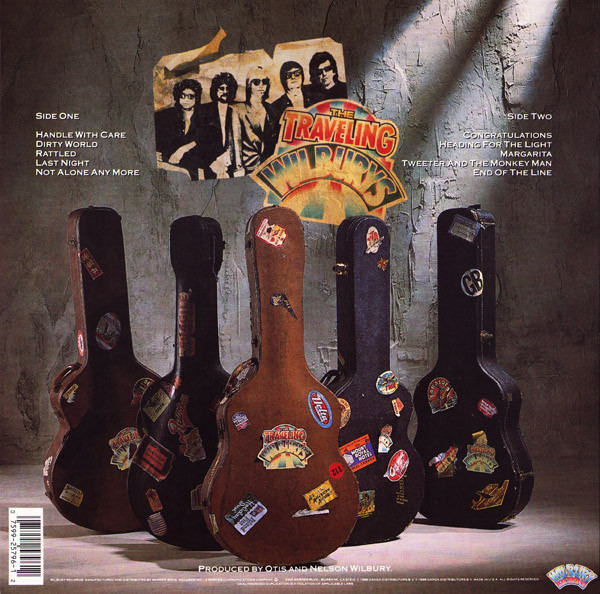
  • Band photography: Neal Preston
  • Sleeve photography: Gered Mankowitz and Chris Smith.
  • Art-director: David Costa for Wherefore Art?

Neal Preston

Like so many American baby boomers, 12 year old Neal Preston fell in love with music after seeing the Beatles on The Ed Sullivan Show in February 1964. A few years later, he first combined this love with his other hobby, photography and started shooting rock shows throughout the New York City area. While still in high school, he formed a small photography company, earning assignments from a variety of publications.

Shortly after graduating in 1970, he moved to Los Angeles, where he became a much-in-demand photographer, covering tours by Led Zeppelin, Queen, Bruce Springsteen and The Who. He also extensively shot stars like The Rolling Stones, Fleetwood Mac, Michael Jackson, Tom Petty and many more.

Fast forward to late May 1988.

Out of the blue, he got a call from a contact to go to a house in Encino,  for some shots of Tom Petty and a few friends. “Tom’s gonna call you and he’ll give you the details,” she said.

When Petty called, Preston asked for directions. In October 2017 the photographer recalled the conversation to Daily Mail: ‘“Well, it’s er, it’s um, er… here, talk to George. So he hands the phone over to a guy named George, and this guy says “Hi, this is George.”

I ask what’s the address and it’s a distinctly Liverpudlian accent and I suddenly realize it’s George Harrison. […] Now, in my world, a Beatle trumps anyone,” Preston explained, starstruck. “I’m in a haze now. I remember nothing about the rest of that phone call,” he laughs, “but I managed to write the address.”

The directions lead to a mansion on Balboa Boulevard, Encino.  The house, designed by Wallace Neff, is owned by Eurythmics’ Dave Stewart.  George Harrison rented the place while staying in Los Angeles to make a cameo appearance in the Hand-Made movie “Checking Out”, and helping Roy Orbison and Tom Petty with their new albums. The recording of The Traveling Wilburys album was not planned, but it was fortunate that Stewart had built a recording studio in the house.

(By the way: it turned out that Dave Stewart had forgotten to ask for permits to make changes to the building. The house has since been demolished.)

Later Dave Stewart took some credit for getting the supergroup together. In an interview to Music Radar he stated, “I was kind of the host/virtual member. They recorded it all in my house. I put Dylan together with Tom Petty … George Harrison was living in my house in Encino at the time. Everybody met up there.”

Not that he was there to witness it all. “I was busy doing quite a few things in England,” Stewart says. “That Wilburys thing happened really quickly. It all took place around my kitchen table and in my garden. I introduced everybody, went off, and when I came back they had already done it.”

Back to Neal Preston: “I get to the house about an hour later, knock on the door and a roadie lets me in and I walk in and George is sitting at the table and I see Roy [Orbison] in the kitchen mixing some tea or something and I think this is pretty wild.”

To the photographer, it is explained that Tom, George and Roy have just finished recording an album with Bob Dylan and ELO’s Jeff Lynne and that some pictures are needed for publicity.

“George pulls me aside and takes me in this small room, closes the door and says: ‘Now, listen to me, Bob is in a pretty good mood. I’ll let you know when the mood is just right, I’ll give you a sign and then we’ll shoot. But we won’t shoot until Bob is ready.’

“Then Tom Petty walks in, gives me a hug and says: ‘Now, Bob’s in an ok mood’.”

“It’s all the same thing. They’re walking on eggshells around Bob Dylan.”

Sometime later, Preston is lead to another room, where Bob is playing pinball. While the other four line up before the lens, Bob doesn’t want to finish his game yet. So, the first shot Preston took, Bob is way in the background hunched over the pinball machine. “I’ve been around Bob before, and Bob’s a good guy. But, you know, he’s Bob Dylan,” Preston said. “We all have our good days and bad days in our lives.”

Sometime later, Bob is ready to join his bandmates. The shoot lasts about an hour. There are pictures made in the house and in the garden.

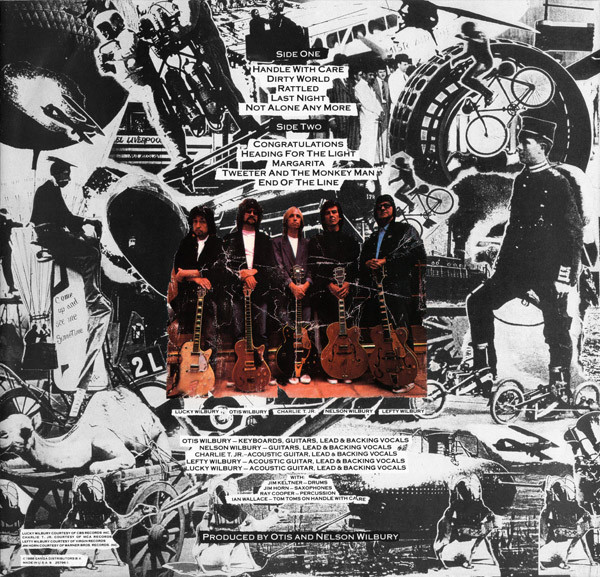
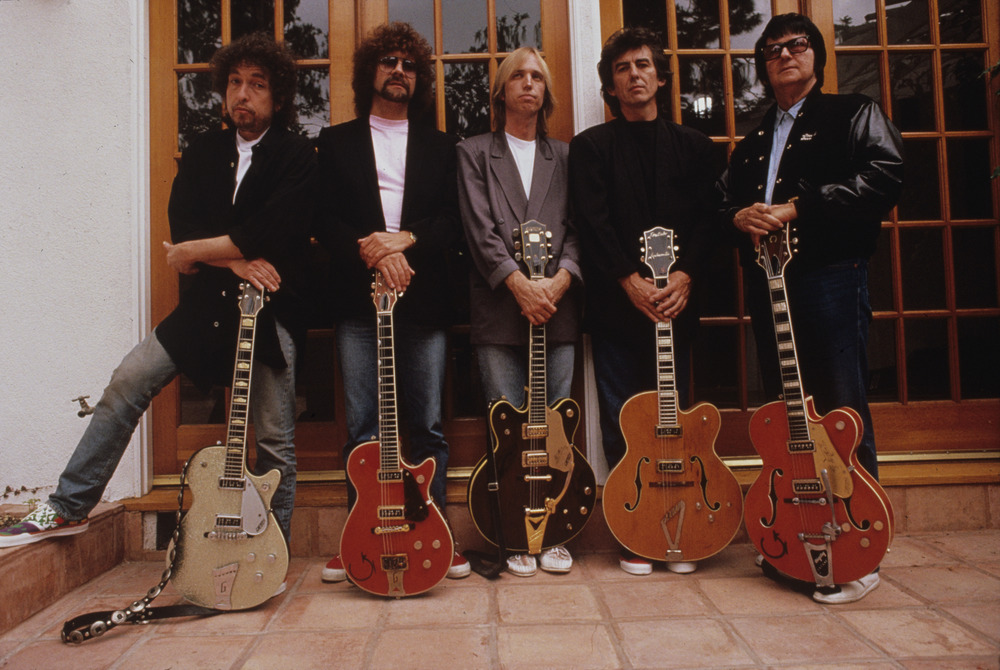
It is a bit of a surprise for the photographer that two of his pictures are given to/chosen by art director David Costa to use for the album sleeve. One of these is even used twice: on the front and the back, while another – the five musicians with their guitars – is used for the inner sleeve front.

“It was never meant to be the iconic Wilbury shoot,” Preston said.

David Costa

The English graphic designer David Costa was probably chosen by George Harrison, as he had recently done the artwork for his comeback album Cloud Nine. (The collaboration would continue with The Very Best of Dark Horse and both the remastered and repackaged Concert for Bangladesh and All Things Must Pass.)

Costa designed the Traveling Wilburys logo.

Besides Neil Preston, two other photographers are mentioned for the sleeve art: Gered Mankowitz and Chris Smith. Mankowitz is best known for his photographs of the Rolling Stones in their prime. He‘s a longtime friend and associate of Costa. But nothing is known of Smith.

When asked, Mr Mankowitz confirmed to me: “I shot the back cover image of the guitar cases in my studio”. But, he added: “I have no idea of who Chris Smith is…………….!”

There’s a Chris Smith, who has been at the forefront of British sports photography for over thirty years. His career started at the Observer newspaper in 1970. Six years later he joined The Sunday Times, where he has worked for over thirty years. He took the famous photograph of The Beatles with Cassius Clay. But that’s his only brush with the world of pop music. So, I doubt he is our man.

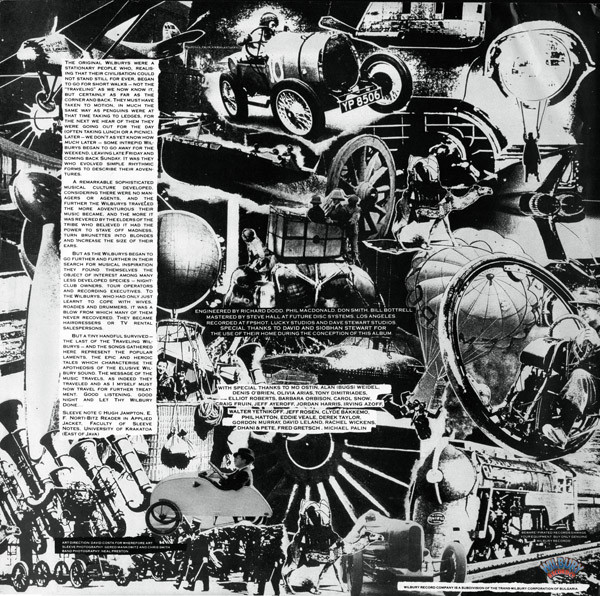
Perhaps the mysterious Smith lived at the beginning of last century and made the vintage photo’s used for the collage on the inner sleeves.  Who knows?

The inner sleeve features a story full of puns about the Wilbury name, by Hugh Jampton (there’s one).  Behind that pseudonym hides one Michael Palin, of Monty Python’s fame.


What else is on the site?

We have a very lively discussion group “Untold Dylan” on Facebook with over 3330 active members.  (Try imagining a place where it is always safe and warm).  Just type the phrase “Untold Dylan” in, on your Facebook page or follow this link 

You’ll find some notes about our latest posts arranged by themes and subjects on the home page of this site.  You can also see details of our main sections on this site at the top of this page under the picture.

The index to all the 597 Dylan compositions and co-compositions that we have found on the A to Z page.

If you are interested in Dylan’s work from a particular year or era, your best place to start is Bob Dylan year by year.

On the other hand if you would like to write for this website, or indeed have an idea for a series of articles that the regular writers might want to have a go at, please do drop a line with details of your idea, or if you prefer, a whole article to Tony@schools.co.uk

And please do note our friends at  The Bob Dylan Project, which lists every Dylan song in alphabetical order, and has links to licensed recordings and performances by Dylan and by other artists, plus links back to our reviews (which we do appreciate).
 

Posted in Uncategorized | Leave a comment

I Dreamed I Saw St. Augustine, and perhaps Joe Hill too.

by Jochen Markhorst

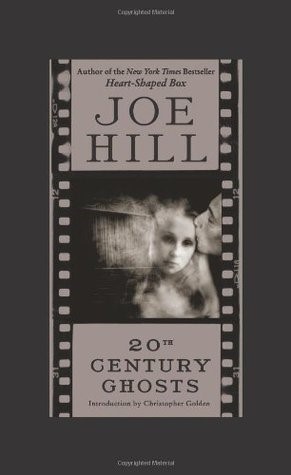
The American writer Joe Hill has been successful for a while, not only as an author of popular comics (the Locke & Key series, for example), but also as a writer of horror, thriller and fantasy since 1997. Winning him prizes, scoring hefty sales figures; some of his work has already been adapted for film too.

His pseudonym is unveiled in 2005 and appears to be not that made up; born in 1972 as Joseph Hillstrom King, he chooses a pseudonym because his father is the world-famous bestselling author Stephen King. Understandably, the young King would like to be judged on his own merits.

And from that first name “Joseph Hillstrom” it is only a small, historically correct step to “Joe Hill”. Father Stephen and mother Tabitha (also a talented writer) are admirers of the legendary Swedish-American union activist and honour him by naming their first son after him.

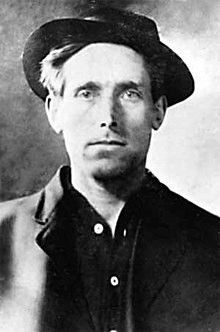
That Swede is born Joel Emmanuel Hägglund (1879-1915) and emigrates from Stockholm to the United States in 1902. He changes his name to Joseph Hillström, earns a living as a worker crisscrossing the country, in the meantime writing and drawing socially-motivated cartoons, political songs and satirical poems.

He is a tough, articulate and intelligent socialist. The latter probably plays a part in his highly dubious death sentence and subsequent execution, November 19, 1915, for the murder of a grocer and his son in Salt Lake City, Utah. On the night of the murder, Joseph Hillström, aka Joe Hill, reports to a local doctor with a gunshot wound in his hand that he refuses to explain – which is about the only incriminating fact on which he is convicted.

Years later, it turns out that Hill’s hand had been wounded in a fight over a woman, Hilda Erickson, who in a retrieved letter also recounts that Joe was shot by her ex-fiancé.

Hill’s handwritten last will is a poem that once again demonstrates his talent for pointed sketches in a firm, witty style. It opens with:

My will is easy to decide
For there is nothing to divide
My kin don’t need to fuss and moan
“Moss does not cling to rolling stone”

The entire poem is set to music decades later by Ethel Raim, who sometimes with her Pennywhistlers shares the stage with Dylan. Immortal, however, is the tragic, gifted Joe Hill mainly from “I Dreamed I Saw Joe Hill Last Night”, the song Earl Robinson made of Alfred Hayes’ poem in 1936. Pete Seeger sings it, Bruce Springsteen plays the song live, very Dylanesque with acoustic guitar and harmonica (2014), but the most famous version is by Joan Baez, Woodstock ’69.

Dylan himself reflects on the song in his Chronicles Vol. 1. Quite extensively, as a matter of fact. It is a fascinating passage in Chapter 2, “The Lost Land”, in which he tries to recall how he started songwriting. The song “I Dreamed I Saw Joe Hill Last Night” and the story behind it is a trigger, at any case.

The life story of the activist immigrant fascinates him, but Dylan then retells it with remarkably little accuracy. For example, he casually mentions that Joe Hill fought in the Mexican War – that war was thirty years before the birth of the Swede. And Dylan tells that Hill was hanged and with his head in the noose spoke his last words, “Scatter my ashes anywhere but Utah.”

Joe was not hanged, but shot and his last words were: “Fire – go on and fire!”

A few years later, when radio maker Dylan plays the Baez version of “Joe Hill” in his Theme Time Radio Hour (episode 73: “Joe”), he apparently has been updated, he corrects the inaccuracies and tells the historically correct story.

Dylan ponders on that song. It doesn’t do Joe Hill justice, he says. He would do it differently and immortalize Hill more like a Jesse James or a Casey Jones. That would also create a nice circle; one of Hillström’s better-known songs is called “Casey Jones – The Union Cap”. Dylan already has a title: “Scatter My Ashes Anyplace But Utah”, and after that he considers modelling that song about Joe Hill on “Long Black Veil”. But alas, although he says he is thinking about how to approach such a first self-written song, it never comes that far. I didn’t compose a song for Joe Hill.

Well, not in those embryonic years anyway, the artist means. In 1967 the old fascination flares up again, when Joe Hill under yet another new alias finds a place on that beautiful album full of itinerant vagabonds, martyrs and outlaws, on John Wesley Harding.

The genesis is romantic. Dylan interrupts his months of playtime with the guys from The Band in West Saugerties and gets on the train to Nashville. That is a journey of some two days and it is tempting to think that Dylan is sitting there in a coupe, writing in his notebook the lyrics for the upcoming LP. In any case, there is no trace of it on The Basement Tapes and Band member Robbie Robertson also knows for sure Dylan did not play anything of John Wesley Harding in the basement of the Big Pink.

On the other hand, we have the testimony of mother Beatty Zimmerman, who in those days regularly stays with Dylan’s young family: Bob “continuously getting up and going over to refer to something” in the “huge” King James Version of the Bible that is always open, on a stand in the middle of his study.

Half quotes, Bible references, and Biblical language – it is all to be found on John Wesley Harding, so that notebook probably says a few things – which then gets completed on the train or at Nashville’s Ramada Inn, where Dylan is staying.

Very different from Blonde On Blonde, as the studio musicians and producer of that previous masterpiece also notice. During the recordings for that LP, the musicians played cards and ping-pong for days while Dylan wrote the songs in the studio, there was no limit to studio time and plenty of room for experimenting with arrangements and deviating instrumentation. Now the songs are already finished and in no time they are on tape with a minimum of instrumentation – apart from a single steel guitar in the last two songs, the job is done by just bassist Charlie McCoy, drummer Kenny Buttrey and Dylan.

“I Dreamed I Saw St. Augustine” is recorded immediately during the first session, October 17, 1967. And during that session, which lasts only three hours, “Drifter’s Escape” and “The Ballad of Frankie Lee and Judas Priest” are recorded too.

Of course, Dylan borrows the title, the opening lines and the circle structure from Joe Hill, but otherwise, as promised, he takes a completely different approach.

In line with the majority of the songs on John Wesley Harding, the language is archaic, taken from the King James Version of the Old Testament. Here Dylan draws primarily from the Book of Daniel, it seems; that book describes many visions and dreams anyway, and in there we also come across the three kings from the LP’s liner notes, the exclamations Lo and Behold, which Dylan saves for the Basement Tapes song, but especially that remarkable idiom. Ye, gifted, arise, utmost, fiery, just to name a few.

Dylan has to bend over backwards every now and then to get those words in and may still slip one or two times (“whom already have been sold”?), but apparently the poet thinks evoking the Scriptural sphere is more important than flawless grammar.

Either way, it works. And then partly thanks to the Kafka-affiliated style and theme. In terms of content, the lyrics have the same opaque clarity, the realistically described irreality as Der Prozeß (The Trial). Therein, the main character Josef K. is in the same state of upheaval as the I-person here; feeling guilty without being guilty, and also ending up lonely, anxious and in shame.

Dylan’s choice of perspective is a great find and comes close to his envisioned ideal from Chronicles. The protest song shouldn’t be preachy, he argues, not one-dimensional. “You have to show people a side of themselves that they don’t know is there.”

In St. Augustine, the protagonist dreams that he was on the jury that sentenced Joe Hill to death, and now is consumed by the insight that he killed an innocent, a saint even. The ambiguity is masterful; the narrator dreams having a vision. The shame, loneliness and anger are real, but the reason is not – after all, it is just a dream. Only apparently unambiguous is the name; however, this St. Augustine has nothing to do with a historical Saint Augustine – the same applies here as with the names in the songs, “John Wesley Harding” and “As I Went Out One Morning”, as with the landlord in “Dear Landlord” or Kafka’s parables and the New Testament parables: Go on, read, it does not say what it says.

The chosen musical accompaniment is sparse and brilliant. In the original, the slow waltz which Dylan will make from it just two years later (with The Band on the Isle of Wight), already shines through – the ripening process has done the song good.

The cover versions are almost always compelling. The men of the English / Australian ensemble The Fatal Shore build a stately cathedral of the song on their debut album (1997), the sympathetic Dirty Projectors record a warm, intimate living room version in 2010 and Thea Gilmore’s spine-chilling approach (Songs From The Gutter, 2005) gave her the courage to venture into an integral version of John Wesley Harding (2011, a glorious and brave album) a few years later.

Thea Gilmore:

John Doe’s cover on the I’m Not There soundtrack (’07) may be a bit overcrowded, but remarkable it is still, as it contains both echoes from The Band and Slow Train Coming. And even Joan Baez’s approach is tolerable for the Dylan fan with Baez allergy, on her Dylan tribute Any Day Now – incidentally with the original drummer, Kenny Buttrey, and also recorded at Nashville’s Columbia Studios (1968).

The most intriguing cover comes from an old slow hand and is on I Still Do (2016). It sounds like Eric Clapton unearthed a lost track from Ry Cooder’s chef-d’oeuvre Chicken Skin Music and then livened it up with his own chicken skin inducing guitar playing. Dramaturgically, Clapton’s singing does not come close to Dylan, obviously, but he knows quite well how to uncover the hidden melodic ore deposits – the quality in which Dylan himself has excelled for more than half a century.

Eric Clapton (sorry, it seems this video is not available in all parts of the world.  In case that affects your viewing of the song there is a second edition beneath).

What else is on the site?

We have a very lively discussion group “Untold Dylan” on Facebook with over 3330 active members.  (Try imagining a place where it is always safe and warm).  Just type the phrase “Untold Dylan” in, on your Facebook page or follow this link 

You’ll find some notes about our latest posts arranged by themes and subjects on the home page of this site.  You can also see details of our main sections on this site at the top of this page under the picture.

The index to all the 597 Dylan compositions and co-compositions that we have found on the A to Z page.

If you are interested in Dylan’s work from a particular year or era, your best place to start is Bob Dylan year by year.

On the other hand if you would like to write for this website, or indeed have an idea for a series of articles that the regular writers might want to have a go at, please do drop a line with details of your idea, or if you prefer, a whole article to Tony@schools.co.uk

And please do note our friends at  The Bob Dylan Project, which lists every Dylan song in alphabetical order, and has links to licensed recordings and performances by Dylan and by other artists, plus links back to our reviews (which we do appreciate).


Posted in Uncategorized | 2 Comments

Just like Tom Thumb’s Blues: the sampler version

By Tony Attwood and Aaron Galbraith

We recently presented, for the first time, an article on “The Sampler Sessions” – musicians who have taken elements of Dylan songs and then represented them in new forms.

We’re not sure too many people have actually considered the work of Dylan alongside the concept of sampling, so we thought we’d investigate and see where it took us.  And encouraged by the fact that a) we enjoyed putting the article together and b) no one else seems to have written much about Dylan and sampling, we thought we’d go further.

If you just think that sampling is not for you, but haven’t listened to any of these works, we’d urge you to try a few (especially as Dylan himself has professed some admiration for sampling, and of course because it can well be said that in taking quotes from other people’s works Dylan himself has been a literary and musical sampler for years and years).

And, just in case sampling really isn’t something you’ve ever got to (what with being a Dylan fan and Dylan and sampling not normally overlapping) we thought we’d give a bit of background, as well as another track to listen to.

First a bit of background (the Dylan track, if you don’t want background, is near the end, but what we have put here is awfully interesting, and you really should read it).

Sampling is not new, and nor was it invented by hip hop artists, but actually goes back to “musique concrète”, in 1940s France, which involved speeding up or slowing down music on tape, and splicing recordings of anything and everything together to make new sounds and forms.   The big names of the era were John Cage, Edgar Varèse, and Karlheinz Stockhausen.  The most famous piece ever however, at least in Britain, was the theme music for the (still running) BBC TV series “Doctor Who” [with which Tony had a little bit to do, as he will endlessly tell anyone who is silly enough to talk to him for more than two minutes.]

The word “sample” started being used around 1978 at the same time as the synthesizer started to be considered a musical instrument.  From there the approach moved into jazz, dub reggae, hip hop and rock as a whole variety of artists took up the approach – Brian Eno, Kate Bush, Peter Gabriel, Thomas Dolby, Stevie Wonder were all pioneers.  Everyone can argue their own idea of the key “turning point” that brough rock and sampling together, but Ton would argue that, “My Life in the Bush of Ghosts” by David Byrne and Brian Eno, did more than any other album to show rock musicians that rock and sampling could work together.  From then on sampling became part of the repertoire.  Some songs have been used as “samples” in over 1000 other tracks.

As with quotes in articles and books from other articles or books, it is accepted that the morally correct and legal process is to acknowledge the original material, and if quoting more than a few lines, seek permission and possibly pay a fee.  But in the world of rock music, such niceties are not always observed.

However courts in most countries have now ruled that sampling without permission is a breach of copyright.  Court findings have clearly laid down that if the creator of the music does not give permission he/she can either seek huge levels of damages, or require the recording to be removed from circulation.  Last year (2019) the European Court of Justice ruled that samples that when heard in a recording, were recognisable, needed the permission of the copyright owner before being used.

So, that’s the background.  And now some music.  Tom Thumb’s Blues is listed as a J. Period Dylan Remix, and is one of a set of bonus tracks on J.Period* And K’NAAN ‎– The Messengers (Deluxe Edition).

The album contains a number of  “Dylan Tribute” tracks such as “Don’t Think Twice”, “4th time around”, “Relationships Lay”, “Hard Rain,” and “It’s alright, ma”.  Here is the sampling of “Just like Tom Thumb’s Blues”…

In the previous article in this series, we made the point that “Lay Lady Lay” was essentially working on the highly distinctive chord sequence that is at the very heart of the song.   In this case we have an approach which takes both the instantly recognisable guitar solo, and one verse of the song.

We’re going to carry on looking at this use of Dylan’s music in at least one more, and possibly lots more articles, now that we’ve started to think about the subject.  Hopefully you might find it interesting, even if you are not deeply into this approach to Dylan’s work.

What else is on the site?

We have a very lively discussion group “Untold Dylan” on Facebook with over 3330 active members.  (Try imagining a place where it is always safe and warm).  Just type the phrase “Untold Dylan” in, on your Facebook page or follow this link 

You’ll find some notes about our latest posts arranged by themes and subjects on the home page of this site.  You can also see details of our main sections on this site at the top of this page under the picture.

The index to all the 597 Dylan compositions and co-compositions that we have found on the A to Z page.

If you are interested in Dylan’s work from a particular year or era, your best place to start is Bob Dylan year by year.

On the other hand if you would like to write for this website, or indeed have an idea for a series of articles that the regular writers might want to have a go at, please do drop a line with details of your idea, or if you prefer, a whole article to Tony@schools.co.uk

And please do note our friends at  The Bob Dylan Project, which lists every Dylan song in alphabetical order, and has links to licensed recordings and performances by Dylan and by other artists, plus links back to our reviews (which we do appreciate).


Posted in Uncategorized | 1 Comment

Bob Dylan and Prince Phillip (and Dignity)

by Larry Fyffe

In his article entitled “Who Wrote Dylan”, Ross Altman asserts that Bob Dylan makes a deal with Prince Charles to write lyrics for his songs. And furthermore that Charles writes Dylan’s early songs. However, it’s rather surprising that someone holding a PhD would commit such grievous errors. Altman mixes up his Princes.

Bob Dylan himself later confesses that it’s Prince Phillip (not Charles) with whom he signs the contract:

Met Prince Phillip at the home of the blues
Said he give me information if his name wasn't  used
He wanted money up front, said he was abused
By dignity
(Bob Dylan: Dignity)

https://youtu.be/2Dlh-X1fpoQ

Mr.Altman points out the fact that the Queen’s son says of course he’s familiar with Dylan Thomas’ work when asked if he knows who the singer Dylan is. Mr. Altman then misses the tip-off that a number of lyrics supposedly written by the American singer contain undignified, even off-colour, remarks – remarks completely uncharacteristic of Prince Charles, but not uncharacteristic of Queen Elizabeth’s husband.

Charles would not have written lyrics such as those below, but Phillip, a navy man, would and he does – it’s rather evident (his favourite beer is “Boddingtons”):

Well, sometimes I might get drunk
Walk like a duck, and smell like a skunk
Doesn't hurt me any, doesn't hurt my pride
Because I got my little lady right by my side
She's trying to hide, pretending she doesn't know me

In the same song, the Duke of Edinburgh, an avid fisherman, goes on to have a little fun with the name of his ”little lady”, Elizabeth The Second:

Well, they ask me why I'm drunk all the time
It levels my head, and eases my mind
I just walk along, and stroll and sing
I see better days, and I do better things
I catch dinosaurs
Make love to Elizabeth Taylor
Catch hell from Richard Burton
(Bob Dylan: I Shall Be Free)

Bob Dylan gets stuck with singing more about British royalty when Prince Phillip can’t resist poking fun at Elizabeth’s paternal grandmother:

Queen Mary, she's my friend
Yes, I believe I'll go see her again
Nobody has to guess
That Baby can't be blessed
Till she finally sees that she's like all the rest
With her fog, amphetamine, and her pearls
(Bob Dylan: Just Like A Woman)

If that weren’t evidence enough, Phillip goes after one of Elizabeth’s relatives of long ago in another song:

When your mother sends back all your invitations
And your father to your sister, he explains
That you're tired of yourself, and all of your creations
Won't you come see me, Queen Jane?
(Bob Dylan: Queen Jane Approximately)

https://youtu.be/65y9dViCI1I

Lady Jane, the daughter of Duke Henry Grey and Lady Frances, is proclaimed Queen, but her reign lasts only a few days: she’s deposed, and replaced by the dead King’s half-daughter ‘Bloody’ Mary; then beheaded.

In the following song lyrics, Phillip once again almost gives himself away – he loves to play polo, a game Bob Dylan has no interest in:

Come over here pony,
I want to climb up one time on you
You're so nasty, and you're so bad
That I swear that I love you, yes I do
(Bob Dylan: New Pony)

Polo is played by royalty, and a polo match is clearly going on in the lyrics below:

All along the watchtower
Princes kept the view
While all the women came and went
Barefoot servants too
Outside, in the distance
A wildcat did growl
Two riders were approaching
And the wind began to howl
(Bob Dylan: All Along The Watchtower)

A footnote from Tony: Larry of course writes this series of articles, but the selection of videos is down to me.  I do try not to repeat my selections over and over when there are others available, but the live version of Dignity back up the page, which I have used several times before, is for me, beyond doubt, the very best one version ever.  So sorry, it does get featured in several articles, but I just can’t resist.

What else is on the site

We have a very lively discussion group “Untold Dylan” on Facebook with over 3330 active members.  (Try imagining a place where it is always safe and warm).  Just type the phrase “Untold Dylan” in, on your Facebook page or follow this link 

You’ll find some notes about our latest posts arranged by themes and subjects on the home page.  You can also see details of our main sections on this site at the top of this page under the picture.

The index to all the 597 Dylan compositions and co-compositions that we have found on the A to Z page.

If you are interested in Dylan’s work from a particular year or era, your best place to start is Bob Dylan year by year.

On the other hand if you would like to write for this website, please do drop me a line with details of your idea, or if you prefer, a whole article.  Email Tony@schools.co.uk

And please do note   The Bob Dylan Project, which lists every Dylan song in alphabetical order, and has links to licensed recordings and performances by Dylan and by other artists, links back to our reviews

Posted in Uncategorized | 2 Comments

Why does Dylan like “Dark as a Dungeon”

Editorial note:

One of the wonderful things about Untold Dylan is that readers are so active in joining in with suggestions.  So when Russell Pottinger suggested another entry for our “Why Does Dylan Like” series, we jumped at the idea.

Great idea, and a song that we have missed.  So here we are…

————-

By Tony Attwood and Aaron Galbraith

Dark as a Dungeon is a song written by singer-songwriter Merle Travis (1917-1983).  Merle was a C&W singer who particularly wrote about the life of, and exploitation, of the coal miners.  His most famous song, which we guess everyone with an interest in the history of popular music must know, was “Sixteen Tons” – his 1947 recording of the song became a gold record, and it has subsequently been recorded by a vast number of singers.

Merle Travis also invented “Travis picking” – a form of guitar fingerpicking, which really is quite tough to learn – much harder than it sounds in fact.

In his early live performances, Elvis Presley sang the song, although he didn’t record it.  Here is the composer performing the song…

“Dark as a Dungeon” itself, like “Sixteen Tons” takes issue with the danger and drudgery of being a coal miner, and it has often been used as a rallying cry by miners seeking improved working conditions.  Again, here’s the composer…

https://youtu.be/-FPmSLzsbdM

As soon as I (Tony) heard this song I found myself thinking “I know that melody”, and after a few seconds of asking Aaron what it was, it came to me: there is a distinct relationship between “Dark as a Dungeon” and “Farewell Angelina.”

It is possible that Dylan recognised the similarity in the melody and so didn’t use the song himself.  He still has still never performed “Farewell Angelina”, since writing it the song in 1964.  But he has sung “Dark as a Dungeon”.

So back to “Dark as a Dungeon,” the song reached a particular level of fame when Johnny Cash included it in his Folsom Prison concert.

And interestingly Joan Baez has sung it as a solo…

as well as performing it on the Rolling Thunder Revue with Bob Dylan in 1975.  In the 1990 European part of the Never Ending Tour and again in 1998 in Melbourne, Australia, Bob performed it live on stage.

https://youtu.be/PSoCIe1rqHo

Here are the lyrics

Oh come all you young fellers so young and so fine
Seek not your fortune in a dark dreary mine
It'll form as a habit and seep in your soul
Until the stream of your blood runs as black as the coal

Where it's dark as a dungeon, damp as the dew
Danger is double pleasures are few
Where the rain never falls, the sun never shines
It's a dark as a dungeon way down in the mine

Well it's many a man that I've seen in my day
Who lived just to labor his whole life away
Like a friend with his dope and a drunkard with his wine
A man will have lust for the lure of the mine

And pray when I'm dead and my ages shall roll
That my body would blacken and turn into coal
Then I'll look from the door of my heavenly home 
and pity the miner digging my bones

Where it's dark as a dungeon, damp as the dew
Danger is double pleasures are few
Where the rain never falls, the sun never shines
It's a dark as a dungeon way down in the mine

The midnight, the morning, or the middle of day,
Is the same to the miner who labors away.
Where the demons of death often come by surprise,
One fall of the slate and you're buried alive.

The final verse, although included in the original song, is often omitted by performers.  Here’s one more famous version…

It’s as dark as a dungeon way down in the mine…

Here are some of the other recent “Why does Dylan like” articles.  A full list of the series is to be found on the Why does Dylan like index page.

  1. Why does Dylan like “Somebody Touched Me”
  2. Why does Dylan like “The End of Innocence”
  3. Why does Dylan like “The Golden Vanity”
  4. Why does Dylan like “Bony Moronie”?
  5. Why does Dylan like Uncle Tupelo, Son Volt & Wilco
  6. Why does Dylan like “Somebody Touched Me”
  7. Why does Dylan like “The End of Innocence”
  8. Why does Dylan like “The Golden Vanity”
  9. Why does Dylan like “Bony Moronie”?
  10. Why does Dylan like Uncle Tupelo, Son Volt & Wilco

What else is on the site

You’ll find some notes about our latest posts arranged by themes and subjects on the home page.  You can also see details of our main sections on this site at the top of this page under the picture.

The index to all the 595 Dylan compositions and co-compositions that we have found on the A to Z page.

We also have a very lively discussion group “Untold Dylan” on Facebook with over 2000 active members.  (Try imagining a place where it is always safe and warm).  Just type the phrase “Untold Dylan” in, on your Facebook page or follow this link 

If you are interested in Dylan’s work from a particular year or era, your best place to start is Bob Dylan year by year.

On the other hand if you would like to write for this website, please do drop me a line with details of your idea, or if you prefer, a whole article.  Email Tony@schools.co.uk

And please do note   The Bob Dylan Project, which lists every Dylan song in alphabetical order, and has links to licensed recordings and performances by Dylan and by other artists, links back to our reviews


Posted in Uncategorized | 3 Comments

T.V. Talkin’ Song: sweet dreams and a rare mention of TV.

by Jochen Markhorst

Dave Stewart’s autobiography Sweet Dreams Are Made Of This (2016) is a double-minded affair, and in line with the image that even a less knowledgeable music connoisseur has of the man: colourful, unruly, creative and well, yes, a bit annoying, at times. The photo collage on the cover is conclusive. Throughout the book, Stewart profiles himself dozens of times as an immigrant in Alice In Wonderland, mushrooms play a leading role in drug-related anecdotes, more than once, and the man’s hippie-like naivety, whether feigned or not, is predominant.

The Dylan fan’s curiosity is sparked by the superlative recommendation by the old master on the back cover: “Dave is a dreamer and a fearless innovator, a visionary of high order, [and] an explosive musician [who] innately recognizes the genius in other people and puts it into play without being manipulative.”

Big words. But Dylan does know the man quite well, since a first collaboration in ’84. In the late 1980s, the occasional group Traveling Wilburys gathers in Stewart’s garden, the first record is recorded in his home studio. There is a click between the two rather different characters and Dylan will call on Stewart’s talents a few times. For example to produce a number of video clips, “When The Night Comes Falling From The Sky”; the hypnotic “Blood In My Eyes”; and “Emotionally Yours”. The latter has acquired some cult status because Dylan actually sings lip-synchronous playback, while playing with conviction an acoustic guitar that most certainly is not on the recording. He does sit at a piano though, on a piano stool, but stubbornly remains with his back to that piano, of course.

In the meantime, the two musicians also look each other up privately, and one of the stories that ensue is set in London:

“One day I took Bob to Speakers’ Corner in Hyde Park, where people stand on boxes and rant about whatever they want. Bob wore his jacket hood up so no one could recognize him, and he enjoyed being in the crowd, listening to the different speakers, even joining in, asking questions. He wrote a song about it when he got back to the hotel. It’s called T.V. Talkin’ Song.”

In an interview with USA Today (August 1990), Dylan already reveals that the song “is based on a speech” he heard at Hyde Park, so Stewart confirms that story. That reading is also consistent with the somewhat isolated position of the song in Dylan’s catalog.  As a rule, we rarely see Dylan fulminate against such a relatively volatile carrier of culture like television, and it has also been a long time since the poet put an anecdote to music. The form is appropriate then, of course; his last talking song was about 25 years ago.

The speaker at Speakers’ Corner has struck a chord with Dylan, that much is clear. Although the poet has rarely commented on the phenomenon of television in his work, and certainly not on its possible objectionable influence, he speaks out quite regularly in interviews.

“TV is so super powerful. It forms people’s opinions. When I was growing up, and even in the sixties, that never was the case. You had to go out and experience things to form opinions. Now you don’t have to move. You get knowledge brought in to you, you know, without the experience of it. So I think there’s something really dangerous in that.” (Boston Review, April ’86)

And at a press conference in Rome, July 2001, the master even looses his cool and agrees, not entirely traceable, with a provoking journalist that TV and media have killed poetry and literature.

“And movies and TV. I mean, you can’t see more horrific things than you see in the media, especially in the news. I’m just talking about the news department, which is showing people absolutely everything they’d ever even dreamed about. Even thoughts they might think and suppress forever, they’d see them in the media. So you can’t express them anymore.”

In any case, both outpourings illustrate a dystopian world view, a paranoia that is characteristic of a major part of the speakers who climb the soapbox in Hyde Park. In the song, however, Dylan remains at a critical distance. The poet is a conduit for someone else’s worldview, avoids sharing his own opinion (“my thoughts began to wander” even suggests that he is only mildly fascinated) and serves a not unamusing ironic punch line in the closing line.

The most famous line is the line about Elvis. “Sometimes you gotta do like Elvis did and shoot the damn thing out.” It refers to an urban legend which is so stubbornly cultivated that it is now incorporated into the cultural baggage of the well-read American. In 1974, Elvis, in his suite on the top floor of the International Hotel in Las Vegas, is said to have shot a bullet through the screen as he saw the hated Robert Goulet. The successful baritone actor/singer is said to have stolen Elvis’ then-girlfriend Anita Wood in the 1950s, that’s why. Graceland sources later reveal, after Elvis’ death, that this is not uncommon.

The King shoots televisions to pieces all the time. Mysterious is the addition by spokesman Kevin Kern, at the opening of the exhibition Elvis After Dark (March 2006), which shows such a shot TV set: “This is the only surviving television or appliance that Elvis shot out that was kept.”

Or appliance”? Did Elvis also shoot vacuum cleaners, ironing-boards and juicers? Intriguing, but we don’t get any answers.

The master is reasonably content with “T.V. Talkin’ Song”. Unlike the esteemed ladies and gentlemen-critics, who in general ignore the song in the often disappointed reviews of under the red sky. In particular “Wiggle Wiggle” is targeted, but the rest of the album does not receive much affection either. Dylan, however, clings to it. Unmoved, he continues to play most songs. The detested “Wiggle Wiggle” more than a hundred times, the title song “Under The Red Sky” is on the playlist until 2013 and also “T.V. Talkin’ Song” is still performed twenty times in 1990. He never announces the song, but after the very last performance, November 18 in Detroit, he does make a final statement: “That’s a song of social comment.”

T.V. Talkin’ Song (outtake):

https://www.youtube.com/watch?v=_a_ZPHNbfbc

What else is on the site

You’ll find some notes about our latest posts arranged by themes and subjects on the home page.  You can also see details of our main sections on this site at the top of this page under the picture.

The index to all the 597 Dylan compositions and co-compositions that we have found on the A to Z page.

We also have a very lively discussion group “Untold Dylan” on Facebook with over 3300 active members.  (Try imagining a place where it is always safe and warm).  Just type the phrase “Untold Dylan” in, on your Facebook page or follow this link 

If you are interested in Dylan’s work from a particular year or era, your best place to start is Bob Dylan year by year.

On the other hand if you would like to write for this website, please do drop me a line with details of your idea, or if you prefer, a whole article.  Email: Tony@schools.co.uk

And please do note  The Bob Dylan Project, which lists every Dylan song in alphabetical order, and has links to licensed recordings and performances by Dylan and by other artists, links back to our reviews

Posted in Uncategorized | 3 Comments

Bonnie Why’d You Cut My Hair. Another Dylan song we missed!

Commentary by Tony Attwood, song found by Aaron Galbraith

With our attempts to find ever more obscure Dylan compositions, and indeed get the number of Dylan compositions and co-compositions up to 600 (for no reason other than the fact that it is a round number) we’re currently searching high and low – not so much for songs that have never been heard before (we are unlikely to find many of them) but those which somehow we have missed from the index of Dylan songs that we have reviewed on this site.

So we now move on to “Bonnie Why’d You Cut My Hair?”

It was performed once on 1 May 1961, according to the official Dylan site and so we presume that is what the recording above is – the performance on 1 May 1961, and presumably it is sung to Bonnie.

Purportedly the ‘real’ (or if you prefer, the original) Girl From The North Country, she first met Dylan in 1959 and they remained close throughout his days in Minneapolis. After he left for New York in December 1960 they remained in regular touch throughout Dylan’s rise to fame.

Jaharana Romney, formerly Bonnie Beecher, was interviewed by Markus Wittman, May 1989 and it is reported that in the book “Wanted Man, in Search of Bob Dylan”, edited by John Bauldie (1992), pages 26-27 we get this commentary…

WITTMAN: Did [Bob Dylan] write any songs back in Minnesota?

ROMNEY: …He wrote a couple of fooling around songs – he wrote one when I cut his hair, which made me so angry!…

… He came to my apartment and said, “It’s an emergency! I need your help! I gotta go home an’ see my mother!”

He was talking in the strangest Woody Guthrie-Oklahoma accent. I don’t know if she was sick, but it was an unexpected trip he had to make up to Hibbing and he wanted me to cut his hair. He kept saying, “Shorter! Shorter! Get rid of the sideburns!”

So I did my very best to do what he wanted and then in the door come Dave Morton, Johnny Koerner and Harvey Abrams. They looked at him and said, “Oh my God, you look terrible! What did you do?” And Dylan immediately said, “She did it! I told her just to trim it up a little bit but she cut it all off. I wasn’t looking in a mirror!”

And then he went and wrote that song, “Bonnie, why’d you cut my hair? Now I can’t go nowhere!” He played it that night in a coffeehouse and somebody told me recently that they had been to Minnesota and somebody was still playing that song, “Bonnie, Why’d You Cut My Hair?” It’s like a Minnesota classic! And so I’ve gone down in history!

This version of the song, we are told, was recorded in Bonnie Beecher’s bedroom.   Here are the lyrics.

Bonnie why d'you cut my hair 
Bonnie why d'you cut my hair
I can't go nowhere

Sitting down all alone
Ain't go no hair on my head
Aint got enough to use a comb
Is your hair Bonnie(Unclear lines)
Hey hey ho

The song is noted in Heylin, as one of a group of three from this period, the others being “Talking Hugh Brown” and “Song to Bonny”.  Heylin notes “Talkin” and “Cut my hair” as the “first originals to appear on tape from the post-Guthrie songwriter.  Both appear to have been entirely improvised,” – which I comment upon a little in the review of “Hugh Brown”.

Heylin suggests that the reason for the trip to Hibbing was to ask his father for some extra money to keep Bob going as he tried to make a career for himself.

Bonny also got her own song – the next piece mentioned in Heylin’s “Revolution in the Air” is “Song to Bonny”

What else is on the site

You’ll find some notes about our latest posts arranged by themes and subjects on the home page.  You can also see details of our main sections on this site at the top of this page under the picture.

The index to all the 595 Dylan compositions and co-compositions that we have found on the A to Z page.

We also have a very lively discussion group “Untold Dylan” on Facebook with over 2000 active members.  (Try imagining a place where it is always safe and warm).  Just type the phrase “Untold Dylan” in, on your Facebook page or follow this link 

If you are interested in Dylan’s work from a particular year or era, your best place to start is Bob Dylan year by year.

On the other hand if you would like to write for this website, please do drop me a line with details of your idea, or if you prefer, a whole article.  Email Tony@schools.co.uk

And please do note   The Bob Dylan Project, which lists every Dylan song in alphabetical order, and has links to licensed recordings and performances by Dylan and by other artists, links back to our reviews

Posted in Uncategorized | 5 Comments

Bob Dylan And Medea

by Larry Fyffe

Before Odysseus makes his sea voyage, Jason makes his.

Jason’s uncle usurps the Greek throne that belongs to Jason’s father. To protect him from the usurper, Jason is hidden away by his mother. Because the usurper doesn’t honour goddess Hera, she enlists Aphrodite to help Jason regain his royal rights.  Aphrodite is said by some to be the daughter of the Olympian Zeus and the Titan goddess Dione – the Titans being possessed of little compassion.

The usurper has tricks of his own up his sleeve, and tells Jason he’ll give up the throne, but first Jason has to embark on sea voyage in quest of the Golden Fleece, a symbol of royal power – the final guard thereof being a dragon – that is, if you make it that far without getting yourself killed.

As a countermove, on the daughter of the ruler of the realm where the Fleece is kept, Aphrodite has her son Cupid cast a spell that makes her fall madly in love with Jason. The daughter, Medea, is herself a possessor of magic powers – she’s a sorceress.

She causes the dragon to fall into a deep sleep; Jason grabs the royal emblem and agrees to take Medea back home with him. She even arranges the death of her own brother to help Jason escape, and then, lo and behold, she arranges the usurper’s death!

Jason fails to regain the throne immediately; he leaves Medea and their children; marries into other royalty; tells Medea to blame the whole mess on Aphrodite.

Needless to say, a bad idea all round … you don’t fool with an enchantress, nor with Aphrodite, let alone with the wife of Zeus. A lonely life of depression awaits Jason after Medea rides off in her dragon-drawn chariot. Who among us would say that he doesn’t deserve it?

A metonymical twist is given to the mythological tale in the poem below:

The fleece of this goat and even
That gold one which cost such pain
To Jason's not worth a 'sou' towards
The tresses which I take
(Guillaume Apollinaire: The Beastiary Of Orpheus' Procession)

Likewise, in the following song lyrics, there’s a sexual shift away from the golden fleece of the ram being a sacrifice to the God of Thunder; apparently, Johnny’s in the basement mixing up the mythologies:

First we wash our feet near the immortal shrine
And our shadows meet, and then we drink the wine
I see the hungry clouds up above your face
And then tears roll down, what a bitter taste
And then you drift away on a summer's day where the wildflowers bloom
With your golden loom
(Bob Dylan: Golden Loom)

Medea becomes the consort of a Greek king whose son Theseus had been a member of Jason’s crew; he marries Phaedra. Aphrodite casts a spell on Phaedra that causes her to fall in love with Theseus’ son by a previous union because the son rejects Aphrodite’s sexual advances.

Now there’s a story ripe for burlesque:

Well, Phaedra with her looking glass
Stretching out upon the grass
She gets all messed up, and she faints
That's 'cause she's so obvious, and you ain't
I wanna be your lover, baby, I wanna be your man
I wanna be you lover, baby, I don't wanna be hers
I wanna be yours
(Bob Dylan: I Wanna Be Your Lover)

In the lyrics below, the mythology of Medea is deconstructed – an enchantress she may be, but an aristocrat she ain’t:

With your sheets like metal, and your belt like lace
And your deck of cards missing the jack and the ace
And your basement clothes, and your hollow face
Who among them can think he could outguess you?
(Bob Dylan: Sad-Eyed Lady Of The Lowlands)

Jason and Medea – in one format or another, it’s a mythological story that never dies:

Was that the thunder that I heard?
My head is vibrating, I feel a sharp pain
Come sit by my side, don't say a word
Oh, can it be that I am slain?
(Bob Dylan: Romance In Durango ~ Dylan/Levy)

https://youtu.be/-NBWMK0CV0Y

What else is on the site

You’ll find some notes about our latest posts arranged by themes and subjects on the home page.  You can also see details of our main sections on this site at the top of this page under the picture.

The index to all the 596 Dylan compositions and co-compositions that we have found on the A to Z page.

We also have a very lively discussion group “Untold Dylan” on Facebook with over 2000 active members.  (Try imagining a place where it is always safe and warm).  Just type the phrase “Untold Dylan” in, on your Facebook page or follow this link 

If you are interested in Dylan’s work from a particular year or era, your best place to start is Bob Dylan year by year.

On the other hand if you would like to write for this website, please do drop me a line with details of your idea, or if you prefer, a whole article.  Email Tony@schools.co.uk

And please do note   The Bob Dylan Project, which lists every Dylan song in alphabetical order, and has links to licensed recordings and performances by Dylan and by other artists, links back to our reviews

Posted in Uncategorized | 7 Comments

NET 1988: Desperate stratagems, Part 1: Heroes and Villains

By Mike Johnson (Kiwipoet)

‘They say sing while you slave
and I just get bored’ (Maggie’s Farm)

When Bob Dylan appeared at Concord Pavilion on June 7 1988 for the first concert of a tour that was to last for the rest of his life, his line up was strictly minimal: lead guitar, bass and drums. With Dylan playing second or rhythm guitar.  Gone were the big bands and girl choruses.

It was back to basics for Bob, with GE Smith on lead guitar, Kenny Aaronson on bass and Chris Parker on drums. But thanks to GE Smith’s comprehensive guitar work, the band didn’t sound too minimal. The pace was mostly fast and jangly. Often the guitars became a blurred, amorphous ‘wall of sound’ sound behind Dylan’s voice

Not all Dylan followers like the GE Smith period, which was to last until 1991, accusing him of pulverising Dylan’s subtle melodies with his often shattering sound, but I don’t think Smith was entirely responsible for that. Dylan himself seems, at times, to be assaulting his songs as much as singing them, rattling through them as if to get them out of the way, as if he’s sick of them.

These 1988 performances create an ambivalent effect. On one hand Dylan’s voice is as powerful and expressive as ever, on the other hand he seems to want to tear the heart out of the songs. His voice is a shock, too, for those used to his clear high mercurial tones; he grunts and snarls and vocalises in a hoarse, breathless, broken style like a man at the end of his tether. His frustration is palpable. You wanna hear this old song again? Well here it is, watch me rip it pieces.

[Just like a rolling stone]

An unsettling listening experience, I think you’ll agree, but it’s become my favourite because it’s so unsettling. The gleeful triumph of the Sixties performances has given way to a muffled rage. Almost sounds like the Sex Pistols!

Such ‘attack’ songs have been criticised as being vindictive, and this performance might support that impression, but it’s too easy to forget the influence of Existentialism in the 1960s when those songs were written. Everybody was reading Camus or a book by Colin Wilson called The Outsider. The idea is that most of us live in bad faith; we are not honest with ourselves or each other. We choose our blindness. We cling to precious illusions. What we need to do is live ‘authentic’ lives.

The girl accused in ‘Just like a rolling stone’ is an example of the worst kind of bad faith – a wilful blindness built on snobbery. Ultimately, living inauthentically is not living at all.

This same understanding animates other songs too, ‘Ramona’, ‘She belongs to me’, ‘Positively Fourth Street.’

The shattering of pretensions, illusions and delusions lie behind such great songs as ‘It’s all right Ma…’ and ‘Gates of Eden’. In that song, political, religious and ontological delusions are mocked, made meaningless, by the mysterious gates. Only behind those gates is the source of authenticity to be found; the only source of truth.

‘Sometimes I think there are no words
But these to say what’s true
And there are no truths
Outside the gates of Eden’

I love the softer, more spooky versions from the late 90s, which take advantage of the Celtic melody, but this angry, powerful version reminds us that this is a kind of protest song. The drums crash and roll; the guitars plunge through the chords. No surrender to melodic sweetness here. Some of the lines come to life with this rough treatment.

‘The savage soldier sticks his head in sand
and then complains…’

Wilful blindness again. The nightmare hallucinatory visions are thrown into stark relief by Dylan’s emphatic 1988 style.

‘The lamppost stands with folded arms
its iron claws attached.’

[Gates of Eden; 10/6/1988]

The year, however, was not totally dominated by GE Smith’s guitar. There were a few great acoustic moments we can’t pass over. One is a strong rendition of ‘With God on Our Side,’ recorded in Oakland for TV (12/4), which accounts for its superior quality. You can still find this on You Tube. We could quibble that this song was recorded before the NET tour began, but I think it’s too good to miss. I was reluctant to drop it on that technicality because Dylan adds a verse about the Vietnam war he doesn’t use again.  That war becomes included in the list of false histories learned at school.

‘The names of the heroes
I was made to memorise
With guns in their hands
And god on their side.’

Some things don’t change much, it seems.

This is one song that doesn’t alter significalntly in performance, although these performances are rare enough. This sounds pretty much as it will sound six years later at the Unplugged 1994 concert, just a bit rawer.


[God on our side, 1988]

Wonderful to hear Dylan play acoustic solo guitar. I think Dylan has a second guitar with him on this folk classic ‘Barbara Allen’, a rough-edged performance which, because it doesn’t fall into a steady beat, sounds like a cross between a recitation and a song. A compelling performance. It’s of special interest because of its mention of Scarlet Town and Sweet William, both of which will appear in Dylan’s 2013 song ‘Scarlet Town.’ What a treasure this one is for those who love the folkie Dylan.

[Barbara Allen, 1988]

And while we’re on the subject of acoustic performances, along comes ‘The Times they are a-changing’ again. I prefer this more intense, thoughtful version to the raucous, crowd-pleasing 1987 version, although I do miss Tench’s piano. (See NET 1987 -) The song changes with the times and suits the 1988 minimal sound just as much as big, dramatic productions.

[MJ NET 1988 Part 1, insert 6 Times a-changing]

The next offering is a real delight, capturing a rare performance of ‘The ballad of Frankie Lee and Judas Priest’ from the 1967 album John Wesley Harding. Dylan tried a few talking songs during the Basement Tapes era that preceded the album, but this is one of the few to make it onto an album. I’ve never quite worked the song out, despite being apparently told the moral at the end. The so-called moral just increases our puzzlement. It’s all about temptation and falling into illusion, but it’s a lot less straightforward than it seems: nothing is revealed.

‘No one tried to say a thing
When they took him out in jest
Except, of course, the little neighbour boy
Who carried him to rest
And he just walked along, alone
With his guilt so well concealed
And muttered underneath his breath
Nothing is revealed’

It bounces along very nicely, however. GE Smith behaves himself and it makes for a lighter moment among some intense performances.

[Frankie Lee and Judas Priest, 1988]

At this stage, I think, we begin to notice something. Because Dylan almost never pulls out the harmonica, and because GE Smith often puts himself in the background, the whole weight of the performance falls on Dylan’s voice. Despite GE Smith’s ability to produce quite a racket, the performances have a minimalist feel. This gives 1988 its unique sound; that harried, hurried, somehow forced rush of a voice carries the show.

A more gentle reflective song like ‘Man in Me’ from the 1970 New Morning album, however, takes on a sharper edge in the 1988 performances. Dylan’s half-shouting vocal style brings the song to life. A sudden eruption of joyousness. When you stop hiding (from yourself and others) you can be your authentic self. ‘Oh, what a wonderful feeling!’

[The Man in Me, 1988]

‘Joey,’ of the 1975 Desire album, has never been one of my favourite songs. I find that it drags, and I haven’t often listened to it all the way through. Underneath it all, I think I am resistant to a celebration of a gangster’s life. I can’t help contrasting it to ‘The lonesome death of Hattie Carrol’ in which a poor, black working woman is randomly killed by a gangster who could have been Joey. If this is a protest song, it seems to miss the mark. I include it here, however, out of a sense of duty since it was very rarely performed, and this is a powerful performance, stronger than the album version I would say. The song benefits from Dylan’s energetic, half shouting, 1988 style.

[Joey 1988]

Arguably, ‘Blonde on Blonde’ is Dylan’s greatest album. Dylan’s adolescent, petulant whine and insinuating vocal style gives many of those songs something of a sinister edge that has never been duplicated in subsequent performances, at least for me. Dylan’s voice keeps hinting at some subtext we have to keep reaching for, giving the songs a depth and mystery beyond their lyrics. ‘Absolutely Sweet Marie’ is a good example. All that brooding resentment and whining complaint perfectly delivered in Dylan’s wah-wah Sixties-tones, the inimitable rise and fall of his voice.

‘I waited for you
when I was half-sick
I waited for you
When you hated me
I waited for you
Inside of the frozen traffic
When you knew I had
Some other place to be’

This doesn’t come across in later performances. In 1988 we get the energy and the anger – and a bouncy rock song. It’s a lively performance, and what it does do is remind us of the rock and roll roots of Dylan’s music; it almost has a 50s feel, Buddy Holly like. Dylan snarls and jeers in fine 1988 style, and if you can forget about the album version, it’s quite a lot of fun.

[Absolutely Sweet Marie, 1988]

I’ve reserved the last slot of Part 1 for a cover. Dylan does Lenard Cohen. Hallelujah! As well as Cohen’s own loveable plodding version, and Jeff Buckley’s soft and soulful version, we have some sixty other cover versions, most of them in the Buckley vein. Typical of Dylan’s 1988 mood, that the song should be shouted out, the repeated ‘Hallelujah!’ more like a cry of agony than a shout of joy.

[Hallelujah 1988]


We’ll be back shortly with Part 2, 1988, for more of that year’s rich and abrasive sounds.

Kia Ora!

The Never Ending Tour 1987: Farewell to all that.

Mike’s previous series: Bob Dylan Master Harpist is indexed here.

What else is on the site

You’ll find some notes about our latest posts arranged by themes and subjects on the home page.  You can also see details of our main sections on this site at the top of this page under the picture.

The index to all the 596 Dylan compositions and co-compositions that we have found on the A to Z page.

We also have a very lively discussion group “Untold Dylan” on Facebook with over 2000 active members.  (Try imagining a place where it is always safe and warm).  Just type the phrase “Untold Dylan” in, on your Facebook page or follow this link 

If you are interested in Dylan’s work from a particular year or era, your best place to start is Bob Dylan year by year.

On the other hand if you would like to write for this website, please do drop me a line with details of your idea, or if you prefer, a whole article.  Email Tony@schools.co.uk

And please do note   The Bob Dylan Project, which lists every Dylan song in alphabetical order, and has links to licensed recordings and performances by Dylan and by other artists, links back to our reviews

Posted in Uncategorized | 9 Comments

Did Dylan really write the same song three times? “Durango”, “Steel” and “Don’t ever”

By Tony Attwood

“You can fool some of the people some of the time” seems a good place to start with unravelling the links between “Steel and Feathers”, “Don’t ever take yourself away”, and “Romance in Durango”.

All are listed as written by Dylan or partially written by Dylan, and all contain similar features.  In fact “Steel and Feathers” and “Don’t ever take yourself away” contain such similar features that you could easily consider them to be the same song.

And we should note that neither “Steel and Feathers” nor “Don’t ever take yourself away” is listed on BobDylan.com as a Bob Dylan song.  Which given the way Bob and his company like to protect his copyright, is odd.

And to return to my opening, the reason that I have quoted “You can fool” is not just because I was fooled into thinking that “Steel” and “Don’t ever” were different songs (the old memory not being all that it was), when I reviewed “Don’t ever” for the first time in 2016, I was more alert and spotted the link back to “Romance in Durango”.  So the old brain wasn’t completely dead at that point.

Unfortunately, the recording of “Don’t ever” which made me realise that there were elements of “Durango” in the song, is no longer freely available on the internet (Amazon has it for a price, but I’m not a subscriber, and the Spotify version has been taken down), so I can’t go back and prove to you from recordings the similarities that are there, but I’m convinced even if no one else is.

So, putting the story together…

Dylan co-wrote “Romance in Durango” with Jacques Levy in 1975 (it was the song that came immediately before “Sara”).

He then wrote “Don’t ever” in 1981 – it appeared on the “Genuine Bootleg” CD. I suspect it was abandoned because it re-uses part of the music from Durango (although in a new style and at a different speed).  So leaving it, but letting a TV series have it was not that surprising if the producers of the series sent in a request to Dylan’s publishing company is not surprising.  No one else had used it, it was just sitting on the file, the TV company acknowledged Dylan’s copyright, so why not make a few bucks more?

But then if that were the case, how on earth did “Steel And Feathers (Don’t Ever)” get given to Nikki Jean?  The obvious answer is that the request for an unfinished song from Nikki Jean was given to Dylan, he said yes, and forgetting that the song had been given to the TV series it went on.   Dylan obviously considered the version he’d recorded as unfinished, so he put it out for completion.  (Or maybe he just said to his assistant, “Send this lady something will you?” and the assistant did).

Anyway, one way or another Nikki Jean undertook a project in which she contacted several very famous songwriters and asked to collaborate with them for her 2011 album “Pennies In A Jar”.  The whole story is in the article reviewing the song.  Dylan sent over “Don’t Ever”.

So I suspect that as far as Dylan and his office were concerned, it was an incomplete song.  It had not been finished for a Dylan album, it is not (as I mentioned above) on the official BobDylan.com site, and if no one in the Dylan household or band was watching the Hawaii Five-O TV series in 2011 then they wouldn’t have known it had been used.  Hopefully CBS knew what they were doing, and paid Bob’s company some copyright money, (CBS being the firm that made the TV series) but when you’ve got money arriving into the bank each month from several hundred songs, who’s counting?

So my guess is that Bob, or his office, didn’t know about Hawaii Five-O or had forgotten about it and that was that.  Nikki Jean had a song from the most famous living songwriter in the world, and she was hardly going to sit there and say “Didn’t this turn up on Hawaii Five O?” any more than I am (having never watched the series).  (But then Bob’s never sent me a song to finish off either).

But it is interesting that the official BobDylan site doesn’t have either song listed.  If I had their phone number, I’d give them a call.  Just to let them know.  But I don’t.  I don’t even have their email address.

Heylin has “Don’t ever take yourself away” listed and notes it as being recorded in two takes on 23 April 1981, with it being copyrighted in 1982.

So there we are.  My thanks to the excellent ears of our readers Dlanor, Bernard Zalon, Theo de Ruigh, and Jack for alerting me to the double use of the song.   And just to clarify… the story told in the original article about Nikki Jean is the story as she and her record company have told it – not something I have concocted.  I’m just reporting what I read.

But that’s the great benefit of the doing this work on a blog; my errors can be picked up and corrected, and then I have a chance to pull comments together and try and set the record straight.

Thank you to everyone who took part in resolving this.  Your work means I think we have now published the full story, which I am not sure anyone has done before.

What else is on the site

You’ll find some notes about our latest posts arranged by themes and subjects on the home page.  You can also see details of our main sections on this site at the top of this page under the picture.

The index to all the 596 Dylan compositions and co-compositions that we have found on the A to Z page.

We also have a very lively discussion group “Untold Dylan” on Facebook with over 3300 active members.  (Try imagining a place where it is always safe and warm).  Just type the phrase “Untold Dylan” in, on your Facebook page or follow this link 

If you are interested in Dylan’s work from a particular year or era, your best place to start is Bob Dylan year by year.

On the other hand if you would like to write for this website, please do drop me a line with details of your idea, or if you prefer, a whole article.  Email Tony@schools.co.uk

And please do note   The Bob Dylan Project, which lists every Dylan song in alphabetical order, and has links to licensed recordings and performances by Dylan and by other artists, links back to our reviews


Posted in Uncategorized | 3 Comments

Bob Dylan And The Symbolism Of The Mirror

by Larry Fyffe

In ancient mythology, Narcissus observes his own reflection in the water, and falls in love with it; he’s unable to see, to put it in the secular terms of modern psychology, beyond the physical plain of his own selfish interests into the subconscious of his mind that once was thought of as an external ‘spiritual world’. In other words, he’s not considerate of the physical presence of others, not at all altruistic.

In the song lyrics below, Louise is compared to a mirror that reflects the physical rather than the spiritual aspect of human existence; she’s not like Johanna:

Louise,  she's all right, she's just near
She's delicate, and seems like the mirror
But she just makes it all too concise, and too clear
That Johanna's not here
(Bob Dylan: Visions Of Johanna)

Double-edged, and full of irony, Bob Dylan’s lyrics be; the line drawn between the physical and spiritual levels of Being is not concise and clear in them. The two levels are tangled up with one another:

When you wake up in the morning, baby, look inside your mirror
You know I won't be next to you, you know I won't be near
I'd just be curious to know if you can see yourself as clear
As someone who has had you on his mind
(Bob Dylan: Mama, You've Been On My Mind)

A Blakean theme that’s repeated in the following lyrics:

The palace of mirrors
Where dog soldiers are reflected
The endless road, and the wailing of chimes
The empty room where her memory is protected
Where the angels' voices whisper to the souls of previous times
(Bob Dylan: Changing Of The Guards)

In the lyrics below, the artist fears he’ll get overly distracted on the physical level, most likely by a beautiful female, and thereby abandon his attempts to reveal the surrealistic side of one’s nature:

I come back to the town from the flaming moon
I see you in the streets, I begin to swoon
I love to see you dress before the mirror
Won't you let me in your room one time 'fore I finally disappear?
(Bob Dylan: Abandoned Love)

To make things more confusing, the Jungian image of the Great White Mother is watching from above:

Equality, liberty, humility, simplicity
You glance through the mirror
And there's eyes staring clear
At the back of your head as you drink
And there's no time to think
(Bob Dylan: No Time To Think)

So is the ghost of the late god of Corn, Elvis Presley:

"Go back and see the gypsy
He can move you from the rear
Drive you from your fear
Bring you through the mirror
He did it in Las Vegas
And he can do it here"
(Bob Dylan: Went To See The Gypsy)

The Titanic performer is no longer physically present, but recordings of his singing are:

Chilling wind as sharp as a razor blade
House on fire, debts unpaid
Gonna stand by the window, gonna ask the maid
Have you seen dignity?
Drinking man listens to the voices he hears
In a crowded room full of covered up mirrors
Looking into the lost forgotten years
For dignity
(Bob Dylan: Dignity)

To complicate matters, the powers-that-be in a secularized society out-do religions of the ‘otherworldly’ type by setting up false reflections of the dual aspects of existence:

He moved across the mirrored room
'Set it up for everyone', he said
Then everyone commenced to do what they were doing
Before he turned their heads
Then he walked up to a stranger, and asked him with a grin
'Could you kindly tell me friend, what time the show begins?'
(Bob Dylan: Lily, Rosemary, And The Jack Of Hearts)

Especially on the capitalist ship of economics, the crew is encouraged to forget that its members are mortal, and that there’s any need for altruism:

We live in a political world
Where mercy walks the plank
Life is in mirrors, death disappears
Up the steps into the nearest bank
(Bob Dylan: Political World)

What else is on the site

You’ll find some notes about our latest posts arranged by themes and subjects on the home page.  You can also see details of our main sections on this site at the top of this page under the picture.

The index to all the 594 Dylan compositions and co-compositions that we have found on the A to Z page.

We also have a very lively discussion group “Untold Dylan” on Facebook with over 2000 active members.  (Try imagining a place where it is always safe and warm).  Just type the phrase “Untold Dylan” in, on your Facebook page or follow this link 

If you are interested in Dylan’s work from a particular year or era, your best place to start is Bob Dylan year by year.

On the other hand if you would like to write for this website, please do drop me a line with details of your idea, or if you prefer, a whole article.  Email Tony@schools.co.uk

And please do note   The Bob Dylan Project, which lists every Dylan song in alphabetical order, and has links to licensed recordings and performances by Dylan and by other artists, links back to our reviews.


Posted in Uncategorized | Leave a comment

Lay Lady Lay: the sampler sessions

By Aaron Galbraith and Tony Attwood

Here’s the first in a potential series of articles looking at songs that use samples of Dylan tracks…first of all with a look at the use of Lay Lady Lay

If you were to guess the most sampled Dylan track what would you pick? Subterranean Homesick Blues? Rainy Day Woman? Like A Rolling Stone?

Quite possibly any of those, and it is not very likely, unless you’ve already studied the genre, that you would pick “Lay Lady Lay”.  Yet that is one of the most used Dylan songs in this form of music.

Now we must admit that neither of us is a big hip hop fan by any means, but over the last few days one of us (Aaron) decided to do a bit of a dive into the murky waters of the use of Bob Dylan samples in hip hop, while the other one (Tony) is trying to understand what it is all about.

So to begin: Lay Lady Lay

There are several tracks which use samples of Lay Lady Lay to provide a musical bed for the artist to rap or singer over, here are some of the best.

  1. The Alabama 3 –  The Gospel Train

What makes this work is that the chord sequence of Lay Lady Lay is so clear and well-known – you can’t mistake it for anything else.

A; C#m; Gm; Bm;

Don’t worry if that means nothing to you – the fact is that there is no other song that uses that sequence (at least that’s Tony’s view).  That sequence goes around a couple of times at the beginning of the song and tells us that this is Lay Lady Lay, and it is that sequence that these recordings use.

2. Here is  The Delinquent Habits – Good Times

Once again it is that four-chord sequence that tells us where we are.

  1. Inl – What You Say


Here it is the bass and the rhythm that lets us know this is Lay Lady Lay.  A different approach but still one that firmly announces the origins of the piece.

  1. People Under The Stairs – Acid Raindrops (this uses a sample of the cover by David T. Walker)

So we are moving further away from that four-chord sequence, but it is still there underneath it all.

  1. Kid Cudi – Highs ‘N’ Lows

But this time, by hearing the bass notes of the chord sequence we know exactly what we are getting.

  1. J PERIOD X K’HANN – Relationships Lay

A clever mix of Lay Lady Lay with perhaps the most famous Dylan film of all time.  And we also get a return to the original song.

Other artists have used smaller samples of the track at moments in their songs, including Tony! Toni! Tone! (Lay Your Head On My Pillow) and a band I love, Big Audio Dynamite (Green Grass).  It’s a very popular choice – and all because of that unique chord sequence.

We’re hoping to take this review further in the near future.

What else is on the site

You’ll find some notes about our latest posts arranged by themes and subjects on the home page.  You can also see details of our main sections on this site at the top of this page under the picture.

The index to all the 595 Dylan compositions and co-compositions that we have found on the A to Z page.

We also have a very lively discussion group “Untold Dylan” on Facebook with over 2000 active members.  (Try imagining a place where it is always safe and warm).  Just type the phrase “Untold Dylan” in, on your Facebook page or follow this link 

If you are interested in Dylan’s work from a particular year or era, your best place to start is Bob Dylan year by year.

On the other hand if you would like to write for this website, please do drop me a line with details of your idea, or if you prefer, a whole article.  Email Tony@schools.co.uk

And please do note   The Bob Dylan Project, which lists every Dylan song in alphabetical order, and has links to licensed recordings and performances by Dylan and by other artists, links back to our reviews


Posted in Uncategorized | 1 Comment

Bob Dylan Live Performances That Never Happened (But could have done) Vol. 1

By mr tambourine

As this is the first volume of this new series I just started, I will give you a small amount of detail as context to explain what this really is.

This is not a series that will just cover songs that were never played live. That would, in my opinion, be too easy to write and it might be sort of predictable and would leave too much room for discussion.

That’s why I decided to make this series as complicated as possible! So, not only songs that have not been played live up to this point will be included, but also songs that weren’t played in certain years at all (maybe even certain venues or on certain dates).

Also, the challenge is not to mention one song multiple times in one article.

These kind of articles should be my comfort zone as I can use as much creativity and imagination as I possibly can.   So, as this is volume 1, I will start off with some easy choices, picking the most random 10 performances I can imagine. And, as this series progresses, I hope to raise the bar each time as high as I can, hopefully to keep your interest.

So here we go:

1: Born In Time in 2005

Born in time had been played only once since the year 2000, and that was in 2003.

If I had to pick a year post 2003, that would certainly be 2005 for this song. Many, if not all of the love songs in Bob’s catalogue which were played in 2005 sounded heavenly, so I have no doubt that this one would have sounded perfect as well. Whether if it was a tender arrangement with violin or some upbeat arrangement as with Love Minus Zero that year –  it doesn’t matter. I’m sure it would have been one of the better performances of the song.

2: World Gone Wrong 1996 opener

Interestingly, World Gone Wrong (the opener of the self titled album from 1993) was never played live. Which surprises me since I think it’s one of the better songs Bob covered in 1992/93. But, if I had to pick the best year for Bob to play it, it would be a 1996 opener of shows. In this period, an upbeat Crash On The Levee was the opener every single night I think, but if World Gone Wrong replaced it a few nights, it wouldn’t have hurt. At least in my eyes.

3: Trail Of The Buffalo 1999 (acoustic with band)

This famous Bob cover from the Never Ending Tour era was buried in 1992.

It would probably sound good in any year of the 90s, but there’s no better year for this one than 1999 when Bob’s vocals were amazing, especially for old traditional ballads full of storytelling, like this one.

4:  Queen Jane Approximately 2014

2014 is surely an underrated year in many ways. Bob’s vocals showed a massive improvement compared to 2012 for example, which was just two years before. In 2014, the setlists did not change too much, but occasionally, mostly in some European cities, Bob would completely change the set and add a collection of different songs.

One of those songs were amazing performances of Girl From The North Country, Shelter From The Storm and Tweedle Dee and Tweedle Dum. All played less than 10 times that year. I’m pretty sure that Queen Jane, last played in Rome 2013, would have been another fine setlist addition. Especially if it was played in Stavern or Gothenburg. In Norway and Sweden Bob always seems extra inspired, so I have no doubt if Queen Jane was temporarily taken off the shelf that it would be so fitting for the occasion.

5: It’s All Over Now Baby Blue 2006

Believe it or not, this song wasn’t played in 2006 at all. I would love to hear this one with the circus organ of 2006 or as some people say ice hockey organ. It would be a thrill for me.

6: Can’t Wait 2015

Can’t Wait wasn’t played at all in 2015, but I think it would’ve been amazing that year. Bob was in his standards phase, but was also giving some great jazz pop arrangements to Beyond Here Lies Nothin’ and Pay In Blood. If those two songs sounded amazing, I’m sure Can’t Wait would’ve sounded great as well.

7: Sara 1978

Wouldn’t this be a legendary performance!  1978 is known as the alimony tour. And whose fault was that? Well, Sara’s I guess. Wouldn’t that be something? Bob doing this song in ’78 with his massive band. Sounds incredible to me.

8:Yea! Heavy And A Bottle Of Bread 1976

I been thinking… the arrangement of I Pity The Poor Immigrant from ’76 could’ve been the arrangement to this song too. It took Bob a while to start playing Basement Tapes songs live, but what if this was the first one he put for this second go-round of the Rolling Thunder?

Bob only played this song in 2002 (once) and 2003 (also once).

9: True Love Tends To Forget 1981

I think we should expect more Street Legal performances in these series since not only is it one of my favorite albums, and an album that is criminally underrated, but also it has not been played much after 1978, the year of its creation. This song of course got buried live in 1978. But, since this is my imaginary world, Dylan here plays it in ’81. His voice was still clear here and sounded young to some degree (even though he was 40 at the time) and he seemed passionate that year for love songs. Well, this would certainly fit that era without a doubt.

10: Tweeter And The Monkey Man 2002

This to me, is my absolute favorite imagination of this volume 1. It’s incredible how well this one would fit.

2002 was a crazy year, with many crazy covers and crazy setlists. The acoustic songs and the guitar solos in this period were especially good. This Dylan standout song from the Wilburys period would shine in this kind of year. In 2002, it seemed like the band played louder than any other year (or the recordings are simply that great).

It also seemed that the band could play any song. Covers of Brown Sugar of the Rolling Stones and Neil Young’s Old Man, it was simply a treat for the ears in many ways. The band harmonies were also great that year, Charlie and Larry with their perfect timing and delivery. I have no doubt, this cover would have been amazing. Guitar solos, harmonies… you name it. I think it would even be better than the studio version.

End of vol. 1


Posted in Uncategorized | 3 Comments