Songs about Bob Dylan: The Joan Baez songs

By Aaron Galbraith and Tony Attwood

Aaron suggested that there are enough songs about Bob Dylan to make a new series, so here we are, starting out with the Joan Baez songs.

And Tony picked up on the idea – so in this series, as before, much of the leg work is done by Aaron and the words are put into some sort of relevant order (or not as may be the case) by Tony.  The “I” is thus Tony.  And that is where we begin…

I’ve always been bemused by Joan Baez as a songwriter, because she is obviously brilliant at the art, and yet has released so little of her work.  Or maybe she really has not written many songs;  I’ve found eight of her compositions, but even if I’ve lost half of what she has created, that is still a tiny number for someone with such talent.

Dylan and Baez met in 1961, and at that time she was already ahead of Bob in the LP stakes – and two of her first three albums went gold.  But by 1963 they were often to be found sharing a stage, and then as these things go, within a couple of years of that they were drifting apart.

But Baez was part of the Rolling Thunder Revue, and in Renaldo and Clara, and by then had already written “To Bobby”.  This was released in 1972, possibly written in 1971.

I'll put flowers at your feet and I will sing to you so sweet
And hope my words will carry home to your heart
You left us marching on the road and said how heavy was the load
But the years were young, the struggle barely had its start
Do you hear the voices in the night, Bobby?
They're crying for you
See the children in the morning light, Bobby
They're dying

No one could say it like you said it, we'd only try and just forget it
You stood alone upon the mountain till it was sinking
And in a frenzy we tried to reach you
With looks and letters we would beseech you
Never knowing what, where or how you were thinking
Do you hear the voices in the night, Bobby?
They're crying for you
See the children in the morning light, Bobby
They're dying
Perhaps the pictures in the Times could no longer be put in rhymes
When all the eyes of starving children are wide open
You cast aside the cursed crown and put your magic into a sound
That made me think your heart was aching or even broken

But if God hears my complaint He will forgive you
And so will I, with all respect, I'll just relive you
And likewise, you must understand these things we give you

Like these flowers at your door and scribbled notes about the war
We're only saying the time is short and there is work to do
And we're still marching in the streets with little victories and big defeats
But there is joy and there is hope and there's a place for you

And you have heard the voices in the night, Bobby
They're crying for you
See the children in the morning light, Bobby
They're dying

This is an astoundingly powerful personal song to release as Baez seeks to persuade Dylan to return to political commentary, perhaps not grasping, as so many people did not, that Bob was for most of the time, not calling on people to rise up, but rather saying “this is how it is”.

Change he suggested, if it ever does come, just happens.  The times are a changing, not because we are making changes for the better, but because things change.  Hollis Brown shoots his wife and kids and then himself because life is so terrible.  He doesn’t rise up and overthrow the state.

Now this of course is ludicrous.  How can I perceive that Dylan is just saying change happens, while Joan Baez feels that by singing about it, change can be made to happen in the right way?

I don’t know, but people saw Dylan as a protest singer, and that thought dominated the feelings about some of his songs rather as those people who have seen Dylan as a religious songwriter have seen religion in every song.

In Chronicles Dylan said, “Joan Baez recorded a protest song about me that was getting big play, challenging me to get with it – come out and take charge, lead the masses – be an advocate, lead the crusade. The song called out to me from the radio like a public service announcement.”

But it was on Diamonds and Rust that Baez showed her extraordinary talent as a songwriter with the title track.

Well I'll be damned
Here comes your ghost again
But that's not unusual
It's just that the moon is full
And you happened to call

And here I sit, hand on the telephone
Hearing a voice I'd known
A couple of light years ago
Heading straight for a fall

As I remember your eyes
Were bluer than robin's eggs
"My poetry was lousy", you said
Where are you calling from?
A booth in the Midwest

Ten years ago
I bought you some cuff links
You brought me something
And we both know what memories can bring
They bring diamonds and rust

You burst on the scene
Already a legend
The unwashed phenomenon
The original vagabond
You strayed into my arms

And there you stayed
Temporarily lost at sea
The Madonna was yours for free
Yes the girl on the half-shell
Would keep you unharmed
Now I see you standing
With brown leaves falling around
An' snow in your hair
Now you're smiling out the window
Of that crummy hotel over Washington Square

Our breath comes out white clouds
Mingles and hangs in the air
Speaking strictly for me
We both could have died then and there

Now you're telling me
You're not nostalgic
Then give me another word for it
You, who are so good with words
And at keeping things vague
'Cause I need some of that vagueness now
It's all come back too clearly
Yes I loved you dearly
And if you're offering me diamonds and rust
I've already paid

Even now all these years – and decades – since I first heard the song I marvel over it.  It is so perfectly composed, so perfectly rounded, how could this be unless the songwriter had written hundreds before to get to this level?

Or if this what she could do straight off, why not write 100 more, because this is a profound work of art!

It was in the year that Diamonds and Rust was released that Dylan invited Joan Baez onto the Rolling Thunder Revue tour, and of course on the tour they did sing a few protest songs.   But I am not sure any new ones emerged at that time.

And as a postscript, how about this thought.

Can you imagine someone writing a song for you with the lines

And you have heard the voices in the night, Bobby
They’re crying for you
See the children in the morning light, Bobby
They’re dying

What would you do?

What else is here?

An index to our latest posts arranged by themes and subjects on the home page.  You can also see details of our main sections on this site at the top of this page under the picture.

There is an alphabetic index to the 550+ Dylan compositions reviewed on the site which you will find it here.  There are also 500+ other articles on different issues relating to Dylan.  The other subject areas are also shown at the top under the picture.

We also have a discussion group “Untold Dylan” on Facebook which mostly relates to Bob Dylan today.  Just type the phrase “Untold Dylan” in, on your Facebook page or follow this link 

And please do note   The Bob Dylan Project, which lists every Dylan song in alphabetical order, and has links to licensed recordings and performances by Dylan and by other artists, is starting to link back to our reviews.

Posted in Uncategorized | 10 Comments

Why does Bob Dylan like “Delia” – and how he rescued the song.

By Tony Attwood

Between 1960 and October 2012 Dylan played this song 12 times in public, and by general agreement during this time he discovered all the depths there are in this song after they had been destroyed by years and years of mistreatment.  I’ve included two Dylan versions here – this first from 1993 is to me the classic

Here are the lyrics – for anyone like me not 100% familiar with American slang of the era, the word “rounders” is, I believe, a word for drunkards, thieves, burglars, and others of ill-repute, bad or illegal behaviour.

Delia was a gambling girl, gambled all around,
Delia was a gambling girl, she laid her money down.
All the friends I ever had are gone.
Delia’s dear ol’ mother took a trip out West,
When she returned, little Delia gone to rest.
All the friends I ever had are gone.Delia’s daddy weeped, Delia’s momma moaned,
Wouldn’t have been so bad if the poor girl died at home.
All the friends I ever had are gone.Curtis’ looking high, Curtis’ looking low,
He shot poor Delia down with a cruel forty-four.
All the friends I ever had are gone.High up on the housetops, high as I can see,
Looking for them rounders, looking out for me.
All the friends I ever had are gone.Men in Atlanta, tryin’ to pass for white,
Delia’s in the graveyard, boys, six feet out of sight.
All the friends I ever had are gone.Judge says to Curtis, “What’s this noise about?”
“All about them rounders, Judge, tryin’ to cut me out.”
All the friends I ever had are gone.Curtis said to the judge, “What might be my fine?”
Judge says, “Poor boy, you got ninety-nine.”
All the friends I ever had are gone.

Curtis’ in the jail house, drinking from an old tin cup,
Delia’s in the graveyard, she ain’t gettin’ up.
All the friends I ever had are gone.

Delia, oh Delia, how can it be?
You loved all them rounders, never did love me.
All the friends I ever had are gone.

Delia, oh Delia, how can it be?
You wanted all them rounders, never had time for me.
All the friends I ever had are gone.


The most commonly held view is that the song is about Delia Green who was born in 1886 and killed aged 14.  The song appears in many forms but the most common is that she was shot dead on Christmas Day, 1900, by  youth named Houston, after the couple had had an argument, seemingly him boasting that he had been to bed with her many times, and she saying that was not so.  He served 12 years in prison and died in 1927.  Delia Green was buried in an unmarked grave.

Many songs that since emerged based on the story, including one famously by Blind Willie McTell “Delia” which retells the story in a different way.

https://youtu.be/FcS16tpA6-c

But the real interest in the story and the song returned in the 1950s and as time went by the music lost all touch with the lyrics.  Pat Boone’s song shows this completely.

Johnny Cash also recorded a version

Now these songs have nothing much to do with Dylan’s song.  And yet Bob Dylan’s version is noted as “traditional” in the catalogue.  Here is the second Dylan version…


Such facts as we have of the real life story because of the work of folk song collectors who have recorded multiple versions of the song.  It seems that at first there was no mention of either protagonist’s age, thus removing a key element from the tale.

The earliest versions also have strong negative references to race, suggesting either the events were of no significance because of the colour of those involved.  Also most early versions are told from the man’s point of view, without any thought of the young woman who died, thus continuing to promote misogyny through the song.

Dylan however does something else – portraying Curtis as a victim of his own situation, as much as Delia.  An interesting approach.

It is a forgotten piece of Dylan’s performance history, but it should not be.  To me this is a wonderful rescuing of an old song that needed reworking.

What else is here?

An index to our latest posts arranged by themes and subjects on the home page.  You can also see details of our main sections on this site at the top of this page under the picture.

There is an alphabetic index to the 550+ Dylan compositions reviewed on the site which you will find it here.  There are also 500+ other articles on different issues relating to Dylan.  The other subject areas are also shown at the top under the picture.

We also have a discussion group “Untold Dylan” on Facebook which mostly relates to Bob Dylan today.  Just type the phrase “Untold Dylan” in, on your Facebook page or follow this link 

And please do note   The Bob Dylan Project, which lists every Dylan song in alphabetical order, and has links to licensed recordings and performances by Dylan and by other artists, is starting to link back to our reviews.

Posted in Uncategorized | 7 Comments

The Dylanesque Sonnet

By Larry Fyffe
Singer/songwriter Bob Dylan follows the Post Modernist convention of smashing  traditional templates. Below, he strips away the fourteen-line format of the Petrarchan sonnet by placing the sestet between two quatrains instead of  positioning it as the second segment of the poem:
I've torn my clothes, and I've drained the cup
Strippin' away at it all
Thinkin' of you when the sun comes up
Where teardrops fall

By the rivers of blindness
In love and with kindness
We would hold up a toast if we met
To the cuttin' of fences
To sharpen the senses
That linger in the fireball heat

Roses are red, violets are blue
And time is beginning to crawl
I just might have to come see you
Where teardrops fall

(Bob Dylan: Where Teardrops Fall)

https://youtu.be/-8heKMupmKU


The sonneteer’s not really sorry about what he’s done – it’s actually rather clever!
As if to leave a clue about what’s happening, the first half of the song’s lyrics follows more closely the traditional form of the Italian sonnet:
There’s the first eight lines, the octave:
Far away where the soft winds blow
Far away from it all
There is the place you go
Where tear drops fall
Far away in the stormy night
Far away and over he wall
You are in the flickering light
Where teardrops fall
Then comes the sestet of six lines:
We banged the drums slowly 
And played the fife lowly
You know the song in my heart
In the turning of the twilight
In the turning shadows of moonlight
You can show me a new place to start
(Bob Dylan: Where Teardrops Fall)
Carrion, regardless -the Owl of Minerva flies at twilight and in its claws be clasped the corpse of the traditional sonnet. 
And of an American folksong:
Oh, beat the drum slowly, and play the fife lowly
Sing the Death March as you carry me along
Take me to the valley, there lay the sod over me
I'm a young cowboy, I know I've done wrong
(Marty Robbins: The Street Of Laredo ~ F. Maynard)
With a little untwisting, here’s another example of a Dylanesque Sonnet that’s near to the traditional form. It follows up on the theme of ‘Where Tearsdrops Fall”:
How long can I stay in this nowhere cafe
While night turns into day
I wonder why i'm so frightened of the dawn
All I have, and all I know
Is this dream of you that keeps me living on
There's a moment when
All things become new again
But that moment might have past and gone
All I have, and I all I know
Is this dream of you that keeps me living on
I look away, and I keep seeing it
I don't want to believe, but I keep believing it
Shadows dance upon the wall
Shadows that seem to know it all
(Bob Dylan: This Dream Of You)
And another that completes the song’s lyrics:
Am I too blind to see, is my heart playing tricks on me
I'm lost in the crowd, and my tears are gone
All I have, and all I know
Is this dream of you which keeps me livin' on
Everything I touch just seems to disappear
Everywhere I am, you are always here
I'll run this race until my earthly death
I'll defend this place with my dying breath
From a curtained gloom 
In a cheerless room
I saw a star from heaven fall
I turned and looked again, but it was gone
All I have, and all I know
Is this dream of you that keeps me living on
(Bob Dylan: This Dream Of You)


What else is here?

An index to our latest posts arranged by themes and subjects on the home page.  You can also see details of our main sections on this site at the top of this page under the picture.

There is an alphabetic index to the 550+ Dylan compositions reviewed on the site which you will find it here.  There are also 500+ other articles on different issues relating to Dylan.  The other subject areas are also shown at the top under the picture.

We also have a discussion group “Untold Dylan” on Facebook which mostly relates to Bob Dylan today.  Just type the phrase “Untold Dylan” in, on your Facebook page or follow this link 

And please do note   The Bob Dylan Project, which lists every Dylan song in alphabetical order, and has links to licensed recordings and performances by Dylan and by other artists, is starting to link back to our reviews.

Posted in Uncategorized | 3 Comments

I’ll Be Your Baby Tonight, and no this isn’t a prelude

by Jochen Markhorst

Somewhere in the last part of his Black Coffee Blues trilogy, in “Smile, You’re Traveling” (2000), the multifaceted phenomenon Henry Rollins expresses his love for Sinatra, and specifically for his 50s albums:

“I like the records he did where he’s all bummed out like In the Wee Small Hours, No One Cares, Where Are You and Only the Lonely.  I like Sinatra because all his life he’s been saying fuck all you motherfuckers with the talent to back it up. He kept coming back no matter what was thrown his way. He inspires me big time. He’s like a swan, graceful but mean when confronted.”

Fifteen years later, Elvis Costello writes a very similar declaration of love in his autobiography, in Unfaithful Music & Disappearing Ink:

“I spent nights deep in The Wee Small Hours of the Morning, No One Cares, and Only the Lonely, that incredible run of intense ballad albums that Sinatra had cut for Capitol with Nelson Riddle.”

Dylan confesses that same love a little more indirectly, in Chronicles, when he unpacks a lot to describe his awe for the song “Ebb Tide”: “The lyrics were so mystifying and stupendous. When Frank sang that song, I could hear everything in his voice — death, God and the universe, everything.”

https://youtu.be/_b6JNRvOat4

“Ebb Tide” is on Side 2 of Frank Sinatra Sings For Only The Lonely (1958) and traces of that album can be found throughout Dylan’s entire oeuvre. In songs like “Forgetful Heart”, “Dignity” and “Wallflower” resonate word choice and song structure, Only The Lonely songs like “One For My Baby (And One More For The Road)” and “Good-Bye” are paraphrased in the Basement, in “Sign Language”, in “Scarlet Town” and in “Don’t Think Twice”, and with some cut and paste work, the classic “Blues In The Night” can be reconstructed in its entirety from Dylan’s Collected Works.

“Blues In The Night” should be somewhere on the first pages of The Great American Songbook. Even composer Harold Arlen, usually a modest man who can’t be caught on selfcongratulatory behaviour, gets excited again when his biographer Edward Jablonski asks about this song: “I knew in my guts that this was strong, strong, strong!” (Rhythm, Rainbow And Blues, 1996 ). He even takes, very unusually, credit for some of the lyrics by Johnny Mercer:

“It sounded marvelous once I got to the second stanza but that first twelve was weak tea. On the third or fourth page of his work sheets I saw some lines—one of them was “My momma done tol’ me, when I was in knee pants.” I said, “Why don’t you try that?” It was one of the very few times I’ve ever suggested anything like that to John.”

(Source: Alec Wilder’s American Popular Song, 1972)

True; it is an exceptional song. Written for the film Hot Nocturne in 1941, but after the success of the song the film title is changed to Blues In The Night. A year later, the song does not win the Academy Award for Best Song. One of the many injustices in the history of the Oscar awards, but it does get a coda. Winner Jerome Kern (“The Last Time I Saw Paris”), who is actually known as a quite competitive, somewhat arrogant song composer with a strong ego, is ashamed. To make up, he gives Arlen a remarkable, personal gift (the walking stick of Jacques Offenbach) and he ensures that the rules of the game are changed: from 1943, an Oscar-nominated song must actually have been written for the film. Kern’s winning “The Last Time I Saw Paris” was an old song that, more or less coincidentally, was inserted at the last minute in the film Lady Be Good. Not an Oscar winner, as Kern himself thought at the time, so he wasn’t even present at the award ceremony.

Dylan is a fan of lyricist Johnny Mercer, and especially of this song, although in Chronicles he still seems to think it’s all Harold Arlen:

“Arlen had written “The Man That Got Away” and the cosmic “Somewhere Over the Rainbow,” another song by Judy Garland. He had written a lot of other popular songs, too — the powerful “Blues in the Night,” “Stormy Weather,” “Come Rain or Come Shine,” “Get Happy.” In Harold’s songs, I could hear rural blues and folk music. There was an emotional kinship there.”

Of course; Woody Guthrie, Hank Williams, Hank Snow… they are all deeper under his skin, “but I could never escape from the bittersweet, lonely, intense world of Harold Arlen.”

Copywriter Johnny Mercer does not get explicit credits from the bard, but indirectly more than once. From this song, from “Blues In The Night”, the Dylan fan recognizes

Now the rain’s a-fallin’
Hear the train a-callin

… of which echoes descend in “A Hard Rain’s A-Gonna Fall” and in “Dusty Old Fairgrounds”, the fourth verse opens with

From Natchez to Mobile
From Memphis to St. Joe

… that should sound familiar too, and the chorus,

The evenin’ breeze’ll start the trees to cryin’
And the moon’ll hide it’s light
When you get the blues in the night
Take my word, the mockingbird’ll sing the saddest kind of song
He knows things are wrong, and he’s right

… reveals where Dylan borrowed that atypical combination of moon and mockingbird from “I’ll Be Your Baby Tonight” (and that last line comes very close to “You’re Gonna Make Me Lonesome”, first verse – when something’s not right, it’s wrong).

Together with “Down Along The Cove”, “I’ll Be Your Baby Tonight” is the odd song out on John Wesley Harding. After ten songs with mysterious, biblical, parable-like lyrics such as “All Along The Watchtower”, “Drifter’s Escape” and “Dear Landlord”, the album closes with two genuine country songs, both love songs with simple language, simple lyrics without extravagancies like barefoot servants, fairest damsels or obscure saints wrapped in solid gold, and they are the only songs on the record in which a steel guitar plays along (Pete Drake).

In retrospects and review articles, the songs are often referred to as “transition songs,” as a transition to, or some sort of strategic, announcement of the country on the next album, on Nashville Skyline. Dylan himself does not agree with that, at least: with the assumption that he would have a preconceived strategy, that at the time of John Wesley Harding he would already have had ideas about the next album. But, obviously, it is undenialble that both songs would fit on Nashville Skyline without any problems.

The last two songs are also recorded last, written last and, unlike the other ten songs, written on the spot, where according to Dylan music and lyrics came simultaneously – for the other songs he had written the lyrics well before.

Thus the Spirit of Nashville, country capital of the world, finally gets hold of Dylan after all. Ironic, because Dylan himself had just relieved the city of that stamp by recording Blonde On Blonde in Nashville. The previously prevailing provincialism and the one-sidedness of the music scene before Blonde On Blonde the reminiscing autobiographer expresses, rather crassly, in Chronicles:

“The town was like being in a soap bubble. They nearly ran Al Kooper, Robbie Robertson and me out of town for having long hair. All the songs coming out of the studios then were about slut wives cheating on their husbands or vice versa.”

… and “I’ll Be Your Baby Tonight” is not that far behind. Admittedly, the text is vague enough to be able to deny adultery is committed here. With some creativity one could even say that the sung Baby is literally a baby, that Dylan is writing a lullaby for the one and a half year old Jesse Dylan. But Ockham’s razor points to the most obvious interpretation: an I-person who sings “I’ll be your sweetheart tonight” is not the lawful life partner of the person to whom the song is sung – but probably a slut wife cheating on her husband or vice versa.

Totally unimportant, of course. “I’ll Be Your Baby Tonight” is a beautiful song, with the shine of an indestructible evergreen, which is almost immediately recognized by the front fighters of both the country and pop world.

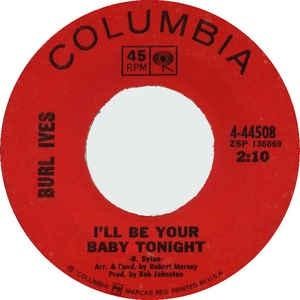
The superpower Burl Ives records his version as early as 1968, a few months after the release of John Wesley Harding, for his album The Times They Are A-Changin’, on which he covers no fewer than four Dylan songs (also “One Too Many Mornings” and “Don’t Think Twice It’s All Right” – Burl writes it without a comma).

The covers are rather controversial. The producer is Dylan expert Bob Johnston, who recorded the original a few months before. The album is recorded in the same studio in Nashville and though the sleeve does not mention musicians, it is likely that the Nashville Cats, Charlie McCoy and Kenny Buttrey are on duty again. But it is arranged quite horribly, with tormenting violins, corny female choirs and a theatrically talk-singing Ives.

“I’ll Be Your Baby Tonight” is the exception. It’s not too bad – Burl just sings, the violins hold back – it is rightly chosen as a single and it is both in America and in Australia a modest hit (numbers 35 and 28 respectively).

Equally eager are Emmylou Harris, Ray Stevens, George Baker, Anne Murray and many more artists; before 1970, within two years, half the premier division already has the song on the repertoire.

The popularity does not decrease after 1970. “I’ll Be Your Baby Tonight” is undoubtedly high on a (non-existent) list of Most Covered Dylan Songs, and is often chosen as a single. The Hollies, Judy Rodman, Bobby Darin, John Walker (of the Walker Bothers), Blossom Toes … that list is endless too.

The biggest success is the one-off project Robert Palmer & UB40, which achieves a major hit in 1990 with a tolerable, cute reggae arrangement of the song.

Dylan’s heart probably skipped a beat when Hank Williams Jr., the son of his great hero, covered the song. Only for sentimental reasons, however – Hank’s cover is intolerably smooth.

Unreal, and much more fun, is the former Deep Purple singer Ian Gillan, turning it into a cheerful, cajun-like sing-along (on Gillan’s Inn, 2006).

https://www.youtube.com/watch?v=C27YpoExSzY

But real beauty, real moving power cannot be found that often. For the time being this is limited to two almost perfect masterpieces, both of which also manage to extract something from the original that Dylan himself only partly achieves.

The first, and actually the best, is Norah Jones, the exceptionally talented daughter of Ravi Shankar, who also sings such a crushing “Heart Of Mine”. Her “I’ll Be Your Baby Tonight” is sultry, a bit ordinary and sexy – exactly what the song calls for. On Stay With Me, 2003.

Well alright, of equal merit is the rendition of Curtis Stigers, not coincidentally also from the jazz corner, with a cool swinging, lazy jazz performance – even better live than the studio version (Real Emotion, 2007).

Apparently Dylan, despite the unmistakable country overtones, injected subcutaneously Wee Small Hours. A Blues In The Night is hidden in it, which only the real jazz talents are able to uncover.

What else is here?

An index to our latest posts arranged by themes and subjects on the home page.  You can also see details of our main sections on this site at the top of this page under the picture.

There is an alphabetic index to the 550+ Dylan compositions reviewed on the site which you will find it here.  There are also 500+ other articles on different issues relating to Dylan.  The other subject areas are also shown at the top under the picture.

We also have a discussion group “Untold Dylan” on Facebook which mostly relates to Bob Dylan today.  Just type the phrase “Untold Dylan” in, on your Facebook page or follow this link 

And please do note   The Bob Dylan Project, which lists every Dylan song in alphabetical order, and has links to licensed recordings and performances by Dylan and by other artists, is starting to link back to our reviews.


Posted in Uncategorized | Leave a comment

Why does Bob Dylan like “Hank Williams as Luke the Drifter”

By Tony Attwood

In Chronicles: Volume One, Bob Dylan wrote, “The Luke the Drifter record, I just about wore out. That’s the one where he sings and recites parables, like the Beatitudes. I could listen to the Luke the Drifter record all day and drift away myself, become totally convinced in the goodness of man.”

“He” in this case is Hank Williams.

Now I am sure some people have investigated this statement by Bob and considered it in detail; but somehow I just haven’t been able to find their musings.  And that is a shame because on this occasion (and not for the first time) I am bemused.

I suspect that this is simply because my background doesn’t lead me to this type of music and recitation – it is a cultural thing rather than anything to do with the quality of the music.

But I have a problem here because I don’t know of other references from Dylan to this album, or if he at any time specified some aspect of the album that influenced him – but I am going to assume for the moment that Bob meant it seriously and he really loved the album.  However the album sure is a strange affair.

It is an album of country versions of the talking blues style – there’s country music in the background and on most tracks the singer just talks in time to the music.

According to the reports I’ve seen, there was a problem with the record however in that Hank Williams was very famous and all his records sold well – but if he suddenly turned up with something that was mostly not sung, a lot of people would buy the record just because it was Hank Williams and then be rather fed up.  Including apparently the companies that had thousands of juke boxes in bars and clubs around the country, who would order Hank Williams records in bulk each time one came out.

So the recording was called “Hank Williams as Luke the Drifter”.  In a documentary on the recording, Hank Williams grandson is quoted as saying, “While Hank was at the peak of his career, he had another side to him that he wanted to get out, and that side was called Luke the Drifter…. That’s a dark side, man.”

Wikipediea states the country music historian Colin Escott said, “If Hank could be headstrong and willful, a backslider and a reprobate, then Luke the Drifter was compassionate and moralistic, capable of dispensing all the wisdom that Hank Williams ignored.”

The album also included a political song “No, No, Joe”, and much lighter tracks such as “Just waiting” and “I’ve been down that road before.”  Here’s “I’ve been down that road before.”

The most famous tracks from the recordings are  “Ramblin’ Man,” “Pictures from Life’s Other Side,” and “Men with Broken Hearts.”  Here are recordings of these songs…

Ramblin Man

“Pictures from Life’s Other Side” is one that was particularly well known at this time.  It had been recorded by Woodie Guthrie and just to give a break from Luke the Drifter, here is Woody’s version…   I have put the lyrics at the end of this article.

Men with broken hearts

From here on are some more of the tracks from the ablum that Bob says influenced him so much in those early days.  It’s not the whole set, but I must admit I found this collection quite hard to take, so in the end I stopped listening.

Help me understand

Too many parties and too many pals

https://youtu.be/jCNk_2uZKMk

Please make up your mind

Be careful of the stones that you throw

And the lyrics to Life’s other side…

In the world’s mighty gallery of pictures
There are scenes that are painted from life
Scenes of youth and of beauty
Scenes of hardship and strife

Scenes of wealth and of plenty
Old age and the blushing young bride
Hang on the wall but the saddest of all
Is a pictures from life’s other side

A picture from life’s other side
Someone has fell by the way
And a life has gone out with the tide
That might have been happy someday

Some poor mother at home
Is watching and a-waiting alone
Longing to hear from her loved one, so dear
That’s a picture from life’s other side

Now the first scene is one of two brothers
Their paths them both differently led
One lived in luxury and riches
And the other one begged for his bread

One night they met on the highway
“Your money or life, sir”, one cried
And then with his knife took his own brother’s life
That’s a picture from life’s other side

The next scene is that of a gambler
Who had lost all his money at play
An’ he draws his dead mother’s ring from his finger
That she wore long ago on her wedding day

It’s his last earthly treasure but he stakes it
Then he bows his head that his shame he may hide
But, when they lifted his head they found he was dead
That’s a picture from life’s other side

A picture from life’s other side
Someone has fell by the way
And a life has gone out with the tide
That might have been happy someday

Some poor mother at home
Is watching and a-waiting alone
Longing to hear from her loved one, so dear
That’s a picture from life’s other side

Now the last scene is down by the river
Of a heart broken mother and babe
In the harbor light glare see them shiver
Outcasts that no one will save

Once she was once a true woman
Somebody’s darlin’ and pride
God help her, she leaps for there’s no one to weep
That’s a picture from life’s other side

A picture from life’s other side
Someone has fell by the way
And a life has gone out with the tide
That might have been happy someday

Some poor mother at home
Is watching and a-waiting alone
Longing to hear from her loved one, so dear
That’s a picture from life’s other side

https://www.youtube.com/watch?v=4M_AHB0g98E

What else is here?

An index to our latest posts arranged by themes and subjects on the home page.  You can also see details of our main sections on this site at the top of this page under the picture.

There is an alphabetic index to the 550+ Dylan compositions reviewed on the site which you will find it here.  There are also 500+ other articles on different issues relating to Dylan.  The other subject areas are also shown at the top under the picture.

We also have a discussion group “Untold Dylan” on Facebook which mostly relates to Bob Dylan today.  Just type the phrase “Untold Dylan” in, on your Facebook page or follow this link 

And please do note   The Bob Dylan Project, which lists every Dylan song in alphabetical order, and has links to licensed recordings and performances by Dylan and by other artists, is starting to link back to our reviews.

Posted in Uncategorized | 10 Comments

Bob Dylan And Arthur Conan Doyle

 
By Larry Fyffe

Observed by a well-respected Victorian poet is that Darwin’s monkey man puts Christian faith to the test:

Who trusted God was love indeed
And love Creation's final law
Though Nature, red in tooth and claw
With ravine, shrieked against his creed
(Lord Tennyson: In Memoriam)
And where there are wild monkey men, there must be wild monkey women:
Don't put on any airs
When you're down on Rue Morgue Avenue
They got some hungry women there
And they really make a mess outta you
(Bob Dylan: Just Like Tom Thumbs Blues)
Edgar Allan Poe’s short story “The Murders In The Rue Morgue” features detective Dupin who solves the gruesome murder of a mother and daughter, the latter’s body stuffed up the chimney; witnesses hear the murderer say something, but they do not recognize the language – the killer turns out to be an orangutan.

Singer/ songwriter Bob Dylan makes reference to Arthur Conan Doyle’s famous detective in the following lyrics:

Well, I quit my job so I could work all alone
And I changed my name to Sherlock Holmes
Followed some clues from my detective bag
And discovered there was red stripes on the American flag

( Bob Dylan: Talking John Birch Paranoid Blues)

In ‘The Adventures Of The Creeping Man’, Sherlock Holmes solves the case of the bizarre behavior of an aging professor who’s engaged to a young woman – like his peeking into his daughter’s bedroom window. Holmes notices that the hands of the professor indicates that he’s been climbing a creeper at night; turns out he’s been taking monkey extract to enhance his virility.
In  the song below, the  persona of the singer/songwriter denies he’s anything like Conan Doyle’s professor:
Little red wagon
Little red bike
I ain't no monkey
But I know what I like
I like the way you love me strong and slow
(Bob Dylan: Buckets Of Rain)
In a version of the following song, monkey women are out and about:
The sun is shinin', ain't but one train on this track
I'm steppin' out of the dark wood
I'm jumpin' on the monkey's back
(Bob Dylan: Gonna Change My Way Of Thinking)
Below, Bob Sherlock attempts to solve the stange case of the Monkey Man, and his transgendered buddy, Tweeter:
The undercover cop was found face-down in a field
The Monkey Man was on the river bridge using Tweeter as a shield
Jan says to the Monkey Man, "I'm not fooled by Tweeter's curl
I knew him long before he ever became a Jersey girl"
(Bob Dylan: Tweeter And The Monkey Man)
Jan, who loves the Monkey Man, is out to shoot someone, but there’s a missing link – the case remains unsolved; the Monkey Man gets away:
And the walls came down
All the way to hell
Never saw them when they're standing
Never saw them when they fell
(Bob Dylan: Tweeter And The Monkey Man)
The story’s not over yet ~ God-fearing authorities are determined to bring down the ‘monkey man’:
They got  Charles Darwin trapped out there on Highway Five
Judge said to the High Sheriff
"I want him dead or alive"
Either way, I don't care
(Bob Dylan: High Water)
And Sigmund Freud’s on the loose as well:
Well I set my monkey on a log
And ordered him to do the dog
He wagged his tail, and shook his head
And he went and did the cat instead
He's a weird monkey, very funky
(Bob Dylan: I Shall Be Free, No. 10)
In such an Archibald MacLeish-circus atmosphere, it’s just hard to keep a good man down:
King Kong, little elves
On the rooftops they dance
Valentino-type tangos
While the make-up man's hands
Shut the eyes of the dead
Not to embarrass anyone
But farewell, Angelina
The sky is embarrassed
And I must be gone

(Joan Baez: Farewell Angelina ~ Bob Dylan)

What else is here?

An index to our latest posts arranged by themes and subjects on the home page.  You can also see details of our main sections on this site at the top of this page under the picture.

There is an alphabetic index to the 550+ Dylan compositions reviewed on the site which you will find it here.  There are also 500+ other articles on different issues relating to Dylan.  The other subject areas are also shown at the top under the picture.

We also have a discussion group “Untold Dylan” on Facebook which mostly relates to Bob Dylan today.  Just type the phrase “Untold Dylan” in, on your Facebook page or follow this link 

And please do note   The Bob Dylan Project, which lists every Dylan song in alphabetical order, and has links to licensed recordings and performances by Dylan and by other artists, is starting to link back to our reviews.

Posted in Uncategorized | 6 Comments

Dusty old fairgrounds: review of another rare Bob Dylan song we missed

By Tony Attwood

This is anothe song I’ve missed in putting together to directory of reviews of every Bob Dylan composition.  Here is the song in question (there is a fair bit of tuning up at the start – they didn’t have digital tuning in those days).

Heylin describes this as another “outlandish account of his youth”, but I see nothing in this to suggest that Dylan is trying to claim this is autobiographical.  Heylin to me seems to be one of those weird people who thinks that just because one writes a song or a poem or indeed a novel, then it has to be autobiographical.  It is as if the whole notion of fiction as an art form has passed him by.

In fact it is a fine representation of a way of life – not the daily 9 to 5 grind, but of travelling with the fair ground through all the different weathers and situations, living a life on the road – that image that has so engrossed Dylan across the years.

Here are the lyrics

Well, it’s all up from Florida at the start of the spring
The trucks and the trailers will be winding
Like a bullet we’ll shoot for the carnival route
We’re following them dusty old fairgrounds a-calling

From the Michigan mud past the Wisconsin sun
’Cross that Minnesota border, keep ’em scrambling
Through the clear county lakes and the lumberjack lands
We’re following them dusty old fairgrounds a-calling

Hit Fargo on the jump and down to Aberdeen
’Cross them old Black Hills, keep ’em rolling
Through the cow country towns and the sands of old Montana
We’re following them fairgrounds a-calling

As the white line on the highway sails under your wheels
I’ve gazed from the trailer window laughing
Oh, our clothes they was torn but the colors they was bright
Following them dusty old fairgrounds a-calling

It’s a-many a friend that follows the bend
The jugglers, the hustlers, the gamblers
Well, I’ve spent my time with the fortune-telling kind
Following them fairgrounds a-calling

Oh, it’s pound down the rails and it’s tie down the tents
Get that canvas flag a-flying
Well, let the caterpillars spin, let the Ferris wheel wind
Following them fairgrounds a-calling

Well, it’s roll into town straight to the fairgrounds
Just behind the posters that are hanging
And it’s fill up every space with a different kind of face
Following them fairgrounds a-calling

Get the dancing girls in front, get the gambling show behind
Hear that old music box a-banging
Hear them kids, faces, smiles, up and down the midway aisles
We’re following them fairgrounds a-calling

It’s a-drag it on down by the deadline in the town
Hit the old highway by the morning
And it’s ride yourself blind for the next town on time
Following them fairgrounds a-calling

As the harmonicas whined in the lonesome nighttime
Drinking red wine as we’re rolling
Many a turnin’ I turn, many a lesson I learn
From following them fairgrounds a-calling

And it’s roll back down to St. Petersburg
Tie down the trailers and camp ’em
And the money that we made will pay for the space
From following them dusty old fairgrounds a-calling

The song was played and recorded on 12 April 1963, and there are elements musically of a fast version of what became “Times they are a changing”, plus lots of other traditional style folk songs within the music.   This track was apparently intended to appear on the album “Bob Dylan in Concert”, planned for release in 1964 but then seemingly cancelled.  It apparently appeared on what is called the “hard-to-find 50th Anniversary Collection 1963′,” but I don’t have a copy because, well, it is so hard to find.

As for the lyrics – the song is pure description.  There is no message – it is totally a case of scene setting.   Haiku 61 came up with a good summary

Melancholy clowns
From one fairground to the next
Ride the blue highways.

There has however been one cover version of the song that I know of, on the album No More, No Less – the first album by  Blue Ash, released in 1973.  I am told that the album was re-released on CD by Collector’s Choice Music 2008.

https://youtu.be/81zUmlf8MQI

I love this.  It’s probably just me, but it so takes me back to the music of the 70s that never made it onto radio stations, but could be found on obscure records.  If I’d found it upon its release, I would have played it all day and night.

What else is here?

An index to our latest posts arranged by themes and subjects on the home page.  You can also see details of our main sections on this site at the top of this page under the picture.

There is an alphabetic index to the 550+ Dylan compositions reviewed on the site which you will find it here.  There are also 500+ other articles on different issues relating to Dylan.  The other subject areas are also shown at the top under the picture.

We also have a discussion group “Untold Dylan” on Facebook which mostly relates to Bob Dylan today.  Just type the phrase “Untold Dylan” in, on your Facebook page or follow this link 

And please do note   The Bob Dylan Project, which lists every Dylan song in alphabetical order, and has links to licensed recordings and performances by Dylan and by other artists, is starting to link back to our reviews.

Posted in Uncategorized | 5 Comments

Who Killed Davey Moore? Well, pretty much everyone.

by Jochen Markhorst

“Buddy” is deeply hurt in The Incredibles (Brad Bird, 2004). The young fan is so eager to become Mr.Incredible’s helper, has crafted all kinds of gadgets with which he can compensate for his lack of superpowers, has already fully outlined how he can be a useful, perhaps indispensable sidekick for his big idol, but unfortunately … not unfriendly, but a bit weary, Mr. Incredible rejects him and pushes him out of his super hero dream, back to the normal human world.

Years later the rancorous Buddy takes revenge. He is now “Syndrome”, and has further qualified himself in his gadgets – ingenious inventions with which he eradicates all superheroes one by one. And now the crown on his work: it’s Mr. Incredible’s turn. The punchline of his triumphant evil speech is now almost classic:

“Oh, I’m real. Real enough to defeat you!  And I did it without your precious gifts, your oh-so-special powers. I’ll give them heroics. I’ll give them the most spectacular heroics anyone’s ever seen! And when I’m old and I’ve had my fun, I’ll sell my inventions so that everyone can be superheroes. Everyone can be super! And when everyone’s super… [laughs maniacally]…no one will be!”

Buddy gives in to an admittedly despicable, but universal vice. The Scandinavians call it The Law Of Jante, in most Germanic languages it is called ground level culture, in China 棒打 出頭鳥 (“the bird that lifts its head”) and in Anglo-Saxon culture it is known as Tall Poppy Syndrome – but the phenomenon has already been described twenty-five centuries ago by Herodotus (in The Histories 5). In essence, it is the envious urge to pull down anyone who positively distinguishes himself, back to the Great Common Denominator.

Syndrome has an original, more subtle, in his eyes more humiliating variant: he does not lower the Tall Poppy, but elevates everyone else to the level of the one that stands out above ground level, Mr. Incredible, so that the special thing about the superhero suddenly becomes normal and everyday, has become the Great Common Denominator.

An extension of this is the moral variant, chosen by song poet Dylan for his fascinating youth work “Who Killed Davey Moore?”  Determining liability in the matter of boxer Davey Moore’s tragic death, the singer leads us to the uncomfortable truth that we are all guilty. We, our society, our culture – and that ultimately nobody is guilty.

It is a toxic consequence of every society. In every collective arise mechanisms, morals, conventions, which can be cruel to the individual or, as here, fatal. The philosophers of the Frankfurter Schule (Adorno, Marcuse) articulate not very accessibly this inevitable phenomenon. More accessible and moving, the Swiss genius Max Frisch depicts the “guilty collective innocence” in his plays – in Andorra (1961), in particular.

The American premiere of this parable-like piece takes place in February 1963 on Broadway, New York. It is likely that Dylan, who absorbs cultural, literary and musical impressions like a sponge in these days, has at least indirectly taken note of Andorra, one of Frisch’s most Brechtian pieces. Just like Brecht, Frisch uses Verfremdungseffekte (“estrangement effects”), and just like in Brecht’s Lehrstücke, Frisch demonstrates here with the fate of the tragic Andri how the collective can inadvertently destroy an individual.

A few weeks after that premiere in February, on March 21, 1963, boxer Davey Moore loses his world title in the fight with Sugar Ramos, after which he will die. And again three weeks later, on April 12 in the Town Hall, near Broadway, Dylan plays his new topical song about the tragedy.

The more serious Dylanologists all suspect that the sponge Dylan copies form and structure of the age-old folk song “Who Killed Cock Robin?”, just as he also used “Lord Randall” as a template for “A Hard Rain’s A-Gonna Fall” and “The Ballad Of Peter Amberly” for “The Ballad Of Donald White” (as for “I Pity The Poor Immigrant”) – it’s a fruitful, grateful and apparently also inspiring technique of songwriting.

But Delawarean Donald Sauter points to a much more likely source, to a children’s rhyme of the nineteenth-century writer Lydia Maria Child: “Who Stole The Bird’s Nest?” from 1865. The similarities are striking indeed:

To-whit! to-whit! to-whee!
Will you listen to me?
Who stole four eggs I laid,
And the nice nest I made?

Not I, said the cow, moo-oo!
Such a thing I’d never do.
I gave you a wisp of hay,
But did not take your nest away;
Not I, said the cow, moo-oo!
Such a thing I’d never do.

Bob-o-link! Bob-o-link!
Now, what do you think?
Who stole a nest away
From the plum-tree to-day?

Not I, said the dog, bow-wow!
I wouldn’t be so mean, I vow.
I gave some hairs the nest to make,
But the nest I did not take;
Not I, said the dog, bow-wow!
I would not be so mean, I vow.

(… and then, just like with Dylan, three more similar couplets, alternated with the chorus).

The Bard extracts details, such as names and remarkable quotes, simply from the newspaper. But the greatest, timeless power of the song is in the find as to elevate this single, individual incident to a symptom of a social malformation, transcending the anecdotal – just like “Only A Pawn In Their Game” does, and “The Death Of Emmett Till” too.

Unlike in Andorra, Dylan does not opt for bloody suspense, but for legal-psychological tension. Davey Moore has already died, it has been in all the newspapers and it still exercises minds. The narrator Dylan therefore cannot use that dramatic dénouement for the suspense, like in, for example, “John Brown” or in “Seven Curses”. Instead, he suggests solving the guilt question, choosing repetition to build up the tension.

In each of six couplets a new suspect speaks. From the third verse at the latest, the tension develops: the listener expects the dénouement, the unmasking of the Real Culprit in the next verse. The referee, the audience, the manager, the gamblers, the sensation journalist and the opponent – however, they can all explain why they cannot be blamed.

In addition, the poet Dylan partly opts for wording and arguments that are almost literally in the newspaper. Opponent and winner Sugar Ramos, for example, in the Sports Illustrated of April 1, 1963, so eleven days before Dylan will sing the song for the first time:

“I did not want to hurt Moore,” Ramos said. “In the ring the fighters are partners. They put on the match. Not to hurt or kill, but to show skill and win the challenge. After the fight my opponent is my brother. But this tragedy is a thing all fighters must live with. It might have been me who was badly injured. Knowing that it could happen, I accept it, and perhaps so did Moore. Perhaps yesterday was his destiny and mine some other day.”

… which the poet transposes to:

Don’t say ‘murder,’ don’t say ‘kill’
It was destiny, it was God’s will

Wryly enough, the words that the poet puts into the mouth of a sensation journalist, there’s just as much danger in a football game paraphrase a statement made by the victim. Less than a year before this, in April 1962, boxer Benny Paret died after his lost fight against Emile Griffith. In the ensuing debate about the dangers of boxing, Sugar Ramos is quoted saying: no one stops the Indy 500 when racing drivers get killed.

That equally tragic, fatal boxing fight has probably already sown the seeds for Dylan’s “Davey Moore”. Gil Turner, singer-songwriter and editor of Broadside, immediately processes that earlier tragedy into one of his best-known songs, “Benny ‘Kid’ Paret” and publishes it barely a week after Paret’s death in the mid-April edition of Broadside, the amateurishly stenciled Greenwich Village folkies’ club magazine that was the first to celebrate Dylan’s talent. Gil Turner, for example, is also the first citizen of the Earth to play “Blowin’ In The Wind” in public (in Gerde’s Folk City on April 16, 1962, the same evening Dylan completes the song) and also the first to record it (with his The New World Singers).

His influence on Dylan is apparent not only by the choice of subject, but also by the music behind “Benny ‘Kid’ Paret”; that is the age-old “The Ballad Of Peter Amberly”, the same music that Dylan will use in turn for “The Ballad Of Donald White”. He also inspires another Greenwich Village celebrity, Phil Ochs, who presents his song about this second boxing tragedy just before Dylan: “Davey Moore”.

So: three songwriters in Greenwich Village who process a boxing tragedy into songs between April ’62 and April ’63.

Phil Ochs opts for an epic, narrative ballad. In the first line Davey Moore sets off, in the last line he dies. Along the way Ochs does not spare with melodrama (“His wife begged and pleaded, you have to leave this game” and “the struggle of two men facing hell”) and caricatural, simple character sketches (‘The money-chasing vultures were waiting for their share” and “hate drives men insane”), interrupted three times by a little imposing chorus:

And thousands gave a roar when Davey Moore walked in
Another man to beat, another purse to win
And all along the ringside, a sight beyond compare

Gil Turner’s ballad is more intelligent. Seven four-line couplets, cyclical structure. The first three verses tell the rise and fall of Paret, then Turner leaves the private and a change to contemplative, universal views follows, such as the fourth verse:

There’s danger on the ocean where the waves roll mountain high
There’s danger on the battlefield where angry bullets fly.
There’s danger in the boxing ring for death is waiting there
Watching for a killing through the hot and smoky air.

… and the smart, Dylanesque sixth verse with the bitter conclusion:

You’ve heard about your Romans, long many years ago
Crowding big arenas just to see the slaves’ blood flow
There’s been lots of changes since those days and now we’re civilized
Our gladiators kill with gloves instead of swords and knives

The final couplet varies on the first verse, bringing it home again, making the song a beautiful, rounded whole.

But Gil Turner also falls short in comparison to the captivating power of Dylan’s “Who Killed Davey Moore?”, thanks to Dylan’s exceptional talent for drama, to his skills to integrate Brechtian stage techniques in his poetry. He brings the main characters back to archetypes (“The Referee”, “The Gambling Man”), they speak curtly, in blunt and thus provocative, clear monologues, which hold the public’s attention. Moreover, Dylan avoids the pitfall of becoming academic (like Turner) and, unlike Phil Ochs, he has an exceptional poetic instinct. Dylan would not produce a laborious verse like

For the fighters must destroy as the poets must sing
As the hungry crowd must gather for the blood upon the ring

… and Phil Ochs will probably be jealous of the deceptive simplicity and brutal poetic power of a fragment like

We didn’t mean for him t’ meet his death,
We just meant to see some sweat,
There ain’t nothing wrong in that.

… just as neither Ochs nor Turner have the flair to elevate up to chorus a syntactic mess, but rhythmically direct hit like

Who killed Davey Moore,
Why an’ what’s the reason for?

Topical, however, the song remains, despite all its timeless power and transcendent literary value. It simply is a song about a single incident and a single individual boxer. The tragic death of Davey Moore and the historical fact that Nobel Prize winner Dylan has written about him do guarantee a place in the history books, the song itself is already covered in dust. Dylan himself never looks back at it, and after a short popularity (Pete Seeger, 1963), his colleagues also stay away – there are hardly any covers.

The two exceptions are truly exceptional, though: in 2005, BoomBox, the thoroughly musical duo from Muscle Shoals, makes an extremely funky, irresistible adaptation of the now antique song, with all the emphasis on the rhythmic power, of course (on Visions Of Backbeat, 2005).

Slightly more loyal, but still distinctive and nevertheless particularly attractive is the veteran “RSM”, the godfather of home recording, the versatile, tireless phenomenon R. Stevie Moore from Nashville who in 2018 has to enlist the help of his fans to craft a somewhat reliable discography on Wikipedia. Around 400 albums, in any case. At the end of the 1980s, the multi-instrumentalist produced a rather lurid and at the same time weirdly exuberant cover of “Who Killed Davey Moore?” – Twin Peaks meets Walt Disney’s Robin Hood, something like that.

Stevie Moore is, by the way, not related to Davey Moore. He is the son of Bob Moore though, Elvis’ bass player on the Dylan cover “Tomorrow Is A Long Time” and moreover: he can be heard on six songs from Dylan’s Self Portrait. Unfortunately not in Dylan’s version of “The Boxer” – that would have rounded the circle perhaps a bit too nicely.


What else is here?

An index to our latest posts arranged by themes and subjects on the home page.  You can also see details of our main sections on this site at the top of this page under the picture.

There is an alphabetic index to the 550+ Dylan compositions reviewed on the site which you will find it here.  There are also 500+ other articles on different issues relating to Dylan.  The other subject areas are also shown at the top under the picture.

We also have a discussion group “Untold Dylan” on Facebook which mostly relates to Bob Dylan today.  Just type the phrase “Untold Dylan” in, on your Facebook page or follow this link 

And please do note   The Bob Dylan Project, which lists every Dylan song in alphabetical order, and has links to licensed recordings and performances by Dylan and by other artists, is starting to link back to our reviews.


Posted in Uncategorized | 5 Comments

Renaldo and Clara II


by Larry Fyffe

Tossa’s Clorinda (like Virgil’s Camilla) is a literary archetype – a soul guided by the white-faced virgin Moon goddess Diana, a beautiful goddess who comes to be associated with Satan and ugly witches. Clorinda re-appears in Bob Dylan’s mixed-up movie ‘Renaldo And Clara’ as the Lady-In-White (Joan Baez), the red rose she carries symbolizes passion. Akin to golden-haired Apollo, Renaldo’s true love is song and music. Jealous-prone Clara lives with Renaldo (Dylan); her name happens to rhyme with Sara, and she’s played by Dylan’s wife.

The Lady-In-White is modelled after the Man-In-White, the mime who’s featured in the movie ‘The Children Of Paradise’ (he’s keeps a rose given to him by Garance, a courtesan). It’s Renaldo, the knight-in-rusty armour, who does not talk very much in the Dylan/Shepard movie. Instead, his French “armour” shines through his music and songs. Matters end rather sadly for the Lady and the Man-In-White, slaves they both be to their own passions – folksongs and pantomime, respectively, if you’re inclined to add biographical allegories to the two movies:

Oh, the ragman draws circles
Up and down the block
I'd ask him what the matter was
But I know he don't talk
(Bob Dylan: Stuck Inside Of Mobile With The Memphis Blues Again)

There’s no doubt that Bob Dylan is quite familiar with ‘The Children Of Paradise’ picture show – the mime, who achieves great success in the theatre of his day, says to the courtesan  who’s fallen in love with him:

"You're right, Garance, love is simple"

In the song below, the line’s repeated:

'Love is simple', to quote a phrase
You've known it all the time
I'm learnin' it these days
Oh, I know where I can find you
Ohhh, in somebody's room
It's a price I have to pay
(Bob Dylan: You're A Big Girl Now)

The mime in ‘The Children Of Paradise’ suffers the same fate as silent movie stars – the ‘talkies’ are at the gate, and the mime disappears into the sheep-like crowd.  Bob Dylan’s aware of the fate of  television’s stars ‘Mr. Jinx’, the cartoon cat, and Lucy of the ‘I Love Lucy’ show; so, as far as Dylan is concerned, it’s a good thing that Garance the courtesan grabs a carriage to make her get-away at the end of the movie:

Mr. Jinx and Miss Lucy, they jumped in the lake
I'm not that eager to make a mistake
(Bob Dylan: Things Have Changed)

Poet Allen Ginsberg appears in the Dylan movie, and relates the biblical story about Simon from Africa (not the apostle) who helps Jesus carry the cross:

And as they led Him away they laid hold upon one Simon
A Cyrenian, coming out of the country
And on him they laid the cross that he might bear it for Jesus
And there followed Him a great company of people, and of women
Which also bewailed and lamented Him
(Luke 23:  26, 27)

Jesus turns to the crowd, and tells them not to pity Him, but to pity themselves; there arose the myth that it was not Jesus who gets crucified, but Simon by mistake.

Double-edged singer/songwriter Bob Dylan is not going to disappear into his own parade; the movie reveals that he sides with Romantic-inclined artists (like the poet Tossa) who are able to bring sad-eyed rebellious types like Camilla and Jesus back to life:

Now I heard of a man who lived a long time ago
A man of sorrow and strife
That if someone was around him had died, and was dead
He knew how to bring them on back to life
(Bob Dylan: Red River Shore)

Dylan’s going to pay in blood, but it’s not going to be his own. He’s a-gonna figuratively sacrifice Elvis Presley instead …. as it sadly turns out, it’s Elvis who literally doesn’t live here anymore:

When the whip that's keepin' you in line doesn't make him jump
Say he's hard of hearin', say that he's a chump
Say he's out of step with reality as you try to test his nerve
Because he doesn't pay tribute to the King that you serve
(Bob Dylan: Property Of Jesus)

Like the courtesan in ‘Children Of Paradise’, Bob Dylan’s rubber-masked persona has no intention of riding a one-trick pony who sacrifices him/her on the saddle of conformity.

In ‘Renaldo And Clara’, Allen Ginsberg sings:

No, no, let us play, for it's yet day
And we cannot go to sleep
Besides in the sky, the little birds fly
And the hills are all covered with sheep
(William Blake: The Nurse's Song)

As I’ve said before: the only thing we know for sure about Bob Dylan is that his name isn’t Bob Dylan.

What else is here?

An index to our latest posts arranged by themes and subjects on the home page.  You can also see details of our main sections on this site at the top of this page under the picture.

There is an alphabetic index to the 550+ Dylan compositions reviewed on the site which you will find it here.  There are also 500+ other articles on different issues relating to Dylan.  The other subject areas are also shown at the top under the picture.

We also have a discussion group “Untold Dylan” on Facebook which mostly relates to Bob Dylan today.  Just type the phrase “Untold Dylan” in, on your Facebook page or follow this link 

And please do note   The Bob Dylan Project, which lists every Dylan song in alphabetical order, and has links to licensed recordings and performances by Dylan and by other artists, is starting to link back to our reviews.

Posted in Uncategorized | Leave a comment

Why does Bob Dylan like “Stone Walls and Steel Bars”

By Tony Attwood

Stone Walls and Steel Bars was written by Ray Pennington and Roy Marcum and was originally recorded by The Stanley Brothers in 1963.  Bob Dylan first played it on 23 August 1997 and played it a total of 37 times between then and 18 August 2002 when it got its final run out.

Here is a recording from a performance in California in 1998.

https://youtu.be/1gWU5j0cilw

In terms of the song lyrics, I take it that the singer not only stole the other man’s wife but also murdered the husband, and is now about to go to the gas chamber.   That is, of course, reading quite a lot into this, although it is the only way I can explain that he is a “three times loser”: he murdered husband and wife (that’s two) and now is being killed by the state (three).

But I am known for totally misreading lyrics, so if there is a simple and clear explanation other than this, do let me know.  Although it could also be that the lyricist actually found two phrases he really liked: “Stone walls and steel bars” first and “three time loser” second, and simply melded them together.

Even if that second explanation is true and the song doesn’t really mean too much, it doesn’t stop it being a great piece of music.  Here are the lyrics in full…

Stone walls and steel bars, a love on my mind
I’m a three time loser, I’m long gone this time.

Jealousy has took my young life,
All for the love of another man’s wife.
I’ve had it coming, I’ve known all the time,
No more stone walls and steel bars and you on my mind.

Gray-haired warden, deep Frisco Bay,
Guards all around me leading my way.
I’ve had it coming, I’m at the end of the line,
No more stone walls and steel bars and you on my mind.

Stone walls and steel bars, a love on my mind,
I’m a three time loser, I’m long gone this time.

The first recording of the song that was released came in 1963 from the Stanley Brothers, and I’ve put a copy of that below these notes.

Ray Pennington, one of the co-composers of the song was a western swing performer, record producer and artists and repertoire manager with a record label – and indeed he produced of some Stanley Brothers records, as well as being an occasional drummer.

But although he clearly had a variety of talents, Pennington seemingly did not always have the success needed to keep the wolf from the door and there were times when (according to the histories I have found) he also worked in a record shop.

However in the 1960s he signed with Capitol Records and later Monument Records, recording a number of records himself, gaining some chart success, as well as finding that his compositions were now in demand.  Ultimately he had the much sought after number 1 hit with “I’m a rambling man” recorded by Waylon Jennings.

From 1984 onwards, Ray Pennington worked for his own record company Step One Records recording many successful songs and albums over the next four years.  After that he slowed down, and eventually took retirement – but as far as I know he is still with us, now aged 85.

As for his co-composer Roy Marcum, I regret I know very little except that apart from writing for the Stanley Brothers he also wrote for Ricky Scaggs.

Here is the first release on Stone Walls and Steel Bars from 1963.

And another version from Bob – rather different this time.

So to the question, why does Bob like this track?

First it has a great opportunity for those opening harmonies.  And the chord changes are unusual.   The chorus with which the song opens (and let us note that opening with the chorus is itself unusual) really sets the scene, and has an iconic feel because of those harmonies and the lyrics.

Then the verse opens not on the tonic – the basic chord of the song, but the dominant.  I can’t think of too many other songs that does this – Dylan does it in “Baby Blue” but not too many other times.   In fact, although only using the chords that we find in 95% of pop and rock songs, the whole of this song has a completely different feel from anything we might expect or anticipate.

And that I think is what makes the song so attractive to any musician looking for something different.  Plus then when combined with a couple of really good simple lyrical phrases, it is an absolute winner.

Finally, the lyrics, although short, have three really cracking lines within them.

Stone walls and steel bars
I’m a three time loser, I’m long gone this time.

I’ve had it coming, I’ve known all the time

These are all dead simple but really very effective and unusual lines.   Yes, there is a mawkishness in the whole piece, but we can maybe forget the meaning and listen to the overall effect!

Oh yes, and how many times do we hear Bob say “Oh you’re so kind” as the audience cheers?

What else is here?

An index to our latest posts arranged by themes and subjects on the home page.  You can also see details of our main sections on this site at the top of this page under the picture.

There is an alphabetic index to the 550+ Dylan compositions reviewed on the site which you will find it here.  There are also 500+ other articles on different issues relating to Dylan.  The other subject areas are also shown at the top under the picture.

We also have a discussion group “Untold Dylan” on Facebook which mostly relates to Bob Dylan today.  Just type the phrase “Untold Dylan” in, on your Facebook page or follow this link 

And please do note   The Bob Dylan Project, which lists every Dylan song in alphabetical order, and has links to licensed recordings and performances by Dylan and by other artists, is starting to link back to our reviews.


Posted in Uncategorized | 6 Comments

Dylan re-imagined: Dylan’s live versions of “On my mind”, “Frankie Lee” and “In the doorway”

By Paul Hobson and Tony Attwood

There is an index to this series at https://bob-dylan.org.uk/dylan-re-imagined

 Mama you’ve been on my mind

This recording “Mama you’ve been on my mind” comes from the late 1990s.

https://www.youtube.com/watch?v=gd5wL73ttio

This is an approach to the song which retains the clarity of the lyrics and the simplicity of the accompaniment, leaving the way Dylan sings as the method of giving new insights into the lyrics.

Somehow the fact that the Mama who has been on his mind, is now from much further back in the past comes across because of the style and approach.  Certainly the guitar solos help enormously to give that feeling of distance in time, and we are carried through those instrumental breaks perfectly until without warning… Bob turns to the harmonica.

The performance on the harp is limited for most of the time emphasising the sameness of the situation – he’s now looking back.

Frankie Lee and Judas Priest

https://www.youtube.com/watch?v=CrXCInARGpA

Sometimes – not that often but sometimes – I find Dylan songs that only come to life for me in the live performance, having not given me that sense of “oomph” in terms of the original recording.

This is certainly true of Frankie Lee.   And it is intersting that this version works for me given the simplicity of the arrangement here, and the fact that some of the lines are sung on a single note.

Maybe I have mellowed over the years, or maybe it is simply, to my ear, what this song needed.  I even like the instrumental break which mostly consists of the band continuing as it has been right the way through the song.

The problem with the song is that it consists of just the same three chords over and over, and many of the vocal lines over the top have the same melody.   It isn’t that I need to hear to lyrics, but rather I need to appreciate the overall sound.  At least that is how it seems to me.

Standing in the doorway

In this version of Standing in the Doorway, Dylan makes the expression of the lyrics as clear as he possibly can – although some members of the audience want to add their own sounds for some reason during the performance.

This really is one of those performances that really does make one go back to the originial with fresh insights simply because the lyrics are now so clear and meaningful.

What else is here?

An index to our latest posts arranged by themes and subjects on the home page.  You can also see details of our main sections on this site at the top of this page under the picture.

There is an alphabetic index to the 550+ Dylan compositions reviewed on the site which you will find it here.  There are also 500+ other articles on different issues relating to Dylan.  The other subject areas are also shown at the top under the picture.

We also have a discussion group “Untold Dylan” on Facebook which mostly relates to Bob Dylan today.  Just type the phrase “Untold Dylan” in, on your Facebook page or follow this link 

And please do note   The Bob Dylan Project, which lists every Dylan song in alphabetical order, and has links to licensed recordings and performances by Dylan and by other artists, is starting to link back to our reviews.


Posted in Uncategorized | Leave a comment

Bob Dylan And Torquato Tasso: Renaldo And Clara


By Larry Fyffe

A number of songs by Bob Dylan are inspired by not-so-happy stories featuring ‘chivalrous’ romance, and ancient mythology:

Gypsy Davey with a blow torch, he burns out their camps
With his faithful slave Pedo, behind him he tramps
(Bob Dylan: Tombstone Blues)

The ballad below tells the story of Lady Brown, the bride-to-be of Lord Thomas. She kills his girlfriend, fair Eleanor; the Lord is not amused, and kills Miss Brown …. and then himself:

The Brown girl had a little penknife
Which was both keen and sharp
And betwixt the short ribs and long
She pricked fair Eleanor to the heart
(Lord Thomas And Fair Eleanor ~traditional)

In the black-humoured Post Modern song below, the wife of the Boss runs off with Henry Lee, head of the clan; the Boss confronts them, and Henry it would seem shoots him down; his wife’s aghast at what Lee has done, and stabs the leader of the clan to death; then kills herself:

"You died for me, now I'll die for you"
She put the blade to her heart, and she ran it through
(Bob Dylan: Tin Angel)

In an Italian epic romance, Rinaldo, a Christian crusader, is distracted from his duty by Armida, an evil enchantress; she falls in love with him. He’s re-awakened to his  duty, and spurns Armida. In a battle, he unknowingly wounds Clorinda, a pagan women whom he loves; she turns Christian, and with her last breath, forgives him; afterwards, Rinaldo reconciles with Armida:

By far over every knight that drew the sword
Or couched the lance, the boy Rinaldo towered
How fierce, how far, he rears his head on high
While fixed on him alone is every eye
(Torquato Tasso: Jerusalem Delivered, Canto I ~ translated)

Bob Dylan and Sam Shepherd paste together a mythological-based Post Modern movie entitled “Renaldo And Clara”. Unnoticed by all Dylan analysts, (except those at ‘Untold’), is that the movie’s roots lie in Tasso’s epic about Rinaldo and Clorinda, a romance story that takes place in an earth-centred Universe:

In the movie, the knight – in not-so-shining armour – sings:

Patty gone to Loredo ...
The door is locked, and the keys are inside
(Bob Dylan: Patty's Gone To Laredo)

One key ~ the Lady-in-White of the movie, like Clorinda, is a remodelled archetype from Virgil’s ‘Aeneid’ – Camilla, a baby, tied to an arrow and slung for her protection across a river to serve Diana, the virgin goddess of the hunt and moon:

Too proud her hands the needle to assume
To ply the household labours of the loom
Recluse abodes, soft garments, she disdains
Yet keeps her virgin honour unprofaned ....
Over hills and forest to their bloody lair
She tracks the lion and the shaggy bear
(Torquato Tasso: Jerusalem Delivered, Canto II)

In the lyrics below, the handmaiden to the white-faced tracker of Ptolemaic constellations is mentioned by the ‘song and dance’ man:

Loyalty, unity, epitome, rigidity
You turn around for one real last glimpse of Camille
'Neath the moon shinin' bloody and pink
And there's no time to think
(Bob Dylan: No Time To Think)

In another fragmented song, Lily’s never met anyone quite like the Jack Of Hearts; to protect him, it appears that she stabs her boyfriend Big Jim to death; Big Jim’s wife takes the blame for it:

The next day was hangin' day, the sky was overcast and black
Big Jim lay covered up, killed by a penknife in the back
And Rosemary on the gallows, she didn't even blink
The hangin' judge was sober, he hadn't had a drink
(Lily, Rosemary, And The Jack Of Hearts)

What else is here?

An index to our latest posts arranged by themes and subjects on the home page.  You can also see details of our main sections on this site at the top of this page under the picture.

There is an alphabetic index to the 550+ Dylan compositions reviewed on the site which you will find it here.  There are also 500+ other articles on different issues relating to Dylan.  The other subject areas are also shown at the top under the picture.

We also have a discussion group “Untold Dylan” on Facebook which mostly relates to Bob Dylan today.  Just type the phrase “Untold Dylan” in, on your Facebook page or follow this link 

And please do note   The Bob Dylan Project, which lists every Dylan song in alphabetical order, and has links to licensed recordings and performances by Dylan and by other artists, is starting to link back to our reviews.

Posted in Uncategorized | 5 Comments

The Wicked Messenger. Bob Dylan; Kafka known and unknown.

by Jochen Markhorst

It was very early in the morning, the streets clean and deserted, I was on my way to the station. As I checked my watch against the tower clock I realized it was much later than I had thought and that I had to hurry, the shock of this discovery made me feel uncertain of the way, I wasn’t very well acquainted with the town as yet, fortunately there was a policeman nearby, I ran up to him and breathlessly asked him the way. He smiled and said: “You asking me the way?” “Yes,” I said, “since I can’t find it myself.” “Give it up! Give it up!” he said, and swung around, like someone who wants to be alone with his laughter.

(Franz Kafka, Give It Up! 1922)

If on John Wesley Harding the Bible is Das Ich, The Ego, as Freud would say, then Kafka is Das Es, The Id, the engine that is driven by a complex of unconscious desires, emotions, and urges. It defines the uncanny, alienated, dreamlike atmosphere of highlights such as “All Along The Watchtower”, “Drifter’s Escape” and this “The Wicked Messenger”, a stifling discomfort so masterfully articulated in Kafka’s stories, like in the above “Gib’s auf”

Dylan does not often mention Kafka and he seems to have only a superficial knowledge of his work. John Cohen, who interviews him in 1968, specifically asks about Kafka’s Parables and Paradoxes, to which Dylan hardly responds. But during a press conference in Rome, July 2001, Dylan states, appreciatively meant: “There’s nobody like Kafka who just sits down and writes something without wanting somebody to read it.”

If anything, this shows some biographical knowledge. True, Kafka did not want his work to be read. During his lifetime he only reluctantly released, on the insistence of admiring friends, a fraction of his work for publication. On his deathbed in the sanatorium he begged his friend Max Brod to destroy all the writings in his study at home (Brod ignored that and deciphered, sorted and published everything – including masterpieces such as Der Prozeß, The Trial, and many parables such as the above Gib’s auf!).

Incidentally, how Dylan comes to his conclusion is puzzling; writers who do not publish their work because they do not want it to be read are by definition unknown, after all.

Nevertheless, despite the presumably superficial knowledge of Kafka’s work, the parallels cannot be ignored. An obvious guess would be that both Jewish writers demonstrate their comparable, superior talent in a similar way because there happens to be a congeniality, a spiritual affinity. Kindred spirits, if you will.

Just like Kafka, Dylan’s grandparents belong to a Jewish minority in the Slavic part of Europe at the beginning of the twentieth century (Dylan’s grandparents flee the pogroms in Odessa in 1905, Kafka then lives in Prague). The oppression, being an outsider, the stories, the parables and the use of language from the Torah… it is cultural baggage that is shared by Kafka and Dylan, and perhaps explains the receptiveness of both men to clear but impenetrable storytelling.

In the same interview with John Cohen (together with Happy Traum, published in the October ’68 Sing Out) Dylan reflects on his lyrics for John Wesley Harding, in particular on “All Along The Watchtower” and “The Wicked Messenger”.

Cohen wants to know what Dylan thinks about traditional ballads, and whether he would also consider a song like “The Wicked Messenger” a ballad. Dylan’s answer seems serious, he chooses simple language and speaks in short, clear sentences and the whole is incomprehensible – Kafka could not have done it better:

“In a sense, but the ballad form isn’t there. Well the scope is there actually, but in a more compressed sense. The scope opens up, just by a few little tricks. I know why it opens up, but in a ballad in the true sense, it wouldn’t open up that way. It does not reach the proportions I had intended for it.”

A ballad, as Dylan teaches in the same interview, is actually the antique version of a feature film; a balladeer tells long, drawn-out stories with a real plot and main characters who perform actions about which the public forms an opinion. The plot and the actions are all plainly told, the listener does not have to find his own interpretation, the listener does not have to fill in blanks – it says what it says.

This is in line with the literary theory; there the literary ballad is defined as a narrative poem.

In that sense, Dylan continues, the ballads on John Wesley Harding are not real ballads:

“These melodies on the John Wesley Harding album lack this traditional sense of time. As with the third verse of “The Wicked Messenger”, which opens it up, and then the time schedule takes a jump and soon the song becomes wider. One realizes that when one hears it, but one might have to adapt to it. But we are not hearing anything that isn’t there; anything we can imagine is really there. The same thing is true of the song “All Along The Watchtower”, which opens up in a slightly different way, in a stranger way, for here we have the cycle of events working in a rather reverse order.”

Kafka all over again: clear vagueness. Or mumbo jumbo, that is of course also possible. The “time schedule takes a jump” in the third verse? The narrative structure of the third verse is identical to that of the first two couplets, the storyline from couplet 1 to couplet 2 is exactly the same as that from couplet 2 to 3.

Each couplet opens with a wide shot; in the first half of the verse in question, an all-knowing narrator outlines successively the protagonist, his living conditions and the decor. Each verse tells an anecdote in lines four to six, every fifth line expresses an interaction of the protagonist with his environment and every sixth line is a Bible paraphrase:

For his tongue it could not speak, but only flatter can be inspired by multiple passages; flattery is damned in about twenty places in the Bible. Because of the proximity of the word wickedness, Dylan’s King James was probably open at Psalm 5, verse 9: “their inward part is very wickedness; their throat is an open sepulchre; they flatter with their tongue.”

The soles of my feet, I swear they’re burning paraphrases another Bible passage in which again the wicked are tackled; Malachi 4:3 “And ye shall tread down the wicked; for they shall be ashes under the soles of your feet.”

And the final line, If you cannot bring good news, then don’t bring any, seems to be inspired by the story of the prophet Micah, the only one of four hundred prophets who predicts that King Ahab will fare badly if he goes to war against the Syrians – all other prophets predict a resounding victory (1 Kings 22). It is not entirely conclusive though; Micha does not bring news, but predicts, and moreover does so at the express request. Ahab knows in advance that Micah never predicts anything good (“I hate him because he never prophesies anything good about me, but always bad.” – 1 Kings 22: 8).

By the way: respected Dylanologists such as Andy Gill and Derek Barker who bend and twist to fit in the prophet Eli (the wicked messenger comes from Eli, after all), seem to ignore that Eli also means “my God”, that Eli is God’s call sign (like Jesus on the cross also calls on Him: Eli, Eli, lama sabachtani – My God, my God, why hast thou forsaken me?).

Despite all the ambiguity and vagueness, within “The Wicked Messenger” it is more likely that the wicked messenger (Proverbs 13:17) comes from God, and not from the prophet Eli. When asked by whom he is sent, he only answers “with his thumb”, because his tongue could only respond with “flattery”. Strange, but traceable still within the Old Testament culture and the Jewish tradition, in which one is not allowed to speak the name of God.

Like all lyrics on John Wesley Harding, the form has a classic, elegant simplicity, yet it is different. Almost all songs (eight of the twelve) consist of eight-line couplets with the rhyme scheme abcb-defe; a classic ballad form, indeed.

But “The Wicked Messenger” has six-line couplets and a rather unique, “open” rhyme scheme: abcdbc. That fourth, surprisingly non-rhyming line contributes to the open character, which Dylan may refer to when he talks about “jumps” to “open” the ballad.

Unusual, but not entirely unique. Maybe Dylan copied “For Once In My Life”, until then actually the only song with this rhyme scheme. That heartbreaker from 1965, according to authority Ella Fitzgerald a beautiful tune, only reaches the canon after Stevie Wonder scores a huge hit with the song (October ’68), but in this late summer of 1967 the walking jukebox Dylan may have heard the Tony Bennet version, or the Four Tops or The Temptations, who all score a little hit with this song in ’67.

There are more indications that Dylan the poet has found this distinctive rhyme at W.H. Auden. Dylan has already written “As I Went Out One Morning” for this same album, whose form, rhyme scheme, weird meter and title all have been copied from Auden’s “As I Walked Out One Evening”.

Indeed, Auden’s “In Schrafft’s” apparently had a comparable effect.   Dylan borrows the structure (the, on this album, unusual three six-line couplets) and, in particular, the different abcdbc rhyme scheme for “The Wicked Messenger”:

Having finished the Blue-plate Special
And reached the coffee stage,
Stirring her cup she sat,
A somewhat shapeless figure
of indeterminate age
In an undistinguished hat.

It takes quite some time before Dylan himself recognizes the special beauty of the song. The dissatisfaction he expresses in that interview with John Cohen (“It does not reach the proportions I had intended for it“) is not false modesty: it takes no less than twenty years for the song to pop up on his set list, and then it is still thanks to the persuasiveness of the men of Grateful Dead that he plays it at all. Jerry Garcia is rather fond of the song, that’s why – in 1975 Garcia already plays it ten times with his hobby project Legion Of Mary, for example.

The version with Dylan, July 12, 1987 in New York, is a driving, dynamic and enthusiastic performance, but Dylan dismisses the recording for Dylan & The Dead (maybe because he makes one mistake in the lyrics), plays it two times more (both times in Italy) and then puts the song back in the bottom drawer.

But in the twenty-first century he rediscovers the song again and he plays “The Wicked Messenger” more than a hundred times. In viciously rocking, sharp versions, destroying much of the deceptive domesticity of the original from 1967, but no less attractive.

Dylan is suddenly even to such an extent charmed that he selects the song for his film Masked And Anonymous (2003). In the original script, the full song lyrics are typed out, but eventually a charming live performance of “Diamond Joe”, the traditional he already plays on Good As I Been To You (1992), appears on that particular spot in the film. It is unknown why Dylan commits this intervention (like “All Along The Watchtower”, “Trying To Get To Heaven” and “Standing In The Doorway” all reach the script, but not the final filming), but is likely that the filmmaker Dylan does not want interference; the ambiguity of “The Wicked Messenger” pushes the film interpretation somewhat too blatantly to messianic distances, probably. To distances he avoids with a “Diamond Joe”, anyway.

The song is fairly popular with colleagues and that produces enough beautiful covers. The soulful adaptation by Rod Stewart with his Faces, the opening track of their debut First Step (1970), is rightly praised.

Patti Smith opts for an ominous, solemn and gradually derailing approach, pushing the song in a completely different direction – which suits the song well (Gone Again, 1996). In terms of atmosphere comparable to the garage sound the Black Keys pour over it, on the successful I’m Not There Soundtrack (2007).

Dylan himself will be touched by Marion Williams’ version, by one of the best gospel singers of the twentieth century. Williams’ “Blowin’ In The Wind” from ’66 is already one of the few successful covers of this worn monument, her “I Shall Be Released” is superb, and especially her unparalleled, brilliant reading of “I Pity The Poor Immigrant” (1969) is goose bumps inducing. Her “The Wicked Messenger” comes close to that – from the magnificent 1971 album Standing Here Wondering Which Way To Go, an intersection of the best that gospel, soul and blues have to offer, and whose title song should be the soundtrack to Kafka’s “Gib’s auf!”


What else is here?

An index to our latest posts arranged by themes and subjects on the home page.  You can also see details of our main sections on this site at the top of this page under the picture.

There is an alphabetic index to the 550+ Dylan compositions reviewed on the site which you will find it here.  There are also 500+ other articles on different issues relating to Dylan.  The other subject areas are also shown at the top under the picture.

We also have a discussion group “Untold Dylan” on Facebook which mostly relates to Bob Dylan today.  Just type the phrase “Untold Dylan” in, on your Facebook page or follow this link 

And please do note   The Bob Dylan Project, which lists every Dylan song in alphabetical order, and has links to licensed recordings and performances by Dylan and by other artists, is starting to link back to our reviews.


Posted in Uncategorized | 3 Comments

Bob Dylan And Giacomo Leopardi (Part II)

By Larry Fyffe

To what extent Bob Dylan has read the works of any particular poet or writer of literature we may not know, but we do know that his song lyrics reveal that he’s been swimming in the Jungian Sea of the collective unconsciousness of the purveyors of art. And swimming there enough times to get soaked by the themes from the days of yore to modern times.

Crouching in the thickets of many of Dylan’s songs is the Italian poet Giacomo Leopardi, himself an admirer of a poet of romance, and melancholic lyrics of love lost:

Why were the winds heard, blowing
Through the dark air, round and round
Till dawn with mournful sound
Were they perhaps the strife
Of your going love of my life?

(Torquato Tasso: What Weeping, Or What Dewfall)

Below, a poetic address to a girl taken away by Nature – literally killed by tuberculosis:

And must all mortals wear this weary yoke?
Ah, when the truth appeared
It better seemed to die!
Cold death, the barren tomb, didst thou prefer
To harsh reality

(Giacomo Leopardi: To Sylvia)

Writer Bob Dylan, in the song following, sings of figurative death-in-life:

Ophelia, she's 'neath the window
For her I feel so afraid
On her twenty-second birthday
She already is an old maid
To her death is quite romantic
She wears an iron vest
Her profession's her religion
Her sin is her lifelessness

(Bob Dylan: Desolation Row)

Not a preference by the author to undertake himself for sure, but Dylan’s characters in narrative songs sometimes take their own lives as happens in traditonal adventure tales of romance:

She touched his lips, and kissed his cheek
He tried to speak, but his breath was weak
"You died for me, now I'll die for you"
She put the knife to her heart, and she ran it through

(Bob Dylan: Tin Angel)

Spotted the poems of Leopardi be with dark humour that mocks the human fascination with fashion that cloaks the inevitabitiy of decay and death:

Fashion: "In short, I contrive to persuade the more ambitious of mortals daily
To endure countless inconveniences, sometimes torture and mutilation
Yes, and even death itself, for the love they have for me"

(Giacomo Leopardi: Dialogue Between Fashion And Death)

The singer/songwriter follows suit in a lighter-hearted fashion:

Well you look so pretty in it
Honey, can I jump on it sometime
Yes, I just wanna see
If it's really that expensive kind
You know it balances on your head
Just like a mattress balances on a bottle of wine
Your brand new leopard-skin pill-box hat

(Bob Dylan: Leopard-Skin Pill-Box Hat)

In the lyrics below, Dylan could well be making a pun on Eugene Delicroix, the French Romantic artist who paints ‘Tasso In The Madhouse’:

Workin' for a while on a fishin' boat
Right outside of Delacroix
But all the while I was alone
The past was close behind

(Bob Dylan: Tangled Up In Blue)

Nature does not hear Giacomo’s plea that Spring regenerate his body, or, at least, the Spirit of the Times:

Ah, since the mansions of Olympus all
Are desolate, and without guide, the bolt
That, wandering over the cloud-capped mountains-tops
In horror cold dissolves alike
The guilty, and the innocent
Since this, our earthly home
A stranger to her children has become
And brings them up, to misery

(Giacomo Leopardi: To The Spring)

The singer/songwriter finds Leopardi’s outlook too dark, but takes his goodly advice:

Thunder on the mountain, rollin' like a drum
Gonna sleep over there where the music's comin' from
Don't need a guide, I already know the way
Remember this, "I'm your servant both night and day"

(Wanda Jackson: Thunder On The Mountain ~ Bob Dylan)

What else is here?

An index to our latest posts arranged by themes and subjects on the home page.  You can also see details of our main sections on this site at the top of this page under the picture.

There is an alphabetic index to the 550+ Dylan compositions reviewed on the site which you will find it here.  There are also 500+ other articles on different issues relating to Dylan.  The other subject areas are also shown at the top under the picture.

We also have a discussion group “Untold Dylan” on Facebook which mostly relates to Bob Dylan today.  Just type the phrase “Untold Dylan” in, on your Facebook page or follow this link 

And please do note   The Bob Dylan Project, which lists every Dylan song in alphabetical order, and has links to licensed recordings and performances by Dylan and by other artists, is starting to link back to our reviews.


Posted in Uncategorized | 1 Comment

Quinn The Eskimo (The Mighty Quinn); one semitone is all it takes.

by Jochen Markhorst

In a New York hotel room, as some guy named Joe from Minneapolis fables on songfacts.com, a Grateful Dead party gets out of hand. Dylan is there too and he is especially amused at the complaints of another famous hotel guest: the actor Anthony Quinn.

There you have it, the source of inspiration for the song. The Grateful Dead is still a relatively unknown band in the summer of ’67 (their first, not particularly notable LP is just three months out), the first time that Grateful Dead is in New York is June 17, ’67 (coincidentally the same day that the murders are committed for which Rubin “Hurricane” Carter will be convicted), and no source mentions that Dylan left the Basement and West Saugerties that June to rebuild a hotel room in New York with Jerry Garcia, but Joe from Minneapolis prefers to ignore these insignificant details.

Jerry from Poughkeepsie knows better: this is “of course” about fun spoiler Sheriff Larry Quinlan, who arrested the LSD guru Dr. Timothy Leary in 1966.

And these are just two of the many quite desperate interpretation attempts that are circulating. “The coming of the Messiah” is another popular one, an even sadder one actually.

The nonsensical, exuberant text of “Quinn The Eskimo” is a magnet for Dylan exegetes with crypto-analytical ambitions, that much a tour along the comments on this song makes clear.

That Dylan himself has repeatedly stated that this song is really not about anything, is preferably ignored and sometimes denied. Obviously, a poet’s unconsciously expressed outbursts can also tell a story or reveal a message, but in this case hidden meanings really do seem far-fetched.

“I don’t know what it was about,” Dylan confesses in the Biograph booklet (1985), “I guess it was some kind of a nursery rhyme.” And in an old interview with John Cohen in 1968, shortly after the Big Pink days, he confirms that there will probably be a link with that Eskimo film with Anthony Quinn (meaning The Savage Innocents from 1960, in which, absurdly, the Mexican Antonio Rodolfo Quinn Oaxaca indeed does play an Inuit), but: “I didn’t see the movie.” It could have triggered it, the journalist insists. Of course, says Dylan, giving in, sometimes you might overhear something. “I know the phrase came about, I believe someone was just talking about Quinn, The Eskimo. ”

Robbie Robertson has fewer doubts. And as a witness of the first hour, he is of course not only entitled to speak, but his words (in Testimony, his autobiography from 2016) also do have a bit more value than the conspiracy theories of hogwashing nitwits on the Plughole of the Occident, the internet forums. Robertson reports:

“Howard Alk and his wife, Jonesy, Albert and Sally Grossman, and Al Aronowitz all came out to Big Pink to see what was going on. They could tell we were having too much fun. We had just recorded “Quinn the Eskimo” with Anthony Quinn in mind—he’d portrayed a memorable character, Inuk the Eskimo, in the 1960 film The Savage Innocents.”

The words “having too much fun”, refer to the preceding paragraph, in which he tells they had just smoked “a J”. Which, in turn, also sheds light on the depth of the lyrics, obviously. And, admittedly, alone the insane fact that Antonio from Chihuahua is cast for the role of an Inuit is enough to inspire a farcical novelty song.

In Chronicles the song title pops up too, again in connection with a film. During the recording sessions for Oh Mercy (1989), Dylan walks in New Orleans past a movie theater where The Mighty Quinn is shown, a Jamaican thriller starring Denzel Washington as the mighty Xavier Quinn, a crime-solving detective. “Funny,” writes Dylan, “that’s just the way I imagined him when I wrote the song” – with which he, very Dylanesque, suddenly implies knowing what the song is about after all.

Some literary handiwork has been attended to it, that much is true. Each chorus has an antithesis, one varying verse line that then always contrasts with the preceding verse (despair – joy, on a limb – going to run, no sleep – doze), there is a cast-iron rhyme scheme and the wording does suggest a deeper meaning. The half reference to Noah (shipbuilding, pigeons) fits Dylan’s flood fascination, which he airs at more Basement sessions (“Down In The Flood”, “Tupelo”, “Big River”), but further attempts to finding a message or a story are ridiculous – it just isn’t there.

Manfred Mann deserves most of the praise. During a listening session where tracks from the unpublished Basement Tapes are revealed to a select club of musicians, he is the only one who recognizes the potential in those messy and rattling two minutes of Quinn. Dylan is not at his best at this recording. It does sound musty and perfunctorily. The master seems even a bit bored and whiny, as a matter of fact (singer Mike d’Abo: “It was sung in a rambling monotone”). Mann squeezes the song in a tight, poppy arrangement and blows up the verse into stadium-worthy sing-along proportions.

Mike d’Abo, who actually wanted to choose “This Wheel’s On Fire”, has difficulty understanding what Dylan is singing, and is forced to flee to a kind of onomatopoeically sound echoing of what he thinks he understands (It was like learning a song phonetically in a foreign language). “I have never had the first idea what the song is about,” he adds, “except that it seems to be Hey, gang, gather round, something exciting is going to happen ’cause the big man’s coming. As to who the big man is and why he is an Eskimo, I don’t know.” (in 1000 UK #1 Hits by Jon Kutner and Spencer Leigh, 2005).

It was, says drummer Mike Hugg in Mannerisms (Greg Russo, 2011), as with most major hits by Manfred Mann, quite a chore: “We had huge problems with Mighty Quinn. We just couldn’t finish it. We kept going back to the studio to try other things. It took us ages to get it right. ”

But a few hours after finishing it, the initial relief evaporates again, as Manfred reveals. After the exhausting recording sessions, he goes home, listens once more in all peace and quiet, and doesn’t like it after all. He rejects the song, and the others just accept his rejection. The song has already been forgotten, when D’Abo calls Manfred a month and a half later. He played an acetate to Lou Reizner from United Artists and both, D’Abo and Reizner, are convinced that it will be a success. He persuades everyone to come and listen again at his home.

“When it was played at Michael’s house, it sounded very good, and I felt pretty foolish. I just couldn’t believe that I could have made such a mistake. Then I asked Michael whether his turntable could have been running fast, and we checked and found that his record turntable was running a semi-tone fast. We then went into the studio and did the work that Mike Hugg referred to. We speeded up the record a semi-tone for release.”

A new, catchy intro is also added: Klaus Voormann, the German bass player, fifes the characteristic tune on his flute and bingo, now (January 1968) we have a world hit – and indeed, for years several sports clubs let the chart breaker blare through the stadiums.

The South African band leader cannot do much wrong with the master anyway, after the previous hits with his songs (“Just Like A Woman”, “With God On Our Side” and “If You Gotta Go, Go Now”). Already in December ’65 Dylan publicly declares that this British band does the most justice to his songs. “Each one of them has been right in context with what the song was all about.” He will therefore have peace with the fact that the song moves to Manfred Mann’s catalog. The appearance on the setlist of Wight, 1969, is probably a gift to the English public. That performance also appears on Self Portrait and on Greatest Hits Vol. II, but then Dylan lets the song rest for 33 years and only plays it again in 2002 (four times) and 2003 (one time, again in England).

Others are more enthusiastic. Grateful Dead plays it often in the encore (59 times), for Manfred Mann’s Earth Band it is even the most played song and the list of covers is endless.

The majority of the covers gratefully adopt the revelry of Mann’s approach. And therefore have little added value, although the metal angle by the Swiss rockers of Gotthard (2003) is funny. Kris Kristofferson’s sober, folky version on Chimes Of Freedom (2012) is quite a relief. Paul Weller tries, together with Sam Moore and Amy Winehouse, to dress up Quinn in a soul jacket, but stumbles over the non-stop party content of the sing-along chorus, too.

No, Manfred Mann’s own revision, with the Earth Band, still is the most distinctive. The best known is, live with overdubs, on the hit LP Watch (1978). Reviled among die-hard Dylan fans, but Manfred plays his hit at every performance since 1971 to this day, and continues to vary. The long, spun out versions sometimes degenerate into improvised jazz rock, then again into screaming hard rock or worn, pompous symphonic rock, but the band invariably brings the song “home” again; out of the chaos the familiar chorus peeps up again, and a relieved audience may – sometimes a capella – sing along.

Whatever else we may think of it: Manfred Mann transforms the faltering, slightly bizarre, misty, unsightly, dadaesque lightweight nonsense rhyme from the Basement Tapes into the indestructible pop historical monument it is today.

Manfred Mann’s Earth Band, 1978:


What else is here?

An index to our latest posts arranged by themes and subjects on the home page.  You can also see details of our main sections on this site at the top of this page under the picture.

There is an alphabetic index to the 550+ Dylan compositions reviewed on the site which you will find it here.  There are also 500+ other articles on different issues relating to Dylan.  The other subject areas are also shown at the top under the picture.

We also have a discussion group “Untold Dylan” on Facebook which mostly relates to Bob Dylan today.  Just type the phrase “Untold Dylan” in, on your Facebook page or follow this link 

And please do note   The Bob Dylan Project, which lists every Dylan song in alphabetical order, and has links to licensed recordings and performances by Dylan and by other artists, is starting to link back to our reviews.


Posted in Uncategorized | 2 Comments

Bob Dylan and Warren Zevon. Heartfelt and Primeval

by Aaron Galbraith.

In 2009 the Huffington Post ran one of Dylan’s greatest latter-day interviews, revealing his own favorite songwriters and thoughts on his own cult status. It is worth a moment of your time to take a read. Here it is.

The interviewer asks Dylan who are some of his favorite songwriters. Dylan answers: “Buffett I guess. Lightfoot. Warren Zevon. Randy. John Prine. Guy Clark. Those kinds of writers.”

The interviewer goes on to ask how well Dylan knows Warren Zevon.  Dylan replies, “Not very well.”

Then the journalist asks, what Dylan likes best about him.  Dylan is quite clear in his answer this time:

“’Lawyers, Guns and Money’.  ‘Boom Boom Mancini’.  ‘Down hard stuff’.”   And then he adds, “‘Join me in LA’ sort of straddles the line between heartfelt and primeval. His musical patterns are all over the place, probably because he’s classically trained. There might be three separate songs within a Zevon song, but they’re all effortlessly connected. Zevon was a musician’s musician, a tortured one. ‘Desperado Under the Eaves.’ It’s all in there.”

The Telegraph also listed Dylan’s 20 favorite musicians and songwriters, including the usual suspects, Hank Williams, Woody Guthrie, Johnny Cash, Elvis Presley, Robert Johnson, Liam Clancy and, once again, Warren Zevon.

During the sessions for Zevon’s 1987 album ”Sentimental Hygiene,” Bob Dylan showed up one day. ”When I walked into the studio and they said, ‘Bob Dylan’s here,’ I said, ‘Why?’ ‘To see you.’ ” Zevon pauses. ”That’s worth a million records to me.”

In 2002 Dylan was in Los Angeles in October performing at the Wiltern Theater. Zevon was in attendance and was taken up to Dylan’s dressing room, where the pair shared a long glance before Dylan mumbled something about how sad he was to hear about Zevon’s illness. ”I have come to value every moment,” Zevon replied. A few moments later, they are discussing songs and musicians. When it was show-time Dylan looked to Zevon and said ”I hope you like what you hear,”.

That night Dylan would sing three Zevon songs without introduction or comment: ”Accidentally Like a Martyr”, ”Lawyers, Guns and Money” and ”Mutineer”. Zevon listened with concentration, soaking up the moment as his idol paid tribute to him. Due to his illness he had to leave early as fatigue set in.

Here is “Accidentally Like a Martyr”

https://www.youtube.com/watch?v=bYa5z37_vyk

And the lyrics

The phone don’t ring
And the sun refused to shine
Never thought I’d have to pay so dearly
For what was already mine
For such a long, long time

We made mad love
Shadow love
Random love
And abandoned love
Accidentally like a martyr
The hurt gets worse and the heart gets harder

The days slide by
Should have done, should have done, we all sigh
Never thought I’d ever be so lonely
After such a long, long time
Time out of mind

We made mad love
Shadow love
Random love
And abandoned love
Accidentally like a martyr
The hurt gets worse and the heart gets harder

And in case this is new to you here’s the original.  We really would recommend you listen to this as well as Dylan’s version.

https://youtu.be/FY-_G_XCT0U

There is in both version, and sudden, unexpected modulation in the instrumental section – a crashing from key to key which tears apart one’s ability to settle into the song.

And of course this is where we have “Time out of mind” which takes on a crashing meaning of its own in this context.

Bob would perform “’Accidentally Like A Martyr” 22 times.

Now, “Lawyers Guns and Money” which shows the amazing range of Zevon’s writing and his instrumentation.

https://www.youtube.com/watch?v=IykubdlLOoU


“Lawyers, Guns and Money” was played four times by Dylan.   Here are the lyrics

Well, I went home with the waitress
The way I always do
How was I to know
She was with the Russians, too

I was gambling in Havana
I took a little risk
Send lawyers, guns and money
Dad, get me out of this

I’m the innocent bystander
Somehow I got stuck
Between the rock and the hard place
And I’m down on my luck

Now I’m hiding in Honduras
I’m a desperate man
Send lawyers, guns and money
The shit has hit the fan

And here is Warren’s version.  And may we say, if you are inclined to skip over tracks in these articles that are not Dylan singing, please do listen to this.

https://youtu.be/lP5Xv7QqXiM

“Mutineer” was played by Dylan 31 times in the year.

Here are the lyrics

Yo ho ho and a bottle of rum
Hoist the mainsail – here I come
Ain’t no room on board for the insincere
You’re my witness
I’m your mutineer

I was born to rock the boat
Some may sink but we will float
Grab your coat – let’s get out of here
You’re my witness
I’m your mutineer

Long ago we laughed at shadows
Lightning flashed and thunder followed us
It could never find us here
You’re my witness
I’m your mutineer

Long ago we laughed at shadows
Lightning flashed and thunder followed us
It could never find us here
You’re my witness
I’m your mutineer

I was born to rock the boat
Some may sink but we will float
Grab your coat – let’s get out of here
You’re my witness
I’m your mutineer
You’re my witness
I’m your mutineer
I’m your mutineer……

https://www.youtube.com/watch?v=rJC4BG76cAw


After the Wiltern show Warren would remark: ”There are levels past which things no longer connect, there’s nothing to relate them to; there’s no way to really analyze them. To hear Dylan sing not just one song, but another. It’s a big thrill, but beyond the honor, it’s just so strange, beyond even computing.”

On that same tour Dylan would also perform “Boom Boom Mancini” from 1987s “Sentimenal Hygiene”. This was a one-off performance on October 4th.

https://www.youtube.com/watch?v=eNKWLfwJEKk

And here is the composer – this time with a live performance


Hurry home early – hurry on home
Boom Boom Mancini’s fighting Bobby Chacon
Hurry home early – hurry on home
Boom Boom Mancini’s fighting Bobby Chacon

From Youngstown, Ohio, Ray “Boom Boom” Mancini
A lightweight contender, like father like son
He fought for the title with Frias in Vegas
And he put him away in round number one

Hurry home early – hurry on home
Boom Boom Mancini’s fighting Bobby Chacon
Hurry home early – hurry on home
Boom Boom Mancini’s fighting Bobby Chacon

When Alexis Arguello gave Boom Boom a beating
Seven weeks later he was back in the ring
Some have the speed and the right combinations
If you can’t take the punches it don’t mean a thing

Hurry home early – hurry on home
Boom Boom Mancini’s fighting Bobby Chacon
Hurry home early – hurry on home
Boom Boom Mancini’s fighting Bobby Chacon

When they asked him who was responsible
For the death of Du Koo Kim
He said, “Someone should have stopped the fight, and told me it was him.”
They made hypocrite judgments after the fact
But the name of the game is be hit and hit back

Hurry home early – hurry on home
Boom Boom Mancini’s fighting Bobby Chacon
Hurry home early – hurry on home
Boom Boom Mancini’s fighting Bobby Chacon

Another take of “Mutineer” would appear on the 1995 Warren Zevon tribute album “Enjoy Every Sandwich”

Also, on the album was Jakob Dylan’s Wallflowers doing “Lawyers Guns and Money”


Zevon has been a massive Dylan fan since his early days. In the mid 60s he was a member of a short lived duo called “Lyme and Cybelle” that released three 7” singles, the second of which was this fun version of, “If You Gotta Go, Go Now” from 1966.

Into the 90s Zevon was covering Dylan in concert. Here is a fine 12 string version of “All Along The Watchtower” for once, modelled after Dylan’s original, rather than the Hendrix version. Followed by a splendid version of “Ring Them Bells”. Both are taken from a 1996 Denver concert.

https://www.youtube.com/watch?v=L2AoacQODik


Then in 2002 he added versions of “Dark Eyes” and “Chimes Of Freedom” to his live shows.

https://www.youtube.com/watch?v=3xRQN0BWYJo

And here is Chimes of Freedom…

https://www.youtube.com/watch?v=LSeaC_A9BXg


In 2002 Zevon commenced recording on what would be his final album “The Wind”. He was diagnosed with an inoperable cancer of the lining of the lung. The album was released just two weeks before his death on 7th September 2003. He was inspired to include a Dylan cover after seeing Dylan cover three of his songs at the Wiltern. Here is the most beautiful and poignant versions of “Knockin’ On Heaven’s Door” you will ever hear. Hear how he repeats towards the end “Open up, open up, open up for me”.

Now to round things off, to promote the “Enjoy Every Sandwich” album, The Wallflowers went on Lettermen to sing their take of “Lawyers, Guns and Money” but this time they brought along Warren’s son Jordan to sing with them. Bob and Warren’s sons give us a special performance on this one, particularly when Jordan sings “Dad, get me out of this”.

What else is here?

An index to our latest posts arranged by themes and subjects on the home page.  You can also see details of our main sections on this site at the top of this page under the picture.

There is an alphabetic index to the 550+ Dylan compositions reviewed on the site which you will find it here.  There are also 500+ other articles on different issues relating to Dylan.  The other subject areas are also shown at the top under the picture.

We also have a discussion group “Untold Dylan” on Facebook which mostly relates to Bob Dylan today.  Just type the phrase “Untold Dylan” in, on your Facebook page or follow this link 

And please do note   The Bob Dylan Project, which lists every Dylan song in alphabetical order, and has links to licensed recordings and performances by Dylan and by other artists, is starting to link back to our reviews.


Posted in Uncategorized | 8 Comments

Bob Dylan And Giacomo Leopardi

By Larry Fyffe

You darlings of the gods! Happy enough
If it be given you to draw one breath
Without some grief; and blest
If you are cured of every grief by death

(Giacomo Leopardi: The Calm After The Storm ~ translated)

Poet Delmore Schwartz, influenced a bit by Edgar Poe and a bunch by Ezra Pound, finds the Universe, unlike the Romantic Transcendentalist poets do, a dark place for mankind to exist in; moments of joy there may be; however, death ends an individual’s oft-troubled existence – in short, life’s  journey is one full of sorrow that always has an unhappy ending.

But Schwartz, Pound, and Poe are crazy fun-loving guys when compared to poet

Giacomo Leopardi. To him, the story of life does indeed have a happy ending, and the reason that it does lies in the fact that everybody dies. No, the happiness is not because of the prospect of a heavenly afterlife (which Frederich Nietzsche calls the ‘morality of slaves’); it’s because death is an eternal holiday from the trials and tribulations of life

Be silent now. Despair for the last time
To our race Fate gave only death
Now scorn Nature, that brute force
That secretly governs the common hurt
And the infinite emptiness of all

(Giacomo Leopardi: To Himself)

So best enjoy life while you can; especially the days of your childhood:

Enjoy it then, my darling child
Nor speed the flying hours!
I say to thee no more:
"Alas, in this sad world of ours
How far exceeds the holiday
The day that goes before"

(Giacomo Leopardi: The Village Saturday Night)

Leopardi’s sombre message echoes in the song lyrics below:

You trampled on me as you passed
Left the coldest kiss upon my brow
All my doubts and fears are gone at last
I've nothing more to tell you now

(Bob Dylan: Tell Ol’ Bill)

According to Giacome Leopardi, a benevolent place the Universe is not; mankind’s existence is quite meaningless. Of frail health, the Italian poet sometimes finds  solace in Nature, but he’s pessimistic, and unable (unlike the lonesome sparrow appears to do) to harmonize the prospect of death with the wonders of the seemingly eternal moon and endless stars; rather death is an escape from life’s sorrows.

Thou from the top of yonder antique
O lonely sparrow, wandering, hast gone
The song repeating till the day is done
And through this valley strays with harmony

(Giacomo Leopardi: The Lonely Sparrow)

The song lyrics below express a similar sentiment:

Relationships of ownership
They whisper in the wings
To those condemned to act accordingly
And wait for succeeding kings
And I try to harmonize with songs
The lonesome sparrow sings
There are no kings inside the Gates of Eden

(Bob Dylan: The Gates Of Eden)

That is, be ye king or pauper, every human’s been cast into a world of servitude, hypocrisy, and destruction; the gates of Heaven are locked forever, but the lonesome sparrow thinks nought of it.

A sentiment that’s expressed in the following poem:

So little cause for carolings
Of such ecstatic sound
Was written on terrestrial things
Afar or nigh around
That I could think there trembled through
His happy good-night air
Some blessed Hope, whereof he knew
And I was unaware

(Thomas Hardy: The Darkling Thrush)

Although he takes solace for a time in the Christian afterlife-dogma, Bob Dylan, or at least his persona, drops his bucket back into the dark vortex of the Schwartzian well:

Well I been to London, and I been to gay Paree
I followed the river and I got to the sea
I’ve been down on the bottom of a whirlpool of lies
I ain’t lookin’ for nothin’ in anyone’s eyes

https://youtu.be/iebQXiwirfE

What else is on the site

You’ll find an index to our latest posts arranged by themes and subjects on the home page.  You can also see details of our main sections on this site at the top of this page under the picture.

The index to the 500+ Dylan compositions reviewed is now on a new page of its own.  You will find it here.  It contains reviews of every Dylan composition that we can find a recording of – if you know of anything we have missed please do write in.

We also have a discussion group “Untold Dylan” on Facebook.  Just type the phrase “Untold Dylan” in, on your Facebook page or follow this link 

And please do note   The Bob Dylan Project, which lists every Dylan song in alphabetical order, and has links to licensed recordings and performances by Dylan and by other artists, is starting to link back to our reviews.


Posted in Uncategorized | 2 Comments

Why does Bob Dylan like “My Blue Eyed Jane”

By Aaron Galbraith and Tony Attwood

We have of late been dealing with several tribute albums Bob Dylan has performed on – and here we have another.  Indeed this is an album that Bob Dylan was centrally involved in, as he made it the first release on his Egyptian record label.

Bob’s contribution to the record was My Blue Eyed Jane by Jimmie Rodgers.  The album was called “The Songs Of Jimmie Rodgers”.

So let’s begin with the composer.  James Rogers was born on 8 September 1897 in Mississippi, and died tragically young at the age of 35 in 1933 in New York.  He is described generally as a “country music pioneer” and of course like Bob Dylan was a singer-songwriter.  He played guitar and banjo and if you want to know more there is a website dedicated to him: www.jimmierodgers.com, where he is described as the “father of country music.  There is also an annual Jimmie Rodgers Music Festival – details are on his site.

Jimmie Rodgers made his name with rhythmic yodelling and gained several nicknames, including “The Singing Brakeman”.  Here is one of two versions of the song Bob is said to have recorded.  However I can’t find a copy of the other version.

https://m.youtube.com/watch?v=T53DFvtWlHI


Bob’s album gained a lot of positive comments over the care that went into the choice of songs and the arrangements.  Indeed many tribute albums are little more than a collection of recordings thrown together quickly in order to make a few dollers.  It was the first release on the Egyptian record label.

Also on the album are songs recorded by Van Morrison, Bono, John Mellencamp, Willie Nelson, Jerry Garcia… Everyone of course wants to be in on a Bob Dylan project.

Steve Earle’s “In the Jailhouse Now” is usually mentioned along with Dylan’s “Sweet Liza Jane” which I am sure we’ll get to in another review.

The musicians backing up Dylan are Tony Garnier (bass), Winston Watson (Percussion) John Jackson (Guitar) Bucky Baxter (Pedal Steel Guitar), and alongside Dylan on vocals… I think it is Emmylou Harris.

Dylan played the song three times in concert in 1999.   Here’s one of the concert versions

The original recording of the song was made on 30 June 1930 in the Hollywood Recording Studios, LA, with Bob Sawyer’s Jazz Band.  

Jimmie Rodgers himself died tragically young on May 26, 1933, aged 35.  At the time of his death, it is said that his songs accounted for fully 10% of RCA Victor’s entire sales.  

Bob Sawyer’s Jazz Band accompanying the composer is made up of Bob Sawyer, piano; Mickey Bloom, cornet; Boyd Senter, clarinet; unknown banjo, tuba, guitar).  Here are the lyrics…

The sweetest girl in the world
Is my blue-eyed Jane.
We fell in love like turtledoves
While the moon was shining down.
I asked her then, I asked her when
Wedding bells would ring.
She said, “Oh, dear, it seems so queer
That this could happen here.”

You are my little pal,
And I never knew a sweeter gal,
My little blue-eyed Jane,
I love you so.
And when the sun goes down
And the shadow’s creeping over town,
Just meet me in the lane,
My blue-eyed Jane.

Janie dear, listen here,
I’ve come to say farewell.
The world is drear without you, dear,
But now I cannot linger here.
I’m going away this very day,
Oh please, come go with me.
I’ll be sad and blue wanting you,
Longing all day through.

My little blue-eyed Jane,
You’ll always be the same sweet thing,
I know you’ll never change,
I love you so.
And when the sun goes down
And the shadow’s creeping over town,
Then I’ll come back again,
My blue-eyed Jane.

And when the sun goes down
And the shadow’s creeping over town,
Then I’ll come back again,
My blue-eyed Jane.

Apart from everything else in this song, the rhyme scheme tears up the rule book and goes off on a route of its own.  Exactly the song of thing that Bob would admire.

In 1985 Bob said, “The most inspiring type of entertainer for me has always been somebody like Jimmie Rodgers, somebody who could do it alone and was totally original. He was combining elements of blues and hillbilly sounds before anyone else had thought of it.

“He recorded at the same time as Blind Willie McTell but he wasn’t just another white boy singing black. That was his great genius and he was there first… he sang in a plaintive voice and style and he’s outlasted them all.”

It is reported in some quarters that Bob also recorded Muleskinner Blues.  If I find a copy of that by Bob, I’ll do a review.

An index of the reviews in the Why Does Dylan Like series can be found here.

What else is here?

An index to our latest posts arranged by themes and subjects on the home page.  You can also see details of our main sections on this site at the top of this page under the picture.

There is an alphabetic index to the 550+ Dylan compositions reviewed on the site which you will find it here.  There are also 500+ other articles on different issues relating to Dylan.  The other subject areas are also shown at the top under the picture.

We also have a discussion group “Untold Dylan” on Facebook which mostly relates to Bob Dylan today.  Just type the phrase “Untold Dylan” in, on your Facebook page or follow this link 

And please do note   The Bob Dylan Project, which lists every Dylan song in alphabetical order, and has links to licensed recordings and performances by Dylan and by other artists, is starting to link back to our reviews.

Posted in Uncategorized | 2 Comments

Bob Dylan And Delmore Schwartz: The Wind And The Rain

by Larry Fyffe

Much of the time the song lyrics of Bob Dylan reflect the influence of the modernist poet, and short story writer, Delmore Schwartz. That is, caught as one is in the interconnected processes of a whirling universe, the triumphs and woes of an individual, be he or she an artist, a child , or a dog, doesn’t amount to a hill of beans:

Dogs are Shakespearean, children are strangers
Let Freud and Wordsworth discuss the child
Angels and Platonists shall judge the dog
The running dog, who paused, distending his nostrils
Then barked and wailed, the boy who pinched his sister
The little girl who sang the song from 'Twelfth Night'
(Delmore Schwartz: Dogs Are Shakespearean)

The fear and foreboding expressed in Existentialist thought is not lost on singer/songwriter Bob Dylan:

If dogs run free, then why not me
Across the swooping plain?
My ears hear a symphony
Of two mules, trains, and rain
The best is always yet to come
That's what they explain to me
Just do your thing, you'll be king
(Bob Dylan: If Dogs Run Free)

In his poem, Delmore Schwartz refers to a song sung by a clown:

A great while ago the world begun
With hey, ho, the wind and the rain
But that's all one, our play is done
And we'll try to please every day
(William Shakespeare: Twelfth Night, Act V, sc.i)

As far as Delmore is concerned – hope notwithstanding – the only thing known for certain about the future is that life doesn’t have a happy ending.

A theme expressed in the song lyrics below:

Let the wind blow high
Let the wind blow low
One day the little boy, and the little girl
Were both baked in a pie
(Bob Dylan: Under The Red Sky)

Even then, when the Ace or Queen of Spades gets drawn by someone from the deck of life it’s just a matter of good or bad luck:

Some of whom are uncertain compel me
They fear the Ace of Spades ....
And they distrust
The fireworks by the lakeside, first the spurt
Then the coloured lights, rising
(Schwartz: At This Moment Of Time)

Both Schwartz and Dylan are haunted by the Gothic poetry of Edgar Allen Poe; in the song lyrics below, Bob Dylan, like Schwartz above, dons the brave face of an ironical black humourist:

Well, I return to the Queen of Spades
And talk with my chambermaid
She knows that I'm not afraid to look at her
She is good to me
And there's nothin' she doesn't see
(Bob Dylan: I Want You)

There are actually some Dylan analysts who claim that his song above has a Christian theme.

To Romantic Transcendentalist poets like William Wordsworth, Nature is basically (though admittedly not always) beautiful and benevolent – especially so when seen through the eyes of a child, and in some of the poems of neo-Transcendentalist Robert Frost.

Schwartz mocks Frost’s poem ‘Stopping By  Woods On A Snowy Evening’ – ‘My horse must think it queer/To stop without a farmhous near’:

That famous horse must feel great fear
Now that his noble rider's no longer here
He gives his harness bells a rhyme
- Perhaps he will be back in time?
(Schwartz: Now He Knows All There Is To Know)

Bob Dylan sides with playwrite Bill Shakespeare far more than he does with
Robert Frost:

The woods are dark, the town is too
Tell ol' Bill when he comes home
Anything is worth a try
(Dylan: Tell Ol' Bill)'

The song lyrics of Bob Dylan usually stay clear of the optimistic outlook of the Romantic Transcendentalist writers ; instead, in them the Schwartz roulette wheel keeps on a-whirling with no regard for truth and justice:

And I played my guitar through the night to the day
Turn, turn, turn again
And the only tune my guitar could play
Was, 'Oh the cruel rain and the wind'
(Dylan: Percy's Song)

https://youtu.be/PRoJVfZAZrw

What else is here?

An index to our latest posts arranged by themes and subjects on the home page.  You can also see details of our main sections on this site at the top of this page under the picture.

There is an alphabetic index to the 550+ Dylan compositions reviewed on the site which you will find it here.  There are also 500+ other articles on different issues relating to Dylan.  The other subject areas are also shown at the top under the picture.

We also have a discussion group “Untold Dylan” on Facebook which mostly relates to Bob Dylan today.  Just type the phrase “Untold Dylan” in, on your Facebook page or follow this link 

And please do note   The Bob Dylan Project, which lists every Dylan song in alphabetical order, and has links to licensed recordings and performances by Dylan and by other artists, is starting to link back to our reviews.

Posted in Uncategorized | Leave a comment

Bob Dylan’s: Seven Days: choose a number, any number, make it mean something

by Jochen Markhorst

https://youtu.be/CmoLawkkPso

“People do wonder about what religion means to you,” journalist Ben Fong-Torres boldly states, in an interview for Rolling Stone (February 14, 1974). Dylan often gets the question and usually, up to his much-discussed conversion in 1979, shrugs it off. As he does this time:

BD: Religion to me is a fleeting thing. Can’t nail it down. It’s in me and out of me.
BF: But it seems to be “in” you enough for religious images to become parts of your songs.
BD: It does give me, on the surface, some images, but I don’t know to what degree.

In 1965, on a similar question, Dylan says he is not that much a Bible reader, but he does sometimes browse the Holy Book (“I glanced through it. I haven’t read it”). And after 1979, after the hours in his Bible study club, he analyzes, looking back: “I had always read the Bible, but I only looked at it as literature” (interview with Robert Hilburn, 1980).

After 1980, Dylan boosts his appreciation for the Bible up, stressing, also unsolicited, that he reads the Bible and does recognize it as Truth, but after a short period of more and occasionally less successful gospel, the bard returns to the more superficial processing of “some images” In his songs.

A considerable faction Dylanologists would rather ignore Dylan’s self-analysis or simply deny that self-professed superficiality. Certainly since Slow Train Coming (1979) there are quite a few Christian Dylan exegetes who with laudable stubbornness insist on seeing the troubadour as the Thirteenth Apostle, with sometimes quite awkwardly reading too much into his song lyrics. Retroactively, too. In songs like “All Along The Watchtower” and “The Times They Are A-Changin”, messianic depths and prophetic vistas are discovered, “Shelter From The Storm” appears to be the fifth canonical gospel, the Gospel according to Saint Robert of Duluth so to speak, the “You” in “I Want You” is of course the Lord God, and so on.

The throwaway “Seven Days” from 1976 does not escape that fate either. First of all by virtue of the title, obviously. “Seven days” – aha! the Scripturals rejoice. Seven is a “Biblical number’, and a Dylanologist like Paul Robert Thomas dedicates more than 400 words in his long article on “Seven Days”, An Examination Of Faith Crisis And Apocalypse (2007), to the special meaning of the number 7 in the Judeo-Christian mystical tradition. And once in that tunnel, confirmation can be found in abundance. Although Thomas is cheating a bit too, by the way. He finds it worth mentioning, for example, that the number 7 “occurs no more, nor less than 700 times in the Old and the New Testament” – one has to search pretty long for a Bible translation wherein that is true. In Dylan’s King James Version, seven (plus the derivatives seventh, seventy, etc.) appears only 562 times. In the English Standard Version 483 times, in the Hebrew, ancient source Codex Leningradensis 425 times, and neither Luther’s German translation from 1545 does reach that mythical 700: 559 times the word sieben or a derivative thereof.

To put it in perspective: the number one hundred occurs equally often (553 times in the KJV), as well as the numbers three and four (511 and 448 times), and two even more often (708 times).

Equally dubious is Thomas’ misleading footnote, in which he wants to make the point that the word seven also “appears in Seven Days 7 times!” In the official version (in Lyrics and on the site) it is six times, in the live version on The Bootleg Series 3 (1991) eight times.

However, those errors, whether conscious or not, have little influence on the overall value of an essay such as Thomas’s, of course. Culpable, on the other hand, is the aplomb with which Christian interpreters put forward their paper-thin, a priori truths. Like in this case: that “Seven Days” is a Biblically inspired song because “seven” is a Biblical number.

The latter is demonstrable nonsense. Seven plays a role in every religion, culture and mystical tradition. There are seven chakras, as the Hindus say. Apollo is born on the seventh day of the seventh month. Atlas has seven daughters, Rome is built on seven hills, Islam has seven heavens and seven hells, Buddha walks seven steps after his birth, it is the sacred number for the Cherokee, and so on – apparently there has been through all ages, cultures and religions a universal, human desire to give a special meaning to 7.

Dylan’s choosing of the number may of course be traced to this “superficial glancing through” the Bible. But then again: just as conclusive would be pointing to William Blake, just to turn into another street. The number seven is used 28 times in Blake’s Collected Poems, relatively more often than in the Bible. The parents of Lyca, the Little Girl Found, search seven days for their lost darling, for example. And we do know that he browses through William Blake’s works since the 1960s, since Blake adept Allen Ginsberg forces the seminal English poet and wizard unto Dylan, who then regularly borrows images, idioms, and entire verses. “Blake did come up with some bold lines,” says Dylan in the interview with John Cohen, 1968. In ’92, Blake is still on his bedside table: “My latest thing of just reading was back into reading the William Blake poems again.”

A year later, Dylan even goes yet one step further when comparing Blake with his best songs:

‘Love Henry’ is a remarkable tale with an enigmatic final section in which a murderess tries to lure a parrot to her knee. It opens up a door for another song, Dylan says. That’s what my best songs do. In the last couple of lines, it might just open a door for another song. William Blake could have written that.

(interview with Gary Hill, 13 October 1993)

Or Moby Dick, in which seven is mentioned 27 times in the first hundred pages alone, or Dante’s Inferno with all those seventh circles and seven kings and seven gates and seven heads. Or all those sevens in Chekhov’s stories, which Dylan read shortly before the creation of this song. “Seven days is no joke!” shouts the nervous Psyekov in The Swedish Match (1883).

The point is: it demonstrates tunnel vision to ignore all those sevens in all those other sources Dylan leafs through more than superficially.

The history of the song gives little reason to think that Dylan has given much love to this, neither to the thought he attaches special value to it. Ron Wood, the Rolling Stone who receives the song as a gift for his solo album Gimme Some Neck, tells Dutch journalist Jip Golsteijn about it in an interview for De Telegraaf (18 August 1979):

Seven Days is not written specially for me. Dylan never writes songs especially for others, he only writes for himself and the others come naturally. That’s the way it is. I came across Seven Days in a very special way. A year ago I spent a private evening playing with Bob at home. Almost every song he ever wrote and more. Eric Clapton and Jesse Ed Davis were also there. We had hours on tape. Seven Days had my special interest, because I happened to have sung lead there. Bob said, “If you want it, you can have it.” That was that. I have kept that cassette with me all the time and listened to it at least once a day. I definitely wanted that number on Gimme Some Neck. Sure, I could have filled my album with only my own songs, but I think that a Dylan song is not out of place on any album, from anyone.”

By then, “Seven Days” is already a while old – Dylan plays it for the first time during a rehearsal in April ’76, and Eric Clapton confirms that he didn’t want the song (and instead got “Sign Language”). During the second Rolling Thunder Revue, Dylan plays it a few times (the third performance later appearing on The Bootleg Series), and then it is enough. Up until twenty years later, in any case; in 1996 the bard rejoices both American and European fans with set lists full of surprises. Songs like “This Wheel’s On Fire” and covers like “New Minglewood Blues” are having their debut, old chestnuts are reeled out, like “John Brown” and “Obviously Five Believers”. And “Seven Days” suddenly pops up again. He plays it thirteen times and then the song is put, this time indefinitely, back in the drawer.

Defensible (Dylan has enough songs in this category), but still a pity. “Seven Days” is potentially a pleasant, up-tempo rocking wake-up call, and that’s how Dylan uses the song. In Utrecht ’96, for example: at the end of the set, after “When I Paint My Masterpiece” and “She Belongs To Me” (second evening).

The text is indeed open enough to allow a multitude of interpretations:

Seven days, seven more days she’ll be comin’
I’ll be waiting at the station for her to arrive
Seven more days, all I gotta do is survive

… but then again not too dizzying; the rhyme is lazy and a bit unimaginative, that last clause is just weak, hardly more than filler.

To a slightly lesser extent one can criticise similarly the follow-up:

She been gone ever since I been a child
Ever since I seen her smile, I ain’t forgotten her eyes
She had a face that could outshine the sun in the skies

Again: nicely “open”. The “she” can be, at the listener’s discretion, understood as a childhood love, or a mother figure, or an abstraction (“zest for life”, for example), or, indeed, a purpose in life: the narrator expecting a guru like Jesus with happy excitement. With a small leap the scripturalists can point to a Bible reference: a woman clothed in the sun, Revelation 12, as the Madonna is often depicted, with a face surrounded by a halo.

But then again: at least as likely the poet Dylan in 1976, when he is only superficially browsing the Bible and borrowing “some images” from it, receives this particular image from William Blake, from his famous painting The Great Red Dragon And The Woman Clothed In The Sun (ca. 1805). Which incidentally is indeed Blake’s illustration to Revelation 12.

Anyway: it is a poetic, Dylan-worthy image, but hardly compensates for the weak, preceding verse Ever since I seen her smile, I ain’t forgotten her eyes. An amateur poetry line illustrating once again that Dylan’s spring is dry, in ’76 and throughout most of ’77.

After the playful, slightly silly bridge (Kissing in the valley / Thieving in the alley) the lyrics offer one more intriguing image: my beautiful comrade from the north.

Intriguing, because comrade is a loaded, unusual personage in songs at all. Joan Baez uses it once, just like Peter, Paul and Mary, both times in serious, heavy anti-war songs (“I Saw The Visions Of Armies” and “Cruel War” respectively), and otherwise only The Beatles once, ironically (“Back In The USSR”) – but Dylan is familiar with the uncommon character designation thanks to the classic “Streets Of Laredo”, which he will later implicitly honour in his Nobel Prize Speech as one of the songs that taught him “the folk lingo”. It also has a sinister connotation therein; in Eddy Arnolds Laredo the comrade is the cowboy who dies, so brave, young and handsome.

And intriguing because beautiful comrade from the North seems to refer to his own classic “Girl From The North Country”, of course.

But the really remarkable thing concerns the music, strangely enough. Dylan’s songs are generally not particularly distinctive in terms of catchy riffs, swinging licks or exciting instrumental intermezzi, but in “Seven Days” there is actually an atypical, attention-grabbing riff, which is granted a moment to shine, all alone in the spotlight: that descending line after the bridge, followed by a tutti – it is even played three times, by Dylan in ’76.

There are some covers, and most of them are fun. The best known is Ron Wood, the “owner” of the song, who colours it with attractive, Stones-like grease, but he is unfortunately a very limited singer.

The Australian legend Jimmy Barnes cannot be accused thereof, in his old-fashioned rocking, packed version from 1987 (on Freight Train Heart). Three guitars, female choir, organ and piano – it comes close to what The Boss would do to the song.

Joe Cocker likes it to be drier and slightly unfurnished, inserting an alien, but not unpleasant, reggae atmosphere (Sheffield Steel, 1982).

The swampy, Little Feat approach of the short-lived band from the Minneapolis songwriter Kevin Howe, The Revelators, with exciting slide guitar and pleasantly varying arrangement (Blackie Ford’s Revenge, 1994) is exciting. His timing could have been better, by the way: the violinist of the original, Scarlet Rivera, is playing along on a next album, on Natchez Trace (2012).

The circle is now rounded off by another veteran of the first hour: Rob Stoner. The multi-instrumentalist, who plays on bass, the very first rehearsal of “Seven Days” (and the subsequent six performances during the Rolling Thunder Revue II), records a very catchy, tight rockabilly version with a high Sun Records quality in 1980, for his unjustly ignored album Patriotic Duty. Hard to find, but worth the search.

Rob Stoner: https://soundcloud.com/rob-stoner/seven-days

What else is here?

An index to our latest posts arranged by themes and subjects on the home page.  You can also see details of our main sections on this site at the top of this page under the picture.

There is an alphabetic index to the 550+ Dylan compositions reviewed on the site which you will find it here.  There are also 500+ other articles on different issues relating to Dylan.  The other subject areas are also shown at the top under the picture.

We also have a discussion group “Untold Dylan” on Facebook which mostly relates to Bob Dylan today.  Just type the phrase “Untold Dylan” in, on your Facebook page or follow this link 

And please do note   The Bob Dylan Project, which lists every Dylan song in alphabetical order, and has links to licensed recordings and performances by Dylan and by other artists, is starting to link back to our reviews.

Posted in Uncategorized | 6 Comments