Why does Dylan like Gordon Lightfoot?

by Aaron and Tony.

As ever the research is by Aaron Galbraith and the commentary is from Tony Attwood (but you probably know that by now)

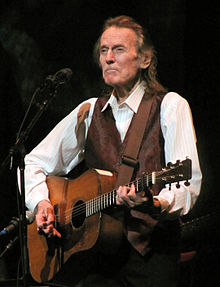
Gordon Lightfoot  was very much part of the folk-rock world which influenced Bob Dylan in his early years as a performer, and on through his life.

“Early Morning Rain” achieved popularity because it told a story that many could relate to, whether the simple events told therein had happened to them or not.  It was created as songs were starting to have lyrics that meant something more than the early rock n roll and traditional country works and was very much central to that evolution.

Gordon Lightfoot’s work has been both highly regarded and highly successful through his career and the songs have been covered by everyone from Elvis Presley to Johnny Cash from Jerry Lee Lewis to Neil Young, from Judy Collins to the Grateful Dead.   It was obvious that Bob would be interested.

Indeed Bob called him, “one of his favourite composers”.  He has subsequently received many honours and was featured at the opening of the 1988 Winter Olympics in Canada.

This is the original Early Morning Rain, one of his most famous songs… do play this by clicking the link if you are not familiar with his music.   It is one of the songs that if you were interested in the songs of the era you will not just remember but know by heart.   We all heard it and those of us who aimed to be folk singers would perform it.  (I don’t think my parents appreciated me singing the “cold and drunk as I might be” line).

In an oft-quoted comment, Dylan said that when he heard a Gordon Lightfoot song he wished “it would last forever”

Another international number 1 is “If you could read my mind” – an utterly exquisite song that works as beautifully and painfully now as it did 1970.

This piece from Wiki gives an insight…

“Lightfoot has cited his divorce for inspiring the lyrics, saying they came to him as he was sitting in a vacant Toronto house one summer. At the request of his daughter, Ingrid, he performs the lyrics with a slight change now: the line “I’m just trying to understand the feelings that you lack” is altered to “I’m just trying to understand the feelings that we lack.”  (This version doesn’t).

He has said in an interview that the difficulty with writing songs inspired by personal stories is that there is not always the emotional distance and clarity to make lyrical improvements such as the one his daughter suggested.”

Moving on to “I’m Not Supposed To Care” –  Bob first attempted it in 1989 in the studio, and then he brought it out for 3 live appearances in 1998, once in Toronto with the songs writer watching on from the audience.

I think you have somebody waiting 
Outside in the rain to take you away
You got places to go, you got people to see 
Still I'm gonna miss you 
But anyway

I wish you good spaces in 
The far away places you go
If it rains or it snows may 
You be safe and warm and never grow old
And if you need someone who loves you, why
You know I will always be there
I'll do it although I'm not supposed to care

I'll give you the keys to 
My flying machine if you'd like
I will show you the light and when you call 
I'm gonna come to you
And when you find someone who loves you, 
I'll know you would treat me the same
Just lie there, you're not supposed to care

I think you have somebody waiting 
Outside in the rain to take you away. 
That's some kind of a game 
Still I'm glad it came down 
To the final round
But anyway

If you think you need someone who needs you, 
You know I will always be there 
I'll do it although I'm not supposed to care

The 89 studio version…

https://www.youtube.com/watch?v=jsLgPMlfe9Y

And the live Toronto version

https://www.youtube.com/watch?v=1IthZynmwRA

As you can hear it had mutated and evolved for Bob over the performances.

Bob played it just three times between 13 May 1998 and 29 October 1998.

Untold Dylan: who we are what we do

Untold Dylan is written by people who want to write for Untold Dylan.  It is simply a forum for those interested in the work of the most famous, influential and recognised popular musician and poet of our era, to read about, listen to and express their thoughts on, his lyrics and music.

We welcome articles, contributions and ideas from all our readers.  Sadly no one gets paid, but if you are published here, your work will be read by a fairly large number of people across the world, ranging from fans to academics who teach English literature.  If you have an idea, or a finished piece send it as a Word file to Tony@schools.co.uk with a subject line saying that it is for publication on Untold Dylan.

We also have a very lively discussion group “Untold Dylan” on Facebook with around 6500 active members. Just type the phrase “Untold Dylan” in, on your Facebook page or follow this link 

You’ll find some notes about our latest posts arranged by themes and subjects on the home page of this site.  You can also see details of our main sections on this site at the top of this page under the picture.  Not every index is complete but I do my best.

Posted in Uncategorized | Leave a comment

Bob And Faith: Religion (Part Vl)

Bob Dylan and Faith

By Larry Fyffe

Mythology-inclined William Blake is influenced by religious leaders other than Abrahamic ones. Zoroaster founds a monastic Persian religion in which the light forces of order emanating from the benevolent One struggles with the dark forces of chaos; individuals have the choice of either practising good or evil social behaviour.

Mani, also a Persian, differs from Zoroaster in that he holds that all cultures possess a dualistic belief in an individual’s struggle between the spiritually good forces of light and dark physical forces of evil – the Neo-Christian religion that Swedenborg advocates would be an example,

British poet William Blake, in an attempt untangle such messed-up religious outpourings, is closer to the thoughts of Zoroaster in his poems; Blake depicts dark forces holding sway over individuals and societies-at-large because of the lack of a mutual balance in the way people treat one another.

Notwithstanding comments by the intellectual snob TS Eliot, Blake has lots of knowledge  pertaining to Greek/Roman mythologies. Blake has visions of himself travelling back in time and conversing with the likes of Homer and Virgil, and with the Nine Muses of ancient mythology:

Whether on the crystal rocks ye rove
Beneath the bosom of the sea
Wandering in many a coral cove
Fair Nine, forsaking poetry!
How have you left the ancient love
That bards of old enjoyed in you
The languid strings do scarcely move
The sound is forced, the notes are few
(Blake: To The Muses)

Blake criticizes the viewpoint found in a lot of the poetry of Robert Southey – his advancing of generalized ‘truths’ held by the established British society of the the day (for instance, African slaves ought to be physically set free, but then spiritually bound to the dogmas of orthodox Christianity).

A sentiment expressed in the song lyrics below juxtaposed with an objective correlative:

Ah, my friends from the prison, they ask unto me
"How good, how good does it feel to be free?"
And I answer them most mysteriously
"Are birds free from the the chains of the skyway?"
(Bodpb Dylan: Ballad In Plain D)

According to Southey, Satan’s punishment awaits all who disobey God’s commandants:

Sir Ralph the Rover tore his hair
He cursed himself in his despair
The waves rush in on every side
The ship is sinking beneath the tide
But even in his dying fear
One dreadful sound could the Rover hear
A sound as if with the Inchcape Bell
The Devil was ringing his knell

(Robert Southey:The Inchcape Bell)

In the following song lyrics, the Almighty is not perceived as all that discriminating – God does not chose to save either a creative artist like William Blake, or a devout religious leader like John Calvin, from dire circumstances:

The watchman, he lay dreaming
As the ballroom dances twirled
He dreamed the Titanic was sinking
Into the underworld
Calvin, Blake, and Wilson
Gambled in the dark
Not one of them would ever live to
Tell the tale of the disembark
(Bob Dylan: Tempest)

A view held apparently by a mentor of the above-mentioned songwriter:

I saw the best minds of my generation destroyed by madness....
Mohammedan angels struggling on tenement roofs illuminated
Who passed through universities with radiant cool eyes
Hallucinating Arkansas, and Blake-light tragedy among the scholars of war ....
(Allen Ginsberg: Howl))

Untold Dylan: who we are what we do

Untold Dylan is written by people who want to write for Untold Dylan.  It is simply a forum for those interested in the work of the most famous, influential and recognised popular musician and poet of our era, to read about, listen to and express their thoughts on, his lyrics and music.

We welcome articles, contributions and ideas from all our readers.  Sadly no one gets paid, but if you are published here, your work will be read by a fairly large number of people across the world, ranging from fans to academics who teach English literature.  If you have an idea, or a finished piece send it as a Word file to Tony@schools.co.uk with a subject line saying that it is for publication on Untold Dylan.

We also have a very lively discussion group “Untold Dylan” on Facebook with around 6500 active members. Just type the phrase “Untold Dylan” in, on your Facebook page or follow this link 

You’ll find some notes about our latest posts arranged by themes and subjects on the home page of this site.  You can also see details of our main sections on this site at the top of this page under the picture.  Not every index is complete but I do my best.
Posted in Uncategorized | 1 Comment

Play Lady Play in the 21st century

Songs selected by Aaron Galbraith, comments by Tony Attwood

As noted before in this series, Aaron not only selects the songs, but delivers them to me (Tony) without comment or explanation, except for an introductory note (reproduced below).  And this for the two of us is the fun of the series – Aaron is free to pick what he likes, and I never know what is going to be there until it turns up.

This time Aaron did give me a note at the start however saying, “I thought it would be a fun exercise to see if I could find covers by women artists of more recent songs, so I set about trying to find some for us to look it. We all know the old classics that are covered again and again…but are artists still listening and finding gems to cover amongst his more recent albums?

“I limited my search to include only songs released on Dylan albums since 2000. So anything from Love & Theft onwards. Heres  the ones I came up with.”

Ain’t Talkin by Bettye LaVette

As soon as you hear the orchestral introduction you just know that this is going to an inventive and  refreshing re-working; and so it proves to be.

Bettye has a fine voice with which she can do all sorts of things – but she matches them exactly to the lyrics and the strings accompanying her.   Better still the arranger knows how to keep the accompaniment exciting, interesting and under control.  No one is engaged in a fight within the ensemble, they are all taking on the person about whom Bettye is singing.   Full marks to the arranger, and indeed the musicians.

And just note what they do approaching the one last extra hour.  Oh that is so good.  Even the fade out has been properly thought thought.

Thunder On The Mountain by Wanda Jackson

I love the intro to this video – and I have no idea why I can’t get it to display – but it won’t no matter what I do, so you’ll have to click the link.  It’s so last century.

https://www.youtube.com/watch?v=3DTKrjplzp8

Now if you don’t know who the Third Man House Band are, well just stay with them for a moment and you will note a certain gentleman who you might recognise who is able to play the guitar quite well.   If you know who I mean you will be just waiting for the guitar solo.

Actually Jack turns up on the next track on the video too, if you want some more.  Just don’t forget to come back here to complete the series.

Life Is Hard by Renee Zellweger from the My Own Love Song movie

The film is a tear-jerker, but if you can for a moment forget the movie, it is really a brilliant rendition with such a simple accompaniment.  And yes it is important for musicians to know how to keep it simple as much as how to show every virtuoso trick in the book.

High Water (For Charley Patton) by Joan Osborne

When we hear an accompaniment that is quite different from Bob’s original and yet which really works, then the chances are the new version of the song is going to be worthy of our time.  And this certain is.

The trick is to match three elements: the lady’s voice, the new accompaniment, and something from the original that links us back to Bob – because its a pound to a penny that everyone but everyone will know the original.

But in a driving forceful piece like this it is hard to get an instrumental break right – yet here they do it.   And as the music picks up again we are just waiting for that catch line at the end of each verse.

Oh yes and they have a fake ending too.   But the point of all this is that the accompaniment is an accompaniment – it is not the main factors – those are the lyrics and the lady’s voice.   To give this much power in a song and get the balance right is a rare treat.

Sugar Baby by Barb Jungr

OK, from the first four notes we know what this, and the arranger keeps that highly distinctive accompaniment – and this works because Barb Jungr is blessed with not just a perfect voice with a stunning range, but also the ability to know when to lay off the virtuoso parts.

And just consider the lyrics she’s singing

Some of these bootleggers, they make pretty good stuff
Plenty of places to hide things here if you wanna hide ’em bad enough
I’m staying with Aunt Sally, but you know, she’s not really my aunt
Some of these memories you can learn to live with 
      and some of them you can’t

Now admit it – would you ever think of delivering lines like that within a performance like this?  If yes you either are an arranger, or you ought to be.  Go and get yourself an agent.  In fact the Aunt Sally line is nigh on impossible to deliver in a way that the audience, if they didn’t know it, would treat it seriously.

And when she sings

There ain’t no limit to the amount of trouble women bring

I cannot believe there is a heterosexual male who is not nodding his head but saying, “but I can’t give them up.”

When it comes to music I am, I always admit, an extremely emotional person and this rendition had me in tears.  Maybe it does that to no one else, but this moved me more than I can express…  I’d better move on.

I Contain Multitudes by Emma Swift…

Aaron in his note to me said he was “very surprised someone has attempted this and so soon, but I think it’s really great!”

I was totally amazed too.  Actually I could have done without the video, and after the first verse I turned the screen off.   There is more than enough in this song already, we don’t need the lyrics or pictures.  At when we do, I hope we get better than this.

Actually I want to go further than that – I think those on screen lyrics and utterly obvious images destroy the performance.  I’m stunned that someone was crass enough to think of doing this.  Or perhaps I am just being all arty and pretentious.  But do try it without the screen and see what you think.  (Or if you don’t know how to turn the screen off, just close your eyes.  That can work too).

The fact is that I don’t know the song off by heart yet, although that day will come, but I still got every word.

It is a gorgeous song with a very simple and very deep meaning that affects all of us, and this is a beautiful rendition.  Don’t let it be spoiled by the art director.

Play Lady Play

Untold Dylan: who we are what we do

Untold Dylan is written by people who want to write for Untold Dylan.  It is simply a forum for those interested in the work of the most famous, influential and recognised popular musician and poet of our era, to read about, listen to and express their thoughts on, his lyrics and music.

We welcome articles, contributions and ideas from all our readers.  Sadly no one gets paid, but if you are published here, your work will be read by a fairly large number of people across the world, ranging from fans to academics who teach English literature.  If you have an idea, or a finished piece send it as a Word file to Tony@schools.co.uk with a subject line saying that it is for publication on Untold Dylan.

We also have a very lively discussion group “Untold Dylan” on Facebook with around 6500 active members. Just type the phrase “Untold Dylan” in, on your Facebook page or follow this link 

You’ll find some notes about our latest posts arranged by themes and subjects on the home page of this site.  You can also see details of our main sections on this site at the top of this page under the picture.  Not every index is complete but I do my best.


Posted in Uncategorized | 8 Comments

Highlands: a review

by  Paul Robert Thomas

  • Recorded Criteria Studios, Miami, Jan 1997
  • Released 30 Sept 1997 on Bob Dylan’s 30th studio album Time Out of Mind
  • Running time 16.31 (his longest track until recently surpassed by Murder Most Foul which is 16.54)
  • Performed 9 times live

Musicians:

  • Bob Dylan: vocals, guitar
  • Daniel Lanois: guitar
  • Augie Meyers: organ
  • Jim Dickinson: keyboards
  • Tony Garnier: Bass
  • Tony Mangurian: percussion, drums

Studio:

  • Produced by: Daniel Lanois is association with Jack Frost Productions (Bob Dylan)
  • Sound Engineer: Mark Howard

The following article is the result of my original hearing of Highlands and of subsequently playing it a number of times. The article has been updated where necessary but for the most part it has been left as originally written and is by no means a comprehensive interpretation of the song but I merely have commented on a number of the lines that jumped out at me and I am sure there are more in depth analysis of this song but hopefully I have approached it from a different angle, interpreting some of the songs’ content for their Biblical meaning as a student of both Christian and Judaic theology and Kabbalah.

Dylan was born on 24 May 1941 in Duluth, Minnesota on the shores of Lake Superior and moved to Hibbing when he was about 7 years old. This area is in the Great Lakes region of North America in the ‘North Country’, (‘Rainy days on the Great Lakes, walkin’ the hills of old Duluth’, Something There is About You from Planet Waves). Part of New York State is known as The Highlands or The North Country that runs far north up to the Great Lakes and the Canadian border.

In the first verse of Highlands Dylan sings ‘Where the Aberdeen waters flow’. Aberdeen is in the ‘North Country’ about 150 miles west of St. Paul, Minnesota (which, incidentally, has a Jewish neighbourhood called ‘Highland Park’) and some 200 miles south-west of Duluth. It stands near the River James, which flows south to Sioux City (Dylan lived, in his youth, in Sioux Falls), where it joins the Missouri River before flowing down to New Orleans, Louisiana and the Mississippi Delta, taking a similar route to ‘Highway 61’.

Aberdeen, Scotland is not in fact in The Highlands but sits in the Grampians. The Highlands are in fact, in the northern peninsula of Scotland extending from the north-west of Loch Ness and Loch Linnhe.

Verse 1, together with 4 similar verses, which one could argue are the chorus, is seemingly drawn from the 1790 poem by Robert Burns, My Heart’s in The Highlands’’.

‘My Heart’s in The Highlands, my heart’s not there,
My Heart’s in The Highlands, a-chasing the deer,
Chasing the wild deer, and following the roe,
My Heart’s in The Highlands, wherever I go’.

 Dylan borrowed a rift and a country blues lilt from Charlie Patton in Highlands (1), and Dylan recently said, ‘It’s just a simple Blues that can go in one direction or another.’ (2)

The last 2 lines of verse 1 of Dylan’s Highlands, ‘I’m going to go there when I feel good enough to go’, is predicated on the assumption that The Highlands represents his paradisaical Utopia. Utopia is that place where some of us hope to reach, spiritually and/or physically, Then these two lines apparently imply, and correctly so according to Christian Theology, that one can only ‘get there’ when one has fully repented one’s past sins and shown oneself to be good and worth of such divine elevation. Such is the task he has set himself in T.O.O.M.’s ‘Tryin’ To Get To Heaven.’

After the ethereality of verse 1, the reality of this song starts to bite in verse 2, ‘Windows were shaking all night in my dreams.’ Dylan’s windows are his worldly perceptions, which are being shaken. He ‘Woke up this morning’ (an opening line to many a Blues song and used by Dylan himself as the opening lines to On The Road Again, George Jackson and Blood in my Eyes (his Mississippi Sheiks cover), and he saw the usual front page headlines depicting the world’s troubles. He feels he’s living in a rat race, he’s entrapped by his own fame, in the same old cage.

In verse 3, he tells us that he ‘doesn’t want nothing from anyone’, he surely has amassed all the wealth he needs, as well as gaining knowledge and experience, even wisdom, maybe he’s not even looking for love any more as he told us on the same album, he’s sick of love! Is his mention of Blondes merely coincidental, since Highlands (16.31) was for many years his longest running song since Sad Eyed Lady of The Lowlands (11.22) from his 1966 album Blonde On Blonde (B.O.B.)? (T.O.O.M. B.O.B. Highlands, Lowlands). In any event, there sure is a surefire way to tell a fake blonde from a real blonde, or maybe that doesn’t even interest him anymore? He is obviously finding it hard to make sense of this fast moving world which remains a ‘mystery’ to him, and he feels like a ‘prisoner’ from another era, and he wishes that the ‘clock’ could be turned back to his youth, perhaps to his Blonde On Blonde period?

In verse 4 he sings, ‘That’s where I’ll be when I get called home’ (Thomas Wolfe said, ‘You can’t go home again’), and is ‘home’ Heaven or literally is it the place of his birth and youth? For in Not Dark Yet on T.O.O.M. he sings ‘I was born here and I’ll die here’, that is he will die at the same place where he was born (Jesus died in Jerusalem, a stone’s throw from where he was born in the Holy Land). Being born a Jew, most Jews (in fact all religious Jews and some Christians) feel it incumbent upon themselves to be buried in the Holy Land, in Jerusalem, from that place where the Messiah will rise again. Incidentally, one of Dylan’s earliest influences, Jack Kerouac, was born and died in Lowell, Massachusetts, his graveside was the subject of a major scene with Dylan and Allen Ginsberg in Renaldo And Clara. ‘The wind whispers to the Buck-Eyed trees that rhyme’ –  Buck-Eyed trees are indigenous to the USA and not to Scotland, another clue that the song isn’t set in The Highlands of Scotland. ‘I can only get there one step at a time’, reminds one of Forever Young, ‘’ which is drawn from the Biblical story of Jacob’s Ladder, ‘And he dreamed, and behold a ladder set upon the earth, and the top of it reached to Heaven….’ (Genesis 28:12). (3)

In verse 5, he’s ‘listening to Neil Young’, who is Canadian from Toronto, which geographically, is actually south of Duluth and is just across the Northern US border, and he needs to turn up the sound (I saw Dylan and Neil Young recently at Hyde Park and didn’t think that Neil Young could get his music any louder) to hear the ‘message’, but the message, the truth, must be quietly stated as there are always those who want to suppress it and don’t want it heard, ‘Someone’s always yellin’ “Turn it down“. Dylan again expresses that he’s just going through life’s motions, drifting aimlessly through ‘scenes’ that he had already played before. He then sings, ‘What in the devil in the world could it all possibly mean’? The devil, Satan, is the god of this world, as he told us a number of times during his born-again-Christian stage speeches, ….’Well the devil owns this world, he’s called the god of this world’, and, ‘…Satan’s called the god of this world’. (4)

By verse 6, he’s feeling that ‘insanity is smashing up against my soul’. How many great artists did go insane, or managed to destroy themselves before that happened? He’s obviously not on a ‘roll’ and hasn’t really been for some years, but maybe T.O.O.M. will start things rolling again? Certainly, the 1998 Grammy Awards seem to confirm this expectancy. Upon winning the Album of the Year award for  T.O.O.M., Dylan had this to say about Buddy Holly’s influence on him and upon the album, ‘I just wanted to say that at one time, when I was about 16 or 17 years old, I went to see Buddy Holly play at Duluth National Guard Armory, and I was three feet away from him, and he looked at me, and I just have some kind of feeling that he was, I don’t know how or why, but I know, he was with us all the time when we were making this record in some kind of way….’  (Buddy you’ll roll no more’ – Standing in the Doorway, T.O.O.M.) It was actually on 31/1/59 when he saw him play, and three days later on 3/2/59, Buddy Holly was a passenger in a light aircraft that took off from Mason City, Iowa, about 100 miles west of Minneapolis, en route to play concerts at Fargo, North Dakota, about 50 miles west of Aberdeen. It crashed in a snow storm a few moments after take-off killing all those on board, the young inexperienced pilot, the ‘Big Bopper’ (JP Richardson), and Richie Valens, who had had a hit with La Bamba, the tune of which Dylan’s Like A Rolling Stone is partly based upon, (5) Dylan was to claim. ‘Buddy Holly was a poet way ahead of his time. Read his story. I played with Buddy Holly in North Dakota, South Dakota, ballrooms, youth dances….’ (6) Dylan was to play piano for Bobby Vee and The Shadows in Fargo, North Dakota as they were the replacement band for Buddy Holly, who never made it to the concerts. Part of why Dylan played on Carolyn Hester’s Columbia album was that he ‘was impressed because she had briefly known and deeply admired Buddy Holly’. (7) This harmonica playing aldum performance of Dylan led directly to John Hammond signing him up for Columbia Records. Comparisons have been made between Dylan and Charles Hardin’ Holly and, ‘in the end, perhaps the best way to encompass what Dylan has done via Holly is to say that Dylan really has replaced him. (8)

He tells us that he has no conscience, which is perhaps hard to believe, and the ‘I just might blow my top’ line reminds me of the line from Under The Red Sky’s TV Talkin’ Song about Elvis and ‘shooting the damn thing out’. ‘A conscience can be trained to recognise good and evil, but its action is involuntary, it is that faculty with us which decides as to the moral quality of our thoughts, words and acts. (9) Is a conscience really so useless to him that he would pawn it? Although pawning does imply that it can be retrieved at a later date.

In verse 7, Dylan sings of a ‘beautiful lake of The Black Swan.’ There is no such lake in Scotland, where in any event, lakes are called ‘Lochs’, although the Great Lakes area of North America is splattered with 100’s of lakes, one of the minor lakes could feasibly be called The Black Swan but more probably, the reference is to Odette who was turned into a black Swan in Tchiakovski’s Swan Lake. ‘The chariots that swing down low’ reminds one of the Spiritual song covered by Elvis, Swing Down Sweet Chariot, and of the Biblical passages, ‘…who maketh the clouds his chariot’ (Psalms 104:3), and, ‘in the second chariot, black horses …. The black horses which are therein to go forth into the North Country….’ (Zechariah 5:2&6). By the end of this verse Dylan views The Highlands as the only place left to go, having lost all hope in this world.

Verses 8-15 takes us to where the song is actually taking place in Boston, Massachusetts, that place where ‘The Yanks’ took a stand against ‘The Brits’ and where from Paul Revere started his famous horse ride (as mentioned by Dylan in Tombstone Blues), and it is from there that Dylan is day-dreaming of The Highlands in a restaurant whose name an exact location is not given but could well be in the ‘Faneuil Hall Wharf’ district of Boston, famous for its eateries. The waitress scene is reminiscent of the scene from Blood on The Tracks song Tangled Up in Blue which took place then in New Orleans, although he was ‘heading up to the east coast’ then. He reveals his current state of indecisiveness in not knowing what he really wants to order, the reason that the waitress probably tells him that ‘you most probably want hard boiled eggs’ is that he could be dressed in his usual black attire as a person in mourning would traditionally wear, for hard boiled eggs are a symbol of Jewish mourning and are part of the traditional Passover meal symbolizing the destructions of the Temples in Jerusalem in 586 BCE and 70 CE, and are also to remind one that the Third Temple, despite the creation of the State of Israel, has yet to be built by The Messiah who, in Judaic tradition, has yet to come. Interestingly enough, and bearing in mind Dylan’s acknowledged Judaic and Christian beliefs, Passover is also the time that Jesus Christ was crucified and He himself partook of the Passover meal, known as The Last Supper and we know he’s at the restaurant in a holiday period as he says, ‘it must be a holiday, there’s nobody around’. In any event, the waitress tells Dylan that they haven’t got any hard boiled eggs, it obviously was not the right time to come, it wasn’t Passover. He describes the waitress as having ‘long white shiny legs’, which reminds one of New Pony from Street Legal, ‘She got great big hind legs’, and this song branded him as being an anti-feminist, as did his ‘can you cook and sew’ line from Is Your Love in Vain’? From the same album. Presumably, Dylan’s ideals of women are not in keeping with contemporary trends of thinking, which is maybe why he doesn’t really notice this modern feminist waitress standing in front of him, as he says, ‘I don’t do sketches from memory’, but then the waitress firmly lets him know that she in nobody’s frozen-in-time female image with her retort, ‘I’m right here in front of you, or haven’t you noticed’? She forces him into a verbal corner and he makes good his escape by confessing that he has read, not merely any female author, but an acclaimed feminist author such as Erica Jong! Perhaps he has even read her best selling book, ‘Fear of Flying’? He actually wrote and performed a song about another female author recorded in 1975 as a Desire outtake, Rita May. Whilst the waitress goes away to contemplate his response to her questioning, he slides out of his chair and steps into the now ‘busy street’, previously there was nobody around, so maybe some time has elapsed since he’s been in the restaurant.

In verse 15 (one of the choruses), the mention of ‘Arrows’ and ‘Bows’ reminds one of Jerusalem by William Blake, ‘Bring me my bow of burning gold, bring me my arrows of desire’. Dylan then repeats the monotonous life’s theme in verse 16, ‘Everyday is the same thing’ (Every Day was a hit for Buddy Holly). What ‘feels further away than ever before’? Is it complete happiness, is it salvation? Whatever it is, he hasn’t attained it yet and it seems obvious that he regrets this and perhaps it’s too late for him to reach or find this unattainable goal and maybe his past choices have left him alone and lonely which is dealt with in verse 17 where he watches as an outsider and at a distance, hetrosexual and happy ‘young people’ (repeated again in Love Sick) and he obviously feels conscious of his advanced years, of young people enjoying themselves and wearing ‘brightly coloured clothes drinking and dancing’ (he could have used ‘Gay’ coloured clothes here, it would have been appropriate, he used the word ‘Gay’ twice in Standing in the Doorway), for Dylan is renowned for his dark or back attire. Can he not ‘trade places with any of them in a minute’ just because he is the famous Bob Dylan and is trapped in his notoriety? He said recently of fame, ‘at a certain point, fame becomes a handicap, fame, being a celebrity, you’d like sometimes to be rid of it’. (10) An interviewer said, ‘In Highlands, he watches young people drinking and dancing and his voice grows hollow with sadness’ ‘I’d change places with any of them if I could’, to which Dylan replied, ‘I can’t help those feelings, I’m not going to try and make a false Pollyanna view. Why would I even want to? And I’m not going to deny them just because they might be a little dismal to look at. I try to let it speak for itself’. (11)

In verse 18, who is the ‘mangy dog’ (reminding one of One Too Many Mornings Down the street the dogs are barking’) that he’s changing his direction of his life to avoid? Is A.J. Weberman back in business hounding him again? This actually brings to mind Robert Browning’s poem The Cardinal and the Dog, where the Cardinal lies on his death-bed and cries out loud to try to stop a ‘black dog of vast bigness, eyes flaming’ from jumping all over the sheets’. The lonely facet is repeated once again as he is talking to himself (in a monologue). Does he need a ‘full leather coat’ against the cold wind that’s blowing? A leather jacket used to be viewed as a ‘sold-out symbol’ when worn by artists such as Dylan. Is voting also a sign of having ‘sold out’? If so, what of performing for President Clinton at the Lincoln Memorial in 1993, or inviting Jimmy Carter back-stage during the 1974 tour (12), or performing for President Obama at the White House? Certainly permitting his Times They Are-A Changin song to be used in a TV advert and there are many other examples.

Recently in an interview, Dylan has stated, ‘I don’t have any problem in that field.’ (13)

The penultimate verse, verse 19, is as revealing as any other on this album, with its oft used pun by Dylan on ‘sun’ and ‘son’, ‘Jesus said I am the light that is above.’ (14) Jesus Christ is referred to as ‘The Sun of righteousness’ in Malachi 4:2, and as the ‘Son of man’ and the ‘Son of God’ at Revelation 1:13, 2:18, and Matthew 26:63, 27:43 & 27:54, and implies the Second Coming of Christ. The reason that He is ‘not like the Son that used to be’ is because at the Second Coming Christ will appear ‘not as a teacher but more as a king who wields His judgement like weapons for the punishment of the impious.His countenance was as the sun shineth in his strength’. (Revelation 1:16) (The Second Coming of Christ is depicted at Revelation 19:11-20:3). The party is over (the song The Party’s Over was covered by Willie Nelson), because the world will be destroyed (‘not by water but by fire next time’, God Knows and, ‘It’s unbelievable that time would finally come’, Unbelievable, Under The Red Sky), and, Dylan is certainly no mellorist, ‘there’s less and less to say’ for some may argue that unbelieving Man deserves his fate, for he could not change his evil ways. Dylan’s ‘got new eyes’, he’s viewing the coming events and the impending Apocalypse (Armageddon) which without doubt he believes will occur, although It’s Not Dark Yet, it sure is getting there, through the eyes of the author of The Book of The Revelation, St. John the Theologian, who wrote it after receiving a vision of Jesus Christ on the Greek island of Patmos. (15) Everything looks far away’ because Dyaln has distanced and separated himself from non-believing mankind.

In the final verse, verse 20, ‘At the break of day’ reflects the warning to watch out for the Coming of Christ, at Mark 13:35, ‘Watch ye therefore, for ye know not when He cometh, at even, or at midnight, or at the cock crowing, or in the morning.’ ‘Over the hills and far away’  could refer to a late 17th Century English song of that name although it does remind me of the Christian Hymn, ‘There is a green hill far away without a city wall, where the dear Lord was crucified, He died to save us all’, ‘There is a Way’ could refer to The Way which is a term used for Jesus Christ at John 14:6, ‘Jesus saith unto him, I am the way, the truth and the life’, it is also the method of salvation, or doctrine of the gospel’. (Acts 19:9) (16)

The album’s title of Time Out of Mind reflects the Biblical promise at Revelation 10:6 concerning New Jerusalem and The Second Coming of Jesus Christ’, when, ‘Time shall be no more’ and of course it appears in Act 1, scene 1 from Romeo and Juliet.

All in all, I find Highlands to be a sad song full of regret, about one unable to come to terms with old age. At his age it brings home all the things he has failed to achieve or has done wrongly and it reveals him to be lonely, aloof and full of regrets and seems a million miles from his ‘I accept chaos’ declaration from the cover of Bringing It All Back Home and seems to epitomize the antithesis of Desolation Row (the title possible drawn from Jack Kerouac’s poem Desolation Peak), although a line from that song does seem to encapsulate Dylan’s apparent present state of well-being, ‘When you asked me how I was doing, was that some kind of joke’?

There is humour present in this song, but it is superficial and doesn’t make you smile from within. On one hand, I find it hard to believe that this is really how Dylan views this world, but on the other hand, if one rally did open one’s eyes, or ‘have new eyes’, and see things how they really are and not as we pretend they are, perhaps we too would be looking for the exit we are all getting nearer to each passing day and certainly Dylan felt he’d came close with the heart scare he had in May 1997 after T.O.O.M. was recorded, suffering from histoplasmosis that had him saying, ‘I really thought I’d be seeing Elvis soon’. The album is resplendent with other gloomy songs or songs of regret such as Not Dark Yet, Tryin’ To Get To Heaven, Love Sick, Standing in the Doorway, Can’t Wait, Cold Irons Bound. Dylan uses not T.S. Eliot’s The Waste Land that he used as the basis for Desolation Row but the poet Robert Burns with his romantic verses of ‘chasing wild deer’ and ‘following the roe,’ and Dylan has used such poetic writings in previous albums such as Nashville Skyline and Self Portrait, I have in mind Belle Isle, and Highlands wouldn’t have been out of place on an album such as Self Portrait and without doubt, Highlands is a timeless piece of work.

Making it to Heaven as a ‘Prodigal Son,’ a repentant sinner, seems to be his only solace in this world.

Notes

(1)     Jon Pareles. New York Times Interview. 29/9/97

(2)     Metropole Hotel Interviews, London. 4/10/97

(3)     All Biblical references are drawn from The Holy Bible, King James  version, New York: Ivy Books. 1991

(4)     Saved! The Gospel Speeches, compiled by Clinton Heylin, New York: Hanuman Books. 1995

(5)     Paul Williams, Bob Dylan Performing Artist 1960-1973, London: Omnibus Press. 1994

(6)     Robert Shelton, No Direction Home, London:New English Library. 1986

(7)     Robert Shelton, No Direction Home, London:New English Library. 1986

(8)     Michael Gray, Song and Dance Man, London: Abacus Books. 1972

(9)     Alexander Cruden, Cruden’s Concordance to the Bible, Cambridge: Lutterworth Press. 1977

(10)   Rabbi Haim Halevy, To Be A Jew, New York: Basic Books. 1971

(11)   Pareles, New York Times Interview. 29/9/97

(12)   Levon Helm, This Wheel’s on Fire, London: Plexus Publishing. 1994

(13)   Metropole Hotel Interviews, London. 4/10/97

(14)   The Gospel According to St. Thomas, Alaska: Messianic Brotherhood. 1982

(15)   Archbishop Averky Taushev, The Apocalypse, Alaska: St. Herman Brotherhood. 1995

(16)   Alexander Cruden, Cruden’s Concordance to the Bible, Cambridge: Lutterworth Press. 1977

The Lyrics: Highlands

Well my heart's in The Highlands, gentle and fair
Honeysuckle blooming in the wildwood air
Bluebells blazing where the Aberdeen waters flow
Well my heart's in The Highlands
I'm gonna go there when I feel good enough to go

Windows were shaking all night in my dreams
Everything was exactly the way that it seems
Woke up this mornin' and I looked at the same old page
Same old rat race, life in the same old cage
I don't want nothin' from anyone, ain't that much to take
Wouldn't know the difference between a real blonde and a fake
Feel like a prisoner in a world of mystery
I wish someone'd come and push back the clock for me

Well my heart's in The Highlands wherever I roam
That's where I'll be when I get called home
The wind it whispers to the buckeye trees of rhyme
Well, my heart's in The Highlands
I can only get there one step at a time
I'm listening to Neil Young, I gotta turn up the sound
Someone's always yellin' "Turn it down"
Feel like I'm driftin', driftin' from scene to scene
I'm wonderin' what in the devil could it all possibly mean

Insanity is smashin' up against my soul
You could say I was on anything but a roll
If I had a conscience, well I just might blow my top
What would I do with it anyway, maybe take it to the pawn shop?
My heart's in The Highlands at the break of dawn
By the beautiful lake of the Black Swan
Big white clouds like chariots that swing down low
Well my heart's in The Highlands, only place left to go

I'm in Boston town in some restaurant
I got no idea what I want
Or maybe I do but I'm just really not sure
Waitress comes over, nobody in the place but me and her
Well it must be a holiday, there's nobody around
She studies me closely as I sit down
She got a pretty face and long white shiny legs

I said "Tell me what I want"
She say "You probably want hard boiled eggs"
I said "That's right, bring me some"
She says "We ain't got any, you picked the wrong time to come"
Then she says "I know you're an artist, draw a picture of me"
I said "I would if I could but
I don't do sketches from memory"
Well she's there, she says "I'm right here in front of you
Or haven't you looked?"

I say "All right, I know but I don't have my drawin' book"
She gives me a napkin, she say "You can do it on that"
I say "Yes I could but I don't know where my pencil is at"
She pulls one out from behind her ear
She says "Alright now go ahead draw me I'm stayin' right here"
I make a few lines and I show it for her to see
Well she takes the napkin and throws it back and says
"That don't look a thing like me"

I said "Oh kind miss, it most certainly does"
She say "You must be joking", I said "I wish I was"
She says "You don't read women authors do ya?"
At least that's what I think I hear her say
Well I say "How would you know, and what would it matter anyway?"
Well she says "Ya just don't seem like ya do"
I said "You're way wrong"
She says "Which ones have you read then?", I say "Read Erica Jong"
She goes away for a minute, and I slide out, out of my chair
I step outside back to the busy street, but nobody's goin' anywhere

Well my heart's in The Highlands with the horses and hounds
Way up in the border country far from the towns
With the twang of the arrow and the snap of the bow
My heart's in The Highlands, can't see any other way to go
Every day is the same thing, out the door
Feel further away than ever before
Some things in life it just gets too late to learn
Well I'm lost somewhere, I must have made a few bad turns

I see people in the park, forgettin' their troubles and woes
They're drinkin' and dancin', wearin' bright colored clothes
All the young men with the young women lookin' so good
Well, I'd trade places with any of 'em, in a minute if I could
I'm crossin' the street to get away from a mangy dog
Talkin' to myself in a monologue
I think what I need might be a full-length leather coat
Somebody just asked me if I'm registered to vote

The sun is beginnin' to shine on me
But it's not like the sun that used to be
The party's over and there's less and less to say
I got new eyes, everything looks far away
Well my heart's in The Highlands at the break of day
Over the hills and far away
There's a way to get there, and I'll figure it out somehow
Well I'm already there in my mind and that's good enough for now

Paul Robert Thomas 6/6/20

You might also enjoy

“Highlands”; its origins in Burns poetry and a beautiful rare reworking in concert

Untold Dylan: who we are what we do

Untold Dylan is written by people who want to write for Untold Dylan.  It is simply a forum for those interested in the work of the most famous, influential and recognised popular musician and poet of our era, to read about, listen to and express their thoughts on, his lyrics and music.

We welcome articles, contributions and ideas from all our readers.  Sadly no one gets paid, but if you are published here, your work will be read by a fairly large number of people across the world, ranging from fans to academics who teach English literature.  If you have an idea, or a finished piece send it as a Word file to Tony@schools.co.uk with a subject line saying that it is for publication on Untold Dylan.

We also have a very lively discussion group “Untold Dylan” on Facebook with around 6500 active members. Just type the phrase “Untold Dylan” in, on your Facebook page or follow this link 

You’ll find some notes about our latest posts arranged by themes and subjects on the home page of this site.  You can also see details of our main sections on this site at the top of this page under the picture.  Not every index is complete but I do my best.

Posted in Uncategorized | 5 Comments

The Mississippi-series, part 4

by Jochen Markhorst

Like earlier “Desolation Row” and “Where Are You Tonight?”, “Mississippi” can’t really be dealt with in one article. Too grand, too majestic, too monumental. And, of course, such an extraordinary masterpiece deserves more than one paltry article. As the master says (not about “Mississippi”, but about bluegrass, in the New York Times interview of June 2020): Its’s mysterious and deep rooted and you almost have to be born playing it. […] It’s harmonic and meditative, but it’s out for blood.

This article continues from

IV         Bertolt, Bobby, Blind & Boy

City’s just a jungle; more games to play
Trapped in the heart of it, tryin’ to get away
I was raised in the country, I been workin’ in the town
I been in trouble ever since I set my suitcase down


Bertolt Brecht is quite proud of himself. On September 4, 1921, he writes in his diary about his “groundbreaking discovery”,

“that actually no one has ever described the big city as a jungle. Where are their heroes, their colonizers, their victims? The hostility of the great city, its malicious stone consistency, its Babylonian confusion of languages, in short: its poetry is not yet created.”

In the same weeks, Brecht writes Im Dickicht der Städte (“In the Jungle of Cities”), a dizzying piece in which Brecht is not too concerned about a logical plot or understandable motives, but shows different stages of a catastrophic quarrel between two men. With a vague, homoerotic undertone, so some like to see a dramatic portrayal of a Rimbaud-and-Verlaine-like relationship, but the main theme is: loneliness – extra sharp-edged because the men, despite being in the big, busy city of Chicago, are actually mostly lonely. Most disconsolate expressed by the timber merchant Shlink: “The infinite loneliness of man makes enmity an unattainable goal.”

By the way, Brecht’s complacent diary entry is yet another fine example of the great playwright’s Love & Theft – earlier in his diaries he explains his admiration for Upton Sinclair’s The Jungle (1905), the social-realist novel that compares the city – not coincidentally also Chicago – to a jungle.  

By the time Dylan writes “Mississippi”, jungle as a metaphor for “big city” is long established. Not only in books, newspapers and films, but also in songs. Songs that are also in Dylan’s record cabinet, anyway. Bobby Darin, for instance.

The 1968 album Born Walden Robert Cassotto marks a rather radical career break for Bobby Darin. He leaves his record label, writes all the songs himself and converts to folk rock, sociocritical lyrics and an unpolished singing style, much more unpolished than the crooning style which made him great. One of the songs, “Long Line Rider”, even causes some controversy, which gets him attention from folk magazine Broadside.

Bobby Darin – Long Line Rider

In the 1969 March/April issue Dylan’s old comrades and doormats print an article from the New York Post of February 1: “Censored Darin Sings a Song of Protest”. The controversy is painfully petty by today’s standards. In the song Darin expresses his amazement at an alleged cover-up operation after the discovery of some unidentified skeletons on a prison site. Remarkably smooth investigation concludes that the corpses were buried there before there was any prison at all, and Darin raises suggestive questions:

All the records show so clear
Not a single man was here
Anyway
Anyway.
That's the tale the warden tells
As he counts his empty shells
By the day
By the day.
Hey, long line rider, turn away.

Just before a television performance (The Jackie Gleason Show, January ’69) record company CBS sends a telegram with the order to delete the above words. Enraged Darin walks out, a scandal seems unavoidable, but it doesn’t really get off the ground.

The song and the story behind it have long since been forgotten, but the flop album itself stands the test of time; it’s a beautiful album with beautiful songs (“I Can See The Wind”, especially, the Leonard Cohen rip-off “In Memoriam” and the Moby Grape-like “Change”). However, style, change of course and the level of protest are not the only indications that Darin is trying to level his idol Dylan. He’s already recorded some successful Dylan covers, will record even more beautiful ones in the coming years (his “I’ll Be Your Baby Tonight” is one of the most successful covers of that evergreen), and on this record Dylan’s influence is evident from the lyrics Darin writes:

We live in a jingle jangle jungle
You're only worth what you can buy
So keep on workin' hard
To keep your own back yard
Teach your kids that God
Ain't fiction
Contradiction
In this jingle jangle jungle you call home.

Dylan undoubtedly knows the record and the song, but jungle as a metaphor for the big city is more likely to have come to him through Phil Ochs’ “Lou Marsh” (or Pete Seeger’s version thereof):

Now the streets are empty, now the streets are dark
So keep an eye on shadows and never pass the park
For the city is a jungle when the law is out of sight
Death lurks in El Barrio with the orphans of the night

The city is a jungle when the law is out of sight”… the image plus the words that match the opening of Dylan’s “Mississippi”, the opening verses that poetically introduce the oppression, hopelessness and anguish of the protagonist.

After the sixth verse, the accumulatio, the accumulation of the equivalents all expressing approximately the same claustrophobic, Kafkaesque distress, seems to come to an end, and the plot can unfold:

I was raised in the country, I been workin’ in the town
I been in trouble ever since I set my suitcase down

… promising a novel-like plot. The trouble, the drastic event in the main character’s life is coming up. A first character description is also given: boy from the countryside, who has to make a living in the metropolitan jungle – and it don’t come easy, as evidenced by the beautiful, lyrical suitcase line.

It’s one of the most beautiful lines in the song, a line with the shine of a polished, old-fashioned blues cliché, but actually a Dylan original – at best it does echo a hint of Blind Lemon Jefferson, “Easy Rider Blues”:

I went to the depot
I mean I went to the depot, set my suitcase down
The blues overtake me and the tears come rollin' down


Blind Lemon is a common thread in Dylan’s oeuvre. “See That My Grave Is Kept Clean” on the first record, which pops up again in the Basement as “One Kind Favor”, “High Water Blues” as template for “Down In The Flood”, Blind Lemon’s guitar in Masked & Anonymous, the name checks in interviews and in Chronicles, the attention in Theme Time Radio Hour… it’s likely that such a verse fragment as I set my suitcase down was etched in Dylan’s brain by Blind Lemon. His poetic brille does the rest; connecting the words to I been in trouble since is considerably more powerful (and more poetical) than Blind Lemon’s somewhat stiff continuation.

Apparently Boy George, of all people, thinks so too – in the twenty-first century he lovingly steals it for “Wrong” (on U Can Never B2 Straight, 2002):

I came to the city with my head so full of dreams
The city was safe alright but not from me
See I've been in trouble since I lay my suitcase down
I love the sound of my own voice, but now I want it drowned

… insinuating that he is one of those predators that turn the city into a jungle. Which, given “Boy” George Alan O’Dowd’s reputation, indeed does sound a little more convincing from his mouth than from Dylan’s.

To be continued. Next up: Mississippi part V: Frost in the room, fire in the sky

=============

Jochen is a regular reviewer of Dylan’s work on Untold.  His books are available via Amazon both in paperback and on Kindle:

Untold Dylan: who we are what we do

Untold Dylan is written by people who want to write for Untold Dylan.  It is simply a forum for those interested in the work of the most famous, influential and recognised popular musician and poet of our era, to read about, listen to and express their thoughts on, his lyrics and music.

We welcome articles, contributions and ideas from all our readers.  Sadly no one gets paid, but if you are published here, your work will be read by a fairly large number of people across the world, ranging from fans to academics who teach English literature.  If you have an idea, or a finished piece send it as a Word file to Tony@schools.co.uk with a subject line saying that it is for publication on Untold Dylan.

We also have a very lively discussion group “Untold Dylan” on Facebook with around 6500 active members. Just type the phrase “Untold Dylan” in, on your Facebook page or follow this link 

You’ll find some notes about our latest posts arranged by themes and subjects on the home page of this site.  You can also see details of our main sections on this site at the top of this page under the picture.  Not every index is complete but I do my best.

Posted in Uncategorized | 1 Comment

Bob Dylan And Faith: Dead Men (Part V)

Bob Dylan and Faith

By Larry Fyffe

Drawing from the literary well of the Judiac/Christian Bible and Greco/Roman mythologies, singer/songwriter Bob Dylan creates his own mythological world in song lyrics; he’s sick and tired of religion and myths being corrupted in order to glorify the New Babylon of materialistic America. In response, Dylan makes old myths new again.

In the following lyrics, Bob Dylan could well be addressing William Blake; he wonders where anti-establishment poets like him have been taken:

What are you trying to overpower me with, the doctrine of the gun
My back is already to the wall, where can I run?
The tuxedo that you're wearing, the flower in your lapel
Ooh, I can't stand it
You wanna take me down to hell
Dead man, dead man
When will you arise?
Cobwebs in your mind
Dust in your eyes
(Bob Dylan: Dead Man, Dead Man)


In the following song lyrics, the listeners thereof hear about an outlaw biologist who’s been hunted down by the Establishment:

They got Charles Darwin
Trapped out there on Highway Five
Judge says to the High Sheriff
"I want him dead or alive
Either one, I don't care"
(Bob Dylan: High Water)

Referencing the nuanced:

"I want him bought back here to me
Alive or dead, don't matter
Though I reckon dead would be easier"
(Robert Mitchum: Dead Man movie)

Mitchum plays John Dickinson, an industrialist in a western town called ‘Machine’. Deconstructed, the following poem springs to mind:

And so, as kinsmen met a night
We talked between the rooms
Until the moss had reached our lips
And covered up our names
(Emily Dickinson: I Died For Beauty)

‘Dead Man’ is a western movie, inspired by Dylan’s mixing of mythologies. In the film, an American native ‘Indian’ who’s studied William Blake, calls himself ‘No Name’ in reference to Book IX of Homer’s “Odyssey”:

Odysseus: ‘No man’ do they call me, my mother and my father
All my comrades as well

Cyclopes: It is ‘No Man’ that is laying me by guile, and by force

Odysseus burns out the eye of the Cyclopes, but the giant’s plea for help is in vain.

An accountant in the movie ‘Dead Man’ whose name is William Blake is mistaken by the ‘Indian’ to be the reincarnation of the poet.The accountant visits a prostitute named Thel. William Blake’s Thel is a young, innocent virgin who is afraid to enter the adult world of experience; no help is the the Church because it speaks only  of ‘rods’ and ‘bowls’, not of male and female sex organs:

Does the eagle know what is in the pit
Or will you go ask the mole
Can wisdom be put in a silver rod
Or love in a golden bowl?
(Blake: The  Book Of Thel)

In ‘Hamlet”, no help is the sanctimonious Polonuis to his Thel-like daughter Ophelia, nor is the sententious maxims given as advice in the lyrics below:

May you grow up to be righteous
May you grow up to be true
May you always know the truth
And see the light surrounding you
May you always be courageous
Stand upright and be strong
May you stay forever young
(Bob Dylan: Forever Young)

The only thing we know for sure about Bob Dylan is that his name isn’t Bob Dylan.

Untold Dylan: who we are what we do

Untold Dylan is written by people who want to write for Untold Dylan.  It is simply a forum for those interested in the work of the most famous, influential and recognised popular musician and poet of our era, to read about, listen to and express their thoughts on, his lyrics and music.

We welcome articles, contributions and ideas from all our readers.  Sadly no one gets paid, but if you are published here, your work will be read by a fairly large number of people across the world, ranging from fans to academics who teach English literature.  If you have an idea, or a finished piece send it as a Word file to Tony@schools.co.uk with a subject line saying that it is for publication on Untold Dylan.

We also have a very lively discussion group “Untold Dylan” on Facebook with around 6500 active members. Just type the phrase “Untold Dylan” in, on your Facebook page or follow this link 

You’ll find some notes about our latest posts arranged by themes and subjects on the home page of this site.  You can also see details of our main sections on this site at the top of this page under the picture.  Not every index is complete but I do my best.


Posted in Uncategorized | Leave a comment

Why does Dylan like “Why do I have to choose”?

By Tony Attwood

Why Do I Have to Choose” was written and recorded by Willie Nelson, released in May 1983 as a single taken from the album “Take it to the limit”.  It got to number 3 on the Billboard country singles charts.

Here are the lyrics…

Why do I have to choose to see everybody lose
To walk around and sing the blues well darling I refuse

Love is hard to find love of any kind
And a love like yours and mine creates it's own design

Why do I have to choose to see everybody lose
To walk around and sing the blues well darling I refuse

And when I think of her and then I think of you
The love is not the same but either love is true

Why do I have to choose to see everybody lose
To walk around and sing the blues well darling I refuse

And here is the original – but if you don’t like this, please don’t give up because what Bob did to this song is something quite different.

And then…

Just over one year later, in 1984 Bob Dylan played this song eight songs.   And you might be a little surprised as to what he did with this gentle ballad.  This version comes from the 1984 tour.

https://youtu.be/ss26KNgDiGs

And just to show us it wasn’t a one off, Bob kept on varying the song – but I am not sure where this version comes from.

https://youtu.be/XSrGZdNs4pU

And here are the two guys together

So why did Bob like it?   Basically because it is a song he can vary and which has a really great catchy line – it just lends itself to becoming something quite different from the original.

I think quite simply Bob heard it, realised it could have come out a very different way, and just re-wrote it.

And I’m rather glad he did.


Posted in Uncategorized | 3 Comments

1986: the year Dylan slowly turned himself all around

By Tony Attwood

My thesis in this series that looks at the topic of each song Dylan has written, taking the songs in the order they were written, is simple.  By looking at what Dylan was writing about, I argue that we can understand a lot about what was concerning him at the time.   And thus when we look across the years we can see how his interests, and indeed his thought patterns, change.

This I believe does give us a deeper insight into Dylan himself than can be achieved by analysing the lyrics of Dylan’s work.  Of course the lyrics are a central part of what Dylan is and what he is feeling and reading at any time.   So in focusing on the subject matter of the song rather than the sources, I do not try to deny the validity of looking at the sources of Dylan’s ideas and insights, but rather offer an extra dimension.  One that cuts to the heart of his own preoccupations.

Using this basis, 1985 had certainly not been the most positive of years for Bob.  The subject matter identified in the article on that year  revealed a unique set of topics…

  • Lost love: 12
  • Love: 6
  • Chaos / criminals escaping / life is a mess / being lost: 6
  • Instrumental: 1
  • Not Dylan’s lyrics: 2

… unique in the sense that never before had the theme of “lost love” dominated Dylan’s output.  And indeed never had there been such negativity.

Looking at the era year by year we can see the main topics

Year Love Lost Love Blues, the end Moving on Faith No going back / being lost
1978 3 3 3 4
1979 19
1980 2 2 7
1981 1 3 6
1982/3 4 4
1984 4 4 2 1
1985 6 12 6

The tendency towards the negative is clear.  After four consecutive years of not writing about lost love, Bob has really moved into a new, less positive direction.

When we come to 1986, I called my earlier article on this year  Experiment, experiment, experiment, genius, ignore  When I wrote that series of articles I was looking at each year in isolation, and not trying to classify songs into their subject matter.  But even so the classification came through – as did the highlight of the year, “To fall in love with you” which I described as an incomplete and abandoned work of great beauty.

https://youtu.be/Sr10xoxUj1w

I think many would agree that it is a stunning although clearly incomplete work, with a beautiful melody and exquisite accompaniment, even on what was clearly a first run through.   So what on earth made Bob ignore it?

The commonplace answer is that Bob never knows his best songs, for there are so many examples we could all come up with of brilliant works being left off albums, only to be recovered later.

But I wonder if this is not too bland an answer.  Could it not be that Bob has left a song off an album simply because it hurt too much, or reminded him of a bad moment?  It’s all very well writing all these songs of lost love but if that writing comes from real feelings of despair then it can wear the artist down.

By 1981 Bob had composed, by my reckoning, 49 lost love songs and 73 songs of love and desire.  These were easily the most common subjects of Bob’s writing, and that dominance of love against lost love shows a positive outlook.  So what happened next?

  • 1982/3:  Love  1, lost love 0.   Also at least five songs that can best be summarised as “there’s no going back.”   It is the lowest engagement with the love theme since Bob started writing.
  • 1984: Love 4 , lost love 4
  • 1985: Love -6, lost love 12

By 1985 he was emotionally sinking, if one accepts that his song writing reflects his thinking (and that is would seem a most reasonable assumption).   So what happened in 1986?

  1. Band of the Hand (It’s hell time man) (It’s all gone wrong)
  2. Rock em Dead (go out have fun)
  3. You wanna ramble (being unfaithful)
  4. Got my mind made up (leaving)
  5. Jammin Me (lost love)
  6. Had a dream about you baby (love)
  7. Ride This Train. (moving on)
  8. To fall in love with you (love)
  9. Silvio* (lyrics by Robert Hunter) (turning life around)
  10. Ugliest girl in the world* (lyrics by Robert Hunter) (love)

The last two songs marked with * are hard to pin down as to their exact date of composition.  My best guess is that they were written after “To fall in love with you”.

Silvio, although the lyrics are not written by Dylan, have lyrics that we may presume appeal to him – and this appeal seems most apposite at this moment…

Stake my future on a hell of a past
Looks like tomorrow is coming on fast
Ain’t complaining ’bout what I got
Seen better times, but who has not?

So this is Bob Dylan taking a new turn, drawing a line in the sand, moving on, or whatever metaphor you prefer.   He’s starting out again, and as the next song says, he’s not going after the pretty women any more, but finding a woman who can give him much deeper and more sincere love and affection.

Now to the usual task of adding up the topics for the year…

  • It’s all gone wrong: 1
  • Having fun: 1
  • Being unfaithful / leaving: 2
  • Lost love / moving on: 2
  • Love: 1

And with lyrics by Robert Hunter we have turning life around and love.

  • Turning life around: 1
  • Love: 1

And so we can see the transition, from the 1985 emphasis on lost love and no going back, and gentle shift into moving on and having fun.

Plus we can now take a guess at why the most wonderful To fall in love with you was abandoned.   Dylan was not ready either to confess his love for a particular woman, or to confess total love even to an unidentified woman.  It turned into a beautiful song, but it was the wrong subject matter for the moment.  He quite possibly had the lyrics, but didn’t want to enunciate them.

“To fall in love with you” is the only love song of a year in which Bob Dylan really needed Silvio as his alternative character.  Once he found that alternative he was ready to move on.

https://youtu.be/Sr10xoxUj1w

But let us also think back once more to the end of 1980 when Bob wrote and sang

I tell people you’re just going through changes
And that you’re acquainted both with night and day
That your money’s good and you’re just being courageous
On them burning bridges knowing your feet are made of clay
Well I say you won’t be destroyed by your inventions
That you brought it all under captivity
And that you really do have all the best intentions
But you’re making’ a liar out of me

It had taken him half a decade to work through that recognition that life and emotions change, and that we all have positive and negative emotion (“night and day”) within ourselves, and only now in 1986 do we find him coming through it.

It had been a long, and seemingly very tough, journey.  Here, one more time, is how it started.

Untold Dylan: who we are what we do

Untold Dylan is written by people who want to write for Untold Dylan.  It is simply a forum for those interested in the work of the most famous, influential and recognised popular musician and poet of our era, to read about, listen to and express their thoughts on, his lyrics and music.

We welcome articles, contributions and ideas from all our readers.  Sadly no one gets paid, but if you are published here, your work will be read by a fairly large number of people across the world, ranging from fans to academics who teach English literature.  If you have an idea, or a finished piece send it as a Word file to Tony@schools.co.uk with a subject line saying that it is for publication on Untold Dylan.

We also have a very lively discussion group “Untold Dylan” on Facebook with around 6500 active members. Just type the phrase “Untold Dylan” in, on your Facebook page or follow this link 

You’ll find some notes about our latest posts arranged by themes and subjects on the home page of this site.  You can also see details of our main sections on this site at the top of this page under the picture.  Not every index is complete but I do my best.


Posted in Uncategorized | 1 Comment

Mississippi 3: Belshazzar on the steppe

This article continues from

by Jochen Markhorst

Like earlier compositions, “Desolation Row” and “Where Are You Tonight?”, “Mississippi” can’t really be dealt with in one article. Too grand, too majestic, too monumental. And, of course, such an extraordinary masterpiece deserves more than one paltry article. As the master says (not about “Mississippi”, but about bluegrass, in the New York Times interview of June 2020): It’s mysterious and deep-rooted and you almost have to be born playing it. […] It’s harmonic and meditative, but it’s out for blood.

III         Belshazzar on the steppe

Every step of the way we walk the line
Your days are numbered, so are mine
Time is pilin’ up, we struggle and we scrape
We’re all boxed in, nowhere to escape

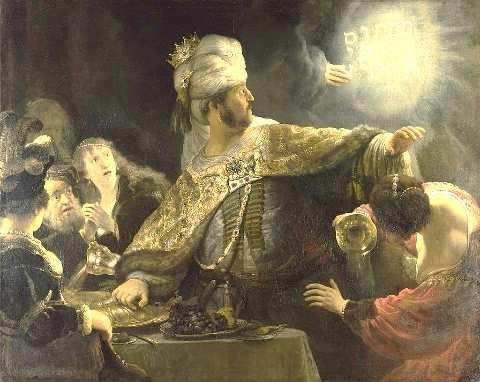
In 1820 Heinrich Heine writes his ballad “Belsazar”, about the last evening of the Babylonian king. That evening, probably October 12, 539 BC, Belshazzar organizes a party. During the feast he is so audacious as to call for the “sacred goblets”, goblets that his grandfather Nebuchadnezzar had stolen from the Temple of Jerusalem during the destruction. He fills a sacred goblet with wine, rises, gulps it in one go to the bottom and, to the great delight of the partygoers present, roars insulting texts about this so-called “Jehovah”, that God of the Jews (Jehovah! I proclaim to you my eternal scorn, for I am the King of Babylon!).

Which he shouldn’t have done.

A hand appears out of nowhere. The hand floats through the room and writes “letters of fire” on the wall. The frenzied revelry is extinguished in one blow and with knocking knees the pale Belshazzar stares at the incomprehensible signs on the wall. The magicians are called in, but no one can decipher those strange symbols.

Belshazzar, however, was murdered that same night by his bodyguard.

Heine re-tells the story from Daniel 5, leaving out, to increase the suspense, the punch line; in the Bible story, the Jewish slave Daniel is brought in, who can indeed tell what those writings on the wall mean: mene mene tekel ufarsin – “numbered, numbered, weighed and divided”. By what God means to say, Daniel helpfully explains to Belsazar, that your days are numbered, that you have been found to be too light, and that your kingdom will be divided.

Like “writings on the wall”, “your days are numbered” has become an expression from which the biblical origins have evaporated; they have both become so common that no one thinks of the Old Testament, Daniel or that cheeky Belshazzar anymore.

Neither does the esteemed Dylan researcher from Albuquerque, Scott Warmuth point to the Bible, but rather to Henry Rollins. Not entirely unjustified; “Mississippi” has indeed borrowed some four, five fragments and word combinations from Rollins’ poems and prose, but attributing this “your days are numbered” to Rollins’ influence is a bit too much credit. The expression has existed for more than twenty centuries (the Book of Daniel was probably written around 165 B.C.) and Dylan himself has used it way before Rollins did (in “When The Ship Comes In”, 1963).

There, in the furious “When The Ship Comes In”, the lieder poet uses the expression in the old, biblical sense: it announces the imminent, ruthless destruction of the enemy and introduces further biblical metaphors (“Pharaoh’s Tribe” and “Goliath”).

However, the protagonist in “Mississippi” is, just like the poet, a couple of decades older and therefore calmer – in this first quatrain, it is one of the seven expressions the narrator chooses to express something like fatigue, hopelessness, existential loneliness.

Individually, the seven expressions are not that spectacular. “Every step of the way” is an ordinary, commonplace phrase, just like “we walk the line” has been established since long before Johnny Cash. The expression has been documented since 1874, indicating the line along which the prisoners in Port Arthur, Tasmania, had to walk during the convict exercise hour, but Johnny Cash probably picked it up from Merle Haggard’s “Sixteen Tons” (1947):

I was born one mornin', it was drizzlin' rain
Fightin' and trouble are my middle name
I was raised in the canebrake by an ol' mama lion
Can't no-a high-toned woman make me walk the line

Cash uses it in the same sense as Merle Haggard: “staying true to your wife” – I find it very easy to be true… because you’re mine, I walk the line. And the songwriter Dylan also uses it often enough with that content (“Can’t Wait”, “Shelter From The Storm”, “Up To Me”, “Let’s Keep It Between Us”), but in “Mississippi” the meaning shifts.

In “Mississippi” the poet is looking for synonyms. In general, Dylan does not shy away from repetitio, from literal repetitions of the same word or an identical word combination. “Everything’s Broken”, “Wiggle Wiggle”, “Hard Rain”, “Rainy Day Women”… at every stage of his career the bard writes “list songs”, songs that rely on the power of repetitio. But here he chooses the accumulatio, the enumeration of equivalents, all of which in this case have a rather Lutheran message: life is suffering.

Characteristic for Dylan’s later work is his multicoloured palette. The seven equivalents are in themselves, separately, not very adventurous. But the special power of this opening coup is the accumulation of expressions from all corners of Dylan’s cultural baggage. The Bible and Johnny Cash are followed by struggle and scrape, which echoes Elvis’ gospel records, or to be more precise: “If We Never Meet Again” that Elvis sings together with The Jordanaires on his first gospel record His Hand In Mine (1960) (“As we struggle through this life and strife”). And “boxed in”, the unusual equivalent of nowhere to escape, with which the quatrain closes, indirectly penetrates Dylan’s vocabulary via those old Lomax recordings, via “Bad Man Ballad”, but Dylan undoubtedly is more familiar with Cisco Houston’s adaptation thereof (“Badman’s Blunder”) and the hit the Kingston Trio scored with it in 1960:

He was steppin’ right along (I was hot-footin’ it)
But he was steppin’ too slow (It was a hot day)
Got surrounded by a sheriff (Boxed in)
In Mexico (I didn’t even have a chance to see the country)

Only the origin of the preceding, tautological nowhere to escape, seems to be a bit further from Dylan’s cradle – in the American Songbook, in the Bible or at Elvis it is not to be found, in any case. Journalists do use it, usually to dramatize coverage of a fire catastrophe (“Power suddenly went out throughout the eight-story building. There was nowhere to escape. The staircases led down into the fire”, New York Times, December 7, 2012).

But with the receptive lyricist Dylan, the source is more literary, perhaps. Chekhov, then. Dylan repeatedly expresses his admiration for the great Russian writer, even suggests in Chronicles that Blood On The Tracks is based on short stories by Chekhov, and reveals in the 1978 Playboy interview: “Chekhov is my favourite writer.”

Traces can be found throughout Dylan’s entire oeuvre, true. The fascination for trains, anyway, the light-absurd, pointless dialogues (“Clothes Line Saga” could have easily been written by the Russian), “Up To Me”, “God Knows” (Chekhov’s most-used stop word), “Seven Days”… all songs in which remarkable twists, idiom and set descriptions seem to come from Chekhov.

And anyway, the entire song “Mississippi” breathes a Chekhov-like, Russian melancholy, and that unusual word combination nowhere to escape can indeed be found with the Russian as well. In his magnificent youth work “The Steppe”, the novella with which he more or less breaks through, in 1888:

“On a hot day when there is nowhere to escape from the sultry, stifling heat, the splash of water and the loud breathing of a man bathing sounds like good music to the ear.”

The novella is a semi-autobiographical account of a journey to Chekhov’s native region, the Mississippi of Russia, the district of Rostov in southern Russia, at the Sea of Azov and the mouth of the Don. Perhaps the most Dylanesque is the lesson that the youthful protagonist learns from his older companions: “Русский человек любит вспоминать, но не любит жить (“Russkij chelovek ljubit vspominat’, no ne ljubit zhit”):

A Russian man loves reminiscing, but he does not love living”

Chekhov is talking about the narrator of “Mississippi”.

To be continued. Next up: Mississippi part IV: Bertolt, Bobby, Blind & Boy

Jochen is a regular reviewer of Dylan’s work on Untold.  His books are available via Amazon both in paperback and on Kindle:

Untold Dylan: who we are what we do

Untold Dylan is written by people who want to write for Untold Dylan.  It is simply a forum for those interested in the work of the most famous, influential and recognised popular musician and poet of our era, to read about, listen to and express their thoughts on, his lyrics and music.

We welcome articles, contributions and ideas from all our readers.  Sadly no one gets paid, but if you are published here, your work will be read by a fairly large number of people across the world, ranging from fans to academics who teach English literature.  If you have an idea, or a finished piece send it as a Word file to Tony@schools.co.uk with a subject line saying that it is for publication on Untold Dylan.

We also have a very lively discussion group “Untold Dylan” on Facebook with around 6500 active members. Just type the phrase “Untold Dylan” in, on your Facebook page or follow this link 

You’ll find some notes about our latest posts arranged by themes and subjects on the home page of this site.  You can also see details of our main sections on this site at the top of this page under the picture.  Not every index is complete but I do my best.


Posted in Uncategorized | 2 Comments

My own version of you: Bob Dylan’s revenge; Bob’s desire

by Tony Attwood

You have made multiple versions of me, says Dylan.  Protest singer, folk singer, rock singer, born again Christian, supporter of Israel, voice of a generation, plagiarist, postmodernist, Kafkaesque, surrealist, blues man, celebrator of love, mourner of lost love…   So now it is time for a reply.

The first time I recall Dylan defining himself he called himself a “song and dance man”.  And now he revisits that definition with “My Own Version of You.”

And immediately the critics go awry in trying to understand the song without understanding that it is a commentary upon them.  “This phrase, particularly as the opening line as a verse, is from the blues song “Sitting On Top Of The World,” performed by The Mississippi Sheiks (1930), Howlin Wolf (1957), and others,” we are told, straight off.  But no, for that comment made within a few days of the album’s release is again a way we are misled.   Listen to the sheiks   and you will clearly hear

Was all the summer, and all the fall
Just trying to find my little all and all
But now she’s gone, I don’t worry
I’m sitting on top of the world

Bob says (with an occasional bit of singing)

All through the summers, into January
I’ve been visiting morgues and monasteries
Looking for the necessary body parts
Limbs and livers and brains and hearts
I’ll bring someone to life, is what I wanna do
I wanna create my own version of you

Of course he might be misquoting, but no, not Bob.    Besides, what’s the point?  He is quite clear; he’s doing a Victor Frankenstein, but he’s also having fun, getting his own back at all those critics who have labelled him and dissected his songs – which of course includes me.  I hold my hands up.  I apologise.  But I can’t stop.

In short this is in fact the final resolution of that moment that started in December 1965 when Dylan gave the only only full length press conference televised in its entirety.

Here’s an extract from that press conference taken from near the start, courtesy of our good friends at Rolling Stone…

Do you think of yourself primarily as a singer or a poet?
Oh, I think of myself more as a song and dance man, y’know.

Why?
Oh, I don’t think we have enough time to really go into that.

But now Bob does have a chance to go back and reverse the moment from December 1965 when everyone wanted to know where he got his ideas from and how he saw himself.  And he has time to do it as his leisure, and at length.  It has, after all, been a long time since the last album.

The opening is fun, a slight misquote from Richard III but an exact quote of John Steinbeck’s last novel, the tale of fallen aristocracy.  And if we look at the lyrics from the point of view of the old man looking back, while the poet considers all those billions of words written about his works just wishing that the silly scribblers had actually LISTENED to what he was singing, and maybe understood a little more.

“I wish you’d’ve taken me with you wherever you went,” he says, and they then go on with their endless commentaries which he is fed up with.   And so I guess it is time for Untold Dylan, along with the rest, to apologise to Bob for all our interpretations.

Although of course we haven’t really hurt him, (“Not for a minute do I believe anything they say”) but even so he is going to bring someone to life.  And we wonder, for what?  A new Dylan?  A new critic?   Bob tells us we know what he means, but sorry Bob, I’m never really sure, because you keep changing tack.  Songs of love, lost love, moving on, that 18 months of Christian songs, that glorious Kafka period… Really Bob, have sympathy on us scribblers.  It’s hard  to keep up; it’s hard to keep track.

And where will these characters come from who are all finally mixed together into Bob’s own creation?  All those movies he has so loved to quote across the years.  Just to get to find “Someone who feels the way that I feel.”

And also it seems someone who isn’t interested in all the things Dylan was, for he is “I’m saying to hell to all things that I used to be.”  So that means he wants someone who feels how he feels NOW.  Hence the building of the new creature.

But I really do think he is also playing games with us, as he has so often done.  I know my oft-expressed thought that sometimes Dylan uses phrases just because they sound good, annoys or frustrates some of my friends on this site who have done so much to unravel the quotes that Dylan slips in, but (to give an example) was Dylan saying something of great significance when he says,  “And I ask myself, ‘What would Julius Caesar do?'”

OK let’s try it.  What would he do?  Julius Caesar claimed he was directly linked to the gods of Rome through descent from Aeneas and Venus as well as from the early (generally mythical) kings of Rome – which gave him a link to the god Mars.

So is Bob acting as a god when he says

"I will bring someone to life in more ways than one
Don't matter how long it takes, it'll be done when it's done"

Well, yes, that is possible.  The fans have made Bob a god.   But at the same time, he gives us a wink, just to remind us that (as so often in his songs, in my view) he is mixing reality and fantasy,

I'm gonna make you play the piano like Leon Russell
Like Liberace, like St. John the Apostle

I must say I have never held Liberace in high regard, although he was a moderately decent pianist.  However St John the Apostle…no he lived before the piano (which was around 1700 in case you are interested).  So just how far are we going to take these connections?  Was he thinking of Blind Willie Johnson?

I'm gonna make you play the piano like Leon Russell
Like Liberace, like St. John the Apostle
I'll play every number that I can play
I'll see you maybe on Judgement Day
After midnight, if you still wanna meet
I'll be at the Black Horse Tavern on Armageddon Street
Two doors down, not that far a walk
I'll hear your footsteps, you won't have to knock
I'll bring someone to life, balance the scales
I'm not gonna get involved any insignificant details

And there is the line that I think gives us the clue – “don’t bother me with details” is the reply of the visionary whose vision has a few logical gaps around.  And really we do have to take this as fun, as Dylan’s revenge on all those people who forever want to get a meaning out of every word he has written.

You can bring it to St. Peter
You can bring it to Jerome
You can bring it all the way over
Bring it all the way home

So, Bob’s newly created creature asks, just where do you want to go with this?  St Jerome, if you are looking for a Christian interpretation of the whole song, still clinging to the view that 1980 never happened and Bob never wrote Making a liar out of me    Or maybe he’s thought of Bo Diddley and his maracas player Jerome Green; and “Bring it to Jerome” – apparently the only song Jerome Green he ever wrote.


And even if normally you can’t be bothered with these odd song links that I slip into my commentaries, I would urge you to listen to this track simply because it is such great fun, and a perfect example of 1950s rhythm and blues which Bob (and I) so love.   And then consider

Bring it to the corner where the children play
You can bring it to me on a silver tray
I'll bring someone to life, spare no expense
Do it with decency and common sense

Now you decide.  Did Bob just make a reference to John the Baptist’s head on a silver platter, and in the desire to recreate life in Jurassic Park or is he carrying on his own theme here opened in the first lines of collecting body parts to create his new creature.

I guess in the end I am still influenced by the science I studied at university where we were taught, if there are several explanations available, always go for the simplest.  And the simplest is that the character in this song is symbolically wanting to create an improbable life form that represents his critics and all those people who keeps wanting to tell you what each line means.

Bob’s creature, in fact, is not like the monster created by Frankenstein but rather a creature made out of the lines of songs, and in this way Bob hopes to understand better both himself, and what is going on around him.

And in doing this Bob is seemingly preparing to use his creation to put the world to rights – he is returning to Bob the protest singer.  For in the final extended section he does mention some of the issues that have bedevilled mankind.   The sacking of Troy by the Achaeans, and the subsequent selling the women into slavery, Freud’s vision without any proof at all, that people can be understood through their dreams, the enslavement of the working classes through agriculture and industry, the landowners who grabbed the American west and enslaved once again, and the justification of all this because of the race and society one was born into.

Yes, it is as Bob once said about the young, “They’ll believe anything,” and as a result  Dylan is creating his creature to show us all that we have forgotten.  To tell us not to worry about what he means, but simply to look around us, and be aware of what is out there.

The creature Bob creates has one purpose: to save himself from all of those who wish to interpret him, and to save us from those leaders he still wishes we would not follow.

Untold Dylan: who we are what we do

Untold Dylan is written by people who want to write for Untold Dylan.  It is simply a forum for those interested in the work of the most famous, influential and recognised popular musician and poet of our era, to read about, listen to and express their thoughts on, his lyrics and music.

We welcome articles, contributions and ideas from all our readers.  Sadly no one gets paid, but if you are published here, your work will be read by a fairly large number of people across the world, ranging from fans to academics who teach English literature.  If you have an idea, or a finished piece send it as a Word file to Tony@schools.co.uk with a subject line saying that it is for publication on Untold Dylan.

We also have a very lively discussion group “Untold Dylan” on Facebook with around 6500 active members. Just type the phrase “Untold Dylan” in, on your Facebook page or follow this link 

You’ll find some notes about our latest posts arranged by themes and subjects on the home page of this site.  You can also see details of our main sections on this site at the top of this page under the picture.  Not every index is complete but I do my best.

Posted in Uncategorized | 16 Comments

Bob Dylan And Faith (Part IV): Swedenborg

by Larry Fyffe

Both the followers of the Christian religion and of the Judaic are sure they can find in the song lyrics of Bob Dylan solid proof that he is one of their own.

Paul Thomas, for example, dismisses quite easily the influence of poet William Blake on Dylan’s lyrics in order not to mess up the assertion that the singer/songwriter has returned to his Jewish roots as an unwavering adherent thereof. What Dylan’s beliefs are as far as any religion is concerned, I do not pretend to know, but in the following song lyrics he says as a an artist:

I go where all things lost are made good again
I sing the songs of experience like William Blake
I have no apologies to make

(Bob Dylan: I Contain Multitudes)

And if one is aware of Blake’s poetry, you don’t need weatherman Dylan telling you of the pre-Romantic’s influence on both style and content in his song lyrics.

Emanuel Swedenborg, a self-proclaimed prophet of Christianity, reloads the faith with a ‘scientific’ analogical twist to take down the rationalist philosophy of Enlightenment thinkers, and re-affirm that the material world is nothing more than a flawed manifestation of some spiritual plane that lies beyond the comprehension of most mortal human beings; figuratively speaking, the Gates of Eden are sealed to them.

Thusly, as above, Swedenborg interprets the words of the otherwise despised St. Paul that the Apostle directs at earthy pagans:

So also is the resurrection of the dead
It is sown in corruption; it is raised in incorruption
It is sown in dishonour; it is raised in glory
It is sown in weakness; it is raised in power
It is sown in a natural body; it is raised in a spiritual body
There is a natural body, and there is a spiritual body

(I Corinthians 15: 42-45)

William Blake, on the other hand, turns on what John Keats would call his “negative capability” by which the the poet upends the material/spiritual split; he turns it on its head. Blake finds the source of knowledge to be in the physical plane of the senses, and that source tells him that there is no absolute truth to be found; instead therein exists an entanglement of ‘light’ and ‘dark’ forces that the individual human being has to grapple with, and hopefully be capable of weighting the balance in favour of the good ‘light’ side.

According to  the Blake, the female biological force is a Tiger that any artistic male has to content with as so he interprets the following words supposedly written by a wise king:

Thou art beautiful, O my love, as Tirzah, comely as Jerusalem
Terrible as an army with banners
(Song Of Solomon 6: 4)

In Blake’s poem below, Tizah symbolizes the dark material world; Jerusalem, the light spiritual realm:

Thou, mother of my mortal part
With cruelty didst mould my heart
With false self-deceiving tears
Didst bid my nostils, eyes and ears
Didst close my tongue in senseless clay
And me to mortal life betray
The death of Jesus set me free
Then what have I to do with thee?
(William Blake: To Tizah~Songs Of Experience)

Those who insist that many songs by Dylan reference specific autobiographical or political events in his life are in trouble deep as far as the following song lyrics are concerned – the female princess with her sexual desire be a demon lover, she flees from the confines of spiritual Eden to which artists like Dylan and Blake aspire:

At dawn my lover comes to me
And tells me of her dreams
With no attempts to shovel the glimpse
Into the ditch of what each one means
At times I think there are no words
But these to tell what's true
And there are no truths outside the Gates of Eden
(Bob Dylan: Gates Of Eden)

https://youtu.be/scTTimn9X0E

Taking his cue from the words of Jesus below, Blake combines Heaven and Hell – instead of separating them:

And I will give unto thee the keys of the kingdom of heaven
And whatsoever thou shalt bind on earth shalt be bound in heaven
And whatsoever shalt be loose on earth shall be loosed in heaven

St. Matthew 16:19)

Taking his cue from William Blake, singer/songwriter Bob Dylan, akin to the Bard’s Prince Hamlet upon the stage, “at times” agrees:

The kingdoms of experience
In the precious wind they rot
While paupers change possessions
Each one wishing for what the other has got
And the princess and the prince
Discuss what is real and what's not
It doesn't matter inside the Gatess of Eden

(Bob Dylan: Gates Of Eden)


Untold Dylan: who we are what we do

Untold Dylan is written by people who want to write for Untold Dylan.  It is simply a forum for those interested in the work of the most famous, influential and recognised popular musician and poet of our era, to read about, listen to and express their thoughts on, his lyrics and music.

We welcome articles, contributions and ideas from all our readers.  Sadly no one gets paid, but if you are published here, your work will be read by a fairly large number of people across the world, ranging from fans to academics who teach English literature.  If you have an idea, or a finished piece send it as a Word file to Tony@schools.co.uk with a subject line saying that it is for publication on Untold Dylan.

We also have a very lively discussion group “Untold Dylan” on Facebook with around 6500 active members. Just type the phrase “Untold Dylan” in, on your Facebook page or follow this link 

You’ll find some notes about our latest posts arranged by themes and subjects on the home page of this site.  You can also see details of our main sections on this site at the top of this page under the picture.  Not every index is complete but I do my best.


Posted in Uncategorized | 2 Comments

The Never Ending Tour 1991 Part 2 – Feet walking by themselves

By Michael Johnson

This article continues from Hidden gems in a train wreck.  Part 1: The Undesirables

A full list of articles in this series appears at the end of this piece.


Back to the most difficult yet fascinating year of the NET, the year of Undesirables, as the band called themselves. 1991, the year of botched performances and strange fruit. The year of hidden gems. The more I listen to these 1991 performances, the more I begin to wonder if there ever was any train wreck. What we are hearing, perhaps, are more like rehearsals, a new band finding its groove. Dylan reaching for a new sound. Feeling his way into the songs once more. As with the bit of jazzy undertow we find in this ‘What Good Am I?’ from Oh Mercy.

What good am I?

In an article in the New York Times, just published, Dylan is asked what role improvisation plays in his music. This is his answer.

‘None at all. There’s no way you can change the nature of a song once you’ve invented it. You can set different guitar or piano patterns upon the structural lines and go from there, but that’s not improvisation. Improvisation leaves you open to good or bad performances and the idea is to stay consistent. You basically play the same thing time after time in the most perfect way you can.’

This is a bit trickier than it sounds, and it sounds like Plato. Somewhere, in the sphere of perfection, there is a perfect performance of the song, and no earthly performance can match its perfect form, merely approximate it. But you can play ‘the same thing’ many different ways, and notions of perfection might change over the years.

Perhaps improvisation is the wrong word for what Dylan is doing, say on a performance like this one of ‘You’re a Big Girl Now’ from 1974. From the opening harp break, he’s feeling his way into the ‘structural lines’ of the song in a sad, whimsical mood, rather than the prowling anger of the 1978 performances, or the howling grief of the 1976 performances. Those ‘structures’ are pretty open ended in terms of the ‘patterns’ that can be set on them. And sometimes those patterns seem … well, improvised.

You’re a big girl now

And Dylan is not asked about vocal improvisation, ways of singing within the structures of the song that give it variation.  Structurally, ‘Blowing in the Wind’ must be one of Dylan’s simplest songs, based as it is on the repetitive ‘No More Auction Blocks.’ But the vocal line can be quite complex in the way in which the voice can seek to link images and ideas. This performance, again from the much maligned summer tour, reminds me of Dylan’s vocal work in 1981, extending across lines, rather than breaking them up, seeking variation within the set structure.

Blowing in the wind.

New to Dylan’s repertoire for 1991 is ‘Shooting Star’ from Oh Mercy. While everybody is naturally drawn to the magnificent ‘Man in the Long Black Coat’, and the dramatic ‘Most of the Time’, ‘Shooting Star’, with its powerful sense of lost possibilities, is hard to overlook. It could be treated as a straight love song, but for that middle section:

Listen to the engine
Listen to the bells
As the last fire truck from hell
Goes rolling by
All the people are praying
It’s the last temptation
The last account
The last time you’ll hear
The sermon on the mount
The last radio playing

As in medieval times, the shooting star may be a harbinger of doom, even the end of the world. This puts a different light on the rest of the lyrics. It’s ‘too late’, not just to make up with lost loves, but to catch salvation. Too late to save the world. Our opportunities for reconciliation with God ‘slip away’ just like lost loves and loves that never were but could have been. Hard to find a better live performance of the song than this one – and his voice doesn’t sound quite so wrecked all of a sudden, does it? In fact he’s in fine voice.

Shooting Star

Those who have enjoyed Dylan’s ‘uncovers’ of old Frank Sinatra and American Songbook songs will enjoy this next item, ‘Lucky Old Sun’. It gets the acoustic treatment, sung with force and feeling. It’s fascinating to compare this to performances he did of this song from 2015 – 2018.

Lucky Old Sun

In his book, Why Dylan Matters, Richard F Thomas cites, ‘When I Paint my Masterpiece’ as one of the earliest of Dylan’s songs to show a strong connection with the classical world. Even the lines about following ‘a pack of wild geese’ should not be taken biographically, but refer to the sacred geese from the Roman goddess Juno who warned the Romans that invading tribesmen from Gaul were attacking. (see Thomas p79)

Dylan seems to agree. When asked about the song in that same New York Times interview, Dylan says,

‘It’s grown on me as well. I think this song has something to do with the classical world, something that’s out of reach. Someplace you’d like to be beyond your experience. Something that is so supreme and first rate that you could never come back down from the mountain. That you’ve achieved the unthinkable. That’s what the song tries to say, and you’d have to put it in that context.’

In other words, the Platonist’s dream. The perfect song, or work of art. This is by no means a perfect performance. In fact it’s pretty rough, and so is the audience. But my ol’ harp-lovin heart is a sucker for the bluesy-jazz harp breaks at the beginning and end, and the song kicks along at a nice easy pace.

When I paint my Masterpiece.

Talk of masterpieces, and along comes ‘Every Grain of Sand’. I’ve written about this song in previous NET posts, and in Master Harpist 4, about the alchemy that brings the elements of the song together in a way that moves us deeply, even when some of the lyrics may seem cliché. There’s a vulnerability in this ragged-voiced version. This is far from the slick, accomplished album version. The beat is gentle, and once more Dylan’s wirey, contentious guitar is evident, as is the constriction of his voice. It starts to sound pretty strained.

I’m not sure what he does with that last verse, and it all gets a bit shaky towards the end. This might be the most forlorn performance of the song I’ve heard.

Every Grain of Sand

And a song that could be forlorn, but isn’t, at least here, is ‘Girl from the North Country’, another song from Dylan’s stable of sixties favourites. By increasing the tempo and livening it up with a peppery harmonica, it escapes any tendency to wallow in nostalgia – that tendency had its full expression in the maudlin duet Dylan did with Johnny Cash back in 1970. Dylan was to develop this upbeat pattern for the song over the years, and we’ll hear a sublime version of it when we get to 2000, but it starts here, rough and ready.

Girl from the North Country

Another sad number from the same era, and another from Dylan’s sixties stable, is ‘One too Many Mornings.’ Some of the pathos of the original, album version has been replaced with a feeling more gentle and resigned. Again, that easy, foot-tapping rhythm carries us along. We’re back in Master Harpist territory with the exploratory harp work that brackets the vocals. It’s not a dramatic, knock your eye out performance, but again we hear Dylan reaching for the structure of the song within a new tempo and mood.

One too many mornings.

We have been following ‘Gates of Eden’, one of the most mysterious songs in Dylan’s sixties stable, and while I still go back to the stunning 1988 performance (See NET 1988, part 1), this more up tempo treatment does the song no injustice. Dylan’s voice is reedier, but clear and sharp. Dylan has often been credited with bringing French Symbolism into modern American music in the style of Verlaine and Rimbaud, and the song certainly does that. But there is a strong echo of Ginsberg and the beat poets too:

The motorcycle, black madonna
two wheeled gypsy queen
And her silver-studded phantom cause
The gray flannel dwarf to scream

Gates of Eden.

Dylan never lets us forget, for too long at least, that he is a rocker at heart. There is the feel of the fifties in this performance of ‘Watching the River Flow.’ This 1971 song, that seems to celebrate the values of relaxation and just kicking back, was not released on an album, but appeared on Bob Dylan’s greatest hits Vol 2 in that year. In spirit, however, it belongs to New Morning and the bucolic Dylan from that era. It’s a bit too kick-arse, however, to be really relaxed. That old ‘midnight café’ is a place for black coffee and brooding. I don’t think Dylan hangs out much the way this song suggests. This is a gutsy, raw performance, from the summer tour of Europe.

Watching the River Flow.

That’s it for part 2 of our tour of that fascinating year, 1991. I’ll be back shortly with the continuation.

Stay safe and Kia Ora

Untold Dylan: who we are what we do

Untold Dylan is written by people who want to write for Untold Dylan.  It is simply a forum for those interested in the work of the most famous, influential and recognised popular musician and poet of our era, to read about, listen to and express their thoughts on, his lyrics and music.

We welcome articles, contributions and ideas from all our readers.  Sadly no one gets paid, but if you are published here, your work will be read by a fairly large number of people across the world, ranging from fans to academics who teach English literature.  If you have an idea, or a finished piece send it as a Word file to Tony@schools.co.uk with a subject line saying that it is for publication on Untold Dylan.

We also have a very lively discussion group “Untold Dylan” on Facebook with around 6500 active members. Just type the phrase “Untold Dylan” in, on your Facebook page or follow this link 

You’ll find some notes about our latest posts arranged by themes and subjects on the home page of this site.  You can also see details of our main sections on this site at the top of this page under the picture.  Not every index is complete but I do my best.


Posted in Uncategorized | 2 Comments

Bob Dylan’s Odyssey: The Basement Tapes part 3

This article continues from

If we deal solely with the sexual imagery in The Basement Tapes the atmosphere imposed upon them by Greil Marcus’s liner notes on the ‘official album’ is inadequate. Only a small part of the narrative The Tapes contain is being emphasized, suggesting a catalogue of sexual encounters, and ‘locker room humour’ at the expense of a deeper understanding or interpretation of the whole work. For The Basement Tapes could be seen as an odyssey in the epic tradition. A Rock ‘N Roll story of loss, alienation, spiritual conflict and homecoming – Redemption.

“Too much of nothing can make a man feel ill at ease”

Too Much of Nothing will be taken as a song in which the abandonment and license begins to play. Too much of nothing sure can make a fella mean – and desperate. (Read King Lear)

“In the day of confession
We cannot mock a soul
Oh when there's too much of nothing
No one has control”

 The waters of oblivion are rising alarmingly and a reckoning must be faced. In a nihilistic search for pleasure everything loses value, nothing is sacred.

"Too much of nothing.
Can make a man abuse a king
He can walk the streets and boast like most
But he wouldn’t know' a thing
Now it's all been done before,
It's all been written in a book,
But when there's too much of nothing
Nobody' should look”.

This song arrives like a moment of sanity; and insight – and dread. The past has all been recorded but who has the courage to look back after living out the orgiastic abandonment of the songs we’ve been discussing. The possible consequence is outlined in Down In The Flood

"Oh Mama you're gonna miss your best friend now
You 're gonna have to find yourself
another best friend somehow"

 The Flood is an archetypal image, open to many interpretations but here Dylan uses it Biblically, as it appears in Genesis and in The Psalms. The waters of oblivion burst their banks and there’s no middle ground, no compromise.

“Wow don't you try to move me
You’re just gonna lose
There's a crash on the levee
And, mama, you've been refused”.

Excess always leads to sober reflection, as epitomized in Too Much Of Nothing, to wisdom, through a reappraisal of personal history and belief suggested in Sign On The Cross

'Wow when I was just a bawlin' child,
I saw what I wanted to be
And it's all for the sake
Of that picture I see 
But I was lost on the moon
As I heard that front door slam,
And that old sign on the cross
Still worries me.

 The tune is reminiscent, in structure, to Amazing Grace but in contrast to the hymn it emphasizes spiritual uncertainty. These are fearsome songs in the context of the whole collection and amplify and compliment each other. As for You Ain’t Goin’ Nowhere – at this point Dylan wasn’t and by all accounts he didn’t care about C.B.S or touring or obligations to his manager or publishers. According to Dylan it was about the time that he recorded the songs of The Basement Tapes that he had begun to realise how much change he had been through, couldn’t avoid.

“I didn’t sense the importance of that accident until at least a year after that. I realized (then) that it was a real accident. I mean I thought I was just gonna get up and go back to doing what I was doing before…. but I couldn’t do it any more”. (Note 11) (Dylan 1969).

“The turning point was Woodstock. A little after the accident. … I looked out into the bleak woods and I said ‘something’s gotta change.’ There was some business that had to be taken care of”. (Note l1)         (Dylan 1974)

This song now appears to reflect the relief and freedom he felt, and could be read as charting his feelings from the period straight after the accident (or just prior to it), to the days when he began to work again. The song begins in present tense with an image of instability, storm. The clouds aren’t ‘heavy’ but ‘swift’, the weather (of the psyche) changeable. But the rain is constant, and the stanza ‘Railings froze’ suggests both stasis and the possibility that the narrator has moved from present to past tense,

"Clouds so swift
Rain won’t lift
Railings froze"

 something which is reinforced by the fourth and fifth stanzas

"Get your mind off wintertime
You ain’t going nowhere".

‘Winter’ must be put aside and faith placed in the future. Then follows the line (chorus) already treated. What we suggest now is that the song deals in the first verse with the depression prior to, or immediately following the accident, the second a refusal to respond to ‘obligations’

"I don't care how many letters they sent'
Morning came and morning went
Pick up your money
Pack up your tent
You ain’t going nowhere".

 In the third verse the nomadic life is rejected, the tent swapped for a ‘tree with roots’. Like the author of The Psalms, Dylan emerges from a period of darkness and calls for a flute, and strengthens his defences against intruders by creating a newfound life committed to family and music.

The final verse may be interpreted as Dylan refusing the role of Genghis Khan, a conqueror/leader without equal, no longer willing to supply his fans with ‘sleep’ (escape or dreams through Dionysian music.). Each verse ends in a chorus of liberation. Dylan has swapped his throne for an easy chair, in which he and his ‘bride’, Sara, his muse, or God are free to ‘fly’; transcending the past and the mundane present.  If there are sexual references, then they seem undoubtedly concerned with Sara. However it seems more likely that they refer to the imminence of union, between Dylan and Sara, Dylan and God or Dylan and his muse. Secure, rooted, Dylan awaits renewal. ‘Ride me high’ might be heard as a phrase similar in meaning to ‘Sit tall in the saddle’. An expression of self-worth and healthy pride.

If you deal with The Basement Tapes (on their own or together with the four albums which followed), they could be read as an Odyssey about the ’66 tour. The excesses of that period, and the cost, and after, a period of regeneration. You Ain’t Going Nowhere, minor as it may seem at first glance, is a pivotal song marking a change of direction. The cynicism mentioned initially may now be heard as a flat determination to put down roots and refuse compromise. A hope he would later express with less certainty in Sign On The Window,

"Build me a cabin in Utah,
Marry me a wife, catch rainbow trout 
Have a bunch of kids who call me 'Pa’, 
That must be what it's all' about
That must be what it's all 'about

 Sometimes, listening to Sign On The Window, it seems that a note of pure desperation enters Dylan’s voice as he sings the final stanza with its parallelism, a device which occurs regularly in Hebrew poetry and most famously in The Psalms. It is a device to imply resoluteness or crisis; to amplify a feeling:

Yet their voice goes out through all the earth
And their words to all the world                            Psalms. 19

They are like a lion eager to tear
like a young lion lurking in ambush Psalms. 17

The effect of this device in Sign On The Window betrays Dylan’s uncertainty. It’s as though he wanted to believe the sentiments of the verse especially as it finishes the song and comes after a description of capricious love and impending storm. ‘Looks like nothing but rain … hope that it don’t sleet’. This verse, the way it’s sung, betrays an underlying desperation which is, as I have already suggested, present at the point Dylan appears to be committing himself to Home and Family. However coming back to the tapes, and to the song Open The Door Homer (Richard), we meet Dylan acting on his conviction that ‘something’s gotta change’. A series of characters act as guides or advisers (reminiscent of line 300 of Job) to the narrator of the song. Jim’s advice is ambiguous, if “there’s a certain way that a man must swim/ If he expects to live off the fat of the land” suggests compromising oneself for material reward. But it might mean putting one’s personal integrity first, in the certainty that this will be rewarded. In one performance the line is sung

"There's a certain way we all must swim
If we expect to live of the fat of the land"

 This either suggests a universal principle to achieve ‘the good life’ in material terms or an admission that all have to compromise. In different moods we might receive one or the other message listening to the song. Interpretation is always subjective. In the second verse ‘House’ appears and the lesson he presents is that,

“everyone must always first flush out his house If he don’t expect to be housing flushes”.

The ‘house’ could be interpreted as the body, which must he made a fit place for the soul, or it could be the soul itself. In the past people didn’t define the one from the other. But the name Mouse, suggests timidity. His blushes, (he appears flushed) indicate he has trouble following his own advice. But it’s good advice. Mick alone seems to have grasped that the important part of the healing process is in making peace with the past and recognizing one’s own limitations.

“Take care of all of your memories
Said my friend Mick
For you cannot relive them
And remember when you're out there
Tryin' to heal the sick, 
That you must always 
First forgive them"'

Don’t deny where you’ve been and what you’ve experienced. You can’t relive the past, but a wise man remembers and ponders it.’ Out of the acceptance of our own mistakes, and through forgiveness, of ourselves and others, we can keep the experience and the meaning of that experience. It is crucial to ‘salvation’. But most people ‘have the experience and miss the meaning’. T.S. Eliot said something like that. ‘Memory’ is central to the meaning of this collection and makes it comparable to such work as The Odyssey of Homer or The Divine Comedy of Dante. The material on The Basement Tapes begins to suggest a ‘Song Cycle’ in the epic tradition of Homer and Dante, but have a closer affinity to Une Saison En Enfer (A season In Hell) and Illuminations, by the French poet Arthur Rimbaud. Further, when Enid Starkie, Rimbaud’s biographer introduces her work on the poet she uncannily echoes what many feel about Dylan –

“All those who study Rimbaud soon reach a gulf of mystery which their imagination and intuition seem unable to bridge… Can a correct picture of the poet be painted from the incalculable contradictions and complexities with which the critic is confronted, a picture which will make him recognizable as a human being, and not merely a collection of abstractions loosely strung together?” ” (Note 12).

Like Dylan, Rimbaud was unpredictable, anti-rationalist, torn by conflicting forces and, without a doubt, a genius. And like Dylan, he created the work he is most celebrated for in a prodigious burst of activity before falling silent. Rimbaud’s importance to Dylan has been quoted many, many times and the following, put alongside the years when Dylan was at the height of his powers, makes it clear why.

It was Rimbaud’s own conviction, expressed in letters, that “the poet, to become Seer must give himself over to a complete disordering of the senses, he must not shrink from anything, nothing is too degenerate, the poet doesn’t risk madness, he embraces it”.

Rimbaud’s work Une Saison En Enfer (A Season In Hell) begins –

“Once, if I remember rightly, my life was a feast at which all hearts opened and all wines flowed. One evening I sat Beauty on my knees – And I found her bitter – And I reviled her…..I managed to erase from my mind all human hope. Upon every joy, in order to strangle it, I made the muffled bound of the wild beast. I called up executioners in order to bite their gun butts as I died    And I played some fine tricks on madness”.

The poem ends:

“Yes; the latest hour is, to say the least, very’ severe    All the filthy memories are disappearing. My last regrets take to their heels – jealousies of beggars, brigands, friends of death, all kinds of backwards creatures – Damned, too if I took vengeance’        I have seen the hell of women down there – and it will now be permitted me to possess truth in one soul and one body”. (Note 13) (Rimbaud’s emphasis)

Rimbaud’s goal was nothing less than to create a new poetic, to re-invent language by the rules of Alchemy, which has made his work difficult for French readers, and almost impossible for his translators (Note 14). Dylan, in his work from his fourth album to Blonde on Blonde appeared to be trying something similar, but unconsciously. The striking similarity between Rimbaud’s imagery, and that of Dylan’s work of that period, presents more of a case for a serious comparative study of the two poets (Does anyone want to try?), than the books which attempt to trace a line between Rimbaud and Jim Morrison. Unlike Rimbaud, Dylan’s silence (retirement) did not last but, after 1967 he never again produced work of such power and transcendence as that composed and performed before the accident. Finally, like Rimbaud, he changed direction upon completing his greatest work. The Basement Tapes (and John Wesley Hardin’), like Une Saison En Enfer, give more than a hint of what occasioned this change. And The Tapes have an affinity with more distant figures, as mentioned above. Like Dante and Homer, The Basement Tapes are Epic, a modern Odyssey charting the journey of the soul.

What The Tapes, Rimbaud and Homer have in common is the charting of a quest for meaning. Homer’s Odyssey reads like a Rock ‘N Roll Circus – if you’re inclined to read it that way – and has plenty of sexual perversion, dominant women, vice and debauchery. It could be seen as a model for The Basement Tapes. (And maybe Sara is Penelope, (Odysseus’ wife) waiting for her own Odysseus by spinning, unraveling and spinning again to keep her husband’s enemies at bay. A very strong determined woman, Penelope, who didn’t see anything denigrating in cooking and sewing). But back to the songs.

Long Distance Operator might be seen as preceding You Ain’t Going Nowhere and Open The Door Homer charting the desperate feelings of trying to ‘connect’ get back from the edge, vulnerable and paranoid.

"Everybody wants to be my friend
But nobody wants to get higher".

The second stanza is not likely to contain a drug reference – Dylan is talking about moral/spiritual height here. And Nothing Was Delivered might be an elegy for the whole experience of touring, addressed to himself as much as to the sycophants and parasites which crowd the frames of Don’t Look Back, the ruthless management of Albert Grossman and C.B.S., which preceded Dylan’s withdrawal from public life and ‘change of personality’.

But the problem with the whole ‘Basement Tapes Odyssey’ is that, like Homer’s masterpiece, we don’t know when the songs were composed, in what order, whether they changed with performance, if there is a ‘definitive’ version of any song, etc. It seems unlikely that these problems will ever be solved, and it is surprising that such scant attention has been paid to The Basement Tapes.

In conclusion we would say that The Basement Tapes are Dylan’s Odyssey, an epic. Like the works of Homer, Dante and Rimbaud, which all contain scenes of debauchery, license, and despair, in these, as in Dylan’s work there are ‘songs of redemption’ and of warning:- This wheel’s On Fire, Down In The Flood, Too Much Of Nothing, Sign On The Cross, and I Shall Be Released the song of Dylan’s home coming, his testament of faith.

"I see my light come shining
From the west unto the east
Any day now
I shall be released".

Salvation, Individuation, has been won through complete surrender to the Shadow, a journey to the underworld, and thence to the heavens, from whence Wisdom is finally grasped and Meaning preserved in a tradition, in memory. Not the memory or history of one man, but of a people, which explains the worldwide influence of Dylan’s work.

A people without history is not redeemed from time”

T.S. Eliot

Out of this history, experience, and meaning, hope is sustained – to be grasped by “each unharmful gentle soul misplaced inside a jail” of an increasingly Dark Age.

Through all the excess and corruption, the ‘spiritual warfare’ and confusion, which assault us, Dylan’s songs offer an anchor rooted in Black, Poor White and immigrant experience. The ghosts of the slavery ships pass, and the spirits of Woody Guthrie, Leadbelly, Mance Lipscombe and a cloud of unknowns gain as much immortality as anyone can hope for and what they learnt, their wisdom, can be ours. This is the legacy preserved in The Basement Tapes, and in the whole corpus of Dylan’s work. This is Bob Dylan’s relevance to the present.

NOTES AND REFERENCES

  1. Clinton Heylin, Dylan: Behind The Shades, 1991.
  2. Stephen Pickering Bob Dylan Approximately’ – A Jewish Poet’ In Search of God. A Midrash. 1974.
  3. Jenny Ledeen, Prophecy In The Christian Era, 1995.
  4. Protestant Christian Doctrine holds the view that once a person has declared that Jesus Christ is Lord and lives by this faith, accepting Baptism as a sign they cannot lose or forfeit their salvation. This doctrine is rooted in Calvin’s Institutes of Religion and is implicit in Lutheran & Evangelical Theology.
  5. Source, Larry Eden being coached for television to ‘express his feelings’ on Bob Dylan – several times. In circulation on video.
  6. As is Blowin’ ‘In The Wind. According to Ledeen. As far back as 1978, 1 attended an English Baptist Service and was surprised to hear the organist play Is Your Love In Vain? as a prelude to the service – but then as we left he played Art Garfunkel’s Bright Eyes.
  7. While we accept that the artist uses personae in his art, he usually draws from his own experience to give credibility to the part he plays, as a recent interview with Albert Finney made clear. Thus we use ‘Narrator’ and ‘Dylan’ in discussing the protagonist in the songs.
  8. Wherever a contentious interpretation of a word or phrase has been used, reference has been made to Dictionaries of Vernacular English & American language and Sexual Slang What hasn’t been at least heavily suggested has been deleted.
  9. Clinton Heylin Bob Dylan Recording Sessions 1960-1995.
  10. Neville Symington, Emotion and Spirit Questioning The Claims of Psychoanalysis and Religion, 1994.
  11. Christian Williams, Bob Dylan In His Own Words, 1994*.
  12. Enid Starkie, Introduction to Rimbaud A Biography, 1961.
  13. Arthur Rimbaud, Collected Poems, Penguin edition. Includes Letters quoted. (The Everyman edition of En Saison En Enfer translates the poem as beginning ‘If My Memory Serves Me Well’!
  14. Arthur Rimbaud, Illuminations. The Poem in French edited by Dr Nick Osmond, Formerly lecturer in French, Sussex University. Pub Athlone French Poets.

Dr Osmond’s edition provides extensive commentary on the Poem, Rimbaud’s Poetic. and ‘code’ and writes in his introduction “Rimbaud’s prose poems combine words in unfamiliar ways, startling us into an awareness of a new possible world…. He took what he needed (for his ‘new language’) from wherever it might be found”. He suggests that as French Academic Criticism has trouble with Rimbaud’s ‘cryptic’ writing any translation is unlikely to provide all that Rimbaud has to say in the way he said it. Dr Osmond also covers Rimbaud’s influences and life in a concise, critical ‘biography’ within his introduction. Dr. Osmond’s help in trying to understand Rimbaud was immeasurable as were others at Sussex in the Department of English & American Studies. K.H.

  1. Greil Marcus, The Basement Tapes. Due for publication August 1997. Meanwhile read his essay on Dylan as Historian in his appreciation of Blind Willie Mctell from The Dustbins of History, 1996.

*      Whilst the book by Christian Williams is a useful ‘quick guide’ to Dylan’s utterances, anyone wishing for a more thorough work should refer to The Fiddler Now Unspoke Vols. 1-3 (K.H.).

All quotations from T.S.EIiot from Four Quartets, Faber & Faber.

MAIN REFERENCE WORKS

The following works were used, at one time or another, unconsciously or specifically.

  • Enid Starkie. Rimbaud Oxford A Biography.
  • Dr N Osmond, Ed. Illuminations, Arthur Rimbaud. Pub: AthIone Press 1976.
  • Reprinted 1993.
  • Robert Shelton, No Direction Home.
  • Clinton Heylin, The Recording Sessions.
  • T.S. Eliot. Tradition and The Individual Talent.
  • T.S. Eliot. Four Quartets.
  • Michael Gray, Song and Dance Man.
  • Anthony Scaduto, Bob Dylan An Intimate Biography, 1972.
  • The Complete Oxford Etymological Dictionary.
  • The Penguin. Dictionary of Slang and Venacular, 1984.
  • Websters Dictionary Of American Slang, 1975
  • Dictionary of Sexual Slang, Pub 1994, John Wiley & Sons Ltd
  • Alan Lomax, The Land Where The Blues Began, 1990
  • Paul Oliver, Blues Off The Record, 1994
  • Paul Oliver, Booklet from Blues and Roots CD. set.
  • Gillian Freeman, The Undergrowth of literature, Pan, Out of Print
  • Anthony Storr, Sexual Deviation, Penguin, Out of Print.
  • John Money, Gay, Straight and in Between, O.U.P
  • Anthony Stevens, Archetype, 1991.

Untold Dylan: who we are what we do

Untold Dylan is written by people who want to write for Untold Dylan.  It is simply a forum for those interested in the work of the most famous, influential and recognised popular musician and poet of our era, to read about, listen to and express their thoughts on, his lyrics and music.

We welcome articles, contributions and ideas from all our readers.  Sadly no one gets paid, but if you are published here, your work will be read by a fairly large number of people across the world, ranging from fans to academics who teach English literature.  If you have an idea, or a finished piece send it as a Word file to Tony@schools.co.uk with a subject line saying that it is for publication on Untold Dylan.

We also have a very lively discussion group “Untold Dylan” on Facebook with around 6500 active members. Just type the phrase “Untold Dylan” in, on your Facebook page or follow this link 

You’ll find some notes about our latest posts arranged by themes and subjects on the home page of this site.  You can also see details of our main sections on this site at the top of this page under the picture.  Not every index is complete but I do my best.


Posted in Uncategorized | 2 Comments

The Mississippi-series, part 2: the line that never was.

by Jochen Markhorst

This article continues from The Mississippi-series, part I; no polyrhythm here please


Like earlier “Desolation Row” and “Where Are You Tonight?”, “Mississippi” can’t really be dealt with in one article. Too grand, too majestic, too monumental. And, of course, such an extraordinary masterpiece deserves more than one paltry article. As the master says (not about “Mississippi”, but about bluegrass, in the New York Times interview of June 2020): Its’s mysterious and deep rooted and you almost have to be born playing it. […] It’s harmonic and meditative, but it’s out for blood.

II          Lomax’ death

Only one thing I did wrong
Stayed in Mississippi a day too long

John Lomax, the groundbreaking musicologist and folklorist to whom we owe the survival of hundreds of folk songs and Lead Belly’s career, dies on January 26, 1948 during a visit to his native state of Mississippi, in Greenville. He is there as guest of honour on John Lomax Day, organized by the mayor, celebrating Lomax’ eightieth birthday. According to legend, John sings the song “Big-Leg Rose” shortly after his arrival, during the press conference, and suffers his fatal heart attack after the last line:

The only thing I ever done wrong
Stayed in Mississippi one day too long

At least, that’s what it says in Greg Milner’s Perfecting Sound Forever: The Story of Recorded Music (2009), and other sources report as well that these last words of “Big-Leg Rose” are also the last words of the legendary music pioneer.

It is, like most stories about celebrities’ last words, a little too good to be true. But it’s no big deal. In the Library Of Congress one can indeed find Lomax’ 1939 recording of “Big-Leg Rosie” (with ie). Sung by a group of prisoners of the infamous Parchman Penitentiary in Mississippi on May 24th, who accompany themselves with ax-cutting; “performed by Frank ‘Gulfport Red’ Mixon and unidentified performers (vocals with ax-cutting) at State Penitentiary, Camp #1”.

In his last book, the autobiography Adventures Of A Ballad Hunter (1947), Lomax does remember that spring night in Mississippi:

The singers on the ground in front, with hoes and axes and a log pile, staged work-gang songs. That night Alan and I heard for the first time “Big Leg Rosie,” “Stewball,” “Po’ Lazus,” the “Bad Man Ballad,” “Diamond Joe,” and many another. Our machine was not handling the aluminium disks without considerable scratching and sputtering, but we captured the tunes accurately enough to be transcribed.

The recording, which can be listened to via the website of the Library Of Congress, is indeed quite damaged here and there, but is clear enough to hear that there is no singing about “Mississippi” and no “day too long”.

But the song titles Lomax lists here offer plenty of other aha-moments:

This “Po’ Lazarus” (John Lomax writes it as Po’ Lazus) is the primal version of the recording that will later be used in the Coen Brothers film O Brother Where Art Thou (2000) and thus gets a surprising tail end for the cantor, James Carter. Mainly thanks to son Alan Lomax. Because the handy tape recorder was invented, with which recordings of much better quality can be made, Alan Lomax returns to Parchman Penitentary in 1959 to re-record as many songs as possible twenty years after his father – including “Po’ Lazarus”.

This version, which is in the name of “James Carter & the Prisoners”, is on the soundtrack of the film. The soundtrack is a huge hit. John Lomax’ granddaughter Anna, the manager of the Alan Lomax Archive, and producer T-Bone Burnett make every effort to find James Carter, who indeed turns out to be alive, who can’t remember a thing from the recording forty years ago and who to his surprise is allowed to accept a check for $20,000. Really stunned, however, he is upon learning that the album sells better than the latest CD’s of Mariah Carey and Michael Jackson. Once he’s processed that, he expresses his desire to reassure The Prince of Pop: “You tell Michael that I’ll slow down so that he can catch up with me.”

In the summer of 1967 Dylan sings “Po’ Lazarus” in the Basement, of which unfortunately only one minute has been preserved (on CD 1 of The Basement Tapes Complete). Echoes of the song can be heard a few years later in Dylan’s prison song “George Jackson”; the “Lord Lord” refrain line is a copy of the “Lawd Lawd” refrain line from “Po’ Lazarus”.

Dylan sings “Diamond Joe” on Good As I Been To You, which, by the way, is not the same “Diamond Joe” he sings in his movie Masked and Anonymous.

“Stewball”, the template for Lennon’s “Happy Xmas (War Is Over)”, is on the repertoire of Pete Seeger, The Greenbriar Boys, Woody Guthrie, Joan Baez and Peter, Paul & Mary, to name but a few of Dylan’s most direct influences, and “Bad Man Ballad” is one of many variants of “Little Sadie”, which Dylan will record for Self Portrait.

In short: all songs that end up in Dylan’s luggage. A line from “Big Leg Rosie”, the song in this same row, to Dylan should be obvious. But there isn’t one. The quoted verse line, the supposed last words of Lomax, “The only thing I ever done wrong / Stayed in Mississippi one day too long”, do not origin from “Big Leg Rosie” but from “Rosie” – the same maiden name, indeed, but a different melody, a different lyrics, a different song:

Little Rosie, your hair grow long,
‘Cause I’m goin’ to see your daddy when I get home.
They ain’t but the one thing that I done wrong.
I stayed in Mississippi just one day too long.
Come and get me an’-a take me home,
These lifetime devils, they won’t leave me lone.
Well, I come here wid a hundred years,
A tree fall on me, I don’t bit mo’ care.

John Lomax’ son Alan, remembers it in Chapter 7 of his Selected Writings, the chapter “Reels And Work Songs”:

For the last song in this group of records, we come to the most intense, the angriest, the most passionate of the work songs in the South. Strangely enough, it is called “Rosie.” “Rosie” is sung full-throated by fifty men, flatweeding in an irrigation ditch in Mississippi. The hoes flash up together and all splash green.

Not a word about his father’s death in this excerpt. He was there when John Lomax had that fatal heart attack, so it’s rather unlikely he would leave that out of the discussion of “Rosie”. If it had been true.

Alan then, while his father still is in the hospital in a coma from which he won’t wake up again, is standing in and represents his father at the inauguration the next day.

He stays an extra day in Mississippi.


Posted in Uncategorized | 2 Comments

Play lady play: from “me me me” to exquisite re-interpretations

Song selection: Aaron Galbraith.  Commentary: Tony Attwood

When, in the ancient days, I played in a band or three, there was a tendency for guys in the group to choose songs for us to do, primarily because they liked them.  Being a difficult sort of person I would ask if that was enough of a reason for us to play such songs.  From what I can recall the discussion rarely got any further than that, the general response to my questioning being that the song was ****ing great and if I couldn’t see it was ****ing great then I was a ****ing idiot.

I thought of this on listening to Cher’s performance of “Like A Rolling Stone”.  What, I wonder, is the point of turning it into a jingle jangle rendition of part of the song?  I mean I know in the early days you couldn’t get the whole of a long song on one side of a 45rpm record, but days have moved on.  Maybe it should be called “Like A Rolling Stone (Bits of)”

Does it add anything to Dylan’s version?  To me, quite the reverse.  It strips out all the brilliance, the anger, the finger pointing, the sad reflection, the head shaking, and instead just goes through the words.  It couldn’t be that she recorded it just to have a go at Sonny could it?

Moving on to the second selection, I think I’ve indicated that when the main invention in a woman’s treatment of a Dylan song is to use to it as an excuse for showing off the lady’s vocal virtuosity, then generally it doesn’t do much for me.

And that is what Tina Turner does.  Her voice can go all sorts of places and meander thither and yon, but I have this old fashioned vision of the arts – what the artist does should be done for a purpose; to add a feeling or emotion or give new insight.   There’s a moment when the good lady gets to the word “Christmas” and it becomes a shriek.  And I ask “why?”  It doesn’t sound good, it doesn’t fit in with the message of the lyrics, in fact it seems to be there just because she can.  To give a comparison, I could write the word “herbivore” at this point, just because I can, but it doesn’t make this a better article.

For me all songs are duets, a meeting of the singer and the music.  I am not sure Ms Turner would ever agree.

I think the point can be made by listening to the same band playing “Tonight I’ll Be Staying Here With You” in that the singing is exactly the same – the sudden reaching out to the limits in the middle eight, and I am left wondering what on earth it is all for.

So time to move on…

The contrast with Joni Mitchell is complete.  I found the background guitar effects come as a shock and at first I felt they were overplayed but as the performance continues the whole effect of the well-known lyrics with the slight changes in the melody and particularly the chords give an arresting effect.

By the time we got to the vagabond at the door I really was transported to another vision into the famous lyrics, which surely is part of the reason for covering a famous Dylan song.  The musical effects add to the ethereal sense and to the whole feeling of drift, which is surely the utter essence of the song.

In fact by the end of the performance I was feeling very uncomfortable whereas with Dylan’s original I felt the opposite, as if the saying goodbye was perfectly all right and it being time to move on was the everyday order of the natural universe.

And I don’t value this new interpretation because I like to feel uncomfortable, but rather that it is part of the world of emotions, and that, after all, is what life is all about.

But now for something completely different…

If you are a regular reader of this series, or indeed any of the series that Aaron and I develop together, you will possibly know that we are separated by some 3500 miles of land and (mostly) water, and we don’t discuss the songs before Aaron presents them to me.

So quite why he puts them in the order he does is never revealed.  And I had to admit that after taking myself down into the utter depths and expanses of Joni, to have the bouncy fun of Dolly was a shock.  She really does turn “Don’t think twice” into a lively jaunt, as if she is off to the jamboree; the real self-centredness of the person leaving, with not a single thought for the sorrow of the ex-partner who is left behind.   Blame, blame, blame, I’m off.

Which is of course how it often is, but if the one left behind is not as guilty as the song makes out, it can be hurtful.   But hey, it’s only love.  Yet as one who has oft been injured in love, it does make me think, has there ever been a nastier line than “you just kind of wasted my precious time”?

And so we move on to …. Janis Joplin.

Now what can be said for a performer who starts at full virtuosity and vigour and then really has nowhere to go but more of the same, and who chooses to perform a song which in the first line has the plea, “Please don’t put a price on my soul”?

I am just gobsmacked.  (That might not be a word that is familiar in your part of the word, but it describes my feeling perfectly.  I’m shocked, amazed, bemused.)

And then the end.  It just… well… stops.  Just like that.  Bang, the end.  Hmmmm.  Not for me.  Not at all.  Quickly I move on…

For Joan Baez’ performing “Seven Curses” Aaron has left me a note saying, “I wanted to include the demo of this track which was released on an extended version of her brilliant album “Play Me Backwards” as it’s utterly fantastic, but it’s not on YouTube, but this version from the Chimes Of Freedom album will have to do, it’s pretty similar and still great…

And indeed it is very interesting to come to this straight after the train being driven through the farmyard shed (which is the main image that comes to mind with the Janis Joplin recording above).

This rendition of “Seven Curses” reveals a perfect understanding of what is in the song – and really this demonstrates the point that I am stumbling towards in this little piece.  The issue is what dominates: the singer or the song?   In an ideal world the two merge as one, the singer is the song, the song is the singer, the accompaniment aids both.  Here it works to perfection.  We ascend to the ideal.

Next Sheryl Crow – Mississippi.

Now we all know Mississippi and we know what to expect, which is why the little organ four note introduction is such a shock.  This is not what this song is about … except odd and unexpected though it is, it doesn’t stop me wanting to stay with this…

And then when we get to “don’t have anything for myself anymore” well…

Now if you have meandered anywhere near to my rambling series on Bob Dylan’s compositions year by year, in which I take a look at the subject matter of each song, you will maybe have noticed the emergence of the idea that quite often Dylan uses phrases not because of their deep meaning but just because they sound good.

And this rendition of Mississippi uses such “sound good” phrases to perfection.  Just listen to “Everybody’s moving” moving onto that utterly gorgeously unexpected line “give me your hand and say you’ll be mine.”

This becomes an utterly joyful piece of fun.  Again, just listen to the last rendition of “Only one thing I did wrong”.  By the end I am still not sure about that four note organ theme, but hell, this is fun.  This really is joyful, amusing, lively, get-up-and-go, take on the world, do your own thing.  With Dylan it was a song of deep reflection.  Now it is transformed.

Next for something quite different: Linda Ronstadt – Just Like Tom Thumbs Blues

https://www.youtube.com/watch?v=a9fmSn0ivWQ

The point here is that we know exactly where we are when we hear those opening chords.  They are the essence of Dylan’s own version and they are kept; we know it is going to be a no-messing rendition.

And it is none the worse for that.  The “I don’t have the strength” line still sends shivers through me each time I hear it and Ms Ronstadt hits it to perfection.

So here is the paradox.  This is the song, as is.  No radical changes.  And yet it works and I want to listen.  I want to hear it.  I want to listen again.  I enjoy it.   The lesson to be learned is that you don’t have to change a song radically in order to make a new version worth hearing.  OK I’m not too taken by the instrumental break; I think I could have done better myself on the organ, but, well, possibly I exaggerate.

Last in this series, Emmylou Harris – Every Grain Of Sand

Aaron’s note to me says, “Emmylou also does a great “When I Paint My Masterpiece” but I went for Every Grain Of Sand…but it was a close call!”

That wouldn’t be my choice however, for what leaps out at me in this rendition is the curious drumming and rhythmic changes.  The drummer is emphasising the second and third beats of each four-beat bar.  It is odd.  It goes “one two three four”  over and over again.   But then suddenly we are into the 12/8 section in which we can hear the lilting 123 – 123 – 123 – 123.

To explain… it begins

In the time (beat beat) of my confession (beat beat), 
in the hour (beat beat) of my deepest need (beat beat)

And so on until we get to

Don't have the inclination to look back on any mistake
Like Cain, I now behold this chain of events that I must break
which is in the lilting 1-2-3 1-2-3 that Dylan wrote it in, originally.

Playing with timing like this can work.  Jochen and I recently had an interesting discussion about the way Dylan plays with the timing in “Not dark yet” by adding two extra beats at the end of the line, and that really does work, because it adds to a sense of unease.   (Incidentally he plays the same trick again but with only one beat added in one of the songs on the new album, but we’ll come back to that anon.)

Anyway, for me the song really demands that beautiful gentle 1-2-3 to make it work and this experiment, brave though it is, makes me feel uncomfortable.

So there we are. Aaron, as ever, I hope I have done justice to your selection, and that you are not too offended by my comments on the tracks that weren’t to my taste.  Let’s do it again.

Meanwhile, here is where we have been

Play Lady Play

Untold Dylan: who we are what we do

Untold Dylan is written by people who want to write for Untold Dylan.  It is simply a forum for those interested in the work of the most famous, influential and recognised popular musician and poet of our era, to read about, listen to and express their thoughts on, his lyrics and music.

We welcome articles, contributions and ideas from all our readers.  Sadly no one gets paid, but if you are published here, your work will be read by a fairly large number of people across the world, ranging from fans to academics who teach English literature.  If you have an idea, or a finished piece send it as a Word file to Tony@schools.co.uk with a subject line saying that it is for publication on Untold Dylan.

We also have a very lively discussion group “Untold Dylan” on Facebook with around 6500 active members. Just type the phrase “Untold Dylan” in, on your Facebook page or follow this link 

You’ll find some notes about our latest posts arranged by themes and subjects on the home page of this site.  You can also see details of our main sections on this site at the top of this page under the picture.  Not every index is complete but I do my best.

Posted in Uncategorized | 2 Comments

Bob Dylan’s Odyssey: The Basement Tapes Part 2

By Paul Robert Thomas & Kim E. Hatton

This article continues from Bob Dylan’s Odyssey: The Basement Tapes, Part 1

The title of Get Ya Rocks Off and the way it’s performed hardly needs explanation. Or does it? It’s unambiguously sexual. Or is it? ‘Old maids’ could either be a derogatory reference to a couple of gay men, or to lesbian sex.

Fats Domino immortalized Blueberry Hill in 1954/5 drawling with bovine contentment ‘I found my thrill on Blueberry Hill’ and he wasn’t referring to the scenery!! Now, just over ten years later, Dylan’s narrator pays the place a visit and reports ‘one man turned to the other man and said …. ‘A homosexual encounter is heavily implied, and driven home with reference to ‘Mink Muscle Creek’ in the next verse, which could be Gay slang for arse, or again, straight slang for vagina. But if Get Ya Rocks Off can only ever be interpreted as a sexual command or invitation (there has been some disagreement on this) then it’s now the last line which is disturbing.

"Well, you know, we was cruisin' down the highway in a Greyhound bus
All kinds-a children in the side road, they was hollerin' at us sayin’
Get Ya Rocks Off (Get em off!)
Get Ya Rocks Off-a-me (Get em off!)"

 Someone has suggested that this is just a reference to the children of southern shantytowns, ragged and dirty, hungry’ and rude. We’ll come back to this at the end of discussing this song.

Another suggestion makes them child prostitutes. They are in ‘the side streets’ – on the edges of society, (another possible interpretation of ‘down by the river’ in the verse quoted earlier. They shout out the refrain of the title. Then again the drawing in Lyrics depicts a man throwing rocks from a pile on top of a van.

So maybe the ‘Rocks’ are ‘oppression’s’, acts of sexual invasion, or rocks of social repressiveness. (The only thing the drawing calls to mind is a scene from a riot). ‘Cruising’ is sexual slang for importuning, seeking out sex. So are these child prostitutes?

It was written at a time when The Velvet Underground; Warhol’s Factory and sexual libertarianism were all in the ascendant. The interpretation hinges on the phrase ‘Get Ya Rocks Off’. If Jagger sang it there would be no doubt that it was a sexual invitation. But it can also mean ‘get loose’, drop your reserve, don’t be so oppressive. And each time that the phrase is used, it’s used Personally and negatively, Get Ya Rocks off-a me. (But as John Baldwin has suggested, in recent conversation, Dylan’s grammar is such that he might mean “get ya rocks onto me’.

In conclusion the song is either a demand for sex, a refusal of sexual advances, or a demand for personal freedom and respect. Maybe the song is an archetypal shout for liberty against oppression. An interpretation, which came to one of us, suggests that the song is a montage, cinematic in its imagery, nonlinear in its chronology. Snippets of sexual encounters perhaps heard of or experienced in the craziness of that era fill one frame at a time till, in the final frame, we see what Greil Marcus might call a slice of Americana. The bearded, matted face of the narrator who has been recollecting these scenes looks out through the smeared window of his millionaire’s touring bus, and sees another world, poor, undernourished but spirited. Ragged kids run alongside shouting “Get Ya Rocks Off!”. Suspend your Bacchanalia and Get Real! (Or even applied to interpreters of Dylan, ‘Stop all your intellectual masturbation and get out on the streets.’)

Million Dollar Bash could also be read as a song about sexual frustration/obsession. ‘I’m hittin it too hard my stones won’t take’ sounds like a masturbation reference, and ‘come now sweet cream’ a seminal reference – if you’ll excuse the pun! Listening to it and reading the lyrics it seems to be describing a boozy sex-soaked apocalyptic orgy to one of us. Going out with a bang not a whimper. Dumb blondes, Silly Nelly, (a ‘Nelly’ is archaic slang for a male prostitute) and Turtle all remind us of the freaks on the ‘official’ Basement Tapes cover as well as Warhol’s retinue. But what about the following stanzas?

"The louder they come
The harder they crack"

"Well I looked at my watch
I looked at my wrist
Punched myself in the face with my fist”

"I look my potatoes down to be mashed
Then l made it over
To that million dollar bash"

 In three of the six verses ‘The Bash’ is in the future. What it is, however isn’t clear. Someone says ‘Orgy’; another says ‘Judgment Day’. But ‘the louder’ they come is a paraphrase of ‘The bigger they are the harder they fall’, a reference to the vanity of pride and self-importance. And ‘Punched myself in the face…’ suggests trying to wake up. Interpret it how you will. If it’s about sexual encounters then they seem pretty futile and vain, ‘Hello/Goodbye, Push/Crash’ ‘But we’re all gonna make it to that Million Dollar Bash’. When ya’ll come to your senses Bob?

In Silent Weekend the woman is the dominant partner, e.g. ‘My baby she gave it to me’ ‘She’s actin tough and hardy’ ‘She’s rockin’ and a reelin’/Head up to the ceiling’ etc. But is ‘she’ a woman? ‘Head’ (Penis) up to the ceiling might refer back to Temporary Like Achilles ‘pointing to the sky and hungry like a man in drag’. Alternatively she could he acting tough and hardy because she’s in the line of women like the ‘steam shovel mama’ and ‘junkyard angel’ of Highway 61 Revisited.

You Ain’t Going Nowhere, popularized by The Byrds and neutered by Joan Baez, appeared as a song almost completely rewritten as an up-tempo celebration of the pastoral life but with much more obscure lyrics on Bob Dylan’s Greatest Hits vol 2. Here it is delivered with a laconic humour with the chorus ‘Whoa-eee ride me high’ sounding like a jaded, cynical request for a good fuck before tomorrow, ‘the day (when) my Bride’s gonna come.’ No double-entendre on ‘come’ here, but who is fucking who in the absence of the ‘bride’? And “we’ll climb that hill no matter how steep, when we get up to it”? We’ll face tomorrow when it comes but, for now, ‘Ride me high’ while we have time. Any sexualisation of this song is wholly dependent on a reading of ‘Ride me high’ = Fuck me hard. So is Dylan’s narrator/persona referring to going back to faithful monogamy? (If so where is he keeping his mistress? Not in the kitchen at this stage). We’ll return to this song with a fuller interpretation later.

The line followed by these songs could be congruent with the tradition they are rooted in – Blues, Burlesque, Jazz and ‘Race Music’, (and of the type of life and characters described in Levon Helm’s story of The Band This Wheel’s On Fire.) The tradition drew a thin veil over sex by describing it in innocuous metaphors or apparently meaningless slang. Listen to Bessie Smith singing ‘I love it when my Daddy takes me for a Buggy Ride’ and try to convince yourself that she’s celebrating the joy of increased mobility!!!! (It seems a good time to mention Bessie Smith because in all this ‘analysis’ maybe we’re not conveying how much deadpan humour and sly ribaldry there is on this vast collection of songs.) But we are aware of many who find that any suggestion of sexual innuendo in Dylan’s songs is anathema to them. But how would they interpret the following:

"Well you can tell everybody'
Down in ol' Frisco
Tell em Tiny Montgomery says Hello”

"Now ev’ry boy and ev’ry girl's
Gonna get their bang
Cause Tiny Montgomery’s
Gonna shake that thing
Tell evr’body
Down in old Frisco
That Tiny Montgomery’s comin'
To say hello"

"Scratch your dad
Do that bird
Suck that pig
And bring it on home'

Pick that drip
And bake that dough
Tell em all
That Tiny says hello"

 Michael Gray has written that some interpreters of Dylan have seen ‘Tiny Montgomery’ as about ‘wielding power’. And someone out there will say he’s God or Jesus. We invite interpretations on this song because if we’re struggling – help us with our load. That said, it seems like Tiny is a randy little bugger who is happy fucking either sex and when he ‘shakes that thing’ well, People Get Ready there’s more than a-train-coming! ‘Suck that pig’ (Fellatio with a cop’?) ‘Do that Bird’? ‘Bring it on home’? San Francisco, notorious for its sexual license, Gay population and carnival atmosphere, seems the ideal setting for such debauchery and even Sade-Masochistic acts. (Does the pig want to be greased?). But maybe Tiny Montgomery is just an old forgotten Blues singer, like Little Walter, who Dylan and The Band wanted to pay homage to. Maybe. Maybe. Please Mrs. Henry has been dealt with playfully in one of Michael Gray’s chapters from Song & Dance Man, as fitting the ‘scatology obsession theory’ which, paraphrased, goes something like this:

The male narrator is playing at little boy lost, drunk and with his bladder bursting, he falls to his knees begging Mrs. Henry to take him to his room. His ‘crane’ (penis is gonna leak, his ‘stool’s’ (turd) squeaking, he’s not going to be able to hold on much longer, and hasn’t got a dime to pay to get in to ‘the little boys room’.

Now that’s power play. And Mrs. Henry is doing the wielding. But couldn’t ‘Down on my knees’ suggest a submissive sexual position? And Mrs. Henry? A sadistically powerful woman or, given the juxtaposition of female title with male name, a transvestite/transsexual? But, doesn’t Gray have a point? This sounds ‘Just Like A Man’ who has been hitting the bottle too hard and now wants Mama to take care of the consequences. He breaks just like a little boy. No? As the title of the chapter from Michael Gray’s Song & Dance Man says, however, ‘Theories-Anyone Can Play’. So, put pen to paper.

The Basement Tapes can be plumbed over and over again for meaning and often, in sharing this article, the authors have violently but creatively disagreed. Is ‘mound’ in Lo and Behold a reference to an erection, what is meant by ‘chicken town’? Another interpretation of chicken, according to American slang, is a young or fresh, (virginal) young woman. Read Charles Bukowski’s short story, Life In A Texas Whorehouse. The phrase never appears there but all is not what it seems. The whole town is a whorehouse except for the pimps, portrayed by various liars, hypocrites and rednecks. Further, an American at Sussex University has confirmed that ‘Chicken Town’ has been used in reference to parts of America, or ‘Red Light’ districts Given these interpretations of ‘chickens’, is this a song of sexual excess?

“Get me out of here my dear man!”

And exhaustion? And ‘dear man’? Effete? Or a pastiche of Anglo/Southern States courtesy? In the process of each of us working on our own ‘angle’, then sharing our ideas we began to form a larger picture, and a theme seemed to be emerging. If such songs as those above, and others which space hasn’t permitted us to treat in enough depth, could be viewed as ‘songs of debauchery’ what of the others, Sign On The Cross, Too Much of Nothing, I Shall Be Released’?

Many have commented extensively and persuasively on the sexual imagery in Dylan’s songs and it is there in many of them. But is sex and excess always viewed positively? Goin’ to Acapulco features a whore (Rose Marie) but the debauchery’ begins to lose its amoral tone. Unease can be detected

“It's a wicked life but what the hell
The stars ain’t falling down.
I'm standing outside the Taj Mahal
I don’t see no one around”.

 ‘It’s a wicked life’ might be read as It’s a sinful life – I’m listening as I write, to the way it’s sung and I’m not convinced by the bravado, vis. it’s ‘wrong’ but ‘what the hell the stars ain’t fallin’ down’…. memories of being a kid and testing the validity of what I’d been told about ‘GOD’, and saying/praying …. ‘I don’t believe you exist’ and being relieved/disappointed when the ‘stars didn’t fall down’. In the song, Dylan seems to be saying ‘it’s a wicked life but’… it’s only sex, a bit of fun, but he doesn’t sing it as though he believes it. The song is performed as a dirge, a lament, carnality offers none of the comfort which is craved. Rose Marie is out for what she can get, ‘likes to go to big places,’ dependent on Dylan to pay. Love stands alone, abandoned. The Taj Mahal, a Tomb/Memorial, was built by a heartbroken Indian Prince to immortalize the love he felt for a young wife who died in childbirth It is a paradigm of unconditional, ‘agape’, love. Dylan suggests nobody is interested in such love.

Maybe this explains why, later, he would change his way of thinking and rant against the Bath Houses in San Francisco (Note 9). Guilt? Self-loathing? (Neville Symington has pointed out that Jesus’s attacks against the pharisees was an attack on his own ‘Shadow’, the part of himself he couldn’t own) (Note 10). As a convert to Fundamentalist Christianity, Dylan would undoubtedly have made a public confession of everything ‘sinful’ to The Church (Vineyard Fellowship) – but in this song a particular moral slant is absent:- ‘I try to tell it like it is’. And in Lo and Behold the stanza, ‘He asked me for my name I gave it to him right away’, which might be interpreted as a rash giving away of the narrator’s sex, integrity or self is followed by a line of remorse ‘I hung my head in shame’ (I associate this with the line in I dreamed I Saw St Augustine ‘I bowed my head and cried’.)

So, while the above songs (including Acapulco‘ and the unexplored Clothes Line Saga, could or could not have sexual references it’s just as possible to read or hear them differently. Art works through its multiplicity of ‘meanings’. Clothes Line Saga, for example, may be heard as a dig at small-town Middle America (Minneapolis?) or a pastiche off Ode To Billy Joe, as Clinton Heylin suggests (Note 9). But many of the songs stand out as being songs of debauchery because, as well as their language and the way the songs are performed, they are in stark contrast to many other songs of the collection. They suggest a tension, a conflict, so that the whole collection begins to make sense in the context of Dylan’s life prior to recording them following a long period of self examination.

The series continues…

Untold Dylan: who we are what we do

Untold Dylan is written by people who want to write for Untold Dylan.  It is simply a forum for those interested in the work of the most famous, influential and recognised popular musician and poet of our era, to read about, listen to and express their thoughts on, his lyrics and music.

We welcome articles, contributions and ideas from all our readers.  Sadly no one gets paid, but if you are published here, your work will be read by a fairly large number of people across the world, ranging from fans to academics who teach English literature.  If you have an idea, or a finished piece send it as a Word file to Tony@schools.co.uk with a subject line saying that it is for publication on Untold Dylan.

We also have a very lively discussion group “Untold Dylan” on Facebook with around 6500 active members. Just type the phrase “Untold Dylan” in, on your Facebook page or follow this link 

You’ll find some notes about our latest posts arranged by themes and subjects on the home page of this site.  You can also see details of our main sections on this site at the top of this page under the picture.  Not every index is complete but I do my best.


Posted in Uncategorized | 1 Comment

The Mississippi-series, part I; no polyrhythm here please

by Jochen Markhorst

Like earlier “Desolation Row” and “Where Are You Tonight?”, “Mississippi” can’t really be dealt with in one article. Too grand, too majestic, too monumental. And, of course, such an extraordinary masterpiece deserves more than one paltry article. As the master says (not about “Mississippi”, but about bluegrass, in the New York Times interview of June 2020): Its’s mysterious and deep rooted and you almost have to be born playing it. […] It’s harmonic and meditative, but it’s out for blood.

I           Sexy Afro- polyrhythm

“Things got contentious once in the parking lot. He tried to convince me that the song had to be “sexy, sexy and more sexy.” I know about sexy, too. He reminded me of Sam Phillips, who had once said the same thing to John Prine about a song, but the circumstances were not similar.”

(David Fricke interview for Rolling Stone, 2001)

In the A&E Series Biography, Peter Guralnick’s brilliant documentary about Sam Phillips is broadcast in 2000: “Sam Phillips – The Man Who Invented Rock ‘n’ Roll”. The film lasts 90 fascinating minutes, and towards the end the sons of Phillips, Jerry and Knox, talk about their father’s interference with John Prine.

At the beginning of 1979 John Prine records a particularly atypical record, Pink Cadillac. After five albums full of widely admired songs, songs for which even Dylan takes off his hat, Prine wants to profess his love for good old rock ‘n’ roll with his sixth album. For the first and only time in his career, the lyrics are of minor importance. It had to be good, honest music, according to Prine in the liner notes of the album.

He repeats it more poetically in the liner notes of the unsurpassed compilation album Great Days, also written down by David Fricke in 1993:

“I wanted to do something noisy, something like if you had a buddy with a band and you walked into his house and you could hear ’em practicing in the basement.”

He would like to record that album in the studio of the legendary Sun Records producer Sam Phillips in Memphis, led by sons Jerry and Knox Phillips, who will also produce Prine’s record. However, to Prine’s delight, one day Dad stops by – and he takes charge of the production right away.

Today “Saigon” and “How Lucky” are on the roll.

The old Phillips only came in to say hello, hears Prine’s – in his ears – “awful” singing and just has to do something. First he thunders his displeasure with Prine’s limp vocals into the studio via the intercom from the control room. “And then he put extra reverb, the slap-back echo, on his voice,” Prine tells. “You felt like Moses talking to the burning bush.”

When it still doesn’t suffice, Phillips slides on his kitchen chair into Prine’s comfort zone and snaps, millimetres from Prine’s face, eyes maniacally wide open and bulging: “And John, can you put some sex in it?

In the documentary, son Knox, who does look a lot like his father, imitates it in a terrifying way, including the wildly insane look.

The next recording of “Saigon” satisfies Sam, but some question marks may be placed over his judgement – Prine’s vocals on this final recording actually do sound rather twisted, unnatural and not very spontaneous. The protagonist nevertheless looks back with pride and affection, in the same documentary. “I was in the studio with Sam Phillips, you know. If Sam told me to stand on my head and sing that night, I would’ve.”

Phillips wanting to hear sex in “Saigon” is conceivable, indeed:

You got everything that a girl should grow
I’m so afraid to kiss you I might lose control
You can hold me tighter but turn loose of my gun
It’s a sentimental present all the way from Saigon

But why Daniel Lanois thinks “Mississippi” should sound “sexy, sexy and more sexy” is less understandable. Dylan does have a point when he says, “The circumstances were not similar.”

However, Dylan’s next statement, still in the same paragraph of that interview with David Fricke for Rolling Stone, is once again familiarly enigmatic:

“I tried to explain that the song had more to do with the Declaration of Independence, the Constitution and the Bill of Rights than witch doctors, and just couldn’t be thought of as some kind of ideological voodoo thing.”

My my. The Declaration of Independence, the Constitution and the Bill of Rights, and before that Dylan also points to a hidden expressive meaning behind the lyrics.
Poor Daniel Lanois; that indeed does require some explanation. The ease with which Dylan shifts complete verses back and forth and the untroubled way with which he deletes entire verse lines (for example, the third outtake opens with I’m standing in the shadows with an aching heart / I’m looking at the world tear itself apart) doesn’t really support the statement that Dylan himself sees very clearly what he wants to express in the text.

Even more puzzling is Dylan’s analysis a little earlier in the interview:

“Lanois didn’t see it. Thought it was pedestrian. Took it down the Afro-polyrhythm route — multirhythm drumming, that sort of thing. Polyrhythm has its place, but it doesn’t work for knifelike lyrics trying to convey majesty and heroism.”

“Multi-rhythm drumming” and “Afro-polyrhythm” does sound a bit hysterical, frankly. On the rejected, breathtakingly beautiful recordings, the three versions which will eventually be released on The Bootleg Series Vol. 8: Tell Tale Signs: Rare and Unreleased 1989-2006 (2008), there is no such thing. Lanois creates a J.J. Cale-like atmosphere, including a tapping foot – it really is not that fancy. It almost seems as if Dylan confuses the song with the also rejected recordings of “Series Of Dreams”, a song that – although it cannot be catalogued under the heading “majesty and heroism” – is indeed filled with a cascade of furious, overwhelming drumming, with “multi-rhythm drumming” and “Afro-polyrhythm”.

Sexy it is, though.

To be continued. Next up: Mississippi part II: Lomax’ Death

Jochen is a regular reviewer of Dylan’s work on Untold.  His books are available via Amazon both in paperback and on Kindle:

Untold Dylan: who we are what we do

Untold Dylan is written by people who want to write for Untold Dylan.  It is simply a forum for those interested in the work of the most famous, influential and recognised popular musician and poet of our era, to read about, listen to and express their thoughts on, his lyrics and music.

We welcome articles, contributions and ideas from all our readers.  Sadly no one gets paid, but if you are published here, your work will be read by a fairly large number of people across the world, ranging from fans to academics who teach English literature.  If you have an idea, or a finished piece send it as a Word file to Tony@schools.co.uk with a subject line saying that it is for publication on Untold Dylan.

We also have a very lively discussion group “Untold Dylan” on Facebook with around 6500 active members. Just type the phrase “Untold Dylan” in, on your Facebook page or follow this link 

You’ll find some notes about our latest posts arranged by themes and subjects on the home page of this site.  You can also see details of our main sections on this site at the top of this page under the picture.  Not every index is complete but I do my best.


Posted in Uncategorized | Leave a comment

Bob Dylan And Faith: William Blake (Part III)

By Larry Fyffe

The downplay of the influence of Blake on Bob Dylan is just too much to take; both in technique and in theme, the nuanced poetry of Blake reveals itself –  seen here, there, and everywhere in the song lyrics of Bob Dylan. As TS Eliot underestimates Blake’s knowledge of classical literature so does Paul Thomas underestimate Dylan’s knowledge of literary giants like the poet William Blake who lives in a world of darkness and light, brightness and night.

Let us go you and I, let us go and make a visit:

O the cunning wiles that creep
In the little heart asleep!
When the little heart doth wake
Then the dreadful night shall break
(William Blake: Cradle Song)

According to the preRomantic poet, the innocence of the Lamb of chilhood soon encounters the dire Tiger of adult experience smiling in the window:

Tiger, Tiger,  burning bright
In the forests of the night
What immortal hand or eye
Could frame thy fearful symmetry?
(Blake: The Tiger)

The following song lyrics depict a society filled with darkness; a Lamb, even with the inner strength of a Tiger, has no protection from the sleep of death. John Lennon is gunned down and killed by an overly zealous fundamentalist follower of a ferocious Tiger God, the Beatle crucified like Jesus – the Lamb of God – on the cross:

Tiger, Tiger burning bright
I pray the Lord my soul to keep
In the forest of the night
Cover him up and let him sleep
Roll on John
Shine your light
Move it on
You burned so bright
(Dylan: Roll On John)

Observes Blake, the Church of the Tiger God binds the natural urges of the adult human with iron chains of dogma:

And I saw it was filled with graves
And tombstones where flowers should be
And priests in black gowns were walking their rounds
And binding with briars, my joys and desires
(Blake: The Garden Of Love)

In the song lyrics below, the sexual desire of human beings, decried by Blake’s black-robed priests, is symbolized by the “Hotel Tiger” :

They walked down by the old canal
A little confused, I remember well
And stopped by a strange hotel
With neon burning bright
He felt the heat of the night
(Bob Dylan: Simple Twist Of Fate)

No Swedenborgan is Blake – as it be on earth so it be in heaven; matters go awry right from the start when the authoritarian God demands that His shiny followers behave as though they were a flock of clawless, tearful, and spearless sheep. Like the Hebrews who flee into the wilderness from Egypt, the established Church ends up with a breakaway pride of Tigers who’d rather rule in hell than serve in heaven:

When the stars threw down their spears
And watered heaven with their tears
Did he smile His work to see
Did He who made the Lamb make thee?
(Blake: The Tiger)

Contrary to what Paul Thomas says in his ‘Untold’ article, Bob Dylan as an artist is Blakean to the core:

Far away where the soft winds blow
Far away from it all
There's a place to go
Where teardrops fall
Far away in the stormy night
Far way and over the wall
You are there in the flickering light
Where teardrops fall
(Bob Dylan: Where Teardrops Fall)

https://youtu.be/hN3KthxvOjE

Untold Dylan: who we are what we do

Untold Dylan is written by people who want to write for Untold Dylan.  It is simply a forum for those interested in the work of the most famous, influential and recognised popular musician and poet of our era, to read about, listen to and express their thoughts on, his lyrics and music.

We welcome articles, contributions and ideas from all our readers.  Sadly no one gets paid, but if you are published here, your work will be read by a fairly large number of people across the world, ranging from fans to academics who teach English literature.  If you have an idea, or a finished piece send it as a Word file to Tony@schools.co.uk with a subject line saying that it is for publication on Untold Dylan.

We also have a very lively discussion group “Untold Dylan” on Facebook with around 6500 active members. Just type the phrase “Untold Dylan” in, on your Facebook page or follow this link 

You’ll find some notes about our latest posts arranged by themes and subjects on the home page of this site.  You can also see details of our main sections on this site at the top of this page under the picture.  Not every index is complete but I do my best.

Posted in Uncategorized | 3 Comments

Bob Dylan’s Odyssey: The Basement Tapes, Part 1

By Paul Robert Thomas & Kim E. Hatton

FOREWORD

The following is the fruit of two very different approaches to the songs performed and recorded by Dylan and The Band in the period June to October/November 1967, after a year of ‘public silence’ from Dylan following his ‘Motorcycle Accident’. This effectively gave him time to reappraise his life during the ‘retirement’ he had been talking about at the time of the 1966 tour.

It is our belief that the songs which appear on The Genuine Basement Tapes give a unique insight into the way Dylan perceived the madness of his fame, the toll it took and the lifestyle it had led him into.

In the case of one of us, we heard many of the songs as containing sexually explicit lyrics, veiled by innuendo, slang and metaphor, and referring to sexual deviations as diverse as male homosexuality, lesbianism, anal intercourse, transvestism and fellatio. This suggested one reason why Dylan had shown so little interest in releasing The Tapes as an album which would bridge the change in his work from Blonde On Blonde to John Wesley Hardin’, of which the latter suggested, to some, that Dylan had undergone what Clinton Heylin reports as ‘a personality change’ (Note 1) – a rather radical expression for achieving maturity.

But, while one of us was working on questioning the songs sexual content, the other was concerned with the overall feel of this wealth of songs. Some were no more than warm-ups, although the choice of material pointed to the wide range of Dylan’s repertoire, harking back to country and blues by little known artists. Then there were pastiches of the emerging ‘teen music’ of the fifties and, most importantly, there was also a wealth of songs which seem preoccupied with doubt, judgement and apocalypse, and so the possibility suggested itself of there being a narrative revealing a time of spiritual crisis following the touring of 1965 & 1966, captured so well on the films Don’t Look Back and Eat The Document.

Whilst confirming our comments here to the songs included in Lyrics we took account of the material available on The Genuine Basement Tapes. What evolved, as both of us worked separately on an exploration of The Tapes, only discussing our work by phone or the occasional letter, was a shared conviction that The Basement Tapes can be interpreted as having a unifying theme which reveals itself as an eschatological conceit, as we ‘wind back the clock and turn back the page to reveal a book which nobody can write’ – but which Dylan has sought to embody the spirit of in the performances of the last thirty years, and comes close to succeeding with on The Basement Tapes alone.

But who knows. A song is a modest thing and interpretation illimitable. Dylan has become an ‘Archetype’ carrying the projections and fantasies of followers as they impose their own preoccupations and interests on to him. To Stephen Pickering, a Devout Jew, Dylan is a Hassidic, a mystic and Prophet working through The Kabbalah (Note 2). To Jenny Ledeen, Dylan single-handedly created the Peace Movement through teaching a Christian ethic via his music, specifically in the composition of Blowin’ In The Wind, and through the songs of the first five years of his career (Note 3).

Pickering and Ledeen have their ‘blind spots’ but their work should be taken seriously. Born Again Christians, whose doctrines require them to believe, a priori, that Dylan is and always will be a Christian, since his conversion in 78, find such a position difficult to reconcile with his ‘amoral lifestyle’ (Note 4), and fans of no apparent belief system seem to suspend any critical judgement when they assert in the person of Larry (Lambchop) Eden, that “Bob Dylan is the most important person in the universe today” (Note 5). Our position undoubtedly has its own lunacies – and will doubtless upset some people. We do not wish to enter into debate but perhaps the editor would welcome an article challenging our conclusions. We accept that what follows isn’t definitive.

Both of us began with a distrust of a lot of Dylan interpretation. It seemed either marred by an obsessive Webermanesque quality or a deficit of humour and balance to say the least. Often we related more to the songs out of a gut reaction, and an admiration for Dylan’s genius in fusing language and music, than to dry academic ramblings comparing Dylan to Blake, Yeats or D. H. Lawrence. The whole point of listening to Dylan we argued, was to respond to the feelings he invokes, setting the mind free to allow images and associations to rise from the unconscious and to ‘forget about today until tomorrow’. The songs might be played over and over again, but to crouch over the C.D. player or tape machine and zap the ‘pause button’ to dissect and scribble down the ‘meaning’, line by line, word by word, and to trace these to films or poems or books Dylan might or might not have seen or read seemed absurd. “What does it all mean?” “What does he sing/write ‘table’ there?” “Who is the Italian poet from the 13th century blah blah blah?”

Put on Like A Rolling Stone, turn up the volume and feel the venom coursing through the lyric as Dylan, by his performance, sets up a chain of responses, memories and insights which identify ourselves at once with the poet/narrator, then with his victim. If you want to feel this song at its most searing, then listen to him scream it out in Manchester 1966, and if you believe any version can be carried by the words alone, listen to his indifferent Isle of Wight performance, or the song in embryo on The Bootleg Series. Same words, a fine poem, but in both cases robbed of all its glory and provoking a disappointment no amount of analysis can relieve. We didn’t want to know why he did it that way, “what he was really saying”, we felt let down, “almost betrayed.” was the response voiced by one of us.

Continually seeing Dylan’s works sombrely dissected on the pages of some Dylanzines, as interesting as some of the opinions of such ‘self-ordained professors’ might be, gave rise to an even deeper sense of betrayal than Dylan at his worst. Did these critics ever stop to put heart and mind together? It’s possible. Read Paul Williams. However, what some of those articles, and works by Gray, Heylin, and some of the contributors to anthologies and the ‘Wanted Man’ series make clear is that Dylan is as much a plagiarizer as any other artist. That he works within a tradition. And they have sent us looking for the sources of Dylan’s inspiration and artistic ventures and ‘opened many a door’.

Most recently, in following Dylan through his ‘roots’ albums, Good As I Been To You and World Gone Wrong and then listening to some of the artists he covers (and mentions in the liner notes to World Gone Wrong) he has revealed artists long forgotten or never heard of. The feelings these old songsters fill you with are where their value lies, along with the history they preserve. When you can pull yourself away from the never-ending tape collection put on some Mance Lipscombe, Big Bill Broonzy or Blind Willie Johnson and… Enjoy! But, ‘The life which is unexamined’ wrote Plato in his Apology ‘is not worth living’. Dylan seems to have taken this to heart throughout his career, so putting aside prejudices we tried some analysis of our own. As collaboration the views we offer are often held by only one of us but for the sake of unity, they appear under our joint authorship.

To begin with we asked why the release of any of the songs from the tapes (as performed by Dylan and The Band) were delayed for so long and then released in such a partial/bastardized form? Why were so many of the songs cast aside or suppressed’? Dylan had made it known that he would never have released The Basement Tapes, and the record put out under that title, in 1975, by Robbie (Jamie) Robinson did not please him. (Although we seem to remember that he made an ironic remark about the record’s success by commenting ‘I thought everybody already had them’).

Listening now to the Genuine Basement Tapes, with 108 of the recorded songs presented, we hazard a guess at why Dylan wanted these songs held back from release. For some of these songs contain some of the most sexually explicit material he ever recorded, often funny, sometimes distasteful, lacking any subtlety, occasionally disturbing. But the collection doesn’t begin and end there. Other songs tip a hat towards Dylan’s and The Band’s influences rooted in a wide musical heritage of Burlesque, Protestant Hymnody, Honky-Tonk, Folk and Blues, Race Music and standard commercial Pop Music. And yet others reveal feelings of alienation and dread, remorse, and a struggle to find meaning and faith of a personal and global nature looking beyond the present to a time of transcendence and salvation, most notably in I Shall be Released, which is sung in American churches today (Note 6).

Bob Dylan Lyrics 1962-1985 displaces the songs of the tapes from the time they were recorded (around June – October 1967) to the release date of Robertson’s selection (75). This might mislead some from immediately recognizing a link with the previous album Blonde On Blonde especially if they’re new to Dylan. (B.O.B might be seen as suggesting an album of songs featuring ‘autobiographical’ material – a ‘self portrait’ penned after the gruelling and debauched ’66 tour.) The Basement Tapes are, we suggest, a continuation of this ‘reflective’ and autobiographical strain which is present more or less in all of Dylan’s material (Note 7).

At the time Blonde On Blonde came out it was very much a ‘hip scene’ album reflecting, amongst other things, the world of Andy Warhol and The Factory, of 15 minute superstars like Candy Darling; a world of sleaze and sexual experimentation, drag addicts and drug addicts, the blurring of sexual boundaries and the cynical dismissal of any morality. The interpretations below, of only some of the songs from The Basement Tapes, suggest that Dylan was aware of and caught up in a similar world, and that may explain why he wasn’t keen to release the ‘evidence’. What follows are the ‘gut reactions’ of one of us to songs that do not seem to be that difficult to ‘decode’ as dealing with sexual excess and experimentation. But these will be followed by a wider look at the material on The Basement Tapes, and the suggestion made that they comprise a particular work which might be called Epic in the literary sense.

The first song to look at, Odds and End~, contains the following lines:

"You promised to love me,
but what do l see
Just you comin' and spillin' juice over me"
 "Now you take your file and you bend my head"

"You're always spillin' juice like you've got somewhere to go"

"Now I've had enough my box is clean
You know what I'm saying and you know what I mean"

'From now on you'd best get on someone else"
"While you're doing it keep that juice to yourself'

 (The words underlined indicate where Dylan places particular stress.)

In this song Dylan could either be speaking through the persona of a woman complaining about his, or some other man’s sexual inadequacies or describing homosexual encounters. It might just as easily be read as a put down of a particularly persistent but unwanted lover. The first verse quoted suggests – ‘you promised to love me’ – but you come too soon, or ‘you promised to love me’ but all you offer is carnal love.

The next verse might be interpreted as a reference to fellatio (file=penis) and either a woman is being forced to ‘give head’ or a man is being forced to perform oral sex. However, in ‘Now I’ve had enough, my box is clean’ the narrator seems to be moving from oral sex to a request for anal sex (though box can refer to vagina according to dictionaries of slang) which is considered more prevalent among gays. Or does ‘box’ refer to ‘body’ (as ‘house’ may?) But soon Dylan’s protagonist, male or female, is refusing to cooperate – ‘you’d best get on someone else’. Because the other always comes too soon? Because the narrator is being pestered or because the ‘love’ is too shallow? “Lost time is not found again”. Finally the last line quoted above might be the narrator insisting that the subject transcend a merely carnal lust in their definition of love. But ‘juice’ may be slang for lust, sexual fluids, or another deviant sexual practice ‘golden showers’ or ‘watersports’. Confused? Juice = Urine (Note 8).

Don’t Ya Tell Henry opens with the following:

"I went down to the river on a Saturday morn,
A~lookin’ around just to see who's born
I found a little chicken down on his knees,
I went up and yelled to him,
'Please, please please!'

          He said Don't ya Tell Henry, 
         Don’t ya tell Henry, 
         Don’t ya tell Henry,
         Apple's got your fly".

 The saga continues with the protagonist looking for ‘the one I love’ visiting The Beanery and spotting ‘horses’, ‘donkeys’, ‘cows’, who say Don’t ya tell Henry’, and in the fourth verse the action takes place in the ‘pumphouse’, slang for whorehouse – which is what is sung, maybe Gay Whorehouse, (‘I looked high and low for that big ol tree’= stud/male-whore with a large erection) or, with ‘Horses and Cows’ mentioned earlier, maybe the place is a known pick up joint catering for all sexual preferences. So this song is an old fashioned honky-tonk, about looking for sex in bawdy houses. But if that’s the case the first verse is disturbing.

"I found a little chicken down on his knees,
I went up and yelled to him Please please please"

 This line has been the cause of hot dispute. ‘Little chicken’ is often an affectionate term for a child but if the whole song deals with sexual encounters this suggests paedophilia. But the line calls to mind an old blues song on the Paul Oliver 4 CD collection, Roots & Blues.

“If you can’t find me a woman I’ll have a cissv boy instead” (circa 1939/45)

The line presents a precedent for one interpretation of the above lines by Dylan. The subject referred to is male but is promiscuous and knowing enough to say ‘Don’t ya tell Henry’. Is Henry a pimp? In a sexual context, it seems that Dylan’s protagonist could be referring to a ‘rent boy’ that he finds in the ‘give head’ position and begs oral sex from. The ‘Henry’ referred to in the song may or may not be the same as ‘Mrs. Henry’ a name which suggests sexual ambiguity; a gay transvestite man perhaps or a tough ‘masculine woman’. But either way the song persists in the refrain ‘Don’t ya tell Henry’ suggesting fear of disapproval or jealousy. Something has to be hidden.

This series of articles will continue shortly.

Untold Dylan: who we are what we do

Untold Dylan is written by people who want to write for Untold Dylan.  It is simply a forum for those interested in the work of the most famous, influential and recognised popular musician and poet of our era, to read about, listen to and express their thoughts on, his lyrics and music.

We welcome articles, contributions and ideas from all our readers.  Sadly no one gets paid, but if you are published here, your work will be read by a fairly large number of people across the world, ranging from fans to academics who teach English literature.  If you have an idea, or a finished piece send it as a Word file to Tony@schools.co.uk with a subject line saying that it is for publication on Untold Dylan.

We also have a very lively discussion group “Untold Dylan” on Facebook with around 6500 active members. Just type the phrase “Untold Dylan” in, on your Facebook page or follow this link 

You’ll find some notes about our latest posts arranged by themes and subjects on the home page of this site.  You can also see details of our main sections on this site at the top of this page under the picture.  Not every index is complete but I do my best.

Posted in Uncategorized | 2 Comments

Rough and Rowdy Ways: the review

by mr tambourine

Bob Dylan’s Rough And Rowdy Ways – An album Dylan was destined to make…

In this review, I would like to put my own take on this album and compare it to what I’ve heard prior to release. And also this should be a mix of a subjective and an objective review.

The best way for me to review an album is to go track by track, from first to last.

This album has 10 songs, that are more than 70 minutes long altogether. Which means the average length for every song is seven minutes. Being a fan of Dylan’s long songs, this was a treat for me.

Before we get into the track-by-track review, I have to mention that this is indeed a shocker of an album in many ways. There’s always a song someone refuses, there’s always something to skip. This album indeed doesn’t have a lowpoint and it doesn’t have a definitive sound because none of the tracks resemble each other musically and none of the tracks resemble some previous work from Dylan in his entire career other than having just a tiny deja vu here and there.  In other words, this is new.
An album for the ages. A definite masterpiece.

I wouldn’t call this a “mortality” record like many have called it. Dylan’s been flirting with mortality his entire career.   But what I will admit – this is the darkest, the most honest, the most realistic artistic portrayal of death Dylan has ever done. In a few songs it goes so deep, that you feel like the protagonist is just there, holding up his hand one last time and waving goodbye to his long-lived life.

For people who have avoided his work after Tempest, and some who have even avoided the work prior to that – all of them should bow down to the master. Because, Bob Dylan is back yet again.   What’s more people who didn’t like Dylan’s Sinatra phase will understand it now and its influence on this record, not completely, but in a few cases on certain songs.

This is a musical genius, who knows a lot about good music, and about music in general. Whenever he finds a good influence for him to base his record upon, he’ll do it like nobody else. There’s constant talk about some kind of a river flowing through this record, but one thing is for sure – Dylan’s river never runs dry.

This material is serious material, and no one can top this in my opinion. This is a 79 year old man. And it may surprise everybody, but it didn’t surprise me.  I said for years now, since Dylan has been performing great shows on his Never Ending Tour in the last 3-4 years, that if he makes an album of original material, that it would be one of his best yet.

I had to listen to stories that Tempest was the last album of original material, or that if he made a new album, it was gonna be in 2018. I remember especially after the “Moon River” and “It’s A Man’s Man’s Man’s World” performances in 2018, people started speculating about a new covers album. I knew it wasn’t gonna happen because Dylan never did more than three albums with the same theme. Which means, releasing another covers album back then would mean the 4th covers album in a row. I just couldn’t see it.

So I’m glad it worked out the way it did.

Dylan is certainly no false prophet, that’s for sure. This album yet again proves his amazing consciousness for the world where we live. This album should have been recorded in January 2020 in Los Angeles. Which means, the songs were written even earlier than that.

Even writing a song like “False Prophet” and using such a cover for the single release – with the skeleton holding a needle in one hand and a gift in the other – just priceless really.

And to release it on the Juneteenth (June 19) – on such a date with all the racism going on in America and a potential civil war on the way in the near future – and also with June 19 being similar to Covid-19 and the current pandemic going on – it all seems to fall so perfectly, all so well timed.

And I’m certain that if these are the end times and we soon all get swept from this Earth – this album will be the only thing that will survive. And future generations will need it – because it will be a fossil of our times.   Future scientists will use this album to discover what happened to us – just like we used to research why dinosaurs were extinct.

Now that I confirmed that this is a “mortality” record, I would like to compare it to some other stuff and rank its position somewhere.

Since “Time Out Of Mind”, Dylan has never had such a dark record again. This is the first one since then. And in my preview of this album I predicted it was gonna be Time Out Of Mind 2.0. mostly because Dylan played four Time Out Of Mind songs (more than any other album) on his latest tour, so I felt what was coming.

But this is not Time Out Of Mind – Time Out Of Mind doesn’t compare to this. Time Out Of Mind to me is now a little baby compared to this. This is just on a whole different level.

Although, I can say one thing – maybe Time Out Of Mind was supposed to sound something like this. Listening to a few outtakes available to us thanks to Tell Tale Signs bootleg series volume 8, some of those alternate versions were darker than the released ones.

Also, Dylan’s voice was rusty back then. It’s much clearer and much more melodic now.
I will not dismiss the importance of Time Out Of Mind on Bob’s career – I will never do that, of course, but I’m just saying – this is another level.

And before we finally get into a track-by-track review, I just one to add one final thing: after this, the next bootleg series will have to be Time Out Of Mind. It would be perfect timing to do that. Bootleg Series volume 16 should be Time Out Of Mind full sessions. The bootleg series team definitely have it, they were even interested to release it for a while now, but haven’t yet decided to do so. I will repeat – the time is now. After Rough And Rowdy Ways, it’s perfect to reflect on it.

The name of the album, Rough And Rowdy Ways, probably isn’t too attractive. The cover too. But that aside – this album is nothing like it seems on first glance.

It starts off with “I Contain Multitudes” – one of the singles Bob released prior to the official release of the album. This one might seem like a drag but it’s definitely an amazing song. Usually, Dylan’s openers are amazing and often set the mood for the album. And are up-tempo. This one is not like that. But being like it is – I must admit I like it. It’s like opening a book – and this is the first chapter that gently lures you in and doesn’t want to spoil the book for you already.

The readers who are experienced would not be discouraged and would continue reading because the first chapter definetely showed some promise.

The lyrics to “I Contain Multitudes” are amazing – there is not a line that’s bad, even the Indiana Jones one, which people like to mention a lot. I like it, and I must admit it’s the line that gives this song its existence. For the first three verses you feel it’s just like any song or just a basic song and it feels like it’s not even a Dylan song musically even though it’s his lyrics without a doubt. The Indiana Jones line gives a life to the song and that’s where it gets interesting. And musically, that’s where the song starts growing.
Although the probably weakest track, at least musically on the album – it shows promise and once it ends, it forces you to play it more and is definitely a grower.

Great opener for an album like this.

I can also say that it reminds of Dylan’s Theme Time Radio Hour era. It’s like his reciting the song on a few occasions.

“False Prophet” feels like it comes from out of nowhere.

People who have listened to all three Sinatra albums, and after hearing Multitudes as the opener, probably will think that it’s gonna be the same album that drags your life away with its somber and gentle arrangements. But it’s not.

False Prophet immediately turns it around 180 degrees and is musically miles better than I Contain Multitudes.

Another single released to promote the album, False Prophet proves how much energy the 79-year old has. And it’s full of that same black humor we got so used to from Dylan.

The next song, “My Own Version Of You” to me, is a horror, dark jazz-swing type of song. It definitely is Bob being Dr Frankenstein who tries to assemble a perfect lover.

I like this so much. I think I can safely say it’s one of many highlights.   Dylan’s lyrical delivery and a play with words is astonishing. It feels like Dylan is rapping a few times. Just amazing.

The fourth track, “I’ve Made Up My Mind To Give Myself To You” could be one of the rare songs that takes me back to Dylan’s post 2000s period. I thought of, for some reason, a cover of “Return To Me” which Dylan recorded for the Sopranos in 2001. But this is miles better of course. Dylan’s singing is definitely beautiful for the most part here.

We haven’t gotten many love songs like this from Dylan in a while, so romantically delivered and with a stunning melody. Takes me back to classics like “Is Your Love In Vain” and “Emotionally Yours”.  It’s one of the rare songs, arranged by Dylan, that feel like a lovely wedding song.

And I don’t want people to misunderstand me here – I believe Dylan is a great singer and has written amazing love songs – but I honestly don’t think he puts his heart into them always and his soul too as much as he maybe needs to, at least for the songs to feel romantic and for weddings. Here, it feels like he’s really trying to bring the best out of him. A perfect wedding song.

The fifth track, Black Rider is a very much overlooked song. Reminds me of psychedelic stuff being made nowadays but much more musically engaged and with conviction and naturally delivered. Also reminds me of Bowie’s “Blackstar” and Cohen’s “You Want It Darker” and Nick Cave’s recent work (like Ghosteen for example) – but a mile better. Mix all of what I’ve mentioned so far with Nancy Sinatra’s “Bang Bang”. Dylan’s most haunting vocal yet and one of his most haunting songs. You thought “My Own Version Of You” was gonna be scary – this is even more. This is the one that portrays death at its finest.

Modern female singers, like Lana Del Ray or Lorde for example, could cover this song a lot, but they won’t capture the emotion of the original probably. But I encourage them to still do it.

The sixth song, Goodbye Jimmy Reed, is a hybrid of Love And Theft and Highway 61 Revisited. There’s even some Thin Wild Mercury here. I wouldn’t say this is one of the highlights though but it’s definitely not a bad song. It’s just that it could be the most predictable track on the album, other than the upbeat tempo that kicks in after a slow Black Rider. The most predictable because it feels like the track that mostly resembles what he has done throughout his career, while other tracks are like nothing like he’s ever done probably, nor anyone else to be honest.

The seventh song, Mother Of Muses takes me back to Oh Mercy sort of. Ring Them Bells could be the most similar one. But I also get vibes of a Christmas melody sort of. Plus, I don’t remember Dylan ever singing so well. His vocal, similar to Black Rider, although seemingly surrendering, is tender, dark and beautiful. Black Rider moves you like a Hitchcock movie, but Mother Of Muses sends shivers down your spine with its beauty.

The eighth song is Crossing The Rubicon. This one feels as if Cry A While was recorded for Time Out Of Mind. Melody similar to Cry A While, Dylan’s vocal similar to False Prophet and ‘Til I Fell In Love With You from Time Out Of Mind. But it’s still, nothing like he’s ever done. The way the slow arrangement keeps you interested – I don’t remember being so captivated for a blues song like this. Usually blues songs run you by. This one doesn’t. It keeps your attention.

The ninth song, Key West (Philosopher Pirate) is a masterpiece. Best track on the album in my opinion, one of Dylan’s best songs ever probably, maybe his best of the entire late career run. It’s nothing like I expected it to be.

It’s a weird hybrid of Most Of The Time, ‘Cross The Green Mountain and Red River Shore, half-baked underrated Dylan songs which I always loved. But it’s nothing like he’s ever done. Sure, he’s done amazing 9+ minute songs, we all know it. But with such a consistent melody and vocal delivery? I don’t really thinks so. This one takes the crown. It made me bow down to the king.

The last track, “Murder Most Foul” of course, is a masterpiece as well. I don’t think it’s better than Key West, but it’s definetely up there somewhere. What a way to close the album. Two songs that combined last 25+ minutes, such masterpieces. Dylan usually ends it with one masterpiece that can sweep away the rest of the album. This one has two mesmerising epics that take the breath away. I’m stunned like I never was before.

Rough And Rowdy Ways should be played for days. Not to mention months or years. Definitely worthy of all the attention it received. If this doesn’t win album of the year then this world is dying. And it will feel like it’s hardly been born, in that case.

Posted in Uncategorized | 10 Comments