Bob Dylan and Warren Zevon. Heartfelt and Primeval

by Aaron Galbraith.

In 2009 the Huffington Post ran one of Dylan’s greatest latter-day interviews, revealing his own favorite songwriters and thoughts on his own cult status. It is worth a moment of your time to take a read. Here it is.

The interviewer asks Dylan who are some of his favorite songwriters. Dylan answers: “Buffett I guess. Lightfoot. Warren Zevon. Randy. John Prine. Guy Clark. Those kinds of writers.”

The interviewer goes on to ask how well Dylan knows Warren Zevon.  Dylan replies, “Not very well.”

Then the journalist asks, what Dylan likes best about him.  Dylan is quite clear in his answer this time:

“’Lawyers, Guns and Money’.  ‘Boom Boom Mancini’.  ‘Down hard stuff’.”   And then he adds, “‘Join me in LA’ sort of straddles the line between heartfelt and primeval. His musical patterns are all over the place, probably because he’s classically trained. There might be three separate songs within a Zevon song, but they’re all effortlessly connected. Zevon was a musician’s musician, a tortured one. ‘Desperado Under the Eaves.’ It’s all in there.”

The Telegraph also listed Dylan’s 20 favorite musicians and songwriters, including the usual suspects, Hank Williams, Woody Guthrie, Johnny Cash, Elvis Presley, Robert Johnson, Liam Clancy and, once again, Warren Zevon.

During the sessions for Zevon’s 1987 album ”Sentimental Hygiene,” Bob Dylan showed up one day. ”When I walked into the studio and they said, ‘Bob Dylan’s here,’ I said, ‘Why?’ ‘To see you.’ ” Zevon pauses. ”That’s worth a million records to me.”

In 2002 Dylan was in Los Angeles in October performing at the Wiltern Theater. Zevon was in attendance and was taken up to Dylan’s dressing room, where the pair shared a long glance before Dylan mumbled something about how sad he was to hear about Zevon’s illness. ”I have come to value every moment,” Zevon replied. A few moments later, they are discussing songs and musicians. When it was show-time Dylan looked to Zevon and said ”I hope you like what you hear,”.

That night Dylan would sing three Zevon songs without introduction or comment: ”Accidentally Like a Martyr”, ”Lawyers, Guns and Money” and ”Mutineer”. Zevon listened with concentration, soaking up the moment as his idol paid tribute to him. Due to his illness he had to leave early as fatigue set in.

Here is “Accidentally Like a Martyr”

https://www.youtube.com/watch?v=bYa5z37_vyk

And the lyrics

The phone don’t ring
And the sun refused to shine
Never thought I’d have to pay so dearly
For what was already mine
For such a long, long time

We made mad love
Shadow love
Random love
And abandoned love
Accidentally like a martyr
The hurt gets worse and the heart gets harder

The days slide by
Should have done, should have done, we all sigh
Never thought I’d ever be so lonely
After such a long, long time
Time out of mind

We made mad love
Shadow love
Random love
And abandoned love
Accidentally like a martyr
The hurt gets worse and the heart gets harder

And in case this is new to you here’s the original.  We really would recommend you listen to this as well as Dylan’s version.

https://youtu.be/FY-_G_XCT0U

There is in both version, and sudden, unexpected modulation in the instrumental section – a crashing from key to key which tears apart one’s ability to settle into the song.

And of course this is where we have “Time out of mind” which takes on a crashing meaning of its own in this context.

Bob would perform “’Accidentally Like A Martyr” 22 times.

Now, “Lawyers Guns and Money” which shows the amazing range of Zevon’s writing and his instrumentation.

https://www.youtube.com/watch?v=IykubdlLOoU


“Lawyers, Guns and Money” was played four times by Dylan.   Here are the lyrics

Well, I went home with the waitress
The way I always do
How was I to know
She was with the Russians, too

I was gambling in Havana
I took a little risk
Send lawyers, guns and money
Dad, get me out of this

I’m the innocent bystander
Somehow I got stuck
Between the rock and the hard place
And I’m down on my luck

Now I’m hiding in Honduras
I’m a desperate man
Send lawyers, guns and money
The shit has hit the fan

And here is Warren’s version.  And may we say, if you are inclined to skip over tracks in these articles that are not Dylan singing, please do listen to this.

https://youtu.be/lP5Xv7QqXiM

“Mutineer” was played by Dylan 31 times in the year.

Here are the lyrics

Yo ho ho and a bottle of rum
Hoist the mainsail – here I come
Ain’t no room on board for the insincere
You’re my witness
I’m your mutineer

I was born to rock the boat
Some may sink but we will float
Grab your coat – let’s get out of here
You’re my witness
I’m your mutineer

Long ago we laughed at shadows
Lightning flashed and thunder followed us
It could never find us here
You’re my witness
I’m your mutineer

Long ago we laughed at shadows
Lightning flashed and thunder followed us
It could never find us here
You’re my witness
I’m your mutineer

I was born to rock the boat
Some may sink but we will float
Grab your coat – let’s get out of here
You’re my witness
I’m your mutineer
You’re my witness
I’m your mutineer
I’m your mutineer……

https://www.youtube.com/watch?v=rJC4BG76cAw


After the Wiltern show Warren would remark: ”There are levels past which things no longer connect, there’s nothing to relate them to; there’s no way to really analyze them. To hear Dylan sing not just one song, but another. It’s a big thrill, but beyond the honor, it’s just so strange, beyond even computing.”

On that same tour Dylan would also perform “Boom Boom Mancini” from 1987s “Sentimenal Hygiene”. This was a one-off performance on October 4th.

https://www.youtube.com/watch?v=eNKWLfwJEKk

And here is the composer – this time with a live performance


Hurry home early – hurry on home
Boom Boom Mancini’s fighting Bobby Chacon
Hurry home early – hurry on home
Boom Boom Mancini’s fighting Bobby Chacon

From Youngstown, Ohio, Ray “Boom Boom” Mancini
A lightweight contender, like father like son
He fought for the title with Frias in Vegas
And he put him away in round number one

Hurry home early – hurry on home
Boom Boom Mancini’s fighting Bobby Chacon
Hurry home early – hurry on home
Boom Boom Mancini’s fighting Bobby Chacon

When Alexis Arguello gave Boom Boom a beating
Seven weeks later he was back in the ring
Some have the speed and the right combinations
If you can’t take the punches it don’t mean a thing

Hurry home early – hurry on home
Boom Boom Mancini’s fighting Bobby Chacon
Hurry home early – hurry on home
Boom Boom Mancini’s fighting Bobby Chacon

When they asked him who was responsible
For the death of Du Koo Kim
He said, “Someone should have stopped the fight, and told me it was him.”
They made hypocrite judgments after the fact
But the name of the game is be hit and hit back

Hurry home early – hurry on home
Boom Boom Mancini’s fighting Bobby Chacon
Hurry home early – hurry on home
Boom Boom Mancini’s fighting Bobby Chacon

Another take of “Mutineer” would appear on the 1995 Warren Zevon tribute album “Enjoy Every Sandwich”

Also, on the album was Jakob Dylan’s Wallflowers doing “Lawyers Guns and Money”


Zevon has been a massive Dylan fan since his early days. In the mid 60s he was a member of a short lived duo called “Lyme and Cybelle” that released three 7” singles, the second of which was this fun version of, “If You Gotta Go, Go Now” from 1966.

Into the 90s Zevon was covering Dylan in concert. Here is a fine 12 string version of “All Along The Watchtower” for once, modelled after Dylan’s original, rather than the Hendrix version. Followed by a splendid version of “Ring Them Bells”. Both are taken from a 1996 Denver concert.

https://www.youtube.com/watch?v=L2AoacQODik


Then in 2002 he added versions of “Dark Eyes” and “Chimes Of Freedom” to his live shows.

https://www.youtube.com/watch?v=3xRQN0BWYJo

And here is Chimes of Freedom…

https://www.youtube.com/watch?v=LSeaC_A9BXg


In 2002 Zevon commenced recording on what would be his final album “The Wind”. He was diagnosed with an inoperable cancer of the lining of the lung. The album was released just two weeks before his death on 7th September 2003. He was inspired to include a Dylan cover after seeing Dylan cover three of his songs at the Wiltern. Here is the most beautiful and poignant versions of “Knockin’ On Heaven’s Door” you will ever hear. Hear how he repeats towards the end “Open up, open up, open up for me”.

Now to round things off, to promote the “Enjoy Every Sandwich” album, The Wallflowers went on Lettermen to sing their take of “Lawyers, Guns and Money” but this time they brought along Warren’s son Jordan to sing with them. Bob and Warren’s sons give us a special performance on this one, particularly when Jordan sings “Dad, get me out of this”.

What else is here?

An index to our latest posts arranged by themes and subjects on the home page.  You can also see details of our main sections on this site at the top of this page under the picture.

There is an alphabetic index to the 550+ Dylan compositions reviewed on the site which you will find it here.  There are also 500+ other articles on different issues relating to Dylan.  The other subject areas are also shown at the top under the picture.

We also have a discussion group “Untold Dylan” on Facebook which mostly relates to Bob Dylan today.  Just type the phrase “Untold Dylan” in, on your Facebook page or follow this link 

And please do note   The Bob Dylan Project, which lists every Dylan song in alphabetical order, and has links to licensed recordings and performances by Dylan and by other artists, is starting to link back to our reviews.


Posted in Uncategorized | 8 Comments

Bob Dylan And Giacomo Leopardi

By Larry Fyffe

You darlings of the gods! Happy enough
If it be given you to draw one breath
Without some grief; and blest
If you are cured of every grief by death

(Giacomo Leopardi: The Calm After The Storm ~ translated)

Poet Delmore Schwartz, influenced a bit by Edgar Poe and a bunch by Ezra Pound, finds the Universe, unlike the Romantic Transcendentalist poets do, a dark place for mankind to exist in; moments of joy there may be; however, death ends an individual’s oft-troubled existence – in short, life’s  journey is one full of sorrow that always has an unhappy ending.

But Schwartz, Pound, and Poe are crazy fun-loving guys when compared to poet

Giacomo Leopardi. To him, the story of life does indeed have a happy ending, and the reason that it does lies in the fact that everybody dies. No, the happiness is not because of the prospect of a heavenly afterlife (which Frederich Nietzsche calls the ‘morality of slaves’); it’s because death is an eternal holiday from the trials and tribulations of life

Be silent now. Despair for the last time
To our race Fate gave only death
Now scorn Nature, that brute force
That secretly governs the common hurt
And the infinite emptiness of all

(Giacomo Leopardi: To Himself)

So best enjoy life while you can; especially the days of your childhood:

Enjoy it then, my darling child
Nor speed the flying hours!
I say to thee no more:
"Alas, in this sad world of ours
How far exceeds the holiday
The day that goes before"

(Giacomo Leopardi: The Village Saturday Night)

Leopardi’s sombre message echoes in the song lyrics below:

You trampled on me as you passed
Left the coldest kiss upon my brow
All my doubts and fears are gone at last
I've nothing more to tell you now

(Bob Dylan: Tell Ol’ Bill)

According to Giacome Leopardi, a benevolent place the Universe is not; mankind’s existence is quite meaningless. Of frail health, the Italian poet sometimes finds  solace in Nature, but he’s pessimistic, and unable (unlike the lonesome sparrow appears to do) to harmonize the prospect of death with the wonders of the seemingly eternal moon and endless stars; rather death is an escape from life’s sorrows.

Thou from the top of yonder antique
O lonely sparrow, wandering, hast gone
The song repeating till the day is done
And through this valley strays with harmony

(Giacomo Leopardi: The Lonely Sparrow)

The song lyrics below express a similar sentiment:

Relationships of ownership
They whisper in the wings
To those condemned to act accordingly
And wait for succeeding kings
And I try to harmonize with songs
The lonesome sparrow sings
There are no kings inside the Gates of Eden

(Bob Dylan: The Gates Of Eden)

That is, be ye king or pauper, every human’s been cast into a world of servitude, hypocrisy, and destruction; the gates of Heaven are locked forever, but the lonesome sparrow thinks nought of it.

A sentiment that’s expressed in the following poem:

So little cause for carolings
Of such ecstatic sound
Was written on terrestrial things
Afar or nigh around
That I could think there trembled through
His happy good-night air
Some blessed Hope, whereof he knew
And I was unaware

(Thomas Hardy: The Darkling Thrush)

Although he takes solace for a time in the Christian afterlife-dogma, Bob Dylan, or at least his persona, drops his bucket back into the dark vortex of the Schwartzian well:

Well I been to London, and I been to gay Paree
I followed the river and I got to the sea
I’ve been down on the bottom of a whirlpool of lies
I ain’t lookin’ for nothin’ in anyone’s eyes

https://youtu.be/iebQXiwirfE

What else is on the site

You’ll find an index to our latest posts arranged by themes and subjects on the home page.  You can also see details of our main sections on this site at the top of this page under the picture.

The index to the 500+ Dylan compositions reviewed is now on a new page of its own.  You will find it here.  It contains reviews of every Dylan composition that we can find a recording of – if you know of anything we have missed please do write in.

We also have a discussion group “Untold Dylan” on Facebook.  Just type the phrase “Untold Dylan” in, on your Facebook page or follow this link 

And please do note   The Bob Dylan Project, which lists every Dylan song in alphabetical order, and has links to licensed recordings and performances by Dylan and by other artists, is starting to link back to our reviews.


Posted in Uncategorized | 2 Comments

Why does Bob Dylan like “My Blue Eyed Jane”

By Aaron Galbraith and Tony Attwood

We have of late been dealing with several tribute albums Bob Dylan has performed on – and here we have another.  Indeed this is an album that Bob Dylan was centrally involved in, as he made it the first release on his Egyptian record label.

Bob’s contribution to the record was My Blue Eyed Jane by Jimmie Rodgers.  The album was called “The Songs Of Jimmie Rodgers”.

So let’s begin with the composer.  James Rogers was born on 8 September 1897 in Mississippi, and died tragically young at the age of 35 in 1933 in New York.  He is described generally as a “country music pioneer” and of course like Bob Dylan was a singer-songwriter.  He played guitar and banjo and if you want to know more there is a website dedicated to him: www.jimmierodgers.com, where he is described as the “father of country music.  There is also an annual Jimmie Rodgers Music Festival – details are on his site.

Jimmie Rodgers made his name with rhythmic yodelling and gained several nicknames, including “The Singing Brakeman”.  Here is one of two versions of the song Bob is said to have recorded.  However I can’t find a copy of the other version.

https://m.youtube.com/watch?v=T53DFvtWlHI


Bob’s album gained a lot of positive comments over the care that went into the choice of songs and the arrangements.  Indeed many tribute albums are little more than a collection of recordings thrown together quickly in order to make a few dollers.  It was the first release on the Egyptian record label.

Also on the album are songs recorded by Van Morrison, Bono, John Mellencamp, Willie Nelson, Jerry Garcia… Everyone of course wants to be in on a Bob Dylan project.

Steve Earle’s “In the Jailhouse Now” is usually mentioned along with Dylan’s “Sweet Liza Jane” which I am sure we’ll get to in another review.

The musicians backing up Dylan are Tony Garnier (bass), Winston Watson (Percussion) John Jackson (Guitar) Bucky Baxter (Pedal Steel Guitar), and alongside Dylan on vocals… I think it is Emmylou Harris.

Dylan played the song three times in concert in 1999.   Here’s one of the concert versions

The original recording of the song was made on 30 June 1930 in the Hollywood Recording Studios, LA, with Bob Sawyer’s Jazz Band.  

Jimmie Rodgers himself died tragically young on May 26, 1933, aged 35.  At the time of his death, it is said that his songs accounted for fully 10% of RCA Victor’s entire sales.  

Bob Sawyer’s Jazz Band accompanying the composer is made up of Bob Sawyer, piano; Mickey Bloom, cornet; Boyd Senter, clarinet; unknown banjo, tuba, guitar).  Here are the lyrics…

The sweetest girl in the world
Is my blue-eyed Jane.
We fell in love like turtledoves
While the moon was shining down.
I asked her then, I asked her when
Wedding bells would ring.
She said, “Oh, dear, it seems so queer
That this could happen here.”

You are my little pal,
And I never knew a sweeter gal,
My little blue-eyed Jane,
I love you so.
And when the sun goes down
And the shadow’s creeping over town,
Just meet me in the lane,
My blue-eyed Jane.

Janie dear, listen here,
I’ve come to say farewell.
The world is drear without you, dear,
But now I cannot linger here.
I’m going away this very day,
Oh please, come go with me.
I’ll be sad and blue wanting you,
Longing all day through.

My little blue-eyed Jane,
You’ll always be the same sweet thing,
I know you’ll never change,
I love you so.
And when the sun goes down
And the shadow’s creeping over town,
Then I’ll come back again,
My blue-eyed Jane.

And when the sun goes down
And the shadow’s creeping over town,
Then I’ll come back again,
My blue-eyed Jane.

Apart from everything else in this song, the rhyme scheme tears up the rule book and goes off on a route of its own.  Exactly the song of thing that Bob would admire.

In 1985 Bob said, “The most inspiring type of entertainer for me has always been somebody like Jimmie Rodgers, somebody who could do it alone and was totally original. He was combining elements of blues and hillbilly sounds before anyone else had thought of it.

“He recorded at the same time as Blind Willie McTell but he wasn’t just another white boy singing black. That was his great genius and he was there first… he sang in a plaintive voice and style and he’s outlasted them all.”

It is reported in some quarters that Bob also recorded Muleskinner Blues.  If I find a copy of that by Bob, I’ll do a review.

An index of the reviews in the Why Does Dylan Like series can be found here.

What else is here?

An index to our latest posts arranged by themes and subjects on the home page.  You can also see details of our main sections on this site at the top of this page under the picture.

There is an alphabetic index to the 550+ Dylan compositions reviewed on the site which you will find it here.  There are also 500+ other articles on different issues relating to Dylan.  The other subject areas are also shown at the top under the picture.

We also have a discussion group “Untold Dylan” on Facebook which mostly relates to Bob Dylan today.  Just type the phrase “Untold Dylan” in, on your Facebook page or follow this link 

And please do note   The Bob Dylan Project, which lists every Dylan song in alphabetical order, and has links to licensed recordings and performances by Dylan and by other artists, is starting to link back to our reviews.
Posted in Uncategorized | 2 Comments

Bob Dylan And Delmore Schwartz: The Wind And The Rain

by Larry Fyffe

Much of the time the song lyrics of Bob Dylan reflect the influence of the modernist poet, and short story writer, Delmore Schwartz. That is, caught as one is in the interconnected processes of a whirling universe, the triumphs and woes of an individual, be he or she an artist, a child , or a dog, doesn’t amount to a hill of beans:

Dogs are Shakespearean, children are strangers
Let Freud and Wordsworth discuss the child
Angels and Platonists shall judge the dog
The running dog, who paused, distending his nostrils
Then barked and wailed, the boy who pinched his sister
The little girl who sang the song from 'Twelfth Night'
(Delmore Schwartz: Dogs Are Shakespearean)

The fear and foreboding expressed in Existentialist thought is not lost on singer/songwriter Bob Dylan:

If dogs run free, then why not me
Across the swooping plain?
My ears hear a symphony
Of two mules, trains, and rain
The best is always yet to come
That's what they explain to me
Just do your thing, you'll be king
(Bob Dylan: If Dogs Run Free)

In his poem, Delmore Schwartz refers to a song sung by a clown:

A great while ago the world begun
With hey, ho, the wind and the rain
But that's all one, our play is done
And we'll try to please every day
(William Shakespeare: Twelfth Night, Act V, sc.i)

As far as Delmore is concerned – hope notwithstanding – the only thing known for certain about the future is that life doesn’t have a happy ending.

A theme expressed in the song lyrics below:

Let the wind blow high
Let the wind blow low
One day the little boy, and the little girl
Were both baked in a pie
(Bob Dylan: Under The Red Sky)

Even then, when the Ace or Queen of Spades gets drawn by someone from the deck of life it’s just a matter of good or bad luck:

Some of whom are uncertain compel me
They fear the Ace of Spades ....
And they distrust
The fireworks by the lakeside, first the spurt
Then the coloured lights, rising
(Schwartz: At This Moment Of Time)

Both Schwartz and Dylan are haunted by the Gothic poetry of Edgar Allen Poe; in the song lyrics below, Bob Dylan, like Schwartz above, dons the brave face of an ironical black humourist:

Well, I return to the Queen of Spades
And talk with my chambermaid
She knows that I'm not afraid to look at her
She is good to me
And there's nothin' she doesn't see
(Bob Dylan: I Want You)

There are actually some Dylan analysts who claim that his song above has a Christian theme.

To Romantic Transcendentalist poets like William Wordsworth, Nature is basically (though admittedly not always) beautiful and benevolent – especially so when seen through the eyes of a child, and in some of the poems of neo-Transcendentalist Robert Frost.

Schwartz mocks Frost’s poem ‘Stopping By  Woods On A Snowy Evening’ – ‘My horse must think it queer/To stop without a farmhous near’:

That famous horse must feel great fear
Now that his noble rider's no longer here
He gives his harness bells a rhyme
- Perhaps he will be back in time?
(Schwartz: Now He Knows All There Is To Know)

Bob Dylan sides with playwrite Bill Shakespeare far more than he does with
Robert Frost:

The woods are dark, the town is too
Tell ol' Bill when he comes home
Anything is worth a try
(Dylan: Tell Ol' Bill)'

The song lyrics of Bob Dylan usually stay clear of the optimistic outlook of the Romantic Transcendentalist writers ; instead, in them the Schwartz roulette wheel keeps on a-whirling with no regard for truth and justice:

And I played my guitar through the night to the day
Turn, turn, turn again
And the only tune my guitar could play
Was, 'Oh the cruel rain and the wind'
(Dylan: Percy's Song)

https://youtu.be/PRoJVfZAZrw

What else is here?

An index to our latest posts arranged by themes and subjects on the home page.  You can also see details of our main sections on this site at the top of this page under the picture.

There is an alphabetic index to the 550+ Dylan compositions reviewed on the site which you will find it here.  There are also 500+ other articles on different issues relating to Dylan.  The other subject areas are also shown at the top under the picture.

We also have a discussion group “Untold Dylan” on Facebook which mostly relates to Bob Dylan today.  Just type the phrase “Untold Dylan” in, on your Facebook page or follow this link 

And please do note   The Bob Dylan Project, which lists every Dylan song in alphabetical order, and has links to licensed recordings and performances by Dylan and by other artists, is starting to link back to our reviews.
Posted in Uncategorized | Leave a comment

Bob Dylan’s: Seven Days: choose a number, any number, make it mean something

by Jochen Markhorst

https://youtu.be/CmoLawkkPso

“People do wonder about what religion means to you,” journalist Ben Fong-Torres boldly states, in an interview for Rolling Stone (February 14, 1974). Dylan often gets the question and usually, up to his much-discussed conversion in 1979, shrugs it off. As he does this time:

BD: Religion to me is a fleeting thing. Can’t nail it down. It’s in me and out of me.
BF: But it seems to be “in” you enough for religious images to become parts of your songs.
BD: It does give me, on the surface, some images, but I don’t know to what degree.

In 1965, on a similar question, Dylan says he is not that much a Bible reader, but he does sometimes browse the Holy Book (“I glanced through it. I haven’t read it”). And after 1979, after the hours in his Bible study club, he analyzes, looking back: “I had always read the Bible, but I only looked at it as literature” (interview with Robert Hilburn, 1980).

After 1980, Dylan boosts his appreciation for the Bible up, stressing, also unsolicited, that he reads the Bible and does recognize it as Truth, but after a short period of more and occasionally less successful gospel, the bard returns to the more superficial processing of “some images” In his songs.

A considerable faction Dylanologists would rather ignore Dylan’s self-analysis or simply deny that self-professed superficiality. Certainly since Slow Train Coming (1979) there are quite a few Christian Dylan exegetes who with laudable stubbornness insist on seeing the troubadour as the Thirteenth Apostle, with sometimes quite awkwardly reading too much into his song lyrics. Retroactively, too. In songs like “All Along The Watchtower” and “The Times They Are A-Changin”, messianic depths and prophetic vistas are discovered, “Shelter From The Storm” appears to be the fifth canonical gospel, the Gospel according to Saint Robert of Duluth so to speak, the “You” in “I Want You” is of course the Lord God, and so on.

The throwaway “Seven Days” from 1976 does not escape that fate either. First of all by virtue of the title, obviously. “Seven days” – aha! the Scripturals rejoice. Seven is a “Biblical number’, and a Dylanologist like Paul Robert Thomas dedicates more than 400 words in his long article on “Seven Days”, An Examination Of Faith Crisis And Apocalypse (2007), to the special meaning of the number 7 in the Judeo-Christian mystical tradition. And once in that tunnel, confirmation can be found in abundance. Although Thomas is cheating a bit too, by the way. He finds it worth mentioning, for example, that the number 7 “occurs no more, nor less than 700 times in the Old and the New Testament” – one has to search pretty long for a Bible translation wherein that is true. In Dylan’s King James Version, seven (plus the derivatives seventh, seventy, etc.) appears only 562 times. In the English Standard Version 483 times, in the Hebrew, ancient source Codex Leningradensis 425 times, and neither Luther’s German translation from 1545 does reach that mythical 700: 559 times the word sieben or a derivative thereof.

To put it in perspective: the number one hundred occurs equally often (553 times in the KJV), as well as the numbers three and four (511 and 448 times), and two even more often (708 times).

Equally dubious is Thomas’ misleading footnote, in which he wants to make the point that the word seven also “appears in Seven Days 7 times!” In the official version (in Lyrics and on the site) it is six times, in the live version on The Bootleg Series 3 (1991) eight times.

However, those errors, whether conscious or not, have little influence on the overall value of an essay such as Thomas’s, of course. Culpable, on the other hand, is the aplomb with which Christian interpreters put forward their paper-thin, a priori truths. Like in this case: that “Seven Days” is a Biblically inspired song because “seven” is a Biblical number.

The latter is demonstrable nonsense. Seven plays a role in every religion, culture and mystical tradition. There are seven chakras, as the Hindus say. Apollo is born on the seventh day of the seventh month. Atlas has seven daughters, Rome is built on seven hills, Islam has seven heavens and seven hells, Buddha walks seven steps after his birth, it is the sacred number for the Cherokee, and so on – apparently there has been through all ages, cultures and religions a universal, human desire to give a special meaning to 7.

Dylan’s choosing of the number may of course be traced to this “superficial glancing through” the Bible. But then again: just as conclusive would be pointing to William Blake, just to turn into another street. The number seven is used 28 times in Blake’s Collected Poems, relatively more often than in the Bible. The parents of Lyca, the Little Girl Found, search seven days for their lost darling, for example. And we do know that he browses through William Blake’s works since the 1960s, since Blake adept Allen Ginsberg forces the seminal English poet and wizard unto Dylan, who then regularly borrows images, idioms, and entire verses. “Blake did come up with some bold lines,” says Dylan in the interview with John Cohen, 1968. In ’92, Blake is still on his bedside table: “My latest thing of just reading was back into reading the William Blake poems again.”

A year later, Dylan even goes yet one step further when comparing Blake with his best songs:

‘Love Henry’ is a remarkable tale with an enigmatic final section in which a murderess tries to lure a parrot to her knee. It opens up a door for another song, Dylan says. That’s what my best songs do. In the last couple of lines, it might just open a door for another song. William Blake could have written that.

(interview with Gary Hill, 13 October 1993)

Or Moby Dick, in which seven is mentioned 27 times in the first hundred pages alone, or Dante’s Inferno with all those seventh circles and seven kings and seven gates and seven heads. Or all those sevens in Chekhov’s stories, which Dylan read shortly before the creation of this song. “Seven days is no joke!” shouts the nervous Psyekov in The Swedish Match (1883).

The point is: it demonstrates tunnel vision to ignore all those sevens in all those other sources Dylan leafs through more than superficially.

The history of the song gives little reason to think that Dylan has given much love to this, neither to the thought he attaches special value to it. Ron Wood, the Rolling Stone who receives the song as a gift for his solo album Gimme Some Neck, tells Dutch journalist Jip Golsteijn about it in an interview for De Telegraaf (18 August 1979):

Seven Days is not written specially for me. Dylan never writes songs especially for others, he only writes for himself and the others come naturally. That’s the way it is. I came across Seven Days in a very special way. A year ago I spent a private evening playing with Bob at home. Almost every song he ever wrote and more. Eric Clapton and Jesse Ed Davis were also there. We had hours on tape. Seven Days had my special interest, because I happened to have sung lead there. Bob said, “If you want it, you can have it.” That was that. I have kept that cassette with me all the time and listened to it at least once a day. I definitely wanted that number on Gimme Some Neck. Sure, I could have filled my album with only my own songs, but I think that a Dylan song is not out of place on any album, from anyone.”

By then, “Seven Days” is already a while old – Dylan plays it for the first time during a rehearsal in April ’76, and Eric Clapton confirms that he didn’t want the song (and instead got “Sign Language”). During the second Rolling Thunder Revue, Dylan plays it a few times (the third performance later appearing on The Bootleg Series), and then it is enough. Up until twenty years later, in any case; in 1996 the bard rejoices both American and European fans with set lists full of surprises. Songs like “This Wheel’s On Fire” and covers like “New Minglewood Blues” are having their debut, old chestnuts are reeled out, like “John Brown” and “Obviously Five Believers”. And “Seven Days” suddenly pops up again. He plays it thirteen times and then the song is put, this time indefinitely, back in the drawer.

Defensible (Dylan has enough songs in this category), but still a pity. “Seven Days” is potentially a pleasant, up-tempo rocking wake-up call, and that’s how Dylan uses the song. In Utrecht ’96, for example: at the end of the set, after “When I Paint My Masterpiece” and “She Belongs To Me” (second evening).

The text is indeed open enough to allow a multitude of interpretations:

Seven days, seven more days she’ll be comin’
I’ll be waiting at the station for her to arrive
Seven more days, all I gotta do is survive

… but then again not too dizzying; the rhyme is lazy and a bit unimaginative, that last clause is just weak, hardly more than filler.

To a slightly lesser extent one can criticise similarly the follow-up:

She been gone ever since I been a child
Ever since I seen her smile, I ain’t forgotten her eyes
She had a face that could outshine the sun in the skies

Again: nicely “open”. The “she” can be, at the listener’s discretion, understood as a childhood love, or a mother figure, or an abstraction (“zest for life”, for example), or, indeed, a purpose in life: the narrator expecting a guru like Jesus with happy excitement. With a small leap the scripturalists can point to a Bible reference: a woman clothed in the sun, Revelation 12, as the Madonna is often depicted, with a face surrounded by a halo.

But then again: at least as likely the poet Dylan in 1976, when he is only superficially browsing the Bible and borrowing “some images” from it, receives this particular image from William Blake, from his famous painting The Great Red Dragon And The Woman Clothed In The Sun (ca. 1805). Which incidentally is indeed Blake’s illustration to Revelation 12.

Anyway: it is a poetic, Dylan-worthy image, but hardly compensates for the weak, preceding verse Ever since I seen her smile, I ain’t forgotten her eyes. An amateur poetry line illustrating once again that Dylan’s spring is dry, in ’76 and throughout most of ’77.

After the playful, slightly silly bridge (Kissing in the valley / Thieving in the alley) the lyrics offer one more intriguing image: my beautiful comrade from the north.

Intriguing, because comrade is a loaded, unusual personage in songs at all. Joan Baez uses it once, just like Peter, Paul and Mary, both times in serious, heavy anti-war songs (“I Saw The Visions Of Armies” and “Cruel War” respectively), and otherwise only The Beatles once, ironically (“Back In The USSR”) – but Dylan is familiar with the uncommon character designation thanks to the classic “Streets Of Laredo”, which he will later implicitly honour in his Nobel Prize Speech as one of the songs that taught him “the folk lingo”. It also has a sinister connotation therein; in Eddy Arnolds Laredo the comrade is the cowboy who dies, so brave, young and handsome.

And intriguing because beautiful comrade from the North seems to refer to his own classic “Girl From The North Country”, of course.

But the really remarkable thing concerns the music, strangely enough. Dylan’s songs are generally not particularly distinctive in terms of catchy riffs, swinging licks or exciting instrumental intermezzi, but in “Seven Days” there is actually an atypical, attention-grabbing riff, which is granted a moment to shine, all alone in the spotlight: that descending line after the bridge, followed by a tutti – it is even played three times, by Dylan in ’76.

There are some covers, and most of them are fun. The best known is Ron Wood, the “owner” of the song, who colours it with attractive, Stones-like grease, but he is unfortunately a very limited singer.

The Australian legend Jimmy Barnes cannot be accused thereof, in his old-fashioned rocking, packed version from 1987 (on Freight Train Heart). Three guitars, female choir, organ and piano – it comes close to what The Boss would do to the song.

Joe Cocker likes it to be drier and slightly unfurnished, inserting an alien, but not unpleasant, reggae atmosphere (Sheffield Steel, 1982).

The swampy, Little Feat approach of the short-lived band from the Minneapolis songwriter Kevin Howe, The Revelators, with exciting slide guitar and pleasantly varying arrangement (Blackie Ford’s Revenge, 1994) is exciting. His timing could have been better, by the way: the violinist of the original, Scarlet Rivera, is playing along on a next album, on Natchez Trace (2012).

The circle is now rounded off by another veteran of the first hour: Rob Stoner. The multi-instrumentalist, who plays on bass, the very first rehearsal of “Seven Days” (and the subsequent six performances during the Rolling Thunder Revue II), records a very catchy, tight rockabilly version with a high Sun Records quality in 1980, for his unjustly ignored album Patriotic Duty. Hard to find, but worth the search.

Rob Stoner: https://soundcloud.com/rob-stoner/seven-days

What else is here?

An index to our latest posts arranged by themes and subjects on the home page.  You can also see details of our main sections on this site at the top of this page under the picture.

There is an alphabetic index to the 550+ Dylan compositions reviewed on the site which you will find it here.  There are also 500+ other articles on different issues relating to Dylan.  The other subject areas are also shown at the top under the picture.

We also have a discussion group “Untold Dylan” on Facebook which mostly relates to Bob Dylan today.  Just type the phrase “Untold Dylan” in, on your Facebook page or follow this link 

And please do note   The Bob Dylan Project, which lists every Dylan song in alphabetical order, and has links to licensed recordings and performances by Dylan and by other artists, is starting to link back to our reviews.
Posted in Uncategorized | 6 Comments

Master Harpist Postscript: Tangled up in Harmonicas: Part 1

Mike Johnson (Kiwipoet)

[Advice to the reader. Please check out Tony Atwood’s probing account of Tangled Up in Blue here. My comments are incidental, and mostly directed to evolving performances of the song. Also note that this is a postscript to a five part series, Bob Dylan Master Harpist, and readers should catch up with those posts first. For readers of the series, note that two of the performances included are repeats.  Please also see other links to Tangled up in Blue, and to this series of articles at the end of the article]

When I told a friend that I was working on an article tracing the development of Dylan’s harmonica playing over a dozen or so performances of ‘Tangled Up in Blue’ he shook his head in pity.

‘You Dylan freaks are a race apart,’ he said.

‘How many times have you played that bloody ABBA record?’ I wanted to know.

‘But ABBA songs are catchy,’ he said.

‘So’s Tangled Up in Blue. Maybe the catchiest song ever written.’

I guess you do have to be a particular kind of crazy to want to listen to variations of one song over and over. But if we’re crazy, what about Dylan himself, who has now performed the song some two thousand times? Something about the song that won’t let go. Dylan keeps coming back to it just like we do. Perhaps it is the perfect example of the unfinished song; a song that can never be finalized because of its very nature, the forever shifting sands of memory. Experience itself is never finalized; language is never at rest. Its perpetually unrealized nature makes it inexhaustible.

The verses are a garden of forking paths, and so is the song itself, its history.

There seem to be two kinds of Dylan songs. Most are unchangeable songs such as ‘Like A Rolling Stone,’ and ‘Times are a Changing’. Times may change but the lyrics don’t. Some songs from Blood on the Tracks don’t work like that, in particular ‘A Simple Twist of Fate’ and ‘Tangled Up in Blue’. The latter song, in all its variations, could be used to chart the ups and downs of the Never Ending Tour itself, the ever changing nature of that tour. If the NET is a creative journey, so is the song. The song is not only about journeying, but has its own journey, one that to some extent we can chart.

I can only tune into parts of that larger history here, as my focus is on the development of Dylan’s harmonica playing. There are lots of performances that don’t use the harmonica. That instrument really only came to the fore in the 1990’s.

A full history would show how this gentle, ballad-like and reflective song from the 1974 New York recordings became the rousing, sometimes raucous, upbeat crowd pleaser we find in the 90’s, and a showcase for some fancy guitar and harmonica work in the rock/blues tradition.

Dylan’s ‘peppering’ harmonica technique, in which many notes are played fast seemingly at random, marked the album version of the song, bouncy but not special, as was the famous 1976 performance you have doubtless watched on You Tube (it’s had over 20 million hits). Dylan came up with a slow, ballad like version for the 1978 tour, with no harp, and the song faded away during the gospel period.

The first performance of interest to us, and harbinger of things to come, is in this rough-house 1984 version. The lyrics are completely transformed, and have a much harsher edge, as does the performance:

‘And when it all came crashing down
I was already south
I didn’t know if the world was flat or round
I had the worst taste in my mouth
That I ever knew
Tangled up in blue…

Sounds like a hangover, I thought when I first heard the song. To get the rawness, Dylan has reverted to a purely acoustic sound, but nothing like those lulling chords from the New York recording, or the upbeat swing of the album version. The journey sure does take its toll; ten years on from the writing of it, and nothing has grown any easier, it seems. The harsher edge of experience is expressed in the screeching edge of the harp. Not really a sound you’d want to hear with a hangover, but one which captures the song’s more desperate side.

It is still based on the peppering technique, but note how he insists on the high, screaming notes, sliding back and forward between them.

The song took a back seat during the Tom Petty years from 1985 – 87, but began to appear in fast, rousing versions in the early years of the NET. The song can be a celebration of experience although full of separations and distances, distances not just in time and geographic space, but between people. A robust ‘keep on keeping on’ spirit vies with the ever-present possibility of regret, the pervasive sense of paradise lost:

….split up on a dark sad night
somewhere in the wilderness

Re-creating it as a foot-stomper meant amping the celebratory aspect of the song, turning it into an ecstatic experience rather than the meditative reflection we found in the 1974 New York recordings. Early attempts to do this, but not quite pulling it off, can be heard in 1989 and 1990. The template is there, the drive, but the conception is not fully realized. The openings for the harp breaks are there, but Dylan doesn’t seem too sure quite how to fill them. Here is one of the more promising early NET performances, from 1990.


Around 1990 something happened to Dylan’ voice. It became scratchy and timberless, and he seemed unwilling to tackle the higher notes. His deliveries tended to flatten out. Various explanations have been put forward for this, ranging from the effects of the break up of Dylan’s second marriage to the overindulgence in certain voice damaging substances with those bad lads in the Travelling Wilburies. His voice didn’t come back fully until 1994/95, and you can hear him in this 1992 performance struggling to recover his range. He struggles also to lift the harp solo into something exciting, and seems to give up before the end of last chorus.


1992 is a key year in the evolution of the NET. Dylan scrapped the ‘garage band’ sound created by guitarist GE Smith, and brought in the slide guitar or dobro, which remains to this day a part of his line up. This softened the sound of the band, and opened up the possibility of a more integrated acoustic/electric effect. This sound was to work well with the evolving TUIB.

By 1993, a remarkable year for the NET, this new sound had found its feet, even if Dylan’s voice had not. The following performance is not just a stepping-stone on the way to greater things; it has arrived. And how! This, jazzy, blistering attack on the song is arguably one of the greatest ever, especially if you’re looking for Dylan playing the electric guitar rather than amplified acoustic. The song has fully come into its own as a stadium rock epic, clocking in at over 11 minutes.

Dylan’s Stratocaster has a particular punky-plunky sound, almost sounding off-key. I can’t know this for sure, but I believe it is Dylan who plays that amazing, angular, off the wall guitar break 5.45 minutes into the song. The smoother, more lyrical John Jackson take over the lead, but you can hear Dylan bitching away at the melody as the two guitars duet. There’s no holding back on the harmonica either. (7.36 – 9.33 mins). Here we find Dylan’s peppering technique at it’s most compelling, playing around with only a few notes, jazzing it, holding the tension of the song before two guitars once more descend into Harlequin madness. Wild abandon in the circus halls of memory,


By 1994 Dylan’s voice had recovered its range, if not its full timbre. The rock epic is in full swing, full of high excitement, although without the guitar pyrotechnics. The harmonica sound is thinner and more acoustic, but hear the way he kind of leans into the melody, pushing it along, beginning to use those short sharp blasts I have called ‘tooting’.

1995, and we are back into those wonderful Prague concerts we explored a little in Master Harpist 2. Concerts that brought us the harmonica triumphs of ‘It’s All Over Now Baby Blue’, and ‘Man In the Long Black Coat.’ Dylan’s voice is quite echoy, but a powerful and confident performance. The harmonica is classic Dyan of that period. High, wild, and with the hard edge, using repetition as each chorus heads for its climax to wrack up the audience. Ecstatic rock at it’s best. Dylan doesn’t play the guitar on this occasion.

In 1996 Dylan came up with a new approach that would characterize the performances for the next five years. Rather than hammer at it with his Stratocaster, he uses an acoustic guitar, mostly playing single notes, driving the song along with repetition and timing. After these wild, rhythmic choruses, the harmonica sounds a note of gentleness and restraint. Restraint followed by release, as the harp lets loose at the climax of the chorus. What is interesting about this particular performance is the overwhelming audience response to the song. Hear that roar when the harp is produced! Dylan may be driving the band, but it sounds as if the audience is driving Dylan. It makes for a pretty rowdy performance, but I wish I’d been there.


Arguably, 1997 was the year the celebratory, foot-stomping, guitar driven TUIB reached its peak. It is futile to expect to find a definitive performance of a Dylan song, especially this chameleon, although it is fun to try! However, some of these 1997 performances must come to close to that magic ‘greatest ever’ category, particularly if you’re thinking of acoustic performances. It was a great year for Dylan. Time out of Mind came out, astonishing admirers and detractors alike, and there is an energy and fire in his performances that is hard to match. As in the 1996 performance, Dylan drives the song along with his acoustic guitar, with a long, triumphant harmonica break to wrap it up.

We find here another of Dylan’s harp playing techniques, what I call ‘shimmering’. You can hear it in the quieter, early part of the harp break; one or two notes are held with varied, soft breathing, creating a sonic ‘shimmer.’ Hard to describe but wonderful to listen to, full of trembling restraint.


[The editor has asked me to break these post with lots of links into two, as the software gets a bit cranky when the posts get too full. I’ll be back with Part 2 of this Master Harpist Postscript. Kia Ora! See you soon!]

Please also note:

You can find the whole series of master harpist articles here  and other reviews of Tangled up in blue at 

What else is here?

An index to our latest posts arranged by themes and subjects on the home page.  You can also see details of our main sections on this site at the top of this page under the picture.

There is an alphabetic index to the 550+ Dylan compositions reviewed on the site which you will find it here.  There are also 500+ other articles on different issues relating to Dylan.  The other subject areas are also shown at the top under the picture.

We also have a discussion group “Untold Dylan” on Facebook which mostly relates to Bob Dylan today.  Just type the phrase “Untold Dylan” in, on your Facebook page or follow this link 

And please do note   The Bob Dylan Project, which lists every Dylan song in alphabetical order, and has links to licensed recordings and performances by Dylan and by other artists, is starting to link back to our reviews.


Posted in Uncategorized | 5 Comments

Petrarch Or Shakespeare: Which Side Are You On?

By Larry Fyffe

The ‘Untold Dylan’ offices have been inundated with letters. Writers thereof are shocked and appalled at the assertion that Bob Dylan imitates the form of the English sonnet when structuring some song lyrics; most of these letters, many with an Italian stamp on them, contain the retort that, although blank verse is often used in translating, it’s the Petrarchan format that’s employed by the American singer/songwriter; not the Shakespearen pattern (as claimed in the article “Bob Dylan And Franciso Petrarch – Part III”). Many of the letters say that there be no hard and fast rule that a Petrarchan sonnet can’t end in a couplet.

A number of letters note that while admittedly the song below links up with William Shakespeare’s Sonnet XV – “Where wasteful Time debateth with Decay” -, the lyrics are easily reformulated as a sonnet having an octave and a sestet.

First the octave:

It's been such a long, long time
Since we loved each other
And our hearts were true
One time, for one brief day, I was just the man for you
Last night, I heard you talkin' in your sleep
Sayin' things you shouldn't say
Ooh, baby
You just might have to go to jail someday

Then the sestet:

Is there anywhere
We can go
Is there anybody
We can see?
Ah, maybe
It's the same for you as it is for me
(Bob Dylan: Long And Wasted Years)

A number of writers note that this song is really three Petrarchan sonnets set in a row:

I ain't seen my family in twenty years
That ain't easy to understand
They may be dead by now
I lost track of them after they lost their land
Shake it up baby, twist and shout
You know what it's all about
What are you doin' out there in the sun anyway
Don't you know the sun can burn your brains right out?

My enemy crashed into dust
Dropped in his tracks, and lost his lust
He was run down hard, and broke apart
He died in shame, he had an iron heart
I wear dark glasses to cover my eyes
There are secrets in them that I can't disguise

(Bob Dylan: Long And Wasted Years)

And the final Petrarchan:

Come back baby, if I hurt your feelings I apologize
Two trains runnin' side by side
Forty miles wide
Down the eastern line
You don't have to go
I just came to see you 'cause you're a friend of mine
I think that when my back was turned
The whole world behind me burned

It's been a while
Since we walked down that long, long aisle
We cried on a cold and frosty morn
We cried because our souls were torn
So much for tears
So much for them long and wasted years

(Bob Dylan: Long And Wasted Years)

Pointed out by some writers is that the following song differs from the Shakespearean sonnet in that the couplet is part and parcel of the sestet rather than it being a concise statement about a change in perspective.

As illustrated by:

She was married when we first met
Soon to be divorced
I helped her out of a jam I guess
But I used a little too much force
We drove that car a far as we could
Abandoned it out west
Split up on a dark and sad night
Agreeing it was best

She turned around to look at me
As I was walkin' away
I heard her say over my shoulder
We'll meet again some day
On the avenue
Tangled up in blue

(Bob Dylan: Tangled Up In Blue)

Don’t send no more letters – no …….if any song by Bob Dylan fits into a foureen-line format, let’s just call it a “Dylanesque sonnet”.

What else is here?

An index to our latest posts arranged by themes and subjects on the home page.  You can also see details of our main sections on this site at the top of this page under the picture.

There is an alphabetic index to the 550+ Dylan compositions reviewed on the site which you will find it here.  There are also 500+ other articles on different issues relating to Dylan.  The other subject areas are also shown at the top under the picture.

We also have a discussion group “Untold Dylan” on Facebook which mostly relates to Bob Dylan today.  Just type the phrase “Untold Dylan” in, on your Facebook page or follow this link 

And please do note   The Bob Dylan Project, which lists every Dylan song in alphabetical order, and has links to licensed recordings and performances by Dylan and by other artists, is starting to link back to our reviews.
Posted in Uncategorized | 5 Comments

Bob Dylan and… Elvis Presley – Like Busting Out Of Jail

by Aaron Galbraith

“When I first heard Elvis Presley’s voice I just knew that I wasn’t going to work for anybody and nobody was going to be my boss. Hearing him for the first time was like busting out of jail.” – Bob Dylan

Bob described Elvis’ recording of “Tomorrow Is A Long Time” as “the one recording I treasure the most”, and that this was his favourite cover of any of his songs. Elvis’ version appears as a bonus track on the largely forgettable “Spinout” soundtrack album from 1966. He first heard the track on the “Odetta Sings Dylan” LP and recorded it during the “How Great Thou Art” sessions.


Also, in 1966 Elvis made a home recording of “Blowin’ In The Wind”. It was eventually released in 1997 on the box set “Platinum – A Life In Music”

Elvis’ playful version of “Don’t Think Twice, It’s All Right” appears on the “Elvis” album from 1973 (AKA “The Fool”).


During the sessions from the same album Elvis’ recorded a short vocal run-through of “I Shall Be Released”. It remained unreleased until the “Walk A Mile In My Shoes” box set in 1995. I can only imagine how a complete version would sound, as this short version is tantalizing.

Bob has been toying with Elvis’ songs since the beginning. Here is an outtake from the “Freewheelin’” sessions. Some excellent harmonica work in this one too. Keep listening as a rocking version starts up after the breakdown of the first around 3 minutes 40 seconds. That’s All Right Y’All!

https://www.youtube.com/watch?v=vDYgiqtpkss

He attempted this once more in 1969 as a duet with Johnny Cash.

“That’s All Right” was Elvis’ debut single from 1954 and was ranked number 113 in Rolling Stone’s 500 Greatest Songs Of All Time.

“Went To See The Gypsy” from “New Morning” is purportedly about Dylan going to see Elvis in Vegas. You can read more about that (here).

In 1973 the “Dylan (A Fool Such As I)” album was released and included Bob’s take of “Can’t Help Falling In Love With You” and “(Now and Then) There’s A Fool Such As I”. Elvis’ version of “Can’t Help Falling In Love With You” was included on the “Blue Hawaii” album and topped the UK singles charts for 4 weeks whilst “(Now and Then) There’s A Fool Such As I” was the b-side of “I Need Your Love Tonight” in 1959.

In 1980 during a “Shot Of Love” session Bob recorded this rocking version of “Mystery Train”. Elvis’ version appears as the b-side to “I Forgot To Remember To Forget” in 1955. This time it was ranked number 77 in Rolling Stone’s 500 Greatest Songs Of All Time.

https://www.youtube.com/watch?v=uY1mhyC2iJk

In a Sevilla concert in 1992 Bob introduces Keith Richards for this excellent take of “Shake, Rattle and Roll”. Elvis released this as a single in 1956 and on the “For LP Fans Only” in 1959. For those keeping score, this was ranked at number 127 by Rolling Stone!


In 1994 it is rumoured that Bob attempted to record an Elvis tribute album. He recorded three tracks before abandoning the project. Here are Bob’s take of “Lawdy Miss Clawdy”, “Money Honey” and “Anyway You Want Me”

https://www.youtube.com/watch?v=y5_rHYcZCXQ


In 1997 Dylan said “What got me into the whole thing in the beginning wasn’t songwriting. When ‘Hound Dog’ came across the radio, there was nothing in my mind that said, ‘Wow, what a great song, I wonder who wrote that?’ … It was just … it was just there.” By the way “Hound Dog” was ranked 19 in Rolling Stones list.

There are a number of additional tracks that both men have recorded including “Here Comes Santa Clause”, “I’ll Be Home For Christmas”,” O Come, All Ye Faithful”, “The First Noel”, “Winter Wonderland”, “Silver Bells”, “Runaway”, “Yesterday”, “Your Cheatin’ Heart”, “Something”, “Froggie Went A’Courtin’”, “Early Morning Rain”, “Blue Moon” and “Let It Be Me”.


Is it just me, or does everyone do “Let It Be Me”? (Why does Bob Dylan so like, “Let it be me”)

Now you might be asking what is the greatest song of all time according to the Rolling Stone list?

Well, the answer is “Like A Rolling Stone”. As Bruce Springsteen said: “Elvis Freed Your Body, Bob Dylan Freed Your Mind”.

The index to the Why Does Dylan like series is here.

What else is on the site

You’ll find an index to our latest posts arranged by themes and subjects on the home page.  You can also see details of our main sections on this site at the top of this page under the picture.

The index to the 500+ Dylan compositions reviewed is now on a new page of its own.  You will find it here.  It contains reviews of every Dylan composition that we can find a recording of – if you know of anything we have missed please do write in.

We also have a discussion group “Untold Dylan” on Facebook.  Just type the phrase “Untold Dylan” in, on your Facebook page or follow this link 

And please do note   The Bob Dylan Project, which lists every Dylan song in alphabetical order, and has links to licensed recordings and performances by Dylan and by other artists, is starting to link back to our reviews.
 

Posted in Uncategorized | 2 Comments

Changing of the Gods

by Larry Fyffe

As opposed to the standard Christian interpretation often given to it, the song analyzed below can be viewed as a critique of social norms established by today’s religious and secular authorities.

An unusual source that singer/songwriter Bob Dylan uses is now revealed exclusively by the ‘Untold Dylan’ researchers to its readers:

In the month of May, namely on May Day in the morning, every man, except impediment, would walk into the sweet meadows and green woods, there  to rejoice their spirits with the beauty and savour of flowers, and with the harmony of birds, praising God in their kind ….

(John Stowe: A Survey Of London)

Bob Dylan deliberately drops a  clue to his listeners that the verse below is inspired by a playful play penned by William Shakespeare –  “A Midsummer Night’s Dream”:

She's smellin' sweet like the meadows where she was born
On midsumner's eve, near the tower

(Bob Dylan: Changing Of The Guard)

The Bard tells a tale of tension between Hermia who’s in love with Lysander, and her father who has chosen Demetrius for his daughter to marry. The Duke of Athens sides with the father in order to protect the tradition of patriarchal authority. The Duke warns Hermia that she will be punished if she does not obey her father.

In Greek/Roman mythology, Jupiter is the symbol of State authority while Apollo, the golden god of the sun, though he too be rational, has an emotional side; he likes to play music. Artemis, the virgin goddess of the silver moon, is Apollo’s sister. The father complains that Lysander has bewitched his daughter – “hast by moonlight at her window sung”.

The Duke warns Hermia she’ll be condemned to worship at the temple of Artemis (Diana) for the rest of her life should she ignore her father’s wishes:

Whether, if you yield not to your father's choice
You can endure the livery of a nun
For aye to be in shady cloistered mewed
To live a barren sister all your life
Chanting faint hymns to the cold fruitless moon

(Shakespeare: A Midsummer Night’s Dream, Act I, sc.i)

Per usual, Dylan varies the story line of the Shakespearean play, but the ending of song is essentially the same –  true love triumphs over the established order – in the sunshine of dreamland if not in the darkness of the actual world:

They shaved her head
She was torn between
Jupiter and Apollo
A messenger arrived with a black nightingale
I seen her on the stairs, and I couldn't help but follow
Follow her down past the fountain where they lifted her veil

(Bob Dylan: Changing Of The Guards)

Ah, but the Blakean dream remains; in it, Apollo, the fiery sun-god, wins, not Zeus (Jupiter), the god of thunder:

She's beggin' to know what measures he will be taking
He's pullin' her down and she's
Clutching on to his long golden locks ....
Peace will come
With tranquillity and splendour on the wheels of fire

(Bob Dylan: Changing Of The Guards)

In the established socio-eonomic order of the non-dream world, it’s the god of thunder who usually triumphs:

If you wish to send anything to the King
I'm your servant both night and day

(Geoffrey Chaucer: The Sergeant-At-Law’s Tale)

In the song lyrics below that reality sets in, as hinted at by the “tower” clue in “The “Changing Of The Guards”:

Thunder on the mountain, rollin' like a drum
Gonna sleep over there where the music's comin' from
I don't need any guide, I already know the way
Remember this, I'm your servant both night and day

(Bob Dylan: Thunder On The Mountain)

Shakespeare’s play is influenced by Chaucer’s “The Knight’s Tale” in which two knights are imprisoned in a tower by the Duke; they escape, and are commanded to fight for the hand of the lady they both are in love with. One prays to Mars, the god of war; the other to Venus, the goddess of love. The lady prays to Artemis, the virgin goddess of the moon. The  knight who prays to Mars wins, but gets thrown from his horse, and, on his deathbed gives the lady to the knight he beat. The lady does not get her wish to remain independent.

In an ironic tone expressed be the song lyrics below:

I've been sittin' down studying the art of love
I think it will fit me like a glove
I want some real good woman to do just what I say
Everybody got to wonder what's the matter with this cruel world today

(Bob Dylan: Thunder On The Mountain)

What else is on the site

You’ll find an index to our latest posts arranged by themes and subjects on the home page.  You can also see details of our main sections on this site at the top of this page under the picture.

The index to the 500+ Dylan compositions reviewed is now on a new page of its own.  You will find it here.  It contains reviews of every Dylan composition that we can find a recording of – if you know of anything we have missed please do write in.

We also have a discussion group “Untold Dylan” on Facebook.  Just type the phrase “Untold Dylan” in, on your Facebook page or follow this link 

And please do note   The Bob Dylan Project, which lists every Dylan song in alphabetical order, and has links to licensed recordings and performances by Dylan and by other artists, is starting to link back to our reviews.


Posted in Uncategorized | Leave a comment

The Freewheelin’ Bob Dylan: the story of the artwork

by Patrick Roefflaer

This is the fourth article in our series on the artwork on Bob Dylan’s albums.  An index to the earlier articles can be found below, and in the index above, “Album artwork”

  • Released:                     May 27, 1963
  • Photographer:               Don Hunstein
  • Liner notes:                  Nat Hentoff
  • Art-director:                  John Berg

The photo session 

For the art work of Dylan’s second album, the same combination of the Columbia Records staff team was commissioned as for the sleeve his debut album: photographer Don Hunstein and art-director John Berg.

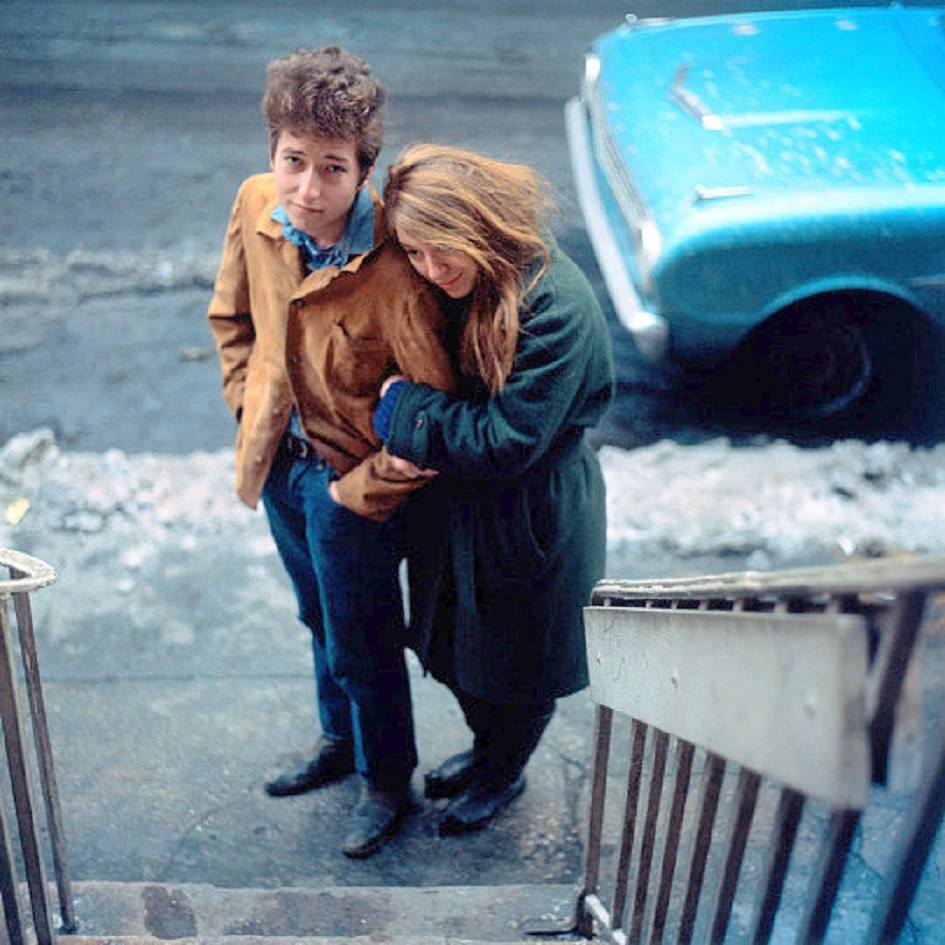
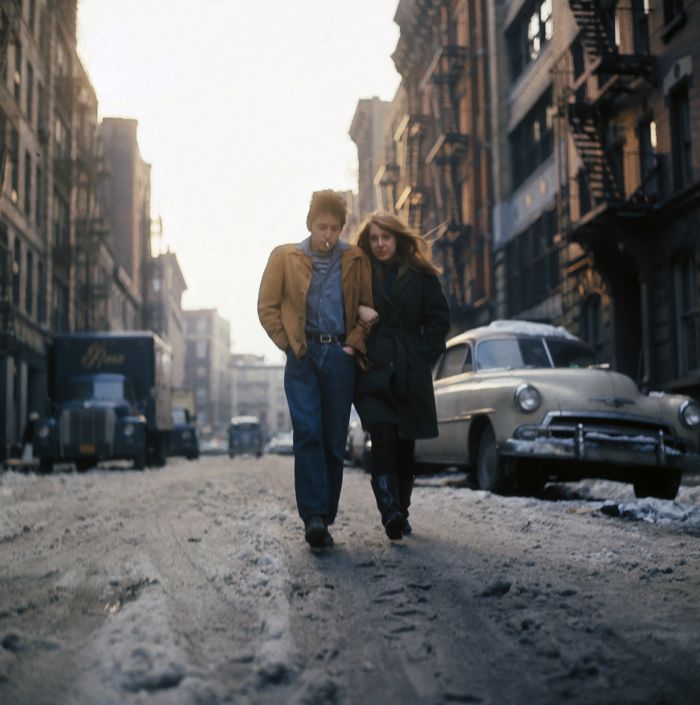
However while for the eponymous album Don Hunstein used a photo studio, this time he decided to try a different location. “I met Bob at his apartment”, he recalled, “which was a third floor walk-up on West 4th Street in Greenwich Village.”

The young folksinger had moved into his first rented apartment in mid-December, 1961, shortly after recording his first album for Columbia.

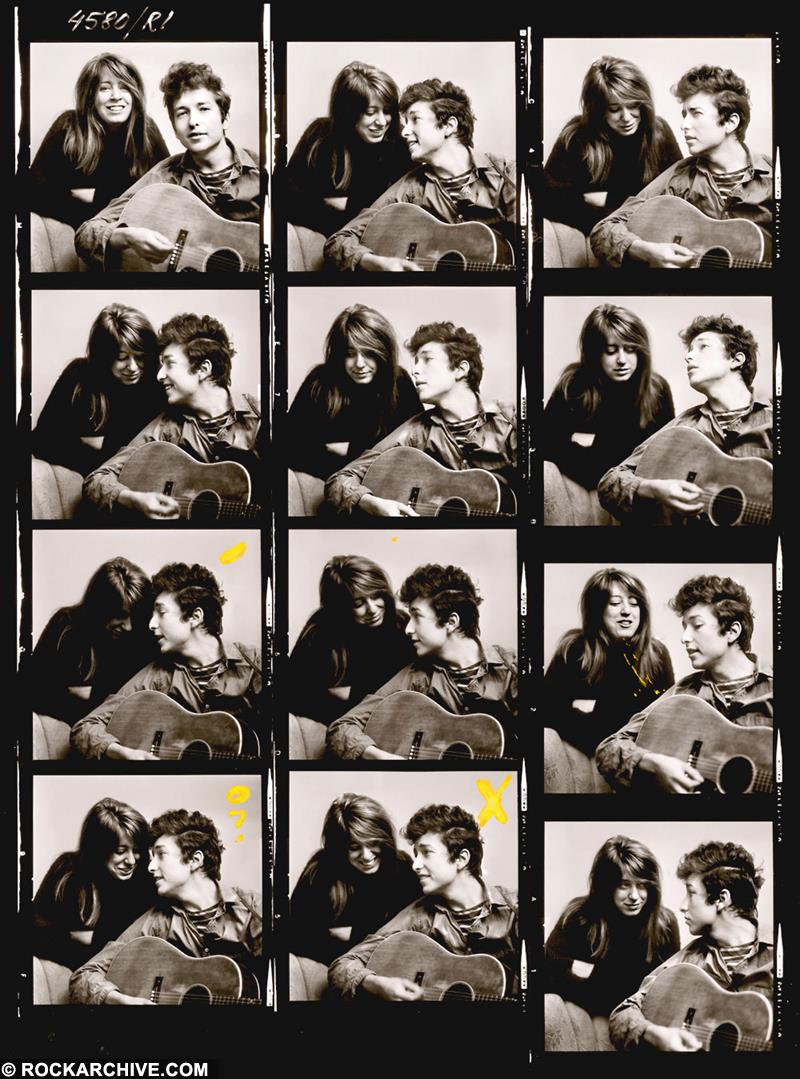
Hunstein snapped away while Dylan smoked cigarettes, played his guitar on his bed, and tried on a number of different hats.

In some of the pictures, Dylan can be seen with his girlfriend, Suze Rotolo. A few weeks before the photo shoot, she had returned from Italy and had moved in with him.

In 2008 she told Terry Gross for NPR (National Public Radio) that it wasn’t planned that she would appear in the shoot: “It was all very casual, and the apartment was very small, and the photographer came and the publicity guy from Columbia came.

So then they started – figured they’d start taking some pictures in the apartment of Bob sitting around, pick up your guitar, put it down, sing something. And then he said – Don Hunstein said to me, get in some of the pictures. So I did. And he took more pictures.

“And then he said let’s go outside and walk.”


It is February 1963. A New York cold winter day. “It was freezing outside”, recalled Suze, “I had on a couple of sweaters. The last one was his, a big bulky knit sweater because the apartment was cold and I threw on a coat on top. So I always look at that picture as I feel like an Italian sausage because I had so many layers on, and he was freezing and I was freezing and had more clothes on. It was very cold that day.”

She adds: “In some out-takes it’s obvious that we were freezing; certainly Bob was, in that thin jacket. But image was all.”

“It was winter, dirty snow on the ground…”, the photographer told The New York Times in 1997, “Well, I can’t tell you why I did it, but I said, Just walk up and down the street. There wasn’t very much thought to it. It was late afternoon — you can tell that the sun was low behind them. It must have been pretty uncomfortable, out there in the slush.”

Hunstein had to work fast. “[T]he light was fading so quickly that I was able to shoot only one color roll and a few black and whites. We were lucky to get what got we got,” he concluded.

The sleeve

From the pile of photos, Dylan chose one with a strong resemblance with an iconic portrait of his idol James Dean, made by Dennis Stock in 1954. The star right in the center, with the perspective lines of the cars and the buildings that meet somewhere far away behind him.

It is a beautiful photo: a moment frozen in time. A fresh-faced Dylan, freezing in the icy weather, has his hands thrust deep into his pockets, while Suze Rotolo hangs on his arm. You can almost hear the snow crackle under the feet of the loving couple, together forever in Manhattan in the early sixties.

It is an iconic cover, much imitated and parodied. “It is one of those milestones that influenced the appearance of other album covers, precisely because of the nonchalance and spontaneity,” Suze wrote in her memoirs. A bit mysterious too. “Most album covers were carefully staged and controlled, to terrific effect on the Blue Note jazz album covers… and to not-so great-effect on the perfectly posed and clean-cut pop and folk albums.”

But it’s more than a beautiful picture: “Maybe no one would ever have understood what those songs were about if the cover hadn’t been around it”, Suze said. “You know, the story is in the songs. Every song he ever wrote about me. It’s all in there. ”

Dee Anne Schroeder, who had been married to Don Hunstein for more than 50 years, looked back in 2007: “An awful lot of people know that picture and didn’t connect it with Don’s name. I think that the album cover does give him credit…but people never paid much attention to album cover photos (or)…the photographers.

“That still remains one of the most popular pictures and a lot of people want it. A lot of people write the story, what that picture means to them. They say, yes, it brings back part of their youth. Even young people today, they look back, it says to them: here are these young people walking…in the middle of a harsh environment. It has become a kind of symbol of youth starting off in a harsh environment, but with hope for the future.”

John Berg didn’t have to add much: the title in green and the name of the singer in red, plus the logo in the upper left corner and the songs titles in black listed on both sides of the young couple.

There’s no black and white portrait on the back. Only liner notes. These are by The Village Voice columnist Nat Hentoff. In June 1963, a larger part of the conversations he had with Dylan, was published in Playboy  (for those who bought the magazine for the articles) as “Folk, Folkum and the New Citybilly”.

Some interesting titbits:

The Freewheelin’ Bob Dylan was rejected as the title of his debut album.

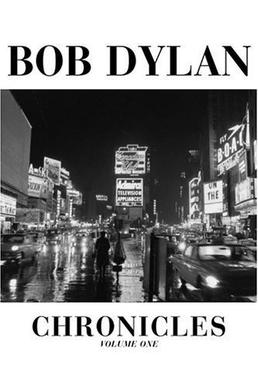
In France The Freewheelin’ Bob Dylan appeared as En roue libre.  When discussing the cover of his book Chronicles, Vol. One (Simon and Schuster, October 2004), Dylan wanted a photo of New York as it looked when he arrived. A photograph of Times Square, from 1961 was chosen from New York City 1960’s (Spring Books 1962).

The photographer?

Don Hunstein

Previously in this series…

The untold story of the artwork on Bob Dylan’s Greatest Hits

The Sleeve Art of Bob Dylan’s album: “Bob Dylan”

The Sleeve Art of Bob Dylan’s Album: Slow Train Coming


Posted in Uncategorized | Leave a comment

Why does Dylan like “Boogie Woogie Country Girl”

By Aaron Galbraith and Tony Attwood

In the last article in this series we looked at “Red Cadillac and a Black Moustache” – a song neither of us knew before we started the research.

Now here is another rather obscure song “Boogie Woogie Country Girl” although in its time it was (like Red Cadillac) far from being obscure.  Dylan recorded it in 1995.

This song was recorded for the Doc Pumus tribute album “Til The Night Is Gone” and album that not only has Dylan on it but also John Hiatt, BB King, Dion, Rosanne Cash, and  Dr. John – and many others.

The piece was written by Doc Pomus and Reginald Ashby and was first recorded and released by Joe Turner and Orchestra.  I’ll take a look at Joe Turner first, and then come back to Doc Pomus.

Here are the lyrics

She wears loafer shoes, a dungaree
Red jacket shirt if you please
My boogie woogie, boogie woogie, boogie woogie country girl
Well, I mean what I mean, my boogie woogie country girl
Now she digs that music with a beat
Rock ‘n’ rollin’ is her need
My boogie woogie, boogie woogie, boogie woogie country girl
Well, I mean what I mean, my boogie woogie country girl
On Saturday night she comes to town
She plays the jukebox, let her hair hung down
My boogie woogie, boogie woogie, boogie woogie country girl
Well, I mean what I mean, my boogie woogie country girl
Let ’em roll
She digs some cherries, she can milk a cow
Don’t like squares, though daddy taught her how
My boogie woogie, boogie woogie, boogie woogie country girl
Well, I mean what I mean, my boogie woogie country girl
Turner was born May 18, 1911 and began performing in the clubs from an early age particularly becoming associated with the boogie woogie pianists of the era.

By the 1940s he was well established, playing alongside Dizzy Gillespie while making records and performing with the likes of Art Tatum, Count Basie etc.  As such he was part of the movement that joined the blues, jump, rhythm and blues and rock n roll into an ever evolving musical form.

“Boogie Woogie Country Girl” came out of this era and like many of the songs at the time included risqué lyrics that led to radio stations banning the songs – which only added to their appeal.

He was also one of the first to record “Shake Rattle andRoll,” a sanitised version of which was a hit for Bill Haley and he recorded Coorrine Corrina.

https://youtu.be/KFCXd9NanLY

A song which of course Bob Dylan sang in a very different way – and I (Tony) want to sneak this in here as I just love this performance.

https://youtu.be/eZokHtbfnig

In 1966 Turner worked with Bill Haley’s band, The Comets, and from here on he returned to jazz and blues performances on occasion with Count Basie and he carried on performing in the 1980s at major jazz festivals.  He died in November 1985 aged 74.

In selecting a song by this legend Bob is seeking to remind us of the heritage that there is in jazz and blues, which should not be forgotten.  Besides it is a lively fun piece of music, which can still be enjoyed today as much as when it was written.

So, back to Doc Pomus the songwriter – who actually began working as a blues singer but by the 1950s he was writing songs for many of the notable recording artists of the day including Lavern Baker and Ray Charles.

His breakthrough came with the song Young Blood recorded by the Coasters.  After that he worked as a lyricist with the composer Mort Shumann writing such songs as  “A Teenager in Love”, “Save The Last Dance For Me”, “Sweets For My Sweet” , “Little Sister”, and           “(Marie’s the Name) His Latest Flame”.  Indeed the songs he worked on reads like a directory of the classics of the era: “Lonely Avenue”, “Viva Las Vegas”, “Can’t Get Used to Losing You”, and “A Mess of Blues”.

Thus it is not too hard to understand Dylan’s interest in one of the great songwriter’s songs – and being Dylan it is not too hard to understand why he chose one of the lesser known songs from the catalogue.

There is an index to the “Why Does Dylan Like” series here..

Posted in Uncategorized | 1 Comment

Bob Dylan And Francisco Petrarch (Part II)

By Larry Fyffe

It’s all about the unrequited love for Laura:

It was on that day when the sun's rays
Was darkened in pity for its Maker
That I was captured, and did not defend myself
Because your lovely eyes had bound me, Lady
It did not seem to me to be a time to guard myself
Against Love's blows, so I went on
Confident and unsuspecting; from that my troubles
Started, amongst the public sorrows
Love discovered me all weaponless
And opened the way to the heart though the eyes
Which are made the passageways and doors of tears
So that it seemed to me it does him little honour
To wound me with his bow in that state
He not showing his bow at all to you who are armed

(Franciso Petrarch: It Was On That Day)

Disorder in form and content be the order of the day as far as the creators of Postmodern art are concerned, but innovation, the hallmark of a true artist, that is taken too far afield will catch the attention of only a few members of the public, if that. Traditional art, whether considered ‘high or ‘low’, that retains its appeal in the public domain is a sign of worthiness.

In literature, the fourteen-line Petrarchan sonnet (it usually comments on love), has endured. In the song by Bob Dylan, below, the prosodic structure of the Petrarchan sonnet can be detected even when somewhat concealed within the written lyrics of the song, and the traditional positioning of the octave and the sestet is inverted.

The sestet:

In death you face life 
With a child and a wife 
Who sleep-walks through your dreams into walls 
You're a soldier of mercy 
You're cold, and you curse, "He 
Who no cannot be trusted must fall"

The octave:

Loneliness 
Tenderness 
High society 
Notoriety 
You fight for the throne 
And you travel alone 
Unknown as you slowly sink 
And there's no time to think

(Bob Dylan: No Time To Think)

In the following song, Dylan pays tribute to the traditional form of the sonnet – its name derived from Francisco Petrarch, a poet from the fourteenth century; the eight-line octave presents an event or a problem to the reader or the listener; the six-line sestet comments on the event or solves the problem.

The octave:

Early one mornin', the sun was shinin'
I was laying in bed
Wonderin' if she'd changed at all
If her head was still red
Her folks they said our lives together
Sure was gonna be rough
They never did like mama's homemade dress
Papa's bankbook wasn't big enough

The sestet:

And I was standin' on the side of the road
Rain fallin' on my shoes
Heading out for the East Coast
Lord knows I've paid some dues
Gettin' through
Tangled up in blue

(Bob Dylan: Tangled Up In Blue)

The Bard pokes a bit of fun at the use of Petrarchan love conceits:

My mistress eyes are nothing like the sun
Coral is far more red than her lips' red
If snow be white, why then her breasts are dun
If hairs be wires, black wire grows on her head

(William Shakespeare: Sonnet CXXX)

And so does Bob Dylan:

Well the woman I love, she got a hook in her nose
Her eyebrows meet, she wears second-hand clothes
She speaks with a stutter, and walks with a hop
I don't know why I love her, but I just can't stop

(Bob Dylan: The Ugliest Girl In The World ~ Dylan/Hunter)

‘Tangled Up In Blue’ continues in a series of the sonnets:

She lit the burner on the stove
And offered me a pipe
"I thought you'd never say 'hello', she said
"You look like the silent type"
Then she opened up a book of poems
And handed it to me
Written by an Italian poet 
From the thirteenth century
And every one of those words rang true
And glowed like burnin' coal
Pourin' off of every page
Like it was written on my soul
From me to you 
Tangled up in blue

(Bob Dylan: Tangled Up In Blue)

What else is here?

An index to our latest posts arranged by themes and subjects on the home page.  You can also see details of our main sections on this site at the top of this page under the picture.

There is an alphabetic index to the 550+ Dylan compositions reviewed on the site which you will find it here.  There are also 500+ other articles on different issues relating to Dylan.  The other subject areas are also shown at the top under the picture.

We also have a discussion group “Untold Dylan” on Facebook which mostly relates to Bob Dylan today.  Just type the phrase “Untold Dylan” in, on your Facebook page or follow this link 

And please do note   The Bob Dylan Project, which lists every Dylan song in alphabetical order, and has links to licensed recordings and performances by Dylan and by other artists, is starting to link back to our reviews.
Posted in Uncategorized | Leave a comment

Wild Wolf: lyrics bemusing, darkness, nothing, darkness

by Jochen Markhorst

In the beginning of his Nobel Prize Speech, after qualifying Buddy Holly and Leadbelly’s “Cottonfields” as his personal sunrise (“the dawning of it all”), Dylan refers to a list of songs that taught him the “lingo”, the songs to which he owes the vocabulary to write his own songs:

“You know that Stagger Lee was a bad man and that Frankie was a good girl. You know that Washington is a bourgeois town and you’ve heard the deep-pitched voice of John the Revelator and you saw the Titanic sink in a boggy creek. And you’re pals with the wild Irish rover and the wild colonial boy. You heard the muffled drums and the fifes that played lowly. You’ve seen the lusty Lord Donald stick a knife in his wife, and a lot of your comrades have been wrapped in white linen.”

Milestones from European and American folk history. Some of them have been publicly honoured by Dylan before. “Stagger Lee” and “Frankie And Albert”, “One Irish Rover”, “Streets Of Laredo” (where the drums sound muffled and fifes play lowly, and the corpses of the comrades are wrapped in white linen) and “Mattie Groves” (in which Lord Donald stabs his wife); these are songs Dylan has recorded, songs he also mentions in Chronicles or are on his set list.

What is new is that Leadbelly’s “The Bourgeois Blues” apparently also belongs on that pedestal. We do hear an echo from “Wild Colonial Boy” in “John Wesley Harding” (he was never known to hurt an honest man), but the song is never mentioned by Dylan before, and that absurdist Titanic sink in a boggy creek is probably a reference to two Woody Guthrie songs, his “When That Great Ship Went Down” and “Buffalo Skinners”.

That leaves “John The Revelator”. From the legendary Blind Willie Johnson, along with “Motherless Children”, “Dark Was The Night” and “Nobody’s Fault But Mine” one of Blind Willie’s indestructible pillars on which the half blues catalogue rests.

For his debut album Dylan has already recorded “In My Time Of Dyin’”, there are arguments to suggest that his ode “Blind Willie McTell” is “actually” about the blind Johnson (but just as many counter-arguments) and a spicy edge has Dylan’s unveiling in the September 2001 Time interview, speaking publicly about Carolyn Dennis for the first time:

“She is a fantastic singer. She’s a gospel singer mainly. One of her uncles was Blind Willie Johnson. What more do you need to know about somebody?”

Dylan is the father of Carolyn’s daughter Desiree, so that would imply he is an in-law family member of the blues monument. If it were true. For now, the only source of that alleged Carolyn Dennis / Blind Willie Johnson family relationship is Dylan himself – and, as we know, that source is not too reliable.

His worship for “John The Revelator”, and Blind Willie Johnson at all, is reliable, though. Dylan borrows a text excerpt for “Tryin’ Get To Heaven” (Now you can seal up the book and not write anymore), performs Johnson songs throughout his career and plays “John The Revelator” in Theme Time Radio Hour (in episode 19, The Bible, the episode in which he reveals more sources of his own songs). And, indeed, he does explicitly qualify the song as one of his major signposts in his Nobel Prize Speech.

Besides “folk lingo”, Johnson’s songs teach him the ominous, gloomy undertones with Biblical imagery Dylan demonstrates in songs such as “I’m Not There”, “Señor”, “Cold Irons Bound” and especially in the darkest and most brooding of them all: “Wild Wolf”.

“Wild Wolf” is the most mythical Basement song. Unknown for a long time, except for the title. For unspecified reasons, copyright was secured in 1973, so the entire Dylan community knew about the existence of the song, but nothing more. Marcus Greil does not mention the song in his canonization Invisible Republic, it is not on the five CDs of the Genuine Basement Tapes, nor on the triple album called the ‘raw’ edition in 2014 and can only be found on the 6-CD box set The Bootleg Series 11: The Complete Basement Tapes. And still only the second take; Sid Griffin also seems to have knowledge of a first take, which he compares in the second edition of his wonderful book Million Dollar Bash (2014) with the second take. He does not report any major differences; the first take lasts one second longer and Richard Manuel plays drums (instead of the piano).

Neither does Griffin shed extra light on the song’s lyrics, so we have to make do with those few intelligible shreds of the second take – which by the way are not unambiguous either; a dozen transcription attempts are circulating on the fan sites and the discussion forums, differing considerably. The opening line, for example, is noted by most decipherers as Now the ruins are barely rolling, but the French Dylanologist Daniel Martin understands Now the doors are barely rowing.

More disagreement there is about the verse in which the Pharaoh is mentioned:

Just like Pharaoh and his armies
They made of solid bread

… is the incomprehensible, most common variant. Some think …made of solid breath a little less insane, but the variant …made of solid wrath comes closest to a coherent, traceable metaphor.

The title and the prevailing sense of lost and lonely desolation perhaps leads an industrious ploughman to the work of Jack London, whose reflections do shine in Dylan’s oeuvre, occasionally. But London has never written about a Pharaoh. He did about the card game faro, but that is a dead end.

On about forty of the more than 140 words there is agreement. Everyone hears now that the holy book is written, both fragments with ‘wolf‘ (that old bad wolf’s gonna howl and the last line, yet the wild wolf he’s…) are generally recognized, as well as the fourth line but nobody feels very sorry for me if I lost everything.

There is also consensus about the importance of exact transcription: that importance is not very great. “Wild Wolf”’s lurid, apocalyptic power is not jeopardized, on the contrary perhaps; the half-intelligible, semi-comprehensible verse fragment do convey some sense of menace as well.

This atmosphere is mainly evoked by Dylan’s speech, the key (everything in minor), the hypnotic marche funèbre rhythm and the atypical, soloistic bass play by Rick Danko, who relentlessly seems to be trying to push the song in a different direction.

Those few intelligible text fragments also do point to the Apocalypse. On one other occasion, Dylan has staged wild wolves as signifiers, in his desolate vision “A Hard Rain’s A-Gonna Fall”.

A Pharaoh’s army comes along in two other places in his oeuvre, in “When The Ship Comes In” and in “Cover Down, Break Through”. Both times the army perishes. In “When The Ship Comes In” with the same cause of death as in the gospel classic “O Mary Don’t You Weep”: Pharaoh’s army got drowned and in “Cover Down” the army is only minutes away from that catastrophe (trampling through the mud).

In the gospel and folk classics, Pharaoh’s army is almost exclusively mentioned in conjunction with Exodus 14, the Bible chapter in which the Pharaoh sends his troops after Moses, into the Red Sea and into death by drowning. Whatever the precise context here may be, it is likely that Dylan uses it, or rather: sees it as a metaphor for impending destruction.

(By the way: Pharaoh seems to be the only word that causes spelling problems in the official publications. Both on the official site and in the consecutive editions of Lyrics, it is consistently misspelled as Pharoah. In Writings & Drawings it is spelled correctly.)

The army of the pharaoh, ruins, wild wolves, the atmosphere of “A Hard Rain’s A-Gonna Fall” … ill-boding darkness and Biblical imagery it is. The spirit of John of Patmos, John The Revelator, the writer of Revelation, the prophet of the Apocalypse, hovers around again. And what does it mean? On this, the poet also sheds some light in that overwhelming Nobel Prize speech:

“[It] can mean a lot of different things. If a song moves you, that’s all that’s important. I don’t have to know what a song means. I’ve written all kinds of things into my songs. And I’m not going to worry about it – what it all means. (…) I don’t know what it means, either. But it sounds good. And you want your songs to sound good.”

… with which Dylan is completely in line with another American Nobel Prize winner, with Ernest Hemingway, tired of all those questions about the deeper meaning of The Old Man And The Sea, the work that earned him the Nobel Prize:

“There isn’t any symbolism. The sea is the sea. The old man is the old man. The boy is a boy and the fish is a fish. The sharks are sharks, no better, no worse. All the symbolism that people say is shit. What goes beyond is what you see beyond when you know.”

(from a letter to critic Bernard Berenson, September 13, 1952)

Despite all beauty, “Wild Wolf” is yet another song that lands on the basement floor and is never picked up again. Not by colleagues either, by the way. Although the song has been public since 2014, no cover has yet been released.

The song is frightening on more fronts, apparently.

What else is on the site

You’ll find an index to our latest posts arranged by themes and subjects on the home page.  You can also see details of our main sections on this site at the top of this page under the picture.

The index to the 500+ Dylan compositions reviewed is now on a new page of its own.  You will find it here.  It contains reviews of every Dylan composition that we can find a recording of – if you know of anything we have missed please do write in.

We also have a discussion group “Untold Dylan” on Facebook.  Just type the phrase “Untold Dylan” in, on your Facebook page or follow this link 

And please do note   The Bob Dylan Project, which lists every Dylan song in alphabetical order, and has links to licensed recordings and performances by Dylan and by other artists, is starting to link back to our reviews.
 

Posted in Uncategorized | 5 Comments

Dylan re-imagined: Subterraenean, I believe in you, Tweedle Dee

Performances selected by Paul Hobson, commentary by Tony Attwood

This series takes live performances of Bob Dylan, in which he has re-worked three of his songs to give them a new direction or new meaning, or simply a new sound or feel.

Unfortunately in this case all the songs that Paul chose have now been deleted from the the internet.  I’ve left the article here waiting for a chance to go back and find new recordings.

—————————-

This time we start with Subterranean Homesick Blues from 2002 complete with what seems to be a false start, and judging by the looks and grins I think Bob has decided to change it there and then on stage.

https://www.youtube.com/watch?v=xki9gw4Hh_U

It is one of those recordings of a song we know so well that anything done to it is going to be a bit of a surprise, but here Bob and the band are just taking us along a different path to the same end result, rather than giving us a totally new journey.

We also have Bob playing lead guitar and quite a decent lead guitar it is too.   And maybe all that bit at the start was deliberate for the guys certainly have learned the new ending.  A great rollicking bit of fun in my estimation.

Second today, I Believe In You from 1995

https://www.youtube.com/watch?v=cEN0zdAyTwM

There’s no mistaking this song from its introduction, no matter what Bob has decided to do to the arrangement.

For me though there is a disappointment.  I always feel that the great highlight of this lovely song is the second section, “I believe in you even through the tears and laughter” and here, for me, the rearrangement doesn’t work.   Listening to the album version I can still get goose pimples at

Oh, when the dawn is nearing
Oh, when the night is disappearing
Oh, this feeling is still here in my heart

But probably that is just my problem – I like the original so much that any messing with the version I love tends to be inferior.  But for sure, not everyone agrees with me.  It is well worth a listen.

However this feeling of disappointment is certainly not true with the version of Tweedle dee & Tweedle dum from the 1990s selected as the final song of this section.  There was a time when Dylan always started the shows with this song, and that is understandable; all bands need something established and well rehearsed to get the band and the audience going.  But it got to be a bit of a drag in the end.

But this one goes further.  A lot further.  Even if you a firm believer that this song isn’t up to much I do hope you will stay with this recording.

And if you are still just not convinced by the song at all, you might care to have a look at Jochen’s review of it on this site – both to give an understanding of what it is all about, and to hear Francesco de Gregori‘s version.  Tweedle in Italian.

However for now here is Bob doing something new with the song.

https://www.youtube.com/watch?v=lBEDHaa6_yg

There is an index to some of the articles in this series here.

What else is here?

An index to our latest posts arranged by themes and subjects on the home page.  You can also see details of our main sections on this site at the top of this page under the picture.

There is an alphabetic index to the 550+ Dylan compositions reviewed on the site which you will find it here.  There are also 500+ other articles on different issues relating to Dylan.  The other subject areas are also shown at the top under the picture.

We also have a discussion group “Untold Dylan” on Facebook which mostly relates to Bob Dylan today.  Just type the phrase “Untold Dylan” in, on your Facebook page or follow this link 

And please do note   The Bob Dylan Project, which lists every Dylan song in alphabetical order, and has links to licensed recordings and performances by Dylan and by other artists, is starting to link back to our reviews.
Posted in Uncategorized | Leave a comment

Bob Dylan And Plutarch

By Larry Fyffe

Bob Dylan modernizes and mingles the style and content  of the writings of Plutarch:

I'll strip you of life, strip you of breath
Ship you down to the house of death
One day you will ask for me
There'll be no one else you'll want to see
Bring down my my fiddle, tune up my strings
Gonna break it wide open like the early Roman Kings

(Bob Dylan: Early Roman Kings)

Lucius Plutarch be a priest in the temple of Apollo where the sun-god is worshipped. Singer/songwriter Bob Dylan alludes to the mythological master musician of the golden lyre in a line from another of his songs – Jupiter is the Roman name for Zeus, the chief Greek god, the slinger of lightning bolts, and the father of Apollo:

She was torn between Jupiter and Apollo

(Bob Dylan: Changing Of The Guards)

Plutarch (Greek inhabitant of the early Roman Empire), writes biographies that focus on the character and morals of historical Roman figures. A Platonist, Lucius believes a universal spiritual domain exists above and beyond the corrupt material world of appearances.

According to Plutarch, general Mark Anthony gives a speech at his commander’s funeral in which his initial praise for the actions of Caesar’s back-stabbers turns into a condemnation of them:

As Caesar’s body is being carried to the tomb, Anthony begins to mingle with his praise, language expressing pity for the victim and horror at what has happened to the Roman ruler; he takes the under-clothes of the dead man, holds them up, showing the stains of blood and holes of the many swords, calling those that did this bloody deed villains and bloody murderers

(Plutarch: The Life Of Anthony ~ translated and summarized)

Following the thrust of Plutarch’s depiction of the general’s oration, the Bard of Elizabethan times has Anthony employ the following words in the introduction of the funeral speech:

Friend, Romans, countrymen, lend me your ears
I come to bury Caesar, not to praise him
The evil that men do lives after them
The good is often interred with their bones
So let it be with Caesar

(Shakespeare: Julius Caesar, Act III, sc.ii)

Likewise, Bob Dylan presents a character who takes out his rage rhetorically on those he considers  self-righteous hypocrites; it’s their blood that’s going to get spilled, not the blood of the narrator – the songwriter cuts the hypocrites into pieces with his words:

This is how I spend my day
I come to bury, not to praise
I'll drink my fill, and sleep alone
I pay in blood, but not my own

(Bob Dylan: Pay In Blood)

Those who have crossed the singer’s persona are going to get a good swift kick in the nuts:

I'll give you justice, I'll fatten your purse
Show me your moral virtues first
Hear me holler, hear me moan
I pay in blood, but not my own

(Bob Dylan: Pay In Blood)

Biographically speaking, Dylan seems to be lashing out at those who take advantage of his talent and ambition in order to advance their own vested interests; for example, members of political protest movements; of religious evangelical organizations.

And Dylan sends out a Plutarchian warning to any female he desires to have as a lover and a muse – don’t mess with Apollo:

Alberta, don't you treat me unkind
Oh my heart is so sad
'Cause I want you so bad
Alberta, don't you treat me unkind ...

Alberta, let your hair hang low
I'll give you more gold
Than your apron can hold
If you'll only let you hair hang low

(Bob Dylan: Alberta)

Mess around, and the golden boy is likely to turn into his father, the god of thunder:

Idiot wind, blowing every time you move your teeth
You're an idiot, babe
It's a wonder that you still know how to breathe

(Bob Dylan: Idiot Wind)

What else is on the site

You’ll find an index to our latest posts arranged by themes and subjects on the home page.  You can also see details of our main sections on this site at the top of this page under the picture.

The index to the 500+ Dylan compositions reviewed is now on a new page of its own.  You will find it here.  It contains reviews of every Dylan composition that we can find a recording of – if you know of anything we have missed please do write in.

We also have a discussion group “Untold Dylan” on Facebook.  Just type the phrase “Untold Dylan” in, on your Facebook page or follow this link 

And please do note   The Bob Dylan Project, which lists every Dylan song in alphabetical order, and has links to licensed recordings and performances by Dylan and by other artists, is starting to link back to our reviews.


Posted in Uncategorized | Leave a comment

Dylan’s 4th time around (or maybe back and forth)

by Jochen Markhorst

The Fleet Foxes, a most charming band from Seattle, has been playing in the Premier League since 2008. Pillars are craftsmanship, catchy melodies and especially music historical awareness: the comparisons with the Beach Boys, Van Morrisson and Crosby, Stills & Nash all make sense.

A crown on the love for homage appears in 2011; on the second album Helplessness Blues is “Lorelai”, a wonderful rip-off from Dylan’s “4th Time Around”. This places the Foxes in a beautiful tradition. Just as Dylan himself does so often, they reuse an existing melody (with small shifts) and that is especially fitting for this song: “4th Time Around” is already a recycled homage to an earlier song: to “Norwegian Wood” by The Beatles – again Lennon’s attempt to write a Dylan song. “Everything’s stolen or borrowed,” are the appropriate closing words of “Lorelai”.

There has been some fuss about this Beatles connection, over the years. Dylan lays a template on Lennon’s “Norwegian Wood”, that is the general agreement by now. Still, the question remains as to what motives Dylan has. Is it intended as a homage or as a parody? Or, in fact, as a kind of warning? Lennon cannot figure it out either. In ’65 the band members often tease him with his Dylan fascination and in his more paranoid moments he thinks Dylan is now cynically reproving him (particulary the closing lines about some personal crutch which the you is not supposed to use, indicating: “don’t try to copy me,” as one might understand), in other interviews he sees it as a friendly nod. Anyway: Lennon will never wear his Dylan cap again, after “4th Time Around”.

Nevertheless, even after songs like “I’m A Loser”, songs that Lennon acknowledges being influenced by Dylan, the bard from Hibbing remains a regular guest.

The reference in “Yer Blues” of course (feel so suicidal, just like Dylan’s Mr. Jones) and in “God” (I don’t believe in Zimmerman). And, even more viciously, in “Serve Yourself”, Lennon’s villainous 1980 parody of “Gotta Serve Somebody”. Sharp and witty, and heartfelt too: on his diary tape of 5 September 1979, his biting “Gotta Serve Somebody … guess he wants to be a waiter now” can be heard – a sneer he unfortunately does not incorporate in his musical answer song.

To McCartney the relationship with Dylan is less sensitive. His winks and reverences are far from conflict-seeking. “Rocky Raccoon” from 1968 (White Album) is perhaps the most sympathetic example. McCartney writes the song in India, according to legend on the roof of the ashram, “with some help” from Lennon and Donovan.

With John Wesley Harding, Dylan has recently put the axe to the psychedelic hippie trend and McCartney conceives the song as a narrative cowboy ballad à la “The Ballad Of Frankie Lee And Judas Priest”. A parody or a copy the song is by no means; it is above all a McCartney song – expertly arranged, descending bass riff, catchy chorus, meandering melody lines.

The Dylan winks are subtle and almost exclusively lyrical. Especially in the irresistible take 8 (on Anthology 3, 1996), in which Rocky is not from Dakota, but:

Rocky Raccoon, he was a fool unto himself
And he would not swallow his foolish pride
Mind you, coming from a little town in Minnesota
It was not the kind of thing that a young guy did
When a fella went and stole his chick away from him

On reflection Macca probably thinks this little town in Minnesota may be a bit overstating, so for the final version he changes it again, this time nodding at the Doris Day song from Calamity Jane (1953): “The Black Hills Of Dakota”. In addition, in this version, Rocky, like Frankie Lee, suffers from foolish pride, the worst of the Seven Deadly Sins. Literally the same words, so Sir Paul scraps those too.

The other references are less flashy, so they may stay. The opponents of Rocky are called Dan and Lil, from which without much literary acumen Dylan can be distilled, Rocky picks up the Bible (twice), just like Dylan does for John Wesley Harding, and with some creative reading into it, there are more subtle hints – the ambiguous, Dylanesque open end, in particular.

Musically, the – tasteful – harmonica stands out. Lennon, presumably, and it is the last time he plays harmonica on a Beatles record.

Parody, homage, ping-pong game with The Beatles or whatever: Dylan takes “4th Time Around” very seriously. It is the first song to be recorded in Nashville, at the restart for Blonde On Blonde on February 14, Valentine’s Day, and he tackles it no fewer than twenty times in succession. The twentieth then is the final take (for comparison: the following “Visions Of Johanna” is done in four takes).

The last recording session (without Dylan, on June 16) is also dedicated to “4th Time Around”, but the overdubs (harpsichord and drums) will not be used. By then, producer Bob Johnston probably realizes that he is already there, with the find of contrasting those lovely guitars with the sarcastic lyrics.

The difference with New York is huge. The acoustic guitars of Joe South and Charlie McCoy, which open the very first session in Nashville, have an elegance that degrades the New York sessions to some rumbling in the garage.

Charlie McCoy is one of the most important secret ingredients of Blonde On Blonde anyhow. Dylan knows the gifted multi-instrumentalist thanks to a sly manipulation manoeuvre by producer Bob Johnston, who lures McCoy and his wife to New York in August ’65 with tickets to a Broadway show. Once in New York, Johnson invites him to the studio, where he just so happens to be working on Dylan’s “Desolation Row”. An acoustic guitar is pushed into McCoy’s hands and he plays the Spanish ornaments that will elevate the monument from a five-star song to a hors category work. Dylan is sold and McCoy later understands that he was a pawn in Johnston’s game:

“Bob Johnston said, ‘You know, I was using you as bait. I wanted Dylan to come to Nashville and he didn’t want to.’ So I was bait and it worked.”

(The Independent, June 24, 2015)

Indeed; when Johnston, half a year later, during those arduous, fruitless recording sessions for Blonde On Blonde in New York proposes to move to Nashville, to Charlie McCoy and his Nashville Cats, Dylan has already overcome his prejudices about those hillbillies with all their songs about slut wives cheating, and he happily agrees.

Lyrically, “4th Time Around” is more ‘ordinary’ than most texts on Blonde On Blonde. Just like in “Visions”, the protagonist confesses to messing around with two women here, but the comparison also ends there. This is nearly a real story; a linear, epic text, almost without inscrutable, symbolic imagery. Bitterly bickering, a man leaves a somewhat hysterical female person and returns to a loving, forgiving lady. The dialogue is briefly, just here and there, somewhat surreal, a dark, symbol-charged image sometimes squeezes itself in, but all in all: a beginning and an end.

“That picture of you in your wheelchair,” for example, is an image puzzling the interpreters – but after the reference to Duchamp’s Mona Lisa in “Visions Of Johanna” (the one with the moustache) this seems like just another, meaningless, joke: presumably Dylan has not only seen the moustachioed Mona Lisa but also the picture of Duchamp and his wheelchair.

However, the lyrics are predominantly remarkably transparent. Well, relatively anyway. Decorated with classical poetic figures of speech, even. She threw me out is neatly placed across You took me in, we hear rhyme and alliteration and repetition, and even encounter an old-fashioned enjambment (That leaned up against / / Her Jamaican rum), all of which is contributing to the contrast effect of this song; the sardonic buffoon wraps his scorn in classical poetry and supports it with an elegant, fizzy melody.

The few artists who risk an interpretation usually stay close to the original. The waltz rhythm, the baroque guitar part – apparently it is difficult to improve.

The most famous cover is certainly beautiful; Yo La Tengo is modest, sultry and hypnotic on the I’m Not There soundtrack (2007). The men from Calexico, the Tex-Mex specialists from Arizona, opt for a dragging slide and a melancholic accordion and suddenly give the song a grieving, lost-love dimension.

The young deceased Texan Chris Whitley, the outstanding guitarist who can sneer ghastly with his unique, hoarse voice, produces a cutting-edge version on a live recording from 2003 (On Air, 2008). His studio recording, on Perfect Day (2000) is superb, too (though his “Changing Of The Guards”, with Jeff Lang on 2007’s Dislocation Blues remains his unsurpassed masterpiece).

Almost-the-most-beautiful cover is the contribution to Amnesty International’s birthday project, Chimes Of Freedom (2012) by the Israeli world citizen and Jack-of-all-trades Oren Lavie. Lavie replaces “Norwegian Wood” with “Tomorrow Never Knows” and only preserves the vocal melody, actually – and that works perfectly.

The most remarkable and appealing, however, is the adaptation by The Young Relics, also from Texas, on their eponymous EP from 2009. Jumping, neurotic and contagiously energetic, including a pleasantly surprising, completely unexpected change in rhythm; halfway a full organ brutally descends down, calming the nervous guitar, smothering all the unrest, crushing every last splinter of Norwegian wood.


Posted in Uncategorized | 1 Comment

Why does Dylan like – Red Cadillac and a black moustache

By Aaron Galbraith and Tony Attwood

“Red Cadillac and a black moustache” was recorded by Bob Dylan for the “Good Rockin’ Tonight” Sun Records tribute album. Of all the Sun Records songs he picks one neither of us hade ever heard of!  Here’s Bob’s version…

https://youtu.be/hpat4YUfdKg

This album sets out to record the legacy of Sun Records, the label through which Elvis Presley, Carl Perkins, Johnny Cash and Jerry Lee Lewis got their start.

The album was released in November 2002 and disc 1 contained…

  1. That’s All Right – Paul McCartney
  2. Mystery Train – Jeff Beck/Chrissie Hynde
  3. My Bucket’s Got A Hole In It – Jimmy Page/Robert Plant
  4. Blue Suede Shoes – Johnny Hallyday
  5. Whole Lotta Shakin’ Going On – Elton John
  6. Blue Moon Of Kentucky – Tom Petty & The Heartbreakers
  7. Sittin’ On Top Of The World – Van Morrison/Carl Perkins
  8. Don’t Be Cruel – Bryan Ferry
  9. Red Cadillac And A Black Moustache – Bob Dylan
  10. Just Walkin’ In The Rain – Eric Clapton & The Impressions
  11. Lonely Weekend – Matchbox Twenty
  12. Who Will The Next Fool Be? – Sheryl Crow
  13. It Wouldn’t Be The Same Without You – Chris Isaak
  14. I Walk The Line – Live
  15. Drinkin’ Wine Spo-Dee-O-Dee – The Howling Diablos
  16. You Win Again – Mandy Barnett

Aaron made the comment above about track nine, and the same thought hit Tony – we both knew all of these tracks, except this one.

Here is the original version by Bob Luman

Having won a talent contest Luman got a spot of Louisiana Hayride and with his backing band called the Shadows he recorded “All Night Long”  with “Red Cadillac and a Black Mustache” as the B side.  He didn’t release it as a single until 1974.

But it was the Warren Smith version of the song that Dylan featured on his radio show, and it seems that it came out as a recording on Sun.

This version certainly has a Sun feel but it doesn’t look as if it became a hit. Indeed some of the comments made on the site above suggest it wasn’t even released at the time of recording.  Certainly the Wiki page on Smith has no mention of the track as a single.

Bob Dylan seems to have a real love of tracks that sound like this – the beat, the slight echo, the crooner’s voice adjusted to be part country part rock, and of course Bob always likes the obscure, the songs others have not found.

So let’s go back to the start.  Here are the lyrics

Who you been lovin’ since I been gone
A long tall man with a red coat on
Good-for-nothing-baby you’ve been doing me wrong
Who you been lovin’ since I been gone

Who’s been playing around with you
A real cool cat with eyes of blue
Triflin’ baby are you being true
Who’s been fooling around with you

Somebody saw you at the break of day
Dining and a-dancing in the cabaret
He was long and tall, he had plenty of cash
He had a red cadillac and a black moustache
He held your hand and he sang you a song
Who you been lovin’ since I been gone


Here’s the video that was put together for the release of the collection…

https://youtu.be/moiRZBVv7Hs


If you would like to read more, there is an index to some of the articles in this series here.   A catalogue of all the indexes is to be found below the picture at the top of the page.

What else is here?

An index to our latest posts arranged by themes and subjects on the home page.  You can also see details of our main sections on this site at the top of this page under the picture.

There is an alphabetic index to the 550+ Dylan compositions reviewed on the site which you will find it here.  There are also 500+ other articles on different issues relating to Dylan.  The other subject areas are also shown at the top under the picture.

We also have a discussion group “Untold Dylan” on Facebook which mostly relates to Bob Dylan today.  Just type the phrase “Untold Dylan” in, on your Facebook page or follow this link 

And please do note   The Bob Dylan Project, which lists every Dylan song in alphabetical order, and has links to licensed recordings and performances by Dylan and by other artists, is starting to link back to our reviews.
Posted in Uncategorized | 6 Comments

Threepenny Opera Revisted


By Larry Fyffe

As previously noted, singer/songwiter Bob Dylan mixes the religious, albeit amusing, outlook of the TS Eliot-based musical ‘Cats’ with Bertolt Brecht and Kurt Weill’s Marxist-oriented musical ‘The Three Penny Opera’. According to Eliot, though life on Earth be dark, the light of Heaven awaits all souls who pray for God to take pity on them. According to Brecht/Weill, everyone under the capitalist system is forced to worship the Golden Calf, for better or for worse.

The Opera makes the point that the consciousness of individuals is determined by the class system imposed upon them by profit-centred economics; everything becomes a commodity. In the musical play, Polly’s father, a clever entrpreneur, makes money off of ‘pity’, while the mass of the people who are in dire straits admire hoodlums as  heroes.

As in the song below:

John Wesley Harding
Was a friend unto the poor
He travelled with a gun in every hand
All along the countryside
He opened many a door
But he was never known
To hurt an honest man
(Bob Dylan: John Wesley Harding)

Polly’s father is a ruthless Bible-thumping businessman who organizes beggars, and charges them a fee for doing so. Polly falls for and marries the charming, but murderous thief, a bigamist to boot, named Macheath; she looks up to him beause he is not cowardly; even after she discovers that Miss Lucy Brown (the daughter of the ‘on-the-take’ policeman who’s in league with Macheath) is also married to him.

The two women spat, but it’s Lucy who helps Macheath escape from jail; he’s then turned-in for money by prostitute Jenny Diver, another one of Macheath’s girlfriends. With minds held in the vice of its psychology, these individuals have little hope of escaping the negative consequences of the capitalist-imposed ideology of self-interest above all else.

So Brecht/Weill, with a wink and a nudge, give their initially dark story a happy ending:

Now, Jenny Diver, yeah, Sukey Tawdry
Oooh, Miss Lotte Lenya, and ole Lucy Brown
Oh, the line forms on the right, babe
Now that Macky's back in town
(Bobby Darin: Mack The Knife)

The motif of who is really the legitimate wife of Macky is picked up in the following song:

It was known all around that Lily had Jim's ring ....
(Rosemary) was tired of the attention, tired of playing
the role of Big Jim's wife
(Bob Dylan: Lily, Rosemary, And The Jack Of Hearts)

In the song, the Jack Of Hearts is a charming, clever thief like Macheath, perhaps even dangerous like him too; Big Jim takes the place of Polly’s father as a symbol of materialistic greed:

Big Jim was no one's fool, he owned the town's
only diamond mine
(Lily, Rosemary, And The Jack Of Hearts)

Lucy Brown helps Macheath escape from jail in the hope that she might finally have him all to herself. On the other hand, Rosemary takes the blame for stabbing Big Jim in the hope that Lily and the Jack Of Hearts might get together.  After the fashion of some of Charles Dickens’ characters, Rosemary sacrifices herself for the good of others.

Jenny Diver dreams of paying in blood, but it’s not going to be hers:

Your fine philosophy, good sirs, you may proclaim
But till you feed us, right and wrong can wait!
Or is it only those who have money
Can enter in the land of milk and honey?
(Brecht/Weill: The Threepenny Opera, Act ll, sc. iii)

Bob Dylan pays his respects to the musical play, stamping the tribute with what I call the “Dylanesque rhyme twist”~ ‘money’/’honey’; ~’honey’/’money’:

It's undeniable what they'd have you think
It's indescribable, it can drive you to drink
They said it was the land of milk and honey
Now they say it's the land of money
(Bob Dylan: Unbelievable)

The medieval poet (and thief) Francois Villon cheekily proclaims to those in authority, “For if you take pity on wretches like us, the sooner will God have mercy on you”; Polly, referencing Macheath:

And as he was not rich
And he was not nice
And even his Sunday collar was black as a crow
And he didn't know how he should treat a real lady
I couldn't tell him "no"
(Brecht/Weill: The Threepenny Opera, Act I, sc. iii)

Thus speaks Zimmerman, the neoRomantic Modernist singer/songwriter:

Right now, I don't read too good, don't send me
No letters - no
Not unless you mail them from
Desolation Row
(Bob Dylan: Desolation Row)
Posted in Uncategorized | 1 Comment

Dylan’s Talkin’ World War III Blues and the rather silly hurdy gurdy man

by Jochen Markhorst

It is confusing reading, Donovan’s autobiography The Hurdy Gurdy Man from 2005. From the first pages the self-mystifications, selfcongratulating boasting and the clearly pumped up tall hero tales are piling up, whereby the autobiographer increasingly fails to act modesty. However, at about a quarter of the book, when the average reader is about to fire up the stove with it, a change takes place: it is starting to get farcical. We have already witnessed one after the other “cosmic connection” and “kindred spirit” and now Donovan has a first, superficial encounter of a few seconds with Brian Jones of The Rolling Stones. Jones turns around and leaves the room, and “somehow, though I didn’t know how, I sensed that I had just made a karmic connection, made contact with something that would wrench my life around and set it on a course of splendours and miseries.”

After this he shifts gear; Donovan mythologizes and romanticises almost all of his experiences and encounters, turning them into divine interventions or into earth -shattering masterstrokes of a brilliant visionary. The absurdity increases.

Dylan writes good lyrics, but “musically I am the more creative and influential”.

The Beatles should also be grateful. “Two years before the beginning of Flower Power and before The Beatles used the same refrain, I was singing Love, Love, Love.” And they could only write “I’m Looking Through You” because Donovan had shared his experiences with LSD with the boys. He does feel some reserve to let McCartney hear what he himself is doing, because Donovan and his producer know that McCartney leaks the best ideas to The Beatles.

This goes on. Andy Warhol owes the design for the cover of the first Velvet Underground LP (the cover with the banana) to… Donovan. Because in his hit “Mellow Yellow” he sang the words electrical banana.

Apparently, he also conscientiously keeps track of what other artists say about him in interviews, and he loves to pick the cherries (“Jimi Hendrix said I was the nicest person he’d ever met”).

In the spring of 1966, Donovan decides to make his latest, spectacular songs public during a series of performances in Los Angeles. “Suffice to say it was an interesting and a curious audience of known and unknown faces out there when I took the stage.”

Besides people like Phil Spector, The Byrds, Peter, Paul and Mary, Sonny and Cher and John Peel, Bob Dylan is in the audience, as Donovan is told. His friend Gyp spots “Dylan in disguise and said hello. Bob sought out darker corners where he would not be noticed.”

By now, the reader knows that Donovan is still bothered by the thousands of times he has been compared to Dylan, or is called “the Scottish Dylan”. Initially, he points out that they are both strongly influenced by Woody Guthrie (but ignores that his first hit “Catch The Wind” has borrowed quite a lot from Dylan’s “Chimes Of Freedom”).

Donovan’s repeated incantation that he really is the real thing and certainly not a fake gets somewhat pitiful, and it becomes plainly ridiculous when he tries to imply that on the contrary, Dylan admires him so much. Donovan’s descriptions of his illustrious encounters with Dylan at London’s Savoy Hotel (known from Dont Look Now) are squirmingly embarrassing, especially for the readers who remember the excerpts from Pennebaker’s documentary.

And then the most hilarious scene, or the most embarrassing one, depending on how you see it, is not even filmed. That scene survives thanks to the witty pen of sharp observer Marianne Faithfull, in her beautiful autobiography:

And then Bob said, “Well, Donovan, won’t you do us a tune?”

Donovan unpacked his guitar and began to play. I’ll never forget it. Oh, God, it was one of the most excruciatingly embarrassing and funny scenes I’ve ever sat through because what Donovan proceeded to play was “Tambourine Man”. It was the tune to “Tambourine Man” exactly. But Donovan had made up new words! It went “Oh, my darling tangerine eyes…” That’s almost all I remember of it. A song that’s never, I’m sure, ever been heard since. After halfway through, Dylan got this very wry smile on his face. Neuwirth over in the corner was cracking up. Almost everybody in the room was trying to keep a straight face because, besides Donovan and Gypsy Dave, they all knew the song well. “Tambourine Man” was on Bringing It All Back Home.

Donovan kept playing away, “My darling tangerine eyes, girl, won’t you ramble with me down my rainbow road…” It was so apparent what was happening that for a moment one might have thought Donovan was putting everybody on. But the possibility of this quickly evaporated. Donovan was incapable of putting anyone on.

The suspense was nerve-racking, and finally Dylan put an end to it.

“You don’t have to sing anymore of that one,” he said.

Donovan stopped playing, slightly bewildered.

“You know,” said Dylan, with a perfect aphoristic pause, “I haven’t always been accused of writing my own songs. But actually, that’s one I did write.”

Donovan was just stunned, dumbfounded. Oh, my God, such consternation. The poor fellow almost died. Penny said later: “There’s a song that was just written right off that poor cat’s book. He’ll never sing it again in his whole life! It was kind of a nice little song that he had, too.”

By way of explanation, Donovan said, “Well, I didn’t know, man. Heard it, you know… somewhere, at some festival I think it was. And thought maybe it was an old folk song.”
And Dylan said, “No, it’s not an old folk song yet.”

(Faithfull; An Autobiography, 1994)

Donovan himself has no memories of this comic interlude, apparently. He does remember though how he pleases a feverish, sick Dylan by playing “To Sing For You” at his sickbed. I sang it soft in the gloom of the heavily draped bedroom.

But Dylan, who in these months, certainly in combination with Neuwirth, is in the most vicious phase of his life, apparently still has a weakness for Donovan. He spares him. It is true that in the documentary we see how he and Neuwirth revel over a newspaper article about the Scotsman and we hear him say, filled with malicious anticipation, our next target – but there will be actually only one, not too deadly, shot fired.

In Manchester, Dylan plays “Talkin’ World War III Blues”, at that time already an oldie and almost removed from Dylan’s repertoire. The cabaret-like, anecdotal character of the song leads to lyrics changes in almost every performance, but this time he alters rather radically: “I looked in the closet and there was Donovan,” he crams in, to the audience’s hilarity. It is more a witty nod to the Dylan / Donovan comparisons whipped up by the press than a personal attack. Dylan also seems to say so to Donovan, there in that hotel room in Dont Look Now. “Just a joke,” something like that.

After ’65, “Talkin’ World War III Blues” disappears from Dylan’s setlist and from the music scene at all. The song being on the music-historical milestone The Freewheelin’ Bob Dylan is actually the only lasting merit. Understandable; the talkin’ blues format has already had its best time and has been milked. Apart from a single outpouring (“Alice’s Restaurant”, “A Boy Named Sue”), this mixture of conference and folk song seems dead and buried in 1965, until a mutation appears in the black slums in the late 70s: rap – a particularly resistant mutation, as it is extremely successful to this day.

Very occasionally a musician tries to breathe life into “Talkin’ World War III Blues”, hardly ever leading to a noteworthy cover. The exception is the Swiss krautrock collective Krokodil, which puts the lyrics in a “Subterranean Homesick Blues” jacket. With at least an entertaining result (on Sweat And Swim, 1973).

In addition to the chosen form, the content will also have moved Dylan to abort the song. The content is topical, pinning Dylan in a political corner where he definitely does not feel at home. Donovan recalls how he witnesses a tantrum of Joan Baez, furious because Dylan refuses to accompany her on a protest march on Trafalgar Square against the Vietnam War. And how he offers to go with her. And later is kissing and smooching with her on a hotel bed. Incidentally, in Baez’s memoirs (And A Voice To Sing With, 1987) none of these “facts” are mentioned – even the name Donovan is not mentioned anywhere.

But the scope of Donovan’s observation, whether or not fantasized, is correct: Dylan no longer wants to be identified with protest, with anti-Vietnam, with political enthusiasm.

World War III shows how that is still a bit of a shame. It has the same theme as the likewise discarded “Let Me Die In My Footsteps”, but thanks to the humour it is much more effective, it resonates much better, thanks also to the bonus, the elegant, poetic punch line.

The narrator reports to a doctor because he is suffering from a crazy dream, in which he walks through a city alone after an atomic bomb attack. He fails to get in touch with the few survivors. One runs off screaming because he thinks the narrator is a communist, another, a lady, refuses to play Adam and Eve, “because you see what happened last time coming.”

The doctor interrupts him. “I have that dream too. Only: I am the survivor. I didn’t see you there.”

In the days after, the narrator tells, it seems that everyone has this dream. And everyone walks around lonely and alone. That is not right. “I’ll let you be in my dreams, if I can be in yours.”

The pointe is a gentle, tasteful motto with which Dylan charmingly formulates an invitation to his poetry of the fifty years hereafter.


Posted in Uncategorized | 9 Comments

MacHeath, Macavity, And The Lamp Post

by Larry Fyffe

Singer/songwriter/ musician Bob Dylan drinks from the artistic well of both the Marxist-oriented Threepenny Opera, starring MacHeath, and the conservative satire of Thomas Eliot’s poetry, featuring Macavity.

Many an artist of these recent times, due to the two terrible world wars, depict a world that’s gone morally bankrupt in which God stands amorally by, and merely watches what’s goin’ on.

The singer/singerwriter, in the following lyrics, observes that the robes of religion are in tatters, and in need of mending:

By the marble slabs, and in fields of stone
You made your humble wishes known
I touched the garment, but the hem was torn
In Scarlet Town, where I was born

(Bob Dylan: Scarlet Town)

In the lyrics below, given the institution of slavery, a Quaker poet of yesteryear has doubts about whether or not there exists a perfect, seamless God:

I pondered over the sacred word
I read the record of our Lord
And, weak and troubled, envy them
Who touched His seamless garment's hem

(John Whittier: The Chapel Of Hermits)

Unlike the Holy Bible wherein a woman “diseased with an issue of blood twelve years” believes that Jesus Christ is a faith-healer:

For she said within herself
"If I may touch His garment
I shall be whole"

(Matthew 9: 21)

In many a modern poem, the imagery of earth-based gas and electric light replaces that of the holy Light emanating from Heaven – from God’s vestments, so to speak.

In the verse that follows, a street lamp flutters like a flustered preacher faced  with the nihilistic outlook of a society that’s fallen away from orthodox religion:

The street lamp sputtered
The street lamp muttered
The street lamp said, "Regard that woman
Who hesitates toward you in the light of the doorway
Which opens on her like a grin
You see the border of her dress
Is torn, and stained with sand"

(TS Eliot: Rhapsody On A Windy Night)

From the stage of a music theatre,  street lamps send out warnings that time’s running out – it’s getting close to being too late for wo/men (represented by Eliot’s  ‘Cats’) to  amend their ways:

Every street lamp seems to beat
A fatalistic warning
Someone mutters
And the street lamp gutters
And soon it will be morning

(Elaine Paige: Memory ~ T Nunn, et al)

The poor, aged, and neglected cat Grizabella makes an appearance upon the stage:

She's all the time in my neighbourhood
She cries both day and night
I know 'cause it was there
It's a milestone, but she's down on her luck

(Bob Dylan: I’m Not There)

In the song that follows, a lamp-post guards the sealed gates of paradise; babies cry outside. If God’s in His Heaven, He’s rather complacent about what’s going on down on Earth:

The lamp post stands with folded arms
Its iron claws attached
To curbs 'neath holes where babies wail
Though it shadows metal badge
All in all can only fall
With a crashing, but meaningless blow

(Bob Dylan: Gates Of Eden

Maavity, Eliot’s ‘mystery cat’, is another stand-in for a stand-offish God:

Like I said, "Carry on"
I wish I was there to help her
But I'm not there, I'm gone

(Bob Dylan: I’m Not There )

According to a number of modern-day neo-Romantic artists, the pages of yesterday’s civil code of moral values fade away like dead flowers. Morals disappear one after the other under the weight of the technology of modern warfare:

Every street lamp that I pass
Beats like a fatalistic drum
And through the spaces of the dark
Midnight shakes the memory
As a madman shakes the dead geranium

(TS Eliot: Rhapsody On A Windy Night)

The same flower symbolizes decaying morality in the song following:

The kings of Tyrus with their convict list
Are waiting in line for their geranium kiss
And you wouldn't know it would happen like this
But who among them really wants just to kiss you

(Bob Dylan: Sad-Eyed Lady Of The Lowlands)

Apparently, it’s a theme, image, and a rhyme – all in one – that’s worth messing around with:

The street lamp said
"Remark the cat which flattens itself in the gutter
Slips out its tongue
And devours a morsel of rancid butter"

(TS Eliot: Rhapsody On A Windy Night)

And so it goes:

Just how much abuse will you be able to take
Well, there's nothing to tell by that first kiss
What's a sweetheart like you doing in a dump like this?

(Bob Dylan: Sweetheart Like You)

Gothic imagery everywhere:

The memory throws up high and dry
A crowd of twisted things
A twisted branch upon a beach
Eaten smooth, and polished
As if the world gave up
The secret of its skeleton

(TS Eliot: Rhapsody On A Windy Night)

Poetic imagery that’s given tribute in the song below:

And take me disappearing through the smoke rings of my mind
Down the foggy ruins of time
Far past the frozen leaves
The haunted, frightened trees
Out to the windy beach
Far from the twisted reach of crazy sorrow

(Bob Dylan: Mr. Tambourine Man)


Posted in Uncategorized | 1 Comment