Before writing this article I assumed Willie Nelson would have had many interactions with Bob throughout the 60s and 70s and covered him many times on album and concert, but my (admittedly limited) research since would suggest that they didn’t start to really hit it off until the 80s.
Bob covered Willie Nelson songs several times throughout the 80s in studio outtakes and concert warm ups.
Popping up on the b-side of “Union Sundown” in 1983 was this fine version of “Angel Flying Too Close To The Ground”. It was the first Dylan 7 inch single I ever owed and it was a treat to turn over the disc and find this great rarity. Some great harmonica work for the harpist aficionados amongst us.
Here we have a great version of “Always on My Mind” from a 1984 tour rehearsal. For the record, I know Nelson didn’t write this but he had a big hit with only a few years prior and it has become a bit of a signature song of his.
And from the same year we have another rehearsal. This time it’s a version of “Why Do I Have To Choose?”
https://www.youtube.com/watch?v=eWm9myCgoQQ
In 1985 came “Live Aid”. Dylan’s onstage comment “I hope that some of the money that’s raised for the people in Africa, maybe they could just take a little bit of it, maybe … one or two million … to pay the mortgages on some of the farms” was viewed as “crass, stupid, and nationalistic” by organizer Bob Geldof. However, Nelson along with John Mellencamp and Neil Young agreed with Dylan and were inspired to start “Farm Aid”. Dylan performed at the inaugural concert in September 1985.
In 1993 Willie released his 40th album “Across The Boardline” including his co-write with Bob on “Heartland”. You can read Tony’s review of the piece here.
Here is a wonderful live version from the pair:
https://www.youtube.com/watch?v=2PKBNQsyffk
Further on-stage collaborations came at Willie’s 60th Birthday celebrations. Here is “Pancho and Lefty” with both men in fine voice. Man, I love this version. Give it a listen.
Hey, did you hear Bob call Willie “A philosopher poet”. Quite a compliment coming from the “poet laureate of rock ‘n’ roll” himself!
In 2004 from Willie’s cable TV special “Outlaws And Angels” comes this duet of Hank Williams’ “You Win Again”. For some reason it didn’t appear on the accompanying album.
Given the size of Willie Nelson’s back catalogue I just assumed he would have covered Bob’s songs many, many times (I own only a small percentage of it, so I trawled his discography online looking for more – man, how I would love a career spanning albums box set, much like the Dylan “Complete Album Collection Vol. One” from 2013). Anyway, these are the ones I could find. Help me out if you are aware of any more.
Here is “What Was It You Wanted”, also from “Across The Boardline” in 1993. He also sang this one at Dylan’s “30th Anniversary Concert Celebration”.
Next up is “He Was A Friend Of Mine”. It appears on the “Brokeback Mountain Soundtrack” album in 2005 and whilst not strictly speaking a Dylan original, it is credited to him on the disc and in the booklet. I’ll include it here for the sake of completeness, and also because it is rather lovely!
Nelson’s next dalliance with a Dylan tune, comes from another soundtrack, this time from the 2007 “I’m Not There” album. Here he is covering “Señor (Tales Of Yankee Power)” with backing from Calexico. It’s one of my all-time favourite Dylan cover versions.
Moving on we have a funky version of “Gotta Serve Somebody” from 2008’s “Moment Of Forever”.
It’s a fine album in my opinion, it also includes a track called “The Bob Song” – which, unfortunately has got absolutely nothing to do with our Bob!!
In 2015 Willie teamed up with the great Merle Haggard for the duets album “Django and Jimmie”. Merle suggested they tackle a Dylan tune. They gave us this jaunty, bouncy version of “Don’t Think Twice, It’s Alright”.
Just recently they have both been on a bit of a Sinatra kick, Bob with his series of albums and Willie with his “My Way” album. I believe the only song common to both is “Young At Heart”. Here is Willie’s take.
Other songs both have covered during their careers include “Let It Be Me”, “Hallelujah”, “A Satisfied Mind”, “Precious Memories”, “Stardust”, “Winter Wonderland”, “Here Comes Santa Claus”, “Autumn Leaves” and “Corrina, Corrina”.
I thought I would end this article on another first for the Untold Dylan site. Here we have a recording by Englebert Humperdinck dueting with Willie on “Make You Feel My Love”. I’m going to assume Humperdinck has never been mentioned on these pages before! Anyway, this appeared on his 2014 album “Englebert Calling”. Willie’s voice and guitar was made for this song.
We have covered a whole series of articles on the theme “Why does Dylan like” and you can find some of them listed in the index.
Performances selected by Paul Hobson, commentary by Tony Attwood
This series takes live performances of Bob Dylan, in which he has re-worked three of his songs to give them a new direction or new meaning, or simply a new sound or feel. Here we start with “One too many mornings”
https://www.youtube.com/watch?v=Xk2FNOGRvL0
For a while Dylan there was a time within the Never Ending Tour, in which Dylan seemed to be intent on making many of his songs sound the same, by changing the melody from the recorded version of each song so that it was now mostly one note, ending with a near falsetto high note – over and over again.
I am not at all sure why he did that – it didn’t seem to me to add anything to the songs, nor indeed to the concert. And on listening to this recording for the first time I feared we were going to get another such rendition.
But then in this 1999 version of “One too many mornings”, Bob changes the feel of song, the melody returns and then the piece concludes with a real crowd pleaser with a harmonica led coda.
Leaving aside what Bob does to the melody at the start (which isn’t at all bad, it is just the memory of those concerts with this effect used for every song, dampens my enthusiasm somewhat) the feel of the song in this performance is magical, switching from the urge to move on which can be felt in the original recording on to a much deeper feeling of regret. He still has to move on, but really he has had enough of this and wishes he could find another way to live his life. It’s not the travelling that gets him, its the sadness that drives him on.
But by the end with that harmonica solo he’s got his resolution back – yes he knows he is stuck in this world of endlessly moving on, but his bag is packed and he is once more on the road, and yeah, the sadness will fade in the end.
Our second choice in this outing is from the late 1990s but has a much jauntier feel despite the apparent sadness of the words: Mama you’ve been on my mind.
https://www.youtube.com/watch?v=gd5wL73ttio
By the instrumental break we really are bouncing along, with the percussion having that fine laid back feel that really works with Bob’s acoustic guitar.
Bob then does some oddness with his voice, before giving us another instrumental verse – and for me it is the instrumental verses that really make this version worth hearing. It is as if he is saying well yes, you have been on my mind but I’m really not letting this get me down – I’ve just been thinking about you, that’s all.
And that really is what the song is all about. A reminiscence of times gone by.
Finally in this outing we have a version of Hard Rain like I had never heard it before. Indeed on hearing it for the first time without seeing what the song was I actually had no idea where we were, from the first two lines that Dylan sings.
https://www.youtube.com/watch?v=f-Dy-yfvOWI
Not every re-working of a classic by Bob works for me – and of course there is not reason why each one should, after all he’s not re-writing just for me. But this is one that doesn’t for me although it does have its moments – such as the “What did you hear” verse with the roar of the wave that could drown the whole world with its emphasis on the first beat of each three.
Musically Bob is by this stage in the performance emphasising the fact that he has changed the timing of the piece into what musicians would describe as 6/8 – six beats to a bar with the emphasis on the first and the fourth.
I am not sure if Bob has done this anywhere else – change a 4/4 song to a 6/8 song, and it certainly does give the whole piece a new twist, but I am not too sure quite what the 1-2-3 1-2-3 emphasis in the second part of each verse really gives us. Does it give me a new insight into the lyrics that we all know so well? No, I can’t really say it does. To me it sounds like an idea, maybe worth trying out, but not really one that works.
But of course that is just me. Perhaps I know the song too well, as maybe we all do. But that is never a reason not to start singing.
In his analysis of Bob Dylan songs ‘Long And Wasted Years’ , Kees de Graaf would have it that the singer/songwriter doesn’t really consider life wasted because, gee, by golly, peace and happiness will be found after a person drops dead; Heaven awaits for those who play their cards right.
But the song ‘Long And Wasted Years’ can also be interpreted so that the narrator in the song concludes that God’s been a way too long in implementing His Plan to save His faithful followers, and those who think He’s just all right are wasting their time.
In a nutshell, the narrator questions the sunburnt Rose of Sharon, who’s a figurative believer in God’s promise that He’ll soon deliver His “first born son”, the people of the land of Israel, from harm:
What are you doing out there in the sun anyway?
(Bob Dylan: Long And Wasted Years)
Duty-bound Rosie says she’s quite willing to wait as long as it takes:
Look upon me, because I am black
Because the sun hath looked upon me
My mother's children were angry with me
They made me the keeper of the vineyards
But mine own vineyard have I not kept
Tell me, O thou whom my soul loveth
Where thou feedest
Where thou makest the flock rest at noon
(Song Of Solomon 1: 6,7)
Whatever Bob Dylan’s personal spiritual beliefs are, we know not. But we do know that he’s an artist – one of few words – whose rebels against established authority rather than accepting dogmatic impositions outright. His song lyrics often burlesque – plays on words like ‘stoned’, for example. Sometimes the listener’s not even sure if he’s being serious or not!
Indeed, writing page after page after… about a camparativey short song to supposedly pin down Dylan as a true-believing religious conformist is ‘long and wasted’ time. Dylan’s lyrics and music, however, do reveal that he becomes bored by focusing his artistic creativity solely on the style of “protest” folksongs; he goes ‘electric’. Likewise, his lyrics and music also change when he becomes disgruntled with a religious organization for which he’s written songs that are quite in tune with its evangelistic message: ’tis said that the Old Testament foretells the future – the coming establishment of Christianity as the one and only true religion.
But the song lyrics of ‘Pay In Blood’ by no means have to be viewed as those of an everlasting believer in the dogmatic teachings of the Vineyard movement. Kees de Graaf insists that the lines of the song show Dylan to be so:
“….in particular in this song, we see some of the the violent struggle, abundantly present in the Old Testament where the resistance against the promised road, which will ultimately lead to the promised Savior, the Messiah ~Yeshua/Jesus ~, is so strong and violent that there is no alternative left but to combat this resistance with equally violent weapons” (Kees de Graaf: Pay In Blood)
An alternate interpretaion is that the singer/songwriter, having had already poked fun at the Old Testament story about Abraham being ordered to kill his son, mocks the Vineyarders for their rather anti-Judaic, and literalistic interpretations of both the Old and New Testaments.
The unquestioning devotion of Rosie the Sunburnt, revised by the Vineyarders, and orthodox Christians alike (she’s now bound to Jesus) is referenced again by the creator of that song whose narrator declares, black humour abounding, that no true Jewish Messiah would be permitted by God to pay in blood, at least not in his own blood:
Well, I'm grinding my out my life, steady and sure
Nothing more wretched than I must endure
I'm drenched in the light that shines from the sun
I could stone you to death for the wrongs that you've done ....
I'll pay in blood but not my own
(Bob Dylan: Pay In Blood)
In spite of the song presented below that blames political and social authorities , de Graaf is sure that Bob Dylan rejects out-of-hand, any down-to-earth, sociological explanations for group or individual anti-social behaviour:
The point that he wants to make is that no man or woman on this earth .....
has the power within himself or herself to rise above the wicked condition
of the human condition that we are all in
(Kees de Graaf: Pay In Blood)
But there’s an alterative viewpoint as to why this may appear to be the case:
They said, 'Listen boy, you're just a pup
They sent him to napalm health spa to shape up
They gave him dope to smoke, drinks, and pills
A jeep to drive, blood to spill
They said, 'Congratulations, you got what it takes'
They sent him back into the rat race without any brakes
He was a clean-cut kid
But they made a killer out of him
(Bob Dylan: Clean- Cut Kid)
De Graaf is a true believer in the concept of ‘original sin.’ There be lots of Dylan’s song lyrics, many of them full of humorous irony, that indicate that the singer/songwriter is not now, nor ever was a believer in ‘original sin’.
What else is here?
An index to our latest posts arranged by themes and subjects on the home page. You can also see details of our main sections on this site at the top of this page under the picture.
There is an alphabetic index to the 550+ Dylan compositions reviewed on the site which you will find it here. There are also 500+ other articles on different issues relating to Dylan. The other subject areas are also shown at the top under the picture.
We also have a discussion group “Untold Dylan” on Facebook which mostly relates to Bob Dylan today. Just type the phrase “Untold Dylan” in, on your Facebook page or follow this link
And please do note The Bob Dylan Project, which lists every Dylan song in alphabetical order, and has links to licensed recordings and performances by Dylan and by other artists, is starting to link back to our reviews.
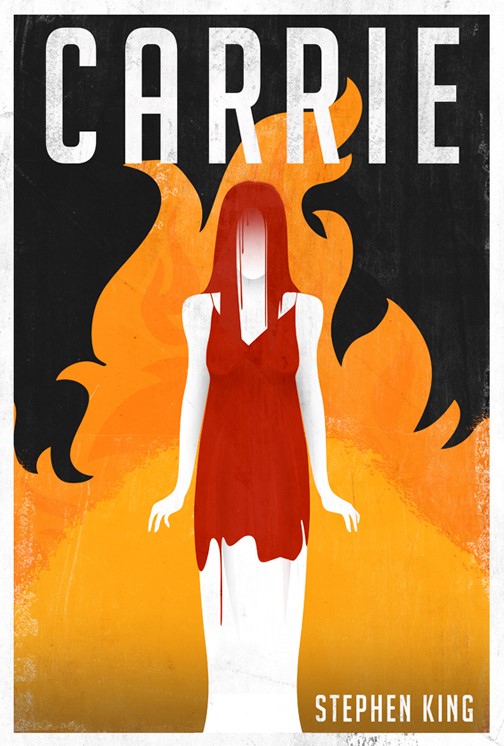
By now Stephen King has joined the pantheon of Great American Writers, and rightly so. Since the 1970s, after the breakthrough with the blood-curdling Carrie (1974), he has been working his way up to become the grandmaster of horror and suspense, but at the latest since the 1990s, the literary quality of his work is increasingly recognized. King’s production is huge, the sales figures are astronomical (around 350 million copies sold) and Hollywood is also happy with the man’s talents. With more than two million votes on the main film site imbd.com (more than half of the voters awarding the perfect 10/10 score), the film adaptation of The Shawshank Redemption is considered the best film of all time, and that is probably also thanks to Morgan Freeman and Tim Robbins – but above all to the compelling, layered and moving story.
The equally strong The Green Mile is thirty-first on that list. King is less satisfied with Kubrick’s widely acclaimed film version of his The Shining, with a frightening Jack Nicholson. And certainly not with the “academic bullshit” that pollutes the film. “It’s like Dylan says,” he says in a Rolling Stone interview in October 2014, “You give people a lot of knives and forks, they’ve gotta cut something.”
The Dylan quote does not just fall from the sky. The writer is a fan, his work is full of Dylan references and quotes. It shows that he is well versed in Dylan’s repertoire; King also quotes from lesser known works such as “On The Road Again” (in The Dead Zone), “I Shall Be Free” (Hearts In Atlantis) and “Tombstone Blues” (in Carrie). And King has used the knives and forks quote from the interview before, in a book, in the preface to the collection of short stories Night Shift. Although the allegation does not fit completely wrinkle-free in the attack the author reopens on the film adaptation of The Shining, it certainly illustrates his knowledge of Dylan’s oeuvre; this line, too, does not originate from a everybody’s friend like “Blowin’ In The Wind” or “Knockin’ On Heaven’s Door”, but from the obscure “Talkin’ New York”.
Whether or not the love is mutual cannot be deduced from Dylan’s lyrics. But it is striking that Dylan has already performed three times in the home town of Stephen King, the unsightly and remote town of Bangor in faraway Maine, with some thirty thousand inhabitants at 35 square miles not exactly a dazzling metropolis.
Anyway, the song does have music-historical value. “Talkin’ New York” is the second song from Dylan’s debut album Bob Dylan (1962), after the cover of Jesse Fuller’s “You’re No Good”, and therefore the first official Dylan composition the world is introduced to. However, the song never reached the canon. In later years, during the revaluation of the initially quite flopped album, it is overwhelmed by the other Dylan original on the album, “Song To Woody”. Understandable, though the song does have more merits than just the curiosity of the birth of a genius.
The form is not too spectacular. The talking blues, the rhythmic talk-singing over a simple, repetitive chord scheme, has been around since 1926, since Christopher Allen Bouchillon (1893-1968) recorded the song “Talking Blues” in Atlanta.
Especially in folk music the form becomes popular, for which Dylan’s idol Woody Guthrie is responsible. Bouchillon is cabaret-esque, but Guthrie replaces the folly and vulgar banalities with epic stories, social commentary and irony, and hijacks the genre for satire, social protest and activism.
After his first attempt, “Talkin’ Dust Bowl Blues” in 1940, he writes some twenty more and it sets a trend. Pete Seeger is making a furore with “Talking Union” and “Talking Atom”, Dylan’s Greenwich neighbours Tom Paxton and Phil Ochs keep the now-moribund genre alive and kicking until the 1970s and in between the talking blues still flares up every now and then thanks to notable outpourings such as the hit that Guthrie’s son Arlo scores with “Alice’s Restaurant” (1967), and Johnny Cash’s “A Boy Named Sue”, of course.
In November 1961, when Dylan records his first album, Guthrie’s work is the model. The private, strictly personal content of the text is different. Off-label also compared to Dylan’s later work; the poet will rarely be this little concealing, unambiguous, openly autobiographical and almost journalistic.
Soberly analyzed, the song recounts a few weeks from the life of the young troubadour, the first difficult weeks in a cold, cold New York. Judging by Dylan’s recollection of those same days in his autobiography Chronicles and judging by reconstructions made by industrious biographers, the song is remarkably accurate – it was about like this. Bitter cold, plodding, Greenwich Village and coffee houses, a harmonica and the trips to East Orange, to the hospital where Woody Guthrie is.
Poetically, the debutant remains within the lines. In the first verse a classic mirror game with up and down, in the third verse the wink rocking, reeling, rolling which the poet, who will be so ferociously associating a few years from now, fits neatly into the context of a subway ride, west rhymes with best and eyes rhymes with skies.
Dominating is a thick Guthrie sauce. The protagonist is a rambler, we also recognise the pensive, half-muttered repetitions from The Great Historical Bum, the ego is exploited and a union member and last but not least: Dylan quotes his hero. The “very great man” who “once said that some people rob you with a fountain pen” is from a famous Woody Guthrie song, from his classic gangster song “Pretty Boy Floyd”:
Yes, as through this world I've wandered
I've seen lots of funny men;
Some will rob you with a six-gun,
And some with a fountain pen.
The first authentic glimpses of the germinating genius are thinly sown, but still: there are some. Accurately, Stephen King picks that one and only truly Dylanesque line out of the song. And the irony is more subtle, more witty with Dylan than with his great example Guthrie.
The last lines are pleasantly non-serious. The crushed musician turns his back on New York, so long, and goes back to the “western skies”, to East Orange.
East Orange is 24 kilometers, 15 miles, west of Greenwich Village, 45 minutes by public transport. Change trains at Penn Station.
What else is here?
An index to our latest posts arranged by themes and subjects on the home page. You can also see details of our main sections on this site at the top of this page under the picture.
There is an alphabetic index to the 550+ Dylan compositions reviewed on the site which you will find it here. There are also 500+ other articles on different issues relating to Dylan. The other subject areas are also shown at the top under the picture.
We also have a discussion group “Untold Dylan” on Facebook which mostly relates to Bob Dylan today. Just type the phrase “Untold Dylan” in, on your Facebook page or follow this link
And please do note The Bob Dylan Project, which lists every Dylan song in alphabetical order, and has links to licensed recordings and performances by Dylan and by other artists, is starting to link back to our reviews.
In this series, “Why does Dylan like,” many of the songs that we have looked at have been suggested by Aaron, with the commentary written up by Tony – as is the case here. And most of the time I (that is Tony) have been able to see at once what Bob Dylan finds so interesting and exciting in the song in question.
But not this time. Which is of course a failing on my part, no one else’s. But I am nonetheless writing up the details of the song in the hope that maybe one or two readers might be able to explain why I have failed so miserably to see anything in this song.
Bob Dylan certainly liked it – he played in 32 times in 1986, and here it is with the lyrics written below…
I can hear the wind a blowing in my mind
Just the way it used to sound
Through the Georgia pines
And you were there to answer when I called
You and me we had it all
Remember how I used to touch your hair?
While reaching for the feeling
That was always there
You were the best thing in my life
I can recall you and me we had it all
I know that we can never live those times again
So I let my dreams take me back
To where we have been
Then I’ll stay with you girl as long as I can
Oh it was so good oh it was so good
Oh it was so good when I was your man
I’ll never stop believing in your smile
Even though you didn’t stay
It was all worthwhile
You were the best thing in my life
I can recall you and me we had it all
You and me we had it all
The song was written by Troy Seals and Donnie Fritts and originally recorded by Waylon Jenning on the 1973 album “Honky Tonk Heroes”.
Now these composers are no occasional song writers. Troy Seals has had his compositions recorded by such luminaries as Elvis Presley, Roy Orbison, Jerry Lee Lewis etc etc. Donny Fritts has been Kris Kristofferson’s keyboard player for forever, and was in (among other films) Pat Garrett and Billy the Kid.
Within a year of the song being published it was used as the title track for Scott Walker’s tenth studio album – his last such before reforming The Walker Brothers.
So, what makes it so special? Most obviously the lyrics are incredibly successful in portraying one of the three great themes of popular music – lost love. It is an absolute statement of lost love – the couple had everything, it was perfection, and then she walked away. But he still remembers her with absolute affection and love, despite her departure, because the affair was the best thing ever.
So no surprise that there have been 25 recordings of it. Here is one of the composer’s own versions…
And the other composer
https://youtu.be/Qtf-bLuLQ88
Which leaves the question that I have been skirting around – why does Bob Dylan like it so much? There are after all many other songs of lost love
My only guess is that he loves the lyrics because they mean something very special to him. He is talking about the lady who has left him in or just before 1986 I guess.
Does Dylan associate “We had it all” with the same event that “To Fall in Love with You” was written about? Of course we can’t possibly know, but it’s the best guess I have got.
I guess it meant a lot to Bob just at the time her performed it, because of the lyrics, and then as Bob so often does, he just moved on. For as Robert Johnson said, “You gotta keep moving.”
The ‘Song Of Solomon’, of the Old Testament Bible, can be interpreted thusly.
The narrator, God (Jesus, if you prefer) is speaking to His beloved, His faithful;
He tells her that she can find Him in the big house by the shepherds’ tents:
If thou know not, O thou fairest among women
Go thy way forth by the footsteps of the flock
And feed thy kids beside the shepherds' tents
I have compared thee, O my love
To a company of horses in Pharaoh's chariots

(The Song Of Solomon 1: 8,9)
Singer/songwriter Bob Dylan updates the analogy. He transforms it into American street lingo – the Almighty’s a cowboy in the sky; she’s a pony named ‘Lucifer’; she calls herself ‘Rosie’, but you can call her Mary Jane if you wanna:
Well, I was sleepin' with the devil
In this crowbar hotel
Well it won't be satisfied
If I remember where

(Bob Dylan: One more ride)
https://youtu.be/JJ2BfbrH4oM
Oh you know, baby
Just tie myself together
May you never leave
The 'lectric chair

(Bob Dylan: One more ride)
The faithful Rose of Sharon responds dutifully to God’s demands for love:
I sat down, under His shadow with great delight
And His fruit was sweet to my taste

(The Song Of Solomon 2: 3)
Street-smart Rosie's hip; she's earthy, and talks salty:
Well, let's roll, baby, roll
(Roll down there)
Roll, baby
(Roll, take a dive down there)
Can't you feel
I'm feelin' steel

(Bob Dylan: One more ride)
She got plans of her own:
What's ya doin' up there
You a-gonna take
A dive
Baby-o?
(Bob Dylan: One more ride)
The holier-than-thou Almighty One says He’s going to give the Rose all of His love; claims He wants to free her from prison.
However, she doesn’t want to go:
I held Him, and would not let Him go

Until I brought him into my mother's house

And into the chamber of her that conceived me

(The Song Of Solomon 3:4)
Says he, ‘Then, you can just stay put down’:
Well, you take my love, and take your time
I think I must be on it
And blow this stuff goin' down
The hand of God is upon it
(Bob Dylan: One more ride)
In fact, he prefers things the way they are – all mixed up:
Take you to myself,
Don't you do it, doggone it
I can't get nowhere
Without you there
(Bob Dylan: One more ride)
The Merry-Go-Round goes around and around – reverses Time:
By Tony Attwood, with lyrics for the song transcribed by Larry Fyffe, research by Aaron Gailbraith
Right Hand Road Blues is a song from the “After the Empire” outtake album which was recorded in 1984 but not released (unofficially of course) until 2016.
https://youtu.be/LBrBdnmGLz8
Here’s a version of the lyrics, valiantly provided by Larry. If you have suggestions for alternatives please do write in…
Right Hand Road Blues
Take the right hand road
You gonna treat me better
Take the right hand road
They got some crazy perttita
Down there
And it can bloodhound roll
Well they call me that simple
But then I must feel fine
Well I’m leavin’ this here town
But Izzy runs her line
Well you can forget to pee, but
Down on the riverside
She got her homely foot in there
She rides like a bloody mare
She got a whole league of syphilis
She runs like pearly mare
Oh but oh, he gets her
I hope I don’t see you there
Well if you gonna call me devil
Take the right hand road
Well you’re gonna treat me better
Take the right hand road
They got some crazy matoco
About to blew your load
Come on, baby
How ’bout Chicago way
I’ll buy you a manor
Way down Chicago way
She grabs her partner
You oughta see her give things away.
Bye, bye,
Good-bye, baby, I’m gone
Bye, bye
Tell my baby, I’m gone
Well we goin’ down to see Anna,
I’m about to have carrion
So what we have here is a standard variant 12 bar blues, in which the first and second line of the verses are not only identical in terms of lyrics, they are also identical in terms of the chord sequence.
Now if we start tracking back we can find a song by Fred McDowell called “Going down to the river” that starts with
I'm goin' down that river I'm goin'-a take that right hand road
I'm goin' down the river I'm goin-a take that right hand road Lord,
I ain't gon' stop walkin' 'Till I get in sweet mama's arms
I think the right hand road generally means the “good path” – going in the right direction morally. Recordings of the McDowell song are available and they are nothing like Dylan’s song.
There is also a Right Hand Road Blues by Brian Langlinais which is a 12 bar blues appearing on his album “Right hand road” released in 2016. Although there are similarities again this is not the same song. The song is available on Spotify.
Michael Messer also has a song called “Right hand road” and on the same album there is a song “Rollin and Tumblin” which is the Dylan song in terms of the musical construction, but not using Dylan’s lyrics. Actually it is a really nice performance and the instrumental break really is something to behold. I know I supposed to be writing about Right hand road but this is quite a find.
There is also a 12 bar blues song, by Furry Lewis which is available on Amazon music – but again not the song Bob sings.
All of which leads me to the simple conclusion that this is a Dylan original, using a moderately common blues phrase “right hand road” in the same way that with “Rolling and Tumblin” Dylan took a popular blues theme and then added his own words.
They may be a bit awkward and bewildering sometimes, but more often they are touching still, the advertising miniatures Dylan occasionally lends himself to in the twenty-first century. The Pepsi commercial is slick, sweet and not very subtle, but actually gives a giant respectful and fun upgrade to “Forever Young”, thanks also to Will.i.am. The sober Apple advertising for the iPod and iTunes from 2006 (with “Someday Baby”) is contagious and stylish, and the film in which Dylan drives through an empty landscape in a Cadillac Escalade confirms the words of Liz Vanzura, Cadillac’s marketing director of: “We tried to be very respectful of the fact that he’s a legend.”
That succeeds partly because the bard, as in those other commercials, says nothing qualitative about the product to be praised. And because Pepsi, Cadillac and Apple are true Americans, just like Dylan, with some tolerance and repression of overly critical thoughts one could suspect Dylan’s recommendation is truthful.
Perhaps because the master talks more, this is a bit more difficult with the IBM advertising. But then again the words of the talking computer Watson fascinate, claiming to have analyzed all of Dylan’s songs.
“Your main themes are,” Watson concludes, “Time Passes and Love Fades.”
“That sounds about right,” Dylan replies amused.
Watson’s claim is actually about right. IBM spokeswoman Laurie Freedman officially reports that the researchers really have fed 320 Dylan songs to Watson and his analysis truly has distilled the aforementioned themes. Wilson’s capabilities of “personality analysis, tone analyzer and keyword extraction” has helped to better understand the data.
Granted, 320 is not all songs, but still: more than half.
The appreciation for Dylan’s commercial trips is anything but widely shared. The fact he allowed the Bank Of Montreal in 1996 to use “The Times They Are A-Changin”, already did taste a bit tricky, but could at least still be classified under the safe heading ‘Irony’. That escape is less credible with the first time that Dylan also physically features in a product promotion, for Victoria’s Secret in 2004. Only the seasoned connoisseurs smile, because they immediately remember the giggly 1965 press conference:
Q: Mr. Dylan, Josh Dunson in his new book Freedom In The Air implies that you have sold out to commercial interests and the topical song movement. Do you have any comments, sir?
BD: Well, no comments, no arguments. No, I sincerely don’t feel guilty.
Q: If you were going to sell out to a commercial interest, which one would you choose?
BD: Ladies’ garments.
Lo and behold! A Biblical forty years earlier the Prophet is already announcing his appearance in a lingerie advertisement.
The song chosen for the soundtrack is “Love Sick” and thereby Dylan casts a second shadow over the beauty of the song.
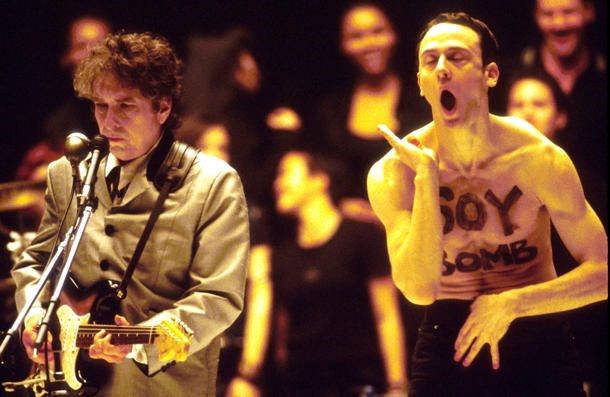
Dylan cannot be blamed for the first Great Distractor. At the presentation of the Grammy Awards in 1998, where he picks up his three Grammies for Time Out Of Mind, Dylan plays “Love Sick”. During the performance one of the background dancers breaks loose, uncovers the upper body, on which with large letters Soy Bomb is written, and performs a somewhat spastic-looking dance right next to Dylan, until he is removed.
The man is a self-proclaimed performance artist, one Michael Portnoy. The purpose of his disturbance was, as he explains later, to “send positive vibrations to viewers at home.” The words soy bomb are a poem that he, on request, also is willing to explain: “Soy… represents dense nutritional life. Bomb is, obviously, an explosive destructive force. So, soy bomb is what I think art should be: dense, transformational, explosive life.”
That crystal clear message did not completely come across. Portnoy blames this, somewhat regretfully, on a miscalculation: “Soy bomb was intended to be a simple poem, but my arms stole all the attention.”
It does, however, draw continuing attention to Portnoy, unfortunately. He is allowed to make his fuzzy say in all major newspapers, gets a stage for his, presumably meant ironically, but still utterly infantile croaking (“Bob Dylan is a thing of the past, I am the future of music” – Daily News) and even true artists like pop artist Eels sustain the stolen fame (“Whatever Happened To Soy Bomb” on Blinking Lights And Other Revelations, 2006).
All in all, the squabbles overshadow the beauty of Dylan’s performance and the extraordinary power of “Love Sick”. On the bonus DVD with the Limited Edition of Modern Times (2006), Portnoy is flawlessly cut away and the glory is artificially restored.
The second Great Distractor is the use of the song in that Victoria’s Secret commercial. Featuring top model Adriana Lima, dressed as sparse as Portnoy at the time, but much more attractive, obviously. The clip offers hardly a story. Lima squirms and seduces, an unaffected Dylan throws, a little surly, his hat on the floor and leaves again, Adriana puts on the hat. There is the connection to the soundtrack: apparently the man does not desire love – perhaps he is sick of love.
The stylized aesthetic of the images certainly detracts from the raw splendor of the song itself. As the opening track for the album, it may be an equally remarkable choice (as the conclusion of an album full of decline and deterioration, it seems more appropriate), but it is actually a great introduction as well.
Producer Daniel Lanois deserves praise. The the first six seconds of the album is rudderless sounds, studio buzz, musicians sitting down with their instruments, or something, then the staccato organ hits from Augie Meyers (“that little back beat skank organ,” as Lanois calls it pleasantly disrespectful) and then that wonderful sound of Dylan’s singing. As if he is calling from an old telephone booth somewhere along a deserted Arizona road to the studio in Miami.
It is a wonderful find from Lanois; by disconnecting the singer from the song, from the recording, as it were, he prevents the song from becoming larmoyant, he avoids it becoming an embarrassing exposé of self-pity and exaggeration. Recorded this way, the despondent words of the washed out narrator get the stately opulence of a nineteenth-century symbolist. “I’m walking through streets that are dead”, “weeping clouds”, “you destroyed me with a smile”, “silence like thunder” … old-fashioned imagery that could have been produced by a fellow Nobel Prize winner like pessimist Maurice Maeterlinck (1862-1949) ) or Baudelaire (“The sound of music, tormenting and caressing / Resembling the distant cry of a man in pain”). But the direct inspiration comes from the Bible again, this time from the Song of Songs: “I am sick of love” is literally there (5:6).
The simple but compelling pulse of the song is just as tempting – the song is popular with colleagues. The well-known contribution of Mariachi El Bronx to the Amnesty project Chimes Of Freedom (2012) eases the angularity of the original and also has a distinctive arrangement (Mexican trumpets, abundant percussion and kitschy gypsy violins). Really appropriated, though, the song is by The White Stripes; “Love Sick” is about a hundred times on the set list and Jack White brings it so intense, loving and driven, that a whole generation of fans thinks it is actually a Jack White song.
In terms of intensity, however, that version is (more than) surpassed by our Flemish friends from Triggerfinger. Ruben Block opts for a similar voice distortion and a similar arrangement as the original, but the performance of the three-man band is – of course – even more meager. And therefore perhaps even more desperate and ominous than Dylan’s. It is definitely the most beautiful cover, and one that may stand next to the master himself.
Worth mentioning, hors concours, is the rendition by one of Dylan’s maternity assistants, an assistant who contributed to the original version: Duke Robillard, one of the guitarists on Time Out Of Mind. Robillard is a veteran (born 1948) and a versatile blues guitarist who seems to mature with the years; especially since the 90s, his popularity among colleagues has been flourishing and he is increasingly being asked for session work. In between, he makes meritorious solo albums, dozens by now, on which the same respect for tradition can be heard as on Dylan’s later albums. New Blues For Modern Man (1999), the album he records shortly after his work with Dylan, presents in addition to his interpretation of “Love Sick” also an admirable cover of Charley Patton’s “Pony Blues” – probably not by chance one of Dylan’s great loves. Robillard’s “Love Sick” is a very pleasant, soulful and sultry homage. His singing skills are not too heavenly, unfortunately, but the rest is masterful. Particularly his B.B. King- and Snowy White-like guitar work.
Construed as a religious allegory, the narrator is Moses in the song ‘Red River Shore’ who’s stuck inside of Egypt with the Israel blues again. He’s a ‘stranger in a strange land” (Exodus 2:2).
The allegory continues in another song entitled ‘Mississipi’. Moses is with an Etheopian girl named Zipporah, but he dreams of a future when he’ll be as faithful as the Rose of Sharon is to God’s first-born son, the country of Israel (Exodus 4:2):
I was thinkin' 'bout the  the things that Rosie said
I was thinkin' I was sleepin' in Rosie's bed
Walkin' through the leaves falling from the trees
Feeling like a stranger nobody sees
(Bob Dylan: Mississippi)
Unlike Rosie of Sharon who’s delighted to serve the Lord, Moses shirks his responsibility to lead God’s chosen people to the Promised Land of Israel:
I am the rose of Sharon, and the lily of the valleys
As the lily among the thorns
So is my love among my daughters
As the apple tree among the trees of the wood
So is the my beloved among the sons
I sat down under his shadow with great delight
And his fruit was we sweet to my taste
(The Song Of Solomon 2: 1,2,3)
God has to ‘encourage’ the Egyptian Pharaoh to let His people go by having Moses call upon a plague of locusts:
And Moses stretched forth his rod over the land of Egypt ....
And the locusts went up over all the land of Egypt
And rested in all the coasts of Egypt; very grievous were they
Before them there were no such locusts, neither after them shall be such
(Exodus 10: 13,14)
In the song ‘The Day Of The Locusts’, the narrator analogously represents Moses; the state of South Dakota with its “badlands” and outlaw town of “Deadwood”, ‘aces and eights’ and all, stands in for the Sinai Desert:
I put down my robe, picked up my diploma
Took hold of my sweetheart, and away we did drive
Straight for the black hills of Dakota
Sure was glad to get out of their alive ....
Yeah, the locusts sang, and they were singing for me
(Bob Dylan: The Day Of The Locusts)
Moses finally screws up his courage, turns outaw, and gathers the Hebrew slaves together. They head out for the Sinai Desert with an Egyptian posse a-ridin’ hard on their tail; they escape across the Sea of Reeds.
Some forty years it takes wandering in the desert, but God fulfils His promise:
And I am come down to deliver them out of the hand
Of the Egyptians
And to bring them up out of that land
Unto a good land, and a large
Unto a land flowing with milk and honey
(Exodus 3:8)
Moses dies; he does not get to cross the River Jordon; he does not get to rest in Rosie’s bed. He’s allowed to come back, but not all the way – because he stayed in Egypt a day too long:
The foreign sun, it's squints upon
A bed that is never mine
As friends and other strangers
From their fates try to resign
Leaving men wholly, totally free
To do anything they wish to do, but die
And there are no trials inside the Gates of Eden
(Bob Dylan: Gates Of Eden)
The man of constant sorrow in the following song is not at all pleased that’s he’s been treated like a fish on a baited hook (he’s Moses, if you like, and the United States with it’s ‘America Dream’ is the Promised Land):
It's undeniable what they'd have you think
It's indescribable, it can drive you to drink
They said it was the land of milk and honey
Now they say it's the land of money
(Bob Dylan: Unbelievable)
Moses pleads with God to change him into a bird so that he can fly across the River Jordon, and be with the one that he loves:
I pray thee, let me go over and see the good land
That is beyond Jordon, that goodly mountain, and Lebanon
But the Lord was wroth with me for your sakes
And would not hear me, and the Lord said unto me
'Let it suffice thee; speak no more unto me of this matter'
(Deuteronomy 3: 25,26)
What’s a poor boy to do:
Wish I was back in the city
Instead of this old bank of sand
With the sun beating down over the chimney tops
And the one I love so close at hand
If I had wings, and I could fly
I know where I would go
But right now I'll just sit here so contentedly
And watch the river flow
Commentary by Tony Attwood. Research by Aaron Galbraith
(We’ve had problems with the video of this one and only performance of this song vanishing from the internet so in case the above goes blank then try here instead).
Bob Dylan has only played this song the once in public, which is a great shame, since Richard Thompson is one of our greatest innovative songwriters and Bob’s version is extraordinarily innovative in its working of the piece.
And because this song was listed in the Time Magazine 100 greatest songs list. They said it was “a glorious example of what one guy can accomplish with just a guitar, a voice, an imagination and a set of astonishingly nimble fingers.” Famously when Richard Thompson heard Dylan’s cover of the song, he said, “It was a surprise, totally. I thought it was a hoax. I thought it was a joke!”
And to be clear I don’t think Thompson meant this is a bad way – rather that he was just unable to believe that Bob had covered his song.
As we know Bob has performed and shown a liking to many of the old “train leaving town” blues songs, so there is every reason not to be surprised that he would like a song about a motorbike – especially one that has a special place in motorcycle history – it was only made between 1948 and 1962 in Stevenage, Hertfordshire – just north of London. (And I’ll slip in the fact that my partner lives on a road which is just off the Great North Road a bit further north – so I’ve found a link to the song too. I always like doing that.)
Apparently the Black Lightning, when produced, was the fastest bike in the world that was being made on a production line which of course then added a lot to its mystique.
Here’s Richard Thompson performing the song, from the album Rumour and Sigh.
Most of us first who were around at the time came across Richard Thompson when he played with Fairport Convention – one of the great folk bands in the UK in the late 1960s. I had the honour of seeing them in those early days in London and remember, now to my absolute embarrassment, telling Richard he ought to face the audience when he played the amazing solos he could devise at the drop of a hat. He very politely said that if he did that everyone would see what he was doing, and he wanted to keep it secret. I did watch him play a few times when I could see his hands and can tell you I had no idea what was going on.
And of course he evolved as a major songwriting talent, with songs like “Meet on the Ledge”. Later Dave Swarbrick joined Fairport, to give them two outstanding musical talents in the same ensemble. Thereafter Richard Thompson went solo, although his work was not always met with acclaim.
The song 1952 Vincent Black Lightning comes from the album “Rumour and Sigh”, but has never (I think) come out as a single. One oddity is that in his own live performances Thompson has on occasion varied the name of the bike – a sort of Dylanesque thing to do.
Speaking about the song on a BBC radio programme Richard Thompson said, “When I was a kid, that was always the exotic bike, that was always the one, the one that you went ‘ooh, wow’. I’d always been looking for English ideas that didn’t sound corny, that had some romance to them, and around which you could pin a song. And this song started with a motorcycle, it started with the Vincent. It was a good lodestone around which the song could revolve”.
A band was set up using the name of the bike as their band name – and of course they sing the song too…
Says Red Molly, to James, “Well that’s a fine motorbike.
A girl could feel special on any such like.”
Says James, to Red Molly, “My hat’s off to you.
It’s a Vincent Black Lightning, 1952.
And I’ve seen you on the corners and cafes, it seems.
Red hair and black leather, my favorite color scheme.”
And he pulled her on behind,
And down to Boxhill, they’d Ride.
Says James, to Red Molly, “Here’s a ring for your right hand.
But I’ll tell you in earnest I’m a dangerous man;
For I’ve fought with the law since I was seventeen.
I’ve robbed many a man to get my Vincent machine.
And now I’m twenty-one years, I might make twenty-two.
And I don’t mind dyin’ but for the love of you.
But if fate should break my stride, then I’ll give you my Vincent, To Ride.”
“Come down Red Molly,” called Sargent McQuade.
“For they’ve taken young James Aidee for Armed Robbery.
Shotgun blast hit his chest, left nothing inside.
Oh, come down, Red Molly, to his dying bedside.”
When she came to the hospital, there wasn’t much left.
He was runnin’ out of road. He was runnin’ out of breath.
But he smiled, to see her cry.
And said, “I’ll give you my Vincent.
To Ride.”
Said James, “In my opinion, there’s nothing in this world
Beats a ’52 Vincent and a Redheaded girl.
Now Nortons and Indians and Greavses won’t do.
Oh, they don’t have a Soul like a Vincent ’52.”
Well he reached for her hand and he slipped her the keys.
He said, “I’ve got no further use…for these.
I see Angels on Ariels in leather and chrome,
Swoopin’ down from Heaven to carry me home.”
And he gave her one last kiss and died.
And he gave her his Vincent.
To Ride.
On fan forums, YouTube, Dylan sites and in Dylan books, the “Answerphone Song” has been bouncing around for several decades now, the recording of a short, funny song, supposedly sung by Dylan as a message on his answering machine sometime in the early sixties. Its authenticity is controversial, and the multitude of sources claiming to have made the copy does not make it more reliable. The generally well-informed Alan Fraser (from the site Searching For A Gem) claims that it was copied from Dylan’s telephone in Malibu in 1975, others say they called the apartment on West 4th Street at the time and Dylan’s house in Woodstock is also mentioned as a source.
Voice, harmonica and guitar sound throughout Dylanesque, that much is true. Not entirely one hundred percent, but that may be due to the poor quality and the fact that those old tape recordings almost never had the correct pace (usually too fast). Anyway, it’s a charming, Dylanworthy recording:
Well, he ain’t at home right now,
He can’t come to the phone
So leave your name and number
When you hear that lonesome tone. [harmonica solo] I’d gladly talk to you right now,
I’d like to guarantee
But I can’t speak or answer now,
Since I’m not really he.
The authenticity becomes all the more doubtful because the lyrics wink at one of Dylan’s most obscure, legendary and mythical songs: the ethereal “I’m Not There (1956)”, one of the absolute highlights of The Basement Tapes. Plus: it is suspiciously well intelligible.
The enigmatic lyrics to “I’m Not There” are incoherent, meandering, sometimes unintelligible and seem largely improvised on the spot. “He would pull these songs out of nowhere,” says eyewitness Robbie Robertson, and he specifies with regard to this song: “There’s something going on inside the song, but you’re not sure what it is.”
On his solo albums, Brian Eno copies the associative, loosely written method of poetry and thematizes it in the opening number of his masterproof Another Green World (1975), in “Sky Saw”:
All the clouds turn to words
All the words float in sequence
No one knows what they mean
Everyone just ignores them
The pitfall is obvious: such a modus operandi soon leads to an accumulation of empty, meaningless sounds, to a Dadaistic hotchpotch of syllables chosen purely for their timbre. As Eno demonstrates in the remaining lyrics to “Sky Saw”:
Mau Mau starter ching ching da da
Daughter daughter dumpling data
Pack and pick the ping pong starter
Carter Carter go get Carter
In other words: painting with sounds, which Eno will intensify on later, instrumental records and will call ambient music. (Exquisite drumming by Phil Collins, by the way.)
Dylan does not fall into that trap; the form is too one-dimensional and way below the ambition of a poet of his class. Not that “I’m Not There” is so much clearer than mau mau starter ching da da, but part of the magic of the song is the suggestion of an ominous, moving story behind the words. It indeed is like Robertson says: something is happening, but you don’t know what is.
The brave transcription attempts may differ, but the overall picture is comparable: inconsistent nebulae with an occasional half-hearted Biblical reference (something with a kingdom so high above her, at any rate) and – predominantly – the regretful observation that the I is not ( anymore) with the lady of his dreams.
The trigger for the Dylan disciples, however, is that one message that comes through loud and clear, also because it is the title: I’m not there.
Should one have to reduce the special appeal of the artist Dylan to one one-liner, then I’m not there is a good candidate. Director Todd Haynes does recognise this very well when he gives his “biopic about the many lives of Bob Dylan” precisely this title (I’m Not There, 2007). The Great Common Divisor of both Dylan’s biography and his discography is, after all, the man’s intangibility, the lack of one identity.
That starts even before his first professional recording, when Robert Zimmerman changes his name and fantasizes different life stories for his New Me, for this “Bob Dylan”. Already in the first radio interviews, newspaper articles and in the liner notes of the first albums, a Dylan’s life that does not exist at all is described. From an unbound vagabond from Gallup, New Mexico, who has been traveling around America with traveling carnival shows since his earliest childhood, for example.
When that vagabond is transformed into Dylan the Folk artist, the Prince Of Protest, he puts on a leather jacket and plugs in an electric guitar. When he then becomes a rock god, a Rimbaud Of Rock, the hippest person on earth (according to Marianne Faithfull), he puts on a hat, becomes a family man and sings “You Win Again” and “Wildwood Flower” – and at this point we only recapitulated the first six years of Dylan’s nearly sixty-year, multi-coloured career. The only all-encompassing stamp that can be put on the indefinable artist is placed by the bard himself, shown in No Direction Home, while reading a newspaper article about himself: “God, I’m glad I’m not me.”
The film footage leaves no doubt as to it being a spontaneous, witty joke, but Freud would effortlessly recognise the deep, deep truth underneath that joke: here an individual looks with a self-evident distance at an alter ego that he may have created himself, but has now started to live a life outside of him. Dr. Jeckyll and Mr. Hyde, indeed.
How remarkable that is, stands out in the comparison with the “normal” reaction of prominent people who are confronted with hurtful, untrue or unwelcome publications. The Trumps, the Tom Cruises, the Lady Gagas and the J.K. Rowlingses respond with indignation, or shrugs, or official denials, or with lawsuits … but never a victim replies chucklingly: “Boy, I’m glad I’m not me.”
It shows a detachment that is not only consciously recognised by Dylan, but also cultivated. In Chronicles, the autobiographer acknowledges his identification with Rimbauds je est un autre, a refrain in the more serious interviews is Dylan’s assurance that the ego from his songs is not me, Bob Dylan. In the radio interview with Mary Travers, in ’75 following Blood On The Tracks, Dylan patiently explains that the listener can read you or he instead of I – “It’s all the same.”
It’s not me. It’s the songs. I am just the postman, I deliver the songs, he tells Robert Shelton in 1978. Similar to the way in which he rejects biographical interpretations of his film Renaldo & Clara: “The film is actually very little about me. It’s a dream. To put it more correctly, it isn’t even my dream.” And a next movie he calls Masked and Anonymous – the silver thread should be clear by now: I’m not there.
The definitive explanation is lucid, complex, confusing, incomprehensible and yet clear, as befits Dylan. He produces this in response to “Seeing The Real You At Last” in an interview with Scott Cohen, in 1985:
“Sometimes the you in my songs is me talking to me. Other times I can be talking to somebody else. If I’m talking to me in a song, I’m not going to drop everything and say, alright, now I’m talking to you. It’s up to you to figure out who’s who. A lot of times it’s you talking to you. The I, like in “I and I”, also changes. It could be I, or it could be the I who created me. And also, it could be another person who’s saying I. When I say I right now, I don’t know who I’m talking about.”
“I’m Not There” would therefore, in all intangibility, contain an amusing paradox – the song poet who repeatedly claims that he himself is not to be found in his films and songs, writes a song in which the I-person propagates the motto of that poet himself: I am not there. And, paradoxically, thus Dylan would sing an autobiographical song after all.
Unfortunately, the approach of the song does not seem that poetic and complex. In all ten verses it can be distinguished that the I complains that he cannot be with a beloved woman, or realises that he cannot stay here. Literal, physical absence, and not so much a metaphysical, metaphorical absence.
An extra veil is given to the song when securing copyright in 1970. Garth Hudson, the acclaimed archivist of the Basement Tapes, has written “I’m Not There, I Am Gone” on the cover and that is how Robbie Robertson calls the song too. The official title, however, receives a mysterious addition in brackets: “(1956)”.
Someone must have been pondering thereon, which is a bit intriguing. Song titles with additions in parentheses are not that special, and Dylan has a weakness for them, as we know since Theme Time Radio Hour episode 47 (“I always liked songs with parentheses in the title”), but songs with a year in between those parentheses are quite rare. The best known is probably the beautiful Beach Boys’ “Disney Girls (1957)”. The year specified there is not too enigmatic; it is a melancholic masterpiece in which the protagonist looks back with nostalgia on a carefree summer in his youth – in 1957, apparently. Three Dog Night sings “Good Feeling (1957)” and explains with the musical accompaniment to which that title refers: it is a 50s doo-wop. And in the – rare – other cases, the song simply sings about an event in the year in question. “Man At The Gate (1913)” by Ron Sexsmith for example, and “Lifted Up (1985)” by Passion Pit.
In short: if a lyricist chooses the addition, it is quite easy to trace. But from where the year 1956 comes in this song title, and what the relationship with the lyrics is at all, is in the lap of the gods. It is tempting to call in the personal biography of the poet Dylan, making Elvis unavoidable. The year in which The King records “Heartbreak Hotel”, earning his definitive breakthrough and in which he scores five number 1 hits. The then fifteen year old Dylan is crushed:
“When I first heard Elvis’s voice I just knew that I wasn’t going to work for anybody and nobody was gonna be my boss. Hearing him for the first time was like busting out of jail.”
But then again; in that case Dylan would have put the 1956 addition after “I Shall Be Released”. Or after “Goin’ To Acapulco”, or “Dress It Up, Better Have It All”, “Minstrel Boy”, perhaps “Get Your Rocks Off” … there are more than a handful of Basement Songs more fitting for a wink to Elvis.
By the way, on the first official release, on the soundtrack of the film I’m Not There in 2007, “1956” has disappeared again, just like on The Basement Tapes Complete (2014).
On the other hand, in 1998, the 1970 copyright is renewed in the U.S. Copyright Office for the full title, including “1956”, (document number V3416D881, registration number: RE 771-501), and again in 2012 – which is weird, considering the song is never officially released under that title.
However, the puzzling with lyics and year evaporates when the music starts. Words float in sequence and nobody knows what they mean – but what they describe the performance artist makes clear even without semantics. This is lyrical in its original, real meaning: the expression of feelings. The singer Dylan uses his voice like the ancient stage Greeks used the lyre to express the protagonist’s feelings. And like Mozart uses the oboe in the adage of KV 361, which is the inspiration for Salieri’s famous monologue in Peter Schaffer’s Amadeus:
“On the page it looked nothing. The beginning simple, almost comic.”
But then suddenly… an oboe, and a moment later the clarinet takes over, and that
“…sweetened it into a phrase of such delight! This was no composition by a performing monkey! This was a music I’d never heard. Filled with such longing, such unfulfillable longing, it had me trembling. It seemed to me that I was hearing a voice of God.”
Granted, a bit exalted, matching Salieri’s stormy Italian temperament, but filtered, the monologue can be transposed to Dylan’s “I’m Not There”. Plaintive, but not complaining, regretful, but still resigned … music filled with such longing, such unfulfillable longing.
The song is an impregnable fortress. Covers there are not. Apart from the one by Sonic Youth, of course, who is given the tough task to produce a cover for the film’s soundtrack. The band permits itself, apparently with the consent of the authorities, some lyrical interventions with which actually some coherence does creep in. It is a good performance, yearning and heavy, but Thurston Moore is not a Dylan of course – and if he had known that the original would also appear on the soundtrack, he probably would have refrained from it. For consolation, Sonic Youth’s version gets a prominent place: over the movie’s credits.
On October 26, 1961, Bob Dylan signs a record deal with Columbia Records in New York City.
The fact that he ends up at Columbia – one of the largest American record companies – is a happy coincidence. Who knows how his career would have gone if he had joined a folk-specialized company such as Folkways Records, Elektra or Vanguard. Perhaps purists would have pulled the plug from his proposal to play electrically amplified.
Anyway, more important in this story is that, shortly before Dylan comes under contract with Columbia Records, the design department of the record company has just been completely renewed. Bob Cato (37) was appointed head of the department in 1960 and John Berg (29) joined as his assistant a year later.
Together they provide a fresh visual language – just in time for the rock music that will take over jazz from the fifties. Certainly after Cato was promoted to assistant director in 1965 and Berg took his place at the head of the department, the department delivers groundbreaking work. In the thirty years that he has been with the firm, Berg has made over 5,000 covers, including Bruce Springsteen’s Born to Run and Thelonious Monk’s Underground.
It is also important to realize that the standard Columbia contract states that the artist may deliver the photo that will be printed on the front of the cover.
Note: Outside the US and Canada, the albums of Columbia Records were released on the CBS label.
December 1961
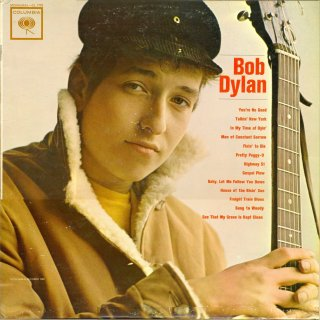
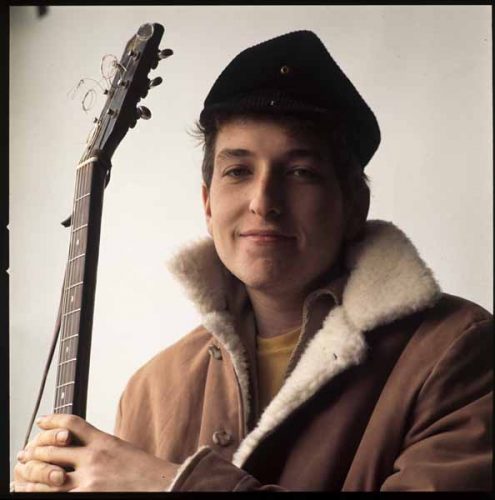
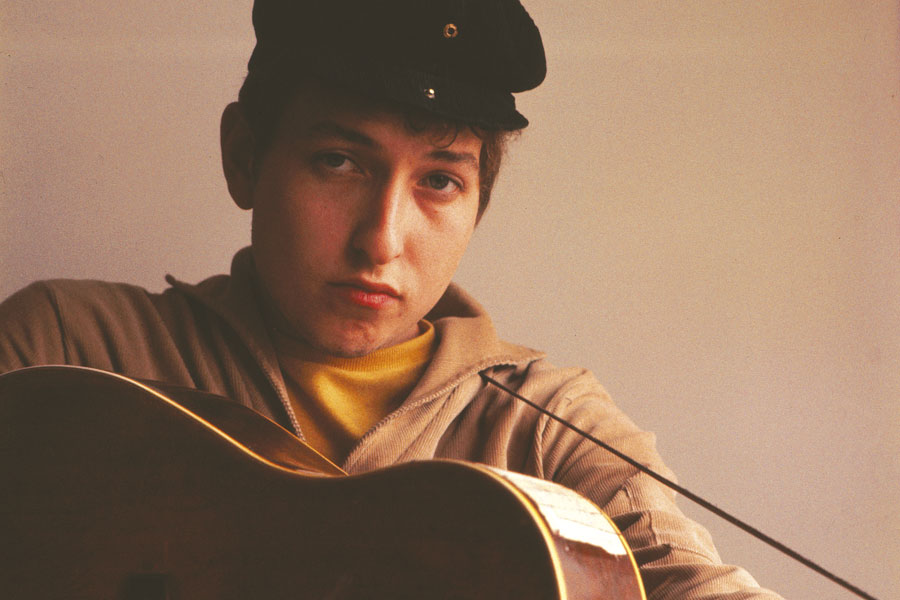
The company does not want to spend much time or money on the cover of the record debut of their latest acquisition. One of the staff photographers is commissioned to make a portrait of the folk singer. Don Hunstein does not even feel the need to go outside the photo studio of Columbia Records on 7th Avenue. He orders the young man take a seat in front of a window, guitar in hand – click, click and ready.
20-year-old Dylan looks like a choir boy, with blushing cheeks, a sheepskin coat and a sailor’s cap on his head – just like the one his idol Woody Guthrie used to wear. Bob looks amused into the lens, a little uncomfortable with all the attention.
To prevent the CBS logo in the upper left corner from being visible through the neck of the guitar, Berg has the photo printed in mirror image.
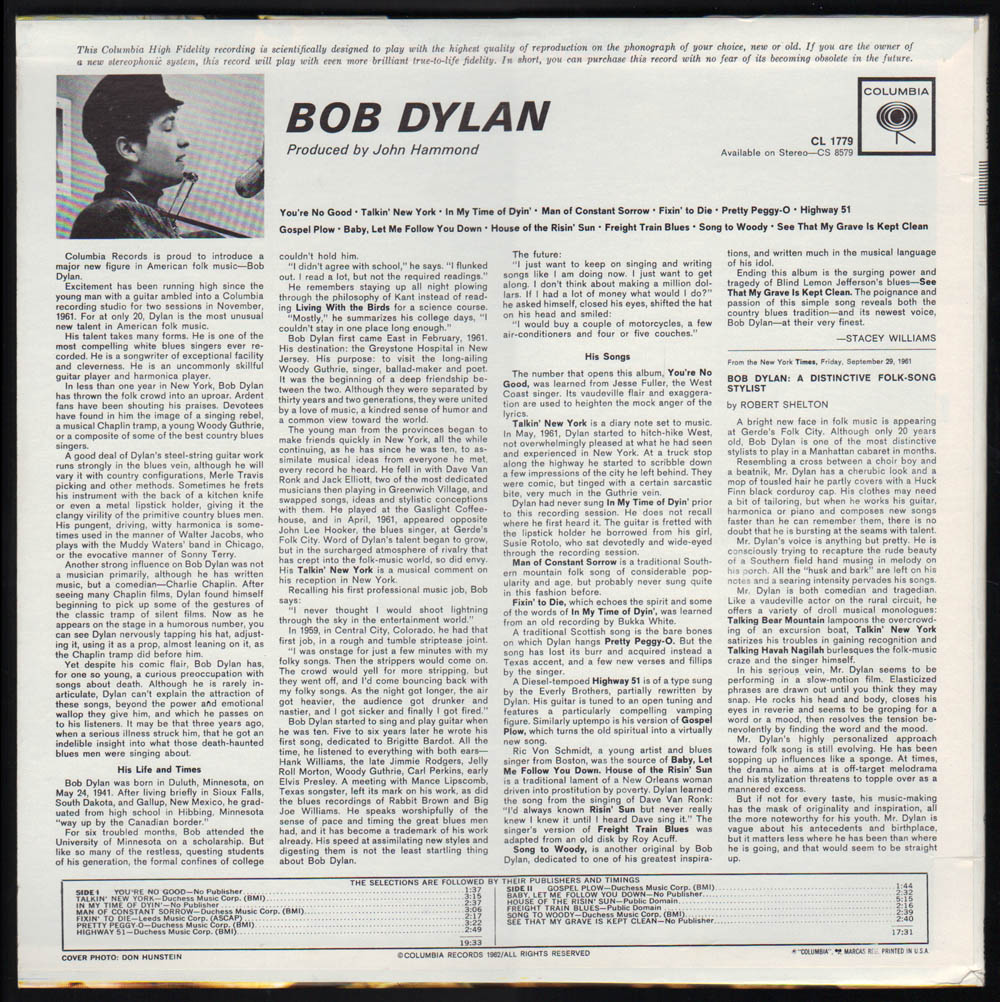
In the early sixties it is common to list the song titles on the front sleeve. To reduce costs, the back of the cover is never printed in colour. The small black and white portrait appears in the upper left corner was also made by the same photographer, probably during one of the two sessions for recording the album, at the end of November 1961.
The rest of the back sleeve is occupied by two texts. In the right-hand column is an article by Robert Shelton, which was previously published in The New York Times. It was this article that probably brought the young artist to the attention of producer John Hammond. The rest of the cover text is attributed to one Stacey Williams – a pseudonym for the same Shelton.
According to the Old Testament, Moses flees from Egypt, and marries an Ethiopian by the name of Zipporah, and then returns to Egypt to free the Hebrews from slavery there:
And she bare him a son,  and he gave his name 'Gershom'
For he said, "I have been a stranger in a strange land"
(Exodus 2: 22)
In the song following, taken as a biblical allegory, it’s clear the narrator identifies with Moses:
Well I'm a stranger here in a strange land
But I know this is where I belong
I'll ramble and gamble for the one I love
And the hills will give me a song
(Bob Dylan: Red River Shore)
The Song of Solomon paints a word-picture of God’s love for Israel, and for those who obey Him, in a series of sexual conceits that features a black woman:
Draw me, we will run after thee
The King has bought me into his chambers
We will be glad, and rejoice in thee
We will remember thy love more than wine
Thy upright love of thee
(Song Of Solomon)
Moses’ brother Aaron gets to speak for him:
And said Moses unto the Lord, "I am not eloquent
Neither heretofore nor since Thou hast spoken unto thy servant
But I am slow of speech, and of a slow tongue"
(Exodus 4:10)
Bob Dylan, as Moses, has a little fun with that:
Well, I don't know what kind of language he used
Or if they do that kind of thing anymore
Sometime I think nobody ever saw me here at all
Except the girl from the Red River Shore
(Bob Dylan: Red River Shore)
The language of Old Testament is often figurative, and the “Son of God” therein is not Jesus, but the Promised Land:
And thou shalt shalt say unto unto the Pharaoh
Thus saith the Lord, "Israel is my son, even my first born"
(Exodus 4: 22)
So interpreted, the Red River is the Egyptian/Ethiopian Nile:
And Moses and Aaron did so, as the Lord commanded ....
And all the waters that were in the river were turned to blood
(Exodus 7: 20)
The Pharaoh with the acquiescence of God who’s quite upset with Moses for being slow to do what He tells him to, gets to treat the Hebrew slaves even worse than before; Zipporah even circumcises their son to stop God from killing her husband right there and then. The Pharaoh finally has enough of God’s wrath after He kills the first born of the Egyptians. Zipporah gets fed up too, and heads back home:
Well, I sat beside her for a while I tried
To make that girl my wife
She gave me her best advice
And said, "Go home and live a good life"
Somehow though I never did get that far
With the girl from the Red River Shore
(Bob Dylan: Red River Shore)
God’s not through with Moses yet. He’s still mad at him, and does not allow Moses to cross the River Jordon into the Promised Land; he dies. However, the Lord’s chosen people are delivered into the Promised Land.
One of the greatest stories ever told – so much so that the singer/songwriter considers the too-slow-Moses allegory worth repeating in another song – only this time, it could be said, his persona crosses the ‘Nile’ of America, into ‘Egypt’:
Well, the emptiness is endless, cold as the clay
You can always come back, but you can't come back all the way
Only one thing I did wrong
Stayed in Mississippi a day too long
(Bob Dylan: Mississippi)
Figuratively speaking, Moses saves Israel, God’s first born. The singer/songwriter himself, in his creative imagination, goes back in time, and brings Moses back to life:
Now, I've heard of a guy who lived a long time ago
A man full of sorrow and strife
Whenever someone around him had died, and was dead
He knew how to bring him back to life
(Bob Dylan: Red River Shore)
Uncle Tupelo were an alt-country band formed in 1987 by Jay Farrar and Jeff Tweedy. It has been said that it was like having Neil Young and Bob Dylan in the same band. Tweedy brought Young’s knack for mercurial but memorable hooks. Whilst Farrar’s cryptic, intense ruminations and personal revelations have more than a passing resemblance to Dylan.
Jeff Tweedy said in an interview, “We probably have more influences than we know what to do with. We have two main styles that have been influences. For instance, we like Black Flag as much as early Bob Dylan and Dinosaur Jr. as much as Hank Williams … To us, hard-core punk is also folk music. We draw a close parallel between the two. We’ll play both in the same set if we get a chance. We don’t have any biases as far as music is concerned.”
Their first album “No Depression” (with the A.P Carter title track) has been cited as one of the most important albums in the alternative country genre. The periodical “No Depression” took its name from the album and “No Depression” is sometimes used as a synonym for the genre.
In 1991 they opened for The Band at a few shows.
Their third album “March 16-20 1992” includes their take of “Moonshiner” using Bob’s 1963 lyric changes.
There are also several unreleased Dylan covers available online including this amazing take on “A Hard Rains A-Gonna Fall” and a fine version of “Wallflower”.
https://www.youtube.com/watch?v=24oBzSa_o_M
Following the release of 4th album “Anodyne” the relationship between Farrar and Tweedy soured to the point where they could no longer work together. The band split, Farrar went on to form Son Volt, and Tweedy took the rest of the band and formed Wilco.
Son Volt continued in the alt country vein, with an emphasis on traditional American Music. Over the next 20 or so years they released 10 albums and several Eps.
An absolutely stunning version of “Going, Going Gone” was included on the “Switchback EP” in 1997.
Jay Farrar kept up a concurrent solo career along with his Son Volt activities. He has performed several Dylan tracks in concert including “Absolutely Sweet Marie” and “Rainy Day Woman #12 & 35”
At the same time Jay was forming Son Volt, Jeff Tweedy and the rest of Uncle Tupelo reformed as Wilco.
In 2003, Wilco released the utterly brilliant “Yankee Hotel Foxtrot” album. The track “Bob Dylan’s 49th Beard” appears on the bonus disc “More Like The Moon EP” and then on the Rarities collection “Alpha Mike Foxtrot”.
https://www.youtube.com/watch?v=48UOZzYAdcY
And things got weird
And I started growing
Bob Dylan's beard
Jeff Tweedy – Bob Dylan’s 49th Beard
Jeff’s haunting solo version of “Simple Twist Of Fate” appeared on the “I’m Not There” soundtrack album in 2007.
In anticipation of the 2008 US presidential election, Wilco released a downloadable version of Bob Dylan’s “I Shall Be Released” that they performed with Fleet Foxes. The MP3 was available as a free download from the band’s website in exchange for a promise to vote in the election. It too was included on the rarities box “Alpha Mike Foxtrot”.
In 2013 Wilco (along with future New Basement Tapes member Jim James) joined Dylan on the AmericanaramA tour. They shared the stage on several occasions singing The Band classic “The Weight”.
“We played that song in a different key every night,” a bemused Tweedy reveals. “It was never in the same key. The tour manager would say, ‘It’s in A flat tonight.’ Or we’d already be out onstage, and we’d talk to Tony Garnier, the bass player, and somehow ask him which key and he’d say, ‘A flat.’ And that’s in front of a lot of people. But Dylan never told us. I think he likes putting himself and his band into a corner, to see if they can play their way out.”
They also performed a wonderful version of “Let Your Light Shine on Me”.
In 2014 Tweedy was asked to write music for a set of unrecorded Bob Dylan lyrics—a project which, without his involvement, became the New Basement Tapes.
But before that happened Jeff was so inspired by these Dylan lyrics that were shared with him that, over the course of two days, he wrote and recorded an album’s worth of songs using and drawing from the Dylan lyrics. The producers ultimately went in a different direction with the project.
Nuremberg, July 1 1978. Bob Dylan offers Eric Clapton a cassette with the first two songs he wrote with Helena Springs: “Walk Out In The Rain” and “If I Don’t Be There By Morning”. Two weeks later Clapton already has recorded both and can present his adaptation to Dylan and Springs when they meet again, this time in England (Blackbushe Aerodrome, July 15). Dylan’s performance there also inspires the title of the album on which the songs will open side A and side B respectively:
“The album we were promoting on this tour was the follow-up to Slowhand, which we had named Backless, a title suggested after we played a gig with Dylan at Blackbushe Airport. It referred to the fact that I thought he had eyes in the back of his head and knew exactly what was going on around him all the time.”
(Eric Clapton, The Autobiography, 2007)
Thus Dylan leaves his mark on this LP on several fronts. But he does not get much applause; both songs are not much appreciated in Dylan circles, and generally “If I Don’t Be There By Morning” is dismissed as even weaker, or more uninspired, or more meaningless than Walk Out. Clapton himself, however, loves the song. It is released as a single (and flops), the song is on his set list for two years, 44 times, and one of those performances also earns a place on his successful live album Just One Night (1980).
In later years, a modest, yet public, revaluation takes place. Just like with Walk Out: Time is friendly for the song. In retrospects and discographies the song is usually ignored, but sometimes it is appreciated as a “pleasant rocker”. The “chunky riffs” get compliments and the song “generates some excitement” because Clapton sounds like The Band.
The revaluation is justifiable. It really is a very nice, melodic rocker, the bridge is remarkable and true, the lyrics are not too titanic, but still food for Dylanologists; largely Love and Theft, so the song uncovers some of the master’s influences and fondnesses.
Dylanesque it is, except for that weird bridge. Both the melody and the words of the bridge are atypical, and especially on a lyrical level suspiciously weak:
Finding my way back to you girl,
Lonely and blue and mistreated too.
Sometimes I think of you girl,
Is it true that you think of me too?
Song titles can sometimes start with a gerund. “Watching The River Flow”, “Driftin’ Too Far From Shore”, “Standing In The Doorway” and “Seeing The Real You At Last”, for example. But within the lyrics it soon gets juvenal and Dylan hardly ever starts a verse with it. “Jokerman”, “Roll On, John” and “Temporary Like Achilles” are the exceptions – and within these songs, they are also the literary weaker spots.
In these song lyrics it doesn’t get any better after Finding, with the poor, Dylan-unworthy rhyming by repetition and the hollow cliché lonely and blue as outliers.
The similarity with the hit song “Working My Way Back To You” by The Four Seasons is probably a coincidence; that was a small hit in the spring of ’66. The worldwide mega hit version by The Spinners is a 1980 release.
The other couplets are much stronger, fortunately. The opening line, Blue sky upon the horizon, is an original and confusing stage direction, suggesting either the beginning of the day or the end of dark clouds at the same time. After that the poet Dylan assembles a blueslamento from various sources.
Blue sky upon the horizon,
Private eye is on my trail,
And if I don't be there by morning
You know that I must have spent the night in jail
Heylin points to Grateful Dead’s “Friend Of The Devil”, the song that Dylan himself will play almost a hundred times between 1990 and 2007. The Dead sings about a sheriff on my trail, Dylan about a private eye on my trail, which rhymes with jail in both songs, and both protagonists remember a twenty dollar bill.
In the live performances of “Going, Going, Gone” in these summer months of ’78 it is already noticeable that Dylan smuggles in a complete verse from Robert Johnson’s “From Four Until Late”, and in this song an echo seems to resonate, too. Johnson opens the second verse with From Memphis to Norfolk, in this song Dylan turns it into, also as opening of the second verse, from Memphis to L.A.
Similarly, Leadbelly resonates in Dylan’s discography since his very first steps in a studio (“Midnight Special”, “Corrina, Corrina”). Fragments from Leadbelly’s songs have coloured Dylan’s work for at least as long; “Gallows Pole” in “Seven Curses”, “John Hardy” in “John Wesley Harding” and “Mr. Tom Hughes Town” (or “Fannin Street”) echoes in both “Just Like Tom Thumb’s Blues” and “The Groom’s Still Waiting By The Altar” (Shreveport women gonna kill you), to name only three examples.
From that last song again seems, equally unimportant by the way, to descend a next phrase: I got a woman living in L.A. versus I got a woman living on Stone Hill.
Interesting, though not too important, all of this, and not very revolutionary either, but it does suggest that, as with “Stop Now”, for example, Helena Springs’ input is very limited. Grateful Dead, Robert Johnson, Leadbelly… all of them artists who are under the skin of the seasoned bluesman Bob Dylan – it is quite unlikely that, while talented, the young, green girl Helena Springs could shake all those references and paraphrases out of her puff sleeve.
It also applies to the title and vers line If I don’t be there by morning. Grammatically and/or syntactically incorrect (it must be either “if I am not there” or “if I won’t be there”). A weathered songwriter like Dylan effortlessly ignores language errors for the sake of rhyme and reason, but an inexperienced novice would not dare to let it pass (according to her own words, this is Springs’ second song lyrics attempt).
The limited input perhaps explains those wondrous additions to the Dylan / Springs songs in the Copyright Files:
With this document, signed by Helena Springs, the songwriter transferred and assigned to Special Rider Music “all her right, title and interest,” including the copyright
… and under “Notes” the whole is once again defined as an “Assignment”, so as a transfer. The same goes for those other songs that have been officially released, such as “Coming From The Heart”, “Stop Now” and “Walk Out In The Rain”.
Agreed, sometimes the songs with co-authors also get strange additions. As with “Isis,” from which Jacques Levy is said to have a 35% ownership:
words, music & arr.: Robert Dylan p.k.a. Bob Dylan; words: Ram’s Horn Music, as employer for hire of Jacques Levy.
… but there is no such addition like this “the rights have been transferred” – though “as employer for hire” is odd again.
The rights to songs he writes with Robert Hunter, like the horrible “Ugliest Girl In The World”, are properly registered to both Ice Nine Publ. Company, Inc. (Hunter’s, or rather Grateful Dead’s publisher, of which Hunter is the president) and to Dylan’s Special Rider Music. Just as, for example, the collaboration with Michael Bolton, “Steel Bars”, is unsurprisingly in both names (Mr. Bolton’s Music, Inc. and Special Rider Music), like “Got My Mind Made Up” is also registered to Tom Petty’s company Gone Gator Music and the honour and rights for “Under Your Spell” are shared with Carol Bayer Sager Music.
In short, it is quite unusual for a co-author to be requested to transfer all rights to Dylan’s music publisher. Springs may still share in the royalties, but it is more likely that she has sold her rights – the U.S. Copyright Office reports on all songs that Dylan’s Special Rider Music is the only “Copyright Claimant”, the only entitled party.
Peculiar. But all that legal haggling has no further influence on the impact of the song, obviously.
That impact is negligible. Just like almost all songs from the Street Legal period (apart from “Señor”), “If I Don’t Be There By Morning” drifts unnoticed away on the Waters of Oblivion. In 2001, the Louisiana veteran club The Hoodoo Kings produces a nice but rather superfluous cover on their eponymous album (although the JazzTimes of July 1, 2001 considers the interpretation as one of the four highlights of the album).
Already in ’78 the Flemish singer Ann Christy tries to score a hit with the song, remarkably enough in combination with that other Dylan / Springs / Clapton title, “Walk Out In The Rain”. Fans of the late Christy think to this day that Dylan wrote the songs for her – and both readings were then, and still are, insurmountably frumpy.
The best interpretations are and remain the live performances of Mr. Slowhand himself. But even Clapton never plays “If I Don’t Be There By Morning” again after May 18, 1980.
In Guildford by the way, 15 miles from Blackbushe Aerodrome – so before abandoning her, he does take the song back home, like a gentleman. Well before the morning, of course.
Sit back and prepare yourself for this one – this is going to be a very video heavy overview of Neil and Bob’s career interactions. Which is how we like it here, right?
In the authorized biography “Shakey” Neil Young refers to himself as “a ‘B student’ of Bob Dylan.” I’m not sure I’d agree, I’d bump him up to an A-. Judging by the amount of Dylan covers he has given in concert and record over the years, he knows his stuff!
Bob became aware of Neil early on and had a bit of a problem with “Heart Of Gold”!!
“The only time it bothered me that someone sounded like me was when I was living in Phoenix, Arizona, in about ’72 and the big song at the time was “Heart of Gold.” I used to hate it when it came on the radio. I always liked Neil Young, but it bothered me every time I listened to “Heart of Gold.” I think it was up at number one for a long time, and I’d say, “Shit, that’s me. If it sounds like me, it should as well be me.”
“I needed to lay back for awhile, forget about things, myself included, and I’d get so far away and turn on the radio and there I am. But it’s not me. It seemed to me somebody else had taken”
He got over it quickly though. In August 1974, Bob Dylan attended a Crosby, Stills, Nash and Young concert in Minneapolis. From a Rolling Stone magazine article by Ben Fong Torres:
“In the middle of the acoustic set, Young introduces ‘For the Turnstiles’ by saying: ‘Here’s a song I wrote a long time ago. There’s a couple of really good songwriters here tonight; I hope they don’t listen too closely.”
The music in the video below starts around the one minute mark…
Then in 1975 the pair got together to rip through a medley of “Helpless” and “Knockin’ On Heaven’s Door” – rewritten as “Knockin’ On The Dragon’s Door”.
In 1988, Neil joined Bob on tour, the pair performed this stunning version of “Gates Of Eden”.
Even though the video quality isn’t great, there is no mistaking Young’s presence as he prowls the stage and his guitar sound is unmistakable.
Young’s performance at the Bridge Benefit Concert in 1989 included this jaunty take on “Everything’s Broken” with Tom Petty.
In 1990 Young released the album “Ragged Glory” with Crazy Horse. It included the track “Days That Used To Be”. The track was originally called “Letter to Bob” and the melody is identical to “My Back Pages”
Talk to me, my long lost friend,
tell me how you are
Are you happy with
your circumstance,
are you driving a new car
Does it get you where you wanna go,
with a seven year warranty
Or just another
hundred thousand miles away
From days that used to be
Neil Young – Days That Used To Be
In 1991 Young’s live album “Weld” includes his definitive “Gulf War” version of “Blowin’ In The Wind”.
“Yeah, well, I had planned to do something along those lines,” he says. “I was gonna do something off Ragged Glory that’s almost the same, ‘Mother Earth.’ But I didn’t really want to do ‘Mother Earth.’ I didn’t think it was gonna make it to the concert. We were rehearsing ‘Blowin’ in the Wind’ before the war and the tour started. Basically, the songs took on the ambience of the times. That’s all we do–we just reflect what’s going on. It just seems like we go out and it all comes from the audience; we just pick it up and send it back. So whatever’s happening, there’s no reason to just go out and entertain.
“Entertainment, all by itself, is great; it’s a great thing to do. But when something like [the war] is happening, certain songs just seem trite. Why bother doing ’em? It’s just natural that the songs reflect what was happening in the country. You’d see it in people’s faces as they came in and out of the concert–the slogans they had on the signs they were holding. But there’s room for everybody. Some people might want to forget about the war. Some people might not.”
That same year Neil teamed up with Bob’s old buddies The Grateful Dead for this awesome version of “Forever Young”
https://www.youtube.com/watch?v=vwvN3KJBT9M
In 1992 Neil played the “Bob Dylan 30th Anniversary Concert” and christened it “Bobfest”. He gave us excellent versions of “All Along The Watchtower” and “Just Like Tom Thumb’s Blues”
A later version of “All Along The Watchtower” was also included on his 2000 live album “Road Rock Vol. 1”.
The 2003 album “Greendale” includes a song “Bandit” – one of Neil’s best in my opinion. In the song Neil sings:
no one can touch you now
but i can touch you now
you're invisible
you got too many secrets
bob dylan said that
somethin' like that
Neil Young – Bandit
Besides the “Like A Rolling Stone” quote this reads like Neil’s take on Dylan’s “Talkin’ World War III Blues”:
Half of the people can be part right all of the time,
Some of the people can be all right part of the time.
But all the people can't be all right all the time
I think Abraham Lincoln said that.
"I'll let you be in my dreams if I can be in yours,"
I said that.
Bob Dylan – Talkin’ World War III Blues
In 2005 he introduces the Song “This Old Guitar” by saying:
“This is Hank William’s guitar [he points to the guitar]. I try to do the right thing with the guitar. You don’t want to stink with Hank’s guitar. I lent it to Bob Dylan for a while. He didn’t have a tour bus so I lent him mine and I left the guitar on the bed with a note saying Hank’s guitar is back there. He used it for a couple of months.”
I wonder what Dylan might have played on Hank William’s guitar.
Young’s 2006 album “Living With War” contains the track “Flags Of Freedom”. A young girl watches her brother march off to certain death to a chorus that echoes Dylan’s “Chimes of Freedom.”
Flags that line old main street
Are blowing in the wind
These must be the flags of freedom flying

She sees her brother marchin' by
Their bond is everlasting
Listening to Bob Dylan singing in 1963
Watching the flags of freedom flying
She sees the president speaking
On a Flat-screen TV
Neil Young – Flags Of Freedom
Another Bridge School Benefit concert in 2008 included this beautiful take of “I Shall Be Released” with Wilco.
The album “A Letter Home” (produced by Jack White – another entry in this “Bob Dylan and…” series) contains covers of some of Neil’s favourites recorded on a refurbished 1947 Voice-o-graph vinyl recording booth. Amongst the tracks was this wonderful take of “Girl From The North Country”
Also to be found as a bonus track on the very expensive vinyl box set special edition was this new version of “Blowin’ In The Wind” – making this one of Neil Young’s rarest and hardest to acquire tracks:
For his part Dylan has mentioned Neil Young once on record:
I’m listening to Neil Young, I gotta turn up the sound
Someone’s always yellin’ “Turn it down”
Bob Dylan – Highlands
When I saw Bob sing this one in Glasgow, he brilliantly changed the lyric to “I’m listening to Annie Lennox” – to cheers from the very partisan Glaswegian crowd, always happy to hear a reference to one of our own from the master! Makes me wonder if he changed this line for every city he visited!
In 2002 Bob performed this wonderful version of a Neil Young classic – from one Old Man to another.
Performances selected by Paul Hobson, commentary by Tony Attwood
In this series we have been taking a look at some of the more notable performances of songs by Dylan on the Never Ending Tour. There is an index to our articles in this series here.
Workingmen’s Blues No 2 from “Modern Times” has been one of Dylan’s favourites since he introduced it into the song rosta on 11 October 2006, and it stayed as part of the Never Ending Tour for two solid years, garnering 267 performances, before finally being set aside 12 years later almost to the day, at least for a while.
Although listening to the performance below I felt it would be hard to make much of the lyrics if one didn’t know them. But the fact is that into this century Bob was still telling us his visions:
Some people never worked a day in their life Don’t know what work even means
Meet me at the bottom, don’t lag behind Bring me my boots and shoes You can hang back or fight your best on the front line Sing a little bit of these workingman’s blues
Moving on to our second choice – “If Dogs Run Free” this is an interesting selection indeed. It was part of New Morning which came out in 1970 but did not get an outing on stage for 30 years until suddenly on 1 October 2000, there it was, in the show.
Over the next five years Bob performed it 104 times, until in 2005 it was once more shut away in its box not to be seen again.
The live performances had none of the twinkling jazzy piano that was central to the album version, and of course the unexpected scat singing of the second vocals, which at times sounds like imitation dog type noises. But the bounce of the song is still there, and here Bob sounds much more convinced about his own lyrics – as if he had looked again at his lyrics and thought – “no this is not rubbish as some reviewers said – we just need to change the arrangement.”
https://www.youtube.com/watch?v=8XocQNESUmQ
And for our third selection today, here is “Highway 61 Revisited. Bob decides to talk to his audience a little before bringing those familiar lyrics, and he really looks like he is enjoying himself with it. And why not – it is a song from 50 years ago, and still going strong. Still most certainly worth performing.
https://youtu.be/W1i_Q9NDGJk
Now it really was a bit of a surprise to find the song has been with us for 50 years, as the listings show us that Bob began playing this song at the end of 1969 and was still playing it in the shows this year – a staggering 1,986 live performances.
As such it is the third most performed song in the Dylan repertoire, with the current (August 2019) list, reading
Ranking
Song
Times played to date
1
All along the watchtower
2268
2
Like a Rolling Stone
2075
3
Highway 61 Revisited
1986
4
Tangled up in Blue
1685
5
Blowing in the Win
1585
6
Ballad of a thin Man
1240
7
Don’t think twice it’s all right
1086
8
It Ain’t me babe
1060
9
Maggie’s Farm
1051
10
Things Have Changed
967
What else is on the site
You’ll find an index to our latest posts arranged by themes and subjects on the home page. You can also see details of our main sections on this site at the top of this page under the picture.
The index to the 500+ Dylan compositions reviewed is now on a new page of its own. You will find it here. It contains reviews of every Dylan composition that we can find a recording of – if you know of anything we have missed please do write in.
We also have a discussion group “Untold Dylan” on Facebook. Just type the phrase “Untold Dylan” in, on your Facebook page or follow this link
And please do note The Bob Dylan Project, which lists every Dylan song in alphabetical order, and has links to licensed recordings and performances by Dylan and by other artists, is starting to link back to our reviews.
This series of articles looks at Dylan’s reinterpretations of his own work, with video examples from his concerts. The videos are selected by Paul and the commentary is by Tony.
Details of previous articles in this series are shown on the index “Dylan re-imagined”
This time we start with “Most Likely You Go Your Way And I’ll Go Mine”
https://www.youtube.com/watch?v=pPzNjVOq1OU
Dylan has put a real bounce into the rhythm, but then against that sings in a laid back way. You can say that even for Bob this is a non-movement piece.
As a result the song becomes a simple statement – he is not trying to convince anyone of the truth of what he is saying. He says he’s going to let you pass, not with a sense of regret but as fact. That’s how it is, there’s nothing else to it.
Then, when after the middle 8, the band takes a more back seat point of view, it is just Bob telling us well… it really is just a statement of how it goes. And the focus moves onto the “Time will tell just who has fell” comment. That time, as we know, has passed. It’s a retrospective.
The nearest we can get to dating that recording, and this song below is to say it is in the early 2000s. If you can get us closer, please do say.
So onto song number two: Hard Rain
https://www.youtube.com/watch?v=ElY8_qidV4Y
Dylan rushes the first line and then waits. The melody has almost gone, but the performance emphasises the lyrics, just as should always happen. And suddenly, even though we know the lyrics forwards, backwards and inside out, we are hearing it unlike ever before.
Even the chorus has a surprise – Dylan singing in harmony with the band! Really? Yes it is.
This very laid back accompaniment means we really can focus on the lyrics once more even though we do know it so well. Indeed with this reworking the meanings can being to shift and change in ways that we do not expect. Just listen to Dylan delivering the line “that could drown the whole world”. We know what it implies and symbolises, except this time we are thinking, is there is something else here that we’ve never got before.
And then after five minutes we get the instrumental with Bob leading on acoustic guitar. No fancy electric lead – no of course not – and then suddenly it cuts and we get the softest verse of all for the “darling young one.”
Even then Dylan has more surprises for us for after the instrumental break we get the “What will you do now?” verse, and here we go even more laid back than before. Thankfully there is no audience shouting and whooping to distract us, as Bob gives us a view from a much higher place than normal for the executioner’s face being always well hidden.
And after all that the chorus changes and then we get a completely new instrumental coda which extends the normal chorus lines to take us to the conclusion. Amazing.
Our final piece in this selection is “Big Girl Now” from the Rolling Thunder Revue 1975.
Dylan is careful to use the slow speed of the song to give us the full power of the lyrics – including a long pause after “You’re a big girl now”. This makes the whole piece, which has always been personal, now ever more personal than before.
This in turn means that lines like “Love is so simple” take on even more power. In fact it becomes almost too much. So much so that I found myself wondering how much more of this angst I could take, and was grateful on the five minute mark for the instrumental verse. But really, if you want a song of pain, here it is. And then some.
In Martin Popoff’s Judas Priest – Heavy Metal Painkillers (2007), one of the founders of the band, Al Atkins, reveals how they got that band name:
“Bruno, the bass guitarist in Judas Priest #1, came up with the idea when looking for something similar to the Black Sabbath name which we liked at the time. He got it from a Bob Dylan album called John Wesley Harding—the song was ‘The Ballad of Frankie Lee and Judas Priest’. The curious moniker can be looked upon as a mild exclamation, or the duality of good and bad, Judas being a betrayer of Christ, a priest being a proponent thereof. Just on its own, the religious tone of the name carried a sort of ominous weight.”
… hitting the nail on the head. This plays out in 1969, and in those years it is trendy to invent a kind of contradictio in terminis as a band name, preferably absurd dualities. So a zeppelin is made of lead, a butterfly is made of iron and an alarm clock is made of strawberry. Metal bands are fond of religious, satanic and dark connotations, resulting in names like Iron Maiden, Black Sabbath and Lucifer’s Friend.
Equally, Dylan the Song Poet is attracted to the alienating effect that can be caused by a loaded name. He is chased away from a nice girl by her boyfriend Achilles, a nun is called Jezebel, a neighbour Tom Paine, he marries Isis and a flirty street sweeper is called Cinderella. But even in that – endless – row of alienating names, “Judas Priest” has a special, eccentric power.
Dylan probably already knows the word combination as a civilized expletive, as a “mild exclamation”, as Al Atkins calls it; instead of taking His name in vain, like “Jesus Christ!” or “God Almighty!”, some decent Christians prefer to use the less blasphemous “Judas Priest!”. Main characters in the plays of Sam Shepard, for example (first in Operation Sidewinder from 1970, later also in Buried Child, ’78).
Language artist Dylan appreciates, just like hard rock singer Al Atkins does two years later, the inner tension and chooses to elevate the decent curse to the name of a protagonist in his ballad.
“Frankie Lee” is less traceable. Dylan’s first association is probably Lightnin’ Hopkins cousin, Frankie Lee Sims, of whom he will play “Lucy Mae Blues” and “Walkin’ With Frankie” some forty years later in Theme Time Radio Hour. And in the second instance perhaps the murderer of “Little Sadie”, Lee Brown; yes sir, my name is Lee – maybe he is even called Frankie Lee Brown.
But both associations the bard probably only has afterwards, reading back – more likely is that the artist chooses an everyday, colourless name as a contrast for that exorbitant “Judas Priest”. A Midwestern, farm boy’s name, such as “Lucy Mae” or “Bobby Jean” or “Billie Joe”. After all, in the ballad Frankie Lee is the somewhat simple loser who goes down, Judas Priest the mysterious, stable counterforce.
“The Ballad Of Frankie Lee And Judas Priest” is the first song Dylan records for John Wesley Harding and probably the first song he writes for it. The elaboration and the length differ considerably from the other eleven songs and the song comes close to Dylan’s own understanding of a classical ballad:
“When they were singing years ago, it would be as entertainment… a fellow could sit down and sing a song for half an hour, and everybody could listen, and you could form opinions. You’d be waiting to see how it ended, what happened to this person or that person. It would be like going to a movie.”
(interview with John Cohen, summer of ’68)
Dylan thinks of epic songs, of the long, drawn-out, narrative ballads, rhyming stories to music, such as “Beowulf” and the Broadsides. The song “John Wesley Harding” was set up like that too, as he explains in ’69 to Rolling Stone’s Jann Wenner: “You know, a real long ballad.”
In the end most of the “ballads” on John Wesley Harding become compressed, parable-like songs of three couplets, more lyrical than epic, which have hardly any common ground with the classical ballads. Only Frankie Lee and Judas Priest still does. Somewhat, at least: it is real long. Well, quite long, anyway.
Yet even with this real long ballad, it is not so much the narrative component that dominates, but that parable character. In the same interview with John Cohen, Dylan himself is a bit shy about his knowledge of, or his click with, parables:
JC: “That’s why I gave you Kafka’s Parables and Paradoxes, because those stories really get to the heart of the matter, and yet you can never really decipher them.”
BD: “Yes, but the only parables that I know are the Biblical parables. I’ve seen others. Khalil Gibran perhaps… It has a funny aspect to it – you certainly wouldn’t find it in the Bible – this type of soul. Now Mr. Kafka comes off a little closer to that.”
“A funny aspect”. Funny? That again indicates a strange sort of congeniality with Kafka. We know from the great Prague writer that he classifies some dialogues, plot twists or situations in his own work as “funny”, have been intended as a joke, situations that the average reader would qualify as lurid, uncomfortable or cruel.
In contrast to Kafka and Dylan, the Biblical parables are usually not too enigmatic, at least: not intrinsic. Jesus’ parables follow a normal cause-and-effect structure, the action and the plot are clear and logical. A sower sows his seed. Some seed grains end up on rocky soil. Those seeds will not grow and bear no fruit. The other seeds fall on good soil and will bear fruit (Luke 8). No surprises, no absurdities. Problems only arise with the interpretation of the chosen metaphor, are text external.
Dylan’s lyrics on John Wesley Harding follow Kafka’s narrative style: the problems start text-internally. Actions, dialogues and plot turns evade everyday expectations and patterns. A traveler asking the way is laughed at by the police officer (Gib’s auf!). A gentleman who wants to leave is stopped by his servant, who demands to know where his lordship thinks he is going (Der Aufbruch). When Gregor’s parents bump into a monstrous giant insect in their son’s bedroom, they do not think: what is this beast doing here, where is our son? Bizarrely, they think: dear God, our son has turned into a beetle (Die Verwandlung).
Because of Kafka’s factual, recording style, the reader at first does not notice the illogic in the opponents’ actions – thus making the evoked anxiety elusive and all the more nerve-wracking.
In “The Ballad Of Frankie Lee And Judas Priest” Dylan applies the same technique. Just like with Kafka, the logic derails right from the start. Frankie Lee needs money, his friend Judas Priest pulls out a roll of banknotes. But then: Judas puts the money “on a footstool just above theplotted plains.” A bizarre, unreal location determination. Next, Frankie’s actions are disconcerting. Word choice and the continuation of the dialogue suggest that it is important which of the ten-dollar banknotes Frankie will choose now. “Make a choice,” says Judas. Frankie assumes a thoughtful pose (“put his fingers to his chin”), but is unable to choose as long as Judas is watching. Judas is lenient and willing to wait somewhere else, but again underlines that he has some concern regarding which specific banknotes Frankie chooses: “You’d better hurry up and choose which of those bills you want” – as if one ten-dollar bill is ‘right’ and the other ‘wrong’.
This psychedelic above the plotted plains is still Dylanesque. It is comparable to illogical location indications such as inside of Mobile, or up on Housing Project Hill, or along the watchtower, or underneath the apple suckling tree – locations that can only be found on the map of La La Land, due to semantics or incorrect prepositions.
Kafkaesque, however, is the consequence with which the incongruence (the apparent importance of the “right” banknotes) by both protagonists is maintained as an obviousness. It clashes with the sense of reality of the reader / listener, thus creating discomfort.
The following verses deepen this discomfort by assigning “improper” qualifications to the dialogue. Judas says that he will wait for Frankie Lee later on, in “Eternity”. “Eternity?” Frankie asks, with “a voice as cold as ice”
A voice as cold as ice? Words can be “cold”, a look, even a character, but a “cold voice” should be something like an unfriendly, unsympathetic voice – Darth Vader, something like that. And also in terms of content unfitting. “Surprised” or “amused” or “shocked” – those are qualifications that would match the tone of Frankie’s verification question, not “unfriendly”.
“Cold” would at least content-wise be appropriate to the following response from Frankie. “Yes, Eternity,” says Judas, “though you might call it ‘Paradise’.”
That does sound a little condescending, and Frankie’s reply is accordingly defensive: “I don’t call it anything” – this time he does not sound “cold” however, but rather says it “with a smile”.
After that, it only gets more tumultuous. Frankie is sitting there on his own, presumably staring at that roll of banknotes, and feels “low and mean” for unclear reasons. A stranger does not just come in, no, he “bursts upon the scene” and approaches Frankie with the wondrous question whether he is “Frankie the gambler, whose father is deceased” – if so: one Priest calls for him, a little down the road. Surprisingly, Frankie replies that he “recalls this Priest very well” – as if it had been years since he last saw him – to add immediately: “In fact, he just left my sight.” Peculiar way to express that someone has just left the room, even more curious after the previous communication that he has not yet forgotten Priest.
On the narrative level, the poet has shifted up a gear again. The derailments are no longer from one sentence to the next, but even within one and the same sentence it starts to grind, logic is lost. Frankie speaks this ambivalent sentence with – incomprehensible – “fear”. To which the stranger replies, just as inconceivably, “as quiet as a mouse” (“Yes, that’s the one”).
We are halfway through, a stylistical rollover is ahead, with this accelerated sequence of incongruities. Time for a breather, for a fermate. The poet Dylan feels that too. The seventh verse is on a substantive level driven and hectic, but syntactically “calm”; Frankie’s actions follow a recognizable logic and a normal pattern (he panics, drops everything, runs in the right direction and finds Judas). The dialogue then is coherent – Frankie’s question is appropriate (“What kind of house is this?”), Judas’ answer is surprising, but not unrealistic (“This is not a house, but a home”).
After the fermate we can return to Full Kafka Mode. In couplets 8, 9 and 10 the mismatches tumble over each other again. On Judas’ quasi-ambiguous, little spectacular correction that he is not standing in front of a house, but in front of a home, a trembling Frankie “loses all control over everything he has made” while the “mission bells” sound.
The dreamlike, Kafkaesque atmosphere now being evoked is enhanced by the shadowy, unreal shifts in time and place. In couplets 6 and 7 it is suggested that Frankie and Judas see each other again and converse in the strange house, but in couplet 8 they are suddenly back on the street in front of that same house. It seems to be a brothel – the description (“bright as a sun”) refers to the most famous brothel in art history, The House Of The Rising Sun and behind the twenty-four windows are twenty-four ladies.
Equally unreal is the subsequent time warp. In Frankie Lee’s reality, sixteen days and nights seem to pass, in which he runs an apparently exhausting and ultimately fatal, orgasmic marathon through that brothel, but Judas, apparently in a different time zone, is still waiting at the bottom of the stairs, waiting to receive him on Day Seventeen.
Just like in couplet 6, the poet is now gearing up again; from couplet 10 the logic does not crash from one line to the other, but within one and the same line:
No one tried to say a thing
When they took him out in jest
“Nobody said anything” would be a normal stage direction for this sad scene, but Dylan nuances: “No one tried to say a thing,” while Frankie Lee’s corpse is being carried “out in jest”. “In jest”? Would it have been more serious, more appropriate, to leave the corpse lying there in the brothel?
No time to reflect thereon; the next enigmatic plot turn again forces away any confusion hereon. Out of nowhere appears “the little neighbor boy” who is also “guilty”, but this loaded addition does not get the chance to resonate either, being already drowned out by the intriguing exit of the neighbour boy: “Nothing is revealed,” he mumbles, under his breath, on top of that – and in passing, the poet thus smuggles in two of Kafka’s main themes (guilt and concealment).
In accordance though with Biblical parables is the coda – an explicit interpretation, or in this case: a moral. However, that only concerns the form, of course. The content is “normally” Dylanesque, or Kafkaesque, but in any case inscrutable:
The moral of this song
Is simply that one should never be
Where one does not belong
So when you see your neighbor carryin’ somethin’
Help him with his load
And don’t go mistaking Paradise
For that home across the road
The poet opens his epilogue with a run of the mill greeting card wisdom (‘know your place, remember who you are, stay where you belong”). The subsequent wisdom begins with “so”, thus promising a conclusion – which does not come. “If your neighbor is carrying something, help him with his load” is not a conclusion from the above, in fact: that “morality” teaches, quite on the contrary, to not go to your neighbour, but to stay “where you belong”.
The last sentence then opens with “And”, suggesting a listing, an addition to the previous appeal to help the neighbour, but alas: again there is no substantive relationship. “And don’t confuse Paradise with that home across the road.”
True to form, the moral of “The Ballad Of Frankie Lee And Judas Priest” is a moral lesson not linked to the little that is told.
Inscrutable, all in all, and that has been a deliberate, strategic choice by the Bard. In stylistic terms, he cheats with incorrect, and therefore confusing, prepositions and conjunctions, and illogical adjectives and adverbs.
In terms of content, he also interlaces the “ballad” with suggestive, symbolic power insinuating accents that force interpretation attempts into distant blind alleys. Biblical of course, by naming Judas Priest, by the capitalization of Paradise and Eternity, by insinuating number symbolism (sixteen symbolizing ‘Love’, seventeen ‘Victory’ and twenty-four ‘Priesthood’ – a seasoned Dylanologist should be able to deduce some heads and tails out of it) and through the paraphrases. Remarkable idioms such as foolish pride, foaming at the mouth and helping with load can all be found in the Book of Books.
Smoke curtains and fog clouds. Masked and anonymous. A classical ballad, an epic poem with a beginning and an end and a real narrative like “Lily, Rosemary And The Jack Of Hearts” is merely suggested, but evaporates behind an accumulation of non-sequiturs, misleading stage directions and irrelevant details … masterfully disguised as a dramatic novella full of Kafkaesque clarity.
The accompanying music is unambiguously simple. A basic, unadorned chord scheme with just three chords (G-Bm-Am) that is repeated from start to finish without variation (Dylan plays with capo, as with almost every song on John Wesley Harding, so in fact it is in C), bass and drums. The only excess is provided by two short, beautiful, harmonica solos.
But in spite of the undeniable beauty and inviting simplicity, length and uniformity seem to deter the colleagues. There are virtually no covers by artists from the higher divisions. Dozens by YouTube amateurs, usually low-quality labours of love by white, spectacled men in their fifties, and in addition a few perfunctory ones by tribute bands – all negligible too.
Obviously, Thea Gilmore cannot escape the song on her beautiful tribute project, the integral performance of John Wesley Harding (2011). Her rendition is beautiful.
Gilmore artificially adds excitement by raising the tempo and the arrangement, to which she steadily adds instruments, but above all: by cheating with the chord scheme. The seventh verse, the textual pause for breath, is turned into a bridge and that is actually a particularly successful find. It had done Dylan’s original well, too.
In 1987 Dylan plays the song with Grateful Dead and Jerry Garcia then takes the song back to the studio of his musical friend David Bromberg in the early nineties. Bromberg releases most of his recordings with Garcia only after Jerry’s death. Their “The Ballad Of Frankie Lee And Judas Priest” is therefore not released until 2004, on the tasteful, acoustic collection Been All Around The World.
The men also opt for minimalist instrumentation, but more ornamented (Bromberg lets his mandolin flutter around the melody and the words). The true stronghold is Garcia’s hypnotic talk-singing, that more than Dylan’s words seems to tell a mysterious, moving and exciting story.
Still, it remains only suggestion, of course.
The final cover is not yet available and must be produced by Judas Priest, obviously. The guys are capable; their cover of Joan Baez’s melancholic ode to Dylan “Diamonds And Rust” (on Sin After Sin, 1977) is amazingly respectful and equally attractive – and after that name choice the second time the British metal band skims Bob Dylan. That cover will come, eventually.
Though there be confusing and paradoxical interpretations abounding here, there, and everywhere, the cosmologies of Gnostic and related Cabbalism, some forms of which are thought knowlegable only to a special elite, can be said to differ from the orthodox Abrahamic religions in that the actions of humans, including the overt display of joy, have an impact on the traditionally aloof, all-powerful ‘God’ – the anthropomorphic ‘masculine’ giant in the sky replaced by linguistic correspondences and metaphors for a universe that is mysterious and infinite.
That is, through the gathering and expanding of knowledge obtained from the proto-science of alchemy that focuses on the basic elements (earth, water, wind, fire), and by acting in good faith for the benefit of one’s fellow man, good works undertaken by enlightened individuals light up the conditions for all in an evolving material world that’s traditionally depicted as dark. According to modern Romantically-inclined mystics, the big problem, rooted in the ancient mystical view, is that ‘sparks’ emanating from the caring homemaker ‘feminine’ side of the Godhead have all but been extinguished; Adam becomes the big boss, necessitating a rebalancing of the cosmological order.
The narrator in the song lyrics below by singer/songwriter/musician Bob Dylan warn of destructive ‘demonic’ forces afoot in the cosmos:
The engines they exploded
Propellers failed to start
The boilers overloaded
The ship's bow split apart
(Bob Dylan: Tempest)
Though the songwriter grows up in the heyday of of Western movies, most of which feature dominant men and submissive women, the lyrics below suggest an equitable and harmonious partnership will once again exist between the sexes:
Searchin' for the truth the way God planned it
But the truth is I might drown before I find it ....
Yeah, I need a woman, oh, don't I
Need a woman, bring it home safe at last ....
Been watchin' you in the sunshine
Walkin' with you in the dark
And I want you to be that woman - treat me right
Be that woman every night
(Ry Cooder: Need A Woman ~ Dylan/Cooder)
At other times, song lyrics envision the sexes trapped in a dark, materialistic world of stupidity devoid of loving spirituality:
Idiot wind
Blowin' through the buttons of our coat
Blowin' through the letters that we wrote
Idiot wind
Blowin' through the dust upon our shelves
We're idiots, babe
It's a wonder we can even feed ourselves
(Bob Dylan: Idiot Wind)
Under such circumstances, fleeing from an Eden that is burning, rather than seeking a union with the Infinite ‘God’, appears to be the rational way out:
"There must be some way out of here"
Said the joker to the thief
"There's too much confusion
I can't get no relief
Businessmen, they drink my wine
Ploughmen dig my earth
None of them along the line
Know what any of it is worth"
(Bob Dylan: All Along The Watchtower)
Before he experimented with Christianity, Bob Dylan displays an interest in Gnostic/Cabbalistic thoughts:
Yes, to dance beneath the diamond sky with one hand waving free
Silhouetted by the sea, circled by the circus sands
With all memory and fate driven deep beneath the waves
Let me forget about today until tomorrow
(Bob Dylan: Mr. Tambourine Man)
Even more so thereafter, but much darker:
She wrote me a letter, and she wrote it so kind
She put down in writin' what was in her mind
I don't see why I should even care
It's not dark yet, but it's getting there
(Bob Dylan: Not Dark Yet)
In the Lurianic Universe, there are demons everywhere a-floatin’:
Broken lines, broken strings
Broken threads, broken springs
Broken idols, broken heads
People sleeping in broken beds
Ain't no use jiving
Ain't no use joking
Everything is broken