This article is part of a series on songs that Bob Dylan has confessed he likes in interviews, or self-evidently likes because they are among the small number of songs that Dylan has performed in concerts, but has not composed himself (the list of other titles in the series thus far appears at the end). This piece is about “Friend of the Devil” with music by Jerry Garcia and John Dawson, with lyrics by Robert Hunter. It appeared on the Grateful Dead’s album “American Beauty.”
We can immediately see some Dylan connections both in Grateful Dead and in Dylan’s own collaborator from time to time, Robert Hunter.
But I think the subject matter is the key – Dylan loves songs of the wanderer, the hobo, the lost soul on the run. I’ve mentioned quite a few of these on this site a number of times – “Drifter’s Escape”, “One too many mornings”It aint me babe,Don’t think twice – perhaps the classic Dylan “song of leaving” with “Look out your window and I’ll be gone – you’re the reason I’m travelling on”.
Beyond the more famous examples we have songs like Someday Baby which contains all the essential ingredients of the blues, and quite different there is Most likely you go your way. A touch of disdain, but just a touch.
And of course there is the Restless Farewell…
Friend of the Devil is of course quite different from Restless Farewell – but the theme is the same – it is the need to move on – “I bid farewell and go down the road”.
Here are the lyrics of Friend of the Devil.
 I lit out from Reno, I was trailed by twenty hounds
Didn't get to sleep last night till the morning came around.

Set out running but I take my time
A friend of the devil is a friend of mine
If I get home before daylight, I just might get some sleep tonight

Ran into the devil, babe, he loaned me twenty bills
I spent the night in Utah in a cave up in the hills.

Set out running but I take my time, a friend of the devil is a friend of mine,
If I get home before daylight, I just might get some sleep tonight

I ran down to the levee but the devil caught me there
He took my twenty dollar bill and vanished in the air.

Set out running but I take my time
A friend of the devil is a friend of mine
If I get home before daylight, I just might get some sleep tonight

Got two reasons why I cry away each lonely night,
The first ones named sweet Anne Marie, and she's my hearts delight

The second one is prison, babe, the sheriffs on my trail,
And if he catches up with me, I'll spend my life in jail.

Got a wife in Chino, babe, and one in Cherokee
The first one says she's got my child, but it don't look like me.

Set out running but I take my time,
A friend of the devil is a friend of mine,
If I get home before daylight, I just might get some sleep tonight
The story is put around that the song is based on the affairs and quick departures of Rock Scully the Dead’s road manager. And although, as I say, it is utterly different from Restless Farewell, the concept is the same – it all comes from the classic Irish folk song of the Parting Glass.
And the concept is captured at the end of that song…
Oh a false clock tries to tick out my time
To disgrace, distract, and bother me.
And the dirt of gossip blows into my face,
And the dust of rumors covers me.
But if the arrow is straight
And the point is slick,
It can pierce through dust no matter how thick.
So I'll make my stand
And remain as I am
And bid farewell and not give a damn.
Musically “the Devil” has a descending bass, and we’ve noted on this site many times how Bob loves the ascending (Like a Rolling Stone) and descending (Sad Eyed Lady) bass lines. And of course we must note that the song has become exceptionally well known, even by people who would normally not listen to the Dead. As Robert Hunter said, “that was the closest we’ve come to what may be a classic song.”
It is also a song that was itself on the move from its conception being played at different tempos, and with different solos interspersed – a favourite occupation of Bob Dylan with his own songs. Indeed even the lyrics change with Robert Hunter later adding a new verse…
"You can borrow from the Devil
You can borrow from a friend
But the Devil will give you twenty
When your friend got only ten"
I am not saying that extra verse is a particularly profound addition, nor is it Hunter at his best, but it takes the song towards the Dylan concept of the ever-evolving music.
And in the midst of all this let us not forget Dylan’s own desire to keep on moving on, as per the Never Ending Tour.
There is also the fact that the song does suit the musical style that Bob created with Tom Petty and the Heartbreakers – in particular with the way the harmonies work. It is a pure Petty approach that we can hear in the chorus of the version in the video above.
But above all it is a song that performers can do so many things with – if you take a moment to listen to Mumford and Sons handling the song, this becomes clear. I can’t find it as a video, but it is on Spotify if you are interested. And if you do make the trip there, do listen to the whole piece, even if you don’t take to the opening; it evolves.
My point is that the song lends itself to re-interpretation in so many ways – add that to the fact that the originators of the song were Bob’s mates, and well, yes it is fairly certain he would have a go.
And there is one other thing that live performers love – the opening is so instantly recognisable…
An index to our latest posts arranged by themes and subjects on the home page. You can also see details of our main sections on this site at the top of this page under the picture.
There is an alphabetic index to the 550+ Dylan compositions reviewed on the site which you will find it here. There are also 500+ other articles on different issues relating to Dylan. The other subject areas are also shown at the top under the picture.
We also have a discussion group “Untold Dylan” on Facebook which mostly relates to Bob Dylan today. Just type the phrase “Untold Dylan” in, on your Facebook page or follow this link
And please do note The Bob Dylan Project, which lists every Dylan song in alphabetical order, and has links to licensed recordings and performances by Dylan and by other artists, is starting to link back to our reviews.
Some of our Untold readers might be a little confused concerning the lyrics of the song by Bob Dylan entitled ‘Lay Lady Lay’. The old Dylan notebook lying in the vault of the Archives Department of the ‘Untold Dylan’ offices will clear matters up. Tony Attwood laid it there many years ago.
Below is the final version of a verse recorded by Bob Dylan, but the notebook reveals that Dylan crosses out the word “yourself” after the last “lay” merely to make the music and lyrics fit together:
Lay, lady, lay, lay across my big brass bedLay, lady, lay, lay across my big brass bedWhatever colours you have in your mindI'll show them to you, and you'll see them shine
(Bob Dylan: Lay Lady, Lay)
In the margins of the notebook the source-song is given; it refers to a gal as a ‘bedspring’, the object of the verb ‘lay’):
I take it to my room, and lay it 'cross my big brass bedI take it to my room, and lay it 'cross my big brass bedI guess I'll be my own singer, neighbours turn cherry red
(Blind Willie McTell: Rough Alley Blues – there doesn’t seem to be a recording of the song freely available on the internet, but it is on Spotify).
Dylan knows the present tense of ‘lay’ goes with the past tense ‘laid’, and that the present tense of ‘lie’ goes with the past tense ‘lay’. In the verse below, ‘lay him low’ would be grammatically incorrect because there’s an object:
"Not me", says the man whose fistsLaid him low in a cloud of mistWho came here from Cubans doorWhere boxing ain't allowed no more
(Bob Dylan: Who Killed Davey Moore)
One might even imagine that Dylan is being spoofed in the following song:
Lie la lie, lie la, la la lie lieLie la lie, lie la la la la lie la la lie ....In the clearing stands are boxerAnd a fighter by his tradeAnd he carries a reminderOf every glove that laid him down
(Simon And Garfunklel: The Boxer)
To confuse matters further, the notebook contains other lyrics that indicate Dylan initially intended to write a gospel song:
Lie, lady, lie, lie across my big brass bedFly, lady, fly, fly with your man a whileUntil the break of day, let me see you make him smile
(Bob Dylan: Ladybird Fly Away Home)
The source of “Whatever colours you have on your mind/I’ll show them to you” ~ In the margins of the notebook, mentioned is a Christian tale of yore that has the Virgin Mary looking like a ladybird beetle – she’s dressed in a scarlet cloak with seven spots that represent her seven sorrows and seven joys. And noted too is another tale that has Mary dropping her golden girdle (belt) to ‘doubting’ Thomas as she flies off to heaven.
On the overleaf, another song is printed in pencil:
Mile by mile, I paddled my old canoeI'll be in heaven when my journey's overFor the one I admireIs watching the shoreGod's River
(Emmett Miller: God’s River)
In the lyrics below, ‘lay’ is correctly used as the past tense of ‘lie’:
But the frozen smile upon my faceFits me like a gloveBut I can't escape from the memoryOf the one I'll always adoreAll those nights when I lay in the armsOf the girl from the Red River Shore
(Bob Dylan: Red River Shore)
Dylan makes reference to the Jordon and/or Mississippi River in the song lyrics below:
Standing by God's River, my soul's beginning to shakeStanding by God's River, my soul's beginning to shakeI'm counting on you to give me a break
(Bob Dylan: Summer Days)
https://youtu.be/TjFnzUgDzbc
What else is here?
An index to our latest posts arranged by themes and subjects on the home page. You can also see details of our main sections on this site at the top of this page under the picture.
There is an alphabetic index to the 550+ Dylan compositions reviewed on the site which you will find it here. There are also 500+ other articles on different issues relating to Dylan. The other subject areas are also shown at the top under the picture.
We also have a discussion group “Untold Dylan” on Facebook which mostly relates to Bob Dylan today. Just type the phrase “Untold Dylan” in, on your Facebook page or follow this link
And please do note The Bob Dylan Project, which lists every Dylan song in alphabetical order, and has links to licensed recordings and performances by Dylan and by other artists, is starting to link back to our reviews.
Music is not a small thing, in religious circles. Christians have been debating for centuries about the edifying quality, or the diabolical nature of music as such, and since the nineteenth century the many Christian divisions have been deliberating over which music does, and which music does not please the ears of the Lord. In the Bible there is music throughout, the Psalms have their own book, just like Canticles, the Song of Songs, that is not the point. But the hair-splitters point to Ezekiel 27 and 28, where it is claimed that the king of Tyrus is actually Satan in human form. Significant in the music discussion is 28:13, the verse that describes what a wonderful, beautiful, beautiful angel Satan used to be in the beginning, before his pride causes God to cast off his favourite angel and to condemn him for all eternity to the pool of sulfur and fire, to hell:
Thou hast been in Eden the garden of God; every precious stone was thy covering, the sardius, topaz, and the diamond, the beryl, the onyx, and the jasper, the sapphire, the emerald, and the carbuncle, and gold: the workmanship of thy tabrets and of thy pipes was prepared in thee in the day that thou wast created.
There it is: already with his creation Satan receives ‘tabrets’ (tambourines supposedly) and ‘pipes’ (flutes). That creates a wonderful dilemma for the theologians. Music is indeed satanic, but it is created by God and played by Satan before his fall, when he still is a high placed, holy Angel Of Yahweh in the Garden of Eden.
The parents of Josh Tillman, the drummer of Fleet Foxes who has been soloing since 2012 as Father John Misty, solve it like most less stringent Christians: Josh is allowed to listen to ‘Christian music’. And pop music is Not Christian. But at the end of the 90s, around the age of seventeen, the parents surprise the musical Josh (he has been playing drums and guitar for years) with a legislative amendment: he may listen to secular music, provided it is ‘spiritual’. One of the purchases that Josh does right away is Dylan’s Slow Train Coming, because he can prove that Dylan is a Christian artist, and to his relief the album does indeed pass parental censorship. It is a discovery. He buys New Morning, Nashville Skyline, Oh Mercy, ‘all these other weird Dylan records,’ until he reaches the monuments like The Times They Are A-Changin’. “My life just totally changed and I know everybody says that about their Dylan experience, but it is really true for me, it inspired me to go and do what I do now,” says Tillman looking back (interview with TLOBF, March 2009). In the following months, however, the fundamentalism continues to crumble and he even can buy U2’s The Joshua Tree and Peter Gabriels So.
It leaves its mark, both the oppressive upbringing and the introduction to Dylan. On his breakthrough album I Love You, Honeybear (2015), according to his own words an autobiographical concept album, he paints a reverberant life full of ferocious sex, adultery, alcohol and drugs, and, like most renegades, he needs disproportionately many fucks and goddamns to tell so. It tempts the reviewers to promote the album as ‘Father John’s own Blood On The Tracks‘. But the kicker “Holy Shit” is a Dylanesque word procession à la “No Time To Think” with the consumer criticism from “Slow Train”, as Tillman also copies in the title song Dylan’s stylistic approach to contrast small, private concerns with self-transcending human issues. And in between each time Slow Train Coming idiom pops up, like in the bizarre “Nothing Good Ever Happens In The Goddamn Thirsty Cow”:
I have it all To pull more women than any two men or a train can haul But my baby she does something way more impressive than the Georgia crawl
In the first version of Dylan’s “Gonna Change My Way Of Thinking” the Georgia Crawl also is an alienating odd duck out:
I got a God-fearing woman One I can easily afford She can do the Georgia crawl She can walk in the spirit of the Lord
The expression refers to a dance and is coined in 1928 by Henry Williams’ and Eddie Anthony’s hit single. Back then it really is a dance. A ferocious, suggestive, sensual dance, but still: a dance.
Come here papa, look at sis Out in the backyard just shaking like this Doin’ the Georgia Crawl, oh Georgia Crawl You don’t need to buy a thing, do the Georgia Crawl
I can shake it east, shake it west Way down south I can shake it the best Doin’ the Georgia Crawl, oh Georgia Crawl You don’t need to buy a thing, do the Georgia Crawl
Of course it does not take long before the Georgia Crawl becomes a metaphor for sexual intercourse, thanks mainly to Blind Willie McTell. Early on, he records two songs in which the notion gets that explicit charge: “East St. Louis Blues” in 1933 and especially the first version of “Broke Down Engine Blues” (1931), the song Dylan takes up in ’93 for World Gone Wrong and honours as a ‘masterpiece’ in the liner notes. There, among all those blues classics, the Georgia Crawl is not out of tune, but on Slow Train Coming it is a bit less well-embedded – it is a rare erotic reference on that otherwise quite evangelical record.
It is not the only remarkable thing about “Gonna Change My Way Of Thinking”. The last verse, for example, where a ‘kingdom called Heaven’, the Heavenly Kingdom is described as ‘a place where there is no pain of birth’. That is a strange description. In the Bible, Heaven is the abode of God and we do not know much more about it than there is a throne and presumably a bookshelf (John sees in Revelation 20:11 that there are “books”, hence).
Dylan’s description, “a place without pain of birth,” seems more applicable to the Kingdom of God, the paradise that will come down on the renewed and beautified earth when Jesus comes back, When He Returns. But in that case it is rather alienating to use the words with which Buddhists describe Nirvana. In addition, Dylan reveals that the place in question was created “about the same time” when He made the earth. So that really must be the Heaven in Genesis 1:1 (“In the beginning God created the heavens and the earth”), the abode of the Lord Himself. The expression is not Christian anyway, and it does not have any expressive power either. God’s abode has no birth and no pain, obviously. Neither puberty, employment protection nor remittance of pension contributions – but why should be listed what is not there? No, it really seems that the poet did not pay close attention during catechism and a bit dimly confuses the Kingdom in Heaven, God’s throne, with the future Kingdom of Heaven, here on earth. In the descriptions thereof indeed denials are used (there will be no disease, there will be no sin, there will be no war), but that Buddhist ‘no pain of birth’, probably inspired by Genesis 3;16 (‘In sorrow thou shalt bring forth children’), remains strange.
Nevertheless, or perhaps because of this, the appeal of the song on a budding mind like that of the culturally oppressed Josh Tillman can be felt. The song thrives on a concrete riff, something between “You Really Got Me” and “Sunshine Of Your Love”, stays between the tight boundaries of an ordinary blues progression and there is great ensemble playing by world-class musicians – foremost guitarist Mark Knopfler of course, but organ and horns are quite heavenly, too.
And lyrically there are enough edifying marks to keep the young Josh from dropping out (the Matthew references, in particular) and mysterious expressions to stay fascinated (like the Georgia Crawl), but above all: the adolescent Tillman will experience great affirmation and liberating recognition with the title and the opening verses. “My thinking is going to change”, “so much oppression” and especially: “a different set of rules”!
Like most songs from Dylan’s Christian days of creation, “Gonna Change My Way Of Thinking” is hardly covered by serious artists. Josh Tillman sometimes ventures into a Dylansong (his “If You Gotta Go, Go Now” for the compilation Subterranean Homesick Blues: A Tribute to Bob Dylan’s ‘Bringing It All Back Home’ is beautiful), but he steers clear of the Slow Train Coming songs.
The only really great adaptation is done by the master himself, together with Mavis Staples for the very successful tribute album Gotta Serve Somebody: The Gospel Songs Or Bob Dylan (2003). The album closes with an exciting, steamy recording of an almost completely rewritten version. The Georgia Crawl has been deleted, the clumsy reference to the Kingdom of Heaven as well, and even the Matthew references to Jesus Dylan omits, a quarter of a century later. Almost, anyway; in the very last line, Staples and Dylan paraphrase Matthew 26:49, “And forthwith he came to Jesus, and said, Hail, master; and kissed him“, the kiss with which Judas betrays Jesus and kills Him – indirectly.
In the following song lyrics, Bob Dylan pays a direct tribute to pre-Beat, stand-up comedian and recording artist Richard ‘Lord’ Buckley:
Hey Mr. Tambourine, play a song for meIn the jingle-jangle morning, I'll come following you
(Bob Dylan: Mr. Tambourine Man)
The allusion is to Buckley’s parody of Charles Dickens’ “A Christmas Carol”:
In came a long angular spookHe looked like seventeen gas-lighter stove pipesCome together with jingle-jangle bells all over
(Lord Buckley: Scrooge)
Below, another tribute to the comedian by the singer/songwriter:
Go to him, he calls you, you can't refuseWhen you ain't got nothing, you got nothing to lose
(Bob Dylan: Like A Rolling Stone)
The re-arranged line comes from:
To know what it means to have nothingYou must have - nothing
(Lord Buckley: The Gasser)
Many of Dylan’s songs (ie, ‘Desolation Row’) are full of Buckley’s absurdist characters who are unbound from time. Lord Buckley be the master of the low burlesque routine whereby some subject or work of art that’s held in high regard is driven into the ground by the use of comically inappropriate language.
Lord Buckley takes on the persona of a preacher dlivering a sermon about Jesus of Nazareth, the son of a carpenter:
But I'm gonna put a cat on youWas the coolest, grooviest, swinginest, wailinestStrumminest, swinginest cat that ever stomped on this green sphereAnd they called dis here cat - Da NazzHe was a carpenter kitty
(Lord Buckley: The Nazz)
Dylan makes burlesque of a sermon concerning an Old Testament patriarch:
Oh, God said to Abraham, "Kill me a son"Abe said, "Man, you must be puttin' me on"God say, "No"; Abe say, "What?"God say, "You can do what you want, AbeBut the next time you see me comin', you better run"
(Bob Dylan: Highway 61 Revisited)
Who among us would question that the two works quoted direcly above are low burlesque in nature.
But what about the lyrics below?:
I was blinded by the devilBorn already ruinedStone-cold deadAs I stepped out of the wombBy His grace I have been touchedBy His word I have been healedBy His hand I have been deliveredBy His spirit I have been sealed
(Bob Dylan: Saved ~ Dylan/Drummond)
The hyperbolic language and proudful boasting in the song lyrics give the careful listener pause for thought. The written words of the Holy Bible are subdued in comparison:
Not everyone that saith unto me, "Lord, Lord"Shall enter into the kingdom of heavenBut he that doth the will of my Father which is in heaven
(Matthew 7:21)
The salvation by ‘faith’ alone or with ‘works’ debate comes to mind. It’s difficult to tell whether Bob Dylan is the jokerman or the thief; only that he certainly doesn’t want to be nailed by a parking meter:
You're a man of the mountains, you can walk on the cloudsManipulator of crowds, you're a dream twisterYou're going to Sodom and GomorrahBut what do you care?
An index to our latest posts arranged by themes and subjects on the home page. You can also see details of our main sections on this site at the top of this page under the picture.
There is an alphabetic index to the 550+ Dylan compositions reviewed on the site which you will find it here. There are also 500+ other articles on different issues relating to Dylan. The other subject areas are also shown at the top under the picture.
We also have a discussion group “Untold Dylan” on Facebook which mostly relates to Bob Dylan today. Just type the phrase “Untold Dylan” in, on your Facebook page or follow this link
And please do note The Bob Dylan Project, which lists every Dylan song in alphabetical order, and has links to licensed recordings and performances by Dylan and by other artists, is starting to link back to our reviews.
On hearing the news that Donald Trump had declared a state of emergency in order to build his border wall with Mexico, I thought of Bob Dylan and his ‘Pay in Blood’, one the strongest and strangest songs in his 2013 album, Tempest, and that puzzling line in a puzzling song:
‘.... I pay in blood but not my own,’
which is what any despot does – the price is always paid in the blood of others. Blood money, I thought, Gangster America. This is the reverse of what Jesus is said to have done, paid for the crimes of others with his own blood. Not so the mafia boss. Not so the slave owner:
‘I'll put you in a chain that you never will break
Legs and arms and body and bone
I pay in blood, but not my own’
In his intriguing book, Why Dylan Matters, Richard F Thomas argues that from the beginning, Dylan has identified America with the Roman Empire, and, since Time Out of Mind in 1997, Dylan has often alluded those three decades leading up to the fall of the Roman Republic, and the founding of the Roman Empire in 27 BC, achieved through bloody civil war, primarily by the general Julius Caesar whose son, Augustus Caesar became the first Roman Emperor. Like America, the Roman Empire was born out of slavery and violence.
‘I’m gonna baptize you in fire so you can sin no more
I’m gonna establish my rule through civil war,’
Bye and Bye
Dylan approaches, this period, and the Homeric period that preceded it, via the poetry of the Roman poets Ovid and Catullus, both outsiders, both outlaws who lived through the turbulent times of the transition from republic to empire. Also Thomas identifies Pay in Blood as a ‘a truly homeric song,’ suggesting that the narrator, one who is completing a long and fraught journey, is Odysseus himself after his return home, after the fall of Troy, another empire:
‘How I made it back home, nobody knows
or how I survived so many blows…’
However, like every framework we devise to understand this song, the Homeric analogy seems only a partial fit, albeit an illuminating one. Tony Attwood, in his post on the song, suggests that it is narrated by an old man (Dylan himself) contemplating revenge against his enemies (those who would call him Judus), another partial fit. Attwood suggests that in this song Dylan has stretched himself a little too far in the direction of indirection, from a poet who can write very directly when he wants to:
You hide behind walls
You hide behind desks
I just want you to know I can see through your masks
The reference to Masters of War, in contrast to Pay in Blood, appears fortuitous to me, since Pay In Blood could be seen to be dealing with the bloody-minded and contrary will of the despot, the corrupt man of power, and more relevantly, the arms dealer whose profit comes from the blood of others – the Masters of War. Sure, this is another partial fit, but it helps explain what few of the commentaries I have read seem to successfully approach – the air of menace and lurking violence in the song. Taken a whole, it’s an ominous song with a sinister edge. None of the utterances can be taken at face value.
The more I take, the more I give

The more I die, the more I live
So says someone who takes but never gives, and whose greed never dies but only increases. Vampire talk. The empire never ended.
The problem here, as with other songs of the period like Early Roman Kings, is the shifting, uncertain nature of the narrative ‘I’, which on one had seems to speak for one suffering from oppression, personal and political, while on the other hand giving expression to gangster attitudes:
‘I got something in my pocket make your eyeballs swim
I got dogs could tear you limb from limb’
In addition to the ‘I’ we have a ‘they’ and a ‘you’ further mixing up the pronoun medicine making any kind of framework of understanding a bit of a stretch. Our understanding is further challenged by these puzzling lines:
‘I'm circlin' around in the Southern Zone
I pay in blood, but not my own.’
If however, we take Southern Zone to refer to the southern hemisphere, we may have a lead for cracking these lines. One of the Roman poets often evoked by Dylan is Virgil, with the parallels sometimes too obvious to be accidental. These lines from Lonesome Day Blues could well have come from Pay In Blood, the sentiment is that close:
‘I’m gonna spare the defeated
I’m gonna speak to the crowd
I’m gonna teach peace to the conquered
I’m gonna tame the proud’
While Virgil wrote:
‘… to teach the ways of peace to those you conquer
to spare defeated peoples, to tame the proud.’
Of course Virgil was the poet used by Dante as a spirit guide for Dante’s journey through Hell to Purgatory. Emerging from Hell, Dante and Virgil find a ‘hidden path’, leading to an island in the ‘encircling sea’, from which Mount Purgatory rises to the heavens… ‘The thought of what mysterious lands might lie in the southern hemisphere beyond the ocean had a fascination for Dante…’ (see FJE Raby “Some notes on Dante” )
Following these hints, to ‘circle around in the Southern Zone’ suggests being trapped between Hell (‘I’ve been through Hell, what good did it do?) and Purgatory, where the spirit might progress towards Heaven. The spirit of the gangster is therefore doomed to circle forever in the southern zone, unable to move upward.
Be that as it may, the last two verses of Pay on Blood bring us back to the slippery deceptions of the despot, with an implication for the state of union of modern America.
‘How I made it back home, nobody knows
Or how I survived so many blows
I've been thru Hell, what good did it do?
My conscience is clear, what about you?

I'll give you justice, I'll fatten your purse
Show me your moral virtue first
Hear me holler and hear me moan
I pay in blood but not my own.

You get your lover in the bed
Come here I'll break your lousy head
Our nation must be saved and freed
You've been accused of murder, how do you plead?
This is how I spend my days
I came to bury, not to praise
I'll drink my fill and sleep alone
I play in blood, but not my own.’
If, at the start penultimate verse, we are with Odysseus, also a king with a violent agenda, the Sacker of Cities as he was known, and with some special pleading on his own behalf as to what a rough time he’s had, we soon arrive at the classic promises of the dictator:
‘I’ll give you justice, I’ll fatten your purse/Show me your moral virtue first’.
All would be dictators promise justice and a nice flow of dirty money, just show your cards first, your, ha-ha, moral virtue. And while I holler and moan about how hard done by I am, my struggle, I pay for my power with your blood. ‘I pay in blood but not my own’ being the last word in the cynicism of the rich and powerful, the arms dealers and moneylenders.
In the last verse, after a grim promise to smash ‘your’ personal life, comes the next classic claim of the despot –
‘Our nation must be saved and freed.’ On his terms of course, and your blood will be the price.
We could take this line at face value, as if it came direct from the old, protest Dylan, but in the mouth of a greedy gangster, it serves a more cynical purpose. In the next line, ‘you’ve been accused of murder…’ we begin a shift towards Mark Antony’s hypocritical and self-serving speech in Shakespeare’s Play Julius Caesar:
‘Friends, Romans, countrymen, lend me your ears;
I come to bury Caesar, not to praise him.
The evil that men do lives after them…’
It is Brutus who is accused of the murder of Caesar by the manipulative Mark Antony, and we find ourselves at that crucial moment in Roman history when the republic became the Empire, born in blood. In the final two lines of the song, the vampire lies down alone after having sucked out the blood of the nation, and piously repeats his mantra, I pay in blood but not my own, which has become a source of pride to him.
Who knows if Trump will have to pay for his wall with the blood of others, or America is poised, with this state of emergency he has declared, to morph from a republic into something less savoury, but Bob Dylan can be spine-tinglingly mysterious and prophetic at times. A Hard Rain’s Gonna Fall was written just before the Cuba crisis, High Water, which predicts the flooding of New Orleans, was written before Hurricane Katrina. I have a friend who swears that these lines from Angelina,
‘There’s a black Mercedes rolling
Through the combat zone’
foretell the death of Princess Diana. Let’s hope that Pay in Blood, with its gangster talk, and its hint in the last verses of political mayhem, murder and power grabs is not one of those songs. An American Imperium? Feels a bit late in history for that, but where Bob Dylan, who has the blood of the land in his voice, and America is concerned, all bets are off.
‘Another politician pumping out the piss
Another ragged beggar blowing you a kiss.’
Pay in Blood
That just about says it all.
Hope you enjoy this recording from 2016. It’s a powerful performance with some significant changes to the lyric. And can anyone hear what he sings instead of ‘body’ in the line, ‘legs and arms and body and bone…’
In his Nobel Prize Lecture, Bob Dylan paid homage to Buddy Holly, and then immediately after that he added,
And somebody – somebody I’d never seen before – handed me a Leadbelly record with the song “Cottonfields” on it. And that record changed my life right then and there. Transported me into a world I’d never known. It was like an explosion went off. Like I’d been walking in darkness and all of the sudden the darkness was illuminated. It was like somebody laid hands on me. I must have played that record a hundred times.
Leadbelly – real name Huddie Ledbetter – was both the singer and composer of the song, and it is most likely that this is the version Bob Dylan heard, recorded in 1940.
It is quite fascinating in the way in speeds up – I am not sure if this was deliberate, perhaps signifying the need to work harder and harder in the cotton fields, or it just happened on that recording. Here are the lyrics…
When I was a little baby,
My Mama would rock me in the cradle
In them there, ol’ cotton fields at home
When I was a little baby,
My Mother would rock me in the cradle
In them there, ol’ cotton fields at home
Oh when them cotton balls bet rotten
You can’t pick very much cotton
In them there, ol’ cotton fields at home
“It was down in Louisiana,
Just ten miles from Texarkana
In them there ol’ cotton fields at home.
Now it may sound very funny,
But you didn’t make very much money,
In them there, ol’ cotton fields at home
Yes it might sound very funny,
But you didn’t make very much money,
In them there, ol’ cotton fields at home
Oh when them cotton balls bet rotten
You can’t pick very much cotton
In them there, ol’ cotton fields at home
It was down in Louisiana,
Just a mile from Texarkana
In them there ol’ cotton fields at home.
I was over in Arkansas,
When the sheriff asked me
“What did you come here for ?”
In them there, ol’ cotton fields at home
Yes I was over in Arkansas,
When the sheriff asked me
“What did you come here for ?”
In them there, ol’ cotton fields at home
Oh when them cotton balls bet rotten
You can’t pick very much cotton
In them there, ol’ cotton fields at home
It was down in Louisiana,
Just a mile from Texarkana
In them there ol’ cotton fields at home.
The lyrics are hardly inspiring in themselves, (they are marginally changed in some later versions), and it is hard to judge the song afresh in order to get a feeling as to what might have excited Bob Dylan so much, unless of course you have never heard it before – my problem is I must have heard it a thousand times.
But the speed increase gives a sense of fun, despite the rather desperate nature of the lyrics. (And I am not sure Bob would have picked up on the rather pedantic point that Texarkana is 30 miles north of the Arkansas / Louisiana border (or so I am told). It is reported in some quarters that many people mistakenly believe Texarkana is in Louisiana…)
But there is something about this song that really does grab singers and songwriters to make their own recordings of it. Here are the Beach Boys…
In fact the Beach Boys decided to make two versions of the song – one arranged by Brian Wilson and later with a different version for their final single release on Capitol.
The song became a major hit for the Beachboys in the UK along with Ireland, Scandinavia and Australia.
And looking through the details we find that hundreds and hundreds of singers, bands and groups have had a go at Cotton Fields, including Elvis Presley in the movie “That’s the way it is.” Elton John had a bash at the piece too.
It is strange indeed that it should become a hit in countries like the UK where we don’t actually have cotton fields. Indeed, not surprisingly the Cotton Gin which enabled the much faster production of cotton, was invented in the USA.
So maybe the song gives Europeans a non-threatening sense of the early days of slavery without having to think about the horrors. Yet this won’t explain why Bob Dylan was taken by the song.
However Bob says, listening to the song was “Like I’d been walking in darkness and all of the sudden the darkness was illuminated. ”
Does he mean through the contrast of the horrors of slavery with the mother rocking her baby while picking cotton?
I honestly can’t resolve this one, so I’m asking for help. Please help me understand
a) Why Bob was so moved by his first hearing of that song
b) Why so many bands have recorded it since
c) Why those recordings became hits.
Is it just because it is a lively tune? Or because it is a lively tune used to picture the horrors of slavery? Or something else?
Low burlesque is a literary technique that takes a subject matter – for example, the work of another artist that is esteemed, and presents it in a degraded manner that is often vulgar. Singer/songwriter Bob Dylan low burlesques Edward FitzGerald’s translation of ‘The Rubaiyat Of Omar Khayyam’, turning the poem into a travesty:
Well, the comic book and me, just us, we caught a busThe poor little chauffeur though, she was back in bedOn the very next day, with a nose full of pussYea, heavy, and a bottle of bread
(Bob Dylan: Yea Heavy And A Bottle Of Bread)
‘Bread’ is metonymical slang for ‘money’.
Dylan messes with the translated verses:
A book of verse underneath the boughA jug of wine, a loaf of bread - and thouBeside me singing in the wildernessOh, wilderness were paradise enow
(The Rubaiyat Of Omar Khayyam)
In another song lyric, the singer/song writer mocks the verse quoted below:
There was a door to which I found the keyThere was a veil past which I could not seeSome little talk awhile of me and theeThere was - and then no more of thee and me(The Rubaiyat Of Omar Khayyam)
Dylan, in a more earthy Sufi mood, dirties things up a bit:
Well, I got the fever down in my pocketsThe Persian drunkard, he follows meYes, I can take him to your house, but I can't unlock itYou see, you forgot to leave me with the key
(Bob Dylan: Absolutely Sweet Marie)
He borrows the ‘key/me’ rhyme from FitzGerald.
Neither is the Dervish in the ‘Rubaiyat’ an ascetic mystic:
Waste not your hour, nor in the vain pursuitOf this and that endeavour and disputeBetter be merry with the fruitful grapeThan sadden after none, or bitter fruit(Omar Khayyam)
With the Sufi in the lines quoted above, the singer/songwriter agrees, and heads out for the wilderness of Kansas:
It's a one track town, just brown, and a breeze tooPack up the meat, sweet, we're headin' outFor Wichita in a pile of fruitGet the loot, don't be slow, we're gonna catch a trout
(Bob Dylan: Yea Heavy And A Bottle Of Bread)
Debasing the ‘Rubaiyat’ (‘And still a garden grows by the water’), Dylan’s travesty is filled with drugs, and the fishy smell of Rimbaudian sexuality; the rhyme is ~ ”trout’/’out’; not ‘flout’/’without’:
The vine has struck a fibre which aboutIf clings my being - let the Sufi floutOf my base metal may be filed a keyThat shall unlock the door he howls without
(Omar Khayyam)
Rather than the Gnostic alchemy of chemistry, it’s the geography of the female form that Dylan surveys:
Now, pull the drummer out from behind that bottleBring me my pipe, we're gonna shake itSlap that drummer with a pie that smellsTake me down to California, baby
(Bob Dylan: Yea Heavy And A Bottle Of Bread)
Bob Dylan loves his country pie.
What else is here?
An index to our latest posts arranged by themes and subjects on the home page. You can also see details of our main sections on this site at the top of this page under the picture.
There is an alphabetic index to the 550+ Dylan compositions reviewed on the site which you will find it here. There are also 500+ other articles on different issues relating to Dylan. The other subject areas are also shown at the top under the picture.
We also have a discussion group “Untold Dylan” on Facebook which mostly relates to Bob Dylan today. Just type the phrase “Untold Dylan” in, on your Facebook page or follow this link
And please do note The Bob Dylan Project, which lists every Dylan song in alphabetical order, and has links to licensed recordings and performances by Dylan and by other artists, is starting to link back to our reviews.
For those of you who may be interested in this, Michael Bolton also had a new album coming “A Symphony Of Hits” on February 8, 2019. This includes newly recorded versions of his greatest hits with a complete orchestra. The album includes a newly recorded version of “Steel Bars”, his 1985 Dylan co-write. Once again you can read about the track here. It is a song that I always disliked, but after reading Tony’s review of the track I gained a new appreciation of the song’s lyrics (Bolton’s over the top singing and production is another matter entirely). Hopefully this version will improve on some of the tracks short comings.
Coming in March is a new album by Jack Savoretti “Singing To Strangers”. This includes a new Dylan co-write titled “Touchy Situation”. A review of this song will be coming soon as it becomes available. There is a 15 track deluxe edition as well as signed edition exclusive to Amazon.
Savoretti has already recorded a great version of Nobody ‘Cept You on a previous album. Here is a live version of his take on the track:
Another album due out early this year is by Bear And A Banjo. So far the title and release date is unknown. However it will include the Dylan co-written track “Gone But Not Forgetten”. This was discovered by Untold-Dylan last year and reviewed here. Several articles have sprung up including the original Untold-Dylan lyrics! https://www.consumerwatchfoundation.com/bobs-gone-not-forgotten-remembered/
Coming to Netflix this year is the new documentary movie – “Rolling Thunder Revue: A Bob Dylan Story By Martin Scorsese”. Whilst there is no official release date yet, it is known that Bob did record a new interview for the film, and there is a rumour that there will be a soundtrack CD available, with the possibility that this will be the next Bootleg Series release.
As I don’t want to speculate on the possibility of a new Dylan studio album that’s about it for now…anyone know of any other interesting releases coming this year please note in the comments below.
What else is here?
An index to our latest posts arranged by themes and subjects on the home page. You can also see details of our main sections on this site at the top of this page under the picture.
There is an alphabetic index to the 550+ Dylan compositions reviewed on the site which you will find it here. There are also 500+ other articles on different issues relating to Dylan. The other subject areas are also shown at the top under the picture.
We also have a discussion group “Untold Dylan” on Facebook which mostly relates to Bob Dylan today. Just type the phrase “Untold Dylan” in, on your Facebook page or follow this link
And please do note The Bob Dylan Project, which lists every Dylan song in alphabetical order, and has links to licensed recordings and performances by Dylan and by other artists, is starting to link back to our reviews.
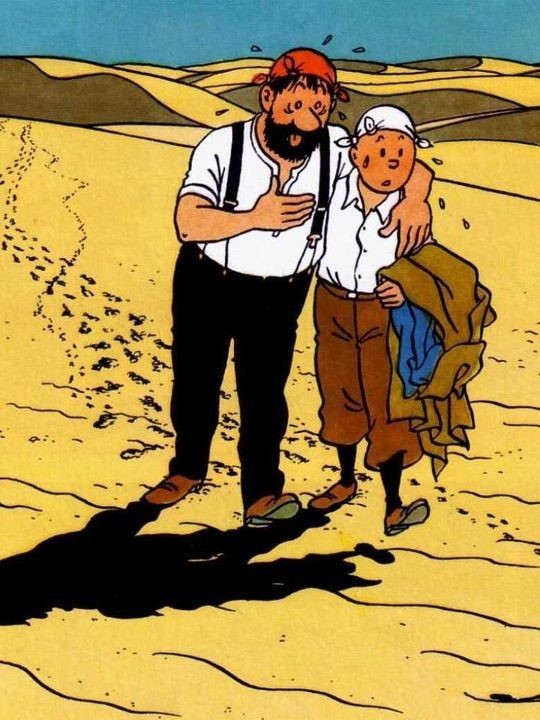
Captain Haddock is not introduced until the ninth album, in The Crab With The Golden Claws (Le Crabe aux pinces d’or, 1941). The character is a golden find from Hergé. The impulsive, physical and upbeat Haddock gives an esprit which the colourless, one-dimensional straight man Tintin simply lacks, much like the bloodless Asterix needs a funny man Obelix , like the upright Dean Martin only becomes amusing thanks to Jerry Lewis.
In that first album with Haddock, Hergé immediately creates an iconic image in an iconic scene. On page 26 the plane with Tintin and Haddock makes a crash landing. In Spain, they think. However, a little later they find the skeleton of a dromedary. But, Haddock deduces, that means we are not in Spain. But in the Sahara. And that animal has died of … he is not capable of saying the horrible word and faints when Tintin finishes his sentence: “… died of thirst, of course.”
The nightmare of the excessive drunk Haddock: The Land of Thirst. The next one-and-a-half pages, the distraught sponge only has one line of text. No matter what Tintin says, whatever happens, Haddock vacantly glazes into the distance and mechanically repeats (five times): “The land of thirst …”
It is too hard, too awful, too much of nothing – and that will make a man feel ill at ease.
Horror vacui, the dismay of the captain is called, the fear of the empty. According to Aristotle, a natural science phenomenon that explains why nature does not allow emptiness, and it was a long accepted explanation until it was refuted in 1614 by Evangelista Torricelli’s experiments with vacuum. The term, however, is too good to be wasted and is maintained, for example for the visual arts (the urge to leave nothing empty on a painting) and philosophy (the drive to find an answer for every question).
Dylan’s lyrics do not seem very eloborate and developed, but if we take it seriously, the approach is: psychological. An excess of nothing makes a person tense, insensitive, vicious, deceitful, turns him, in short, into a particularly unpleasant fellow. But, as mentioned, not very elaborated. Presumably this is also one of those lyrics that Dylan quickly rattles out of his old typewriter in the living room of the Big Pink, while the guys from The Band downstairs prepare the stuff for the next session.
All analysts point to T.S. Eliot, because of those two names in the chorus. Valerie and Vivian indeed are the two women in the life of the Nobel Prize-winning British-American writer. As far as Eliot’s work is concerned, Dylan has been pretty dismissive for a long time. Back in 1965 still distinctly hostile, even:
“You read Robert Frost’s The Two Roads, you read T. S. Eliot – you read all that bullshit and that’s just bad, man, It’s not good. It’s not anything hard, it’s just soft-boiled egg shit.”
In 1966 still not very tolerant:
“Carl Sandburg and T. S. Eliot aren’t poets. Their words don’t sing. They don’t come off the paper. They’re just super-romantic refugees who would like to live in the past. I never did admire them.”
And in 1978 Dylan also regards him one of those poets who ‘assume they know something you don’t know’, he thinks Eliot is presumptuous.
In the years that follow, there is apparently a revaluation. In Chronicles T.S. Eliot is mentioned twice. One time outright positively: I liked T. S. Eliot. He was worth reading, and the other time Dylan refers to a work:
T.S. Eliot wrote a poem once where there were people walking to and fro, and everybody taking the opposite direction was appearing to be running away. That’s what it looked like that night and often would for some time to come.
The revaluation is unexpected and at least as remarkable is the small misleading that Dylan undertakes once again. The Eliot text to which Dylan refers does not come from a poem, but from a little known play, from The Family Reunion (1939):
Agatha:
In a world of fugitives
The person taking the opposite direction
Will appear to run away
This careless assignment fits into a pattern; Chronicles is so interspersed with erroneous references and incorrect assignments that it must be a conscious strategy. Dylan also talks about Pericles’ Ideal State Of Democracy (the statesman and general Pericles never wrote any book at all), Tacitus’ Letters to Brutus (which do simply not exist, in the days of Tacitus Brutus had been dead for two hundred years) and he mentions Sophocles’ book on the nature and function of the gods – Sophocles really only writes tragedies and has never written such a book. (Hesiod did, but he lived about three centuries earlier). And also in interviews he frequently screws up names, titles and works.
Not too important. What is interesting is Dylan’s final recognition of T.S. Eliot, and thus indirectly the recognition of what others have been saying for a long time: that there are really some lines to be drawn between both Nobel laureates. Perhaps not content-wise, although some overlap can be found. The famous ‘in the room the women come and go’ from The Love Song Or Alfred J. Prufrock for example, which echoes in “All Along The Watchtower” and the name-check in “Desolation Row”, of course. But the most striking similarity is the working method, the artistic vision of both literary geniuses.
T.S. Eliot is the mint master of the much-quoted immature poets imitate; mature poets steal and practices it, too. His chef d’oeuvre The Waste Lands is an amalgam of paraphrased quotes from both the ‘high-culture’ and the ‘low-culture’, a cross-border masterpiece in which snippets from among others Shakespeare, Wagner, Dante, the Bible but also from popular schlager music and old folk songs are processed. Indeed: exactly like his soul mate Dylan operates – mature poets do steal.
For the masterly, sketchy miniature “Too Much Of Nothing” Dylan seems to have browsed through his Collected Works of Shakespeare, admitting Bible scraps and reflections from Greek myths in between.
The title echoes Much Ado About Nothing, the overall mood breathes King Lear. The alienating word combination abuse a king can only be found once in the world literature; in Shakespeare’s Pericles, Prince Of Tyre (‘Peace, peace, and give experience tongue / They do abuse the king that flatter him’) just like the bizarre to eat fire is unique; the only known corresponding act is Portia’s horrible suicide from the fourth act of Julius Caesar (‘she fell distract and, her attendants absent, swallowed fire’).
Ill at ease is the old-fashioned phrase that Cassio uses in Othello, Leontes in The Winter’s Tale dreads sleeping on a bed of nails, and words like temper, to mock, oblivion and confession have never been used by Dylan before, but are found hundreds of times at Shakespeare.
Only the beautiful line Now, it’s all been done before / It’s all been written in the book does not seem to have been stolen from Shakespeare, but inspired by the Bible: ‘The thing that hath been, it is that which shall be; and that which is done is that which shall be done: and there is no new thing under the sun.’ (Ecclesiastes 1: 9). And Shakespeare also mentions those waters of oblivion, but the origin is much older, of course; by that, the Ancient Greeks meant the River of Forgetfullness, the Lethe, in the underworld.
The magical beauty of T.S. Eliot’s and Dylan’s works lies within the coherent, poetic image that rises from all these odds and ends, the fascination within its multifaceted nature.
Here, in this song, a fatigue is worded lyrically, that much is clear – but whereof? Is this narrator fed up with materialism, with our consumption-oriented society? Could be. Dylan writes this in 1967, anti-materialism is in the air and those few more serious songs he so seemingly effortlessly plucks from that same air, these days, all describe emptiness, desolation, dissociation: “I’m Not There”, “This Wheel’s On Fire”, “Tears Of Rage”,”One Man’s Loss” and, in a way, “I Shall Be Released” too.
The chorus with greetings to Valerie and Vivian pushes all surrounding imagery in a different direction: to a blues-like lamento of the bitter lover, of a narrator who is discouraged by the empty-headedness, or the disinterest of his beloved.
Confusing is the use of the preposition in the refrain. ‘Send them all my salary / On the waters of oblivion’? Are Vivian and Valerie forgotten, in the dustbin of history, floating around on the waters of oblivion? But then: how would he remember their names, and some moral obligation to send them money? Now the storyteller seems to sing something like ship my money to them disremembered ladies of bygone days – it is either a paradox or an anacoluthon, an ungrammatical sentence.
Well, apparently, the poet prefers a nicely flowing verse line over syntax.
Just as easily the song poet dashes off, once again, a beautiful melody. Since The Basement Tapes Complete (2014) we know for sure that Dylan in these summer months, like a Mozart, has access to an inexhaustible Source of Beautiful Melodies. All those sketches and shreds that are indifferently left behind on the cellar floor … every other artist would have, like a Salieri, thanked God for ideas like “On A Rainy Afternoon”, “I’m Guilty Of Loving You” or “Wild Wolf”, not to mention “Sign On The Cross” and “I’m Not There” – but Wolfgang Amadeus Dylan chews on it once and spits them out again.
“Too Much Of Nothing” escapes the cornfield. It belongs to the fourteen songs manager Albert Grossman takes to the market and it is the first Basement song to get an official release, as Peter, Paul And Mary record it in the late summer of ’67. They even score a hit with it, in November. Some created legend surrounds that recording. The trio changes Vivian into Marion – the name of my aunt, according to Noel ‘Paul’ Stookey – and that is said to have displeased Dylan, would have led to the final estrangement between the poet and the trio that had once established his name (with their recording of “Blowin’ In The Wind”).
That slightly sensational story is eagerly pumped around, among others by a repentant Stookey himself, in Kathleen Mackay’s Intimate Insights from Friends and Fellow Musicians (2010):
“We blew Dylan’s rhyme scheme of Vivian,” Stookey admitted. “Dylan never said anything. We never copped to it. But as a songwriter myself, I can imagine that you write a chorus with alliteration and poetic quality, and it all hangs on the name Vivian, then you hear Marion and say ‘what’s that?’”
Yeah, well. Maybe so. But not very likely. In general, Dylan does not seem very sensitive to what others are doing to his songs. Manfred Mann only phonetically imitates “Quinn The Eskimo”, female colleagues often change she and him and he and her, even at the expense of rhyme, Joan Baez loses the alliteration of “Mama You Been On My Mind” with “Daddy You Been On My Mind” and Dylan himself is just about the first to disrespect his own lyrics; he changes them continuously and is rarely text-proof when, during concerts, he surprises his audience with some forgotten gem from the lower shelves.
An alleged discomfort with the cover by Peter, Paul And Mary can not be attributed to its quality either. It is actually a surprisingly good, beautifully layered version of a song of which they really only had a rather sketchy example. The usual pitfall of the trio – smoothed out, all too clean covers – is avoided by allowing raffled edges; the drummer as well as the harmonica player and the guitarist are unleashed in the couplets, the contrast with the stillness and the superior harmonies in the chorus causes goose bumps (on Late Again, 1968). It is too short, the only downside. And Marion, well, Marion really is not that important.
Among the colleagues the song is not popular anymore. Following Peter, Paul And Mary, there is a short boom, in 1970. The British folk rockers of around Sandy Denny, Fotheringay, record a nice, but somewhat redundant version for their nameless debut album. The same applies to The New Seekers, on their likewise unnamed debut album, also in 1970; nice, but barely different from Peter, Paul And Mary – including Vivian’s name change.
Distinctive is the slightly psychedelic approach of the obscure British progrock group Five Day Rain (1970, again), whose multicoloured cover resurfaces more than thirty years later, as a bonus track on the CD release of their only, self-titled album – it has a very attractive, very timely charm.
Just as dated, but with an exciting soul injection, is the version by Spooky Tooth, on their underrated debut album It’s All About (1968). For the reissue from 1971, with the new title Tobacco Road, “Too Much Of Nothing” is replaced by a successful cover of “The Weight”, an upgrade, indeed.
After 1970 the song evaporates more or less. A single tribute band on YouTube, the inevitable reverence by Robyn Hitchcock (very nice though, a drawling live version from The Basement in Sydney, 2014), but that does not really count – the song is, just like Vivian, floating away on the Waters of Oblivion, drying up in the Land of the Thirst.
An index to our latest posts arranged by themes and subjects on the home page. You can also see details of our main sections on this site at the top of this page under the picture.
There is an alphabetic index to the 550+ Dylan compositions reviewed on the site which you will find it here. There are also 500+ other articles on different issues relating to Dylan. The other subject areas are also shown at the top under the picture.
We also have a discussion group “Untold Dylan” on Facebook which mostly relates to Bob Dylan today. Just type the phrase “Untold Dylan” in, on your Facebook page or follow this link
And please do note The Bob Dylan Project, which lists every Dylan song in alphabetical order, and has links to licensed recordings and performances by Dylan and by other artists, is starting to link back to our reviews.
By Tony Attwood, with research by Jochen Markhorst
Of late I have been writing about some of the songs that Bob Dylan appears to have a particular affection for. There’s a list of the other songs already covered in this series; today it is Uncloudy Day.
In many ways you only have to listen to the opening ten seconds of the recording that Bob Dylan mentions in interviews to realise this is going to be something very different. And as you listen to this recording below, do remember it was made in 1956 – before the writing (or at least the writing that we still have recordings) of Bob Dylan the song creator, had started.
https://youtu.be/TmBNuNNnGHY
And it is not the lyrics that stop us in our tracks, although they are certainly arresting, for it is quite possible to go through the whole song without considering the words at all. And in case you just have here is the opening…
Wo oh they tell me of a home where no storm clouds riseWo oh they tell me of a home far away so far away Wo oh they tell me of a home where no storm clouds riseWo wo they tell me of an unclouded day
Incidentally the lyrics sites that have this song listed tend to give a different version of the lyrics from that on the recording – even when they cite the Staple Singers. That doesn’t really matter but if you want the exact version of this song – the one Dylan listened to, then these lyrics are not right.
The reason for the lyrical variation is the age of the song – it was written by Josiah Kelley Alwood in 1879 as a hymn. Alwood was known as one of the “circuit riding” preachers who was later an elder in the North Ohio Conference of the United Brethren Church. At the end of the century Alwood wrote about the writing of the song in A Rainbow at Midnight and A Song With Morning
It was a balmy night in August 1879, when returning from a debate in Spring Hill, Ohio, to my home in Morenci, Michigan, about 1:00 a.m. I saw a beautiful rainbow north by northwest against a dense black nimbus cloud. The sky was all perfectly clear except this dark cloud which covered about forty degrees of the horizon and extended about halfway to the zenith. The phenomenon was entirely new to me and my nerves refreshed by the balmy air and the lovely sight. Old Morpheus was playing his sweetest lullaby. Another mile of travel, a few moments of time, a fellow of my size was ensconced in sweet home and wrapped in sweet sleep. A first class know-nothing till rosy-sweet morning was wide over the fields.
To awake and look abroad and remember the night was to be filled with sweet melody. A while at the organ brought forth a piece of music now known as “The Unclouded Day.” A Day and a half was bestowed on the four stanzas.
But it was The Staple Singers version of the song from 1956 that turned Bob on, with Mavis Staples providing the lead. The song was also performed by Phish at Farm Aid – Dylan’s favourite charity it seems, in 1998.
Many others have taken it up since including Johnny Cash, Brenda Lee, and The Blind Boys of Alabama.
Here are what I think are the original lyrics from the composer of the song…
O they tell me of a home far beyond the skies,
O they tell me of a home far away;
O they tell me of a home where no storm clouds rise,
O they tell me of an unclouded day.
O the land of cloudless day,
O the land of an unclouded day,
O they tell me of a home where no storm clouds rise,
O they tell me of an unclouded day.
O they tell me of a home where my friends have gone,
O they tell me of that land far away,
Where the tree of life in eternal bloom
Sheds its fragrance through the unclouded day.
O they tell me of a King in His beauty there,
And they tell me that mine eyes shall behold
Where He sits on the throne that is whiter than snow,
In the city that is made of gold.
O they tell me that He smiles on His children there,
And His smile drives their sorrows all away;
And they tell me that no tears ever come again
In that lovely land of unclouded day.
Bob has told the story of hearing the Staple Singers version of the song when he was a youngster:
“..it was the most mysterious thing I’d ever heard. It was like the fog rolling in. I heard it again, maybe the next night, and its mystery had even deepened. What was that? How do you make that? It just went through me like my body was invisible. What is that? A tremolo guitar? What’s a tremolo guitar? I had no idea, I’d never seen one. And what kind of clapping is that? And that singer is pulling things out of my soul that I never knew were there. After hearing “Uncloudy Day” for the second time, I don’t think I could even sleep that night. I knew these Staple Singers were different than any other gospel group. But who were they anyway?
I’d think about them even at my school desk. I managed to get down to the Twin Cities and get my hands on an LP of the Staple Singers, and one of the songs on it was “Uncloudy Day.” And I’m like, “Man!” I looked at the cover and studied it, like people used to do with covers of records. I knew who Mavis was without having to be told. I knew it was she who was singing the lead part. I knew who Pops was. All the information was on the back of the record. Not much, but enough to let me in just a little ways. Mavis looked to be about the same age as me in her picture. Her singing just knocked me out. I listened to the Staple Singers a lot. Certainly more than any other gospel group. I like spiritual songs. They struck me as truthful and serious. They brought me down to earth and they lifted me up all in the same moment. And Mavis was a great singer — deep and mysterious. And even at the young age, I felt that life itself was a mystery….
“…So I had seen this picture of the Staple Singers. And I said to myself, “You know, one day you’ll be standing there with your arm around that girl.” I remember thinking that. Ten years later, there I was — with my arm around her. But it felt so natural. Felt like I’d been there before, many times. Well I was, in my mind.
Bob returned to this subject when introducing the song again in May 2006, adding
“Tremolo guitar bar – that’s one of the hardest things to master if you’re a singer – the tremolo bar. It’s hardly ever used, you won’t hear anybody use it, because it’s very hard to control. But when you use it the right way, it can be a very beautiful effect, as we can hear from Pop Staples and The Staple Singers, singing “Uncloudy Day.”
But I think we have to remember something else. Listening today in 2019, I am amazed by this sound, and need to play it over and over again to get the hang it, to understand it, to encompass its meaning. And after a lifetime of listening to and playing music I know what’s going on here. But still I was absolutely stopped in my tracks when I listened.
So what must it have been like when Bob heard it in 1956? No wonder he was totally knocked out.
The Staple Singers could have sung it unaccompanied, or with a standard accompaniment, and each time it would have been something very special. But this… this is something else. Like a bolt from the heavens.
To finish, here are the Blind Boys with their utterly different version.
Bob Dylan And William Saroyan: A Thousand Miles From Sure
By Larry Fyffe
Ramblin’ Jack Elliott performs the satirical song ‘Acne’ with the young Bob Dylan on radio. Elliott’s well known for a rendition of a traditional folk song that a country singer makes a big hit with – Bobby Bare sings the following words in a live performance:
Can't remember when I ateIt's just thumbs and walk and waitAnd I'm still five hundred miles away from homeIf my luck had just been rightI'd be with them all tonightBut I'm still a five thousand miles away from home
(Bobby Bare: Five Hundred Miles Away From Home)
The song’s quite similar to the following fiddle and blue grass tune:
Oh me, oh my, you could hear the whistle blow a hundred milesLast night I lay in jail, had no money to go my bailLord, how it sleeted, and it snowedOh me, oh my, how it sleeted, and it snowedI've been to the East, I've been to the WestI'm going where the chilly winds don't blow
(Doc Watson: Reuben’s Train)
Singer/ songwriter writer Bob Dylan takes a word sample:
Well, I been to the East, and I been to the WestAnd I been out where the black winds roarSomehow though I never did get that farWith the girl from the Red River shore
(Bob Dylan: Red River Shore)
And from the same song:
If you miss the train I'm onCount the days I am goneYou can hear the whistle blow a hundred milesA hundred miles, Lord, Lord, LordYou can hear the whistle blow a hundred miles (Bob Dylan: I Was Young When I Left Home)
The folk song begins:
Ol' Reuben made a train, and he put it on the trackHe ran it to the Lord knows whereOh me, oh my, ran it to the Lord know knows where
(Reuben’s Train)
You can hear its echo in the Wilf Carter-like yodelling song below:
I thought I heard that steamboat whistle blowin'And she blowed like she never blowed beforeI'm afraid my little lover's on that boatI'm afraid my little lover's on that boatAnd it will take her to the Lord's knows where
(Shirkey and Harper: Steamboat Man)
And in the Dylan song:
Listen to that Duquesne whistle blowingBlowing like she never blowed before ....Listen to that Duquesne whistle blowingBlowing like my woman's on board(Bob Dylan: Duquesne Whistle ~ Dylan/Hunter)
Likely a coincidence, Bobby Bare’s “five thousand miles away from home’ appears in the a one-act play ‘My Heart’s In The Highlands’ by William Saroyan. The drama is a romantic comedy with an Existentialist absurdist bent, featuring a struggling and moneyless poet, and his son Johnny. Also, orphaned Henry, the adopted, aways whistling, newspaper boy, and Macgregor, an ever-hungry, singing Scotsman who says he’s forever dreaming of his homeland:
"I reckon I'm five thousand miles from home.Do you think we could eat a little bread and cheeseto keep my body and spirit together?"
(My Heart’s In The Highlands: William Saroyan)
Saroyan’s an optimistic humanist in the days of the Great Depression, and his creative works impact Dylan’s own. Below is a famous aphorism by the writer and dramatist :
"Good people are good because they've come to wisdom through failure.We get very little wisdom from success, you know."
(William Saroyan)
Sings Bob Dylan:
Some speak of the futureMy love, she speaks softlyShe knows that there's no success like failureAnd that failure's no success at all
(Bob Dylan: Love Minus Zero)
And then there’s the absurdly humourous:
I said, "Tell me what I want"She say, "You probably want some hard-boiled eggs"I said, "That's right, bring me some"She say, "We ain't got any, you picked the wrong place to come"
T Bone Burnett is a fan. A great find is “Just Dropped In” in the performance of Kenny Rogers & The First Edition under the psychedelic trip scene in The Big Lebowski. When the popular ‘multimedia platform’ Garden & Gun asks for a ‘Smoking Southern Playlist’ in 2018, Burnett selects ten songs, with Mickey Newbury’s “Nights When I Am Sane” gracing the list among classics like “Wade In The Water” from The Staple Singers and Hoagy Carmichael’s “Lazy River”. And in January 2019 T Bone comes full circle when he chooses “Just Dropped In” for the ambitious, masterful hit series True Detective, this time in a newer version by Mickey Newbury himself (over the credits of season 3, episode 1).
Mickey Newbury is a great artist, though first and foremost a musician’s musician, a highly acclaimed songwriter who makes beautiful records and beautiful songs, but his money is mainly earned thanks to the royalties of the covers. Keith Richards, Joan Baez, Johnny Cash, Jerry Lee Lewis, Etta James, Roy Orbison … not small fry either, the artists who cover his songs. And towering above everything and everyone, of course, is Elvis, who elevates Newbury’s “An American Trilogy” to the canon.
Dylan met him at least once, on that memorable evening in the spring of 1969 at Johnny Cash’s home, where after dinner some of the world’s best songwriters gather around the fireplace:
“I was having dinner at Johnny Cash’s house outside of Nashville. There were a lot of songwriters there. Joni Mitchell, Graham Nash, Harlan Howard, Kris Kristofferson, Mickey Newberry [sic] and some others. (…) We sat in a circle and each songwriter would play a song and pass the guitar to the next player. (…) I played “Lay, Lady, Lay” and then I passed the guitar to Graham Nash.”
(Chronicles)
Graham Nash recalls it slightly differently, of course attributing a leading role to himself again. Johnny Cash instructs his guests to play a song.
“Nobody moved. Bob was sitting on the stairs with Sara, and both of them looked uncomfortable. Mickey Newbury, a famous songwriter from Nashville, was there; so was Kris Kristofferson, and of course Joni and me. Everyone stared at those guitars as if they were radioactive.”
But Graham feels ‘ridiculously’ confident and thinks: Fuck it – I’ll get up.
“So I grabbed a guitar, sat on the stool, and whipped off a version of “Marrakesh Express”. All abooooard … I hit the last chord, knew I’d killed it, put the guitar back on the stand … and walked right into a standing lamp that went crashing to the floor.”
(Wild Tales, A Rock & Roll Life)
That breaks the ice, everyone laughs, Dylan now overcomes his reticence and plays “Lay Lady Lay” and “Don’t Think Twice”. Kristofferson plays “Sunday Morning Coming Down”, Joni Mitchell “Both Sides Now”. What Mickey Newbury plays Nash does not disclose, but he has to be given credit for spelling his name correctly, unlike Dylan.
Newbury’s masterpiece Looks Like Rain is to be released half a year later, and it is an obvious guess he performs the highlight of that album, the magical folk song “San Francisco Mabel Joy”.
The record contains only beautiful songs (“She Even Woke Me Up To Say Goodbye”, “The Thirty-Third Of August”, to name but two of the most covered ones), but the Dylan fan especially jumps up at “T. Total Tommy”. Although the title suggests an ode to the country and bluegrass legend Tom T. Hall, the first verse already makes clear that Newbury targets Dylan:
To the sad-eyed misinterpreted Hung-up child of clay So the drunken poet’s pretty words Didn’t help you find your way
… and the chorus gives away which style figure from the intimate living room concert resonates with Mickey:
T Total Tommy took a toke of tea Black cats backin’ up a big oak tree Tick tocks ticking out a tune on time Last words looking for a line to rhyme Saw fish swimming in the sea-saw-sea But me, well, I’m only looking
https://www.youtube.com/watch?v=lWg4boYuql4
(In the recording above the song per se starts on 57 seconds).
A frantically alliterating chorus, concluded with a nod to “It’s Alright Ma (I’m Only Bleeding)” (the next chorus ends with I’m only crying), and in between some more Dylan references and paraphrases.
Newbury has heard Dylan singing Lay lady lay across my big brass bed a couple of times and apparently thinks this intrusive initial rhyming is typically enough to copy into his Dylan pastiche. Understandable, but not quite a direct hit; Alliteration has been a popular figure of style for centuries and every songwriter sooner or later succumbs to it.
This same evening, Mickey also hears how Graham Nash’s Colored cottons hang in air / Charming cobras in the square, that Joni Mitchell sings And ice cream castles in the air / and feather canyons everywhere, not to mention the Actual Apostle of Alliteration, Kris Kristofferson:
Well I woke up Sunday morning With no way to hold my head, that didn’t hurt And the beer I had for breakfast wasn’t bad
Other, just as little reliable sources, say Kristofferson is playing “Me And Bobby McGee” that evening. Makes no difference – that song also has an initial rhyme in almost every line of verse.
Anyway: Newbury associates letter rhyming with Dylan.
Dylan himself attributes the opening words to creative poverty, as he reveals in the Biograph booklet. “The song came out of those first four chords. I filled it up with the lyrics then, the la la la type thing, well that turned into Lay Lady Lay, it’s the same thing with the tongue, that’s all it was really.”
The continuation, lay across my big brass bed, can just as little be attributed to a fresh, original flash:
I take it to my room and lay it ‘cross my big brass bed I take it to my room and lay it ‘cross my big brass bed I guess I’ll be my own singer, neighbours turn cherry red
… from “Rough Alley Blues” (1931), from the man who could the sing the blues like nobody can, Blind Willie McTell.
Nor can the rest of the lyrics be accused of Nobel worthy new poetic expressions, or any other literary shine, for that matter. Dylan himself is not too content with it either, according to the same Biograph commentary. Columbia Records president Clive Davis wants to release the song as a single. “I begged and pleaded with him not to. I never felt too close to the song, or thought it was representative of anything I do.”
In interviews he makes similar remarks (“There may be better singles in the fresh material,” Melody Maker, August 1969), and also more precise ones:
“I rewrote “Lay, Lady, Lay”, too.. (…) A lot of words to that song have changed. I recorded it originally surrounded by a bunch of other songs on the Nashville Skyline album. That was the tone of the session. Once everything was set, that was the way it came out. And it was fine for that time, but I always had a feeling there was more to the song than that.”
(Playboy interview, november 1977)
Whether Dylan has indeed found more in the song is debatable. During the Rolling Thunder Revue and in the Hard Rain version, a few lines have changed, that much is true. A hollow cliché like You can have your cake and eat it too has been replaced by the not much stronger You can love, but you might lose it, for example (but resurfaces on other nights on other places in the song). On Hard Rain a total of 78 (out of 171) words are different, so yes, okay, a lot of words have changed. And: those performances are done with an overwhelming extra shot of love, with energy and a compelling urgency – and that certainly benefits the song.
The alleged missing warmth or representativeness is not that big an issue anymore, evidently; Dylan has played the song more than 400 times, plays it still in the twenty-first century, pushing “Lay Lady Lay” into his personal Top 50.
Enough colleagues who feel warmth for the song, too. “Lay Lady Lay” has fans like Madonna, The Everly Brothers and Duran Duran, apparently touching more artists than just the usual suspects like The Byrds, Richie Havens or Melanie. Many more artists even; the song is probably in a (non-existing) Top 20 of most covered Dylan songs.
Magnet’s fascinating, atmospheric version (with a wonderful guest contribution by Gemma Hayes, for the soundtrack of Mr. & Mrs. Smith, 2005) is rightly praised.
The industrial grunge approach by Ministry is distinctive, to say the least (on Filth Pig, 1996) and actually has the Lure of the Forbidden.
But in the end, a laid-back, sultry approach fits the song best. Like Buddy Guy (Bring ‘Em In, 2005) or the one by Cher (for safety reasons changed to “Lay Baby Lay”), on her exquisite, staggeringly disregarded album 3614 Jackson Highway (1969), produced in the well-known Muscle Shoals Studio, Sheffield Alabama, by grandmaster Jerry Wexler.
The ultimate swoon away version should, obviously, have come from Barry White, but The Walrus Of Love breaches his duties. He is excellently replaced by Isaac Hayes though, on the beautiful tribute album Tangled Up In Blues, 1999. Somewhat over the sultriest top, yes, but for once, only this one time, it is allowed.
An index to our latest posts arranged by themes and subjects on the home page. You can also see details of our main sections on this site at the top of this page under the picture.
There is an alphabetic index to the 550+ Dylan compositions reviewed on the site which you will find it here. There are also 500+ other articles on different issues relating to Dylan. The other subject areas are also shown at the top under the picture.
We also have a discussion group “Untold Dylan” on Facebook which mostly relates to Bob Dylan today. Just type the phrase “Untold Dylan” in, on your Facebook page or follow this link
And please do note The Bob Dylan Project, which lists every Dylan song in alphabetical order, and has links to licensed recordings and performances by Dylan and by other artists, is starting to link back to our reviews.
‘The Daring Young Man On The Flying Trapeze’ is a short story by William Saroyan, based on a song by the same name, in which a struggling and starving writer performs the amazing feat of surviving on cigarettes and coffee, until he’s mercifully released from his life of sorrow by death into the eternity of nothingness after falling on his bed – only in his dreams does he find any happiness:
He'd fly through the air with the greatest of easThe daring young man on the flying trapeze
(Bruce Springsteen: The Daring Young Man On The Flying Trapeze ~
Leybourne/Lyle)
Below, a song that features circus performers – they be signs that the end of the world as we know is approaching:
Fifteen jugglersFifteen jugglersFive believersFive believersAll dressed like menTell your mama not to worryBecause this is just my friend
(Bob Dylan: Obviously Five Believers)
It doesn’t sound like these ‘believers’ represent those who will be awarded the Five Crowns for their faith in the biblical Lord of Heaven.
The crown of life:
Blessed is the man that endure the temptationFor when he is tried, he shall receive the crown of lifeWhich the Lord hath promised to them that love Him
(James 1:12)
The crown of glory:
And when the chief Shepherd shall appearYe shall receive a crown of gloryThat fadeth not away
(I Peter 5:4)
The crown of rejoicing:
For what is our hope, or joy, or crown of rejoicing?Are not even ye in the presence of our Lord Jesus Christat His coming?
(I Thessalonians 2:19)
The crown of incorruption:
And every man that strive the for the mastery is temperatein all thingsNow they do it to obtain a corruptible crownBut we an incorruptible
(I Corinthians 9:25)
The crown of righteousness:
Henceforth there is laid up for me a crown of righteousnessWhich the Lord, the righteous judge, shall give me at that dayAnd not to me only But unto all them also that love His appearing
(II Timothy 4:8)
There may be those who can become five-star believers; however, they’re obviously not the five men hanging around with the fifteen jugglers.
A number of times, singer/songwriter Bob Dylan employs the motif of the circus in his examination of the dire conditions of human existence:
Once upon, you dressed so fineYou threw the bums a dime in your prime, didn't you?People'd call, say, "Beware doll, you're bound to fall"You thought they were all kiddin' you .....You never turned around to see the frownsOn the jugglers and the clownsWhen they all come down, and did tricks for you
(Bob Dylan: Like A Rolling Stone)
The circus is dark, and many people want to run away from it:
Here comes the blind commissioner, they've got him in a tranceOne hand is tied to the tight-rope walker, the other is in his pantsAnd the riot squad, they're restless, they need somewhere to goAs Lady and I look out tonight from Desolation Row
(Bob Dylan: Desolation Row)
In this modern Babylon, there’s no rejoicing – only sinful morality, and corrupt laws:
The judge, he holds a grudgeHe's gonna call on youBut he's badly builtAnd he walks on stiltsWatch out he don't fall on you
(Bob Dylan: Most Likely You Go Your Way And I’ll Go Mine)
For the participants bound in the Existentialist circus ring of mighty Babylon, where enough’s enough, resistance is futile :
Walk upside down inside handcuffsKick my legs to crash it offSay, "Okay, I've had enoughWhat else can you show me?
(Bob Dylan: It’s Alright Ma)
It’s an Archibald MacLeish circus out there:
Quite unexpectedly as VasserotThe armless ambidextrian was lightingA match between his great and second toeAnd Ralph the Lions was engaged in bitingThe neck of Madame Sossman while the drumPointed, and Teeny was about to coughIn waltz time swinging Jocko by his thumb Quite unexpectedly the top blew off
(Archibald MacLeish: The End Of The World)
What else is here?
An index to our latest posts arranged by themes and subjects on the home page. You can also see details of our main sections on this site at the top of this page under the picture.
There is an alphabetic index to the 550+ Dylan compositions reviewed on the site which you will find it here. There are also 500+ other articles on different issues relating to Dylan. The other subject areas are also shown at the top under the picture.
We also have a discussion group “Untold Dylan” on Facebook which mostly relates to Bob Dylan today. Just type the phrase “Untold Dylan” in, on your Facebook page or follow this link
And please do note The Bob Dylan Project, which lists every Dylan song in alphabetical order, and has links to licensed recordings and performances by Dylan and by other artists, is starting to link back to our reviews.
I’m not the first to approach this question. Ever since Dylan’s Christian period (1979 – 81) that question has been asked, and was raised again by the box set compilation of live and studio recordings, Trouble no More, released a couple of years ago.
My answer to the question is a qualified yes, non-Christians can relate to the Christian period, but to begin with, let’s look at the opposing case. At the time, John Lennon reacted with sarcasm to Dylan’s ‘You Gotta Serve Somebody.’ Was this black or white, good or bad message really coming from the master of nauance and shades of irony, creater of such subtle works of genius as Visions of Johanna, rock’s cynic in chief? Lennon lampooned the song with a riposte of his own, ‘Serve Yourself’ – hardly Lennon’s greatest work and a bit of flop as far as being a take-off goes, but judge for yourself
https://www.youtube.com/watch?v=oXd25Jqi7G0
This either-or message is stated strongly in ‘Precious Angel’, the second track on Slow Train Coming:
‘Now there's spiritual warfare and flesh and blood breaking down
Ya either got faith or ya got unbelief and there ain't no neutral ground.’
Dylan’s other great peer, Leonard Cohen, also had problems. ‘When Dylan converted to Christianity in the late ’70s Cohen was taken aback, to put it mildly. According to Leonard Cohen biographer Sylvie Simmons, he saw Dylan’s decision as a betrayal of Judaism and it seriously rocked his world. He would hopelessly wander around his house saying “I don’t get it. I just don’t get this. Why would he go for Jesus at a late time like this? I don’t get the Jesus part”. (Marco Zoppas, see http://www.italianinsider.it/?q=node/6653)
This apparent retreat into the simplistic universe of Pentecostal Christianity quickly alienated those who loved the personal and exploratory songs of the seventies, Planet Waves, Blood on the Tracks, Desire, Street Legal – mature and sophisticated songs, if pretty world weary by the time we get to Street Legal in 1978. Hindsight doesn’t help much. These lyrics from ‘Slow Train Coming’ the flagship song of the era, must be the most cringeworthy the Master ever penned. (And please don’t tell me about ‘Neighborhood Bully.’)
‘All that foreign oil controlling American soil
Look around you, it's just bound to make you embarrassed
Sheiks walkin' around like kings, wearing fancy jewels and nose rings
Deciding America's future from Amsterdam and to Paris’
Not only is this a distorted view of the world (foreign oil never controlled American soil) but is racist (those nose rings which sheiks don’t wear, is clearly a slur), and in these sentiments we can find the origins of what, in Trump’s America, we can call Christain Nationalism. A particulary nasty varient of the religion in which Trump is seen as appointed by God to lead America back into fossil fuel dominance of the world. See scary essay on Mike Pense and the dominionists:
And yet, in fairness, other lyrics in that same song seem to hark back to the Dylan who speaks out fearlessly against social injustices:
‘People starving and thirsting, grain elevators are bursting
Oh, you know it costs more to store the food than it does to give it.’
The song pumps along like a real Dylan classic, but what’s the message?
‘I don't care about economy, I don't care about astronomy
But it sure do bother me to see my loved ones turning into puppets…’
Isn’t it you, Bob, turning into a puppet? That do bother me. Who are the real men-stealers?
To make matters worse, Dylan didn’t appear to grasp Christianity’s golden rule: do unto others as you would have others do unto you. Dylan reverses the message:
‘If you do right to me, baby
I’ll do right to you too…’
(Do Right To Me)
No Bob, respectfully, doing right to her is not conditional on her doing right to you.
So what can be salvaged? As it turns out, quite a lot. To start with, most of these songs are great rockers in the gospel tradition, and Dylan is in wonderful voice. We could have a lot of arguments about this, but for my money, Dylan’s peak performance years were 1980 -81, and a lot of these songs are solid tub-thumpers. Unless you’re a real wet blanket, it’s hard to not get up and dance to songs like ‘Cover Down’. Watch it, next you’ll be clapping your hands and shouting halleluiah!
Some vocal performances during this period are Dylan’s greatest. ‘I Believe In You’, an almost hysterical assertion of faith, puts Dylan up there with the greatest male vocalists of all time, Ray Charles, Frank Sinatra, take your pick. An extra bonus for the non-believer here is that this song could be heard as a love song to a woman. Just quietly put Jesus aside for a moment and we have one of Dylan’s greatest love songs:
‘I believe in you even through the tears and the laughter
I believe in you even though we be apart
I believe in you even on the morning after
Oh, when the dawn is nearing
Oh, when the night is disappearing
Oh, this feeling is still here in my heart’
We seem to know that ‘morning after’; we catch it in songs as diverse as ‘One Too Many Mornings’ and ‘A Simple Twist of Fate’, and the disappearing night haunts the last verse of Visions of Johanna.
( I believe in you)
‘If you’ve ever felt the pain of time and the loss of years this song is for you,’ writes Noah Joel, one of comments following the You Tube clip of the 1980 Toronto concert. Yes sir!
Let’s take a step back and think about Ray Charles again for a moment. Charles is credited with bringing the rhythms, cadences and chord changes of church music into the profane world of jazz and rock, and was attacked by Christians for doing so. Charles sexualizes church music by stripping it of God and Jesus and getting down to the nitty-gritty – hot orgasmic love. You can hear it in this rocking version of ‘I Got a Woman’. In the middle of the song he breaks into a remarkable series of chants, shouts, yelps, screams and scat-singing that comes right out of the Southern Baptist churches of his childhood. In songs like this we find the origins of modern ecstatic music in jazz and rock.
Ray Charles, I got a woman Newport 1958.
For those who want to take this further, try ‘What I Say’ and listen how the singer works with the back-up singers, the Raylets, to create the chant and response effect that again, comes right out of a foot stomping, tub-thumping, Pentecostal Christianity, but in this case it’s the sexual act that is being celebrated. Religious ecstasy becomes the ecstasy of the flesh. We tend to forget what a furore this music caused. Elvis wriggling his hips was nothing compared to Charles’ reenactment of sex in such songs.
Odd, isn’t it, how this exuberant, blatant celebration of sexuality seems, from this distance quite… well, innocent. Sin is nowhere in sight. Rumour has it that gospel singer Mahalia Jackson turned down big offers to do just what Charles’ did and go over to the dark side; the staunch Mahalia of course refused.
After twenty-five years of thoroughly sexualized rock music, which did little else but celebrate the profane and the sex and drugs and rock and roll culture, along comes a born again Bob Dylan, who reverses Charles by bringing the profane back to the religious. Earthly love gives way to heavenly love, and we’re back in church again. Earthly love becomes a metaphor for heavenly love, but the carnal gets the short shrift. You can hear the tension between the carnal and the divine in songs like the unfinished ‘Yonder comes Sin’, which, while the lyrics are attacking carnality, the music is just too damned sexy for its own good.
My argument here is that unbelievers and men stealers can’t be too precious when it comes religion in the blues/folk/jazz traditions that gave rise to modern rock and the songs of Bob Dylan. All those ‘lordy lords,’ and ‘lord have mercy’ were for real, the Devil might well have been waiting for Robert Johnson at the crossroads, and Saint Peter may well have had some whisky stashed away for Sonny Terry and Brownie McGee – Bob’s Heaven’s Door brew for sure! In other words there is a thorough going interpenetration (ahem!) between the sacred and the profane in modern music. I can enjoy the god inspired gospel songs of Mahalia Jackson as universal expressions of devotion and love, just as I can bliss out with John Coltrane’s suite A Love Supreme without freaking at the god-driven linear notes. No religion can own passion like this. The same applies to the few great Dylan songs that came out of this period.
Every Dylan phase has seen its works of genius, ‘A Hard Rain’ and ‘It’s all Right Ma’ from the protest period; ‘Desolation Row’ and ‘Visions of Johanna’ from his surrealist period; ‘Tangled up in Blue’ and ‘Isis’ from his personal period in the seventies. When it comes to the gospel songs there may be no clear winner, but a cluster of fine creations, among which I would include ‘Every Grain of Sand’, ‘What Can I Do For You’, ‘I believe In You’, ‘Heart of Mine’, and ‘In The Garden’. Not to mention the great unreleased songs of the era, ‘Angelina’, ‘Yonder Comes Sin,’ ‘Let’s Keep It Between Us,’ and the magnificent ‘Making A Liar Out of Me’.
Just, as a non-believer, I can marvel at a creation like Coltrane’s A Love Supreme, so I can marvel at some of great cathedrals and churches that Christianity has inspired. They were built to inspire awe and you’d need a heart of stone not to be touched by them. When I think of cathedrals like Chartres, with their vaulted spaces, I think of Dylan’s ‘In The Garden’ and the cathedral-like spaces the music produces. Before continuing, and launching into this fanciful analogy, I strongly recommend the reader consult Tony Atwood’s excellent account of this song. Not only does he have the musical knowledge to describe the chord sequence which I can only waffle at, but also his sober assessment of the song is at variance with my admiration for it. I think he’s right from his side and I’m right from mine, but everyone has their own Dylan!
It’s best to start with this early performance of the song in 1979. In this slow version you can hear Dylan carefully building his cathedral of sound, an ascending movement, rising action, a plateau, then a descending movement, falling action, before the next rise, with the sequence repeated. Note that the track breaks about 4 mins into the song. All the verses are there, however.
[insert MP3 In The Garden 1979]
This makes me think of the rank of arches holding up the roof of the Chartres Cathedral.
Like this Gothic Architecture, the music creates airy, vaulted spaces upon which the lyrics can create frescos beginning with one of the dramatic moments in the Jesus story, when he is arrested in the Garden of Gethsemane. To get the ‘fresco’ effect, we need to change cathedrals, to the Sistine Chapel in Rome, and have good look at the ceiling.
As an unbeliever, I can be moved by this a stupendous representation of a culture’s mythology; art has it’s own power, almost independent of the beliefs that inspire it.
In more modest way, Dylan attempts a similar feat, using his words to paint his scenes upon the architecture of the music. We are presented with five frescos, highlighting different events in Jesus’ life. Here’s a more confident, sonically richer version.
In the garden, Toronto 1980
By 1988 the song had turned in a tearing rocker. The questions being asked throughout the song turn from an invitation to reflect into a pounding denunciation of all who can’t see and hear and get with the message.
https://www.youtube.com/watch?v=ERS7k0dwKO8
The Jesus that emerges from this song, and others of the period, is perhaps Dylan’s fullest realization of the Outlaw Hero archetype, the despised one, the loner, the criminal. This Outlaw Hero appears as a persona, the narrative ‘I’ in songs like ‘Don’t Think Twice’ – ‘I’m on the dark side of the road’ or as characters presented for our admiration and sympathy. We have Rubin Carter, John Wesley Harding, Joey… space prevent a full account of this, but these heroes culminate in the one who came ‘to die a criminals death.’ It is Jesus as the Outsider that seems to attract Dylan. This is from Precious Angel (my line arrangement, as I hear it):
‘You were telling him about Buddha

you were telling him about Mohammed in the same breath
You never mentioned one time the Man who came

and died a criminal's death.
We have to conclude that what gives Jesus the edge is his criminal status. We begin to see that, just like we all have our own Dylan, Dylan has his own Jesus, a Dylanized Jesus, if you like, and Leonard Cohen’s fretting can be put in context. Dylan’s Outlaw Jesus has a number of qualities, chief among them, and what lies behind the Garden of Gethsemane incident, is the capacity for self-sacrifice, the Noble Crook. Christianity doesn’t have a patent for this strange capacity humans have to act selflessly.
The character Sydney Carton in Charles Dickens’ Tale of Two Cities is an almost perfect Dylan character. Cynic and Nihilist with shady connections, moody and depressive, he is finally prepared to go to the scaffold to save his friends’ lives, and thus have a noble end. The Christians might see Carton as a Jesus figure, and try to monopolize such human traits; as unbelievers, however, we are just as free to secularize Jesus as a representative of a much broader human type. Sacrifice is a motif that appears in number of Dylan songs; the immediately pre-Christian Where are you Tonight is quite explicit:
‘The truth was obscure, too profound and too pure,

to live it you had to explode.
In that last hour of need, we entirely agreed,

sacrifice was the code of the road.’
The Code of the Road, not the code of Jesus or the Bible. When I begin to see Dylan’s Outlaw Jesus within the context of his developing motifs and themes, I don’t feel so intimidated or put off by his tub-thumping assertions, because he’s really mythmaking, just like so many times before, constructing a Jesus out of pre-existing materials. Remember too, he was knocking on heavens door, and using Jesus to castigate the masters of war long before he was converted.
Finally, returning to that simplistic either-or issue with which we began this enquiry, I am beginning to wonder if the liberal insistence that there has to be middle ground, neutral ground, isn’t something of an illusion. Back in the sixties, Dylan would have been well aware of the radical Black Power movement and the pronouncements of another outlaw, Eldridge Cleaver: ‘There is no more neutrality in the world. You either have to be part of the solution, or you’re going to be part of the problem.’
In other words, ‘you gotta serve somebody.’
Kia Ora!
What else is here?
An index to our latest posts arranged by themes and subjects on the home page. You can also see details of our main sections on this site at the top of this page under the picture.
There is an alphabetic index to the 550+ Dylan compositions reviewed on the site which you will find it here. There are also 500+ other articles on different issues relating to Dylan. The other subject areas are also shown at the top under the picture.
We also have a discussion group “Untold Dylan” on Facebook which mostly relates to Bob Dylan today. Just type the phrase “Untold Dylan” in, on your Facebook page or follow this link
And please do note The Bob Dylan Project, which lists every Dylan song in alphabetical order, and has links to licensed recordings and performances by Dylan and by other artists, is starting to link back to our reviews.
To draw the attention of the listener to his thoughts concerning the alienation wrought by an industrialized society, singer/songwriter Bob Dylan compares humans to machines (See:”Bob Dylan And Depersonalization“). He’s not a one-trick pony, however – Dylan presents not so much Grimm fairy tale animals that are human-like, but rather he gives humans animal form:
I got a new ponyShe knows how to fox-trot, lope and paceShe got great big hind legsAnd long black shaggy hair hanging in her face
(Bob Dylan: New Pony)
That is to say – in human social systems, there be the powerful in control, and the powerless under control:
The cat's in the wellThe wolf is looking downHe got a big bushy tailDragging on the ground
(Bob Dylan: Cat’s In the Well)
Mythically speaking, mankind finds himself locked out of the harmonious biblical Garden of Eden, and thrown out into a Gothic-like landscape that’s filled with dark Satanic mills – a sure sign that the Judeo-Christian apocalypse is at hand:
Well, the howling wolf will howl tonightThe king snake will crawlTrees that've stood for a thousand years suddenly will fall ....You know that sometimes Satan comes as a man of peace
(Bob Dylan: Man Of Peace)
Burlesque is a literary tool used for constructing satire – takes a matter, and mocks it – often printing the subject in paint the colour of black-humour.
It’s dark out there:
You know the streets are filled with vipersWho've lost all ray of hopeYou know it ain't even safe no moreIn the palace of the Pope
(Bob Dylan: Don’t Fall Apart On Me Tonight)
https://youtu.be/xALs54SgIik
But hang on – it’s not dark all of the time – there are glimpses of light:
In the song lyrics below, Dylan compares officials of a university to a ‘praise of locusts’ from which he must escape:
But the next time I looked, there was light in the roomAnd the locusts sang, yeah, it give me a chillOh, the locusts sang such a sweet melodyOh, the locusts sang their high whining trillYeah, the locusts sang, and they were singing for me
(Bob Dylan: The Day Of The Locusts)
The plague of praise, but also animalistic sex mitigates the blues – if and when it’s available:
Little red rooster crowingThere must be something on his mindWell I feel just like that roosterHoney ya treat me so unkind
(Bob Dylan: Meet Me In The Morning)
Cock-a-doodle-doo – seems that when the tiny one-eyed midget’s in town, he’s not that fussy what kind of sex’s around:
I went down to the river on a Saturday mornA-lookin' around just to see who's bornI found a little chicken down on his kneesI went up, and yelled to him"Please, please - please"
(Bob Dylan: Don’t Ya Tell Henry)
There’s time to cry, and there’s time to laugh – in the following verse, Walt Disney cartoon animals are given human characteristics:
Oh, the fishes will laughAs they swim out of the pathAnd the seagulls will be smilingAnd the rocks on the sandWill proudly standThe hour that the ship comes in
(Bob Dylan: When The Ships Come In)
All in all, the world envisioned is a rather absurd place, seen as though through the lens of an organ grinder’s monkey – humans transmute into frogs and mice:
He took Miss Mousy on his knee, uh-huhTook Miss Mousy on his knee, uh-huhTook Miss Mousy on his kneeSaid, "Miss Mousey, will you marry me?"
(Bob Dylan: Froggy Went A-Courtin’ ~ Dylan/ traditional)
A listener might well be tempted to burlesque one of the song-and-dance man’s burlesque routines:
He saw an animal as smooth as glassSlithering his way through the grassSaw him disappear by a tree near the lake"Hmmhmm, l think I'll call it a Drake"
(Man Gave Names To All The Animals)
‘Drake’ is what a male duck is called, and it’s also the name of a present-day popular Canadian rap singer.
In 1968 Beatty Zimmerman, Dylan’s mother, stays with the young family of her son in Woodstock for a while. In an interview with writer Toby Thompson (Positively Main Street, 1971) she reveals that she noticed how frequently her son is browsing through the Bible:
“In his house in Woodstock today, there’s a huge Bible open on a stand in the middle of his study. Of all the books that crowd his house, overflow from his house, that Bible gets the most attention. He’s continuously getting up and going over to refer to something.”
Traces can be found effortlessly in the song lyrics from John Wesley Harding, but around them, in the songs of the Basement Tapes, echoes of the stately, antique idiom from the King James Version of the Bible (the English translation from 1611) also resound. Certainly in the few ‘more serious’ songs, songs which are clearly preceded by some honest craftsmanship and – limited – refining (“This Wheel’s On Fire”, “I Shall Be Released”, “Down In The Flood”, for example) but those Old Testament echoes also ring in semi-improvised, nonsense songs like “Open The Door, Homer” and “Lo And Behold!”. And in the perhaps most absurd of them all, in “Yea! Heavy And A Bottle Of Bread”.
The first time Evil speaks in the Bible is in Genesis 3, the chapter about the Fall, when immediately in verse 1 the snake chums up with the naive Eve: Yea, hath God said, Ye shall not eat of every tree of the garden?
Genesis 3, so the word ‘Yea’ is also the grand entrance of Evil in God’s creation at all, and therefore seems utterly out of place in Dylan’s incomprehensible, foolish, cheerful Basement song.
Is it, though? ‘Yea! Heavy’ could also be read as an alternative articulation of יהוה, of Jehovah – the Torah is written in the original, vowel-free primal form of Hebrew, so it is not that big a leap. And only a few chapters later, in Genesis 21, we find the combination of bottle and bread (And Abraham rose up early in the morning, and took bread, and a bottle of water)… but no, that is taking things too far.
All in all, Dylan’s chorus sounds more like a churting variation on the festive pirate motto from Stevenson’s Treasure Island (1883), on Yo-ho and a bottle of rum, and with that the biblical solemnity is lost again. Not to mention aimless lines like Slap that drummer with a pie that smells or Get the loot, don’t be slow, we’re gonna catch a trout.
Hardly biblical. Biblical connotations are at best due to the free, associative way of working in which the poet immerses. An interpretation should, therefore, be more on the path of the experts on the unconscious, of the psychoanalysts.
Rather early in his career, Sigmund Freud abandons hypnosis and becomes quite a fan of Free Association. He becomes convinced it tells him more about the patient than hypnosis does and notices it also eliminates the great disadvantage of hypnosis: the fact that the patient does not remember anything afterwards and refuses to recognize himself in what he has revealed in trance.
In the second half of the twentieth century, Freud is slowly being taken off his marble pedestal, there is even opposition to the ‘pseudoscience’ that psychoanalysis is said to be, and one of Freud’s discoveries taking the rap for it, concerns the importance of free association. Sigmund’s cocaine use is often brought up to undermine his preoccupation with the unconscious, and, to add insult to the injury, the Viennese founder in fact has been manipulating the results of free association in order to hold on to the theory that it is a key to the unconscious.
Whatever the case, artists do enjoy using Freud’s invention. At the beginning of the twentieth century the surrealists undertake a literary variant of the diagnostically intended free speech and in doing so, actually return to the source of Freud’s ideas: Freud was inspired by one of his favorite writers, Ludwig Börne (1756-1837), who in 1823 published Die Kunst, in drei Tagen ein Originalschriftsteller zuwerden (“The Art of Becoming an Original Writer in Three Days”). A short essay, of which the trump card is his ‘secret’ to become a good writer: Take a few sheets of paper and for three days in succession write down, with any falsification or hypocrisy, everything that comes into your head.
Freud, who reads Börne’s views as a fourteen-year-old, re-reads the work years later, recognizes with surprise his own diagnostic method and writes honestly, in a letter to competing fellow Ferenczi: “He could well have been the source of my originality.”
Börne’s essay was meant to be ironic, but that seems to escape both Young and Old Sigmund.
In psychoanalysis, the method may have become quite controversial, the artists of Surrealism remain on their podium. After the Surrealists and the derivative Dadaists, hordes of artists jump to free association to create art, to find inspiration or to mask the lack of it. André Breton, Jackson Pollock, John Cage, Salvador Dali, Allen Ginsberg, John Lennon, Jack Kerouac … mostly writers, and that is understandable. Part of the charm is. after all, trying to find out after creation: where the hell did that come from, behind what lock door of the sub- or unconscious was the frumious Bandersnatch or I am the eggman hidden and: what it could mean?
Dylan’s lyrics then could have arisen from a mix of those biblical echoes and that ‘Yo-ho and a bottle of rum‘ from the song Dead Man’s Chest. Therein is also to be heard the verse line With a Yo-Heave-Ho! and a fare-you-well and that comes very close.
The song is still in the air, in the 60s. It was written long ago, in 1901, for a Broadway version of Treasure Island (based on that single, lonesome refrain in Treasure Island), but in 1954 it is picked up again for the filming (Return To Treasure Island) and from 1956 onwards, it can be heard weekly, also in Duluth, as the theme song to the television series The Adventures Of Long John Silver.
More recognizable are the short imperatives. Get the loot, Slap that drummer, Take me down … just like the humbug in imperative in another Basement gem, in “Tiny Montgomery” (Scratch your dad, Suck that pig, Trick on in) resonances of Alexander Pope’s examples of catachresis, of ‘wrong-use’ from 1728 (Pin the plank, Nail my sleeve).
Retracing the remaining verse lines or fragments is a dead-end street. For a major part, the jumpy Dylan seems to be guided by the first rhyme that presents itself after the first spontaneous refutation: just us – caught the bus – full of pus, one-track town – just brown, headin’ out – catch a trout … it lacks linear connections, cause-and-effect structure or any narrative logic.
The only thing that Dr. Freud probably underlined is the recurring romantic wanderlust: in every couplet the narrator is looking forward to departure, to away-from-here. We caught the bus in the first verse, after that we’re headin’ out for Wichita and finally take me down to California. Satisfied, the cherry-picking psychoanalyst would undoubtedly conclude that his method has exposed Mr. Dylan’s unconscious fear of commitment, that Mr. Dylan feels trapped in his smothering family life, here in Woodstock.
Although similar in structure, melodic charm, catchiness and humbug, “Yea! Heavy And A Bottle Of Bread” never reaches a status like “Quinn The Eskimo”, “You Ain’t Going Nowhere” or “Million Dollar Bash”. No Manfred Mann, Byrds or Fairport Convention and even no Coulson, Dean, McGuiness, Flint want to take care of the song. Just bad luck, probably.
It takes about twenty years for a first, perhaps somewhat flat, yet very attractive and at least noteworthy cover to float up to the surface (from the enjoyable post-punkers The Creepers from Manchester, John Peel Session 5, 1987).
The joyful, respectful Basement Tapes Project (live at Joe’s Pub in Manhattan, ’07) the three-day exercise of the sympathetic born musician Howard Fishman is an admirable project, and Fishman’s rendition of Yea! Heavy is one of the highlights: dryly comical, smoothly swinging and contagious, played with audible pleasure.
Even more intriguing is the contribution of Taylor Bacon to one of the most successful Dylan tribute projects, Million Dollar Bash – Missouri Salutes Bob Dylan (2006), an acclaimed double album on which thirty-eight mostly completely unknown artists from Missouri honour Dylan’s oeuvre with a cover. Taylor Bacon’s cover is a slightly psychedelic cross between The Velvet Underground and 80’s New Wave, and quite irresistible. Wonderful second voice, too.
The definitive cover is produced a year later, in 2007 by Hank Shizzoe & The Directors (on Headlines). Twenty years too late to be chosen by David Lynch for the soundtrack of Blue Velvet or Wild At Heart, forty years too late for Yea! Heavy to rise to the same level as “The Mighty Quinn”, but then: at that time the masterful roots rocker from the Swiss farming village of Grüt (Canton of Zurich) had hardly been born.
An index to our latest posts arranged by themes and subjects on the home page. You can also see details of our main sections on this site at the top of this page under the picture.
There is an alphabetic index to the 550+ Dylan compositions reviewed on the site which you will find it here. There are also 500+ other articles on different issues relating to Dylan. The other subject areas are also shown at the top under the picture.
We also have a discussion group “Untold Dylan” on Facebook which mostly relates to Bob Dylan today. Just type the phrase “Untold Dylan” in, on your Facebook page or follow this link
And please do note The Bob Dylan Project, which lists every Dylan song in alphabetical order, and has links to licensed recordings and performances by Dylan and by other artists, is starting to link back to our reviews.
The classic analysis of the content of lyrics of popular songs is that there are three options: love, lost love and dance. And indeed for many a long year those three subject areas have dominated popular music.
Of course the blues added another dimension: the fact that the world has all gone wrong, and the singer is left with nothing.
But still that is not everything, for it is possible to write a song to put across a message; the protest songs are an obvious example. It is possible to write a song to tell a story – for exactly the same reason as any story teller writes a story: for entertainment, or to give a moral.
One can also write soings to offer a particular view of the universe – this being an approach by religious leaders or civil rights activities. And of course over time there have been many other approaches, and as we know Bob Dylan has ventured into many of these different approaches to lyric writing.
But in looking at all these different types of lyrics, there is one thing that has often concerned me, and that is the propensity of some analyists of Dylan’s work to insist that most of his lyrics related to issues that Dylan believes in and that all the lyrics have to make sense.
Which raises the question, why should Dylan be different from any other story teller? Why should the stories have significance? Why should they make sense?
One of the songs that I adore in the Dylan library, and one that I have come back to time and time again, “The Drifters Escape” doesn’t really make sense at all. OK if you play with the meanings a bit, it sort of has a meaning, but one has to do quite a big of jiggling around to get there.
But I love the song not because I find a meaning, but because of the sound and the way the individual images fall over each other while the music stays static. Curiously, I don’t enjoy hearing Dylan’s re-working of the song in the recordeings of his live performances – to me those versions miss the essence of the song. But then who am I to tell Dylan what’s right and what’s wrong?
However the overall point is that just because many stories that we hear make some sort of sense, have a start and an end, and maybe even a moral, it does not mean that all songs have to be like this. It does not mean that “Visions of Johanna” has to be about something – it can, like a painting, be an image or a set of images that just roll back and forward across the canvas, offering different reflections and shades of light depending on which way you look at them.
Now all this seems fairly obviously to me: but clearly not to many people, because many of the discussions on this site and indeed on other websites and in countless books, are about the meaning behind Dylan songs, with writers saying, “X in Dylan refers to Y” where X and Y can be anything from a joker to the state of Israel.
And maybe that is true sometimes – but I rather suspect most of the time not. To me many of the songs deliberately make no sense at all, because they are instead the equivalent of a set of pictures which simply set a scene. Johanna is clearly like this, to me, as is Tell Ol Bill – another song I mention whenever I have a chance. It is a set of images, with a sort of hint of a situation, occasional pasts and presents.
Of course there was a time when Dylan tell us very clearly what his songs were all about – during his Christian period of songwriting. And here is the great irony. The one time when we didn’t need to be told what Dylan was saying – (“When He Returns” for example) is clarity beyond clarity – we can’t mistake what it is about. But when things are not clear, he leaves them misty and uncertain.
Of course arguing about the meaning of the song is the easiest way to debate a song – it takes us onto concrete ground – we can argue from a sort of logical basis and see if the logic holds up.
But really I think it is a false route: most of the time we should be talking about feelings not meanings. And yet I know I am as guilty as anyone in travelling down the meaning route time and again in my reviews, and if I have time I’ll go back and change them to correct my own mistake. Although a mistake that has taken me years to grasp.
OK “Abandoned Love” is about, well, abandoned love. And that is true in many cases. But by and large I think this is an exception. Most of the time the songs are abstracts. And the more we see them as abstracts, to my mind, the more enjoyable they become.
Bob Dylan’s oft down in the basement mixing up the musical medicine in a big pot. He notes that a good medecine man always attempts to balance the elements of earth, air, fire, and water. Could be just a coincidence, but it appears that Dylan tosses some Elizabethan poetry into the cauldron:
My love is like ice, and I to fireHow comes it then that this her cold so greatIs not dissolved through my so hot desireBut the harder grows the more I her entreat?
(Edmund Spenser: My Love Is Like Ice And I To Fire)
Spenser be a distant relative of Lady Diana Spencer.
For those who like a more modern taste, Dylan adds to the boiling pot a smidgen of poetry by American Robert Frost:
Some say the world will end in fireSome say in iceFor what I've tasted of desireI hold with those who favour fire
(Robert Frost: Fire And Ice)
The singer/songwriter pours himself a cup of the hot soup for a taste test:
My love she speaks of silenceWithout ideals of violenceShe doesn't have to say she's faithfulYet she's true like ice, like fire
(Bob Dylan: Love Minus Zero)
To make a soup of his own, a friend of Bob Dylan uses an Elizabethan recipe that wife June gets from ‘Doc’ Carter’s library:
Love is a burning thingAnd it's makes a fiery ringBound by wild desireI fell into a ring of fire
(Johnny Cash: Ring Of Fire)
Dylan tries another cup of his own concoction:
You're the one that I admireEvery time we meet togetherMy soul feels like it's on fireNothing matters to meAnd there's nothing that I desire'Cept you, yeah, you
(Bob Dylan: ‘Cept You)
He’s throws in a spoonful of spicy poetry from preRomantic William Blake:
Bring me my bow of burning goldBring me my arrows of desireBring me my spear; O, let the clouds unfoldBring me my chariots of fire
(William Blake: Jerusalem)
Dylan wonders if it’s safe to give some of the medicine to his son:
He's young and on fireFull of hope and desireIn a world that's been raped and defiledIf I fall along the wayAnd can't see another dayLord, protect my child
(Bob Dylan: Lord Protect My Child)
That Bob Dylan comments on Frost, Blake, Cash and the Carter Family elsewhere diminishes the possibility of the composition of his lyrical soup be mere coincidence.
Apparently, William Blake stirs up his own broth from bits of the Holy Bible:
And it came to pass, as they went on, and talkedThat, behold, there appeared a chariot of fireAnd horses of fireAnd parted them both asunderAnd Elijah went up by a whirlwind into heaven
At most concerts in 1978 Dylan has a hardly enlightening introduction talk to the Tales Of Yankee Power. A chat which, as the year progresses, fans out wilder and wilder. Initially, Dylan only reveals that he wrote it in the train on his way to Mexico. Later evenings he changes it into a train from Monterrey to San Diego, then again he reveals it was written in Chihuahua and gradually the story gets more savage. In November he tells that he recently was on the train to Mexico at night. At a stop in Monterrey an old Mexican gets in.
“He was just wearing a blanket, and he must have been 150 years old. I took another look at him an I could see that both his eyes were burning out. They was on fire. And there was smoke coming out of his nostrils. Ah, well this is a man that I want to talk to.”
And then Dylan starts to sing. Well.
His commentary in the booklet to the 1985 box set Biograph is easier to follow. This tells he has a kind of “Just Like Tom Thumb’s Blues” part 2 in mind. The song is one of them border type things, he says. “Nuevo Laredo, Rio Bravo, Brownsville, Juarez, I don’t know – ya know, sort of like lost yankee on gloomy Sunday-carnival-embassy-type of thing,” and more images we already know from Tom Thumb and its inspiration, Lowry’s Under The Volcano. We do not have to search for much more, Dylan consoles.
“In some kind of way I see this as the aftermath of when two people who were leaning on each other because neither one of them had the guts to stand up alone, all of a sudden they break apart… I think I felt that way when I wrote it.”
Might be true – Dylan writes the lyrics in the autumn of 1977, shortly after the divorce of Sara (July ’77).
More reliable, however, seems to be a rare outpouring of candor in July 1978:
“This song is inspired by a man named Harry Dean Stanton. Some of you may know him.”
That is what Dylan says to announce the upcoming song “Señor (Tales Of Yankee Power)” at the Blackbush Aerodrome concert in Camberley, UK, July 15, 1978, and some supporting facts to this unveiling are known. At the previous performance, three days earlier in Gothenburg, Dylan reveals, again at the announcement of this song, that he wrote this song about six months ago during a tour, in which he seems to make an innocent slip:
“This is a new song written about six months ago on a trip through the southern part of the … northern part of the States. Anyway it’s entitled Tales Of Yankee Power.”
With actor Harry Dean Stanton, with whom he became friends on the set of Peckinpah’s Pat Garrett & Billy The Kid, Dylan has indeed undertaken a road trip, three-days holiday by car from Guadalajara to Kansas City, so actually through the southern part of the … northern part of the United States, to visit Leon Russel. Almost 1600 miles, so you have to sit on each other’s lip for a while.
The Señor inspiration is palpable. Although Stanton comes from Kentucky, he has a southern, slow, desert-like aura. He plays in blockbusters like The Godfather II, Alien, Repo Man and Pretty In Pink, but ineffaceable is his leading role in Paris, Texas, poetic his portrait of plodding bootlegger in the Dylan clip for Dreamin’ Of You and immortal is Harry Dean in his last role, in Lucky (2017). Three motion pictures in which Stanton has a hat (or cap) and roams through a desert environment, in Texas, New Mexico or Arizona, silent and aimless, with a strong can you tell me where we’re heading-aura, with a mesmerizing ‘you know, kind of a lost yankee on a gloomy Sunday afternoon-carnival-embassy-like something’-allure. And in all three the actor is natural, he actually does not have to act and is therefore completely credible.
Inspired by this Harry Dean Stanton, the poet Dylan chooses a dry, exotic, but familiar decor and poetic imagery to express that displaced feeling, the words rhyme nicely and verses like Lincoln County Road or Armageddon are powerful and suggestive without telling all too much.
Lincoln County inspires clarifiers to find references to Dylan’s film experiences with Peckinpah, because Billy The Kid established his name in the so-called Lincoln County War of 1881. The geographical fact that the notorious UFO site of Area 51 in Lincoln County is located, places for others the inscrutable magnetic field in a meaningful context and even more superficial is the interpretation that Lincoln is a metaphor for ‘something good’ (compared to Armageddon as ‘something bad’). Incidentally, in the original version it is Portobello Road, which sort of relativises the overstrained mythical connotations.
In any case, the song is a highlight on Street Legal, the album that has been giving trouble since its publication. Authoritative critic Marcus Greil chops it into pieces. Dead air he calls it, the singing fake, fey and smug, the songs bad. Most American reviewers agree and the album sells moderately.
In Europe people are much more positive, the record gets cheering reviews even, and reaches the top of the charts. However, everyone agrees on one thing: the sound quality is lousy. Dull, messy, unfinished. The master himself is not too proud either, and apologizises with time and stress.
Apart from that, he does not seem too content with the songs: with one exception, he never considers playing any of them after 1978. Only “Señor” survives the twentieth century – until now Dylan has played this song 271 times. Quite rightly (it is a beautiful song), but ignoring the other eight is remarkable. “Is Your Love In Vain? “, “Changing Of The Guards” and “Where Are You Tonight?” all have the unusual qualities of a regular Dylan classic and the other songs are not that wrong either. In 1999 a polished, remastered reissue of Street Legal is released, and that one takes away some of the worst deficiencies – yes, a veil is lifted.
Musically, “Señor“ differs slightly from the other songs on Street Legal. Dylan works for the first time with a big band and stuffs the songs with wind instruments, backing vocals, percussion and keys. He holds back in “Señor“. True, here the ladies, the bongos, the bells and even a mandolin also play along, but there is still some air, still space between the notes.
Opinions about the lyrics are as divided as they are about the entire album. One sees a bad imitation of a quasi-profound Dylan text, others see that Dylan is only one step away from his conversion to Christianity. The Señor being the Lord, hence. True, in favour of that interpretation some hints can be found – there are enough biblical references in the text (Jesus overturning the tables, Armageddon, the cross around her neck) and Mary Alice Artes, the lady who introduced him to the Vineyard Christian Fellowship, is thanked on the cover (with the mysterious function indication ‘Queen Bee’).
But then again, Biblical references Dylan’s songs have throughout the decades and the lyrics are not that exceptional. Wonderful, but also run-of-the-mill Dylanesque.
Film references, for example, are a constant in Dylan’s catalog. Here we see a nod to Paint Your Wagon, that weird musical-western from ’69 with Clint Eastwood, and the tail of the dragon is that legendary, curvy road (Route 129 between Tennessee and North Carolina) from both Thunder Road (1958) and the weird cult classic Two-Lane Blacktop from 1971 (with James Taylor in his only film role). Even traces of Kafka lecture can be found again (just like on John Wesley Harding): the execution scene from Der Prozeß (‘The Trial’) seems to be the inspiration for ‘the last thing I remember before I stripped and kneeled’ (Josef K. also has to undress and go down on his knees), like the sobering ‘Son, this is not a dream no more, it’s the real thing’ characterizes Kafka’s entire oeuvre in one single line of verse.
In short: Bible, film, literature … ‘ordinary’ Dylan lyrics. Off-label is at most magnetic field; an outlandish term like for instance fiberglass in “Dirge”; terms that somehow, instinctively, do not seem to fit in Dylan lyrics.
The late Jerry Garcia has always been a devout fan, has made many successful Dylan covers, also and especially with his Grateful Dead, with whom he was also so lucky to accompany Dylan on a tour (1987). Garcia’s version of “Señor” on the soundtrack of Masked And Anonymous (2003) is fine.
Another direct hit can be found on another soundtrack: Willie Nelson & Calexico on I’m Not There (2007). Although the border-feeling with Calexico, Willie Nelson and Jerry Garcia, obviously, should be stronger, in 2011 a beautiful cover is produced in Slovenia, or all places. Ex-Walkabouts frontman Chris Eckman with The Frictions scamper dangerously close to power-pop, but score many points with ragged guitars and hollow, ghostly background vocals. Eckman’s piece de resistance is a Beatles cover, though – an eerie, unreal reading of “Yellow Submarine”.
A distinctive, and perhaps the most loving cover, is made by Joan Baez protégé Richard Shindell; a bit ominous orchestrated, a great singer he is not, but the dry, sparse mood suits the song perfectly (on South Of Delia, 2007).
No known cover by Harry Dean Stanton, although the song is almost literally tailor-made for him. As a musician he is not without merit, plays guitar and harmonica, makes music in several films (including in Twin Peaks: The Return and in Lucky) and legendary is his story about a recording with Bob Dylan, which he tells a few times, like here in an interview with the British The Observer:
“Dylan and I got to be very close. We recorded together one time. It was a Mexican song. He offered me a copy of the tape and I said no. Shot myself in the foot. It’s never seen the light of day. I’d sure love to hear it.”
We probably will never hear it. Harry Dean Stanton dies on September 15, 2017, two weeks before the premiere of Lucky.
An index to our latest posts arranged by themes and subjects on the home page. You can also see details of our main sections on this site at the top of this page under the picture.
There is an alphabetic index to the 550+ Dylan compositions reviewed on the site which you will find it here. There are also 500+ other articles on different issues relating to Dylan. The other subject areas are also shown at the top under the picture.
We also have a discussion group “Untold Dylan” on Facebook which mostly relates to Bob Dylan today. Just type the phrase “Untold Dylan” in, on your Facebook page or follow this link
And please do note The Bob Dylan Project, which lists every Dylan song in alphabetical order, and has links to licensed recordings and performances by Dylan and by other artists, is starting to link back to our reviews.
This article is part of our occasional series on why Bob Dylan likes specific songs that he either mentions in interviews or occasionally performs. Other articles in the series are listed at the end.
“Not Fade Away” was written by Buddy Holly, under his Christian names of Charles Hardin, and by Norman Petty, the producer (although some have doubted how much input Petty had). Jerry Allison, the drummer of the Crickets, however is thought to have had an input into the song in terms of the distinctive Bo Diddley rhythm. The song, recorded in May 1957, was originally released as the B side of “Oh Boy!”
The song was played by the band at Holly’s final concert before his death in a plane crash in 1959 – although not, as is often stated, as the very last song of the gig. (Saying it was the last song makes a better story for journalists however).
https://www.youtube.com/watch?v=AyTtFNGzFsE
The song therefore has iconic status, and it certainly has an unusual approach – leaving aside the instrumental verse there are just two chorus, and an incredibly simple accompaniment. And indeed it is that simplicity of musical movement that makes the instrumental break much more powerful as it leaps up to the sub-dominant and effectively jumps to a new key for a moment.
But much of the appeal comes from the simplicity of the rest of the song, both of the music and the lyrics. Although love songs were of course very much the staple diet of popular music at the time, this simplicity of song construction was not. And because of the simplicity everyone knew it and could recite the lines.
I’m gonna tell you how it’s gonna be You’re gonna give your love to me I’m gonna love you night and day You know my lovin’ won’t fade away You know my lovin’ won’t fade away
My love is bigger than a Cadillac I try to show you but you drive me back Your love for me has got to be real For you to know just how I feel A love for real, not fade away
Buddy Holly’s singing style was unusual as well, and the overall sound took the listener into a different world – most particularly a world far, far away from parents (remembering this was a time when families tended to stay much closer together, have smaller houses – and thus little privacy for youngsters, and the whole notion of “teenager” as someone other than just a little adult, and the “teenage years” of rebellion were still in the future).
In such a scenario that opening line, “I’m gonna tell you how its gonna be” was not only addressed to the singer’s girlfriend, or hoped-for girlfriend, but to the entire older generation against whom a new rebellion was being formulated, if not yet raged. It wasn’t yet a political rebellion, but it cleared the way ready for statements such as…
Come mothers and fathers Throughout the land, And don’t criticize What you can’t understand Your sons and your daughters Are beyond your command, Your old road is rapidly agin’, Please get out of the new one If you can’t lend your hand For the times they are a-changin’
Mothers and fathers very much did criticise what they didn’t understand, and what they didn’t get was Buddy Holly’s voice, his music, his lyrics, his glasses… in fact all of it, and I think “I’m gonna tell you how it’s gonna be” symbolised the start of the new teenage journey.
Bob Dylan said in an interview in 1984, “I saw Buddy Holly two or three nights before he died. I saw him in Duluth, at the Armory. He played there with Link Wray. I don’t remember the Big Bopper. Maybe he’d gone off by the time I came in. But I saw Richie Valens. And Buddy Holly, yeah. He was great. He was incredible. I mean, I’ll never forget the image of seeing Buddy Holly up on the bandstand. And he died – it must have been a week after this. It was unbelievable.”
In 1998 Dylan spoke on the subject again. “Buddy Holly. You know, I don’t really recall exactly what I said about Buddy Holly, but while we were recording [Time Out Of Mind], every place I turned there was Buddy Holly. You know what I mean? It was one of those things. Every place you turned. You walked down a hallway and you heard Buddy Holly records, like “That’ll Be the Day.” Then you’d get in the car to go over to the studio and “Rave On” would be playing. Then you’d walk into this studio and someone’s playing a cassette of “It’s so Easy.” And this would happen day after day after day. Phrases of Buddy Holly songs would just come out of nowhere. It was spooky. But after we recorded and left, you know, it stayed in our minds.”
There is a stunning simplicity in the lyrics from that opening of “I’m gonna tell you how it’s gonna be” through to the second verse with the extraordinary metaphor, “My love is bigger than a Cadillac” which everyone just accepted without question. It’s not “All the world’s a stage” for sure, but it is something else.
And those two central lines in the second verse
Your love for me has got to be real For you to know just how I feel
is a powerful image wrapped up in a way that we hardly notice. It truly is a great song, hidden within its own simplicity.
Undoubtedly Bob loves it for its history, but also because it symbolises the opening of the door that he later so powerfully went through.
Postscript: since writing this piece Jochen has reminded me of what Dylan said about Buddy Holly in his Nobel Prize lecture. Here it is…
If I was to go back to the dawning of it all, I guess I’d have to start with Buddy Holly. Buddy died when I was about eighteen and he was twenty-two. From the moment I first heard him, I felt akin. I felt related, like he was an older brother. I even thought I resembled him. Buddy played the music that I loved – the music I grew up on: country western, rock ‘n’ roll, and rhythm and blues. Three separate strands of music that he intertwined and infused into one genre. One brand. And Buddy wrote songs – songs that had beautiful melodies and imaginative verses. And he sang great – sang in more than a few voices. He was the archetype. Everything I wasn’t and wanted to be. I saw him only but once, and that was a few days before he was gone. I had to travel a hundred miles to get to see him play, and I wasn’t disappointed.
He was powerful and electrifying and had a commanding presence. I was only six feet away. He was mesmerizing. I watched his face, his hands, the way he tapped his foot, his big black glasses, the eyes behind the glasses, the way he held his guitar, the way he stood, his neat suit. Everything about him. He looked older than twenty-two. Something about him seemed permanent, and he filled me with conviction. Then, out of the blue, the most uncanny thing happened. He looked me right straight dead in the eye, and he transmitted something. Something I didn’t know what. And it gave me the chills.
I think it was a day or two after that that his plane went down.