It’s hard to believe but it was 20 years ago last month that the first White Stripes album was released! By way of celebrating the anniversary, and as promised, here is a look at the Dylan interactions in the career of Jack White III.
A Bob Dylan show was the first concert White ever saw — he says he had seat No. 666.
“I know that the first concert I went to when I was ten years old was Bob Dylan, and I really wanted him to play ‘Blowin’ In The Wind’ – but he didn’t play it. I wasn’t upset. I kind of thought it was cool he didn’t when I was ten years old.”
That first album included The White Stripes take on Dylan’s “One More Cup Of Coffee.”
The album also included covers of Son House’s “Cannon” as well as the classic “St James Infirmary Blues”, which Dylan adapted for “Blind Willie McTell”.
Talking of Blind Willie McTell, the Stripes second album “De Stijl” was dedicated to the man, as well as including a wonderful version of McTell’s “Your Southern Can Is Mine”
A non-album single immediately followed this of McTell’s “Lord, Send Me An Angel”
The White Stripes really exploded into the world’s consciousness with the release of third album “White Blood Cells”. The second single “Fell In Love With A Girl” included a live version of “Love Sick” on the b-side.
In concert the White Stripes would continue to cover Dylan songs, including “The Ballad Of Hollis Brown”, “Blind Willie McTell”, “It’s Alright Ma, I’m Only Bleeding” and “Isis”.
Jack White told The Observer about Dylan’s need for privacy in 2004: “I guess I like that about him. It seems like everybody today is so available – ready, willing and available for anything, and will go on and be part of a reality show at the drop of a hat. It seems like nobody has any sort of dignity any more. Dylan was trying to maintain his dignity, and a lot of people from an era earlier than maybe 40 or 50 years, it was easier to maintain that dignity.”
In 2006 Bob included The White Stripes “Seven Nation Army” on the “Countdown” episode of “Theme Time Radio Hour”.
And then Dylan and White struck up a friendship in 2007.
“That was just by accident. I went and saw him play in Detroit and he said to me, ‘We’ve been playing one of your songs lately at sound checks.’ I thought, Wow. I was afraid to ask which one. I didn’t even ask. It was just such an honor to hear that.
“Later on, I remember I went home and I called back. I said, “Can I talk to the bass player?” I called the theatre. I was like, “Did Bob mean that he wanted me to play tonight? ‘Cause he said some things that I thought maybe – maybe I misconstrued. Was he meaning that he wanted me to play with him tonight? I don’t want to be rude and pretend that I didn’t hear or something like that.” So turned out yeah, we played together that night. He said yeah, come on, let’s play something, and we played “Ball and Biscuit,” one of my songs. It’s not lost on me that he played one of my songs, not the other way around.”
That night Bob and Jack played “Ball and Biscuit together. You can read about that here as well as listen to their take of the song (including the White Stripes versions of “Isis” and “Black Jack Davey”): Why does Dylan like Jack White’s “Ball and Biscuit”?
They also performed “One More Cup Of Coffee”, “Outlaw Blues” and “Meet Me In The Morning”. This might be the only time Dylan has performed “Meet Me In The Morning” live. Could someone confirm or deny this in the comments section below?
[Note from Tony: BobDylan.com has the total number of performances of “Meet me in the Morning” as “1” -September 19, 2007. So it looks like it was the only one!]
https://www.youtube.com/watch?v=ROZHgFYqY68
Jacks “other” band, The Raconteurs also opened for Dylan on a leg of the Never-Ending Tour.
In 2009 Jack formed another new band, The Dead Weather, this time he mainly sticks to drums and writing, but pops up on guitar and vocals now and then. The first album “Horehound” contains a cover of “New Pony” with the wonderful Alison Mosshart on lead vocals.
In 2011 Jack contributed to Bob’s Hank Williams Tribute album “The Lost Notebooks of Hank Williams”. You can read about Bob’s own contribution “The Love That Faded” here. The Love that Faded” by Hank Williams and Bob Dylan.
Jack contributed a great track called “You Know That I Know”.
“I did a project with Bob Dylan: he put together twenty or twenty-five people to finish writing Hank Williams songs that only had lyrics and didn’t have music – it was the opposite of this project. I did this a year beforehand – I had to write music for Hank Williams’ lyrics”
Also in 2011 Jack collaborated on a new album by Wanda Jackson, producing and playing on her album “The Party Ain’t Over”. Bob is quoted on the hype cover sticker, “An atomic bomb in lipstick…the queen of rockabilly”. He goes on to say “…could have a smash hit with just about anything”.
The album includes Wanda and Jack’s amazing version of “Thunder On The Mountain”. Here is the stunning official video.
In 2012 Jack was interviewed by the New York Times and discussed his friendship with Bob and Bob’s love of welding!
“This is my workshop,” he said. There were brown burlap sacks draped over some chairs, and sewing and woodworking equipment scattered on the floor. There were also some tools for welding, which White said he was getting into through his friend Bob Dylan. “I’d never done it before, and he’d been doing it for a while, so he kind of gave me the lowdown,” he said. One day the two of them were sitting on White’s front porch, just enjoying the view, when Dylan turned to him and said, “You know, Jack — I could do something about that gate.” “That would be pretty cool,” White said, laughing. “I don’t know what kind of discount I’m going to get.”
Just recently he was featured in Rolling Stone, again discussing his friendship with Bob.
“He’s been an incredible mentor to me, and a good friend, too. I’m lucky to even have one conversation with him. Everything else has been icing on the cake.
“He’s very complicated. A lot of people who go through fame, even a small taste of it, are going through experiences that probably no human being should ever go through. I’ve walked into a room and felt like I’m intimidating people. You don’t know what you’re supposed to do. I think people like Dylan end up trying to avoid that stuff”.
When asked if the two had written a song together, he offered the intriguing reply:
“I cannot tell you that. I wish I could tell you, but I cannot”.
Searching for a gem, looking for a jewel, as Dylan sings in “Dirge” and that is a well-found song quote for searchingforagem.com, the site that tries to bring order to the endless ocean of oddities and obscure Dylan releases.
The same sense of romance is evident from the name for the double album Nuggets, gold clumps, which Elektra releases in 1972, a compilation album on which obscure songs by obscure, mostly psychedelic bands from the period 1965-1968 are being saved from oblivion.
The unexpected, great success of the record indeed brings about a revaluation for some of the polished nuggets. For the band of Dylan’s organist Al Kooper, for example, The Blues Project, whose “No Time Like The Right Time” closes side 1. This does Al Kooper a kind of poetic justice; after all, the pop music-loving world owes him the retrieval of Odessey & Oracle, the Zombies’ masterpiece that only is released after the band has already disbanded itself due to a lack of success. “Time Of The Season” is the big hit, in 1969, two years after the Zombies recorded it.
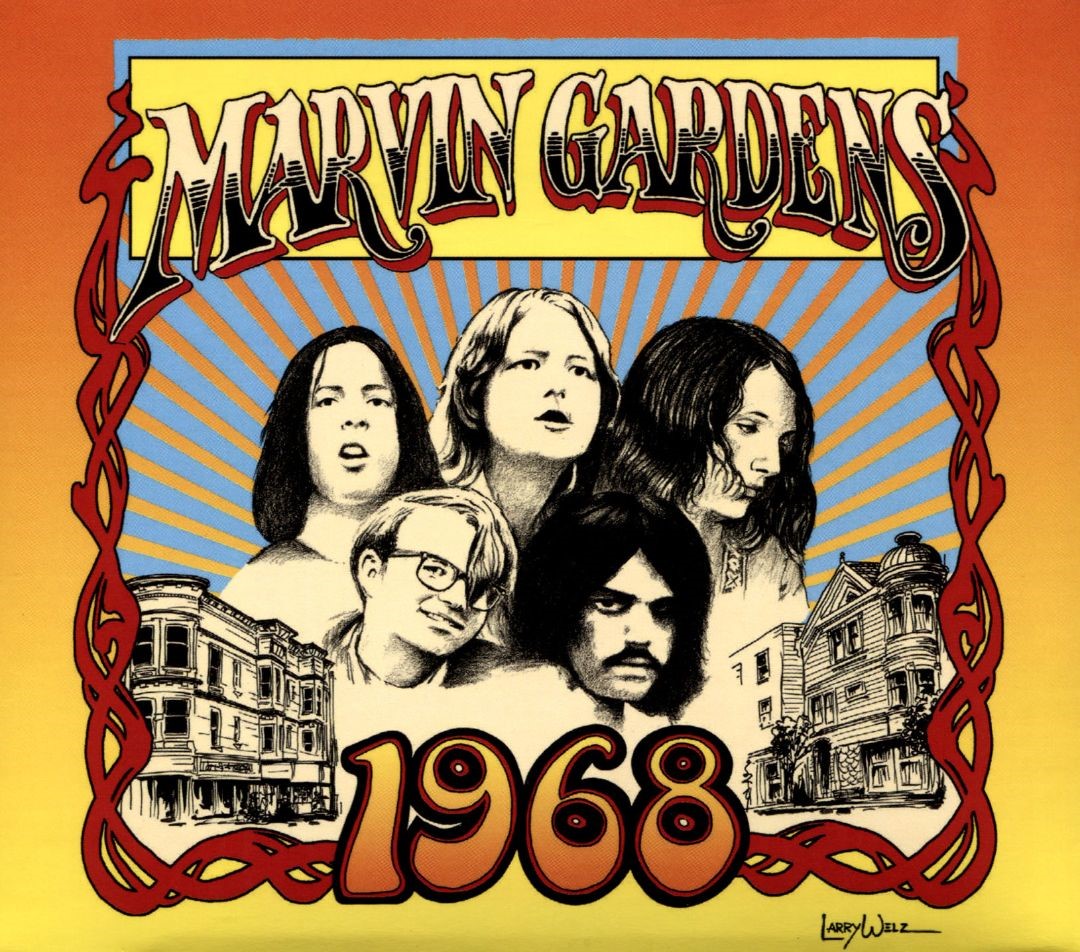
The mine from which those lost gems are dug up, has since seemed inexhaustible. Not all excavations really deserve that delayed appreciation, but every once in a while: bull’s eye. In November 2016, 1968 is released, from the completely unknown Marvin Gardens. The band, from San Francisco of course, is mainly driven by the boundless talent of Carol Duke, a cross between Janis Joplin and Grace Slick. The Texan (from Lubbock, the birthplace of Buddy Holly) has the blues and folk in her blood, and that blends well with the psychedelic rock of her Californian brethren. The band dares to polish and beautify great songs from Leadbelly, Mississippi John Hurt and Hoagy Carmichael, and has own material too, but their piece de résistance is a Dylan cover: the lost ditty “Walking Down The Line”.
It is one of Dylan’s early railroad songs. From the very beginning, the construction of the first railways is idealized with big words like “connecting people”, “progress”, “unification” and “prosperity”. And rightly so, of course. In the Arts, however, the endless strings of steel soon symbolize Wanderlust, the romantic longing for unknown destinations and, strangely enough, demise, loneliness and abandonment too.
The train is a tragedy proclaiming leitmotif in Tolstoy’s Anna Karenina (1877), in 1843 one of Dylan’s heroes, Nathaniel Hawthorne, chooses the railroad as a metaphor for the spiritual journey his protagonist makes (The Celestial Railroad), in almost half of all stories of another hero, Chekhov, trains come by, Melville often uses train imagery and the first filmmakers also recognize the dramatic power of a railway set (such as The Kiss In The Tunnel, 1899, and The Great Train Robbery, 1903).
Dylan is, as is well known, fond of the symbolic power of train transport and, at the very least, taken with the misty ambiguity that arises when allowing a roaming protagonist to walk down the line. After all, apart from walking along the railway line, it can also mean: going over a straight line to prove that you are not drunk, balancing on the border between Good and Evil, or staying good, walking in line. That last meaning is the meaning that the main character in Johnny Cash’s “I Walk The Line” expresses, and that particular song Dylan has had almost his entire life on a towering pedestal, as we understand from his autobiography Chronicles when he talks about his song “Man In The Long Black Coat”:
“In some kind of weird way, I thought of it as my “I Walk The Line,” a song I’d always considered to be up there at the top, one of the most mysterious and revolutionary of all time, a song that makes an attack on your most vulnerable spots, sharp words from a master.”
This walk the line echoes considerably with the young Dylan. Alone in those early years he uses the expression in “Mixed Up Confusion”, “Bob Dylan’s Blues” and in “Restless Farewell”. And in “Walkin ‘Down The Line”, a remarkable song that of course does not have the mythical power of Cash’s masterpiece, but which also makes a fair impact.
Part of the attraction lies in the stimulating contrast between lyrics and music. The storyteller, who is dragging down the line, is certainly not happy. He has walked all night along the rails, melancholic, with a troubled mind, his girlfriend, who by the way is not too smart, is not feeling well and the money has run out. Sadness everywhere, but the musician Dylan lays a catchy, cheerfully hopping melody underneath, which gives the lament (unintentionally?) a comical charge.
The decor cannot be determined unambiguously. But his feet are flying and he is wearing his walkin’ shoes, so it is likely that the poet here tries to evoke the image of a destitute wanderer following a railroad. The poet has not given much love to the lyrics. It is also figuratively a directionless whole, a not too inspired collection of folk and blues clichés, with just one single Dylan-worthy flash: I see the morning light / Well, it’s not because / I’m an early riser / I didn’t go to sleep last night.
Dylan considers the song a throw-away, apparently, and treats it that way. To safeguard copyrights, he makes a Witmark recording (which will later end up on The Bootleg Series 1-3), for Broadside Dylan already recorded it once before, in October ’62, and in May ’64, at colleague Eric Von Schmidt’s home in Florida, it surprisingly pops up again, but it never reaches a stage or an album.
https://youtu.be/v4z3w8tVxoU
However, the song does not go unnoticed either. It is immediately picked up by colleagues and covered dozens of times in the 60s alone. The narrator’s suffering completely evaporates in all those cheerful, hopping arrangements, but that does not spoil the fun; the melody and the accompaniment have such indestructible, granite power that every adaptation is contagious.
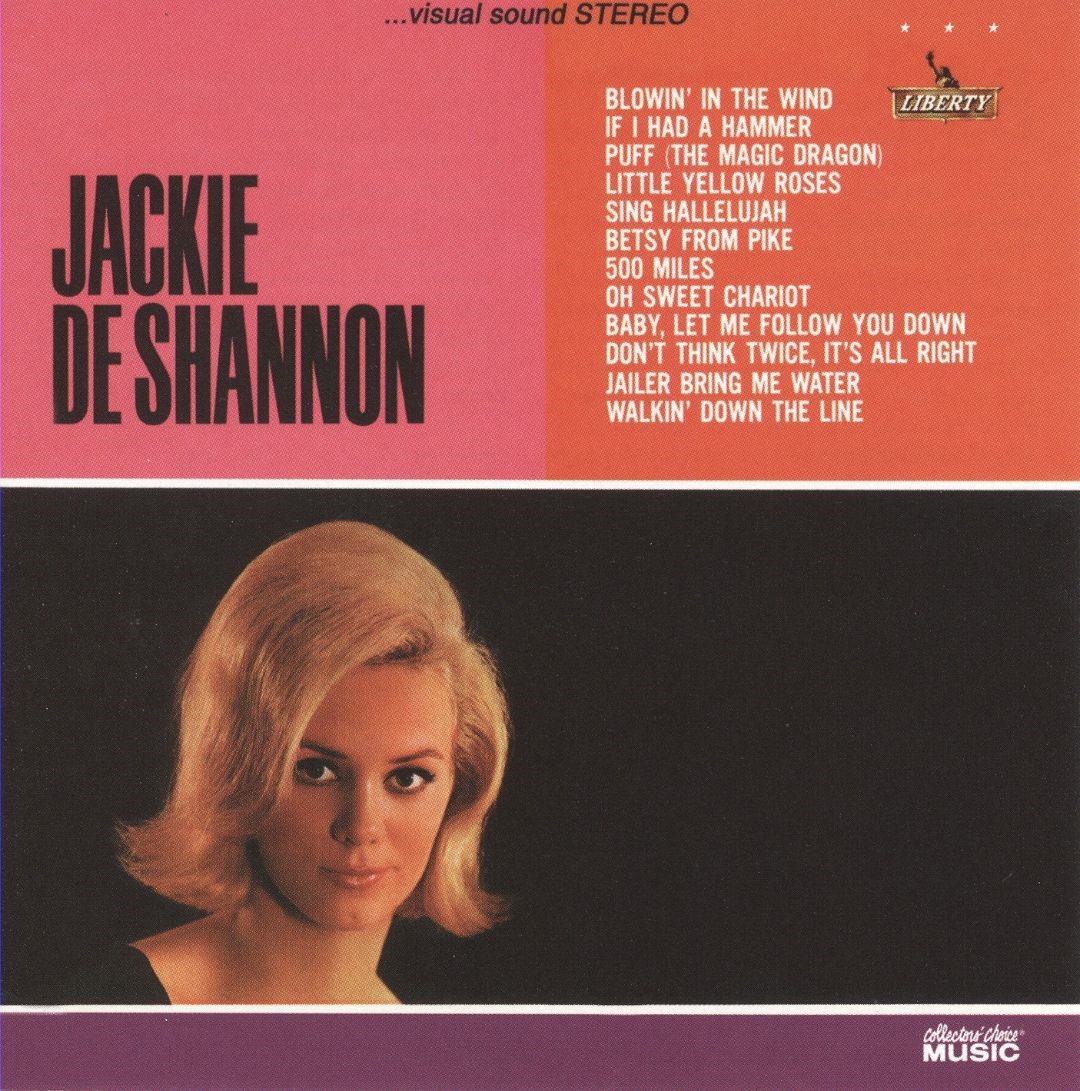
The first one is recorded as early as 1963 and is done by the very charming and very talented Jackie DeShannon. It opens her debut album, which she originally wanted to fill with Dylan covers. Remarkable, because this is shortly after The Freewheelin’ Bob Dylan; Dylan’s repertoire is by no means the inexhaustible treasure trove it will be a few years later. DeShannon’s record company Liberty, however, puts a stop to the intention and the singer has to limit herself to three Dylan songs (“Blowin ‘In The Wind” and “Don’t Think Twice, It’s All Right” survive too), accompanied by folk classics such as “500 Miles” and Dylan related songs such as “Baby Let Me Follow You Down”.
No own songs, by the way, and that is quite remarkable. DeShannon has written dozens of excellent songs. “Put A Little Love In Your Heart”, “Bette Davis Eyes”, “When You Walk In The Room”, “Breakaway”, to name just a few, and her songs are often covered. “Don’t Doubt Yourself Babe” on The Byrds’ first LP Mr. Tambourine Man is hers, for example, as well as Marianne Faithfull’s biggest hit “Come And Stay With Me”. But for her first album she does not dare to do her own work, oddly enough – or those fools from Liberty intervened again, which is of course a possibility too.
Anyway, the gifted songwriter acknowledges and recognizes Dylan’s mastery early on.
Other covers from this period all have a similar, dated sound and arrangements (Glen Campbell, The Dillards, Joe & Eddie, Ricky Nelson), without undermining the song’s charm.
“Walkin’ Down The Line” continues to be popular in later decades. Sometimes to boost a performance (Linda Rondstadt, for example), sometimes as an attractive option to fill up an album side (Ry Cooder with the Rising Sons, Eilen Jewell) and very occasionally on Dylan tribute records (the one by Robin & Linda Williams on A Nod To Bob Vol.2 from 2011 is great fun). In 1987 it seems that Dylan is finally giving in. The men of Grateful Dead want to play the song on their joint tour. It is even practiced, the recording thereof reveals a very pleasant, energetic version and Dylan seems to like it too – but ultimately rejects it again.
In the end, the most beautiful version is that excavated jewel from 1968 of the late revelation Marvin Gardens. The intro is goose bumps inducing, the arrangement fluctuates somewhere between The Who and The Doors, and is infinitely more intelligent and varied than the bulk of those dozens of other covers. But above all: it is one of the few interpretations where the interpreter respects the lyrics’ content. Singer Carol Duke and the band understand that they need to express the suffering of a bumped soul, walkin’ down the line with a troubled mind.
This series of articles looks at Dylan’s reinterpretations of his own work, with video examples from his concerts. The videos are selected by Paul and the commentary is by Tony.
Details of previous articles in this series are shown on the index “Dylan re-imagined”
Here we look at Girl from the North Country, Down along the cove, and two version of Don’t think twice.
Girl From the North Country late 90s
https://www.youtube.com/watch?v=9Ylgc4y6Ipk
Bob gives us a long introduction, and it is unfortunate that the double bass is overloaded on the mix at the ends. Interesting too that the audience cheers as he starts singing – how could the audience not know what this was just from the intro?
Dylan plays with the lyrics in a most curious way. It seems to distance him from the woman rather than expressing his love for her – which is odd given the sympathetic accompaniment. It almost seems from the singing like he is a dissolute old lover remembering a much younger women, while the music doesn’t reflect this at all.
The music indeed seems to say, yes I am doing well, everything is fine, but oh I remember those old times and I hope she remembers me as I remember her. But somehow the voice doesn’t quite capture the same thought.
But… for the last verse – the repeat of the first verse, yes it does all work. The instrumental section before that final verse does set us up perfectly, Dylan now sings with much more sympathy, and then plays a lovely coda with a repeated phrase before moving onto the harmonica. This is performance is utterly worth hearing for this last quarter – as the band builds behind the harmonica we know that the singer is out there doing his thing, but behind all the bravado and fun he can still have positive thoughts for the old days.
Down Along The Cove 2006
https://www.youtube.com/watch?v=mvPszWmsbjo
In this version “Down along the cove” starts like a 12 bar blues and then suddenly goes a bit odd, and that is always how the song has been, for it is a song that seems to have no connection with the rest of John Wesley Harding.
Here the lyrics are almost unintelligible… is that deliberate? Possibly so because the originals are not, in my opinion, Dylan’s most inspired lines…
Down along the cove
 We walked together hand in hand
 Down along the cove
 We walked together hand in hand.
 Ev’rybody watchin’ us go by
 Knows we’re in love, yes, and they understand
What is interesting is that Dylan gets a seven minute performance out of what was originally just ten lines of very simple lyrics. He does this of course by adding extra verses, and I think the puzzle here is simply, why? Why reprieve this simple song and extend it so much?
My guess is that this must be the performance from the Cap Roig festival and Dylan chose the piece in relation to the setting. I’ve not been, but the pictures look fairly cove like to me. If you know, please do write in. And if I am wrong, tell me gently.
Don’t think twice
But now with our final selection today, there can be no doubt why Dylan sings this over and over. It is a staggeringly beautiful, sad, magnetic, hypnotic song. In the first version below Bob just about makes it to the microphone in time.
https://www.youtube.com/watch?v=b3niBKLN238
This version reflects the utter sadness of the song. But still a song where the key lines are jump out and (if you are of an emotional turn of mind) bring tears to your eyes.
“I gave her my heart but she wanted my soul” indeed – and just listen to the audience singing along – a sing along out of sheer and utter devotion to this complete masterpiece. The musical accompaniment is almost jolly, reflecting the length of time those of us in the older generation have know this song from the moment it first arrived on Freewheelin’.
But even all this doesn’t prepare us for the harmonica, played so gently and perfectly in keeping with the feeling generated by all that has gone before. What a beautiful version.
And now compare and contrast that version from 2000 with this from 2019.
https://www.youtube.com/watch?v=O3WZgNGu1qY
After that opening verse I must admit that I was expecting the beat to come in to carry the song forward through the rest of the verses. I am not sure if Dylan’s voice carries this slow version all the way through, but of course that is a matter of taste. To me it sounds to too much like a lost soul thinking of the past, while the original (and the pervious version above) mixes the regret with the determination to move on in a much more balanced way.
And of course our own interpretations are always part of our own lives. I think one needs to have love and lost in order to see the total depth in this “moving on” song.
But it is an extraordinary version, and I’m really glad to have had the chance to hear it. And I loved the piano solo – and the way the lights go out at the end.
From the deep well of esoteric mystical knowledge that attempts to uncover the source of ultimate reality lying behind the world of light and darkness, singer/songwriter Bob Dylan draws out buckets of allegorical narratives, and ornate images (of water, wind, fire, and earth) which he then pours into cups filled with his music.
There’s the vision experienced by the bibical prophet Ezekiel:
And I looked, and behold, a whirlwind came out of the North
A great cloud, and a fire infolding itself ....
Also out the midst thereof came the likeness of four living creatures ...
As for the likeness of their faces, they four had the face of a man
And the face of a lion on the right side
And they four had the face of an ox on the left side
They four also had the face of an eagle
(Ezekiel 1: 4,5,10)
A very similar vision of birds and humans, of animals tamed and untamed, repeats in the New Testament:
And the first beast was like a lion
And the second beast like a calf
And the third beast had face as a man
And the fourth beast was like a flying eagle
(Revelation 4: 7)
Somewhat likewise in the Cabbalistic poem below:
Then from the light of Infinity a simple line
Hung down from above, lowered into space
And through that line, He emanated
Crafted, formed, and made the worlds
Prior to these four worlds, there was one light Of Infinity
Whose name is One, in wondrous, hidden unity
(Isaac Lauria: The Tree Of Life)
They be narratives and images that Dylan stirs together in the following song lyrics:
Just step into the arena
Beat a path of retreat up the spiral staircases
Pass the tree of smoke, pass the angel with four faces
Begging God for mercy, and weepin' in unholy places
(Bob Dylan: Angelina)
In the New Testament, Jesus (as his name comes to be pronounced in English) performs miracles, casts out evil demons:
Immediately there met Him out of the tombs
A man with an unclean spirit
Who had his dwellings among the tombs
And no man could bind him, no, not with chains ....
Neither could any man tame him
(Mark 5: 2,3,4)
The quote from Mark is not unlike the short narrative song below that depicts an outlaw of the Old West as though transformed by sparks of goodness emanated from the One:
John Wesley Harding
Was a friend unto the poor
He travelled with a gun in every hand ....
But no charge held against him
Could they prove
And there was no man around
Could track or chain him down
(Bob Dylan: John Wesley Harding)
Galloping onward, the singer/songwriter has a bit of fun with Ezekiel, Lauria, and Mark’s image. The goodly “boss” turns into a serpent; goes after Adam and Eve:
He renounced his faith, he denied his Lord
Crawled on his belly, put his ear to the wall
One way or another, he'll put an end to it all
He leaned down, cut the electric wire
Stared into the flame, and he snorted the fire
Peered through the darkness, caught a glimpse of the two
It was hard to tell for certain who was who
He lowered himself on a golden chain
(Bob Dylan: Tin Angel)
Many writers have an affinity for the the imagery deployed by the Gnostics. The Bard
humourously depicts a lover who loses all sense of himself – indeed he’ll shed his serpent’s skin for the love of a lady – to him, she’s the Absolute One:
Your love and pity doth the impression fill
Which vulgar scandal stamped upon my brow
For what care I who calls me well or ill
So you over-grow my bad, and good allow? ....
In so profound abysm I throw all care
Of other voices that my adder's sense
To critic, and to flatter, stopped are
(William Shakespeare: Sonnet CXII)
The words ‘care’ and ‘are’ don’t live in the rhyme-house no more.
Nor is ‘Will’ called ‘Bill’ at the time, but there’s:
The river whispers in my ear
I've hardly a penny to my name
The heavens never seemed so near
All my body glows with flame ....
You trampled on me as you passed
Left the coldest kiss upon my brow
All my doubts and fears have gone at last
I've nothing to tell you now
(Bob Dylan: Tell Ol' Bill)
Shakespeare rhymes ‘brow’ with ‘allow’; Dylan rhymes ‘brow’ with ‘now’.
https://youtu.be/vzgCXi69zEQ
What else is here?
An index to our latest posts arranged by themes and subjects on the home page. You can also see details of our main sections on this site at the top of this page under the picture.
There is an alphabetic index to the 550+ Dylan compositions reviewed on the site which you will find it here. There are also 500+ other articles on different issues relating to Dylan. The other subject areas are also shown at the top under the picture.
We also have a discussion group “Untold Dylan” on Facebook which mostly relates to Bob Dylan today. Just type the phrase “Untold Dylan” in, on your Facebook page or follow this link
And please do note The Bob Dylan Project, which lists every Dylan song in alphabetical order, and has links to licensed recordings and performances by Dylan and by other artists, is starting to link back to our reviews.
To be clear, in this article we are talking here primarily about the Dylan composition, “Hallelujah” not the Leonard Cohen song, which Dylan performed on a couple of occasions. The official Dylan site only refers to the Cohen song, which isn’t very helpful. They don’t seem to realise there was a Dylan composition of the same name.
https://youtu.be/B6IoRNRahqo
So the Hallelujah that we are referring to, the 1981 outtake, is one of a collection from that year which include Dylan compositions and the work of others. Here’s the list
If Dylan songs have anything in common it is that they have a clear structure. Not always the same structure (by which I mean it isn’t always verse-verse-verse, or verse / chorus / verse chorus or any other variations), but still a structure – a structure of the sections of the song, and a structure within each section.
But listening to Hallelujah it is rather difficult to work out what is going on. Of course there is a structure, but it just doesn’t come across immediately not least because the melody and the bass part seem to have completely separate lives of their own with Bob performing a meandering melody line against an active bass line.
Yet this is clearly a well thought through and rehearsed piece but it doesn’t seem to be anything like finished. Where, after all, are the rest of the words? Surely with such an intricate musical line such as the one we have here, Bob would have composed more lyrics.
A guess as to how this composition evolved would be that the bass player one day came in with that line, Bob liked it, and started to evolve the melody around it. But the complexities of the piece mean that this clearly was not done as the recording was running. Everyone here knows exactly what is going on – and what is going on is not normal for Dylan.
But what of the words? They are not clear but fortunately one of us (and it is not Tony) has an ear for these things…
Park it in your drive, in your door
Birds in the meadow
I've been here before
It's a long day
From South Bend to your manor
Lost your way
Below
(Hallelujah, hallelujah .....)
Save me if you find it in your will
Well, I wish, wish you well
These feathers are by your side, me yea
(Hallelujah, hallelujah .....)

They've seen your feathers, and your will
Tie your banner on you well
'Cause I want you
And I couldn't wail
Stick the feather there
Hallelujah, hallelujah ....)
And having got that far it is possible to say that the song is most likely to have been inspired by:
So oft have I invoked thee for my museAnd found such fair assistance in my verse ....Have added feathers to the learned's wingAnd given grace a double majesty
(William Shakespeare: Sonnet LXXVIII)
It is the “feathers” that points to the particular sonnet, and “Will” that points to the author.
The British made fun of the American rebels for trying to imitate overly-pompous European fashion known as ‘macaroni’ as in…
Yankee Doodle went to town a-riding on a pony
Stuck a feather in his cap and called it macaroni
(Yankee Doodle)
So Dylan could be making fun of himself for trying to imitate Shakespeare – ie, by writing a piece of macaroni….as the Bard might himself be doing.
But it is also most likely that this song was abandoned when it was far from finished, so also very likely that there were to have been more clues as to what was going on, if Dylan had actually finished the job.
Anyway, if you have been reading, you have just read what we think is the world’s first ever review of this Dylan song. And if you have been, thank you for reading.
What else is here?
An index to our latest posts arranged by themes and subjects on the home page. You can also see details of our main sections on this site at the top of this page under the picture.
There is an alphabetic index to the 550+ Dylan compositions reviewed on the site which you will find it here. There are also 500+ other articles on different issues relating to Dylan. The other subject areas are also shown at the top under the picture.
We also have a discussion group “Untold Dylan” on Facebook which mostly relates to Bob Dylan today. Just type the phrase “Untold Dylan” in, on your Facebook page or follow this link
And please do note The Bob Dylan Project, which lists every Dylan song in alphabetical order, and has links to licensed recordings and performances by Dylan and by other artists, is starting to link back to our reviews.
To begin, and to avoid us getting rather mixed up, there are two Hallelujah songs. One written by Leonard Cohen and one written by Bob Dylan. This article concerns the Leonard Cohen piece. The Dylan song is one of those pesky tracks that somehow we seem to have missed, despite all the grand claims I make on the site of reviewing every Dylan song. A review of Dylan’s composition, complete with lyrics will be the next post on this site.
Dylan wrote his song in 1981 four years before Leonard Cohen wrote his song. I wonder if there was ever a conversation between the two songwriters in which Dylan told Cohen he’d got a song called Hallelujah which wasn’t working very well, and Cohen then wrote his version.
That last bit is of course supposition, but what we do know is that Bob performed the Cohen version in 1988 whilst it was still a relatively obscure track, a few years before John Cale, Shrek, Jeff Buckley and a hundred other versions were recorded or performed.
It is also a song that has the associated story. Bob Dylan asked Leonard Cohen how long it took to write Hallelujah. The answer came back “two years”.
Cohen then came back to Bob and said, “I really like ‘I and I.’ How long did it take you write that?”
Dylan told him it was done and dusted in 15 minutes
David Remnick in his profile of Leonard Cohen in the New Yorker, points out however that it actually took Cohen five years to write “Hallelujah,” and when it was done, his label didn’t even want to release the album it appeared on because it didn’t seem commercial. The Wiki article on the song says that Cohen wrote around 80 verses for Hallelujah, before it was condensed down to the final version.
But here’s a thought – if the five years is true, what this means is that both Dylan and Cohen were writing a song called Hallelujah at the same time. Could be a coincidence of course. Or maybe they did have a chat. “What you working on Leonard?” “A song called Hallelujah. What about you?” “Trying to find some songs for the next album. Hallelujah you say? I could give it a go.”
Here’s Bob’s version of Cohen’s work
And here is a live version by the composer…
As noted however, the song found greater popular acclaim through a recording by John Cale, which inspired a recording by Jeff Buckley.
Here is John Cale
Apparently over 300 versions have now been recorded, and it has been used in film and TV as well. Here, to end the video selection is Jeff Buckley
One interesting link between Cohen and Dylan is that both composers change the lyrics of their songs. The Cohen shows on the 1988 tour and the 1993 tour particularly varied the lyrics, and since then other performers have taken bits from different versions.
As for the lyrics of Dylan’s own song – well the lyrics are the reason my review of the song hasn’t appeared as yet. I can’t understand a word.
I suppose the strength of the Cohen piece is that it can be reinvented so many ways to be joyful or sorrowful, according to how the singer wants to interpret the song. Wiki, in its review, calls Cohen’s version dispassionate, Cale’s sober and sincere, and Buckley’s sorrowful. The list of the ways it has been interpreted goes on and on.
And my guess would be that it is this, that has made the song attractive to Dylan – that it can be reworked to mean so many different things. Just as his own songs can. Here are the lyrics…
Now, I've heard there was a secret chord
That David played, and it pleased the Lord
But you don't really care for music, do you?
It goes like this, the fourth, the fifth
The minor fall, the major lift
The baffled king composing hallelujah

Hallelujah
Hallelujah
Hallelujah
Hallelujah

Your faith was strong but you needed proof
You saw her bathing on the roof
Her beauty and the moonlight overthrew ya
She tied you to a kitchen chair
She broke your throne, and she cut your hair
And from your lips she drew the hallelujah

Hallelujah
Hallelujah
Hallelujah
Hallelujah

You say I took the name in vain
I don't even know the name
But if I did, well really, what's it to you?
There's a blaze of light in every word
It doesn't matter which you heard
The holy or the broken hallelujah

Hallelujah
Hallelujah
Hallelujah
Hallelujah

I did my best, it wasn't much
I couldn't feel, so I tried to touch
I've told the truth, I didn't come to fool you
And even though it all went wrong
I'll stand before the lord of song
With nothing on my tongue but hallelujah

Hallelujah
The point for many people, I suspect, is also that anyone can take a line from the song and it can mean something to that person in that situation. And indeed that can be said of so much of Bob’s music. I seem to have come across so many people who hold a few lines of Dylan very close to their heart.
But let me finish with one trio of lines
She tied you to a kitchen chairShe broke your throne, and she cut your hairAnd from your lips she drew the hallelujah
And, well, yes, what exactly is going on there, particularly in relation to the lines that come before? Please do let me know.
Here’s the verse in full
Your faith was strong but you needed proofYou saw her bathing on the roofHer beauty and the moonlight overthrew yaShe tied you to a kitchen chairShe broke your throne, and she cut your hairAnd from your lips she drew the hallelujah
And some people say Bob can be obscure.
An index to some of the other articles in the “Why does Dylan like?” series is here.
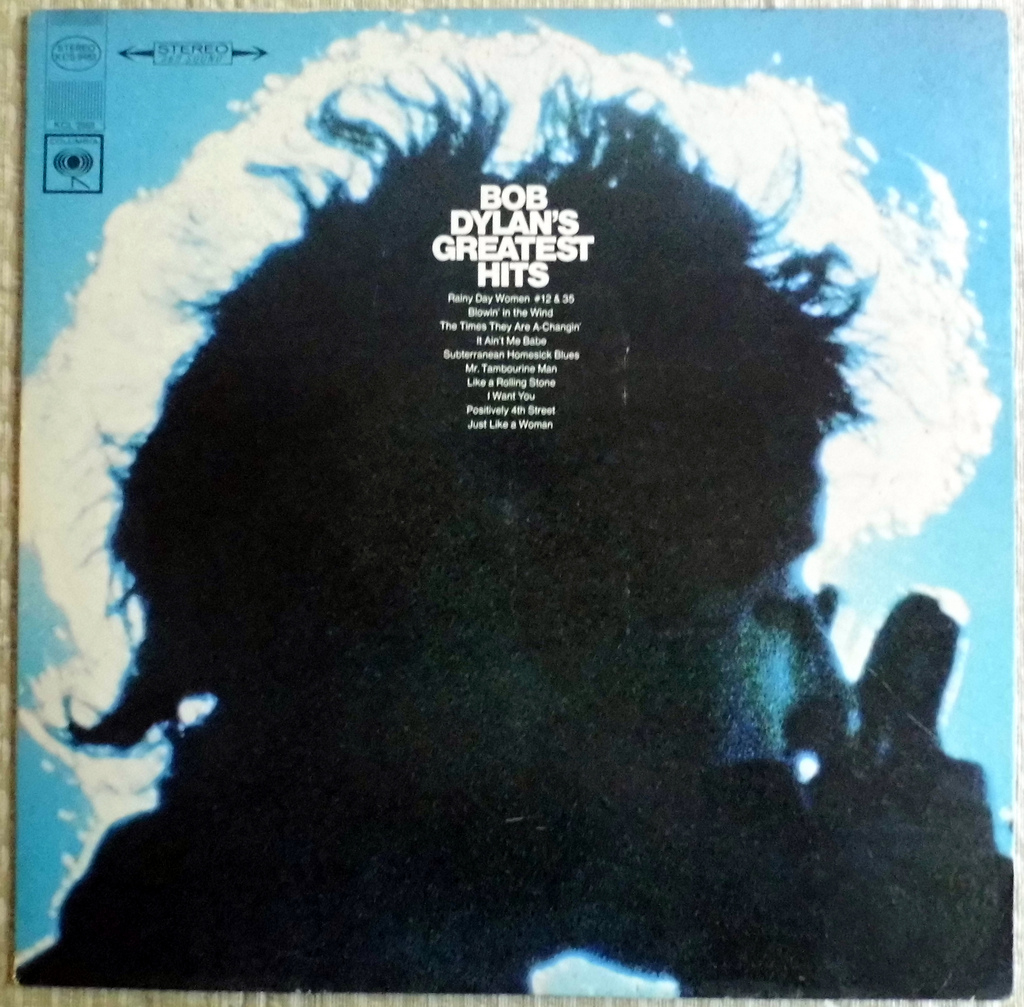
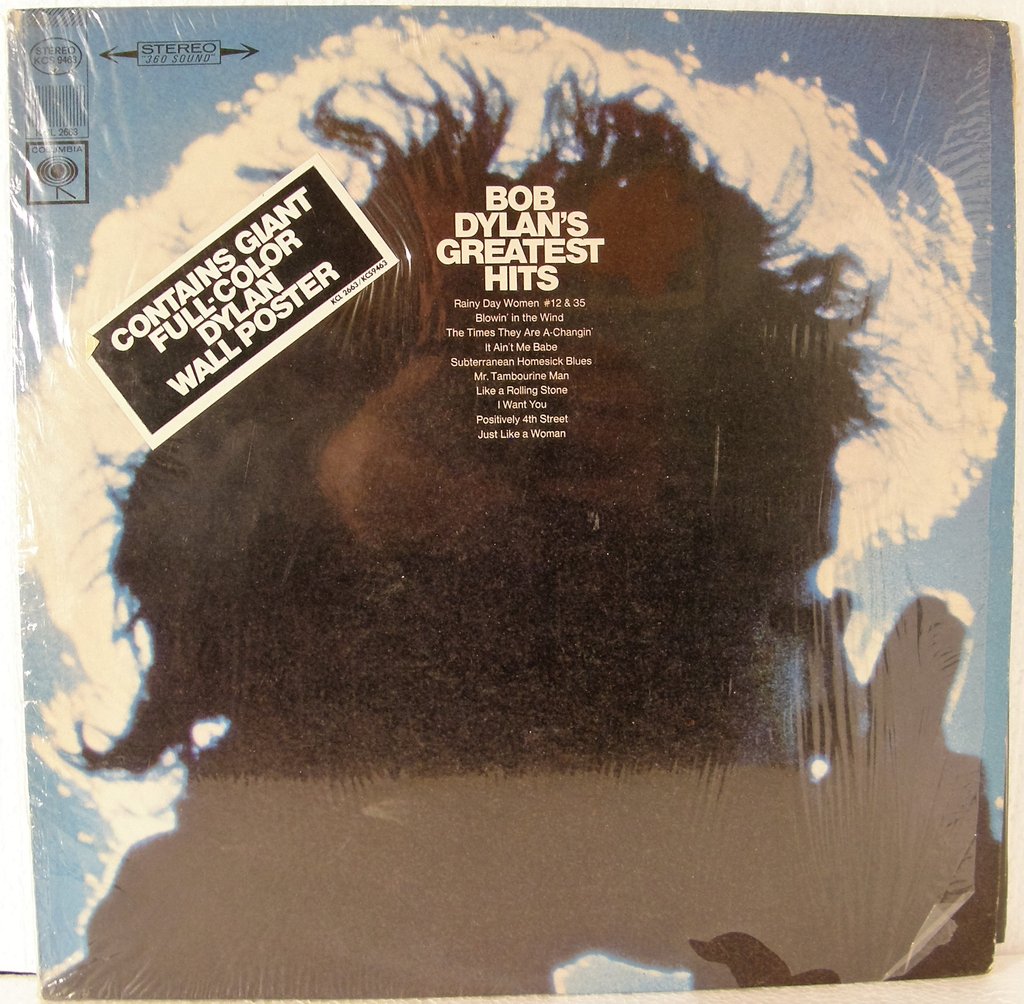
A compilation album isn’t actually part of this series concerning the artwork of the sleeves of Dylan’s studio albums, but the history of his first greatest hits album is too beautiful not to mention. Especially since, in 1966-67, three albums appeared with that same title.
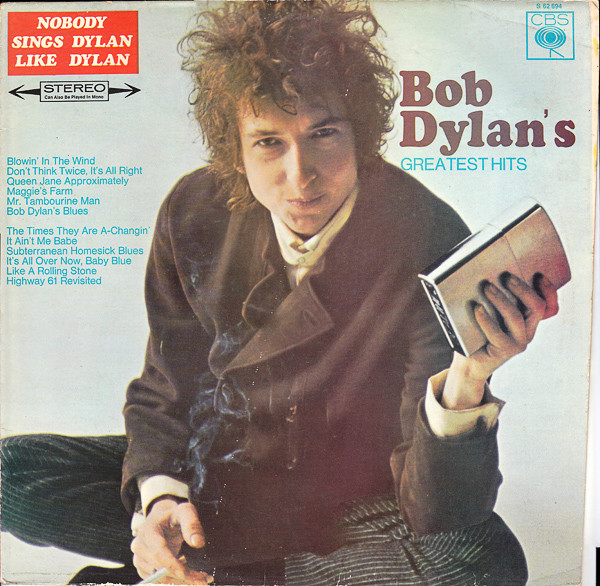
The Netherlands: Bob Dylan’s Greatest Hits – No One Sings Dylan Like Dylan
Released: March 27, 1966
Photography: Jerry Schatzberg
Art-director: ?
Worldwide, CBS Holland was the first to release a compilation of Bob Dylan’s songs – exactly one year before the Columbia Records did the same in the US. Up until then only three mono albums of the singer had officially been released in the Netherlands.
The title, Bob Dylan’s Greatest Hits, wasn’t exactly right, as ‘Positively Fourth Street’ was missing and four songs were previously unreleased in Holland and Belgium and so completely unknown to the listeners. Because this compilation appeared before Blonde on Blonde was released, there’s nothing from that double album between the 12 selected songs.
On the front, there’s a picture made by Jerry Schatzberg, during a session for Blonde on Blonde. During that session, on January 28, 1966, Dylan fooled around with random object that were present in the photo studio. A picture was chosen of Dylan with a cigarette in one hand and an ridiculously large Zippo lighter in the other.
On the sleeve, a subtitle is visible in the upper left corner: ‘No One Sings Dylan Like Dylan’. A slogan first used by CBS UK on June 21, 1965, to promote Bringing It All Back Home.
Great-Britain: Bob Dylan – Greatest Hits
Released: December 1966
Photography: Jerry Schatzberg
Art-director: ?
Some nine months later, CBS UK released a similar album in Great-Britain and Ireland, titled Greatest Hits. Like the Dutch compilation it contains 12 songs, but since Blonde on Blonde was a hit by then, there’s a different selection of songs.
Many people seem to think that this album first appeared in 1967, even suggesting it was released at the same time as the US version. However the album entered the British sales list on January 14, 1967, so a release date somewhere in the last weeks of 1966 is more probable.
More important for our story is that this British album has a different sleeve design. Like the Dutch release, this photo is chosen from the same session with Jerry Schatzberg (January 28, 1966).
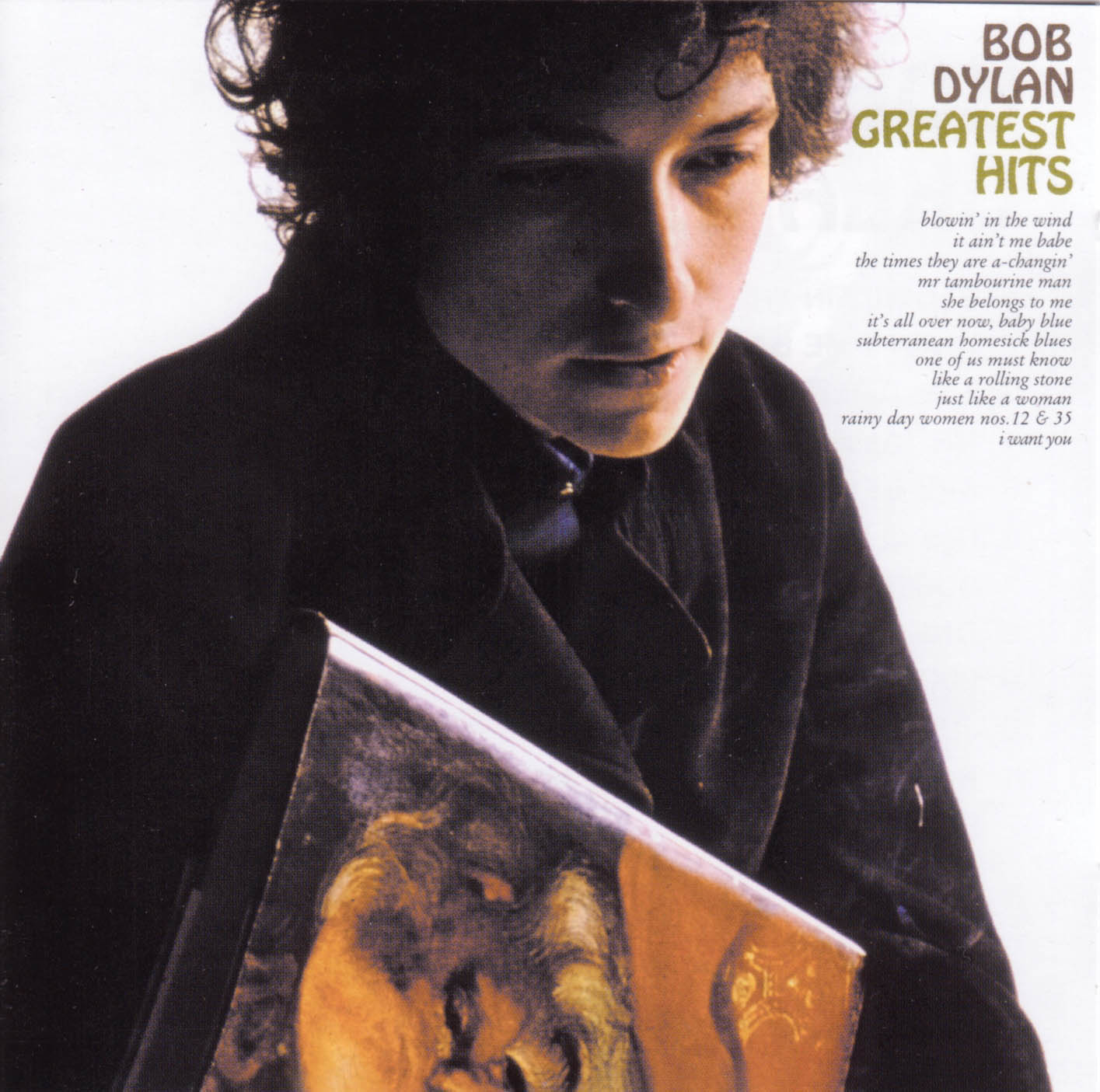
On the front there’s a picture of Bob Dylan, deep in thoughts, before a white background and in his arms is a large book with a portrait of a Biblical looking man.
The bearded man is a fragment from De aanbidding der wijzen (The Worship of the Kings), a painting by Peter Paul Rubens from 1624. The book by Jacques Lassaigne, published in New York in 1958, is titled Flemish Painting from Bosch to Rubens.
There are other pictures from that sessions from Dylan with the book, which make it obvious that the picture is mirrored for the sleeve. That way there’s room for the record company’s logo on the left and titles of the album and the songs on the right.
On the back of the sleeve the song titles are printed once more, plus the pictures of six of the seven regular Dylan albums appeared until then – for some reason Another Side of Bob Dylan is missing.
US: Bob Dylan’s Greatest Hits
Released: March 27, 1966
Photography: Rowland Scherman (front), David Gartner and Fred Hammerstein (back)
Poster: Milton Glaser
Art-director: John Berg
In early July 1966, while riding his Triumph motorbike, Dylan had an accident. After this, he disappeared completely from the public eye. As there was no communication at all from the Dylan camp, a lot of speculation was raised: the singer had broken his neck or he might even be dead. Others pretended to know he was in rehab.
Whatever the facts: Bob Dylan had a perfect excuse to cop out. His manager, Albert Grossman canceled all his obligations: the rest of the tour, plans for a book, a play and a movie. Even the deal to deliver one last album to the record company was renegotiated, so that he didn’t have to go into the record studio any more.
The staff at Columbia Records felt the chapter Bob Dylan came to an end and proposed a compilation album. The time was ripe as recently at least one big name had released a greatest hits for the first time: The Rolling Stones (Big Hits (High Tide and Green Grass) – March 1966), while others would do so soon: The Beach Boys (Best of the Beach Boys – July 1966) and The Beatles (A Collection of Beatles Oldies – December 1966).
Dylan himself however didn’t like the idea and refused to co-operate. He didn’t even want attend a photo session for the sleeve.
So the art-director had to be creative.
“Dylan had no direct input in it,’ explained photographer Rowland Scherman in 2013 to Ben Yakas. ‘It was in his contract that he could veto any picture he didn’t like. But this was actually in between contracts. He got another contract a month or so later [actually August 21 1967], but in between contracts he didn’t have the chops to change it.”
Front
The remarkable picture on the front is made by Rowland Scherman, then a freelance photographer mainly working for Life magazine.
The photo was made on November 28, 1965. On that day Dylan played the Coliseum in Washington DC. Scherman lived nearby and visited the concert with his wife. A good photographer always carries his camera and Rowland used his press card to get backstage.
In the book Encounters with Bob Dylan (Tracy Johnson – Humble Press, 2000) Scherman explained: “Dylan was in that dirty blue spot, doing some song I can no longer remember. I put the 300 mill on him, and I could see the whole thing. His hair, his halo, his harp — the three H’s. So, I went bang, bang, bang, bang — six or seven frames. No motor or anything. Then, I said, ‘Thank you very much, I’ll be leaving now.’ I didn’t hang around. I just kept thinking, ‘It doesn’t get any better than this,’ and went back to watch the rest of the concert.”
Sometime later Scherman showed the pictures to the fiancé of his sister, who happens to be the art director at Columbia: “I took them up to John Berg – he’d done dozens of album covers, and he looked through this stack, which was only about an inch-thick stack of slides, and the third one he picks up, he said, ‘That’s the next cover.’ It happened faster than I just told you about it.”
Berg offered him to buy the photo. “I got paid three hundred bucks for shooting that album cover. Three hundred bucks. In 1966, that wasn’t bad dough, it was a couple of months’ rent.”
“John Berg, smart as he was, blew it up big and cropped it real tight and flopped it so his face was looking the other way, and then wrote the type in the top of his head. It was my idea to shoot it backlit, and this may be the first backlit album anywhere. But it was his design that really made it as strong as it was.”
Back
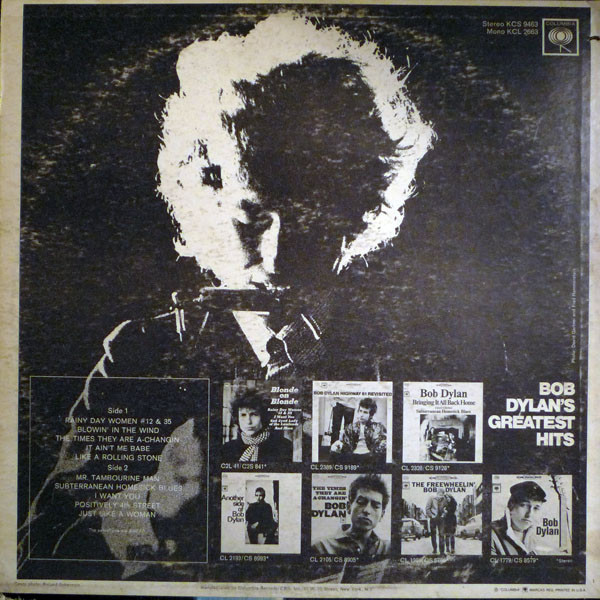
On the backside of the sleeve, there’s a picture of a similar backlighted Bob Dylan.
There’s not much info to be found on this photo. To make the mystery even greater: there are two people credited: David Gartner and Fred Hammerstein.
At that time, Gartner was the official photographer of Playboy magazine and was specialized in making pictures of the bunny’s and all kinds of famous people at party’s.
In my search for info, I found David Gartner on Facebook. Much to my delight, he was prepared to answer my questions. “That photo was taken in Queens New York at Forrest hills tennis courts, now called Arthur Ashe Stadium. I was photographer and Fred Hammerstein. 1968.”
I suggested that it might have been Forest Hills Tennis Stadium in New York. On Augustus 28, 1965 Bob Dylan played there, for 15.000 people, the openings concert of his very first tour with a band.
Mister Gartner confirmed date and location, and added: “I do remember that the photo was taken behind the curtain. As he turned his head to the curtain and the floodlight hit behind him to lighten up his hair.”
About why there are two names mentioned, Mister Gartner explained: “It was my assignment to photograph Bob Dylan, [for the promoter for the concert, Jerry Weintraub]. As Fred Hammerstein was working with me I thought it would be fair to put both names down.”
So, as this picture was taken three months before Scherman made the picture used on the front of the sleeve, it’s possible that John Berg already had Gartner’s photo, recognized the similarity between the two images and worked from there.
Poster
Another stroke of genius from Berg was to add a third image of Dylan without facial features: a large poster, put inside the sleeve.
Again the design was pre-existing: Push Pin Studios had printed the poster in 1966 – but it isn’t clear if it was actually sold. The poster was designed by one of the founding members of the studio: Milton Glaser.
Milton Glaser was a graphic designer (in 1976 he made the I♥NY logo for the city of New York), and coincidently he happened to be a friend of Dylan’s manager Albert Grossman. As such, Grossman had asked him to design the cover of Dylan’s book: Tarantula.
Glaser was inspired by a work of the French artist Marcel Duchamp: Self Portrait in Profile, from 1959. Just like Duchamp he drew Dylan’s profile as a black silhouette, simply placed against a plain white background. This places the focus on the huge colorful swirls which represent Dylan’s free flowing long hair. Long hair, that at this point in history was a symbol of freedom and non-conformity and would have had an obvious appeal to fans of his music.
Because the book was on hold, and it would be a shame to waste such a beautiful image, plans were made to sell it as a poster.
John Berg asked Glaser for few minor changes: the original hair was in brown and blue, so Berg asked for more color. Also, a suggestion of Glaser to add an harmonica in a holder, was found superfluous by Berg.
Grammy
The photo by Scherman and the design by John Berg (and his superior Bob Cato) win a Grammy for best album cover in 1968. “The Grammy shows up,” says Scherman, “and my name’s misspelled, just like it is on the album. Not only that, but the gramophone part was broken. I packed it back up and said, ‘Thanks a lot, but spell my name right and send me another Grammy.’ Never heard from them again. What knocks me out now is that he’s turned out to be one of the icons of the ’60s. That makes me proud, along with the fact that it’s in the Library of Congress.”
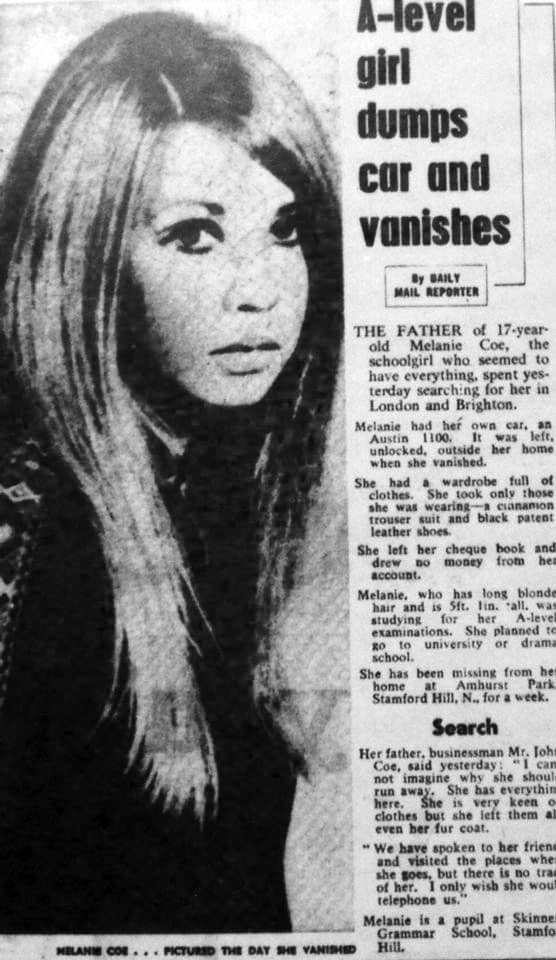
Melanie Coe is seventeen years old when she leaves a note on the table and runs away from home. Her parents, briefing the media, seem concerned, but indignant too. “I cannot imagine why she should run away,” her father John complains, “she has everything here … even her fur coat.”
It’s true, Melanie does not lack anything. She is doing well at school, has a wardrobe full of clothes and even her own car (an Austin 1100). A-level girl dumps car and vanishes, headlines the London Daily Mail of February 27, 1967, next to an almost full-page photo of the debutante.
Striking enough to attract Paul McCartney’s attention. “We’d seen a story in the newspaper about a young girl who’d left home and not been found,” McCartney recalls 30 years later, in the biography Many Years From Now. “That was enough to give us a story line. So I started to get the lyrics – she slips out and leaves a note and then the parents wake up – It was rather poignant.”
Poignant enough to inspire the heartbreaking “She’s Leaving Home”, one of the highlights of the album that is the best record of all time, according to Rolling Stone and to Roger Waters and to The Oxford Encyclopedia, Sgt. Pepper’s Lonely Hearts Club Band (1967).
Dylan is not a big fan. In September 1978, in the interview with Matt Damsker, he judges fairly clinically, looking back at John Wesley Harding:
“The Beatles had just released Sergeant Pepper, which I didn’t like at all, because I didn’t like… I could see that… Talk about indulgence. I thought that was a very indulgent album, though the songs on it were real good. I just didn’t think all that production was necessary.”
… and in Biograph’s booklet (1985) he even blames the entire trend for overproduction on that one Beatles album.
“Since the late sixties, maybe since Sgt Pepper on, everybody started to spend more of their time in the studio, actually making songs up and building them in the studio.”
That sounds pretty cool and pure, but Dylan’s own recording history is not entirely unstained either, of course. On The Cutting Edge, for example, we can follow how Dylan can spend hours and hours refining a song in the studio. “She’s Your Lover Now” is a good example, “Like A Rolling Stone” is a marathon, and on “Sad-Eyed Lady” Dylan himself reveals that it was only written in the studio, while the musicians were waiting for hours.
Still, he does have a point and his wonder can be felt. For Sgt. Pepper The Beatles have spent more than seven hundred hours in the studio; more than Dylan needs for his first twenty (!) studio albums. And true, all that tinkering and all those overdubs, additions and technical tricks take something away from the magic, from the pure artistry.
But: underneath, under that overproduction, the songs on Sgt, Pepper are “real good”.
One of those real good songs is “She’s Leaving Home” and apparently inspires Dylan to the theme of “Tears Of Rage”, to the jeremiade of a father who feels abandoned by his daughter.
Immediate cause seems to be, very unusual, an autobiographical fact, as mentioned in the first two lines:
We carried you in our armsOn Independence Day
Shortly before this, Dylan became the father of a daughter (Anna), who admittedly was not born on Independence Day, July 4, but still only a week later, on July 11 – close enough to allow some poetic freedom.
Such a major personal event usually leads to more sugary songs. Stevie Wonder writes the lovely “Isn’t She Lovely” at the birth of Aisha, Billy Joel the safe “Lullabye (Goodnight My Little Angel)” for his Alexa Ray, Kanye West (with Paul McCartney) the sentimental “Only One” as tribute to his little daughter North, The Beatles sing the antique baby song “Ain’t She Sweet”, Jay Z’s “Glory” … it’s a long list.
Sinatra’s “Nancy (With The Laughing Face)” is also included in that category, but that is not entirely justified. Composer Jimmy Van Heusen and lyricist Johnny Burke’s had originally, in 1942, only compiled a birthday song for Burke’s wife Bessie: “Bessie With The Laughing Face”. A year later, during a birthday party at Sinatra’s for three-year-old Nancy, both men improvise in jest “Nancy With The Laughing Face”. Ol’ Blue Eyes breaks and is sobbing with emotion; he thinks the men wrote it especially for him. Embarrased, they leave it that way and when Sinatra even records the song in the studio, a few months later, they register the royalties in Nancy’s name.
Related are the songs of fathers who say goodbye to a phase of life and sing nostalgically the transition from child to adult woman. Neil Young’s “Here For You”, for example, and “I Loved Her First” from Heartland (“Girl You’ll Be A Woman Soon” should definitely not be included).
But a father / daughter song with the bitter, reproachful approach of “She’s Leaving Home” is actually quite unique, and that must have appealed to Dylan’s aversion to sentimental clichés.
Unlike The Beatles, Dylan does not opt for a narrative ballad, but for the dramatic monologue. The influence of Robert Browning, presumably. Browning’s substantive influence popping up in Dylan’s oeuvre is a constant. For the last verse of “Subterranean Homesick Blues”, he borrows from Browning’s last verse of “Up at a Villa – Down in the City” (the avoiding of scandals, the wearing of sandals and the rhyme with handles). The much quoted there’s no success like failure from “Love Minus Zero” paraphrases Brownings often recurring preoccupation with success and failure (“Shall life succeeding in that it seems to fail, and a minute’s success pays the failure of years”). And the world could come to an end tonight from “I and I” can be found in “The Last Ride Together” (1855).
Not coincidentally, they are all dramatic monologues, from which Dylan draws. The poetic form, the form in which an ego addresses a fictional audience or a silent opponent, is of course not Browning’s invention, but is perfected by the Englishman. T.S. Eliot is a follower, and Dylan, who by the way will also feel a kinship with Browning’s brilliant rhyming, too.
An additional advantage for the bard who is so fond of keeping things vague (according to Dylan scholar Joan Baez), is the ambiguity that is almost ingrained in this form; the conversation partner being invisible and unknown, allows by definition the circumstances to be open to multiple explanations. The You can also be an abstraction, for example, or a population group, or a social movement, or the mirror image of the narrotor – open hunting season for enthusiastic Dylan exegetes with cryptoanalytic ambitions, at any rate.
“Tears Of Rage” is a popular object of study. “An allegory of the Vietnam experience,” Tim Riley sees, with soldiers on the beach and incapable, deceitful commanders. A song from the perspective of the Founding Fathers, about the current state of affairs in the United States, thinks Paul Williams. King Lear comes by regularly and Sid Griffin sees Jesus references in we scratched your name in the sand. In John 8, the scene with the adulterous woman, Jesus writes “something” in the sand, presumably “he who is without sin cast the first stone” – all in all a rather far-fetched and even by Dylan standards very thin reference.
The “find” in Lamentations 3: 48-51, proudly pointed out by some commentators, turns out to be just as thin:
Streams of tears flow from my eyes because my people are destroyed.My eyes will flow unceasingly, without relief, until the Lord looks down from heaven and sees.
What I see brings grief to my soul because of all the women of my city.
… triggered by tears and grief, obviously. But alas: this is a Bible translation from 1978. In 1967 Dylan browses the King James Version, which does not mention tears or grief:
Mine eye runneth down with rivers of water for the destruction of the daughter of my people. Mine eye trickleth down, and ceaseth not, without any intermission. Till the Lord look down, and behold from heaven. Mine eye affecteth mine heart because of all the daughters of my city.
And Greil Marcus, the man who also claims that Dylan “hysterically” shouted “You’re a liar!” at that Judas incident in Manchester (Dylan calmly sneers the words, barely raises his voice), nearly crashes at his canonization of this song and calls it, among other things, an “eerie invocation of Independence Day” – turning the holiday “into an image of betrayal and loneliness.”
My my.
The men from the first hour view it less historically or hysterically. Richard Manuel, who delivers the beautiful music to the lyrics, admits that he does not completely understand the text. Levon Helm calls it a number about a parent’s heartbreak and Robbie Robertson also knows: It’s from a parent’s point of view.
There is something to be said for that. Dylan has just had a daughter, shortly after Independence Day, has been touched by “She’s Leaving Home” and now sits down at the typewriter. Fanning out to empty fragments like the heart is filled with gold or to wait upon him hand and foot and especially the aggrieved why must I always be the thief fits Dylan’s changing understanding of art, as he will explain to John Cohen a year later:
“What I do know is that I put myself out of the songs. I’m not in the songs anymore, I’m just there singing them, and I’m not personally connected with them.”
Dylan explains this in response to “Dear Landlord”, which he writes in these same weeks, and is a credo that extends to most Basement songs.
The song acquires classical status almost immediately after The Band chooses it as the opening song for their monumental debut album Music From Big Pink (1968). The perfection of that recording scares others off; there are not that many covers – it even takes Dylan more than twenty years to play the song for the first time (June ’89 in Greece).
The members of The Band always have it on the set list. Moving added value has the rendition by composer Richard Manuel in 1985, a year before his death, recorded with Rick Danko (on his first official solo album, the posthumously released Whispering Pines: Live At The Getaway from 2002).
Joan Baez is an early bird, as early as 1968, but her a-capella arrangement has at most curiosity value. Beautiful is the live version by the Jerry Garcia Band from 1990, nice is the old-fashioned cover by Karate in the twenty-first century (on the EP In The Fishtank, 2005) and satisfying the recording by Ian & Sylvia, who have a kind of poetic right to the song (after all, three songs from Ian & Sylvia were recorded in the Basement too).
In his admirable Basement project Live At Joe’s Pub (2007), Howard Fishman opts for a minimalist, intimate approach and that one is also heartbreaking.
All covers share the melancholic, tear-jerking atmosphere of the original, but the only one that comes close to perfection is ex-Byrd Gene Clark, on his masterful album White Light from 1971 – thanks in particular to the plaintive colour of his voice, comparable to Manuel, and the Band-like interpretation of the arrangement.
Nevertheless, the “second original”, The Band’s, remains untouchable – apparently that one really cannot be improved. From the album that Roger Waters says is after Sgt. Pepper the most influential album in the history of rock ‘n roll, Music From The Big Pink – “it affected Pink Floyd deeply, deeply, deeply.”
Pointed out by Jochen Marthorst is that the lyrics that make up Bob Dylan’s song ‘No Time To Think’ can be reformulated into a series of reversed Petrarchan-like sonnets with the eight-lined octave coming after the six-lined seset with the rhyme scheme AABCCB.
In case you are not that familiar with the Petrarchan sonnet, the lyrics presented below demonstrate how it’s done. And in case you want to hear the song while reading the lyrics presented in this way, here once again is the cover version that Jochen selected…
The first sonnet:
In death, you face life
With a child, and a wife
Who sleep-walks though your dreams into walls
You're a soldier of mercy
And you're cold, and you curse you
Cannot be trusted, must fall
(A different version than the one quoted above says “curse he” to keep the rhyme with “mercy”)
Loneliness
Tenderness
High society
Notoriety
You fight for the throne
And you travel alone
Unknown, as you slowly sink
And there's no time to think
The second sonnet:
In the Federal City
You've been blown and shown pity
For secrets, for pieces of change
The empress attracts you
But oppression distracts you
And it makes you feel violent and strange
Memory
Ecstasy
Tyranny
Hypocrisy
Betrayed by a kiss
On a cool night of bliss
In the valley of the missing link
And there's no time to think
The third sonnet:
Judges will haunt you
The country priestess will want you
Her worst is better than best
I've seen all these decoys
Through a set of deep turquoise
Eyes, and I feel so depressed

China doll
Alcohol
Duality
Mortality
Mercury rules you
And destiny fools you
Like the plague with a dangerous wink
And there's no time to think
The fourth sonnet:
Your conscience betrayed you
When some tyrant waylaid you
Where the lion lies down with the lamb
I'd had paid the traitor
And killed him much later
But that's just the way that I am

Paradise
Sacrifice
Morality
Reality
But the magician is quicker
And his game is much thicker
Than blood, and blacker than ink
And there's no time to think
The fifth sonnet:
Rollin' in jealousy is
All that he sells us
He's contented when you're under his thumb
Madmen oppose him
Your kindness throws him
To survive it you play deaf and dumb

Equality
Liberty
Humility
Simplicity
You glance though the mirror
And there's eyes staring clear
At the back of your head as you drink
And there's no time to think
The sixth sonnet:
Warlords of sorrow
And queens of tomorrow
Will offer their heads for a prayer
You can't find no salvation
Have no expectation
Any time, any place, any where

Mercury
Gravity
Nobility
Humility
You know you can't keep 'er
And the water gets deeper
That is leading onto the brink
And there's no time to think
The seventh sonnet:
You've murdered your vanity
Burned your sanity
For pleasure you must now resist
Lovers obey you
But they cannot sway you
They are not even sure you exist

Socialism
Hypnotism
Patriotism
Materialism
Fools makin' laws
For the breaking of jaws
And the sound of the keys as they clink
And there's no time to think
The eighth sonnet:
The bridge that you travel on
Goes to the Babylon
GIrl with the rose in her hair
Starlight in the East
You're finally released
You're stranded with nothin' to share

Loyality
Unity
Epitome
Rigidity
You turn around for one real
Last glimpse at Camille
'Neath the moon shinin' bloody and pink
But there's no time to think
The ninth sonnet:
Bullets can harm you
And death can disarm you
But, no, you will not be deceived
Stripped of all virtue
As you crawl through the dirt you
Can give, but you cannot receive

No time to choose
When the truth must die
No time to lose
Or say good-bye
No time to prepare
For the victim that's there
No time to suffer or blink
There's no time to think
There is something about the 12 bar blues. And there is something about White Stripes – I utterly loved that duo. And indeed so did Bob. Certainly Jack White is one of the greatest guitarists of them all.
Dylan has always been a fan of the 12 bar format – that straightforward three chord song where the first line is repeated and then answered. Probably because of the number of possibilities it adds. You’ll find 12 bar songs on Dylan albums from the earliest days onwards. “Down the Highway” on Freewheelin” to “Highway 61 Revisited”. From “New Pony” to “Til I fell in love with you.”
So what of Ball and Biscuit?
It came from the album “Elephant” by the Stripes, and became a big fan favourite, despite not ever being released a single. The reason for that was probably it’s length. Record company executives like to keep their singles short. And of course radio stations wouldn’t like to play it.
The whole song is about a man/woman relationship which could also be about drugs – it depends how you want to interpret the lyrics; most people go with the drugs link, as it is fairly obvious all the way through.
There is also the whole seventh son thing, relating to the special talents a seventh son is supposed to have. The seventh son of a seventh son reaches god like powers in the myth – but it appears that Jack White is the seventh son – or at least that is what is said in some of the publicity.
Here’s the White Stripes doing it their way
It is considered by many to be the best Jack White song ever. The Washington post said of the song in its review that it was the Stripes “definitive statement.”
Now let’s hear the album version, which is of course what introduced most people to the piece…
This is, I guess, what Bob heard and what knocked him and out.
Here are the lyrics – and we can see here the mysticism that Bob has liked in many parts of his career – in this case the mystique of being a seventh son.
It’s quite possible that I’m your third man, girl
But it’s a fact that I’m the seventh son
It’s quite possible that I’m your third man, girl
But it’s a fact that I’m the seventh son
And right now you could care less about me
But soon enough you will care, by the time I’m done
Let’s have a ball and a biscuit, sugar
And take our sweet little time about it
Let’s have a ball, girl
And take our sweet little time about it
Tell everybody in the place to just get out
And we’ll get clean together
And I’ll find me a soapbox where I can shout it
You read it in the newspaper
Ask your girlfriends and see if they know
You read it in the newspaper
Ask your girlfriends and see if they know
That my strength is ten-fold, girl
I’ll let you see it if you want to before you go
Let’s have a ball and a biscuit, sugar
And take our sweet little time about it
Let’s have a ball
And take our sweet little time about it
Tell everybody in the place to just get out
We’ll get clean together
And I’ll find me a soapbox where I can shout it
Yeah, I can think of one or two things to say about it, now listen
It’s quite possible that I’m your third man
But it’s a fact that I’m the seventh son
It was the other two which made me your third
But it was my mother who made me the seventh son
And right now you could care less about me
But soon enough you will care, by the time I’m done
Yeah, you just wait
So stick around, we’ll figure it out
And since we are talking about Bob doing a White Stripes song we can reverse the compliment. Here are the Stripes doing Isis
And (again) since we are doing Dylan / White Stripes links there is Black Jack Davey which Bob played 18 times in 1993.
Of course the trouble with this sort of connection following is that it can go on forever. For example the Incredible String Band also recorded Black Jack Davy, and Dylan went out of his way to praise the ISB when asked about the Beatles – Dylan famously citing “October Song” by ISB as a song he particularly liked.
The fact is the Stripes, Dylan and indeed the Incredible String Band have this same thing in common – they all love to explore, to twist, to turn and to seek out new meanings within the music, as well as seeking out new ways of making the music do something new. It is all about exploration.
Of course quite often the meanings that emerge are not overt and clear, but they are part of the music, even if they cannot be turned into straight explanations.
And because you don’t have to play any of these videos unless you want to, and you can also stop them if you don’t like them I thought I would indulge myself and offer the ISB singing Black Jack Davey.
How did we get here? Well, much the same way that Bob travels with his musical interests. You simply start from any point you like and keep listening as you find more and more connections. If you want more ISB you can take a look at the article, “Why does Dylan like October Song”
Here, to stop this little meander is “Black Jack Davey”
I’ve stopped. But we can always start again.
What else is on the site
You’ll find an index to our latest posts arranged by themes and subjects on the home page. You can also see details of our main sections on this site at the top of this page under the picture.
The index to the 500+ Dylan compositions reviewed is now on a new page of its own. You will find it here. It contains reviews of every Dylan composition that we can find a recording of – if you know of anything we have missed please do write in.
We also have a discussion group “Untold Dylan” on Facebook. Just type the phrase “Untold Dylan” in, on your Facebook page or follow this link
And please do note The Bob Dylan Project, which lists every Dylan song in alphabetical order, and has links to licensed recordings and performances by Dylan and by other artists, is starting to link back to our reviews.
This series of articles looks at Dylan’s reinterpretations of his own work, with video examples from his concerts. In this article we look at Just like a Woman from the late 1990s, “It’s all over now baby blue”, and “My back pages.” As ever the recordings are selected by Paul Hobson and the commentary and personal comments are from Tony.
Details of the previous episodes in this series are shown at the end of the article.
First off today then, is Just like a woman.
https://www.youtube.com/watch?v=Ska5ZpaEf4A
Very unusally for Bob Dylan he starts with a harmonica solo, and it is a wandering and occasionally rambling solo not at all typical of Bob’s normal work. And that provides an intro for the fact that when he begins to sing it is a halting, uncertain voice that emerges. Indeed he’s so laid back he’s almost retreating.
The singer is totally resigned to the situation; he is broken by what has happened and what he has seen as the musicians weave counter melodies around his voice almost tangling him up in his sadness and desperation.
And indeed when he gets to “What’s worse is this pain in here” it really does sound like he is going to break up.
In fact so much pain is there in here that it almost becomes a relief to move on to the next song – which in our case is “It’s all over now baby blue.” And this time although the introduction eventually tells us what song we are going to hear it does take a while.
But when we do get to Bob’s vocal it is clear at once that we are getting a very much more reflective, inward looking consideration of the song than we are used to.
To my ear it does take Bob a verse to get into the new mood of the song, but it is certainly worth persevering with this piece because from the second verse onwards we get an interpretation that is well worth hearing and a very clear re-consideration of the emotions within the song.
In fact it is one of those re-working of songs that made me want to go back to the lyrics and reconsider them myself, even though I have lived with them since they were first heard on the LP.
Whereas sometimes the song appears to be just a statement of fact – almost a “get over it, it is over, move on” this is not that at all. There is a deep sadness here which we don’t always hear, particularly as the instruments weave in and out of each other’s melodic line
https://www.youtube.com/watch?v=p20f4h_I_ec
And indeed when Bob tells us “they will not bother you” it is with a level of regret that we rarely hear.
There is also a most curious effect when Bob sings the “all” in “It’s all over now baby blue” wherein he sings a note outside of the chord that the band is playing, to give a dischord that again we are not used to in this song. This break up really is tearing him apart.
And to stay with the meloncholia, we finish this set with My Back Pages from the 2000s. As you can hear the audience is very appreciative of being at a performance of the classic.
Unfortunately the balance of the band doesn’t work all the way through after the first verse, which may well be just a fault in the recording, and it is a great shame, but still we can appreciate what Bob is doing here.
https://www.youtube.com/watch?v=h2XwL-IL4UY
Between 1978 and 2012 Dylan performed the song 260 times, which is of itself interesting, given that it appeared initially on “Another Side” in 1964. Quite what encouraged him to re-visit the song and perform it for the first time 14 years after he recorded the song I don’t know but it certainly gave the audience a surprise for which they show fulsome appreciation.
And the unexpected plaintive harmonica solo added to that sense of something special happening in the show. Indeed the decision to extend the final instrumental section at the conclusion of the performance across several verses is inspired. I am not sure there is another moment like this in Dylan’s work.
The series so far
You can find the first article in the series here where we looked at Pretty Peggy O, Ring them Bells and the total reworking of Visions.
The second article took in Like a Rolling Stone, Positively 4th Street and Just like Tom Thumb’s Blues.
Part 3 took in Tears of Rage, Masters of War and Man of Constant Sorrow.
In Norman Foster’s semi-humourous western movie ‘Rachel And The Stranger’, starring Robert Mitchum and William Holden, a purchased wife (Loretta Young) is treated not unkindly, but not lovingly by her husband (Holden); alongs comes a tall, dark stranger (Mitchum) who shows interest in the wife; the cold-hearted husband realizes that he loves his wife, and he’d best start showing it.
A song from the western movie:
Once was a man, a hateful man
Had a wife, but didn't see the danger
'Til one day, one fateful day
Along came a tall dark stranger
(Robert Mitchum: Tall Dark Stranger ~ Webb/Salt)
Perhaps gathered from coincidence are the following song lyrics:
Oh sister,  when I come to lie in your arms
You should not treat me as a strange
Our father would not like the way that you act
And you must realize the danger
(Bob Dylan: Oh Sister ~ Dylan/Levy)
https://youtu.be/YiOnyZ5UClQ
The movie ‘La Strada’ (The Road) takes place in modern-day Italy. It mixes realism with surrealism; paints the same theme in darker colours –
Circus strongman, the abusive Anthony Quinn, unintentionly kills his circus rival, and only comes to realize that he loved his child-like drum-and-trumpet playing wife after he’s abandoned her, and she dies. She’s associated with warm ‘air’ from the cosmological mythology of yore; the ‘mighty’ Quinn with cold ‘earth’; the Christ-like tight-rope walker with regenerative ‘water’. As the movie ends, the chain-breaking strongman grasps the wet sand with his hands as he crawls on the beach.
A crooner later sings along with the thematic tune from the ‘La Strada’:
If you would open up your heart
And let my love come shining through
You'd know how much
I wanna walk the road with you
(Perry Como: Travelling Down A Lonely Road ~ Rota/Galdier/Raye)
In his double-edged, often ironic, song lyrics, singer/songwriter/musician Bob Dylan shows the influence of Marcel Carne’s ‘”Children Of Paradise”, and Frederico Fillini’s “La Strada”, films that feature mimes and tight-rope walkers:
Yes, to dance  beneath the diamond sky
With one hand waving free
Silhouetted by the sea
Circled by the circus sands with memory and fate
Driven deep beneath the waves
Let me forget about today until tomorrow
(Bob Dylan: Mr. Tambourine Man)
For the moment at least, the speaker avoids the social command that one’s obligated to serve somebody:
She's got everything she needs, she's an artist
She don't look back ....
For Halloween buy her a trumpet
And for Christmas give her a drum
(Bob Dylan: She Belongs To Me)
In the face of these demands, the independent-minded individual struggles to loosen the chains that bind his destiny:
l don't have the inclination to look back on any mistake
Like Cain, I now behold this chain of events that I must break
In the fury of the moment, I can see the master's hand
In every leaf that trembles, in every grain of sand
(Bob Dylan: Every Grain Of Sand)
Dylan envisions earthly existence metaphorically as a travelling troupe of acrobats and clowns:
They're selling post cards of the hanging, they're painting the passports brown
The beauty parlour is filled with sailors, the circus is in town
Here comes the blind commissioner, they've got him in a trance
One hand is tied to the tight-rope walker, the other is in his pants
And the riot squad, they're restless, they need somewhere to go
As Lady and I look out tonight from Desolation Row
(Bob Dylan: Desolation Row)
What else is on the site
You’ll find an index to our latest posts arranged by themes and subjects on the home page. You can also see details of our main sections on this site at the top of this page under the picture.
The index to the 500+ Dylan compositions reviewed is now on a new page of its own. You will find it here. It contains reviews of every Dylan composition that we can find a recording of – if you know of anything we have missed please do write in.
We also have a discussion group “Untold Dylan” on Facebook. Just type the phrase “Untold Dylan” in, on your Facebook page or follow this link
And please do note The Bob Dylan Project, which lists every Dylan song in alphabetical order, and has links to licensed recordings and performances by Dylan and by other artists, is starting to link back to our reviews.
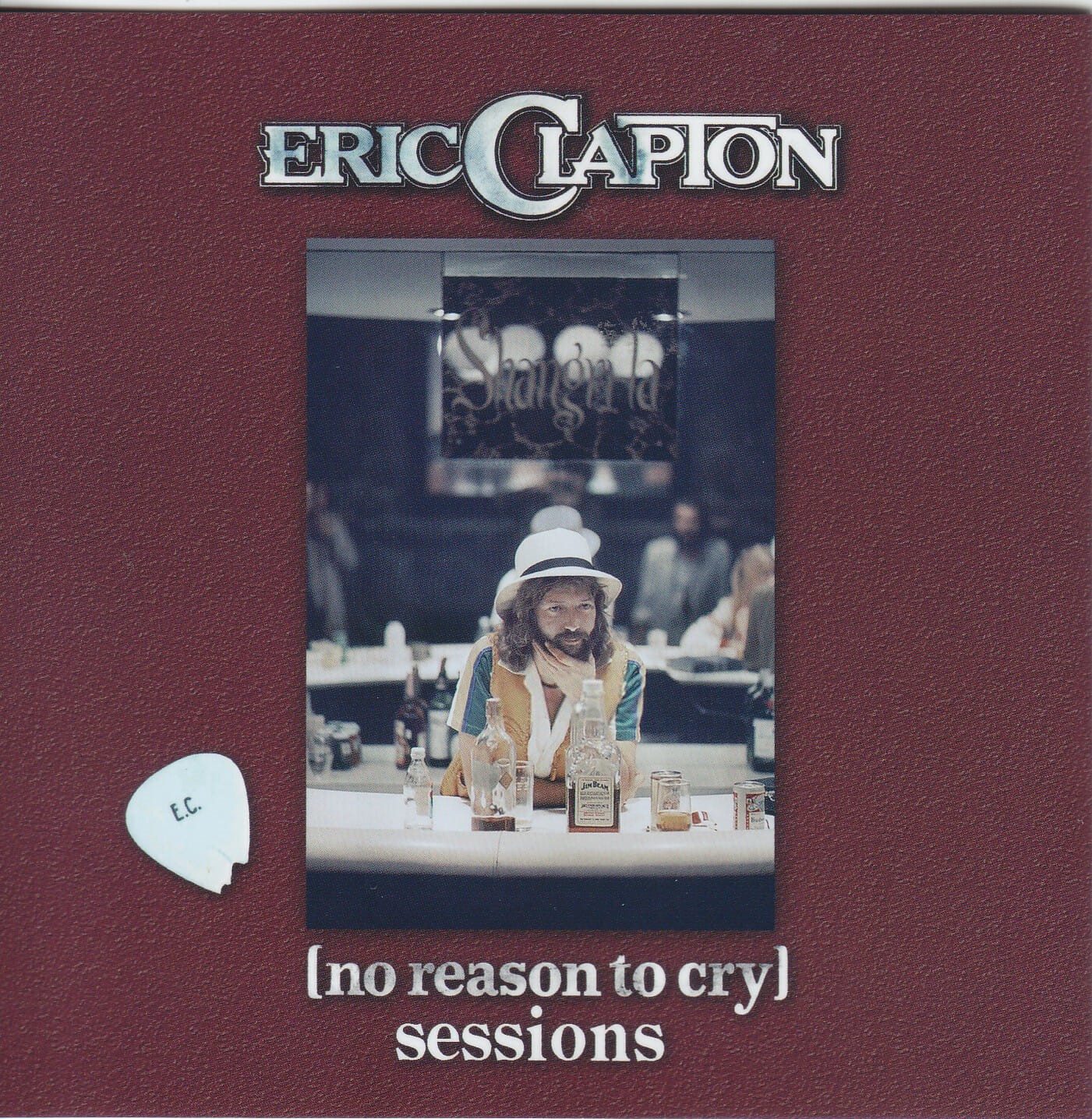
In the winter of 1975/76 Eric Clapton is in Los Angeles, in The Band’s Shangri-La Studio to record one of his most successful 70s albums, No Reason To Cry. But despite that success, he looks back with little satisfaction in his autobiography (Clapton: The Autobiography, 2007).
Clapton calls it a “drunken and chaotic album”, blaming it on his own unstable state, on the fact that he initially tried to record the album without a producer and on the idyllic location and circumstances of the studio. The men of The Band and producer Rob Fraboni come to the rescue. All Band members play along, Richard Manuel gives him the beautiful song that will be the opening song (“Beautiful Thing”) and Rick Danko writes and sings, together with Clapton, the successful song “All Our Past Times”. And above all: Slowhand is so lucky that Dylan is around, in those days.
It is a bit mysterious, by the way. Dylan “was living in a tent in the garden of the studios, and every now and then he would appear and have a drink and then disappear again just as quickly.” But during one of those brief visits from that tent-resident, Clapton can ask if the bard would contribute something to his album, “write,sing, play, anything.”
“One day he came in and offered me a song called “Sign Language,” which he had played for me in New York. He told me he had written the whole song down at one sitting, without even understanding what it was about. I said I didn’t care what it was about. I just loved the words and the melody, and the chord sequence was great. Since Bob doesn’t restrict himself to any one way of doing a song, we recorded it three different ways, with me duetting with him.”
It is, Clapton concludes this episode, all in all his favourite track on the album.
The short passage in Clapton’s memoir is intriguing. So Dylan has already played the song before, in New York. That must have been during those chaotic, overcrowded Desire sessions, to which the British guitar god has less pleasant memories. When he is invited, he is delighted, but the enthusiasm immediately evaporates when he enters the studio.
There are “two or three bands already waiting to go into the studio”, there are twenty-four musicians present and Clapton is one of the five invited guitarists. It is “not unlike being in a doctor’s waiting room” and he has the same feeling as when he first met Dylan in the mid-60s: “I felt like Mr. Jones again ”- with the witty self-mockery in which his autobiography excels, Clapton refers to the incomprehensible, disorientated Mr. Jones from “Ballad Of A Thin Man”, something is happening here, but you don’t know what it is.
Despite all self-mockery, he does ignore the parallels with his own No Reason To Cry; according to the liner notes no fewer than forty (!) people are involved in the production thereof. In addition to the names of the men from The Band and Dylan, Ron Wood also stands out – according to tradition, Clapton was first offered “Seven Days”, but he passed that song on to the Rolling Stone, who indeed plays it on his next solo album (Gimme Some Neck, 1979).
The other intriguing point concerns Dylan’s own lyrics and genesis analysis: written down in one sitting without even understanding what it was about.
That seems a bit posed. It is not that complicated. Apparently a moderately inspired Dylan wanted to unleash his creativity on the potentially fertile, symbolic sign language metaphor. In song art, and in the arts at large, a rather unexplored image, indeed, that invites the creation of Nobel-worthy new poetic expressions.
Sign language, for example, beautifully depicts the limits of the human deficit, or is the key to deciphering what is not being said; thus beautifully symbolizes the inability and pitfalls of interpersonal communication – all angles which could infuse a language-loving, poetic genius like Bob Dylan in his usual form to an “Idiot Wind” or a “Man In The Long Black Coat”.
But he cannot reach those heights, in these days. We are on the eve of 1976, a year like 1972 and like 1984, years in which the spring is dry and the poet is watching the river flow, contemplating unreachable masterpieces.
Dylan has the phrase sign language, scribbles some rhymes in the margin, of which only sandwich and advantage survive, and even these rhymes he cannot squeeze in without hammering and prying:
You speak to me in sign language,
As I’m eating a sandwich in a small cafe
At a quarter to three.
In itself a promising, cinematic opening. Similar to the decor and the constellation of “Love Is Just A Four-Letter Word” or the interlude of “Highlands”, and it seems to be based on Sinatra’s “Only The Lonely” (Each place I go only the lonely go / Some little small café) and on Sinatra’s “One For My Baby (And One More For The Road)”: It’s quarter to three / There’s no one in the place ‘cept you and me – both can be found on the album Sings For Only The Lonely (1958), incidentally.
So: in three short lines an I-person and relationship stuff, a promising metaphor, the contrast of a banal act with a universal, human conflict, an attractive, Dylan-worthy rhyme find and references to the Great American Songbook … the way seems to be paved for a multi-coloured , mosaic-like Dylan classic.
The second verse does not really destroy hope;
But I can’t respond to your sign language.
You’re taking advantage, bringing me down.
Can’t you make any sound?
… does, however, lead to a first raised eyebrow. “You’re taking advantage”? The main characters, presumably love partners, have a communication problem, the click is no longer there, they no longer understand each other – that much is clear. But apparently the poet pertinently wants to paste the rhyme find sign language / advantage into it, even at the expense of a storyline, whether intended or not. After all, this is the poet who repeatedly defines his understanding of song art with the words: it’s the sound; words should not interfere.
Dylan does not succeed here in the latter; the content of the words “taking advantage” does interfere, is alienating and distracts from the sound.
The poet, who told Clapton he shook the lyrics out of his sleeve in one short session, recognizes this too. The third verse is therefore not very ambitious:
‘Twas there by the bakery, surrounded by fakery.
This is my story, still I’m still there.
Does she know I still care?
… a lazy, empty rhyme (bakery / fakery), a stylistic remarkably weak line of text (This is my story, still I’m still there) and a weirdly unsuccessful punchline, where the I-person suddenly becomes sentimental and – out of nowhere – wistfully wonders if she knows he still cares about her.
No, this is not the song artist who wrote “Abandoned Love” barely six months ago and who will build an alphabetical cathedral like “No Time To Think” in a year and a half.
Some rehabilitation then the final verse offers.
Link Wray was playing on a jukebox, I was paying
For the words I was saying, so misunderstood.
He didn’t do me no good.
The rhyming triple is nice and a pre-announcement of the rhyming pleasure that Dylan soon will demonstrate on Street Legal (“I took a chance, got caught in the trance or a downhill dance” in “We Better Talk This Over”, for example) and the greeting to Link Wray is appealing. Link Wray is thus admitted to a fairly exclusive members’ club, the club of Musicians Who Are Mentioned In A Dylan Song.
Neil Young, Alicia Keys, Blind Willie McTell, Ma Rainey and Beethoven, Billy Joe Shaver, Elvis … it’s a colourful, attractive mix of people and Link “Rumble” Wray will feel at home there. And apparently the name check also contributes to his already undisputed status; after Dylan, Link Wray is also sung by The Fall (“Neighborhood Of Infinity”, 1984), The Who (“Mirror Door”, 2006) and by Robbie Robertson (“Axman”, 2011).
With a sense of poetry, one might appreciate Robbie Robertson’s tribute to Link Wray as the closing of the circle; after all, Robertson plays two solos in that first homage, in “Sign Language”. Wonderful, again – it varies on that unusual, pinched, nervous little tour de force opening Dylan’s “Going, Going, Gone” on Planet Waves. Which is again very gracefully and sympathetically appreciated by Clapton, who is actually a much better guitarist:
“It also gave me the opportunity to overdub Robbie Robertson, doing his “wang bar” thing that I love so much.”
He is elegant, the godly Commander Of The Order Of The British Empire, triple member of the Rock and Roll Hall of Fame, West Bromwich Albion fan and eighteen-fold Grammy Award winner from Ripley, Surrey.
“Ladies and gentlemen, please welcome the poet laureate of Progressive Rock. The man who attempted to elevate rock music to new levels of artistic credibility. The legend who forced art into bed with Psychedelic rock, who donned capes in the ’70s and disappeared into a bank of keyboards and ten minute guitar solos, who emerged to find the Hobbit, and who suddenly shifted gears into fantasy and epic story-telling, releasing some of the strangest concept albums of his career. Ladies and gentlemen, welcome to the Prog Rock Tribute Concert To Bob Dylan…On Ice!!”
Starting us off tonight with their cover of “Open The Door, Homer” is the short lived English Prog band Titus Groan!
Thanks for that guys, the Bard would have been proud! It’s time to welcome our next act, give it up for the symphonic stylings of Refugee, featuring ex-The Nice members Lee Jackson and Brian Davidson plus future Yes & Moody Blues keyboard man Patrick Moraz. Here they are with their version of “She Belongs to Me”…
Wasn’t that something?? Love those keyboard solo’s Patrick!
Next we will be hearing a track from the legendary Emerson, Lake & Palmer. Here we have “Man In The Long Black Coat”
Now Greg Lake will step up to the mic for his take on a song he wrote with Bob called “Love You Too Much”
Thanks Greg…that was wonderful.
Now there is nothing Prog fans love more than a competition, so here is ex-Genesis Steve Hackett with his own version of “Man In The Long Black Coat”! Who does it best??
Now it’s time to bring out Yes men Steve Howe, Jon Anderson and Geoff Downes for their wonderful version of “Sad Eyed Lady Of The Lowlands!
Steve is going to stay on stage and take over from Jon on lead vocals for his version of “Just Like A Woman”
https://www.youtube.com/watch?v=IpCxSE_2rlI
Wasn’t that amazing! Now it’s time to bring out our headliner tonight…here he is…its ex-Genesis front man Phil Collins with his prog-tastic take of “The Times They Are A-Changin”!
Now like all good tribute concerts it’s time to end the evening with a special one of a kind supergroup! You know them from their time in groups such as Genesis, Yes, Asia and King Crimson. Ladies and Gentlemen let’s hear it one more time for Steve Hackett, with guests John Wetton and Chris Squire for their Prog Rocking version of “All Along The Watchtower”!!
Thanks for coming everyone…see you next time! Safe journey home, please remember to take all your possessions with you…and be careful on the ice whilst leaving the arena!!
What else is on the site
You’ll find an index to our latest posts arranged by themes and subjects on the home page. You can also see details of our main sections on this site at the top of this page under the picture.
The index to the 500+ Dylan compositions reviewed is now on a new page of its own. You will find it here. It contains reviews of every Dylan composition that we can find a recording of – if you know of anything we have missed please do write in.
We also have a discussion group “Untold Dylan” on Facebook. Just type the phrase “Untold Dylan” in, on your Facebook page or follow this link
And please do note The Bob Dylan Project, which lists every Dylan song in alphabetical order, and has links to licensed recordings and performances by Dylan and by other artists, is starting to link back to our reviews.
There are some songs by Bob Dylan that can be construed as ‘confessional’, as expressing the singer/songwriter’s strong personal feelings in the manner of poets like Allen Ginsberg.
‘The Groom’s Still Waiting At The Altar’ presents an allegory. In orthodox Christian terms, Jesus is depicted as a groom who’s waiting to be married to his bride, His church followers, once they’re found worthy.
With the benefit of hindsight, Dylan’s lyrics below can be interpreted as a peace-seeking Jewish groom who finds union with his Christian bride, Claudette, so far to be unworkable:
Don't know what I can say about Claudette
That wouldn't come back to haunt me
Finally had to give her up
'Bout the time she began to want me
But I know God has mercy
On them who are slandered and humiliated
I'd a-done anything for that woman
If she didn't make me feel so obligated
(Bob Dylan: The Groom's Still Waiting At The Altar)
The singer/songwriter, or his persona anyway, throws back, with Juvenalian glee, any humiliation he’s suffered at Claudette’s hands:
What can I say about Claudette?
Ain't seen her since January
She could be respectively married
Or running a whorehouse in Buenos Aires
(Bob Dylan: The Groom's Still Waiting At The Altar)
It’s later revealed that Nazi escapees to Argentina, including the ‘architect of the holocaust’, were likely assisted by the Vatican.
The lyrics of ‘Dead Man, Dead Man’ could be said to depict a cob-webbed, tuxedo-clad Christian bride waiting around while she unrealistically expects her dead groom to return sooner or later; in the meantime, she colaborates with the gun-happy American rulers of modern Babylon:
What are you trying to overpower me with,
the doctrine of the gun?
My back is already to the wall, where can I run?
The tuxedo that you're wearing, the flower in your lapel
Ooh, I can't stand it, I can't stand it
You wanna take me down to Hell
Dead man, dead man
When will you arise?
Cobwebs in your eyes
Dust upon your eyes
(Bob Dyan: Dead man, Dead man)
Nevertheless, agreeing with a Christian poet, Dylan considers his experience not be a waste of time:
Since then 'tis centuries,  and yet
Feels shorter than a day
I first surmised the horses' heads
Were toward eternity
(Emily Dickinson: Because I Could Not Stop For Death)
He has nothing but affection for the empathic Christians who sailed with him – he just stayed a day too long:
Strangers they meddled in our affairs
Poverty and shame were theirs
But all that suffering was not to be compared
With the glory that is to be
And I'm still carrying the gift you gave
It's part of me now, it's been cherished and saved
It'll be with me unto the grave
And then unto eternity
(Bob Dylan: In The Sumertime)
A number of analysts of the song lyrics of Bob Dylan assert that many of them can be ‘decoded’, and found autobiographical. As far as I am concerned that’s a dubious path to travel down since Dylan songs tend to have universal, rather than personalized, themes. That is not to say there are no songs that at least give the impression that they are ‘confessional’ – this especially when it comes to Dylan’s “conversion” to the Christian fundamentalism, and his later disillusionment with some of its leaders and followers. These songs seldom criticize the teachings of Jesus per se, but instead the rather harsh interpretations imposed upon Christ’s parables by evangelistic leaders.
Bob Dylan at times mocks organized religion in a humourous way. On winding down his ‘Christian phase’, he imitates the style of a fire-and-brimstone evangelist preacher, a role he took on, presumably seriously, for a time; the accompanying upbeat music gives the Horation burlesque away:
Trouble in the city, trouble in the farm
You got your rabbit's foot, you got your good-luck charm
But they can't help you none when it's trouble
Trouble
Trouble, trouble, trouble
Nothin' but trouble
Trouble in the water, trouble in the air
Go all the way to the other side of the world, you'll
find trouble there
(Bob Dylan: Trouble)
https://youtu.be/ikGCZVs2jfM
The song is inspired by a con man who puts on the mask of a fire-tongued preacher in the movie ‘The Music Man’:
Yes, you got lots and lots of trouble
I'm thinkin' of kids in knickerbockers
Shirt-tail young ones, peekin' in the pool
Hall window after school, you got trouble folks
Right here in River City ....
(Trouble, trouble, trouble)
(Robert Preston: Ya Got Trouble ~ Willson)
Christian churches, including evangelistic ones, have a long history of fomenting hatred against non-Christians, especially the Jews – even to this day. Indeed, the Nazis picked up on the depiction thereof to justify the committing of the most heinous crimes against humanity imaginable. That’s not at all funny, and Dylan turns to Juvehalian satire to express his anger:
I need a shot of love, I need a shot of love
Why would I want to take your life?
You've only murdered my father, raped his wife
Tattooed my babies with a poison pen
Mocked my God, humiliated my friends
(Bob Dylan: Shot Of Love)
It’s quite a hyperbolic interpretation of words said to be uttered by Jesus that Dylan hurls back at the literal-inclined fundamentalists:
For I am come to set a man at variance against his father
And the daughter against her mother
And the daughter-in-law against her mother-in-law
(Matthew 10:34)
As Christopher Ricks points out, Dylan uses Menippean mockery as well. The singer/songwriter criticizes the personal flaws of individuals such as arrogance, and hubris – those who consider themselves to have the one and only answer to the world’s problems. Though the following lyrics are double-edged as Dylan’s often are, they can be interpreted to mean many of those individuals who claim to be followers of Jesus ironically have a heart of stone. The poet William Blake envisions Christ as an imaginative child who shines the light of natural love in a world darkened by institutionalized hatred:
He's the property of Jesus
Resent him to the bone
You got something better
You got a heart of stone
You can laugh at salvation, you've can play Olympic games
You think that that when you rest at last, you'll go back to where you came
But you picked up quite a story, and you've changed since the womb
What happened to the real you, you've been captured but by whom?
(Bob Dylan: The Property Of Jesus)
https://vimeo.com/74542363
Blakean to the core are the following song lyrics:
I hear the ancient footsteps like the motion of the sea
Sometimes I turn, there's someone there, other times it's only me
I am hanging in the balance of the reality of man
Like every sparrow fallen, like every grain of sand
(Bob Dylan: Every Grain Of Sand)
Wrote the preRomantic poet:
To see the world in a grain of sand
And a Heaven in a wild flower
Hold infinity in the palm of your hand
And eternity in an hour
(William Blake: Auguries Of Innocence)
On our Facebook page I recently linked to a review of the Rolling Thunder movie, a review which had the headline “Scorceses Bob Dylan documentary leaves you clueless.” It included this comment:
“At the risk of sounding blasphemous, I must confess I’ve never understood what Bob Dylan sings. Except for the track Blowing In The Wind. I am yet to decode what ‘Upon four-legged forest clouds the cowboy angel rides’ and ‘He just smoked my eyelids and punched my cigarette’ means.”
And immediately two trains of thought came into my mind. First, art is not always full of clear and overt meanings. And second, Dylan is himself confusing because his songs are sometimes overtly meaningful – but often not. Which can lead to the temptation to think that because some are clearly meaningful (“Masters of War” serves well if you want one example) they should all be – if only we can find the key to unlock the meanings.
And to give another area of clarity, “Positively 4th Street” and the other songs of disdain really do hit the listener in the face – what is not to understand about “You’ve got a lot of nerve to say you are my friend” as an opening line?
Likewise, many of the love songs are clear (consider, “To make you feel my love”) as well as the lost-love songs (for example “Girl from the north country”). And as you would expect most of the religious pieces are also fairly clear such as “When He Returns”.
Indeed, as I have mentioned in passing before, it has always struck me as odd that the one time Dylan gave his audience a lecture (and it really was a lecture) on the meaning of songs, was when he performed religious songs throughout his concerts; the one time he didn’t need to tell us – it was all there for us to hear.
But like all masters of their art, and as the arrival and departure of the religious era shows, Dylan doesn’t always work in the same way. His art is ever varied – and like so many great artists he likes to play games, and he likes to deal in impressions, as much as he wants to give a clear message.
Take “Times they are a changin’,” recognised by many of one of the seminal works of the era and one of Dylan’s great early pieces. A true monument of the protest movement.
Except when you come to the lyrics, it isn’t a protest song at all. It actually says that things are moving on, pretty much of their own accord. There is no reference to protesting, challenging the political norms, none of the anarchism of “Don’t follow leaders.” No, it is a song that just says, quite clearly and overtly, things are changing and there is nothing any of us can do about it.
As for the rest of the Times They Are a Changing album, as I have oft pointed out, it is all about things standing still, and nothing changing. When things are bad people just pick up their belongings and keep on moving on or give up the uneven struggle.
Now if I wanted to draw a conclusion from this, I’d say the key element of Dylan’s work at this point was not to promote social and political form, but rather to paint a series of pictures of American society as he saw it.
But of course Dylan can also be obscure, and “Gates of Eden” is a perfect early example. Obscurity piles on obscurity as the writer quoted at the start of this piece suggests. And it is to songs like this that the analysts are drawn – and yes I admit I’ve done my own bit of trying to sort out meanings from some of Dylan’s lines.
But such analyses can lead us down strange paths, which perhaps the composer never intended. To see an example, it is suggested on the “Song Meanings” site that
“At dawn my lover comes to me And tells me of her dreams
is reference to Paradise Lost, where Eve tells Adam of the dream about the forbidden fruit, and off we go into a detailed examination of what Genesis is about.
And maybe some of the discussions that can be found in a thousand books and a billion web pages can lead to an understanding of what Dylan was thinking when he wrote those words. But my question is twofold. One, does that help us appreciate the song? And two, does that help us at all, since most of the time we won’t have a clue if we are really right, because Dylan isn’t saying.
Of course in one sense the answer can be “yes it does help” – the more we can get inside the head of the artist (whatever the art form) the deeper our understanding. But we should also remember that phrases and ideas in Dylan songs can be lifted from the Bible, from a movie, from an obscure Japanese book or anywhere else, not because they represent some almighty truth that the composer wishes to express, but because they sound good when sung, and Bob rather fancied them.
And I would argue there is absolutely nothing wrong with using a phrase in a song, just because it sounds good. There is no rule that says songs actually have to mean anything at all.
Thus just as a painter of abstract art might choose a particular shade of pink because she or he likes that particular shade of pink, not for any deeper meaning, so a songwriter might use a line “He not busy being born is busy dying” not because it is singularly profound, but because it is in essence pretty meaningless but SOUNDS profound.
Now mentioning pink (not for any reason, it just happened to come into my head) I was reminded of this comment I read on a web site while researching this article about one of my favourite novels. (I got distracted – it is a very common failing for me – but it is also a technique many artists use, picking up often disconnected ideas and thoughts from life around them).
It says, “In The Restaurant at the End of the Universe, we find our heroes in a stolen spaceship, on a course to crash into a local star as a special effect for the band Disaster Area. This is of course a reference to Pink Floyd, and their song “Set the Controls for the Heart of the Sun”.
Of course? I mean “OF COURSE”????
Now it is possible that Douglas Adams in writing “The Restaurant at the End of the Universe” was listening to that Pink Floyd track and it gave him the idea. But I am not sure he ever said that was the case, even if he did, does it matter? What is funny in the book is that in the far distant future there are two restaurants, one at the start of the universe (“The Big Bang Burger Bar”) and one at the end. And the title “The Restaurant at the End of the Universe” is just inherently funny because of the juxtaposition of the end of all things and going out for a meal.
But I suspect many critics travel down the well-worn paths of connecting the not necessarily connected, not particularly to illuminate our understanding of a work of art, but simply to show off, or because the idea just popped into view at the time of writing, and like the idea in the book or the song, felt like a good idea at the time. And perhaps they feel moved by their idea because they have not got hold of the idea that maybe a song, like a painting, like a work of modern dance, or like a Beethoven piano concerto, might not be about anything, but simply is. And through simply being, some people can get a huge amount out of it simply by looking and listening.
To my mind, Dylan is a great artist, worthy of the Nobel prize, because he has taken an art form (popular music) which is often very constricted in terms of what it can say, and how it can be said, and given that art form new dimensions which allow it to say anything – sometimes with meaning, sometimes in abstract terms. In short he’s moved us from “You ain’t nothing but a hound dog, crying all the time, you ain’t never caught a rabbit and you ain’t no friend of mine” (a song which we may note only has one other line – “They said you were high class, but that was just a lie”) and given us songs in which overt meanings, obscure meanings, quite possibly no meanings, complex constructions, simple constructions, original lines and copied lines, collide together and get mixed up to give meanings and no meanings. Songs which may have a meaning in places, but then which quite often don’t.
Just think of Visions of Johanna. It is a vision; but a vision that is not clear, a vision that can be re-interpreted. Compare Dylan’s various versions of it with Old Crow Medicine Show. We might think we have a grip on the meanings behind Dylan’s versions of the song either on the album or live on stage, but now the meaning changes as fast as we try to get hold of it.
https://youtu.be/XMHgBNmQ6EM
And so I would argue that although art can be about meaning and messages, most of the time great art isn’t just about meaning, and indeed quite often great art isn’t about meaning at all. A novel can carry a moral tale, but it can also be entertainment (as in a detective story). It can be untrue (as is all fiction) but can also be informative (as with historical fiction that keeps to the historical reality). It can be about a vision with no start and no end (consider the novels of Thomas Pynchon, after “Lot 49”. There is no limit to what you can do in a novel in the hands of a master. Likewise, there is no limit to what a song can do in the hands of a master.
Likewise visual art. It can be representational – a drawing of something that exists, or it can be a long way away from representing anything. I have in my home prints of works by Jackson Pollock and Bridget Riley and I spend a fair bit of time at home looking at them. But their meaning? I am no closer to that than when I was given the pictures 10 years ago. Likewise consider the theatre of the absurd or if you prefer Dali and the surrealists. What does it mean? Ah, now there’s a question.
And yet in the midst of all this I come across people who keep on insisting that art has to be either autobiographical or political. Did anyone think Elvis was singing about a past love affair when he sang the three lines of Hound Dog? Of course not. And just because Robert Johnson quite possibly did feel like he had a Hell Hound on his trail, does that mean that Tom Petty really did see vampires walkin’ through the valley as he was writing “Free Fallin”? I doubt it.
Thus I reach the conclusion that just because a person has an interest in religion that does not of itself make every work of art religious. Just because a person creates a work of art on a religious theme that does not make that person a convert – nor all of her or his work religious.
And I reach this conclusion through two simple steps. First art can be many things: entertainment, insight, questioning, political awareness, social commentary, commemoration of the past, passing the time of day. And second, people change.
Of course in our society today people seek to understand Dylan’s meanings because western culture has for years been beguiled by the scientific notion that everything is understandable and therefore (with a bit of mental shuffling) everything has a meaning. Even life itself has a meaning, at least as soon as we add a god to the mix.
But most of the time Dylan is not like this. And worse, from the perspective of those who seek to understand him, he is an artist who changes. Sometimes he is autobiographical, sometimes religious, sometimes political, sometimes metaphorical, sometimes surreal, sometimes funny, sometimes obscure, sometimes simply poetic.
Let me take an example: the song Tell Ol’ Bill. I choose it not just because I like it, but also because it is one of Dylan’s less well known pieces and so there is a chance you might come to this afresh, and because it is a perfect example of how Dylan can combine meanings with suggestions to give us an overall “essence” but not a straight “this is about x”.
If we go through the lyrics below the song appears to be about an exile writing back to an ex girlfriend in his homeland. We get the idea, maybe, that the singer is about to undertake one last act but what that act is, we don’t know. Nor do we know why he needs to do this, nor why he is an exile.
In short we know very little. Virtually nothing in fact. And the tiny fragments we do know can be contradictory. What, for example, within the context of the song, can we make of
Why must you come down off of your high hill? Throw my fate to the clouds and wind
Who is the enemy at the gate, when the singing is singing to himself alone? And above all why should the recipient of the message
Tell ol’ Bill when he comes home Anything is worth a try Tell him that I’m not alone That the hour has come to do or die
Or come to that how can be alone and not alone?
Of course answers can be found to the questions, but those answers are not clear – and I would argue that this is the intent. They are not meant to be clear.
Clarity, can come from a myriad sources. For example, one can create a work of art that looks or sounds obscure but is explained in a flash by its title. Dylan chose not to do this, calling the song “Tell Ol Bill” which tells us nothing at all, because a lot of the detail that we need for an explanation is missing. We’re getting snatches of the situation – like hearing a report on the phone which keeps cutting out.
As a result of this obscurity, art can just be itself: the art, rather than the expression of a meaning. If it moves you, or gives you insights, or you simply likes the shapes, the colours, the patterns, the sounds, then fine. Quite often that is all the artist wants to give you – enough to develop your appreciation and enjoyment but not an absolute statement.
So my point is that some art is about actual things, some is about nothing that we can express in language, and some is half way between the two.
To give an example of a work of art that is itself obscure but is explained by the title, we may consider “Guernica” the world famous masterpiece by Pablo Picasso is about something – the casual bombing practice on the Basque town of Guernica during Spanish Civil War. Here the knowledge of what it is about, via the title, gives us an understanding of the painting which I suspect most of us would never grasp, if we did not have the title.
Now let’s try another example. “Visions of Johanna” by Bob Dylan is, like “Tell Ol’ Bill” obscure. We get the idea, but we never know quite what the song is exactly about. We have to work it out ourselves, find our own images, find our own meanings – or maybe not find meanings at all but just take the feelings that we get from the song.
We can also go digging in history to find out more. We can look at Picasso’s political affiliations which give us further insight. We can find that Tell Old Bill appeared in a compendium of American folk songs by Carl Sandburg’s compendium of American folksongs from 1927 which does indeed open with the line Tell Old Bill when he gets home.
And maybe that gives us a clear that Dylan really is simply picking up lines that he likes and reusing them to make a set of meanings that are not clear, and unlike Picasso’s work is never meant to be clear.
We might also note that Dylan takes a line from Edgar Allen Poe’s “To one in paradise” …
(Such language holds the solemn sea
To the sands upon the shore)
Shall bloom the thunder-blasted tree,
Or the stricken eagle soar!
At which point we can of course get a bit worked up about the fact that Dylan nicked (or if you prefer borrowed) a line for Edgar Allen Poe. However what I am trying to say is that although it is interesting to know that Dylan has used phrase from Poe, as it is indeed interesting to see all the sources of Dylan’s lines, we should not, in studying these origins, lose track of the overall impact of the work as a whole. For that is what it is. It is not a collection of individual lines – it is a complete piece of art which opens a window on another world.
My view is thus that it is interesting to analyse the lyrics in detail, just as we might look at a painting and analyse the use of individual colours or brush strokes, and that such detail can help us understand the artist’s work. But we must also look at, or in Dylan’s case hear, the overall work.
For me, Dylan’s masterpieces (Johanna, Tell Ol Bill, Things have Changed, The Drifter’s Escape etc) are the absolute masterpieces because of the overall feeling they offer. Or one might say, the overall “impression.”
And this is true both in songs where the meaning is clear as much as those where the meaning is obscure. “Not Dark Yet” for example, has lyrics that make it clear what the song is about. But beyond that, the simplicity of the opening line, “Shadows are falling and I’ve been here all day” itself paints a picture. Add the music which Dylan has created around that line (technically the point is that he doesn’t start singing on the first beat of each bar) gives us a sense of the world falling apart and everything coming to an end.
In short, what we get is a total package of music and words – and it doesn’t matter whether you are able to appreciate where the bars in the music stop and start, any more than not knowing about paint and brush stroke technique inhibits one’s enjoyment of the visual artist’s work.
I don’t need to know what Old Bill was up to and why he is where he is, or indeed why Bob Dylan wrote the song. What I get from these lines is a vision of a place, and of a man’s feelings, and in understanding and appreciating that, I am enhanced. I have learned a little more about life. And for that I am grateful.
Tell ol’ Bill when he comes home Anything is worth a try Tell him that I’m not alone That the hour has come to do or die
Two young, up-and-coming talents of French cinema meet on a film set in 1958, at the start of both breakthroughs. No main roles yet, but fairly visible supporting roles: Jean-Paul Belmondo plays Pierrot, a young gang member and Alain Delon can be admired in the role of Loulou, the young boyfriend of gang leader Olga. Sois Belle Et Tais-Toi, the somewhat corny gangster comedy is called – “Be beautiful and shut up”.
People are not that sensitive to sexism in those years, and the slogan resonates. In 1960 Serge Gainsbourg writes a whole song around the one-liner (on the EP Romantique 60), in English the blunter modification Just shut up and look pretty makes headway and in 1982 legendary painter Karel Appel embarrasses hostess Miss Sonja Barend live on television when he snaps: “Tais-toi et sois belle!”
By that time its impropriety has crossed the accepted standards of decency, but it remains popular. Only now as a provocation, as an ironic commentary, or cynically, as a feminist weapon. The many paraphrases are often witty. The masculine variant Sois beau and tais-toi, for example (of which the Belgian Marka makes another nice song, 1997), or the pun Sois blonde ou teins-toi (“Be blond or paint it”), or the funny knock-out which in May ’68 is attributed to De Gaulle, Sois jeune et tais-toi (“Be young and shut up”).
With all due respect for all his admirable qualities, Dylan does not exactly have the reputation of being a role-breaking, feminist front warrior. Already in the early 60s his main characters distinguish themselves again and again with hurt and misguided male chauvinist lamenting (“Don’t Think Twice”, “I Don’t Believe You”), sometimes even with poison prone to misogyny (“Ballad In Plain D”, “Like A Rolling Stone”, “Most Likely You Go Your Way” and “Just Like A Woman”, of course) and the hubbub does not subside in the next decade either, thanks to songs like “Idiot Wind” and “Is Your Love In Vain?”.
It is noteworthy how Dylan, when he is confronted with the Archie Bunker content of these lyrics, does not hide behind his standard reaction, behind the – otherwise credible – defense that his songs are not autobiographical, that the I is not I, Bob Dylan, that je est un autre.
For example, in the case of “Is Your Love In Vain?” On the “chauvinistic” line you can cook and sew, make flowers grow Dylan responds:
“That criticism comes from people who think that women should be karate instructors or airplane pilots. I’m not knocking that – everyone should achieve what she wants to achieve – but when a man’s looking for a woman, he ain’t looking for a woman who’s an airplane pilot. He’s looking for a woman to help him out and support him, to hold up one end while he holds up another.”
(Rolling Stone interview with Jonathan Cott, September 1978)
The criticism does not decelerate him. In the 1980s and beyond, Dylan even adds a little extra, and the suspicion seems justified that a child of the 1950s is speaking here, with correspondingly fossilised ideas about traditional roles and women’s rights.
Notorious is the one-liner from “Sweetheart Like You”, You know, a woman like you should be at home / That’s where you belong, and even in the twenty-first century, the now sixty-year-old bard wrecks his chances on cheers from the emancipated corner after the sexist grenade in “Sugar Baby”:
You always got to be prepared but you never know for what
There ain’t no limit to the amount of trouble women bring
That is 2001. And five years later, when retirement age is reached, Dylan really, really doesn’t care anymore, apparently:
I got troubles so hard, I just can’t stand the strain
Some young lazy slut has charmed away my brains
(Modern Times, “Rollin’ And Tumblin’”)
The pasha talk of the imperative macho from “I’ll Be Your Baby Tonight” on 1967’s John Wesley Harding will not receive much applause from feminist dogmatisers either. Close your eyes, bring that bottle over here, shut the shade … the self-assured Don Juan gives seven brief orders, reassuring her in the meantime that she “does not have to be afraid”, because “tonight he is going to be her lover”.
With hindsight, it’s a good thing no ethical border guards were around in the Basement, a few weeks before the recording of “I’ll Be Your Baby Tonight”, when Dylan makes a run-up to that song with the men from The Band: “Baby, Won’t You Be My Baby”.
The same protagonist goes one step further, and barks his version of sois belle et tais-toi:
Shut your mouth, close your eyes,
Baby, won’t you be my baby?
Well, it’s 1967. You probably still can get away with it. And anyway, this one outpouring of machismo pales in the presence of the surrounding couplets: it is rather gray and unpleasant, out there. True, the refrain line to which the song owes its title is a romantic, widely used cliché in song culture since the 1920s (“Won’t You Be My Loving Baby” by the Halfway House Orchestra from 1927, for example, and “Won’t You Be My Baby” by Bennie Moten’s Kansas City Orchestra from 1930), but Dylan’s setting of this line is far from romantic.
That setting is, on the contrary, apocalyptic. Although not as kaleidoscopic as in “A Hard Rain’s A-Gonna Fall” and not as subcutaneous as the references in songs such as “Jokerman” or “Slow Train”, but straightforward, in rough, unambiguous terms. All mankind in misery in the first verse, nothing appealing to discern in verse two, followed by a dead end road and culminating in the fourth verse with a biblical-sounding doom prophecy: east and west the fire will rise.
It is an odd hotchpotch, all in all – that sweet, somewhat frivolous cliché won’t you be my baby, the desolate backdrop and that pompous sexism. Apparently the poet feels so too; from “Baby, Won’t You Be My Baby” only one take is known, which on top of that is brutally interrupted when Garth Hudson starts an organ solo. And afterwards the song is immediately thrown into the waters of oblivion.
Still, a pity. With one more scribble and scratch session, Dylan would have made something more of those lyrics, and the music is pretty fun. A rather basic blues, but still.
Tony Attwood argues convincingly that the music is a duplicate of the classic “Mama Don’t Allow” (or “Mama Don’t”), and there is little to argue against that. It moves Tony to a contagious ode to the song and a spotlight on J.J. Cale’s wonderful live version, which is indeed beautiful. Attwood does ignore the most moving version of the song, though, the one by the “fabulously talented Mr. Dudley Moore” in the seventy-eighth Muppet Show (October 1979, season 4, episode 7). Dudley Moore has brought a robotic music device that removes the need for other musicians. It is truly heartbreaking to see how an unemployed Animal has to endure Moore singing Mama don’t allow no drummer man in here, leaving the drum solo to the R2D2-ish vessel.
By the way, Kermit and Attwood disagree about the origin of the song. Tony traces it back to 1928, to one Riley Puckett, while Kermit dates it 1929 in his announcement and attributes the song to Cow Cow Davenport. Attwood is probably right; Cow Cow Davenport does have a known tendency to claim other people’s songs, and the oldest known recording is indeed from 1928 by Puckett, for Dylan’s record company Columbia, incidentally.
Apart from that: Dylan is of course not the only one who duplicates structure and melody of old classics for a new song. “Mama Don’t Allow” is in turn a copy of the classic “This Train (Is Bound For Glory)”, which was popular in the early 20s and with which Sister Rosetta Tharpe scored a big hit in the 30s (The version that Dylan plays in his Theme Time Radio Hour is her re-recording from 1947).
Dylan himself recorded the song in 1961 (to be found on the so-called Minnesota Hotel Tapes Bootleg, on which it is wrongly attributed to Big Bill Broonzy). Dylan is, obviously, fascinated by the song because it is the name giver and the silver thread of his personal bible, of Woody Guthrie’s autobiography Bound For Glory.
And before that, Willie Dixon already sculpted “My Babe” out of Bound For Glory, a song recorded by both Little Walter and Elvis, among others. The King did not record it until 1969, but Little Walter scored a huge hit with it in 1955. Radio maker Dylan plays Little Walter no less than five times. Not this “My Babe”, though Walter’s version of this particular song is most certainly under his skin, too.
https://www.youtube.com/watch?v=p3cKJ42HAd0
Woody Guthrie, “This Train Is Bound For Glory”, Little Walter, “Mama Don’t”, Sister Rosetta Tharpe, “My Babe”, Willie Dixon, “Baby, Won’t You Be My Baby”… the chain demonstrates once again the deep truth of Dylan’s words during that wondrous MusiCares speech, February 2015:
“All these songs are connected. Don’t be fooled. I just opened up a different door in a different kind of way.”
Dylan’s unfinished sketch from the Basement is unknown until the official release (The Basement Tapes Complete, 2014), and that official release, understandably, does not lead to much excitement; covers there are not. Yes, one from Howard Fishman, who has the admirable mission to perform all Basement songs. He turns it into a semi-acoustic, Buckets Of Rain-like fingerpickin’ blues, with a hysterical violin as a troublemaking disturbance – pleasantly disrespectful.
Ok, cards on the table – I am as big a Paul McCartney fan as I am of Bob Dylan so this should be something of an easy piece to write. Except it isn’t, the two men rarely met (at least publicly) – the picture above is the only one I can find of the pair together. It doesn’t seem that there was much influence on each others writing, certainly not lyrically, maybe musically the occasional Macca track will be a bit “Dylan-y” and vice-versa.
However, they have had quite a bit to say about each other the years and here are some of Dylan’s thoughts on the early Beatles:
“The Beatles came along, and kind of grabbed everyone by the throat. You were for them or against them. You were for them or you joined them, or whatever. Then everybody said, ‘Oh, popular song ain’t so bad,’ and then everyone wanted to get on the radio.”
“They were doing things nobody was doing. Their chords were outrageous, just outrageous, and their harmonies made it all valid. You could only do that with other musicians. Even if you’re playing your own chords you had to have other people playing with you. That was obvious. And it started me thinking about other people.
“But I just kept it to myself that I really dug them. Everybody else thought they were for the teenyboppers, that they were gonna pass right away. But it was obvious to me that they had staying power. I knew they were pointing the direction of where music had to go. I was not about to put up with other musicians, but in my head the Beatles were it.
Over the years Bob has had much to say on McCartney:
“They were fantastic singers. Lennon, to this day, it’s hard to find a better singer than Lennon was, or than McCartney was and still is.”
“I mean I’m in awe of McCartney. He’s about the only one that I am in awe of. But I’m in awe of him. He can do it all and he’s never let up, you know. He’s got the gift for melody, he’s got the rhythm. He can play any instrument. He can scream and shout as good as anybody and he can sing the ballad as good as anybody, you know so… And his melodies are, you know, effortless. That’s what you have to be in awe… I’m in awe of him maybe just because he’s just so damn effortless. I mean I just wish he’d quit, you know. [laughs] Just everything and anything that comes out of his mouth is just framed in a melody, you know …”
The remaining Beatles discussed that early meeting with Dylan in their 1995 Anthology series:
McCartney goes so far to state that Dylan was “our idol”, adding, “I could feel myself climbing a spiral walkway as I was talking to Dylan. I felt like I was figuring it all out, the meaning of life.”
For his part Dylan would answer the hotel phone by shouting, “This is Beatlemania here!” Otherwise they drank wine and hung out.
McCartney was inspired by the speed at which Dylan recorded “New Morning” in 1970, which was recorded over a five day period:
“Dylan inspired Wild Life, because we heard he had been in the studio and done an album in just a week. So we thought of doing it like that, putting down the spontaneous stuff and not being too careful. So it came out a bit like that. We wrote the tracks in the summer, Linda and I, we wrote them in Scotland in the summer while the lambs were gambolling. We spent two weeks on the Wild Life album all together. At that time, it was just when I had rung Denny Laine up a few days before and he came up to where we were to rehearse for one or two days.”
Dylan has covered a couple of McCartney’s songs over the years.
Here is a wonderful, playful version of “Yesterday” he recorded with George Harrison in 1970. I’m not sure what George is doing with his lead guitar playing, it gets a bit reggae towards the end but I love it!
Bob also included a cover of “The Long And Winding Road” in a show in 1978. Unfortunately, I am unable to find any audio of his version. It is intriguing to say the least!
Then in 2014 for the McCartney tribute album “The Art Of McCartney”, Bob pops up with a fine cover of “Things We Said Today”.
https://youtu.be/B28G1P9l9yw
I would be interested to hear his own thoughts on why he chose this track (or if it was chosen for him). McCartney has described the song as “future nostalgia”, which is a very interesting concept for a 1963 pop song. It moves effortlessly back and forward through time:
“Someday when we’re dreaming, deep in love not a lot to say…”“then we will remember things we said today”“You say you will love me, if I have to go”
Dylan keeps much of the original’s optimistic mood intact but his distinctive voice adds much to the piece. The selection of this track shows that Dylan knows his stuff as Beatle’s songs go it’s a bit of a deep-cut.
When McCartney was asked the question “Which Dylan track would he cover” this was his answer:
“That’s a very difficult question to answer, as there are so many great songs. ‘Mr. Tambourine Man’ comes to mind because it’s something you could cover.” He continued, “Singing Dylan songs can be difficult because something like ‘Like A Rolling Stone’, it’s so Dylan that it would be hard to get the spirit that he puts on it. ‘A Hard Rain’s A-Gonna Fall’ is another good one, you know. I’d put that on a list as well.”
I have been unable to find any examples of McCartney covering Dylan. The only tracks I can find that they both sang at some point is “My One And Only Love” (Triplicate / Kisses On The Bottom) and “Froggie Went A Courtin” – McCartney recorded this in 1991 as a warm up to his Unplugged show. Dylan recorded his take in 1992 so it is interesting they were both thinking about this track around the same time!
Let’s be honest though, McCartney and Dylan are top of the pile in the entire history of music. If Dylan has any peers in music, it can only be McCartney. If McCartney has any peers, it can only be Dylan.
You can read part 1 of this article at Cool Hand Bob
David Weir analyzes many of Bob Dylan’s song lyrics too much methinks through the lens of canonized Christian dogma, but assures us he is not imposing any religious message on the songs.
Kees de Graaf, on the other hand, comes to praise Dylan for his supposed Christian beliefs, but ends up burying Dylan’s figurative language underneath page upon page upon page that expound de Graaf’s own Christian beliefs. In a nutshell, Jesus Christ is the one and only answer to all the world’s problems.
The Bible, of course, is composed of two major books – the Old and the New Testaments with both of them composed of many smaller ‘books.’ Bob Dylan often references these major works in his song lyrics, but we really do not know what his personal spiritual beliefs are.
What we do have in front of us is his music and his song lyrics even though he quite often revises both of these aspects of his art form as well. To me it seems, if not into art for its own sake, Dylan is a seeker of knowledge, and his life experiences be a teacher that gives no definitive or simple answers. He also looks to traditional folk and blues songs, as well as to an assortment of literary and dramatic works; movies, too.
Regardless of what de Graaf thinks, Dylan’s song lyrics tend to present a Gnostic, if not Gothic, view of worldly existence – a dark, overly materialistic place in which everybody’s trapped, but from which the rebellious persona in his songs attempts to escape – in both body and spirit – through the door of empathy, a door that is seldom open:
As I walked out one morning To breathe the air around Tom Paine'sI spied the fairest damsel that ever did walk in chainsI offered her my handShe took me by the armI knew that very instant She meant to do me harm
(Bob Dylan: As I Went Out One Morning)
Time waits for no one – wish though we might that it would, the human body cannot remain forever young; attention has to be paid:
My clothes are wet, tight on my skinNot as tight as the corner that I painted myself inI know that fortune is waitin' to be kindSo give me your hand, and say you are mine
(Bob Dylan: Mississippi)
Between then and there, the hand revealed is the one dealt to us in the poker game of life – go ask Willie Loman, he knows:
I've been trying to get as far away from myself as I canSome things are too hot to touchThe human mind can only stand so muchYou can't win with a losing hand
(Bob Dylan: Things Have Changed)
Poor Willie – the American Dream turns into a nightmare (‘Death Of A Salesman’ by Jewish American author Arthur Miller). The myth of the freedom-loving frontier cowboy (including outlaws with hearts of gold) lives on – perpetuated in Western movies, often produced by Jews who escaped the horrors of persecution by fleeing to America (Wyatt Earp is buried in a Jewish cemetary in California):
John Wesley HardingWas a friend to the poorHe travelled with a gun in every handHe opened many a doorBut he was never knownTo hurt an honest man
(Bob Dylan: John Wesley Harding)
Meanwhile back at the ranch, many of the song lyrics by Bob Dylan compare modern America to the biblical Babylon of old:
There's a woman on my lapand she's drinking champagneGot white skin, got assassin's eyes....This place ain't doing me any goodI'm in the wrong town, I should be in Hollywood
(Bob Dylan: Things Have Changed)
The only thing we know for sure about Bob Dylan is that his name isn’t Bob Dylan, and that his persona has no fondness for the hypocritical behaviour of supposedly religious leaders; nor for any of their like-minded followers:
Well, I'm grinding my life out, steady and sureNothing more wretched than what I must endure ....Low cards are what I've gotBut I'll play this hand whether I like it or not
(Bob Dylan: Pay In Blood)
As did Jewish American actor Paul Newman in the movie ‘Cool Hand Luke’.