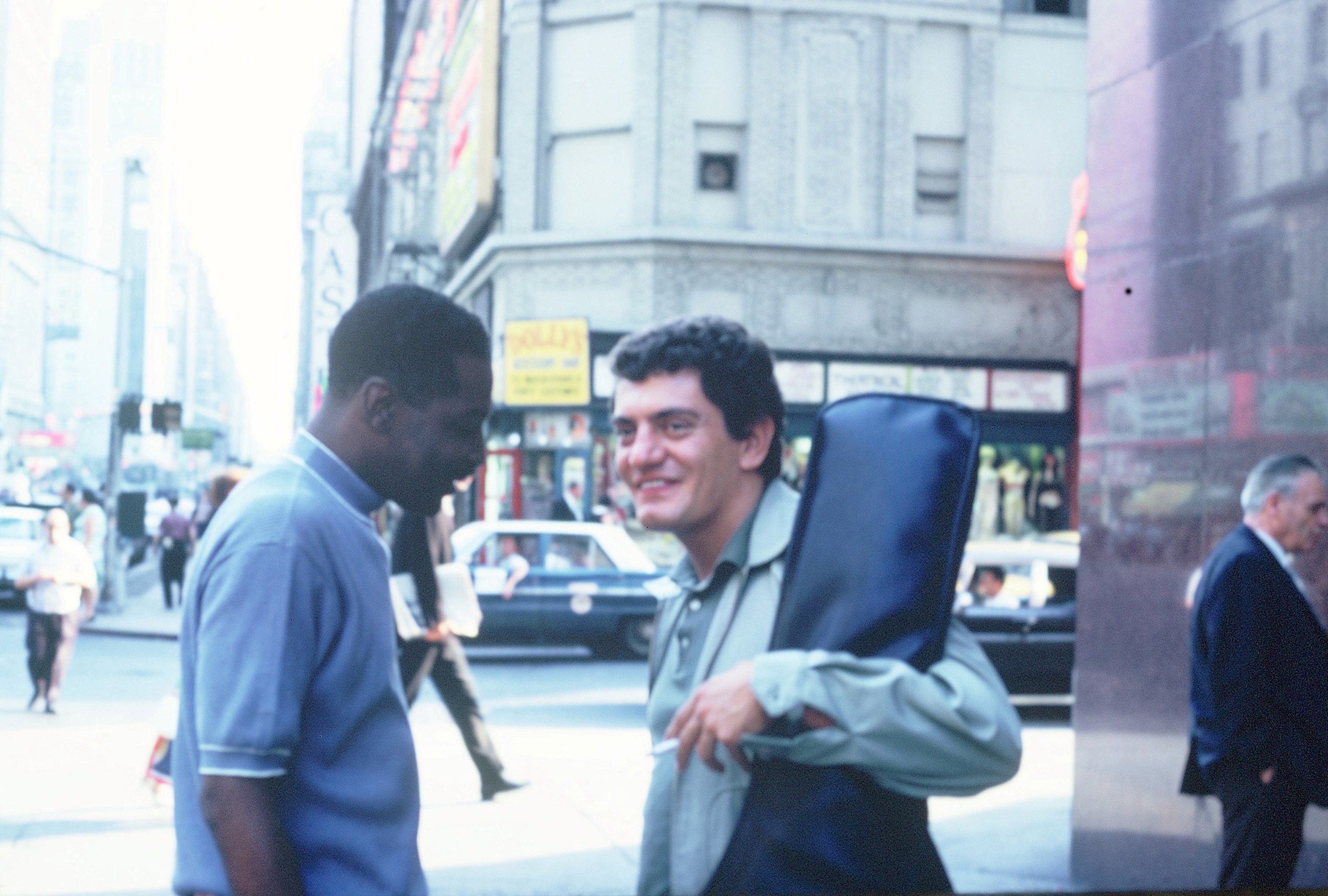
This is another of the songs from the “After the Empire” based on a chord sequence – in essence the two primary chords of the major scale with a passing chord tucked in between. The sequence is sung over and over again, often to the words “I’m ready for you” (rather than the “Ready for Love” printed on the video link that we have.
https://youtu.be/FdSEay_7Gzg
Discogs.com has the song with a very curious listing which includes
Written by Mick Ralphs
Composed by Bill Payne, Bob Dylan, Felix Cavaliere, Mick Falphs
Songwriter: Paul Rogers.
Make of that lot what you will. Anyway the song proceeds on its repetitive way, and then stops, and then they take it up again, although without lyrics before moving on.
Incidentally Dylan is noted on the official Bob Dylan site has having performed “I’m ready” 24 times in September and October 1978, but there are no details of the song given.
There is also Halleujah I’m ready which might be the song that the site is thinking of, as it is clearly performed in concert, and is not listed under H on the site.
https://www.youtube.com/watch?v=v2d29KuKQs8
Generally the time, date and place of this recording is given as Cherokee Studio, Hollywood, 31 October 1985, and there’s no reason to disagree.
It is simply a knock around experiment with less impact or possibility than the others we have covered here from this era such as
From my perspective these songs do have the benefit of showing Dylan at work at this point in time, but this was certainly not the way he worked at other periods in his life, and rather reflects a moment when he had run out of ideas.
Ah well, when the ideas are not there, all you can do is wait until they return.
What else is on the site
You’ll find an index to our latest posts arranged by themes and subjects on the home page. You can also see details of our main sections on this site at the top of this page under the picture.
The index to the 500+ Dylan compositions reviewed is now on a new page of its own. You will find it here. It contains reviews of every Dylan composition that we can find a recording of – if you know of anything we have missed please do write in.
We also have a discussion group “Untold Dylan” on Facebook. Just type the phrase “Untold Dylan” in, on your Facebook page or follow this link
And please do note The Bob Dylan Project, which lists every Dylan song in alphabetical order, and has links to licensed recordings and performances by Dylan and by other artists, is starting to link back to our reviews.
In April 2014, BBC Radio 4 starts with the entertaining theme series “I Was …” and they are actually always fascinating shows. The broadcasts of half an hour focus on a completely unknown main guest with one special merit. “I Was Johnny Cash’s Tailor“, for example, or “I Was Ernest Hemingway’s Secretary” or “I Was John Lennon’s Trauma Surgeon“.
On Thursday, June 1, 2017, Dylan fans tune into BBC 4, when Daniel “Catfish” Russ can tell his story in the broadcast “I Was Bob Dylan’s One-Off Sparring Partner“.
Dylan’s love for boxing is well known and with some regularity an anecdote pops up demonstrating that love. In 2014, he visits a training session of world champion Manny Pacquiao, who immediately posts a proud photo on Twitter. In interviews and speeches, Dylan sometimes mentions that he visits boxing fights, in the 70s he trains with former professional boxer Bruce ‘The Mouse’ Strauss and director Quentin Tarantino has an amusing story how an old Dylan manages to hit him full and hard in the face at a sparring party. “He got one in there when I wasn’t paying attention. I think it was a right jab. I let my guard down for a minute, and he just thumped it in. It was a good punch.”
The technical details then come from one-off sparring partner Daniel Russ, who in a boxing school in Austin, in the spring of 2008, to his astonishment suddenly faces Bob Dylan. Russ is a former amateur boxer, trained as a rabbi, a moderately successful writer and reasonably talented blues harmonica player, but above all a well-to-do advertising man in Texas. He actually just came in to say hello to the owner, an old friend of his. The 51-year-old Russ is no longer boxing, but when his friend asks if he could please spar with some old guy (“don’t even hit him. I mean not at all… just move around”), he is willing to put on the gloves for this one time. To his astonishment, he faces his great idol Bob Dylan a minute later. “If you paid me by the shot, I wouldn’t hit this guy….EVER.”
Russ is verbally gifted and has more than enough perspective on the sport, so on the radio show he can explain well how Dylan boxes.
“I got to spar him two rounds. And he knew what he was doing, he knew the mechanics of fighting and everything. He threw a couple of jabs, you know, like, instead of just doing pop – pop, when the jab comes, I put this hand up to catch it, and then he’d throw a double, so I put my hand down, the second one went through my guard and hit me in the head.
So, he knew how to do that, because your second one has to go further than your first one. So that’s something he practised. I was crowding him a little bit, I mean, I was getting in his space, forcing him back, and he hit me with a hook in the ribs. That was really good, good shot.
You either stay outside the shots or you stay inside the shots, you don’t wanna be where the shots are perfectly thrown. And when I stepped in on him, he hit me in the body with a hook, I thought that was cool. Bob Dylan hit me with a hook. He knew how to punch. He knew how to throw a jab and step with it, he knew how to defend himself, like his jab started at the shoulder, and went out and came back to the shoulder, he didn’t drop it, he knew how to hold his body, he knew how to move, he knew how to throw a jab right-handed hook, he knew how to mix the shots up.
Boxers put their feet apart, okay, you don’t put them together, because that’s when you get knocked-out, when you can’t move back. So you always keep a nice space between them, and he seemed to be doing that perfectly. Because it’s Bob Dylan, he does everything perfectly. He sings perfectly, he plays perfectly, that’s how he is. He probably doesn’t do anything half-ass. He probably, when he first learned how to throw a jab, he probably threw a thousand times.”
Russ takes the gloves home and still cherishes them. “I remember how I came home and I thought to myself: Two old jews got in the ring in Texas. And I was one of them.”
Relatively little can be found in Dylan’s work of that boxing love. Twice a song revolves around a boxer, but not around boxing (“Who Killed Davey Moore” and “Hurricane”), in his entire catalog there is no more than a handful of hints to the noble art of self-defense (in “Clean -Cut Kid”, in “Gotta Serve Somebody” and in “The Groom’s Still Waiting At The Altar”) and he covers “The Boxer” on Self Portrait.
At the time, in 1970, covering that particular song was a bit spicy. Around the song there is a rather thinly founded story, that Paul Simon would have meant it as a sneer to Dylan. In Greenwich Village, Dylan’s boxing love is well known, he has also left his home and his family to go to New York, and with that lie–lie-lie-chorus Simon shouts “lies lies lies” to the bard. Out of spite about his alleged betrayal of the folk movement, or something like that. Simon’s biographer Marc Eliot calls that interpretation utterly nonsensical (in Paul Simon. A Life, 2010), Simon himself has a radically different, credible story with regard to the genesis of the chorus and Dylan’s own answer, that cover on Self Portrait, is of course the most elegant.
But one time, somewhere at the start of his career, Dylan sheds light on his love of fist fighting in an own song: “I Shall Be Free 10”.
The song is an odd duck out, on side 1 of Another Side Of Bob Dylan (1964). The famous report by Nat Hentoff, the lucky wilbury who is allowed to attend the entire recording session on behalf of The New Yorker, does show the main merit of the song: it brings air, it is a comic relief. Producer Wilson laughs, the two technicians have fun, Dylan stumbles over the words a few times and eventually needs an extra insert to come to a complete recording. It is followed by “other songs, mostly of lost love or misunderstood”, and after the last recording, “My Back Pages”, the session ends at half past one in the morning. Dylan recorded fourteen songs in five and a half hours, eleven of which will appear on the album.
The decision to record the entire album in one fell swoop is based on commercial motives, as we are led to believe. Usually we don’t do this, says Tom Wilson, but record company Columbia must have the record before the fall sales convention, the fall fair that is scheduled for seven weeks later, late July, in Las Vegas.
That seems silly. Dylan is Columbia’s golden boy, can, again according to Tom Wilson, record whenever he wants to, and why he could not record a few songs on this Monday, a few others on Tuesday and the rest on Wednesday, is not clarified with this nonsensical fall sales convention argument.
It does provide insight, though, into how the questionable choice for “I Shall Be Free No. 10” as an album track was realised, at the expense of, for example, the also recorded, infinitely nicer “Mama, You Been On My Mind”, one of Dylan’s most beautiful love songs anyway. Apparently the still overheated decision makers think that “I Shall Be Free No. 10” on the album will create the same relaxing breathing space as during that monumental recording session.
It does not. Certainly, the song is entertaining, has music-historical value and indeed provides a comic relief the first few turns – but that effect does not last, it does not have the indestructible, granite charm of “To Ramona” or “Chimes Of Freedom” … or “Mama, You Been On My Mind”. In fact, the song is like a warm-up act in the theater. Dylan brings a series of unrelated, comic anecdotes, or rather, coathangers for witty one-liners (“I’m going to make your face look just like mine”), one of which even survives the twentieth century: Yippee! I am a poet and I know it.
But then again: it is of course the only Dylan song that gives a glimpse of his boxing fascination – that humourous second verse in which the narrator, shadow-boxing, fantasizes how he knocks The Greatest, triple world champion, Olympic champion and Sportsman Of The Century (Sports Illustrated) Cassius Clay, “clean out of his spleen”.
In that respect, Quentin Tarantino and Daniel “Catfish” Russel got away pretty well.
What else is on the site
You’ll find an index to our latest posts arranged by themes and subjects on the home page. You can also see details of our main sections on this site at the top of this page under the picture.
The index to the 500+ Dylan compositions reviewed is now on a new page of its own. You will find it here. It contains reviews of every Dylan composition that we can find a recording of – if you know of anything we have missed please do write in.
We also have a discussion group “Untold Dylan” on Facebook. Just type the phrase “Untold Dylan” in, on your Facebook page or follow this link
And please do note The Bob Dylan Project, which lists every Dylan song in alphabetical order, and has links to licensed recordings and performances by Dylan and by other artists, is starting to link back to our reviews.
Call it ‘black baroque’ or call it ‘gothic gnosticism’, the theme that haunts many of the songs by Bob Dylan is the certainity of death, often figuratively associated in his song lyrics with a woman – likewise, in western literary formats as well:
His lady has taken another mateSo we will make our dinner sweetYou will sit on his white neck-boneAnd I'll peck out his pretty blue eyes
(The Twa Corbies: traditional ballad)
A theme continued in later poetry:
I see a lily on thy browWith anguish moist and fever dewAnd on thy cheeks a fading roseFast withereth too
(John Keats: La Belle Sans Merci)
In the Dylan song lyrics below:
You trampled on me as you passedLeft the coldest kiss upon my browAll my doubts and fears have gone at lastI've nothing to tell you now
(Bob Dylan: Tell Ol’ Bill)
In the lyrics directly above, the narrator takes on the masculine ‘he-man’ attitude that’s often expressed in the Existentialist novels of Ernest Hemingway – ie, ‘guts’ is the showing of grace and dignity under pressure:
I went down to where the vultures feedI would've gone deeper, but there wasn't any needHeard the tongues of angels, and the tongues of menWasn't any difference to me
(Bob Dylan: Dignity)
The narrator notes that death comes soon enough without any need of letting the emotional effects of a lost love move things along in the direction of a supposed better afterlife.
A theme expressed by a Romantic poet with a Modernistic bent:
Two roads diverged in the yellow woodAnd since I could not travel both ....Then took the other, as just as fairAnd having perhaps the better claimBecause it was gassy, and wanted wearThough as for that passing thereHad worn them really about the same
(Robert Frost: The Road Not Taken)
Frost darkens Romantic Transcendentalist Walt Whitman’s sunny poems “Leaves of Grass’ by treading upon them in the path on which he decides to travel.
It’s worth repeating that the singer/songwriter, alluding to Victorian poet Lord Tennyson, and to Frost again, does much same thing to the “Wiseman lookin’ in a blade of grass” (‘Dignity’):
The evenin' sun is sinkin' lowThe woods are dark, the town is tooTell ol' Bill when he comes homeThat anything is worth a tryTell him that I'm not aloneThat the hour has come to do or die
(Bob Dylan: Tell ol’ Bill)
How much the songwriter’s personal outlook may or may not match that of the narrator in the song lyrics is a moot point. If not directly, Bob Dylan comes in contact with poet Ezra Pound’s open-to-interpretation style of writing (that is, it’s understated, objective, omissive, and imagistic) through the stories of Ernest Hemingway:
It’s awfully easy to be hard-boiled about everything in the day time,
but at night it is another thing
(Ernest Hemingway: The Sun Also Rises)
The singer/songwriter, as it’s been pointed out, alludes to Hemingway in the song lyrics below:
Wedding bells are ringing, and the choir is beginning to singWhat looks good in the day, at night is another thing
(Bob Dylan: Summer Days)
https://youtu.be/elQthPY-CL8?t=10
In the movie ‘To Have And Have Not’, based on Hemingway’s novel of the same name, Lauren Bacall (Slim) says to Humphrey Bogart:
"You know, Steve, you're not very hard to figure.Only at times. Sometimes I know exactly what you're going to say. Most of the time."
Sings the songwriter:
Most of the timeI can surviveAnd I can endureAnd I don't even think about her
I should begin by saying that if you are an aficionado of all that is refined in the world of entertainment you might like to sit down before listening to this.
And I must admit that when it was put to me that Bob Dylan liked “Surfin Bird” and more generally the band The Trashmen who recorded it, I had a certain amount of dubious feelings floating around my mind.
But then it starts to make sense. Both Dylan and The Trashmen are from Minnesota and Dylan did indeed spend a year at the University of Minnesota. And both Bob and the Trashmen can be said to be artists who like to subvert the form that they are working in.
Anyway, after leaving university Bob headed for New York and the influence of Woody Guthrie. But, as I was trying to point out in my recent post about “For you baby” and the influence of Ginsberg and the Beat generation on Bob Dylan, although we rightly associate Dylan with Guthrie, there are multiple other influences on his work as well. And this is one of them.
Plus we do have a clear confirmation of Dylan’s interest in the Trashmen, for according to Tony Andreason, “He came out and watched us play in the ’80s. We were doing a benefit in Minnetonka, and Dylan came and was there all night long. He sent a woman over to talk to us and wanted to know if we were available to go out on tour with him for any length of time, and we said we really weren’t. We weren’t interested, regardless of who it was. It wasn’t going to work.” Which I think, is a bit of a shame.
Backing up this story there is an article on the University of Minnesota Press blog, “On Bob Dylan’s early folk years and the flourishing Minnesota music scene in the 1960s” in which they report that “Trashmen rhythm guitarist Dal Winslow recalled that… Dylan was asked by Rolling Stone what he did in his spare time. “He said, ‘Well, I go out and watch The Trashmen perform at Minnetonka, Minnesota.’ And I thought, ‘Well, thank you, Bob. I take back everything I said about you’.”
The article also notes that Dylan has played in the Twin Cities (St Paul and Minneapolis) regularly since the late 70s, which adds further credence to the story.
“The Bird’s the Word” was also a hit for The Rivingtons
and was very similar to their previous hit “Papa Oom Mow Mow” (which I have conveniently placed below so that you can check, just in case you are thinking I am making this all up.)
The group subsequently won a series of battle of the bands competitions and signed a record contract, with the song reaching number 4 on the Billboard Hot 100.
And the reason for me picking up on this song now, is to emphasise the multiplicity of inputs into his musical consciousness that Dylan has. This is not to say that he would attempt to create music such as this, but rather that he took all these different musical forms and welded them into his own music. If some of Bob’s lyrics don’t make any sense then nor did all the music that he liked. But he also had a liking the folk music that so influenced his early recordings as well.
Indeed it is interesting that “Bird is the word” was released just about the same time as “Freewheelin'” and Bob clearly at that time had not lost touch with his roots or his humour.
Many singers and bands covered “Bird is the word” and after it turned up on the TV series “Family Guy” it actually got into the UK singles chart in 2009. It returned in 2010 and this time made the top ten.
As for the Trashmen, they kept going, although with occasional changes of personnel due to the inevitable ravages of time, including extensive tours between 2007 and 2010. The album “Bringing Back the Trash” was released in 2014 and the band retired from public life once more the following year. Here they are just before they called it a day for the last time.
Lodi is a small town in San Joaquin County, located somewhere in the middle of California. On the official website, Lodi likes to present herself as a sunny, prosperous town that owes her fame to being a succesful producer of wine grapes, even as Zinfandel Capital of the World, and it proudly points to the 2015 Wine Region Of The Year award.
All very enviable and impressive, but of course Lodi does not owe her fame to that. For that the town would have to thank Creedence Clearwater Revival, for writing the B-side of the world hit “Bad Moon Rising” from 1969: “Lodi”.
But alas, in that catchy song, which soon becomes just as popular as the A-side, John Fogerty certainly doesn’t put the town in a sunny spotlight. With the refrain line Oh Lord, I’m stuck in Lodi again the local tourist office won’t be too gilded. Fogerty doesn’t mean it personally, as he later explains. Though he comes from Berkeley, a hundred kilometers away, he has never actually been to Lodi when he writes the song. However, it has the coolest sounding name, hence Fogerty’s location choice. It is pronounced as lo-dai, and indeed, with the foregoing Lord I’m, the refrain runs like a charm.
Nevertheless, the official authorities prefer to ignore the song. On the clumsy but very extensive site www.lodi.govmore than a hundred historical dates of interest since 1869 are remembered, including immortal highlights such as the production of 3000 wagon loads of watermelon in 1886 (“grown without irrigation!”), the first Lodi Grape Festival in 1934 and the dedication of a new police facility in 2003. But becoming world famous in 1969 through Creedence’s song is not mentioned anywhere. Incidentally, it is a less sensitive matter to the residents and the middle class; at local festivals, fairs and other events there is always a banner somewhere with Fogerty’s famous one-liner and sometimes Oh Lord I’m stuck in Lodi again is even the motto on such an occasion.
After the painful break with his bandmates in 1972 and especially due to the shameful stranglehold contract with manager Saul Zaentz, Fogerty refuses to play his old Creedence hits for a decade and a half. In the end it is Bob Dylan who pushes him back in the right direction, he tells in the interview with Uncut, March 2018. He describes the run-up in more detail in his autobiography Fortunate Son (2015). In February 1987 he talks to Dylan after a spontaneous performance with George Harrison at a Taj Mahal concert in Los Angeles. At the request of the audience, Dylan plays one of his own songs, then it is George Harrison’s turn with “Honey Don’t” and “Twist And Shout”.
“For three minutes I sang “Ooooh” directly across a mic from George Harrison, like the Beatles on Ed Sullivan. That was an amazing feeling. Bob said, “All right, John, we’ve all done a song. Do Proud Mary.”
“Sorry, Bob,” I told him. “I’m not doing my old songs. I don’t do them anymore.” I was being kind of difficult, and I knew it. And instead of arguing about it, Bob Dylan, in his genius and ever so influential way, said, “If you don’t do Proud Mary, everybody’s gonna think it’s a Tina Turner song.”
There was no way out now. I thought, Bob Dylan just told me I’d better play my song or it’s gonna turn into a Tina Turner song. It was something only a musician could do—get out from under all the crap and find a way. So I played “Proud Mary.” And enjoyed it. Immensely.”
“Dylan’s words were very provocative and he certainly put the bee in my bonnet, you could say,” Fogerty admits in that same Uncut interview. A few months later, he plays at a benefit concert for Vietnam veterans and, for the first time in all those years, he plays “Fortunate Son”, “Who’ll Stop The Rain” and all those other CCR classics.
It is not the first or only time that Fogerty recognizes Dylan’s influence. In that autobiography he admires the songwriter Dylan in no uncertain terms and when a sweet-talking radio maker calls him the voice of a generation (SiriusXM, October 16), he shrinks back: no, no, that’s Dylan. In an interview with American Songwriter, May 2013, he can’t even come up with the right superlatives to do justice to the bard’s influence:
“Bob Dylan, you will never be able to overstate his importance, his cultural impact at that time. No matter how much exaggeration and hyperbole you use about Bob Dylan, you still haven’t said it enough: If any one guy was responsible for ending the war in Vietnam, then it’s Bob Dylan. Because millions upon millions of young people hearing his music, dissecting his words, becoming children of his poetry and having a cultural point of view, it’s all kind of in Bob’s image, in his shadow.”
And the most tangible that influence is of course in his songs, like in “Lodi”, in which Fogerty varies on Dylan’s “Stuck Inside Of Mobile”.
In 1978, Dylan returns the compliment by reusing another line from “Lodi” for the obscure “Legionnaire’s Disease”. With a somewhat macabre twist, though. Where Fogerty sings If I only had a dollar for ev’ry song I’ve sung, Dylan sings I wish I had a dollar for everyone that died.
That is not the only strange thing about the song. The place in the man’s catalog alone is quite unique; Dylan never recorded the song or performed it on stage, but in 1981 the copyrights are protected, the lyrics are incorporated in The Lyrics and on the site. Comparable at most to the fate of “Love Is Just A Four Letter Word”.
In addition, the subject is alien. Legionnaires’ disease (Dylan misspells it Legionnaire’s), or legionellosis, a severe form of pneumonia, is detected in 1976 after an outbreak of the disease when 221 veterans, who are staying in the same hotel in Philadelphia for a reunion of the American Legion, get infected with the bacterium that we have named since the legionella pneumophila bacterium.
It is actually quite unusual, such an acute and above all fleeting approach by a Dylan song. Other topical songs, such as “George Jackson” or “Who Killed Davey Moore” have a historical incident as a source of inspiration too, but on top of that have a timeless, the anecdote transcending value. Here at “Legionnaire’s Disease” we see an attempt to do so, in that strange last verse, but it doesn’t really get off the ground. The concept of the veterans’ disease is simply too specific to disconnect from the content, too explicit to gain a metaphorical quality.
There is some Dylanesque word play and art. Not much, but at least more than in most Slow Train Coming songs, which he will write after this song. Got ’em hot by the collar is a catachesis, a non-existent expression, and seems to be composed of hot under the collar and to get by the collar. Plenty of old maid shed a tear has an archaic, nineteenth-century colour, just as put on a squeeze is rather a gangster idiom from 1930s films, and semantically does not fit here anyway.
The bard himself is not too proud of it, apparently. He uses the song only for the sound check, just as he seems to dash off more songs that remain unpublished in those days, and then soon rejects the song.
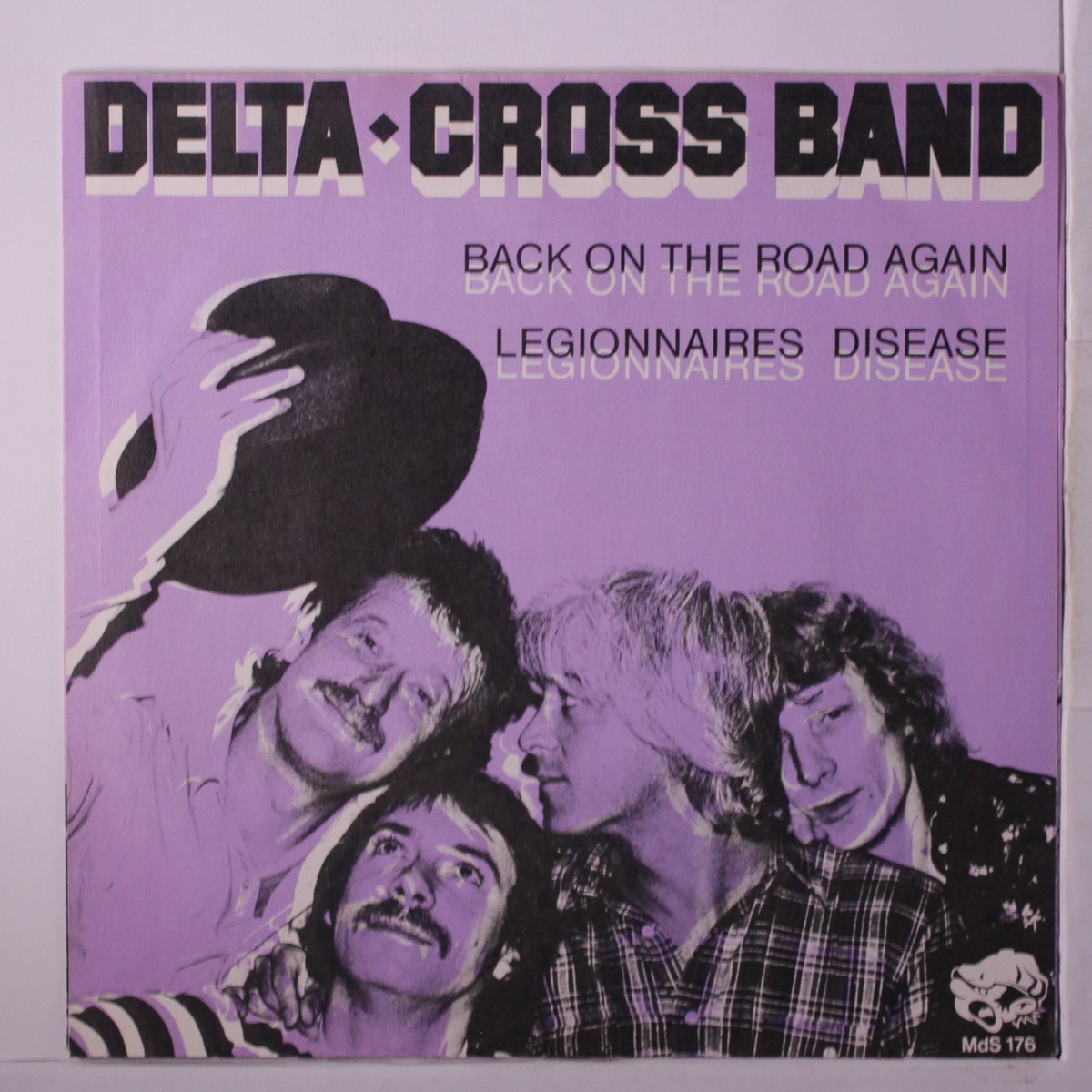
But guitarist Billy Cross, from the backing band, is fond of “Legionnaire’s Disease”. Two years later, when Billy’s Dylan experience is already a thing from the past, he strikes a record deal with his Danish friends from the Delta Cross Band. Cross still has an old tape from a Detroit sound check, and that is enough to convince his band members: for the album Up Front (1981) they produce the first official recording of this Dylan song.
The recording also makes it more clear why the master left the song behind – that bit between the verses is very much like “Like A Rolling Stone”. Reparable – Dylan would undoubtedly have rewritten it or thrown it out for a possible recording – but hey, he has plenty of new songs this month in 1978. And Dylan really, really hates to repeat himself, studio engineer Chris Shaw explains in 2008:
“He just hates it. A lot of times on “Love & Theft”, he’d do a version of a song and he’d say, “Aww, I’ve done that already. We gotta figure out some other way of doing it.” That’s really what it’s all about with him.”
With or without that Rolling Stone snippet it is a great song, but it does not survive. That admirable resuscitation by Billy Cross is also the song’s only notable version. There are still some poor versions by tribute bands, but colleagues from the higher echelons ignore “Legionnaire’s Disease”, just like Dylan himself does.
John Fogerty would be the ideal candidate, obviously. During his concerts in 2018, he always plays four or five covers between solo work and CCR classics. “Jambalaya” of Hank Williams, The Who’s “My Generation”, “My Toot Toot” of Rockin ‘Sidney, “When The Saints Go Marching In”, The Beatles, Gary U.S. Bonds, Sly & The Family Stone… an obscure gem from Dylan’s Secret Catalog certainly would fit in harmoniously.
Delta Cross Band:
What else is on the site
You’ll find an index to our latest posts arranged by themes and subjects on the home page. You can also see details of our main sections on this site at the top of this page under the picture.
The index to the 500+ Dylan compositions reviewed is now on a new page of its own. You will find it here. It contains reviews of every Dylan composition that we can find a recording of – if you know of anything we have missed please do write in.
We also have a discussion group “Untold Dylan” on Facebook. Just type the phrase “Untold Dylan” in, on your Facebook page or follow this link
And please do note The Bob Dylan Project, which lists every Dylan song in alphabetical order, and has links to licensed recordings and performances by Dylan and by other artists, is starting to link back to our reviews.
In his short stories and poems, Edgar Allan Poe burlesques the idea of life after death:
Thank heaven! the crisisThe danger is pastAnd the lingering illnessIs over at lastAnd the fever called 'living'Is conquered at last
(Edgar Allan Poe: For Annie)
The Holy Bible gives credence to the possible existence of evil spirits called ‘ghouls’ as well as of goodly angels:
And when the sabbath was pastMarry Magdalene, and Mary the mother of James And Salome had bought sweet spices ....And entering into the sepulchreThey saw a young man sitting on the right sideAnd clothed in a long white garmentAnd they were affrighted
(Mark 16:1,5)
Singer/songwriter Bob Dylan carries on Poe’s burlesque of the afterlife in a number of song lyrics. Our grave lady of the spades is the consort of poet TS Eliot’s ‘eternal footman’; in the lyrics that follow, she takes good care of the Orpheus-like narrator, and looks after the chambers that house the dead – he’s a poet-musician who is not afraid to look at his mummified Eurydice.
Indeed, Dylan and his Queen paste up seductive ads to lure recruits to the dark tombs:
I return to the Queen of SpadesAnd talk with my chambermaidShe knows that I'm not afraid to look at herShe is good to meAnd there's nothing she doesn't seeShe knows where I'd like to beBut it doesn't matterI want you, I want youYes, I want you, so badHoney, I want you
(Bob Dylan: I Want You)
Mistress D is quite the enchantress – she likes to get around:
One night I was dancin' with a lady in blackWearin' black silk gloves, and a black silk hatShe looked at me strange with black velvet eyesShe looked at me strange, all cunning and wiseI saw the flesh just fall off her bonesThe eyes in her skull was burnin' like coals
(Rolling Stones: Dancing With Mr. D)
Mr. D, the man in the long black coat, he’s got those all those nights in Hades with his chambermaid to look forward to:
Well, I eat when I'm hungry Drink when I'm dryLive my life on the squareEven if the flesh falls off my faceIt won't matter as long as you are there
(Bob Dylan: Dreamin’ Of You)
All is not such a field of clover in the land of the living, however:
In “The Threepenny Opera”, our lady of the skull and cross-bones, Jenny Diver, fantasizes that she gets revenge on those who treat her badly while she’s working as a chambermaid in a hotel:
And the ship, a Black FreighterWith a skull on its masthead will be comin' inThen you gentlemen can say, "Hey, girl, finish the floorsGet upstairs, make the beds, earn your keep here"You toss me your tips, and look out at the shipsBut I'm countin' your heads while I make up the beds'Cause there's nobody gonna sleep here
(Judy Collins: Pirate Jenny ~ Weill/Brecht)
The song above inspires Bob Dylan. In the song below, he envisions a slow black train comin’ up around the bend to rescue him – rather than a pirate ship:
There's a woman on my lap, and she's drinking champagneGot white skin, got assassin's eyesI'm looking up into sapphire-tinted skiesI'm well dressed, waiting for the last trainStanding on the gallows with my neck in a nooseAny minute not, I'm expecting all hell to break loose
(Bob Dylan: Things Have Changed)
Indeed, it’s a circus freak show of thieves, killers – sinners of all kinds – out there:
Lizzie Borden took an axeAnd gave her mother forty whacksWhen she saw what she had doneShe gave her father forty-one
(Nursery rhyme: Lizzie Borden)
There’s Our Lady Of Death, a scythe-carrying, black-coated madonna who rides around on a pale motorcycle:
The motorcycle black MadonnaTwo-wheeled gypsy queenAnd her silver-studded phantom causeThe grey-flannel dwarf to screamAs he weeps to wicked birds of preyWho pick up on his bread crumb sins
(Bob Dylan: Gates Of Eden)
According to the following lyrics, the Eternal Footman’s job is secure, but others best keep eyes wide open – life can be boring but it’s full of risks:
See the cross-eyed pirates sittingPerched on the sunShooting tin cansWith a sawed-off shotgunAnd the neighbours they clapAnd they cheer with each blastFarewell AngelinaThe sky's changing colourAnd I must leave fast
(Bob Dylan: Farewell Angelina)
What else is on the site
You’ll find an index to our latest posts arranged by themes and subjects on the home page. You can also see details of our main sections on this site at the top of this page under the picture.
The index to the 500+ Dylan compositions reviewed is now on a new page of its own. You will find it here. It contains reviews of every Dylan composition that we can find a recording of – if you know of anything we have missed please do write in.
We also have a discussion group “Untold Dylan” on Facebook. Just type the phrase “Untold Dylan” in, on your Facebook page or follow this link
And please do note The Bob Dylan Project, which lists every Dylan song in alphabetical order, and has links to licensed recordings and performances by Dylan and by other artists, is starting to link back to our reviews.
When this article was written, there was on the internet a recording of Dylan performing it, but sadly that has now vanished, and there is no replacement at this moment (2020).
Let me tell you, until another recording turns up, that this is a piece of Beat experimentation undertaken with Allen Ginsberg during a set of recordings made in November 1971. If you would like to read more about Dylan and Ginsberg, Larry has provided us with an article on this very subject. There is also film of Dylan and Ginsberg at the grave of Kerouac in the movie Renaldo and Clara.
For details of Dylan and Ginsberg working together on these songs you might also be interested in the article on this site, on the song “Vomit Express”.
And to complete the package, another song from these sessions “Jimmy Berman Rag” has also been reviewed here.
I am told that this recording has Bob Dylan on guitar [actually on untuned guitar – and I suspect that was intentional], David Amram French Horn, recorder, piano; Perry Robinson, clarinet; Jon Sholle, guitar; Happy Traum, banjo; Surya, zither; Moruga, drums; and Ginsberg, Dylan, Peter Orlovsky and Anne Waldman on vocal.
As with other the other songs from this collection I am dependent on other people to provide the lyrics – so if you are brave enough to have a go here I’ll put them up.
It has often been said that a central part of the influence on Dylan that developed his interest in this form of composition for a while was “Mexico City Blues” by Jack Kerouac, written in 1959. Kerouac said of his work that it was a spontaneous composition in which memories, fantasies and dreams are all combined through free association. He was, he said, wanting to be seen as a jazz poet.
Here is part of the opening of Mexico City Blues
Butte Magic of IgnoranceButte MagicIs the same as no-ButteAll one lightOld Rough RoadsOne High IronMainwayDenver is the same'The guy I was with his uncle wasthe govornor of Wyoming''Course he paid me back'Ten DaysTwo WeeksStock and Joint'Was an old crook anyway'The same voice on the same shipThe Supreme VehicleS.S. ExcaliburMaynardMainlineMountainM erudvhagaMersion of Missy
It is also reported that in 1985 Dylan commented, “I came out of the wilderness and just naturally fell in with the Beat scene, the bohemian, Be Bop crowd, it was all pretty much connected. It was Jack Kerouac, Ginsberg, Corso, Ferlinghetti … I got in at the tail end of that and it was magic … it had just as big an impact on me as Elvis Presley.”
Dylan also spoke of Kerouac’s “breathless, dynamic bop phrases,” and it is said in many commentaries, found in Kerouac a person like himself – a person who came to New York as an outsider full of ideas.
Dylan and Ginsberg started in 1963 and continued until Ginsberg died in 1997 – in which year Bob dedicated a performance of “Desolation Row” to his friend, saying it was Ginsberg’s favourite Dylan composition.
It has long struck me (and of course many who have written on Dylan before me) that to fully understand Dylan we have to understand that Dylan was wrapped up not just in the revival of folk music, but also in the Beat scene – and these were two utterly different traditions. Also Beat was in many ways a left wing movement, with which Dylan has certainly not always been at all comfortable.
Besides which Dylan joined the Beat scene late on in its evolution by which time it had nothing to do with the working class tradition laid down by Woody Guthrie.
But I do think that contemplating the influence of the Beat generation along with Woody Guthrie songs, and Dylan’s keen interest in the blues and rock and roll, does lead to a fuller understanding of his lyrics. It takes us a long way away from debating who the Sad Eyed Lady of the Lowlands was, and instead sees Dylan as a writer experimenting with words and phrases in the way that many contemporary artists experiment with colours and shapes.
It is maybe that experimentation, rather than the express meanings, that might give us a greater insight into Dylan’s compositions.
Woman with hat – artists can not resist it. Picasso paints dozens of portraits of his successive muses and mistresses with headwear. From his earliest, blue period (Femme au chapeau à plumes, 1901) via the tragic Marie-Thérèse Walter (the one of Le Rêve, 1932) to Dora Maar (mistress from 1936 to 1944) and muse Lee Miller (1937), Nusch Éluard, who inspired half the forefront of the surrealists (Magritte, Miró, Man Ray) and second wife Jacqueline Rocque in ’54, until his last works; the central female figure on Final auvre (1971) also has a nice hat. It is universal among painters, that fascination. Warhol (Woman with hat, 1957) Matisse, Van Dongen, Renoir, Vermeer (Girl with a Red Hat, 1665), and also Rembrandt paints dozens of women’s hats, including a red one on his Saskia.
It’s not much different with the musicians. Randy Newman thinks a lady is most exciting when she leaves her hat on (“You Can Leave Your Hat On”, 1972). Gene Kelly wonders “Where Did You Get That Hat?” (1949). Woody Guthrie has a laugh with it in 1940 with “Wimmen’s Hats”: you can sell a woman any old thing… if you tell her it’s a hat (written one day after he wrote “This Land Is Your Land”, remarkably enough), Prince swoons in admiration for a maid with a raspberry beret (“Raspberry Beret”, 1985) and Carmen Miranda understands that everyone is glad to see her with her wearable fruit salad (“The Lady In The Tutti Frutti Hat”, 1943).
Dylan is not at all indifferent either. The lady in “Black Diamond Bay” causes some furore by wearing a Panama hat as well as a necktie. “Cute hat, by the way,” flirts the Don Juan in “Sweetheart Like You” and a veil has something too, apparently (“Golden Loom”, “Changing Of The Guards”).
But this song is different.
It oozes sarcasm, “Leopard-Skin Pill-Box Hat”. Thanks to the humour, the speaker only just avoids the pitfall of adolescent hurt, aggrieved jealousy, but mean and slightly bitter he is all the same. And the prosecutors of the Dylan community agree who the target of that biting ridicule is: Edie Sedgwick, the childish femme fatal from the Warhol entourage.
The witnesses are not the leasts. Patti Smith states, in writing, without a hint of doubt, that Sedgwick is the real heroine, the real protagonist of Blonde On Blonde, singer Nico states that Leopard-Skin is about Edie and that “everyone thought it was about Edie because she sometimes wore leopard” and Andy Warhol points out that Dylan and Sedgwick spent a few days in The Castle, a somewhat pompous country retreat in the hills of Hollywood, just before the recordings, around Christmas ’65.
Some witness experts endorse the witness statements; leading biographers such as Clinton Heylin, David Yaffe and Michael Gray study indirect evidence and draw the same conclusion, quite categorically even.
The jealous blows would then come to the credit of Dylan’s friend Bob Neuwirth, who after Dylan has a indeed convincingly documented relationship with Sedgwick.
The defense is not strong. Unsolicited, Dylan first explains it himself, on stage at the Royal Albert Hall, May 27, 1966, when, after a performance of Leopard-Skin, he responds to the boo:
“What you’re just hearing here now is the sound of the songs…you’re not hearing anything else except the songs, the sound…of the words…and sounds…so, you know, you can take it or leave it. (…) I’m sick of people asking what does it mean. It means NOTHING.”
Detective Jan Wenner does not believe this and explicitly asks about the underlying idea of this song for his Rolling Stone interview, 1969. Defensively the main suspect Bob D. states:
“It’s just about that. I think that’s something I mighta taken out of the newspaper. Mighta seen a picture of one in a department store window. There’s really no more to it than that. I know it can get blown up into some kind of illusion. But in reality it’s no more than that. Just a leopard skin pillbox. That’s all.”
And that is not too credible a reply. Every reader or listener who has moved beyond primary school understands: this text is not about a hat. It is about a fictional or perhaps real lady underneath that hat. There are no witnesses to discharge, other witness experts such as Ian Bell and Howard Sounes leave the options fairly open and only report that ‘people’ think that this song could be about Edie, that ‘people’ suspect that the two have had a short relationship. Robert Shelton does not even mention her. In his No Direction Home, however, he delivers exculpatory evidence by quoting indirectly a discharging statement from intimus Bob Neuwirth: “Bob never wrote a song about any one person. They are about a lot of people, and sometimes not about any people at all.”
Alas, again not very valid, of course. This report is not dated by Shelton, but we can assume that Neuwirth says so sometime in the late 1960s. At least well after Dylan has already written “Song To Woody”, “The Ballad Of Hollis Brown”, “Ballad In Plain D” and more songs that are unmistakably about one real person. And also in later years Dylan sings about recognizable individuals (“George Jackson”, “Sara”, “Lenny Bruce”, to name but a few examples), but Neuwirth’s point is clear: Dylan does not hide an attack on or an ode to someone behind misty, ambiguous metaphors. “Leopard-Skin Pill-Box Hat” undoubtedly contains impressions and memories, but above all it is poetic realism, the condensing of fragments of a reality. And well alright, part of that poeticized verity is perhaps Dylan’s disdain for superficial ladies who hide uncertainty behind promiscuous behavior and appearance, and yes, recent experiences with a certain Miss Sedgwick will probably find a romanticized echo.
Clearer sources of inspiration, however, are not a hat or a specific lady, but can be found in Dylan’s record collection. The bullying humour, the lyrics structure: “Automobile Blues” by Lightnin’ Hopkins from 1960: “I see you drivin’ ’round in your brand new automobile.” And perhaps even more heavily the Memphis Minnie classic resonates, the song Dylan announces in his Theme Time Radio Hour with the words one of the great blues songs of all time, one of the great car songs of all time, one of the great driver songs of all time! Sung by one of the great old ladies of all time: “Me And My Chauffeur Blues” (1941), and, still enchanted, closes up with Memphis Minnie, you can drive me anywhere!
In an early version of Leopard-Skin that influence is still almost undiluted:
Well you can ride with me, honey,
I'll be a chauffeur,
Just as long as you stay in the car:
If you get out and start to walk
You just might topple over,
In your brand-new leopard-skin pill-box hat.
The song’s final version is a struggle. The first run, still in New York, has a slow, dragging blues stomp and lasts more than six minutes (the final version takes just over four minutes). The last take in New York is already faster and sharper, but Dylan is still missing something, apparently. Perhaps he is annoyed by the unimaginative, drum part – no, no, no, it’s not as good as it was yesterday one can hear him say on The Cutting Edge. Maybe we can just record a few versions and then glue the best parts together, he proposes to producer Bob Johnston, who answers with an enthusiastic “Yeah!”
It will not be done. Dylan takes the song to Nashville, where the magic begins. Not by itself, by the way; in Nashville, too, the maestro has to pull and push for thirteen takes, while not avoiding frivolous experiments. He holds on to corny party items right through the song for a while – a doorbell and a jokingly chanting “Who’s there?”-choir and car horn honking. At the end of the day, he drops that too, fortunately (the horn is in the wrong key, also).
But the end product is contagious, as also the colleagues seem to think.
Distinctive is the sizzling, steamy live version by Wofgang Niedecken, the singer of the Cologne ensemble BAP, unfortunately sung unintelligibly in the Kölsch dialect (“Leopardefellhut”, 1995), with prominent slide guitar. As with most covers the opportunity is seized to let the guitarist excel; it is a real Chicago blues, after all. Irresistible in this category are Charlie Musselwhite, John Mellencamp, with a fantastic wind arrangement too, Tommy Womack, master guitarist Peter Parcek and especially guitarist Walter Trout, who by the way has also one of the most intense versions of “Girl. From The North Country” at his fingertips.
And otherwise the pianist gets a leading role, as with chief Dylan interpreter Jimmy LaFave.
Virtually no one does deviate from the Chicago blues format. Janet Planet, the Brown-Eyed Girl who has been Van Morrison’s muse for years, fills two albums with Dylan covers in more complex jazz arrangements that rarely manage to move (although her “I Shall Be Released” has a very special grandeur). Her Leopard-Skin is one of the few covers that fail.
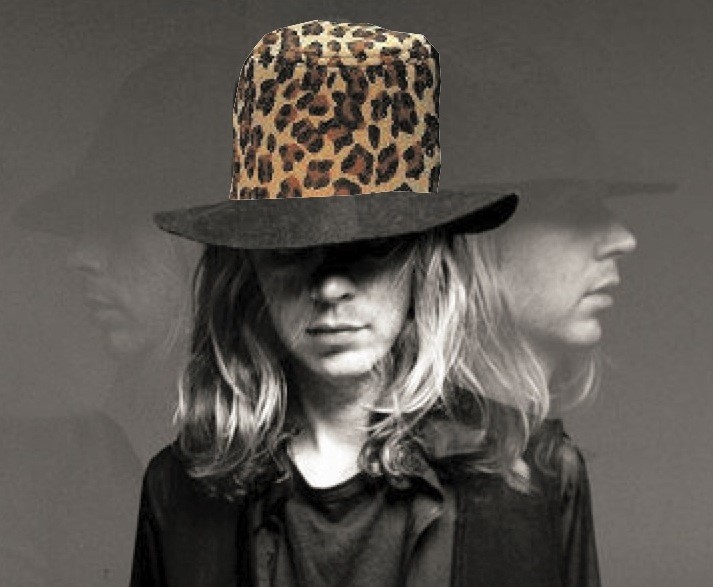
Style retention is not a must, though. The furious, stirring version by Beck, the opening track of the charity album War Child – Heroes vol. 1 (2009) is a fascinating mix of industrial violence and musical craftsmanship, and belongs in any case in the Top 5 of most successful covers. Reportedly, Beck was chosen by Dylan himself to record this song for War Child. That was a good choice from the old master. And that’s a cute hat, by the way.
Considering the point of view taken by modern Existentialist writers that, given the vastness of the universe, the path chosen by an earth-bound individual human being to travel on doesn’t even amount to a hill of beans:
Though as for that the passing thereHad worn them really about the same ....I shall be telling this with a sighSomewhere ages and ages henceTwo roads diverged in the woods, and II took took the one less travelled byAnd that has made all the difference
(Robert Frost:The Road Not Taken)
The message that he takes from the back of a box of Frosted Flakes, singer/songwriter Bob Dylan repeats to ol’ Bill loud and clear; and note the Dylanesque ‘rhyme twist’ ~ “I”/”by”/”sigh”; ~ “try”/”die”/”defy”/”sigh”:
The evenin' sun is sinkin' lowThe woods are dark, the town is too ....Tell ol' Bill when he comes homeAnything is worth a tryTell him that I'm not aloneThat the time has come to do or die All the world I would defyLet me make it plain as dayI look at you now, and I sighHow could it be any other way?
(Bob Dylan: Tell Ol’ Bill)
According to both Bob Frost and Robert Dylan, the path chosen indeed matters a great deal to the individual taking it:
My little horse must think it queerTo stop without a farmhouse nearBetween the woods and frozen lakeThe darkest evening of the yearHe gives his harness bells a shakeTo ask if there is some mistakeThe only other sound's the sweepOf easy wind and downy flake
(Robert Frost: Stopping By The Woods On A Snowy Evening)
Should you listen to zinger Dylan expecting tips on what life’s all about, and why you ought to have a sense of pride living it, you are not going to find much help here.
Note the ‘rhyme twist’~ “stake”/”take”/”lake”;~”shake”/”flake”/”mistake”/”lake”:
So many roads, so much at stakeToo many dead ends, I'm at the edge of the lakeSometimes I wonder what it's gonna takeTo find dignity
(Bob Dylan: Dignity)
Things are bad out there:
Next to come in was a big black snakeUh-huhNext to come in was a big black snakeUh-huhNext to came in was a big black snakeAte up all of the wedding cake
(Bob Dylan: Froggie Went A-Courtin’~Dylan/traditional)
But hold on to them thar reins, partner. According to a number of religions, there be Angels, Egyptians, and Cowboys who live forever and ever in a Heaven or in a Hell.
Not everyone agrees with that particular dogma:
My name is Ozymandias, king of kingsLook on my works, ye mighty, and despair!Nothing beside remains. Round the decayOf that colossal wreck, boundless and bareThe lone and level sands stretch far away
(Percy Shelley: Ozymandias)
Bob Dylan’s gospel songs contian Christian hope of a hereafter, but in other song lyrics there be Shelley’s message of a cold, dead-end for the individual. In the lyrics of regret below, note the ‘rhyme twist’ from the poem above
~ “decay”/”away”:
There's a wall of pride, high and wideCan't see over to the other sideIt's such a sad thing to see beauty decayAnd sadder still to see your heart torn away
(Bob Dylan: Cold Irons Bound)
https://youtu.be/XbI7osmrU_o
The Existentialist point of view fails to consider that man is a social animal who depends on others, especially on one’s mother, because, at least in the beginning, individual humans cannot survive on their own:
Each man's death diminishes me
For I am involved with mankind
Therefore, send not to know
For whom the bell tolls
It tolls for thee
(John Donne: For Whom The Bell Tolls)
The Ace of Spades is a hard card to play:
I can hear the church bells ringin' in the yard
I wonder who they are ringin' for?
I know I can't win
But my heart just won't give in
(Bob Dylan: Standing In The Doorway)
What else is on the site
You’ll find an index to our latest posts arranged by themes and subjects on the home page. You can also see details of our main sections on this site at the top of this page under the picture.
The index to the 500+ Dylan compositions reviewed is now on a new page of its own. You will find it here. It contains reviews of every Dylan composition that we can find a recording of – if you know of anything we have missed please do write in.
We also have a discussion group “Untold Dylan” on Facebook. Just type the phrase “Untold Dylan” in, on your Facebook page or follow this link
And please do note The Bob Dylan Project, which lists every Dylan song in alphabetical order, and has links to licensed recordings and performances by Dylan and by other artists, is starting to link back to our reviews.
It is not a topic we’ve looked at before but in 1995, Bob Dylan saw his iconic status transcend the stage to the world of video games when an interactive CD-ROM was unveiled by Graphix Zone and Sony Music Entertainment. Based on Dylan’s career, players were introduced to a collection of photos and objects that, when clicked, revealed details about Dylan’s life, inspirations and music.
Boasting some never-before-released songs such as Dylan controversially performing House of the Rising Sun at the Newport Folk Festival in 1965, the game, known as “Highway 61 Interactive”, remains a unique piece of pop culture history and a compelling pre-internet document of one of rock music’s most influential frontmen.
The combination of rock music and video games was not unique then and certainly isn’t now. Indeed, Harmonix’s Rock Band games, in which players use faux instruments to play riffs alongside popular rock songs including Dylan’s Tangled Up in Blue, have proven to be some of the biggest commercial hits of recent years. Elsewhere, we’ve seen thatfamous bands have slot machines too, with Guns N’ Roses, Megadeth and Jimi Hendrix joining decade specific releases like The Groovy Sixties and The Super Eighties for online casino players to enjoy.
What’s interesting about Highway 61 Interactive is that it presents a precursor to every rock band’s website today. It is, therefore, fittingly pioneering, much like the acclaimed musician’s work. But if you’re looking for something a little more exciting online, why not try the Guitar Hero-inspired flash game called Guitar Flash where you use the keys on your keyboard to play along with popular rock songs.
If you were inspired by playing Bob Dylan on Guitar Hero 5, which was released on all major consoles, you’ll enjoy the ease and simplicity of Guitar Flash which can, as the name suggests, be played from anywhere thanks to an internet connection and a flash-enabled browser.
For Dylan fans who want the opportunity to emulate their hero – well, sort of – you could give Rock Band Sim a try. This is another browser based online game that combines the rock n roll entertainment of Guitar Hero with the immersive nature of roleplay as you try to turn your band into the next big thing. Your job is to go from garage band to selling out arenas, writing songs and managing band politics along the way.
Elsewhere, you might also want to give Brutal Legend a go. It’s inspired by music that is significantly different from most of Dylan, although to a degree reminiscent of the Dylan and the Dead era and brings the power of the guitar to the world of video gaming by arming you with a magical six-string and navigating an environment that’s all about rock n roll. Featuring music from Motorhead, Megadeth, Black Sabbath and Judas Priest, Brutal Legend also boasts the voice-work from Tenacious D frontman and actor Jack Black. The online multiplayer version offers hours of fun.
We all know how inspirational music can be. Online you’ll find lots of entertaining games which have taken their cues from great artists like Dylan. From the delights of Guitar Hero to the immersive simulation of Rock Band Sim to the exciting slot machines bearing the name of rock n roll legends.
The song 26 Storeys High appears at track seven (33:40 – 37:40)
I noted in the review of Dylan’s Nothing here worth dying for: that Bob was using a simple technique of playing the same chords over and over again and letting the rest of the band and the vocalists join in, even though they had probably never heard the song before this point.
The rotating three chord idea was not new at that point of course. “All along the watchtower” uses the same technique. “Drifter’s Escape” goes even further into minimalism as a way of constructing music, and offers just two chords and a never changing vocal line.
And it is interesting in the case of those two songs, the lyrical theme is about being trapped. “‘Help me in my weakness,’ I heard the drifter say” launches the Escape, while the Watchtower starts with the bleak, “There must be some way out of here.”
And maybe such thoughts were lurking at the back of Bob’s mind as he used the three chord trick again for 26 Storeys High in the “After The Empire” song recorded in 1985. Unfortunately the one recording of this song that was on line seems to have been taken down – but if you find one could you write to Tony@schools.co.uk with the URL and I will add a link back in.
In this song the three chords are F, E7, Am. The Watchtower has Am, G, F (with an extra G thrown in as an introduction to the next line). Not the same, but a similar idea.
And the notion that “there must be some way out of here” is a theme in both – although in “26 storeys” the reference is (I think) to a criminal act having gone wrong and the criminals being holed up on the 26th floor. But I’m needing someone to disentangle all the words for me to be sure of this [Larry would you care to oblige as you have so often before?] but it may well be not that at all, but perhaps that the notion is that living in the tower block is so awful that suicide is the only way out.
But I might have got both approaches wrong.
Anyway, whatever the lyrics mean, suddenly, and seemingly without any warning at the 1 minute 44 seconds mark we get a middle 8 – a different section – which at least gives us a relief from the depression of the repeated three chords.
The middle 8 comes a second time – as before with a climax – and then suddenly we are back down to the three chord section. And there are some lines that are quite clear such as “Saturday night on the run” and “every window holds a loaded gun”.
The way the female singers come in, and the fact that the band knows about the middle 8 (with its unexpected semitone rise and fall at the end) suggests that this was not the first run through of the song, but it was possibly the last. There is no further sighting of the song; Heylin does not even have it listed.
Of course not too many people would attempt a song like this outside of the straight hard core blues genre, but Bob obviously is wanting to try something different as with the use of “Saturday night on the run” over and over at the end. This has a very interesting effect that suggests that the song could have gone further and become a particularly effective if particularly bleak moment in Bob’s catalogue, but it appears that didn’t happen.
So, two riders don’t appear from the distance, the drifter doesn’t escape, the stand off goes on.
This one take is all we have.
What else is on the site
You’ll find an index to our latest posts arranged by themes and subjects on the home page. You can also see details of our main sections on this site at the top of this page under the picture.
The index to the 500+ Dylan compositions reviewed is now on a new page of its own. You will find it here. It contains reviews of every Dylan composition that we can find a recording of – if you know of anything we have missed please do write in.
We also have a discussion group “Untold Dylan” on Facebook. Just type the phrase “Untold Dylan” in, on your Facebook page or follow this link
And please do note The Bob Dylan Project, which lists every Dylan song in alphabetical order, and has links to licensed recordings and performances by Dylan and by other artists, is starting to link back to our reviews.
The Swedish computer scientist and researcher Olof Björner (1942) is a celebrated and respected man in Dylan circles. He has been following the career of the bard since 1963, and since 1989 (Words Fill My Head) he publishes the results of his monks’ work: exhaustive, detailed and accurate overview lists of every note that Dylan plays in studios, on stage and in rehearsal rooms.
The Dylanologists are happy with him; his site, bjorner.com, is freely accessible, is regularly updated and is an incomparable source for thousands of facts about Dylan songs.
Statistics enthusiasts can indulge themselves at the song index, among other things. There Björner keeps track of how often and where Dylan plays his (and other artist’s) songs, and for the figure fetishists he also keeps score of the songs Dylan has played more than five hundred times on a separate list. In the spring of 2018 there are 32 songs on it and the top is composed of the usual suspects:
1. All Along The Watchtower (2257 times)
2. Like A Rolling Stone (2029)
3. Highway 61 Revisited (1919)
4. Tangled Up In Blue (1700)
5. Blowin’ In The Wind (1542)
So one would be tempted to conclude: these are the five songs that the master is most proud of, the ones he prefers to play himself, that never bore him. However, that conclusion is not entirely accurate, for it is based on fuzzy statistics.
“Like A Rolling Stone”, for example, is ten years older than “Tangled Up In Blue” and therefore has an ‘unfair advantage’. The ranking becomes more accurate by dividing the number of performances by the number of years since the song is part of Dylan’s repertoire; this leads to an reliable average number of performances per year.
In that case the top five suddenly looks radically different:
1. Summer Days (51.8 times a year, since the first performance in 2001)
2. Things Have Changed (51.6)
3. All Along The Watchtower (43.4)
4. High Water (For Charley Patton) (42.1)
5. Love Sick (41.0)
https://youtu.be/TjFnzUgDzbc
Entirely accurate the list would become by dividing the number of performances by the number of concerts that Dylan has given since the debut of the song in question, but let’s not exaggerate. For this ranking it would not matter; the surprise “Summer Days” remains Dylan’s relatively most played song, is statistically his showcase.
Surprising, because “Summer Days” definitely does not belong to the canon. It is never mentioned in lists of Favourite Dylan Songs, has not appeared on single, covers are scarce and it is rarely selected for the compilation albums that keep on being released. Twice only; “Summer Days” is the last song on the American release of The Best Of Bob Dylan, 2005, and it is one of the 87 songs selected for the Japanese release of the 5cd box Dylan Revisited – All Time Best, 2016.
Incidentally, this fact is not too meaningful; no fewer than 127 different songs have been selected for the eight official Best Of and Greatest Hits compilation albums and overview boxes that have been released since “Summer Days” – it is rather an achievement not to be chosen for one of those cash cows.
Dylan’s passion for “Summer Days” is hard to fathom. It’s a catchy, driving twelve-bar blues, great fun to play for the band and it drives a pleasant, exciting Schwung through the audience, but then again: in that category Dylan’s catalogue has dozens of songs. “It Takes A Lot To Laugh”, “New Pony”, “Lonesome Day Blues” … that list is long. Distinctive, compared to all those other exciting, audience-friendly blues songs, are perhaps the lyrics – after all, something does make Dylan reach for “Summer Days” so significantly more often.
The lyrics to the song, like many songs from “Love And Theft” (2001), have been lovingly stolen from rather incoherent sources. The most curious is and remains the now well-known dip into that obscure Japanese work, Confessions Of A Yakuza by Junichi Saga. Dylan quotes from this work in a few songs on “Love And Theft” (in “Lonesome Day Blues” and in “Floater”, in particular) and here he copies the old businessman and the break in the roof passages.
At least as obscure is the origin of the line I got eight carburetors, boys, I ‘m using ’em all; that paraphrases almost literally It’s got eight carburetors and it uses them all (and is five couplets later also short on gas) from the surf rocker “Hopped-Up Mustang” by Arlen Sanders, a flopped single from 1964 that occasionally can be found on compilation albums. Later on the album, Dylan grants that dusty single a literal name check, in “High Water (For Charley Patton)”:
I got a cravin’ love for blazing speed Got a hopped up Mustang Ford
And apart from that the ‘more ordinary’ winks to Elvis (“I’m Counting On You”), Woody Guthrie and a single folk song twirl down (Where do you come from? Where do you go? is, of course, the chorus of “Cotton- Eyed Joe”).
But then the seventh verse, that crowded verse with shares lent from The Great Gatsby (F. Scott Fitzgerald, 1925). No fewer than twenty-two syllables the bard crams into that third verse (She says, “You can’t repeat the past.” I say, “You can’t? What do you mean, you can’t? Or course you can”) … apparently the poet really wants this quote, the length of which is quite a challenge even for a reknowned Grandmaster of Phrasing like Dylan.
The content of the quote is in line with the stories that employees and session musicians tell about the recordings, illustrating Dylan’s explicit intention with “Love And Theft”: “to repeat the past”, to resuscitate history. Not only does Dylan reuse old melodies and text fragments, he also takes old singles to the studio to make clear to his band which sound he wants to reproduce, which history he wants to repeat. Technician Chris Shaw testifies:
“On “Love And Theft” and Modern Times, Bob would sometimes come in with reference tracks, old songs, saying, “I want the track to be like this.” (…) He’d come in and present these templates and use them as reference points.”
And technician Mark Howard tells how this need already arises in the run-up to Time Out Of Mind (1997):
“He’d tune into this radio station that he could only get between Point Dune and Oxnard. It would just pop up at one point, and it was all these old blues recordings, Little Walter, guys like that. And he’d ask us, “Why do those records sound so great? Why can’t anybody have a record sound like that anymore? Can I have that?” And so, I say, “Yeah, you can get those sound still.” “Well,” he says, “ that’s the sound I’m thinking of for this record.”
Daniel Lanois, the producer of Time Out Of Mind, agrees, confirms the quest for restoration of the past:
“Bob has a fascination with records from the Forties, Fifities and even further back. We listened to some of these old recordings to see what it was about them that made them compelling.”
And studio musicians like Duke Robillard recount this modus operandi too.
In itself, it does not match well, it is not consistent with equally reliable, various testimonies that declare that Dylan “really, really hates to repeat himself” (Chris Shaw in Uncut, October 2008). We have seen this aversion demonstrated for decades on stage; Dylan keeps changing his songs, renewing, reinterpreting, up to the point of unrecognizability, even. A repugnance that only concerns his own work, apparently. Actually since Oh Mercy (1989), but unmistakably, explicitly since “Love And Theft” the old master seems to have made it his mission to repeat the past.
In the seventh verse of “Summer Days” he expresses this adage in so many words, and since then he keeps repeating it all over the world, in his Never Ending Tour – since the premiere of the song, October 5, 2001 in Spokane, Washington , the bard has been hurling his provocative of course you can repeat the past into the audience from some nine hundred stages.
He really, really means it.
What else is on the site
You’ll find an index to our latest posts arranged by themes and subjects on the home page. You can also see details of our main sections on this site at the top of this page under the picture.
The index to the 500+ Dylan compositions reviewed is now on a new page of its own. You will find it here. It contains reviews of every Dylan composition that we can find a recording of – if you know of anything we have missed please do write in.
We also have a discussion group “Untold Dylan” on Facebook. Just type the phrase “Untold Dylan” in, on your Facebook page or follow this link
And please do note The Bob Dylan Project, which lists every Dylan song in alphabetical order, and has links to licensed recordings and performances by Dylan and by other artists, is starting to link back to our reviews.
Although surrounded by a culture steeped in the tenets of the Calvinist religion, poet Emily Dickinson distances herself from organized religion. She particularly detests the dogma of ‘original sin’ that church leaders send nipping at the heels of parishioners.
Dickinson sides with the serpent of Eden who gives Adam’s wife Eve a book of Romantic Transcendentalist poetry that he’s written concerning the trees in Eden – with its focus on the tree growing in the midst of the Garden:
And the serpent said unto the woman
"Ye shall not surely die"For God doth know that in the day ye eat thereofThen your eyes shall be opened, and ye shall be as godsKnowing good and evilAnd when the woman saw that the tree was good for foodAnd that it was pleasant for the eyesAnd a tree to be desired to make one wiseShe took of the fruit thereof, and did eat And gave also unto her husband with herAnd he did eat
(Genesis 3:4,5,6)
The Holy Bible tells a different story, however; God banishes Adam and Eve from Paradise for disobeying Him. From that day on, the sight of a snake makes the senuous poetess nervous:
A narrow fellow in the grassOccasionally rides ....But never met this fellowAttended or aloneWithout a tighter breathingAnd zero at the bone
(Emily Dickinson: A Narrow Fellow In The Grass)
On the other hand, a Modernist poet highly praises Dickinson for her daring to be different:
I saw a young snake glideOut of the mottled shade ....It quickened and was goneI felt my slow blood warmI longed to be that thingThe purely sensuous form
(Theodore Roethke: Snake)
Given the culture in which he lives, singer/songwriter Bob Dylan alludes to the biblical serpent without feeling the need to mention it:
He saw an animal as smooth as glassSlithering his way through the grassSaw him disappear by a tree near a lake["Ah, think I'll call it a snake"]
(Bob Dylan: Man Gave Names To All The Animals)
Emily Dickinson’s Romantic Transcendentalist sense of goodness in Nature is tempered by her awareness of the dark Puritan belief that evil lies therein:
There came a wind like a bugleIt quivered through the grassAnd a green chill upon the heartSo ominous did pass
(Emily Dickinson: There Came A Wind Like A Bugle)
A sunlit symphony is the pantheistic picture of Nature that’s presented in the lyrics below, but drums and bugles are associated with war:
Struck by the sounds before the sunI knew the night had goneThe morning breeze like a bugle blewAgainst the drums of dawn
(Bob Dylan: Lay Down Your Weary Tune)
It’s not all good. Death, the Eternal Footman, he waits for you – he wants you so bad:
One dignity delays for allOne mitered afternoonNone can avoid this purpleNone evade this crownCoach, it insures, and footman Chamber, and state, and throngBells also in the villageAs we ride grand along
(Emily Dickinson: One Dignity Delays For All)
Bob Dylan raises his hat to Emily Dickinson:
The guilty undertaker sighsThe lonesome organ grinder cries ....And the saviours who are fast asleep, they wait for youAnd I wait for them to interruptMe drinkin' from my broken cupAnd ask me to open up the gate for you
(Bob Dylan: I Want You)
The last hiss, the snake gets:
So many roads, so much at stakeToo many dead ends, I'm at the edge of the lakeSometimes I wonder what it's gonna takeTo find dignity
This article explores an idea – I am not sure if I am going to be able to take this idea forward into a series of articles, and I want to see how this article feels first before I commit, but it is an idea that fascinates me.
My point is that occasionally Dylan throws out lines or sections of verses that seem to be completely at odds with his general view of the world, as we might take it from the rest of his writings.
This example comes from Dignity
https://youtu.be/2Dlh-X1fpoQ
I went down where the vultures feedI would’ve gone deeper, but there wasn’t any needHeard the tongues of angels and the tongues of menWasn’t any difference to me
Dylan composed the song in 1989, and as has been widely reported, left it until 1994 to perform it. It is said that he was unsure whether the song really was something worth performing, or not.
The notion within the song is straightforward: many art works symbolise evil (for example) as a being or entity – often called The Devil. Goodness likewise has an personification in the Christian tradition in God, Jesus etc. So why not personify Dignity?
Why not indeed, and that is what, I guess, Bob was up to – or at least it is the only way I can make sense of these lines.
Searchin’ high, searchin’ low
 Searchin’ everywhere I know
 Askin’ the cops wherever I go
 Have you seen dignity?
And that’s fair enough – until we get to the “vultures” bit. Bob seems to be saying that the angels of the Almighty and us ordinary folk are all the same. Where everything is in a mess and people’s dignity has been stripped away from them, then there is nothing left.
I find this most interesting, and those four lines relating to the vultures have long puzzled me. Of course I have to admit from the start that they might have no meaning – they might well simply be lines that Bob knocked out because they sound good. To say that might seem to denigrate Dylan’s art – but I don’t think so. He has, in my view, a rare ability to pull out lines which are memorable and interesting, but which are also meaningless or contradictory. Or indeed so meaningful they can have 100 different meanings.
But to try and make sense of it, people in desperate situations, he seems to be saying, have had their dignity stripped away from them, and talking with such people doesn’t help them. When their dignity has gone, they need to get that dignity back before anything else can happen.
Of course I don’t know if that is right – or if Bob meant those four lines to have any meaning at all, but even in such situations, his writing can provide me with thoughts and insights, which I do enjoy pondering. And I quite like setting them out in little articles, because the process helps me clarify my thought (and after all, you don’t have to keep reading).
Every dictionary has its own definition of the word “dignity”, and here’s a simple one I rather like and which seems to fit with Bob’s approach in the song.
“Dignity is the right of a person to be valued and respected for their own sake, and to be treated ethically.”
And so to return to Bob’s four lines…
I went down where the vultures feedI would’ve gone deeper, but there wasn’t any needHeard the tongues of angels and the tongues of menWasn’t any difference to me
Where the vultures feed – where people have no dignity because they have been stripped of any means of having dignity, all the talking in the world won’t help, no matter who does it.
And so I’m reminded of another of my favourite songs, the Drifter whose song opens with “Help me in my weakness”. In The Drifter’s Escape” the Drifter has no dignity, he even has to be carried out of the courtroom – and yet he does manage to get some dignity back with the ultimate irony – when everyone sees the destruction of the court room by the bolt of lightening, and they all bow down to pray, the drifter gets up and strolls out. Dignity, of a kind, returned.
Dignity is stripped also from the subject of “Tell Ol Bill”
Tell me straight out if you willWhy must you torture me within?Why must you come down off of your high hill?Throw my fate to the clouds and wind
And the tragedy of the subject of that song is that there is no escape – there is no way to regain the dignity that has been stolen…
I look at you now and I sighHow could it be any other way?
There is indeed a desperate hopelessness here.
Back with “All along the watchtower, it is the joker who has lost his dignity while the thief has found his…
“No reason to get excited,” the thief, he kindly spoke
 “There are many here among us who feel that life is but a joke
And maybe that takes me back to the start. If one feels life is but a joke, then dignity can come and be taken away at random. There is no plan from on high, there are no rules, there is nothing we can do with certainty, the drifter escapes by chance, just as chance has brought the subject of Tell Ol Bill, so low.
Thus when Bob sings
I went down where the vultures feedI would’ve gone deeper, but there wasn’t any needHeard the tongues of angels and the tongues of menWasn’t any difference to me
it is indeed all just haphazard – a joke, a world without meaning, a world in which things just happen.
This is of course the opposite of most religious views, wherein the purpose is to worship the Lord, and behave according to the rules that the prophets have laid down.
And Bob might well have been qualified to make such a comment in 1989 because he had been Saved ten years earlier, and now reflects that the tongues of angels and the tongues of men all spoke the same stuff – both being capable of removing a person’s dignity.
As an atheist I find the whole process of believing totally, and then falling out of the system of belief, utterly fascinating. But also I find that yes, I feel a need to have a certain level of dignity about myself as I try and find a way of proceeding through this world without going completely mad.
I am reminded of Douglas Adams comment in “The Restaurant at the End of the Universe” where he says, “There is a theory which states that if ever anyone discovers exactly what the Universe is for and why it is here, it will instantly disappear and be replaced by something even more bizarre and inexplicable.
“There is another theory which states that this has already happened.”
That works for me. I guess, to have dignity, we all need something to hold on to. But I’m with Bob in 1989 on this one. Angels and men are both capable of stripping away one’s dignity. Laughing at them both helps me keep myself together. For Bob, in 1989, I guess it was writing songs that did it. But I hope he had a few laughs too.
What else is on the site
You’ll find an index to our latest posts arranged by themes and subjects on the home page. You can also see details of our main sections on this site at the top of this page under the picture.
The index to the 500+ Dylan compositions reviewed is now on a new page of its own. You will find it here. It contains reviews of every Dylan composition that we can find a recording of – if you know of anything we have missed please do write in.
We also have a discussion group “Untold Dylan” on Facebook. Just type the phrase “Untold Dylan” in, on your Facebook page or follow this link
And please do note The Bob Dylan Project, which lists every Dylan song in alphabetical order, and has links to licensed recordings and performances by Dylan and by other artists, is starting to link back to our reviews.
Whether you get any deep pleasure out of the “After the Empire” tracks – the tracks in which Dylan explored various songs that were then abandoned – there is one thing about them which cannot be denied – they give us a real insight into how Dylan was composing at this time.
In the particular case of this song he came to the studio with three ideas that might or might not turn into a song.
First there is the melody which can be expanded and developed around the basic structure. Second there is the four chord sequence which is played over and over again throughout the entire song without any variation. This sequence is vital since it is what allows the rest of the ensemble to join in very quickly and know exactly where the song is going.
Then third there is the phrase, “Nothing here worth dying for” which defines where the lyrics are going to go and the emotions of the song. The feeling I get is that Bob is making up the rest of the song lyrics as he goes along having generated the title line.
So, we know it is a song of leaving, or perhaps a song of “no regrets”, and those songs can be rather dismal or heavy, unless there is something in the song that grabs us. If we consider “Not Dark Yet” – one of the darkest songs in the repertoire, Dylan keeps our attention by holding back each line for an extra beat. We may not realise that is what he is doing, but he has us on edge.
Then in the key lines his voice is raised and he gives us killer phrases.
Feel like my soul has turned into steel
She wrote me a letter and she wrote it so kind
Sometimes my burden is more than I can bear
Every nerve in my body is so naked and numb
Not Dark Yet takes a structure and breaks it, because it has all been worked out. But here there is just a sketch, and because the structure is so well established from the off there is little that can be varied.
Yes the melody can change a little around the four chords, and of course so can the lyrics, but the chords can’t change because that is what the band and singers are following. And the rhythm can’t change because that is what is holding everyone together.
To make this a more complete song, in my view, there needs to be the variations – so we might have four lines ending “nothing here worth dying for” followed by another four lines with that same ending, but then a change – a new sequence of chords would be the most obvious – which gives us a break and a chance for the lyrics and melody to take on a new direction.
I’m not suggesting I could write a better song than Dylan – of course not – but I rather saying, this is what I suspect Dylan might have looked at, had he felt that this was a song going somewhere and which he therefore ought to work on.
Of course in this session of “Nothing worth dying for” Bob could have introduced such a change with a wave of the hand or a nod of the head, or a change in the way he was playing the guitar, and the rest of the band would quickly pick it up, but it seems the inspiration didn’t come to him.
So the song is trapped in its own ever revolving cycle of the same four chords and the doom and gloom of the title. Nothing wrong with doom and gloom of course – Desolation Row showed that, as did the aforementioned “Not Dark Yet”- but it needs inspiration in terms of lyrics and structure, and that I think is what is missing here. If Bob had been minded, he could have gone away and written the extra bits that were needed – or indeed instructed the band and singers there and then – but it seems it was not a day when that might happen, and so the song died after this one run through…
So the song died as it was born, and even Heylin missed this collection of songs when he was compiling his magnum opus.
And why did it die? Perhaps because Dylan just couldn’t find where to take the song after all those repetitions of the four chord sequence. Possibly because “Baby Stop Crying” is rather similar. Possibly because “Someone’s Got A Hold of My Heart/Tight Connection to My Heart” is also of the same ilk.
And possibly because he knew that one day he would write the ultimate song about dying.
Even after all these years that still has me on the edge.
What else is on the site
You’ll find an index to our latest posts arranged by themes and subjects on the home page. You can also see details of our main sections on this site at the top of this page under the picture.
The index to the 500+ Dylan compositions reviewed is now on a new page of its own. You will find it here. It contains reviews of every Dylan composition that we can find a recording of – if you know of anything we have missed please do write in.
We also have a discussion group “Untold Dylan” on Facebook. Just type the phrase “Untold Dylan” in, on your Facebook page or follow this link
And please do note The Bob Dylan Project, which lists every Dylan song in alphabetical order, and has links to licensed recordings and performances by Dylan and by other artists, is starting to link back to our reviews.
“I always liked songs with parentheses in the title,” says host Dylan in episode 47 of his radio show Theme Time Radio Hour, at the announcement of Sonny Stitt’s “Fools Rush In (Where Angels Fear To Tread)”. These are no empty words: no less than 68 times in the 104 episodes, the radio maker chooses such a song title. And Dylan’s own catalog also contains more than twenty titles with parentheses, from “Suze (The Cough Song)” to “High Water (For Charley Patton)”. Not until the 21st century, after 2001, the grandmaster finally seems to be bored with it.
But then again: the poet is not reluctant in the autobiography Chronicles (2004). On average, one pair of parentheses per ten pages, whereby he superfluously often places complete sentences in parentheses. “Okay, we were going to forget about “Dignity” for a while. (We never did go back to it.)”, for example.
Dylan does not appear to use a system. Sometimes the explanatory addition only contributes to the impenetrability, like in “Señor (Tales Of Yankee Power)” and “I’m Not There (1956)”, and sometimes it clarifies, like “High Water”, but usually a phrase from the chorus or the refrain verse is in parentheses: “I Don’t Believe You (She Acts Like We Never Have Met)” or “Coming From The Heart (The Road Is Long)”.
And “One Of Us Must Know (Sooner Or Later)” of course, Dylan’s fifth song with parentheses in the title.
It is one of his favourite songs, the master reveals in the Rolling Stone interview in 1969, and one in which, especially by Dylan standards, an exceptional amount of love has been invested. The twenty (!) attempts, rehearsals, misses and alternatives on discs 11 and 12 of the unsurpassed The Cutting Edge – Collector’s Edition (2015) illustrate this in a fascinating way. It is hardly surprising that the accompaniment changes in the course of such a session, but that the song also fans out so radically on the other fronts (lyrics, melody, tempo) is an eye-opener.
The studio talk, especially in the first two rehearsals, reveals intimate details about the creative process. Apparently Dylan has already had a first pre-rehearsal with Al Kooper. He searches his notes, finds them again, asks for help (presumably from the piano-playing Kooper) “How is the chorus?”, sings along a few words that will disappear later (“I’m glad it’s through, you’re mad it’s through”) and then interrupts: “That’s not right, Al. I don’t get it.”
Kooper answers something unintelligible, Dylan asks “What’s the tempo?” and then starts, quite slowly, with the groundwork of the first verse as we know it: “I didn’t mean to hurt you so bad.”
Hardly arrived at the chorus, Dylan interrupts once more, and again addresses Kooper: “Are you sure we played it at that tempo?”
It should be even slower… The first four lines now take 47 seconds. For comparison: in the final, 24th take, this first verse is played eleven seconds faster, in three-quarters of the original time.
It is compelling and almost blatantly voyeuristic, as close as the listener is to the process of creation.
At the sixth rehearsal, Dylan is still having doubts: “Is that the way it was?’, the song then seems to slide into its final form, the thin wild mercury sound even sparks for a moment, but disappears again at rehearsal no. 9. The maestro hears that too. “I don’t think that’s the right way. You think so? I think we ought to do it quieter.”
Around that time, the playing of pianist Paul Griffin starts to shine – the magical, final piano part is still a long way off, but the contours are starting to get clear. Griffin (1937-2000) can basically go as he pleases and may, at his own discretion, tinker with his keyboard playing that, as the hours pass, culminates in an enchanting mix of shyness, threat, drama and allure. Critic Jonathan Singer puts it better: “Half Gershwin, half gospel, all heart”, and Al Kooper lacks superlatives to honour “probably Paul Griffin’s finest moment.”
At the moment, January 1966, Griffin is already a musician’s musician – the connoisseurs have known him since the late 1950s. He has played on a whole series of (mostly soul) hits, even gifted keyboard player Burt Bacharach gets up from his piano stool to let Griffin play with his Dionne Warwick or a Chuck Jackson (the striking organ part in “Any Day Now” is Griffin), Solomon Burke considers him his own private keyboard player and Dylan already knows him from the idiosyncratic strolling and hopping on “Like A Rolling Stone” and “Just Like Tom Thumb’s Blues”.
But Kooper is right: “One Of Us Must Know” inspires him to his very best moments. In the following years, Griffin occasionally comes close to this peak. His contribution to Van Morrison’s masterpiece Astral Weeks (1968), the work he provides for Steely Dan (especially on “Peg”, from the album Aja, 1977) and the supporting part and the distinctive frills on Don McLean’s world hit “American Pie” (1971).
And while Dylan seeks tempo, melody and orchestration, he continues to work on the lyrics. Quite radically, too – nothing of the original chorus is maintained:
Now you’re glad it’s through
And I’m feeling so mad
Now that I let you cry
I didn’t mean to hurt you so bad
… is one of the early variants. Although the couplets change less drastically, but still effortlessly enough to put an end to the fairly broad belief that the text is anecdotal.
The cooled down lover Dylan here dumps Warhols Beauty No. 2, Edie Sedgwick, that is the most popular interpretation. For a biographical, anecdotal interpretation a few facts speak, that much is true. Certainly compared to the surrounding songs on Blonde On Blonde, it is an unusually dry, unadorned monologue, with no inscrutable secondary characters like those shady doctors, preachers or jelly-faced women. Even the rare, potentially ambiguous passages (the scarf that hides the mouth, the blinding snow) may symbolize emotional cold and social discomfort, but are in fact so little weird that they might actually be real remembered images.
The relative transparency of the words allows the assumption that the poet stays close to home, in any case. And indeed, the poet has achieved rock-divine status in recent months, with the subsequent overdose of attention from excited girls and teenage fanatics without sense of perspective. An amalgam of those groupies then becomes the you in this song and gets discarded by the protagonist. Recognizable are the clumsy clichés like “I understand you so well”, the immediate, total surrender at the first meeting with the idol and the awkward embarrassment of His Worship (“I didn’t realize how young you were”), who sober and cruel diminishes: “You just happened to be there, that’s all.”
Anyway: it is a beautiful song and it is rightly being released as a single. After the mega hit “Like A Rolling Stone”, “Can You Please Crawl Out Your Window?” did flop. Now “One Of Us Must Know” should make advantage of the momentum and yield Dylan another hit.
That doesn’t work, strangely enough. The single does nothing in the US, grazes the charts in Europe. The artist seems to be bothered by that, just like he is later, with the debacle of “Baby, Stop Crying”: the song disappears from his setlist for years and only after flattering sales pitches by sympathetic fans like the journalist Larry Sloman, it is picked up again – in 1976, ten years later.
Others have fewer reserves, but rarely know how to capture the beauty within. The Boo Radleys produce an original but tiring mix of trash and stillness on the tribute album Outlaw Blues (1992), the singer of Simply Red, Mick Hucknall, keeps it safe and pleasant (Chimes Of Freedom, 2012) and the Dutch rockers and Dylan adepts Jan Barten and Fons Havermans are doing quite well, but no more than that.
The two covers that still stand out somewhat can also be found on tribute albums. One on Blues On Blonde On Blonde from 2003. Clarence Bucaro, an otherwise rather mediocre singer-songwriter from Brooklyn, opts for a roaring twenties arrangement, with clarinet, upright bass and acoustic jazz guitar, thus giving a nice nostalgic and melancholic touch to one of Dylan’s inexorable masterpieces.
The most attractive cover, by far, is on Mojo’s 2016 Blonde On Blonde Revisited tribute, on the occasion of the monument’s fiftieth anniversary, by veteran Chip Taylor.
The seventy-six year old legend starts the song as an American Recording by Johnny Cash; talk-singing over a wavering guitar. A bit later on, the song is sparsely dressed up with a modest, mercury organ, then a discreet bass, light accompaniment on the floor tom and a goosebump-inducing second voice. The old-fashioned mellotron in the background, halfway through, is particularly elegant.
It is a wonderful rendition by an oldtimer who should have gotten his place in the Rock & Roll Hall Of Fame a long time ago – not only did Chip Taylor write “Angel Of The Morning” and “Son Of A Rotten Gambler”, but most of all: he is the writer of the indestructible classic “Wild Thing”. And from that other monument with parentheses in the title, Janis Joplin’s “Try (Just A Little Bit Harder)”.
Chip Taylor:
What else is on the site
You’ll find an index to our latest posts arranged by themes and subjects on the home page. You can also see details of our main sections on this site at the top of this page under the picture.
The index to the 500+ Dylan compositions reviewed is now on a new page of its own. You will find it here. It contains reviews of every Dylan composition that we can find a recording of – if you know of anything we have missed please do write in.
We also have a discussion group “Untold Dylan” on Facebook. Just type the phrase “Untold Dylan” in, on your Facebook page or follow this link
And please do note The Bob Dylan Project, which lists every Dylan song in alphabetical order, and has links to licensed recordings and performances by Dylan and by other artists, is starting to link back to our reviews.
Interview Magazine has a page online called “New Again Bob Dylan” which re-runs an interview they did with Bob in February 1986.
The piece opens with a section called “A dozen influential records” and we’ve been plundering the list for a while in the “Why does Dylan like” series.
The songs I’ve picked to review all make sense – they are ones where we have other references from Bob to his fondness either for the song or the singer or both. But there is a problem later on because near the end of the list we hit ““Riding On Train 45,” by the Delmore Brothers.
Now that is interesting because “Train 45” is a Woodie Guthrie song, so we might expect Bob to pick up on it. Here it is, complete with a long instrumental introduction…
Oh, that train I ride on is a hundred coaches long You can hear the whistle blow a hundred miles If that train runs right I’ll be home tomorrow night ‘Cause I’m nine-hundred miles from my home And I hate to hear that lonesome whistle blow
I’m a-walkin’ down that track I’ve got tears in my eyes Trying to read the letter from my home If that train runs right, I’ll see my woman Saturday night I’m nine-hundred miles from my home And I hate to hear that lonesome whistle blow
So why is this called “Train 45” – that I don’t know.
I even found an album of train songs called “Train 45” – and hundreds of versions of the song played above song – often with variant lyrics. Here’s a fun version to give you an idea of how it varied
Moving on I found the Delmore Brothers – the band Dylan cites – they certainly were popular musicians. Wiki calls them pioneer singer-songwriters and musicians who were stars of the Grand Ole Opry in the 1930s. Indeed it is reported that their recording “Freight Train Boogie” in 1946 is considered by some to be the first ever rock n roll record.
It’s not the song Dylan refers to, but it helps give a bit of context…
There is even a web page which lists all the Delmore’s songs, but no song with “45” in the title is listed. A second page of Delmore recordings on the same site tells the same story – lots of train songs but nothing with “45” in the title.
So going back to the article to check, it is certainly possible that Bob didn’t say or imply “Riding on that Train 45” by the Delmore Brothers but rather was simply saying “Riding on that Train 45” and “Delmore Brothers” as two separate listings.
So if that were the case, let’s consider the two separately. Here’s a typical Delmore song
and just to balance it up another version of the Train 45 song
After all of which let’s come back to Bob and ask why he likes the song. Certainly the J E Mainer version is terrific fun – well played, well sung, utterly full of energy, and if nothing else in terms of this roundabout search, it has led me to this recording and for that I am grateful. If this is the version Bob liked, then I’m with him all the way. It is just so lively and inventive.
However curiously the Wiki page on Mainer (1898 to 1971) makes no mention of this song although it lists a vast number of recordings that he did make including a significant number of LPs.
And as a final point, I found a video of JE Mainer’s brother playing the song at a live gig. Watch out for the guy walking straight in front of the camera.
And so to round it all off, another of JE Mainer’s songs.
Why does Dylan like the song even if we can’t find the recording he mentioned. Well, because as I said above – it is such incredible fun. If you got this far without playing the Mainer version, then shame on you, you are not paying attention.
Here it is again. Just for you. Do play it – I suspect this is the version Bob was thinking of. He just got the performer mixed up.
What else is on the site
You’ll find an index to our latest posts arranged by themes and subjects on the home page. You can also see details of our main sections on this site at the top of this page under the picture.
The index to the 500+ Dylan compositions reviewed is now on a new page of its own. You will find it here. It contains reviews of every Dylan composition that we can find a recording of – if you know of anything we have missed please do write in.
We also have a discussion group “Untold Dylan” on Facebook. Just type the phrase “Untold Dylan” in, on your Facebook page or follow this link
And please do note The Bob Dylan Project, which lists every Dylan song in alphabetical order, and has links to licensed recordings and performances by Dylan and by other artists, is starting to link back to our reviews.
A good number of the writers of the Age of Enlightenment appeal to man’s ability to reason in an effort to reduce the social, political, and economic conflict that they observe in the world around them; the ‘God’ of the religious establishment is tossed outside the workings of the Universe as He no longer seems to want to get involved anyway.
Romantic writers of the day opt for intuition, rather than reason, as the right path to follow in the quest for knowledge – they look to external nature to gain insight through the senses by experiencing things that are blissful, and things that are Gothic-like.
Romantic Transcendentalist writers attempt to merge transcendentalism and romanticism together – they claim to sense a spiritual goodness emanating from the distant Creator that permanently pervades the physical world.
Taking their cue from the Gothic Romantics, Symbolist poets go out of their way to derange their senses, and peek into the irrational recesses of the human mind that includes a night-time place wherein lies a land of dark dreams.
The Modernist American poet Theodore Roethke takes an individualistic, Existentialist view; he sweeps the style and content of previous artists into the vortex of a figurative whirlwind in a bid to make poetry anew. Roethke calls on poets who employ concrete ‘objective correlatives’ to express emotion – William Blake, John Keats, Emily Dickinson, Ezra Pound, and William Carlos Williams:
In a dark time, the eye begins to seeI meet my shadow in the deepening shadeI hear my echo in the echoing wood A lord of nature weeping to a treeI live between the heron and the wrenBeasts of the hill, and serpents of the den
Down the road between Paradise and Hell also travels Bob Dylan, and, like Roethke, the singer/songwriter pulls himself out of the ditch of darkness and despair at the last moment:
Shadows are fallin', and I've been here all dayIt's too hot to sleep, and time is runnin' awayFeel like my soul has turned into steelI've still got the scars that the sun didn't heal ....I've been down on the bottom of a whirlpool of liesI ain't lookin' for nothin' in anyone's eyesSometimes my burden is more than I can bearIt's not dark yet, but it's gettin' there
(Bob Dylan: Not Dark Yet)
A college-educated country songwriter/singer rejects both Roethke and Dylan’s existentialist angst-ridden outlook – in fact, turns matters completely upside down with a dose of sincere Christian altruistic concern:
And you start to thinkAbout settling downThe things that would have been lost on youAre now clear as a bell And you find yourself ....When you meet the oneYou've been waiting forAnd she's everything That you want, and more
(Brad Paisley: Find Yourself)
Not filled with selfless light are the following earlier-written song lyrics that are instead filled to the brim with self-serving cynicism:
Oh find me, I'm under your wingFind me, you are my whirlwind ....I'll be your lover, and you'll meet me thereOr maybe do whatever you want me to doFind me, a running bellFind me, I wish you all wellBaby, you are my everything
(Bob Dylan: Find Me)
https://youtu.be/GUpePcp2jQw
In the poem below, the shortness of an individual’s life is compared to being entangled with existential responsibility when awake – the longness of death is compared to being asleep:
I wake to sleep, and take my waking slowI feel my fate in what I cannot fearI learn by going where I have to goWe think by feeling. What is there to know?I hear my being dance from ear to earI wake to sleep, and take my waking slow
Somewhat similarly, the following song lyrics are easily interpreted to mean that, even if an individual thinks him/herself to be sincerely religious, the time to act on, and to strengthen one’s moral values, is in the here and now when alive rather than standing around, and waiting – relying on faith alone – to be judged by God in an afterlife:
God don't make promises that He don't keepYou got some big dreams, baby, but in order to dream yougotta still be asleepWhen you gonna wake up, when you gonna wake upWhen you gonna wake up, and strengthen the things that remain?
(Bob Dylan: When You Gonna Wake Up)
The song ends on a sardonic note: “Believe in His power that’s about all you have to do.”
In the end, Bob Dylan brings in all back to the shelter inside of which Theodore Roethke’s solitary individual resides :
Well, you're on your own, you always wereIn the land of wolves and the thievesDon't put your hope in ungodly manOr be a slave to what somebody else believes
(Bob Dylan: Trust Yourself)
What else is on the site
You’ll find an index to our latest posts arranged by themes and subjects on the home page. You can also see details of our main sections on this site at the top of this page under the picture.
The index to the 500+ Dylan compositions reviewed is now on a new page of its own. You will find it here. It contains reviews of every Dylan composition that we can find a recording of – if you know of anything we have missed please do write in.
We also have a discussion group “Untold Dylan” on Facebook. Just type the phrase “Untold Dylan” in, on your Facebook page or follow this link
And please do note The Bob Dylan Project, which lists every Dylan song in alphabetical order, and has links to licensed recordings and performances by Dylan and by other artists, is starting to link back to our reviews.
Dylan is not the only songwriter who admires T.S. Eliot. Recognition and appreciation are widely displayed in the music world. Genesis, Bowie, Arcade Fire, Lou Reed, Tori Amos, Manic Street Preachers … just a few examples of artists who quote, paraphrase or mention Eliot in their lyrics.
Neil Tennant, from the famous pop duo Pet Shop Boys, publicly declares that the lyrics of their first hit “West End Girls” are inspired by The Waste Land, and with that he refers to the style; the changing narrative perspectives and the collage-like insertion of alienating references (the opening lines are from an old gangster film with James Cagney, “from Lake Geneva to Finland Station” is Lenin’s train journey towards the Russian Revolution).
In the liner notes of the 2001 re-release of their debut album Please (1986), the other half of the duo, keyboard player Chris Lowe, shifts the attention to the music, and especially to the background singer: “Helena Springs has got one of my favourite female backing voices of all time.” Singer Neil Tennant adds: “She’s got a fantastic, magisterial voice.”
Ah. That is where Helena Springs did go. In this hit, she only has a small supporting role (those two hollow, somewhat gothic lines How much do you need and How far have you been), but the men ask her for more songs and even write a song with her. “A New Life”, the B-side to their world hit with Dusty Springfield, “What Have I Done To Deserve This?”
For her solo album New Love, she changes the lyrics and title to “A New Love”, but that is equally unsuccessful. Some attention in the British press, though, where she usually expresses her respect for teacher Dylan. Like in the Melody Maker of October 27, 1984:
“Dylan basically taught me how to write a song. The first song I wrote by myself was Boy, Want You Down On Your Knees. Bob loved it and made me write more. Dylan’s an incredible teacher. You might think he wouldn’t be but he’s so patient, so easy and has an ear that’s unreal. Dylan taught me how to write rock and roll.”
When she was traveling as a background singer with Dylan, 1978 and 1979, she wrote “a lot of stuff” together with Dylan, of which a few songs were recorded. How much is still floating around is unknown. “It just kept flowing, we didn’t stop writing.”
On the Rundown Rehearsal Tapes bootleg there are a few, Eric Clapton records “If I Don’t Be There By Morning” and “Walk Out In The Rain”, The Searchers score a hit with “Coming From The Heart”… by and by, some songs see the light of day.
Fan sites are intrigued, Dylanologists interested. Not like it is the Holy Grail, but still. With some uncertainties, one comes up to twenty-one titles, from half of them the title is the only thing that is known.
One of the twenty-one titles is “Stop Now”. Two recordings of the song end up on that Rundown Rehearsals bootleg. A slow, rather enthusiastic version, supposedly recorded on 8 June ’78, and a faster, tighter and more serious version from a month earlier, 2 May 1978. Incidentally, Michael Krogsgaard, who is generally well informed, and with him Olof Björner, think that both versions were recorded on May 1, during the fifth Street Legal session.
https://www.youtube.com/watch?v=va4GxMAH-k4
A remarkable comment on “Stop Now” in The Copyright Files creates some clarity with regard to that – otherwise unimportant – date, but causes confusion on another point:
With this document, signed by Helena Springs, the songwriter transferred and assigned to Special Rider Music “all her right, title and interest,” including the copyright, to the song “by Helena Springs and Bob Dylan….”
The data for the transaction are:
Assignment
By Helena Springs & Bob Dylan.
P1: Helena Springs
P2: Special Rider Music
On “execution date” 2 May, so one day after the likely recording date, Helena signs a legal document in which she transfers “all her right, title and interest”, including copyright, and grants them to Dylan’s music publisher Special Rider Music. At the U.S. Copyright Office, however, the song is still registered in the name of both (document number V1702P386), and this amendment is not mentioned.
But it is conceivable that the song was wrongly attributed to Springs. In every respect, it does indeed seem like a song Dylan would effortlessly dash off; atypical text fragments or melody lines, such as in “Coming From The Heart” and “More Than Flesh In Blood”, “Stop Now” does not have – it really is one of those archetypal Dylan finger exercises, something like “Stepchild”, or “Seven Days” .
Musically anyway. A regular twelve-bar blues in an everyday stop-and-go arrangement, a nice but not surprising bridge, melody lines that follow traditional blues licks … all pleasant and swinging, but ‘composition’ is a big word and a second ‘composer’ on such a workpiece only gets in the way.
The same applies to the lyrics. Similar horny ambiguities as in “New Pony”, a promiscuous protagonist and the idiom of old blues heroes such as Blind Willie McTell and Arthur Crudup. The opening echoes Elvis (“Mean Woman Blues”, I got a woman, mean as she can be versus “Stop Now” I have a woman, fine as she can be), but harmonica virtuoso Sonny Boy Williamson II seems to be the direct source of inspiration. His “Stop Now Baby” (1954) has practically the same chorus.
Dylan turns
You better stop now
You better stop now
Stop now baby
Darling before it’s too late
…into:
You have better
Stop now, stop now,
Stop now, stop now,
Before it’s too late.
Almost identical. No coincidence; Dylan’s love for Sonny Boy Williamson II has been adequately documented, as has Dylan’s tendency to cherrypick from Sonny Boy’s work.
The stop-and-go run-up to the choruses Dylan copies from “Don’t Start Me Talkin”, the classic he also plays with The Plugz in David Lettermans show, 1984. In Chronicles he fabulizes that Sonny Boy once gave him a harmonica lesson (“Boy, you play too fast”), in Theme Time Radio Hour, radio maker Dylan plays no less than eight times a song of his, and later works are littered with references; “Your Funeral And My Trial” in “Cry A While”, for example, and in “Spirit On The Water” the Nobel Prize winner quotes from both “Black Gal Blues” and “Sugar Mama Blues”.
No, the lyrics neither give cause to think that the talented, charming Helena has been involved – this really is the work of a seasoned bluesman (m/f).
In the 80s, Helena Springs continues her career in England, but not as a solo artist. As a background singer, she accompanies half the premier division. She can be seen and heard behind Bowie during Live Aid, with Bette Midler during a television special and she tours with Elton John.
Also because her daughter Nina is getting too old by now for a traveling life, Helena slowly withdraws from the music scene towards the end of the 1980s and takes a different path. Thanks to Nina, she notices there are only white Barbie dolls on the market. In 1994 Helena, under her real name Lisandrello, launches the company Hamilton Design Systeme, which sells the coloured Candi Dolls with reasonable success.
Daughter Nina Lisandrello is just as pretty as her mother and broke through as an actress (Beauty And The Beast, Law & Order, NCIS), so Helena still catches, at least indirectly, some reflected shine from the spotlight.
No such luck for “Stop Now”. The song, according to Clinton Heylin at one time nominated for Street Legal, but scrapped in favour of “New Pony”, has completely faded away and is now buried under the dust of the years.
https://youtu.be/VKWPSNar5U0
What else is on the site
You’ll find an index to our latest posts arranged by themes and subjects on the home page. You can also see details of our main sections on this site at the top of this page under the picture.
The index to the 500+ Dylan compositions reviewed is now on a new page of its own. You will find it here. It contains reviews of every Dylan composition that we can find a recording of – if you know of anything we have missed please do write in.
We also have a discussion group “Untold Dylan” on Facebook. Just type the phrase “Untold Dylan” in, on your Facebook page or follow this link
And please do note The Bob Dylan Project, which lists every Dylan song in alphabetical order, and has links to licensed recordings and performances by Dylan and by other artists, is starting to link back to our reviews.
This is another song from the After the Empire collection – and in this case it sounds as if some work has been done on the song before the recording starts – Dylan certainly has worked through the lyrics.
https://youtu.be/0vGVdFvsXw4
The song is not listed in Heylin, so has obviously emerged since his volumes came out as has most of the After the Empire collection which means the recordings sometime in 1985.
The title sung in the chorus line is memorable, but I get the feeling that the song is at an interim stage of its evolution, just a song about not going back to the past friend, lover, associate, situation until “they” ask him back – and presumably apologise along the way.
There might be some good lyrics within the song – I’m not going to try and transpose them, because I always get it wrong – but it just sounds to me like a variation on the travelling on, gotta keep moving on type of song. There is certainly a “railroad track” in there and the thought that “I’ll meet you when you need a friend”, combined with the thought that no matter how often the singer helps the unnamed subject of the song, he or she will end up on his/her knees again, and again.
This concept of repetition is well met by the music itself – there are four chords that are played over and over and over again without any variation. That matches exactly with what the lyrics seem to be saying: it just goes on and on and on.
So that’s it – there are just some people who can’t cope, and no matter how often you help them, they keep falling down. And yes, that is true, and maybe a justification for no going back until one is asked.
Although it is interesting that the chorus line is “I won’t go back til they call me back again”. And as I played the song over and over for the purpose of this review, I began to wonder: “why THEY?” I mean there if it is the individual who is down and out, why isn’t it “Til you call me back again”?
From what I can make out of the lyrics, the answer is unclear. Is it that the singer is alienated by all the people in this other community? Is it that the subject of the song is institutionalised, and it is the guardians who call the singer back?
I’m not sure Bob actually had any thought as to the answer; I suspect he just had the phrase and the music then popped into this head.
But, I can’t help thinking there is something that a genius like Bob could have done with this material – maybe a very different “B” section in there which kicks it in another direction.
As it is, I am just stuck wondering who “they” are. His family? His friends? Musicians he has known? And those chords going round and round and round without any variation….
Songs about things endlessly repeating are very hard to get right, because where the music in essence repeats itself over and over the song becomes boring – which is probably the situation that the lyrics are describing.
So maybe this is just too hard a task for the songwriter to deal with. Especially since he is also known to have favoured the phrase, “Don’t look back”.
What else is on the site
You’ll find an index to our latest posts arranged by themes and subjects on the home page. You can also see details of our main sections on this site at the top of this page under the picture.
The index to the 500+ Dylan compositions reviewed is now on a new page of its own. You will find it here. It contains reviews of every Dylan composition that we can find a recording of – if you know of anything we have missed please do write in.
We also have a discussion group “Untold Dylan” on Facebook. Just type the phrase “Untold Dylan” in, on your Facebook page or follow this link
And please do note The Bob Dylan Project, which lists every Dylan song in alphabetical order, and has links to licensed recordings and performances by Dylan and by other artists, is starting to link back to our reviews.