In my original article about Dylan’s lesser known song “Well, well, well” I raved over a version by Dylan’s co-composer for this piece. That was some six or seven years ago and I still do play the recording, and still do think that is a masterpiece of live performance and arrangement.
But despite my ravings, (or more likely probably, because of them), the song has remained as unknown now as it was when I wrote that original piece.
However, Francesco Garolfi, whose work was mentioned in the “Dylan Cover a Day” series, and who then subsequently got in touch with Untold Dylan to say thanks, which was I thought incredibly kind of him.
And just to show he has not forgotten us, Francesco has been back into touch offering us a recording of him performing Dylan’s “Well, Well, Well”. And when a talented artist is kind enough to take note of this site, the very least I can do is pass on the recording. Although in truth I’d want to include it on Untold Dylan, because I not only love the song that Dylan co-composed, I also do love this totally new arrangement
The recording was made just after Francesco received the Italian Blues award – which explains the unexpected array of abandoned amps and instruments around him.
What I love about this performance is the scene setting at the start of the music, which somehow seems both relevant to the stage setting, and which in a curious way gives me the feeling of tumbling water. But more than that I think it is really interesting to compare this with not only the Danny O’Keefe version but also the Ben Harper recording, which is also featured in the original review (see the link above).
But there is more, for what it also shows, I feel, is that talented musicians with the ability to re-think a song from the very start, really can take a song to a totally new place, without utterly losing the connection with the original piece.
Now just to make life more confusing than it already is, there are a couple of other songs with the same title, one written (I think) by John Lennon, but to be clear there is no connection with this lesser known Dylan co-composition.
And to the best of my knowledge, the recordings presented here and on the previous article linked above are the only recordings of the song (given that Dylan did not record it himself), which seems an awful waste. When we listen to the way in which Francesco Garolfi, Ben Harper and Danny O’Keefe interpret the song it really gives an insight into the inventiveness of these musicians and the potential of the lyrics Dylan created.
Although for completeness I should add there is also a version by Steve Howe on the “Portraits of Bob Dylan” album. It is not freely available on the internet, but it can be found on Spotify. However I wouldn’t really push you in that direction; that version is one that seems to me to lose track of the original piece completely. So I am not just raving over any and every version of this song; there are limits. Much better to listen to Francesco Garolfi’s version above.
And just in case you think I am out on my own with my feelings about Francesco’s work, you might care to have a look at this page, which opens with a comment from Peter Walsh, who produced the works of Peter Gabriel, Scott Walker, Simple Minds and others. He said, “Francesco Garolfi is one of the best musicians I’ve ever worked with.”
So, you see, it is not just me!
There are over 100 tracks by Francesco on Spotify, but if you don’t have a subscription or the time for anything else, do listen to his version of “Buckets of Rain”
Through a prophet, God speaks to King Ahaz of Judah:
Therefore the Lord Himself will give you a sign
Behold a virgin shall conceive
And have a son
And shall call his name 'Immanuel'
(Isaiah 7:14)
Emanuel Swedenborg figures he’s that sign, that person.
According to Swedenborg, there be emanations of light and dark forces that spread out from the Godhead, and form the material world. But, unlike in other variations of Gnosticism, the Almighty One is Jesus Christ.
He’s everywhere at once, and the only One capable of existing beyond space and time. But He’s no clockmaker outside the Universe that sets everything in motion, and then steps aside.
Swirling around in different levels of the Cosmos, spiritual angels and demons fly; the task for physical mortals is to find a way through the maze, and get in contact with the love and wisdom within the universal spirit of Jesus:
For in Him dwelleth all the fullness
Of the Godhead bodily
(Colossians 2:9)
It’s a more plasmatic picture of the Cosmos (a figuratively fluid one that consists of earth, wind, fire, and water) that’s depicted in Bob Dyan’s Tarantsula-shaped Universe.
Though the little book “Tarantula” has its serious parts, overall it’s quite funny.
On the road therein, Sandy Bob relates to Justine a dream he has – she seemingly a Swedenborgian:
(I) was unable to do anything about
this fire - you see - not because I was lazy
or because I loved to watch fires
- but because myself and the fire
were in the same Time all right
but we were not in the same Space
(Bob Dylan: Tarantula)
In his time, a preRomantic poet also satirizes Swedenborg’s contention of the uniqueness of the Holy Bible in regard to literal/figurative – material/spiritual “correspondences”:
Apparently, the following lines not eligible because they are too earth-oriented:
Mock On Voltaire, Rousseau
Mock on, mock on: 'tis all in vain
You throw the sand against the wind
And the wind blows it back again
(William Blake: Mock On Voltaire, Rousseau)
Nor these:
To see the world in a grain of sand
And a heaven in a wild flower
Hold infinity in the palm of your hand
And eternity in an hour
(William Blake: Auguries Of Innocence)
The quote beneath from a poet who’s brought up as a Swedenborgian, but he secularizes its Christian aspects; takes a middle path, becomes a mystic in outlook:
From what I tasted of desire
I hold with those who favour fire ....
I think I know enough of hate
To say for destruction ice
Is also great
(Robert Frost: Fire And Ice)
The creator of the Tarantulean Universe, on the other hand, appears to permit his Cosmos to expand quite rapidly:
(T)ho i might be nothing but a butter sculptor ....
i must go now - i have this new hunk of margarine
waiting in the bathtub -yes I said MARGARINE
& next week i just might decide to use cream cheese
(Bob Dylan: Tarantula)
25: Davy Crocker
No relation to Charlie, Fess Parker sings:
Fought single-handed through the Indian War
'Til the Creeks was whipped
And peace was in store
(Wellingtons: The Ballad Of Davy Crockett ~ Blackburn/Bruns)
Fess joins the pilgrim’s parade, and sells out his stock of coonskin hats before heading off to Texas to fight at the Alamo ~ those damned Mexicans – having banned slavery – need a whipping:
Things don’t go well for Davy.
In fact, bad things are happening all over the place:
(P)icture of dirt farmer
 - long johns - coonskin cap
strangling himself on his shoe
(Bob Dylan: Tarantula)
Good news though in Venice; according to Bill Shakespeare, Lorenzo has managed to convert Jewess Jessica to Christianity; loves not only her, but her money besides.
Garage mechanic Antonio’s a good-hearted fellow ~ “hires out women for baseball players”.
Lorenzo tells Jessica not to feel so alone; she must change her name to LONZO:
& must walk the streets of life
forever with lazy people
having nothing to do but fight
over women
(Bob Dylan: Tarantula)
Actually, she’s not alone; there are strange men out there with their pin-up posters.
Including cook Betty Crocker hawking dinner plates while she’s holding hands with Elvis the Pelvis, he dressed in drag:
(C)rooked betty & volcano the leg
here they come - theyre popped out
and theyve been crying in the chapel
(Bob Dylan: Tarantula)
Hymn singing:
I searched and I searched
But I couldn't find
No way on earth to gain peace of mind
Now I'm happy in the chapel
Where people are of one accord
(Elvis Presley: Crying In The Chapel ~ Artie Glenn)
Along the way, Charlie Darwin’s observing that some cuckoos have short wings, and fly crooked; some lay eggs in another birds’ nest.
Sandy Bob depicts the behaviour of some preachers as even worst:
Well, the cuckoo is a pretty bird
She warbles as she flies
I'm preaching the word of God
I'm putting out your eyes
(Bob Dylan: High Water)
It’s all more than enough to drive a person through the swinging doors of the “Babylon Saloon”:
Then the music takes me back to Tennessee
When they ask who's the fool in the corner ... crying
I say, "The little ole wine drinker me"
(Charlie Walker: Little Ole Wine Drinker Me ~  Mills/Jennings)
The song above being inspired by a wine company’s commercial ~
“Little ole winemaker me!”
Indeed:
(W)ho should come by but the
little ole winemaker
trying to be helpful
(Bob Dylan: Tarantula)
Publisher’s note: because of the number of musical examples herein, this post is published in two parts – Part 4.2 will follow shortly. Details of all the previous episodes in this series are to be found on the Never Ending Tour index page.
———–
By Mike Johnson (Kiwipoet)
We’ll begin this final post for 2010 by rounding up a few of the songs from Dylan’s early ‘protest’ period, song which, as I’ve commented before, Dylan did not abandon even though he’d long since stopped writing such topical songs. These songs are the foundation of Dylan’s career, and the main reason for his artistic identity and early fame.
‘The Ballad of Hollis Brown’ is a simple driving blues that tells a powerful story driven to despair by poverty, driven in the end to murdering his ‘wife and five children’ and committing suicide. It is a tense, elegant piece of storytelling, and by using the second person (you) after the first verse, rather than the third person (he), achieves an uncomfortable intimacy with his character.
This Kansas City performance with its minimal backing, a thudding drum, mandolin and darkly driven bass, is as good as any and better than most.
Hollis Brown
‘John Brown,’ although not a blues, is another piece of tense story-telling, this time of a dramatic confrontation between a mother and soldier son over the issue of war, ending with the son’s final rejection of his mother’s jingoistic patriotism. ‘You weren’t there standing in my shoes,’ he tells her.
The song has a similar minimal arrangement as ‘Hollis Brown,’ with mandolin, which is maybe why Dylan doesn’t perform both songs at the same concert. Putting them together as I have here emphasizes the similarity of their arrangements.
This performance from Tokyo (March 23rd) is a rarity in that Dylan punctuates some of the verses with a single, insistent, bluesy harp note. As far as I know, this the first time Dylan has played the harp for this song. A little gem this one.
John Brown
Also highly topical, ‘The Lonesome Death of Hattie Carroll’ was taken from a newspaper story and dramatically portrays the contempt of the rich for the poor. Over the previous few years Dylan had been perfecting a half-recited, half-sung version, half way between poetry and song, in keeping with the story-telling that drives the song. As with Hollis Brown and John Brown, one of the prime virtues of the song is its compact, condensed storytelling. This acoustic performance from Dornbirn (June 19th) continues that presentation of the song, the half-spoken delivery gives rise to an intimate rather than strident performance.
Hattie Carroll
The greatest of these early protest songs has to be ‘A Hard Rain’s A-Gonna Fall.’ It isn’t a topical song, dealing with story of a particular character, like the three songs we’ve looked at so far, but ranges far and wide in the regions of human suffering and war. A truly visionary and prophetic song. Whenever I see a reference to child soldiers, a heart-rending feature of modern war, I think of the line, ‘I saw guns and sharp swords in the hands of young children.’
You will have you own response to the strange, circus-like organ riff in this New York performance (23rd Dec), and maybe wonder if it doesn’t fall a little too heavily into the dumpty-dum. I think I’ve grown used to it now, and it doesn’t put me off the way it once did.
Hard Rain
‘Masters of War’ of course belongs to this little set. I included the Padova performance in Part 2 (See NET, 2010, part 2), but it won’t hurt to include the equally powerful Tokyo performance here.
Masters of War
It may seem that ‘Cat’s in the Well’ is the odd man out here, as it was written for the 1991 album Under the Red Sky, but by placing it here I’m emphasizing my view that it is a protest song of its own right, with anti-war strains running through it, along with intimations of disaster and doom. The song is fading from Dylan’s set list, where it was often used as a kicker to start a concert as it does here. This Tokyo (23rd march) performance is the second to last, the song vanishing from view after 2010. To my mind, one of the sharpest and clearest performances we’ve had. A boogie-like beat.
Cat’s in the well
I’ve always seen Desolation Row as a protest song, albeit of a different stamp from the earlier songs. I tend to see a greater continuity between the early, acoustic, protest song and the mid-sixties surrealist songs than is generally acknowledged. In ‘Desolation Row,’ a social concern that might have taken a whole song now gets one or two evocative lines:
And the riot squad they’re restless
they need somewhere to go
as lady and I look out tonight from Desolation Row.
This one from Dornbirn (19th June) swings along in fine style to begin with, but I’m not too sure how to take the breaking up of the vocal into single words that fall heavily into the beat of the song at 4.47 mins. Dylan falls into this vocal pattern from time to time during this stage of career, and for me it’s too intrusive to ignore, and distracts from the unfolding of these amazing lyrics.
Desolation Row
I could say similar things about this performance of ‘Visions of Johanna,’ another mid-sixties masterpiece, and maybe Dylan’s best ever song although that might be difficult to tell from this rather jerky version from Mashantucket (Nov 27th). I find these performances lack the spooky mysterious atmosphere of the album version, or the bleak world-weariness of the sixty’s live performances. That odd, stilted organ however might have its raison d’etre.
Vision of Johanna
—————
You can read more about Untold Dylan on our home page and we also have a very active Facebook group – just search for Untold Dylan Facebook on your search engine.
By Tony Attwood, based on research by Aaron Galbraith.
The third in our series of reviews of the songs that Bob Dylan has declared as being his favourite pieces from specific composers is Warren Zevon’s song ‘Desperado Under the Eaves’,
You will probably know songs like “Werewolves of London” and “Accidentally Like a Martyr” – and if so you might know, or at least be ready for this recording. But if not, it could come as a bit of shock, especially if you are sitting still and listening to the music with no interruptions and you are not engaged in any other form of activity. This is not a song for the background.
Indeed this is a song that breaks all the rules of what you can and can’t do in a song – or at least in a song in the contemporary popular style. For just as Bob Dylan broke all the rules of writing contemporary songs for a wide audience which were not just about the three classic themes of popular music (love, lost love and dance), so did Warren Zevon, although he has broken different rules and broken them in different ways.
The song starts with a gentle string quartet outlining the theme of the music – and the melody and both chord sequence are interesting and arresting. There is nothing that I am reminded of; this is music of a different kind. But then so are the lyrics “of a different kind.” Just read the opening verse as it plays…
I was sitting in the Hollywood Hawaiian Hotel
I was staring in my empty coffee cup
I was thinking that the gypsy wasn't lyin'
All the salty margaritas in Los Angeles
I'm gonna drink 'em up
It is not just that “salty margaritas” are rarely mentioned in popular music, it is more that we are given so much information in five lines. The first two set the scene, but then there is background in the third line, and then the suggestion of desperation in lines four and five. So much in just five lines, but of course we don’t know why he is drinking…
Songs like “Isis” give us a lot of information, but songs like that can be clearer – he’s married her, she’s gone, which at least gives us context… but this is just hints combined with atmosphere which makes it much more troubling. “Visions of Johanna” at the other extreme is virtually all atmosphere, since we never know if Johanna really is real… But this is different. It is real, he is desperate, but what has caused it?
And if California slides into the ocean
Like the mystics and statistics say it will
I predict this motel will be standing until I pay my bill
That is a wonderful side step, it is funny, but the image is frightening, and more it all comes after that gentle string quartet opening. Do you hear anything predicting this in the opening? If not, then what?
And what helps all this uncertainty get inside me is the way the music changes, not once but over and over and over. It is as if every possible musical mechanism for jolting the listener out of her/his apathy is used at once, and beyond all the realms of possibility it works.
Until then after all that, we have had the music resembling something…. but still… what?
Don't the sun look angry through the trees
Don't the trees look like crucified thieves
Don't you feel like Desperados under the eaves
Heaven help the one who leaves
What? indeed! Musically and lyrically this is beyond everything we know in terms of pop and rock music.
Still waking up in the mornings with shaking hands
And I'm trying to find a girl who understands me
But except in dreams you're never really free
Don't the sun look angry at me
Then unexpectedly we are back to the start – oh he’s going to sing the opening again… but no, he does the mmmmmm – and I suddenly thought could anyone else ever have got away with this? Certainly not unless they had both that gorgeous melody and an excellent arranger who knows exactly how to pull a string quartet and rock drummer together so that everyone can co-exist.
I was sitting in the Hollywood Hawaiian Hotel
I was listening to the air conditioner hum
It went mmm...
Look away
(Look away down Gower Avenue, look away)
Nothing I know about popular music, or its history, prepared me for this track, which I’ve never heard before now (and I am probably revealing my absolute ignorance – sorry, somehow the piece just past me by).
So I went looking for the explanation….
All the above was written without looking up anything on the internet or elsewhere to give me background about this song. I found it very disturbing as I listened (I played it five or six times while preparing and then writing this little piece) and it is only now after I have heard it enough to have it in my head as I write, have I looked for the context.
And I discover that apparently at the heart of the song is an alcoholic trying to come off the drink. Zevon has also reported this to be one of his most personal songs. It also seems that he directed the string section himself – and if that’s true (and I have no reason to think it’s not – it is just that not everything said in the world of rock music is actually true) that is no mean feat for a rock musician. (The reverse is also true of course. Try putting a classically trained violinist in charge of a rock band in a recording session).
All I can say is, “thanks Bob, thanks Aaron.” I didn’t know the piece before. It is troubling and worrying, but what a sensational piece of music it is.
The series continues (when I have had a chance to recover).
A list of all the articles in this series is given at the end.
By Larry Fyffe
22: The Egotist
The problem for those who smirk at the contention that Bob Dylan hides clues in his works, especially those with a Eurocentric point of view, is that they do not realize, as Poe’s detective surely would, that Dylan hides his clues in plain sight.
Especially in “Tarantula”.
Tells this tale about a supposed ‘male’ man:
(W)hile on the other side of the street
this mailman who looks like Shirley temple
& who's carrying a lollypop stops
& looks at a cloud & then the sky
he gets kinda pissed
& decides to throw his weight around a little
& bloop a tulip falls dead
(Bob Dylan: Tarantula)
Shirley Temple’s outraged at the besmirching of her sexual transformation.
Sings a song from her movie “Bright Eyes”:
On the good ship
Lollipop
It's a sweet trip
To a candy shop
Where the bonbons play
On the sunny beach of Peppermint Bay
(Shirley Temple: On The Good Ship Lollypop ~ Whiting/Clare)
It’s a mean old world outside – Shirley gets her lollipop taken; her song’s stolen; and she ends up getting hanged.
Her lyrics darkened down a bit:
Take me disappearing ....
Out to the windy beach
Far from the twisted reach
Of crazy sorry
(Bob Dylan: Mr. Tambourine Man)
Hopalong Bob Cassidy blames it on Pancho; Pancho blames it on some guy called Harold …. his last name might be Lloyd.
The Mexican bandit brags that he quickly dispatches the smart-ass guy in a slap-stick manner:
Pancho was very startled
& screamed "I'll give you a friend or doe, you freak!"
& banged him with a judo chop
& stuck his head through the ladder
(Bob Dylan: Tarantula)
Given the evidence cited below, the above story’s seems to be a tall tale:
Via a TV broadcast, Richard Boone tells the story differently: on his way to escort the daughter of a landowner across the border from Mexico to the United States, Paladin, an expert in the martial arts, and a have-gun-will-travel kind of guy, digs out a young Pancho Villa who’s been buried up to his neck in sand ~ saves him from a slow death arranged by the above-mentioned landowner.
Pancho and his gang capture Paladin and the girl; ‘the knight without armour’ tries to convince the revolutionary to let him and the landowner’s daughter continue on their way.
Quicker than lightning, Paladin resorts to physical means in order to ensure that he achieves his objective.
English author George Meredith enters the fray.
In the tragicomedy “The Egotist”, self-absorbed Sir Willoughby only pays attention to others when he runs out of ideas of his own.
Truth and beauty unfolds ~ in the Keatian bower of bliss, a good wife “points to her husband like a sunflower”:
Egotist shows you his diary
& he says "i've learned to be silent"
& you say "youve learned nothing
- youve just said something"
(Bob Dylan: Tarantula)
In the song lyrics below, the lover knows her rightful place:
My love she speaks like silence
Without ideals or violence
She doesn't have to says she's faithful
Yet she's true, like ice, like fire
(Bob Dylan: Love Minus Zero)
23: The Lord Of The Spiders
by Larry Fyffe
According to the advocates of the “New Historicism” literary approach, an educated interpreter’s associations gathered from a piece of writing are said to be as valid as those considered thought up by the original author.
So the “Harold”, mentioned in the lines below, might be interpreted by some as a reference to the slap-stick actor (Harold Lloyd), or perhaps he’s a spoof on William Golding, the author of “Lord Of The Flies”:
(W)e sat in a room where Harold
who called himself "Lord Of The Dead Animals"
was climbing down a ladder
(Bob Dylan: Tanantula)
In William Golding’s story, the Christian, non-Jewish, creed of ‘original sin’, the disposition to do ‘evil’, manifests itself among a group of teenage boys who are stranded on a tropical island.
Friedrich Nietzsche’s “will to power” wins out with the ‘strong’ boys coming out on top.
Based on the biblical verse quoted beneath with reference to the god of a Philistine city:
Thus saith the Lord, "Is it not because there is not a God in Israel
That thou sendest to enquire of Baalzebub, the god of Ekron?
Therefore though shalt not come down from that bed
Which thou art gone up, but shalt surely die"
(II Kings: 1:6)
Demonstrated in “Rain”, starring John Crawford, is that words can be manipulated by a persona in a performance to suit his or her own egocentric purposes ~ as conducted to do so by a director on the movie set.
Pointed out below:
(I)'m not saying  books are good or bad, but I don't think
youve ever had the chance to find out for yourself
what they are all about
(Bob Dylan: Tarantula)
But now to get serious ~ a card-player and gun-toting former Confederate soldier from the cartoons, and a rabbit, join the parade of characters on the road to Tarantula Ville:
Jim Ghandi, the welder, is overlooking
from the window & yells something like
"aw reet ye sons a vermints
- draw ye now or shut ye mouths frever"
(Bob Dylan:Tarantula)
In this series Aaron selects the music, and Tony responds with his thoughts, which as you will see below, sometimes can meander somewhat.
Aaron: Take a Message to Mary was written by Boudleaux and Felice Bryant and first released by The Everly Brothers in 1959.
Tony: I’ve always found this a most curious song. The lyrics are desperately sad and tragic, and yet the music (at least in the Everly Brothers version) is really bouncy and quite jolly. Maybe most people just don’t feel that contradiction, or maybe it is there to express the contradiction between what happened to the singer, and the message he wants to send to his loved one. But whatever the reason it feels like a contradiction to me.
I suppose it is also part of the tradition of songs about going to jail not because one is thoroughly evil or nasty, but because one, sort of, falls into the criminal way of life – as if these things happen by accident. It’s not his fault, he’s a frontier lad. I’m poor, they are rich, that’s not fair.
The fact that he is in prison for a stagecoach robbery takes us back to the days of Westerns, the genre of movie where fifty people can be killed in a shoot out on screen, and then everything is ok again… until the next episode. Bring on the Lone Ranger.
Aaron: Dylan’s version came from the 1970s album, Self Portrait
Tony: Bob puts a lot more into the vocals than the Everlys to my mind. While they rely on the harmonies, as they always did, this is Bob using his full vocal range. Indeed if one ever wants to counter the old argument that Bob can’t sing, here’s a perfect example to show what nonsense that is.
In fact I’m so taken by his singing that I don’t really care about the lyrics any more. Indeed, pedantic musician that I am in my old age, I am more offended by the musical modulation (jerking the key up by a semitone or tone) at the end which rounds the piece off. I’d be surprised if Bob wrote that – it’s just weird and unnecessary. But apart from that, Bob turns it into a really nice song, showing his vocal range to a decent arrangement.
Incidentally, the couple who wrote the song also wrote (sometimes together sometimes just Boudleaux) “All I Have to Do Is Dream” (credited solely to Boudleaux but I had my doubts), “Bye Bye Love”, “Wake Up Little Susie” and “Love Hurts”, Clearly they and the Everlys got on rather well.
Indeed their story is one of the classic tales of struggling artists who finally made the big time. They lived in a mobile home, churning out songs day and night until they had a hit with a Little Jimmy Dickens song “Country Boy”. After that it all turned out all right.
(In fact the song “Country Boy” which turned the Bryants into mega-star composers really is unbelievable from a 2023 point of view. I don’t want to interrupt the flow of Aaron’s choices of music, but I will add it at the end of the piece in case you are interested).
Aaron: “Take a message” eventually became a favorite of reggae artists, with several covering it in the mid-70s. Here is Jackie Brown from 1974
Tony: Adding the reggae beat takes us even further away from the tragedy of the song. And maybe that is the point – that life is random and we are not the masters of our destiny. It’s not a message I care for at all – but then on the other hand maybe I am just reading stuff into the lyrics that are really there.
Aaron: Teddy Thompson son of Richard and Linda Thompson made a habit of including an Everly Brothers cover on each album. Linda is on duet vocal on this one from 2005
Tony: By taking the speed down we finally have a sad song, which I suspect is what Mr and Mrs Bryant had in mind when they wrote it. Indeed, this is indeed the only version of the song we have heard in which the music and lyrics are properly united. The singer’s fantasy world that he wants to project to Mary is now faithfully seen as a fantasy, and the emphasis finally is on his tragedy, as epitomised by the singing of the last line.
And so with Aaron’s selection discussed, I want to go back to Little Jimmy Dickens and the first song written by the man who wrote “All I Have to Do Is Dream” and then co-wrote with his wife, “Bye Bye Love”, “Wake Up Little Susie” and “Love Hurts”.
The question I want to pose is, “How does one write ‘Country Boy’ (below) and then go on to write those Everly hits?” One suspects that the lady wife had more influence on Mr Bryant’s writing career than she is ever given credit for. Without her, I am not sure we would ever have had the Everly Brothers as we got to know them.
I find it hard to pick many absolute highlights from the Never Ending Tour series that are not Dylan songs, as much of the time they sound to me like songs that have been played through just once or twice in rehearsal without too much thought about the arrangement. My guess (and it is of course no more than that) is that Bob thinks of a song he likes and starts playing it, and the guys join in. Then if it goes ok, they play it in the show.
It can be fun, and enjoyable on the occasion, but listened to in retrospect the rough edges become very prominent and one ends up wishing that there had been a little more rehearsal… an agreement as to what happens in the instrumental break, how the performance ends, where the harmonies come in and where they don’t etc.
Satisfied Mind from 1996 isn’t perfect by any means, but it does sound as if everyone knew what they were doing, and really wanted to perform this song
There’s an interesting bit of history of the song on Wiki, which tells us it was “written by Joe “Red” Hayes and Jack Rhodes. Hayes explained the origin of the song in an interview: “The song came from my mother. Everything in the song are things I heard her say over the years. I put a lot of thought into the song before I came up with the title. One day my father-in-law asked me who I thought the richest man in the world was, and I mentioned some names. He said, ‘You’re wrong; it is the man with a satisfied mind.’
I’m now of an age where both my parents have passed away, but I still have the fondest memories of them, although I know they were often horrified by what I got up to in the early days. So there’s an personal emotional appeal with the song, but beyond that there is a sublime elegance about the composition which Bob finds and maintains throughout. And I am so glad that at least in this song there had been enough rehearsal for the harmonies to work in a meaningful way.
And I must admit I am moved by the meaning of the lyrics. Very, very simple of course, but very true. If you can’t be satisfied with your life, what else is there?
I suspect Bob remembered the song particularly because of the Johnny Cash version, which is below, but I think the performance above by Bob far outshines what Johnny Cash did.
The Strigiphilus garylarsoni is a species of louse belonging to the Ischnocera family that, as we all know of course, mainly affects the Ptilopsis leucotis, the northern white-faced owls (not to be confused with ptilopsis granti, the southern white-faced owl). The garylarsoni, an ugly little parasite, was discovered fairly recently and – obviously – named after Gary Larson, the creator of The Far Side, the insane, sometimes lurid, frenzied, hilarious cartoons particularly popular in scientific circles, which were eventually published in more than 1900 newspapers between 1979 and 1994.
Biologist Dale H. Clayton, who discovered and named the louse, wanted to honour Larson “in appreciation of the unique light he has shed on the workings of nature,” as he writes in the official publication, in the Journal Of Medical Entomology, May 1990. A few months earlier, he had already put his feelers out to the cartoonist, writing him a personal letter, also thanking Larson for “the enormous contribution that my colleagues and I feel you have made to biology through your cartoons.” Larson feels honoured, and proudly and quickly incorporates the naming of “his” louse into the retrospective The PreHistory of the Far Side (1989):
“I considered this an extreme honor. Besides, I knew no one was going to write and ask to name a new species of swan after me. You have to grab these opportunities when they come along.”
Friendly and witty, though presumably Larson knows as well: it really is not that “an extreme honor”, not that special. New insect varieties, ferns, mosses, flowers, fungi or deep-sea monsters are discovered every day, extinct or not, and most of them are named after celebrities. There are four related trilobites named after the four Ramones (Mackenziurus ceejayi, deedeei, joeyi and johnnyi), the Ptomaphagus thebeatles is a beetle that has been discovered in Amsterdam’s Vondelpark, the Alviniconcha strummeri is a sea slug, Henry Rollins is honoured with a jellyfish (Amphinema rollinsi), and The Beatles have been immortalised individually in four related trilobites also… and these are just a few examples of only rock stars.
There are, in fact, thousands of writers, kings, musicians, politicians, actors and other celebrities to be found in the records of university libraries. Dylan has to make do with an Italian stonefly: the Leuctra dylani. For which naming in 2007, by the way, the Austrian entomologist Wolfram Graf has a somewhat peculiar motivation: “dedicated to Bob Dylan, poet, composer, singer and dancer.” Well, perhaps the researcher associates the stonefly’s stiff motorics with Dylan’s dancing skills.
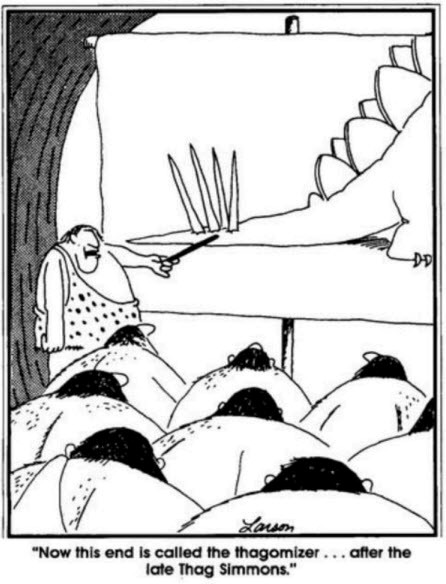
A lot cooler and more special already is when a dinosaur is named after you. Clint Eastwood is proud of the Europatitan eastwoodi, a giant sauropod from the early Cretaceous, and Gary Larson has the next best thing: the thagomizer. After Larson created the cartoon about a group of cavemen being taught about the Stegosaurus, in which the professor teaches that the four spikes on its tail are called a thagomizer, “after the late Thag Simmons”, scientists actually start calling this spiny part of the tail a “thagomizer” – as it turned out, the thing did not yet have a name, and Larson’s joke has since been gratefully adopted. Even by the respectable Smithsonian Institution, as well as in academic papers, books and the successful BBC programme Planet Dinosaur (2011).
In the rock world, meanwhile, there is only one prominent who gets this special honour, a dinosaur naming. Not Dylan. Eastwood’s Europatitan may be classified as a Somphospondylan, but that really just means “spongy vertebra”, and has nothing to do with Bob Dylan. No, Dylan is passed over by a dear colleague: in 2001, scientists Scott D. Sampson, Matthew Carrano, and Catherine A. Forster name and describe in Nature the Masiakasaurus knopfleri, a carnivorous theropod dinosaur that lived in the Late Cretaceous in the area of present-day Madagascar. Unfortunately, the motivation is not too remarkable and extremely brief. “After singer/songwriter Mark Knopfler, whose music inspired expedition crews.” Still: very, very honourable.
Dylan will be at peace with it. To Mark Knopfler we owe the exceptional, ethereal beauty of “I Believe In You”, the goosebumps on “Precious Angel”, and the breath-taking restraint of the twelve-string contribution to the acoustic outtake of “Blind Willie McTell”. And the percussive perfection of the acoustic guitar on “Man Gave Names To All The Animals”, the very last recording for Slow Train Coming, on the fifth and final session day, 4 May 1979. Would have deserved a reverential, explicit reference from Dylan, actually.
He saw a vicious lizard devouring meat
Six feet long, procumbent front teeth
A carnivorous mutt on the late Cretaceous prairie
Ah, I think I’ll call it a Masiakasaurus knopfleri
Something like that anyway.
Jochen is a regular reviewer of Dylan’s work on Untold. His books, in English, Dutch and German, are available via Amazon both in paperback and on Kindle:
Bob Dylan has always said that “if you want to know anything about me then listen to my songs.” He prefers not to speak in public, he intensely dislikes TV and he tends to see himself as a craftsman who should get on with his work. It is easy to see though that he does acknowledge that he is primarily a performer, and a constant opinion throughout his career has been that his songs do not mean the same when sung by someone else. Another perhaps more recent opinion is that many of his recordings were first drafts of songs which he has since developed on stage (he has also said that some recordings have nailed the song ).
The Never Ending Tour’s origins are very interesting. Dylan observed in Chronicles that he was struggling as a performer in 1986-87 when he toured the world with Tom Petty and the Heartbreakers. He claimed that he could not recognise his own songs when performing them and seemed to suggest that this feeling was even worse when trying to perform his songs with the Grateful Dead during this same period.
I believe that this disconnect is easy to hear when listening to his performances with Jerry Garcia’s band but not easy to detect when listening to both the 1986 and 1987 tours with Tom Petty.
Indeed, I would argue that both these tours are very different. The first year contains long shows with many marvellous cover songs adding a distinctive identity. The second year’s shows are shorter shows with no cover songs other than ‘Go Down Moses’ and the setlist virtually changing from one show to the next; these are among his greatest-ever tours. Some people however may consider that performing with a ready-made, established band, is a sign of fatigue. Who really knows?
The other major factor during this period is that Bob did not write many songs and the songs that he did write were mostly co-written such as ‘Got My Mind Made Up’ with Tom Petty or R&B performance pieces like ‘Shake’. The other factors which seem to support Dylan’s own view that he was almost finished were the “Hearts of Fire” film role (playing a washed-up has-been) and deliberately making the “Down in the Groove” album as inconsequential as he possibly could.
Bob Dylan suggests in Chronicles that he had an enlightening experience when performing in Europe in late 1987 which was a major turning point for him together with the discovery of a different musical theory which enabled him to rediscover his songs, and it is interesting to see that he did not waste any time in resuming touring.
However, with the NET he made a number of very significant changes. Probably the most relevant was the decision to omit a keyboard player from the band. The piano/organ sound had been a vital component of his live band for many years and although the 1984 European tour had a stripped-down band it still had the long-standing keyboard sound. The other major omission was the Queens of Rhythm. The brilliant female backing singers had been a terrific addition to his music since 1978 and although he rested them from time to time such as the 1984 tour, they had been an integral part of his music for nearly 10 years.
When the 4-piece NET band performed their first concert on the 7th June 1988 other changes were clear to hear. The band drenched in darkness came out all guns blazing and did not divert from a high-octane, take no prisoners performance during both the electric and acoustic segments. These early concerts also began to introduce more traditional songs into the mid-concert acoustic set.
Another innovation was G E Smith accompanying Dylan on the acoustic songs and their duelling guitar’s adding another dimension to the songs. This developed into the later sublime performances in which an acoustic performance would change midway, to a full band performance such as’ Knockin’ On Heaven’s Door ‘. This first US tour also had the unusual, unannounced added band member Neil Young trading guitar licks with Dylan and Smith.
The electric ‘Gates of Eden’ is an early highlight of the first few shows. I remember seeing video footage of these first NET concerts at a UK Dylan Convention in 1989. I must admit that the performances were initially disconcerting and the powerhouse, no-frills sound took some getting used to. However, looking back this was the release he needed from his earlier performing self and was the beginning of his attempt to develop a new audience.
Prior to the NET’s first tour in June 1988, Dylan had in the May recorded the superb Traveling Wilbury’s album, and co-wrote the songs including’ Dirty World’, ‘Congratulations’ and ‘ Tweeter and the Monkey Man.’ And despite the presence of Roy Orbison, Dylan also contributed the majority of the lead vocals.
During this period he may also have begun to write the songs for his first album of all new and original songs in four years: “Oh Mercy”. The album was recorded the following Winter but the seeds were planted during this first year of the NET.
The album was one of his most important especially given his writer’s block and the fact that there were great songs such as’ Dignity’, ‘Born in Time’ and ‘Series of Dreams’ left off the album demonstrates what a truly brilliant album it was (interesting to note that Daniel Lanois has recently said how highly he values the album and how feels it is a greater album than the much-heralded “Time Out Of Mind” which has the honour of its own Bootleg Series now being released).
This is the background to the beginning of the NET and I would like to explore some of the tour’s history. The numbers are amazing. The NET has lasted for 35 years. There have been 3165 concerts. The tour has been performed in six of the 7 continents of the world. The range of songs performed is dazzling; both his own songs and an enormous variety of cover songs. There have been 26 NET bands during this period and over 30 backing musicians have been in the band during the years.
Dylan has also preferred to have a muli-instrumentalist in his band since 1992 which has enabled him to cover more musical ground. Tony Garnier, the bass player, has remarkably been with the band for 34 years. Since 2001 he has preferred to have his current NET band as his studio band when recording the great albums he has recorded since this time (usually with a couple of other musicians such as David Hidalgo augmenting the NET musicians ).
It is clear to see that since 1986, the actual year that he began the constant touring, Dylan’s primary consideration in relation to his art is live performance. He has continued to record great albums, but whereas in the 1960s and 1970s he recorded more albums and toured less (no touring between 1966 and 1974 … 8 long years ) since 1988 he has recorded far fewer albums, especially albums of his own songs, but has been on the almost non-stop (in lockdown tours were cancelled in the Far East and the USA ) Never Ending Tour.
Yet the NET has been criticised by older critics and older fans because of the constant reworkings of his songs both musically and lyrically. However, these people completely misunderstand the ethos of Bob Dylan. Dylan has never been a nostalgia act and he has always rebelled against people’s expectations of him. He expects his audience to have an open mind and allow him to challenge himself, and his band. Bob Dylan knows that not every new arrangement or lyric change is going to be successful but this does not deter him from trying. The key point is that as a performing artist, he needs to try.
The NET has also led to an expanding of the musical canvas. The Love & Theft and Modern Times albums extended the folk, rock and blues music with country swing, rockabilly, jazz, big band etc. This unrestricted musical framework also involved a widening of the cover songs performed live and so a run of songs could be 1930’s cover song, mid-sixties classic and that of a Tin Pan Alley crooner. The great traditional cover song albums in 1992 and 1993 and the terrific Sinatra-inspired cover albums released between 2015 and 2017 also contributed to further extending the musical palette.
There have been further musical explorations along the way including the superb Great Musical Experience in Nara with the Tokyo New Philharmonic Orchestra, the Wynton Marsalis Septet jazz performance, the Christmas in the Heart album, The Bromberg Sessions and The Supper Club concerts. I would include the Rough and Rowdy Ways album (and tour) together with the recent Shadow Kingdom concert within these musical explorations.
Mike Johnson’s current great series on the NET includes many great performances from this groundbreaking tour. Mike’s emphasis has been on Dylan’s own compositions and the myriad performances of classic songs from all stages of the tour. It is a mighty achievement which currently has 105 episodes up to 2010. There is another series covering the rich oeuvre of cover songs performed throughout the tour waiting to be written.
There has been a deterioration in his voice over the course of the NET, probably a natural progression allied to not allowing sufficient rest between the various legs of the tour. However, it is remarkable how well his voice has held up despite the fluctuations in the vocal cords and it is amazing how the recording of the classic Shadows in the Night album in 2014 resulted in another transformation leading to his finest singing in over 20 years. Many people including his right-hand man Tony Garnier feel that his 2019 US tour was his greatest tour – if not ever, certainly of the NET.
Dylan has said that the only place you can be yourself is on stage. Obviously, his motivation for performing on stage and his relentless touring is connecting with an audience (or as he referred to the audience during last year’s London concerts “music lovers”).
It is also most obvious that Bob Dylan’s idea of connecting with an audience is not getting the audience to sing his songs, or playing his most popular songs or telling them how wonderful they are or flashing light shows,etc. He has never played the game. It was reported that he left George Harrison standing in the wings with his guitar in hand at Wembley Arena in 1987 preferring to end the concert with ‘Go Down Moses’.
The other part of this motivation is connecting with his songs both his own and also cover songs which he admires and makes his own (as in the case of the Sinatra-inspired albums). I also believe that he has further motivation because, as his songs demonstrate, he is a student of history. We have all heard the stories of him on tour seeking out the childhood homes of some of the musicians he holds in high regard. I also feel he has a strong attachment to the historic venues he performs in. It has been speculated that he owns a historic theatre or two in the USA. In Blackpool in 2013, I watched as he left the Imperial hotel during the afternoon of the 8pm concert. I believe he was on his way to the Opera House for a private tour of the venue and to take in the history of the largest theatre in Europe.
The excellent Scorsese Rolling Thunder Revue film released in 2019 has a most wonderful ending with a dynamic performance of ‘Knockin’ On Heaven’s Door’ leading into an audio of ‘The Water is Wide’ and then a magnificent rolling list of all the Dylan tours from 1975 to 2019. Bob Dylan may be emulating the great blues giants who have always been at his side…constantly playing another joint. The great B B King was driven to play over 200 shows a year. However, the NET is of a different order. The ever-changing 35-year tour has constantly toured the world and the emotional connection Dylan has made with people of all ages in countries with different languages, different cultures is unique.
This article is part of a long-running series which reviews the artwork of Dylan’s albums from the earliest days of his career. An alphabetical index to the albums covered in the series can be found here.
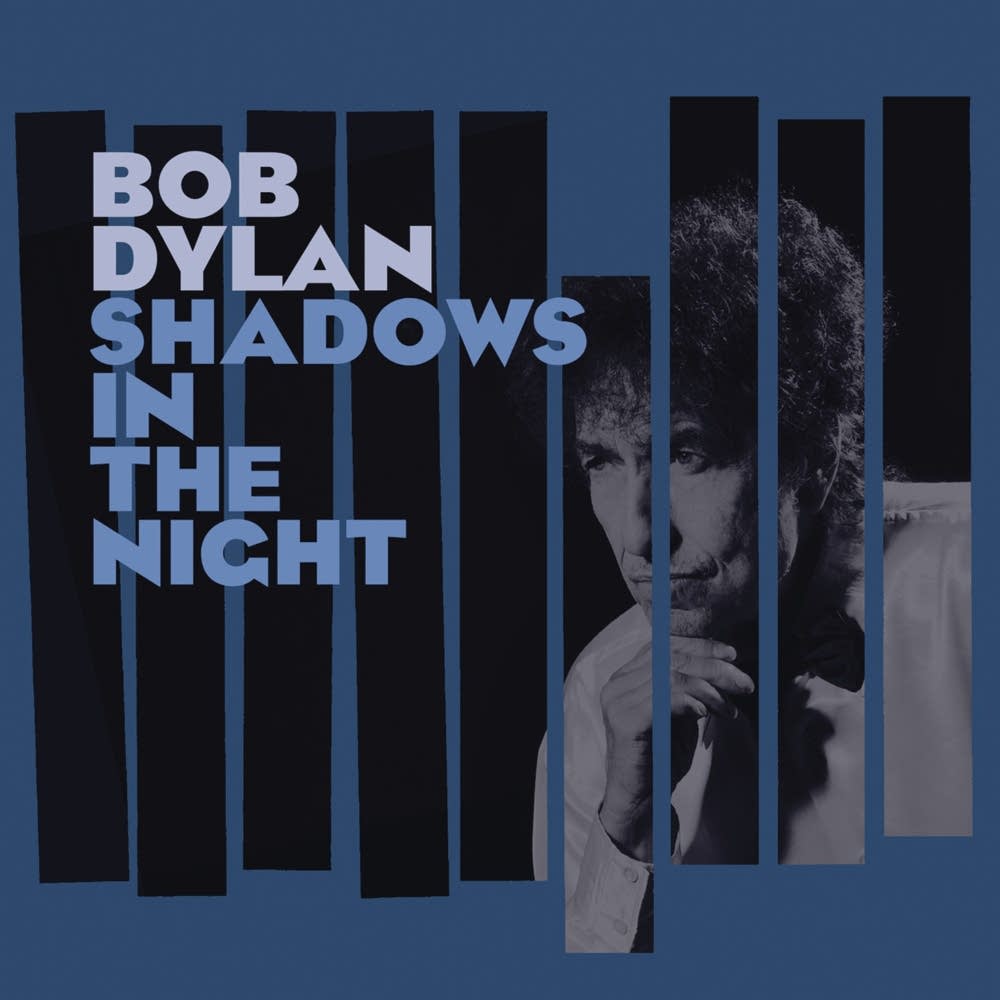
Dylan’s album artwork: Shadows in the Night
by Patrick Roefflaer
Released: February 3, 2015
Photographers: William Claxton, John Shearer
Art-director: Geoff Gans
Front
When Bob Dylan is confronted with writer’s block, he likes to go back to music that appealed to him as a young man. In the early nineties it was the blues and folk music on Good as I Been to You and World Gone Wrong. Twenty years later, he – like so many before him – flips through the Great American Songbook.
With Frank Sinatra as his guide, he pays tribute to the kind of professional songwriters who saw their glory days come to an end through artists like himself and The Beatles: singers who shifted the norms by seeing it as their right to write their own songs.
To present his first album with this kind of covers, (“Shadows in the Night”), he chooses the formal language of the period just before he himself started as a recording artist: the early sixties. But much cooler than the art work of Sinatra’s albums of that time, is the graphic art of the jazz label Blue Note Records, for which Reid Miles created a series of iconic album covers, often with photographs made by label co-founder Francis Wolff.
Dylan had worked with Miles Reid before: he was the photographer for The Basement Tapes (1975). But by 2014 both Reid and Wolff were no longer with us.
So Geoff Gans, Dylan’s regular art-director since the mid-Nineties, had to come up with making something similar. Gans based his design on a concept of which Reid made three variations for Blue Note.
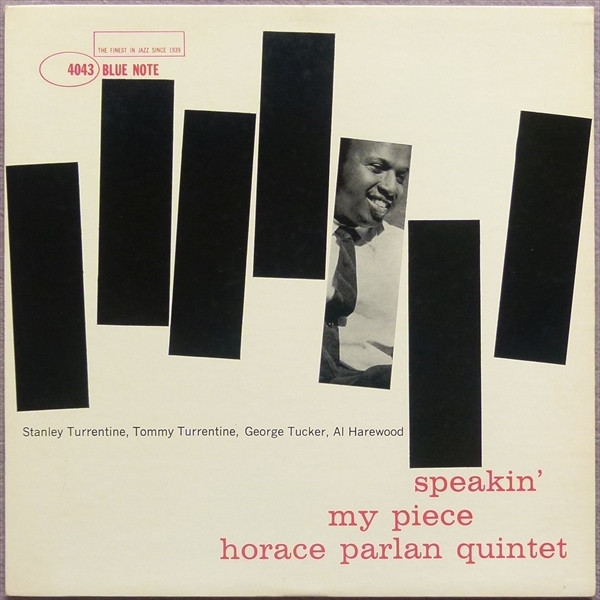
In July 1960 appeared Speakin’ My Piece an album by The Horace Parlan Quintet. Pictured are seven black bars of equal size on a white background. The bars weave a bit like on a sound wave. The third bar from the right shows a black and white photo of the leader of the five – a photo by Francis Wolff. The lettering is in red.
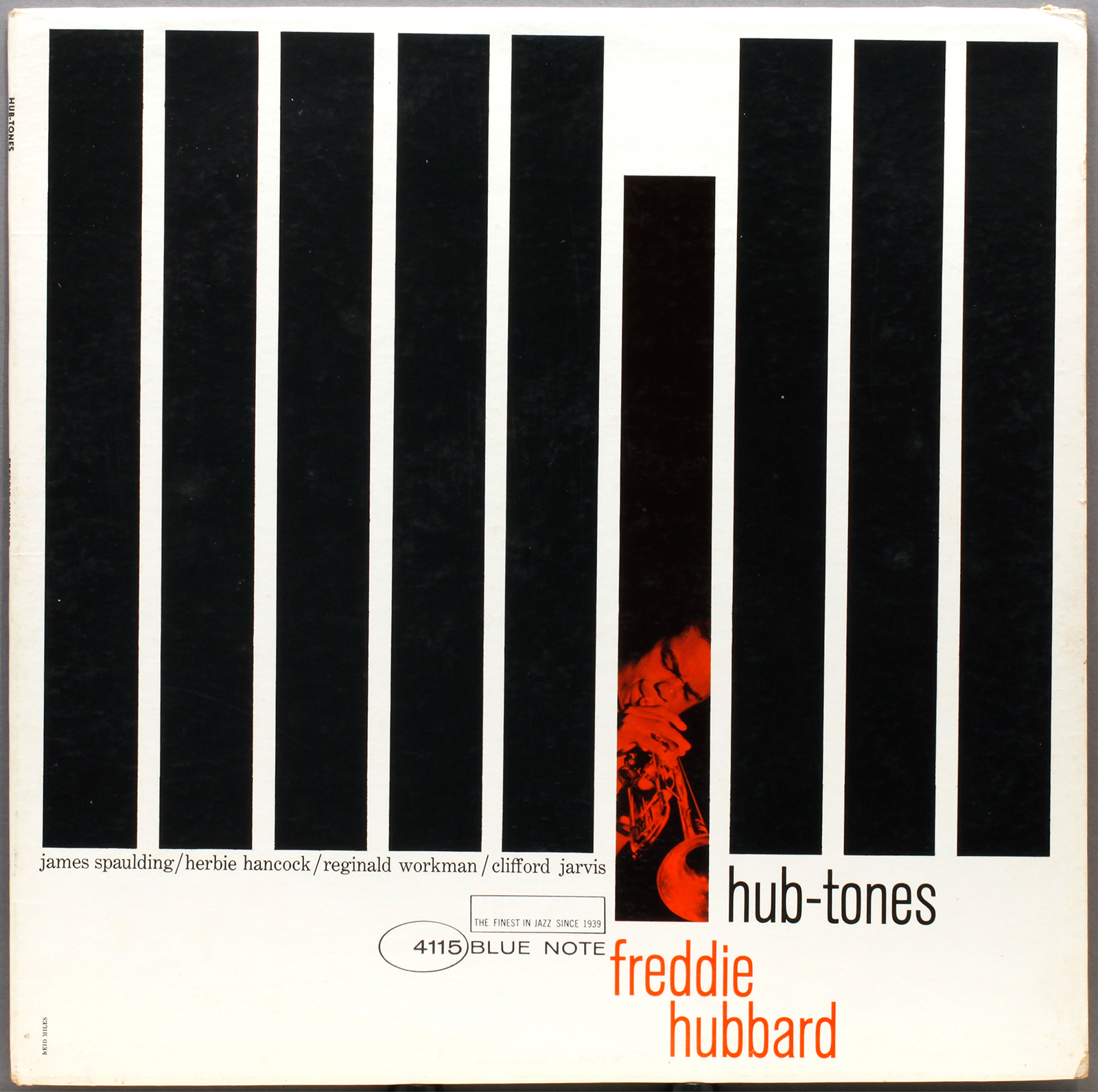
Reid improved this design two years later for Hub-Tones, an album by jazz trumpeter Freddie Hubbard, released in October 1962. Again the backdrop is white, and the bars are black. This time there are nine of them, all vertical and all the same size. This time it’s the fourth bar from the right that show the red tinted photograph.
This bar is dropped down slightly, like a depressed piano key, to make it stand out. Simple, yet perfect.
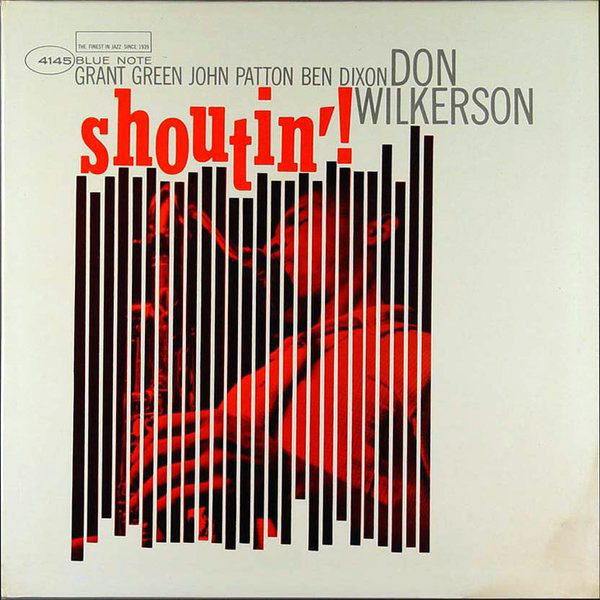
Less than ten months later, Reid used a third variation on the same concept for Shoutin’ by Don Wilinson (July 1963). Again the colour scheme remains white, black and red. This time the vertical black bars are much smaller, as there are 24 of them.
Now they seem to be following the shapes of the lettering of the name of the album: shoutin’. Again there’s a red tinted black and white photograph of the saxophonist, but this time it is spread across all the bars.
Bob Dylan.
Geoff Gans took the overall look of the Freddie Hubbard album: nine vertical bars, of which the fourth from the right is dropped down slightly.
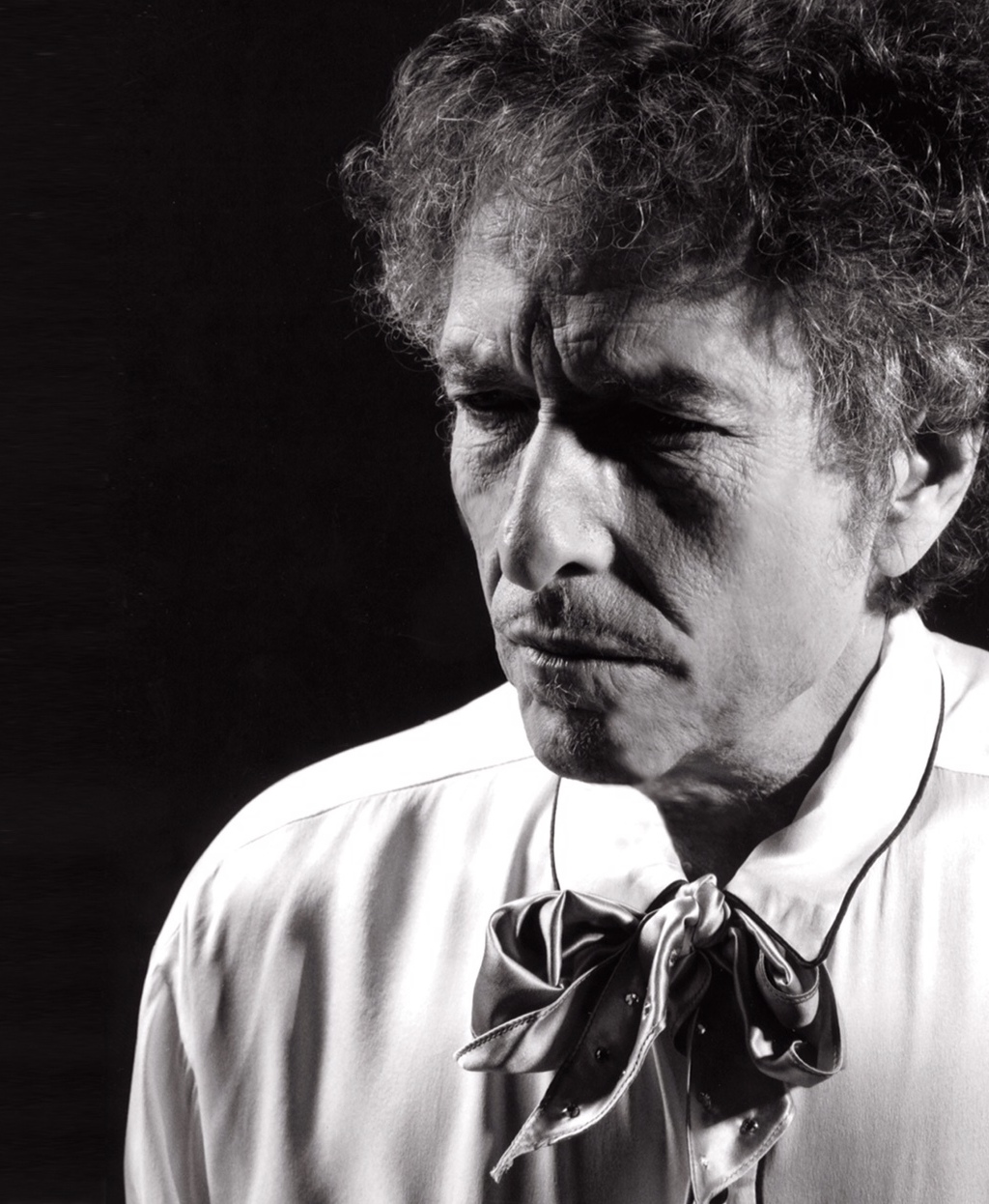
From the Don Wilinson album he used the idea to place a black and white photograph of Dylan in a thoughtful pose, coming through the bars. Instead of a white background, Gans used a blue filter over both the background and the photograph.
Although, in the minimal credits featured on the package, only John Shearer is mentioned as photographer, the formal attire and general look of the used portrait strongly reminds of other photos William Claxton had made of Bob Dylan almost a decade earlier.
William Claxton was best known as a photographer of jazz musicians and movie stars in the fifties (Frank Sinatra, Chet Baker…). One of his last assignments was for Dylan: portraits used for Modern Times (2006) and Tell Tale Signs (Rare And Unreleased 1989-2006) (2008).
The photographer died in 2008 at the age of 81.
For the title and name, Gans lets go of miles Reid’s visual language. Instead of the small font, often in lower-case letters as used by Reid, Gans opts for large capital letters. The font he uses is Eagle Bold, designed by Morris Fuller Benton and introduced by American Type Founders in 1934. These letters are also printed in blue, with the name Bob Dylan in a lighter shade.
Back
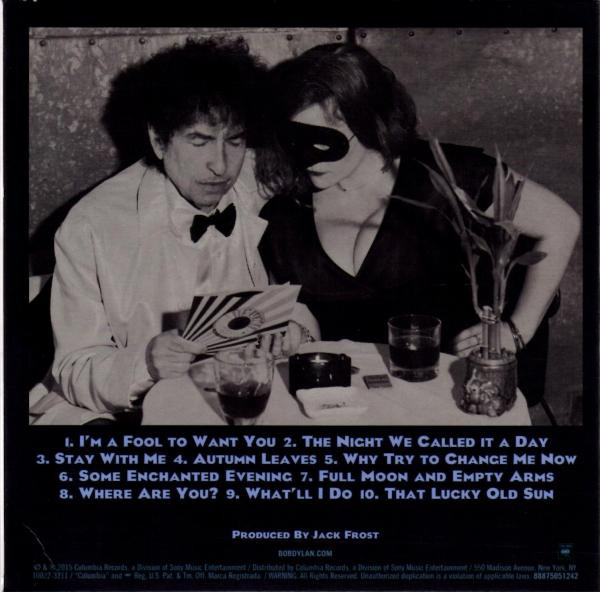
The back sleeve is mostly filled with a large black and white photograph of Bob Dylan and a masked woman.
They are sitting at a small nightclub table, dressed in their finest clothes, and looking at a 7” single. Not, as you might expect something by Frank Sinatra, but a Sun record!
To be precise (based on the larger version of the photo and the newly designed sleeve), it is identified as Johnny Cash’s ‘Get Rhythm’/’I Walk The Line’, re-released by Jack White’s Third Man Records on 21 May 2013.
Because of this, some believe that the masked lady could well be Meg White, the former wife of label owner Jack White. But the scene might refer to photos of Sinatra and his then wife, Mia Farrow, wearing masks at Truman Capote’s 1966 Black and White ball.
The photo was taken by John Shearer, who was more or less Dylan’s official photographer between 2012 and 2017. Under the photograph there are the titles of the songs and the people who contributed to the recordings and sleeve design.
The label design for both the CD and album versions is a Blue Note facsimile.
Some of the pilgrims on their way discuss art and philosophy:
One says to the other that James Whistler creates “art for art’s sake”, and it doesn’t matter one iota that a portrait he paints is of his mother; the arrangement is what counts, not the expression of any sentimentality or morality.
The other, a follower of Carl Jung, tells the tale below that illustrates that you have to gather what you can from coincidence:
(T)he little old man is planning revenge
just as the same old time train
shakes his whistler's mother painting off the wall
& it gooses him too
(Bob Dylan: Tarantula)
Lilith-reversed Debbie Reynolds of “How the West was Lost” divorces her two-timing husband Eddie Fisher; her second husband Harry Karl is a wealthy shoe salesman, and a gambler to boot.
Harry, he gets himself into the portrait:
Harie Carl & the Cruel Mother teasing at your
harmless fate
(Bob Dylan: Tarantula)
Meanwhile back at a ranch in Angola, the Portuguese military attacks rebels – Africans therein who want to rid themselves of their European masters.
Not to worry, says a traveller to his gal: existentialist Jean-Paul Sartre in his book “Nausea” agrees with Friedrich Nietzsche that God is dead; but that just gives individuals more freedom to think for themselves.
To make his point, the Sartrized guy decides to exercise his new-found freedom.
And it’s not to protest the colonial war:
Angola being bombed this morning
i right now am happy with nausea ....
i am leaving my kid on your doorstep
(Bob Dylan: Tarantula)
There are three motley, and saucy, groups in the parade:
1) The Existentialists, led by Albert Camus’ author of “The Myth Of Sisyphus”.
Monk says he has made an important decision for him:
(H)e's with the angels now
& he says "all's useless - useless"
(Bob Dylan: Tranantula)
2) The Instinctualists, led by H.D. Lawrence, author of “The Rocking-Horse Winner”:
& instinct, poet of the antique zenith
putting on his hoofs
& whinnying "all's not useless
all is very signifying"
(Bob Dylan: Tarantula)
3) The Pied Pipers, led by Bob Dylan; he takes the middle path:
& the insane pied piper
stealing the Queen's Pawn
& the conquering war cry
"neither - neither"
(Bob Dylan: Tarantula)
Sings:
Without your love
I'd be nowhere at all
Oh, what would I do
If not for you
(Bob Dylan: If Not For You)
21: Thelonius
Besides ‘Miss Lucy’ from the ” Sweet Bird Of Youth”, there’s ‘Lucy Brown’, and ‘Pirate Jenny’ from the “Threepenny Opera”. Its theme ~ capitalist “morality” promotes self-interest even among the poor; the wealthy exploit everyone; the poor, a few.
Suky Tawdry, Jenny Diver
Lotte Lenya,  sweet Lucy Brown
Yes, the line forms on the right, dear
Now that Macheath's back in town
(Louis Armstrong: Mack The Knife ~ Weill/Brecht/Blitzstein)
A theme repeated in the song lyrics below:
Steal a little, and they throw you in jail
Steal a lot, and they make you king
(Bob Dylan: Sweetheart Like You)
In the “Threepenny Opera”, Jenny Diver, akin to the story of Judas and the donkey-riding Jesus, betrays her lover and pimp Macheath for a promised reward.
Goes a tale told to the pilgrims on their way to New York City:
"(I) still aint gonna tell you nothing about jenny"
he calls me an idiot & I say "here take my donkey
if it'll make you feel any better"
(Bob Dylan: Tarantula)
Jenny apparently gets around:
Jenny's a-wet, poor body
Jenny's seldom dry
She dirtied her petticoat
Coming through the rye
(Robert Burns: Coming Through The Rye)
In the make-believe world of the ‘Threepenny Opera’, Macheath escapes death from hanging.
Likewise, the Christi-like figure in the song lyrics below:
Just then a bolt of lightning
Struck the courthouse out of shape
And while everybody knelt to pray
The drifter did escape
(Bob Dylan: The  Drifter's Escape)
In the opera, the Bible’s interpreted so as to coincide with one’s own self-interest.
Reminds of the following lines:
Only you, who believe what suits you
Could speak so badly of thelonius baker
(Bob Dylan: Tarantula)
Thelonius Monk’s a piano-playing jazz musician that Dylan likes listening to, and meets in New York City.
Though few songs by Dylan can properly be described as jazz:
To each his own
It's all unknown
If dogs run free
(Bob Dylan: If Dog's Run Free)
Every now and then Dylan likes to throw in a rarity – a song he has never before, or only rarely, performed. When he performed ‘What Good Am I?’ at Lintz on the 12th of June 2010, he hadn’t performed the song since 1999, and would perform it only four times in 2010. It’s a song about how we shut ourselves off from the injustices and tragedies of the world, and how our denial adds to those injustices:
What good am I if I’m like all the rest
If I just turn away, when I see how you’re dressed
If I shut myself off so I can’t hear you cry
What good am I?
We can feel that we’re not good for much in this world when we shut out the pain of those who love us. It’s not just a political thing; it’s very personal:
What good am I then to others and me
If I’ve had every chance and yet still fail to see
If my hands are tied must I not wonder within
Who tied them and why and where must I have been?
This is a fine performance by Dylan, driven by a slow, heavy thudding drum.
What Good Am I?
‘I Feel A Change Coming On,’ co-written with Robert Hunter from Together Through Life, was only performed twenty-two times, and not after 2010. This is the second to last performance, Kansas City, 7th August. In his article on the song, Tony Attwood recommends that we don’t read too much into these lyrics and I agree with that. In hindsight, the title is provocative, however, as 2010 was the beginning of some big changes for the NET, changes we’ll see playing out in 2011 and 2012.
I Feel a Change Coming On
In 2009 Dylan introduced a new version of this gospel tub-thumper ‘Gonna Change My Way of Thinking’ which steers away from a lot of the Pentecostal posturing of the original,
I’m sittin’ at the welcome table, I’m so hungry I could eat a horse
I’m sittin’ at the welcome table, I’m so hungry I could eat a horse
I’m gonna revitalize my thinking, I’m gonna let the law take its course
without totally losing the religious implications, although arguably with a touch of cynicism:
Jesus is calling, He’s coming back to gather up his jewels
Jesus is calling, He’s coming back to gather up his jewels
We living by the golden rule, whoever got the gold rules
There were a handful of performances in 2010, and the song would disappear after 2011. It’s a good bouncy number to kick off a concert. Here it’s the first song from Mashantucket, 27th Nov.
Gonna Change My Way of Thinking
Putting the two songs together like that, both heralding change, I can’t help but wonder if Dylan had some inkling or intimation that in fact there would be big changes coming up in the next couple of years. There is some evidence that Dylan was incubating his next album, Tempest, in 2010. ‘Classics Professor Richard F Thomas discovered that Dylan began writing the first draft of the title song on hotel stationery during the European leg of the NET in summer 2010 and that the song progressed from “alphabetical wordlists” written in Istanbul in late May to “the almost-finished song” in Spain one month later.’ (Wikipedia)
Tempest would turn out to be a very different album from Together Through Life, both in spirit and execution, and would usher in a new phase of Dylan’s career. The shift that made Tempest possible was taking place between 2009 and 2011. A change was coming on and he was indeed changing his way of thinking.
Another song that was only passing through is ‘If You Ever Go To Houston,’ also from Together Through Life. This may be a minor song but it swings along in fine style and contains some classic Dylan sentiments:
I got a restless fever
Burnin' in my brain
Got to keep ridin' forward
Can't spoil the game
The same way I leave here
Will be the way that I came
This one’s from Dornbirn 19th June, and features Dylan centre stage on the guitar.
If You Ever Go To Houston
‘Simple Twist of Fate,’ inescapably one of Dylan’s greatest songs, and one of his clearest expressions of how we are but playthings of the gods (the fates), was only played once in 2009, looked as if it was on the way out, only to begin a resurgence in 2010 that would continue through to 2021. I know of no other song that so clearly expresses the pathos of one night stands.
This might not match the magnificent 2005 performance at Brixton (See NET, 2005, Part 1) but this rather bouncy performance from New York, 23rd December, keeps up the tradition of fine performances of this song. This is Dylan once more on the guitar, centre stage.
Simple Twist of Fate
Staying with Blood On the Tracks for the moment, we move to Billings (11th August) for this also bouncy ‘Shelter From the Storm’ – that’s almost a Rasta beat jumping it along, quite a different arrangement from previous versions. Probably because the hard-edged 1976 live version is etched into my brain this one doesn’t get to me the way it might. I love Dylan’s description of himself as ‘a creature void of form.’ I know just how that feels.
Shelter from the Storm
I’m glad Dylan didn’t lose sight of ‘Spirit on the Water’ one of those deceptively gentle songs from Modern Times. The song would last through to 2018. By 2006, when the song was written, Dylan could wear his profundity lightly. I don’t know about ‘best ever’ but this is the performance I keep returning to; there’s a defiant joyousness in it that’s hard to match. (Parma. 18th June)
Spirit On the Water
That same joyousness seems to infect ‘High Water (for Charlie Patton),’ although it’s a much darker song, a vision of the chaos and anarchy let loose by a natural disaster. It’s more about moral chaos than extreme weather. Over the years we’ve heard some wonderful versions of the song, often featuring Donnie Herron on mandolin who provides the country, ‘square dance’ sounding accompaniment and Dylan at his growly best. (My favourite performance is from 2006, see NET 2006, part 3, while editor Tony Attwood has yet another favourite: https://bob-dylan.org.uk/archives/24795)
This one’s from Mashantucket, a performance to rival both Tony’s and my favourites, especially with those sharp little harp interjections.
High Water
Perhaps with ‘Summer Days’ the apparent joyousness is matched by an underlying scepticism: ‘What looks good in the day, at night is another thing.’ Always, it’s the reality behind the appearance that counts. We have heard harder, louder, faster versions than this one (also from Mashantucket), but the sharpness of Dylan’s vocal brings that disjunction between appearance and reality into focus.
Summer Days
The brisk pace of ‘Rollin’ and Tumblin’’ shouldn’t fool us into thinking that there’s any kind of joyousness in this song, as the lyrics are pure hard-edged blues – ‘sooner or later you too shall burn.’ Arguably there’s an underlying joyousness in all blues, as it was originally sung to relieve the singer of his troubles, rather than be depressing.
The hard bounce here is cathartic. There is a bitter defiance in this song which goes to the very foundations of the blues. (Kansas, 7th August) Nice slide guitar from Herron.
Rollin’ and Tumblin’
That same spirit of bitter defiance permeates ‘Cry a While,’ only played once in 2010, at Kansas City, but revived in 2012 and played through to 2019. With its tempo switch from blues to jazz, which Dylan sometimes abandons, this is a tricky song to perform. It evokes a world of deceit and betrayal and ends with the threat of litigation and death. The bluesy segments take us down into the underworld of dark feelings while the jazzy segments lift us up onto rebellion and provocation.
Another top notch performance, broodingly introduced by Herron’s violin. Note how the slide guitar backing echoes the sound of the big band era, which the song evokes in both the lyrics and the music.
Cry a While
There’s a similar mixture of despair and defiance in Dylan’s melancholy masterpiece, ‘Trying to Get to Heaven.’ I may have quoted them before, but in the last verse I find some of Dylan’s finest writing, and can’t resist sharing again.
Gonna sleep down in the parlor
And relive my dreams
I'll close my eyes and I wonder
If everything is as hollow as it seems
Some trains don't pull no gamblers
No midnight ramblers, like they did before
I been to Sugar Town, I shook the sugar down
Now I'm trying to get to heaven before they close the door
I think this recording is from New York, but I’ve lost the exact date. A vigorous performance from Bob.
Trying to Get to Heaven
Perhaps it’s not so much despair as fatalism that drives ‘Not Dark Yet.’ I don’t know any other song of Dylan’s that so clearly articulates his sense of mortality, the inevitability of approaching death. As I’ve suggested before, the older Dylan gets, the more real this song sounds. A bleak and bluesy harp break punctuates this performance from Clemson (17th October). I only wish the recording was a little better, and that Dylan had not fallen into the rhythm of the song quite so emphatically. He usually sounds better when he sings across the beat.
Not Dark Yet
We return to Mashantucket to catch ‘Lovesick,’ a song in which melancholy merges grandly into despair. Some nice guitar work here from Sexton and a convincing vocal by Bob. Lovers of this song, however, will find a much energised performance in 2011.
Lovesick
In 2010 Dylan began, for some concerts, replacing ‘All Along the Watchtower’ with ‘Forever Young’ as the last song of the night. If for a moment, and whimsically, we imagine that the ‘monkey’ referred to in the later version of ‘Gonna Change My Way of Thinking’ as this overriding sense of mortality and approaching death, then we can imagine that Dylan, on the verge of seventy, might find some humour in finishing with this anthem to youth. By performing it last he ends up jumping on the monkey’s back to win another year on the road.
This recording is from Lintz, and continues Dylan’s recent practice of singing the song unaided, with no chorus of voices for the chorus, leaving the song feeling kind of naked, but more real for all of that. The old, and fading dumpty-dum creeps into this one however, and I think I prefer the smoother, less jerky versions.
Forever Young
That’s it for this time around. We shall meet again – next time for the last round of performances from 2010.
Kia Ora.
There is an index to all the episodes in this series here.
There are details of some other current and recent series on the home page
Postmodern writing often plays around with subconscious associations, with mind- twisting allusions that lure the reader or listener into the entangled web of the text in search of meaning within the sound effects created by the arrangement of words.
“Tarantula” by Bob Dylan, a masterpiece thereof.
A group of pilgrims, it might be said, are on their way to New York City.
Gnostcs, led by decadent poet Charles Swinburne, arrive to join the pilgrimage; they explain to any pilgrim willing to listen that the physical world is condemned to perpetual darkness because the Almighty’s female aspect messes up by abandoning her binary male partner ~ leaves him behind in the far off spiritual wilderness.
Consequently finds her incomplete self mating with a smooth-talking, malevolent Demiurge:
She slays, and her hands are not bloody
She moves as a moon in the wane
White-robed, and thy raiment is ruddy
Our Lady of Pain
(Charles Swinburne: Dolores)
Burlesqued it appears in these lines from Bob Dylan’s book:
& kill babies among lady shame
good looks & her constant foe
torn sawyer of the breakfast cereal
causing all females paying
no attention to this toilet massacre to be
hereafter called LONZO
(Bob Dylan; Tarantula)
Suggests to this reader that the earthly male companion to the lady of shame and pain be no other than Mario LANZA!
Johnny and Prudence are lovers in a squeaky-clean movie entitled “The Midnight Kiss”. It stars Mario Lanza and Kathryn Grayson; she’s an aspiring young opera singer who falls in love with an Italian truck driver; and he with her; they perform in an opera together.
In the movie, handsome Mario Lanza dresses up as a nineteenth-century military officer.
Could be that the lines below, from “Tarantula”, undermine the storyline of the motion picture ~ blasts it with burlesque ~ (B)road saves the clean!
The word “censor” plays off against “sensor”, and gets mixed into the soupy literary broth with a good sprinkling of ‘s’ alliteration:
The censor in a twelve wheel drive semi
stopping in for donuts
& pinching the waitress
he likes his women raw & with syrup
he has his mind set on becoming a famous soldier
(Bob Dylan: Tarantula)
Be that as it may, the story of our adventurous pilgrims continues ~
the wife of Roy Rogers meets up with Lilith, Adam’s first wife – that “femme fatale” Debbie Reynolds.
Deb featured in the movie “How The West Was Won” as Lilith Prescott, a riverboat – singer; Gregory Peck as a gambler:
& debbie reynolds, she comes along
& both her & dale, they start shacking up
in the newspapers
(Bob Dylan: Tarantula)
Debbie especially is real bad:
Lilith teaches her new husband, Bubba
how to use deodorant
also teaches him that
"stinky doo doo' means nasty filth
(Bob Dylan: Tarantula)
In the movie, she sings of the new Promised Land:
Away, away
Come away with me
Where the grass grows wild, the winds blow free ...
And I'll give you a home in the meadow
(Debbie Reynolds: A Home In The Meadow ~ Cahn, et. al.)
19: The Golden Gate
by Larry Fyffe
Under the moon, a bunch of Solipsists, Realists and Absurdists join in on the philosophical discussions by pilgrims as they wend their way to New York City.
Monty Hall, down from Winnipeg, shouts out, “How does it feel? Let’s make a deal!”
The show’s a hit, and still making the rounds:
I pick a number between one and two
And ask myself what would Caesar do
(Bob Dylan: My Own Version of You)
Contestants in the original TV show, dressed in absurd costumes, have the numbers 1, 2, and 3 to chose from; they have to cope with the game-show host’s interference, and could end up ‘winning’ a worthless booby prize; that is, they get “Zonked!”
In the tale told below, the narrator thereof decides to change from a Solipsist into a Realist after he realizes that Zonk, a boxer who’s real name is Danny, be the booby prize in this round, and would knock him into little pieces should the narrator/contestant pick the wrong door to open:
(M)e - I started wondering about whether anybody existed
but I never pushed it
especially when Zonk was around
Zonk hated himelf & when he got high
he thought everybody was a mirror
(Bob Dylan: Tarantula)
The remaining Solipsists continue to argue among themselves as to whether they are all alone, or not:
Justine was always trying to prove she existed
as if she really needed proof
(Bob Dylan: Tarantula)
Note that the word “diddley” means “absolutely nothing”:
- Ruthy - she was always trying to prove Bo Diddley existed
(Bob Dylan: Tarantula)
To confuse matters, Monty puts on a phonograph record:
Tell you Mona, what I wanna do
Build my house next door to you
Can I see you sometime
We can go kissing through the blind ...
Can I see you in the front
Listen to my heart go bumpity bump
(Bo Diddley:  Mona)
& Zonk he was trying to prove that he existed just for Ruthy
but later on said that he was trying to prove he existed to himself
(Bob Dylan: Tarantula)
Meantime, Mona tells Bo what she wants to do ~ find a bridge between all-out sensual pleasure, and complete asceticism ~ the ‘golden mean’ – apparently in
San Francisco:
Mona - she resembles a sexy Buddha
& always looks like she's standing over the Golden Gate
(Bob Dylan: Tarantula)
I started off this new series, suggested by Aaron, with “Death of an Unpopular Poet” and since reaction back to myself was fairly positive, here is the second piece. However I would add that for the most part I am not familiar with the songs Bob put on his favourites’ list, so I am coming to most of them afresh at the moment of writing.
For the second song we have Gordon Lightfoot with ‘Shadows’.
As with the first song in the series we have a composition with a melody of the type that Bob would never have written, and with a regularly repeated chorus, which is far from being Bob’s favourite device. So all in all a very non-Dylan piece of music.
And I have to admit I personally have a problem with the organ’s four-note phrase repeated over and over again. For me (and as ever it is just my own thoughts on the matter, coming to a recording for the first time) it gets in the way of everything else.
But I suspect the melody attracted Bob, which obviously you can hear in the recording above. And the lyrics…. well, I thought it might be helpful to print some of them out.
Won't you reach out, love and touch meLet me hold you for awhile?I been all around the worldOh, how I long to see you smileThere's a shadow on the moonAnd the waters here belowDo not shine the way they shouldAnd I love you just in case you didn't knowLet it goLet it happen like it happened once before
There’s no denying there is a good set of images with the challenge of what the “it” is in “let it go”. Indeed as the song moves on, it is clear it is a lost love song, the type of song Bob doesn’t write much. He writes about old relationships, but often with a sense of pleasure that it is over – sometimes even utter disdain – after all you can’t get more of a put down than “You’ve got a lot of nerve to say you are my friend”.
So this is lost love song with a really pleasing melody and the simple question, “Is it me or is it you?” There are some fine images of course, such s the “shadow of a dream” and the self-doubt (which composers often have problems within the lost love songs. Indeed “Is it me or is it you, Or the shadow of a dream?” is perfectly ok as a line in my view, but I am not really convinced “Is it wrong to be in love?”
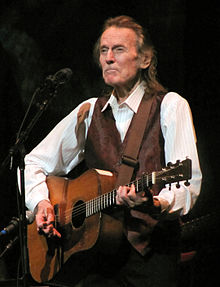
Gordon Lightfoot was part of the folk-pop round of performers in the 1960s and 70s, and considered as one ofthe greats of Canadian songwriting. His brother once said, “His name is synonymous with timeless songs about trains and shipwrecks, rivers and highways, lovers and loneliness,” which to a degree sounds like some of Dylan’s favourite themes.
As for his best known composition, surely it is Early Morning Rain…
… which would undoubtedly be in my personal list of songs I wish I had written – although that of course is utterly irrelevant.
But more to the point the songs of Canada’s greatest have been recorded by everyone from Elvis to Jerry Lee, from Bob to Judy Collins.
In fact Bob once said, “I can’t think of any Gordon Lightfoot song I don’t like. Everytime I hear a song of his, it’s like I wish it would last forever…. Lightfoot became a mentor for a long time. I think he probably still is to this day”.
If you want more Gordon Lightfoot, just leave the link above running.
Anyway, my not being totally drawn to Shadows is undoubtedly my failing, as I am sure you have already realised. The man is synonymous with brilliant songwriting, and Bob’s not that bad a judge.
Writer D.H. Lawrence joins the pilgrimage to New Babylon; cries out that the struggle to survive, and the sexual drive (pointed out by Charles Darwin), gets usurped by modern industrial capitalists.
In the lines below, Social Darwinism mocked ~ i.e., curly hair determines one’s destiny:
(T)he sight of george raft - richard nixon - liberace
d.h. lawrence & pablo casals - all the same person
struggle -struggle
& your weapons of curls blowing
(Bob Dylan: Tarantula)
Senator Joe McCarthy comes along; tells the Monk that he doesn’t like monkey-lovers:
(H)e don't like people that say
he comes from the monkeys
(Bob Dylan: Tarantula)
Henry Miller jumps into the stream of consciousness and tells a tale of ‘hot’ sex.
Porno-Lit parodied below:
Grady O'lady comes in - gives everybody the nod
& wants to know where she can get a maid ....
O'lady takes an orange out of her pocket
"got this from Aztec country - watch me now boys"
she takes the orange & oozes & dribbles
all down her mouth all over her skirt -
more - more - she's all covered in orange
(Bob Dylan: Tarantula)
Later on, a possible source of the above lyrics revealed:
I buyed me a little box about four acres square
filled it with guineas, and silver so fair
Oh now I'm bound for Turkey, I travel like an ox
And in my breeches pocket I carry my little box
(Bob Dylan: Taddle O'Day ~ traditional)
Street slang for ‘dirty sex’ hidden in a future song ~ in the lyrics quoted beneath:
Brownsville girl with your Brownsville curls
Teeth like pearls, shining like the moon above
Brownsville girl
Show me all around the world
Brownsville girl, you're my honey love
(Bob Dylan: Brownsville Girl ~ Dylan/Shepard)
“I’d walk a million miles for one of your smiles” sings back-faced Al Jolson ~ “My Mammy” (Young/Lewis/Donaldson). Tarantsulated below: Al, the Jewish performer drops into a theatre to watch “Two Women”, an Italian-language movie that stars Sophia Loren in which a mother and daughter are raped by Moroccan ‘irregulars’ from the Fench African colony who are fighting against the German Nazis in Italy.
Humphrey Bogart’s not there.
Hubris notwithstanding, apparently Jolson expects a postage stamp to be issued in his honour:
(I)n the winter a blackface musician announces
he is from Two Woman
he spends his free time trying to peel the moon
& he's here to collect his eight cent stamp
(Bob Dylan: Tarantula)
Below, metonymically speaking with humour and wordplay abounding, Walter Scott, and George Eliot (a woman) get Shakespeared:
(O)k, so you used to get B's in the Ivanhoe tests
& A minuses in the silas marners
then you wonder why you failed hamlet exams
yeah well, that's because one hoe and one lass
do not make a spear
(Bob Dylan: Tarantula)
17: Hopalong Bob
William Boyd and Andy Clyde star in the western movie “Hoppy Serves A Writ”.
Milk-drinking black-clad, white-horsed, hard-riding lawman Bill “Hopalong” Cassidy, and his slapstick-sidekick “California” Carlson ride into Bob Dylan’s kaleidoscopic montage of movie stars acting as though they’re in the unfenced Old West – here supposedly located in Texas and Oklahoma.
The times they are a-changing.
“Talkies” take over. Silent movies are dead.
Nor do printed words talk:
(T)he audio repairman stumbles
thru the door with "sound is sacred
so come in and talk to us"
written on the back of his shirt
(Bob Dylan: Tarantula)
Louis L’Amour grabs the opportunity to make money by writing noveletts about Hopalong’s adventures:
Into the Valley of Burlesque the cowboy angels ride.
Mocked be that any sexual activity is pretty well outlawed in those Hoppy Days whether in stories, at the movies, or on tv:
(O)ut of his past appears Insanely Hoppy
screaming and dancing
(Bob Dylan; Tarantula)
He holds up a stagecoach, and takes the strongbox that contains a nursery rhyme:
Little Jack Horner
Sat in the corner
Eating his Christmas pie
He put in his thumb
And pulled other a plum
And said, " What a good boy am I"
Exchanges the nursery rhyme for a night of sex:
Listen to the fiddler play
When he's playing 'til the break of day
Oh me, oh my
Love that country pie
(Bob Dylan: Country Pie)
Sometimes things don’t go that well:
(E)xcept that I can't do anything with with my finger
& it's already beginning to smell
(Bob Dylan: Tarantula)
Onward, onward rides Hoppy, with his sidekick, into New Babylon.
In pursuit of the Golden Calf:
(T)he american flag turned green
& andy clyde kept pestering about a back paycheck
(Bob Dylan: Tarantula)
They’re not alone, don’t forget:
& all the rest of these people
that would make leadbelly a pet
(Bob Dylan: Tarantula)
IX When Charlie was around, something good would usually come out
“Country Pie” is a song that I played a guitar part on – my favourite guitar part ever played on a Dylan song, back on Nashville Skyline. I wanted to do it different, so I played fiddle on this. But it is just a good-time tune, you know. I think it’s kinda Bob’s concept of country life: “Give to me my country pie”.
(Charlie Daniels on his “Country Pie” cover on Off The Grid, 2014)
At the talk-show-style book launch of Ron Cornelius’ book The Guitar Behind Dylan & Cohen at Nashville’s Music Hall of Fame, 2017, Charlie Daniels and Bob Wilson sit next to each other on stage. So the conversation, despite Cornelius having absolutely no involvement in the album, a few times drifts off to Nashville Skyline – which is, after all, the album where Wilson and Daniels met, the breakthrough for Charlie Daniels, and the album that is at the intersection of Cornelius, Bob Johnston, Dylan and both musicians. And to that joyous, frequent drifting off we owe insights and backstories about the origins of individual songs like “Country Pie” and the album at all. Recalling “Country Pie” in particular enthuses Daniels:
“Something that always sticked in my mind with Nashville Skyline is when Bob started doing “Country Pie”. And I had my Telecaster and Bob [Wilson] had the piano, and he started playing those chords and Bob started playing tadeladeda-tatataa… I never forget that, that’s my favourite piano part you ever did, and then I came in on the Telecaster, remember that? [singing:] “And just like old Saxophone Joe when he got the hogshead…” and I just…, I mean…, it just blew… we were just… but that was the spirit of things I mean: we were having fun.”
He stumbles over his own words, bursts out in infectious laughter almost 50 years after that evening at Columbia Studio A, seems to completely forget about the other guests, the presenter and the audience, here on this stage in Nashville, and has a reminiscing, intimate entre-nous with Bob Wilson – who does confirm his stories in full. And then just wants to have said publicly:
“But for Charlie Daniels and that Telly of his, Nashville Skyline would not have been Nashville Skyline. I mean, this guy was perfect. You got all these talented god-gifted guitarists in Nashville, but he was perfect for that album.”
They wave praise at each other rather effusively, but it doesn’t get awkward; the recording of “Country Pie” illustrates and supports both the memories and analysis of both men. It is true, after all; the song is carried by Wilson’s funky piano intro and the bouncy, pleasantly intrusive encouragement of Daniels’ Telecaster. Dylan’s objection at the time, “I don’t want another guitar player, I want him”, is quite understandable. And in his autobiography Chronicles (2014), Dylan reaffirms his appreciation, even confesses to feeling a kind of soul affinity, and moreover, suggests a kind of dependence on Charlie Daniels’ input:
“I was wondering who he [Johnston] was going to bring to the sessions this time and was hoping he’d bring Charlie Daniels. He’d brought Charlie before, but he’d failed to bring him a few times, too. […] When Charlie was around, something good would usually come out of the sessions.”
… in which, as an aside, that oddly passive “I was hoping he’d bring Charlie Daniels” also stands out. This is 1970. Dylan has long since been in the position of being able to dictate who he wants to play with – but still seems unaware that he could order Jimi Hendrix, Glenn Gould, Paul McCartney and Gene Krupa to the studio, so to speak.
Our cliché expectations of country & western it definitely does not meet, the intro by the duo Wilson & Daniels. Which is hardly surprising: Bob Wilson hails from Detroit and indeed has soul in his blood and in his fingers, having made a modest name for himself in the years before with piano contributions to the San Remo Quartet’s instrumental soul-muzak and sweaty, funky, flopped soul stompers like “All Turned On” and “After Hours” – which we also hear back in that blues trifle “Western Road”, the improvisation he, as an encore, set in after “Lay, Lady, Lay” last night, 13 February 1969.
How song-defining Wilson’s intro is, the prog rock dinosaurs of The Nice demonstrate, with one of the first covers of “Country Pie”, still in its 1969 birth year. Side A of their over-ambitious LP Five Bridges is devoted entirely to the rather pretentious “The Five Bridges Suite”, but no less brave is Side B: rock symphonic arrangements with jazz-rock-like excursions on Sibelius’ “Karelia Suite” and Tchaikovksky’s “Pathetique”. And then, No.3 of Side B, a bizarre interpretation of Dylan’s “Country Pie”, larded with Bach’s “Brandenburg Concerto No. 6”. How successful that is, is debatable, but Keith Emerson is obviously an extremely talented craftsman, and accurately hits the bearing of “Country Pie”: he builds his entire excerpt on Wilson’s piano pattern from the intro.
In the studio, Charlie Daniels also immediately picks up on its funkiness – his pinched guitar licks and rousing lines are closer to Curtis Mayfield than to Chet Atkins. Looking back on it fifty years later with justifiable pride, he still finds: “My favourite guitar part ever played on a Dylan song.” Can’t be topped, he apparently thinks in 2014, when he records the song again for his Dylan album Off The Grid: Doin’ It Dylan; he swaps the Telecaster for his violin. He could have skipped the song, of course, but the “good-time tune” is irresistible – Charlie has contributed to some 30 studio recordings of Dylan originals (apart from Nashville Skyline, also for Self Portrait and New Morning), but this is the only song on his tribute album to which he returns (the other nine covers are mostly from the 1963-1967 period).
Fun, and good-time, indeed – but the fiddle does not compensate for the loss of that energising, funky guitar part. Fairport Convention demonstrates as early as 1981 that Daniels should have stayed true to himself; Richard Thompson, an exceptionally adept and original guitarist himself after all, takes his hat off to Charlie’s input and in broad strokes copies the part. In an otherwise rather perfect cover from which the funk and ragtime has virtually evaporated – promoting the song to a dynamic country rocker. Including a ferociously-disrespectful, anarchistic rockabilly coda.
Still, it is only one of the rare covers. The song does not become a classic. Dylan himself ignores the song as well, more than thirty years, until he suddenly resuscitates it in 2000, playing it over a hundred times. In rather faithful, funky and hoppy versions, with a starring role for Larry Campbell’s solo guitar, usually playing attractive derivatives of Daniels’ template. After 2001, “Country Pie” does pop up on the setlist a few more times, but after a final performance in 2007, it is over.
The latest revival for now comes from the good old Nitty Gritty Dirt Band, the guys who have been distinguishing themselves at times with fine Dylan covers since the 60s and crowned it in May 2022 with the very attractive tribute album Dirt Does Dylan. Beautiful cover design and filled with nice to very nice versions of everyman’s friends like “She Belongs To Me”, “Quinn The Eskimo”, “Forever Young” and “Don’t Think Twice”. Plus one outsider: our half-forgotten country-funk gem “Country Pie”. This time in a folky, unpretentious pub version.
Listen to the fiddler play.
Jochen is a regular reviewer of Dylan’s work on Untold. His books, in English, Dutch and German, are available via Amazon both in paperback and on Kindle:
Continuing my personal selection of the greatest moment from the Never Ending Tour, I come to “It’s Alright Ma” from 2001.
Once again we are with a song that those with a musical ear will know from the opening of the introduction and everyone else will know from the opening line and that distinctive chord change.
More than that most of us will know every word of every line, and by 2001 will have heard it at least a few times before live, as well as hundreds of time on recordings. Or to be brief: we already know the piece inside out, despite its lyrical complexity.
But of course this is also not a song that naturally lends itself easily to a full band accompaniment, and if we are to have Bob on his own performing the piece there is not too much he can do to differentiate this performance from others without the changes sounding forced.
So what he brilliantly does here is give us a gentle accompaniment. The speed of the song is just a fraction slower than the album, but above all we have that gentle percussion along with a second acoustic guitar. And the result is a completely new vision created from a song we know oh so well and lyrics that have become part of our very existence.
Indeed amazingly, even though we do know all those lyrics, they now shine through afresh, and bring with them a new realisation of what this is all about. Individual lines that were just part of the mix before now take on a special significance, even though Bob is not emphasising anything beyond the last word of each line.
Indeed much of the effect is achieved by the way Bob treats the last word of each line. The lack of melody vanishes – with the pitch changing in some lines but not every line. And when get to “It’s all right ma” yes for the first time I really do feel that he is explaining himself and his life to his ma. “Don’t worry about what I’m doing ma, that’s how it goes these days.”
What I also find is that for the first time I am appreciating the sound of the lines, rather than the meaning of each word – it is as if at times the vocals are in fact another instrument – it is the sound not the meaning of the words that draws me in.
Of course maybe that is because I know every line so well, or maybe it is through something else in the way Bob ends each line but this really is a most curious effect achieved with such a small change.
Then the whole performance is further enhanced by the way Bob changes the rhythm of the lyrics – not just with the final word of each section, but throughout, often in fairly subtle ways.
For me this is the re-birth of an old favourite that maybe I felt I had heard so often that I could not appreciate anymore. If the writing of the song was a work of genius (as surely it was) this re-arrangement is equally the work of a master at the very top of his game.
By Aaron Galbraith and (a rather over-excited) Tony Attwood
Foreword for new readers: Aaron in the USA selects the song and the tracks, and Tony in the UK adds his comments while listening to the recordings Aaron has selected.
Aaron:“It Hurts Me Too” is based on “Things ‘Bout Comin’ My Way”, recorded by Tampa Red in 1931, recording this in 1940.
Tony: This is an absolute classic blues format based around the chord sequence:
Bb, Bb7, Eb, Ebm, Bb, F, Bb
It’s a sequence that offers easily as much as the 12 bar blues sequence, but is used far less often for some reason. Maybe because there are no repeated vocal lines, which makes the 12 bar blues even easier to write. Or perhaps if it had become known as the 8 bar blues (which is in fact what it is) it would have caught on more. Personally, as a sequence, I love it.
But this song does show how much there is, in this simple arrangement of chords and a great musical arrangement built on top of it. It is just verse after verse with the same last line for each verse, but so much can be done with it.
Aaron: Dylan’s version came from 1970s Self Portrait
Tony: Bob plays around with the rhythm and with the classic chord sequence adding an extra chord as the penultimate after “go wrong with you”.
But what we really notice is the addition of the swing beat which allows for all the laid-back fun in the instrumental verse. That swing beat gives us 16 bars of bouncy 4/4 rhythm and a totally different feel. And what really, really makes it work is that accompaniment, so gentle, but with so much swing – these guys must have had a wow of a time playing this.
I really wonder how on earth Bob thought of putting this rhythm to the song. Was it entirely his idea or did he hear this rhythmic version on an old 78rpm? (And I must odd, it would be a hell of a track to dance to in a classic but fast 1930s swing style. Way beyond my abilities now, and actually it probably was when I was a lot younger, but I can see it in my mind’s eye, and it sure looks good.)
Anyway, enough of that…
Aaron: Three members of The Rolling Stones released an album in 1972 called Jamming with Edward! Based on jam sessions while waiting for Keith to arrive in the studio, their version of the track incorporates lyrics from Dylan’s Pledging My Time
Tony: What a fabulous introduction; I just feel it is a trifle sad that with all this talent on display, they couldn’t come up with something more after that intro. But then I guess they were just waiting for the final member of the band to show, and so they are going to play it, not work on the arrangement. Good fun. Nice change over to Dylan’s “Pledging my time” partway through as well, which of course is based on the same sequence. I’m sure you’ll know it inside out, but just in case here it is…
Aaron:Several great versions followed over the years by the likes of Foghat, Eric Clapton, Robert Palmer , Steve Miller ETC. But here is a version by Keb’ Mo’ from 2000 who took this song in an entirely different direction
Tony: Wow this is a surprise – not a track I knew at all; either this is a brilliant find Aaron or I am, as ever, several hundred years behind the times. This is incredible; it is exactly the sort of musical invention that I adore and worship. He’s kept the lyrical style, and the chord sequence, although there is one change (the one written as Ebm in my original is played at Gb I think – sorry I am doing this in my head and not at the piano and that change just took me completely by surprise), and it is a stunner. It works perfectly, while giving us that little feel that yes, ok, the beat is pronounced and speeded up, the instrumentation is different, but (he says) I’m still going to give you another surprise too.
And if I may wander over to another art form, it would be an absolute scream to dance this piece as a couple, to a triple-step just dancing around the whole ballroom floor. Just the band playing this, and one couple travelling the whole floor – goodness I ought to have had a life writing film scripts rather than advertising copy.
Oh Aaron, that was so much fun. Another article soon please!
PS: I’ve just started to play that final track again – I would strongly recommend anyone who has read this ramble of mine and listened to the Keb Mo version to the end now does this. Go back to the start and play it again, and just take in that opening in the knowledge of where the song goes to. I say again “wow, wow and thrice wow” (sorry to non-UK readers, that’s a very English joke… Frankie Howerd, if you remember).
In “Tarantula”, per usual, it’s difficult to pin shape-shifter Dylan down; it’s pages are left wide open for interpretation.
For instance, therein is Al Capp’s “Li’l Abner”, but then again, perhaps the biblical character Abner.
Biblical Abner switches sides; supports David as king rather than Saul’s son because Abner’s been accused of disloyalty for sleeping with one of Saul’s concubines.
The commander of David’s army, his brother having been killed by Abner, stabs the turncoat to death which makes David very angry.
Nevertheless, synchronicity there be ~ the American cartoon-satirist Capp, initially somewhat liberal-minded turns about; he becomes more and more right-wing in his political sentiments.
A reversed mirror image of Bob Dylan that can be put in a corncob pipe and smoked:
(H)e Abner cursed out East Texas, tomatoes
& tin pan alley, he didn't talk to me
he talked in a mirror
(Bob Dylan: Tarantula)
Likewise, Jake the Flesh, the biblical Jacob; or Mick Jagger, the devil of the Rolling Stones, the group founded by Brian Jones. “Jumping Jack Flash” is not written yet so take want you can gather from coincidence; but there’s the nursery rhyme “Jack Be Nimble”.
Afloat on the timeless Jungian Sea, beneath mona moon, sneaky Jacob, born holding on to Esau’s heel, “steals” his fraternal twin’s birthright.
Yahweh further informs Jacob about the ladder of history ~ that Persia will defeat Babylon, and captive Hebrews will be allowed to return to Jerusalem to assist in the restoration of Israel to its former glory – if they all behave themselves of course.
So said it could be, as indicated by the bible verses below, that Jacob, as an ardent follower of Yahweh, will make good things happen – he’s the Rain Man.
Yahweh says to him:
For I will pour water upon him that is thirsty
And floods upon the dry ground
I will pour my spirit upon thy seed
And my blessing upon thine offspring
And they shall spring up as among the grass
As willows by the water courses
(Isaiah 44: 3,4)
In the Third Testament, known as the Tarantula, Jacob warns the Flower Lady that the Herculean elephant boy is not afraid to take on the boy from the New Babylon who’s trying to drown Albion.
Rain Man yelled
"watch out Flower Lady, there's an elephant coming"
but by this time she was singing auld lang syne
with Babbooo Boy
who'd snuck up, stuck a lead
weight life jacket around fablan
& threw him in the swimming pool
(Bob Dylan: Tarantula)
The Flower Lady records the following song:
Show me the country, where the bombs had to fall
Show me the ruins of the buildings, once so tall
And I'll show you a young man
With so many reasons why
There but for fortune go you and I
(Joan Baez: There But For Fortune ~ Phil Ochs)
The lyrics following, perhaps an answer song from Dylan’s nemesis ~ recorded in Blake’s Albion, the Land of the Fab Four:
The painter paints his brushes black
Through the canvas runs a crack
Portrait of the pain never answers back
But nobody's buying flowers from the flower lady
(Peter And Gordon: The Flower Lady ~ Phil Ochs)
In reference to the personification of America below:
She's an artist, she don't look back
She can take the dark out of night-time
And paint the daytime black
(Bob Dylan: She Belongs To Me)
Meanwhile, San Francisco’s freezing, and New York’s suffering from spells of Poe:
All wreathed with fairy fruits and flowers
And all the flowers were mine
Ah, dream too bright to last
(Edgar Allan Poe: To One In Paradise)
15: Tarzantula
Joining the Tarantula pilgrim parade is the cousin of Ronnie Hawkins:
& Suzy-Q, the angel
putting new dime into this adoption machine
as out squirts a symbol
sqawking & freezing & crashing
into the bowels of some hideous soap box
(Bob Dylan: Tarantula)
The cousin, from Louisiana, performs the landmark rocknroll song quoted beneath:
Oh Suzy-Q, Oh Suzy-Q
I love you, my Suzy-Q
I like the way you walk
I like the way you talk
I like the way you walk, I like the way you talk
My Suzy-Q
(Dale Hawkins: Suzy-Q ~ D.Hawkins/Chaisson/Burton)
With its roots in the Jazz Age of F. Scott Fitzgerald, and his wife Zelda:
Now, you swing over here
Now, you swing over there
For you swing on out, and you do the Suzie-Q
Oh, you dance in
Yes, you're prancing
When you hear the music play, that's your cue
(Lil Armstrong: Doing The Suzie-Q)
Below, a Tarzan-yelling song intended to be funny – with appalling racist slurs (even Walt Whitman refers to Afro-Americans as “baboons”):
Oh yes, I saw her Saturday at the show down town
She said, "Hi there, Baboon, can I sit down?"
I said, "Wait a minute, baby, where's your raccoon?"
(Dale Hawkins: See You Soon Baboon)
If the lyrics above by the gentleman from Dixieland had any influence on the following song by the Beatles, the Fab Four do not admit it, and rightly so:
Well, she and her man who called himself Dan
Were in the next room at the hoedown
Rocky burst in, and grinning a grin
He said, "Danny Boy, this is a showdown"
But Daniel was hot, he drew first and shot
And Rocky collapsed in the corner
(Beatles: Rocky Raccoon ~ McCartney/Lennon)
The influence of the poem below readily acknowledged;
And the two men lay stiff and stark
Pitched on his head, and pumped full of lead
Was Dangerous Dan McGrew
While the man from the creeks lay clutched to the breast
Of the lady that's known as Lou
(Robert Service: The Shooting Of Dan McGrew)
In ‘Tarantula’, Dylan, who turns away from protest songs of the day, uses a “two-b” name in ‘the Flower Lady & Babboon Boy’, maybe the latter in reference to Phil Ochs (Dylan, being driven in a limousine, tells Phil to get out of the car).
Ochs writes the anti-Vietnam War song below, the lyrics of which give the protest song a sharper edge.
Bob Hope and Anita Bryant entertain the troops in South Vietnam:
The comic and the beauty queen are dancing on the stage
Raw recruits are lining up like coffins in a cage
We're fighting a war we lost before the war began
We're the white boots marching in a yellow land
(Phil Ochs: White Boots Marching In A Yellow Land)
The narrator in the lines beneath resorts to sarcasm:
(I) don't care what bob hope says
he aint going with you nowhere
(Bob Dylan: Tarantula)
Ready or not here I come
Gee that used to be such fun
Apples peaches pumpkin pie
Who's afraid to holler I?
One of the many pleasant surprises of The Basement Tapes is the corny, churting parody of Bobbie Gentry’s exceptional world hit “Ode To Billie Joe”, which inspired Dylan’s deliberately saltless throwaway “Clothes Line Saga”. Although, throwaway… when 34 years later The Roches adorn the tribute album A Nod To Bob (2001) with their version, the raw lump of ore from the basement turns out to contain a shining jewel. By then, the three Irish-American sisters from New Jersey have had the song in their repertoire for more than 20 years, and that prolonged polishing, refining and sanding has by then taken the featherweight trifle into, as Dylan would say, the stratosphere, into the regions where only Very Great Dylan covers are allowed to float around. Where Hendrix’s “All Along The Watchtower” is, and Derek Trucks’ “Down In The Flood”, “Tangled Up In Blue” by the Indigo Girls, those regions.
Dylan’s inspiration is not that hard to trace; in that same summer of 1967 when the men have their playtime in the basement, Gentry’s “Study of Unconscious Cruelty” (her words) dominates the charts; the song is a mainstay on the radio. And the radio DJ digging into the Billboard Top 20 for his playlist in the late summer of ’67 will, in many cases, snap up a neighbouring hit that accompanies “Ode To Billie Joe” in those same months: “Apples, Peaches, Pumpkin Pie” by Jay & the Techniques, a dated but still enjoyable soul stomp. A relaxed Dylan, relieved of his toothache and finally pie-eating again, listening to the radio in the background at the breakfast table in the morning, scribbling down a witty response to Billie Joe in his notebook, quickly writes “pie assortment” down in the margin – should yield some funny lyrics at a later point, the self-confident best songwriter in the world knows.
At least, that is an attractive scenario on the premise that the lyrics of “Country Pie” are a leftover from the Big Pink. Which does seem very likely, after all. Just as nice a guess would then be the scenario that an inspiration-seeking Dylan, a year and a half later in a motel room in Nashville, leafing back through his notebook, gets struck by Saxophone Joe, the pie assortment and especially the word “country”.
We know that Dylan arrived in Nashville with only “a handful of songs”, or, to be more precise: “The first time I went into the studio I had, I think, four songs” (Rolling Stone Interview with Jann Wenner, 1969), and that even the idea of making an album only surfaced after a day or so. And that “Tonight I’ll Be Staying Here With You”, the “Girl From The North Country” duet with Cash and “Nashville Skyline Rag” only emerged sometime after the first day of recording.
It seems obvious then that Dylan arrived with the songs that were also recorded first: “To Be Alone With You”, “I Threw It All Away”, “One More Night” and “Lay, Lady, Lay”. The only tune that follows “Lay, Lady, Lay” on that 13th February is the rather directionless, clearly improvised on the spot “Western Road” – it seems plausible that the basket was empty at that point, and that the rest of Nashville Skyline, including “Country Pie”, was not written until after this 13th February.
It is even quite likely that a lot of the music and melody are only conceived on the spot, in the studio on February 14. Session musicians pianist Bob Wilson and guitarist Charlie Daniels, the two driving forces of “Country Pie” both emphasise the free, unstructured nature of the Nashville Skyline sessions. As Charlie puts it on the Letterman Show, 27 July 1982:
“That was some of the freest… about as free as you can get in the studio, because he wanted you to do, you know, what you wanted to do. As opposed to somebody telling you exactly what to do. He would want you to put your own self into it, your own style of playing and all.”
It is something they are not used to at all, and it is especially clear from the stories of the eternally grateful Charlie Daniels, that the musical accompaniment to songs like “Nashville Skyline Rag” and “Country Pie” came more or less out of the blue.
Charlie Daniels being eternally grateful, as he is convinced he owes his entire career to nine words spoken by Dylan during the Nashville Skyline sessions. He tells the story often, like here for the Grammy Foundation Living History interview in 2017:
“They had a really good guitar player booked that had worked with him before, that was booked for all 15 sessions, but he couldn’t make the very first one for some reason. He was booked on another session. And they asked me to come in and fill in for him, which I did, and I literally… I was playing guitar and I literally hung on everything that Dylan did, every chord he played, every note that came out of his mouth. I was sitting there looking at him and playing, and when the session was over, I was packing my gear up, I was fixing to leave, and Dylan asked Bob Johnston: where’s he going, and he said he’s leaving, I got another guitar player coming, and then Bob Dylan said nine words that changed my life. He said, I don’t want another guitar player, I want him.”
It is a story Daniels gladly retells, almost always in roughly the same words (including that dramatic “he said nine words that changed my life”). And then explains it further; Dylan “had a big enough heart that he put the name of the session players on the back of his album, pretty prominently actually,” and that changes everything. Not only for his own self-confidence and status, but “it gave me a validity that I could have worked years and years to try to find.”
Sympathetic and modest, but perhaps a little too modest; Charlie Daniels’ exceptional talent would have taken him to the Premier League without Dylan’s nine words just as well. Dylan sped it up a bit, probably. Moreover, Daniels – out of that same sympathetic modesty – underplays the reciprocity; that Nashville Skyline owes its charm and magic in no small part to Charlie Daniels. That is, anyway, what quite some insiders with a right to speak argue…
To be continued. Next up Country Pie part 9 (final): When Charlie was around, something good would usually come out
Jochen is a regular reviewer of Dylan’s work on Untold. His books, in English, Dutch and German, are available via Amazon both in paperback and on Kindle: