A Dylan Cover a Day: Property of Jesus

By Tony Attwood

I reviewed Property of Jesus on this site  back in 2016 and immediately confessed my position in terms of religion, so that anyone kind enough to spend a moment or two reading my meanderings would appreciate that I was not trying to hide my own viewpoint under the guise of giving a balanced review of a piece of music.  My reviews aren’t balanced  – they come from my upbringing, my experience, my beliefs – same for all of us.

But as I think I noted at the time, and certainly have always felt, there are two ways to read this song: either the person sung about is liberated by being the property of Jesus or else she or he is enslaved by being the property of Jesus.  Being someone else’s property is of course in contemporary language, enslavement, a reduction of the full person, mental abuse…

I don’t think Bob has ever performed the song live – I know it wasn’t part of the “gospel tour” and it is not shown as being played live on the official Bob Dylan site so I think not.

And of course I don’t know exactly what Bob meant when he wrote the piece, but I had a bash at explaining my thoughts in my review here (see link above) and I’ve been a bit bemused to see that on some computers, if you do a search for the song title, my review comes up actually at, or at least near, the top of page one on Google (not that many people do search for the song on Google!)

Anyway, that’s the background, except for the fact that there are very few cover versions of the song.  However one of them is by Sinéad O’Connor of whom I have written several times in relation to “I believe in you” not least because I do consider one of the greatest Dylan covers of all time.  So of course I start with her…

Right from the start with the rhythm we know this is going to be different, and then we find the vocals are going to run the same melody line after line, relentlessly and the anti-established church view for which Ms O’Connor is well known is established.

The percussion emphasises her point of view, and her solid, strong vocals add to that.   And then, very curiously at the word “stone” the music softens, as if the heart of stone is not a criticism at all, but salvation.  Your “heart of stone” enables you to stand up against the propaganda of the church, and the evils of the Catholic Church in Ireland that Ms O’Connor has spoken about so clearly, and from personal experience.

I have never been sure what the lines

But you're picked up quite a story and you've changed since the wombWhat happened to the real you, you've been captured but by whom?

actually refer to.  Are these lines criticising the individual who says she/he doesn’t need God, or is it a reference to the person who has been caught up in a religion and has lost the “real you” and been transformed into a person who puts everything second to the belief that has now overtaken every waking moment of the individual’s life?   Or is “you” the Church itself?

And yet and yet…

There was a very good piece about the artist in America Magazine some six months ago which is well worth reading if you are interested in Sinéad O’Connor and her work.  It has a fair perspective, and perhaps helps put her performance of “Property of Jesus” into a deeper perspective than I can ever do.  And what it does portray to me, and what this recording gives me, is a deeper sense of just how far the media mob and its allies seek to punish an individual for his/her views.   For as the article says, “in the years that followed the extent of the abuse and its coverup became much more widely known….

“Three decades ago, Catholics were demanding Sinéad O’Connor apologize for defaming the church. Perhaps we had it all wrong. Maybe we should be apologizing for the way we treated her.”

Of course, many will disagree, and after all, what does my opinion matter?  But listening to Dylan’s composition, and her rendition of it, I do still find that song puzzling, and I’m grateful to Sinéad O’Connor for recording her version.

This next recording is from Neal Casal, and although it is beautifully produced I am not sure that it adds anything to my understanding of the song.  But that is not to put down Neal Casal, who as you may know, was a staggeringly brilliant musician who tragically took his own life because of his mental health problems.  And I use this opportunity to mention this because mental health is still something that is hard to discuss in our society – except it seems by those who constantly wanted to dismiss Sinéad O’Connor as being crazy and mentally deranged.   Thus it is that western civilisation finds it very easy to knock and hurt people with whom they disagree, but not so easy to support those who suffer from mental health problems.

But, time to move on.   Chrissie Hynde has said “Yes, I’m very religious. I’ve never doubted the existence of God for a moment, and I deliberately try to associate with other people for whom religiosity is important, whether Muslim or Roman Catholic or whatever. I pray, and I keep God at the forefront of my consciousness as much as I can. I know there is a super being out there who looks over and controls everything that I do. How could anyone think otherwise?”

So now we have a version that clearly expresses the view that this is a pro-Christian anti-atheist song.  Which really does make the different versions even more interesting.  Same song, seemingly opposite viewpoints.

If you have battled your way to the end of my ramble today, thank you, and if nothing else I do hope I have in a small way been able to suggest that just because some people hold utterly different views from others, that in itself is not harmful.  It is what they do in the pursuance of those views that is the problem.

But of course, that is just my view.

The Dylan Cover a Day series

  1. The song with numbers in the title.
  2. Ain’t Talkin
  3. All I really want to do
  4.  Angelina
  5.  Apple Suckling and Are you Ready.
  6. As I went out one morning
  7.  Ballad for a Friend
  8. Ballad in Plain D
  9. Ballad of a thin man
  10.  Frankie Lee and Judas Priest
  11. The ballad of Hollis Brown
  12. Beyond here lies nothing
  13. Blind Willie McTell
  14.  Black Crow Blues (more fun than you might recall)
  15. An unexpected cover of “Black Diamond Bay”
  16. Blowin in the wind as never before
  17. Bob Dylan’s Dream
  18. You will not believe this… 115th Dream revisited
  19. Boots of Spanish leather
  20. Born in Time
  21. Buckets of Rain
  22. Can you please crawl out your window
  23. Can’t wait
  24. Changing of the Guard
  25. Chimes of Freedom
  26. Country Pie
  27.  Crash on the Levee
  28. Dark Eyes
  29. Dear Landlord
  30. Desolation Row as never ever before (twice)
  31. Dignity.
  32. Dirge
  33. Don’t fall apart on me tonight.
  34. Don’t think twice
  35.  Down along the cove
  36. Drifter’s Escape
  37. Duquesne Whistle
  38. Farewell Angelina
  39. Foot of Pride and Forever Young
  40. Fourth Time Around
  41. From a Buick 6
  42. Gates of Eden
  43. Gotta Serve Somebody
  44. Hard Rain’s a-gonna Fall.
  45. Heart of Mine
  46. High Water
  47. Highway 61
  48. Hurricane
  49. I am a lonesome hobo
  50. I believe in you
  51. I contain multitudes
  52. I don’t believe you.
  53. I love you too much
  54. I pity the poor immigrant. 
  55. I shall be released
  56. I threw it all away
  57. I want you
  58. I was young when I left home
  59. I’ll remember you
  60. Idiot Wind and  More idiot wind
  61. If not for you, and a rant against prosody
  62. If you Gotta Go, please go and do something different
  63. If you see her say hello
  64. Dylan cover a day: I’ll be your baby tonight
  65. I’m not there.
  66. In the Summertime, Is your love and an amazing Isis
  67. It ain’t me babe
  68. It takes a lot to laugh
  69. It’s all over now Baby Blue
  70. It’s all right ma
  71. Just Like a Woman
  72. Knocking on Heaven’s Door
  73. Lay down your weary tune
  74. Lay Lady Lay
  75. Lenny Bruce
  76. That brand new leopard skin pill box hat
  77. Lily, Rosemary and the Jack of Hearts
  78. License to kill
  79. Like a Rolling Stone
  80. Love is just a four letter word
  81. Love Sick
  82. Maggies Farm!
  83. Make you feel my love; a performance that made me cry.
  84. Mama you’ve been on my mind
  85. Man in a long black coat.
  86. Masters of War
  87. Meet me in the morning
  88. Million Miles. Listen, and marvel.
  89. Mississippi. Listen, and marvel (again)
  90. Most likely you go your way
  91. Most of the time and a rhythmic thing
  92. Motorpsycho Nitemare
  93. Mozambique
  94. Mr Tambourine Man
  95. My back pages, with a real treat at the end
  96. New Morning
  97. New Pony. Listen where and when appropriate
  98. Nobody Cept You
  99. North Country Blues
  100. No time to think
  101. Obviously Five Believers
  102. Oh Sister
  103. On the road again
  104. One more cup of coffee
  105. (Sooner or later) one of us must know
  106. One too many mornings
  107. Only a hobo
  108. Only a pawn in their game
  109. Outlaw Blues – prepare to be amazed
  110. Oxford Town
  111. Peggy Day and Pledging my time
  112. Please Mrs Henry
  113. Political world
  114. Positively 4th Street
  115. Precious Angel
Posted in Uncategorized | Leave a comment

Tarantula 30: Oh Pancho Oh Cisco


by Larry Fyffe

Take a little stretch, and conjectured it can be that the following lines make reference to the sentimental western adventures of the Cisco Kid and his sidekick Pancho:

Pancho was very startled
& screamed "i'll give you a friend or doe, you freak"
& banged him with a judo chop
(Bob Dylan: Tarantula)

In a short story by William Porter (aka O. Henry), the (Fran)Cisco Kid is described as “a vain person, as all eminent assassins are …”

Therein, the Tex-Mex bandito sings to himself:

Don't you monkey with my Lulu girl
Or I'll tell you what I'll do
(William Porter: The Caballero's Way)

Cisco’s gal double-crosses her outlaw-boyfriend, but her new guardian-lover, a Texas Ranger, guns her down by mistake; in the twist ending, the Kid fools the lawman into thinking that he’s disguised himself by dressing up to look like her.

Cisco (played by Duncan Renaldo) gets a jovial partner named Pancho (after Villa?) who chops up the English language when the two are portrayed on radio and TV, and in movies, as humour-prone nice guys mistakenly believed to be outlaws.

Brings to mind the following song lyrics:

The only thing we knew for sure about Henry Porter

Is that his name wasn’t Henry Porter.

In O. Henry’s story, though she definitely does not do so intentionally, Cisco’s gal gives up her own life in order that the Kid can get away from the Texas Ranger who’s out to kill him.

As he rides off into the sunset on his horse Diablo, Cisco (or so it could be said anyway) sings the following lyrics to himself:

I always liked San Francisco
I was there for a party once
Maybe someday you'll see that it's true
There was no greater love than what I had for you

(Bob Dylan: Maybe Someday – the Untold edit)

Besides Charles Dickens, TS Eliot has a say too:

And the cities hostile and towns unfriendly
And the villages dirty and charging high prices
(TS Eliot: The Journey Of The Magi)

Oh Pancho. Oh Cisco!:

Through hostile cities and unfriendly towns
Thirty pieces of silver, no money down
(Bob Dylan: Maybe Someday)

Below lie the roots of another Bob Dylan song:

Had King Solomon been the janitor, with all his treasures 
piled up in the basement,
Jim would have pulled out his watch every time he passed, 
just to see him pluck at his  beard with envy

(William Porter: The Gift Of The Magi)

As in:

Big Jim was no one's fool, he owned the town's only diamond mine ....
But his bodyguards and silver cane 
   were no match for the Jack Of Hearts
(Bob Dylan: Lily, Rosemary,  And The Jack Of Hearts)

Posted in Uncategorized | Leave a comment

The art work on Dylan’s albums: Planet Waves

This article is part of a long-running series which reviews the artwork of Dylan’s albums from the earliest days of his career.  An alphabetical index to the albums covered in the series can be found here.

Dylan’s album artwork: Planet Waves

by Patrick Roefflaer

  • Release                         January 17, 1974
  • Illustrations                 Bob Dylan
  • Liner Notes                  Bob Dylan
  • Art-director                  Bob Dylan

In September 1973, Bob Dylan signed an album record deal with Elektra/Asylum Records. Because he can no longer use the trusted art directors of Columbia, he decides to design the artwork for the album entirely on his own. There’s not even a photographer involved.

Front

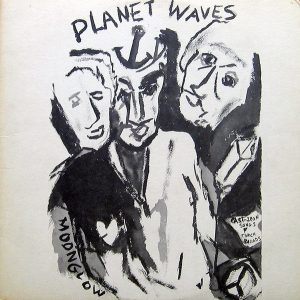
As for Self Portrait and The Band’s debut album (Music from Big Pink), Bob Dylan makes a painting for the front of the cover. On a white background he places figures and letters, in rough strokes, with black ink (or paint).
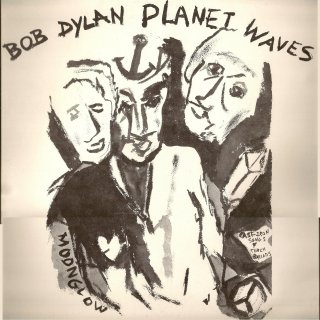
The image shows an unknown man, decorated with various attributes: an anchor on his forehead, a pierced heart on his jacket and the word ‘Moonglow’ on his sleeve. Behind the figure are two more men, of which only the faces are depicted. The head of the man on the right is clear, but otherwise he is surrounded by a grey spot.

Three objects are depicted in grey: some kind of crystal, a peace sign and a badge with the words ‘cast iron songs & torch ballads’. Those words may be a characterization of the album, an addition to the title “Planet Waves,” which tops the list. With some goodwill, you can see references to the song “Never Say Goodbye.” In that song, the singer claims that his dreams are made of “iron and steel.” There is also talk of ‘crashing waves’.

A key song perhaps? But one with a fairly vague text.

The name of the performer is missing from the front of the cover. As with the last few albums, nowhere on the front cover is it mentioned that this is a Bob Dylan album.

Since there isn’t even a picture of the singer shown, the record company are worried potential buyers could overlook the release.  The solution is to put a sticker on it with ‘Bob Dylan’.

This is done on the plastic in which the album is packed, or even directly on the cover. For the French pressing, someone tries to imitate Dylan’s handwriting to add his name to the title.

Back

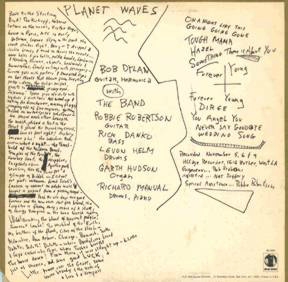
The back of the cover is also executed with black letters on a white background. Surrounded by a narrow golden border, the white square is roughly divided into three columns using two angular lines.

In the left column is a handwritten text – possibly excerpts from a diary – complete with deletions and typographical errors (‘Buddha’ and ‘echoes’).

In the middle: the title at the top is underlined by three waves, and below that a list of the musicians, with their main instruments. Richard Manuel has been renamed ‘Manual’. A mistake or a joke?

The column on the right shows another list: the song titles, with those of side 1 and side 2 separated by a cross. Below that, some more data is added: location, (some of the) dates of the recordings, plus the names of the technical staff involved.

If the lack of the singer’s name on the front caused some problems for the record company, the back proved to be even more problematic. In the piece of text on the left, there’s talk about ‘big dicks’ and ‘bar stools that stank from sweating pussy’. Of course Asylum’s lawyers objected to the passages that could be considered obscene.

Deleting the offensive words was apparently not an option and so a compromise is found.

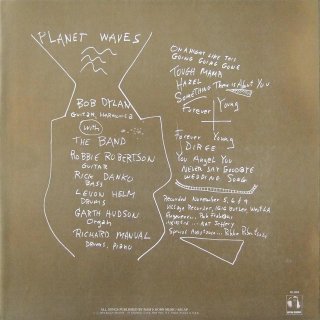
The disc will be sold in a transparent protective cover, with the back of the cover completely hidden behind a golden loose sheet. On that sheet, in white letters, an enlargement of the middle and right columns is shown.

In England, the albums are distributed by another independent record company: Island Records. Someone at the company feels that the extra sheet is easier to read when the colours are reversed: golden letters on a white background.

Rejected designs

Because of all that hassle, the album does not reach the stores in time and the tour has been going on for two weeks when the album finally appears on January 17, 1974. In some articles, it is mentioned that the postponement is due to a late name change of the record. However, this is not evident from the promo copies that have been distributed.

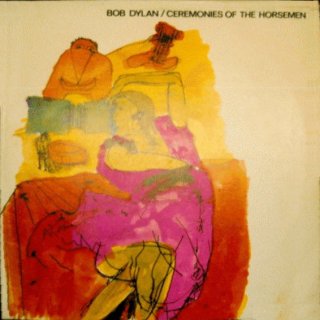
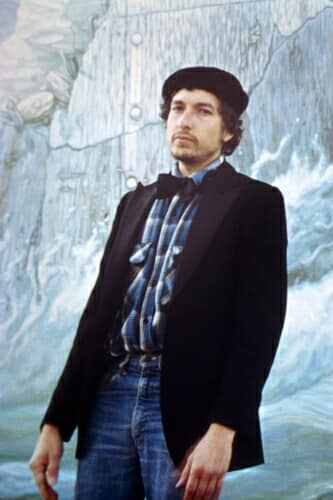
It appears that originally Dylan had indeed designed a different cover, with a painting of a dancer on the front and a photo of himself with a beret on the head on the back.

The record was then titled Ceremonies Of The Horsemen – a quote from ‘Love Minus Zero/No Limit’ of 1965.

In addition, another possible title is mentioned: Love Songs. However, no cover design has surfaced for this.

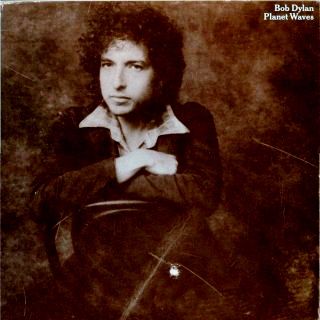
In 1982, Sony Music (which by then had bought CBS) took over the rights to the album. For the reissue, a new cover design was considered.

The sepia-tinted photo of Dylan with a beret was probably taken by Lynn Goldsmith, in October 1975.

Variants

In addition, there are several variants of the cover, two of which stand out in particular.

In the former Rhodesia (now Zimbabwe) the cover is printed negatively so that both the front and back display white letters and lines against a black background.

The so-called quadraphonic LP pressing, published in 1974 by Asylum, distinguishes itself from the ordinary stereo pressing because the front of the cover is black, with a reduced version of the original cover in the middle.


Posted in Uncategorized | 1 Comment

NET 2011 part 1: Things should start to get interestin’ right about now…

By Mike Johnson (Kiwipoet)

In 2011 things do indeed start to get interesting. Dylan, now turned 70, stands on the threshold of a transformation that will set the tone for the next eight years, and usher in one of the most remarkable decades in Dylan’s performing career. Dylan will astonish both his supporters and detractors alike with this transformation, and those who said that by 2010 the NET was played out and that Dylan was at the end of the line would eat their words.

2011 is the last year of the era I have dubbed ‘the circus barker and the organ grinder’ which began in 2006. In 2012 Dylan will switch to playing the grand piano and his new album, Tempest, which released a new set of songs into the mix, will set a new benchmark for live performances. The dumpty-dum of the circus baker years will evolve into swing, and his voice too will evolve from a bark into rough-edged singing and crooning.

You don’t have to subscribe to the ‘black hole’ interpretation of those circus barker years to sense the new energy in Dylan’s 2011 performances, as we shall see soon enough, but something else was happening that can’t be picked up by just listening to sound files. Dylan was starting to do strange things on stage, especially during his centre-stage performances, which in 2011, became more prominent. In previous posts I have discussed how, starting in 2006, Dylan retreated behind his keyboard, often leaving centre stage vacant. This I called his anti-performance performance and anti-spectacle spectacle. In 2008 – 2010 he would front up with his guitar and harmonica for two or three songs to show his audiences something of the Dylan they remembered and perhaps craved.

In 2011 Dylan began to use those centre-stage appearances for extraordinary performances, spectacles of a riveting but disturbing nature.

Andrew Muir, who wrote One More Night, referred to a number of times in previous posts, quotes blogger Rainer Vesely “Since Dylan crawled out from his hiding place behind the keyboard, where he ducked away from 2005 -09, he is staging a 90 to 100 minute drama, in which he puts much, much more emphasis on his physical presence than ever before. He really acts (!) and recites, gestures, mimics, uses, very consciously, his weird way of walking, knee bending, staring, half closing or wide-opening his eyes.”

Muir supports this with his own experience of the Manchester concert. “Dylan  (was) centre stage for much of the time, giving an extraordinary display of visual gestures, body contortions and facial engagement.”

The liner notes on the bootleg album for the first Hammersmith concert read: “Skilfully balancing and retaining the necessary duality of professional arrogance and humility, Dylan half passes, extends, collects, pirouettes, and counter-can-ters effortlessly through his show. At times, he lopes with the modest style of a crooner or old music-hall entertainer … skipping, reeling rhymes ..”

It’s time we had a look at a couple of these performances to see what the fuss is all about. I get the feeling you had to be there, but videos give something of the flavour of these shows.

The first I’ve picked is ‘Tangled Up In Blue’ from Manchester, 10th October.


It’s an unsettling experience, watching that performance, the facial grimaces, the strange shrugging of his body inside his long black coat, the way he touched his face and the back of his head. His combination of crooning and barking, and slipping somewhat hysterically into falsetto on the words ‘you’ and ‘blue’ can only add to the weirdness of it. It’s strangely compelling, but also very good. Note the power of those harp blasts.

Here is the sound file of that performance in case the video suddenly becomes unavailable.

Tangled up in Blue.

(There are other 2011 videos of this song on You Tube but I can’t recommend them as the sound quality is too poor. There is mass of material on You Tube now, but much of it is inferior in terms of sound and/or video quality.)

This well-known video of ‘Can’t Wait’ from Milan (22nd June) may not be able to match the 2010 performance (See NET 2010 part 1) in terms of its musical power, but sure is showy, with Dylan pacing about, throwing his arms out and generally acting histrionically. But doesn’t he get a little grin on his face when he points to the audience and repeats ‘I don’t know I don’t know I don’t know how much longer I can wait’?

I’m not quite buying it, but it’s fun to watch

And here’s the sound file:

Can’t Wait

This might not be Mick Jagger’s cavorting, David Bowie’s costume dramas or even Leonard Cohen’s deadpan stage act but is certainly a spectacle in its own right. Show bizz.

Not only the performances but Dylan’s outfits were souped up, what I call his riverboat gambler costume. Here’s how he’s described in the liner notes to the second Hammersmith concert:

“At this point it should be said that Bob was pretty much wearing a long black coat tonight. Garbed in a three-quarter length black jacket/coat with four brass buttons, over a blue shirt and blue neckerchief drawn together by a silver ring. On his jacket were more brass buttons and the occasional glimpse of his shirt sleeve revealed sparkling cufflinks. He wore black trousers with white piping vertical stripe on the outside of each leg and, of course, a hat, tonight’s being light grey, with a small feather to one side. A stage dandy from head to toe. With that kit on you know you’re in show business.” (My emphasis)

Then there is that puzzling Eye of Horus used as a backdrop on stage.

Lots of ink has been spilled on trying to decode the symbolism of this, and I would encourage the reader to look at the articles on the subject by Larry Fyffe here at Untold Dylan.

The problem is not just the eye itself, but the figure above the eye which seems to have flames coming from it. That figure has been interpreted as Baphomet, or the Goat of Mendes – in short, the devil. This has fed into the narrative you can find on You Tube that Dylan sold his soul to the devil in return for fame and fortune.

It has also been interpreted in the completely opposite sense: “The Dylan Eye Logo, the eye being the eye of God, the crown being King of kings and lord of lords, Jesus and the diving Dove being the Holy Spirit. Performing in front of a huge symbol for the trinity has to have profound significance for what the man believes.”

Or it could be the eye of a falcon. “The Eye of Horus has been used for many metaphors over the years, i.e., Eye of the Mind, Third Eye, Eye of the Truth or Insight, the Eye of God Inside the Human Mind. The ancient Egyptians, believing in its mystic powers, gave all of these names to the Eye of Horus.” (National Library of Medicine.)

It wasn’t only used as a backdrop but Dylan Eye Logos were available at concerts in badge form.

So Dylan’s bizarre performances, his dandified costumes and his Eye all go to create a renewed interest in his concerts, which was surely his aim. Despite his apparent indifference, he can’t have been happy with reports of his audience deserting his concerts early, and the NET’s sinking reputation in the few years prior to 2011. But, for me anyway, it is the vigour and passion of the performances that really tell the story. Take this performance of ‘Love Sick’ from the third Hammersmith concert (21st Nov), for example:

Love Sick

I can’t bring to mind any other performance of the song that matches this one for power and clarity. As soon as I heard it, it joined my list of ‘best evers.’ All the vocal resources he brought to ‘Tangled Up in Blue’ he brings to bear here to deliver a remarkable performance.

I have introduced this song many times, but feel I’ve missed something. That it expresses a profound alienation from the world (the walking ghost) may be true enough, but it also expresses an intense spiritual state.

“The opening line of the first track on Time Out of Mind set the theme and tone for the entire proceedings: ‘I’m walking through streets that are dead.’ The stark imagery and the gritty, gravelly vocals channelled those of a biblical prophet. And indeed, the lyrics of that first song, ‘Love Sick,’ were rooted in the love poetry of King Solomon, whose aptly titled Song of Songs — commonly understood to be an allegory for the love between God and the people of Israel — has the exiled collective seeking His comfort from afar, explaining, ‘For bereft of Your Presence, I am sick with love.’ Or, put another way, Israel is ‘lovesick” for God.’’’ (Seth Rogovoy at forward.com – shared by Jane Carol Seff on Untold Dylan’s Facebook page).

This confirms the impression I’ve always had that this song was not about a woman, or at least not only about a woman.

Dylan brings this new vigour to these performances of ‘Things Have Changed.’ This Manchester performance is a hard one to beat. The song bustles along with Dylan nailing every line.

Things Have Changed (A)

That has all the hallmarks of a Crystal Cat recording (sharpness, clarity etc), but even that compelling performance may not be the best. This one from Memphis (30th July) is a contender, and interesting in itself in terms of audience reaction. You can feel the enthusiasm of the crowd, and the sound is not as abrasive as Crystal Cat recordings can be.

Things Have Changed (B)

Seth Rogovoy also had some interesting things to say about ‘Not Dark Yet’ and other songs from Time Out of Mind. “A triptych of songs — ‘Tryin’ to Get to Heaven,’ ‘Standing in the Doorway’ and ‘Not Dark Yet’ — took their themes from the Yom Kippur ritual. In ‘Standing in the Doorway, the singer insists, ‘There are things I could say but I don’t / I know the mercy of God must be near.’ The song ‘Not Dark Yet’ captures the liminal state of consciousness that overtakes one over the course of Yom Kippur worship:

‘Shadows are falling, and I’ve been here all day’

Plus:

‘I know it looks like I’m moving, but I’m standing still’

Plus:

‘Don’t even hear a murmur of a prayer
It’s not dark yet, but it’s getting there.’”

(Yom Kippur is the “Day of Atonement” and the holiest day of the Jewish year. Healthy adults are commanded to refrain from eating and drinking from sunset to sunset to remind us of the frailty of the human body and our own mortality.)

As with ‘Lovesick,’ a spiritual state is being expressed here. This is another Hammersmith (second concert) Crystal Cat recording of ‘Not Dark Yet.’ Wonderful the way Dylan uses the harmonica to create a fading echo.

It’s Not Dark Yet (A)

Lovers of the song might appreciate this performance from Lille, France (16th Oct), equally exciting.

It’s Not Dark Yet (B)

Looking at what Seth Rogovoy calls ‘a triptych of songs’ we can’t include ‘Standing in the Doorway’ as it disappeared from the setlists in 2005 (It will reappear for a single performance in 2017), but we do have ‘Trying to Get to Heaven.’

“And ‘Tryin’ to Get to Heaven’ offers a detailed description of the Neilah service, the final service of the day, offering worshippers their last opportunity to make teshuvah [repentance/return] before sundown, before their names are inscribed in the Book of Life for the next year (or not). In Dylan’s words: ‘You can seal up the book and not write anymore / I’ve been … tryin’ to get to heaven before they close the door.’ Words spoken by someone on intimate terms with the arc of the holiest day of the Jewish calendar.”

Here’s the Hammersmith performance (second concert):

Trying to Get to Heaven (A)

And here’s the Lille performance:

Trying to Get to Heaven (B)

That’s it to kick off the year. I’ll be back soon to dig deeper into 2011

Until then

Kia Ora

Posted in Uncategorized | Leave a comment

Other people’s songs: In my time of dying

By Aaron Galbraith (in the USA) and Tony Attwood (in the UK).

Aaron selects the recordings and emails these with his notes to Tony who tries to write something about the song during the time it is playing.  Links to the previous episodes in this series is given at the end.

Aaron: “In My Time of Dying” was written by Blind Willie Johnson. The lyrics were inspired by a passage in the Bible from Psalms 41:3 “The Lord will strengthen him upon the bed of languishing, thou wilt make all his bed in his sickness”.

Tony: OK, after about an hour of flapping around back and forth I am more confused now than when I started.   So let me try and explain the source of my confusion.

There are several versions of the lyrics of this song on the internet but none seem to accord with the recording above.

There are also two titles of the song – the second of these “Jesus make up my dying bed” is shown on the Google entry as being the song Dylan recorded as “In my time of dying”, starting

Now in the time of dyingI don't want nobody to moan

So I think the song above is “Jesus make up my dying bed” – as the full heading on the YouTube link above says, but I am really not convinced that this is the same song as “In my time of dying”.   Of course, that is probably just my lack of knowledge, because a lot of people seem to be saying the two songs are linked.  And thematically they are of course, but musically … at the moment I just don’t hear it and hence have ended up going around in circles.

Thus, better that I admit I have no idea what I am writing about, and let you, dear reader, write in and put me straight.   How are the songs, “Jesus make up my dying bed” and “In my time of dying” as performed by Dylan, related?  Apart from being about death.

Aaron: Bob’s version appears on side 1 of his debut album.

Tony: So this is the song I first heard on Dylan’s first album.  Wiki cites the album liner notes as saying “Dylan had never sung “In My Time of Dyin'” prior to this recording session. He does not recall where he first heard it. The guitar is fretted with the lipstick holder makeshift slide he borrowed from girlfriend, Suze Rotolo, who sat devotedly and wide-eyed through the recording session.”

Aaron: Led Zeppelin’s version was released on their sixth album Physical Graffiti in 1975. The album credits list the four group members as the song’s authors, despite the earlier released versions. At a little over 11 minutes, it is the longest studio track by the group. So plenty of time for Tony to make his comments!!

Tony: Yes well, thank you, Aaron.  As it happens I am not a Led Zepplin fan and the thought of listening to 11 minutes of them and finding something to write at the same time is a little challenging.

Does it do anything for me emotionally?  Nope.  Does it entertain me?  Sorry, again nope.  Does it make me want to go back and play it again?   Sorry a third time, but no.

I think (and of course this is just a guess) that the band knew that they were short of material for the album, and so decided to do a long atmospheric version of a blues song.  But the atmosphere doesn’t work for me – it is just a prolonged improvisation around a couple of sets of chord changes and a rhythmic feature.

Now of course maybe I don’t appreciate any of this because I have spent a little too long trying to see if I can find a link between the two songs we have here: “Jesus make up my dying bed” and “In my time of dying” beyond the fact that they are both about dying.  I would love someone to be able to show me the finer points of the link between these two pieces, because I am blowed if I can find them myself.

Aaron: Martin Gore, the main songwriter from Depeche Mode released his version on his debut solo album from 2003, apparently based on the Dylan version.

Tony: And wouldn’t you know it, the version that Aaron has found in the USA is not available in the UK.  But as most of our readers are not in the UK, I’m putting it in…

Tony: And fortunately there is a UK version

Tony: An antidote to Led Zep.   Now here we have an atmosphere which is appropriate to the lyrics of the song.  And just in case you don’t keep up with such things, I should add Mr Gore is/was the songwriter for Depeche Mode as well as being a multi-instrumentalist.

He’s gone for the full atmospheric approach – which is ok, but I think rather than play it again I’d sooner go and make myself a coffee.

I’m really sorry Aaron, maybe I’m having an off day, but I’ve done my best.  Would you like to say what you think of these versions and how they are related to each other?   Normally I feel I can cover up for my ignorance by writing more words (along the lines of “never use 50 words when 5000 are available) but today, I have hit the buffers.   It’s going to take me a little while to recover from that 11 minutes (was it really only 11 minutes – it felt like 11 hours) of Led Z.

I’ll try harder next time!


Posted in Uncategorized | 5 Comments

I’ve Made Up My Mind To Give Myself To You (2020) part 4: I see thy glory


by Jochen Markhorst

IV         I see thy glory

My eye is like a shooting star
It looks at nothing here or there, looks at nothing near or far
No one ever told me, it’s just something I knew
I’ve made up my mind to give myself to you

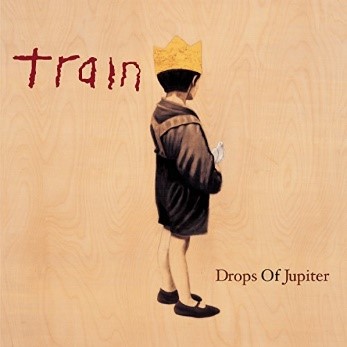
“Drops Of Jupiter (Tell Me)” (2001) is a fine rock song and the definitive breakthrough for Californian band Train. Two Grammy Awards, and the album, Train’s second LP Drops Of Jupiter is a resounding success: double platinum. The band is no shooting star. Excellent musicianship, charismatic singer, particularly strong hooks in catchy, melodic rock songs – Train has now been scoring one nice hit after another attractive flop after another millionseller for more than 20 years. And one of its strongholds is singer Pat Monahan’s poetic talent. Not so much in terms of depth and sophistication, but at least technically similar to Dylan; Monahan has a similar feel for euphony, a talent for unobtrusively integrating tried-and-tested stylistic devices, and a similar feel for fun rhyme inventions. Which we already see in the first hit, 1998’s “Meet Virginia”;

She doesn't own a dress, her hair is always a mess
If you catch her stealin', she won't confess
She's beautiful, she smokes a pack a day, wait that's me, but anyway
She doesn't care a thing about that, hey
She thinks I'm beautiful. Meet Virginia

… with seemingly casual but well-considered rhyme triplets (the next verse opens with She never compromises, loves babies and surprises / Wears hi-heels when she exercises), as we know from Dylan’s songs like “We Better Talk This Over” (The vows that we kept are now broken and swept / ‘Neath the bed where we slept), “Simple Twist Of Fate” or “Cold Irons Bound” (The walls of pride are high and wide / Can’t see over to the other side) – there are many examples and they can be heard in every decade of Dylan’s career. And Monahan, like Dylan, manages to maintain quality through the years. The 2009 world hit “Hey, Soul Sister” demonstrates just as much craftsmanship and linguistic delight, and a next world hit, “Drive By” in 2012, opens no less strongly:

On the other side of a street I knew
Stood a girl that looked like you
I guess that's déjà vu
But I thought this can't be true 'cause
You moved to west L.A., or New York or Santa Fe
Or wherever, to get away from me

The love for smart quality lyrics does not come out of the blue, we understand from a Q&A in the Rolling Stone of 24 July 2003. Dad Monahan paved the way, Pat reveals:

“I was the last of seven kids, and my father was so obsessed with music that I’d walk in from school and he’d make me listen to records — make me listen to why a song was great. Stan Getz and Cal Tjader and Milt Jackson … He was very into words. Songs like ”Jeepers Creepers” — it’s fucking good — and ”Moon River,” where I think the words make the melody so amazing.”

“Moon River”, the song of which Dylan says in Chronicles: “My favorite of all the new ones was “Moon River”. I could sing that in my sleep,” and “Jeepers Creepers”, which Dylan considers one of the “big songs” in that same autobiography, among standards like “When Irish Eyes Are Smiling” and “The Very Thought Of You”… in any case, Dylan and Monahan share cultural baggage and taste as well.

A distinguishing quality of that breakthrough hit “Drops Of Jupiter” then is its consistency, in this case its perhaps old-fashioned but no less enjoyable fidelity to the motif “cosmos”. In terms of content, the lyrics are a put-down, a poetic account of an ordinary adultery jeremiad. The title comes along only once, in the opening (Now that she’s back in the atmosphere / With drops of Jupiter in her hair), but it does right from the start introduce that motif, which shoots by in every verse. And also in the chorus:

But tell me, did you sail across the sun?
Did you make it to the Milky Way to see the lights all faded
And that Heaven is overrated?
And tell me, did you fall for a shooting star?
One without a permanent scar, and did you miss me
While you were looking for yourself out there?

… with a relatively traceable use of the milked metaphor shooting star. At least, in both literature and song art, the image is commonly used for something like fleeting, transient fame. Often as a set piece symbolising impermanence, as in Dylan’s own 1989 “Shooting Star”. Or metaphorically, as in Bad Company’s “Shooting Star”, or Arlo Guthrie’s “Victor Jara”, Nancy Sinatra & Lee Hazlewood’s “Sand” (one of the most beautiful songs on the forgotten, charming album Nancy & Lee, 1968).

Incidentally, Disney seems to associate the cosmic phenomenon, oddly enough, rather with something like “long journey”; both in Aladdin (I’m like a shooting star / I’ve come so far / I can’t go back to where I used to be, “A Whole New World”) and in Hercules (Like a shooting star, I will go the distance / I will search the world, I will face its harms, “Go The Distance”), it has nothing to do with “transience, fleeting fame”. As the Bard did teach us at the time:

Earl of Salisbury.
Ah, Richard, with the eyes of heavy mind
I see thy glory like a shooting star
Fall to the base earth from the firmament.
(Richard II, Act II, Scene 4)

All of them light years away, anyway, from the wondrous My eye is like a shooting star / It looks at nothing here or there, looks at nothing near or far in the fourth verse of Dylan’s “I’ve Made Up My Mind To Give Myself To You”.

Odd on several fronts. To begin with, the singular is oddly chosen. Whether they are seductive, or spitting fire, or twinkling like stars: eyes are always plural. The communication with the singular “My eye is …” suggests either a one-eyed protagonist, or pushes the associations towards “evil eye”, “third eye”, something like that. A far-fetched possibility could be that the singer wants to incorporate the ambiguity “My I” as in “my self” – which in itself would give some poetic beauty to both shooting star and the follow-up line – but it is ultimately far too laborious. In that case the poet could have simply chosen “I am like a shooting star”.

And the second peculiarity is the metaphorical charge. In the official publication of the lyrics, on the site, the explanatory line has been shortened from It looks at nothing here or there, looks at nothing near or far to It looks at nothing, neither near or far, which makes no further difference in terms of content, of course. Apparently, the image of “shooting star” was chosen to express something like “randomness, purposelessness” or, indeed, “disinterest”. Which all fits spectacularly poorly with the tenor of the song – after all, this is a very interested narrator who has made the very deliberate, purposeful decision to give himself to “you”.

However, it does suit an entertainer who, from Salt Lake City to Birmingham and from East L.A. to San Antone, gives himself to the audience, never seeking eye contact with those present. An entertainer who looks at nothing here or there, looks at nothing near or far.

Hmm… sounds familiar. Could it be that biographical interpreters perhaps score a second point here?


To be continued. Next up I’ve Made Up My Mind To Give Myself To You part 5:


Jochen is a regular reviewer of Dylan’s work on Untold. His books, in English, Dutch and German, are available via Amazon both in paperback and on Kindle:


Posted in Uncategorized | 4 Comments

The Tarantula Files Continued

by Larry Fyffe

In regards to ‘Tarantula’ by Bob Dylan ~

Details about the three pin-up gals are rather sketchy and confusing, but it seems Betty’s gangster-friend gets a bit too fresh with Zelda and Jenny at a steamy bar; apparently, he ends up stabbed to death; the cool-headed narrator of the story, with his donkey, take off with Jenny.

Next morning, says to a reporter from the National  Enquirer:

"(I) still aint gonna tell you nothing
about Jenny"
(Bob Dylan: Tarantula)

Certainly leaves the impression that Jenny did the bad boy in.

In any event, detectives Auguste Dupin and Sherlock Holmes, both disguised, are snooping around for clues:

Mona’s cousin – this 320 pound Frenchman

– he resembles Arthur Canon Doyle

(Bob Dylan: Tarantula)

A guy named ‘Monk’ raises Sherlock Holmes’ suspicious eyebrow:

Monk, typical flunky
& writer of eccentric gag lines to tell yourself
if you're ever hung up in the Andes
(Bob Dylan: Tarantula)

Detective Auguste Dupin notes that the author who pens the the song beneath is surely ultimately responsible for the death of Big Diamond Jim:

Big Jim lay covered up
Killed by a penknife in the back
And Rosemary on the gallows
She didn't even blink
(Bob Dylan: Lily, Rosemary, And The Jack Of Hearts)

It’s quite likely that the monk, who’s disguised as such in the song below, is the killer of Betty’s gangster friend in ‘Tarantula’ ~ anyway, so surmise the two detectives with the help of Lord Buckley:

As the leading actor hurried by
In a costume of a monk
There was no actor anywhere
Better than than the Jack of Hearts
(Bob Dylan: Lily, Rosemary, And The Jack Of Hearts)

The two private-eyes set out to prove the robber called Jack in the song above is the one and the same figure who’s known as Monk in the spider-book.

They claim that Monk is the offspring of the AntiChrist – based on the line ~ “(T)here is a gigantic mirror & Monk immediately disintegrates.”

The son of the Beast alluded to in the Holy Bible:

I considered the horns, and, behold
There came up among them another little horn ....
And behold, in this horn were eyes like the eyes of man
And a mouth speaking great things
(Daniel 7:8)

Now ain’t that just like the Jack of Hearts who moves across the mirrored room; says, ‘set it up for everyone’ … and then later disappears.

Posted in Uncategorized | 1 Comment

Dylan’s favourite songs 4: Randy Newman: ‘Sail Away’,

By Tony Attwood

So far we have looked at three of the songs that Bob Dylan himself declared to be his favourite songs of all time…

In America you get food to eat
Won't have to run through the jungle
And scuff up your feet
You just sing about Jesus and drink wine all day
It's great to be an American

Ain't no lion or tiger, ain't no mamba snake
Just the sweet watermelon and the buckwheat cake
Ev'rybody is as happy as a man can be
Climb aboard, little wog, sail away with me

Sail away, sail away
We will cross the mighty ocean into Charleston Bay
Sail away, sail away
We will cross the mighty ocean into Charleston Bay

In America every man is free
To take care of his home and his family
You'll be as happy as a monkey in a monkey tree
You're all gonna be an American

Sail away, sail away
We will cross the mighty ocean into Charleston Bay
Sail away, sail away
We will cross the mighty ocean into Charleston Bay

Randy Newman talked about the song in an interview in 2013, saying “I wrote about slave trade from the view of the recruiter from the slave trade. He is talking, you know, come to America and then talks about using that and I [found] another way to do it. I mean, you could say the slave trade is bad, horrendous or a great crime of the nation, but I chose to do differently.”

It most certainly is a most unusual song, and one that takes the emotional level up to 250 on a scale of 1 to 10, both through the lyrics and the arrangement.   Just the notion of Africans being tricked into boarding the boat to America for a better life when in fact they are being sold into slavery is utterly emotionally overwhelming.

(Slavery was abolished in the United States 1865, 32 years after it was abolished in England…. I know a little of the history of slavery in England as the village in which I live is recorded in the Domesday Book of 1086 as being populated with 19 villagers and two slaves.  I find it extraordinary and emotional to feel that the footpath and river that I have walked a thousand times – and which as the Domesday book map shows, has not moved in the course of the last thousand years in the village – was trodden by those slaves gathering water for their owners.)

It is an incredibly emotional song, in the way that Bob’s own songs normally aren’t, tearing at the heartstrings, if you are emotionally inclined, and there are some very interesting cover versions around.   Consider this from Sonny Terry and Brownie McGhee and then in total contrast Tonic Sol Fa.

Footnote: I thought I had finished writing my little commentary on this song, when suddenly the contrast between “Times they are a changin'” and “Saily Away” struck me with more force.   “Times” of course looks to a future which is brighter and in which liberty is finally obtained, not through the struggles of mankind to overthrow the oppressor and the entitled, but because it just happens.   “Sail Away” offers same thought – get on the boat and come to America and liberty and good living will be yours.

Both were completely untrue. Obviously, times haven’t changed in my lifetime (at least not in the sense of wars and poverty ending, attitudes changing, liberty being attained) and the American promised in “Sail Away” was obviously a total lie.   I wonder if Bob thought of this when he added the song to his list, or was he just thinking of the extraordinary performance of the song by its creator, and its beautiful melody?


Posted in Uncategorized | 5 Comments

Tarantula 27: Lem the Clam; 28: An Untold Production: Tyrantula, The Motion Picture

by Larry Fyffe

27: Lem The Clam

“Tarantula” by Bob Dylan has the “Beat” style and content of writer William Burroughs splashed all over it.

For example, Dylan’s written words “Lem the Clam tho, he really gives a damn if dale evans does get nailed slamming down the scotch” (Tarantula) clearly echo, with a smile, Burroughs’ “Hear Clem and Cash, down in the Everglades of Florida get their jollies killing wild pigs with knives” (The Cat Inside).

Many of Dylan’s allusions likely make direct reference to actual associates (ie, Harold, Maurice) of the addict-turned-killer.

However, actual biographical details are not required to draw allegorical meaning from the personalized, and modernized, mythology of Dylan’s “Thus Spake Tarantula”.

Therein, anarchist/antichrist Moan sends Lacky up from the pits of the Abyss to rid the capitalist organization above of Medusa, a beautiful female creature who distracts male workers from focusing on their jobs – she turns them, or at least parts of them, into stone.

As instructed, Lacky holds up a mirrored shield to protect himself from the direct gaze of Medusa; then he cuts off her snake-covered head:

Medusa going into a room with two swords above the door
- some removable mirrors inside
- Medusa disappears ...
Lacky,  a strange counterpart of the organization 
- he comes out of the room carrying a mirror
(Bob Dylan: Tarantula)

Alas, works alone do not please the Amighty One ~ the two knives fall down, and one slices not-so-lucky Lacky in half.

The warning in the lines beneath ignored:

But the two-handed engine at the door
Stands ready to smite once
And smite no more
(John Milton: Lycidas)

There’s no place safe to turn:

“(B)y noon, we’re in Abyss Hallway” (Tarantula), and before evening we’re headed for “the judgement hall of Christ” (Precious Angel).

There’s just no escape ~ righteous Bible-thumping authorities follow mortals right down into the earth-filled grave:

Temptation's not an easy thing
Adam given the devil reign
Because he sinned, I got no choice
It run in my vein
(Bob Dylan:  Pressing On)

Indeed, death is not the end:

Leaving men wholly, totally free
To do anything they wish to do, but die
(Bob Dylan: Gates Of Eden)


28: An Untold Production: Tyrantula, The Motion Picture

Directed by L.J. Fyffe

Narrated by Sandy Bob

Introduction

There was New York Jake, the butcher's boy
He was always getting tight
(Bob Dylan: Days Of Forty-nine ~ traditional)

Aka ~ “The Flesh”

Peewee the Ear … him & Jake the Flesh

– along with Sandy Bob from Pecos

******************************************

And here they come … there’s an American group of ‘champagne musicians’, led by a German-speaking player of the accordion, marching toward New York City in search of Fatty Aphrodite’s shadow on Groundhog Day:

(T)he lawrence welk people
Inside the window, they're running the city planning division
& they hibernate & feeding their summers by conversing
with poor people's shadows & other ambulance drivers

They strike up the band with a traditional tune:

Here she comes around the mountain … the piano-playing soul singer who strays not that far from the Lord’s furry group of groundhogs:

(A)retha with no goals, eternally single

& one step soft of heaven

She sings:

I'm only one step ahead of heartbreak
One step ahead of misery
One step is all I have to take backwards
To be the same old fool for you I used to be
(Aretha Franklin: One Step ~ Singleton/Snyder)

And lookie here … three guys and a gal from Australia, consoling Obie, Fatty’s funny buckteethed boyfriend:

(B)y the the way, I've heard you
live in a world of your own
yes, it's true, says Obie
& also don't go to birthday parties

Whose lament goes like this:

Close the door, light the light
We're staying home tonight ...
And we'll live in a world of our own
(The Seekers: We Live In A World Of Our Own ~ T. Springfield)

Paid tribute in the following song lyrics:

Close your eyes, close the door
You don't have to worry anymore
I'll be your baby tonight
(Bob Dylan: I'll Be Your Baby Tonight)

More missy minstrels mentioned:

(C)rooked betty &  volcano the leg
here they come - theyre popped out
and theyve been crying in the chapel

All the singers searching in the vain for Fatty Aphrodite the lost groundhog; everyone’s sobbing, including an apparently cross-dressed Pelvis:

I searched and I searched
But I couldn't find
No way on earth to find peace of mind
Now I'm happy in the chapel
Where people are of one accord
(Elvis Presley: Crying In The Chapel ~ A. Glenn)

Another tearful songster, known as Peewee, gets a nod:

(W)ho should come by but the little
ole winemaker trying to be helpful

His song, a sorrowful one:

When they asked me who's in the corner
Crying
I say, "The little ole wine drinker me"
(Charlie Walker: Little Ole Wine Drinker Me ~ Mills/Jennings)

To sum up ~ Fatty’s dismembered body is discovered in a Nashville alleyway.

Butcher Jake’s done in by old Brown Dan:

(W)ho by this time is beating Jake the Flesh
to death with a hacksaw

There’s a happy ending though; Daisy Mae and Li’l Abner finally get married in the chapel:

You daisy mae
who are not even one of the masses


Posted in Uncategorized | Leave a comment

Never Ending Tour: the Absolute Highlights – Visions of Johanna

By Tony Attwood

OK, this one is going to be contentious, not least I fear with Mike Johnson who titled his review of the concert that this version of Visions in 1991 comes from “King of the Unsteady”.

Mike’s view is that 1991 was a “difficult and contentious year… Not quite the train wreck that the commentators claim, the year comes across to me more like a year of on-stage rehearsals, with Dylan trying out new arrangements and new musicians in front of audiences. This attempt to make old songs new again would not fully pay off until later years. Here we see them in their raw state, and the results are more gritty than pretty.”

And of course I take a lot of note of Mike’s views because he’s the one who has brought all these recordings together so that all of us can enjoy them and understand the context through his commentaries.   I just sit here and listen (and fiddle with the website a bit).

Beyond that sitting and playing with the website, my life in music has been a life not of great performances in front of big audiences (if only) but of “trying out new arrangements” mostly with no audiences.

And contemplating this recording makes me understand a little bit more what I am doing here.  I’m not looking for a set of wonderful recordings that could be put together onto an ultimate album of “Dylan’s greatest NET recordings” but rather renditions of the songs we know with something in them that makes me just stop, contemplate and be amazed.

Yes, I would agree that this recording is not of the highest quality (the hand clapping is particularly frustrating) and yes maybe Dylan had just worked out this approach to Visions and was trying it on stage for the first time, but whatever brought about this moment, this version of Visions is to me utterly stunning.   Forget the quality, and any mistakes you perceive in the lyrics (and I would never agree there are mistakes because Bob has treated all lyrics as fluid and open to adjustment at a moment’s notice – and why not?)

But what he does is take Vision to that “somewhere else” which I think many of us in the creative arts talented (like Bob) or otherwise (like most of us) are chasing.  That hard-to-define moment when the shade of blue in the painting, is tinged with the tiniest taste of green, when the actor pauses for just that extra second, of when the piece of music is rearranged in marginal ways and manages to say something quite different.

In this version of Visions, there is an extraordinary energy now within the song, rather than the laid-back approach which is symbolised by that famous opening, “Ain’t it just like the night to play tricks when you’re tryin’ to be so quiet?”    No, we are not in the grip of the night.  Rather Bob and the song together are fighting back.   It is not going to be a quiet night, we are not sitting here stranded, and we are not trying to deny reality.    That was merely the starting point.    For now we have not so much denied reality as said, “it doesn’t actually have to be like this”.

The point is that the song is a monologue from an observer of The Lost (if I may call them that) which doesn’t mean that the singer has to be part of The Lost, part of the quiet background, part of the dope heads who do nothing.  Indeed of course he is not because by the end of the song his conscience explodes.  He knows most certainly that it doesn’t have to be like this.  More, it shouldn’t be like this.

To me, this is Dylan’s best interpretation of the lyrics as the album version we are so used to.    This time the singer is angry with the cynicism of “Ya can’t look at much, can ya man?” bursting out all over.  On the album version, I always feel that the singer accepts that line and says “you are probably right, even though you are doomed”, now he’s not agreeing he is very much fighting back.  And he wants us to know it.

Thus the descriptions within the song, such as

Inside the museums, infinity goes up on trialVoices echo this is what salvation must be like after a whileBut Mona Lisa musta had the highway bluesYou can tell by the way she smiles

can be accepted in a sort of “this is how life is” way, or they can be rejected.  In this latter case, Dylan is not part of the scene, but the outside observer looking in at the wretched, the lost, the junkies, the damned, the people who say “far out man” and think they have said something important (or even meaningful), the people who are so lost that their entire contribution to life is now nothing more than “muttering small talk at the wall.”

And the great part of the vision, turned this way around, is that it is not only financially well-to-do but actually unproductive middle classes who are muttering small talk, it is their opposite numbers – the dope heads in the attics who are doing the same.

I love this version.  It is the political activist who raged against discrimination and the inequalities of capitalist society shouting out, “Stop being so utterly self-centred – go out and do something”.

And further, musically I love it because I think it is a sublime arrangement of the song.  And then politically I love it too.

Smoking dope and saying “far out man” does nothing to improve the world and this time that is what Visions says.

The Absolute Highlights series

Posted in Uncategorized | 1 Comment

I’ve Made Up My Mind To Give Myself To You (2020) part 3


by Jochen Markhorst

III         Give the Salt Lakers what they want

I’m giving myself to you, I am
From Salt Lake City to Birmingham
From East LA to San Antone
I don’t think I could bear to live my life alone

 The playlist at Obama’s US presidential election campaign rallies is attractive and enjoyable, with a few surprising outsiders (U2’s “City of Blinding Lights”, for instance), but still mostly usual suspects and predictable choices. Bruce Springsteen’s “The Rising”, Curtis Mayfield’s “Move On Up”, Sam and Dave with “Hold On, I’m Comin'”, songs like that. And in that category also falls the old O’Jays hit “Give The People What They Want”. The O’Jays reveal to Obama what the people want: truth and no more lies, and freedom, justice and equality, and altogether ambitious is the preachy interlude, summarising the election manifesto of every politician of every denomination:

People want better education now, now
People want better food to eat
People want, hey, better housing
People need money, money
People need equality
People need understanding
People need freedom

In the concert hall, wishes are somewhat more modest. Usually, audiences are already content with a few familiar hits and tolerable sound quality. And any concert audience gets particularly excited from: recognition.

The Dutch are used to it, to (mostly American) artists greeting fans in Amsterdam with an enthusiastic “Hello Denmark!”  Just as Belgian fans will have to live with “Bonjour France!” in Brussels, Norwegians with “Hallå Sweden” and Slovaks with a heartfelt “Dobré ráno Slovenia!”. Slovenia and Slovakia are the most mixed-up names in the world anyway, even more so than Austria and Australia; the story that around the world the embassies of Slovenia and Slovakia maintain a shuttle service to exchange misdelivered mail once a month is not officially confirmed by either, but seems to be really true.

The fans in small countries usually do not make an issue of it and politely cheer back. Still, they cheer much louder when Paul Simon says “Hello Warsaw” in Warsaw, when Mick Jagger shouts “Hej Stockholm” in Sweden and when Paul McCartney topographically correct greets the crowd in Munich.

A superlative of it is the joy that erupts when one’s own city is mentioned in a song lyric. It’s a bit childish perhaps, well, even cheap probably, but it’s just the way it is: irrational pride undulates even through more distinguished audiences when Billy Joel plays “New York State Of Mind” in his hometown, something special happens when Bowie plays “Heroes” in Berlin, and Glen Campbell knows what to do when he finally performs in Phoenix in 1988: “And 21 years ago, this song came out. I figured I’ve got to do it.” And, of course, when he then deploys “By The Time I Get To Phoenix”, this neat, bedraggled audience also starts cheering and whistling. Arguably the most compelling, the most goose-bumps inducing of all is Springsteen’s version of Tom Waits’ “Jersey Girl”, the live-in-Jersey version on Live 1975-85 (1986), with that ever-flaring ecstasy whenever The Boss sings the word “Jersey”.

Almost all entertainers are aware of the mechanism; you score bonus points if you appeal to local pride. Steve Miller adapts the row of place names from “Rock’n Me” (I went from Phoenix, Arizona / All the way to Tacoma / Philadelphia, Atlanta, L.A.) to tonight’s location. “The Motor City where the girls are so pretty” when he is in Detroit, for example. The wacky alternative trio The Presidents Of The United States Of America choose the musical variety, covering AC/DC’s “Highway To Hell” when they play in Australia, “French Girl” when they are in Paris, and in Belgium Plastic Bertrand’s alternative Belgian anthem of the Walloons “Ça Plane Pour Moi” – a brilliant move that Metallica will copy when they are in Brussels in 2019.

But Dylan is Dylan. For a very long time, he seems rather indifferent to this simple crowdpleaser. In Mobile and in Memphis, he hardly ever plays “Stuck Inside Of Mobile With The Memphis Blues Again”, and if so, he seems to do it with some reluctance: “Per special request tonight. About two hundred people wanted to hear this,” he mutters somewhat gruffly (Mobile, 26 October 1997). Just as he teasingly does play two songs from Together Through Life in Houston in 2015, but not “If You Ever Go To Houston”.

Between 1985 and 2013, he performs five times in Champaign, Illinois, but never plays “Champaign, Illinois”, seventeen concerts in Amsterdam over the years, but never “Slow Train” on the setlist (Deciding America’s future from Amsterdam and to Paris). The one time in his career that he performs in Aberdeen (16 September 2000) does not entice him to perform “Highlands”, and even in Israel Dylan does not play “Neighboorhood Bully” – which surely would have earned him quite a few extra sympathy points.

In all those decades, Dylan succumbs to the charm of pleasing audiences with name-dropping only a handful of times. “Kansas City” has been on the setlist only once in sixty years… indeed, in Kansas City. When he is in Rome for the sixth time, in 1991, he finally delights the Romans with “When I Paint My Masterpiece” (Oh, the streets of Rome are filled with rubble). However, they remain rare exceptions.

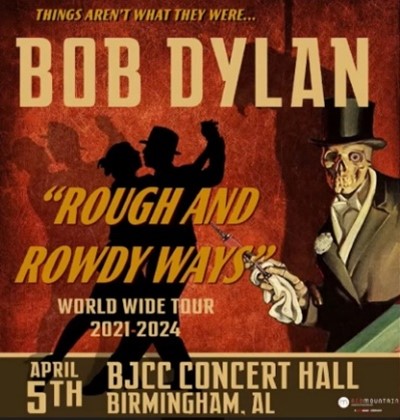
But: you get older, you get softer. Towards the end of his career, then, the now very elderly troubadour is apparently more audience-friendly than ever. In fact, it almost seems as if he inserted this one verse, the first bridge of “I’ve Made Up My Mind To Give Myself To You” especially for his audience. Four place names that are on his 2022 tour calendar, and, even more atypically, he does make a point of it: “From Salt Lake City to Birmingham!” shouts the entertainer announcing the song on 30 June in Salt Lake City. The warm-up works well. Jubilantly, the audience jumps up when they hear the name of their city, at 1’39”. It was no different in Birmingham, 5 April, and in Los Angeles, mid-June, and the fans are even a degree more enthusiastic in Texas, in San Antonio on 14 March.

Give the people what they want.

To be continued. Next up I’ve Made Up My Mind To Give Myself To You part 4: I see thy glory


Jochen is a regular reviewer of Dylan’s work on Untold. His books, in English, Dutch and German, are available via Amazon both in paperback and on Kindle:


Posted in Uncategorized | 5 Comments

Tarantula 27: The Lumberjacks Are Coming

By Larry Fyffe

by Larry Fyffe

The Taranterbury Tales continue:

(I) moved from the forest
- frozen in the moment
 (Bob Dylan: Tarantula)

In the song lyrics below, said it could be that ‘forest’ is not a noun, but a comparative adjective; ie, ‘fore’, ‘forer’, ‘forest’:

Upon four-legged forest clouds
The cowboy angel glides
(Bob Dylan: Gates Of Eden)

The noun rendition from “Tarantula”, likely a reference to the following song lyrics:

I'll walk to the depths of the deepest black forest
Where the people are many, and their hands are all empty
(Bob Dylan: A Hard Rain's A-Gonna Fall)

A woody motif that’s a hallmark of singer/songwriter/musician Bob Dylan:

Born in 'Liz Texas timber
Up where the eagles fly
(Tony Attwood: Patty's Gone To Laredo ~ Dylan)


Drawn from songs back a ways in time.

Lyrics of one modernized beneath:

I've been to the wild wood, mother
Make my bed soon
For I'm weary with hunting
And would like to lie down
(Martin Carthy: Lord Randal ~ traditional)

Which brings up an obvious observation:

(E)verybody talks about the middle ages
as if it was actually the middle ages
(Bob Dylan: Tarantula)

Likewise, one might ask, How come historians had the foresight to call it World War One?

(T)here are only three things that continue
Life - Death & the lumberjacks are coming
(Bob Dylan: Tarantula)

For sure, no false prophet there!:

I cut down trees, I wear high heels
Suspendies and a bra
I wish I'd been born a girlie
Just like my dear papa
(Monty Python: The Lumberjack Song ~ Tomlinson, et.al.)

Posted in Uncategorized | Leave a comment

Other people’s songs: “Days of 49”

by Arron Galbraith and Tony Attwood

In this series, we look back at songs recorded by, but not written by, Bob Dylan, with a glance at their origins, Bob’s version, and the recordings of one or two others.   Aaron selects the songs, Tony adds his thoughts as they play.

——–

Aaron:Days Of 49″ is an old-time ballad from the California Gold Rush days. Some scholars have suggested that it was written by minstrel singer Charles Bensell or vaudevillian Charley Rhoades. The first recording and indeed the first release was by Jules Allen “The Singing Cowboy” in 1928.

Tony: It is interesting that this rhythm is never used these days – it almost seems funny and maybe rather childish.  I often wonder about how things fade in and out of favour – there is after all nothing inherently odd about this rhythm – but I suppose it reminds people of children jigging up and down.   And it is hard to do much with the rhythm – it doesn’t lend itself to much variation without destroying the whole rhythm itself.  Having selected the rhythm, the perform is stuck with it.

Aaron: Dylan’s version came from 1970s Self Portrait

Tony: Bob has put it in a minor key (I don’t know enough about the song’s history to know if this was a Dylan-innovation or whether lots of other performers had done it before.  Certainly from the one copy I’ve got stored on computer the song mutated very early indeed.  This Logan English version comes from 1957 and has the song utterly transformed – so by the time Bob got to the piece it really had moved on from its origins.

Bob may have taken his version from elsewhere (and if you know where, please write it – usually when I write about things I don’t know it turns out that everyone else in the Bobbyverse knows the answer, and I am the only one who doesn’t).

Aaron:  Fairport Convention recorded a live version in  1973, “A Tree With Roots – Fairport Convention And The Songs Of Bob Dylan”

Tony: This is indeed very much Bob’s version – or perhaps I should say the version Bob used, which he may have got from somewhere else.  The difference is that the accompaniment is more sparse; I do like the use of the piano in the Dylan edition.  But the sparce use of the lead guitar really seems to work to me.  And I do like the harmonies in the chorus.

I think the point here is that there is an assumption that most listeners will know the song at least to some degree, so the performers are deliberately going out of their way to add more to the song, without destroying its essence.  And believe me it takes talent to do that – it is much harder than one might think.  It also helps if one has an arranger in the band, who works out how the arrangement is going to go, rather than let everyone do their own thing.  Just listen to the instrumental verse – they really got this sorted.

Aaron: Lastly we have Phil Trigwell – originally from the U.K. where he was a member of a skiffle group in the 1950s. In 1971 he moved to Sweden and was active in the rockabilly revival there.

Tony: Coming to each song in turn and writing my commentary as I go, at the first hearing of each song (or at least the first hearing in a while) I bring in my own prejudices.  Everyone does – it is impossible to hear a piece of music with an open mind if music has always been part of your life.

And for some reason or other, genenerally I don’t enjoy songs in which the vocal part is spoken by a man with a bass voice.  Basso profundo I think it is called – but here it really works because of the speed and the way it fits with the accompaniment and the vocal harmonies.  It is also funny to hear that voice say “jolly saucy crew”.   But the point is that after each declaimed verse one is waiting to hear the harmonies again.  And increasing the drama in the declamation when the fight scene occurs really works too.

Of course what happens is the monotone is abandoned later on – he’s still declaiming but with variation, and that keeps our attention.  We really want to know what he is going to do in each subsequent verse – and that roaring verse with its slight venture into humour is again unexpected (given that I know the song, but not all the lyrics).

And it works also because in the end he is left in his misery, being pointed out by passers by – which the music somewhat suggests, but not totally.

Certainly by the end I am hooked and want to play it again.  A great find Aaron – for by no means the first time I’m thoroughly obliged to you for what you’ve presented.   Terrific fun for me.  I hope you (my reader) enjoyed it too.

Posted in Uncategorized | 5 Comments

A Dylan Cover a Day 115: Precious Angel

By Tony Attwood

Overtly religious songs are not my favourites, irrespective of what particular religion they seek to promote, for one reason because I’m an atheist and for another because the message that this or that religion is the one true way tends to be rather too simple a song concept for my taste.  (Although of course since the message, if true, is the biggest message of all, I guess for the believers there is an excuse).

But I do make an exception for “Precious Angel” which is a beautiful song, musically and lyrically, in my view.  Which in turn makes it rather strange that so few covers are available – and those that are really don’t add too much to what we got in the original.

Esteban Paez

Esteban Paez also had a go at my favourite Dylan religious song, “When He Returns” – which again for me doesn’t quite reach the force of Dylan’s live version which I have raved over before, but it is still worth a listen.

Anyway moving on… the desire to make the covers as close to Dylan’s original work seems to be what actually shines through with the versions of this song I’ve found.  Danielle Brillo is another example.  Yes there are differences from the original, but hardly enough to make it worth all the effort, it seems to me.

Simply Dylan of course know what they are doing because Dylan songs are what they do, live on stage.   And here again the point is the same – this is as close a copy of the original as they can get.   So 10/10 for copying (and I don’t mean that sarcastically – it is very hard to get this sort of thing this close).  And the chorus of ladies adds something extra, but I am not sure I am really moved.

But finally, I got some help (and most certainly not for the first time) from Jochen whose article on this site, Precious Angel. Unpopular, otherwise brilliant  contains a version I missed.

Since Jochen did all the work in finding this, I let him have the final say…

“…only the Renee Zellweger version from the film approaches the beauty of the original.

“For cinematographic reasons, that version is limited to one verse and one chorus and that really is a shame; beautifully, intimately arranged and surprisingly well sung by the actress, who seems to sing the second voice too. The fragment adorns a silent film scene, in which Zellweger in her wheelchair is illuminated by the light of fireworks, you torch up the night.

“Her eyes slowly fill with tears.”

https://youtu.be/343mqZxRc5A


The Dylan Cover a Day series

  1. The song with numbers in the title.
  2. Ain’t Talkin
  3. All I really want to do
  4.  Angelina
  5.  Apple Suckling and Are you Ready.
  6. As I went out one morning
  7.  Ballad for a Friend
  8. Ballad in Plain D
  9. Ballad of a thin man
  10.  Frankie Lee and Judas Priest
  11. The ballad of Hollis Brown
  12. Beyond here lies nothing
  13. Blind Willie McTell
  14.  Black Crow Blues (more fun than you might recall)
  15. An unexpected cover of “Black Diamond Bay”
  16. Blowin in the wind as never before
  17. Bob Dylan’s Dream
  18. You will not believe this… 115th Dream revisited
  19. Boots of Spanish leather
  20. Born in Time
  21. Buckets of Rain
  22. Can you please crawl out your window
  23. Can’t wait
  24. Changing of the Guard
  25. Chimes of Freedom
  26. Country Pie
  27.  Crash on the Levee
  28. Dark Eyes
  29. Dear Landlord
  30. Desolation Row as never ever before (twice)
  31. Dignity.
  32. Dirge
  33. Don’t fall apart on me tonight.
  34. Don’t think twice
  35.  Down along the cove
  36. Drifter’s Escape
  37. Duquesne Whistle
  38. Farewell Angelina
  39. Foot of Pride and Forever Young
  40. Fourth Time Around
  41. From a Buick 6
  42. Gates of Eden
  43. Gotta Serve Somebody
  44. Hard Rain’s a-gonna Fall.
  45. Heart of Mine
  46. High Water
  47. Highway 61
  48. Hurricane
  49. I am a lonesome hobo
  50. I believe in you
  51. I contain multitudes
  52. I don’t believe you.
  53. I love you too much
  54. I pity the poor immigrant. 
  55. I shall be released
  56. I threw it all away
  57. I want you
  58. I was young when I left home
  59. I’ll remember you
  60. Idiot Wind and  More idiot wind
  61. If not for you, and a rant against prosody
  62. If you Gotta Go, please go and do something different
  63. If you see her say hello
  64. Dylan cover a day: I’ll be your baby tonight
  65. I’m not there.
  66. In the Summertime, Is your love and an amazing Isis
  67. It ain’t me babe
  68. It takes a lot to laugh
  69. It’s all over now Baby Blue
  70. It’s all right ma
  71. Just Like a Woman
  72. Knocking on Heaven’s Door
  73. Lay down your weary tune
  74. Lay Lady Lay
  75. Lenny Bruce
  76. That brand new leopard skin pill box hat
  77. Lily, Rosemary and the Jack of Hearts
  78. License to kill
  79. Like a Rolling Stone
  80. Love is just a four letter word
  81. Love Sick
  82. Maggies Farm!
  83. Make you feel my love; a performance that made me cry.
  84. Mama you’ve been on my mind
  85. Man in a long black coat.
  86. Masters of War
  87. Meet me in the morning
  88. Million Miles. Listen, and marvel.
  89. Mississippi. Listen, and marvel (again)
  90. Most likely you go your way
  91. Most of the time and a rhythmic thing
  92. Motorpsycho Nitemare
  93. Mozambique
  94. Mr Tambourine Man
  95. My back pages, with a real treat at the end
  96. New Morning
  97. New Pony. Listen where and when appropriate
  98. Nobody Cept You
  99. North Country Blues
  100. No time to think
  101. Obviously Five Believers
  102. Oh Sister
  103. On the road again
  104. One more cup of coffee
  105. (Sooner or later) one of us must know
  106. One too many mornings
  107. Only a hobo
  108. Only a pawn in their game
  109. Outlaw Blues – prepare to be amazed
  110. Oxford Town
  111. Peggy Day and Pledging my time
  112. Please Mrs Henry
  113. Political world
  114. Positively 4th Street
Posted in Uncategorized | 1 Comment

I’ve Made Up My Mind To Give Myself To You (2020) part 2

by Jochen Markhorst

II          Wanted Man in Birmingham

I’m sitting on my terrace, lost in the stars
Listening to the sounds of the sad guitars
Been thinking it all over, and I thought it all through
I’ve made up my mind to give myself to you

After the cinematic exposition of the opening two lines, reminiscent of Heine, the song immediately takes a curious, strangely ambivalent turn. The pensive stargazer on his terrace apparently is not, as the opening promises, an emotional dreamer at all, but a rather clinical, down-to-earth analyst who now shares with us the outcome of a rational consideration. For it is an announcement of some surprise, “I have decided to give myself to you” – not very romantic, really.

The specific choice of words seems borrowed from an indestructible monument, from Don Gibson’s “I Can’t Stop Loving You”. Originally a B-side, incredibly, from the most perfect single in the history of country music, “Oh, Lonesome Me b/w I Can’t Stop Loving You” (1958, and both originated in one divinely inspired writing session as well, on Friday afternoon, 7 June 1957). But immortalised by Ray Charles, of course. And torch-bearers like Elvis, Sinatra, Paul Anka, Jerry Lee, Van The Man, and well, everyone in the premier league really, keep the flame burning. Which makes the word combination “I’ve made up my mind to…”, the opening words, belonging to the song forever.


The message, however, we have also heard once before with Dylan, also in a romance-suggesting context:

All right, I’ll take a chance, I will fall in love with you
If I’m a fool you can have the night, you can have the morning too

… in the controversial “Is Your Love In Vain?” (Street-Legal, 1978). Controversial because quite a few critics analyse that

  1. a) a male chauvinist pig with an incorrigible Archie Bunker mentality is speaking here, and
  2. b) the “I” is Bob Dylan himself – the ineradicable, childish misconception that I = the writer himself, that is.

Dylan deftly dodges that odd accusation here. In “Is Your Love In Vain?” it is abundantly clear that the “You” is a lady, a female suitor even. Fall in love with you, Can you cook and sew, make flowers grow… quite explicit, all in all . That clarity is lacking in “I’ve Made Up My Mind To Give Myself To You”; the “You” could be anything. A woman, but also God, the fans, Art, Jesus, a drug of choice – the “You” is ambiguous enough, so analysts can choose from a whole palette of interpretation possibilities. “The audience” is a popular one. Also because then again the step to I = Dylan himself is so tantalisingly small, of course. And because it’s a charming, appealing interpretation at all. Dylan, sitting on the terrace of his Malibu home on a balmy coronalockdown summer evening, pondering under the stars, in the living room Marty Robbins’ “El Paso” is playing, and then he contemplates that he will record another album and resume his Never Ending Tour, something like that. “I have decided to give myself to you, my audience, for another four years.” Fits quite well, and wholeheartedly on the third verse, the lyrics of the first bridge;

I’m giving myself to you, I am
From Salt Lake City to Birmingham
From East LA to San Antone
I don’t think I could bear to live my life alone

… where, to further excite the biographical analysts, all four places mentioned are indeed on Dylan’s 2022 tour calendar; 30 June he plays Salt Lake City, Birmingham 5 April, Los Angeles 14-16 June, and 13 and 14 March San Antonio. An inside joke we’ve also seen before; “Wanted Man”, the song Dylan writes for his comrade Johnny Cash’s San Quentin concert in 1969, lists 14 place names of cities on Cash’s 1968/69 tour schedule.

Ambivalent it remains, of course. After all, the listener has been conditioned for decades now to hear a romantic confession in an outpouring like “I give myself to you”. “For Sentimental Reasons”, Johnny Winters’ “Ain’t That Kindness” (1970, the funky rocker with the amusing Dylan reference Two riders were approachin’ / But they were no friends of mine), Ray Charles’ early croon-song “If I Give You My Love”, “Drive My Car”, Lee Dorsey’s “A Lover Was Born”… from all corners and all decades of pop music we know songs in which a protagonist makes an overtly intellectually motivated decision to fall in love. Outnumbered, of course, by the millions of songs in which the heart overpowers the brains, in which the first-person cannot control the infatuation, songs like “I’ve Just Seen A Face”, Tom Waits’ “I Hope That I Don’t Fall In Love With You” and half the American Songbook up to extremes like Dylan’s “Dirge” (I hate myself for lovin’ you), but still: we have long since accepted the rational announcement “I give myself to you” as a declaration of love as well.

The song poet, the walking music encyclopaedia and living jukebox Bob Dylan, knows that too, of course. But he muddies the romantic connotations as early as the ensuing second verse:

I saw the first fall of snow
I saw the flowers come and go
I don’t think that anyone ever else ever knew
I’ve made up my mind to give myself to you

… pushing the listener’s associations more towards melancholy, end-of-life, elderly contemplation. Although “The first fall of snow” may still be somewhat ambiguous – it is the same metaphor Robert Burns uses for “the first kiss” in “To A Kiss”, the ode that DJ Dylan quotes in its entirety in the bonus episode “Kiss” of his Theme Time Radio Hour, February 2015 (Love’s first snow-drop, virgin kiss).

Nor is a romantic connotation predominant in the sequel. I saw the flowers come and go is another contribution to one of the dominant motifs of Rough And Rowdy Ways, the album that already opens with

Today and tomorrow and yesterday too
The flowers are dying like all things do

… the opening words of track 1, “I Contain Multitudes”. In track 3, “My Own Version Of You”, the protagonist speaks All through the summers into January as he dwells in a “winter of discontent”, in “Crossing The Rubicon” all seasons pass, “Key West” lies outside time (Bougainvillea blooming in the summer, in the spring / Winter here is an unknown thing)… the passage of time, of the flowers coming and going, is a thing on Rough And Rowdy Ways. Still, as it should be in an exceptional Dylan song, the gateway to other interpretations remains open; after all, “flowers” symbolises expressions of love. “I’ve seen the flowers come and go” is as much a poetic account of the blossoming and again extinction of an amorous love.

The third line, the last line before the chorus line, is not too exciting. “I don’t think anyone else ever knew” suggests a furtive love story, adultery perhaps, but Dylan’s rehashing of it on the studio recording, and the indifferent variants on the live performances already signal that the poet himself does not attach too much weight to this verse either. For Dylanologists, though, the studio rehash I don’t think that anyone ever else ever knew is a fine example of what we’ve heard studio personnel like engineers Chris Shaw and Malcolm Burn explain many times before – Dylan cares relatively little about mistakes like that. As long as the sound is right. Dylan mainly wants to hear the right guy, his persona for these lyrics, when judging the recording; the emotion, the colour, the guy. “It was never about whether it was in tune or out of tune or anything like that,” as Burn explains in Uncut, 2008.

And this is a guy who starts stuttering when he thinks back to days gone by, apparently.


To be continued. Next up I’ve Made Up My Mind To Give Myself To You part 3: Give the Salt Lakers what they want


Jochen is a regular reviewer of Dylan’s work on Untold. His books, in English, Dutch and German, are available via Amazon both in paperback and on Kindle:


Posted in Uncategorized | 1 Comment

Not Dark Yet Version 1: at last we know how Bob got that edgy feel into the song

By Tony Attwood

I imagine I am with several million other people for whom “Not Dark Yet” is one of the greatest of all of Dylan’s musical achievements.  Not necessarily the greatest, but one of them.  An utter masterpiece portraying a sense that everything is “just slipping away.”

So coming to this early version which is so different from the one that we know from the album is a shock.  But ultimately a shock that reveals how Bob came to create such an amazing piece of music.

In this earliest of versions, we have the same song – although the lyrics travel a somewhat different pathway – as when Bob sings about love after “some kind of pain”.

"I got nothing left over from the love that we knew
A love that I know that I never can share
It's not dark yet but it's getting there"

And this simple textual change transforms how we appreciate the song.  Some of the other textual changes are interesting, and “I’m in the land of the lost” does give us a real clue as to the thinking processes going on.  But the return to his thinking about “her” and her tender lips, makes it quite clear that this is a “lost love” song – which I don’t think the album version that we have got to know, is, at all.

Of course, “It’s not dark yet but it’s getting there” is indeed a concept that fits with the absolute pain of lost love – a pain can last, develop, engross, overtake, or anything else negative you care to name for years and years, leading to a total decline in the person.

But what Bob has also done here is added a repeated (with variations) short lead guitar phrase and used a totally different rhythmic approach, which after years of knowing the album version, comes as an absolute shock.   Now “just being in the same country as her is making me blue” does indeed fit with this repetitive rhythm.   Lost love can be like this, tied up in an ever-repeating set of thoughts that envelops the person who is lost.  So yes it works.

However, although it is a perfectly acceptable (or indeed an utterly amazing song), and one that we would have enjoyed had it turned up on the album instead of the version we got, it would have totally destroyed the overall concept of the version we did get.

And more than anything that thought comes with the line “I’m praying the master will guide me past”.  That thought is a total contradiction of the song that was released on “Time out of mind”.

In fact from the very start what we have with the “Time out of Mind” version is nothing to do with the Almighty, but rather an instrumental part that is a constant statement of that famous early line “Time is running away”.  In short, it’s not God, it just is.

Indeed what we have in the album version is an utter belief that the darkness continues to grow and there is not only no way out now, there is never any way out.  Ever.  The universe expands and eventually dies.  Time passes, we grow old, and die.

The percussion is utterly different and gives a sense of timelessness.  And this is where we start to get the clue as to what is going on, because this timelessness is achieved by the very unusual rhythm of the album version.  Indeed I would argue that although there are multiple changes between this early edition and the final version on the album,  it is the rhythmic change that transforms what would have been just another album track, albeit one with interesting lyrics, into one of the ultimate absolute masterpieces of contemporary music.

What the album version gives us is five bars of 4/4 time of music which makes it sound as if the band and the singer are somehow out of sync – which of course they are not.  Now this constant use of five-bar phrases is virtually unknown in contemporary pop, rock, blues etc and even if one has no musical knowledge concerning the construction of songs, there is something deeply unsettling about that fifth bar.  We are used to groups of four bars in a phrase – that is what every song has.  Until this one.

And the reason for having it is simple: it gives us a musical sense of the passing time seen in that famous opening line, “Shadows are falling and I’ve been here all day”.  It is that simple, but previously unexplored extra bar at the end of the line which gives us that sense of time breaking down.  Which in fact makes “and I’ve been here all day” believable.  (There’s a lot more on this, if you are interested, in “Not Dark Yet, the music and the covers” – see the footnote).

So what did Bob do in this first version?

Clearly from the off he was thinking about the phrasing of the song, because what he does is use a four-bar phrase for the lyrics followed by three bars of music.  Which sounds very odd when it is written out, but in fact that the last word of each line can be heard as either the fourth bar of the vocal lines, or the first bar of the instrumental lines.

If you listen again you’ll hear that that last word is extended over the instrumental part – a descending single word with the lead guitar taking up its repeated phrase.   So we get a sense that something slightly unusual and even unsettling is happening here, but it still somehow seems to balance out.  If we focus on Dylan’s singing, then that is a four-bar phrase.  If we focus on the instrumental at the end of each line, then that is a four bar phrase.  So the brain gives us a sense of “normal” or “balanced” musical phrasing.   It is only if we try to count out the beats that we realise that this is very odd as the both the vocal lines and the instrumental line are using the same bar as one of “their own.”

So Dylan had the idea of expressing the uneasiness of Not Dark Yet as a concept from the start.   But as I note, the brain has an ability here to play both games at once.  We get a slight sense of unease, but we let it pass because we can hear and feel both sides at once.  Musically it is brilliant, but our brains let it pass.

But in the album version, we very clearly get four bars of music with vocals, and then one and only one bar of instrumental.  So it is a five bar phrase, and that five bar phrasing is very odd.  Even for a person who knows nothing of four beats in a bar or four bar phrases, (which is what 99% of all popular music gives us)  it feels much edgier than this original version that we have now been able to hear through the release of the new album).

And this must have been a deliberate re-thinking of the music by Dylan as he changed the lyrics to be so much edgier, with that feeling in line two that “time is running away”.

Yes now we can hear much more clearly that time is running away, and although most listeners will not spend their time counting the number of beats and bars between each phrase.  But the edginess of the lyrics is utterly translated into the edginess of the music so now we feel it.  We now actually feel that time is running away.

I am so knocked out by having this version available, for I’ve so often wondered how Bob came not just to think of having an extra bar between each line of music but how he made it fit.  Now on hearing this first version, we know.

Thank you Bob.  Thank you record company executives.   I’ve puzzled over this for 16 years.   Phew; I shall die happy (although hopefully not for a while).

You might also be interested in

Posted in Uncategorized | 1 Comment

Other people’s songs: House of the Rising Sun (and the littlest birds)

By Aaron Galbraith (in the USA) and Tony Attwood (in the UK).  As ever, Aaron selects the songs and adds his comments, and Tony on the other side of the ocean replies.  In this series we are listening to songs that Dylan has recorded but not written, and seeing where it all leads.  Today it is “House of the Rising Sun”.  A list of the 44 previous episodes is at the end, and there is more about Untold Dylan on our home page, and our Facebook site.

———–

Aaron: The earliest recorded version of this traditional folk song, of uncertain authorship,  was by Tom Clarence Ashley & Gwen Foster in 1933

Tony: Oh this is why I love this series – I’ve never heard this before and had no idea that the original had this bouncy approach, plus a melody and chord sequence that was in many parts so different from the one we know today.  And although my knowledge of music of the 1930s is patchy I do think the chords used here are quite unusual for this time – a mix of popular song chords and blues I think.  That is a really fascinating recording.

Aaron:  Dylan learned the song from the singing of Dave Van Ronk: “I’d always known ‘Risin’ Sun’ but never really knew I knew it until I heard Dave sing it.”

Tony: Aaron, I know that you do the selection of the music for this series, so my apologies here, but I really do want to slip in the Dave Van Ronk version here, because in my experience a lot of people I’ve talked to about this era of music have never heard it.   Thanks to the Smithsonian we have a recording.  Prepared to be amazed.

Tony: It really is a very unusual approach to this sort of music.   And of course it is a long way from the original version above.  But, there’s a problem… for what this track uses is the chord sequence that Bob used – a chord sequence that is quite a long way from that used in 1933.

But, this version by van Ronk appeared in August 1964 and the first Dylan album came out in March 1962, so I think we have to take it that Bob listened to van Ronk perform the song in a folk club, and took the approach with the chords, but straightened out the melody.  Unless it was Bob who created the chord sequence, and van Ronk copied it, and then added his hesitant vocal approach for his album two years later.   I think the former is more likely, but if anyone has the definitive answer perhaps they can resolve it for me.  I’m just trying to put it together, not suggesting that I know.

Aaron: The most famous and successful version appeared in 1964 by The Animals. Alan Price famously got arrangement credits for this, simply because there was insufficient room to name all five band members on the record label, and Alan Price’s first name was first alphabetically. As a result, a lot of later versions that are covers of the Animals version credit him as well. In America it became the first British Invasion number one unconnected with the Beatles.

Tony: Now I can add something personal.  As a very young musician (a pretentious schoolboy in fact) I played organ in a band that certainly never got within a billion miles of the big time, but we did once play as second warm up band to the Animals (I suspect we were probably booked by mistake).

I know my father was completely unsure whether to be annoyed at me not staying in to do my homework, or proud that I was getting some work as a musician – as he had done in his youth playing sax in a touring dance band (I have two photographs of that band in pride of place in my sitting room).   Anyway, back with me and the Animals, no one noticed the warm-up band of course, but it’s a nice memory for me.

And of course that broken chord sequence has itself become famous.

Aaron: This song has been covered by everyone from Dolly Parton, Jerry Garcia and Russell Watson to many many others. Here is one final version I discovered, that I particularly like.  It is by The Be Good Tanyas

Tony: Wow what an episode this is for me (sorry if I am boring everyone else).  The Be Good Tanyas were and are, in my view utterly superb, so I am going to slip another one of theirs in.  With “Rising Sun” they have taken a piece that we all know so well, and has clearly been performed in so many ways, but given it a totally different treatment.   The lightness of their musical approach takes nothing away from the lyrics because of the brilliant vocals.  Do listen to it all the way through.

And so I can’t resist ending this ramble of mine with another of their recordings.   Just listen to what they do with the rhythms in “Littlest Birds”.

Aaron, I had a rotten night out last night at a club that didn’t seem to realise that dance music is supposed to have some swing in it.  I really don’t understand young people these days!!!  But this morning you have given me a real lift, remembering old times and having a chance to put the Be Good Tanays on this site.  I’m out at another dance club tonight, this time with my favourite dance partner.  You’ve set me up for the day, and evening.


Posted in Uncategorized | 2 Comments

Tarantula 25: Velly Solly and 26: Rain

By Larry Fyffe

Tarantula 25: Velly Solly

by Larry Fyffe

& into the march now where tab hunter
leads with his thunderbird
(Bob Tarantula)

‘Chubbie’ Clementine is mentioned by Bobby Darin in song lyrics; and ‘Fatty’ Aphrodite is mentioned in the novelette “Tarantula” by Bob Dylan:

The old bridge trembled
and disassembled
(Bobby Darin: Clementine ~ traditional/P. Montrose,  et.al.)

There’s no overweight woman in the song below.

A pregnant one perhaps:

The bridge at midnight trembles
The country doctor rambles
(Bob Dylan: Love Minus Zero)

Nor be there “fatties” in the western movie “My Darling Clementine” about lawman Wyatt Earp (Henry Fonda), along with Doc Holiday, and Clementine Carter.

Obverse bubbles come to the surface of the plasmatic sea as it grows darker in the lines below.

No possibility of a happy ending in the offing in ‘Tarantula’; things just go from bad to worse:

& anointed into the shelves of a live hell
the unimaginative sleep, repetition without change
& fat sheriffs who watch for doom in the mattress
(Bob Dylan: Tarantula)

Happier  the following song lyrics:

They say for every boy and girl
There's just one love in this whole world
And I know I've found mine
(Tab Hunter: Young Love ~ Cartey/Joyner)

Likewise, the movie “Pleasure Of His Company”  starring Tab Hunter, Debbie Reynolds, and Fred Astaire.  Rancher Roger with wife Jessica drive off in a sports car while her father Pogo, still thinking of himself as a playboy, flies off to Europe with Toy, the happy-go-lucky Chinese ‘house boy’.

Toy talks thusly as below, and Debbie’s cultured father in the movie apes him:

"(V)ery sorry - velly solly"
(Bob Dylan: Tarantula)

Similarly, black actors and actresses were often told to speak in dialects of slavery days (the grandfather in the above-mentioned movie looks like Colonel Saunders).

Seems the likes of pretty white-faced actors like Hunter receive no marks for advancing the cause of civil rights:

(P)earl bailey stomps him up against a buick
(Bob Dylan: Tarantula)

In the Tennessee Williams’ play “The Milk Train Doesn’t Stop Here Anymore”, Hunter takes on a serious role; nicknamed the “Angel Of Death”, Tab attempts to spiritually guide an elderly actress to a peaceful death though she thinks he’s just after her money.

“We all live in a house that is on fire”, he says to the little old lady, “no fire department to call”.

Not at all Zen-like be the narrator in the following song lyrics:

Yes, I'm leaving this morning
Just as soon as the dark clouds lift
I'll break in the roof
Set fire to the place as a parting gift
(Bob Dylan: Summer Days)


26: Rain

by Larry Fyffe

The parade of talking pilgrims continues on down Tarantula Road:

(B)ut I asked him anyway
"whatever happened to gregory corso?"
(Bob Dylan: Tarantula)

Dramatic irony ~ we readers know for sure that Corso writes the poem below:

O Bomb, I love you
I want to kiss your clank, eat your boom
You are a paean, an acme of scream
(Gregory Corso: The Bomb)

The burlesquer above, burlesqued below:

& Nuclear Beethoven screaming
"oh aretha - i shall be your voodoo doll
- oh prick me - let's make somebody hurt"
(Bob Dylan: Tarantula)

The narrator’s satire continues:

(H)e replied " wanna play some cards?"
to which I answered "no but what ever happened to jane russell?"
(Bob Dylan: Tarantula)

The lyrics of the following song contains a hint about what happens to Jane:

And over in the corner
Much to my surprise
Mr. Hughes hid in Dylan shoes
Wearing his disguise
(Ricky Nelson: Garden Party)

Howard Hughes casts Jane Russell in the funny-filled movie “The Outlaw”, a burlesque film the location of which is supposedly New Mexico. Two gunslingers fight over a horse named ‘Red’. In the end, the gal Rio rides off with Billy the Kid (she’s packing a couple of busty weapons of her own) after Doc Holiday (played by Canadian-born Walter Huston) gets shot by jealous marshal Pat Garrett because the two ‘softie’ outlaws become pals.

In this western movie, the Apaches are coming:

"Now whatta we do, make a stand, or run for it?"
(Pat Garrett: 'The Outlaw')

From a later song:

I didn't know whether to duck or to run, so I ran
(Bob Dylan: Brownsville Girl ~ Dylan/Shephard)

Then an American playwright arrives on the scene disguised as an Armenian:

& curiously belonging to the armen ian hunchback
resembling arthur miller who's very turned off
(Bob Dylan: Tarantula)

Mixing up the medicine:

"He reminds me rather of Hoagy Carmichael, but there is something 
cold and ruthless ..."

(Ian Fleming: "Casino Royale")

Arthur Miller’s “Death of A Salesman” depicts Willie Loman as a victim of the ‘American Dream’.

Walter Huston of “The Outlaw” is the father of movie director John Marcellas

Huston:

(W)e get stoned on joan crawford
& form teeming colonies
& die of masculine conversation
...Marcellus, wearing khaki
when madness struck him immediately
(Bob Dylan: Tarantula)

In the movie “Rain”, directed by Lewis Milestone, Joan Crawford stars as Sadie; she a prostitute that a brimstone missionary (Walter Huston) is determined to ‘save’ while native drums beat in the background:

I was nothing, I was nobody
Now I'm something
I'm somebody
(Joan Crawford: "Rain")

Converted, Sadie’s eyes glaze over. Shaken by the power of the devil, and unable to resist her, the narrow-minded preacher enters Sadie’s bedroom, and rapes ‘one of the daughters of the king’.

The next morning, Sadie puts on a frapper dress ~ plays  the “Wabash Blues” to blow the hypocrisy away.

The missionary, be dead by suicide.


Posted in Uncategorized | 3 Comments

NET 2010: Stay Dylan Stay. Part 4.2


This article is part of the Never Ending Tour series, the full index to which is here.  Because of the number of musical examples in this episode it has been divided into two.  The first part (NET 2010 Part 4.1: Stay Dylan Stay) can be found through that link.

———–

By Mike Johnson (Kiwipoet)

‘Watching the River Flow’ is no protest song, in fact it appears to leave all that angst behind, but it doesn’t quite work out that way, and the song is a complaint of a different kind – ‘I don’t have much to say.’ The singer is still in the ‘all-night café’ of his earlier songs, and while he professes to ‘sit here so contentedly and watch the river flow’ it’s still the same old bad world out there:

People disagreeing on all just about everything, yeah
Makes you stop and all wonder why
Why only yesterday I saw somebody on the street
Who just couldn’t help but cry

This is another brisk song with which Dylan would open a concert and use as a warm-up. This kicks off the Kansas City concert. I miss the scintillating harp breaks we heard in 2005, but I have no complaints with this:

Watching the River Flow

If you sit around doing nothing long enough you might start wondering what you’re waiting for: salvation? death? some good drugs? for the rest of your life to arrive? That’s what the world of ‘Senor’ feels like. The gypsy ‘with a broken flag and a flashing ring’ has shaken you out of your dream and now it’s time to ‘disconnect these cables/overturn these tables’ and get out of Dodge before it’s too late.

Despite its slow tempo, the song is packed with tension and quiet desperation. Dylan loses nothing of the nexus of feeling that drives the song in this Kansas City performance. I’m not sure about ‘best ever,’ there have been so many great performances, but it must come close. A magnificent vocal performance, and anguished harp breaks. The song is on the way out, however, and won’t be heard after 2011.

 Senor

Lovers of ‘Senor’ might like to compare that to the 2003 performance (2003 part 2: Pounding pianos and hectic harps) which is another candidate for ‘best ever.’

One of the most successful adaptions of a Blonde on Blonde song would have to be this hard-hitting take of ‘Most Likely You Go Your Way (And I’ll Go Mine)’ from Kansas City, not because it captures the ambience of the album version (it doesn’t), but because it puts a new, tough energy into the emotion of the song. Most of us will know what it feels like to have to pass up a possible relationship with more hurt than a shrug of the shoulders. Sometimes we just have to let someone go – but not without a twinge of regret or a bit of grudge. Not without a parting shot.

The song suits this gutsy, thumpy treatment, with minimal backing and dramatic pauses. And of course the triumphant harp.

The song was also fading from Dylan’s setlists, but would undertake a remarkable revival in 2021/22.

You go your way

Almost as successful is this Parma (June 18th) performance of that great Blonde on Blonde surrealist, world weary epic ‘Stuck Inside Of Mobile With The Memphis Blues Again.’ To my mind Dylan has struggled to bring this song to life on stage, but, despite some ragged vocals that get a bit lost, this one pulls it off.

Stuck inside of mobile (A)

You might, however, prefer this one from Tokyo, with harmonica to finish. The vocal is stronger and the recording a bit better.

Stuck inside of mobile (B)

We can do a similar comparison with ‘Honest With Me from Love and Theft. This performance from Lintz (12th June) gives this uncompromising rocker a good go. There is a desperate edge to this song. Look at how it kicks off:

Well, I’m stranded in the city that never sleeps
Some of these women they just give me the creeps
I’m avoidin’ the Southside the best I can
These memories I got, they can strangle a man
Well, I came ashore in the dead of the night
Lot of things can get in the way when you’re tryin’ to do what’s right

The impossibility of living with our memories is a major thread in Dylan’s later work. Our memories tend to come back to haunt us; some we can live with, some we can’t.

Honest with me (A)

However good that is, I prefer this one from Tokyo. It’s faster and harder. The increased tempo suits the song. I do like these minimal arrangements that foreground the vocal. When he falls into emphasizing the rhythm and splitting up the words, around 2.45 mins, the effect is strange and powerful rather than awkward; it’s fine line he’s walking here in terms of the vocal.

Honest with me (B)

Dylan was to perform ‘Just Like a Woman’ a whopping seventy times in 2010, but never again, at least not so far. Mostly songs fade slowly from the setlists before disappearing, but not his one. Although it’s a contentious song, I regret seeing it go, and have fond memories of the audience singing performance from 2004. So, let’s sit back and enjoy one last performance a song that falls somewhat uncomfortably between an accusation and a plea. This performance from Mashumtucket  is the song’s final airing.

Just like a woman

Another song that vanishes for good in 2010 is that wonderful song of lust ‘Lay Lady Lay,’ a regular NET stalwart. Again, a final performance ever from Mashumtucket. I can’t help but wonder as I listen to this if Dylan knew he’d never sing it again. Am I just imagining that he’s singing it with a particular, valedictory relish? Some farewell blasts from the harp?

Lay Lady Lay

Although not a part of the NET, Dylan’s bleak, stripped back performance of ‘The Times They Are A-Changing’ at the White House for Barak Obama’s inauguration is notable. I can’t help thinking he chose that song to remind Obama to ‘Please heed the call’ (for equity and social justice).   If you haven’t seen it, check it out here:

https://www.youtube.com/watch?v=Fo8IvGXccug

That’s it for this post and 2010. Next up, 2011, a year in which new things begin to happen. Catch you there.

Until then

Kia Ora


Posted in Uncategorized | Leave a comment

I’ve Made Up My Mind To Give Myself To You (2020) part 1

by Jochen Markhorst

I           God will pardon me, that’s his job

Heinrich Heine (1797-1856) is the other Jewish artist to convert to Christianity. Unlike Dylan, purely opportunistically motivated, of which Heine makes no secret.

He received his doctorate in law in 1825, and as a Jew he could never become a lawyer or a university professor. He writes unconcernedly but cynically that he regards his baptismal certificate as his “Eintrittsbillet zur europäischen Kultur, entrance ticket to European culture”. And religion, church and faith he mocks throughout his life, in his poems, conversations and personal writings. “Den Himmel überlassen wir den Engeln und den Spatzen, we leave heaven to the angels and the sparrows,” is one of the milder examples.

On his deathbed, ill and miserable, he still writes: “Am very miserable. Coughed terribly for twenty-four hours; I shall press charges against the good Lord, who acts so cruelly on me, at the Society for the Cruelty to Animals.” Heine leaves on record that he wants no religious fuss at his funeral, no rabbi, pastor or priest is allowed to speak, and he continues to mock until his death: “Dieu me pardonnera, c’est son metier – God will pardon me, that’s his job,” are, according to his friend Alfred Meißner, the last words of the German mockingbird in Paris. Not coincidentally also Nietzsche’s favourite poet.

With Dylan, religion does go a little deeper, though;

“I’m a religious person. I read the scriptures a lot, meditate and pray, light candles in church. I believe in damnation and salvation, as well as predestination. The Five Books of Moses, Pauline Epistles, Invocation of the Saints, all of it.”
(Jeff Slate interview, Wall Street Journal, 19 December 2022)

Conversion is not the only similarity between the two greatest Jewish poets of recent centuries. On a level above, their status is very similar; Heine was the standard-bearer of nineteenth-century counterculture, both feared and respected and hated by the bourgeoisie, and his emigration to Paris, 1831, was reviled as a betrayal, similar to Dylan’s switch to electric rock music in 1965. But the main similarity, of course, is artistic fraternity, the similarities within the oeuvres of both giants.

Already unmistakable on a transcendent level; the irony, the ability to hide the weighty under lightness, the interweaving of “high art” with “low culture”, the sardonic outliers, the melancholy and casual humour – the congeniality is remarkable. And on a content level, coincidentally or not, we also see plenty of common ground. Like with the first verse of one of the highlights on Rough & Rowdy Ways (2022), in Dylan’s late masterpiece “I’ve Made Up My Mind To Give Myself To You”,

I’m sitting on my terrace, lost in the stars
Listening to the sounds of the sad guitars
Been thinking it all over, and I thought it all through
I’ve made up my mind to give myself to you

… which takes every Heine fan to Neben mir wohnt Don Henriquez (“Don Henriquez lives next to me”):

Doch in stiller Abendstunde          But in the quiet hours of the evening
Sitzt er ganz allein daheime,        He is all alone at home
In den Händen die Gitarre,          In his hands the guitar
In der Seele süße Träume             In his soul sweet dreams

Hereafter, Heine does take a different turn in this poem than Dylan does, destroying the romantic overtones with one of his famous “ironic pointes” (Quivering he touches the strings / Starting his improvising / Argh, his squeeking and scrapings / Torture me like caterwauling!), but this setting and this mood are strikingly similar.

To what extent Dylan leaves the romantic mood intact is open to debate. In Dylan’s song, at least, the suggestion of romance is many times more penetrating than in Heine’s, mainly thanks to the unfair advantage: the music. There are exceptionally many of Heine’s poems set to music, more than a hundred anyway, also and especially by the Big Guns (Schubert, Wolf, Schumann, Mendelssohn-Bartholdy, Brahms, Strauss, Wagner, Tchaikovsky, Liszt – well, all of them, actually), but as it so happens, this Don Henriquez isn’t. And if Don Henriquez had been set to music at all, it is highly doubtful whether a Grieg or a Schubert would have chosen a similar deceptive loveliness as Dylan did for “I’ve Made Up My Mind To Give Myself To You”.

The release of Rough And Rowdy Ways, 19 June 2020, has been greeted with exclusively positive to jubilant reactions, and much of the joy concerns the album’s immense richness, its many references and allusions, enriching aesthetic pleasure with something like intellectual satisfaction. After all, it sort of boosts the ego when you understand a pun, crack a code, recognise a quote, can place a paraphrase – and on that front, the artist Dylan meets his admirers more than ever. Whitman, Little Walter, Juvenalis, Billy ‘The Kid’ Emerson, Caesar, Frankenstein and Charlie Poole… every song on the album strings allusions together. And one of the subtler ones is the chosen musical accompaniment to “I’ve Made Up My Mind To Give Myself To You”: the waltz-like shuffle from Offenbach’s gondola song “Belle nuit, ô nuit d’amour” (1881).

The find is presented by Jon Pareles in his New York Times review immediately on release date 19 June, upon which social media quickly spread the find across the planet, and after being parroted around thousands of times, I’ve Made Up My Mind = Offenbach’s barcarolle is by now considered musicological fact. It largely explains the song’s irresistible appeal, its delightfulness. “But my songs are standing on a strong foundation, and subliminally that’s what people are hearing,” Dylan says as early as 1997 in the interview with the same Jon Pareles, following the release of Time Out Of Mind.

“Belle nuit, ô nuit d’amour” is indeed firmly embedded in our cultural baggage. It is used in advertisements (Audi, Baileys, Fiat, and more), in films like Woody Allen’s Midnight In Paris (2011) and, crushingly and heartbreakingly, in Roberto Benigni’s La vita è bella (1997), even and especially in one of the Auschwitz scenes. Because, as the ad boys and filmmakers know, the simple lick, the sultry summer evening romanticism and the pleasant 6/8 meter have been steadily ingrained in us for over a hundred years now – Offenbach’s barcarolle is a strong foundation.

Baileys commercial – Belle nuit, ô nuit d’amour:

To be continued. Next up I’ve Made Up My Mind To Give Myself To You part 2: Wanted Man in Birmingham


Jochen is a regular reviewer of Dylan’s work on Untold. His books, in English, Dutch and German, are available via Amazon both in paperback and on Kindle:


Posted in Uncategorized | 4 Comments