Bob Dylan And The Symbolism Of The Mirror

by Larry Fyffe

In ancient mythology, Narcissus observes his own reflection in the water, and falls in love with it; he’s unable to see, to put it in the secular terms of modern psychology, beyond the physical plain of his own selfish interests into the subconscious of his mind that once was thought of as an external ‘spiritual world’. In other words, he’s not considerate of the physical presence of others, not at all altruistic.

In the song lyrics below, Louise is compared to a mirror that reflects the physical rather than the spiritual aspect of human existence; she’s not like Johanna:

Louise,  she's all right, she's just near
She's delicate, and seems like the mirror
But she just makes it all too concise, and too clear
That Johanna's not here
(Bob Dylan: Visions Of Johanna)

Double-edged, and full of irony, Bob Dylan’s lyrics be; the line drawn between the physical and spiritual levels of Being is not concise and clear in them. The two levels are tangled up with one another:

When you wake up in the morning, baby, look inside your mirror
You know I won't be next to you, you know I won't be near
I'd just be curious to know if you can see yourself as clear
As someone who has had you on his mind
(Bob Dylan: Mama, You've Been On My Mind)

A Blakean theme that’s repeated in the following lyrics:

The palace of mirrors
Where dog soldiers are reflected
The endless road, and the wailing of chimes
The empty room where her memory is protected
Where the angels' voices whisper to the souls of previous times
(Bob Dylan: Changing Of The Guards)

In the lyrics below, the artist fears he’ll get overly distracted on the physical level, most likely by a beautiful female, and thereby abandon his attempts to reveal the surrealistic side of one’s nature:

I come back to the town from the flaming moon
I see you in the streets, I begin to swoon
I love to see you dress before the mirror
Won't you let me in your room one time 'fore I finally disappear?
(Bob Dylan: Abandoned Love)

To make things more confusing, the Jungian image of the Great White Mother is watching from above:

Equality, liberty, humility, simplicity
You glance through the mirror
And there's eyes staring clear
At the back of your head as you drink
And there's no time to think
(Bob Dylan: No Time To Think)

So is the ghost of the late god of Corn, Elvis Presley:

"Go back and see the gypsy
He can move you from the rear
Drive you from your fear
Bring you through the mirror
He did it in Las Vegas
And he can do it here"
(Bob Dylan: Went To See The Gypsy)

The Titanic performer is no longer physically present, but recordings of his singing are:

Chilling wind as sharp as a razor blade
House on fire, debts unpaid
Gonna stand by the window, gonna ask the maid
Have you seen dignity?
Drinking man listens to the voices he hears
In a crowded room full of covered up mirrors
Looking into the lost forgotten years
For dignity
(Bob Dylan: Dignity)

To complicate matters, the powers-that-be in a secularized society out-do religions of the ‘otherworldly’ type by setting up false reflections of the dual aspects of existence:

He moved across the mirrored room
'Set it up for everyone', he said
Then everyone commenced to do what they were doing
Before he turned their heads
Then he walked up to a stranger, and asked him with a grin
'Could you kindly tell me friend, what time the show begins?'
(Bob Dylan: Lily, Rosemary, And The Jack Of Hearts)

Especially on the capitalist ship of economics, the crew is encouraged to forget that its members are mortal, and that there’s any need for altruism:

We live in a political world
Where mercy walks the plank
Life is in mirrors, death disappears
Up the steps into the nearest bank
(Bob Dylan: Political World)

What else is on the site

You’ll find some notes about our latest posts arranged by themes and subjects on the home page.  You can also see details of our main sections on this site at the top of this page under the picture.

The index to all the 594 Dylan compositions and co-compositions that we have found on the A to Z page.

We also have a very lively discussion group “Untold Dylan” on Facebook with over 2000 active members.  (Try imagining a place where it is always safe and warm).  Just type the phrase “Untold Dylan” in, on your Facebook page or follow this link 

If you are interested in Dylan’s work from a particular year or era, your best place to start is Bob Dylan year by year.

On the other hand if you would like to write for this website, please do drop me a line with details of your idea, or if you prefer, a whole article.  Email Tony@schools.co.uk

And please do note   The Bob Dylan Project, which lists every Dylan song in alphabetical order, and has links to licensed recordings and performances by Dylan and by other artists, links back to our reviews.


Posted in Uncategorized | Leave a comment

Lay Lady Lay: the sampler sessions

By Aaron Galbraith and Tony Attwood

Here’s the first in a potential series of articles looking at songs that use samples of Dylan tracks…first of all with a look at the use of Lay Lady Lay

If you were to guess the most sampled Dylan track what would you pick? Subterranean Homesick Blues? Rainy Day Woman? Like A Rolling Stone?

Quite possibly any of those, and it is not very likely, unless you’ve already studied the genre, that you would pick “Lay Lady Lay”.  Yet that is one of the most used Dylan songs in this form of music.

Now we must admit that neither of us is a big hip hop fan by any means, but over the last few days one of us (Aaron) decided to do a bit of a dive into the murky waters of the use of Bob Dylan samples in hip hop, while the other one (Tony) is trying to understand what it is all about.

So to begin: Lay Lady Lay

There are several tracks which use samples of Lay Lady Lay to provide a musical bed for the artist to rap or singer over, here are some of the best.

  1. The Alabama 3 –  The Gospel Train

What makes this work is that the chord sequence of Lay Lady Lay is so clear and well-known – you can’t mistake it for anything else.

A; C#m; Gm; Bm;

Don’t worry if that means nothing to you – the fact is that there is no other song that uses that sequence (at least that’s Tony’s view).  That sequence goes around a couple of times at the beginning of the song and tells us that this is Lay Lady Lay, and it is that sequence that these recordings use.

2. Here is  The Delinquent Habits – Good Times

Once again it is that four-chord sequence that tells us where we are.

  1. Inl – What You Say


Here it is the bass and the rhythm that lets us know this is Lay Lady Lay.  A different approach but still one that firmly announces the origins of the piece.

  1. People Under The Stairs – Acid Raindrops (this uses a sample of the cover by David T. Walker)

So we are moving further away from that four-chord sequence, but it is still there underneath it all.

  1. Kid Cudi – Highs ‘N’ Lows

But this time, by hearing the bass notes of the chord sequence we know exactly what we are getting.

  1. J PERIOD X K’HANN – Relationships Lay

A clever mix of Lay Lady Lay with perhaps the most famous Dylan film of all time.  And we also get a return to the original song.

Other artists have used smaller samples of the track at moments in their songs, including Tony! Toni! Tone! (Lay Your Head On My Pillow) and a band I love, Big Audio Dynamite (Green Grass).  It’s a very popular choice – and all because of that unique chord sequence.

We’re hoping to take this review further in the near future.

What else is on the site

You’ll find some notes about our latest posts arranged by themes and subjects on the home page.  You can also see details of our main sections on this site at the top of this page under the picture.

The index to all the 595 Dylan compositions and co-compositions that we have found on the A to Z page.

We also have a very lively discussion group “Untold Dylan” on Facebook with over 2000 active members.  (Try imagining a place where it is always safe and warm).  Just type the phrase “Untold Dylan” in, on your Facebook page or follow this link 

If you are interested in Dylan’s work from a particular year or era, your best place to start is Bob Dylan year by year.

On the other hand if you would like to write for this website, please do drop me a line with details of your idea, or if you prefer, a whole article.  Email Tony@schools.co.uk

And please do note   The Bob Dylan Project, which lists every Dylan song in alphabetical order, and has links to licensed recordings and performances by Dylan and by other artists, links back to our reviews


Posted in Uncategorized | 1 Comment

Bob Dylan Live Performances That Never Happened (But could have done) Vol. 1

By mr tambourine

As this is the first volume of this new series I just started, I will give you a small amount of detail as context to explain what this really is.

This is not a series that will just cover songs that were never played live. That would, in my opinion, be too easy to write and it might be sort of predictable and would leave too much room for discussion.

That’s why I decided to make this series as complicated as possible! So, not only songs that have not been played live up to this point will be included, but also songs that weren’t played in certain years at all (maybe even certain venues or on certain dates).

Also, the challenge is not to mention one song multiple times in one article.

These kind of articles should be my comfort zone as I can use as much creativity and imagination as I possibly can.   So, as this is volume 1, I will start off with some easy choices, picking the most random 10 performances I can imagine. And, as this series progresses, I hope to raise the bar each time as high as I can, hopefully to keep your interest.

So here we go:

1: Born In Time in 2005

Born in time had been played only once since the year 2000, and that was in 2003.

If I had to pick a year post 2003, that would certainly be 2005 for this song. Many, if not all of the love songs in Bob’s catalogue which were played in 2005 sounded heavenly, so I have no doubt that this one would have sounded perfect as well. Whether if it was a tender arrangement with violin or some upbeat arrangement as with Love Minus Zero that year –  it doesn’t matter. I’m sure it would have been one of the better performances of the song.

2: World Gone Wrong 1996 opener

Interestingly, World Gone Wrong (the opener of the self titled album from 1993) was never played live. Which surprises me since I think it’s one of the better songs Bob covered in 1992/93. But, if I had to pick the best year for Bob to play it, it would be a 1996 opener of shows. In this period, an upbeat Crash On The Levee was the opener every single night I think, but if World Gone Wrong replaced it a few nights, it wouldn’t have hurt. At least in my eyes.

3: Trail Of The Buffalo 1999 (acoustic with band)

This famous Bob cover from the Never Ending Tour era was buried in 1992.

It would probably sound good in any year of the 90s, but there’s no better year for this one than 1999 when Bob’s vocals were amazing, especially for old traditional ballads full of storytelling, like this one.

4:  Queen Jane Approximately 2014

2014 is surely an underrated year in many ways. Bob’s vocals showed a massive improvement compared to 2012 for example, which was just two years before. In 2014, the setlists did not change too much, but occasionally, mostly in some European cities, Bob would completely change the set and add a collection of different songs.

One of those songs were amazing performances of Girl From The North Country, Shelter From The Storm and Tweedle Dee and Tweedle Dum. All played less than 10 times that year. I’m pretty sure that Queen Jane, last played in Rome 2013, would have been another fine setlist addition. Especially if it was played in Stavern or Gothenburg. In Norway and Sweden Bob always seems extra inspired, so I have no doubt if Queen Jane was temporarily taken off the shelf that it would be so fitting for the occasion.

5: It’s All Over Now Baby Blue 2006

Believe it or not, this song wasn’t played in 2006 at all. I would love to hear this one with the circus organ of 2006 or as some people say ice hockey organ. It would be a thrill for me.

6: Can’t Wait 2015

Can’t Wait wasn’t played at all in 2015, but I think it would’ve been amazing that year. Bob was in his standards phase, but was also giving some great jazz pop arrangements to Beyond Here Lies Nothin’ and Pay In Blood. If those two songs sounded amazing, I’m sure Can’t Wait would’ve sounded great as well.

7: Sara 1978

Wouldn’t this be a legendary performance!  1978 is known as the alimony tour. And whose fault was that? Well, Sara’s I guess. Wouldn’t that be something? Bob doing this song in ’78 with his massive band. Sounds incredible to me.

8:Yea! Heavy And A Bottle Of Bread 1976

I been thinking… the arrangement of I Pity The Poor Immigrant from ’76 could’ve been the arrangement to this song too. It took Bob a while to start playing Basement Tapes songs live, but what if this was the first one he put for this second go-round of the Rolling Thunder?

Bob only played this song in 2002 (once) and 2003 (also once).

9: True Love Tends To Forget 1981

I think we should expect more Street Legal performances in these series since not only is it one of my favorite albums, and an album that is criminally underrated, but also it has not been played much after 1978, the year of its creation. This song of course got buried live in 1978. But, since this is my imaginary world, Dylan here plays it in ’81. His voice was still clear here and sounded young to some degree (even though he was 40 at the time) and he seemed passionate that year for love songs. Well, this would certainly fit that era without a doubt.

10: Tweeter And The Monkey Man 2002

This to me, is my absolute favorite imagination of this volume 1. It’s incredible how well this one would fit.

2002 was a crazy year, with many crazy covers and crazy setlists. The acoustic songs and the guitar solos in this period were especially good. This Dylan standout song from the Wilburys period would shine in this kind of year. In 2002, it seemed like the band played louder than any other year (or the recordings are simply that great).

It also seemed that the band could play any song. Covers of Brown Sugar of the Rolling Stones and Neil Young’s Old Man, it was simply a treat for the ears in many ways. The band harmonies were also great that year, Charlie and Larry with their perfect timing and delivery. I have no doubt, this cover would have been amazing. Guitar solos, harmonies… you name it. I think it would even be better than the studio version.

End of vol. 1


Posted in Uncategorized | 3 Comments

“Desolation Row”: the Ophelia-stanza.

By Jochen Markhorst

On March 8, Tony posted here on Untold “Desolation Row – The Origins of the Title”. That was Chapter 1 of my attempt to write an article about “Desolation Row”, which got a bit out of control. It led to a 17-chapter book (available on Amazon). We will still post some chapters here, though. Below a second contribution: Chapter 6, on the Ophelia-stanza.

As Tears Go By
Now Ophelia, she’s ’neath the window
For her I feel so afraid
On her twenty-second birthday
She already is an old maid
To her, death is quite romantic
She wears an iron vest
Her profession’s her religion
Her sin is her lifelessness
And though her eyes are fixed upon
Noah’s great rainbow
She spends her time peeking
Into Desolation Row


I          Stompin’ At The Savoy

A work of art like “Desolation Row” stands on its own, but yet… the promise “to sketch You a picture of what goes on around here sometimes” (liner notes Bringing It All Back Home) is a tempting incentive to browse around Dylan’s environment in the months prior to the completion of the monument. Not so much to “crack codes” or to find out what the words “actually” mean, but because it offers mere mortals a chance; a chance to gain some insight into the method, or the inspiration, or the perception of a poetic genius.

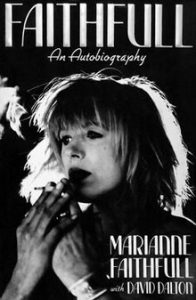
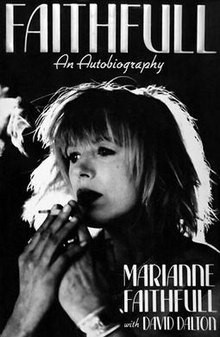
Marianne Faithfull, in her grandiose memoirs Faithfull; An Autobiography (1994), lifts an intriguing corner of the veil:

“For days I had been told that Bob ‘was working on something.’ I asked what (I was meant to ask). ‘It’s a poem. An epic! About you.’ Why bless his heart, I thought, he’s hung up too! But you don’t ever quite know with Bob; he wears his heart very close to his vest. No one was ever such a seducer as Dylan.”

This is early May 1965; in the eight or nine days that Faithfull hangs out in Dylan’s suite at the Savoy Hotel. The first recording of “Desolation Row” takes place on July 29 and the only other candidate for a “poem about you” with “epic” qualities is “Like A Rolling Stone”, which according to Dylan was distilled from a poem of ten pages long (or twenty, according to a radio interview in Montreal ’66, or six, as he says in Shelton’s No Direction Home).

The fairylike, elusive and seemingly timid Faithfull is indeed a perfectly fitting, lifelike model for the Miss Lonely who went to the finest schools. In addition to all other exceptional qualities, “Like A Rolling Stone” would then also have a prophetic value:

Once upon a time you dressed so fine
You threw the bums a dime in your prime, didn’t you?
People’d call, say, “Beware doll, you’re bound to fall”
You thought they were all kiddin’ you
You used to laugh about
Everybody that was hangin’ out
Now you don’t talk so loud
Now you don’t seem so proud
About having to be scrounging for your next meal

… almost every letter of the legendary opening couplet being perfectly applicable five years later to the bizarre fate of Marianne, who indeed goes from riches to rags, ends up in the gutter, is homeless for a while, and freeloading and scraping up her food, shelter and drugs.

But this striking resemblance Faithfull also has to the Ophelia from the fourth verse of “Desolation Row”.
She idolizes Dylan, this spring of ’65. He is “the hippest person on earth”, and when “God Himself” checks into the Savoy on April 26, 1965, she just has to go there.

The timing is lousy. The then eighteen-year-old has just discovered she is pregnant and in ten days she will marry the father, the unfortunate John Dunbar. But at this moment Dunbar is still in Cambridge for a few more days, and the impulsive teenager, who for most of her life has a particularly poor resistance to temptations, does go. So I went to see the gypsy, as she writes with a superb sense of irony. (The writer is infectiously prone to the dosed use of unobtrusive Dylan references. She has difficulty with the fog-and-amphetamine factor of producer Andrew Loog Oldham, to name but one nice example).

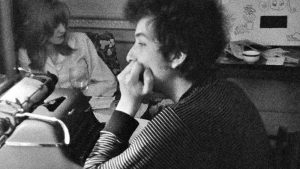
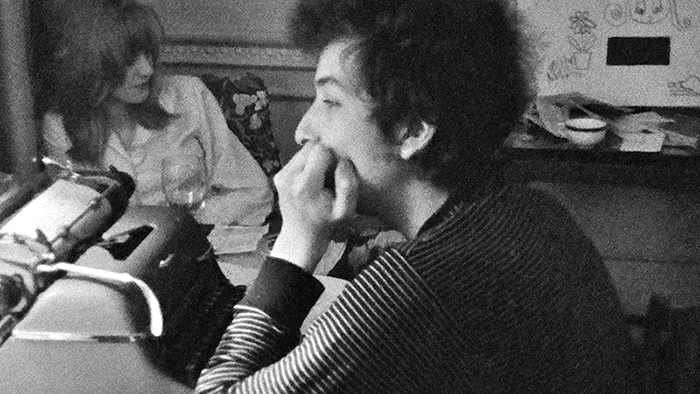
She is already an arrivée, has already had Top 10 hits (with “As Tears Go By” and “Come And Stay With Me”) and therefore has little trouble penetrating the inner sanctum. But in there she is again the blue, uncertain ingénue. Those few flashes from Marianne in Don’t Look Back, curled up in a chair in the corner, staring swooningly at Dylan, do match her own recollection; she keeps quiet, especially for fear of making a fool of herself. “I mean, what if I said something really stupid? The gates of Eden would be closed forever.” And also somewhat intimidated by the presence and beauty and talent of Joan Baez, by the way – who, according to Marianne, plays a breath-taking version of “As Tears Go By”. “I’ve never heard it sound better,” she says, adding with superior irony: “not even by whatsisname,” both a self-mocking reference to former partner Mick Jagger and a nod to one of the horrible films in which she plays in those years, I’ll Never Forget What’s’is Name (1967). In which she does write film history, as a matter of fact: she is the first actor to use the word fuck in a movie.

II         To be Ophelia (or not)

Being timid and curled up in a corner, however, draws the attention of the Bard, according to the chapter “What’s A Sweetheart Like You Doing In A Place Like This”. La Faithfull tells how he makes advances that she does not recognize as such, upon which he furiously blames her for playing games. Her astonished sputtering that she is pregnant and is getting married next week, turns Dylan into a frantic Rumpelstiltskin, tearing up a sheaf of papers in a tantrum like a furious child: “Are you satisfied now?!”

Marianne suspects that the pile of paper was the “epic poem” he supposedly wrote for her.

A far more attractive option is that impressions of Faithfull have nevertheless swirled down in lyrics. Maybe in “Like A Rolling Stone”, but the Ophelia couplet in Desolation is just as strong a contender.

Marianne does have an Ophelia-like aura and describes in her memoirs how she herself identifies with exactly this tragic heroine:

“For years I had been babbling about death in interviews. That was playacting. There came a time, however, that it stopped being a performance. The combined effect of playing Ophelia and doing heroin induced a morbid frame of mind – to say the least – and I began contemplating drowning myself in the Thames. I was acting as a child does. I had fused with my part…. I would indulge myself in lurid pre-Raphaelite fantasies of floating down the Thames with a garland of flowers around my head.”

Dylan and Faithfull herself are not the only ones who see an Ophelia in the fragile beauty, in the aristocratic, blonde Mona Lisa. Director Tony Richardson offers her the role in 1968, first in the stage performance and then in the film adaptation (1969) of Hamlet. Coincidentally, she really is an Ophelia on her twenty-second birthday (Marianne does indeed turn twenty-two on December 29, 1968, during the stage performances and just before the film version of Hamlet).

It is not an undisputed choice. The critics are divided. Time Magazine is poetic and downright positive (“remarkably affecting… ethereal, vulnerable, and in some strange way purer than the infancy of truth”), but most reviews are less flattering. The general tenor is: stoned hippie girl, empty-headed sex object.

Hindsight and Marianne’s own report do support the harsh critique. We don’t see Ophelia, but we continue to see Faithfull, childish and erotic at the same time, bordering on awkwardness, even – her first scene (Act I, scene 3) is with brother Laërtes, who does not seem to warn her of Hamlet, but of men like Dylan and Jagger:

Weigh what loss your honor may sustain
If with too credent ear you list his songs,
Or lose your heart, or your chaste treasure open
To his unmastered importunity.

… watch out for that horny guy who makes your head spin with his beautiful songs, so that you will lose your chastity and respectability. But in the meantime, Marianne’s / Ophelia’s tightened breasts are almost bulging out of her cut dress and she kisses her brother for a long time on the (open) mouth, giving the whole scene an unprecedented and incestuous charge unforeseen by Shakespeare.

Both during the plays and during the filming, Faithfull is often high, in between acts she has sex in the dressing room with protagonist Nicol Williamson, and otherwise with the drug dealer of the Stones, Tony Sanchez, thus paying him for heroin. She later regrets that quite a bit, and she shares with us a dubious life lesson she learned from it, in which she again squeezes in a Dylan reference:

“I never had any cash. I now realize that if you do want drugs, then you have to make your own money and buy them! To live outside the law you must be honest, but I didn’t understand that yet. For years I simply charmed and seduced people to get what I wanted.”

She sometimes plays the madness scene right after she has used heroin. “It might even have helped in some perverse way, she admits in her other autobiography, in Memories, Dreams And Reflections (2008).

It explains, all in all, the detached, hazy appearance, that look as if she sees Noah’s great rainbow, but at the same time the closeness of the abyss, the peeping into the desolate back-alley, the peeking into Desolation Row.

III       Faithfull revisited

With the same benefit of hindsight, it seems that the artist Dylan, in the spring of 1965, sketches the future of the girl who is curled up in a chair next to him in the hotel room. One scene can even be found one-on-one in Faithfull’s book. The opening Ophelia, she’s ’neath the window seems to be a paraphrase of what Marianne describes as her upcoming groom John Dunbar is waiting for his fiancé down the street, under the window of Dylan’s hotel suite. Naively and clumsily, she reveals that rather embarrassing fact in Dylan’s overpopulated suite, upon which the whole company, Dylan first, rushes to the window to see for whom Marianne has rejected Dylan and to mock him. Dunbar, he’s ’neath the window, for him I feel so afraid.

An old maid is, oddly enough, quite a striking description too. Marianne is only eighteen, but apparently the susceptible, sharply observing Dylan already sees the contours of the old maid she will be in four years’ time, on her twenty-second birthday; a young girl with the life experience of a forty-year-old ex-groupie – with the accompanying, perhaps inevitable, tragedy and decline. An iron vest, the seemingly unapproachability, cuddly but unreachable, is just as recognizable, and even the words that Dylan steals from Jack Kerouac, her sin is her lifelessness, very aptly portray Faithfull’s vacant Ophelia, to whom death is quite romantic.

Fourteen years later, shortly after the release of her come-back album Broken English (1979), the chanteuse tells in the chapter “Dylan Redux” that Dylan visits her completely unexpectedly in London. Badly timed once again of course – Faithfull has just got married to Ben Brierly – and Dylan is cuddly, compellingly vulnerable, swears he has never been able to forget her, and he expresses regret for the incident with the torn poem.

But what was written in the poem we still don’t know.

————————————————

Jochen’s new book has just arrived in the offices and we’ll be reviewing that shortly.

It’s available in English and in Dutch, both as a paperback and on Kindle.

Details are on the UK Amazon site, or of course on the Amazon site for your country.

Just search for “Desolation Row” by Joch Markhorst.


What else is on the site

You’ll find some notes about our latest posts arranged by themes and subjects on the home page.  You can also see details of our main sections on this site at the top of this page under the picture.

The index to all the 595 Dylan compositions and co-compositions that we have found on the A to Z page.

We also have a very lively discussion group “Untold Dylan” on Facebook with over 2000 active members.  (Try imagining a place where it is always safe and warm).  Just type the phrase “Untold Dylan” in, on your Facebook page or follow this link 

If you are interested in Dylan’s work from a particular year or era, your best place to start is Bob Dylan year by year.

On the other hand if you would like to write for this website, please do drop me a line with details of your idea, or if you prefer, a whole article.  Email Tony@schools.co.uk

And please do note   The Bob Dylan Project, which lists every Dylan song in alphabetical order, and has links to licensed recordings and performances by Dylan and by other artists, links back to our reviews

Posted in Uncategorized | 4 Comments

Talking Hugh Brown: We’ve got another Dylan original composition

By Tony Attwood

Well, you don’t get a Dylan song that for one reason or another we’ve never listed on this site, for months and months, and then suddenly a couple turn up within a week or two of each other.

Of course that is no one’s fault but mine; I’m supposed to have the job of tracking the remaining few compositions down.  Aaron is currently cursing himself for having (like me) missed “Talking Hugh Brown” but it is really my fault.  It turned up on the 1960 Minnesota Party Tape.

So apologies from me, and now the excuses.

What is misleading is that in some places the running order of the songs on the tape recording of Bob at a little gathering is shown as

1. Red Rosey Bush (trad.) 00:00
2. Johnny I Hardly Knew You (trad.) 03:22
3. Jesus Christ (Woody Guthrie) 07:45
4. Streets Of Glory (trad.) 10:33
5. K.C. Moan (1927 Memphis Jug Band) 11:20
6. Blues Yodel No. 8 (Jimmie Rodgers – G. Vaughan) 13:53
7. I’m A Gambler (trad.) 14:49
8. Talking Columbia (Woody Guthrie) 16:55
9. Talking Merchant Marine (Woody Guthrie) 17:33
10. Talking Hugh Brown 19:58
11. Talking Inflation (Tom Glazer) 21:27
12. Come See Jerusalem (trad.) – Missing
13. San Francisco Bay Blues (Jesse Fuller) – Missing

So as you can see Talking Hugh Brown comes in just on 20 minutes as song number 10.  Except it doesn’t.  At least not on the copy I’ve got.   But, ears wide open (as Aaron’s are and mine aren’t) it is there at four minutes.

In other words, if you see a copy of the listing above, check that it relates to the recording you are listening to.

 Here’s the lyrics kindly supplied by Bob Dylan Roots
I knew a boy named Hugh Brown
He's the laziest man in town
Got up this morning and combed his hair
He's so lazy, he just don't go anywhere
He just kinda opens his door and walks out
And looks around and walks away

Well, he sprained his arm combing his hair
I don't think that's quite really fair
He lays in bed all the time
I don't think that's very right
He's such a lazy bastard

You know, it was raining the other day,
I mean the other night
And Hugh Brown said
And Hugh Brown, (he's) so lazy that
He said to me, "Bob, it's raining on my bed"
And I says "Oh", and he says "Yeah", and I says "Oh"
Hugh Brown never closed the window

Oh, that’s the end.

Heylin has the song listed as the 10th composition in “Revolution in the air” and notes it as being “performed by Dylan in the fall of 1960, Minneapolis.”  He notes it as being entirely improvised, and thus along with “Bonnie why’d you cut my hair?” has the songs down as “early markers of that rare ability Dylan has frequently displayed in the studio and onstage of composing “on the spot”.”

But I don’t go for that.  The technique of improvising lyrics on the spot is not utterly easy to master, but it is not restricted to a golden few.  Indeed in contemporary society where improvised comedy (or “improv” as it is known, as least in Britain) has become a very big thing, improvising a comic song is a common part of the routine.  Indeed, in my own very amateur way I have done this with one or two ensembles in England, and some of the professionals with whom I have worked can knock out these pieces easily, on the spot.

If you listen to this recording

you’ll probably recognise it as the standard tune used for these comic affairs.  And if you go to the link below you can see how it pans out – and yes it is all improvised on the spot…

The point is that yes, it takes skill, practice and nerve (in front of an audience) but it is not a mark of genius.  Not everyone can improvise, and few can improvise well, but Heylin is strolling way out of his knowledge zone at this point in seeing Dylan’s early talking blues above as an indicator of some deep-rooted genius yet to express itself.

What else is on the site

You’ll find some notes about our latest posts arranged by themes and subjects on the home page.  You can also see details of our main sections on this site at the top of this page under the picture.

The index to all the 596 Dylan compositions and co-compositions that we have found on the A to Z page.

We also have a very lively discussion group “Untold Dylan” on Facebook with over 2000 active members.  (Try imagining a place where it is always safe and warm).  Just type the phrase “Untold Dylan” in, on your Facebook page or follow this link 

If you are interested in Dylan’s work from a particular year or era, your best place to start is Bob Dylan year by year.

On the other hand if you would like to write for this website, please do drop me a line with details of your idea, or if you prefer, a whole article.  Email Tony@schools.co.uk

And please do note   The Bob Dylan Project, which lists every Dylan song in alphabetical order, and has links to licensed recordings and performances by Dylan and by other artists, links back to our reviews
Posted in Uncategorized | 5 Comments

Bob Dylan And The Symbol Of The Flower (Part III): Hart Crane

By Larry Fyffe

Romantic Transcendentalist poets intuit the presence of the mysterious driving force behind the Cosmos pervading all Nature; the flower reaching upwards towards the sky with its roots in the ground serving as a symbol for that vitalistic spirit.

Rococo and Pre-Raphaelite poets, on the other hand, depict the beauty of the flower as a distraction from the separate ‘other world’ in which God the Creator of the Universe resides; not all that unlike Gnostic notions that envision the ‘real’ world as a dark place, in this case a place full of ‘sins’ of the flesh, in which the light from the transcendental spiritual plane is not detected by most inhabitants of the physical realm.

Hart Crane, as previously noted, employs the elaborate ornamental alliterative/assonate-strewn Rococo-like writing style of such artists, but he is more of a ‘down-to-earth’ poet in the manner of poet Walt Whitman with his ‘techno-romantic’ themes – notwithstanding that Whitman uses simpler diction:

O, early following thee, I searched the hill
Blue-writ and odour-firm with violets, till
With June the mountain broke through green
And filled the forest with what clustrous sheen!
(Hart Crane: Cape Hatteras)

Romantic, but not Rococo, the following song lyrics be; you can take the poet out of the country, but you can’t take the country out of the poet:

Well, I'm a stranger in a strange land
But I know this is where I belong
I'm a rambler and a gambler for the one I love
And the hills will give me a song
(Bob Dylan: Red River Shore)

Crane lifts up the language – purples it, embellishes it – in order to to make poetics anew, but the basic flowery Transcendentalist Romantic message remains:

Mark how her turning shoulders wind the hours
And hasten while her penniless rich palms
Pass superscription of bent foam and wave
Hasten, while they are true, - sleep, death, desire
Close round one instant in one floating flower
(Hart Crane: Voyages)

For the most part, singer/songwriter/musician Bob Dylan turns away from such embellishments in his song lyrics though not from Crane’s angst-ridden examination of the human condition including aspects like sleep, desire, and death:

Everybody got all the money
Everybody got all the beautiful clothes
Everybody got all the flowers
I don't have one single rose
I feel a change coming on
And the fourth part of the day's already gone

(Bob Dylan: I Feel A Change Coming On)

In many modern works of art, images of the ever faster-moving, hustling and bustling cityscape of concrete, stone, and steel replaces the organic images of a  rural landscape.

Mechanical symbols like the 'iron horse' come to the fore:
And the breakfasters glide glistening steel
From tunnel into field - iron strides the dew
Straddles the hill, a dance of wheel on wheel
You have a half hour's wait at Siskiyou
Or stay the night and take the next train through
(Hart Crane: The River)

As well it’s said that any yearning for a return to the supposed good old days of yesterday, whether in the ‘here’ or in the ‘hereafter’, is going be a long time coming to fruition should you believe that such a dream will indeed come true:

Sometimes I feel so low-down and disgusted
Can't help but wonder what's happening to my companions
Are they lost or are they found
Have they counted the cost it'll take to bring down
All the earthly principles they're gonna have to abandon?
There's a slow, slow train coming up around the bend

(Bob Dylan: Slow Train)

Unlike his poetic persona, Hart Crane is too impatient to wait for Love, and chooses an early death:

Migrations that must needs void memory
Inventions that cobblestone the heart
Unspeakable Thou Bridge to Thee, O Love
Thy pardon for this history, whitest Flower
O Answerer of all - Anemone
Now while thy petals spend the sunshine about us, hold
(O Thou whose radiance does inherit me)
Atlantis,  - hold thy floating singer late!

(Hart Crane: Atlantis)

With the approach of a rain storm, the flowers of the anemone close up.

What else is on the site

You’ll find some notes about our latest posts arranged by themes and subjects on the home page.  You can also see details of our main sections on this site at the top of this page under the picture.

The index to all the 595 Dylan compositions and co-compositions that we have found on the A to Z page.

We also have a very lively discussion group “Untold Dylan” on Facebook with over 2000 active members.  (Try imagining a place where it is always safe and warm).  Just type the phrase “Untold Dylan” in, on your Facebook page or follow this link 

If you are interested in Dylan’s work from a particular year or era, your best place to start is Bob Dylan year by year.

On the other hand if you would like to write for this website, please do drop me a line with details of your idea, or if you prefer, a whole article.  Email Tony@schools.co.uk

And please do note   The Bob Dylan Project, which lists every Dylan song in alphabetical order, and has links to licensed recordings and performances by Dylan and by other artists, links back to our reviews


Posted in Uncategorized | Leave a comment

Clothes Line Saga and the perfect nod to Bob; nod nod nod

by Jochen Markhorst

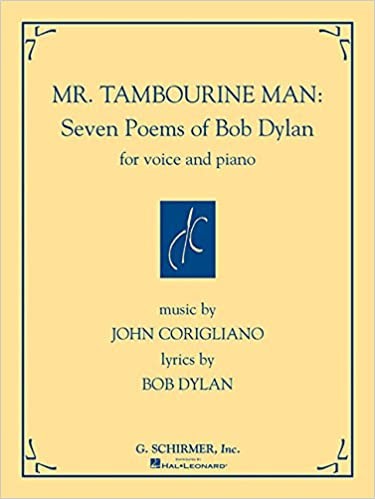
The American John Corigliano is quite a Grammy Award collector. The counter now stands at six, and in between the classical composer also scores an Oscar (for the music to The Red Violin, 1999) and the Pulitzer Prize for Music, for his Second Symphony (2001). A striking title in the list of prize-winning works has the work for which Corigliano wins his third and fourth Grammy: Tambourine Man: Seven Poems of Bob Dylan.

In the program booklet at the premiere (Carnegie Hall, March 2000), Corigliano writes that he has selected the seven lyrics for their poetic value from a collection of Dylan lyrics, while he “had never heard his songs”, sketching a self-portrait of a possessed composer who works and works while life outside passes by:

“I had always heard, by reputation, of the high regard accorded the folk-ballad singer/songwriter Bob Dylan. But I was so engaged in developing my orchestral technique during the years when Dylan was heard by the rest of the world that I had never heard his songs.

So I bought a collection of his texts, and found many of them to be every bit as beautiful and as immediate as I had heard – and surprisingly well-suited to my own musical language. I then contacted Jeff Rosen, his manager, who approached Bob Dylan with the idea of re-setting his poetry to my music.”

That seems a bit too posed. Born in 1938 in New York, the city where he has lived and worked all his life… Corigliano must have had a compulsive urge to put his fingers in his ears crossing the streets, through the subway stations and parks, cafes and cinemas, through life at all, for more than forty years, to “never hear his songs”.  And “coincidentally”, six of the seven lyrics he chooses from hundreds and hundreds of Dylan lyrics happen to be part of the canon: the cycle opens with “Mr. Tambourine Man”, on the way his “Blowin ‘In The Wind” and “All Along The Watchtower” are processed and the final is “Forever Young”.

The song cycle describes, according to the composer,

“… a journey of emotional and civic maturation, from the innocence of Clothes Line through the beginnings of awareness of a wider world (Blowin’ in the Wind), through the political fury of Masters of War, to a premonition of an apocalyptic future (All Along the Watchtower), culminating in a vision of a victory of ideas (Chimes of Freedom). Musically, each of the five songs introduces an accompanimental motive that becomes the principal motive of the next.”

The only title really standing out is number two, the obscure “Clothes Line Saga” from The Basement Tapes, which according to Corigliano expresses “innocence”.

Now, that is an original perspective indeed, which does show that the maestro is not hindered by any Dylan knowledge. The song, originally called “Answer To Ode”, is a pastiche. When Dylan in the basement of The Big Pink in Woodstock dashes off songs with his buddies, that summer of ’67, Bobbie Gentry’s moving country pop jewel “Ode To Billie Joe” is at the top of the charts. Dylan, who usually only parodies music he admires, imitates the emotionless recitation, the petty dialogues and the muggy boredom of the hit, but refrains from an underlying drama which makes Gentry’s ballad so blood-curdling, which provides the true power to this “study of unconscious cruelty,” as Gentry calls it.

What remains is a pointless anecdote, an overexposed snapshot of a saltless existence in a dead village, where the question of whether the laundry is already dry is more important than the news that the vice president has gone mad. It works irresistibly comically, especially because the waiting for a punch line is not being rewarded – and roughly like in dialogues at Chekhov or like Peter Sellers at his deadpan best, the comic power lies in Dylan’s lingering, monotonous recital.

For many clarifiers that is too thin. They then insist on exposing expressiveness beneath the surface. A Greil Marcus (Invisible Republic, 1997) can “crack the code of the talk”, knows we are hearing “what Raymond Chandler descibed as the American voice: flat, toneless and tiresome”, “a voice that can say almost anything while seeming to say almost nothing.” Marcus, incidentally, seems to know that the narrator is a boy, a teenage boy double for Bobbie Gentry’s teenage girl, but does not reveal from what he derives that knowledge. Obvious it is not; in the kind of household that emerges from Dylan’s thin sketch, picking up the laundry is more a woman’s job, a job entrusted to the daughter of the house, and the silly talk that the neighbour in the third verse starts with the storyteller is hardly the kind of conversation an adult man will have with his fifteen, sixteen-year-old neighbour’s son, but rather with a teenage girl.

This part of Marcus’ analysis, however, this unmotivated gender determination, does not trigger the most eyebrow-raising. That would be provoked by his thoughts on the second verse, the verse recalling how the Vice-President has gone mad. Slightly hysterical is Marcus’ insistence on his argument that this verse hides sharp political criticism of Vice President Hubert Humphrey. In the acted lethargy of the performance, he now hears that the village is actually Washington DC 1967, Humphrey is vice president, Marcus even hears criticism of Humphrey’s turnaround on civil rights since his days as mayor of Minneapolis, in 1948, and concludes that this answer song answers the question Bobbie Gentry’s hit evokes: what did the girl and the suicidal Billy Joe throw off that Tallahatchie Bridge?

Dylan’s song, Greil Marcus concludes, tells us it was the vice-president who jumped off the bridge.

Mike Marqusee (Wicked Messenger, 2006) sees in the song “a bleak social vision”, “unperturbed American complacency” and an America “cultivating amnesia”, and Oliver Trager (Keys To The Rain, 2004) even a “veiled commentary at the US resumption of attacks on North Vietnam.”

Both gentlemen acknowledge “Ode To Billie Joe” as a source, both admire the subtle way in which that song manages to move, but both also cloak themselves in the conviction that this one sentence, the Vice-President’s gone mad, is a serious, politically motivated comment, reflecting Dylan’s opinion on a current topic.

Well. Granted: fascinating or at the very least amusing struggles of well-read, eloquent gentlemen with a gem that Dylan himself never looks back on, but nevertheless very far-fetched interpretations of a text that is foremost meaningless and, precisely for that reason, funny.

The only noteworthy cover of this song is an interpretation that at the very least matches the original (switching off the dramatic Nobody-Sings-Dylan-Like-Dylan mode: it really does surpass the original).

Suzzy and Maggie Roche from The Roches are the dream candidates for an attempt: unique, unusual harmonies and very deadpan, witty presentation are characteristics of their artistry. They succeed completely; their contribution to the tribute album A Nod To Bob (2001) is quite brilliant. The ladies deliver the paradoxical juggling act to sing both toneless and melodic. The indispensable organ work of Garth Hudson turns out to be dispensable after all: the Roches arrange traditionally, but oh so effectively by trickling in more instruments per couplet. The organ is only used percussively in the second verse, but still honours Hudson in the third verse with short strokes. The coda is ingenious; after a Trugschluß, the deceptive cadence, the sisters conclude the song with a short, wordless finale that manages to even enhance the comic effect.

It is three minutes and fifteen seconds of total perfection – Suzzy and Maggie produce one of the most beautiful Dylan covers ever. Quite an achievement. Worth at least six Grammy Awards.

What else is on the site

You’ll find some notes about our latest posts arranged by themes and subjects on the home page.  You can also see details of our main sections on this site at the top of this page under the picture.

The index to all the 595 Dylan compositions and co-compositions that we have found on the A to Z page.

We also have a very lively discussion group “Untold Dylan” on Facebook with over 2000 active members.  (Try imagining a place where it is always safe and warm).  Just type the phrase “Untold Dylan” in, on your Facebook page or follow this link 

If you are interested in Dylan’s work from a particular year or era, your best place to start is Bob Dylan year by year.

On the other hand if you would like to write for this website, please do drop me a line with details of your idea, or if you prefer, a whole article.  Email Tony@schools.co.uk

And please do note   The Bob Dylan Project, which lists every Dylan song in alphabetical order, and has links to licensed recordings and performances by Dylan and by other artists, links back to our reviews



Posted in Uncategorized | 2 Comments

The subject matter of Dylan’s songs 1971 to 1973

by Tony Attwood

This is part of an ongoing series which attempts to assign a short simple theme or meaning to each Dylan composition, not (I hasten to add) to simplify Dylan’s work but to try and give me (and anyone else who happens to be reading) a greater insight into the way Dylan moved through themes and meanings in his songs.

By way of example (and this is the example I have given several times) many people consider Dylan (particularly in the 1960s) as a writer of “protest ” songs.  Yet very few people (if any) have mentioned that “protest” was the theme of a tiny minority of his compositions, or that his most famous “protest song” (Times they are a changin’) is not a protest song at all, but rather a song about the fact that the world changes in its own way, no matter what we do.

This article covers 1971 to 1973.  There is an index to the articles already written relating to the meanings of the songs of the 1950s and 1960s.   In terms of the 1970s, one article precedes this one The meanings behind Bob Dylan’s 15 compositions of 1970

That article about 1970 makes the point that 1970 saw Dylan move onto another new theme – the environment and how it relates to, and to an extent how it effects, the world and the way we see the world.  Many of the songs from that year have environmental elements in them, as well as other issues, and the final listing of the songs’ prime element from that year gave us

  • The environment, places, locations: 5
  • Jewish prayer: 1
  • Visit: 1
  • Love: 4
  • Lost love: 1
  • Blues: 1
  • Be yourself: 1

So just two themes emerged in more than one song: the environmental songs and love songs – and indeed many of the songs which I have not counted as primarily “environmental” in the list above, do have environmental elements.  Bob, we may take it, was in love and feeling that the place was significant.

That collection of songs gave us a new list of key topics that appear in Dylan’s lyrics, and selecting as I have done in earlier years, just the categories that have reached double figures since he began writing songs at the end of the 1950s, we get these subject areas as the main ones that Dylan had written about from his very first songs through to this 1970 collection…

  • Being trapped/escaping from being trapped (being world-weary): 10
  • Randomness (including Kafkaesque randomness): 11
  • Humour, satire, talking blues: 13
  • Surrealism, Dada: 15
  • Travelling on, songs of leaving, songs of farewell, moving on: 16
  • Protest 20
  • Lost love / moving on: 31
  • Love, desire: 35

As such Bob Dylan, in terms of subject matter, had become, across the years, much more conventional in his writing than generalised articles recognise.  But he never stopped exploring, as 1971 shows.  In that year Dylan only wrote six songs but they were a very varied collection.

And indeed 1971 was a year in which Bob took more time out but producing two magnificent songs. Here is the list of songs with, as before, the shortest possible description of the topic of each song…

  1. Vomit Express (postmodernist blues; cheapest seats on the cheapest flight)
  2. When I paint my masterpiece (art, Rome, the environment)
  3. Watching the river flow (The artist as observer, the environment)
  4. George Jackson (protest)
  5. Wallflower (asking for a dance)
  6.  For you baby (love)

What is particularly interesting is that, as I have oft mentioned, one of the most widely accepted definitions of what constitutes the themes of the lyrics of popular music came from Professor Keith Swanwick of London University Institute of Education (whose work I particularly remember since he oversaw my research degree) who stated that the vast bulk of popular songs dealt with just three subjects: love, lost love and dance.

Dylan had not, up to this point, particularly bothered himself with dance (apart from once saying that he saw himself as a song and dance man, when asked to define his music) and yet here (perhaps for the first time) he wrote (or possibly co-wrote) a country song about dancing: Wallflower.

1972 then gave us an even shorter list of new songs which as it turned out incorporated a hint of what might come next…

  1. Forever Young – (Love and hope for a child)
  2. Billy 1, 4, and 7 and the Main title theme – Billy the Kid (Being trapped; they’re out to get you)

Adding the two years’ music together we get, in terms of the short-version of the themes…

  • Post-modernism: 1
  • The environment: 2
  • Protest: 1
  • Dance: 1
  • Love: 2
  • Being trapped: 1

Now moving on one more year we have 1973.  The earlier article about the chronology of Dylan’s writing is still on line: Bob Dylan in 1973: moving into the second round of unadulterated genius

And the songs created that year, with their brief lyrical content summary, were…

  1. Goodbye Holly (Death)
  2. Wagon Wheel (Rock me mama) (Moving on)
  3. Sweet Amerillo (Moving on)
  4. Knocking on heaven’s door (Moving on – although we should add the song has nothing to do with the movie)
  5. Never say goodbye (The environment)
  6. Nobody cept you (Love)
  7. Going going gone (Lost love)
  8. Hazel (Love)
  9. Something there is about you (Love)
  10. You Angel You (Love)
  11. On a night like this (Love)
  12.  Tough Mama (Love / lost love)
  13. Dirge (This wheel’s on fire reworked)  (Disdain)
  14. Wedding Song (Rejection of labeling, setting oneself free

So here are another 14 songs and the themes assigned give these totals…

  • Love: 5
  • Lost love: 2
  • The environment: 1
  • Death: 1
  • Moving on: 3
  • Rejection of labelling: 1
  • Disdain: 1

Pulling these three years together we get these subject totals for 1971-3

  • Post-modernism: 1
  • The environment: 3
  • Protest: 1
  • Dance: 1
  • Love: 7
  • Being trapped: 1
  • Lost love: 2
  • Death: 1
  • Moving on 3
  • Rejection of labelling: 1
  • Disdain: 1

Which now means we can update the complete total of Dylan’s subject matter from the start of his song writing career up to 1973.  As usual categories that have one or more new songs that appear for the first time in this article, have these shown after the plus sign, and the new grand total after the equals sign.

Thus art was the subject matter of three songs written prior to 1971, but of no songs in the period covered here.   Being trapped was the subject matter of 10 earlier songs, and one more song in this period, making (rather obviously) 11 songs in total.

All Dylan compositions by subject up to 1973

  • Art: 3
  • Be yourself: 1
  • Being trapped/escaping from being trapped (being world-weary): 10 + 1 = 11
  • Blues: 9
  • Betrayal: 1
  • Celebrating a city 1
  • Change: 4
  • Dance: 1
  • Death: 3 + 1 = 4
  • Depression: 1
  • Disasters: 1
  • Disdain: 7 + 1 = 8
  • Environment: 6 + 3 = 9
  • Eternity: 1
  • Future will be fine: 2
  • Gambling: 2
  • Happy relationships: 1
  • How we see the world: 3
  • Humour, satire, talking blues: 13
  • Individualism: 8
  • It’s a mess: 3
  • Jewish prayer: 1
  • Leadership: 2
  • Look after yourself: 1
  • Lost love / moving on: 31 + 2 = 33
  • Love, desire: 35 + 7 = 42
  • Lust: 1
  • Moving on: 9 + 3 = 12
  • Nothing changes: 4
  • Nothing has meaning: 2
  • Party freaks: 3
  • Patriotism: 1
  • Personal commentary: 2
  • Post modernism 0 + 1 = 1
  • Protest 20 + 1 = 21
  • Randomness (including Kafkaesque randomness): 11
  • Rebellion: 1
  • Rejection of labeling: 0 + 1 = 1
  • Relationships 1
  • Religion, second coming: 2
  • Sex (country life): 1
  • Social commentary / civil rights: 6
  • Slang in a song: 4
  • Surrealism, Dada: 15
  • Travelling on, songs of leaving, songs of farewell, moving on: 16
  • The tragedy of modern life: 3
  • Visit: 1
  • WH Auden tribute: 1

And as usual here is the list of the top categories by the end of 1973…

  • Being trapped/escaping from being trapped (being world-weary): 11
  • Randomness (including Kafkaesque randomness): 11
  • Moving on: 12
  • Humour, satire, talking blues: 13
  • Surrealism, Dada: 15
  • Travelling on, songs of leaving, songs of farewell, moving on: 16
  • Protest: 21
  • Lost love / moving on: 33
  • Love, desire: 42

We can see of course that moving on turns up three times – and it could be argued that they should be merged to make a giant moving on category with 61 songs, but I still feel the difference between the types of moving on songs, and find the categories worth keeping as separate groups.  Some just reflect the desire to move on, some the moving on because love has gone and one needs to escape, and some that link to the notion of farewell.

These then are the nine themes that have occupied Dylan the songwriter the most since he started writing at the end of the 1950s.

What else is on the site

You’ll find some notes about our latest posts arranged by themes and subjects on the home page.  You can also see details of our main sections on this site at the top of this page under the picture.

The index to all the 594 Dylan compositions and co-compositions that we have found on the A to Z page.

We also have a very lively discussion group “Untold Dylan” on Facebook with over 2000 active members.  (Try imagining a place where it is always safe and warm).  Just type the phrase “Untold Dylan” in, on your Facebook page or follow this link 

If you are interested in Dylan’s work from a particular year or era, your best place to start is Bob Dylan year by year.

On the other hand if you would like to write for this website, please do drop me a line with details of your idea, or if you prefer, a whole article.  Email Tony@schools.co.uk

And please do note   The Bob Dylan Project, which lists every Dylan song in alphabetical order, and has links to licensed recordings and performances by Dylan and by other artists, links back to our reviews
 

Posted in Uncategorized | 2 Comments

Bob Dylan And The Lusty Buck

by Larry Fyffe

In Greek mythology, the aforementioned Galatea is a sea nymph adored by the Cyclops whose one eye is burned out by Odysseus. After the giant reforms, and stops eating people, the nymph softens her attitude towards him, and they get married. Prior to the Trojan War, Jason sets out in search of the Golden Fleece. Members of his crew include Orpheus who marries Eurydice, and Theseus who marries Phaedra. Already pointed out is that Bob Dylan makes fleeting references to these mythological stories in his song lyrics.

Another member of Jason’s crew is Peleus who marries Thetis, the leader of the female sea nymphs. Zeus, is forewarned that Thetis will bear a son more powerful than his father Saturn. To ward off that possibility, Zeus tells the mortal Peleus he’s able to capture the shape-shifting nymph by binding her, and holding on to her tightly. This he does, they marry, and she gives birth to Achilles. Noted is that Bob Dylan references this Greek hero of the Trojan War, a war sparked by Eris, the Goddess of Discord, who is insulted she’s not invited to the wedding of Peleus and Thetis.

Apparently, Bob Dylan knows a number of the nymphs well:

Charotte’s a harlot
Dresses in scarlet
Mary dresses in green
It’s soon after midnight
And I’ve got a date with the fairy queen
(Bob Dylan: Soon After Midnight)

Poet Robert Graves makes the case that all the negative portrayals of women, including that of Eve, are put forth to undermine the Pagan respect for, and worship of, The White Goddess, the Mother of Birth, Love, And Death – Earth itself.

A Roman poet, in support of selfish masculine love, glories the kidnapping of Thetis:

Then Peleus, it is said, for Thetis burned with love
Then Thetis did not scorn human hymeneals
Jove himself felt Peleus should yoke with Thetis
O born in a time of all the ages too much missed
Hail, heroes, breed of God! O noble progeny
Of mothers beautiful, I hail you once again!
(Gaius Catullus: Catullus, no. 64 ~ translated)

An Elizabethan poet is not so kind; he blames women for the lack of harmonious relationship between the sexes notwithstanding that in mythology the daughter of the Goddess of Grain, Persephone, is held by Hades in the cold underworld for half of each year:

My Love is like ice, and I to fire
How comes it then this her cold so great
Is not dissolved by my so hot desire
But harder grows the more I her entreat?
(Edmund Spenser: My Love Is Like Ice, And I To Fire)

Christian Gnostic Emanuel Swedenborg places women in a subordinate position to men, Eve having been taken from the side of Adam. A modernist Romantic poet, whose mother be a Swedenborger, gives little thought to the on-and-off frigid behaviour of Thetis and Persephone, symbolized below by the frozen lake; he simply accepts things the way things are – or so it seems:

My little horse must think in it queer
To stop without a farm house near
Between the woods and frozen lake
The darkest evening of the year
(Robert Frost: Stopping By Woods On A Snowy Evening)

It’s a viewpoint expressed by the singer/songwriter in the lyrics below – using the same symbolism:

Twilight on the frozen lake
North wind about to break
On footprints in the snow
Silence below
(Bob Dylan: Never Say Goodbye)

For both Frost and Dylan, an artificial wall now separates, not only the two human sexes from one another, but both sexes from the natural world as viewed by the Pagans. In these modern times, contact with the White Goddess is lost. In the poem below, a doe and then a lusty buck stares through a barb-wired, tumbling wall at a man and a woman; then it’s gone:

He viewed them quizzically with jerks of head
As if to ask, “Why don’t you make some motion
Or give me some sign of life? Because you can’t
I doubt if you’re as living as you look”
Thus till he had them almost feeling dared
To stretch a proffering hand  ~ and a spell-breaking
(Robert Frost: Two Look At Two)

The singer/songwriter envisions himself as that lusty buck; he’s staring from the other side of the wall, not from the wild side of it:

This place ain’t doing me any good
I’m in the wrong town, I should be in Hollywood
Just for a second I thought I saw something move
(Bob Dylan: Things Have Changed)

Posted in Uncategorized | 3 Comments

Bob Dylan’s Set lists for Japan: the Untold Proposal

by mr tambourine

Before I start writing, I just want to say, that after researching Bob’s current shows as deep as I can, and his entire live career and some of his studio albums, this would be my wishlist of setlists that are coming from April 1. Desperately hope Bob sees this, and gives these ones a try.

  • April 1 2020 , Tokyo
  • show #1 of Japanese Tour
  1. Things Have Changed
  2. It Ain’t Me, Babe
  3. Highway 61 Revisited
  4. Simple Twist Of Fate
  5. Can’t Wait
  6. When I Paint My Masterpiece
  7. Honest With Me
  8. Tryin’ To Get To Heaven
  9. Make You Feel My Love
  10. Pay In Blood
  11. Lenny Bruce
  12. Early Roman Kings
  13. Girl From The North Country
  14. Not Dark Yet
  15. Thunder On The Mountain
  16. Soon After Midnight
  17. Gotta Serve Somebody

Encore

  1. Ballad Of A Thin Man
  2. It Takes A Lot To Laugh, It Takes A Train To Cry
  3. Buckets Of Rain (first since 1990!)

Instrumentally…

  • 1, 18 – Bob on guitar
  • 2, 3, 6, 7, 8, 9, 11, 13, 15, 16, 17, 20 – Bob on piano
  • 4, 5, 10, 12, 14, 19 – Bob center stage

And the new lyrics for Buckets Of Rain

''Buckets of rain
Buckets of tears
Got all them buckets wastin' my years''

''Like your smile
And your fingertips
I like the way you move your hips
I like the cool way you look at me
Every day spent with you makes me feel guilty''

''Painted wagon
Painted bike
I ain't no fool, but I know what I like
I like the way you hold me strong and slow
I'll still be in love with you, baby, no matter where I go''
  • April 2 2020, Tokyo
  • show #2 of Japanese Tour
  1. It’s All Good (first since 2009)
  2. It Ain’t Me, Babe
  3. Highway 61 Revisited
  4. Simple Twist Of Fate
  5. Can’t Wait
  6. When I Paint My Masterpiece
  7. Honest With Me
  8. Tryin’ To Get To Heaven
  9. Make You Feel My Love
  10. Pay In Blood
  11. Lenny Bruce
  12. Early Roman Kings
  13. Girl From The North Country
  14. Not Dark Yet
  15. Thunder On The Mountain
  16. Soon After Midnight
  17. Gotta Serve Somebody

Encore

  1. Ballad Of A Thin Man
  2. It Takes A Lot To Laugh, It Takes A Train To Cry
  3. Buckets Of Rain

Instrumentally…

1, 18 - Bob on guitar
2, 3, 6, 7, 8, 9, 11, 13, 15, 16, 17, 20 - Bob on piano
4, 5, 10, 12, 14, 19 - Bob center stage

New lyrics for ”It’s All Good”

''Talk about me, babe, if you must
Leave me hanging, ruin my trust
I'd do the same, I surely would
You know what they say, they say it's all good''

''People sick in the country, people sick on the land
Some so sick, they can hardly stand
Everybody would move away, if they could
It's hard to believe, but it's all good''

''They find a disease, they give it a name
Put us on our knees, force us to pray
But this disease, will be cured..
You can be sure of that, 'cause it's all good'' 
  • April 4 2020, Tokyo
  • show #3 of Japanese Tour
  1. Cold Irons Bound (first since 2011)
  2. It Ain’t Me, Babe
  3. Highway 61 Revisited
  4. Simple Twist Of Fate
  5. Can’t Wait
  6. When I Paint My Masterpiece
  7. Honest With Me
  8. Tryin’ To Get To Heaven
  9. Make You Feel My Love
  10. Pay In Blood
  11. Lenny Bruce
  12. Early Roman Kings
  13. Girl From The North Country
  14. Not Dark Yet
  15. Thunder On The Mountain
  16. Soon After Midnight
  17. Gotta Serve Somebody

Encore

  1. Ballad Of A Thin Man
  2. It Takes A Lot To Laugh, It Takes A Train To Cry
  3. Buckets Of Rain

Instrumentally…

1, 18 - Bob on guitar
2, 3, 6, 7, 8, 9, 11, 13, 15, 16, 17, 20 - Bob on piano
4, 5, 10, 12, 14, 19 - Bob center stage

New lyrics for ”Cold Irons Bound”

''I'm beginning to hear voices
There's no one around
I'm all used up
Can't hear no other sound''

''The tornadoes of change
Have torn me to shreds
Reality has always
Had too many heads''
  • April 5 2020, Tokyo
  • show #4 of Japanese Tour
  1. Things Have Changed
  2. It Ain’t Me, Babe
  3. Ballad Of A Thin Man
  4. Simple Twist Of Fate
  5. Can’t Wait
  6. When I Paint My Masterpiece
  7. Honest With Me
  8. Tryin’ To Get To Heaven
  9. Make You Feel My Love
  10. Pay In Blood
  11. Lenny Bruce
  12. Early Roman Kings
  13. Girl From The North Country
  14. Not Dark Yet
  15. Thunder On The Mountain
  16. Soon After Midnight
  17. Gotta Serve Somebody

Encore

It Takes A Lot To Laugh, It Takes A Train To Cry

Instrumentally…

1 - Bob on guitar
2, 3, 6, 7, 8, 9, 11, 13, 15, 16, 17 - Bob on piano
4, 5, 10, 12, 14, 18 - Bob center stage
  • April 6 2020, Tokyo
  • show #5 of Japanese Tour
  1. Things Have Changed
  2. It Ain’t Me, Babe
  3. Ballad Of A Thin Man
  4. Simple Twist Of Fate
  5. Can’t Wait
  6. When I Paint My Masterpiece
  7. Honest With Me
  8. Tryin’ To Get To Heaven
  9. Make You Feel My Love
  10. Pay In Blood
  11. Lenny Bruce
  12. Early Roman Kings
  13. Girl From The North Country
  14. Not Dark Yet
  15. Thunder On The Mountain
  16. Soon After Midnight
  17. Gotta Serve Somebody

Encore

  1. It Takes A Lot To Laugh, It Takes A Train To Cry

 Instrumentally

1 - Bob on guitar
2, 3, 6, 7, 8, 9, 11, 13, 15, 16, 17 - Bob on piano
4, 5, 10, 12, 14, 18 - Bob center stage
  • April 8 2020 , Osaka
  • show #6 of Japanese Tour
  1. Ballad Of A Thin Man
  2. It Ain’t Me, Babe
  3. It’s All Good
  4. Simple Twist Of Fate
  5. Can’t Wait
  6. When I Paint My Masterpiece
  7. Everything Is Broken (first since 2003)
  8. I’ll Remember You (first since 2005)
  9. Mama, You Been On My Mind (first since 2009)
  10. Shot Of Love (first since 1989)
  11. Lenny Bruce
  12. Cold Irons Bound
  13. Girl From The North Country
  14. Not Dark Yet
  15. Union Sundown (first since 1992)
  16. If Dogs Run Free (first since 2005)
  17. Gotta Serve Somebody

Encore

  1. It Takes A Lot To Laugh, It Takes A Train To Cry

Instrumentally

  • 1 – Bob on guitar
  • 2, 6, 7, 8, 9, 11, 13, 15, 16, 17 – Bob on piano
  • 3, 4, 5, 10, 12, 14, 18 – Bob center stage

New lyrics for Everything Is Broken

''Broken saddles on broken horses
Broken battles with broken forces
Broken bottles with broken plugs
Broken cups and broken muggs
When you're young, don't be outspoken
Everything for you will be broken''
''Broken health, broken sickness
Broken vows, broken forgiveness
Broken heaven, broken hell
Broken roof, broken well
If you need anything, get some tokens
Everything else is just broken''

New lyrics for I’ll Remember You

''There's some people that
You don't forget
Whether they make you happy or blue
When the roses fade
I won't be afraid
'Cause I'll remember you''


''Didn't I, didn't I try to love you?
Didn't I, didn't I try to be there?

Didn't I wait for the fate to guide us?
When the rain was falling on your hair''

New lyrics for Mama, You Been On My Mind

''oh, sweet darlin', don't let yourself down, 
the bad times you cannot skip
I am grieving for your love and
I'll be there if you lose your grip
you know that in the end it's all decided by a coin flip
Mama, you'll always be on my mind''

New lyrics for Shot Of Love

''Don't need a shot of medicine to kill my disease
Don't need a shot of holy water to bring to my knees
Don't need a shot of money, what good does it bring?
Don't need a shot of judgement, I need a shot of angels' wings
I need a shot of love''
''Don't need a shot of morning, to start my day fine
Don't need a shot of nighttime, don't need a shot of wine
Don't need a shot of whiskey, not even from my own
I need a shot of something that don't make me feel alone''

New lyrics for Union Sundown

''My memories come from god knows where
It's really hard to say
Many times I felt life wasn't fair
But I made more than a few cents a day
I feel blessed most of the time
When I think of all of this
Thankfully, I saw the sign right on time
And wasn't betrayed by a kiss''

SECOND TO LAST VERSE

''My name came from Israel
There's nothing I could ever do
I was born miserable
But I became who I wanted to''

FINAL VERSE

Almost an entire song has different lyrics, covering many geographical locations like the original lyrics do, but with a different meaning. The final two verses add a different tone, bringing humor and religion to the story!

If Dogs Run Free new lyrics

''Some people say ''who let the dogs out''
I say let them go!''

''Just do your thing
Start to sing
When dogs run free!''
  • April 9 2020, Osaka
  • show #7 of Japanese Tour
  1. Ballad Of A Thin Man
  2. It Ain’t Me, Babe
  3. Just Like Tom Thumb’s Blues (first singing version since 2014)
  4. You’re A Big Girl Now (first since 2007)
  5. Shot Of Love
  6. Shelter From The Storm (first since 2015)
  7. Everything Is Broken
  8. I’ll Remember You
  9. Mama, You Been On My Mind
  10. Pay In Blood
  11. Lenny Bruce
  12. Cold Irons Bound
  13. Girl From The North Country
  14. Not Dark Yet
  15. Union Sundown
  16. Buckets Of Rain
  17. Gotta Serve Somebody

Encore

  1. It Takes A Lot To Laugh, It Takes A Train To Cry

Instrumentally…

  • 1 – Bob on guitar
  • 2, 4, 6, 7, 8, 9, 11, 13, 15, 16, 17, 18 – Bob on piano
  • 3, 5, 10, 12, 14 – Bob center stage


  • April 10 2020, Osaka
  • show #8 of Japanese Tour
  1. Cat’s In The Well (first since 2010)
  2. It Ain’t Me, Babe
  3. It’s All Good
  4. You’re A Big Girl Now
  5. Shot Of Love
  6. Shelter From The Storm
  7. Everything Is Broken
  8. Tryin’ To Get To Heaven
  9. Make You Feel My Love
  10. Pay In Blood
  11. Lenny Bruce
  12. Cold Irons Bound
  13. Girl From The North Country
  14. Not Dark Yet
  15. Union Sundown
  16. If Dogs Run Free
  17. Gotta Serve Somebody

Encore

  1. It Takes A Lot To Laugh, It Takes A Train To Cry

Instrumentally…

  • 1 – Bob on guitar
  • 2, 4, 6, 7, 8, 9, 11, 13, 15, 16, 17, 18 – Bob on piano
  • 3, 5, 10, 12, 14 – Bob center stage


  • April 14 2020, Tokyo
  • show #9 of the Japanese Tour
  1. Things Have Changed
  2. My Back Pages (first since 2012)
  3. It’s All Good
  4. You’re A Big Girl Now
  5. Shot Of Love
  6. Shelter From The Storm
  7. Everything Is Broken
  8. Tryin’ To Get To Heaven
  9. Don’t Think Twice, It’s Alright
  10. Pay In Blood
  11. I’ll Remember You (new arrangement)
  12. Cold Irons Bound
  13. Mama, You Been On My Mind (new arrangement)
  14. Not Dark Yet
  15. Union Sundown
  16. Buckets Of Rain
  17. Gotta Serve Somebody

Encore

  1. Girl From The North Country
  2. NEW ORIGINAL SONG (Live debut)
  3. Cat’s In The Well

Instrumentally

  • 1, 3, 19, 20 – Bob on guitar
  • 2, 4, 6, 7, 8, 9, 11, 13, 15, 16, 17, 18 – Bob on piano
  • 5, 10, 12, 14 – Bob center stage


  • April 15 2020 , Tokyo
  • show #10 of Japanese Tour
  1. Things Have Changed
  2. My Back Pages
  3. It’s All Good
  4. You’re A Big Girl Now
  5. Shot Of Love
  6. Shelter From The Storm
  7. Everything Is Broken
  8. Tryin’ To Get To Heaven
  9. Don’t Think Twice, It’s Alright
  10. Pay In Blood
  11. I’ll Remember You
  12. Cold Irons Bound
  13. Mama, You Been On My Mind
  14. Not Dark Yet
  15. Union Sundown
  16. Buckets Of Rain
  17. Gotta Serve Somebody
  • Encore
  1. Girl From The North Country
  2. NEW ORIGINAL SONG

Instrumentally…

1, 3, 19 – Bob on guitar

2, 4, 6, 7, 8, 9, 11, 13, 15, 16, 17, 18 – Bob on piano

5, 10, 12, 14 – Bob center stage

And then…

Same set until the end of the tour after this.

What else is on the site

You’ll find some notes about our latest posts arranged by themes and subjects on the home page.  You can also see details of our main sections on this site at the top of this page under the picture.

The index to all the 595 Dylan compositions and co-compositions that we have found on the A to Z page.

We also have a very lively discussion group “Untold Dylan” on Facebook with over 2000 active members.  (Try imagining a place where it is always safe and warm).  Just type the phrase “Untold Dylan” in, on your Facebook page or follow this link 

If you are interested in Dylan’s work from a particular year or era, your best place to start is Bob Dylan year by year.

On the other hand if you would like to write for this website, please do drop me a line with details of your idea, or if you prefer, a whole article.  Email Tony@schools.co.uk

And please do note   The Bob Dylan Project, which lists every Dylan song in alphabetical order, and has links to licensed recordings and performances by Dylan and by other artists, links back to our reviews
 

Posted in Uncategorized | Leave a comment

Born in time; reborn, recreated, reinvigorated, in 2002.

by Jochen Markhorst

In 1983, prior to an ever-charged state visit to Israel, Chancellor Helmut Kohl borrows the expression Die Gnade der späten Geburt (“the mercy, or blessing, of late birth”), trying to make the point that his generation is reaching a turning point in the German relationship with the Jewish state. After all, his generation (Kohl is from 1930) was born too late to have participated in acts of war or Nazi crimes and thus can give Israeli prime minister a clean hand – although the Bundeskanzler does not ignore an ancestral sin, a hereditary debt.

The intellectual approach with the biblical choice of words by the pragmatic power politician Kohl, who until then has not particularly distinguished himself in the area of existential questions, will have appealed to Dylan, or at least he will have noticed it. He just happens to be in Israel on the occasion of the late Bar Mitzvah of his son Jesse and has recently recorded “Neighborhood Bully”, a Zionist satire lashing out at the surrounding anti-Semites and the passive international community.

The simplicity of the expression and the, at the same time, complex meaning of it, is grist to the mill of the poet Dylan. Yet another pro-Israel song would be overkill, but he recognizes the mystical undertone and saves it. No doubt the poet hears an echo from the Bible lessons, ten years ago, where he will have heard that Christ has always been there (“out of time”) and was born in time only for his earthly years.

That born in time comes to the surface again as an old favourite, the classic “Stardust” (1927) by the admired Hoagy Carmichael haunts his mind. “Stardust” is a beautiful song with a double frame, a song about a song about a lost love and opens with the inspiring lines:

Sometimes I wonder why I spend
The lonely nights dreaming of a song
The melody haunts my reverie
And I am once again with you

“Born In Time” focuses on the second frame, on the bittersweet memory and concludes with the regrettable conclusion that destiny spins a foggy web.

https://vimeo.com/255146830

The poet borrows images such as that fateful web from a less likely source: the nineteenth-century poet Lucy Larcom (1824-1893):

“Alas! the weft has lost its white.
It grows a hideous tapestry,
That pictures war’s abhorrent sight: –
Unroll not, web of destiny!
Be the dark volume left unread, –
The tale untold, – the curse unsaid!”

… from “Weaving” (1869), a complex, long poem in which a young weaver’s reflections on society’s imperfection, sense of God, solidarity of white and black female weavers and individual responsibility are expressed. Far from this Dylan song “Born In Time”, all of them themes, but completely in the vein of the young Dylan – which must have ignited a spark of recognition.

Browsing through the collection of Larcom’s poetry, Poetical Works (presumably), the poet Dylan apparently also stumbled across the elegant “Across The River”:

Saying, “I will go with thee,
That thou be not lonely,
To yon hills of mystery;
I have waited only
Until now, to climb with thee
Yonder hills of mystery.

… from which Dylan borrows those hills of mystery, as Larcom’s tone, choice of words and imagery seem to deliver one of the templates for Dylan’s later work. Songs like “Workingman’s Blues #2” and “’Cross The Green Mountain” have the same stately elegance, but actually throughout Dylan’s entire oeuvre we see hints that the nineteenth-century Larcom seems to be a kindred spirit as well as a source. Larcom has a similar fascination with shipping and water disasters (“The Sinking Of The Merrimack”, for example, about a shipping disaster that repeatedly comes along in Larcom’s work), delivers fragments like the best is yet to come (which the bard will cite in “If Dogs Run Free”) and can sneer like a Dylan in the mid-60s:

I am not yours, because you love yourself:
Your heart has scarcely room for me beside.
I could not be shut in with name and pelf;
I spurn the shelter of your narrow pride!

(“A Loyal Woman’s No”, 1863)

All in all: the religious references, “Stardust” and the nineteenth-century lyric, lead to a stylish, almost melodramatic song text evoking old-fashioned film images: shades of gray, Humphrey Bogart and Lauren Bacall, film studio decors and cigarettes.

The music is beautiful, but does not completely fit with this text. At least, Dylan seems to feel so himself; this particular song is quite a struggle. Originally it is meant for Oh Mercy (1989). It is even the first song to be recorded for that album – usually a sign that Dylan is committed to it. And although the first recording immediately seems to be successful, something feels off, apparently. Producer Lanois starts messing around with the arrangement, Dylan deletes words and rewrites lines, two more full recordings are completed, but in the end the master rejects the song. The why is not clear – this is one of two Oh Mercy recordings (“God Knows” being the other) which Dylan does not discuss at all in his autobiography Chronicles Vol. 1.

Neither does the eventual release of two of the three takes, on part 8 of the Bootleg Series (Tell Tale Signs, 2008), bring any clarity: beautiful song, beautiful recordings, nothing wrong there – quite on the contrary. And, entirely in line with Dylan’s unfathomable self-critical abilities, he again skips the most successful take; the missing third take can only be found on illegal bootlegs (for instance on the beautiful Deeds Of Mercy, 2001). The orchestration on that version is fairly perfect, precisely creating the dream atmosphere that the text requires. Dylan sings a little more sentimental, perhaps more affected too – presumably he therefore rejects this take too and eventually replaces it with the bland, and definitely much weaker “Where Teardrops Fall”.

A year later Dylan tries again, this time more out of need. The Was Brothers David and Don are hired for the new record under the red sky. That doesn’t inspire, and neither does the procession of top musicians who walk in and out every day (David Crosby, Stevie Ray Vaughn, Elton John, just to name a few). The troubadour lacks good songs, starts with warming up a left-over (“God Knows”), records lesser quality songs such as “Wiggle Wiggle” and “10,000 Men” and then decides to pull “Born In Time” out of the drawer again, a second cast-off from Oh Mercy. Three complete recordings are necessary again, Dylan deletes verse lines and rewrites even more radically than a year ago, but then there is finally a recording with which he can have peace, which ends up on the record. Most certainly nice too, but inferior to the Oh Mercy recordings, as we now know.

Yeah well. Dylan and his view on his own songs. Hills of mystery and foggy webs.

Eric Clapton has a short fling with the song. His studio version (on Pilgrim, 1998) is attractive enough, but also a bit drowsy, and after four performances (one with Dylan, Madison Square Garden 1999), Old Slowhand is bored with it already.

The beautiful, sad interpretation by Meg Hutchinson (on A Nod To Bob Vol. 2, 2011), accompanied only by a sparse piano part and, later in the song, some thin, electronic sound fields, is striking; Meg seems to have more appreciation for the underlying emotions.

The most exciting cover is once again produced by Barb Jungr, in 2002, the English chansonnière who has recorded dozens of often remarkable Dylan covers. Her artificial recitation and the occasionally very sought after arrangements are still a stumbling point sometimes, but on “Born In Time” it works wonderfully well – there is a strange and attractive tension between the almost cheerful accompaniment (jolly jumping piano, cheerfully fiddling solo violin) ) and Jungr’s dramatic vocals on the one hand and the content of the lyrics on the other (on Every Grain Of Sand, 2002, the tribute album on which besides the inevitable misses also that exceptional “Is Your Love In Vain?” can be found).

What else is on the site

You’ll find some notes about our latest posts arranged by themes and subjects on the home page.  You can also see details of our main sections on this site at the top of this page under the picture.

The index to all the 595 Dylan compositions and co-compositions that we have found on the A to Z page.

We also have a very lively discussion group “Untold Dylan” on Facebook with over 2000 active members.  (Try imagining a place where it is always safe and warm).  Just type the phrase “Untold Dylan” in, on your Facebook page or follow this link 

If you are interested in Dylan’s work from a particular year or era, your best place to start is Bob Dylan year by year.

On the other hand if you would like to write for this website, please do drop me a line with details of your idea, or if you prefer, a whole article.  Email Tony@schools.co.uk

And please do note   The Bob Dylan Project, which lists every Dylan song in alphabetical order, and has links to licensed recordings and performances by Dylan and by other artists, links back to our reviews


Posted in Uncategorized | 3 Comments

Bob Dylan And The Symbol Of The Flower (Part II): Edith Sitwell

by Larry Fyffe

British beat poet Edith Sitweĺl, influenced by the French Symbolists (ie, Arthur Rimbaud), and associated with the first-half-of-the-20th-century Bloomsbury Group, takes on the persona of mythological Persephone, the Goddess of Grain and Queen of the Underworld. Sitwell’s decorative writing style reflects the artistic genre of yore known as Rococo, a style that often puts the focus on flowers in its elaborate ornamentations.

Her poems be art for art’s sake but contain Zen-like koan messages; Sitwell draws upon ancient Greek and Roman mythology while revising the stories to depict the modern struggle of female artists in a male-dominated field; a more sentimental and sexualized viewpoint replaces the proclaimed ‘objectivity’ of poets like Modernists TS Eliot and Ezra Pound.

Alliterative, assonate, and synesthetic, the lyrics below refer to “Magnifico”, an Italian statesman who also be a  Renaissance rationalist poet; “Ariadne” refers to Persephone, the crowned wife of Hades, the God of the Underworld:

But no one heard the great Magnifico
Or his pale song, for underneath the low
Deep bough the queen slept, while the flowers that fall
Seem Ariadne’s starry coronal
(Edith Sitwell: The Mauve Summer Rain)

In the dark-humoured song lyrics below, the personna of Zeus, the brother of Hades, is taken on.
The oh-so-compassionate God of Thunder releases Peresphone out of the darkness into the light for part of the year so she can perform her wifely, mother-like duties, and, in these modern times, even write poetry if she wants to; note the homophonous ‘sew’/’sow’:

All right, I’ll take a chance
I will fall in love with you
If I’m a fool you can have the night
You can have the morning too
Can you cook and sew, make the flowers grow?
(Bob Dylan: Is Your Love In Vain)

The following, a tribute to the ‘blooming’ and ‘bloody’ British Bloomsbury Set perhaps:

Flowers on the hillside, blooming crazy
Crickets talking back and forth in rhyme
Blue river running slow and lazy
I could stay with you forever, and never realize the time
(Bob Dylan: You’re Gonna Make Me Lonesome When You Go)

The lyrics below of a God-is-everywhere Victorian poet, more restrained is he than the Bloomsburys, features a wallflower as a symbol for the mysterious Cosmos:

Flower in the crannied wall
I pluck you out of the crannies
I hold you here, root and all, in my hand
Little flower – but if I could understand
What you are, root and all, and all in all
I shall know what God and man is
(Alfred Tennyson: Flower In The Crannied Wall)

Though seldom flamboyant like the Counter-Reformationist Rococo style, and sometimes
purply-worded like the Modernist Hart Crane, or dark and dramatic like neoBaroque poet TS Eliot, the singer/songwriter for the most part keeps lyrics simple, or at least they seem so at first glance.
“Wallflower” is a metaphor for a shy person:

Wallflower, wallflower
Won’t you dance with me?
I’m sad and lonely too
Wallflower, wallflower
Won’t you dance with me?
I’m falling in love with you
Bob Dylan: Wallflower)

Sitwell’s beat lyrics impact the Grateful Dead:

Look for a while at the china cat sunflower
Proud walking jingle in the midnight sun
Copperdome ‘bodhi’ drip a silver kimono
Like a crazy quilt star gown through a dream night wind
(Grateful Dead: China Cat Sunflower ~ Hunter/Garcia)

The alliterative, rhythmic sound of the words trumping the syntax:

The apples are an angel’s meat
The shiny dark leaves make clear sweet
The juice; green wooden fruits alway
Fall on these flowers as white as day
(Edith Sitwell: At The Fair)

Then there’s this:

Silvio, silver and gold
Won’t buy back the beat of a heart grown cold
Silvio, I gotta go
Find out something only dead men know
(Bob Dylan: Hunter/Dylan)

Edith Sitwell has her critics, but as it’s said of her: after “losing every battle, she won the campaign”(New Statesman).

n).

Posted in Uncategorized | 2 Comments

Steel and Feathers. Dylan composition number 595.

By Tony Attwood

A central part of this blog has been the notion of creating a place where every single Bob Dylan composition or co-composition is listed and reviewed.   When we started the project, those of us involved at the time thought that the total was going to be around 400 songs.

Heylin’s two-volume epic (Revolution in the Air, and Still on the Road) lists 610 songs which are numbered and then perversely it ends with one final song to which he has not ascribed a number!  (What a strange fellow he is).

But many of these songs, however, are simply references to titles or themes which Dylan has made in passing, but for which no evidence exists apart from a line of conversation somewhere along the road or an alleged now-lost recording from a session that someone happens remembering sometime.

Indeed the very first song sets the scene for the two volumes: Song to Brigit.  Dylan mentioned it once, but that is we all know, Dylan plays games with fans, journalists and above all supposedly deep-thinking analysts so maybe it existed, maybe it didn’t.  (Fortunately, Untold Dylan came on the scene long after most of the game playing had finished, and I very much doubt we’ve ever come to Bob’s attention, so I also totally doubt he’s lobbed any false trails our way.  Although I can’t deny it would be so wonderful if he ever thought we were worth bothering with.)

Anyway, my point is that given that the very first Heylin song is non-extant, and quite possibly never happened, we can take Heylin’s 610 total with big pinches of sodium chloride.  At least our total (up to about a week ago) of 594 was justified by actual references to actual pieces of music which have now all been actually listened to and reviewed.  And indeed this site includes a fair number that Heylin never even mentioned in passing.

So it would be fun to get our total up from 594 to 612, just to outdo the old pontificator, but progress these days is slow.  However a week or so back, Aaron provided an article 10 songs that Dylan let others finish and on checking the list through, as a good publisher always should do, I suddenly realised that one of those 10 had never been included on Untold Dylan.  Shock horror.  594 rose to 595.

The piece is Steel And Feathers (Don’t Ever) and it is one of the songs which Dylan started, abandoned and then allowed another songwriter to continue to its conclusion.  In this case it was Nikki Jean, who undertook a project in which she contacted several very famous songwriters and asked to collaborate with them for her 2011 album “Pennies In A Jar”.

According to the Wikipedia article on the album Nikki Jean “travels the country writing with her heroes. In the process Nikki wrote with over 30 hall of fame songwriters including Thom Bell, Luigi Creatore, Lamont Dozier, Burt Bacharach, Jeff Barry, Carole King, Bobby Braddock, Paul Williams, Jimmy Webb, Barry Mann and Cynthia Weil and Carly Simon.”

No Dylan in that list, because to be pedantic she didn’t write WITH Dylan.  He gave her an unfinished work from years before and let her get on with it.

There is a clear description of how it all happened in relation to Bob Dylan on this videoed discussion

But, again according to Wiki, “Although most of the album was recorded while Nikki Jean was at Columbia Records she was released from her contract midway through its creation.”

Which is a bit odd with such a large and seemingly successful idea.  But she got a new contract with another company and released the album and went on tour. Here is a live version with Daryl Hall.

One of the key elements of the song (and of course we don’t know which of the composers is responsible) is the variance in the length of the emphasis of beats within the lines of lyrics and the changing rhyme patterns. 

If you list to the opening lines the variations become quite apparent by line four which has a rhythmic pattern quite different from line two, which it answers.

Then in the “Take your time” section the rhythm bends again and so does the rhyming scheme.  To give but one partial example “time” rhymes with “crime” at the end of the line as we might conventionally expect, but in the answering line “hiding” and “ridin” rhyme internally.  And then the rhyme scheme is abandoned totally in the next section with “shiny and new”.

So both the rhythmic and rhyming scheme, the things that hold popular songs together and make them easy to remember (which is in essence what makes them “pop”) is played with, manipulated, and then thrown out the window.

This game playing with rhythm and rhyme continues throughout, and if anything gets more and more extreme with

Take a cab to that little old diner and take a stab
At piecing together the steel and the feathers that make me

Quite what the steel and feathers are we are not told, but we guess the inner hardness that keeps the individual on the road, and the outer softness that suggests vulnerability.  Which actually when you think about it, is the exact opposite of what most songs that get into this sort of discussion portray.  Normally it is the outer self that appears solid and able to withstand pressure and pain, but the internal that is soft and falling apart.

Typical Bob Dylan.  Take an idea and turn it upside down.  (Or in this case, inside out).

——–

Don’t ever take yourself away
Don’t ever take yourself to a place where I can’t find you
Don’t ever take yourself away
I will never leave you, I will never deceive you I’ll be right there walkin behind you

Take your time, take my confession, take my crime
Take the halo I’m hiding and faith I got ridin on you

Rob me blind, I’d still see the best in human kind
In the way you make this broken world all shiny and new

Don’t ever take yourself away
Don’t ever take yourself to a place where I can’t find you
Don’t ever take yourself away
I will never leave you, I will never deceive you I’ll be right there walkin behind you

Take a cab to that little old diner and take a stab
At piecing together the steel and the feathers that make me

I’ve been told my hand is a hard one to hold
I fly or I sing but give me poison I’ll drink if you make me

Don’t ever take yourself away
Don’t ever take yourself to a place where I can’t find you
Don’t ever take yourself away
I will never leave you, I will never deceive you I’ll be right there walkin behind you

Take my tears to water the flower garden
Take my years so we can grow but
Don’t ever take yourself away
Don’t ever take yourself to a place where I can’t find you
Don’t ever take yourself away
I will never leave you, I will never deceive you I’ll be right there walkin behind you.

———–

It is a really beautiful song in my view.  Not a song we might recognise as a Dylan work, but the game playing with the music is very Dylan, and the feelings conveyed are eye watering (at least for anyone who knows a thing or three about love and lost love).

In my view it is a great addition to our catalogue of what was 594 but it now 595 songs.  One of those pieces which I need to be in an emotionally very secure place to be able to listen to, so I can’t always play it.  But when I can, it really is beautiful.#

And for the sake of pedantry, taking into account the work of others, I’m placing this in Dylan’s chronology in 1981, although the music was not composed until 2011.

What else is on the site

You’ll find some notes about our latest posts arranged by themes and subjects on the home page.  You can also see details of our main sections on this site at the top of this page under the picture.

We also have a very lively discussion group “Untold Dylan” on Facebook with over 2000 active members.  (Try imagining a place where it is always safe and warm).  Just type the phrase “Untold Dylan” in, on your Facebook page or follow this link 

If you are interested in Dylan’s work from a particular year or era, your best place to start is Bob Dylan year by year.

On the other hand if you would like to write for this website, please do drop me a line with details of your idea, or if you prefer, a whole article.  Email Tony@schools.co.uk

And please do note   The Bob Dylan Project, which lists every Dylan song in alphabetical order, and has links to licensed recordings and performances by Dylan and by other artists, links back to our reviews

Posted in Uncategorized | 8 Comments

Desolation Row (part one): The origins of the title

by Jochen Markhorst

Justification

Last December I finally found the courage to sit down and write an article on “Desolation Row”. Against my better judgment – I do know that you can’t do justice to such a monument in the 1400-2000 words an article usually gets. The same goes for songs like “Ain’t Talkin”, “Where Are You Tonight?”, “Brownsville Girl”… too big, too monumental.

But then again; even “No Time To Think” I eventually managed to squeeze into an article (okay, 2500 words, but still), so I thought: who knows.

It went wrong immediately, of course. After the first 1500 words I was not even beyond the title. And then the ten twelve-line couplets with the abundant explosion of colourful characters and bewildering scenes were yet to come.

In short: it has become a book. Available via Amazon, and here on Untold Tony will publish a few chapters. Below, the first. I do hope you’ll enjoy it.

Desolation Row part one: Title

Down at the end of the Lonely Avenue of Broken Dreams

I           Heartbreak Hotel

In September 1955, Mae Boren Axton and Tommy Durden write “Heartbreak Hotel”. The story behind it has since become an urban legend; an anonymous hotel guest burns his identity papers and jumps out of the hotel window towards his death. His farewell letter only says, “I walk a lonely street”. Tommy or Mae (both claim the idea) is struck by the newspaper report in the Miami Herald about it, renames the hotel to Heartbreak Hotel, and the first number 1 hit for Elvis is in the pipeline:

Well, since my baby left me
I found a new place to dwell
It’s down at the end of Lonely Street
At Heartbreak Hotel

A great story, and both songwriters tell it often enough, but it is only half true. Or less than half true, even. Investigative journalist Randy Owen delves into history in 2016 and, to begin with, cannot find that inspiring newspaper report from the Miami Herald anywhere. He does, however, find the tragic story of Alvin Krolik.

Krolik is a petty Chicago criminal who reports himself to the police in November 1953 after a series of armed robberies of hotels, restaurants and liquor stores. He is a Converted Sinner, the police see social value in publicity and call the newspapers. A staged photo of the interrogation is published in the Chicago Daily Tribune and Krolik is quoted. Frustration and heartache about his failed marriage to Agnes, Krolik says, have pushed him into a criminal, downward spiral. But he has anxiety attacks and regrets. And has even already written his memoirs “to save others from this fate.”

The words with which he promotes the autobiography do have a poetic ring:

“If you stand on a corner with a pack of cigarettes or a bottle and have nothing to do in life, I suggest you sit down and think. This is the story of a person who walked a lonely street. I hope this will help someone in the future.”

… and the newspapers gratefully adopt the ready-made headline: The Man Who Walked Lonely Street. The judge is moved too, and Alvin gets off with a symbolic prison sentence.

Two years later, at the end of August 1955, he makes the papers again. On a Saturday evening in El Paso, Texas, Alvin Krolik walks armed into a liquor store. The owner Delta Pinney is an old hat at this. Before Alvin appears on stage, Pinney has shot about eight robbers (the counts vary). The shooting liquor trader reaches under the counter for two of his eight hidden, loaded pistols down there, and peppers Krolik with nine bullets. Alvin dies on the spot.

A dozen American newspapers in Texas, North Carolina and Alabama report on this bloody incident, with headlines and subtitles that vary on Krolik’s own slogan two years earlier: The Story Of The Man Who Walked Lonely Street. Not the Miami Herald though, but somehow songwriters Durden and Axton must have seen or heard it – “Heartbreak Hotel” is written two weeks after this incident.

II          Lonely Street

https://youtu.be/FUE3Z-LoWyQ

It is a powerful, appealing image. In the same weeks, Doc Pomus writes “Lonely Avenue”, which is his breakthrough six months later when Ray Charles scores a big hit with it.

https://youtu.be/xxqj5i8jSLo

About the same time, Baker Knight writes “Lonesome Town” for Ricky Nelson, the song Dylan admires so deeply, and also in 1958 Kitty Wells records “Lonely Street”, with which Andy Williams will score well one year later.

The susceptibility to “lonely street” as a metaphor for desolation, despair, is probably been laid by the hit “Boulevard Of Broken Dreams” from 1933. Written for the little impressive film Moulin Rouge, which quickly fades in the shadow of the song’s success, by the duo Al Dubin and the legendary composer Harry Warren (“Chattanooga Choo Choo”, “On The Atkinson, Topeka And Santa Fe”, “Jeepers Creepers”).

It is an attractive tango and a big hit, but the true stronghold is of course the golden find of copywriter Al Dubin. “Boulevard Of Broken Dreams” penetrates the daily vocabulary almost immediately as an expression and has proverb status today.

It inspires a series of variants. Hank Williams roams a “Lost Highway” (1949), the Stanley Brothers inspire with an unhappy wandering on the “Highway Of Regret” (1959, borrowed for Dylan’s “Make You Feel My Love”). In between, the criminal Alvin Krolik introduces his variant, the “Lonely Street”.

And in 1965, Elvis, Stanley Brothers and Hank Williams fan Bob Dylan searches for and finds his own street name with the same metaphorical charge: “Desolation Row”.

III         Kerouac’s Desolation

For the specific choice of words Desolation and Row, most commentators do refer to Kerouac’s Desolation Angels (published May 1965, about six weeks before Dylan does write his song) and to John Steinbeck’s Cannery Row (1945).

With some goodwill there are lines to be found from Steinbeck’s work to Dylan’s, but they are not too significant. The multitude of colourful characters, the seamy side of the city atmosphere and the word “row”, that’s about it. On the other hand: the literal appearance of Cannery Row half a year later in “Sad-Eyed Lady Of The Lowlands” (“With your sheet-metal memory of Cannery Row”) is remarkable. Though that seems, according to Joan Baez’s autobiography And A Voice To Sing With (1987), to be an echo of a carefree summer in love:

“When you came to stay in Carmel Valley, we went to coffee houses on Cannery Row, drove up and down the Big Sur coast, and bought an upright piano for two hundred dollars.”

Kerouac is deeper under Dylan’s skin and the influence of the Beat Poet on the bard is well documented. In 1994, Ginsberg analyses: “I know Kerouac was a major inspiration for him as a poet” and since the twenty-first century Dylan’s quote from the Elliott Mintz interview (June ’87) is on the reprints of Kerouac’s On The Road:

“I read On The Road in maybe 1959. It changed my life like it changed everyone else’s.”

Book and poem titles from Kerouac are a common thread in Dylan’s catalogue. On The Road is copied unfiltered (“On The Road Again”, 1965), The Subterraneans echoes in “Subterranean Homesick Blues”, poem titles from Kerouac resonate in even more songs and the same applies to specific expressions and several word choices. “Housing Project Hill” in “Just Like Tom Thumb’s Blues” literally comes from Desolation Angels, for example.

On his website about Jack Kerouac, Dharma beat, the English Kerouac connoisseur Dave Moore presents more finds. Such as the exclamation in chapter 81, They sin by lifelessness!, which returns paraphrased in Dylan’s “Desolation Row” and Dylan borrows the perfect image of a priest from chapter 92, in which, incidentally, the character David is compared to St. Augustine – another name that will resonate with Dylan.

Especially those literal and almost literal appropriations demonstrate that Dylan has Kerouac’s book on his bedside table at the time of the conception of “Desolation Row” and devours it in the weeks between the book’s publication and the song’s origins. In Kerouac’s work the words desolation and desolate appear eighty-five times, so it is quite likely that the term desolation has hooked itself into the creative part of Dylan’s jumpy mind.

IV         Row

Thus, the poet, who is looking for his own variant of Lonely Street, has caught the meaningful part of the street name. After that, only the generic term is missing to complete the name. “Desolation Street“? Or “Desolation Avenue“? Road, Boulevard or Lane? Place, Drive, Way?

For a poet for whom the sound is more important than the semantic content, “boulevard” is perhaps the most obvious choice, but Dylan dismisses that variant. To the delight of The Sweet, the glam rock band that reaches an artistic and commercial high point in 1973 and then can call its third album Desolation Boulevard (with hits such as “Ballroom Blitz” and “The Six Teens”).

The poet is more attracted to “row”, and that can be traced too. In addition to that link to an admired literary work, Cannery Row, the walking music encyclopaedia and jukebox Bob Dylan will have a good feeling about “row” thanks to his song baggage.

Gershwin’s Porgy & Bess visit Catfish Row, for example, but Dylan more likely thinks of Woody Guthrie’s “Buffalo Skinner”:

Our trip it was a pleasant one
As we hit the Westward Row
Until we struck ol’ Boggy Creek
In old New Mexico

… the song he will sing in the Basement (with a different title, “The Hills Of Mexico”) and to which he refers in his Nobel Prize Speech when he reveals which songs have taught him the “lingo” (“you saw the Titanic sink in a boggy creek”).

On top of that there is probably – after all – the semantic charge. Death Row, the name for the cell block with the prisoners facing execution, is very common and fits in well with the mood that Dylan wants to express in the poem, and Skid Row has long been an established concept in the American vocabulary, a synonym for fringes, for slums, for ghetto. “Skid Row” is also often mentioned in Desolation Angels, by the way – fourteen times.

And with that Dylan is there. He has an original, melodious street name with the desired symbolic charge, with the power of an allegory. And with many rhyme options – not unimportant for a word combination that will close every verse as a refrain line. “Desolation Row”… yes, it sounds good. And you want your songs to sound good (as Dylan says in his Nobel Lecture).

What else is on the site

You’ll find some notes about our latest posts arranged by themes and subjects on the home page.  You can also see details of our main sections on this site at the top of this page under the picture.

The index to all the 594 Dylan compositions and co-compositions that we have found on the A to Z page.

We also have a very lively discussion group “Untold Dylan” on Facebook with over 2000 active members.  (Try imagining a place where it is always safe and warm).  Just type the phrase “Untold Dylan” in, on your Facebook page or follow this link 

If you are interested in Dylan’s work from a particular year or era, your best place to start is Bob Dylan year by year.

On the other hand if you would like to write for this website, please do drop me a line with details of your idea, or if you prefer, a whole article.  Email Tony@schools.co.uk

And please do note   The Bob Dylan Project, which lists every Dylan song in alphabetical order, and has links to licensed recordings and performances by Dylan and by other artists, links back to our reviews

Posted in Uncategorized | 2 Comments

Bob Dylan And The Symbol Of The Flower (Part 1)

By Larry Fyffe

Too happy in her unhappiness is the singer of the lyrics below:

There is nothing that a flower can say
That your lips can prove with a kiss
Send me no flowers today
Got a lot of flowers, and what I miss
Is being in your arms again

(Doris Day: Send Me No More Flowers ~ Bacharach/David)

Not so, the singer of the following lyrics:

Everybody got all the money
Everybody got all the beautiful clothes
Everybody got all the flowers
I don't have one single rose
I feel a change coming on
And the fourth part of the day's already gone

The roots of songs from the lost-love tree sink deep into the soil of the past:

He taught me to love him
He called me his flower
That blossomed for him
All the brighter each hour
But I wroke from my dreaming
My idol was clay
My visions of love
Have all faded away

(Carter Family: Wildwood Flower ~ Webster, et.al.)

The hope of everlasting love hangs around, but it too fades away:

Well, what's the use of dreaming?
You got better things to do
Dreams never did work out for me anyway
Even when they did come true

(Bob Dylan: I Feel A Change Coming On ~ Dylan/ Hunter)

As life itself fades away. In the poem quoted below, over-happy about the prospect of death is the poet’s persona – the flowers of the cypress tree symbolize sorrow, but to him they look like roses:

But the horror of Death is an ecstasy
And the sweetest song is an elegy
And the lovliest flowers in the world to me
Are the roses which bloom on the cypress tree

(Midnight: Charles Baudelaire)

The persona presented by the singer/songwriter in the following lyrics considers such a sentiment rather idiotic; in no hurry is he to greet the end of life, inevitable though it be; sorrow is just part of life that has to be put up with:

I waited for you on the running boards
Near the cypress tress, while the springtime turned
Slowly into autumn

(Bob Dylan: Idiot Wind)

To wait for happiness in another world, in an ‘afterlife’, be  the ‘morality of slaves’:

I am a forest, and a night of dark trees
But he who is not afraid of my darkess
Will find banks full of roses under my cypresses

(Frederick Nietzsche: Thus Spake Zarathustra)

Sardonically, so spake another poet:

Ah Sunflower! weary of time
Who countest the steps of the sun
Seeking after that sweet golden clime
Where the traveller's journey is done

(William Blake: Sunflower)

[Editor’s footnote: if you have played the Wildwood Flower video then do leave it running, the follow up video is a treat too].

What else is on the site

You’ll find some notes about our latest posts arranged by themes and subjects on the home page.  You can also see details of our main sections on this site at the top of this page under the picture.

The index to all the 594 Dylan compositions and co-compositions that we have found on the A to Z page.

We also have a very lively discussion group “Untold Dylan” on Facebook with over 2000 active members.  (Try imagining a place where it is always safe and warm).  Just type the phrase “Untold Dylan” in, on your Facebook page or follow this link 

If you are interested in Dylan’s work from a particular year or era, your best place to start is Bob Dylan year by year.

On the other hand if you would like to write for this website, please do drop me a line with details of your idea, or if you prefer, a whole article.  Email Tony@schools.co.uk

And please do note   The Bob Dylan Project, which lists every Dylan song in alphabetical order, and has links to licensed recordings and performances by Dylan and by other artists, links back to our reviews

Posted in Uncategorized | 3 Comments

10 songs that Dylan let others finish and the number of Dylan compositions jumps to 595*!

By Aaron Galbraith

*I have been so used to writing 594 Dylan songs that I put that in the title of this piece originally.  The point is with the extra song found for this article we are now at 595 – Tony.

A couple of months ago Tony did a ranking of his favourite obscure tracks and as I love a list more than most, I thought I’d join in with my top 10 of the songs that Dylan let others finish for him! To be clear, I’m not including songs which Dylan co-wrote from start to finish with someone else, but just those tracks that never got finished and someone else picked up, in most cases, years later and completed with Dylan’s permission.

So here is my official Top 10 countdown of the Songs Dylan let others finish.

  1. Worth The Waiting For (Completed by Dave Stewart)

Based on a Dylan/Stewart jam session from 1985, Stewart wrote a new lyric about his and Annie Lennox relationship and included it on his 2011 “Blackbird Diaries” album. It’s a decent little song and perhaps better in this live version with Daryl Hall.

  1. On, Wisconsin (Completed by Trapper Schoepp)

The earliest known lyric for a Dylan song to be completed by someone else. The lyrics were up for auction and Trapper saw them online and wrote the music to this playful Guthrie-esque piece. Dylan approved and the track was released in 2018 on Trapper’s “Primetime Illusion” album

  1. Steel And Feathers (Don’t Ever) (Completed by Nikki Jean)*

Nikki Jean contacted several very famous songwriters and asked to collaborate with them for her 2011 album “Pennies In A Jar”. Dylan sent her his (then) unreleased “Don’t Ever Take Yourself Away” and she wrote new verses for the song. Here is a live version with the ever dependable Daryl Hall.

  1. Duncan And Jimmy (Completed by Rhiannon Giddens)

A splendidly fun piece from the New Basement Tapes album. Is it just a fun little piece about two buddies, riding the rails, having fun without a care in the world or is it about renowned country singer/songwriter Jimmy Duncan, I’m not sure but it is a whole mess of fun!

  1. Wagon Wheel (Completed by Old Crow Medicine Show)

A boot stomping hoedown of a track and a massive hit to boot! The Old Crow guys took a snippet of a Dylan track, with mumbled lyrics and turned it into something really, really, special here. Again, here we have the “King-of-appearing-on-live-takes-of-newly-completed-Dylan-tracks”, its Daryl Hall with Darius Rucker.

5: Matthew Met Mary (Completed by Elvis Costello)

Maybe it’s because I had to search for a long time to eventually hear this song, but I really do love it. It has an absolute killer line “A thousand doors couldn’t hold me back from you”. It reads like it’s sort of about marriage and sort of about organized religion, but it’s true meaning remains tantalizingly out of reach. Dylan, I’m sure would have tightened up the lyric if he had completed it, but Elvis’ version is a glimpse into what could have been. If only it had been included on the NBTC album.

  1. Stranger (Completed by Marcus Mumford)

I am not a Mumford & Sons fan at all, but Marcus Mumford really turned out to be the MVP of the New Basement Tapes band. His “When I Get My Hands On You” is fantastic and nearly made this list, but I went for the more rocking “Stranger” instead. It is suitable obscure and impenetrable, it jumps back and forth through time between the 20th century and the old wild west. It is filled with great lines such as “I wanna tombstone pearl handle revolver” which just scans so beautifully – I just wished Dylan had finished it! But we are left with this and it is just fantastic.

  1. Gone But Not Forgotten (Completed by Poo Bear & Jared Gustsadt)

Potentially Dylan’s most recent song. The song first appeared in 2018 and then was included as part of the final episode of the “Bear and a Banjo” podcast series. You should check out the whole series as it is really great and as they said “this song stitches together the entire series in the form of a lyrical puzzle”.  There is also a bonus live episode containing all the music from the series and the album will follow soon. Here is an acoustic version of the track.

  1. Touchy Situation (Completed by Jack Savoretti)

This reads to me almost as a companion piece to “Gone But Not Forgotten” although the rumour is that it comes from an early-90s notebook, man what delights that notebook would contain! It would seem that Dylan, just out of the blue, sent Jack Savoretti this lyric and asked if he could do anything with it…quite a thing to be asked and boy does he knock it out of the park, especially with the middle 8 which is out of this world great!

  1. Kansas City (Completed by Marcus Mumford & Taylor Goldsmith)

In an album filled with great moments, a lyric here and there, a musical accompaniment there, this song is where everything comes together perfectly. It feels like a complete song (even though the last verse was imported from another song!). Imagine this lyric had appeared on say “Bringing It All Back Home”?

And I love you dear, but just how long
Can I keep singing the same old song
And I love you dear, but just how long
Can I keep singing the same old song
I’m going back to Kansas City

Here is a wonderful live version from Marcus Mumford with a face melting mandolin solo! Unfortunately, Daryl Hall was unavailable for this performance.

* Steel and Feathers was not previously included in our index of Dylan songs, and thus takes the grand total of Dylan compositions up one.


Posted in Uncategorized | 4 Comments

I Am A Lonesome Hobo. Dylan leaves the tap running.

by Jochen Markhorst

“Many complain that the words of the wise are always merely parables and of no use in daily life, which is the only life we have.” Thus Kafka’s short, parable-like story Von den Gleichnissen (“On Parables”, 1922) opens.

In the continuation, the omniscient narrator gives an example of the imagery used by them impractical sages. “Go over” never means that we should cross to an actual place, but rather that we should go to “some fabulous yonder, something unknown to us, something that he cannot designate more precisely either.” And the story ends with a short dialogue that is carried out ad absurdum:

Concerning this a man once said: Why such reluctance? If you only followed the parables you yourselves would become parables and with that rid of all your daily cares.
Another said: I bet that is also a parable.
The first said: You have won.
The second said: But unfortunately only in parable.
The first said: No, in reality: in parable you have lost.

It is the only story in which Kafka thematizes parables themselves. Kafkaesque is the execution; the great Prague author casts it in a paradox. The transcending theme we have come to know from more stories: life as hopeless deadlock is also a theme of short stories like A Little Fable and Before The Law, longer stories like In The Penal Colony and novels like The Trial. Atypical, though, is the key sentence of Von den Gleichnissen, which is surprisingly unambiguous and nihilistic: “All these parables really set out to say merely that the incomprehensible is incomprehensible, and we know that already.”

In “I Am A Lonesome Hobo” the poet Dylan proves himself, just like in most songs on John Wesley Harding, an art brother of Kafka, of his parable-like character and ambiguity, but the paradox is unique – though one could doubt whether it was deliberately inserted by the poet Dylan.

The poor wanderer tells in the first two verses how he has lost everything by not adhering to social codes. He had wealth, family and friends, but was guilty of “bribery, blackmail and deceit” and now he is lonely and broke. The obvious conclusion then would have to be: I was stupid, I should have followed the law, I should have obeyed the codes we all agreed on. But no, paradoxically, amidst all the misery he now experiences, the advice of the repentant sinner is to not comply with the codes: “live by no man’s code.”

The following advice is similarly paradoxical: hold your judgment for yourself – that wisdom the hobo preaches after he has publicly shared his opinion about bribery, extortion and cheating, after he has condemned jealousies as petty and has rated his own decline as “shameful”. For a man who thinks you should above all keep your judgment to yourself, he is quite outspoken and judgmental.

Inconsequent, or paradoxical, or … perhaps a thoughtful, extra layer after all? Dylan writes a parable or at least a parable-like text, and therein the famous definition of Dutch poet Martinus Nijhoff applies: “Go on, read, it does not say what it says.” As the etymology also reveals (derived from the Greek para-bállein = throwing alongside).

In that case, the hobo does not say what he says, and the readers land in the same vortex as with Kafka – the clear, powerful sentences suggest a clear, simple message, but confuse by contradicting themselves. Much like in Kafka’s shortest prose piece Die Bäume (“The Trees”):

For we are like tree trunks in the snow. In appearance they lie sleekly and a little push should be enough to set them rolling. No, it can’t be done, for they are firmly wedded to the ground. But see, even that is only appearance.

A self-contradicting sequence of observations in parable form, just like “I Am A Lonesome Hobo”. But unlike Dylan’s lyrics, Kafka’s text is a fully composed whole; Dylan’s paradox is rougher, too sketchy to assume intent.

Probably the creation of this song has been similar to “Dear Landlord” and “I Pity The Poor Immigrant” – the poet Dylan finds a nice, loaded opening sentence and then leaves the tap open.

The exceptional talent of a poetic genius like Dylan guarantees fascinating song lyrics, even though the content does perhaps not stand up to the critical review of an academic interpreter.

Hobo as a metaphor is indeed not too original, but in this context, in an archaic-sounding song with austere, acoustic accompaniment, irresistible. And the elevation to metaphor is a trend break in itself, of course, after the dozens of drifters, tramps, ramblers, wanderers and rolling stones that populate Dylan’s oeuvre from the six years before – they are all literal vagrants.

In an interview with Melody Maker, May 29, 1965, Ramblin’s Jack Elliott remembers how Dylan’s repertoire initially seems to consist mainly of hobo songs:

“I kind of thought he was imitating Woody but he said he wasn’t, that he learned those songs from various hobos he met on the road. So I didn’t argue about it. I dug him, and I guess he reminded me of myself a little when I was younger.

In those days he had a repertoire of wonderful hobo songs, some of which I had never heard before.”

The hobo from “I Am A Lonesome Hobo”, on the other hand, is not really a homeless wanderer, but a protagonist who chooses the image of an orphaned vagabond to describe his current, desolate state of mind.

The vast majority of reviewers, both professional and unpaid enthusiasts, miss the opportunity to roam endless distances with the obvious fact that the poet here uses lonely tramp only in a transferable way. Woody Guthrie is brought in, reference is made to the age-old archetype in songs that the wanderer is, and in fact only one single Christian exegete tries to look behind that wanderer’s mask. “The Devil,” Ben Cartwright suspects (in The Telegraph # 49, 1994), or at least a narrator who has been seduced by Satan.

But the mere fact that this is the only unsympathetic hobo in Dylan’s entire oeuvre might reveal that this protagonist is not a real wanderer, but – for example – a retired businessman looking back on his life. And then establishes how all commercial successes and all material gain have cost him true happiness; he is lonely and unloved and has no real home. The price, he now sees, was too high. An edifying songtext, all in all, the message of which could have come flawlessly from Luke The Drifter – apart from the confusing, Kafkaesque, moralizing finale, of course.

The song is and remains, despite all its simple beauty, a neglected child. Dylan plays it five times in the studio (the fifth take is the final one) and never again. Just as lukewarm is the colleagues’ love; there are not too many covers. To compensate: almost every cover is very attractive.

The oldest cover is quite obscure and is recorded a few months after the original, in 1968, by old friends Brian Auger Trinity & Julie Driscoll, known for the extremely successful, now classic Basement hit “This Wheel’s Of Fire”. Their very groovy “I Am A Lonesome Hobo” is actually as seductive and has an equally antiquarian charm today, but at the time neither Brian Auger nor the record company believe in it. The recording is not used for the album Open (thankfully, their irresistible version of Donovan’s “Season Of The Witch” does withstand the selection), and is merely released as a single in France. Only in 1999 does the gem appear on the collection The Mod Years: 1965-1969.

At the other end of the spectrum stands the austere, folky version of Thea Gilmore, on her beautiful, respectful tribute project John Wesley Harding (2011), according to the native of Oxford Dylan’s “most sustained and satisfying record.” Only with banjo and guitar. And with Thea’s breathless, ethereal singing, of course.

The old-fashioned approach is also preferred by Dylan veteran Duke Robillard, on his thirty-fifth (!) studio album Ear Worms, 2019. The slow, slightly lurid reading reveals how the song would have sounded if Dylan had written it around Time Out Of Mind and had recorded it with Robillard and producer Daniel Lanois in New Orleans. Fortunately, Duke does not sing himself. Co-Rhode Islander Mark Cutler helps him out.

Completely different and just as pleasant is the energetic, compelling approach of The Triffids, the new-wave band from Perth, Australia. Hidden on their forgotten 1983 debut album, Treeless Plain, it stands the test of time. It is also the shortest version of “I Am A Lonesome Hobo”; more than a minute shorter than the master’s 3’24” and much shorter than the longest cover, the 5’33” of the lamented guitar genius Jef Lee Johnson.

Jef Lee Johnson (1958-2013) plays during his rich but too short career with jazz greats like McCoy Tyner, with jazz funk king George Duke, with soul queen Aretha Franklin and pop virtuoso Billy Joel, he plays in the house band of David Letterman and tours with R&B talent Erykah Badu. But in 2009, four years before his death, he reveals on his tribute album The Zimmerman Shadow where his deepest love lies: with Dylan.

The album definitely deserves a place in an imaginary Top 10 of Best Dylan Tribute Albums. The eleven Dylan covers on the record (nine actually; from “Knockin ‘On Heaven’s Door”, Jef Lee delivers three – sublime – versions) are all surprising and sparkling, inspiring wildly fanning jazz rock here (“As I Went Out One Morning”), and modest, sultry declarations of love there (“Idiot Wind”, “Blind Willie McTell”) proving, just like the jazz arrangements of Michael Moore’s Jewels And Binoculars, Dylan right, in Chronicles: “Musicians have always known that my songs were about more than just words.”

And that Jef Lee Johnson was a musician is an understatement. In the parable and in reality.

What else is on the site

You’ll find some notes about our latest posts arranged by themes and subjects on the home page.  You can also see details of our main sections on this site at the top of this page under the picture.

The index to all the 594 Dylan compositions and co-compositions that we have found is on the A to Z page.

We also have a very lively discussion group “Untold Dylan” on Facebook with over 3000 active members.  (Try imagining a place where it is always safe and warm).  Just type the phrase “Untold Dylan” in, on your Facebook page or follow this link 

If you are interested in Dylan’s work from a particular year or era, your best place to start is Bob Dylan year by year or for a deeper set of indexes follow the decade summaries (Dylan in the 60s etc) listed under the picture.

On the other hand if you would like to write for this website, please do drop me a line with details of your idea, or if you prefer, a whole article.  That is how all our writers have joined in the fun: just by sending in a piece or an idea.  Email Tony@schools.co.uk

And please do note our friends working on  The Bob Dylan Project, which also lists every Dylan song in alphabetical order, and has links to licensed recordings and performances by Dylan and by other artists, plus links back to our reviews


Posted in Uncategorized | 2 Comments

The meanings behind Bob Dylan’s 15 compositions of 1970

By Tony Attwood

Although “New Morning” is seen as being, in terms of Bob Dylan, the work that started the new decade, there was, in fact, quite an overlap in terms of time between the writing/recording of some of the Self Portrait songs and the New Morning collection.

But to make this series on the themes within Dylan’s work manageable I’m keeping with convention and seeing Self Portrait as part of the 60s and New Morning as part of the 1970s.

By the end of the 60s we have found the main themes of Dylan’s song writing to be

  • Being trapped: 10
  • Randomness (including Kafkaesque randomness): 11
  • Humour, satire, talking blues: 13
  • Surrealism, Dada: 15
  • Travelling on, songs of leaving, songs of farewell, moving on: 16
  • Protest: 20
  • Lost love / moving on: 30
  • Love, desire: 31

So what happened next?

What really grabs my attention is the way the series of songs starts – for “Time Passes Slowly” is exactly the antithesis of the protest songs such as “When the ship comes in”.  It is rural relaxation.  Not revolution but stasis.

But also these songs are a mix bringing in all sorts of topics although as I’ll explain I think one bit of background does come shining through in many of these pieces.

This one theme that does keep popping up all the way through the songs of this year – the environment around us.  From “Time passes slowly” onwards Dylan is reflecting, in many of these songs, on the world around him.  The environment might not always be the core of each song but in many cases it plays an important background part.  The hotel in “Went to see the gypsy” is certainly not the heart of the matter, but it provides the context and location – and we get a lot of context and location here.   And that is not always the case in Dylan’s songs.

Here is the list of compositions for this year, with the briefest of summaries as to its content.

  1. Time passes slowly (Just relax, there’s nothing to do; environment, lost love)
  2. Father of night (a Jewish prayer)
  3. Went to see the gypsy (a visit)
  4. All the tired horses (I’m tired; environment)
  5. If not for you (Love)
  6. Sign on the window (Thinking about the past; environment)
  7. Working on a Guru (Blues, I need philosophical help when things are bad?????)
  8. Ballad of Easy Rider.  [This song was originally placed in 1970 but following some more research has now been moved back to 1969]
  9. One more weekend (Love; being away – environment)
  10. New Morning (Love; exploring opportunities, environment)
  11. Three Angels (Christmas decorations; environment? The Book of Revelations?)
  12. If dogs run free (Just be yourself)
  13. The Man in Me (Rural life; environment)
  14. Winterlude (Love; environment)
  15. Day of the locusts (Getting his degree; environment)

Taking the environment as the key issue of these songs, not least because it is the one theme that crops up over and over again, then the themes we get for this year are…

  • The environment, places, locations: 5
  • Jewish prayer: 1
  • Visit: 1
  • Love: 4
  • Lost love: 1
  • Blues: 1
  • Be yourself: 1

Of course with a number of the songs covering several topics they could each also be classified elsewhere – particularly with the love element being the prime consideration alongside the environment throughout.    The rules I set myself when I started this series was to have each song listed in one main topics – and so that is what happens in the list above.

We have had one Jewish song before: Talkin Hava Negeilah blues so one could argue that is now a category – although the two songs are very different in style, content and indeed intent.

I’m taking the list above as the one I’m going to add to the overall list of categories.    That then gives us the overall chart of topics as below.  As before, where there is a new addition of songs from this year that is included after the + sign, with the grand total after the equals sign.  Where there is just one number it means there was nothing new in this year.

  • Art: 3
  • Be yourself: 0 + 1 = 1
  • Being trapped/escaping from being trapped (being world-weary): 10
  • Blues: 8 + 1 = 9
  • Betrayal: 1
  • Celebrating a city 1
  • Change: 4
  • Death: 3
  • Depression: 1
  • Disasters: 1
  • Disdain: 7
  • Environment: 0 + 6 = 6
  • Eternity: 1
  • Future will be fine: 2
  • Gambling: 2
  • Happy relationships: 1
  • How we see the world: 3
  • Humour, satire, talking blues: 13
  • Individualism: 8
  • It’s a mess: 3
  • Jewish prayer: 0 + 1 = 1
  • Leadership: 2
  • Look after yourself: 1
  • Lost love / moving on: 30 + 1 = 31
  • Love, desire: 31 + 4 = 35
  • Lust : 1
  • Moving on: 9
  • Nothing changes: 4
  • Nothing has meaning: 2
  • Party freaks: 3
  • Patriotism: 1
  • Personal commentary: 2
  • Protest 20
  • Randomness (including Kafkaesque randomness): 11
  • Rebellion: 1
  • Relationships 1
  • Religion, second coming: 2
  • Sex (country life): 1
  • Social commentary / civil rights: 6
  • Slang in a song: 4
  • Surrealism, Dada: 15
  • Traveling on, songs of leaving, songs of farewell, moving on: 16
  • The tragedy of modern life: 3
  • Visit: 0 + 1 = 1
  • WH Auden tribute: 1

This gives us a new list of key topics that appear in Dylan’s lyrics (selecting as I have done in earlier years, just the categories that have reached double figures).

  • Being trapped/escaping from being trapped (being world-weary): 10
  • Randomness (including Kafkaesque randomness): 11
  • Humour, satire, talking blues: 13
  • Surrealism, Dada: 15
  • Travelling on, songs of leaving, songs of farewell, moving on: 16
  • Protest 20
  • Lost love / moving on: 31
  • Love, desire: 35

An index to all the previous articles in this series (covering all Dylan’s songwriting up to 1969) can be found here.

What else is on the site

You’ll find some notes about our latest posts arranged by themes and subjects on the home page.  You can also see details of our main sections on this site at the top of this page under the picture.

The index to all the 594 Dylan compositions and co-compositions that we have found on the A to Z page.

We also have a very lively discussion group “Untold Dylan” on Facebook with over 2000 active members.  (Try imagining a place where it is always safe and warm).  Just type the phrase “Untold Dylan” in, on your Facebook page or follow this link 

If you are interested in Dylan’s work from a particular year or era, your best place to start is Bob Dylan year by year.

On the other hand if you would like to write for this website, please do drop me a line with details of your idea, or if you prefer, a whole article.  Email Tony@schools.co.uk

And please do note   The Bob Dylan Project, which lists every Dylan song in alphabetical order, and has links to licensed recordings and performances by Dylan and by other artists, links back to our reviews

Posted in Uncategorized | Leave a comment

Bob Dylan Puts On Saturn’s Rings


by Larry Fyffe

Early in his career, the singer/songwriter/musician Bob Dylan visits Greece where he converts to Paganism. Not wanting any of his fans shouting out and accusing him of cutting off Saturn’s balls, he keeps it a secret.

In Greek/Roman mythology, Rhea is the “Great Mother”, a Titan goddess, wife of Cronus (Saturn), who is the “Father of Time”.  Rhea gives birth to such Olympian gods as Zeus(Jupiter), the God of Thunder; Hades (Pluto), the God of the Underworld; and Demeter (Ceres), the Goddess of Grain.

Cronus tries to stop time; he yearns to prevent his children from overthrowing him, and comes up with a great idea – he eats them. Rhea saves Zeus by hiding him in a cave on Mount Ida. He has sex with his sister Demeter; the union produces Persephone who carries on her mother’s agrarian duties, but abducted by Hades, she can do so for only half the year, Demeter and Hades having been saved by Zeus who forces his father Saturn to throw up, and, according to mythologist and poet Robert Graves, castrates him.

In the following song lyrics, Bob Dylan takes on the persona of Apollo, the son of Zeus. Like his Titan grandfather, Apollo tries to save Time for himself by taking it from others; he does this his way – he sings ‘hymns’ about his newfound ‘religion’:

You will search, babe, at any cost
But how long, babe, can you search for what is not lost
Everybody will help you
Some people are very kind
But if I can save you any time
Come on, give it to me
I'll keep it with mine
(Bob Dylan: I'll Keep It With Mine)

The double-edged language in the song decoded reveals that the narrator thereof is addressing Demeter who does not know that her daughter Persephone has been taken away by her uncle Hades to the dark Underworld. Demeter disguises herself as an old woman, and leaves Mount Olympus in search of her daughter. Refusing to eat or drink, she searches for Persephone everywhere to no avail; she meets four earth-bound sisters near a well; she gets invited to their house where she finds shelter and nourishment; she becomes more like her old self again, younger.

“They told her any house in the town would welcome her, but that they would like best to bring her to their own” (Edith Hamilton ~ Mythology: Timeless Tales Of Gods And Heroes).

Apollo, the Sun-God, retells the story in the song lyrics below:

I can't help it if you think that I am odd
If I say I'm not loving you not for what you are
But for what you're not
Everybody will help you
Discover what you set out to find
(Bob Dylan: I Keep It With Mine)

None of this digital crap for Apollo, it’s analogical time all the way down; albeit with irony, the singer/songwriter, imitating the voice of his father, explains in simple  terms what happened – time’s now tuned to the natural order of night and day, and four seasons (‘Irony’ stems from the Greek word ‘Eiron’ as in the traditional song performed by Dylan entitled ‘Belle Isle’):

The train leaves at half past ten
But it will be back in the old spot again
The conductor, he's still stuck on the line
And if I can save you any time
Come on, give it to me
I'll keep it with mine
(Bob Dylan: I'll Keep It With Mine)

That is, Demeter learns that Persephone is not lost: she’ll be back when spring comes. Her mother is still sad, but she’s happier; she realizes, given the circumstances, Zeus does the best that he can by getting her daughter back for part of the year; after all Hades is the brother of Zeus, and the God of Thunder does not want all Hell to break loose. And wouldn’t you know it, Albert, in the alleyway, is aware of the gravity of the situation – Einstein’s there with a jealous monk named Isaac.

In any event, the singer/songwriter, feeling that he’s being taken advantage of by the Pagan organization, writes a letter of resignation, addressed to “Father Zeus”:

There is a recording of Odds and Ends within this article from Rolling Stone

From now on you best get on someone else
While you're doing it, keep that juice to yourself
Odds and ends, odds and ends
Lost time is not found again
(Bob Dylan: Odds And Ends)

Now that wasn’t confusing at all, was it?!

What else is on the site

You’ll find some notes about our latest posts arranged by themes and subjects on the home page.  You can also see details of our main sections on this site at the top of this page under the picture.

The index to all the 594 Dylan compositions and co-compositions that we have found on the A to Z page.

We also have a very lively discussion group “Untold Dylan” on Facebook with over 2000 active members.  (Try imagining a place where it is always safe and warm).  Just type the phrase “Untold Dylan” in, on your Facebook page or follow this link 

If you are interested in Dylan’s work from a particular year or era, your best place to start is Bob Dylan year by year.

On the other hand if you would like to write for this website, please do drop me a line with details of your idea, or if you prefer, a whole article.  Email Tony@schools.co.uk

And please do note   The Bob Dylan Project, which lists every Dylan song in alphabetical order, and has links to licensed recordings and performances by Dylan and by other artists, links back to our reviews

Posted in Uncategorized | 2 Comments

Never Say Goodbye: cliché or genius? The battle of the critics

By Tony Attwood

If you are a regular reader of Untold Dylan, you will probably have realised that we have two regular reviewers working on the site: Jochen Markhorst and myself.   We don’t compare notes, we’ve never met (what with living in different countries and over 400 miles apart), we’ve never spoken on the phone, but aside from Jochen sending me each article, we do correspond on whatever issues turn up.

However, I don’t think we have ever completely disagreed with each other over a Dylan song… until now.   For Jochen recently provided me with his review of “Never Say Goodbye,” (which we published yesterday) and it turned out that our opinions on this one song, rather obscure as it is, and never publically performed by Dylan song, were utterly different from each other.

In correspondence with Jochen, I mentioned the song’s utter simplicity and beauty, to which Jochen replied, “I’d say a line like “You’re beautiful beyond words” is a worn-out cliché in every language I know. And in itself there is nothing wrong with the occasional cliché (being so true is what makes it a cliché, after all), but this particular one is all the more annoying when a poet uses it.”

Now I wouldn’t dare try to counter Jochen’s insights when it comes to the literary merits of songs; his knowledge of the origins and antecedents of forms and phrases in a multiplicity of languages and cultures, is way beyond mine.  OK he has an advantage over me being multi-lingual, but even so – he’s still way beyond me in this field.

But there is one area that I suspect I do bring something to the table that Jochen can’t, and that is on the issue of musical form.

And for once in a Dylan song, I think that fully to appreciate this very obscure piece which Dylan has never once played in public, we really do need to know about the music and the lyrics.

So to consider…

You’re beautiful beyond words
You’re beautiful to me
You can make me cry
Never say goodbye.

Jochen argued: ‘Isn’t this precisely why we invented poets: to capture in words what to us, mere mortals, is beyond words? If then the poet on duty comes up with: “sorry, this is beyond words”, my thought is: unfit for the job.’

Now my reply is that the simplicity and beauty of the line – and indeed of that whole verse – is created by the music, and the music here is very unusual, not just for Dylan, but for all of popular music and the folk music that preceded it.  Changing keys during a song is incredibly unusual, not just for Dylan, but throughout the genre.

This is the exact opposite of Dylan’s normal approach.  Take a song like “Times they are a-changing” – it is the lyrics that make the song, not the melody which uses just five notes, and not the accompaniment which uses just two chords.  It is the lyrics that grabbed the attention.

What’s more I think I am influenced particularly by the fact (which I stupidly didn’t go into in my original review of the song, what with my being so interested about what Bob was doing with the music) that I don’t hear this song as being a paean to a woman at all, as I think Jochen has done, but a celebration of a beautiful landscape.  Put that unusual choice of lyrics with the very unexpected approach to the accompaniment and we have a unique Dylan song.

However to be fair, it is not the only time Bob has done this musically – and curiously the one other time I immediately think of, where he does it so clearly and dramatically is also in a song which is (at least in part) about the environment: Inside Out.

But let’s leave the music – for I did try to deal with that in my original review of the song

Instead, consider these words, and consider them, if you will, from the perspective of a man utterly entranced by a most amazing and beautiful unspoiled environment…

And if you can, play the song at the same time (hopefully the link above will continue to work long enough for you to do this – if not you’ll need to dig out your copy of the album) that will be even better…

Twilight on the frozen lake
North wind about to break
On footprints in the snow
Silence down below

You’re beautiful beyond words
You’re beautiful to me
You can make me cry
Never say goodbye

Time is all I have to give
You can have it if you choose
With me you can live
Never say goodbye

My dreams are made of iron and steel
With a big bouquet
Of roses hanging down
From the heavens to the ground

The crashing waves roll over me
As I stand upon the sand
Wait for you to come
And grab hold of my hand

Oh, baby, baby, baby blue
You’ll change your last name, too
You’ve turned your hair to brown
Love to see it hangin’ down

That last verse could of course feel very much like it was written to a woman, although it could reflect the changing of the seasons.  But changing the last name, in western culture, suggests marriage, and of course if we are already thinking of a man’s love song to a woman there we are; it is a song proposing marriage.  But it is possible that maybe this lake had a different name at one time and it was subsequently changed.  (Now that would be a clincher for my argument).

Late additional note from Tony:  Larry has found a lake that has had its modern American name (that of a slaver) changed back to its original name.  I think that adds a trifle to my argument.   See Larry’s comments below.

And, I would argue, the crashing waves rolling over me is what we get when we listen to the music with its changing of keys, and the confusion that results.  Indeed in my original review I mentioned how the highly eminent dylanchords website gave up on deciphering the music when we get to “grab hold of my hand” and simply wrote “chaos” to describe what the musicians were up to.  (Actually I think that is rather harsh – but these guys are the masters of decoding Dylan’s music, so I’ll not argue the point).

And… the book “Bob Dylan all the songs” says seven takes were made of this song, and one wonders why Dylan chose this one song to work through so many times.  Surely they couldn’t all have screwed up the modulations…. unless there is a real reason for the “chaos”.  But apparently re-work it over and over they did.  So that “chaos” section must be what they wanted.

Of course, I don’t know if I am right, or if Jochen is right, or if both of us are wrong.  But I do love the song, and I do find that what happens in the music transforms the lyrics from what could well be described a worn-out cliché into something utterly remarkable and inspiring.

What else is on the site

You’ll find some notes about our latest posts arranged by themes and subjects on the home page.  You can also see details of our main sections on this site at the top of this page under the picture.

The index to all the 594 Dylan compositions and co-compositions that we have found on the A to Z page.

We also have a very lively discussion group “Untold Dylan” on Facebook with over 2000 active members.  (Try imagining a place where it is always safe and warm).  Just type the phrase “Untold Dylan” in, on your Facebook page or follow this link 

If you are interested in Dylan’s work from a particular year or era, your best place to start is Bob Dylan year by year.

On the other hand if you would like to write for this website, please do drop me a line with details of your idea, or if you prefer, a whole article.  Email Tony@schools.co.uk

And please do note   The Bob Dylan Project, which lists every Dylan song in alphabetical order, and has links to licensed recordings and performances by Dylan and by other artists, links back to our reviews

Posted in Uncategorized | 30 Comments