Never Say Goodbye; never go back

by Jochen Markhorst

Sometime between 1733 and 1746 Bach writes his Piano concerto No. 5 in F minor (BWV 1056). Not for the piano, which has only recently been invented, but for harpsichord. However, the piece is usually – fortunately – performed on the piano. As with almost all of Bach’s concert works, the centerpiece is special. In this case the Largo, the majestic, melancholic resting point between the Allegro and the Presto.

Responsible for the thin wild mercury beauty is probably not the heartbreaking melody, but the continuo, the cast-iron base of cello, bass and plucked violins under the hesitant, shy and lonely piano notes. The continuo seems mainly to descend, much like M.C. Escher’s never-ending staircase (Ascending and Descending, 1960), causing the listener to keep waiting for a climax – which does not come, of course.

Despite all deceptive simplicity, it is a wildly complex challenge to write such a piece around a basso continuo – there is only a very thin line between tormenting boredom and breathtaking suspense. Perhaps the most famous example is the Adagio from Mozart’s ″Gran Partita″ (KV 361), the piece that introduces Salieri to Mozart’s genius in Peter Shaffer’s Amadeus, so brilliantly portrayed by actor F. Murray Abraham in Milos Forman’s film.

Secretly Salieri looks at the sheet music, and is immediately swept away:

“On the page it looked nothing. The beginning simple, almost comic. Just a pulse. Like a rusty squeeze box. And then suddenly, high above it. An oboe. A single note, hanging there, unwavering, until a clarinet took it over, sweetened it to a phrase of such delight.”

And here too: no climax. Only, just like with Bach, regret. Regret that the piece does not go on indefinitely.

You would think that it is a popular form for pop music. A repeated lick, a catchy bass line or a remarkable drum pattern as a basso continuo, and then an improvising melody over it – without ever reaching a real climax. But alas. The fear to bore leads most artists to the decision to insert a bridge, or a short, contrasting chorus or maybe a tempo change. Peter Gabriel’s ″Solsbury Hill″, Buffalo Springfield’s ″For What It’s Worth″, ″The Day Before You Came″ from Abba…  Only a few exceptions remain steadfast. ″Tomorrow Never Knows″, and a handful of J.J. Cale songs (″The Old Man And Me″, for example), but there are not too many successful examples of catchy songs-without-a-climax.

Dylan, however, is a grandmaster in this area. ″Along All Along The Watchtower″, ″Shelter From The Storm″, ″Political World″; songs in which neither the music nor the lyrics offer a climax, but still hold up, thanks to the power of Dylan’s recital or the poetic beauty of the lyrics. Or to that promise of a denouement, that just keeps on hanging and hanging… as in ″Never Say Goodbye″.

Hidden somewhere at the end on Side Two of Planet Waves, a forgotten gem from Dylan’s catalogue shines. ″Never Say Goodbye″ has been mainly ignored since its release, is mentioned here and there without further emotion or qualification, casually dismissed as a filler and only a very few times appreciated. Dylan does not look back at the song either – in 1973 he records the song, then never performs it again. Which in itself is hardly conclusive, of course. We do know that Dylan is a remarkably poor judge of his own work. But the silence of the thousands of devout bobheads is quite odd.

The song is one of the first songs for Planet Waves. When the recordings start in November 1973, Dylan has made demo recordings of three songs months before (in June): in addition to ″Never Say Goodbye″ also ″Nobody ‘Cept You″ (which would eventually only appear on The Bootleg Series in 1991) and ″Forever Young″, the instant classic that will be released on Planet Waves in two different versions.

Initially Dylan still has a thing for ″Never Say Goodbye″. As Roger McGuinn (from The Byrds), who is in need of a Dylan song in the spring of 1973, remembers in Larry Sloman’s On The Road With Bob Dylan (1978):

“I’ve been hanging out a lot with Bob in Malibu,” Roger told us, “playing basketball, and stuff. One day, he was sitting on my couch and we were trying to write a song together and I asked him if he had anything and he said he had one that he started but he was probably gonna use it himself and he started playing “Never Say Goodbye”. He hadn’t written all the verses yet, but he had the tune. I liked it, but it was his.”

And eight months later, Dylan apparently still thinks the song strong enough to select for the new album.

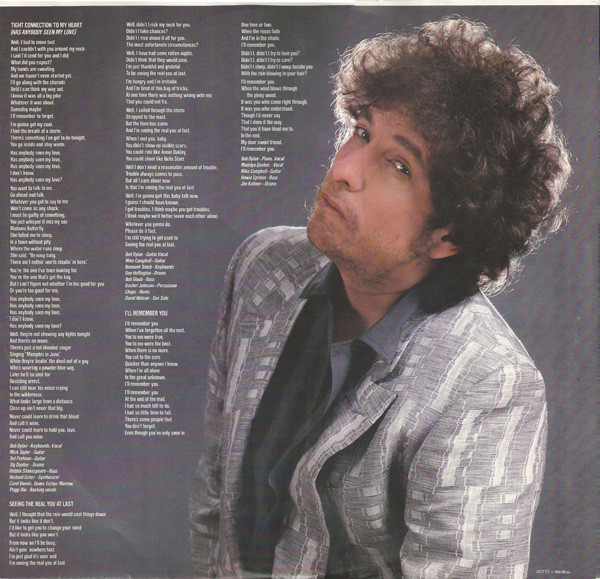
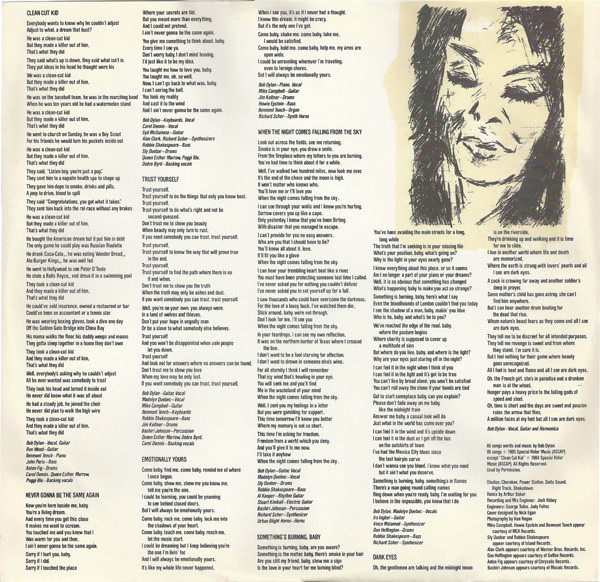
The Great Silence afterwards may be due to the lyrics. Which are, indeed, perhaps a bit directionless and incoherent, and also marred by clichéd idleness. Any connection between the couplets, linear or systemic or whatever, cannot be found. And even within those verses things go wrong; breaking waves rolling over him while standing on the sand? Dreaming of iron and steel with a large, hanging bouquet of roses? Okay, there is an otherwise opaque link with the album cover. In the bottom right that hand-drawn cover promises “Cast-Iron Songs & Torch Ballads”, the bottom left says “Moonglow” and well alright, that does have some sort of lyrical connection with the first verse, and yes: the word “waves” does come along too.

Still, the Master did not just shake something out of his sleeve. McGuinn does reveal that Dylan is working on it, for one thing. And after careful consideration, an entire verse was deleted. Between verse 2 and 3 there was originally the rather Dylanesque:

Time is all I have to give
You can have it if you choose
With me you can live
Never say goodbye.

… revealing Dylan’s eternal preoccupation with Time and evoking earlier work like ″I’ll Keep It With Mine″ and ″Pledging My Time″.

And Clinton Heylin, the unofficial discographer of all Dylan songs, claims in his Revolution In The Air that Dylan deviates from his own published lyrics and actually sings you’ve changed your last name. Heylin, however, also limits himself to seeking clarification of the text. The mere mention of a frozen lake and the North wind even leads him to see “a perfect evocation of Duluth in the still of winter” in the lyrics.

My my. Well, exaggeration is an art form too.

No, the real power of this beauty from Dylan’s repertoire is this time in the music – in the basso continuo after the opening couplet, the continuo that keeps on working towards a non-existent finale.

The intro alone has been given a rather unusual attention. Rambling, an acoustic guitar rattles the first four chords, suddenly Robbie Robertson’s electric guitar jumps up, pinching the last notes and making room for a lyrical bass, somewhere in the back the piano wakes up and then the singer can start: Twilight on the frozen lake

Six years after the Big Pink, The Band is back on track for this album, and that works out very well. The Canadian quintet has been playing with Dylan for hundreds and hundreds of hours, is therefore like no other ensemble able to follow the whims of the master and may even overrule the boss in musical discussions; Dylan almost considers the multi-instrumentalists Robbie Robertson, Rick Danko, Levon Helm, Garth Hudson and Richard Manuel as equals. The Band has never been a smooth, tight band, and not even too harmonious; rattling and grinding and crackling – but it is precisely that which harmonizes perfectly with Dylan’s singing style and way of working. The second song of the album, ″Going, Going, Gone″ is the first moment when everything, all the great qualities of both The Band and Dylan, comes together for a brief, magical moment.

The quieter but prettier sister of this song is “Never Say Goodbye”. For just under three minutes the song builds up to a climax that just doesn’t come, melodies tumble over each other, none of the five musicians plus Dylan feels responsible for something as trivial as a solid foundation or a tight rhythm – even occasional drummer Richard Manuel lets it go, after a minute of obediently tapping along – and yet, and yet: everything continues to work towards the same unknown, unattainable goal, the song runs on six legs, as it were. Music filled with such longing, such unfulfillable longing, as Salieri sighs in Shaffer’s Amadeus.

Covers do not exist either. Yes, a few diligent, but failed ones on YouTube, without exception by white, over-serious men in their late forties, in the living room with acoustic guitar.

No, we have to wait for Sinéad O’Connor, who like no other could elevate the romance, the unfulfillable longing in this song.

(In the next post Tony Attwood replies with his interpretation of the song.)

What else is on the site

You’ll find some notes about our latest posts arranged by themes and subjects on the home page.  You can also see details of our main sections on this site at the top of this page under the picture.

The index to all the 594 Dylan compositions and co-compositions that we have found on the A to Z page.

We also have a very lively discussion group “Untold Dylan” on Facebook with over 2000 active members.  (Try imagining a place where it is always safe and warm).  Just type the phrase “Untold Dylan” in, on your Facebook page or follow this link 

If you are interested in Dylan’s work from a particular year or era, your best place to start is Bob Dylan year by year.

On the other hand if you would like to write for this website, please do drop me a line with details of your idea, or if you prefer, a whole article.  Email Tony@schools.co.uk

And please do note   The Bob Dylan Project, which lists every Dylan song in alphabetical order, and has links to licensed recordings and performances by Dylan and by other artists, links back to our reviews

Posted in Uncategorized | 10 Comments

The Never Ending Tour: 1987 – Farewell to all that

By Mike Johnson (Kiwipoet)

‘And I try to harmonize with song
the lonesome sparrow sings’ 

(Gates of Eden)
‘I change during the course of a day. I wake and I’m one person, 
and when I go to sleep I know for certain I’m somebody else.’

I begin this journey through thirty-two years (and counting) of Bob Dylan’s Never Ending Tour with many fears and trepidations. I have to confess from the outset that I am no Dylan scholar; there are few Dylan books upon my shelf. Of Dylan’s life I know very little. I got about half way through Clinton Heylin’s compendious Behind the Shades but gave up on it. I’d rather spend the time I had listening to the songs.

That there might be something more to this than mere indifference only recently occurred to me when I encountered this quote from Jalāl ad-Dīn Muhammad Rūmī, a Persian poet from the Thirteenth Century:

‘Study me as much as you like, you will never know me. For I differ a hundred ways from what you see me to be … I have chosen to dwell in a place you can’t see.’

Does this remind you of anybody we know? Wherever you think he is, he’s not there. In a similar vein Dylan has said:

‘I change during the course of a day. I wake and I’m one person, and when I go to sleep I know for certain I’m somebody else.’

Rather than study Dylan, I immerse myself in the songs, entering them as one might a warm bath. You don’t study a warm bath, it might go cold on you; you just get into it. There may be hidden glimmerings of a life behind the songs, but it is through the songs themselves, and their various performances, that we come to know who ‘Bob Dylan’ is. And he is what he is in that moment of performance only.

‘I’m only Bob Dylan when I have to be. Most of the time I’m just myself.’ Most of the time.

So my journey through the NET (The Never-Ending Tour) will not become a biography, but rather move from performance to performance, the best performances of each year, at least those I can find. Unfortunately, I cannot date every performance, or move chronologically through each year, as my own records are patchy, and I sometimes didn’t keep the date of the song, only the year.

I could go on with more fears and trepidations and confessions of unfitness for the task ahead, but now I’m impatient to get on with it.

The first concert of the NET was on June 7 1988, but the best place to start is the year before, so we can get a sense of where Dylan was before the tour kicked off.

The misleading popular press would have it that Dylan was ‘in a sad place’ in 1987, in the months leading up to the tour. We are led to believe that he was ‘lost’ and ‘in search of directions.’ Maybe so, but this is not reflected the performances of that year, which are full of power and vigour.

Dylan worked with two bands in 1987, Tom Petty’s band and the Grateful Dead. Dylan had been working with Petty’s band since 1985, and by 1987 the performances were assured and confident. Dylan’s voice was sharp and clear, but he’d developed a staccato vocal style, breaking up his longer lines into shorter bursts and even single words, and this would carry through into 1988.

You can hear this breaking up of the lines clearly in the following performance of ‘Forever Young.’ The simple, clichéd lyrics can hardly account for the power of this song, which I believe lies in the impossibility of its repeated injunction: ‘may you stay forever young.’ There’s a heartbreak in here; we’d like to stay forever young, and our children too, but it is a forlorn yearning. Time will be time.

Of course we can stay young at heart, but even that doesn’t last forever.

The two versions of ‘Forever Young’ on the 1974 Planet Waves album point to the different ways of delivering this song, as an uplifting, upbeat celebration – or a dirge. The ninety-one year old Pete Seeger played it upbeat on the Dylan Amnesty tribute album, Chimes of Freedom (2012), but Dylan has almost always played it as a dirge, drawing out the essential pathos of the song. The slower the beat, the more drawn out and agonizing the main injunction becomes.

None more so than with this performance, London, November 17. Those who followed my Master Harpist series will be happy to note the thoughtful, gentle harp solo that introduces the song. The harp solo elaborates the theme of mortality and improvises around the sad-making melody line with its doomed uplift.

Forever Young

Wonderful, to hear way the voices of the girl chorus come floating in as we reach the end of the verses. Although he’d been working with girl choruses since the 1978 tour, and they played a big role in the Gospel years, by 1987 Dylan was using them very discretely and with subtle effect. Enjoy them while you can as 1987 was the last year Dylan was to use them.

Wonderful too, to hear how Petty’s pianist Benmont Tench anchors the musical line with playing that is solid and inventive.

Tench’s piano can also be heard to great effect on this haunting performance of ‘John Brown’, a little skipping riff that adds to the eeriness of the effect.

John Brown

‘John Brown’ is one of those songs never officially released but which crept up on us through performances. Like ‘Masters of War’, John Brown is seen as an anti-war, protest song. It is that, but the driving heart of the song is the dramatic confrontation between mother and son on the train platform, when John Brown ‘comes home from the war.’

The first verses quickly take John Brown off to war and back again, and build up the mother’s dewy-eyed patriotism and pride.

‘She got a letter once in a while and her face broke into a smile
As she showed them to the people from next door
And she bragged about her son with his uniform and gun
And these things she called a good old-fashioned war.’

Her illusions are shattered when her son returns, a broken man, to accuse her, and he finally ‘dropped his medals down into her hand.’ It is the bitterness of the young man, and the folly of his mother, that drives the narrative.

At the same time, we get what is perhaps Dylan’s most succinct attack on war, a telling observation that must surely resonate in our own age of perpetual war:

"Oh, and I thought when I was there, God, what am I doing here?
I'm a-tryin' to kill somebody or die tryin'.
But the thing that scared me most
was when my enemy came close
And I saw that his face looked just like mine. "

‘Die trying’ has entered our language as an expression of determination, but it is that identification of self with the hostile other that gives the song its touch of greatness.

The songs on John Wesely Harding (1967) are shot through with moral paradoxes and mysteries. ‘I dreamed I saw Saint Augustine’, written twelve years before Dylan’s conversion to Christianity, is steeped in religious feeling, a sense of spiritual despair. St Augustine is doomed to ‘tear through these quarters’, that is our world, ‘searching for the very souls/ whom already have been sold.’

At the end of the song we are confronted with the same realization that we found in John Brown – we are our own enemies.

I dreamed I saw St. Augustine
Alive with fiery breath
And I dreamed I was amongst the ones
That put him out to death
Oh, I awoke in anger
So alone and terrified
I put my fingers against the glass
And bowed my head and cried

On the album, the song comes over as sad, and slow, but in performance, and these are quite rare, there is an added sense of anger and despair. In 1987, his ‘cut up’ vocals lends the song a strange edge as if each word or phrase is being torn out of the melodic line, torn out of the singer’s throat. A wonderful, powerful performance, again anchored by Tench’s piano.

 I dreamed I saw St Augustine

Another song from that album that Dylan began to feature that year is  ‘Wicked Messenger’. A mysterious narrative with religious overtones, I’ve always thought of it as a sister song to ‘All along the watchtower’ and it can be powerful in performance. It is, however, perhaps a little too mysterious, and without the apocalyptic subtext of ‘Watchtower’, although both songs appear to bring bad news.

I particularly like the sound the band achieves in this performance, a hard, rough and ready, minimal sound. Interesting, how Dylan was slowly shaping Petty’s band, which can play loud and heavy, into this thin, sharp sound. It’s beginning to sound more like he effect he will achieve in the first years of the NET.

Wicked Messenger

We will see this song emerge in the late 90s in powerful, upbeat forms, but I think it’s the musical and vocal timing in this one that makes it one of my favourites.

‘I and I’, a gentle little song from the second side of Infidels, 1984, became a staple of the Petty years, often hard, bashing versions. By 1987 the sound was cut back to a crisp minimum. It’s worth picking up on the song here, as it will re-emerge in the 90s in both hard rock and softer forms.

I and I

There’s an apocryphal tale told about Dylan and Lenard Cohen having a conversion. Dylan expresses his admiration for Cohen’s ‘Halleluiah’, and asks him how long it took to write. “Five years,” Cohen replies, then expresses his admiration for ‘I and I’ and asks how long Dylan took to compose it. “Fifteen minutes,” Dyan says.

In terms of the lyrics, it’s an offbeat, whimsical song, touched with fantasy, which seems to express our fundamental aloneness in the world, even from our lovers, although the thought of them might offer comfort. The song contains the genius line: ‘Someone else is speaking with my mouth/but I’m listening only to my heart.’

And that wonderful chorus line:

‘I and I, in creation where one’s nature
neither honours nor forgives.’

Another hard, unremitting, Old Testament view of human nature.

A song that will also stick around well into the 90s is the apocalyptic, ‘Senor’, off the 1978 album Street Legal. There are some fine performances of this song during the Gospel years but here, in 1987, it gets a particularly passionate treatment. (I have written about this song in Master Harpist 3, and suggest the reader check out those comments). Tench and Dylan again work well, with a hard-edged but minimal rock sound.

Senor

What Dylan setlist would be complete without ‘The times they are a-changing’, the protest song that doesn’t protest anything? It must be in the running for Dylan’s most iconic song, and we’ll see it going through its own changings. In 1987 he could still deliver it like the Dylan of old, as a challenge, and play discordant harp just like he used to. As he grows older, the stridency of the song will give way to more mellow, philosophical performances; like that other iconic protest song, ‘Blowin in the wind’, ‘Times…’ is more like a meditation on time than a call to arms.

The times they are a-changing

The work Dylan did with the Grateful Dead has been pretty well documented. Like other Dylan commentators, I often find the results strangely lacking despite the obvious effort everyone is putting in. There are however some real gems. Among them is a rare performance of ‘Under your spell’, the final track on Knocked out loaded, 1986. It is a forlorn song indeed, straight from the dark night of the soul : ‘I was knocked out and loaded in the naked night…’

The soul is in a piteous state, unable to connect emotionally or spiritually, facing death ‘two feet from the well’; in other words, so close to salvation, yet so far away. I take the ‘well’ to imply the waters of life in the deserts of feeling. The last lines are pure Old Testament despair:

‘Well the desert is hot, the mountain is cursed
Pray that I don’t die of thirst
Baby, two feet from the well’

Surely must be Dylan’s most despairing last lines ever.

To ‘let the dead bury the dead’ (Mathew 8: 22) suggests we put aside the past so we might be ‘born again’ into the future free of spirit. In this song, however, the spirit is heavily burdened by emotional stuff, intoxicated and unable to shake free.

I’ll see you later when I’m not so out of my head
Maybe next time I’ll let the dead bury the dead

 Under Your Spell

Because of the poor recording, Dylan’s voice sounds distant and wan – you have to strain to hear it –  and this, more by accident than design I’m sure, fits in perfectly with songs ambience, its inherent pathos. A distant keening voice, almost extinguished. The thin sound of the harmonica picks up on that dreary mood and carries it to the end of the song. A mini-masterpiece it seems to me.

Idiot Wind

‘Idiot Wind,’ an acknowledged masterpiece, is difficult song to sustain in performance. It’s long and angry and I imagine takes a considerable emotional effort. Yet it remains the greatest of Dylan’s ‘attack’ songs, full of spite, anger, self-justification, smugness, pain and more pain – it’s an emotional tour-de-force. In this performance with the Grateful Dead, Dylan gives it all he’s got. Not an easy song to listen to, to see a soul laid bare in such a way. Magnificent.

Ballad of a Thin Man

As is this ripping performance of ‘Ballad of a Thin Man’, another song that we will often run into on our journey through the NET. I think it’s about the soul’s encounter with ‘otherness’ – the Other. In this age of multiple sexualities, this song seems to me to be more relevant than ever a carnival of the libido. These distorted carnival freaks reflect our own sexuality back to us, throw it in our faces, and when they’re done they say – ‘Here is your throat back, thanks for the loan.’

In carnival land, your power, status and literary pretensions mean nothing. Logic gives way to absurdity. Ego has nothing to cling to. You are in existential free-fall crying ‘Oh my God am I here all alone.’ Riddled with sexual imagery, the song sounds best when it’s given a sinister twist, as it is on the album Highway 61 Revisted, 1965. In this 1987 performance Dylan is in fine voice and there’s some nice guitar work by Gerry Garcia.

Knocking on Heavens door

If there is such a thing as definitive ‘Knocking on Heaven’s’ door, then this epic performance must be it. He just keeps on knocking! Is that a newly made-up verse I hear towards the end? Yes, and it sounds good.

This is a song of farewell, the final farewell of all. Death looms over the sweetness of this song, and Garcia sounds inspired. It’s Dylan’s vocal however which commands attention. Anyone tells you Dylan can’t sing, play them this one.  Vibrant and passionate, full of promise. A perfect way to end this post.

See you next time for 1988, when the tour kicks off for real.

Kia Ora!

Further thoughts

Articles on the songs above from the Untold Dylan archives

What else is on the site

You’ll find some notes about our latest posts arranged by themes and subjects on the home page.  You can also see details of our main sections on this site at the top of this page under the picture.

The index to all the 594 Dylan compositions and co-compositions that we have found on the A to Z page.

We also have a very lively discussion group “Untold Dylan” on Facebook with over 2000 active members.  (Try imagining a place where it is always safe and warm).  Just type the phrase “Untold Dylan” in, on your Facebook page or follow this link 

If you are interested in Dylan’s work from a particular year or era, your best place to start is Bob Dylan year by year.

On the other hand if you would like to write for this website, please do drop me a line with details of your idea, or if you prefer, a whole article.  Email Tony@schools.co.uk

And please do note   The Bob Dylan Project, which lists every Dylan song in alphabetical order, and has links to licensed recordings and performances by Dylan and by other artists, links back to our reviews

Posted in Uncategorized | 5 Comments

The Titanic-Olympic War


By Larry Fyffe

By now it should be obvious to the readers of ‘Untold Dylan’ that our intrepid researchers have uncovered evidence that reveals the singer/songwriter/musician Bob Dylan is a Gnostic shape-shifting time-traveller; indeed, it is he who actually writes the ancient mythologies attributed to the Greeks and Romans.   Therein lies a “Great Code” that when deciphered reveals  major happenings in the musician’s harrowing journey from a little town in Minnesota to the top of Mount Olympus.

For the last ten years, our researchers have been stuffing our biggest computer, affectionately called “Fat Nancy”, with Dylan’s song lyrics, scholarly works thereon, biographical material … so on and so forth. Following is a summary of the read-out gathered from the “Fat Nancy” in reference to the mythology of the Titanic-Olympic War in which the gigantic gods known as the Titans (who have little compassion for mere mortals) are overthrown by the rebellious gods known as the Olympians.

Saturn be the god of the Universe and Time; the Titan decides to consume his children. Zeus banishes him; mythologist and poet Robert Graves even claims Zeus castrates him. “Fat Nancy” concludes that Saturn’s modern equivalent is none other than Elvis Presley; he loses touch with the younger generation:

Maybe it's to late, but I sometimes even hate myself for loving you
Trying to be strong, then night comes along, and I start wanting you, wanting you ...
Hating me for wanting to be with you, knowing you don't love me like you used to
But it's midnight, and, ohhh, I miss you
(Elvis Presley: It's Midnight ~ Wheeler/Chesnut)

Atlas, god of the Sky, stands steadfast with his fellow Titans, and gets severely punished by the Olympian Zeus – forced he is to carry the heavens on his shoulders. Perseus, the son of Zeus and the mortal Dinae, turns the Titan into a rock. Concludes the computer, Atlas is the modern equilvalent of Buddy Holly who dies in an airplane crash:

One, two, three o'clock, four o'clock, rock
Five, six,  seven o'clock, eight o'clock rock,rock
Nine, ten, eleven o'clock, twelve o'clock, rock
We're gonna rock around the clock tonight
(Buddy Holly: Rock Around The Clock ~ Freedman/Myers)

Prometheus be the god of Fire, a Titan who has a soft spot for the human mortals, and sides with Zeus and the Olympians against the tyranny of the Titans; however, he suspects the younger gods are no different; his modern equivalent, Johnny Cash:

The taste of love is sweet
When hearts like ours meet
I feel for you like a child
Oh, the fire was wild
(Johnny Cash: Ring Of Fire)

https://youtu.be/It7107ELQvY

Oceanus be the god of the Rivers and Seas; Zeus does not banish him; instead the Titan is allowed to have control of the Oceans because he protects Hera, the wife of Olympian Zeus, during the Titanic-Olympic War. His modern equivalent is Frank Sinatra who stars as Danny Ocean in the movie ‘Ocean’s Eleven’ in which he plays a casino robber:

Take me back, I love you
Pity me, I need you
I know it's wrong, it must be wrong
But right or wrong, I can't get along without you
(Frank Sinatra: I'm A Fool To Want You)

Here’s what “Fat Nancy” deciphers in reference to the gods on Mount Olympus. Zeus, the god of Thunder, who overthrows the Titan Saturn, is the ‘Beat’ writer Jack Kerouac in recent times:

And I will die,  and you will die, and we all will die
and even the stars will fade out one after another in time
(Jack Kerouac: "Desolation Angels")

Neptune, god of the Sea, the “Earth-Shaker,” is Neil “Shakey” Young;

I'm the ocean, I'm the giant undertow
I'm the ocean,  I'm the giant undertow
(Neil Young: I'm The Ocean)

Hades be the god of Underworld who abducts Persephone; he’s Mick Jagger:

Take me down little Susie, take me down
I know you think you're the queen of the underground
And you can send me dead flowers every morning
Send me dead flowers by the mail
Send me dead flowers to my wedding
And I won'the forget to put roses on your grave
(Mick Jagger/Rolling Stones: Dead Flowers~Jagger/Richards)

Venus, the goddess of Love, be born of the seafoam; modern equivalent, Joan Baez:

The Madonna was yours for free
Yes, the girl on the half-shell
Would keep you unharmed
(Joan Baez: Diamonds And Rust)

Dionysus be the god of the Vine, and he can turn himself into a lion, (some mythologists say he’s the son of Zeus – transformed into a golden rain, he rapes Persephone). He’s Dylan’s code word for Robbie Robertson of The Band:

We carried you in our arms on Independence Day
And now you throw us all aside, and put us all away
Oh, what dear daughter 'neath the sun
Could treat a father so
To wait upon him hand and foot, and always tell him 'no'?
(Richard Manuel/The Band: Tears Of Rage ~ Bob Dylan/Robbie Robertson)

Diana be the goddess of the Moon; she has a dark and light side – she’s Joni Mitchell:

I’ve looked at life from both sides now
From give and take, and still somehow
It’s life’s illusions I recall
I really don’t know life at all
(Joni Mitchell: Both Sides Now)

Apollo, son of Zeus, be the god of the Sun –  Bob Dylan himself, that is (Kerouac, Robertson, Manuel, Mitchell, and Young are Canadians).

What else is on the site

You’ll find some notes about our latest posts arranged by themes and subjects on the home page.  You can also see details of our main sections on this site at the top of this page under the picture.

The index to all the 594 Dylan compositions and co-compositions that we have found on the A to Z page.

We also have a very lively discussion group “Untold Dylan” on Facebook with over 2000 active members.  (Try imagining a place where it is always safe and warm).  Just type the phrase “Untold Dylan” in, on your Facebook page or follow this link 

If you are interested in Dylan’s work from a particular year or era, your best place to start is Bob Dylan year by year.

On the other hand if you would like to write for this website, please do drop me a line with details of your idea, or if you prefer, a whole article.  Email Tony@schools.co.uk

And please do note   The Bob Dylan Project, which lists every Dylan song in alphabetical order, and has links to licensed recordings and performances by Dylan and by other artists, links back to our reviews

Posted in Uncategorized | 5 Comments

Was Dylan ever really a protest singer – even in the 1960s?

by Tony Attwood

Of late I have been working my way through the songs Dylan wrote in the 1950s and 1960s.  (There’s an index to the articles at the end of this piece). I make it 262 songs written and co-written, starting from the three 1969 songs, and ending with “Living the blues” in 1969.

This list is enhanced beyond the number of songs written in other years because it includes all the songs on the Basement Tapes (which in other circumstances might not have been recorded or might not have survived given that some were just improvisations, or sketches) plus the “New Basement Tapes” based on the notebook in which Dylan created a set of lyrics for songs he did not go on and finish.

By way of comparison, most commentators credit Paul McCartney with 200 songs in his entire career.  The only songwriter of renown who exceeds Dylan’s output appears to be Irving Berlin who is often quoted as having written 1500 songs in a 60-year career.  The exact dates of many of his compositions cannot be stated with certainty as they were copyrighted in batches, but it is generally agreed that he wrote approximately 95 songs between 1917 and 1921 (probably his most active period of writing), which averages 19 songs a year.  However, it appears that the sketches that would be Berlin’s equivalent to the Basement Tapes have not survived – for the most part we only have details of the final copyrighted songs.

What I have been doing in the articles in this series about Dylan’s song writing from 1959 to 1969 is listing the songs in chronological order and assigning a simple topic or theme to each song in order to categorise them.  The totals are for the entire period by category are…

  • Art: 3
  • Being trapped/escaping from being trapped (being world-weary): 10
  • Blues: 8
  • Betrayal: 1
  • Celebrating a city 1
  • Change: 4
  • Death: 3
  • Depression: 1
  • Disasters: 1
  • Disdain: 7
  • Eternity: 1
  • Future will be fine: 2
  • Gambling: 2
  • Happy relationships: 1
  • How we see the world: 3
  • Humour, satire, talking blues: 13
  • Individualism: 8
  • It’s a mess: 3
  • Leadership: 2
  • Look after yourself: 1
  • Lost love / moving on: 30
  • Love, desire: 31
  • Lust : 1
  • Moving on: 9
  • Nothing changes: 4
  • Nothing has meaning: 2
  • Party freaks: 3
  • Patriotism: 1
  • Personal commentary: 2
  • Protest 20
  • Randomness (including Kafkaesque randomness): 11
  • Rebellion: 1
  • Relationships 1
  • Religion, second coming: 2
  • Sex (country life): 1
  • Social commentary / civil rights: 6
  • Slang in a song: 4
  • Surrealism, Dada: 15
  • Travelling on, songs of leaving, songs of farewell, moving on: 16
  • The tragedy of modern life: 3
  • WH Auden tribute: 1

Of course, many of these topics could be joined together to make broader topics but I’ve kept them apart thus far to keep a record of the original totals I came up with, and in case I have the strength and tenacity to repeat the process with the 1970s.

Here are the subjects that have 10 or more songs attributed to them.

  • Being trapped: 10
  • Randomness (including Kafkaesque randomness): 11
  • Humour, satire, talking blues: 13
  • Surrealism, Dada: 15
  • Travelling on, songs of leaving, songs of farewell, moving on: 16
  • Protest: 20
  • Lost love / moving on: 30
  • Love, desire: 31

What does interest me particularly, is that this was the decade when Dylan became known as not just a protest songwriter, but THE protest songwriter of the modern age.  Yet even in this period of his life, protest songs were only third on the list of topics, and greatly outnumbered by his songs taken from what are generally considered the traditional pop subject matter of love, lost love and dance.  Of course Bob didn’t bother himself with dance, but he did write a third more love and lost-love related songs during this time, than protest songs.

Thus on this analysis, jJust under 8% of the songs Dylan wrote in the period 1959/1969 were protest songs.  Even if some of the categorisations that I have given are challenged, that percentage is still going to be very low.

Here is the list of the most popular categories for Dylan’s songs in this period as a percentage of all the songs written during this era.

  • Being trapped: 4%
  • Randomness (including Kafkaesque randomness): 4%
  • Humour, satire, talking blues: 5%
  • Surrealism, Dada: 6%
  • Travelling on, songs of leaving, songs of farewell, moving on: 6%
  • Protest: 8%
  • Lost love / moving on: 11%
  • Love, desire: 12%

By this analysis the great protest singer/songwriter of the age wasn’t dedicating himself to challenging the status quo: he was a singer and creator of songs about love, who also took on some protest songs along the way.

One can of course argue that Dylan’s most popular or most memorable songs were the protest songs, and so to consider this point I’ve pulled together the protest songs that I found in my first reviews by subject.  Then to try and overcome any arguments that my categorisation was not fair, I went back and added ten more songs that might perhaps be called “protest” by some analysts.  I have left the details of the categories that I assigned as I worked through the decade in the earlier articles.

This now gives me 31 songs out of 262, or 12% of his total output.   Here is the full list, and in case the argument is put that although the number of protest songs was small, they were the most important songs that Dylan composed in the era, I’ve included the full list.

I would add that I have even included “Times they are a changin” which I have often argued is not a protest song at all, but rather a song that the lyrics of which say that change is happening no matter what we do.  This is quite contrary to the general understanding of a protest song in which the key point is that people (often young people) should rise up in order to change the world order.

Here’s the expanded list with the descriptions that I assigned each song, on compiling the original articles…

  1. Man on the street (Tragedy of life, the lack of humanity in urban communities)
  2. Hard times in New York Town (a satire on urban life)
  3. Talkin’ John Birch Society Blues (Right wing protest)
  4. Death of Emmett Till (social commentary: racism)
  5. The Ballad of Donald White (social commentary)
  6. Let me die in my footsteps (anti-nuclear war; stand up and be proud)
  7. Ain’t gonna grieve (civil rights)
  8. Long Ago Far Away (nothing has changed)
  9. Hard Rain’s a gonna fall (War protest)
  10. Ballad of Hollis Brown (Rural protest)
  11. John Brown (War protest)
  12. Train A Travellin’  (Stand up and protest about what’s going on around you)
  13. Ye Playboys and Playgirls  (Stand up and change the world)
  14. Oxford Town (Racism Protest)
  15. Masters of War (War protest)
  16. Who killed Davey Moore?  (Boxing, Inequality)
  17. Walls of Red Wing (Protest: life is a matter of chance)
  18. You’ve been hiding too long. (Our leaders have betrayed the ideals of our country)
  19. Seven Curses (Absolute betrayal of justice)
  20. With God on our Side (Protest)
  21. Talking World War III Blues (Protest, surrealism)
  22. Only a pawn in their game  (Social commentary, protest)
  23. North Country Blues (Rural protest)
  24. Gypsy Lou  (Art, Protest)
  25. When the ship comes in  (Protest)
  26. The Times they are a-Changing (Protest)
  27. Percy’s Song (The failure of justice)
  28. The Lonesome Death of Hattie Carroll (Protest, racism)
  29. Chimes of Freedom (Protest)
  30. Gates of Eden (Protest, Individualism, A world that makes no sense)
  31. Desolation Row (Political protest; It’s not the world, it’s how you see the world).

Conclusions

What I take from this little exercise is that

a) The range of subjects Dylan tackled was huge and incredibly varied – it is one of the things that marks him out as a songwriter.

b) Any attempt to categorise him, or this era in his writing, as being dominated by protest songs, is completely false.

c) During the decade Dylan meandered around his chosen subjects.  Some, such as “being trapped” clearly relate to his condition at the time (ie in the Basement) while others seem to take his interest for a few songs, sometimes just one song, and then are left as he once more moves on.

d) The output is phenomenal and I suspect far above even the most prolific time in the life of the other American songwriter of great merit with a massive output, Irving Berlin.

e) As the decade ended, Dylan moved into new areas of writing, such as the Kafkaesque lyrics of the JWH album, followed by the country inspired love songs at the end of the decade, which were so very different from his earlier work.   But Dylan was experimenting all the way through the decade. Those 41 categories that I have used above to classify all of Dylan’s songs from the era do not simply establish as a varied writer, they also reveal him to be a writer who wants to explore, who wants, within his work to travel to all possible places, who wants to see what happens if one tries that, this or something else.

I’ve no idea if anyone else has found this exercise interesting, but I must say that when I started it, despite having spent several years catalouging Dylan’s writing through his entire career, I had no idea just how varied the subject matter of Dylan’s output was in this era, nor which subjects would turn out to be his main areas of interest.  For that alone, I’m rather glad I was able to find the time to do it.  It fascainted me, even if no one else.

I might even have a go at the 1970s next.

Dylan’s songwriting in the 1960s: the series

What else is on the site

You’ll find some notes about our latest posts arranged by themes and subjects on the home page.  You can also see details of our main sections on this site at the top of this page under the picture.

The index to all the 594 Dylan compositions and co-compositions that we have found on the A to Z page.

We also have a very lively discussion group “Untold Dylan” on Facebook with over 2000 active members.  (Try imagining a place where it is always safe and warm).  Just type the phrase “Untold Dylan” in, on your Facebook page or follow this link 

If you are interested in Dylan’s work from a particular year or era, your best place to start is Bob Dylan year by year.

On the other hand if you would like to write for this website, please do drop me a line with details of your idea, or if you prefer, a whole article.  Email Tony@schools.co.uk

And please do note   The Bob Dylan Project, which lists every Dylan song in alphabetical order, and has links to licensed recordings and performances by Dylan and by other artists, links back to our reviews

Posted in Uncategorized | Leave a comment

Bourbon Street and the problem with cultural references

by Jochen Markhorst

Louis Jordan (1908-1975) is, of course, the Grandmaster of Novelty Songs, the songs relying on a comic effect.  Their hit potential is indestructible and of all times. Songs like “They’re Coming To Take Me Away, Ha-Haaa!” (Jerry Samuel, 1966), “Da Da Da” (Trio, 1982), “Yakety Yak” (The Coasters, ’58), artists like Zappa (“Dancing Fool”) and Weird Al Yankovic.

Even Sinatra sins one time (with the utterly failed “Mama Will Bark”, ’51) and in the summer of 2018 Cardi B scores a worldwide hit with the novelty song “I Like It”.

In the 40s, Louis Jordan and his band Tympany Five score one hit after another with farcical choruses, bizarre sound effects or humorous lyrics. “G.I. Jive”, “Mop! Mop!”, “Five Guys Named Moe”, “Petootie Pie”, to name just a few.

In the space of ten years, between 1942 and 1951, Jordan produces no fewer than fifty-four Top 10 hits, fifteen of which achieved number 1 (!) in the R & B / Race Charts, and nineteen singles also score cross-over, in the white lists. No small hits there either; nine times the Top 10 of the US Pop Chart and two hits are even really, really cross-over, scoring in three lists: “Ration Blues” also achieves the first place in the Country Charts, as well as “Is You Is Or Is You Ain’t My Baby”.

But archiving the King Of The Jukebox only as a novelty artist does not do justice to Jordan’s phenomenal musicality, the refined compositions and, above all, his enormous influence. Chuck Berry points to Louis Jordan, when someone tries to honour him as the Founder of The Rock ‘n’ Roll. Without Louis Jordan, Berry says, I would never have got into music.

He also easily admits that he simply stole Johnny B. Goode’s earth-shattering intro from Jordan: from the intro to “Ain’t That Just Like A Woman” – which has inspiring lyrics too, apparently. Inspiring Chuck Berry to “Brown-Eyed Handsome Man” and Dylan to a song like “Highway 61 Revisited”, that accumulation of surreal, unrelated couplets with Biblical references:

There was Adam, happy as a man could be
Till Eve got him messin’ with that old apple tree
Ain’t that just like a woman?
Yeah, ain’t that just like a woman?
Ain’t that just like a woman?
They’ll do it every time

Lot took his wife down to the cornerstore for a malted
She wouldn’t mind her business, boy did she get salted
Ain’t that just like a woman?
Yeah, that’s just like a woman, they’ll do it every time

James Brown, too, repeatedly recognizes the impact on his own development, as does Little Richard, and Jordan’s producer, Milt Gabler, transposes the jukebox king’s music to his white client Bill Haley, again such a Founding Father of the rock ‘n’ roll. Bill Haley And The Comets include quite a few Jordan songs in their repertoire (“Choo Choo Ch’Boogie”, “Caldonia”). It all justifies the honorary title Grandfather Of Rock ‘n’ Roll, at any rate.

As a radio programme maker, Dylan cannot avoid the man. In his Theme Time Radio Hour, he plays Louis Jordan eight times, as often as Sinatra and Bob Wills, one less than leader George Jones. “Louis became one of the pioneers of rhythm & blues,” Dylan says appreciatively in episode 13, after “If You’re So Smart, How Come You Ain’t Rich?”, and then recalls how even Chuck Berry calls Jordan one of his main influences, “… and Chuck doesn’t reflect or transmit light falling on anybody.”

In the basement of the Big Pink, the spirit of Louis Jordan also roams around, in 1967. Moods of corny haziness are set in novelty songs such as “My Bucket’s Got A Hole In It”, “Kickin’ My Dog Around” and “See You Later, Allen Ginsberg” and the corniness reaches a creative peak at “Bourbon Street”, the brother of Jordan’s first number 1 hit: “What’s The Use Of Getting Sober (When You Gonna Get Drunk Again)”.

The gimmick of that Jordan song is the opening dialogue between a despondent, severely disappointed father and his idiot son who can’t resist alcohol. When dad is done with his reproachful whining, the drunk son gets all the space he needs to sing his drunk song on booze: “Why would you want to get sober if you will get drunk again after all.”

From that part, the song’s stronghold, Dylan then copies and extrapolates the dictation, the phrasing and the liquid recital; Dylan’s protagonist is the son from What’s The Use, who just hangs at the bar again, after Dad’s scolding.

Dylan and the guys from The Band know how to match the washed-out slowness of Jordan’s song, which evokes the wee small hours of a shattered night on the country’s most notorious nightlife street, Bourbon Street in New Orleans. The Big Pink does not have such an excellent wind section as the Tympany Five, but behold: just a drunken trombone (Rick Danko, presumably) is enough to evoke New Orleans.

The text seems largely improvised on the spot and is not entirely understandable. But that the good-humoured Dylan lets the lyrics revolve around a harmless wordplay à la Rainy Day Women can still be extracted. The (few) analysts seem to igore that, though. Clinton Heylin, Greil Marcus and Tony Attwood do not see much more than a boozer hanging at a bar somewhere on Bourbon Street, or roaming from bar to bar. All three then ignore the opening line “I like another Bourbon Street”, the line “I want a Bourbon Street” and especially the refrain line of the last verses: “Mister bartender, I’ll have another Bourbon Street”.

Alliterating with a common order, a Bourbon straight, pure, but even more so, the barfly apparently wants to see a whole street of bourbon whiskeys in front of him, a row of let’s say eight drinks – Geronimo! And the fact that Bourbon Street actually is the name of a famous pub street in America is a nice bycatch for an extra layer to the pun.

The appropriate name is pure coincidence, by the way; the street is named after the French royal house (after all, La Nouvelle-Orléans used to be the capital of the French colony Louisiana), not after the whiskey variant that was originally distilled in Bourbon County in Kentucky, twelve hundred kilometres away.

In 2018, Dylan will then complete the circle by returning to the slurringly sung booze. Following the likes of Willie Nelson, Motörhead, George Clooney and David Beckham, he releases his own whiskey series: Heaven’s Door. According to the test panel of Grub Street, the popular food blog of New York Magazine, the tastiest of these whiskeys is, for that matter, not the Tennessee Bourbon, but the Double Barrel Whiskey. At least, that one is said to be the most “Dylan-y” of the three whiskeys, having still some “depth”.

“I wouldn’t say it’s a great Dylansong, but it’s cerainly an imitation of an okay Dylan song,” says panel member Adam Platt, New York Magazine’s culinary reviewer, and the other critics agree.

The Bourbon is okay. Not awful. But: “there isn’t anything, like, Bob Dylan about this,”  says music editor Sam Hockley-Smith. Platt, agrees, again very quotable:

“It’s not weird and curly-haired and sinewy. Spiky and sort of gathering stones and moss. It’s pretty much straight down the middle of the road.”

For the sinewy, bizarre, disheveled weirdo they then have to play the last song on disc 4 of The Bootleg Series 11 – The Basement Tapes Complete: the catchy, silly, Dylan-y “Bourbon Street”.


Footnote from Tony Attwood: I guess my problem was the issue of whisky.  Now if the song had been about Australian merlot, I might have stood a chance of getting its meaning.


What else is on the site

You’ll find some notes about our latest posts arranged by themes and subjects on the home page.  You can also see details of our main sections on this site at the top of this page under the picture.

The index to all the 594 Dylan compositions and co-compositions that we have found on the A to Z page.

We also have a very lively discussion group “Untold Dylan” on Facebook with over 2000 active members.  (Try imagining a place where it is always safe and warm).  Just type the phrase “Untold Dylan” in, on your Facebook page or follow this link 

If you are interested in Dylan’s work from a particular year or era, your best place to start is Bob Dylan year by year.

On the other hand if you would like to write for this website, please do drop me a line with details of your idea, or if you prefer, a whole article.  Email Tony@schools.co.uk

And please do note   The Bob Dylan Project, which lists every Dylan song in alphabetical order, and has links to licensed recordings and performances by Dylan and by other artists, links back to our reviews

Posted in Uncategorized | 1 Comment

Bob Dylan And The New Historicism

by Larry Fyffe

In ‘Far From The Madding Crowd’, Thomas Hardy, with black humour abounding, romanticizes the values of Victorian country life by referencing the ancient mythology of the aristocratic Trojan War.  The heroine of Hardy’s story is sexually attracted to, and marries, a rather amoral soldier named Troy. At the end of the story, she returns to her shepherd friend. He’s attuned to the workings of the natural world and has the good Christian name of Gabriel, the angel who appears to the Virgin Mary. The Realistic aspects of rural living take hold; she ceases her selfIsh indulgences and follows the human inclination to help one’s neighbour.

Time marches on, and the approach to literature known as the New Criticism comes to the fore; it has little regard for the economic, political, and sociological events happening in the era in which the literature being studied is written. Pseudo-Marxist New Historicism of the post-modern age reacts to the claimed ‘objectivity’  of the New Criticism and focuses on how subjective elements in both history and literature interact with one other.

The academic process used by the intelligentsia lends itself to satire and burlesque by writers and artists not only from within but especially by those from outside this social group. In effect, the approach is like a dragon that’s trapped in a capitalist cavern and is eating its own tail.

Back to ideology-driven mythology. Theseus is the wise and honourable ruler of Athens who gives the people of the city the right to govern themselves. He marries Phaedra who falls in love with her stepson. Theseus’ son loves danger, not woman, and he rejects her. Phaedra commits suicide but leaves a letter that tells her husband that his son violated her, and he believes it. The son is banished, and he gets killed. His father, needless to say, is heartbroken when he finds out the truth.  Up to her old tricks, Aphrodite has put a spell on Phaedra in order to get back at Theseus’ son. He had the audacity to spurn the advances of the goddess of love and sex, known to the Romans as Venus.

The song below, examined through the mirror of the New Historical perspective, burlesques the above mythology, and derivatives formulated therefrom over time, by employing a mixture of what is usually considered ‘low’ art, and what is usually considered ‘high’ art:

Well, Phaedra with her looking glass
Stretching out upon the grass
She gets all messed up, and she faints
That's 'cause she's so obvious, and you ain't
(Bob Dylan: I Wanna Be You Lover)

In the following lyrics, though its relative moral outlook is put not asunder, the New Historicism with its disregard for what is considered by many to be ‘basic human nature’ is mocked:

I hurt easy, I just don't show it
You can hurt someone, and not even know it
The next sixty seconds could be an eternity
Gonna get down low, gonna fly high
All the truth in the world adds up to one big lie
I'm in love with a woman who don't even appeal to me
(Bob Dylan: Things Have Changed)

Below, the singer/songwriter, pretending to belong to a class that he isn’t, takes on a persona akin to that of a hobo from the times of the Great Depression:

I am a lonesome hobo
Without family or friends
Where one man's life might begin
Is exactly where mine ends
I have tried my hand at bribery, blackmail, and deceit
And I've served time for everything
'Cept begging on the street
(Bob Dylan: I Am A Lonesome Hobo)

The next song satirically inverts the capitalist creed that the economic structure provides the prospect of prosperity for everyone:

You never change your socks
And the little streams of alcohol
Come trickling down the rocks
The brakemen have to tip their hats
And the railway bulls are blind
There's a lake of stew
And of whiskey too ....
In the Big Rock Candy Mountains
(Pete Seeger: Big Rock Candy Mountain ~ traditional folk song)

The suppositions of New Historicism be summed up quite nicely in the following song; Christian values usurped and corrupted by the wealthy and powerful take a beating:

Might like to wear cotton, might like to wear silk
Might like to drink whiskey, might like to drink milk
You might like to eat caviar, you might like to eat bread
You may be sleeping on the floor, sleeping in a king-sized bed
But you're gonna have to serve somebody, yes indeed
Well, it may be the devil, and it may be the Lord
Both you're gonna have to serve somebody
(Bob Dylan: Gotta Serve Somebody)

What else is on the site

You’ll find some notes about our latest posts arranged by themes and subjects on the home page.  You can also see details of our main sections on this site at the top of this page under the picture.

The index to all the 594 Dylan compositions and co-compositions that we have found on the A to Z page.

We also have a very lively discussion group “Untold Dylan” on Facebook with over 2000 active members.  (Try imagining a place where it is always safe and warm).  Just type the phrase “Untold Dylan” in, on your Facebook page or follow this link 

If you are interested in Dylan’s work from a particular year or era, your best place to start is Bob Dylan year by year.

On the other hand if you would like to write for this website, please do drop me a line with details of your idea, or if you prefer, a whole article.  Email Tony@schools.co.uk

And please do note   The Bob Dylan Project, which lists every Dylan song in alphabetical order, and has links to licensed recordings and performances by Dylan and by other artists, links back to our reviews

Posted in Uncategorized | 2 Comments

Dylan’s (possible) new album, “Days Of Yore” and the 2020 Summer European Tour?

by mr tambourine

I have recently written a couple of articles (Bob Dylan: Potential 2020 Setlists. Part 1, the Japan Tour and Bob’s Japanese tour: Potential set lists part 2) about Bob’s potential setlists for the Japanese Tour from April 1 to April 21. It seems that another show was added, April 24, also Tokyo. So that’s 12 concerts in Tokyo and 3 in Osaka for April

Now that I’m writing this new article, maybe it will get expanded some more? Maybe to Australia shortly for three more shows maybe? Maybe not. No one mentioned this so far, this is just my thinking.   Just like I started hearing some news about Bob’s new album coming up somewhere in the near future.

First time I read something, I saw some news of a ‘’2021 Promotional European Tour’’.

Now, I’m hearing rumours about Bob having eight to 10 songs, that are supposed to be original songs, some sources say eight, some sources say 10, no one mentions any covers. Just original songs were mentioned. Also, now it’s a 2020 Summer European Tour, not 2021 anymore.

Any names of the songs maybe? Not yet.   All I heard is the album name ‘’Days Of Yore’’.

Even though I was skeptical about it in the beginning, I think I’m beginning to see that it could make sense.

The only way I can imagine a new Bob album currently is by recalling all kinds of arrangements of songs in recent memory, let’s say from 2016, when it was announced Bob won the Nobel Prize for literature. Since then, there have been some pretty interesting arrangements.

So what is Days Of Yore exactly? What could it be?

Days Of Yore mostly gets mentioned in olden days of old songs. One of the occasions I heard them in was the Christmas songs – many of them from Bob’s Christmas In The Heart from 2009.

That’s why this name, when it came up, scared a lot of people. ‘’Oh, no, another cover album’’.

But let’s get one thing straight.   Bob never released three albums in a row with the same theme.

Even the famous Christian Era, was just three years long (1979-1981), even though when you take a look at the material Bob produced at the time, it seems like decades.

The Golden Age of Dylan, the Bringing It All Back Home, Highway 61 Revisited and Blonde On Blonde phase was just captured in three albums, it could’ve easily been five, or maybe even six.

An album like Infidels had material for seven albums it seems, with all the outtakes that got left off. Even Shot Of Love outtakes seem that way sometimes.

Since 1990, with the disaster of Under The Red Sky, Bob has been taking it slow with new material.

  • Under The Red Sky 1990 -> Time Out Of Mind 1997
  • Time Out Of Mind 1997 -> Love And Theft 2001
  • Love And Theft 2001 -> Modern Times 2006
  • Modern Times 2006 -> Together Through Life 2009
  • Together Through Life 2009 -> Tempest 2012
  • Tempest 2012 -> Days Of Yore 2020???

I know, this is the longest gap ever.  But I’m kind of getting tired of comments that Tempest was the last album of original material.  It is quite possible that Bob is just scaring us a little on purpose, and he’s taking his time.

But whatever this may be – this ‘’Days Of Yore’’ – if that’s really gonna be the name – this album should excite us all.

Why?  I think Dylan, based on his live performances, is in top form, no matter how you look at it.

Vocally – this is the best Dylan has sounded in – I gotta say it – more than 30 years. It’s crazy to say it, but it’s true. I know many people might disagree, but I have heard people who have seen him 100+ times that have said the same thing.

I remember the first time I heard Shadows In The Night. Still to this day it shocks me.  I thought Dylan was reborn in 1997 with Time Out Of Mind.  I thought Dylan was reborn in 1979 when he became a born-again Christian.  You have many cases where people mention his ‘’reborn’’ phases. It’s hard to tell which phase it truly was.

But the one from 2015 when singing the Sinatra songs – completely staying in key and showing a lot of passion – it was amazing.  But then came two more albums – then came the live shows 2015-2019 – and it just got better.

2018 and 2019 are amazing years for live Bob.  It’s crazy to think about it.

When I heard Shadows In The Night – even though I saw a rebirth – I also thought it was the final curtain. It felt like Bob has left everything for the end – and the end seemed to be near.

I just keep praying – whenever I can – that Bob is alright.  Last year’s ‘’fall’’ in Vienna, when he was warning the crowd to stop taking pictures, really scared me. I thank God he was alright.

And not only that – he came back better.  The fans in Vienna must’ve made him furious.

As some of the followers of my YouTube channel know, Bob’s (so far) last album of original material Tempest was inspired by a statue in Vienna, Austria. The cover of the album that is.

So the fact that they made him angry that night, must’ve really inspired Bob.  It wasn’t until then that we got some setlist changes later during the tour.

And then, the recent Fall Tour 2019 – singing Not Dark Yet like he sang it; just mesmerizing really.

Bob’s peers seem to be doing Farewell Tours all over the place or are unfortunately passing away, but Bob keeps going – somehow, someway.   Indeed 2016 was a year where many celebrities died, especially musicians – Bob won the Nobel Prize that year.

Bob’s best buddies die then and there – like Robert Hunter before the Fall Tour 2019 – and Bob performs such versions of Not Dark Yet later – probably as a secret tribute to his good buddy – or maybe even Lenny Bruce; the same could be said about the Lenny Bruce performances.

And now – if he’s really recording a new album – and the fact that it might be the best we’ve heard in a while – as I said, because of Bob’s improved vocals.  And also, and I find this very interesting, his lyrical revisions over the last few years for songs like “Simple Twist Of Fate” or “Lenny Bruce” or even “When I Paint My Masterpiece” – could be a hint at something that’s coming. Honestly, some of those re-writes are so good. The new Simple Twist Of Fate lyrics are so great – I sometimes think they are better than the original.

Also, the Tangled Up In Blue lyrics from 2016 to 2018; we could be onto something really special.

I think if Days Of Yore really comes out, it will be something that could be Bob’s reaction to the Nobel Prize victory more than anything.   A lot of people were skeptical about it: well, now’s a chance for Bob to show them one more time that he earned it – fair and square. Nobody earned it more.   So Bob’s been taking his time – and he’s ready to surprise us.

Now, the tour of 2020 in summer in Europe?   Locations like France, Spain, Northern Italy, Balkan, Turkey and Israel are mentioned.  Something like a combination of a 2010 and 2011 Tours?

The only locations I heard are really in the mix are Italy and Turkey. So if that’s true, then a tour along the lines of that considered above could be what we get.

Although, I’m not sure that if Bob were to promote an album, that he would promote it anywhere other than the US – at home.  Tempest, after all, was debuted in the States – although precedent doesn’t have to mean a thing.

Hopefully, we got some more exact info soon. All of these are just rumours so far.  But soon, they might be true, we don’t know. Let’s just wait and find out, although no matter what, we should be excited.

I’m just – as always – worried about Bob going to Japan with the coronavirus still spreading.   Hopefully, everything will be alright, for Bob does invariably manage to jump over another obstacle in his way.

The Tour in Japan should be a good one – as always – if everything goes well as it hopefully will.

It’s looking like an exciting 2020 Tour for now – let’s hope Bob doesn’t disappoint us in any kind of way. So far, I have not felt that will happen. So, I know I will be happy no matter what – as long as he’s still playing, as long as he’s still producing something new – whether if it’s new studio work, new bootleg series, new movies about him, new books (Chronicles vol. 2 maybe??), new greatest hits compilations, new paintings, new arrangements in live shows or new setlist additions – it doesn’t matter.

To be living at the same time as Bob Dylan – what’s better than that?

What else is on the site

You’ll find some notes about our latest posts arranged by themes and subjects on the home page.  You can also see details of our main sections on this site at the top of this page under the picture.

The index to all the 594 Dylan compositions and co-compositions that we have found on the A to Z page.

We also have a very lively discussion group “Untold Dylan” on Facebook with over 2000 active members.  (Try imagining a place where it is always safe and warm).  Just type the phrase “Untold Dylan” in, on your Facebook page or follow this link 

If you are interested in Dylan’s work from a particular year or era, your best place to start is Bob Dylan year by year.

On the other hand if you would like to write for this website, please do drop me a line with details of your idea, or if you prefer, a whole article.  Email Tony@schools.co.uk

And please do note   The Bob Dylan Project, which lists every Dylan song in alphabetical order, and has links to licensed recordings and performances by Dylan and by other artists, links back to our reviews

Posted in Uncategorized | 2 Comments

Lay lady lay to Nashville Skyline The meanings of Dylan’s songs in 1968/9

by Tony Attwood

This article is part of a series that attempts to describe the subject matter of each Dylan song in a few words, in order to trace how his songwriting evolved over time, looking both at his interests within each year, and the subjects that particularly attracted him throughout his first decade as a writer.

As we saw in the last article in the series, the John Wesley Harding album took a direction of its own when it comes to the subject matter of Dylan songs, with a heavy emphasis on Kafka and the breakdown of cause and effect.   Dylan had written surreal songs before, but by and large this album travelled in a direction of its own.

But the album had a curious ending with two songs seemingly disassociated with the rest of the LP.  Was that a bizarre Kafkaesquian trick – a way of saying this whole album makes no sense because these last two songs have nothing to do with everything that has gone before?  If so, it was very successful, because few people have ventured to explain what Bob was up to with those final songs, other than the notion that he had run out of Kafkaesque songs  Quite what that meant however we had to wait and see because the following year Dylan took a break, and in the rest of the decade we were given just 16 songs.

As throughout the series I have attempted to give the shortest possible description to each song and what we can see is that in as much as anything that had gone before was an influence, the influence came more from those last two songs rather that “All Along the Watchtower” and “The Drifter’s Escape”.

Here is the list with the simplest of descriptions of the lyrics after each title.

  1. Lay Lady Lay (love)
  2.  Nowhere to go – co-written with George Harrison (escape)
  3. Minstrel Boy (we need to look after ourselves, as no one else will do it)
  4. I threw it all away (lost love; love is all there is)
  5. I don’t want to do it (lost love)
  6. I’d have you anytime (love)
  7. To be alone with you (love)
  8. One more night (lost love)
  9. Peggy Day (love)
  10. Country Pie (sex? country life?)
  11. Tell me it isn’t true (love)
  12. Tonight I’ll be Staying Here With You (love)
  13. Wanted Man (being on the run)
  14. Champaign Illinois (celebration of the city)
  15. Ballad of Easy Rider (being world-weary)
  16. Living the blues (lost love)

Thus the most obvious way to read this is to see JWH as a one-off; here we have an utterly different approach to the subject matter for the songs as Dylan goes back to old themes and tries one or two new ones as well.

In JWH we had six songs that can be readily seen to be influenced by Kafka, two love songs, a couple of stream of consciousness pieces, a homage to WH Auden and a piece about living forever.

What we do have however are a few unusual topics, which may well have come about because was working with other songwriters during this year.  It may also be because he was trying to break away from his established themes.  The “assigned” notes below relate to topics we have already established in Dylan’s earlier writings in the 1950s and 1960s.

  • Love: 6
  • Lost love: 4
  • Escape (assigned to moving on): 1
  • Look after yourself: 1
  • Being on the run (assigned to moving on): 1
  • A celebration of one city: 1
  • Being world-weary (assigned to being trapped): 1
  • Sex / country life: 1

This is quite a mixture, and a real sign after JWH of Dylan turning back to some favourite themes, as well as trying out a couple of new approaches.

Love and lost love, as we have seen, have been key Dylanesque topics throughout his first decade as a songwriter.  But the other six topics which each have one song, are new to the list.

In the final article in this series on the subject matter of Dylan’s writing in the 1960s, I’ll look at the subjects that Bob chose for his songs, from the start of his writing to 1969.  And there is something of a surprise within that, I feel.

What else is on the site

You’ll find some notes about our latest posts arranged by themes and subjects on the home page.  You can also see details of our main sections on this site at the top of this page under the picture.

The index to all the 594 Dylan compositions and co-compositions that we have found on the A to Z page.

We also have a very lively discussion group “Untold Dylan” on Facebook with over 2000 active members.  (Try imagining a place where it is always safe and warm).  Just type the phrase “Untold Dylan” in, on your Facebook page or follow this link 

If you are interested in Dylan’s work from a particular year or era, your best place to start is Bob Dylan year by year.

On the other hand if you would like to write for this website, please do drop me a line with details of your idea, or if you prefer, a whole article.  Email Tony@schools.co.uk

And please do note   The Bob Dylan Project, which lists every Dylan song in alphabetical order, and has links to licensed recordings and performances by Dylan and by other artists, links back to our reviews

Posted in Uncategorized | Leave a comment

Is Your Love In Vain? Is this the most beautiful Dylan cover ever?

by Jochen Markhorst

Whatever you give a woman, she will make greater. If you give her sperm, she’ll give you a baby. If you give her a house, she’ll give you a home. If you give her groceries, she’ll give you a meal. If you give her a smile, she’ll give you her heart. She multiplies and enlarges what is given to her. So, if you give her any crap, be ready to receive a ton of shit!

Erick S. Gray is a particularly successful and fruitful author from Queens, New York, who has been writing a book almost every year since 2003 with admirable regularity. His works are – not quite rightly – placed in the hip hop literature box. The main characters usually come from the black ghettos, speak street language, fool around with drugs and sex, and hunt for money and power, which they usually equate with “respect”. Most women have a role similar to that of the ladies in the video clips of rap artists: they are often referred to as bitches or sistas and the size of bottom and breasts is many times more important than what the lady might have to say. In short, one would not suspect Gray of woman-friendliness or political correctness.

But: he has his PR in order. The above quote has been a hit on Facebook pages, blogs, in “inspirational quotes” collections and even among self-proclaimed feminists for years. In half the cases it is wrongly attributed to the venerable Nobel Prize winner William Golding, preceded by twenty words that indeed are from Golding (“I think women are foolish to pretend they are equal to men. They are far superior and always have been”).

The popularity is somewhat striking. They make babies, are good at house-cleaning and my, they can cook too… Erick S. Gray basically says that women are such great housemothers. The same qualities, actually, as Dylan searches in “Is Your Love In Vain?” – a kitchen princess, handy with needle and thread and keeping the front garden in order (“Can you cook and sew, make flowers grow”).

But at the time of publication (1978), Dylan does not get such applause as Erick S. Gray. On the contrary. Reviewers and journalists accuse him of misogyny, an Archie Bunker mentality and sexism. Greil Marcus constructs a somewhat arduous metaphor: “He speaks to that woman like a sultan checking out a promising servant girl for venereal disease.”

He is also called to account in interviews, such as, with a cowardly detour, by Jonathan Cott in Rolling Stone (November 1978):

JC: Is Is Your Love in Vain? to be taken literally? You’ve been accused of being chauvinistic in that song, especially in the line “Can you cook and sew make flowers grow?”
BD: That criticism comes from people who think that women should be karate instructors or airplane pilots. I’m not knocking that – everyone should achieve what she wants to achieve – but when a man’s looking for a woman, he ain’t looking for a woman who’s an airplane pilot. He’s looking for a woman to help him out and support him, to hold up one end while he holds up another.
JC: Is that the kind of woman you’re looking for?
BD: What makes you think I’m looking for any woman?

With that counter-question, the weary poet actually says what he has already explained dozens of times: my songs are not necessarily autobiographical. Je est un autre, “I” is someone else, he says, with Rimbaud. After all, we do not ask with which kings Dylan has enjoyed supper either, or why and how he was offered flight accessories (“I have dined with kings, I ‘ve been offered wings”).

As Paul McCartney admits, private views or really lived-in impressions do trickle in such a song: “When I write, I’m just writing a song, but I think themes do come up. You can’t help it. Whatever’s important to you finds its way in” (Conversations with Paul du Noyer, 2015). Which is confirmed again in the interview Dylan has with Barbara Kerr, in January 1978, for the Boston Herald, in which he elaborates less misty than usual on his stranded marriage and on women in general:

“Women are sentimental. They get into that romantic thing more easily. But I see that as a prelude. Women use romance and passion to sweeten you up. A man is no more than a victim of that passion. You give me a woman who can cook and sew, and I’ll take that over passion any day.”

You give me a woman who can cook and sew… there we have such a private view which finds its way in. Like a verse as “I’ve been to the mountain and I’ve been in the wind” could be a playful nod to Dylan’s own past, or rather: Dylan’s own oeuvre. To “Blowin’ In The Wind” and to “A Hard Rain’s A-Gonna Fall” (“I’ll reflect it from the mountain so all souls can see it”).

All in all, though, it is primarily a song text for a glowing, dirge-like soul ballad, for Otis or Sam Cooke or Solomon, for one of those giants who can make us feel this narrator’s blues.

“Is Your Love In Vain? ” is, after all, primarily a song in which the protagonist gives way to his uncertainty, much like Presley’s main character in “Are You Lonesome Tonight?”. The form is similar: a series of questions, all of which illustrate that the endearing narrator is not very decisive and needs a lot of confirmation before he dares to make his move. “Do you really love me, or are you just being nice?” “Can I trust you, or is your love empty?” Moving words really, demonstrating vulnerability. It is hard to see where Greil Marcus sees that woman-despising sultan. The doubt of this fragile lover is quite obvious, like the whole of side two of Street Legal, of which “Is Your Love In Vain?” is the opening track, is characterized by hesitation, uncertainty and dubiousness: in these five songs the singer asks a question twenty-three times.

Underexposed, due to all that squabbling about the alleged misogyny, remains the beauty of the music. Agreed, much of the art pleasure at the time was hampered by the muddy sound quality of the LP, but a serious reviewer should of course not be distracted thereby. Still, it takes a few decades before a wider revaluation of the song bubbles to the surface.

Elvis Costello explicitly mentions the song when he describes his excitement at the first turn of Dylan’s new album, which he runs on a small cassette player:

“The brand-new Dylan record, Street Legal, began to play. I’d already memorized two of the songs from that performance in Los Angeles, just three weeks earlier.
My new fascination was a song called “Is Your Love in Vain?” It sounded like a question that I meant to ask of myself more frequently.”
(Unfaithful Music & Disappearing Ink, 2015).

And Jim Beviglia, in his Counting Down Bob Dylan: His 100 Finest Songs (2013) confesses his love too, calling it “smooth and soulful”, and putting it at number 85.

At the latest since the polished SACD re-release from 2003, we can all hear well how smooth and soulful the song is, how the beautiful melody over the descending bass line is beautifully framed by old-fashioned, melancholic wind instruments and a glowing, vibrating, vintage organ.

The best compliment is, obviously, musical. Too many covers do not exist, and worth mentioning is at most the folky, acoustic, archaic attempt by Vikki Clayton (Honor-Tokened, 1999), but only one single artist recognizes the power of the melody and knows how to elevate it: Barb Jungr. The English jazz greatness and chansonnière has a documented weakness for Dylan and has already played dozens of Dylan songs. Faring a little more often right than wrong, and every once a while she delivers an absolute masterpiece. Like her version of “Is Your Love In Vain?” on her tribute album Every Grain Of Sand (2002). Only accompanied by a – very – lyrical piano, Jungr’s heartbreaking recital leaves no doubt about her interpretation: indeed, an extremely fragile, insecure and vulnerable soul, yearning for true love.

What else is on the site

You’ll find some notes about our latest posts arranged by themes and subjects on the home page.  You can also see details of our main sections on this site at the top of this page under the picture.

The index to all the 594 Dylan compositions and co-compositions that we have found on the A to Z page.

We also have a very lively discussion group “Untold Dylan” on Facebook with over 2000 active members.  (Try imagining a place where it is always safe and warm).  Just type the phrase “Untold Dylan” in, on your Facebook page or follow this link 

If you are interested in Dylan’s work from a particular year or era, your best place to start is Bob Dylan year by year.

On the other hand if you would like to write for this website, please do drop me a line with details of your idea, or if you prefer, a whole article.  Email Tony@schools.co.uk

And please do note   The Bob Dylan Project, which lists every Dylan song in alphabetical order, and has links to licensed recordings and performances by Dylan and by other artists, links back to our reviews


Posted in Uncategorized | 1 Comment

Bob Dylan And Cupid (Part III)

You might also enjoy…

By Larry Fyffe

From a Jungian point of view, the narrative song ‘Lily, Rosemary, And The Jack Of Hearts’ spins with ‘archetypes’ that pre-exist within the ‘collective unconscious’, in the ‘psyche’, of the human mind. But as I’ve pointed out, the song also has a number of external concrete sources.

Writes Bob Dylan ~. ‘The Odyssey’ is a great book whose themes have worked their way into the ballads of a lot of songwriters: ‘Homeward Bound’, ‘Green, Green, Grass of Home’, ‘Home on the Range’, and my songs as well (Bob Dylan: The Nobel Lecture). Captain Odysseus ties himself to the mast of the ship so he won’t be seduced away from his journey home; yet, at the same time, he gets to hear the enchanting songs that the mermaids are singing:

Well, I sailed through the storm
Strapped to the mast
Oh, but our time has come
I'm seeing the real you at last
(Bob Dylan: Seeing The Real You At Last)

It’s no stretch of the imagination at all to suggest that ‘Lily, Rosemary, And The Jack Of Hearts’ has roots that go back to Greek and Roman mythology. It’s quite simple to consider ‘The Jack of Hearts’ as a character analogous to Cupid: ‘Lily’ to Psyche; ‘Rosemary’ to Persephone; and ‘Big Jim’ to Hades.

Biblical analogies come to mind as well. There’s no problem in making such an interpretation except when the analyst claims that his or her conjectures are the closest to, or indeed, the correct explanation as to what the song is about. But the analyst has to stay within the boundaries of the text of the song that s/he’s looking at or listening to, in order for his/her interpretation to have any validity. Inserting too many of one’s own beliefs into the analysis, without sufficient textual evidence, is not going to convince other readers or listeners (at least those who do not share the same beliefs) that s/he is on the right track in so far as decoding the song goes.

The two plots vary of course, but as regards the comparison of the mythological story concerning “Cupid And Psyche”, and the narrative song that’s about “Lily, Rosemary, And The Jack Of Hearts”, there are indeed a number of similarities that stand out. Let’s tie ourselves to the mast, and have a listen ~ Lily and Psyche are both depicted as butterfly-like princesses. Lily is drawn to Jack; Psyche to Cupid. Both male characters play around with emotions associated with the heart. Jack and Cupid each go missing for a time.

Rosemary is the wife of Big Jim; Persephone, the wife of Hades. Rosemary sacrifices herself, and so does Peresphone though only for half of each year. Jim owns a diamond mine; Hades rules the mineral underworld. Both wives feel trapped. Rosemary thinks about stabbing Big Jim; Psyche comes close to stabbing Cupid. All this, and more – too much to be mere coincidence.

Writes Bob Dylan ~ When Odysseus in ‘The Odyssey’ visits the famed warrior in the underworld. Achilles – who traded a long life full of peace and contentment for a short one full of honour and glory – tells Odysseus it was all a mistake. ‘I just died, that’s all.’ There was no honour. No immortality. And that if he could, he would rather choose to go back and be a lowly slave to a tenant farmer on earth than what he is, a king in the land of the dead (Bob Dylan: The Nobel Lecture):

Well, I rush into your hallway
Lean against your velvet door
I watch upon your scorpion
Who crawls across your circus floor
Just what do you think you have to guard
You know I want your loving
Honey, but your're so hard ....
Achilles is in your alleyway
He don't want me here, he does brag
(Bob Dylan: Temporary Like Achilles)

Notes Frederick Nietzsche ~ Christianity becomes the official religion of the Roman Empire where it promotes Achille’s “slave morality” – promises a reward of happiness and peace, but only in Heaven after you die. The narrator in the lyrics below indirectly references Goddess Persephone who comforts the corn, but it’s pointed out that the life of a slave ain’t that great:

All the early Roman kings
In the early morning
Coming down the mountain
Distributing the corn
Speeding through the forest
Racing down down the track
You try to get away
They drag you back
(Bob Dylan: Early Roman Kings)

Lucifer’s given the best line in the following poem:

Here we remain secure, and in my choice
To reign is worth ambition though in Hell
Better to reign in Hell, than serve in Heaven
(John Milton: Paradise Lost, Book I)

A neo-Romantic gnostic poet contends that Satan has done rather well for himself – orthodox Christianity marks the triumph of patriarchy, and denigrates ancient myths that feature the likes of Psyche, Lilith, and the great White Mother:

Mermaids will not be denied
The last bubbles of our shame
The Dragon flaunts an unpierced hide
The true fiend governs in God's name
(Robert Graves: Mermaid, Dragon, And Fiend)

All the top angel Gabriel gets to say to Lucifer when the rebellious angel’s discovered in Eden:

But wherefore thou alone? Wherefore with thee
Come not all hell broke loose?
(John Milton: Paradise Lost, Book IV)

Unlike Rosemary who’s standing on the gallows with her head in the noose, and doesn’t even blink (she’s as content as youthful Persephone used to be in the summertime before being taken prisoner by Hades), the narrator in the lyrics below is rather troubled:

Standing on the gallows with my head in a noose
Any minute now I'm expecting all hell to break loose
(Bob Dylan: Things Have Changed)

What else is on the site

You’ll find some notes about our latest posts arranged by themes and subjects on the home page.  You can also see details of our main sections on this site at the top of this page under the picture.

The index to all the 594 Dylan compositions and co-compositions that we have found on the A to Z page.

We also have a very lively discussion group “Untold Dylan” on Facebook with over 2000 active members.  (Try imagining a place where it is always safe and warm).  Just type the phrase “Untold Dylan” in, on your Facebook page or follow this link 

If you are interested in Dylan’s work from a particular year or era, your best place to start is Bob Dylan year by year.

On the other hand if you would like to write for this website, please do drop me a line with details of your idea, or if you prefer, a whole article.  Email Tony@schools.co.uk

And please do note   The Bob Dylan Project, which lists every Dylan song in alphabetical order, and has links to licensed recordings and performances by Dylan and by other artists, links back to our reviews

Posted in Uncategorized | Leave a comment

The subject matter of the John Wesley Harding songs


by Tony Attwood

This article continues the series in which a very simple and short meaning is assigned to each Dylan song.  It is not suggested that this action of giving the briefest of descriptions to each song can convey the full meaning of the song but rather that these very short meanings help us try to find patterns in Bob Dylan’s songwriting which may be obscured through the full in-depth analysis provided elsewhere on this site.

A list of the articles in this series is provided in the index Bob Dylan songs of the 1960s

By the time Bob Dylan turned to writing the songs for his new album in 1967 he had already composed or improvised at least 86 songs that year which we now know as the Basement Tapes, as well as sketch out the lyrics that were found in the notebook that became the New Basement Tapes.

But Bob clearly did not want to use Basement Tape ideas of the NBT booklets for his new album, for as we know he now turned to writing 12 new tracks for his LP, eventually called John Wesley Harding.

And this is where our descriptions have to change, because as Dylan himself as admitted in several interviews, for this album he was often simply taking an opening line (or a single idea) and then writing lines that followed from it, without any real significance or deep connected meaning within or between those lines. Thus inside these songs we find lyrics that are drawn from Kafka, occasionally from elsewhere, and we have our result: song lyrics which are alluring and interesting, clearly not real, but not dada or surreal either.  And then two utterly different pieces tacked on the end.

Following the pattern used in the earlier articles in this series I am trying to write the briefest of summaries of the subject matter of each song, and thus below is the short-form precis of the JWH songs.  The descriptions here are longer than those used for songs in the earlier part of the decade – which is a reflection of the songs more than a change of the style of summary.

Thus these songs do not, for the most part, build on the days and nights in the Basement; they are something quite new.  And the final two are clearly quite removed from the rest of the album.

Here is the list, with the shortest of descriptions that I can find in each case…

So what can we make of this?   After a lot of pondering my best shot is

  • Kafkaesque randomness, stream of thoughts: 7
  • WH Auden tribute: 1
  • Eternity: 1
  • Do your own thing: 1
  • Love: 2

Now let us compare that with the Basement Tapes.

The two most popular subjects within the Basement Tapes were “Love and lust” (with 10 songs) and “being trapped and escaping from being trapped” with nine.  Here we have Kafkaesque randomness at the top of the list, which is certainly not that far from “being trapped” – and certainly The Drifter’s Escape takes the Kakaesque situation to the limits.

Thus there is a continuity in Dylan’s thought processes here – or perhaps we might say an some continuity but also evolution as well.

Looking back to the Basement Tapes topic list we find included

  • Love and lust: 10
  • Being trapped, and escaping from being trapped: 9
  • Nothing has meaning: 2
  • Surrealism: 1

And as such, although the formatting and style of the music on JWH is different, there is a continuity of thought that I perceive here.  It is not something I have always seen commented upon elsewhere where reviewers tend just to take each album in isolation.

So taking the full list of the subject matter of Bob Dylan’s songs through the 50s and 60s my list of subjects, including JWH is shown below.  Where there is just one number this means there are no JWH songs in this area.  JWH songs are indicated by there being two numbers: the first number represents the total from previous albums or periods, the number after the plus sign is the total from JWH and the overall total is after the equals sign.

This is the complete Bob Dylan subject list up to and including the JWH songs…

  • Art: 3
  • Being trapped/escaping from being trapped: 9
  • Blues: 8
  • Betrayal: 1
  • Change: 4
  • Death: 3
  • Depression: 1
  • Disasters: 1
  • Disdain: 7
  • Eternity: 0 + 1 = 1
  • Future will be fine: 2
  • Gambling: 2
  • Happy relationships: 1
  • How we see the world: 3
  • Humour, satire, talking blues: 13
  • Individualism: 7 + 1 = 8
  • It’s a mess: 3
  • Leadership: 2
  • Lost love / moving on: 26
  • Love, desire: 24 + 1 = 25
  • Lust : 1
  • Moving on: 7
  • Nothing changes: 4
  • Nothing has meaning: 2
  • Party freaks: 3
  • Patriotism: 1
  • Personal commentary: 2
  • Protest 20
  • Randomness (including Kafkaesque randomness): 4 + 7 = 11
  • Rebellion: 1
  • Relationships 1
  • Religion, second coming: 2
  • Social commentary / civil rights: 6
  • Slang in a song: 4
  • Surrealism, Dada: 15
  • Travelling on, songs of leaving, songs of farewell, moving on: 16
  • The tragedy of modern life: 3
  • WH Auden tribute: 0 + 1 = 1

As usual I have now selected out the themes that are occurring most regularly, defined here as being songs which have ten or more titles in the group.

  • Randomness (including Kafkaesque randomness): 11
  • Humour, satire, talking blues: 13
  • Surrealism, Dada: 15
  • Travelling on, songs of leaving, songs of farewell, moving on: 16
  • Protest: 20
  • Love, desire: 25
  • Lost love / moving on: 26

Of these, Randomness (with seven JWH songs) and love and desire (with one) are the only two categories from his main list that Dylan utilised in the JWH recordings.

The conclusion is that Dylan was indeed looking to break away from his previous writing in creating the JWH album.  He did this by taking the theme of randomness that he had used before and taking it into a new Kafkaesque dimension.  He most certainly made a clean break from his time in the Basement, deliberately setting out to do something quite different.

And then, seemingly at the end, he did it again, for having written the ten JWH songs that are of a type, he added the final two love songs that really don’t have too much (musically or lyrically) to do with all that had gone before: I’ll be your baby tonight  and Down along the cove.

JWH is an album that before those two tracks makes a lot of sense – it is an exploration of the meaning of life from many forms, including the randomness that occurs when one takes an incident or (in terms of the actual writing, a single line) and moves outward from there without deliberate reference to the rest of the world.

But those two final tracks are quite different.  Is there a meaning to be assigned to their inclusion therein, or did Bob just run out of ideas, or did he just think “I’ve had enough of this format – let’s do something different?  Or did “I’ll be your baby tonight” just pop into his head, he quite liked it and then thought, we can’t have that all on its own?

I don’t know, and even if Bob tells us I am not sure I’d 100% believe him!

The series will continue.


Posted in Uncategorized | 4 Comments

I And I (1983). I Am That I Am.

by Jochen Markhorst

Anguilla is a small Caribbean island (about the size of the city of Stoke-on-Trent, about two thirds of Staten Island), separated from St. Maarten by a strait with the misleading name Anguilla Channel. In the summer of ’82, the island receives high visitors: the schooner Water Pearl docks, with co-owner Bob Dylan aboard.

The visit is a milestone for the “Anguillan Bob Dylan”, for Bankie Banx. The local legend had a number 1 hit in ’77 with “Prince Of Darkness” and now, on board in the harbour, Dylan hears the song, is charmed and asks around to invite this Banx. Tracking down Bankie is no problem, obviously. Everyone knows him around here. And when the troubadours meet, there is a click. Banx invites Dylan to visit him at home. In Bankie’s rehearsal room, Dylan directly confiscates the organ.

“After a while, Bob says, ‘Hey, Bankie, this thing sounds pretty good. Can you record that?’ and I said, ‘Bob, I already did.’ In a mellow voice, he replies, ‘Really?’ ‘I played it back for him, and he asked me to put a reggae baseline on it.’

Bob asked two female vocalists to join them: Priscilla Gumbs (who famously asked “Bob who?”) and Amelia Vanterpool. When the girls arrived, they sang three-part harmonies together. When they’d finished, Dylan asked about the cost of production. Bankie recalls, “I said, ‘Bob, man, I’m cool.’ He said, ‘You know what, Bankie, you can have my boat to do that tour you wanted to do.’ He gave me his yacht for six weeks.”

(Sarah Harrison, design anguilla magazine, 2008)

According to some sources, including Heylin, the song recorded there in the summer of ’82 is called “It’s Right”, but the recording has never surfaced anywhere. A little coda it does get, though. Dylan has “Prince Of Darkness” played during the audition of guitarist G. E. Smith, in November ’87 (to be heard on the bootleg Dancing In The Dark). Bankie is invited backstage to the MTV Unplugged session in November ’94, where Dylan reveals to him, not entirely truthfully, that he regularly performs “Prince Of Darkness” on stage (Banx: “That was a big thing for me’).

And the Anguillian intermezzo echoes in the two songs Dylan records after this session, through which suddenly such an unreal, Caribbean wind blows: “Jokerman” and “I And I”.

The most famous claim to fame of “I And I” today seems to be the leading role the song plays in that famous Leonard Cohen anecdote, which Cohen likes to tell more than once:

“That was a song that took me a long time to write. Dylan and I were having coffee the day after his concert in Paris a few years ago and he was doing that song in concert. And he asked me how long it took to write it. And I told him a couple of years. I lied actually. It was more than a couple of years.

Then I praised a song of his, “I and I”, and asked him how long it had taken and he said, ‘Fifteen minutes.’ [Laughter]”

The song does actually not have any other music history fame; it is no longer performed by Dylan, there are hardly any covers and it does not appear on compilation albums or overview works either. Pity, still. Granted, it does not have the monumental quality of “Hallelujah”, but it deserves more than oblivion.

Besides the reggae atmosphere of the musical accompaniment, the Caribbean influence is already apparent from the title. I and I is a rather complex concept, with which the Rastafarians express something like we are all one or God is in you and me. The source is presumably the mysterious ehyeh asher ehyeh from Exodus 3:14, which is translated in capital letters with I Am That I Am, God’s answer to Moses’ question of what He should be called.

The Common English Bible says “I Am Who I Am”, Luther Ich Werde Sein Der Ich Sein Werde (something like “I Shall Be Who I Shall Be), and linguists argue that there are still three, four more different variations which would cover the content.

The source, Exodus, apparently is also felt by the poet Dylan: the closing line of the chorus originates from Exodus too, from Chapter 33: for there shall no man see me and live.

He then carries on browsing and processes Bible quotes like the race is not to the swift (Ecclesiastes 9:11), rightly dividing the Word of truth (2 Tim. 2:15) and eye for eye, tooth for tooth (Deut. 19:21). The latter in particular has opened the poetic vein, presumably; to the associative mind of a genuinely language-loving genius like Dylan, the sound similarity between eye and eye and I and I is of course irresistible.

Freely combining further, the creative vein yields that cruel closing line: if you dare to cast a glance on God, you’re gone. And in the end that chorus then combines Yah, the God of the Rastafarians, with Yahweh, the God of the Jews, a kinship that the poet Dylan has sought out before. In “Precious Angel” for example (“our forefathers were slaves”).

All very playful, foggy and fascinating, but really Dylanesque is the embedding of all those Biblical references in worldly film noir decors plus the suggestion of epic, the appearance of a narrative in the couplets.

The first lines already evoke a Sam Spade-like opening scene. Musing, a man looks down on his bed in which a girlfriend-for-one-night is lying, morning light falls through the blinds, a voice over reveals the man’s somewhat sentimental thoughts and then suddenly it takes an enigmatic turn: in a previous life she could have been “faithfully wed to some righteous king who wrote psalms beside moonlit streams.”

Beautiful, poetic image, but a just king writing psalms? Only David and Solomon were psalm-writing kings, but neither truly deserves the label “righteous”. Certainly not David. Solomon perhaps, with some goodwill. But then again; can one be a faithful wife to a man with a harem of “seven hundred wives, princesses, and three hundred concubines” (1Ki11:3)? It would be a rather cynical qualification.

Because of this opening scene, the main character appears to be an archetype from Dylan’s farewell songs. The I-narrator from “One Too Many Mornings” is also such a weary lover on the threshold, looking back to the bed, before choosing the conflict- and communication-avoiding road to solitude, an image also emerging from the sketchy description of the protagonist in “Tangled Up In Blue”, the narrators in “Highlands”, “Summer Days”, “Mama, You Been On Mind” … men who wander lonely, thinking of the abandoned woman, but still prefer to to go on without her.

The confusing, special beauty of “I And I” is the sum of storytelling techniques from all those songs. From the 70s, from “Tangled Up In Blue” we know the fiddling around with time. Here the poet in the first verse suggests that it is early in the morning, in the fourth verse he gloomily thinks the world could come to an end tonight, that the world could perish tonight and in the fifth verse it is noontime. And every time the narrator is walking the same walk from the second verse, his nocturnal concubine still sleeping at home.

In the meantime, he roams, just like in “I Shall Be Free No. 10” and later in “Highlands”, an almost empty world, he records similar scenery pieces as in “Ballad For A Friend”, “I’ll Keep It With Mine” and “Tryin’ To Get To Heaven”,  interlacing the observations and the narrator’s meditations with that dizzying mix of Biblical quotes and half-known references. Smoking down the track invades Dylan’s idiom thanks to Elvis, or at least: thanks to the adaptation that The Band makes of the rock ‘n’ roll monument “Mystery Train” (Elvis is unassailable, but The Bands funky stomp on Moondog Matinee, 1973, is beautiful ). And that’s all right in the next line must have been triggered by Elvis (“That’s All Right”, 1954). The darkest part of the road is an echo of James Carr’s hit from ’67, “The Dark Side Of The Street” and “two men on a platform” is an image the poet may have picked up anywhere. From the film Send Me No Flowers (with Doris Day and Rock Hudson, 1964), for example.

All in all, the song marks the transition to Dylan’s Late Work, to those sparkling amalgams of centuries of Western art and culture in which the Nobel Prize winner will excel roughly from Oh Mercy (1989). Cohen’s witty pointe that the creation of “I And I” did cost Dylan fifteen minutes, is therefore only a half-truth. Writing it down may have taken fifteen minutes, but the creation in the artist’s mind has taken really quite a bit more than fifteen years.

What else is on the site

You’ll find some notes about our latest posts arranged by themes and subjects on the home page.  You can also see details of our main sections on this site at the top of this page under the picture.

The index to all the 594 Dylan compositions and co-compositions that we have found on the A to Z page.

We also have a very lively discussion group “Untold Dylan” on Facebook with over 2000 active members.  (Try imagining a place where it is always safe and warm).  Just type the phrase “Untold Dylan” in, on your Facebook page or follow this link 

If you are interested in Dylan’s work from a particular year or era, your best place to start is Bob Dylan year by year.

On the other hand if you would like to write for this website, please do drop me a line with details of your idea, or if you prefer, a whole article.  Email Tony@schools.co.uk

And please do note   The Bob Dylan Project, which lists every Dylan song in alphabetical order, and has links to licensed recordings and performances by Dylan and by other artists, links back to our reviews

Posted in Uncategorized | 5 Comments

Bob Dylan And Cupid (Part II)

by Larry Fyffe

According to ancient Greek/Roman mythology, Psyche, daughter of a king, attempts to get on the good side of the Olympian Goddess Venus. The mortal maiden is searching for Cupid, the winged son of the Goddess of Love and Beauty.

Up to her usual tricks, Venus sends princess Psyche down into the darkness of the Underworld to fetch her a beauty potion. She’s to pick up a box from Persephone, the Goddess of Grain and the Queen of the Underworld who was kidnapped by Hades. Zeus placates Persephone’s mother by allowing her daughter to return to the Upper World six months of the year; when she’s up, it’s spring and summer; when she’s down, it’s autumn and winter. The star constellation Virgo (Persephone) hangs close to Leo in the night sky.

On the return journey from the Underworld, Psyche lets curiosity get the better of her; she opens the box, and falls into a deep sleep. Cupid comes along, pricks the sleeping beauty with one of his arrows; she wakes up, and is told by Cupid to deliver the box to his mother.

‘Tempest’ is a song by Bob Dylan in which the singer/songwriter messes with the above mythology – the watchman has a dream that the Titanic is sinking into the Underworld:

There’s an artist on board the Titanic in the Poe-like dark-humoured dream within a dream:

Leo took his sketchbook
He was often so inclined
He closed his eyes, and painted
The scenery in his mind
Cupid struck his bosom
And broke it with a snap
The closest woman to him
He fell into her lap
(Bob Dylan: Tempest)

Leo, in mythology, is a tough-skinned, man-eating lion. Hercules (the son of Jupiter, he’s born of a mortal woman) snaps the back of the monster lion with his bare hands. According to Robert Graves, Venus is born of sea-form from the testicles of Saturn (Cronus), a Titan. They’re cut off by his son Jupiter (Zeus) who then becomes the Olympian God of the Sky; his brothers Neptune (Poseidon) and Pluto (Hades) get to be the rulers of the sea and of the world of minerals respectively.

As previously noted, Psyche is warned not to question the commands of Cupid (Eros) – don’t shine a light on the God of Love; she eventually becomes his wife, and Goddess of the Soul; she’s given butterfly wings:

Lo! In yonder window niche
How statue-like I see thee stand
The agate lamp within thy hand!
Ah, Psyche, from the regions which
Are holy land
(Edgar Allan Poe: To Helen)

The God of the Sea, a rider of dolphins, is mentioned in the song lyrics below:

Praise be to Nero's Neptune, the Titanic sails at dawn
Everybody's shouting, 'Which side are you on?'
(Bob Dylan: Desolation Row)

The Goddess of Agriculture is Persephone’s mother Ceres (Demeter). Apparently, she with Persephone and Poseidon are paid tributes at the temple of ‘Two Queens and A King’.

Double-edged the following lyrics be:

Backstage the girls were playing five-card stud by the stairs
Lily had two Queens, and was hoping for a third to match her pair
(Bob Dylan: Lily, Rosemary, And The Jack Of Hearts)

Could Lily, like Psyche, actually be hoping that the dashingly handsome card of Love turns up rather than another Queen? ie, Cupid, the God of Love.  For sure, he’s not the desexualized chubby Cupid pictured on today’s Saint Valentine’s Day cards. The Jack of Hearts is described as  “looking like a saint”; Lily is called ‘a princess’, and ‘the butterfly”. Is there a parallel story to the Greek/Roman mythology lurking behind the curtains of the cabaret? Zephyr, the west wind (sent by Cupid to rescue Psyche) is the mildest of the four gods of the Wind:

Outside the streets were filling up, the windows were open wide
A gentle breeze was blowing, you could feel it from inside
Lily called another bet, and drew up the Jack Of Hearts
(Bob Dylan: Lily, Rosemary, And The Jack Of Hearts)

It’s all mixed-up and confusing because, in the mythological narrative, Psyche’s two jealous sisters nearly convince her to stab the sleeping Cupid with a knife. Lily, the flower of Death, is a good candidate for knifing Big Diamond Jim to death:

The cabaret was empty now, a sign said, 'Closed for repair'
Lily had already taken all the dye out of her hair
She was thinking 'bout her father, who she very rarely saw
Thinking 'bout Rosemary, and thinking about the law
But most of all, she was thinking 'bout the Jack Of Hearts
(Bob Dyan: Lily, Rosemary, And The Jack Of Hearts)

https://youtu.be/cs4uRJnslLg


What else is on the site

You’ll find some notes about our latest posts arranged by themes and subjects on the home page.  You can also see details of our main sections on this site at the top of this page under the picture.

The index to all the 594 Dylan compositions and co-compositions that we have found on the A to Z page.

We also have a very lively discussion group “Untold Dylan” on Facebook with over 2000 active members.  (Try imagining a place where it is always safe and warm).  Just type the phrase “Untold Dylan” in, on your Facebook page or follow this link 

If you are interested in Dylan’s work from a particular year or era, your best place to start is Bob Dylan year by year.

On the other hand if you would like to write for this website, please do drop me a line with details of your idea, or if you prefer, a whole article.  Email Tony@schools.co.uk

And please do note   The Bob Dylan Project, which lists every Dylan song in alphabetical order, and has links to licensed recordings and performances by Dylan and by other artists, links back to our reviews

Posted in Uncategorized | 1 Comment

The subject matter of the Basement tapes compared to other Dylan songs

by Tony Attwood

This article updated 17 Feb 2020, with a few extra statistics at the end of the piece.

Trying to categorise the themes within Bob Dylan’s songwriting is complicated – many songs overlap between themes, and besides, who is to say how the themes should be defined?  My own judgement as to what makes a theme thus affects the results – if you do your own analysis of Dylan’s songs by subject, you’ll come up with your own results.

But I have pressed on with this idea of categorising Dylan’s songwriting, not because I am trying to offer a definitive view as to what Bob was writing about in the 1950s and 1960s, but rather to give myself a general feeling about how he chose what to write about.  A feeling which I hope might influence my reviews of these songs, should I choose to go back and review the reviews.

Looking at the New Basement Tapes notebook and the complete collection of Basement Tapes recordings what hits me most of all is the sheer variety of topics that Dylan covers.  Some themes that have become well established in Dylan’s writing by this time are well represented, but they don’t get used over and over.  Other new themes emerge.  Only occasionally touched themes from the past get an airing again.

Let me give an example.  There are 31 “lost love” and “moving on” songs on The Basement Tapes recordings.   And even if you profoundly disagree with my categorisation of each song, I am fairly sure you will be putting a lot of those songs together into the “lost love / moving on” groups.  Lost love and moving on is a central theme of Bob Dylan in the 1960s.

But there are so many other themes as well, and so many songs and sets of lyrics, that we can almost lose sight of individual subjects.  Hence my attempt at any analysis.

The full list of categories that I have selected for the Basement Tapes and the notebook is given below with the total number of songs I have allocated to each topic given as well.  Lost love and moving on was the key topic, with almost 50% of the notebook songs falling into this area.

New Basement Tapes notebook

  • Down and out blues: 1
  • Happy relationship: 1
  • Doing my own thing (Individualism): 1
  • Random events: 3
  • Betrayal: 1
  • Love: 1
  • Lost love / moving on: 10
  • Gambling: 1
  • Leadership: 2

Basement Tapes – all topics covered

Below are the totals for the original boxed set of Basement Tapes recordings.  I’ve separated the songs out into the listings for the three articles used to analyse the song.  Given that there is a link in terms of the time each song was written and recorded, and the order in which they were removed, it is interesting to see how over the period of the recordings, Dylan’s interests changed.  The themes that were prevalent at the start slipped away as time passed, and in particular, we can notice that love as a subject was dropped by the second 20 songs while “being trapped” and escaping from the entrapment suddenly emerged as a topic.   “Moving on” as a topic was used only once in the first 40 songs, but then became the dominant theme of the last group of songs.

Part 1

  • Change: 4
  • Love and lust: 7
  • Party freaks: 3
  • Relationships: 1
  • Life is a mess: 3
  • Disaster: 1

Part 2

The meanings of the second 20 songs on the Basement Tapes

  • Lost love:  1
  • Nothing has meaning: 2
  • Disdain: 1
  • Being trapped, and escaping from being trapped: 9
  • Surrealism: 1
  • Slang in a song: 4
  • Moving on: 1

Part 3

  • Humour: 2
  • Life is a mess: 4
  • Lost love / being lost: 5
  • Love: 3
  • Moving on / Nothing lasts forever: 8
  • The Woman is in control (Leadership): 3

The Topics of the Basement Tapes songs (not including the New Basement Tapes notebook songs)

We can now look at the Basement Tapes as a whole.  Some themes appear throughout the series (those marked with an asterisk) others come and go.

  • Being trapped, and escaping from being trapped: 9
  • Change: 4
  • Disaster: 1
  • Disdain: 1
  • Humour: 2
  • Life is a mess: 7*
  • Lost love / being lost: 6*
  • Love and lust: 10*
  • Moving on / Nothing lasts forever: 9*
  • Nothing has meaning: 2
  • Party freaks: 3
  • Relationships: 1
  • Surrealism: 1
  • Slang in a song: 4
  • Woman is in control (Leadership): 3

*These topics spread across more than one of the three collections analysed,

That gives us 15 topics across 63 songs.   And given that Bob Dylan clearly didn’t have a plan during the Basement Tapes days and nights, this becomes one of the richest sources of data for us in terms of understanding how Bob worked in coming up with ideas for songs.

We have the story, of course, of the creation of Sad Eyed Lady where Bob worked away on the song through the night and the band sat around waiting for him to complete the song.  But here in the basement, we see a different approach – songs emerging very quickly out of the situation in which Bob and the guys were sitting around, improvising, talking, drinking (etc) and trying out ideas.

The songs on certain topics do come in groups, but even so Bob is clearly moving on quickly between topics as he tries out different possibilities.

If we now compare the New Basement Tapes notebook of lyrics with the Basement Tapes songs we find only two themes that appear in both collections.   The NBT has three songs about random events, while the Basement Tapes has two on nothing having any meaning.  And the NBT has two songs on leadership, while the Basement Tapes has three, all of which have the emphasis of women being in control.

This shows again (to me if no one else) that the Basement Tapes subject matter really was influenced by the situation of Dylan and the guys being together and songs emerging.

There is nothing in the Basement Tapes that suggests that Bob Dylan was sitting and planning songs, topics or themes, (as in, “let’s try some songs about…”) rather it appears that they just emerged, often taking form and shape during the lyrics of the song itself.

The Basement Tapes topics in order of popularity

Here is the list of topics in the Basement Tapes in order of their popularity of use.

  • Love and lust: 10
  • Being trapped, and escaping from being trapped: 9
  • Moving on / Nothing lasts forever:9
  • Life is a mess: 7
  • Lost love / being lost: 6
  • Change: 4
  • Slang in a song: 4
  • Party freaks: 3
  • Woman is in control (Leadership): 3
  • Humour: 2
  • Nothing has meaning: 2
  • Disaster: 1
  • Disdain: 1
  • Relationships: 1
  • Surrealism: 1

Topics that had gone before & songs written in the Basement

Dylan’s writing up to and including 1967, is below.

The first number (or only number) shows songs up to the Basement Tales including the New Basement Tapes notebooks.  The number after the plus sign shows the number of songs found on the Basement Tapes.   Then after the equals sign, we have the total number of songs we have found by Dylan, throughout his career thus far, in that category.

  • Art: 3
  • Being trapped and escaping from being trapped: 0 + 9 = 9
  • Blues: 8
  • Betrayal: 1
  • Change: 0 + 4 = 4
  • Death: 3
  • Depression: 1
  • Disdain: 6 + 1 = 7
  • Disaster: 0 + 1 = 1
  • Future will be fine: 2
  • Gambling: 2
  • Happy relationships: 1
  • How we see the world: 3
  • Humour, satire, talking blues: 13 + 2 = 15
  • Individualism: 7
  • Leadership / woman is in control: 2 + 3 = 5
  • Life is a mess: 0 + 7 = 7
  • Lost love / moving on / being lost: 25 + 6 = 31
  • Love, desire, lust: 18 + 10 = 28
  • Moving on / nothing lasts forever: 6 + 9 = 15
  • Nothing changes: 4
  • Nothing has meaning: 0 + 2 = 2
  • Party freaks: 0 + 3 = 3
  • Patriotism: 1
  • Personal commentary: 2
  • Protest (war, poverty, society) 20
  • Randomness: 4
  • Rebellion: 1
  • Relationships: 0 + 1 = 1
  • Religion, second coming: 2
  • Slang in a song: 0 + 4 = 4
  • Social commentary / civil rights: 6
  • Surrealism, Dada: 14 + 1 = 15
  • Travelling on, songs of leaving, songs of farewell, moving on: 16
  • Tragedy of modern life: 3

I think that makes 237 songs

Finally, the most common topics found in Dylan songs since he started writing, up to the Basement Tapes.  These are all the topics with over 10 songs in them – also now showing for the first time the percentage of songs in each category.

  • Lost love / moving on / being lost: 31 (13%)
  • Love, desire, lust: 28 (12%)
  • Protest (war, poverty, society) 20 (8%)
  • Travelling on, songs of leaving, songs of farewell, moving on: 16 (7%)
  • Humour, satire, talking blues: 15 (6%)
  • Moving on / nothing lasts forever: 15 (6%)
  • Surrealism, Dada: 15 (6%)

Those seven groupings of subject matter account for 140 out of the 237 songs considered, which is 59% of the songs.  In other words 41% of the songs were songs relating to the remaining topic areas.

This collection of 237 songs, up to and including the Basement Tapes represents 40% of the songs (including co-written songs) that we have found written by Bob Dylan.

Of course this was not the end of 1967 because Bob Dylan then left the Basement and composed 12 songs for his new album.  I’ll consider those next in this series.

Dylan songs of the 1950s and 1960s…

Posted in Uncategorized | Leave a comment

Tryin’ To Get To Heaven but not falling from the sky

by Jochen Markhorst

Among the many pearls glittering on one of his most beautiful albums, Hunky Dory from 1971, shines the remarkable “Song For Bob Dylan”, a beautiful song with a striking text, of which the often quoted a voice like sand and glue are the most memorable words.

Bowie’s song doesn’t fall from the sky. With the partly idolating, partly reproaching ode, the British chameleon shakes off the Dylan feathers he has worn for a year or two: on his playlist are the Dylan covers “She Belongs To Me” and “Don’t Think Twice”, for a while he performs in a Dylan-1963 look, including proletarian cap, the first two albums are filled with half and full Dylan references and the word dylanesque is a constant in the (mostly positive) reviews of those LPs. In an interview for Melody Maker (’76) the singer looks back on “Song For Bob Dylan”:

“It was at that period that I said,OK, if you don’t want to do it, I will. I saw the leadership void.”

But he remains faithful to his idol in the following decades. In this same Hunky Dory period Bowie records another unreleased nod to Dylan, “It’s Gonna Rain Again”, with the hobby project Tin Machine he releases “Maggie’s Farm” on a single, in between with the band of Bryan Adams he records a heavy but attractive “Like A Rolling Stone” and most of all: in 1998 he takes a shot at “Tryin’ To Get To Heaven”. Never officially released, unfortunately, although it is a mesmerizing version.

It is a very well-chosen cover. With its despondent, dark verses full of mysterious imagery and expressive metaphors, the monumental masterpiece is situated exactly at the intersection of Dylan’s and Bowie’s repertoire – even the title fits both Bowie’s first hit “Space Oddity” (1969) and his last, “Lazarus” (2016).

In reviews, the song is often mentioned in the same breath as that other monument on Time Out Of Mind, “Not Dark Yet”. Understandable: apart from the music both songs are also thematically comparable. The narrator despairs, the end of life approaches inevitably.

Tryin’ is still slightly less desolate. Where “Not Dark Yet” does not even offer the prospect of redemption in an afterlife (“I just don’t see why I should take care”), at least the gate to heaven is open here – still, anyway. Though it is far from a consoling, cloudless counterpart of “Not Dark Yet”, obviously. Predominant is an identical worn-out languor, embedded in the same structure: both lyrics are cast in Dylan’s beloved François Villon format, songs without a chorus but with recurring refrain lines that end every verse.

Tryin’ is more accessible. Dylan opts for the well-known, almost archaic life path metaphor, as it has been worded for centuries, by poets such as Emiliy Dickinson, Pablo Neruda, Paul McCartney and Robert Frost:

Two roads diverged in a yellow wood,
And sorry I could not travel both
And be one traveler, long I stood
And looked down one as far as I could
To where it bent in the undergrowth

(The Road Not Taken, 1916)

In every couplet the narrator travels, the protagonist is literally on his way and in a figurative sense tries to reach the gate of heaven. The I-person roams from the middle of nowhere to Missouri, follows the Mississippi up to the estuary, as far as New Orleans and thus roughly follows Highway 61. On the way, he plucks to his heart’s content from the blues idiom. “Trying To Get To Heaven” Dylan already hears in 1962, at a concert by Reverend Gary Davis in Gerde’s Folk City, and he is probably familiar with Al Koopers variant, with the chorus “Tryin’ to get to heaven in due time / Before the heaven doors close” (“Wake Me Shake Me”, The Blues Project, 1966).

Just as classic and extremely effective is the trick with which the poet sets the mood in the first two lines: the threatening, dampening silence preceding a summer thunderstorm.

As in many of Dylan’s most beautiful works, the lyrics reach lyrical and poetic peaks through this combination: the connection of fragments of blues clichés (“wading through the high muddy water”) with paraphrase (the Biblical lonesome valley comes from Psalm 23) and catachresis, innovative word combinations (“The heat rising in my eyes”). “You can seal up the book and not write anymore” is another great find, such an elegant variant of the Closed Book as a metaphor for the end of a relationship.

Teasing are the nostalgic references to drug consumption. Mary-Jane is an almost antique pseudonym for marijuana, but Dylan’s first association is the whore madam from the old folk song “Ridin ‘In A Buggy, Miss Mary Jane”, which he probably knows in the performance of Pete’s half-sister Peggy Seeger (1958) :

Oh, Miss Mary Jane.
Sally's got a house in Baltimore,
in Baltimore, in Baltimore.
Sally's got a house in Baltimore,
and it's full of chicken pie.

Thanks to Nancy Sinatra’s “Sugar Town” (1966) and especially the frank explanation by songwriter Lee Hazlewood, we know that Sugar Town is sugar cubes drenched in LSD. In a few reviews of Tryin’, it is partly therefore concluded that the entire song is a tribute to the deceased Jerry Garcia – and also because it is possible, with some kung-fu acrobatics, to filter fragments of Grateful Dead song titles from the song. It is a hardly sustainable thesis with thin evidence. And anyway: whenever Dylan writes an admiring in memoriam, he is far from vague or ambiguous: “Lenny Bruce”, “Roll On John”, “Blind Willie McTell”, “High Water (For Charley Patton)”.

Sugar Town – Nancy Sinatra (not the best qualty, but a wonderful, corny videoclip):

The literary peak is in the middle, as it should be. The third verse portrays in a masterful, stifling way the meaninglessness of existence, by observing a platform full of commuters: “I can hear their hearts a-beatin’ / Like pendulums swinging on chains.”

The following lines are different from the published lyrics on bobdylan.com. The official site states:

I tried to give you everything
That your heart was longing for

 Already in the studio Dylan stumbles over its too clichéd nature and improves it to the much more powerful, much more desperate

When you think that you’ve lost everything,
You find out you can always lose a little more.

Lucinda Willams’ cover (on the Amnesty project Chimes Of Freedom, 2012) is appreciated, in general. Overappreciated. It is true that the instrumentation is beautiful, but Williams’ singing is terrible, overacting like a Nicholas Cage in a ten a penny action movie (with a similar dictation too, by the way) and Lucinda is so busy groaning and gasping that it becomes painfully clear: she has no idea what she is singing.

Then the reading by veteran Peter Rowan, a bluegrass musician from a lower division, is much more attractive. With the Czech backing band Drúha Tráva, he records a dreamy, sultry version for the album New Freedom Bell in 1999. And the interpretation by loyal Dylan disciple Robyn Hitchcock, with the cooperation of recognized Dylan interpreters Gillian Welch and David Rawlings, is very attractive too (on Spooked, 2004).

But towering far above them all is the gothic cathedral Bowie constructs from “Tryin’ To Get To Heaven”. Bowie’s respect is almost tangible, but it doesn’t paralyze him. An artist of his calibre dares to deviate from the original, an artist with his qualities knows how to enrich the original. Bowie’s tendency to the theatrical is of course much more pronounced than Dylan’s tendency to dramatize, fitting this work very well. Unlike in the parent song, a sharply rising tension curve is constructed here, which, very dramatically, collapses halfway. The intensity with which Bowie then sings the last two verses is chilling.

It is a magnificent cover by a great artist.

What else is on the site

You’ll find some notes about our latest posts arranged by themes and subjects on the home page.  You can also see details of our main sections on this site at the top of this page under the picture.

The index to all the 594 Dylan compositions and co-compositions that we have found on the A to Z page.

We also have a very lively discussion group “Untold Dylan” on Facebook with over 2000 active members.  (Try imagining a place where it is always safe and warm).  Just type the phrase “Untold Dylan” in, on your Facebook page or follow this link 

If you are interested in Dylan’s work from a particular year or era, your best place to start is Bob Dylan year by year.

On the other hand if you would like to write for this website, please do drop me a line with details of your idea, or if you prefer, a whole article.  Email Tony@schools.co.uk

And please do note   The Bob Dylan Project, which lists every Dylan song in alphabetical order, and has links to licensed recordings and performances by Dylan and by other artists, links back to our reviews

Posted in Uncategorized | 6 Comments

Bob Dylan And Cupid Part 1


by Larry Fyffe

Singer/songwriter/musician Bob Dylan claims that he has little knowledge regarding ancient Greek and Roman mythology, but ‘Untold’ has already shown examples of his song lyrics to our loyal readers that reveal that the Captain in the tower is not being truthful.

And there’s more evidence right here in an ‘Untold’ exclusive. ‘Belle Isle’ is a traditional song chosen by Bob Dylan which tells anew the mythological tale of Cupid and Psyche. In the song, the narrator thereof takes upon himself the role of the impish Cupid whose fired arrows of desire cause people, and the gods themselves, to fall in love. Psyche be a mortal whose looks rival those of Venus, the Goddess of Love and Beauty (See – ‘Mythology: Timeless Tales Of Gods And Heroes’ by Edith Hamilton).

The analogous song lyrics:

I spied a fair maiden at her labour
Which caused me to stay for a while
And I thought of a goddess to beauty
Blooming bright star of Bright Isle
(Bob Dylan: Belle Isle ~ traditional)

As the story goes in ancient mythology, bright and shiny Venus is jealous that anyone dares to compare Psyche to a goddess.  Venus plays mean tricks on her, not being content that the poor girl is lonely because mortals are so much in awe of her that they do not consider her a prospect for a bride. Venus tells her winged son, the handsome Cupid, to make her rival fall in love with a horrible creature. But Cupid himself is smitten when he gazes upon her beauty. (Venus causes the Trojan War when she bribes the Trojan Paris by promising him the Greek beauty Helen).

The song lyrics continue onward with the Cupid/Psyche analogy:

I humbled myself to her beauty
Fair maid, where do you belong
Are you from heaven descended
Abiding in Cupid's fair throne?
(Bob Dylan: Belle Isle ~ traditional)

Love-befuddled Cupid pleads to Apollo for help, the son of great god Jupiter. Apollo’s oracle tells Psyche’s parents to send their daughter to a dark and rocky hill. There she’s to wait for a “winged serpent” who’s stronger than the Olympian gods themselves; he’s to be her long-awaited husband. Scared, yes she is, but she has faith, and obeys.

In the song, the maiden says to the narrator whom she does not know:

Young man, I will tell you a secret
It's true that that I am a maid that is poor
And to part from my vows, and my promise
Is more than my heart can endure
(Bob Dylan: Belle Isle ~ traditional)

Cupid sends a gentle breeze that lifts Psyche down to a green meadow. Upon the bank of a river stands a wondrous palace in which she is to abide. Cupid comes to visit her only when it’s dark in order that she won’t recognize him due to his supreme beauty; he wishes to keep his dirty little secret safe and sound from his mother. He tells Psyche that he loves her, but he’ll leave if she lights a lamp to have a look at him. He also warns her about her sisters. Her jealous sisters inform Psyche that they know her husband hides from her because he’s really a cruel and ugly serpent. To prove otherwise, she lights a lamp; Cupid awakes, and flies off after confirming to her who he is. Feeling guilty as hell because of her lack of trust, Psyche’s determined to search for her husband for as long as it takes though she has to endure a lot more obstacles thrown in her way by Venus.

So go the traditional song lyrics:

Therefore, I remain at my service
And go through my handship and toil
And wait for the lad that has left me
All alone on the banks of Belle Isle
(Bob Dylan: Belle Isle ~ traditional)

Time passes, things happen; still smitten by Psyche, Cupid finally appeals directly to Jupiter in the hope that the chief god can put an end to his anguish. Jupiter does so by turning Psyche into an immortal; Venus then has no qualms about accepting Psyche as her daughter-in-law. This is the ‘surprise’ proffered in the verse below – the solution that Jupiter comes up with to settle Cupid’s conundrum.

The narrator in the song reveals himself to the maiden – he’s Cupid, or so it can be interpreted:

Young maiden I wish not to banter
It's true, I came here in disguise
I came to fulfill our last promise
And hope to give you a surprise
(Bob Dylan: Belle Isle ~ traditional)

The maid of Belle Isle gets immortalized:

I've known you're a maid I love dearly
And you've been in my heart all the while
For me there is no other damsel
Then my blooming, bright star of Belle Isle
(Bob Dylan: Belle Isle ~ traditional)

Mythological Cupid is called upon in another song sung by Dylan:

Cupid, bend back your bow
Let your arrow flow
Straight away, to my love and me
Cupid, don't ask why
Let your arrow fly
Straight away, to my love and me
(Bob Dylan: Cupid ~ Dylan/Cooke)

The ‘why’ is that it’s a tribute to Sam Cooke:

Cupid, draw back your bow
And let your arrow go
Straight to my lover's heart for me, for me
Cupid, please hear my cry
And let your arrow fly
Straight to my lover's heart for me
(Sam Cooke: Cupid)

What else is on the site

You’ll find some notes about our latest posts arranged by themes and subjects on the home page.  You can also see details of our main sections on this site at the top of this page under the picture.

The index to all the 594 Dylan compositions and co-compositions that we have found on the A to Z page.

We also have a very lively discussion group “Untold Dylan” on Facebook with over 2000 active members.  (Try imagining a place where it is always safe and warm).  Just type the phrase “Untold Dylan” in, on your Facebook page or follow this link 

If you are interested in Dylan’s work from a particular year or era, your best place to start is Bob Dylan year by year.

On the other hand if you would like to write for this website, please do drop me a line with details of your idea, or if you prefer, a whole article.  Email Tony@schools.co.uk

And please do note   The Bob Dylan Project, which lists every Dylan song in alphabetical order, and has links to licensed recordings and performances by Dylan and by other artists, links back to our reviews

Posted in Uncategorized | 1 Comment

The subject matter of Dylan’s Basement Tapes songs. Part 3

by Tony Attwood

This series is analyzing in very simple terms, what Bob Dylan’s lyrics are about.  Simplicity is part of the key here since it allows us to try and link songs together into groups, and from that gather the central themes of Dylan’s writing, year by year.

There is a point in this, for many writers have analyzed Dylan with a view to proving he was writing about a particular topic or from a particular viewpoint much of the time.  I’m trying to give a simple meaning description to each song, and then look back for patterns.

In this article on the songs from the Complete Basement Tapes we come to the final collection of Basement Tapes songs.

Many of these songs which are grouped together in the final CD in the box set, are spontaneous,  improvised inventions with no real meaning and were never thought of as anything other than the guys having fun.  I’ve done my best to give each song a meaning, but I’ll fully admit that at the end I am on fairly shaky ground and other meanings (or no meaning at all) are probably just as valid as anything I might say.

Here is the list of songs from this final group with each one given a simple subject title.  The links, as ever, are to the reviews of the songs on this website.

  1. My Woman She’s a Leavin’.  (She’s in control)
  2. Mary Lou I love You Too (Love and leaving = life is a mess)
  3. What’s it gonna be when it comes up? (surreal lost love)
  4. It’s the flight of the Bumblebee (humour)
  5. All you have to do is dream (love / sex)
  6. Wild Wolf: (darkness, nothing, darkness = life is a mess)
  7. Gonna Get You Now (tangled up in a mess = life is a mess)
  8. Two dollars and 99 cents (everything’s cheap = life is a mess)
  9. Jelly Bean (the world is upside down = life is a mess)
  10. Any Time (Love – come to me any time)
  11. Down by the station (I’m lost)
  12. That’s the breaks (nothing lasts forever)
  13. Pretty Mary (I’m moving on)
  14. The King of France (humour)
  15. She’s on my mind again (lost love)
  16. On a rainy afternoon (passing time)
  17. I can’t come in with a broken heart (lost love)
  18. Next time on the Highway (moving on)
  19. Northern Claim (moving on)
  20. Love is only mine (moving on)
  21. Bring it on home (moving on)
  22. The Spanish Song (?)
  23. The Hidden Song (?)

Here are the themes from this final part of the box set grouped together and slightly simplified…

  • Humour 2
  • Life is a mess: 4
  • Lost love / being lost: 5
  • Love: 3
  • Moving on / Nothing lasts forever: 8
  • Woman is in control (Leadership): 3

So that is the end of analysing the Basement Tapes, and what has become clear is how although certain lyrical themes pop up all the way through, Bob Dylan was getting ideas and then exploring them through several songs before moving on again.

The whole process is of course to some degree a personal analysis, but in my view, it is still worth doing to give an indication of Dylan’s themes, even if we might disagree on the detail.

This is part of the Dylan in the 1960s series.  Other articles in the series include


What else is on the site

You’ll find some notes about our latest posts arranged by themes and subjects on the home page.  You can also see details of our main sections on this site at the top of this page under the picture.

The index to all the 594 Dylan compositions and co-compositions that we have found on the A to Z page.

We also have a very lively discussion group “Untold Dylan” on Facebook with over 2000 active members.  (Try imagining a place where it is always safe and warm).  Just type the phrase “Untold Dylan” in, on your Facebook page or follow this link 

If you are interested in Dylan’s work from a particular year or era, your best place to start is Bob Dylan year by year.

On the other hand if you would like to write for this website, please do drop me a line with details of your idea, or if you prefer, a whole article.  Email Tony@schools.co.uk

And please do note   The Bob Dylan Project, which lists every Dylan song in alphabetical order, and has links to licensed recordings and performances by Dylan and by other artists, links back to our reviews

Posted in Uncategorized | Leave a comment

Lo And Behold: this is chicken town

by Jochen Markhorst

(This text published 13 Feb 2020 was updated 23 Feb 2020)

“What’s it to ya, Moby Dick?
This is chicken town!”

An opulence of wondrous exuberances, in the sparkling Basement Tapes pearl “Lo And Behold!” and chicken town is just one of many. Thirteen years later, the poultry reference is still intriguing, when John Cooper Clarke, the unaudited court poet of the No Future Generation, also claims to be staying in some Farm Fowl City.

John Cooper Clarke (Salford, 1949) is a British performance poet and when he puts on his sunglasses, he is a cross between the young Dylan and Ronnie Wood. There are more matches with Dylan: his poetic vein and a compelling talent to articulate his poetry rhythmically and melodically. Other comparisons fall short. Musically Cooper Clarke prefers to be accompanied by bare, driving percussion, sometimes a bass line, occasionally a few stray piano chords or some industrial guitar violence. And the catalog is completely incomparable: the Brit records four albums between 1978 and ’82, and that is it. He continues to perform, to this day, but rarely chooses to be accompanied musically.

His pièce de résistance is the 1980 thunderous poem “Evidently Chickentown”, a rhythmic barrage of profane despair, where every verse ends with the despondent observation that the protagonist still is trapped in Chicken Town:

The bloody cops are bloody keen
To bloody keep it bloody clean
The bloody chief’s a bloody swine
Who bloody draws a bloody line
At bloody fun and bloody games
The bloody kids he bloody blames
Are nowhere to be bloody found
Anywhere in chicken town

The poem is, very Dylanesque, an appropriation, directly derived from “Bloody Orkney”:

This bloody town’s a bloody cuss
No bloody trains, no bloody bus,
And no one cares for bloody us
In bloody Orkney.

The bloody roads are bloody bad,
The bloody folks are bloody mad,
They’d make the brightest bloody sad,
In bloody Orkney.

… a wartime poem said to be written by serviceman Captain Hamish Blair, who was stationed in Orkney in World War II.

John Cooper Clarke’s “Evidently Chickentown” has already survived the twentieth century. It continues to show up in documentaries about Thatcher’s England, in films (for example in Anton Corbijn’s Control, on the tragic life of Joy Division’s Ian Curtis) and even in American TV series – over the credits of a Sopranos episode in 2007, for example.

Recurring in the praises and the re-emerging discussions about the work, is the question: what could this Chicken Town be? The always active and ever-expanding Dylan blogs and Dylan interpreters cannot solve this question satisfactorily. Even Greil Marcus carefully avoids an interpretation of this city name for twenty-four pages (the “Time Is Longer Than Rope” chapter in his Invisible Republic is a wildly fanning essay about “Lo And Behold”) but the Cooper admirers can not work it out either.

Contextually, the work does not give a hint, and anyway, a clue will not be there either; an unleashed Dylan here indulges in a frisky, jumpy association game, without worrying about something as irrelevant as intrinsic logic or even a thin storyline. He picked up Chicken Town somewhere – perhaps from fellow countryman Joseph Kalar (1906-1972), the proletarian poet who, like Dylan, was born and raised on the Iron Range in Minnesota. His nickname Rimbaud from the Northern Woods is not entirely conclusive, but will have attracted Dylan as much as Kalar’s unmistakably Woody Guthrie-like appearance, hobo past and workers’ heart. His prose, particularly his “proletarian sketches”, captures the idiom and dialect of the miners and has a similar poetic power and beauty that we hear in Dylan’s Chronicles. In it, in those prose sketches, we also repeatedly come across descriptions of Chicken Town, apparently a (nickname for a) neighbourhood in the mining town of Merritt – for example in the Mesaba Impression “Dust of Iron Ore”, a fascinating sketch of miner’s life during the Great Depression of the 1930s.

It’s just a detail, this chicken town, one of the less noticeable ones even. Dylan weaves around it myriadic, multi-coloured concoctions of half-familiar snippets of text and turbid references. Scraps like I hung my head in shame and syntax like An’ boys, I sure was slick come from the country idiom, and phrases such as Round that horn or Gonna thread up do sound quite authentic, but are catachreses, “abusio’s”, familiar sounding word-play with expressions. To pick up the thread is a template, for example. Round the Horn is actually a nautical concept; the rounding of Cape Horn. Here, through the combination with the equally nonsensical ride that herd, the association is a departure signal (“sound the horn”, “round up”, something like that).

Similarly, the chorus Lo and behold does sound Biblical, but this specific word combination does not occur in the Bible. Genesis 15:3 is the closest thing to it (And Abram said, Behold, to me thou hast given no seed: and, lo, one born in my house is mine heir).

The Bible translation is from 1611, and somewhere in the eighteenth century the expression lo and behold penetrates the vocabulary of the upper circles. Apparently, it becomes a chic way to express wonder or elation. As appears from a 1808 letter from Queen Victoria’s Lady Of The Bedchamber, Lady Sarah Spencer Lyttelton:

Hartington… had just told us how hard he had worked all the morning… when, lo and behold! M. Deshayes himself appeared.

Half a century older (July 22, 1766) is a letter from an anonymised Lady to actor and playwright Thomas Hull:

Here was I sat down, full of Love and Respect to write my dearest Friends a dutiful and loving letter, when lo, and behold! I was made happy by the receipt of yours.

But already at the beginning of the nineteenth century it has become archaic and is really only used ironically. To humorously pretend surprise at an obviousness, for example, or to comment a disappointing revelation.

And, remarkably, it does pop up one time in the English translation of Proust’s masterpiece À La Recherche Du Temps Perdu:

“The doorknob of my room, which was different to me from all the other doorknobs in the world, inasmuch as it seemed to move of its own accord and without my having to turn it, so unconscious had its manipulation become – lo and behold, it was now an astral body for Golo.”

… ironically again. Due to the translator, though. In the source text there is nothing coming close to that Biblical exclamation.

No, the most likely source for the poet Dylan is at home on the bookshelf in the nursery: Grimm’s Fairy Tales, in Edgar Taylor’s translation. Chapter 25, “Rumpelstiltskin”:

Round about, round about,
Lo and behold!
Reel away, reel away,
Straw into gold!

… the song that strange hobgoblin sings as he spins straw into gold.

All in all, it colours the changing moods of the protagonist in Dylan’s song, evidently a fairly young man undertaking quite a journey. From an unknown point of departure he goes to San Antonio, he passes through Pittsburgh (so geographically the point of departure could be West Saugerties, from the Big Pink) and from there it is still more than 2400 kilometres, 1500 miles. But after about a thousand kilometres, he is stranded in Tennessee and eventually does return to Pittsburgh – our hero travels a few thousand kilometres in four verses. If he really wants to do all of that by train (although “coachman” may also mean, very old-fashioned, stagecoach driver), he must either transfer endlessly or make a detour, via Chicago, losing at least three days.

Along the way he meets Moby Dick, decides to purchase a herd of moose (of the kind that can fly, some distant family of Rudolf with his red nose, presumably) and he travels a bit with a Ferris wheel – absolute tosh.

But: it does sow a seed. And the men of The Band are fertilised. The echoes of songs such as “Odds And Ends”, “Tiny Montgomery” or “Please Mrs. Henry” can all be heard in Music From The Big Pink and “Lo And Behold! ” seems to descend into the brilliant showpiece of that album, into “The Weight”.

Robbie Robertson himself points to personal life experiences, to Levon Helm and the films of Luis Buñuel, but it is very unlikely that the modern classic “The Weight” (Take a load off Annie) could have been conceived without “Lo And Behold!”:

I pulled into Nazareth,
I was feelin’ about half past dead
I just need some place
where I can lay my head

… is undeniably an echo from Dylan’s

I come into Pittsburgh
At six-thirty flat.
I found myself a vacant seat
An’ I put down my hat.

In his autobiography This Wheel’s On Fire (1993), Levon Helm also mentions “The Weight” as one of the songs “we brought down from Big Pink” and he remembers:

“The funny thing was, when Capitol sent out a blank-label acetate of Big Pink to press and radio people, everyone assumed “The Weight” was the Dylan song on the album. The Band fooled everyone except themselves.”

The humbug of “Lo And Behold!” works – unintented – all the more comically in the covers that tackle the song with bloodless seriousness (Invisible Republic is a good example), or, less comically, the humourless, toe-curling artists who try to put some pathos in the meaningless bullshit. Tribute bands often fall into that trap, and of the more ambitious artists, B-actor Marjoe Gortner is a high / low point on the LP Bad But Not Evil – although according to Billboard at the time (1972) it was a “strong debut” of a “hot film star”.

The positive exception is, again, the version of Coulson, Dean, McGuinnes, Flint on perhaps the most beautiful Dylan covers album ever, Lo And Behold from 1972. The furry British quartet excels under the direction of producer Manfred Mann, the hit-sensitive master musician who himself is already one of the best Dylan interpreters. Pure rock ‘n’ roll, indeed – sounding something like Lou Reed’s “Vicious” performed by Bad Company – and yet almost as irresistible, uplifting as the original.

But in the end, Dylan’s original with The Band is only matched by the take 1 that we get to know thanks to The Basement Tapes Complete. The first recording sets in even more deadpan, but Dylan loses his cool; after the third verse almost collapsing into guffaws. And a little later again. An’ boy, he sure is slick.

What else is on the site

You’ll find some notes about our latest posts arranged by themes and subjects on the home page.  You can also see details of our main sections on this site at the top of this page under the picture.

The index to all the 594 Dylan compositions and co-compositions that we have found on the A to Z page.

We also have a very lively discussion group “Untold Dylan” on Facebook with over 2000 active members.  (Try imagining a place where it is always safe and warm).  Just type the phrase “Untold Dylan” in, on your Facebook page or follow this link 

If you are interested in Dylan’s work from a particular year or era, your best place to start is Bob Dylan year by year.

On the other hand if you would like to write for this website, please do drop me a line with details of your idea, or if you prefer, a whole article.  Email Tony@schools.co.uk

And please do note   The Bob Dylan Project, which lists every Dylan song in alphabetical order, and has links to licensed recordings and performances by Dylan and by other artists, links back to our reviews


Posted in Uncategorized | Leave a comment

Absolute exclusive: Empire Burlesque and Biograph art work

      by Patrick Roefflaer

Empire Burlesque

  • Released                        June 10, 1985
  • Photographer                 Ken Regan
  • Drawing                         Bob Dylan
  • Art-director                    Nick Egan

The photographs

In the second half of 1984, Bruce Springsteen scores hit after hit with dance remixes of songs from of his album Born in The USA. All these mixes are the work of Arthur Baker.

Bob Dylan would also like a few hit singles, so he contacts the hip-hop producer and gives him free rein with the recordings for his next album. The message is concise, but clear: “I want to sell a lot of records!”

The packaging must also be fashionable: for the cover photo, he puts on a grey-white yuppie cardigan, complete with shoulder pads. The collar of the shirt neatly over the lapel and the sleeves rolled up à la Michael Jackson … Our hero looks like he’s ready for a supporting role in the popular Eighties series Miami Vice.

Ken Regan, Dylan’s official tour photographer since the days of the Rolling Thunder Revue, does the job in a photo studio. It paints a completely different picture of the singer than the photographs that Regan delivered for the covers of Desire and Hard Rain.

The mystery girl on the back

On the back of the album cover is another portrait of Dylan. This time he is wearing a straw hat, a black leather vest and an open shirt with a print motif. And he is in nice company. It is striking that the face of the exotic-looking young lady is half-hidden behind the frame.

There has been much speculation about her identity. Would she be Bob’s girlfriend? Or one of his singers? When he’s asked about it, Bob Dylan vaguely answered that she “happened to be next to him at a party”.

In January 2010, a Nicola Menicacci on the expectingrain.com forum claims to know the girl: “She is an Italian girl from Rome of Lybian Jewish origins.”

“You can see pictures of Bob with her family in the Biograph booklet”, he adds. You can find it at page 25. There the girl is sitting next to Dylan. He wears the same clothing as on the cover photo. Nicola adds that the photo was taken “in her cousin’s house during the 1984 tour.”
“I haven’t been authorized to disclose her name. But she does not belong to the star system. She actually comes from a trader and antique dealer’s family. She ran into Bob on the street close to the Roman railway station.”

Dylan played three concerts at Palazzo dello Sport in Rome, from 19 to 21 June 1984. Ken Regan was present as the official tour photographer. So the story could be true.

Incidentally, there is a nice anecdote about the shirt that Dylan is wearing on these photos. Ian McLagan, who played keyboards during this 1984 Europe Tour, tells it in his book All The Rage (1998).

“’Hey, I like your shirt.’ He [Dylan] was pointing at me. This was my chance to show solidarity with my hero. ‘Would you like it? It’s yours,’ I said, unbuttoning it and handing it to him. […] Bob never wore my shirt again after that night in Verona, but for some reason he kept it with him, and carried it over his shoulder every day as he walked to the bus and to the plane. […] It was odd, but the following year I saw a photograph of him wearing it on the back cover of his next album, Empire Burlesque.”

The design

In 1978, Londoner Nick Egan is a singer with the punk band The Tea Set. As a student graphic design at the College of Art and Design in Watford, he creates the covers of their singles. The manager of The Clash likes his work and asks for a few covers for the band’s singles ‘White Man In Hammersmith Palais’ and ‘Tommy Gun’.

Egan’s first album cover is for Searching For The Young Soul Rebels, Dexys Midnight Runners debut.

A chance encounter with Malcolm McLaren leads to designs for the new group he is managing: Bow Wow Wow. The famous parody on Édouard Manet’s Déjeuner sur l’herbre, with a then 14-year-old Annabella Lwin posing nude, is a scandal success.
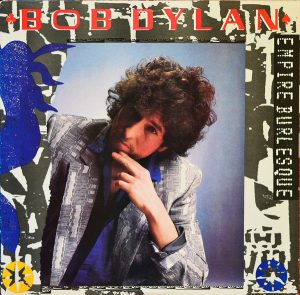
Via Malcolm’s girlfriend Viviane Westwood Egan rolls into the world of fashion.  Around 1984, he moves to New York to try to make it there.

His first major assignment is for Bob Dylan: Empire Burlesque.

His most striking contributions are a grey border around the front and back cover photographs.
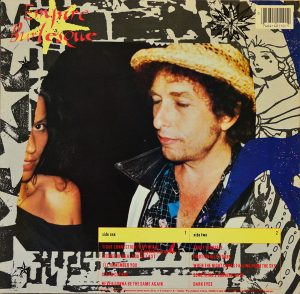
 

On the front, the border is embellished with a blue and a yellow circle containing a star, plus a blue spot on the left, as a counterweight to the title on the right, executed in a font with computer-like dots.

On the dust sleeve of the vinyl album, Dylan is again showing off his Eighties jacket. On the other side, the song’s lyrics are printed, supplemented with a black-and-white portrait of a smiling young lady with closed eyes. Dylan made the drawing.
Because I thought it was remarkable that Egan, so short after his arrival in the States, received an order for such an important customer, I contacted him to asked how this happened. His answer is so fascinating that I present it in its entirety here.

From Empire Burlesque to Biograph

“Dylan had been interested in working with Malcolm McLaren, the man who helped orchestrate the British Punk scene in 1976. Which made perfect sense,  to me at least.

Dylan had a genuine punk attitude, in fact I think he is, in many ways,  the Godfather of punk. From the beginning he didn’t give a shit about what people thought, going electric at the 1964  Newport Folk Festival for example, is total punk.

Dylan’s 1964 performance were accompanied by criticisms of Dylan’s antics and dismissive nature;

‘Dylan made a spontaneous decision on the Saturday that he would challenge the Festival by performing with a fully amplified band.’

‘His attitude was, “Well, fuck them if they think they can keep electricity  out of here, I’ll  do it”

Just like Punk, later on, he didn’t care about petty rules, he wasn’t a singer.  In fact I believe, in the beginning, record labels considered him as only a songwriter, they wanted him to write songs for other artists. He created a very unique ‘non-singer’ vocal sound just like Punk did, immediately breaking down everything before him. I  think he saw Malcolm as being cut from the same cloth, both were Jewish, both questioned the status quo, both were creative geniuses. I always think it’s a mistake to lump Dylan in with anything else that happened in the 60’s, the only similarity was, he was there, but he was forging his own path,

He wanted Malcolm to make a music video for one of the tracks off ‘Empire Burlesque’, something Malcolm was not the least bit interested in doing.  Malcolm had asked me to check it out while I was in New York working on the album cover for his first solo record ‘Duck Rock’ and report back with my thoughts.

So I met with Jeff Rosen who ran Davasee Entertainment, Dylan’s publishing company. Now Jeff is a truly fantastic human being and really was the only person Dylan trusted to speak on his behalf. Jeff was an amiable, no bullshit, guy and without him, I wouldn’t have got as close to Dylan as I did. After the initial contact, Malcolm told me to pass, on his behalf, on the video idea.

This is something that rarely happens to Dylan, being turned down, I could feel their surprise. So when I offered to do the album cover if they needed it, their answer was  “yes!”.  They saw my close creative relationship with Malcolm and how he obviously trusted me to get on with the ‘Duck Rock’ album cover while he was in London.

Trust is a big thing with Dylan,  he kept a close-knit collection of people around him, who could vet any outsiders as well as hold CBS at bay, without Dylan ever having much to do with them, just like Malcolm. It always blew my mind when I was up at CBS, when these seasoned veterans of the record industry, who had dealt with every major artist on the planet, would be in awe that I worked directly with Bob himself, asking me what he was like and did he remember them from one meeting five years earlier.

In fact, the reason I felt so comfortable around him was, he reminded me of a really good friend of mine, photographer, Bob Gruen, who was from the same generation. Bob was always really laid back, rarely got angry and was always really appreciative of anything you did for him, plus his name was also Bob.

When I look back on it, I really was quite privileged to have such an icon of popular culture interested in my ideas and opinions. He found, in me, a connection into a new generation.

One surreal moment happened when my phone rang at 3:00am, my girlfriend at the time answered it ready to have a go at whoever was calling at such a late hour. I guess the caller asked if I was there and when she said “yes, who is it?”, he said “Bob Dylan” I think she thought it was a prank call, as I did when she told me.   I could  hear this distant voice say “hi Nick, it’s Bob” and I recognized the voice immediately, trying to comprehend that Bob Dylan was calling me from Moscow at 3:00 am  New York time, just to chat.

It was those off the cuff and unconventional moments I had with Bob that, I now look back on, as being part of his character the one that makes him Bob Dylan.  I experienced quite a few of that ‘genius at work’ moments in the time I worked with him.

From a marketing point of view he must have been a nightmare, he wasn’t interested in having a dialogue with anyone at the label and I think the idea of doing interviews were painful to him.

That whole promotional aspect was something that he knew was important, but it wasn’t something he wanted to spend a lot of time over.  I think the birth of MTV had made him reconsider his approach a little more, hence the reason he contacted Malcolm McLaren, when a lot of people didn’t know who Malcolm was. Dylan was in touch and knowledgeable but again, I think the process was what bothered him the most.

After I had agreed on working on the ‘Empire Burlesque’ album cover I was actually quite shocked about the photo. I had moved into being an  Art Director as opposed to being just a designer, for this very reason. I wanted to begin the creativity from scratch and that meant choosing and working with a photographer who I thought would get the best look for a concept. I was tired of dressing up bad publicity photos into album covers but I made an exception in this case.

I had no involvement whatsoever in the photoshoot or even the selection of what photo to use and if it was up to me I would never have used it. No disrespect to Ken Regan, who is a very good photographer, it just wasn’t a front cover for me. The back cover photo was even stranger, the photo was some kind of snapshot by a friend, I think. I was specifically told to cut half of the girls face out of the photo, not all of it, just half.

I think a lot of great artists like to push boundaries to see how far they can get, almost daring someone to question it – ‘it’s so bad it’s good’ philosophy, which made it all the more interesting for me, a kind of creative subversion. So that’s why I framed it with those illustrative kitsch burlesque style sketches but just to keep people guessing I added the Matisse cut-outs which are artistic, hoping to get visually, what Bob was subversively saying.

Q: So, I guess it was your punk attitude that attracted him. Perhaps to counter-balance the slick photograph he wanted to use with the Miami Vice style jacket?

This is the interesting thing about a lot of artists, although the whole process is something many are not interested in when it comes to the final approval that’s something they nearly always obsess about. The minutia, the things you wouldn’t think they would care about, How big the type is, the colour of the type, placement of the album title, how big and where the production credits go.

Ironically those are the things I care least about, if there were no credits or lyrics at all, I’d be happy, but that’s where all the problems always occur. I’ve wasted more valuable time discussing whether the producer’s name should be bold and bigger than the engineers name and where the publishing and copyright lines go than I ever have about what photo to put on the cover.

I remember being called by Jeff Kramer (part of Dylan’s management team) to meet Bob and show him the finalized ideas for ‘Empire Burlesque’ at the Power Station Recording Studio, in New York,  before we went to print.

I casually made my way across the City, not able to find a cab, I ended up walking about 40 blocks from my apartment to the studio. I arrived about 30 mins late and when I got to lobby the `receptionist looked at me and said “they’ve been waiting for you for ages”  We didn’t have cell phones then so there was no way I could let them know I was going to be late and besides, I’d been in studio’s with dozens of bands all over the world and never remember it ever being a big deal, whatever time you arrived.

Generally, bands back then worked all night and I would show up sometime during the evening and even then I’d still have to wait around for two hours while someone was recording a vocal. Studios are like Las Vegas casinos, you have no sense of time as there are no windows and people could be drinking vodka at 6am like it was 6pm.

I was led into one of the studios, as the door opened I saw about 15 people all sitting around the edge of the room, most sitting on the floor, I couldn’t see Bob, but I could see an empty chair in the middle of the room next to the producer, I figured that was Bob’s chair and he must be in a recording booth until I heard his voice coming from in front of the mixing desk saying  “High Nick, take a seat” I realized that everyone had been waiting for me and that the pride of place was this empty chair, which is where I was meant to sit. I noticed a couple of people I recognized, Jan Wenner, editor and founder of Rolling Stone Magazine, Phil Ramone a big rock’n’roll producer, so I figured everyone in the room was some kind of  VIP.

People were obviously intrigued as to who I was but Bob didn’t say a word to anyone. He didn’t introduce me or ask why I was late.  He waited for me to sit down and then the recording engineer pressed play and began playing the ‘Empire Burlesque’ album from start to finish.

I could feel everyone in the room looking at the back of my chair and wondering who the hell I was and why I was so important that they waited for me to arrive before playing the album. To this day I think they still wonder who I was and why I was given the center of attention. I just knew that it made me extremely nervous to the point that I didn’t remember hearing a single note, made more so, by the fact that between each song,   Bob would turn around and look at me for approval, I just nodded each time.  When the playback finished the people in the room were ushered out quickly  Bob apologized for the awkward situation I found myself in and as if nothing had happened, we went through the final artwork.

This was Bob’s way of telling those sitting in that studio that he didn’t care what they thought, I just happened to be a useful prop, to illustrate that he was more interested in what some mysterious character’s opinion was than he was theirs. The fact he knew they wondered who I was, was all part of it and as I said, to this day not one of them is any the wiser. Even though I felt a little uncomfortable about being put on the spot like that, I totally get why he did it. It was another “fuck you!” to the music establishment.

It was pretty soon after finishing the artwork for ‘Empire Burlesque’ that I was invited to a meeting with Jeff Rosen about a special project. CBS were celebrating 20+ years of Dylan on their label by releasing the first Bob Dylan Box Set, ‘Biograph’.  I was to be given access to a collection of photos and unlike ‘Empire Burlesque’, where Bob’s involvement was minimal, ‘Biograph’ was completely different.

This was very important to him, in every aspect from the sequence of the songs, the sleeve notes to the artwork. He and I spent time discussing the songs and their relevance, he really wanted me to capture the essence of his work and he singled out certain songs that were important. He was very clear that the artwork should be ‘art’ and not just a record cover.

My immediate dilemma was how to portray such a huge and important body of work with a definitive cover, Jeff Rosen added that the cover of the booklet,  inside the box was just as important as the box cover. The second I saw the black and white publicity photo from around 1961 I knew that was it, that was the cover, nothing else came close. It had a very Punk Rock quality, his messy hair, the aloof look to the side, the black high collar, it could have been Johnny Thunders, Patti Smith or Mick Jones from The Clash, it was full of rebellion, revolution and attitude. I wanted to take this iconic image and turn it into something contemporary like Andy Warhol had done with Marilyn Monroe.  I was also influenced by Matisse’s  ‘Jazz’ exhibition at the Museum of Modern art and his use of shapes and primary colours. There was also an artist duo from the UK called Gilbert and George who took photographs and turned them into a large colourful stained glass window style, that were backlit which is where the thick outline idea around the photo came from.

I also loved the high contrast minimal white background photos that were in Italian Vogue at the time but I also wanted the photo to be the focus so a red overlay was the best way to catch people’s eyes and a very small almost unnoticeable title at the top. I argued at the time that there would be very few people on the planet who wouldn’t immediately recognize it as Bob Dylan. The challenge also was that people didn’t think it was just his early music so I ghosted two images on the background of Bob from different eras, one with an electric guitar, the other with acoustic.

The cover of the booklet also reflected the American Pop Art scene that started in the 50’s but was starting to become popular at the very same time Dylan was recording his first record. Artists like Robert Rauschenberg and Richard Hamilton were using photo collage. Dylan fits right into the revolution in American art, more than any other musical artist at the time. So it was fitting that ‘Biograph’ was launched at the Whitney Museum of Art, in November 1985. Images from the artwork were blown up to giant sizes and were hung on the walls of the Whitney Museum. So, I achieved exactly what I set out to do, to make the images in ‘Biograph’  works of art.

Bob and Jeff Rosen were blown away by the packaging and Jeff, later on, presented me with a signed copy ‘Biograph’ as a gift from Bob, it reads

“To Nick Egan, thanks for making this what it is, you’re a star, Bob Dylan”
There have been a few artists who have gone out of their way to show appreciation for what I’ve done for them, but few went to the lengths Dylan did.

Sometime that year I was applying for my Green Card and my lawyer told me I needed to get letters of support from at least three people of exceptional merit and achievement in their field.

I asked Jeff Rosen if Bob might consider writing one of these letters. Jeff wasn’t too optimistic about me getting it, he told me the last time Dylan did this for anyone, it was for John Lennon and he hadn’t done it since, but that he said he would at least ask.

A few days later I get a call from Jeff telling me Bob had agreed and signed the letter.  Unbelievable, to have this incredible artist who had helped define American culture and who will go down as one of the greatest artists of all time had written a letter in support of my immigration, me and John Lennon (the other two people of exceptional merit who also wrote on my behalf were INXS and film Director John Hughes).

The thank-you Bob gave me on ‘Knocked Out Loaded’ was a surprise as I wasn’t involved with that packaging at all.

Naming Empire Burlesque

In their book Bob Dylan: All the Songs – the Story Behind Every Track, Phillippe Margotin and Jean-Michel Guesdon suggest that the title “possibly refers to America, which became a superpower in an increasingly ridiculous world.”

On the English Wikipedia page you can find a completely different opinion: “The title of the album, Empire Burlesque, probably refers to a theatre in Newark, NJ, where strippers and comedians entertained[…]. If Dylan was inspired, it remains to be discovered. It might have been a stop on his way to visit Woody Guthrie in Greystone Park.”

But… it is impossible that young Dylan would have taken a look there, while passing in January 1961. The theatre closed its doors on February 14, 1957 and in July 1958 the building was demolished. When Dylan took the bus to New Jersey to visit Woody, he would have seen only a parking place on the spot, designed for customers of the shopping centre.


What else is on the site

You’ll find some notes about our latest posts arranged by themes and subjects on the home page.  You can also see details of our main sections on this site at the top of this page under the picture.

The index to all the 594 Dylan compositions and co-compositions that we have found on the A to Z page.

We also have a very lively discussion group “Untold Dylan” on Facebook with over 2000 active members.  (Try imagining a place where it is always safe and warm).  Just type the phrase “Untold Dylan” in, on your Facebook page or follow this link 

If you are interested in Dylan’s work from a particular year or era, your best place to start is Bob Dylan year by year.

On the other hand if you would like to write for this website, please do drop me a line with details of your idea, or if you prefer, a whole article.  Email Tony@schools.co.uk

And please do note   The Bob Dylan Project, which lists every Dylan song in alphabetical order, and has links to licensed recordings and performances by Dylan and by other artists, links back to our reviews

Posted in Uncategorized | 4 Comments

Kahlil Gibran: The Drunkard Lebanese-American, He Follows Me

by Larry Fyffe

Sufism is an offshoot of Islam that’s characterized by asceticism and mysticism. A Sufi looks inwardly to his/her mind and soul for the meaning of human existence rather than outwardly to the doctrines of orthodox religion that exclude ‘strangers’ and ‘nonbelievers’. Within every individual human, it’s believed, there exists a spiritual light that can be ignited in spite of sordid conditions on earth that an individual may endure.

The writings of Sufi poet Rumi influence the song lyrics of Bob Dylan and The Grateful Dead. Likewise, the Sufi poetry of Omar Khayaam, but, in contrast to Rumi, Omar looks inwardly with the assistance of a ‘jug of wine’. Kahlil Gibran, a Lebanese-American writer, is a Sufist who’s influenced by Christianity as well as by preRomantic poet William Blake, and members of the Romantic Transcendentalist literary movement. Perhaps because he leads a lifestyle that’s inconsistent with his espoused asceticism, Gibran, ‘the prophet’, would become overly influenced by alcohol.

‘The Prophet’ is a short book in prose poetry by Kahlil Gibran, a boiled soup of biblical-like aphorisms often expressed in paradoxical terms. Advice on how to live one’s life is given through the persona of a prophet who’s waiting for a symbolic ship that’s going to take him home. Rather open to subjective interpretations by readers the book’s aphorisms be.

The book is all the rage in America during the time of the people’s rebellion against the war in Vietnam:

And he beheld his ship coming with the mist
Then the gates of his heart were flung open
And his joy flew far over the sea
And he closed his eyes, and prayed in the silences of his soul
(Kahlil Gibran: The Prophet)

its poetic words echo in the song lyrics below:

A song will lift
As the mainsail shifts
And the boat drifts on to the shore line
And the sun will respect
Every face on the deck
The hour that the ship comes in
(Bob Dylan: When The Ship Comes In)

According to the aphorism below, seeking out material things and physical pleasures be not the high road to spiritual joy:

There are those who give little of the much they have ....
And there are those who have little and give it all
They are the believers in life, and the bounty of life
(Kahlil Gibran: The Prophet)

However, the aphorism below by the singer/songwriter turns things around, and leaves room for Omar’s hedonistic thoughts of ‘a jug of wine and thou”:

Some people will offer you their hand, and some won't
Last night I knew you, tonight I don't
(Bob Dylan: Mississippi)

For Gibran’s prophet, love is unselfish whether it’s parental or otherwise:

Your children are not your children
They are the sons and daughters of Life's yearning for itself ....
You may give them your love, but not your thoughts
For they have their own thoughts
You may house their bodies, but not their souls
(Kahili Gibran: The Prophet)

An ascetic sentiment expressed in the following song lyrics:

Come mothers and fathers throughout the land
And don't criticize what you don't understand
Your sons and your daughters are beyond your command
(Bob Dylan: The Times They Are A-Changing)

Expressed again in the aphorism below, albeit not so adamantly that grown-ups ought not be possessive:

I once knew a woman, a child I'm told
I give her my heart, but she wanted my soul
But don't think twice, it's all right
(Bob Dylan: Don't Think Twice)

What else is on the site

You’ll find some notes about our latest posts arranged by themes and subjects on the home page.  You can also see details of our main sections on this site at the top of this page under the picture.

The index to all the 594 Dylan compositions and co-compositions that we have found on the A to Z page.

We also have a very lively discussion group “Untold Dylan” on Facebook with over 2000 active members.  (Try imagining a place where it is always safe and warm).  Just type the phrase “Untold Dylan” in, on your Facebook page or follow this link 

If you are interested in Dylan’s work from a particular year or era, your best place to start is Bob Dylan year by year.

On the other hand if you would like to write for this website, please do drop me a line with details of your idea, or if you prefer, a whole article.  Email Tony@schools.co.uk

And please do note   The Bob Dylan Project, which lists every Dylan song in alphabetical order, and has links to licensed recordings and performances by Dylan and by other artists, links back to our reviews

What else is on the site

You’ll find some notes about our latest posts arranged by themes and subjects on the home page.  You can also see details of our main sections on this site at the top of this page under the picture.

The index to all the 594 Dylan compositions and co-compositions that we have found on the A to Z page.

We also have a very lively discussion group “Untold Dylan” on Facebook with over 2000 active members.  (Try imagining a place where it is always safe and warm).  Just type the phrase “Untold Dylan” in, on your Facebook page or follow this link 

If you are interested in Dylan’s work from a particular year or era, your best place to start is Bob Dylan year by year.

On the other hand if you would like to write for this website, please do drop me a line with details of your idea, or if you prefer, a whole article.  Email Tony@schools.co.uk

And please do note   The Bob Dylan Project, which lists every Dylan song in alphabetical order, and has links to licensed recordings and performances by Dylan and by other artists, links back to our reviews

Posted in Uncategorized | 5 Comments