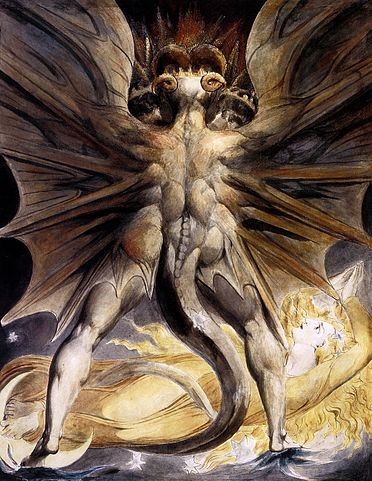
For every female is a Golden Loom. Bob Dylan and William Blake

by Jochen Markhorst

Barely a generation after his death, the work of the unique multi-talent William Blake (1757-1827) is in danger of disappearing on the waters of oblivion.

The zeitgeist of the nineteenth century is not really open to Blake’s own mythology full of visionary, black-romantic images and sexual liberties. However, after his rediscovery and rehabilitation, his influence on art in the twentieth century and beyond, is unstoppable. Traces of Blake can be found in every corner of Western culture, references in films, music, painting, comics and literature are innumerable and his greatness can be considered established by now.

The title of Aldous Huxley’s hallucinatory The Doors Of Perception (1954) comes from The Marriage Of Heaven And Hell and inspires Jim Morrison to call his band The Doors. The painting The Great Red Dragon and the Woman Clothed in Sun (1803) plays a key role in Thomas Harris’s Red Dragon (1981) and – of course – in both movie adaptations thereof (Manhunter and Red Dragon). And in the spin-off Hannibal  another Blake can be seen (The Ancient Of Days hangs in that huge Biltmore Estate of the disgusting billionaire Mason Verger).

Blake’s work is cited in the graphic novels V for Vendetta and in Watchmen, in films such as Blade Runner and Mean Streets, by poets such as Allen Ginsberg, in pop music by U2, Van Morrison and Tangerine Dream, classical composers like Benjamin Britten and Ralph Vaughan Williams have set his poems to music (as did Ginsberg, by the way: Songs of Innocence and Experience by William Blake, 1970) and the sets in the EA game Dante’s Inferno (2010) lean on Blake’s illustrations to the Divina Commedia.

And with Dylan, Blake references and quotes have been a constant throughout the decades. “Gates Of Eden” (1965) and “Every Grain Of Sand” (1981) are the best known carriers of Blakean influences, and small Blake snippets such as little boy lost in “Visions Of Johanna” can be found on almost every album. Dylan’s travelling circus The Rolling Thunder Revue also owes its name to the English genius (“Michael contended against Satan in the rolling thunder” from Milton), “Ring Them Bells” (1989) could have been one of Blake’s own Songs Of Experience (1794) and in “Roll On John” (2012) Dylan quotes more literally than ever, including antique spelling: “Tyger, tyger, burning bright” (from The Tyger, 1794).

In the 70s, Dylan writes his arguably most Blakean song, “Golden Loom”. Golden loom is a beloved metaphor at Blake; in Jerusalem alone, the last and longest of his prophetic books, he uses it six times – for instance when he describes the Gates of Eden, by the way. The “immortal shrine” Dylan picks up from the poem Preludium to Europe, the “hungry clouds” from The Argument. This is the only time that Dylan uses the archaic word “dismal” (Blake uses it hundreds of times, in Jerusalem nine times) and the accessible The Book Of Thel (1789) perhaps inspires the emergence of the atypical “lotus” and “perfume”.

The borrowed idiom contributes to the mystical, dream-like style that also characterizes Blake’s prophetic books, but not exclusively; the other images, the content, and especially the anecdotal character thereof, hints at a second influencer: at the Canadian bard and Dylan fan Leonard Cohen, and in particular the well-known, beautiful opening lines of his melancholic farewell song “Hey, That’s No Way To Say Goodbye”:

I loved you in the morning, our kisses deep and warm
Your hair upon the pillow like a sleepy golden storm

“Golden Loom” seems to be an eighteenth-century remake of that famous song anyway. In the liner notes of the Greatest Hits album from 1976, Cohen himself reports about that song:

“This song arises from an over-used bed in the Penn Terminal Hotel in 1966. The room is too hot. I can’t open the windows. I am in the midst of a bitter quarrel with a blonde woman. The song is half-written in pencil but it protects us as we manoeuvre, each of us for unconditional victory. I am in the wrong room. I am with the wrong woman.”

And his spoken intro to the same song at the Montreux concert, 25 June ’76, sounds as if it had been written by Dylan:

“It was a terrible hotel room. The windows wouldn’t close (sic!). The radiator wouldn’t stop hissing. The faucet wouldn’t stop its mythological drip into the destroying porcelain sink. I was with the wrong woman as usual. But as your Eastern physicians, Eastern metaphysicians know, just as from the darkest mud blooms the whitest lotus, so from the brownest hotel room you occasionally get a good song.”
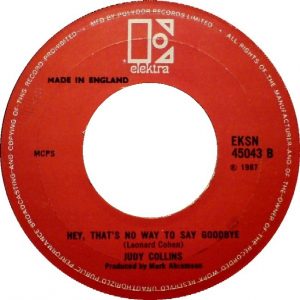
The end of a love affair in a hotel room and the blooming lotus are already lines to Dylan’s “Golden Loom” (which of course was written earlier than Cohen’s words in Montreux), and once on that track there are more hints to be found.

“Where the wildflowers bloom” is a nod to the very first recording of “Hey, That’s No Way To Say Goodbye”, by Judy Collins, blooming on her LP Wildflower (and as B-side of her single “Both Sides Now”, 1967), probably also Dylan’s first introduction to the song and in “the trembling lion” one could suspect a hint to the name Leonard (“Leonard” means “powerful lion”).

However: too far-fetched, and quite unlikely. Dylan quotes, paraphrases and borrows enough, as he does with the work of William Blake in this song, but arcane, laborious encryptions on this Junior Woodchucks’ Guidebook level – very unlike him. Subconsciously, maybe. The lines without Blake references do have an undeniable Leonard Cohen fragrance; “I see the sailing boats across the bay”, “And then our shadows meet and we drink the wine”, “And then I kiss your lips as I lift your veil” … all of them verses that could have been lifted from “Suzanne” or “So Long Marianne” or “Sisters Of Mercy”.

Well alright then, a wildflower and a trembling lion subsequently emerging from Dylan’s freely associating mind – it is not that inconceivable.

“Golden Loom” is an outtake of those hectic, crowded Desire sessions, but fortunately recorded at the quietest moment. The restless, chaotic Dylan has packed the sessions with musicians, experienced and inexperienced, the culmination being the July 28 session, when twenty-two musicians walk in and out of the studio. A day later, when people like Eric Clapton have chosen to stay far away from that madness, “only” twelve are left and on July 30, the day of “Golden Loom”, there is ultimately a manageable, workable club of seven people left. Consequently, this day will be the most productive recording day; the final versions of “Oh, Sister”, “One More Cup Of Coffee”, “Black Diamond Bay”, “Mozambique” and “Rita May” will also be realized on this 30 July.

Saxophonist Mel Collins has not arrived yet, does not participate in this song, so at “Golden Loom”, which is the first on the program, there are only six musicians present.

It results in a beautiful, dreamy, pleasantly casual exercise that is completed quickly; the first full take is technically not perfect (the pace is accelerating, for example), but it does have the perfect imperfection of Dylan’s best work. Eventually, this take will be released on The Bootleg Series 1-3 (1991). Why Dylan dismisses the recording for the album is – as usual – unclear. Both in terms of performance and thematically (desire, after all), the song fits well with Desire, but the master lets it drift away on a summer’s day and graciously grants Roger McGuinn “Golden Loom”.

The ex-Byrd is an acclaimed member of the Rolling Thunder Revue and records shortly after the tour with revue colleagues Mick Ronson, drummer Howie Wyeth and bassist Rob Stoner (also Desire‘s rhythm section) the beautiful album Cardiff Rose (1976), on which the Blood On The Tracks outtake “Up To Me” is a highlight. For his next album he brings together a new band with the obvious and well-chosen name Thunderbyrd. The eponymous album is produced by Desire producer Don DeVito and is less successful, but it also contains a couple of gems: particularly “Golden Loom”. The band is great live, as they demonstrate on the first Rockpalast night (in the night of 23 to 24 July 1977, in the Grugahalle in Essen). There, in Germany, McGuinn proclaims it to be his song:

“Bob Dylan wrote a song and he gave me… he gave me the song and he didn’t even record it himself. And the song is called Golden Loom.”

Not entirely accurate (as Dylan did record it), but what the heck; Thunderbyrd’s performance of the song is wonderful. The concert is rightly released on video and in 2012 on DVD. On Amazon it still sells quite well. This version is also by far the most exciting cover of “Golden Loom”.

Noteworthy furthermore are Maria Muldaur (on the tribute album Heart Of Mine, 2006) with a lazy, lounge blues rendition and Icelandic veteran Björn Thoroddsen, who records the lovely album Bjössi – Introducing Anna in Nashville in 2016 with the phenomenon Robben Ford. Thoroddsen has proven himself mainly in jazz, Ford is a bluesman, but surprisingly their “Golden Loom” is a very attractive folky interpretation. Beautifully sung by the Icelandic Anna Þuríður Sigurðardóttir, who by the way is less succesful with the other Dylan cover on the album, the otherwise fine, equally folky orchestrated “Seven Days”. Again a throwaway, from the aftermath of Desire. And again with a Blakean flavour; the little boy is and remains lost, but the little girl Lyca is found – after Seven Days of searching, the trembling woman is told where Lyca can be found by a couching lion:

On his head a crown,
On his shoulders down
Flowed his golden hair.
Gone was all their care

(“Little Girl Found”, Songs Of Experience, 1794).

Thunderbyrd at Rockpalast:

https://www.youtube.com/watch?v=3a05vtxZIHg


What else is here?

An index to our latest posts arranged by themes and subjects on the home page.  You can also see details of our main sections on this site at the top of this page under the picture.

There is an alphabetic index to the 550+ Dylan compositions reviewed on the site which you will find it here.  There are also 500+ other articles on different issues relating to Dylan.  The other subject areas are also shown at the top under the picture.

We also have a discussion group “Untold Dylan” on Facebook which mostly relates to Bob Dylan today.  Just type the phrase “Untold Dylan” in, on your Facebook page or follow this link 

And please do note   The Bob Dylan Project, which lists every Dylan song in alphabetical order, and has links to licensed recordings and performances by Dylan and by other artists, is starting to link back to our reviews.
Posted in Uncategorized | Leave a comment

Everything Is Broken (Part II): Christ And The Phoenix

This article continues from “Everything is broken although God has a plan”

by Larry Fyffe

The alchemic symbol of the ‘phoenix’, the mythical fire bird that represented the rising and setting sun, goes back to time out of mind, back farther than the Hebrew Bible and the Judeo-Christain Bible in which the symbol also appears. The death-defying bird is interpreted by some followers of the Judaic faith as a symbol of the Jewish people who rise from the ashes of near destruction; by other followers of the Christian faith as a symbol of the resurrected Christ after His death on the cross:

The Hebrew vision – Things ‘will’ go awry at times for the people chosen by Yahweh to be delivered into the Promised Land; that is, when their behavior shows they’ve abandoned His laws:

I said, "I will die with my nest
And I will live as long as the phoenix"
(Tanakh, Job 29:l8):

The Christian vision – His crucified Son ‘shall’ return from heaven to the desert below to settle accounts once and for all, God having abandoned His wayward creations to fend for themselves, kicking them out of the green pastures of Eden:

Then I said, "I shall die in my nest
And shall multiply my days as the sand"
(King James Bible, Job 29:18)

As previously mentioned, in song Bob Dylan references the alchemic symbols of the raven, the swan, the peacock, the albatross (pelican), and, below, the phoenix.

Though no names are mentioned, it’s apparent that the phoenix in the lyrics below be Christ. And Jesus shall return to earth, there’s no doubt it. He has to change things around:

Don't you cry, and don't you die, and don't you burn
Like a thief in the night, He'll replace wrong with right
When He returns
(Bob Dylan: When He Returns)

On the other hand in the next song, it’s the wayward that the phoenix symbolizes. The narrator in the song stays too long in the state bordered by the ‘American ‘Nile’. But he does move on. Akin to Moses, it could be said that he almost makes it back to the Promised Land of Israel:

Well the emptiness is endless, cold as the clay
You can always come back, but you can come back all the way
Only thing I did wrong
Stayed in Mississippi a day too long
(Mississippi: Bob Dylan)

In the following double-edged lyrics, Jesus can be thought of as the fire bird that must return to earth. That is, if most of mankind, unlike the Hebrews under the stern hand of Yahweh, are incapable of saving themselves from total destruction:

I'm gonna walk across the desert, 'til I'm in my right mind
I won't think about what I left behind
Nothin' back there anyway that I can call my own
Go back home, and leave me alone
It's a long road, it's a long and narrow way
If I can't work up to you, 
you'll surely have to work down to me someday
(Bob Dylan: Narrow Way)

Apparently, there’s something to be said for a God that has a Son that’s not so strict as His Father:

Treat me kindly dear blue angel
Deepest colour of the night
Be merciful, be gentle
For I have no strength to fight
(The Strawbs: Blue Angel ~ Cousins)

Bob Dylan echoes the sentiment expressed above in the song sung by the Strawbs:

I heard a voice at the dusk of day
Sayin', "Be gentle, brother, be gentle and pray"
It's a long road, it's a long  and narrow way
If I can't work up to you, 
you'll surely have to work down to me someday
(Bob Dylan: Narrow Way)

Dylan also has a bit of fun at the expense of the dogmatic twisters of the Christian religion:

Shake the dust off of your feet, don't look back
Nothin' can hold you down, nothin' that you lack
Temptation's not an easy thing, Adam given the Devil reign
Because he sinned, I got no choice, it run in my vein
(Bob Dylan: Pressing On)

Posted in Uncategorized | 2 Comments

Dylan’s greatest obscure songs ranked in order!

By Tony Attwood

In 2015 USA today published an article titled, “Ranking all of Bob Dylan’s songs, from No. 1 to No. 359”

Now if you are a regular reader of Untold Dylan you might well note a problem here: because on our site, produced without any of the millions of dollars at USA Today’s disposal, we’ve got 590 songs that we are fairly clear Bob wrote or co-wrote.

(Although I think I have included one song twice, so we might be about to drop down to 589, but either way it is still a lot more than USA Today found).

And it gets worse for USA Today.  Not only have they lost over 230 songs (a bit careless one might agree) but also they missed some real gems songs out, like “Tell Ol’ Bill”.   But worse again they included songs that Bob didn’t write.  Songs like “Gospel Plough.” And then again “Like a Rolling Stone” pops up twice, because they list the version on Self Portrait as a separate song.

There are multiple inconsistencies of this type throughout the list, although they do try to excuse themselves in the blurb by saying “We ranked studio releases only (including movie soundtracks) or songs that Dylan played in concert more than 100 times.”

So suddenly “Bob Dylan’s songs” doesn’t actually mean, as it normally would, “songs Bob wrote.”

Of course these are not the only people who have screwed up lists of Bob Dylan songs, and given that for the majority of songs they don’t explain their choice of a position in the list, it is all rather meaningless.

But it gave me an idea.  What about the best “obscure” Dylan songs?    Then, as ever I found someone had got there before me, but still the lists are interesting.   Rolling Stone did a piece called “20 Overlooked Bob Dylan classics” which opened with “You’re no good” from 1962, so again we are not looking at songs Dylan wrote, but songs he has performed.  “You’re no good” was written by Jesse Fuller.

And their view of “overlooked” was a trifle odd too, as it included “Black Diamond Bay” and “Where are you tonight?”  Not really overlooked are they?

Next up I found a site called “CultureSonar” which has the strap line “Never stop being interesting” which I rather like.  They have an article, “The 10 Best Bob Dylan Songs You May Have Never Heard” which sounds promising except that it starts with “Boots of Spanish Leather”.

And so the list of lists goes on with writers particularly assuming that we don’t know songs like “Caribbean Wind” just because it isn’t on a mainstream album.  You can obviously find such lists yourself just by typing an appropriate phrase into a search engine.

But since I like to think our site here is a rather well-known Dylan site in its own right, and if nothing else has the benefit of having the biggest ever list of songs that Dylan has composed or co-composed, so I think we ought to join in with….

The 10 Best Obscure Songs that Dylan Wrote.

By which I mean songs that didn’t appear on a mainstream album, and excluding pieces like Caribbean Wind that we all know about.

But when it got to putting them in order, well, I couldn’t really.   So I cheated and put them in alphabetical order.

  1.  Abandoned Love.    I count this as obscure because there are these two utterly different versions, and I keep on meandering me between the two and most casual Dylan fans don’t know the song.  They are both worthy of inclusion here.
  2. Angelina.   I didn’t really like this song when reviewing it myself, and couldn’t see what Dylan was doing with it – as my review of it says.   And then Jochen sent over his review of this song which ends with a link to Ashley Hutchings version, and not for the first time I changed my view of a song while editing an article.   Ignore everything I said.  Jochen got it right.
  3. Ballad for a friend.   The amazing early blues that I have raved over since I started this site over 10 years ago.   How the young Dylan wrote this so early in his career is utterly beyond me.  If I am ever asked to give an example of what makes me think Dylan is a genius as a musician, rather than as a literary person, this is the track I trot out.
  4. I once knew a man.   It turned up just the once as a song played at rehearsal for a TV programme, and that’s it.   We eventually did get a couple of decent versions of the lyrics (see the comments section under the review), but that never reduces my love of this punk blues rock something else song.
  5. I’m not there.   OK this is not really obscure any more because much of the time this is the third most accessed song review on this site.   But the vast majority of Dylan fans  for some odd reason choose not to read this site (although quite a few people do) so they still don’t know about it.  And it still tears at my heart and my mind after years of listening to it.   A miracle of a piece.
  6. Rock em dead.   This really really really is how you do rock n roll.   What is not to adore here?
  7. Tell Ol’ Bill.   I’ve written about this so often on this site as my all time favourite Dylan song you’ve probably got fed up with it.  But the music and lyrics combination in terms of creating that total overwhelming feeling of uncertainty of the future and just keeping on keeping on, is just something else.
  8. To fall in love with you.    Everyone’s favourite obscure song.
  9. Well well well.   It is just this one version of this song which Dylan co-wrote that I love, but when we come to obscure that does it for me.
  10. Yonder comes sin.   I don’t go for most of the religious songs, although the live version of “When He Returns” has always been on my list.   But this one gets close, and for me is the best of the religious songs, after that very special version of When He (which isn’t really obscure enough to include in my top 10.   Several of the live versions of When He have now vanished, but when I wrote the review I managed to include a whole raft of them, and there are still one or two survivors.  So two number tens, because well, you can’t do a top 11.

What else is on the site

You’ll find an index to our latest posts arranged by themes and subjects on the home page.  You can also see details of our main sections on this site at the top of this page under the picture.

The index to the 500+ Dylan compositions reviewed is now on a new page of its own.  You will find it here.  It contains reviews of every Dylan composition that we can find a recording of – if you know of anything we have missed please do write in.

We also have a discussion group “Untold Dylan” on Facebook.  Just type the phrase “Untold Dylan” in, on your Facebook page or follow this link 

And please do note   The Bob Dylan Project, which lists every Dylan song in alphabetical order, and has links to licensed recordings and performances by Dylan and by other artists, is starting to link back to our reviews

Posted in Uncategorized | 5 Comments

Sign on the cross: the words mean nothing

by Jochen Markhorst

“Elvis,” Dylan replies to the question by whom he likes to hear his songs covered, “Elvis Presley recorded a song of mine. That’s the one recording I treasure the most of all… it was  called Tomorrow Is A Long Time” (Rolling Stone interview with Jann Wenner, November ’69).

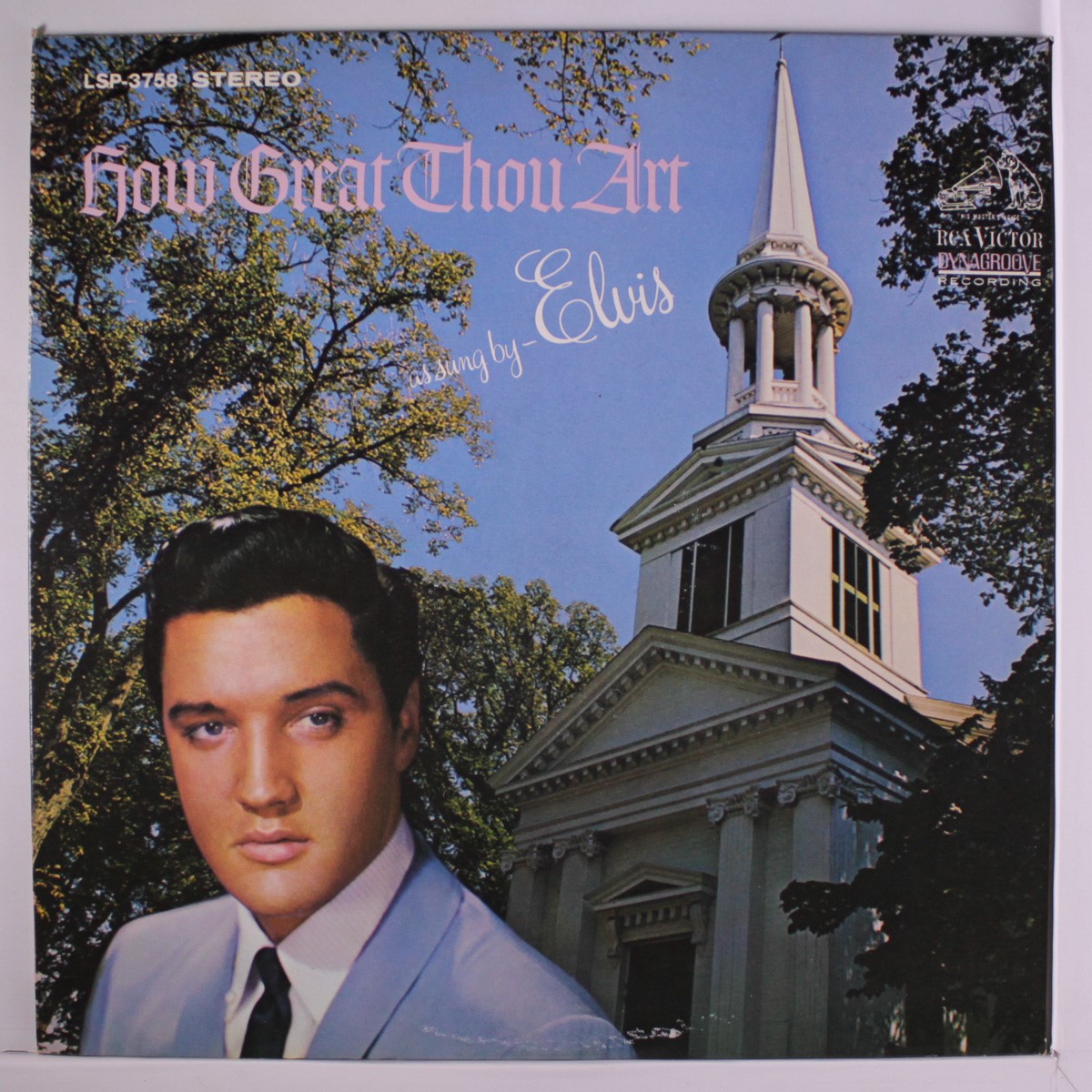
In May 1966, shortly after Dylan completed the recordings for Blonde On Blonde, Presley enters the RCA Studio B in Nashville to record in four days eleven of the twelve songs for his second gospel album, How Great Thou Art. Partly with men who have just assisted Dylan, by the way; both Charlie McCoy and bass player Henry Strzelecki are on the payroll. The twelfth song, the final song (and the hit) “Crying In The Chapel” was recorded by Presley in 1960 and was released as a single in 1965.

The album with the twelve songs will only be released half a year later, in February ’67, but in between Spinout (October 1966) appears, on which The King sings two songs which have been recorded on May 26, 1966, the second recording day of How Great Thou Art: “Down In The Alley” and that most valuable compliment that Dylan has ever received, “Tomorrow Is A Long Time”, which Presley knows through the version of Odetta.

Dylan’s love for Elvis is deep and well-documented, as is his attachment to gospel. “Songs like Let Me Rest On A Peaceful Mountain or I Saw The Light are my religion,” he confesses in the Newsweek interview (1997). And in the acclaimed MusiCares speech in 2015, he aloud dreams of the plan to record a whole gospel album with the Blackwood Brothers. Again an Elvis connection: the Blackwood Brothers are Presley’s favourite gospel quartet. For his first gospel album, he plunders their repertoire (“His Hands In Mine” and “In My Father’s House”, among others), he has been friends with the family since the early 1950s, copies the Blackwood logo font on his first two gospel records, often invites the brethren to Graceland and also performs with them once. The title song “How Great Thou Art” Elvis learns from the brothers too, by the way (and James Blackwood will sing the song again at Elvis’s funeral). And the other classic that connects Dylan and The King:

“One of the songs I’m thinking about singing is Stand By Me with the Blackwood Brothers. Not Stand By Me the pop song. No. The real Stand By Me.” And then Dylan quotes the entire song lyrics – “I like it better than the pop song.”

On Presley’s How Great Thou Art, “Stand By Me” is the fifth song, recorded one day before “Tomorrow Is A Long Time” – a lot comes together on this album for Dylan. Undoubtedly, How Great Thou Art has often been on the turntable in Hi Lo Ha, in Dylan’s house that spring of 1967. And echoes thereof resonate a few months later in the Basement of the Big Pink, where Dylan plucks his first own gospel song from the air: “Sign On The Cross”.

It is a remarkable song, rightly praised as one of the absolute highlights of the Basement Tapes, on the same level as “I’m Not There” and “I Shall Be Released”. And just like “I’m Not There”, and many more Basement songs, the song emerges rather spontaneously. Witness from the first hour Garth Hudson confirms this, in the moving Rolling Stone documentary (November 2014), in which he visits the Big Pink again for the first time in almost fifty years. The old Hudson slowly shuffles around, sits musing at the piano and shares his memories, including about “Sign On The Cross”:

“Bob didn’t like to sing the same song over and over again. Sounds to me like he did make up songs on the spot. (…). I think “Sign On The Cross” was done in real time. Both the composition and the execution thereof.”

So the lyrics have been improvised on the spot and are accordingly inconsistent, partly unintelligible, and appear to be a huddle of fragments of Blackwood, Bible and Luke The Drifter.

Key to the Kingdom, for example, echoes the song of the same name from the Brothers. Your days are numbered is a Bible phrase (from Job and from Daniel) with which Dylan has something anyway – he already uses it in “When The Ship Comes In” and will later use it again in “Mississippi”. And the spoken sermon part is unmistakably Luke The Drifter, Hank Williams’s alter ego. “Men With Broken Hearts”, “Be Careful Of The Stones That You Throw” (the song the men also play in the Basement these days), “Too Many Parties and Too Many Pals”, which is added to radio maker Dylan’s Theme Time Radio Hour’s playlist forty years later, “The Funeral”, “Help Me Understand” … all those songs with rhyming sermonettes, talk-sung sermons, that Dylan has under his skin and of which he copies the drawling diction, the rhythm and the vague Southern accent for this part of “Sign On The Cross”.

Initially, goofiness undoubtedly triggered the song’s creation. In the first part, the first three couplets, Dylan is still flawlessly in Buster Keaton mode. He sings free of irony, wistful, almost falsetto, carried by the particular heavenly organ playing of Garth Hudson and the stately cadence of the song. Once at the sermonette, the bard does not completely succeed in keeping a straight face and one can hear the corners of his mouth curl up. Gradually, the (not very successful) Southern accent creeps up stronger, but: his talent for improvisation and his self-control do not let him down and he completes the sermon without exploding.

In terms of content, it is far from coherent, but a single, almost-rounded, aphoristic gem does shine. The door is here and you might want to enter it, but, or course, the door might be closed stands out. Luke The Drifter loves parables, but this one seems to be inspired by one of Kafka’s most famous: Vor dem Gesetz, “Before the Law”, the parable told to Josef K. in Der Prozeß (The Trial) by a preacher. Herein, the main character arrives at “The Law”. He wishes to gain entry, but the Türhüter, the Doorkeeper, does not let him in and lets the man wait for years, until his death, at the door to the Law. You might want to enter it, but the door might be closed.

It is, with all its beauty, slightly frustrating. The perfect, unearthly musical accompaniment, Dylan’s breathtaking vocals, the rough poetic diamonds, the enigmatic concept sign on the cross … the brilliant, boundlessly inspired song poet Dylan from 1967 needs at most half a typewriter session to create a definitive masterpiece in the outer category, another “Desolation Row” or “Visions Of Johanna”.

But he shrugs it off. It is unknown why he discharges the song without comment, does not grant it a second take or at least performs it again on stage. Perhaps he does not feel completely at ease with the unserious approach of a religious song, or he fears that he is not able to oversee the impact of the chosen images (although this does not stop him a bit later, in the songs for John Wesley Harding). And, more importantly, the words mean nothing, have no coherence, and merely suggest an evangelical message.

In any case, in January 1974, just under five years before his much talked-about conversion and the ensuing deadly serious gospel songs, Dylan claims that religion does not go too deeply for him:

“Religion to me is a fleeting thing. Can’t nail it down. It’s in me and out of me. It does give me, on the surface, some images, but I don’t know to what degree.”

That is quite different for Elvis, for whom gospel, experience of God and religion are deeply, deeply rooted in his genes. But even Elvis has reserves: at a concert in 1955 where the Blackwood Brothers are also performing, he refuses to sing rock ‘n’ roll songs – out of respect for his idols.

Eventually it will take until 1973 before Roxy Music fills the gap and lets a gospel song flourish in a pure rock environment, with the masterpiece “Psalm” on the Stranded album. Admittedly steeped in the famous Bryan Ferry irony, but still…

“Sign On The Cross” is not one of the fourteen songs offered to other artists on the “publishing demo” in 1968, nor is it on the first bootlegs Great White Wonder (’69) and Great White Wonder II (’70). The song is still unknown when copyright is established in 1971.

In 1972 the song finally comes to the surface: on one of the best Dylan tribute albums ever, on Coulson, Dean, McGuinness, Flint’s Lo And Behold! from England, produced by the Supreme Guru of the Dylan covers, Manfred Mann.

It is a wonderful version. Dennis Coulson is from Benwell, Newcastle, Tom McGuinness from Wimbledon, Dixie Dean lives a few miles away in New Malden and drummer Hughie Flint was born and raised in Manchester – on paper the men are thoroughly English. But they do hide that very well. The moment their “Sign On The Cross” starts, the listener is in a wooden church in the Alabama countryside. First only a subservient piano and a modest bass behind the sensitive, fragile vocals of Dennis Coulson, in the second verse drums and accordion join in and the guitar of McGuinness places tasteful, lyrical decorations (more beautiful than Robbie Robertson’s exquisite Curtis Mayfield licks of the original). In the third verse the brakes are released. The band switches to an irresistible blues stomp with a grand ladies choir, to switch back just before the sermonette. Coulson is too wise to get caught in such a sermon; that would indeed break the spell. Instead, the men let Jimmy Jewell, the saxophonist to whom we also owe that short, heart-warming sax solo in Joan Armatrading’s “Love And Affection”, toot a dry, melancholic solo. Then all the obligations are met and the men, supported by the enthusiastic background singers, can let their freak flags fly. The song ends as it should end: furious, uplifting and above all soulful.

Elvis could not have done it better.

Postscript: For once we are unable to offer online videos of the cover version that is cited here.   Coulson, Dean, McGuinness, Flint’s version of the song may of course be available in your location.  But if not and you want to hear it you will either have to subscribe to an obliging subscription service or else try and find a copy of the Lo And Behold! album in an obliging store.

What else is on the site

You’ll find an index to our latest posts arranged by themes and subjects on the home page.  You can also see details of our main sections on this site at the top of this page under the picture.

The index to the 500+ Dylan compositions reviewed is now on a new page of its own.  You will find it here.  It contains reviews of every Dylan composition that we can find a recording of – if you know of anything we have missed please do write in.

We also have a discussion group “Untold Dylan” on Facebook.  Just type the phrase “Untold Dylan” in, on your Facebook page or follow this link 

And please do note   The Bob Dylan Project, which lists every Dylan song in alphabetical order, and has links to licensed recordings and performances by Dylan and by other artists, is starting to link back to our reviews


Posted in Uncategorized | 2 Comments

Everything Is Broken (Part II): Christ And The Phoenix

Unfortunately, the wrong article was published here (by Tony, of course) and so has been removed.

The correct article under this title is now here

Apologies to Larry, and to all readers.

Posted in Uncategorized | 2 Comments

“Moving on the Water”. The 590th Bob Dylan composition we’ve found

By Tony Attwood

At 47.55 on the collection of songs known as “Between Saved and Shot” (see the recording below) there is a song we’ve not mentioned here.  “Moving on the Water”.

It is primarily an instrumental with a simple rift played across two chords, and the occasional singing by the female backing group.

Nothing much happens here, but it is a Dylan composition, and we’ve covered more occasional pieces on the Basement Tapes.  It lasts a couple of minutes, so here is a mention.

I can’t really review it because it is, like so many tracks on the Basement Tapes, just an idea worked through to see where it goes.  And it seems it goes nowhere much.   Normally it would be heard no more, but this is after all Dylan.  And we do aim to review every single song.

But there is one inducement to hearing this piece, aside from being able to claim that you have listened to every known Bob Dylan song, and that is that it runs into the tantalising “Don’t Ever Take Yourself Away”

https://youtu.be/mrsRBrajx9Y

And if you want another incentive you can leave the recording playing and listen to Dylan performing a superb version of Mystery Train after that.

I’m going to do another check of all the songs on this album just in case there is anything else I missed first time around.

Meanwhile here is the list from the outtakes album

Is It Worth It
High Away
Hallelujah
Magic
You’re Still A Child To Me
Wind Blows On The Water
All The Way Down
My Oriental Home (Instrumental)
We’re (Living) On Borrowed Time
I Want You To Know I Love You
On A Rockin’ Boat
Movin’ (On The Water)
Almost
Don’t Ever Take Yourself Away
Bonus:
Mystery Train (S Phillips/H Parker) *
Heart Of Mine
Watered Down Love
Shot Of Love

What else is here?

An index to our latest posts arranged by themes and subjects on the home page.  You can also see details of our main sections on this site at the top of this page under the picture.

There is an alphabetic index to the 550+ Dylan compositions reviewed on the site which you will find it here.  There are also 500+ other articles on different issues relating to Dylan.  The other subject areas are also shown at the top under the picture.

We also have a discussion group “Untold Dylan” on Facebook which mostly relates to Bob Dylan today.  Just type the phrase “Untold Dylan” in, on your Facebook page or follow this link 

And please do note   The Bob Dylan Project, which lists every Dylan song in alphabetical order, and has links to licensed recordings and performances by Dylan and by other artists, is starting to link back to our reviews.
Posted in Uncategorized | 1 Comment

Bob Dylan and punk. Give the anarchist a cigarette.

by Aaron Galbraith

Bob Dylan and punk might not seem like the most natural of bedfellows but it would seem that there is a lot of mutual respect between Dylan and many punk musicians and bands.

The band on Down In The Groove’s “Sally Sue Brown” includes both the Sex Pistols’ Steve Jones on guitar and The Clash’s Paul Simonson on bass. The one song Dylan said he wished he written was Johnny Thunders “You Can’t Put Your Arms Around A Memory”.


Punk acts a-plenty have covered Dylan tracks over the years including Richard Hell with “Going Going Gone”, The Clash “The Man In Me”, Johnny Thunder “It Ain’t Me, Babe”, “Joey” & “Like A Rolling Stone” and The Ramones with “My Back Pages”, to name just a few.

https://m.youtube.com/watch?v=n0w_BuDs6oQ

All of this leads us nicely to The Minutemen and “Bob Dylan Wrote Propaganda Songs”.

I’m waitin’, in third person, I’m collecting
Dispersing, information, labeled rations
Bob Dylan wrote propaganda songs!

Manifestos, are my windows, and my proof
Locations, and more rations, outline my route!
Bob Dylan wrote propaganda songs!

At 1 minute 29 seconds, the track is actually on the longer side for the Minutemen. Their first album contained 18 tracks all ranging between 30 and 50 seconds long, so this one is something of an epic!

The song appears on the “What Makes a Man Start Fires? album. Songwriter Mike Watt stated “That song came out because I was starting to worry are my songs starting to sound too sloganeering? And then I thought, ‘Hey Bob Dylan, his stuff was almost as vital as propaganda.'”

If you have any previous experience of the Minutemen, it provides exactly what you would expect from the band: it’s short, experimental, unusual structure and not one second is wasted. I like it a lot!

Moving on to our second piece today, it’s Chumbawamba with “Give The Anarchist A Cigarette”.

Those of us who grew up in the 90s will remember their classic 1998 hit single “Tubthumping”. The track in question appears on their earlier 1994 album “Anarchy”

The title comes from a scene in the Dylan movie “Don’t Look Back” in which Dylan’s manager Albert Grossman tells him “They’re calling you an anarchist now”, to which Dylan replies “Give the anarchist a cigarette”.


Albert! Who?
Bobby! Who?
For god’s sake, burn it down

Nothing ever burns down by itself
Every fire needs a little bit of help
Nothing ever burns down by itself
Every fire needs a little bit of…

Give the anarchist a cigarette
‘Cause that’s as close as he’s ever gonna get
Give the anarchist a cigarette
Bobby just hasn’t learned it yet
Give the anarchist a cigarette
The times are changing, but he just forgets
Give the anarchist a cigarette
He’s gonna to choke on his harmonica, Albert

Nothing ever burns down by itself
Every fire needs a little bit of help
Nothing ever burns down by itself
Every fire needs a little bit of…

Give the anarchist a cigarette
A candy cig for the spoiled brat
Give the anarchist a cigarette
We’ll get Albert to write you a cheque
Give the anarchist a cigarette
He’ll be burning up the air in his personal jet
Give the anarchist a cigarette
You know I hate every Popstar that I ever met

Nothing ever burns down by itself
Every fire needs a little bit of help
Nothing ever burns down by itself
Every fire needs a little bit of…

Give the anarchist a cigarette
Burn, baby, burn
Burn, baby, burn


Grunge magazine lists the track as one of the harshest lyrics in history. They write, that the track “outright calls Dylan old, pathetic, washed-up, and out-of-touch. They sing, “Give the anarchist a cigarette / ‘Cuz that’s as close as he’s ever gonna get / Give the anarchist a cigarette. Bobby just hasn’t earned it yet / Give the anarchist a cigarette. The times are changing but he just forgets.” You thought Don Henley had church bells down there? That’s nothing compared to accusing Bob Dylan of “not earning” something. But true to form, the band doubles down, calling Dylan a “spoiled brat” with his own private jet. But it’s not just you, Bob—Chumbawamba’s singer proudly admits, “I hate every popstar that I’ve ever met.” So at least you’ll have company in that private jet of yours”.

Just to prove that Bob could be as punk as any one of these bands, let’s remember that time he played Letterman backed by NYC punk band The Plugz. Now this is some punk rock!

The song was written by Sony Boy Williamson II.  Here are the lyrics

Well, I’m goin’ down to Rosie’s, stop at Fannie Mae’s
Gonna tell Fannie what I heard, her boyfriend say

Don’t start me to talkin’, I’ll tell her everything I know
I’m gonna break up this signifyin’, ’cause somebody’s got to go

Jack give his wife two dollars, go downtown and get some margarine
Gets out on the streets, ol’ George stopped her
He knocked her down, and blackened her eye
She gets back home, tell her husband a lie

Don’t start me to talkin, I’ll tell everything I know
I’m gonna break up this signifyin’, somebody’s got to go

She borrowed some money, go to the beauty shop
Jim honked his horn, she begin to stop
She said, “Take me, baby,” around the block
I’m goin to the beauty shop, where I can get my hair sock

Don’t start me to talkin’, I’ll tell everything I know
Well, to break up this signifyin’, somebody’s got to go

A Postscript from Tony

I am absolutely not an expert on punk – quite the reverse in fact – so I was not contemplating being part of this article, but I can’t let the Letterman show go by without referring back to one of my favourite obscure Dylan recordings made in the rehearsals for that show: “I once knew a man”

If you are interested in the lyrics or the origins of this song, please do visit the article on “I once knew a man”   There are a fair number of comments after my little piece on the recording, but please do note, several correspondents reported lyrics that relate to another song of the same title, not the one Dylan sings here.

If you scroll right down the comments to near the end you’ll find two versions of the lyrics, one from Larry and one from Mick Gold.

What else is here?

An index to our latest posts arranged by themes and subjects on the home page.  You can also see details of our main sections on this site at the top of this page under the picture.

There is an alphabetic index to the 550+ Dylan compositions reviewed on the site which you will find it here.  There are also 500+ other articles on different issues relating to Dylan.  The other subject areas are also shown at the top under the picture.

We also have a discussion group “Untold Dylan” on Facebook which mostly relates to Bob Dylan today.  Just type the phrase “Untold Dylan” in, on your Facebook page or follow this link 

And please do note   The Bob Dylan Project, which lists every Dylan song in alphabetical order, and has links to licensed recordings and performances by Dylan and by other artists, is starting to link back to our reviews.
Posted in Uncategorized | 3 Comments

Everything Is Broken, although God has a plan

by Larry Fyffe

The three Abrahamic religions more or less agree that that God has a plan, not yet fulfilled, that will eventually unify all mankind into a Oneness filled with the spiritual light of His Love; God’ s not that far away, and He’s looking out for His physical creations; have faith in Him, and out from the darkness into which human beings have fallen they will come.

On the other hand, Gnosticism, unlike light-oriented Zoroastrianism, depicts humans locked tightly in their physical bodies, and the material world; they’re destined to whirl around and around in a  fragmented world of darkness. Only a few are able to ignite the latent spark within, and make their way up the tangled steps toward ‘gnosis’ in order to keep alive the spirit of Love sent out to them from the far-away Monad:

Singeth songwriter Bob Dylan:

I'm a-goin' back out 'fore the rain starts a-fallin'
I'll walk to the depths of the deepest black forest .....
Where black is the colour, where none is the number
And I'll tell it, and think it, and  speak it, and breathe it
And reflect it from the mountain so all souls can see it
(Bob Dylan: A Hard Rain's A-Gonna Fall)

The Romantic Transcendentalist poets, including Wordsworth, Coleridge, Keats, and Shelley, are influenced by Gnostics, and their anological associations conjured up with ancient alchemy experiments that involve the basic ‘elements’ of earth, wind, water, and fire. PreRomantic poet Blake does somewhat the same thing though he dismisses Swedenborg’s depiction of a spirit-world that’s quite separate from  the physical.

Alchemic symbols used by Gnostics that are associated with the steps that must be taken to achieve self-knowledge include the raven, the swan, the peacock, the pelican, and the phoenix, symbols still embedded in the language of today by way of the songs and poems of yesteryear.

Prior to his experimenting with Christianity, and after, Bob Dylan writes and sings a number of songs that reference these symbols. Indicated in these songs is that the steps toward hermetic enlightenment are blocked for most people in a world that’s under the control of industrialization and capitalism. There’s little chance of experiencing any revelation of the need to turn one’s life around by coming in contact with the dark forces within one’s inner being, or with the light that’s beckoning the way out. The raven’s behind the window pane with a broken wing, and the white swan glides right on by.

The symbol of the peacock, its once white feathers now aglow in the colours of the rainbow, is there in song too. The Blake-like lyrics below depicts a narrator whose not yet ready ‘to go clear’ in the search for ‘gnosis’; he’s willing to help others, but he himself is blocked from displaying peacock feathers as he walks up the steps of alchemic progress:

The cry of the peacock, flies buzz my head
Ceiling fan broken, there's heat in my bed ....
And them Carribean winds still blow from Nassau to Mexico
Fanning the flames in the furnace of desire
And them distant ships of liberty on them iron waves so bold and free
Bringing everything that's near to me nearer to the fire
(Bob Dylan: Carribean Wind)

In the following lyrics one finds  that the old alchemic symbol associated with sacrificing oneself for the good of all – the pelican that’s thought to drink it’s own blood – is replaced by its biological relative, the albatross, a symbol for good news which is employed by Coleridge.

The mariner’s moving up the ladder in search of the golden of rule of ‘gnosis’, but he has no intention of carrying with him someone else’s burden while doing so:

Well, I had to move fast
And I couldn't with you around my neck
I said I'd send for you, and I did
What did you expect?
(Bob Dylan: Close Connection To My Heart)

A line borrowed from a film noir:

I said I got to move fast. I can't with you around my neck
(Humphrey Bogart: Sirocco)

The narrator in the above song lyrics is not going to unwaveringly follow in Christ’s footsteps; he’s not willing to die, figuratively or otherwise, to save someone else:

Never could drink that blood
And call it wine
Never could learn to hold you, love
And call you mine
(Bob Dylan: Tight Connection To My Heart)

The phoenix is a mythical bird, not a real one like the others. By way of Gnostic analogy that’s drawn from the failure of ancient alchemy to turn lead into gold, it symbolizes rebirth from the ashes of an old social order to a new one, a cycle that keeps repeating itself. The new order is not necessarily one of progress for the good of mankind, bound as it is to become corrupted by the dark world in which everything is broken.

Thus spake Zimmerman.

Part 2 of this article is now available here

Posted in Uncategorized | Leave a comment

Dylan’s Walk Out In The Rain with my (current) girlfriend who makes me cry each night

by Jochen Markhorst

“Here’s one by a bluegrass songwriter named Bob Dylan,” says Ronnie McCoury in September 2007, introducing “Walk Out In The Rain” at a bluegrass festival in Austin, Texas.

It is not the first time he makes the joke. Seven years earlier, he also performs with his brother Rob and with his father Del, the heir to the bluegrass throne, with The Del McCoury Band in San Francisco and announces the same song as “a song by Eric Clapton, originally written by a bluegrass songwriter from the 70s by the name of Bob Dylan.”

A glance at the set lists and in the discographies of the greatest bluegrass artists shows that the joke isn’t that absurd; almost every bluegrasser has one or more Dylan songs in the repertoire.

Ronnie McCoury also records “Man Gave Names To All The Animals”, Tony Rice is one of the greatest bluegrass guitarists and records “Sweetheart Like You”, “Girl From The North Country” and “One More Night”, Alison Krauss “I Believe In You”, Doc Watson “Don’t Think Twice”, Flatt & Scruggs, The Hillmen, The Johnson Mountain Boys, the Old Crow Medicine Show of course… pick anywhere in the bin with bluegrass records and you will hit a Dylan song.

The love is deep and mutual. “I like bluegrass music,” Dylan says plain and simple in the 1977 Playboy interview with Ron Rosenbaum, and in 1984, in the interview for the L.A. Times with Robert Hilburn, he expresses it more eloquently:

“It puts you in tune with your own existence. Sometimes you really don’t know how you feel, but really good music can define how you feel. It can make you feel not so much alone. That’s what it has always done for me – people like Hank Williams, Bill Monroe, Muddy Waters, Robert Johnson…”

… thus placing bluegrass pioneer Bill Monroe in the same line-up as Hank Williams and Robert Johnson, between Dylan’s greatest country hero and Dylan’s greatest blues idol.

Not just empty words either. In Theme Time Radio Hour, Dylan plays five songs from Monroe and over the years he performs on stage regularly Monroe songs or songs he learned from the pioneer. “Precious Memories”, “Blue Moon Of Kentucky”, “Gotta Travel On”, to name but a few. “They were like the speed metal or bluegrass,” says the radio maker admiringly, before starting “Roll In My Sweet Baby’s Arms”, and a few seconds later the listener immediately understands where the artist Dylan found his inspiration for “Maggie’s Farm”:

I ain’t gonna work on the railroad
I ain’t gonna work on the farm
I’ll lay around the shack till the mail train comes back
I’m rollin’ in my sweet baby’s arms

… and in episode 94, “Questions”, he honours Ol’ Bill with the words he knew how to dance and he could sing like nobody, before starting “I Wonder Where You Are Tonight” – again a title where every Dylan fan has an Aha experience.

At the start, around the third minute of Scorcese’s No Direction Home (2005), Dylan recounts a sweeping childhood memory, not shying away from the Big Words. He remembers how he started playing the guitar as a ten year old boy because he found one in the family home. But that’s not all he finds:

“There was a great big mahogany radio, that had a 78 turntable – when you opened up the top. And I opened it up one day and there was a record on there – country record – a song called “Drifting Too Far From The Shore”. The sound of the record made me feel like I was somebody else… and er, then, uh, you know, that I, I was maybe not even born to the right parents or something.”

… that must have been the version by Charles and Bill Monroe, The Monroe Brothers, recorded in 1936. Another title Dylan confiscates, by the way (for the Knocked Out Loaded-song, 1986).

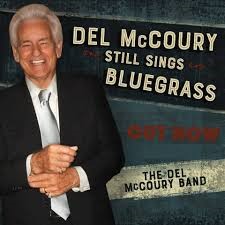
All in all, Dylan is probably delighted with the fact that the singer and guitarist of Monroe’s Blue Grass Boys from the 60s, Del McCoury himself, has put his “Walk Out In The Rain” on the repertoire.

It is a song with a charming history. Dylan writes it in 1978 together with Helena Springs, the lady who is the record holder in the Bob Dylan Co-Writer category (presumably 21 songs). The young, handsome, inexperienced Helena Springs is a welcome distraction for the recently divorced Dylan during his tour through the Far East and Australia (17 February – 1 April 1978) and they are having a good time together. Helena cheerfully remembers:

“We were together in Brisbane one evening and he was playing on the guitar and we were just goofing around, laughing, and I said, ‘I can’t really write’ … He said, ‘Well, come on, I’ll write something with you. We’ll write something together.’ And I said, ‘Okay.’ He said, ‘You start singing some stuff and I’ll start playing.’ So he started strumming his guitar and I started to sing, just making up lyrics. And he’d make up stuff, and that was when we got If I Don’t Be There by Morning and Walk Out in the Rain.”

Granted, she is not exactly blessed with a great, compelling storytelling talent, but Miss Springs does divulge notable information in a most charming way. Around that evening in Brisbane, it seems that there is indeed a turning point in the relationship. Dylan performs four times in Brisbane, from 12 to 15 March. In presenting the band, the bard has introduced the ladies with a variety of witty, sometimes corny gossip since the start of the tour. “Debbie Gibson on the left. She is my wife”, for example, and “In the middle my ex-wife Jo-Ann Harris”, or “my childhood sweetheart Jo-Ann Harris”.

But from February 28, in Tokyo, Helena Springs is consistently presented as my fiancée, or (usually) my current girlfriend, sometimes with additions that are no longer acceptable in the #MeToo era. “The girl who makes me cry every night, she has a great, great future and a great behind, Miss Helena Springs”, and in Brisbane with the friendly nudge nudge wink wink bonus: “We get along pretty well this tour.”

Three months after Australia, on July 1, Helena Springs is still Dylan’s background singer and is still being introduced as my current girlfriend. The crew is now in Europe, at a festival in Nuremberg on the famous Zeppelinfeld, the enormous terrain where the NSDAP held Hitler’s party conferences and parades in the 1920s and 30s.

At the end of that memorable performance, special guest Eric Clapton enters the stage, who then plays along with two more songs (“I’ll Be Your Baby Tonight” and “The Times They Are A-Changin’”). Clinton Heylin quotes Clapton’s memory of the by-catch of that guest appearance:

“He just laid that cassette on me [with Walk Out In The Rain en If I Don’t Be There By Morning]. He was hooked up with this girl called Helena Springs. They were co-writing and I think he was very proud of it and laid it on me when we were in Nuremberg. I’ve still got that cassette of them two… When I get down sometimes, I listen to them and it will bring me right out, because I know that no one else has got it. This was a gift to me…”

Two weeks later they meet again at the festival at Blackbushe Aerodrome, July 15, and in the meantime Clapton has already recorded both songs for his sixth studio album, Backless. “Walk Out In The Rain” opens side A, “If I Don’t Be There By Morning” opens side B.

In general, the Dylan aficianados shrug off both songs. Heylin thinks Walk Out is the better of the two, but still little inspired and less good than “Coming From The Heart”.

The December 1978 Rolling Stone reviews Backless as “There’s nothing calamitous on it” and suspects that both Dylan songs have been “dredged up from the Sub-Basement Tapes.” Not great, but still memorable, Attwood says, and most Backless reviews are either neutral or negative, regarding this song. “Pale and uninspired,” for example.

Time has been kinder to the song. After a few rare, not very appealing covers (Ann Christy, Groovie Ghoulies) the song wakes up again in the twenty-first century. Perhaps thanks to The Del McCoury Band, where it has been on the set list since 2000. In 2001 blues talent Kenny Neal records a particularly nice version, with a leading role for violin (on One Step Closer, which also features a beautiful version of The Band’s “Remedy”).

This in turn inspires Clapton, who always keeps an eye on his heirs. In 2004, Slowhand reanimates the song he recorded a quarter of a century earlier: from March to July he performs “Walk Out In The Rain” fifty-three times, always as the third song, after “Let It Rain” and “Hoochie Coochie Man” – beautiful, compelling versions with a dynamic, splendidly playing Clapton in top form. Belfast April 24, 2004 was broadcast by the BBC and surfaces a little later – of course – as a bootleg.

My, what a very nice song it proves to be after all.

Clapton in Belfast:


What else is here?

An index to our latest posts arranged by themes and subjects on the home page.  You can also see details of our main sections on this site at the top of this page under the picture.

There is an alphabetic index to the 550+ Dylan compositions reviewed on the site which you will find it here.  There are also 500+ other articles on different issues relating to Dylan.  The other subject areas are also shown at the top under the picture.

We also have a discussion group “Untold Dylan” on Facebook which mostly relates to Bob Dylan today.  Just type the phrase “Untold Dylan” in, on your Facebook page or follow this link 

And please do note   The Bob Dylan Project, which lists every Dylan song in alphabetical order, and has links to licensed recordings and performances by Dylan and by other artists, is starting to link back to our reviews.


Posted in Uncategorized | 3 Comments

“All the way down”: A missing Dylan track rediscovered

by Tony Attwood

This song is mentioned in The Copyright Files by Tim Dunn where it is suggested that it comes from early 1981, and registered for copyright in 1985.  Otherwise there seems to be little or nothing said about the piece.

I don’t have a stand alone version of this song, but it does turn up on “Between Saved and Shot” at 25 minutes.

For the most part it consists of the title line over and over with a few extra lines which are pretty much impossible to hear well enough to transcribe.

Because of the highly repetitive nature of the song there is a huge temptation to move on to something else, but then suddenly out of nowhere the whole piece takes off at 28 minutes and we get 45 seconds of a jolly bouncy 12 bar blues before one final reminder of “All the way down”.

https://youtu.be/mrsRBrajx9Y

What is interesting is that the song clearly has been rehearsed, or at least run through once or twice because the rhythms and pauses are not what one would always expect.  Yes of course the backing band and singers can have picked it up as they go along but the change noted above at the 28 minute marker does make it clear that the ladies and gentlemen of the band did know something about what was going to happen.

And that is about it for this song.   Mostly one line with 45 seconds of really intruiging music right at the end.   I wish there was more of the latter and less of the former, but that’s Bob in a rehearsal for you.

I’m adding it to the list of Dylan compositions that we keep simply because I want that list to be as comprehensive as possible, but it is really just a sketch.

What else is here?

An index to our latest posts arranged by themes and subjects on the home page.  You can also see details of our main sections on this site at the top of this page under the picture.

There is an alphabetic index to the 550+ Dylan compositions reviewed on the site which you will find it here.  There are also 500+ other articles on different issues relating to Dylan.  The other subject areas are also shown at the top under the picture.

We also have a discussion group “Untold Dylan” on Facebook which mostly relates to Bob Dylan today.  Just type the phrase “Untold Dylan” in, on your Facebook page or follow this link 

And please do note   The Bob Dylan Project, which lists every Dylan song in alphabetical order, and has links to licensed recordings and performances by Dylan and by other artists, is starting to link back to our reviews.

Posted in Uncategorized | 3 Comments

Bob Dylan And Mary Magdalene 

by Larry Fyffe

The names of the two main characters in “Victory” tempts one to give the story a Christian interpretation – Heyst rhymes with Christ; Lena is a shortened form of Magdelena. But the ending of Joseph Conrad’s sorrowful tale is too Hamlet-like to make such an interpretation stand up to scrutiny.

In songs by Bob Dylan, Mary Magdalene’s name, in one form or another, pops up. According to interpretations given by a number of biblical scholar, she’s a prostitute who’s been reformed by Jesus.   Which begs the question – How is she treated in Bob Dylan’s lyrics when they’re analyzed from a Christian point of view?

Well, let’s examine the following song:

Hot chili peppers in the blistering sun
Dust on my face, and my cape
Me and Magdalena on the run
I think this time we shall escape
(Bob Dylan: Romance In Durango ~ Dylan/Levy)

The story therein be akin to the one about the substitution of Simon the Libyan on the cross. According to the song lyrics above, Jesus evades sure death on the cross, a sentence handed down because one of His followers assaulted a guard.

According to the Holy Bible, this is not how things are supposed to happen:

And Mary Magdalene and Mary, the mother of Joses
Beheld where He was laid
And when the sabbath was past
Mary Magdalene, and Mary, the mother of James and Salome
Had brought sweet spices that they might come and anoint Him
(Luke 15: 47; 16: 1)

So in Dylan’s song, the God of Thunder, disguised as Captain James Kirk, arrives on the scene; He intends to correct the course of biblical history; things start to go bad for the escaped Jesus:

Was that the thunder that I heard
My head is vibrating, I feel a sharp pain
Come sit by me,  don't say a word
Oh, can it be that I am slain?
(Romance in Durango)

https://www.youtube.com/watch?v=-NBWMK0CV0Y

Not only is the Jesus figure hit by a hail of bullets, Mary Magdalene’s demons return – the former whore gives James Kirk a wink; he flips open his Communicator, and says, “Beam me and my new sweetheart up, Scotty!” God’s so angry at His son that He causes the history train that’s carrying the New Covenant to slip off the rails!

In another song, Dylan tells a similar tale of Mary Magdalene’s duplicity. Scarlet Town represents the Jerusalem of old; sweet William is Jesus. As in the Bible, Mistress Magdalene visits Christ in the sepulchre where He’s preparing to ascend to Heaven:

Scarlet Town in the month of May
Sweet William on his deathbed lay
Mistress Mary, by the side of the bed
Kissin' his face, heapin' prayers on his head
(Bob Dylan: Scarlet Town)

In the Bible, Jesus tells Mary to spread His Word, but it’s clear by what says to her in the song that she’s planning to get out of town – perhaps going to Turkey or even France:

"You got legs that can drive men mad
A lot of things we didn't do that I wish we had
In Scarlet Town the sky is clear
You'll wish to God that you stayed right here"
(Bob Dylan: Scarlet Town)

Below, another song by Dylan that indicates the character of the narrator who’s obviously Jesus. Bob (aka Sam Spade) takes on the role of a ‘film noir’ detective who finds out that Jesus thinks all women are whores, and  that they ought to confess it; Christ’s a bit concerned that Mistress Mary might blackmail Him. Should it come to light that He’s made use of her services, His reputation will be in ruins (the Holy Bible claims that she “had been healed of evil spirits” by  Christ).

Jesus confesses to the detective what he does before Mary gets out of Jerusalem:

Queen Mary, she's my friend
Yes, I believe I'll go see her again
Nobody has to guess
That Baby can't be blessed
Till she finally sees that she's like all the rest
With her fog, her amphetamine, and her pearls
(Bob Dylan: Just Like A Woman)

Jesus says He visits the  prostitute (‘Baby’ and ‘Queen’ are His pet names for Mary Magdalene), and tells her if she promises to keep her mouth shut, He’ll bless her:

Yes, I believe it's time for us to quit
And when we meet again
Introduced as friends
Please don't let on that you knew me when
I was hungry, and it was your world
(Bob Dylan: Just Like A Woman)

The detective, you see, has been investigating Mary’s murder; it takes Spade 48 hours, and Christ ends up getting crucified. Seems Mary should not have laughed at Him.

Posted in Uncategorized | 2 Comments

Let Me Die In My Footsteps; let me depart this song and sing another

by Jochen Markhorst

A minor faction of Dylanologists argues that “Let Me Die In My Footsteps” is actually the first Dylan song. It is the first composition for which he comes up with the melody all by himself, not borrowing from a Guthrie song or some traditional – hence it being the first real Dylan song.

Dylan sees it differently, according to Chronicles:

“I did compose a slightly ironic song called “Let Me Die in My Footsteps.” I based it on an old Roy Acuff ballad.”

Agreed, the simple G-C-D chord scheme can be found. In fact, it can be laid over almost any Roy Acuff song. But then again: that also applies to a million other songs. There is, however, no ballad with a similar melody in Acuff’s oeuvre.

More fascinating is Dylan’s remark at the end of this passage:

When I began performing “Let Me Die in My Footsteps”, I didn’t even say I wrote it. I just slipped it in somewhere, said it was a Weavers song.

Remarkable is, obviously, first of all the modesty, the embarrassment even that keeps a young Dylan from saying he has written a song. But moreover: the Weavers reference does not come out of the blue.

Dylan is thinking of an early song by the versatile talent Shel Silverstein (Sheldon Allan Silverstein, 1930-1999), who has a few realistic chances of immortality. His at that time very popular cartoons for Playboy (from 1957 to 1975) do not stand the test of time, nowadays look a bit corny and dull, but on other fronts he has produced timeless hits. Entire generations of Americans grew up and grow up with his children’s books. The best-selling and most translated is The Giving Tree  and the disruptive, slightly anarchist Uncle Shelby’s ABZ was and is a masterpiece. His plays are now fading somewhat, as is his poetry. His best songs, however, remain monumental.

First his biggest hit: “A Boy Named Sue”, that the whole world will continue to sing in the version of Johnny Cash. He is also a regular songwriter for Dr. Hook (“Sylvia’s Mother”, “The Cover Of The Rolling Stone”) and Marianne Faithfull probably still is very grateful for the beautiful “The Ballad Of Lucy Jordan”.

He also makes records himself. Less successful, but filled with beautiful songs and sometimes hilarious lyrics. Inside Folk Songs is such an album, and The Weavers pick the song that Dylan thinks of when he announces “Let Me Die In My Footsteps” as a Weavers song: the cabaretesque “Standing On The Outside Of Your Shelter”.

Dylan’s association is obvious. Just like Footsteps, Silverstein’s song is inspired by the half-hysterical phenomenon of thousands of Americans digging fallout shelters in the backyard for fear of the nuclear Apocalypse. “Standing Outside Your Shelter” transforms that sad phenomenon humorously to a funny song:

I’m standing on the outside of your shelter, lookin’ in,
While the bombs are here a-droppin’ everywhere.
Through the glass, you look so sweet and warm,
And safe and cosy — Have I ever told you that I care?

Humour cannot be found in Dylan’s song, although he himself values it as “slightly ironic” in Chronicles. The lyrics are in fact stately, patriotic, infused with Woody Guthrie, sometimes poetic, here and there somewhat naive-pacifist (the I’d buy the whole world couplet, for example) and some one-liners have an uncomfortably high level of greeting cards wisdom. “One must learn to live, not learn to die”, and all that – whereby the young poet will, by the way, offend seasoned philosophers from Plato, Seneca and Cato to Thomas à Kempis and Erasmus; they all can explain very well that, quite on the contrary, learning to die is a higher purpose of human life.

https://youtu.be/13KcdxpRn4Y

Despite those few less shiny moments, the song is and will most certainly remain one of the early masterpieces from the bard’s repertoire. Beautiful melody, hypnotic cadence and a catchy recurring verse line as a chorus. Dylan is pleased too, initially. In March ’62 he proudly presents Footsteps to his mentor Izzy Young, it has been on the track list for The Freewheelin‘ for some time, the recording, 25 April 1962, is one-take only and columnist Nat Hentoff from The Village Voice has already written the song’s background information for the liner notes. Folk magazine Broadside is allowed to publish the lyrics (April ’62, with a different title by the way: “I Will Not Go Down Under The Ground”) and in July it is on his set list.

A few months later, though, he seems to be fed up already. He breaks off a Witmark recording halfway and a moment later “Let Me Die In My Footsteps” has also been removed from the track list for The Freewheelin’ – it is being replaced by “Masters Of War”.

It is one of the first times, but certainly not the last time that Dylan rejects a beautiful song for a recording, heartlessly degrading it to a throw-away. Usually for reasons of his own, baffling, even reproachable in the eyes of us mere mortals. “Mama, You Been On My Mind”, for example, and “I’ll Keep It With Mine”, “Blind Willie McTell”, “Series Of Dreams” and dozens more, which we eventually can enjoy after all, thanks to illegal bootlegs and later the Bootleg Series.

But in this case it is at least somewhat understandable. The young poet / singer has written songs like “Blowin ‘In The Wind” and “A Hard Rain’s A-Gonna Fall” and recognizes the difference in quality: these songs are universal, vague, poetic and ambiguous enough to provide a timeless, transcendent value.

“Let Me Die In My Footsteps”, on the other hand, is topical, hung up on a passing, time-bound craze. In 1959, fallout shelters become commonplace to the extent that women’s magazines publish photo reports with interior tips. In the September ’61 issue of Life Magazine, President Kennedy writes an open letter to all Americans advising them to build fallout shelters, and a little later DIY-kits are for sale at the hardware store. After the Cuban Missile Crisis, October ’62, however, the hysteria gradually starts to fade away and this does not escape Dylan – his song vaguely smells of a slogan song anyway, but now it also starts to sound old-fashioned. “I’ve sung it too many times,” he says as he discards the song – which doesn’t sound too credible from the man who will sing a “Blowin ‘In The Wind” more than a thousand times, a “Like A Rolling Stone” more than two thousand times.

The spiritual father may reject his song, but it does – of course – survive. On Broadside Ballads Vol. 1, the first folk compilation album from the eponymous folk magazine, released in 1963, is a first official, pretty nice recording, performed by Happy Traum – with friend Dylan in the background.

After that it remains silent for a while, until in ’72 the cheerful quartet of born musicians Coulson, Dean, McGuinnes and Flint, led by producer Manfred Mann, present an eccentric, beautiful cover. Hippie spirits still float around, the Tibetan Book of the Dead is on many a coffee table and the British opt for a George Harrison / Ravi Shankar approach with Indian tabla’s and mantra-like unison singing. That works wonderfully well; surprisingly, the song gains depth, it acquires a (quasi-) Eastern-philosophical added value. Brilliant, but it doesn’t make waves, unfortunately.

Only the release of the original, on The Bootleg Series 1-3 (1991), really leads to a second life. The country version of Alastair Moock (on Bad Moock Rising, ’99) has the empty-headed beauty of a dumb blonde, but it is nevertheless quite beautifully made. Jason Bennet from Colorado Springs often produces successful Dylan covers (“Abandoned Love”, “Shooting Star”) and his Footsteps may be somewhat conservative, but is touching still (on the collection Positively Pikes Peak – The Pikes Peak Region Sings Bob Dylan, 2011 ).

The most beautiful cover is anything but conservative. For a stage adaptation of Orwell’s 1984 (2015), one Liz Mistele with David Kaye and the otherwise little famous band Electric Mustache sing a gothic, dramatic version of “Let Me Die In My Footsteps”. The arrangement winks at Dylan’s “Love Sick”, the sound goes back to the industrial New Wave from say 1984, a second guitar imitates symphonic rock doodling from the 70s and the singer maintains an attractive tension between dedain and pathos – and thus this version of a song Dylan wrote back in 1961 bridges half a century of popular music.


What else is here?

An index to our latest posts arranged by themes and subjects on the home page.  You can also see details of our main sections on this site at the top of this page under the picture.

There is an alphabetic index to the 550+ Dylan compositions reviewed on the site which you will find it here.  There are also 500+ other articles on different issues relating to Dylan.  The other subject areas are also shown at the top under the picture.

We also have a discussion group “Untold Dylan” on Facebook which mostly relates to Bob Dylan today.  Just type the phrase “Untold Dylan” in, on your Facebook page or follow this link 

And please do note   The Bob Dylan Project, which lists every Dylan song in alphabetical order, and has links to licensed recordings and performances by Dylan and by other artists, is starting to link back to our reviews.
Posted in Uncategorized | 1 Comment

Songs about Dylan: Part 7 – the blues about Bob.

Research by Aaron Galbraith; comments by Tony Attwood

Syd Barrett was one of the most amazing talents of the 1960s, but circumstances stripped him of the longevity he should have had as a composer, and so we are left with a handful of wonderful songs and bits and pieces he would have written and developed had life turned out differently.

By 1963 Syd Barrett was already writing songs of a unique flavour (“Effervescing Elephant” dates from this time), and was also friends with David Gilmour with whom he occasionally played at local clubs.

Syd went to see Dylan perform in 1964 and Bob Dylan Blues was written as a result.  The following year he joined the Tea Set, the band whose name he suggested changing (as there was already a band called the Tea Set), to The Pink Floyd Sound.   That band started recording in 1965, and of course the rest of it is very well known.

Syd Barrett continued writing and some of his songs such as “Bike” were recorded by Pink Floyd while he was with the band – and indeed at the start he was the main writer for the band.  However by 1967 Syd was becoming unreliable and erractic due to excessive drug use, and indeed by that time when they toured with Hendrix he was already failing to appear at several gigs.   I was fortunate enough as a teenager to catch one of the shows where he did turn up, and the memory of that wonderful night of seeing both acts has stayed with me through the many years since.

“Bob Dylan Blues” is thus a very early piece, and hardly representative of what he achieved later on “Piper at the Gates of Dawn” but it is worth noting as a part of Syd’s legacy.   Here’s “Bike” – a song which like so much of Syd’s later work doesn’t just tear up every rule, it tears up every rulebook as well.

This version sadly cuts the ending section, but you get the idea.  Or if you don’t, well, sorry, it meant (and still means) a huge amount to those of us who were there and who survived.

https://youtu.be/mBCctL88dRk

Moving on and back on planet Earth we have Ralph McTell with “Zimmerman Blues”

If you know anything of Ralph McTell you will know “Streets of London” – at least I think you will.  Certainly in the world I inhabit in the UK everyone knows Streets of London.  It won the 1974 Ivor Novello Award for Best Song and opened McTell’s 1972 album “Not till Tomorrow” – an album which includes Tony Visconti as a multi-instrumentalist and indeed Mary Hopkin.

I get a little sadness now, just now and then
It comes to remind me, what it was like when
I was out on the road
Happy, hungry and cold
First you win and then you lose
Oh, Lord, I've got the Zimmerman blues

Don't give me money now, 'cause it's bad for my head
You can keep the honey now, put something else on that bread
To lose all them old time friends
Who missed how they were making it end
And we all wound up confused
That's what you call the Zimmerman blues

Do a concert for Angela, build a building or two
It gets harder for me, but easier for you
As sure as the stars turn above
All we ever asked for was love
And I think that we've all been used
Ending up with the Zimmerman blues

I get a little sadness now, just now and then
It comes to remind me, when I called you a friend
So where do we go from here?
For me it won't ever get that near
And if it did, I know what I would choose
Anything but the Zimmerman blues

Take two lines from that

All we ever asked for was love
And I think that we've all been used

and you have the whole era wrapped up.

RBHS jukebox commented that the song was “Inspired by the complexities and contradictions that make up the life of a public figure,” which is better than I could express it.

McTell said of the song, “I used Bob’s real name to try to strip away the identity he had assumed so as to reveal his true self not what he had become and I hoped that it would be a reminder to me as well that the changes you go through are not always the best ones.”

The phrase “Zimmerman Blues” itself caught on and was used by a fanzine at one time.

McTell also did a version as part of the one off band The GPs with Richard Thompson, Dave Mattacks and Dave Pegg from Fairport Convention.   Sorry if those names don’t mean too much to you, but believe me for many of us (particularly in the UK) those are the giants.

Elsewhere in the series

Posted in Uncategorized | 3 Comments

Gnostic Symbolism Of The Raven  

By Larry Fyffe

Rationalist thinkers during the Age of Enlightenment cast the Judeo-Christian God outside the workings of the physical Universe, and look instead to science in order to explain human behaviour – without resorting to moral terms like ‘good’ and ‘evil’. They consider the Alchemy experiments of yore to be a ‘proto-biology’ – an attempt to explain human behaviour on the basis of the  ‘elements’ of earth, air, fire and water.

Gnostic thinkers do somewhat the same thing; they cast the Monad into the deep and far-off mysterious, and nonmaterial regions of the Universe though “He/She” still connects with mankind’s material world. Neo-gnostics consider Alchemy to be a ‘proto-psychology’ – an attempt to explain human behaviour on the basis of unconscious images and figurative language: on archetypes, analogies,  coincidences, and correspondences wrought in the human mind. According to these  gnostics, Sigmund Freud’s psychoanalytic method focuses too much on the physical sex drive.

Rationalists, for these gnostics, are unable to adequately explain the evolution of the ‘spirtual’ side of mankind that co-exists with the physical side. Sophia, a symbol of feminine wisdom, plays a large part in gostic thinking; the raven symbolizes the first step in the revitalization of the sparks of spiritualism in the phyical body – individual humans must first confront the blackness trapped within the inner soul before they can release it, move on, and be warmed by the red light shining at the higher levels of the “collective” unconscious. In mythology, Apollo, the Sun God scorches the white raven black because he’s angry at the bird for being a wicked messenger, for telling him that his lover, the daughter of a king, has been unfaithful. In the Bible, the maiden in the ‘Song of Solomon’ is blackened in her search for love.

Observed is that not all traces of Gnostic thought are erased from the Holy Bible:

And he sent forth a raven, which went forth to and fro
Until the waters were dried up from the earth
(Genesis 8: 8)

Noah is aware that, unlike the white dove, the black raven can survive by eating impure carrion that’s floating on the flood waters.

Many an artist, rebellious against orthodoxy, be influenced by Gnosticism. The lyrics of singer/songwriter Bob Dylan exhibit such an influence; in the following song, the black bird might well symbolize a lover who’s hindered from taking the first flight upwards towards ‘gnosis’:

The wind howls like a hammer
The night blows cold and rainy
My love she's like some raven
At my window with a broken wing
(Bob Dylan: Love Minus Zero)

And in the song below, the feathers of a nightingale, a symbol of virtue, are turned raven black:

She was torn between Jupiter and Apollo
A messenger arrived with a black nightingale
(Bob Dyan: Changing Of The Guards)

At least through Christian eyes, the raven, or black crow, becomes associated with bad luck rather than with the beginning of a spiritual journey:

Woke in the mornin', wanderin'
Weary and worn out ....
Black crows in the meadow
Across the broad highway
Though it's funny, honey
I don't feel much
I'm out of touch
With being a scarecrow today
(Bob Dylan: Black Crow Blues)

Bringing it all back home to:

Once upon a midnight dreary
While I pondered weak and weary ....
Open here I flung the shutter
When, with many a flirt and flutter
In there stepped a stately raven
Of the  saintly days of yore
(Edgar Alkan Poe: The Raven)

What else is here?

An index to our latest posts arranged by themes and subjects on the home page.  You can also see details of our main sections on this site at the top of this page under the picture.

There is an alphabetic index to the 550+ Dylan compositions reviewed on the site which you will find it here.  There are also 500+ other articles on different issues relating to Dylan.  The other subject areas are also shown at the top under the picture.

We also have a discussion group “Untold Dylan” on Facebook which mostly relates to Bob Dylan today.  Just type the phrase “Untold Dylan” in, on your Facebook page or follow this link 

And please do note   The Bob Dylan Project, which lists every Dylan song in alphabetical order, and has links to licensed recordings and performances by Dylan and by other artists, is starting to link back to our reviews.
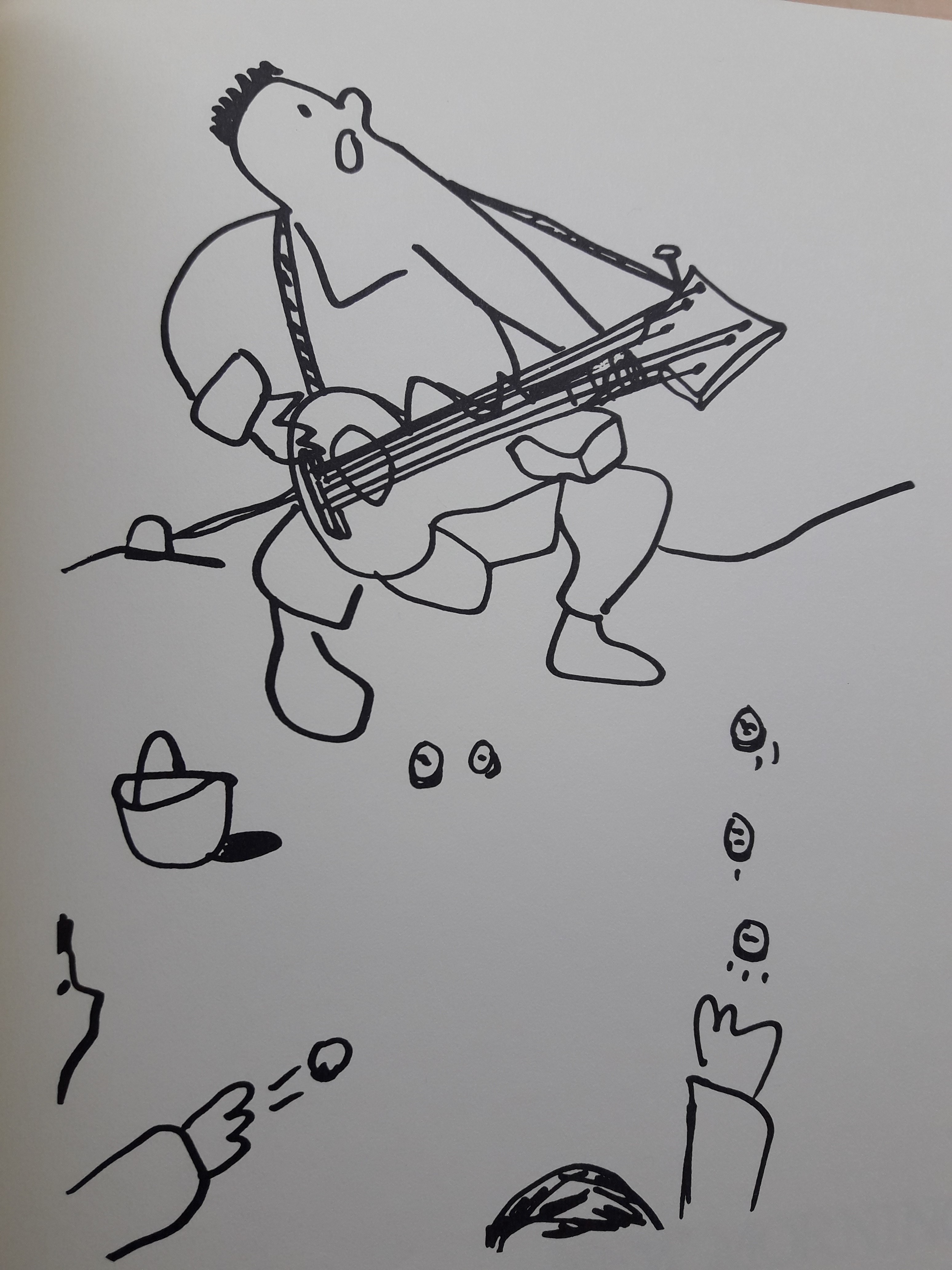
Posted in Uncategorized | Leave a comment

The art work on Bob Dylan’s albums: The Basement Tapes

Patrick Roefflaer

The Basement Tapes…

  • Released                       January 17, 1975
  • Photographer                Reid Miles
  • Liner Notes                    Greil Marcus
  • Design Consultant         Bob Cato

Throughout Summer and Fall of 1967, Bob Dylan and the musicians that later would call themselves The Band, recorded more than hundred songs during informal sessions in West Saugerties, New York. Because most of these recording took place in the cellar of the house called Big Pink, the sessions were dubbed The Basement Tapes.

“We never thought that the public was ever going to hear any of this,” Robbie Robertson said to Uncut in 2016. “It was specifically a songwriting thing, Bob wanted to put down songs for other people to record. We’d lay down a song and he’d say, “Oh, that would be a good one for Ferlin Husky,” or, “Ah, I dunno, maybe Ramblin’ Jack Elliott might be able to get into that.” It was a random, fun thing.”

However, in January 1975, Dylan unexpectedly gave permission for the release of a selection of the recordings. Robbie Robertson was appointed to make a selection of the songs, and worked on them with engineer Rob Fraboni.

Because no photographs exist of Bob Dylan with The Band from the period the recordings were made, a new portrait was needed for the sleeve.  Robertson felt that the sleeve of Underground, an 1967 album by Thelonious Monk, had the right kind of vibe. The art-director of that Grammy Award album was John Berg, who had done much of Dylan’s albums and the photographer was Reid Miles (1927-1993).

Reid Miles

When around 1955, the modern jazz label Blue Note started to release their recordings on 12″ LPs, they needed someone to design album covers. Producer and photographer Francis Wolff found Esquire magazine journalist, Reid Miles, who had studied creative design. Although the budgets were small, he created a “hip” brand identity for the label, working with Wolff’s photographs or just “some outrageous graphics!”, as he would put it. Blue Note became the epitome of modern, cool and progressive and Miles Reid one of the earliest album cover designers to take note of.

In the sixties Reid became interested in photography himself, and excelled in that too – as can be seen on the sleeve of Underground. Robertson contacted Miles and told him what he needed.

Reid found the perfect spot for the Basement Tapes shoot in the cellar of the Hollywood YMCA, at the corner of Schrader and Selma. The boiler room, with pipes and mechanical gear all around provided the right look.

The idea was to gather the musicians involved, plus a Fellini like cast of characters suggested by the album’s songs; an Eskimo, the fat lady (with a Mrs Henry T-shirt), a ballerina, a nun, a circus strongman…

As nowhere is mentioned who is who, speculations that people as Neil Young, Ringo Starr and Todd Rundgren are among those involved.

None of them are.

The dwarf, representing Tiny Montgomery, is the actor Angelo Rossitto – famous from Freaks (1932), Mad Max Beyond Thunderdome (1985) and Tom Waits’ Swordfishtrombones (1983).

Here are the characters from this front side of the outer sleeve: mostly musicians + friends

  • David Blue (cross legged, with bowler hat)
  • Levon Helm, ready for the million dollar bash
  • Photographer John Scheele (with hair pulled back + moustache )
  • Richard Manual (in Royal Air Force uniform)
  • (The Band’s equipment manager) Bill Scheele (in the hat and shades, with a beard)
  • Robbie Robertson (in Red Army uniform)
  • unknown
  • Garth Hudson (with tuba)
  • (recording engineer) Ed Anderson (in drag)
  • Bob Dylan (with mandolin)
  • Rick Danko, with accordion
  • dog

Some friends came along for the event: John and Bill Scheele. Bill is equipment manager for The Band, while his brother John documented Dylans’ 1974 reunion tour as photographer. There’s David Blue and Bob Neuwirth.

The “man in drag” at upper right is recording engineer Ed Anderson and Quinn the Eskimo is William David “Charlie” Chin, who’s band Cat Mother & The All Night Newsboys opened for The Band at their first NYC appearance at Fillmore East, in 1969.

John Schleese’s recollected in 2011 to Jim Linderman: “That was a most surreal day: No cameras were ever allowed back then, so this was a conscious effort to evoke the spirit of those sessions. It brought out a mischievous side of Bob Dylan – how he could put on a hat or costume and assume a new identity. In hindsight, that’s a hallmark of his songs and creative work. […]

We started up in a bright room with pool tables to get dressed and ready.”

In a interview to Carol Caffin (published in BandBites, Volume II, No. 2, 2008), John Schleese explained that “Reid had brought in racks of clothes, a pre-fitted selection like you’d do for a casting call, to have pieces ready that would fit Bob or one of the other guys. I know there had to be some special requests because Ed Anderson, who was one of the team by then, was dressed up as a pageant queen. It was a lot of fun, because Ed’s tall and gangly and does not make a very attractive girl. [laughs]”

Bob switched into a red and white striped jacket with a black and grey swirl pattern in bands across the arms and chest. The jacket is made from a Cheumash Indian blanket, which he borrowed from a female friend. In 2012 she offered the jacket to be sold through PFC Auctions. She provided a letter of provenance, in which she describes her relationship with the songwriter. In the letter she explained that the jacket “…was a little too small for him. Whilst wearing the jacket Dylan split the back and arm open but this has since been stitched.”

“They all tried stuff on upstairs”, John continues, “When we went downstairs, I didn’t take a lot of pictures or intrude into the session, because it was Reid’s photo shoot. I only took a few snapshots of them getting ready, kind of documentary shooting. A few pictures show Bob posing people, moving them around in the shot. Reid had roughed out the basic composition, but Bob helped everyone strike their poses, adding to the surrealism.“

Once Miles had chosen the photo’s he felt were best to use for the artwork, he destroyed the outtakes. “He would have picked his best transparencies”, explained John Schleese, “in this case, color slides,  and submitted them to Columbia. He’d reduce any second-guessing by basically saying “not only are these the best shots, they’re the only shots.”

Bob Cato put one photo on the outside of the fold-out sleeve, with Bob right in the middle of the front, surrounded with the members of the band and the song’s characters on the back. There’s no typography on the outer sleeve. The album’s title is written on a cardboard box right at the front.

The other photo is used on the inner sleeve, next to liner notes provided by Greil Marcus. The text offers a scholarly, if somewhat perplexing analysis, framing the songs in a historical context.

Continue reading

Posted in Uncategorized | 4 Comments

Dylan’s Minstrel Boy: With twelve forward gears, it’s been a long hard climb

by Jochen Markhorst

Oh, I think of myself more as a song and dance man, y’know.

At the same press conference in San Francisco (December 3, 1965) where he declares that Manfred Mann is the best interpreter of his songs, Dylan defines himself as a song and dance man, as a troubadour, or: a minstrel. He postulates it with a boyish, charming grin, still smiling when he has to repeat it, but he does mean it, as we know by now.

Already in “Talking New York”, the first Dylan song which the world gets to know, he introduces himself as a traveling musician, and hereafter he keeps reminding us. I just walk along and stroll and sing, he sings in “I Shall Be Free”, I am a wandering song singer, he tells in “A Hard Rain’s A-Gonna Fall”, in “Eternal Circle”, in “I Shall Be Free No. 10”, he is a Mr. Tambourine Man following the music in “Farewell Angelina”, is stoned for his songs in “Rainy Day Women # 12 & 35”, and in the 21st century, on Tempest, the I still enters the scene singing and dancing: bring down my fiddle, tune up my strings.

The Traveling Wilbury’s, the supergroup in which Dylan is “Lucky Wilbury”, explicitly present themselves as minstrels too, in the attached, fictional provenance: “Dim Sun, a Chinese academic, argues that they may be related to The Strolling Tilburys, Queen Elizabeth the First’s favorite minstrels.”

And on the first record of The Traveling Wilbury’s, former Monty Python Michael Palin concludes that the group’s origins can be traced back to a culture shift at the originally very sedentary Wilbury’s:

Some intrepid Wilburys began to go away for the weekend, leaving late Friday and coming back Sunday. It was they who evolved simple rhythmic forms to describe their adventures.

Minstrels, in short. It therefore seems likely that Dylan came across his nom de plume “Lucky Wilbury” via this bridge. Through his oeuvre dozens of roaming musicians, troubadours and minstrels do march, but only one of them gets a name:

Oh, Lucky’s been drivin’ a long, long time
And now he’s stuck on top of the hill

… the minstrel Lucky in “Minstrel Boy”. Dylan shakes this charming song from his sleeve during that carefree summer of 1967 in the Big Pink, as he goofs around with the guys from The Band, filling the spectacular Basement Tapes. The world only gets acquainted with the song thanks to the live recording of the Wight concert, which ends up on Self Portrait.

At that point it is still unclear whence the song comes, but when Writings & Drawings is published in 1973, it appears that Dylan considers the song to be a Basement Tape. He places the lyrics as a second song in the “From Blonde On Blonde to John Wesley Harding” chapter, on page 364. Immediately after “Quinn The Eskimo”, which opens the chapter with twenty-one Basement songs, and before “Down In The Flood”.

Apparently Dylan has been brooding on the song some more: it is one of the fifteen chosen songs for which he makes a drawing. These Basement songs inspire him disproportionately often anyway. Five times, the Basement songs get five drawings – the lyrics of the ten other chapters, the chapters that are hung on the ten official albums, have on average only one drawing each.

Compared with most of the other fourteen drawings, the scribble to “Minstrel Boy” is quite one-dimensional. A boy with a guitar is thrown coins, so it is really no more than an awkward illustration of the first verse (Who’s gonna throw that minstrel boy a coin). Although … that rope or string from the guitar to a stone (?) behind the minstrel is strange. Is the minstrel tethered? Or is it perhaps a cable, does Lucky play electrically amplified?

It is almost inevitable to interpret the song autobiographically. From day one, Dylan presents himself as a song and dance man, and here he sings, after those tumultuous years ’62 -’66 of non-stop recording, tours, cheers and booing, hysterical raving, idolatry and mud-slinging, about a musician who, after having been on the road for a long time, now has crashed. Feeling – despite all the female attention – lonely and burdened. And moreover: in the last verse, Dylan suddenly switches from the third person to the first person and sings: I’m still on that road.

Mysterious, however, is mainly the third line of the first verse, the line that only exists in writing. In terms of content, the words are quite uncomplicated. With twelve forward gears, it’s a long hard climb – so that was a trip with a pretty heavy truck or a big tractor; the poet finds a fresh metaphor to express that it certainly has not been a lazy-on-a-sunny-afternoon ride, those years on the road.

No, the mystery lies mainly in the question: where does that line come from? Neither on the very fragmentary and sketchy Basement recording from 1967, nor on the Wight 1969 live recording those words can be heard. On Wight Dylan sings something like with aching jumpers, with all on down or maybe well aching and jumping with all laid down, words, anyway, that have nothing in common with the line that is written in Writings & Drawings and again later in The Lyrics and on the site.

Curious, moreover, is the effort Dylan has made to insert these, otherwise little spectacular, words and protect them under copyright law. It seems to contribute next to nothing to the song’s expressiveness, and anyhow, it is a song Dylan will never look back on – the one performance in ’69 is also the last one.

At the release, on the maligned Self Portrait, the song yields the very rare nice things that are said and written about the album. Even headsman Greil Marcus steps out of character for a second, in his infamous What is this shit review (Rolling Stone, June 1970): “Minstrel Boy is the best of the Isle of Wight cuts; it rides easy.”

And apparently the song is appreciated by the audience too; on the recording one can hear how the listeners after the first line move from words to deeds and throw the minstrel coins – clattering at his feet, at the microphone stand.

This exceptional position, which the song only shares with “Copper Kettle”, is somewhat maintained over the years. “Minstrel Boy” is occasionally highlighted and appreciated in retrospects, in overview articles and on fan forums in the following decades, in which Self Portrait is slowly reaping some revaluation.

However, the song remains obscure. Apart from a single tribute band, the entire music world follows Dylan’s example: it is never played, biographers ignore it and the song degenerates into a catalog number in the overview lists.

That won’t change until 2013. “Minstrel Boy” is on both The Bootleg Series Vol. 10: Another Self Portrait as on The Bootleg Series Vol. 11: The Basement Tapes Complete and, sure enough, is picked up by artists like Robyn Hitchcock and Dave Rawlings, who bring the song to the stage once in a while.

More admiration deserves Jolie Holland, the New Weird American who previously has dusted such a wonderful “Tell Me That It Isn’t True” on The Lagniappe Sessions (2014). In 2017 she releases the beautiful Wildflower Blues with her old bandmate Samantha Parton, which besides a very nice cover of Townes Van Zandt’s “You Are Not Needed Now” also contains the greatest cover of “Minstrel Boy”.

The ladies think the song is a bit too short, though. Jolie is bold enough to write two extra couplets, which by the way fit perfectly. They call their music North Americana and outsider folk, a self-invented genre designation that actually does justice to their oeuvre perfectly; their “Minstrel Boy” is a sensual, lazy-sunny-afternoon performance with superior singing by the ladies. They do deserve a lot of coins.

Jolie Holland & Samantha Parton:


What else is here?

An index to our latest posts arranged by themes and subjects on the home page.  You can also see details of our main sections on this site at the top of this page under the picture.

There is an alphabetic index to the 550+ Dylan compositions reviewed on the site which you will find it here.  There are also 500+ other articles on different issues relating to Dylan.  The other subject areas are also shown at the top under the picture.

We also have a discussion group “Untold Dylan” on Facebook which mostly relates to Bob Dylan today.  Just type the phrase “Untold Dylan” in, on your Facebook page or follow this link 

And please do note   The Bob Dylan Project, which lists every Dylan song in alphabetical order, and has links to licensed recordings and performances by Dylan and by other artists, is starting to link back to our reviews.


Posted in Uncategorized | 4 Comments

Bob Dylan: Gnostic Alechemy Revisited


By Larry Fyffe

Singer/songwriter Bob Dylan comes in contact with the symbols of Gnostic Alchemy from the get-go. He reads ‘The Raven’ by Edgar Allan Poe, and he takes part in  ‘Madhouse On Castle Street’, a modernist Western TV  play concerning a guy imprisoned within the walls of his own room; the social and physical envirnoment including one’s own body surrounds and constrains his spirit-seeking soul; not yet able to start over again from his basic white skeleton, the prisoner can’t take the next step in the direction from whence comes the overly bright golden light of a faceless God.

In the play, Bob Dylan sings the following song – the white swan being the alchemic symbol associated with the second stage of ‘gnosis’:

Tenderly William kissed his wife
Then he opened her head with a butcher's knife
And the swan on the river went glidin' by
The swan on the river went glidin' by
(Bob Dylan: The Gliding Swan ~ Dylan/traditional)

In the film “Renaldo and Clara”, Bob Dylan messes around with gnostic themes. The ghost-like White Lady arrives in a horse-drawn carriage, Emily Dickinson style:

Because I could not stop for Death
He kindly stopped for me
The carriage but just ourselves
And immortality
(Emily Dickinson: Because I Could Not Stop For Death)

The tiny, messy, tomb-like apartment parodies the giant pyramids of  Egypt, and its ancient mythologies – Horus is the falcon-headed son of the Egyptian sun goddess Isis, and her earth-bound husband Osiris; the ostrich-feathered Osiris is her twin brother who’s killed, and then thrown to the  catfish in the Nile River by their jeolous snake-like brother Seth. The left eye of Horus, representing the moon, is injured when he fights with his uncle, but his bigger right eye is an alchemy symbol that stands for the protection that his mother provides for everyone:

I was thinkin' about turquoise, I was thinkin' about gold
I was thinkin' about diamonds, and the world's biggest necklace
As we ride through the canyons, though the devilish cold
I was thinkin' about Isis, how she thought I was so reckless
(Bob Dylan: Isis ~  Dylan/Levy)

In the song lyrics below, the mythology of Isis and Osiris, and the biblical teachings of Jesus Christ are mixed together:

Oh sister, am I not a brother to you
And one deserving of affection
And is our purpose not the same on this earth
To love and follow His direction?
(Bob Dylan: Oh Sister ~ Dylan/Levy)

Brings to mind:

AndI said, "What is written, sweet sister
On the door of this legended tomb?" "
She replied: "Ulalume - Ulalume!
'Tis the vault of thy lost Ulalume!"
(Edgar Allan Poe)

The followers of modernist Jamaican gnostic Rastafarianism are somewhat akin to North American Mormons, but they geographically reverse the Promised Land. To them, Jah’s chosen people are black Africans, and the Ethiopia of old that includes part of Egypt is the Promised Land. There, a princess, a worshipper of Isis, protects Egyptain-born Moses.

However, many Africans become slaves of the “Babylonians”, of Europeans and Americans who change gnostic teachings into what they call the religion of ‘Christianity’ with stories like the ‘curse of Ham’. Jesus, for many Rastafarians, is Jah who appears on earth in the form of Haile Salassie, a descendant of King Solomon and the Queen of Sheba. Salassie be symbolized by the ‘Red Lion’; he’s considered the physical manifestation of the unified, re-masculinized Judeo-Christain God; the female goddess Isis gets short shifted, and displaced once again.

In the following lyrics, the singer/songwriter plays with the “Song of Solomon”; with “But life shall go for life, eye for eye, tooth for tooth, hand for hand, foot for foot” (Deuteronomy19: 21); and with “Thou canst not see my face, for there shall no man see me, and live” (Exodus 33: 20):

Been so long since a strange woman has slept in my bed
Look how sweet she sleeps, how free must be her dreams
In another lifetime, she must have owned the world, or been faithfully married
To some righteous king who wrote psalms beside moonlight streams
In creation where one's nature neither honours or forgives
I and I
One says to the other, "No man sees my face and lives"
(Bob Dylan: I And I )

Posted in Uncategorized | 7 Comments

Songs about Bob Dylan: the Americana tracks

By Aaron Galbraith

In this series we are looking at songs about Bob Dylan.   Recently we have covered…

For our next trick…let’s look at some Americana tracks…

First up

Rex Foster’s “Thinkin About Bob Dylan”

I must say right from the start that I love the Rex Foster track. The track appears on his second album “Artist” in 1991. The whole album is fantastic, his voice is like a warm hug, go check it out, and it’s available in its entirety on YouTube. It also includes an excellent take of “Song To Woody”.

Now here’s an interesting true story The song was playing on the radio station KFAN in the San Antonio area when someone called in and said he was Bob Dylan and wanted to know where he could buy Rex’s CD. Later that morning the owner of a local record store that carried the disc called the radio station to say, “Guess who was just in my store? Bob Dylan! and he just bought the Rex Foster album!”

Rex had a very interesting career, his first album “Roads of Tomorrow” came out in 1970 and then he attempted a follow up which didn’t appear. He moved into jewelry design (you can check out his work on line – he has designed for Johnny Cash, Merle Haggard and Sting amongst others). He then came back in 1990 and has since released 9 albums, including that long lost second album from back in the day, which also included an excellent version of “Only A Hobo”. I guess, as he said “he hadn’t come into my own time” yet.

Again, no lyrics available online for “Thinkin About Bob Dylan” so I had a bash at them myself. I couldn’t figure out one person’s name towards the end.

I’m sitting around thinking about Bob Dylan
Get me in trouble quick
You see old Bobby he’s a genius
And around here they just call me Stick

In the old days I tried to follow
And I wrote a lot of strange lines
But my images were hollow
I hadn’t found my own time
I hadn’t come into my own time

Now he’s just a coupla days older than me
And he learned his from the streets
Me I was raised in the backwoods
And I learned mine from the creek

And I’m thinking about Bob Dylan
And I think about old Hank Williams
And I talk to Peter Rowan every chance I get
About the end
Or is it the beginning

And I spent my time in the city
Just to get a reference point
And decipher all the screaming
Get a feel for the joint

And I found it was simple
Yeah and I found it was true
If I just get myself out of my way
Then maybe I’ll know what to do

Like unplug the television
And unload my gun
Spend time teaching my children
About the days to come

And I’m thinking about Bob Dylan
And I think about Nostradamus
And I talk to Townes Van Zandt every chance I get
About the end
Or is it the beginning

Well now I love my old pal Bob Dylan
And I hear he’s on the road again
I hope he stops by the house
To compare notes on the end

Like is in going to be a hanging
Or just another dance
And is there really enough time left
Or are we just going to kick back and grin

And I’m thinking about Bob Dylan
And I think about Crazy Horse
And I talk to Jerry Jeff every chance I get
About the end
Or is it the beginning

And I’m thinking about Bob Dylan
And I think about Katsy Quadil (??)
And I talk to Peter Yarrow every chance I get
About the end
Or is it the beginning

And I’m thinking about Bob Dylan
And I think about John Wayne
And I talk to Mom and dad every chance I get
About the end
Or is it the beginning

Next Ryan Bingham – “Dylan’s Hard Rain”

Bingham is one of a select group of people (along with Bob Dylan) to win a Grammy, Golden Globe and an Oscar. Bingham’s was for the track “The Weary Kind” produced by T Bone Burnett for the acclaimed film “Crazy Heart”. As it is an excellent piece of work I might as well add it here.

“Dylan’s Hard Rain” appeared on his second album “Roadhouse Sun” in 2009. Again, check out the whole album as it is really something special

The song itself a fairly self explanatory anti war piece set to some Byrds-esque accompaniment. It very successfully brings Dylan’s own “Hard Rain” message up to date, almost 50 years later.

His fans later persuaded him to record a version of “Hard Rain” itself as part of his online Bootleg series.

Here are the lyrics to “Dylan’s Hard Rain”

Well, I'm a homeless man
With my thumb in the wind
I sure miss my kin but then again
I'm on the road with a song for you

I took a step, I lost a bet
They cut off my tongue, now they're full of regret
Careful what you say
If they ain't gonna listen anyway

Just make the cash, bet on the past
Everybody's so afraid to be last
You can't take back everythin' you leave behind

Is everybody so ashamed
For lettin' it all slide?
Is everybody so afraid?
Mr. Dylan's Hard Rain was fair warnin'

On a shake down in the alley
Breakin' people's faces, gonna start you up a rally
I've never seen a day in the sun with the gun
That's loaded for you

There's some hippies in the back room
Rockin' and a-rollin' and a-smokin' to an old tune
Someone took the guitar and a match
And set peace on fire

Hey my brother, what is wrong?
You lost all your money on the corner rollin' bones
Give him your cash, motherfucker
He's too fast for you

Is everybody so ashamed
For lettin' it all slide?
Is everybody so afraid?
Mr. Dylan's Hard Rain was fair warnin'

On the TV, there's a white man
Too much make up on his wife with God's plan
I guess the religious vote made it to Congress

And on the border of Tijuana
People are growin' truck loads of marijuana
Maybe someday our friends will be American farmers

Then the necklace in the south
A few hopeless people still hangin' it around
The wind's gonna cut you down in the long run

Is everybody so ashamed
For lettin' it all slide?
I won't be afraid
Mr. Dylan's Hard Rain is where it's pourin' in, fair warnin'

So can we save us from today?
The hands of the wretched are the ones gettin' paid
Everythin' stays the same, if you don't change it

And all the dreams will bust at the seam
It all goes down in the mighty machine
You don't care now, but someday you might need it

I heard the whistle start to blowin'
Then I saw the mountain in the back come tumblin'
Everybody's wishin' they could get out of the way
Everybody's wishin' they could dig their ass out of the grave

Rod MacDonald – “ I Am Bob Dylan”


Next up it’s Rod MacDonald with his “I Am Bob Dylan”. He is an independent artist and has appeared on stage with amongst others Pete Seeger, Peter Yarrow, Odetta and Tom Paxton. Apparently he was the first American artist to tour the Czech Republic.

Anyway, this track appears on his 9th album “A Tale Of Two Americas” in 2005.

in the last ten minutes five people have asked me
are you bob dylan?
are you bob dylan?
so i thought i'd come clean in case it was you who asked me
i am bob dylan
i am bob dylan
and all i need to know is
what are you lookin' at?
yeah, what are you lookin' at?
in the last two weeks ten people have asked me
are you somebody?
are you anybody?
do ya think i look like bob dylan for nothin'?
I am somebody yes,
I am anybody and all i need to know is
what are you lookin' at?
yeah, what are you lookin' at?
in the new millennium, the people will ask you
are you with somebody?
are you with anybody?
so if anybody asks you, you can just tell them
you're with bob dylan
say you're with bob dylan
and all i need to know is
what are you lookin' at?
yeah, what are you lookin' at?

He is also lead singer of the band Big Brass Bed which has released 3 albums of Dylan covers. Here is their take of “High Water”.


Now as a “bonus track” to the Americana songs I’ll throw Wilco’s “Bob Dylan’s 49th Beard” at the end here, just because I love it so much!

It’s an almost perfect break up song, here it is performed live and solo by writer Jeff Tweedy.


What else is here?

An index to our latest posts arranged by themes and subjects on the home page.  You can also see details of our main sections on this site at the top of this page under the picture.

There is an alphabetic index to the 550+ Dylan compositions reviewed on the site which you will find it here.  There are also 500+ other articles on different issues relating to Dylan.  The other subject areas are also shown at the top under the picture.

We also have a discussion group “Untold Dylan” on Facebook which mostly relates to Bob Dylan today.  Just type the phrase “Untold Dylan” in, on your Facebook page or follow this link 

And please do note   The Bob Dylan Project, which lists every Dylan song in alphabetical order, and has links to licensed recordings and performances by Dylan and by other artists, is starting to link back to our reviews.


Posted in Uncategorized | 2 Comments

The Lonesome Organ Grinder: Why do people work to understand Dylan’s lyrics?

Or to put it another way, “Is there a secret code within Bob Dylan’s songs, and if so what does it tell us?”

By Tony Attwood

One day, I guess when I was around 14 or 15, the thought struck me (or perhaps I simply read it in a book) that if I was a God and wanted the lesser mortals on planet Earth to follow my rules for a good life, and then maybe as a sideline, do a bit of worshipping of my almighty and immortal self, I’d set those rules for living out in a pretty damn clear way, so everyone could understand them.

So if I didn’t want people to kill each other I’d say “Thou shall not kill other people.”  If on the other hand I thought it was ok to kill fascists, I’d say “Thou shall not kill other people except fascists.”   And then I’d define a fascist in a pretty exact manner.

And so on.

I think at the time that I had this thought of what I’d do if I were a god (as I mentioned, it was but a passing flicker in the mind, in those troublesome mid-teenage years) I tried to write my God-like diktats down in a notebook.  But I was a teenager and so soon got bored – what with not actually being a Supreme Being and there being the regular night’s homework to complete and a rather nifty play about to begin on TV.

It was also around this time that I discovered the blues of Robert Johnson, and a little after that the music of Bob Dylan.  And in retrospect I rather think the order of discovery was important, because by the time I got to hearing “Blowing in the Wind” I was already well versed in puzzling out meanings for myself, having moved on from seeking to understand

You sprinkled hot foot powder, mmm
Mmm, around my door, all around my door
It keep me with ramblin' mind, rider
Every old place I go, every old place I go

to trying to work out (without academic assistance either from the Head of Music or the Head of English at the boys grammar school I attended in rural England) quite what “You ain’t nothing but a hound dog” actually meant.  (What with the phrase “hound dog” not actually being part of the English language spoken in Dorset).

So by the time “The answer my friends is blowing in the wind,” came along, I was something of an old hand at solving the meanings of lyrics on my own (not least because at that moment I didn’t have a girlfriend, TV in my part of the UK only offered three channels, and the internet for some impenitrable reason had not yet been invented, so I had quite a bit of time on my hands).

Thus I puzzled, and in the end I took Dylan’s line to mean that we didn’t and indeed couldn’t know anything much about anything unless we go looking.   Life is just out there. Our lives and our experiences make the meanings, they are not handed down from on high, they are not naturally there.  We create the world through our interactions with it.

Or something like that.

And that led to the inevitable conclusion that since we were all individuals, each person’s understanding of the world was going to be individual, because, as English folk singer Roy Harper later put it, “everything’s just everything because everything just is”


I suppose the view that there was stuff out there but that it was unknowable except through personal interpretation, was enhanced by the opening of the other side of Freewheelin’.  “It ain’t no use to sit and wonder why babe if you don’t know by now”.   That seemed to me to carry the message – the world is unknowable unless you look at it and take note and work it out yourself.  And even then you only know it in your own terms.

Since I was on my own with no one to debate these issues (at least until I passed my driving test and was allowed to drive my mum’s car to the nearest town which by chance had a folk club where to my amazement other people knew the music of Dylan) I left it at that.  Everything’s just everything because the answer is blowing in the wind.  Fair enough.

Except that when I did get to that folk club and found other people who knew about Dylan and liked Dylan and sang his songs, they didn’t talk about the meanings behind the songs.  They sort of nodded and occasionally sang along, just like they did when someone performed a 18th century Irish / Scottish ballad like “The Parting Glass”.

So in rural Dorset (which is the opposite end of the country from Scotland) it was just me trying to puzzle it all out, and that was still the case when “Times they are a changin” emerged.  But by now it was different for this time I tried to use the techniques I’d been taught in A Level English Literature to comprehend Blake, Byron, Shakespeare and Elliot  Thus I listened to Dylan and thought “hang on a minute, this is not about creating a revolution” it is about a revolution that happens just because it happens.  Time and events following their natural path.  No fighting the old order on the streets.  It’s just the natural order of things.  Stuff happens, times pass, times change.  Everything’s just everything.

And of course I also found the work of Dylan Thomas, and my increasingly bemused parents gave me, at my request, a volume of his collected poems for Christmas. And so I read Dylan Thomas’ injuction, ”Never be lucid, never state, if you would be regarded great,” which I rather liked.   The notion that being vague and unclear was actually a place one could quite reasonably be.  And why not?  Screw clarity, long live vagueness.    “Ain’t it just like the night to play tricks when you’re trying to be so quiet.”

I read an article about Dylan Thomas recently that said he “was a seismic event in English-language poetry.”  As indeed has been Bob Dylan.   And indeed where Dylan Thomas wrote “Light breaks where no sun shines,” Bob wrote

Darkness at the break of noon
Shadows even the silver spoon
The handmade blade, the child's balloon
Eclipses both the sun and moon
To understand you know too soon
There is no sense in trying

And ever since then I have wondered at people who have wanted to put a meaning on each and every Dylan song, and wanted to say to them, which bit of “There is not sense in trying” do you not get?

Louis MacNeice wrote of Dylan Thomas that his writing, “went back to the oldest of our roots – roots which had long been ignored, written off or simply forgotten.”  If I had such an ability to understand and turn my understanding into prose I would probably have ended up with the same expression about Bob Dylan.   His work is not about meaning, it is as often as not about going back to the oldest of our roots and reminding us of them while playing games with words, exactly as our ancestors did until we got confused by printing, TV and the internet.

And that was the clue that I needed, because roots are roots, they are not about meaning.  Yes if a song moves you, or reminds you of where you came from or where you might want to go, or indeed actually go, that’s fine.  But that doesn’t mean that’s what it is about.

So both with Bob Dylan and Dylan Thomas and most of the other poets whose work I have admired through my life, I don’t have to know what a song or a poem means.   And I think (if I may be so bold as to suggest that I know what Bob thinks) that when Bob Dylan said, in his Nobel Prize speech, “When Melville put all his old testament, biblical references, scientific theories, Protestant doctrines, and all that knowledge of the sea and sailing ships and whales into one story, I don’t think he would have worried about it either – what it all means,” he was not only right about Melville, he was clarifying his own work.

Elsewhere Bob said, “I’m not just up there re-creating old blues tunes or trying to invent some surrealistic rhapsody…. it’s the sound and the words. Words don’t interfere with it. They— they— punctuate it. You know, they give it purpose. And all the ideas for my songs, all the influences, all come out of that. All the influences, all the feelings, all the ideas come from that. I’m not doing it to see how good I can sound, or how perfect the melody can be, or how intricate the details can be woven or how perfectly written something can be. I don’t care about those things.”

That was Bob in an interview in 1977, and really, I don’t see how much clearer Bob can get although in one way it might lead us to the question, “So where does Dylan get his ideas from?”

It was when I first read Jochen’s review of “I Pity the Poor Immigrent ” that I started stumbling along this meandering path that this article is, for there Bob says that he just finds the words in his head and adds for clarity, “To tell you the truth, I have no idea how it comes into my mind.”

I can emphasise with that – not in any way to compare my abilities as an amateur song writer, and professional scribbler of books and adverts, with the Nobel Prize winner, but the fact is most of my work comes entirely in that way.  I just find a line in my head and see where it goes.  Same with the characters.  I invent someone and see what she or he does.

Mix in the fact that there are some songs that have a message and others that tell stories, and others that do neither and there you have it.  Much of the time there is no deeper meaning, and even when we think there is, there isn’t.  As with, “Times they are a changing” which is about times changing, not about people changing the world around them.  Ever since it was written people have been happily ignoring the words in order to explain the song.  How odd is that!

Yet there was one period where Bob really did give us a set of clear meanings, and that was of course in his religious period, and there, rather curiously he actually spent time at some of his gigs giving us poor saps in the audience a lecture on how Jesus came to offer salvation to the world.

Not too many writers have discussed the irony of this but it is there screaming in our faces: the one time when all the meaning of Dylan’s songs was as clear as daylight, he felt the need to lecture us on what his songs meant.   Yet the rest of the time when the meaning is shrowded in shadows, he doesn’t give us a clue.

Certainly for me this is the clicher.   When the songs were all about salvation and belief, the lyrics were clear and he gave us a lecture.  The rest of the time they are brilliant, beautiful and confusing collections of thoughts and images, which is what makes them so enduring – and he tells us nothing.  That tells me most of what I want to know.

Consider, if you will, “There must be some way out of here, said the joker to the thief”.   I am sure everyone who has ploughed through this article and got to this point will be able to give a rendition of a meaning to that most famous of lines.   And that is it’s brilliance.   We can all get an image.  The line would be far less potent if it actually had a real live meaning that was clear to everyone.  “There must be some way out of here said David to Goliath.”  Well, maybe.   The fact that we have no idea who Dylan’s characters are, nor what their motives are, nor why Dylan is writing about them, neither at this point nor by the end of the song.  That is the point.

If for some reason you have been kind enough to wander through some of my own meanderings on Dylan’s work within this website, you might well have picked up the fact that there are two Dylan compositions that I utterly adore.   Both are moderately obscure when it comes to the considering the 558 Dylan songs that (thus far at least) we have logged and commented upon on this site.   And both are equally obscure in their meanings.

I refer to “The Drifter’s Escape” and “Tell Ol’Bill”.

Each song has a set of images that are incredibly powerful, interesting, and simulatenously completely obscure.   In each case it more or less impossible to work out exactly what is happening either to the drifter who is escaping (in the first song) or to the singer is in Tell Ol Bill who is seemingly far from escaping.

When Dylan sings “The rivers whispers in my ear” – it takes the listener with any scrap of imaginative feel to another land.  And the images hit us line after line.  “I’m stranded in this nameless place” indeed.  That is the essence of the song.

Which brings me inevitably to the masterpiece that seemingly not many other people see as being of much importance at all.   If you can work out a meaning in this, that is fine.  But quite honestly I think if you do that, you are missing the entire point.

And yes, ok, there is a meaning if you want to be pedantic: the meaning that there is no meaning.  But that’s as far as it goes.

“Oh, help me in my weakness”
I heard the drifter say
As they carried him from the courtroom
And were taking him away
“My trip hasn’t been a pleasant one
And my time it isn’t long
And I still do not know
What it was that I’ve done wrong”

Well, the judge, he cast his robe aside
A tear came to his eye
“You fail to understand,” he said
“Why must you even try?”
Outside, the crowd was stirring
You could hear it from the door
Inside, the judge was stepping down
While the jury cried for more

“Oh, stop that cursed jury”
Cried the attendant and the nurse
“The trial was bad enough
But this is ten times worse”
Just then a bolt of lightning
Struck the courthouse out of shape
And while ev’rybody knelt to pray
The drifter did escape

And to ram home the point and to spell it out even more clearly

Well, the judge, he cast his robe aside
A tear came to his eye
“You fail to understand,” he said
“Why must you even try?”

What else is here?

An index to our latest posts arranged by themes and subjects on the home page.  You can also see details of our main sections on this site at the top of this page under the picture.

There is an alphabetic index to the 550+ Dylan compositions reviewed on the site which you will find it here.  There are also 500+ other articles on different issues relating to Dylan.  The other subject areas are also shown at the top under the picture.

We also have a discussion group “Untold Dylan” on Facebook which mostly relates to Bob Dylan today.  Just type the phrase “Untold Dylan” in, on your Facebook page or follow this link 

And please do note   The Bob Dylan Project, which lists every Dylan song in alphabetical order, and has links to licensed recordings and performances by Dylan and by other artists, is starting to link back to our reviews.

Posted in Uncategorized | 5 Comments

Bob Dylan And  The Heart Of Darkness: Joseph Conrad (Part ll)

Bob Dylan And  The Heart Of Darkness: Joseph Conrad (Part ll)

The Heart of Darkness Part I is available here.

By Larry Fyffe

In ‘Lolita’, Valdimir Nabokov defies his readers to unravel whether he’s writing about something that happens in real life, or feeding to his readers a fantasy composed in the mind of the author in order to mock the literary genre that includes Joseph Conrad’s “Victory: An Island Tale”.

That work is a psychological-based ‘romance’ story in which the main character, alienated by ‘civilization’, retreats to an isolated island in the East Indies only to become entangled in a tragic love affair – Shakespeare’s “The Tempest” updated to fit the alienation wrought by modern times.

Singer/songwriter Bob Dylan’s mocking pokes at the orthodox creeds of organized religions, and even individualistic spiritualism albeit to a lesser extent, ought not to be taken that, for him, nihilism has been loosed upon the contempory world. No less literary figures than Geoffrey Chaucer, William Blake, and Joseph Conrad have done the same thing.

In a song on his “Tempest” album, the singer/songwriter references a previous song -“The Titanic”, a dream about the ship’s sinking:

The watchman was a-dreamin'
Was dreamin' a sad, sad dream
He dreamed Titanic was sinking
Out on the deep blue sea
(Carter Family: The Titanic)

The Dylan song references a romantic movie about the ship’s hitting an iceberg, and theist John Calvin whose concept of a “predetermined elect” rocks the religious establishment; so is the preRomantic poet William Blake mentioned; he’s the preRomantic poet who critiques both John Calvin and Emanuel Swedenborg for their separating the material and the physical world. And perhaps too is the Marxist-leaning poet Edmund Wilson. None come back to tell what becomes of them after they die, after they ‘disembark’ from the here-and-now:

Calvin, Blake, and Wilson
Gambled in the dark
Not one of them would ever live
To tell the tale of disembark
(Bob Dylan: Tempest)

It does not pass muster that the Dylan song asserts that there’s no meaning to existence except that given by organized religion, by theists like John Calvin and Emanuel Swedenborg. Dylan’s use of  double-edged diction indicates many humans, including perhaps the singer/songwriter himself (his persona anyway), intuitively feels that some plan exists behind it all – no matter how deep, mysterious, and unfathomable that plan be.

In the following song both the Holy Bible and the poet William Blake are alluded to – black humoured the lyrics may be:

I hear the ancient footsteps like the the motion of the sea
Sometimes I turn, there's someone there, other times, it's only me
I'm hanging in the balance of a perfect finished plan
Like every sparrow falling, like every grain of sand
(Bob Dyan: Every Grain Of Sand)

Writes a Beat poet:

I saw the best minds of my generation destroyed by madness ....
Hallucinating Arkansas, and Blake-light tragedy among the scholars 
of war
(Allen Ginsberg: Howl)

Which brings us back to the Indies (both East and West), and the anti-colonial writings of
Joseph Conrad that includes  “Victory: An Island Tale” with its alchemic Blakean ‘Satanic Mills’ symbolism, and a Universe that’s disinterested in mankind’s trials and tribulations – the Tropical Belt Coal Company along with “the dark, cool early morning-blue of Diamond Bay” (Part IV, ch. 1):

Bob Dylan’s “Desire” album mixes up the medicine – “And the prince and princess/Discuss what’s real, and what is not”.

On the back cover of the album is pictured Joseph Conrad, and inside a song that features the sinking of a whole island (heretofore the Titanic is recognized as the world’s biggest metaphor):

As the island slowly sank
The loser finally broke the bank in the gambling room
The dealer said, "It's too late now
You can take your money, but I don't know how
You can spend it in the tomb"
(Bob Dylan: Black Diamond Bay ~ Dylan/Levy)

Posted in Uncategorized | 1 Comment