Performances selected by Paul Hobson, commentary by Tony Attwood
This series takes live performances of Bob Dylan, in which he has re-worked three of his songs to give them a new direction or new meaning, or simply a new sound or feel.
Unfortunately in this case all the songs that Paul chose have now been deleted from the the internet. I’ve left the article here waiting for a chance to go back and find new recordings.
—————————-
This time we start with Subterranean Homesick Blues from 2002 complete with what seems to be a false start, and judging by the looks and grins I think Bob has decided to change it there and then on stage.
https://www.youtube.com/watch?v=xki9gw4Hh_U
It is one of those recordings of a song we know so well that anything done to it is going to be a bit of a surprise, but here Bob and the band are just taking us along a different path to the same end result, rather than giving us a totally new journey.
We also have Bob playing lead guitar and quite a decent lead guitar it is too. And maybe all that bit at the start was deliberate for the guys certainly have learned the new ending. A great rollicking bit of fun in my estimation.
Second today, I Believe In You from 1995
https://www.youtube.com/watch?v=cEN0zdAyTwM
There’s no mistaking this song from its introduction, no matter what Bob has decided to do to the arrangement.
For me though there is a disappointment. I always feel that the great highlight of this lovely song is the second section, “I believe in you even through the tears and laughter” and here, for me, the rearrangement doesn’t work. Listening to the album version I can still get goose pimples at
Oh, when the dawn is nearing Oh, when the night is disappearing Oh, this feeling is still here in my heart
But probably that is just my problem – I like the original so much that any messing with the version I love tends to be inferior. But for sure, not everyone agrees with me. It is well worth a listen.
However this feeling of disappointment is certainly not true with the version of Tweedle dee & Tweedle dum from the 1990s selected as the final song of this section. There was a time when Dylan always started the shows with this song, and that is understandable; all bands need something established and well rehearsed to get the band and the audience going. But it got to be a bit of a drag in the end.
But this one goes further. A lot further. Even if you a firm believer that this song isn’t up to much I do hope you will stay with this recording.
And if you are still just not convinced by the song at all, you might care to have a look at Jochen’s review of it on this site – both to give an understanding of what it is all about, and to hear Francesco de Gregori‘s version. Tweedle in Italian.
However for now here is Bob doing something new with the song.
An index to our latest posts arranged by themes and subjects on the home page. You can also see details of our main sections on this site at the top of this page under the picture.
There is an alphabetic index to the 550+ Dylan compositions reviewed on the site which you will find it here. There are also 500+ other articles on different issues relating to Dylan. The other subject areas are also shown at the top under the picture.
We also have a discussion group “Untold Dylan” on Facebook which mostly relates to Bob Dylan today. Just type the phrase “Untold Dylan” in, on your Facebook page or follow this link
And please do note The Bob Dylan Project, which lists every Dylan song in alphabetical order, and has links to licensed recordings and performances by Dylan and by other artists, is starting to link back to our reviews.
Bob Dylan modernizes and mingles the style and content of the writings of Plutarch:
I'll strip you of life, strip you of breath
Ship you down to the house of death
One day you will ask for me
There'll be no one else you'll want to see
Bring down my my fiddle, tune up my strings
Gonna break it wide open like the early Roman Kings
(Bob Dylan: Early Roman Kings)
Lucius Plutarch be a priest in the temple of Apollo where the sun-god is worshipped. Singer/songwriter Bob Dylan alludes to the mythological master musician of the golden lyre in a line from another of his songs – Jupiter is the Roman name for Zeus, the chief Greek god, the slinger of lightning bolts, and the father of Apollo:
She was torn between Jupiter and Apollo
(Bob Dylan: Changing Of The Guards)
Plutarch (Greek inhabitant of the early Roman Empire), writes biographies that focus on the character and morals of historical Roman figures. A Platonist, Lucius believes a universal spiritual domain exists above and beyond the corrupt material world of appearances.
According to Plutarch, general Mark Anthony gives a speech at his commander’s funeral in which his initial praise for the actions of Caesar’s back-stabbers turns into a condemnation of them:
As Caesar’s body is being carried to the tomb, Anthony begins to mingle with his praise, language expressing pity for the victim and horror at what has happened to the Roman ruler; he takes the under-clothes of the dead man, holds them up, showing the stains of blood and holes of the many swords, calling those that did this bloody deed villains and bloody murderers
(Plutarch: The Life Of Anthony ~ translated and summarized)
Following the thrust of Plutarch’s depiction of the general’s oration, the Bard of Elizabethan times has Anthony employ the following words in the introduction of the funeral speech:
Friend, Romans, countrymen, lend me your ears
I come to bury Caesar, not to praise him
The evil that men do lives after them
The good is often interred with their bones
So let it be with Caesar
(Shakespeare: Julius Caesar, Act III, sc.ii)
Likewise, Bob Dylan presents a character who takes out his rage rhetorically on those he considers self-righteous hypocrites; it’s their blood that’s going to get spilled, not the blood of the narrator – the songwriter cuts the hypocrites into pieces with his words:
This is how I spend my day
I come to bury, not to praise
I'll drink my fill, and sleep alone
I pay in blood, but not my own
(Bob Dylan: Pay In Blood)
Those who have crossed the singer’s persona are going to get a good swift kick in the nuts:
I'll give you justice, I'll fatten your purse
Show me your moral virtues first
Hear me holler, hear me moan
I pay in blood, but not my own
(Bob Dylan: Pay In Blood)
Biographically speaking, Dylan seems to be lashing out at those who take advantage of his talent and ambition in order to advance their own vested interests; for example, members of political protest movements; of religious evangelical organizations.
And Dylan sends out a Plutarchian warning to any female he desires to have as a lover and a muse – don’t mess with Apollo:
Alberta, don't you treat me unkind
Oh my heart is so sad
'Cause I want you so bad
Alberta, don't you treat me unkind ...

Alberta, let your hair hang low
I'll give you more gold
Than your apron can hold
If you'll only let you hair hang low
(Bob Dylan: Alberta)
Mess around, and the golden boy is likely to turn into his father, the god of thunder:
Idiot wind, blowing every time you move your teeth
You're an idiot, babe
It's a wonder that you still know how to breathe
(Bob Dylan: Idiot Wind)
What else is on the site
You’ll find an index to our latest posts arranged by themes and subjects on the home page. You can also see details of our main sections on this site at the top of this page under the picture.
The index to the 500+ Dylan compositions reviewed is now on a new page of its own. You will find it here. It contains reviews of every Dylan composition that we can find a recording of – if you know of anything we have missed please do write in.
We also have a discussion group “Untold Dylan” on Facebook. Just type the phrase “Untold Dylan” in, on your Facebook page or follow this link
And please do note The Bob Dylan Project, which lists every Dylan song in alphabetical order, and has links to licensed recordings and performances by Dylan and by other artists, is starting to link back to our reviews.
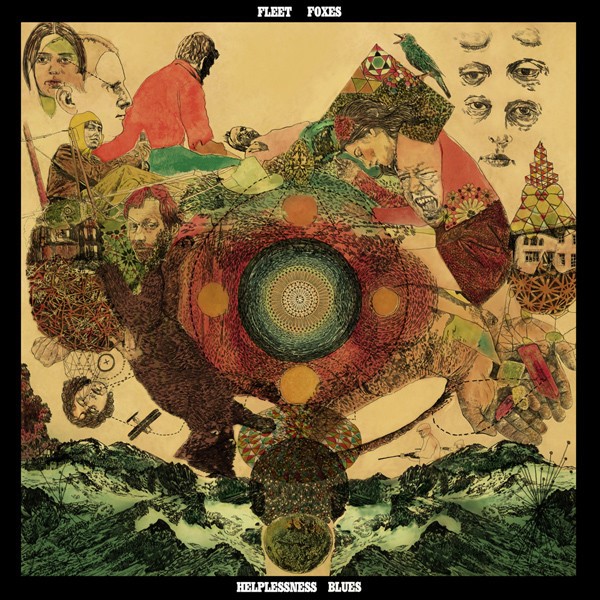
The Fleet Foxes, a most charming band from Seattle, has been playing in the Premier League since 2008. Pillars are craftsmanship, catchy melodies and especially music historical awareness: the comparisons with the Beach Boys, Van Morrisson and Crosby, Stills & Nash all make sense.
A crown on the love for homage appears in 2011; on the second album Helplessness Blues is “Lorelai”, a wonderful rip-off from Dylan’s “4th Time Around”. This places the Foxes in a beautiful tradition. Just as Dylan himself does so often, they reuse an existing melody (with small shifts) and that is especially fitting for this song: “4th Time Around” is already a recycled homage to an earlier song: to “Norwegian Wood” by The Beatles – again Lennon’s attempt to write a Dylan song. “Everything’s stolen or borrowed,” are the appropriate closing words of “Lorelai”.
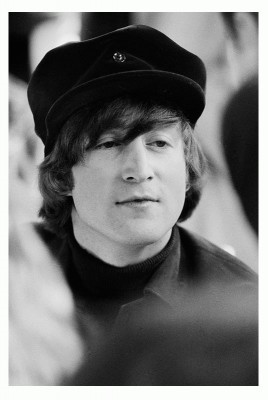
There has been some fuss about this Beatles connection, over the years. Dylan lays a template on Lennon’s “Norwegian Wood”, that is the general agreement by now. Still, the question remains as to what motives Dylan has. Is it intended as a homage or as a parody? Or, in fact, as a kind of warning? Lennon cannot figure it out either. In ’65 the band members often tease him with his Dylan fascination and in his more paranoid moments he thinks Dylan is now cynically reproving him (particulary the closing lines about some personal crutch which the you is not supposed to use, indicating: “don’t try to copy me,” as one might understand), in other interviews he sees it as a friendly nod. Anyway: Lennon will never wear his Dylan cap again, after “4th Time Around”.
Nevertheless, even after songs like “I’m A Loser”, songs that Lennon acknowledges being influenced by Dylan, the bard from Hibbing remains a regular guest.
The reference in “Yer Blues” of course (feel so suicidal, just like Dylan’s Mr. Jones) and in “God” (I don’t believe in Zimmerman). And, even more viciously, in “Serve Yourself”, Lennon’s villainous 1980 parody of “Gotta Serve Somebody”. Sharp and witty, and heartfelt too: on his diary tape of 5 September 1979, his biting “Gotta Serve Somebody … guess he wants to be a waiter now” can be heard – a sneer he unfortunately does not incorporate in his musical answer song.
To McCartney the relationship with Dylan is less sensitive. His winks and reverences are far from conflict-seeking. “Rocky Raccoon” from 1968 (White Album) is perhaps the most sympathetic example. McCartney writes the song in India, according to legend on the roof of the ashram, “with some help” from Lennon and Donovan.
With John Wesley Harding, Dylan has recently put the axe to the psychedelic hippie trend and McCartney conceives the song as a narrative cowboy ballad à la “The Ballad Of Frankie Lee And Judas Priest”. A parody or a copy the song is by no means; it is above all a McCartney song – expertly arranged, descending bass riff, catchy chorus, meandering melody lines.
The Dylan winks are subtle and almost exclusively lyrical. Especially in the irresistible take 8 (on Anthology 3, 1996), in which Rocky is not from Dakota, but:
Rocky Raccoon, he was a fool unto himself
And he would not swallow his foolish pride
Mind you, coming from a little town in Minnesota
It was not the kind of thing that a young guy did
When a fella went and stole his chick away from him
On reflection Macca probably thinks this little town in Minnesota may be a bit overstating, so for the final version he changes it again, this time nodding at the Doris Day song from Calamity Jane (1953): “The Black Hills Of Dakota”. In addition, in this version, Rocky, like Frankie Lee, suffers from foolish pride, the worst of the Seven Deadly Sins. Literally the same words, so Sir Paul scraps those too.
The other references are less flashy, so they may stay. The opponents of Rocky are called Dan and Lil, from which without much literary acumen Dylan can be distilled, Rocky picks up the Bible (twice), just like Dylan does for John Wesley Harding, and with some creative reading into it, there are more subtle hints – the ambiguous, Dylanesque open end, in particular.
Musically, the – tasteful – harmonica stands out. Lennon, presumably, and it is the last time he plays harmonica on a Beatles record.
Parody, homage, ping-pong game with The Beatles or whatever: Dylan takes “4th Time Around” very seriously. It is the first song to be recorded in Nashville, at the restart for Blonde On Blonde on February 14, Valentine’s Day, and he tackles it no fewer than twenty times in succession. The twentieth then is the final take (for comparison: the following “Visions Of Johanna” is done in four takes).
The last recording session (without Dylan, on June 16) is also dedicated to “4th Time Around”, but the overdubs (harpsichord and drums) will not be used. By then, producer Bob Johnston probably realizes that he is already there, with the find of contrasting those lovely guitars with the sarcastic lyrics.
The difference with New York is huge. The acoustic guitars of Joe South and Charlie McCoy, which open the very first session in Nashville, have an elegance that degrades the New York sessions to some rumbling in the garage.
Charlie McCoy is one of the most important secret ingredients of Blonde On Blonde anyhow. Dylan knows the gifted multi-instrumentalist thanks to a sly manipulation manoeuvre by producer Bob Johnston, who lures McCoy and his wife to New York in August ’65 with tickets to a Broadway show. Once in New York, Johnson invites him to the studio, where he just so happens to be working on Dylan’s “Desolation Row”. An acoustic guitar is pushed into McCoy’s hands and he plays the Spanish ornaments that will elevate the monument from a five-star song to a hors category work. Dylan is sold and McCoy later understands that he was a pawn in Johnston’s game:
“Bob Johnston said, ‘You know, I was using you as bait. I wanted Dylan to come to Nashville and he didn’t want to.’ So I was bait and it worked.”
(The Independent, June 24, 2015)
Indeed; when Johnston, half a year later, during those arduous, fruitless recording sessions for Blonde On Blonde in New York proposes to move to Nashville, to Charlie McCoy and his Nashville Cats, Dylan has already overcome his prejudices about those hillbillies with all their songs about slut wives cheating, and he happily agrees.
Lyrically, “4th Time Around” is more ‘ordinary’ than most texts on Blonde On Blonde. Just like in “Visions”, the protagonist confesses to messing around with two women here, but the comparison also ends there. This is nearly a real story; a linear, epic text, almost without inscrutable, symbolic imagery. Bitterly bickering, a man leaves a somewhat hysterical female person and returns to a loving, forgiving lady. The dialogue is briefly, just here and there, somewhat surreal, a dark, symbol-charged image sometimes squeezes itself in, but all in all: a beginning and an end.
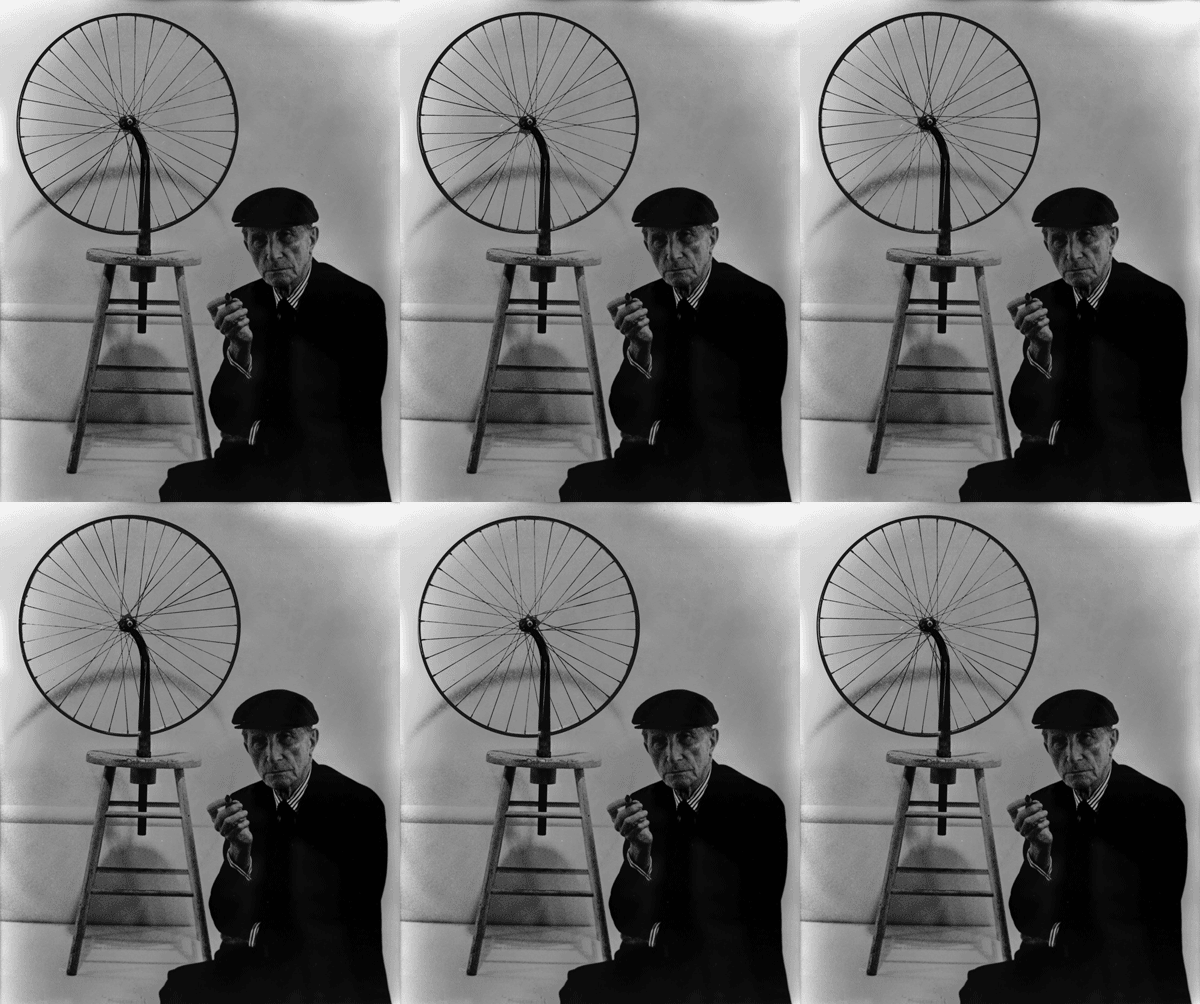
“That picture of you in your wheelchair,” for example, is an image puzzling the interpreters – but after the reference to Duchamp’s Mona Lisa in “Visions Of Johanna” (the one with the moustache) this seems like just another, meaningless, joke: presumably Dylan has not only seen the moustachioed Mona Lisa but also the picture of Duchamp and his wheelchair.
However, the lyrics are predominantly remarkably transparent. Well, relatively anyway. Decorated with classical poetic figures of speech, even. She threw me out is neatly placed across You took me in, we hear rhyme and alliteration and repetition, and even encounter an old-fashioned enjambment (That leaned up against / / Her Jamaican rum), all of which is contributing to the contrast effect of this song; the sardonic buffoon wraps his scorn in classical poetry and supports it with an elegant, fizzy melody.
The few artists who risk an interpretation usually stay close to the original. The waltz rhythm, the baroque guitar part – apparently it is difficult to improve.
The most famous cover is certainly beautiful; Yo La Tengo is modest, sultry and hypnotic on the I’m Not There soundtrack (2007). The men from Calexico, the Tex-Mex specialists from Arizona, opt for a dragging slide and a melancholic accordion and suddenly give the song a grieving, lost-love dimension.
The young deceased Texan Chris Whitley, the outstanding guitarist who can sneer ghastly with his unique, hoarse voice, produces a cutting-edge version on a live recording from 2003 (On Air, 2008). His studio recording, on Perfect Day (2000) is superb, too (though his “Changing Of The Guards”, with Jeff Lang on 2007’s Dislocation Blues remains his unsurpassed masterpiece).
Almost-the-most-beautiful cover is the contribution to Amnesty International’s birthday project, Chimes Of Freedom (2012) by the Israeli world citizen and Jack-of-all-trades Oren Lavie. Lavie replaces “Norwegian Wood” with “Tomorrow Never Knows” and only preserves the vocal melody, actually – and that works perfectly.
The most remarkable and appealing, however, is the adaptation by The Young Relics, also from Texas, on their eponymous EP from 2009. Jumping, neurotic and contagiously energetic, including a pleasantly surprising, completely unexpected change in rhythm; halfway a full organ brutally descends down, calming the nervous guitar, smothering all the unrest, crushing every last splinter of Norwegian wood.
“Red Cadillac and a black moustache” was recorded by Bob Dylan for the “Good Rockin’ Tonight” Sun Records tribute album. Of all the Sun Records songs he picks one neither of us hade ever heard of! Here’s Bob’s version…
This album sets out to record the legacy of Sun Records, the label through which Elvis Presley, Carl Perkins, Johnny Cash and Jerry Lee Lewis got their start.
The album was released in November 2002 and disc 1 contained…
That’s All Right – Paul McCartney
Mystery Train – Jeff Beck/Chrissie Hynde
My Bucket’s Got A Hole In It – Jimmy Page/Robert Plant
Blue Suede Shoes – Johnny Hallyday
Whole Lotta Shakin’ Going On – Elton John
Blue Moon Of Kentucky – Tom Petty & The Heartbreakers
Sittin’ On Top Of The World – Van Morrison/Carl Perkins
Don’t Be Cruel – Bryan Ferry
Red Cadillac And A Black Moustache – Bob Dylan
Just Walkin’ In The Rain – Eric Clapton & The Impressions
Lonely Weekend – Matchbox Twenty
Who Will The Next Fool Be? – Sheryl Crow
It Wouldn’t Be The Same Without You – Chris Isaak
I Walk The Line – Live
Drinkin’ Wine Spo-Dee-O-Dee – The Howling Diablos
You Win Again – Mandy Barnett
Aaron made the comment above about track nine, and the same thought hit Tony – we both knew all of these tracks, except this one.
Here is the original version by Bob Luman
Having won a talent contest Luman got a spot of Louisiana Hayride and with his backing band called the Shadows he recorded “All Night Long” with “Red Cadillac and a Black Mustache” as the B side. He didn’t release it as a single until 1974.
But it was the Warren Smith version of the song that Dylan featured on his radio show, and it seems that it came out as a recording on Sun.
This version certainly has a Sun feel but it doesn’t look as if it became a hit. Indeed some of the comments made on the site above suggest it wasn’t even released at the time of recording. Certainly the Wiki page on Smith has no mention of the track as a single.
Bob Dylan seems to have a real love of tracks that sound like this – the beat, the slight echo, the crooner’s voice adjusted to be part country part rock, and of course Bob always likes the obscure, the songs others have not found.
So let’s go back to the start. Here are the lyrics
Who you been lovin’ since I been gone
A long tall man with a red coat on
Good-for-nothing-baby you’ve been doing me wrong
Who you been lovin’ since I been gone
Who you been lovin’ since I been gone
Who’s been playing around with you
A real cool cat with eyes of blue
Triflin’ baby are you being true
Who’s been fooling around with you
Who’s been fooling around with you
Somebody saw you at the break of day
Dining and a-dancing in the cabaret
He was long and tall, he had plenty of cash
He had a red cadillac and a black moustache
He held your hand and he sang you a song
Who you been lovin’ since I been gone
Who you been lovin’ since I been gone
Here’s the video that was put together for the release of the collection…
An index to our latest posts arranged by themes and subjects on the home page. You can also see details of our main sections on this site at the top of this page under the picture.
There is an alphabetic index to the 550+ Dylan compositions reviewed on the site which you will find it here. There are also 500+ other articles on different issues relating to Dylan. The other subject areas are also shown at the top under the picture.
We also have a discussion group “Untold Dylan” on Facebook which mostly relates to Bob Dylan today. Just type the phrase “Untold Dylan” in, on your Facebook page or follow this link
And please do note The Bob Dylan Project, which lists every Dylan song in alphabetical order, and has links to licensed recordings and performances by Dylan and by other artists, is starting to link back to our reviews.
As previously noted, singer/songwiter Bob Dylan mixes the religious, albeit amusing, outlook of the TS Eliot-based musical ‘Cats’ with Bertolt Brecht and Kurt Weill’s Marxist-oriented musical ‘The Three Penny Opera’. According to Eliot, though life on Earth be dark, the light of Heaven awaits all souls who pray for God to take pity on them. According to Brecht/Weill, everyone under the capitalist system is forced to worship the Golden Calf, for better or for worse.
The Opera makes the point that the consciousness of individuals is determined by the class system imposed upon them by profit-centred economics; everything becomes a commodity. In the musical play, Polly’s father, a clever entrpreneur, makes money off of ‘pity’, while the mass of the people who are in dire straits admire hoodlums as heroes.
As in the song below:
John Wesley Harding
Was a friend unto the poor
He travelled with a gun in every hand
All along the countryside
He opened many a door
But he was never known
To hurt an honest man
(Bob Dylan: John Wesley Harding)
Polly’s father is a ruthless Bible-thumping businessman who organizes beggars, and charges them a fee for doing so. Polly falls for and marries the charming, but murderous thief, a bigamist to boot, named Macheath; she looks up to him beause he is not cowardly; even after she discovers that Miss Lucy Brown (the daughter of the ‘on-the-take’ policeman who’s in league with Macheath) is also married to him.
The two women spat, but it’s Lucy who helps Macheath escape from jail; he’s then turned-in for money by prostitute Jenny Diver, another one of Macheath’s girlfriends. With minds held in the vice of its psychology, these individuals have little hope of escaping the negative consequences of the capitalist-imposed ideology of self-interest above all else.
So Brecht/Weill, with a wink and a nudge, give their initially dark story a happy ending:
Now, Jenny Diver, yeah, Sukey Tawdry
Oooh, Miss Lotte Lenya, and ole Lucy Brown
Oh, the line forms on the right, babe
Now that Macky's back in town
(Bobby Darin: Mack The Knife)
The motif of who is really the legitimate wife of Macky is picked up in the following song:
It was known all around that Lily had Jim's ring ....
(Rosemary) was tired of the attention, tired of playing
the role of Big Jim's wife
(Bob Dylan: Lily, Rosemary, And The Jack Of Hearts)
In the song, the Jack Of Hearts is a charming, clever thief like Macheath, perhaps even dangerous like him too; Big Jim takes the place of Polly’s father as a symbol of materialistic greed:
Big Jim was no one's fool, he owned the town's
only diamond mine
(Lily, Rosemary, And The Jack Of Hearts)
Lucy Brown helps Macheath escape from jail in the hope that she might finally have him all to herself. On the other hand, Rosemary takes the blame for stabbing Big Jim in the hope that Lily and the Jack Of Hearts might get together. After the fashion of some of Charles Dickens’ characters, Rosemary sacrifices herself for the good of others.
Jenny Diver dreams of paying in blood, but it’s not going to be hers:
Your fine philosophy, good sirs, you may proclaim
But till you feed us, right and wrong can wait!
Or is it only those who have money
Can enter in the land of milk and honey?
(Brecht/Weill: The Threepenny Opera, Act ll, sc. iii)
Bob Dylan pays his respects to the musical play, stamping the tribute with what I call the “Dylanesque rhyme twist”~ ‘money’/’honey’; ~’honey’/’money’:
It's undeniable what they'd have you think
It's indescribable, it can drive you to drink
They said it was the land of milk and honey
Now they say it's the land of money
(Bob Dylan: Unbelievable)
The medieval poet (and thief) Francois Villon cheekily proclaims to those in authority, “For if you take pity on wretches like us, the sooner will God have mercy on you”; Polly, referencing Macheath:
And as he was not rich
And he was not nice
And even his Sunday collar was black as a crow
And he didn't know how he should treat a real lady
I couldn't tell him "no"
(Brecht/Weill: The Threepenny Opera, Act I, sc. iii)
Thus speaks Zimmerman, the neoRomantic Modernist singer/songwriter:
Right now, I don't read too good, don't send me
No letters - no
Not unless you mail them from
Desolation Row
(Bob Dylan: Desolation Row)
It is confusing reading, Donovan’s autobiography The Hurdy Gurdy Man from 2005. From the first pages the self-mystifications, selfcongratulating boasting and the clearly pumped up tall hero tales are piling up, whereby the autobiographer increasingly fails to act modesty. However, at about a quarter of the book, when the average reader is about to fire up the stove with it, a change takes place: it is starting to get farcical. We have already witnessed one after the other “cosmic connection” and “kindred spirit” and now Donovan has a first, superficial encounter of a few seconds with Brian Jones of The Rolling Stones. Jones turns around and leaves the room, and “somehow, though I didn’t know how, I sensed that I had just made a karmic connection, made contact with something that would wrench my life around and set it on a course of splendours and miseries.”
After this he shifts gear; Donovan mythologizes and romanticises almost all of his experiences and encounters, turning them into divine interventions or into earth -shattering masterstrokes of a brilliant visionary. The absurdity increases.
Dylan writes good lyrics, but “musically I am the more creative and influential”.
The Beatles should also be grateful. “Two years before the beginning of Flower Power and before The Beatles used the same refrain, I was singing Love, Love, Love.” And they could only write “I’m Looking Through You” because Donovan had shared his experiences with LSD with the boys. He does feel some reserve to let McCartney hear what he himself is doing, because Donovan and his producer know that McCartney leaks the best ideas to The Beatles.
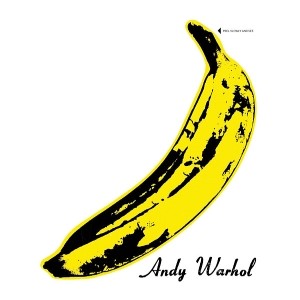
This goes on. Andy Warhol owes the design for the cover of the first Velvet Underground LP (the cover with the banana) to… Donovan. Because in his hit “Mellow Yellow” he sang the words electrical banana.
Apparently, he also conscientiously keeps track of what other artists say about him in interviews, and he loves to pick the cherries (“Jimi Hendrix said I was the nicest person he’d ever met”).
In the spring of 1966, Donovan decides to make his latest, spectacular songs public during a series of performances in Los Angeles. “Suffice to say it was an interesting and a curious audience of known and unknown faces out there when I took the stage.”
Besides people like Phil Spector, The Byrds, Peter, Paul and Mary, Sonny and Cher and John Peel, Bob Dylan is in the audience, as Donovan is told. His friend Gyp spots “Dylan in disguise and said hello. Bob sought out darker corners where he would not be noticed.”
By now, the reader knows that Donovan is still bothered by the thousands of times he has been compared to Dylan, or is called “the Scottish Dylan”. Initially, he points out that they are both strongly influenced by Woody Guthrie (but ignores that his first hit “Catch The Wind” has borrowed quite a lot from Dylan’s “Chimes Of Freedom”).
Donovan’s repeated incantation that he really is the real thing and certainly not a fake gets somewhat pitiful, and it becomes plainly ridiculous when he tries to imply that on the contrary, Dylan admires him so much. Donovan’s descriptions of his illustrious encounters with Dylan at London’s Savoy Hotel (known from Dont Look Now) are squirmingly embarrassing, especially for the readers who remember the excerpts from Pennebaker’s documentary.
And then the most hilarious scene, or the most embarrassing one, depending on how you see it, is not even filmed. That scene survives thanks to the witty pen of sharp observer Marianne Faithfull, in her beautiful autobiography:
And then Bob said, “Well, Donovan, won’t you do us a tune?”
Donovan unpacked his guitar and began to play. I’ll never forget it. Oh, God, it was one of the most excruciatingly embarrassing and funny scenes I’ve ever sat through because what Donovan proceeded to play was “Tambourine Man”. It was the tune to “Tambourine Man” exactly. But Donovan had made up new words! It went “Oh, my darling tangerine eyes…” That’s almost all I remember of it. A song that’s never, I’m sure, ever been heard since. After halfway through, Dylan got this very wry smile on his face. Neuwirth over in the corner was cracking up. Almost everybody in the room was trying to keep a straight face because, besides Donovan and Gypsy Dave, they all knew the song well. “Tambourine Man” was on Bringing It All Back Home.
Donovan kept playing away, “My darling tangerine eyes, girl, won’t you ramble with me down my rainbow road…” It was so apparent what was happening that for a moment one might have thought Donovan was putting everybody on. But the possibility of this quickly evaporated. Donovan was incapable of putting anyone on.
The suspense was nerve-racking, and finally Dylan put an end to it.
“You don’t have to sing anymore of that one,” he said.
Donovan stopped playing, slightly bewildered.
“You know,” said Dylan, with a perfect aphoristic pause, “I haven’t always been accused of writing my own songs. But actually, that’s one I did write.”
Donovan was just stunned, dumbfounded. Oh, my God, such consternation. The poor fellow almost died. Penny said later: “There’s a song that was just written right off that poor cat’s book. He’ll never sing it again in his whole life! It was kind of a nice little song that he had, too.”
By way of explanation, Donovan said, “Well, I didn’t know, man. Heard it, you know… somewhere, at some festival I think it was. And thought maybe it was an old folk song.”
And Dylan said, “No, it’s not an old folk song yet.”
(Faithfull; An Autobiography, 1994)
Donovan himself has no memories of this comic interlude, apparently. He does remember though how he pleases a feverish, sick Dylan by playing “To Sing For You” at his sickbed. I sang it soft in the gloom of the heavily draped bedroom.
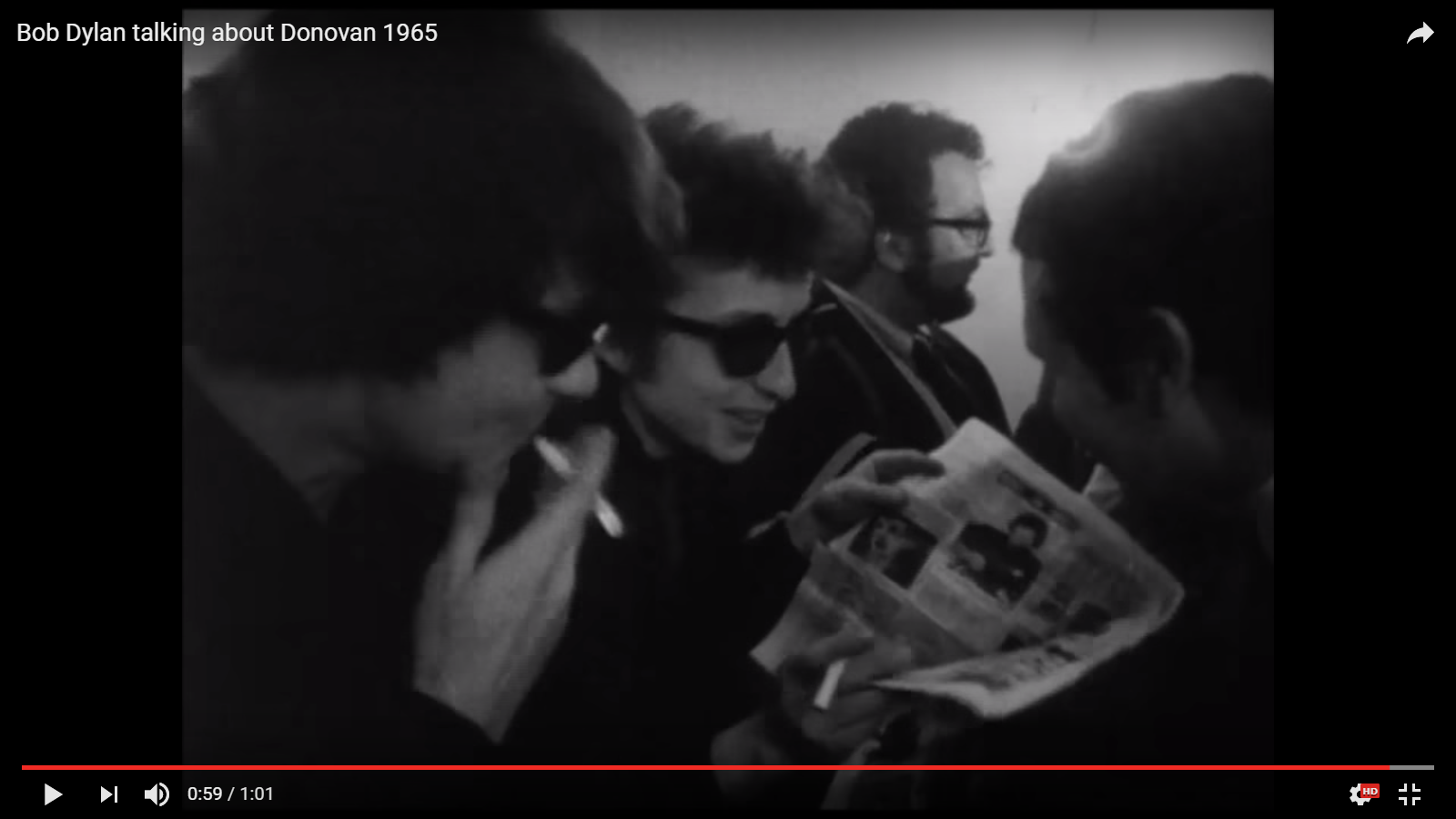
But Dylan, who in these months, certainly in combination with Neuwirth, is in the most vicious phase of his life, apparently still has a weakness for Donovan. He spares him. It is true that in the documentary we see how he and Neuwirth revel over a newspaper article about the Scotsman and we hear him say, filled with malicious anticipation, our next target – but there will be actually only one, not too deadly, shot fired.
In Manchester, Dylan plays “Talkin’ World War III Blues”, at that time already an oldie and almost removed from Dylan’s repertoire. The cabaret-like, anecdotal character of the song leads to lyrics changes in almost every performance, but this time he alters rather radically: “I looked in the closet and there was Donovan,” he crams in, to the audience’s hilarity. It is more a witty nod to the Dylan / Donovan comparisons whipped up by the press than a personal attack. Dylan also seems to say so to Donovan, there in that hotel room in Dont Look Now. “Just a joke,” something like that.
After ’65, “Talkin’ World War III Blues” disappears from Dylan’s setlist and from the music scene at all. The song being on the music-historical milestone The Freewheelin’ Bob Dylan is actually the only lasting merit. Understandable; the talkin’ blues format has already had its best time and has been milked. Apart from a single outpouring (“Alice’s Restaurant”, “A Boy Named Sue”), this mixture of conference and folk song seems dead and buried in 1965, until a mutation appears in the black slums in the late 70s: rap – a particularly resistant mutation, as it is extremely successful to this day.
Very occasionally a musician tries to breathe life into “Talkin’ World War III Blues”, hardly ever leading to a noteworthy cover. The exception is the Swiss krautrock collective Krokodil, which puts the lyrics in a “Subterranean Homesick Blues” jacket. With at least an entertaining result (on Sweat And Swim, 1973).
In addition to the chosen form, the content will also have moved Dylan to abort the song. The content is topical, pinning Dylan in a political corner where he definitely does not feel at home. Donovan recalls how he witnesses a tantrum of Joan Baez, furious because Dylan refuses to accompany her on a protest march on Trafalgar Square against the Vietnam War. And how he offers to go with her. And later is kissing and smooching with her on a hotel bed. Incidentally, in Baez’s memoirs (And A Voice To Sing With, 1987) none of these “facts” are mentioned – even the name Donovan is not mentioned anywhere.
But the scope of Donovan’s observation, whether or not fantasized, is correct: Dylan no longer wants to be identified with protest, with anti-Vietnam, with political enthusiasm.
World War III shows how that is still a bit of a shame. It has the same theme as the likewise discarded “Let Me Die In My Footsteps”, but thanks to the humour it is much more effective, it resonates much better, thanks also to the bonus, the elegant, poetic punch line.
The narrator reports to a doctor because he is suffering from a crazy dream, in which he walks through a city alone after an atomic bomb attack. He fails to get in touch with the few survivors. One runs off screaming because he thinks the narrator is a communist, another, a lady, refuses to play Adam and Eve, “because you see what happened last time coming.”
The doctor interrupts him. “I have that dream too. Only: I am the survivor. I didn’t see you there.”
In the days after, the narrator tells, it seems that everyone has this dream. And everyone walks around lonely and alone. That is not right. “I’ll let you be in my dreams, if I can be in yours.”
The pointe is a gentle, tasteful motto with which Dylan charmingly formulates an invitation to his poetry of the fifty years hereafter.
Singer/songwriter/ musician Bob Dylan drinks from the artistic well of both the Marxist-oriented Threepenny Opera, starring MacHeath, and the conservative satire of Thomas Eliot’s poetry, featuring Macavity.
Many an artist of these recent times, due to the two terrible world wars, depict a world that’s gone morally bankrupt in which God stands amorally by, and merely watches what’s goin’ on.
The singer/singerwriter, in the following lyrics, observes that the robes of religion are in tatters, and in need of mending:
By the marble slabs, and in fields of stone
You made your humble wishes known
I touched the garment, but the hem was torn
In Scarlet Town, where I was born
(Bob Dylan: Scarlet Town)
In the lyrics below, given the institution of slavery, a Quaker poet of yesteryear has doubts about whether or not there exists a perfect, seamless God:
I pondered over the sacred word
I read the record of our Lord
And, weak and troubled, envy them
Who touched His seamless garment's hem
(John Whittier: The Chapel Of Hermits)
Unlike the Holy Bible wherein a woman “diseased with an issue of blood twelve years” believes that Jesus Christ is a faith-healer:
For she said within herself
"If I may touch His garment
I shall be whole"
(Matthew 9: 21)
In many a modern poem, the imagery of earth-based gas and electric light replaces that of the holy Light emanating from Heaven – from God’s vestments, so to speak.
In the verse that follows, a street lamp flutters like a flustered preacher faced with the nihilistic outlook of a society that’s fallen away from orthodox religion:
The street lamp sputtered
The street lamp muttered
The street lamp said, "Regard that woman
Who hesitates toward you in the light of the doorway
Which opens on her like a grin
You see the border of her dress
Is torn, and stained with sand"
(TS Eliot: Rhapsody On A Windy Night)
From the stage of a music theatre, street lamps send out warnings that time’s running out – it’s getting close to being too late for wo/men (represented by Eliot’s ‘Cats’) to amend their ways:
Every street lamp seems to beat
A fatalistic warning
Someone mutters
And the street lamp gutters
And soon it will be morning
(Elaine Paige: Memory ~ T Nunn, et al)
The poor, aged, and neglected cat Grizabella makes an appearance upon the stage:
She's all the time in my neighbourhood
She cries both day and night
I know 'cause it was there
It's a milestone, but she's down on her luck
(Bob Dylan: I’m Not There)
In the song that follows, a lamp-post guards the sealed gates of paradise; babies cry outside. If God’s in His Heaven, He’s rather complacent about what’s going on down on Earth:
The lamp post stands with folded arms
Its iron claws attached
To curbs 'neath holes where babies wail
Though it shadows metal badge
All in all can only fall
With a crashing, but meaningless blow
(Bob Dylan: Gates Of Eden
Maavity, Eliot’s ‘mystery cat’, is another stand-in for a stand-offish God:
Like I said, "Carry on"
I wish I was there to help her
But I'm not there, I'm gone
(Bob Dylan: I’m Not There )
According to a number of modern-day neo-Romantic artists, the pages of yesterday’s civil code of moral values fade away like dead flowers. Morals disappear one after the other under the weight of the technology of modern warfare:
Every street lamp that I pass
Beats like a fatalistic drum
And through the spaces of the dark
Midnight shakes the memory
As a madman shakes the dead geranium
(TS Eliot: Rhapsody On A Windy Night)
The same flower symbolizes decaying morality in the song following:
The kings of Tyrus with their convict list
Are waiting in line for their geranium kiss
And you wouldn't know it would happen like this
But who among them really wants just to kiss you
(Bob Dylan: Sad-Eyed Lady Of The Lowlands)
Apparently, it’s a theme, image, and a rhyme – all in one – that’s worth messing around with:
The street lamp said
"Remark the cat which flattens itself in the gutter
Slips out its tongue
And devours a morsel of rancid butter"
(TS Eliot: Rhapsody On A Windy Night)
And so it goes:
Just how much abuse will you be able to take
Well, there's nothing to tell by that first kiss
What's a sweetheart like you doing in a dump like this?
(Bob Dylan: Sweetheart Like You)
Gothic imagery everywhere:
The memory throws up high and dry
A crowd of twisted things
A twisted branch upon a beach
Eaten smooth, and polished
As if the world gave up
The secret of its skeleton
(TS Eliot: Rhapsody On A Windy Night)
Poetic imagery that’s given tribute in the song below:
And take me disappearing through the smoke rings of my mind
Down the foggy ruins of time
Far past the frozen leaves
The haunted, frightened trees
Out to the windy beach
Far from the twisted reach of crazy sorrow
Before writing this article I assumed Willie Nelson would have had many interactions with Bob throughout the 60s and 70s and covered him many times on album and concert, but my (admittedly limited) research since would suggest that they didn’t start to really hit it off until the 80s.
Bob covered Willie Nelson songs several times throughout the 80s in studio outtakes and concert warm ups.
Popping up on the b-side of “Union Sundown” in 1983 was this fine version of “Angel Flying Too Close To The Ground”. It was the first Dylan 7 inch single I ever owed and it was a treat to turn over the disc and find this great rarity. Some great harmonica work for the harpist aficionados amongst us.
Here we have a great version of “Always on My Mind” from a 1984 tour rehearsal. For the record, I know Nelson didn’t write this but he had a big hit with only a few years prior and it has become a bit of a signature song of his.
And from the same year we have another rehearsal. This time it’s a version of “Why Do I Have To Choose?”
https://www.youtube.com/watch?v=eWm9myCgoQQ
In 1985 came “Live Aid”. Dylan’s onstage comment “I hope that some of the money that’s raised for the people in Africa, maybe they could just take a little bit of it, maybe … one or two million … to pay the mortgages on some of the farms” was viewed as “crass, stupid, and nationalistic” by organizer Bob Geldof. However, Nelson along with John Mellencamp and Neil Young agreed with Dylan and were inspired to start “Farm Aid”. Dylan performed at the inaugural concert in September 1985.
In 1993 Willie released his 40th album “Across The Boardline” including his co-write with Bob on “Heartland”. You can read Tony’s review of the piece here.
Here is a wonderful live version from the pair:
https://www.youtube.com/watch?v=2PKBNQsyffk
Further on-stage collaborations came at Willie’s 60th Birthday celebrations. Here is “Pancho and Lefty” with both men in fine voice. Man, I love this version. Give it a listen.
Hey, did you hear Bob call Willie “A philosopher poet”. Quite a compliment coming from the “poet laureate of rock ‘n’ roll” himself!
In 2004 from Willie’s cable TV special “Outlaws And Angels” comes this duet of Hank Williams’ “You Win Again”. For some reason it didn’t appear on the accompanying album.
Given the size of Willie Nelson’s back catalogue I just assumed he would have covered Bob’s songs many, many times (I own only a small percentage of it, so I trawled his discography online looking for more – man, how I would love a career spanning albums box set, much like the Dylan “Complete Album Collection Vol. One” from 2013). Anyway, these are the ones I could find. Help me out if you are aware of any more.
Here is “What Was It You Wanted”, also from “Across The Boardline” in 1993. He also sang this one at Dylan’s “30th Anniversary Concert Celebration”.
Next up is “He Was A Friend Of Mine”. It appears on the “Brokeback Mountain Soundtrack” album in 2005 and whilst not strictly speaking a Dylan original, it is credited to him on the disc and in the booklet. I’ll include it here for the sake of completeness, and also because it is rather lovely!
Nelson’s next dalliance with a Dylan tune, comes from another soundtrack, this time from the 2007 “I’m Not There” album. Here he is covering “Señor (Tales Of Yankee Power)” with backing from Calexico. It’s one of my all-time favourite Dylan cover versions.
Moving on we have a funky version of “Gotta Serve Somebody” from 2008’s “Moment Of Forever”.
It’s a fine album in my opinion, it also includes a track called “The Bob Song” – which, unfortunately has got absolutely nothing to do with our Bob!!
In 2015 Willie teamed up with the great Merle Haggard for the duets album “Django and Jimmie”. Merle suggested they tackle a Dylan tune. They gave us this jaunty, bouncy version of “Don’t Think Twice, It’s Alright”.
Just recently they have both been on a bit of a Sinatra kick, Bob with his series of albums and Willie with his “My Way” album. I believe the only song common to both is “Young At Heart”. Here is Willie’s take.
Other songs both have covered during their careers include “Let It Be Me”, “Hallelujah”, “A Satisfied Mind”, “Precious Memories”, “Stardust”, “Winter Wonderland”, “Here Comes Santa Claus”, “Autumn Leaves” and “Corrina, Corrina”.
I thought I would end this article on another first for the Untold Dylan site. Here we have a recording by Englebert Humperdinck dueting with Willie on “Make You Feel My Love”. I’m going to assume Humperdinck has never been mentioned on these pages before! Anyway, this appeared on his 2014 album “Englebert Calling”. Willie’s voice and guitar was made for this song.
We have covered a whole series of articles on the theme “Why does Dylan like” and you can find some of them listed in the index.
Performances selected by Paul Hobson, commentary by Tony Attwood
This series takes live performances of Bob Dylan, in which he has re-worked three of his songs to give them a new direction or new meaning, or simply a new sound or feel. Here we start with “One too many mornings”
https://www.youtube.com/watch?v=Xk2FNOGRvL0
For a while Dylan there was a time within the Never Ending Tour, in which Dylan seemed to be intent on making many of his songs sound the same, by changing the melody from the recorded version of each song so that it was now mostly one note, ending with a near falsetto high note – over and over again.
I am not at all sure why he did that – it didn’t seem to me to add anything to the songs, nor indeed to the concert. And on listening to this recording for the first time I feared we were going to get another such rendition.
But then in this 1999 version of “One too many mornings”, Bob changes the feel of song, the melody returns and then the piece concludes with a real crowd pleaser with a harmonica led coda.
Leaving aside what Bob does to the melody at the start (which isn’t at all bad, it is just the memory of those concerts with this effect used for every song, dampens my enthusiasm somewhat) the feel of the song in this performance is magical, switching from the urge to move on which can be felt in the original recording on to a much deeper feeling of regret. He still has to move on, but really he has had enough of this and wishes he could find another way to live his life. It’s not the travelling that gets him, its the sadness that drives him on.
But by the end with that harmonica solo he’s got his resolution back – yes he knows he is stuck in this world of endlessly moving on, but his bag is packed and he is once more on the road, and yeah, the sadness will fade in the end.
Our second choice in this outing is from the late 1990s but has a much jauntier feel despite the apparent sadness of the words: Mama you’ve been on my mind.
https://www.youtube.com/watch?v=gd5wL73ttio
By the instrumental break we really are bouncing along, with the percussion having that fine laid back feel that really works with Bob’s acoustic guitar.
Bob then does some oddness with his voice, before giving us another instrumental verse – and for me it is the instrumental verses that really make this version worth hearing. It is as if he is saying well yes, you have been on my mind but I’m really not letting this get me down – I’ve just been thinking about you, that’s all.
And that really is what the song is all about. A reminiscence of times gone by.
Finally in this outing we have a version of Hard Rain like I had never heard it before. Indeed on hearing it for the first time without seeing what the song was I actually had no idea where we were, from the first two lines that Dylan sings.
https://www.youtube.com/watch?v=f-Dy-yfvOWI
Not every re-working of a classic by Bob works for me – and of course there is not reason why each one should, after all he’s not re-writing just for me. But this is one that doesn’t for me although it does have its moments – such as the “What did you hear” verse with the roar of the wave that could drown the whole world with its emphasis on the first beat of each three.
Musically Bob is by this stage in the performance emphasising the fact that he has changed the timing of the piece into what musicians would describe as 6/8 – six beats to a bar with the emphasis on the first and the fourth.
I am not sure if Bob has done this anywhere else – change a 4/4 song to a 6/8 song, and it certainly does give the whole piece a new twist, but I am not too sure quite what the 1-2-3 1-2-3 emphasis in the second part of each verse really gives us. Does it give me a new insight into the lyrics that we all know so well? No, I can’t really say it does. To me it sounds like an idea, maybe worth trying out, but not really one that works.
But of course that is just me. Perhaps I know the song too well, as maybe we all do. But that is never a reason not to start singing.
In his analysis of Bob Dylan songs ‘Long And Wasted Years’ , Kees de Graaf would have it that the singer/songwriter doesn’t really consider life wasted because, gee, by golly, peace and happiness will be found after a person drops dead; Heaven awaits for those who play their cards right.
But the song ‘Long And Wasted Years’ can also be interpreted so that the narrator in the song concludes that God’s been a way too long in implementing His Plan to save His faithful followers, and those who think He’s just all right are wasting their time.
In a nutshell, the narrator questions the sunburnt Rose of Sharon, who’s a figurative believer in God’s promise that He’ll soon deliver His “first born son”, the people of the land of Israel, from harm:
What are you doing out there in the sun anyway?
(Bob Dylan: Long And Wasted Years)
Duty-bound Rosie says she’s quite willing to wait as long as it takes:
Look upon me, because I am black
Because the sun hath looked upon me
My mother's children were angry with me
They made me the keeper of the vineyards
But mine own vineyard have I not kept
Tell me, O thou whom my soul loveth
Where thou feedest
Where thou makest the flock rest at noon
(Song Of Solomon 1: 6,7)
Whatever Bob Dylan’s personal spiritual beliefs are, we know not. But we do know that he’s an artist – one of few words – whose rebels against established authority rather than accepting dogmatic impositions outright. His song lyrics often burlesque – plays on words like ‘stoned’, for example. Sometimes the listener’s not even sure if he’s being serious or not!
Indeed, writing page after page after… about a camparativey short song to supposedly pin down Dylan as a true-believing religious conformist is ‘long and wasted’ time. Dylan’s lyrics and music, however, do reveal that he becomes bored by focusing his artistic creativity solely on the style of “protest” folksongs; he goes ‘electric’. Likewise, his lyrics and music also change when he becomes disgruntled with a religious organization for which he’s written songs that are quite in tune with its evangelistic message: ’tis said that the Old Testament foretells the future – the coming establishment of Christianity as the one and only true religion.
But the song lyrics of ‘Pay In Blood’ by no means have to be viewed as those of an everlasting believer in the dogmatic teachings of the Vineyard movement. Kees de Graaf insists that the lines of the song show Dylan to be so:
“….in particular in this song, we see some of the the violent struggle, abundantly present in the Old Testament where the resistance against the promised road, which will ultimately lead to the promised Savior, the Messiah ~Yeshua/Jesus ~, is so strong and violent that there is no alternative left but to combat this resistance with equally violent weapons” (Kees de Graaf: Pay In Blood)
An alternate interpretaion is that the singer/songwriter, having had already poked fun at the Old Testament story about Abraham being ordered to kill his son, mocks the Vineyarders for their rather anti-Judaic, and literalistic interpretations of both the Old and New Testaments.
The unquestioning devotion of Rosie the Sunburnt, revised by the Vineyarders, and orthodox Christians alike (she’s now bound to Jesus) is referenced again by the creator of that song whose narrator declares, black humour abounding, that no true Jewish Messiah would be permitted by God to pay in blood, at least not in his own blood:
Well, I'm grinding my out my life, steady and sure
Nothing more wretched than I must endure
I'm drenched in the light that shines from the sun
I could stone you to death for the wrongs that you've done ....
I'll pay in blood but not my own
(Bob Dylan: Pay In Blood)
In spite of the song presented below that blames political and social authorities , de Graaf is sure that Bob Dylan rejects out-of-hand, any down-to-earth, sociological explanations for group or individual anti-social behaviour:
The point that he wants to make is that no man or woman on this earth .....
has the power within himself or herself to rise above the wicked condition
of the human condition that we are all in
(Kees de Graaf: Pay In Blood)
But there’s an alterative viewpoint as to why this may appear to be the case:
They said, 'Listen boy, you're just a pup
They sent him to napalm health spa to shape up
They gave him dope to smoke, drinks, and pills
A jeep to drive, blood to spill
They said, 'Congratulations, you got what it takes'
They sent him back into the rat race without any brakes
He was a clean-cut kid
But they made a killer out of him
(Bob Dylan: Clean- Cut Kid)
De Graaf is a true believer in the concept of ‘original sin.’ There be lots of Dylan’s song lyrics, many of them full of humorous irony, that indicate that the singer/songwriter is not now, nor ever was a believer in ‘original sin’.
What else is here?
An index to our latest posts arranged by themes and subjects on the home page. You can also see details of our main sections on this site at the top of this page under the picture.
There is an alphabetic index to the 550+ Dylan compositions reviewed on the site which you will find it here. There are also 500+ other articles on different issues relating to Dylan. The other subject areas are also shown at the top under the picture.
We also have a discussion group “Untold Dylan” on Facebook which mostly relates to Bob Dylan today. Just type the phrase “Untold Dylan” in, on your Facebook page or follow this link
And please do note The Bob Dylan Project, which lists every Dylan song in alphabetical order, and has links to licensed recordings and performances by Dylan and by other artists, is starting to link back to our reviews.
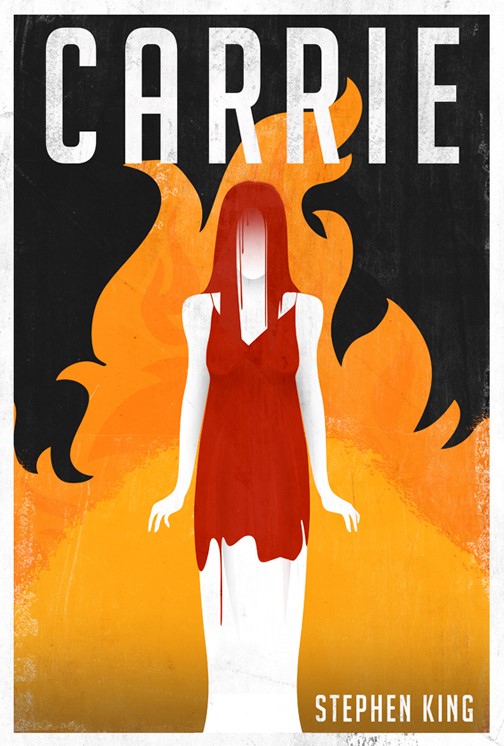
By now Stephen King has joined the pantheon of Great American Writers, and rightly so. Since the 1970s, after the breakthrough with the blood-curdling Carrie (1974), he has been working his way up to become the grandmaster of horror and suspense, but at the latest since the 1990s, the literary quality of his work is increasingly recognized. King’s production is huge, the sales figures are astronomical (around 350 million copies sold) and Hollywood is also happy with the man’s talents. With more than two million votes on the main film site imbd.com (more than half of the voters awarding the perfect 10/10 score), the film adaptation of The Shawshank Redemption is considered the best film of all time, and that is probably also thanks to Morgan Freeman and Tim Robbins – but above all to the compelling, layered and moving story.
The equally strong The Green Mile is thirty-first on that list. King is less satisfied with Kubrick’s widely acclaimed film version of his The Shining, with a frightening Jack Nicholson. And certainly not with the “academic bullshit” that pollutes the film. “It’s like Dylan says,” he says in a Rolling Stone interview in October 2014, “You give people a lot of knives and forks, they’ve gotta cut something.”
The Dylan quote does not just fall from the sky. The writer is a fan, his work is full of Dylan references and quotes. It shows that he is well versed in Dylan’s repertoire; King also quotes from lesser known works such as “On The Road Again” (in The Dead Zone), “I Shall Be Free” (Hearts In Atlantis) and “Tombstone Blues” (in Carrie). And King has used the knives and forks quote from the interview before, in a book, in the preface to the collection of short stories Night Shift. Although the allegation does not fit completely wrinkle-free in the attack the author reopens on the film adaptation of The Shining, it certainly illustrates his knowledge of Dylan’s oeuvre; this line, too, does not originate from a everybody’s friend like “Blowin’ In The Wind” or “Knockin’ On Heaven’s Door”, but from the obscure “Talkin’ New York”.
Whether or not the love is mutual cannot be deduced from Dylan’s lyrics. But it is striking that Dylan has already performed three times in the home town of Stephen King, the unsightly and remote town of Bangor in faraway Maine, with some thirty thousand inhabitants at 35 square miles not exactly a dazzling metropolis.
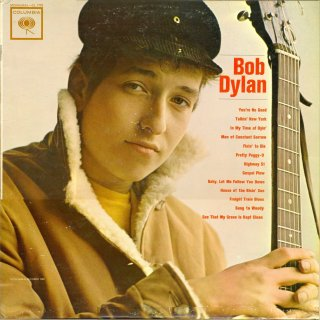
Anyway, the song does have music-historical value. “Talkin’ New York” is the second song from Dylan’s debut album Bob Dylan (1962), after the cover of Jesse Fuller’s “You’re No Good”, and therefore the first official Dylan composition the world is introduced to. However, the song never reached the canon. In later years, during the revaluation of the initially quite flopped album, it is overwhelmed by the other Dylan original on the album, “Song To Woody”. Understandable, though the song does have more merits than just the curiosity of the birth of a genius.
The form is not too spectacular. The talking blues, the rhythmic talk-singing over a simple, repetitive chord scheme, has been around since 1926, since Christopher Allen Bouchillon (1893-1968) recorded the song “Talking Blues” in Atlanta.
Especially in folk music the form becomes popular, for which Dylan’s idol Woody Guthrie is responsible. Bouchillon is cabaret-esque, but Guthrie replaces the folly and vulgar banalities with epic stories, social commentary and irony, and hijacks the genre for satire, social protest and activism.
After his first attempt, “Talkin’ Dust Bowl Blues” in 1940, he writes some twenty more and it sets a trend. Pete Seeger is making a furore with “Talking Union” and “Talking Atom”, Dylan’s Greenwich neighbours Tom Paxton and Phil Ochs keep the now-moribund genre alive and kicking until the 1970s and in between the talking blues still flares up every now and then thanks to notable outpourings such as the hit that Guthrie’s son Arlo scores with “Alice’s Restaurant” (1967), and Johnny Cash’s “A Boy Named Sue”, of course.
In November 1961, when Dylan records his first album, Guthrie’s work is the model. The private, strictly personal content of the text is different. Off-label also compared to Dylan’s later work; the poet will rarely be this little concealing, unambiguous, openly autobiographical and almost journalistic.
Soberly analyzed, the song recounts a few weeks from the life of the young troubadour, the first difficult weeks in a cold, cold New York. Judging by Dylan’s recollection of those same days in his autobiography Chronicles and judging by reconstructions made by industrious biographers, the song is remarkably accurate – it was about like this. Bitter cold, plodding, Greenwich Village and coffee houses, a harmonica and the trips to East Orange, to the hospital where Woody Guthrie is.
Poetically, the debutant remains within the lines. In the first verse a classic mirror game with up and down, in the third verse the wink rocking, reeling, rolling which the poet, who will be so ferociously associating a few years from now, fits neatly into the context of a subway ride, west rhymes with best and eyes rhymes with skies.
Dominating is a thick Guthrie sauce. The protagonist is a rambler, we also recognise the pensive, half-muttered repetitions from The Great Historical Bum, the ego is exploited and a union member and last but not least: Dylan quotes his hero. The “very great man” who “once said that some people rob you with a fountain pen” is from a famous Woody Guthrie song, from his classic gangster song “Pretty Boy Floyd”:
Yes, as through this world I've wandered
I've seen lots of funny men;
Some will rob you with a six-gun,
And some with a fountain pen.
The first authentic glimpses of the germinating genius are thinly sown, but still: there are some. Accurately, Stephen King picks that one and only truly Dylanesque line out of the song. And the irony is more subtle, more witty with Dylan than with his great example Guthrie.
The last lines are pleasantly non-serious. The crushed musician turns his back on New York, so long, and goes back to the “western skies”, to East Orange.
East Orange is 24 kilometers, 15 miles, west of Greenwich Village, 45 minutes by public transport. Change trains at Penn Station.
What else is here?
An index to our latest posts arranged by themes and subjects on the home page. You can also see details of our main sections on this site at the top of this page under the picture.
There is an alphabetic index to the 550+ Dylan compositions reviewed on the site which you will find it here. There are also 500+ other articles on different issues relating to Dylan. The other subject areas are also shown at the top under the picture.
We also have a discussion group “Untold Dylan” on Facebook which mostly relates to Bob Dylan today. Just type the phrase “Untold Dylan” in, on your Facebook page or follow this link
And please do note The Bob Dylan Project, which lists every Dylan song in alphabetical order, and has links to licensed recordings and performances by Dylan and by other artists, is starting to link back to our reviews.
In this series, “Why does Dylan like,” many of the songs that we have looked at have been suggested by Aaron, with the commentary written up by Tony – as is the case here. And most of the time I (that is Tony) have been able to see at once what Bob Dylan finds so interesting and exciting in the song in question.
But not this time. Which is of course a failing on my part, no one else’s. But I am nonetheless writing up the details of the song in the hope that maybe one or two readers might be able to explain why I have failed so miserably to see anything in this song.
Bob Dylan certainly liked it – he played in 32 times in 1986, and here it is with the lyrics written below…
I can hear the wind a blowing in my mind
Just the way it used to sound
Through the Georgia pines
And you were there to answer when I called
You and me we had it all
Remember how I used to touch your hair?
While reaching for the feeling
That was always there
You were the best thing in my life
I can recall you and me we had it all
I know that we can never live those times again
So I let my dreams take me back
To where we have been
Then I’ll stay with you girl as long as I can
Oh it was so good oh it was so good
Oh it was so good when I was your man
I’ll never stop believing in your smile
Even though you didn’t stay
It was all worthwhile
You were the best thing in my life
I can recall you and me we had it all
You and me we had it all
The song was written by Troy Seals and Donnie Fritts and originally recorded by Waylon Jenning on the 1973 album “Honky Tonk Heroes”.
Now these composers are no occasional song writers. Troy Seals has had his compositions recorded by such luminaries as Elvis Presley, Roy Orbison, Jerry Lee Lewis etc etc. Donny Fritts has been Kris Kristofferson’s keyboard player for forever, and was in (among other films) Pat Garrett and Billy the Kid.
Within a year of the song being published it was used as the title track for Scott Walker’s tenth studio album – his last such before reforming The Walker Brothers.
So, what makes it so special? Most obviously the lyrics are incredibly successful in portraying one of the three great themes of popular music – lost love. It is an absolute statement of lost love – the couple had everything, it was perfection, and then she walked away. But he still remembers her with absolute affection and love, despite her departure, because the affair was the best thing ever.
So no surprise that there have been 25 recordings of it. Here is one of the composer’s own versions…
And the other composer
https://youtu.be/Qtf-bLuLQ88
Which leaves the question that I have been skirting around – why does Bob Dylan like it so much? There are after all many other songs of lost love
My only guess is that he loves the lyrics because they mean something very special to him. He is talking about the lady who has left him in or just before 1986 I guess.
Does Dylan associate “We had it all” with the same event that “To Fall in Love with You” was written about? Of course we can’t possibly know, but it’s the best guess I have got.
I guess it meant a lot to Bob just at the time her performed it, because of the lyrics, and then as Bob so often does, he just moved on. For as Robert Johnson said, “You gotta keep moving.”
The ‘Song Of Solomon’, of the Old Testament Bible, can be interpreted thusly.
The narrator, God (Jesus, if you prefer) is speaking to His beloved, His faithful;
He tells her that she can find Him in the big house by the shepherds’ tents:
If thou know not, O thou fairest among women
Go thy way forth by the footsteps of the flock
And feed thy kids beside the shepherds' tents
I have compared thee, O my love
To a company of horses in Pharaoh's chariots

(The Song Of Solomon 1: 8,9)
Singer/songwriter Bob Dylan updates the analogy. He transforms it into American street lingo – the Almighty’s a cowboy in the sky; she’s a pony named ‘Lucifer’; she calls herself ‘Rosie’, but you can call her Mary Jane if you wanna:
Well, I was sleepin' with the devil
In this crowbar hotel
Well it won't be satisfied
If I remember where

(Bob Dylan: One more ride)
https://youtu.be/JJ2BfbrH4oM
Oh you know, baby
Just tie myself together
May you never leave
The 'lectric chair

(Bob Dylan: One more ride)
The faithful Rose of Sharon responds dutifully to God’s demands for love:
I sat down, under His shadow with great delight
And His fruit was sweet to my taste

(The Song Of Solomon 2: 3)
Street-smart Rosie's hip; she's earthy, and talks salty:
Well, let's roll, baby, roll
(Roll down there)
Roll, baby
(Roll, take a dive down there)
Can't you feel
I'm feelin' steel

(Bob Dylan: One more ride)
She got plans of her own:
What's ya doin' up there
You a-gonna take
A dive
Baby-o?
(Bob Dylan: One more ride)
The holier-than-thou Almighty One says He’s going to give the Rose all of His love; claims He wants to free her from prison.
However, she doesn’t want to go:
I held Him, and would not let Him go

Until I brought him into my mother's house

And into the chamber of her that conceived me

(The Song Of Solomon 3:4)
Says he, ‘Then, you can just stay put down’:
Well, you take my love, and take your time
I think I must be on it
And blow this stuff goin' down
The hand of God is upon it
(Bob Dylan: One more ride)
In fact, he prefers things the way they are – all mixed up:
Take you to myself,
Don't you do it, doggone it
I can't get nowhere
Without you there
(Bob Dylan: One more ride)
The Merry-Go-Round goes around and around – reverses Time:
By Tony Attwood, with lyrics for the song transcribed by Larry Fyffe, research by Aaron Gailbraith
Right Hand Road Blues is a song from the “After the Empire” outtake album which was recorded in 1984 but not released (unofficially of course) until 2016.
https://youtu.be/LBrBdnmGLz8
Here’s a version of the lyrics, valiantly provided by Larry. If you have suggestions for alternatives please do write in…
Right Hand Road Blues
Take the right hand road
You gonna treat me better
Take the right hand road
They got some crazy perttita
Down there
And it can bloodhound roll
Well they call me that simple
But then I must feel fine
Well I’m leavin’ this here town
But Izzy runs her line
Well you can forget to pee, but
Down on the riverside
She got her homely foot in there
She rides like a bloody mare
She got a whole league of syphilis
She runs like pearly mare
Oh but oh, he gets her
I hope I don’t see you there
Well if you gonna call me devil
Take the right hand road
Well you’re gonna treat me better
Take the right hand road
They got some crazy matoco
About to blew your load
Come on, baby
How ’bout Chicago way
I’ll buy you a manor
Way down Chicago way
She grabs her partner
You oughta see her give things away.
Bye, bye,
Good-bye, baby, I’m gone
Bye, bye
Tell my baby, I’m gone
Well we goin’ down to see Anna,
I’m about to have carrion
So what we have here is a standard variant 12 bar blues, in which the first and second line of the verses are not only identical in terms of lyrics, they are also identical in terms of the chord sequence.
Now if we start tracking back we can find a song by Fred McDowell called “Going down to the river” that starts with
I'm goin' down that river I'm goin'-a take that right hand road
I'm goin' down the river I'm goin-a take that right hand road Lord,
I ain't gon' stop walkin' 'Till I get in sweet mama's arms
I think the right hand road generally means the “good path” – going in the right direction morally. Recordings of the McDowell song are available and they are nothing like Dylan’s song.
There is also a Right Hand Road Blues by Brian Langlinais which is a 12 bar blues appearing on his album “Right hand road” released in 2016. Although there are similarities again this is not the same song. The song is available on Spotify.
Michael Messer also has a song called “Right hand road” and on the same album there is a song “Rollin and Tumblin” which is the Dylan song in terms of the musical construction, but not using Dylan’s lyrics. Actually it is a really nice performance and the instrumental break really is something to behold. I know I supposed to be writing about Right hand road but this is quite a find.
There is also a 12 bar blues song, by Furry Lewis which is available on Amazon music – but again not the song Bob sings.
All of which leads me to the simple conclusion that this is a Dylan original, using a moderately common blues phrase “right hand road” in the same way that with “Rolling and Tumblin” Dylan took a popular blues theme and then added his own words.
They may be a bit awkward and bewildering sometimes, but more often they are touching still, the advertising miniatures Dylan occasionally lends himself to in the twenty-first century. The Pepsi commercial is slick, sweet and not very subtle, but actually gives a giant respectful and fun upgrade to “Forever Young”, thanks also to Will.i.am. The sober Apple advertising for the iPod and iTunes from 2006 (with “Someday Baby”) is contagious and stylish, and the film in which Dylan drives through an empty landscape in a Cadillac Escalade confirms the words of Liz Vanzura, Cadillac’s marketing director of: “We tried to be very respectful of the fact that he’s a legend.”
That succeeds partly because the bard, as in those other commercials, says nothing qualitative about the product to be praised. And because Pepsi, Cadillac and Apple are true Americans, just like Dylan, with some tolerance and repression of overly critical thoughts one could suspect Dylan’s recommendation is truthful.
Perhaps because the master talks more, this is a bit more difficult with the IBM advertising. But then again the words of the talking computer Watson fascinate, claiming to have analyzed all of Dylan’s songs.
“Your main themes are,” Watson concludes, “Time Passes and Love Fades.”
“That sounds about right,” Dylan replies amused.
Watson’s claim is actually about right. IBM spokeswoman Laurie Freedman officially reports that the researchers really have fed 320 Dylan songs to Watson and his analysis truly has distilled the aforementioned themes. Wilson’s capabilities of “personality analysis, tone analyzer and keyword extraction” has helped to better understand the data.
Granted, 320 is not all songs, but still: more than half.
The appreciation for Dylan’s commercial trips is anything but widely shared. The fact he allowed the Bank Of Montreal in 1996 to use “The Times They Are A-Changin”, already did taste a bit tricky, but could at least still be classified under the safe heading ‘Irony’. That escape is less credible with the first time that Dylan also physically features in a product promotion, for Victoria’s Secret in 2004. Only the seasoned connoisseurs smile, because they immediately remember the giggly 1965 press conference:
Q: Mr. Dylan, Josh Dunson in his new book Freedom In The Air implies that you have sold out to commercial interests and the topical song movement. Do you have any comments, sir?
BD: Well, no comments, no arguments. No, I sincerely don’t feel guilty.
Q: If you were going to sell out to a commercial interest, which one would you choose?
BD: Ladies’ garments.
Lo and behold! A Biblical forty years earlier the Prophet is already announcing his appearance in a lingerie advertisement.
The song chosen for the soundtrack is “Love Sick” and thereby Dylan casts a second shadow over the beauty of the song.
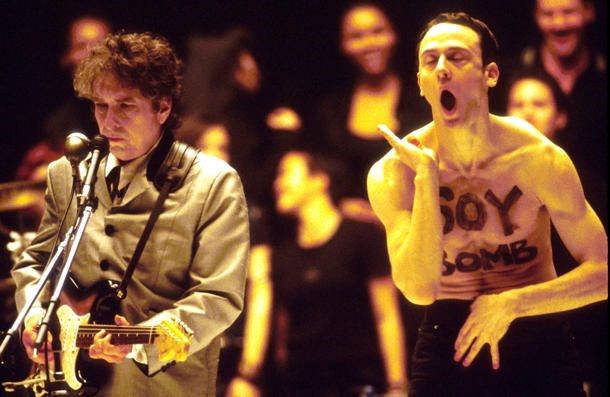
Dylan cannot be blamed for the first Great Distractor. At the presentation of the Grammy Awards in 1998, where he picks up his three Grammies for Time Out Of Mind, Dylan plays “Love Sick”. During the performance one of the background dancers breaks loose, uncovers the upper body, on which with large letters Soy Bomb is written, and performs a somewhat spastic-looking dance right next to Dylan, until he is removed.
The man is a self-proclaimed performance artist, one Michael Portnoy. The purpose of his disturbance was, as he explains later, to “send positive vibrations to viewers at home.” The words soy bomb are a poem that he, on request, also is willing to explain: “Soy… represents dense nutritional life. Bomb is, obviously, an explosive destructive force. So, soy bomb is what I think art should be: dense, transformational, explosive life.”
That crystal clear message did not completely come across. Portnoy blames this, somewhat regretfully, on a miscalculation: “Soy bomb was intended to be a simple poem, but my arms stole all the attention.”
It does, however, draw continuing attention to Portnoy, unfortunately. He is allowed to make his fuzzy say in all major newspapers, gets a stage for his, presumably meant ironically, but still utterly infantile croaking (“Bob Dylan is a thing of the past, I am the future of music” – Daily News) and even true artists like pop artist Eels sustain the stolen fame (“Whatever Happened To Soy Bomb” on Blinking Lights And Other Revelations, 2006).
All in all, the squabbles overshadow the beauty of Dylan’s performance and the extraordinary power of “Love Sick”. On the bonus DVD with the Limited Edition of Modern Times (2006), Portnoy is flawlessly cut away and the glory is artificially restored.
The second Great Distractor is the use of the song in that Victoria’s Secret commercial. Featuring top model Adriana Lima, dressed as sparse as Portnoy at the time, but much more attractive, obviously. The clip offers hardly a story. Lima squirms and seduces, an unaffected Dylan throws, a little surly, his hat on the floor and leaves again, Adriana puts on the hat. There is the connection to the soundtrack: apparently the man does not desire love – perhaps he is sick of love.
The stylized aesthetic of the images certainly detracts from the raw splendor of the song itself. As the opening track for the album, it may be an equally remarkable choice (as the conclusion of an album full of decline and deterioration, it seems more appropriate), but it is actually a great introduction as well.
Producer Daniel Lanois deserves praise. The the first six seconds of the album is rudderless sounds, studio buzz, musicians sitting down with their instruments, or something, then the staccato organ hits from Augie Meyers (“that little back beat skank organ,” as Lanois calls it pleasantly disrespectful) and then that wonderful sound of Dylan’s singing. As if he is calling from an old telephone booth somewhere along a deserted Arizona road to the studio in Miami.
It is a wonderful find from Lanois; by disconnecting the singer from the song, from the recording, as it were, he prevents the song from becoming larmoyant, he avoids it becoming an embarrassing exposé of self-pity and exaggeration. Recorded this way, the despondent words of the washed out narrator get the stately opulence of a nineteenth-century symbolist. “I’m walking through streets that are dead”, “weeping clouds”, “you destroyed me with a smile”, “silence like thunder” … old-fashioned imagery that could have been produced by a fellow Nobel Prize winner like pessimist Maurice Maeterlinck (1862-1949) ) or Baudelaire (“The sound of music, tormenting and caressing / Resembling the distant cry of a man in pain”). But the direct inspiration comes from the Bible again, this time from the Song of Songs: “I am sick of love” is literally there (5:6).
The simple but compelling pulse of the song is just as tempting – the song is popular with colleagues. The well-known contribution of Mariachi El Bronx to the Amnesty project Chimes Of Freedom (2012) eases the angularity of the original and also has a distinctive arrangement (Mexican trumpets, abundant percussion and kitschy gypsy violins). Really appropriated, though, the song is by The White Stripes; “Love Sick” is about a hundred times on the set list and Jack White brings it so intense, loving and driven, that a whole generation of fans thinks it is actually a Jack White song.
In terms of intensity, however, that version is (more than) surpassed by our Flemish friends from Triggerfinger. Ruben Block opts for a similar voice distortion and a similar arrangement as the original, but the performance of the three-man band is – of course – even more meager. And therefore perhaps even more desperate and ominous than Dylan’s. It is definitely the most beautiful cover, and one that may stand next to the master himself.
Worth mentioning, hors concours, is the rendition by one of Dylan’s maternity assistants, an assistant who contributed to the original version: Duke Robillard, one of the guitarists on Time Out Of Mind. Robillard is a veteran (born 1948) and a versatile blues guitarist who seems to mature with the years; especially since the 90s, his popularity among colleagues has been flourishing and he is increasingly being asked for session work. In between, he makes meritorious solo albums, dozens by now, on which the same respect for tradition can be heard as on Dylan’s later albums. New Blues For Modern Man (1999), the album he records shortly after his work with Dylan, presents in addition to his interpretation of “Love Sick” also an admirable cover of Charley Patton’s “Pony Blues” – probably not by chance one of Dylan’s great loves. Robillard’s “Love Sick” is a very pleasant, soulful and sultry homage. His singing skills are not too heavenly, unfortunately, but the rest is masterful. Particularly his B.B. King- and Snowy White-like guitar work.
Construed as a religious allegory, the narrator is Moses in the song ‘Red River Shore’ who’s stuck inside of Egypt with the Israel blues again. He’s a ‘stranger in a strange land” (Exodus 2:2).
The allegory continues in another song entitled ‘Mississipi’. Moses is with an Etheopian girl named Zipporah, but he dreams of a future when he’ll be as faithful as the Rose of Sharon is to God’s first-born son, the country of Israel (Exodus 4:2):
I was thinkin' 'bout the  the things that Rosie said
I was thinkin' I was sleepin' in Rosie's bed
Walkin' through the leaves falling from the trees
Feeling like a stranger nobody sees
(Bob Dylan: Mississippi)
Unlike Rosie of Sharon who’s delighted to serve the Lord, Moses shirks his responsibility to lead God’s chosen people to the Promised Land of Israel:
I am the rose of Sharon, and the lily of the valleys
As the lily among the thorns
So is my love among my daughters
As the apple tree among the trees of the wood
So is the my beloved among the sons
I sat down under his shadow with great delight
And his fruit was we sweet to my taste
(The Song Of Solomon 2: 1,2,3)
God has to ‘encourage’ the Egyptian Pharaoh to let His people go by having Moses call upon a plague of locusts:
And Moses stretched forth his rod over the land of Egypt ....
And the locusts went up over all the land of Egypt
And rested in all the coasts of Egypt; very grievous were they
Before them there were no such locusts, neither after them shall be such
(Exodus 10: 13,14)
In the song ‘The Day Of The Locusts’, the narrator analogously represents Moses; the state of South Dakota with its “badlands” and outlaw town of “Deadwood”, ‘aces and eights’ and all, stands in for the Sinai Desert:
I put down my robe, picked up my diploma
Took hold of my sweetheart, and away we did drive
Straight for the black hills of Dakota
Sure was glad to get out of their alive ....
Yeah, the locusts sang, and they were singing for me
(Bob Dylan: The Day Of The Locusts)
Moses finally screws up his courage, turns outaw, and gathers the Hebrew slaves together. They head out for the Sinai Desert with an Egyptian posse a-ridin’ hard on their tail; they escape across the Sea of Reeds.
Some forty years it takes wandering in the desert, but God fulfils His promise:
And I am come down to deliver them out of the hand
Of the Egyptians
And to bring them up out of that land
Unto a good land, and a large
Unto a land flowing with milk and honey
(Exodus 3:8)
Moses dies; he does not get to cross the River Jordon; he does not get to rest in Rosie’s bed. He’s allowed to come back, but not all the way – because he stayed in Egypt a day too long:
The foreign sun, it's squints upon
A bed that is never mine
As friends and other strangers
From their fates try to resign
Leaving men wholly, totally free
To do anything they wish to do, but die
And there are no trials inside the Gates of Eden
(Bob Dylan: Gates Of Eden)
The man of constant sorrow in the following song is not at all pleased that’s he’s been treated like a fish on a baited hook (he’s Moses, if you like, and the United States with it’s ‘America Dream’ is the Promised Land):
It's undeniable what they'd have you think
It's indescribable, it can drive you to drink
They said it was the land of milk and honey
Now they say it's the land of money
(Bob Dylan: Unbelievable)
Moses pleads with God to change him into a bird so that he can fly across the River Jordon, and be with the one that he loves:
I pray thee, let me go over and see the good land
That is beyond Jordon, that goodly mountain, and Lebanon
But the Lord was wroth with me for your sakes
And would not hear me, and the Lord said unto me
'Let it suffice thee; speak no more unto me of this matter'
(Deuteronomy 3: 25,26)
What’s a poor boy to do:
Wish I was back in the city
Instead of this old bank of sand
With the sun beating down over the chimney tops
And the one I love so close at hand
If I had wings, and I could fly
I know where I would go
But right now I'll just sit here so contentedly
And watch the river flow
Commentary by Tony Attwood. Research by Aaron Galbraith
(We’ve had problems with the video of this one and only performance of this song vanishing from the internet so in case the above goes blank then try here instead).
Bob Dylan has only played this song the once in public, which is a great shame, since Richard Thompson is one of our greatest innovative songwriters and Bob’s version is extraordinarily innovative in its working of the piece.
And because this song was listed in the Time Magazine 100 greatest songs list. They said it was “a glorious example of what one guy can accomplish with just a guitar, a voice, an imagination and a set of astonishingly nimble fingers.” Famously when Richard Thompson heard Dylan’s cover of the song, he said, “It was a surprise, totally. I thought it was a hoax. I thought it was a joke!”
And to be clear I don’t think Thompson meant this is a bad way – rather that he was just unable to believe that Bob had covered his song.
As we know Bob has performed and shown a liking to many of the old “train leaving town” blues songs, so there is every reason not to be surprised that he would like a song about a motorbike – especially one that has a special place in motorcycle history – it was only made between 1948 and 1962 in Stevenage, Hertfordshire – just north of London. (And I’ll slip in the fact that my partner lives on a road which is just off the Great North Road a bit further north – so I’ve found a link to the song too. I always like doing that.)
Apparently the Black Lightning, when produced, was the fastest bike in the world that was being made on a production line which of course then added a lot to its mystique.
Here’s Richard Thompson performing the song, from the album Rumour and Sigh.
Most of us first who were around at the time came across Richard Thompson when he played with Fairport Convention – one of the great folk bands in the UK in the late 1960s. I had the honour of seeing them in those early days in London and remember, now to my absolute embarrassment, telling Richard he ought to face the audience when he played the amazing solos he could devise at the drop of a hat. He very politely said that if he did that everyone would see what he was doing, and he wanted to keep it secret. I did watch him play a few times when I could see his hands and can tell you I had no idea what was going on.
And of course he evolved as a major songwriting talent, with songs like “Meet on the Ledge”. Later Dave Swarbrick joined Fairport, to give them two outstanding musical talents in the same ensemble. Thereafter Richard Thompson went solo, although his work was not always met with acclaim.
The song 1952 Vincent Black Lightning comes from the album “Rumour and Sigh”, but has never (I think) come out as a single. One oddity is that in his own live performances Thompson has on occasion varied the name of the bike – a sort of Dylanesque thing to do.
Speaking about the song on a BBC radio programme Richard Thompson said, “When I was a kid, that was always the exotic bike, that was always the one, the one that you went ‘ooh, wow’. I’d always been looking for English ideas that didn’t sound corny, that had some romance to them, and around which you could pin a song. And this song started with a motorcycle, it started with the Vincent. It was a good lodestone around which the song could revolve”.
A band was set up using the name of the bike as their band name – and of course they sing the song too…
Says Red Molly, to James, “Well that’s a fine motorbike.
A girl could feel special on any such like.”
Says James, to Red Molly, “My hat’s off to you.
It’s a Vincent Black Lightning, 1952.
And I’ve seen you on the corners and cafes, it seems.
Red hair and black leather, my favorite color scheme.”
And he pulled her on behind,
And down to Boxhill, they’d Ride.
Says James, to Red Molly, “Here’s a ring for your right hand.
But I’ll tell you in earnest I’m a dangerous man;
For I’ve fought with the law since I was seventeen.
I’ve robbed many a man to get my Vincent machine.
And now I’m twenty-one years, I might make twenty-two.
And I don’t mind dyin’ but for the love of you.
But if fate should break my stride, then I’ll give you my Vincent, To Ride.”
“Come down Red Molly,” called Sargent McQuade.
“For they’ve taken young James Aidee for Armed Robbery.
Shotgun blast hit his chest, left nothing inside.
Oh, come down, Red Molly, to his dying bedside.”
When she came to the hospital, there wasn’t much left.
He was runnin’ out of road. He was runnin’ out of breath.
But he smiled, to see her cry.
And said, “I’ll give you my Vincent.
To Ride.”
Said James, “In my opinion, there’s nothing in this world
Beats a ’52 Vincent and a Redheaded girl.
Now Nortons and Indians and Greavses won’t do.
Oh, they don’t have a Soul like a Vincent ’52.”
Well he reached for her hand and he slipped her the keys.
He said, “I’ve got no further use…for these.
I see Angels on Ariels in leather and chrome,
Swoopin’ down from Heaven to carry me home.”
And he gave her one last kiss and died.
And he gave her his Vincent.
To Ride.
On fan forums, YouTube, Dylan sites and in Dylan books, the “Answerphone Song” has been bouncing around for several decades now, the recording of a short, funny song, supposedly sung by Dylan as a message on his answering machine sometime in the early sixties. Its authenticity is controversial, and the multitude of sources claiming to have made the copy does not make it more reliable. The generally well-informed Alan Fraser (from the site Searching For A Gem) claims that it was copied from Dylan’s telephone in Malibu in 1975, others say they called the apartment on West 4th Street at the time and Dylan’s house in Woodstock is also mentioned as a source.
Voice, harmonica and guitar sound throughout Dylanesque, that much is true. Not entirely one hundred percent, but that may be due to the poor quality and the fact that those old tape recordings almost never had the correct pace (usually too fast). Anyway, it’s a charming, Dylanworthy recording:
Well, he ain’t at home right now,
He can’t come to the phone
So leave your name and number
When you hear that lonesome tone. [harmonica solo] I’d gladly talk to you right now,
I’d like to guarantee
But I can’t speak or answer now,
Since I’m not really he.
The authenticity becomes all the more doubtful because the lyrics wink at one of Dylan’s most obscure, legendary and mythical songs: the ethereal “I’m Not There (1956)”, one of the absolute highlights of The Basement Tapes. Plus: it is suspiciously well intelligible.
The enigmatic lyrics to “I’m Not There” are incoherent, meandering, sometimes unintelligible and seem largely improvised on the spot. “He would pull these songs out of nowhere,” says eyewitness Robbie Robertson, and he specifies with regard to this song: “There’s something going on inside the song, but you’re not sure what it is.”
On his solo albums, Brian Eno copies the associative, loosely written method of poetry and thematizes it in the opening number of his masterproof Another Green World (1975), in “Sky Saw”:
All the clouds turn to words
All the words float in sequence
No one knows what they mean
Everyone just ignores them
The pitfall is obvious: such a modus operandi soon leads to an accumulation of empty, meaningless sounds, to a Dadaistic hotchpotch of syllables chosen purely for their timbre. As Eno demonstrates in the remaining lyrics to “Sky Saw”:
Mau Mau starter ching ching da da
Daughter daughter dumpling data
Pack and pick the ping pong starter
Carter Carter go get Carter
In other words: painting with sounds, which Eno will intensify on later, instrumental records and will call ambient music. (Exquisite drumming by Phil Collins, by the way.)
Dylan does not fall into that trap; the form is too one-dimensional and way below the ambition of a poet of his class. Not that “I’m Not There” is so much clearer than mau mau starter ching da da, but part of the magic of the song is the suggestion of an ominous, moving story behind the words. It indeed is like Robertson says: something is happening, but you don’t know what is.
The brave transcription attempts may differ, but the overall picture is comparable: inconsistent nebulae with an occasional half-hearted Biblical reference (something with a kingdom so high above her, at any rate) and – predominantly – the regretful observation that the I is not ( anymore) with the lady of his dreams.
The trigger for the Dylan disciples, however, is that one message that comes through loud and clear, also because it is the title: I’m not there.
Should one have to reduce the special appeal of the artist Dylan to one one-liner, then I’m not there is a good candidate. Director Todd Haynes does recognise this very well when he gives his “biopic about the many lives of Bob Dylan” precisely this title (I’m Not There, 2007). The Great Common Divisor of both Dylan’s biography and his discography is, after all, the man’s intangibility, the lack of one identity.
That starts even before his first professional recording, when Robert Zimmerman changes his name and fantasizes different life stories for his New Me, for this “Bob Dylan”. Already in the first radio interviews, newspaper articles and in the liner notes of the first albums, a Dylan’s life that does not exist at all is described. From an unbound vagabond from Gallup, New Mexico, who has been traveling around America with traveling carnival shows since his earliest childhood, for example.
When that vagabond is transformed into Dylan the Folk artist, the Prince Of Protest, he puts on a leather jacket and plugs in an electric guitar. When he then becomes a rock god, a Rimbaud Of Rock, the hippest person on earth (according to Marianne Faithfull), he puts on a hat, becomes a family man and sings “You Win Again” and “Wildwood Flower” – and at this point we only recapitulated the first six years of Dylan’s nearly sixty-year, multi-coloured career. The only all-encompassing stamp that can be put on the indefinable artist is placed by the bard himself, shown in No Direction Home, while reading a newspaper article about himself: “God, I’m glad I’m not me.”
The film footage leaves no doubt as to it being a spontaneous, witty joke, but Freud would effortlessly recognise the deep, deep truth underneath that joke: here an individual looks with a self-evident distance at an alter ego that he may have created himself, but has now started to live a life outside of him. Dr. Jeckyll and Mr. Hyde, indeed.
How remarkable that is, stands out in the comparison with the “normal” reaction of prominent people who are confronted with hurtful, untrue or unwelcome publications. The Trumps, the Tom Cruises, the Lady Gagas and the J.K. Rowlingses respond with indignation, or shrugs, or official denials, or with lawsuits … but never a victim replies chucklingly: “Boy, I’m glad I’m not me.”
It shows a detachment that is not only consciously recognised by Dylan, but also cultivated. In Chronicles, the autobiographer acknowledges his identification with Rimbauds je est un autre, a refrain in the more serious interviews is Dylan’s assurance that the ego from his songs is not me, Bob Dylan. In the radio interview with Mary Travers, in ’75 following Blood On The Tracks, Dylan patiently explains that the listener can read you or he instead of I – “It’s all the same.”
It’s not me. It’s the songs. I am just the postman, I deliver the songs, he tells Robert Shelton in 1978. Similar to the way in which he rejects biographical interpretations of his film Renaldo & Clara: “The film is actually very little about me. It’s a dream. To put it more correctly, it isn’t even my dream.” And a next movie he calls Masked and Anonymous – the silver thread should be clear by now: I’m not there.
The definitive explanation is lucid, complex, confusing, incomprehensible and yet clear, as befits Dylan. He produces this in response to “Seeing The Real You At Last” in an interview with Scott Cohen, in 1985:
“Sometimes the you in my songs is me talking to me. Other times I can be talking to somebody else. If I’m talking to me in a song, I’m not going to drop everything and say, alright, now I’m talking to you. It’s up to you to figure out who’s who. A lot of times it’s you talking to you. The I, like in “I and I”, also changes. It could be I, or it could be the I who created me. And also, it could be another person who’s saying I. When I say I right now, I don’t know who I’m talking about.”
“I’m Not There” would therefore, in all intangibility, contain an amusing paradox – the song poet who repeatedly claims that he himself is not to be found in his films and songs, writes a song in which the I-person propagates the motto of that poet himself: I am not there. And, paradoxically, thus Dylan would sing an autobiographical song after all.
Unfortunately, the approach of the song does not seem that poetic and complex. In all ten verses it can be distinguished that the I complains that he cannot be with a beloved woman, or realises that he cannot stay here. Literal, physical absence, and not so much a metaphysical, metaphorical absence.
An extra veil is given to the song when securing copyright in 1970. Garth Hudson, the acclaimed archivist of the Basement Tapes, has written “I’m Not There, I Am Gone” on the cover and that is how Robbie Robertson calls the song too. The official title, however, receives a mysterious addition in brackets: “(1956)”.
Someone must have been pondering thereon, which is a bit intriguing. Song titles with additions in parentheses are not that special, and Dylan has a weakness for them, as we know since Theme Time Radio Hour episode 47 (“I always liked songs with parentheses in the title”), but songs with a year in between those parentheses are quite rare. The best known is probably the beautiful Beach Boys’ “Disney Girls (1957)”. The year specified there is not too enigmatic; it is a melancholic masterpiece in which the protagonist looks back with nostalgia on a carefree summer in his youth – in 1957, apparently. Three Dog Night sings “Good Feeling (1957)” and explains with the musical accompaniment to which that title refers: it is a 50s doo-wop. And in the – rare – other cases, the song simply sings about an event in the year in question. “Man At The Gate (1913)” by Ron Sexsmith for example, and “Lifted Up (1985)” by Passion Pit.
In short: if a lyricist chooses the addition, it is quite easy to trace. But from where the year 1956 comes in this song title, and what the relationship with the lyrics is at all, is in the lap of the gods. It is tempting to call in the personal biography of the poet Dylan, making Elvis unavoidable. The year in which The King records “Heartbreak Hotel”, earning his definitive breakthrough and in which he scores five number 1 hits. The then fifteen year old Dylan is crushed:
“When I first heard Elvis’s voice I just knew that I wasn’t going to work for anybody and nobody was gonna be my boss. Hearing him for the first time was like busting out of jail.”
But then again; in that case Dylan would have put the 1956 addition after “I Shall Be Released”. Or after “Goin’ To Acapulco”, or “Dress It Up, Better Have It All”, “Minstrel Boy”, perhaps “Get Your Rocks Off” … there are more than a handful of Basement Songs more fitting for a wink to Elvis.
By the way, on the first official release, on the soundtrack of the film I’m Not There in 2007, “1956” has disappeared again, just like on The Basement Tapes Complete (2014).
On the other hand, in 1998, the 1970 copyright is renewed in the U.S. Copyright Office for the full title, including “1956”, (document number V3416D881, registration number: RE 771-501), and again in 2012 – which is weird, considering the song is never officially released under that title.
However, the puzzling with lyics and year evaporates when the music starts. Words float in sequence and nobody knows what they mean – but what they describe the performance artist makes clear even without semantics. This is lyrical in its original, real meaning: the expression of feelings. The singer Dylan uses his voice like the ancient stage Greeks used the lyre to express the protagonist’s feelings. And like Mozart uses the oboe in the adage of KV 361, which is the inspiration for Salieri’s famous monologue in Peter Schaffer’s Amadeus:
“On the page it looked nothing. The beginning simple, almost comic.”
But then suddenly… an oboe, and a moment later the clarinet takes over, and that
“…sweetened it into a phrase of such delight! This was no composition by a performing monkey! This was a music I’d never heard. Filled with such longing, such unfulfillable longing, it had me trembling. It seemed to me that I was hearing a voice of God.”
Granted, a bit exalted, matching Salieri’s stormy Italian temperament, but filtered, the monologue can be transposed to Dylan’s “I’m Not There”. Plaintive, but not complaining, regretful, but still resigned … music filled with such longing, such unfulfillable longing.
The song is an impregnable fortress. Covers there are not. Apart from the one by Sonic Youth, of course, who is given the tough task to produce a cover for the film’s soundtrack. The band permits itself, apparently with the consent of the authorities, some lyrical interventions with which actually some coherence does creep in. It is a good performance, yearning and heavy, but Thurston Moore is not a Dylan of course – and if he had known that the original would also appear on the soundtrack, he probably would have refrained from it. For consolation, Sonic Youth’s version gets a prominent place: over the movie’s credits.
On October 26, 1961, Bob Dylan signs a record deal with Columbia Records in New York City.
The fact that he ends up at Columbia – one of the largest American record companies – is a happy coincidence. Who knows how his career would have gone if he had joined a folk-specialized company such as Folkways Records, Elektra or Vanguard. Perhaps purists would have pulled the plug from his proposal to play electrically amplified.
Anyway, more important in this story is that, shortly before Dylan comes under contract with Columbia Records, the design department of the record company has just been completely renewed. Bob Cato (37) was appointed head of the department in 1960 and John Berg (29) joined as his assistant a year later.
Together they provide a fresh visual language – just in time for the rock music that will take over jazz from the fifties. Certainly after Cato was promoted to assistant director in 1965 and Berg took his place at the head of the department, the department delivers groundbreaking work. In the thirty years that he has been with the firm, Berg has made over 5,000 covers, including Bruce Springsteen’s Born to Run and Thelonious Monk’s Underground.
It is also important to realize that the standard Columbia contract states that the artist may deliver the photo that will be printed on the front of the cover.
Note: Outside the US and Canada, the albums of Columbia Records were released on the CBS label.
December 1961
The company does not want to spend much time or money on the cover of the record debut of their latest acquisition. One of the staff photographers is commissioned to make a portrait of the folk singer. Don Hunstein does not even feel the need to go outside the photo studio of Columbia Records on 7th Avenue. He orders the young man take a seat in front of a window, guitar in hand – click, click and ready.
20-year-old Dylan looks like a choir boy, with blushing cheeks, a sheepskin coat and a sailor’s cap on his head – just like the one his idol Woody Guthrie used to wear. Bob looks amused into the lens, a little uncomfortable with all the attention.
To prevent the CBS logo in the upper left corner from being visible through the neck of the guitar, Berg has the photo printed in mirror image.
In the early sixties it is common to list the song titles on the front sleeve. To reduce costs, the back of the cover is never printed in colour. The small black and white portrait appears in the upper left corner was also made by the same photographer, probably during one of the two sessions for recording the album, at the end of November 1961.
The rest of the back sleeve is occupied by two texts. In the right-hand column is an article by Robert Shelton, which was previously published in The New York Times. It was this article that probably brought the young artist to the attention of producer John Hammond. The rest of the cover text is attributed to one Stacey Williams – a pseudonym for the same Shelton.
According to the Old Testament, Moses flees from Egypt, and marries an Ethiopian by the name of Zipporah, and then returns to Egypt to free the Hebrews from slavery there:
And she bare him a son,  and he gave his name 'Gershom'
For he said, "I have been a stranger in a strange land"
(Exodus 2: 22)
In the song following, taken as a biblical allegory, it’s clear the narrator identifies with Moses:
Well I'm a stranger here in a strange land
But I know this is where I belong
I'll ramble and gamble for the one I love
And the hills will give me a song
(Bob Dylan: Red River Shore)
The Song of Solomon paints a word-picture of God’s love for Israel, and for those who obey Him, in a series of sexual conceits that features a black woman:
Draw me, we will run after thee
The King has bought me into his chambers
We will be glad, and rejoice in thee
We will remember thy love more than wine
Thy upright love of thee
(Song Of Solomon)
Moses’ brother Aaron gets to speak for him:
And said Moses unto the Lord, "I am not eloquent
Neither heretofore nor since Thou hast spoken unto thy servant
But I am slow of speech, and of a slow tongue"
(Exodus 4:10)
Bob Dylan, as Moses, has a little fun with that:
Well, I don't know what kind of language he used
Or if they do that kind of thing anymore
Sometime I think nobody ever saw me here at all
Except the girl from the Red River Shore
(Bob Dylan: Red River Shore)
The language of Old Testament is often figurative, and the “Son of God” therein is not Jesus, but the Promised Land:
And thou shalt shalt say unto unto the Pharaoh
Thus saith the Lord, "Israel is my son, even my first born"
(Exodus 4: 22)
So interpreted, the Red River is the Egyptian/Ethiopian Nile:
And Moses and Aaron did so, as the Lord commanded ....
And all the waters that were in the river were turned to blood
(Exodus 7: 20)
The Pharaoh with the acquiescence of God who’s quite upset with Moses for being slow to do what He tells him to, gets to treat the Hebrew slaves even worse than before; Zipporah even circumcises their son to stop God from killing her husband right there and then. The Pharaoh finally has enough of God’s wrath after He kills the first born of the Egyptians. Zipporah gets fed up too, and heads back home:
Well, I sat beside her for a while I tried
To make that girl my wife
She gave me her best advice
And said, "Go home and live a good life"
Somehow though I never did get that far
With the girl from the Red River Shore
(Bob Dylan: Red River Shore)
God’s not through with Moses yet. He’s still mad at him, and does not allow Moses to cross the River Jordon into the Promised Land; he dies. However, the Lord’s chosen people are delivered into the Promised Land.
One of the greatest stories ever told – so much so that the singer/songwriter considers the too-slow-Moses allegory worth repeating in another song – only this time, it could be said, his persona crosses the ‘Nile’ of America, into ‘Egypt’:
Well, the emptiness is endless, cold as the clay
You can always come back, but you can't come back all the way
Only one thing I did wrong
Stayed in Mississippi a day too long
(Bob Dylan: Mississippi)
Figuratively speaking, Moses saves Israel, God’s first born. The singer/songwriter himself, in his creative imagination, goes back in time, and brings Moses back to life:
Now, I've heard of a guy who lived a long time ago
A man full of sorrow and strife
Whenever someone around him had died, and was dead
He knew how to bring him back to life
(Bob Dylan: Red River Shore)