Usually containing the word ‘like’ or ‘as’, a simile is a trope that creates a vivid comparison between an object (or action), and a different thing that has some similar aspect.
Bob Dylan constructs lots of similes – below, he presents a woman who firmly attaches herself to a man:
Get away from all these demagogues
And these bad luck women stick like glue
It's either one or the other, or neither of the two
(Bob Dylan: Nettie Moore)
Dylan’s quoted words can be interpreted – decoded – as making fun of the literary scholar’s inability to define and clearly separate one figure of speech from another. Indeed, the singer/songwriter earlier pens a similar warning about the ability of metaphors to multiply uncontrollably, entitled ‘The Trouble With Tropes’, but the coded message never gets received nor recorded by Captain (Bill Shatner) Kirk on the USS Enterprise:
Buffalo Bill wouldn't have known what to do
If he got just one look, one good look at you
And I don't know what to do either
Just want to tell you, "it's neither"
Tom say, "Don't take her"
Judas said, "Leave'er her"
(Bob Dylan: Golden Tom, Silver Judas)
In the song lyrics below, a simile (blossom soft as snow) meets up with a hyperbole (a river of tears); a personification (trailing moss); an alliteration (mystic, moss); and vowel assonance (keep, sea, tear):
The trailing moss, and mystic glow
The purple blossom soft as snow
My tears keep flowing to the sea
(Bob Dylan: Moonlight)
The above moon verse – a tribute to the neo-Transcententalist poet below:
Here is no question of whiteness
White as can be, with a purple mole
At the centre of each flower
(William Carlos Williams)
Bobby ventures down into the basement; he deliberately mixes up the metaphoric medicine. In the lyrics that follow, the women is depicted as a saint swirling in smoke; she’s poisonous, like mercury, to one’s artistic health:
With your mercury mouth in the missionary times
And your eyes like smoke, and your prayers like rhymes
And your silver cross, and your voice like chimes
Oh, who do they think could bury you?
(Bob Dylan: Sad- Eyed Lady Of The Lowlands)
Similes that Dylan employs are not as bright nor as pure white as the ones used by those Romantic Transcendentalists who find in Nature a mystical spirit of vitality:
Through the darkness on the pathways of life
Each invisible prayer is like a cloud in the air
Tomorrow keeps turning around and around
We live and we die, we know not why
(Bob Dylan: When The Deal Goes Down)
More gleeful is the following simile:
I wandered lonely as a cloud
That floats over vales and hills
When all at once I saw a crowd
A host, of golden daffodils
(William Wordsworth: Daffodils)
Mixing similes together can have a humourous effect – if you’re a hungry as a pig, a farm animal that eats almost anything, then you should eat one even though it looks like a dachshund:
Well, I asked for something to eat
I'm as hungry as a hog
So I get brown rice, seaweed
And a dirty hot dog
(Bob Dylan: On Road Again)
What else is here?
An index to our latest posts arranged by themes and subjects on the home page. You can also see details of our main sections on this site at the top of this page under the picture.
There is an alphabetic index to the 550+ Dylan compositions reviewed on the site which you will find it here. There are also 500+ other articles on different issues relating to Dylan. The other subject areas are also shown at the top under the picture.
We also have a discussion group “Untold Dylan” on Facebook which mostly relates to Bob Dylan today. Just type the phrase “Untold Dylan” in, on your Facebook page or follow this link
And please do note The Bob Dylan Project, which lists every Dylan song in alphabetical order, and has links to licensed recordings and performances by Dylan and by other artists, is starting to link back to our reviews.
‘Rosemary combed her hair and took a cabbage into town’
No. She didn’t. She took a carriage into town, but it’s easy enough to mishear Dylan. He has a way of bending words, and while he can articulate with great clarity, he can also gulp a syllable or three, or rush words to fit into the musical line or with delayed vocal timing. He can stretch or compress words as desired. Whatever the reason, mishearing Dylan goes with the territory, and the results can be amusing, and occasionally illuminating.
Some mishearings are simply silly, as with Rosemary and her cabbage from the song Rosemary and the Jack of Hearts, but at best mishearing can initiate a creative engagement with the text, involving backtracking and rediscovering what he really sang. There is a certain constructedness in a Dylan song, especially evident in those he keeps reconstructing in performance, and by listening we enter, to some extent, into the creative process. Dylan encourages this creative engagement by an elusive sketchiness in terms of narrative and character creation which leaves us lots of room for our imaginations, and to find our song within Dylan’s.
In describing what they term ‘critical deformance’, which involved putting a poem through particular procedures such as reading it backwards, reversing lines, changing the order of verses etc, authors Jerome McGann and Lisa Samuels comment: ‘In this perspective, the critical and interpretive question is not “what does the poem mean?” but “how do we release or expose the poem’s possibilities of meaning?”’
Mishearing is not exactly a deformance in the sense intended by McGann and Samuels, which involves a systematic changing of the text. However, arguably, mishearing is an aural deformation of a more accidental nature, but which just might release or expose the song’s possibilities of meaning.
It might also expose something else, what our mishearing’s tell us about ourselves and what we are looking for in a Dylan song:
The highway is for gamblers, better use your sense
‘Take what you have gathered from cold winds so dense.’
No! He doesn’t sing that, but that’s how I heard it for many years, making four words out of one, and when I finally saw the lyrics, I felt sort of disappointed, let down. My ‘cold winds so dense’ conjoured, for me, the lonely back roads of Jack Keroack’s ‘On The Road’ which I was reading at the time. The lonely back roads are the ‘highway’ we find in the previous line, with the kind of wind that was blowing when Dylan and Suzie Rotolo had their photo taken for the cover of Freewheelin’ on a freezing New York day. But what he really sang was, ‘take what you have gathered from coincidence.’
Once discovered, my mistake made me reflect on Dylan’s word choice. ‘Coincidence’ suggests a meaningless, absurd world where significance might only be found, if at all, in the collision of random, chance events. It takes us deeper into the world of illogic than my mishearing, but still… the existential shiver is the same, so my mishearing was in keeping with the song’s affective centre. Or so I like to think.
In any case, it gives us a good excuse to revisit this 1965 BBC live version in which Dylan makes quite a meal out the word ‘coincidence’ – I’m sure if you listen hard enough you’ll hear those cold winds so dense
It’s worthwhile noting that when we first began listening to Dylan albums back in the 1960s we had no way of independently verifying the lyrics. There was no internet, no official lyrics, the first book of Dylan lyrics did not come out until later.
To compound the problem, Dylan was singing words we’d never heard sung before, as they did not belong to the lexicon of pop music. Words like ‘museum’, ‘infinity’, ‘amphetamine’ and, well, ‘coincidence.’
Furthermore, they were often in unexpected combinations equally unfamiliar to our ears. We had to argue it out, and of course listen to the songs over and over. Did he really sing ‘The darkness at the break of noon shadows even the silver spoon’? These were far cry from Ricky Nelson or Bobby Darin lyrics. We hardly knew what we were hearing, nor how to make sense of it.
Add to all that, being poor students, we were spinning our precious mono vinyl on shitty old turntables, with platinum needles that hadn’t been changed since Presley’s Heartbreak Hotel, gutless amplifiers and crappy old speakers. It’s a wonder we could hear anything.
I can’t help wondering if Dylan kind of intended this. We quickly moved into an age when lyrics printed on sleeves and slipped into the ablums was all the rage, but, to my knowledge, Dylan only ever did this for Street Legal (1978) and Empire Burlesque (1985). Maybe he wanted us to struggle to get the words, wanted us to listen over and over. Maybe he knew that the lyrics sounded a lot better and more mysterious in performance than on the printed page…
‘Ever since you walked right in the circus been complete
I say good bye to haunted rooms and faces in the street.’
No. ‘…the circle’s been complete,’ is what he sings. But ‘circus’ worked just fine for me, while it lasted. It look me back to Desolation Row, when the circus came to town (those haunted rooms where they nail curtains), and it seemed fitting that, from the persective of the early 1970’s, the arrival of true love should complete the 60’s circus.
I was onto something, I thought; except I wasn’t. At first I was disappointed, again, until I thought of Joni Mitchell’s ‘Circle Game’, and in that light Dylan’s ‘Wedding Song’ engages in a neat bit of intertextuality.
This is not the only circle I turned into a circus. I made the same mistake with Carribean Wind.
‘From the circus (of) ice to the furnace of desire.’
No. It’s ‘circle of ice,’ but I was seeing circuses everywhere. And circles too. Just to add to the fun, we have ‘circled by the circus sands’ in Mr Tambourine Man.
‘Misty Liar is his, a Philistine is what she is She’ll do wonders and work with your fate Feed you coconut bread, spice buns in bed If you don’t mind sleepin’ with your head face down in the plate.’
No! He doesn’t sing that, although I keep hearing it. In this case, several creative mishearings over four lines leads to a creative misinterpretation. Let’s look at what he really sings:
Miss Delilah is his, a Philistine is what she is
She'll do wondrous works with your fate
Feed you coconut bread, spice buns in your bed
If you don't mind sleepin' with your head face down in a grave.
I constructed a woman quite different from Dylan’s. Misty Liar is the hippy chick who might tell fortunes, play the earth mother with her coconut bread. She’s happy enough to take you to bed, if you don’t mind passing out in her lap.
Dylan’s Miss Delilah is much darker, more sinister figure. She comes out of the Bible, a woman who sold out a man (only later was she seen as arch temptress), and to sleep with her you have to lie down in a grave. That might be your grave. Might be hers. A big price to pay for those spice buns. Both ‘plate’ and ‘grave’ might work as a sexual reference, but Dylan’s brings death onto the scene. I have to let go my playful ‘plate’ now for the real thing, and in the process lose that neat rhyme!
I got into trouble at the end of this song, too:
‘Did he make it to the top, well he probably didn’t drop
Struck down by the strength of the will..
No. That doesn’t really make sense. If he didn’t drop how come he was struck down? It all made sense when I read the actual lyrics. No disappointment this time.
‘Did he make it to the top, well he probably did, and dropped
Struck down by the strength of the will…’
Yes, even Jesus suffered from that old ‘foot of pride.’ In this case my mishearing did not enrich my understanding of the song, just confused me.
I’m not a great fan of Dylan covers, nobody sings Dylan like Dylan, but in the spirit of fun, I couldn’t resist this gutsy version of Foot of Pride by Dirty Ray, described by the uploader as a “blues hack” based in Minneapolis. He’s caught the angry edge of the song, and roughed it up. The fun part is that Dylan’s enunciation is model of clarity compared to Dirty Ray’s weird word bending. If you don’t already know the words, good luck, now you know how it feels…
They'll stone you when you're tryin' to make a fuck
They'll stone you and then they'll say "good luck"
No! This was a wilful mishearing, because I knew perfectly well that Dylan doesn’t use profanities. ‘They’ll stone you when you’re trying to make a buck,’ works just fine, but, I swear the way he sings it, with that leering implication he’s so good at, it sounds like he’s singing ‘fuck’ instead of ‘buck’, as if he wants us to mishear it. After all, it would be in perfect keeping with the wild, anarchic, irreverent tone of the song. So, I close and my eyes and hear what I want to hear.
Now he looked so immaculately frightful as he bummed a cigarette
And he went off sniffing dreampipes and reciting the alphabet
No. I was thrown when I read that what he really sang was, ‘And he went off sniffing drainpipes and reciting the alphabet.’ Dreampipes made sense to me at the age of sixteen. A pipe filled with nice dreamy stuff (nod-wink), like the pipe offered to the singer in ‘Tangled up in Blue’. It was fitting. But drainpipes? That’s toxic. That’s very unromantic. It changes the whole feeling of the sketch presented to us. It’s so much stronger than my predictable ‘dreampipes’ that I want to run away and hide. And I loved that song for so long mishearing that line.
No! A wonderful mishearing as it ties in with the broader focus of the album, Infidels, and songs like ‘Man of Peace’ and ‘Union Sundown.’ But what he really sings is ‘You can hear them tyres spin.’ Again I’m humbled. That’s much more dramtic and concrete than my ‘empires’.
That’s just a sample. I keep discovering new mishearings. Even while writing this blog I read that the end of ‘Can’t Wait’ reads:
‘I thought somehow that I would be spared this day’
and I’ve never heard that. I hear:
‘I thought somehow I would be spared this fate.’
I’m convinced enough that I’m hearing correctly to become suspicious of the official lyrics… Play it again Joe, let’s hear what he really sings. Here is the famous 2011 Milan version. Although I think there are better versions, Dylan is obviously having fun hamming this one up. Looks like he wants to laugh. And, I’ll eat my hat if he doesn’t sing ‘fate’ and not ‘day.’
Let us know your favourite mishearings, and how you felt when you found out the actual lyrics.
What else is on the site
You’ll find an index to our latest posts arranged by themes and subjects on the home page. You can also see details of our main sections on this site at the top of this page under the picture.
The index to the 500+ Dylan compositions reviewed is now on a new page of its own. You will find it here. It contains reviews of every Dylan composition that we can find a recording of – if you know of anything we have missed please do write in.
We also have a discussion group “Untold Dylan” on Facebook. Just type the phrase “Untold Dylan” in, on your Facebook page or follow this link
And please do note The Bob Dylan Project, which lists every Dylan song in alphabetical order, and has links to licensed recordings and performances by Dylan and by other artists, is starting to link back to our reviews.
Notes:
New Post idea> Dylan scolarship in the Age of Climate change: A guilty pleasure.
Catharsis
Stoic but affirmations filled. It’s all right ma. Flat nasal delivery vesus open throated howling. They both work for me, tho the 1974 version is more cathartic
Dancing to dylan.
Bob Dylan and the underworld: in the land of shady deals, the scent of corruption
Carribean wind, where are you tonght, cry awhile, when the deal goes down, foot of pride, sweetheart like you, the slease bar
I was having a read through Tony’s 2015 review for If You Gotta Go (Go Now) and it spurred me to write a quick look at several of the more interesting versions of the track that have came out over the years. I’m going to ignore Manfred Mann and Fairport Convention’s excellent singles as these are both well known and well loved.
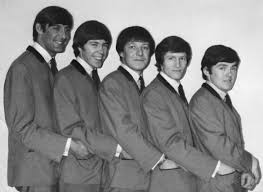
As Tony noted The Beatles influence it might intrigue you to know that the very first release of the song was on a 1965 7” single by a group called The Liverpool Five. Curiously, none of the five were from Liverpool in fact they hailed from London and had a penchant for Beatles’ style poses in their promotional photographs and record sleeves!
Anyway, here it is and a very fab version it is too!
Unfortunately they turned out to be one of the least successful British Invasion bands and the single didn’t chart anywhere! I have to say I do like the version and am bit surprised it didn’t give them a much deserved hit.
With the exception of the Manfreds and the Fairport covers the other most famous version has to be The Flying Burrito Brothers (yet another failed single for this track). Great countrified version here, I love both Gram Parsons and Chris Hillman so this is right up my street.
And then there is this by Mae West
I’m not really sure what to say about this, except it’s kinda mad! This would definitely rank in anyone’s top 10 oddest Dylan cover versions. I wonder what Bob made of this one!
West’s version was released on the 1966 Way Out West album. The album also contains covers of Day Tripper and Twist And Shout among others. Great album cover too!
Here’s a great rollicking version by the Cowboy Junkies, some great drum fills and splendid vocals. This was originally released as a b side to the Southern Rain single, and later on a b sides and rarities compilation album. It’s so good it was also included on the great Dylan covers album May Your Song Always Be Sung Vol 2. They also use the lyric “it’s not that I’m asking you to take part in any kind of quest” as opposed to “it aint that I’m questionin’ you to take part in any quiz’ – hence the title of this article!
https://m.youtube.com/watch?v=pHVO6geVvv4
My all time favourite cover version takes the track down a completely new and previously undiscovered path. It was released as a bonus track on the tribute album ‘Subterranean Homesick Blues: A Tribute To Bob Dylan’s ‘Bringing It All Back Home’’. This recording is by J. Tillman (AKA Father John Misty), this one blew me away the first time I heard it and still does today whenever it pops up on my playlist. Give this a listen, you won’t believe where he takes this one. Spellbinding.
Then there was an official Dutch only 7” by Bob himself which leaked out in 1965. Again, no chart action and it’s a release that not many know about, the original single will set you back a few quid on eBay. As it’s a different version to any other releases and it’s never came out in cd as far as I’m aware… luckily YouTube is your friend again for this one!!
What else is on the site
You’ll find an index to our latest posts arranged by themes and subjects on the home page. You can also see details of our main sections on this site at the top of this page under the picture.
The index to the 500+ Dylan compositions reviewed is now on a new page of its own. You will find it here. It contains reviews of every Dylan composition that we can find a recording of – if you know of anything we have missed please do write in.
We also have a discussion group “Untold Dylan” on Facebook. Just type the phrase “Untold Dylan” in, on your Facebook page or follow this link
And please do note The Bob Dylan Project, which lists every Dylan song in alphabetical order, and has links to licensed recordings and performances by Dylan and by other artists, is starting to link back to our reviews.
First off, let me reiterate – I’m an English guy who has visited the USA many times, but don’t consider myself to be immersed in its history and traditions. I do my best, but the basic fact is I am neither an American, nor an academic student of American culture, politics and traditions. So I might be getting some of this wrong.
But in essence I think “On, Wisconsin” is the “state song” – if that is the correct term – of the American state. That is not the song under discussion here (obviously) but just for clarity here is what I think is an official, or official-style version of the piece.
OK, now having got that noted, there is a song by Trapper Schoepp with the same title, the melody of which has a slight resemblance to the melody of the anthem (if that is the right word) above. And it has lyrics written in part or full by Bob Dylan.
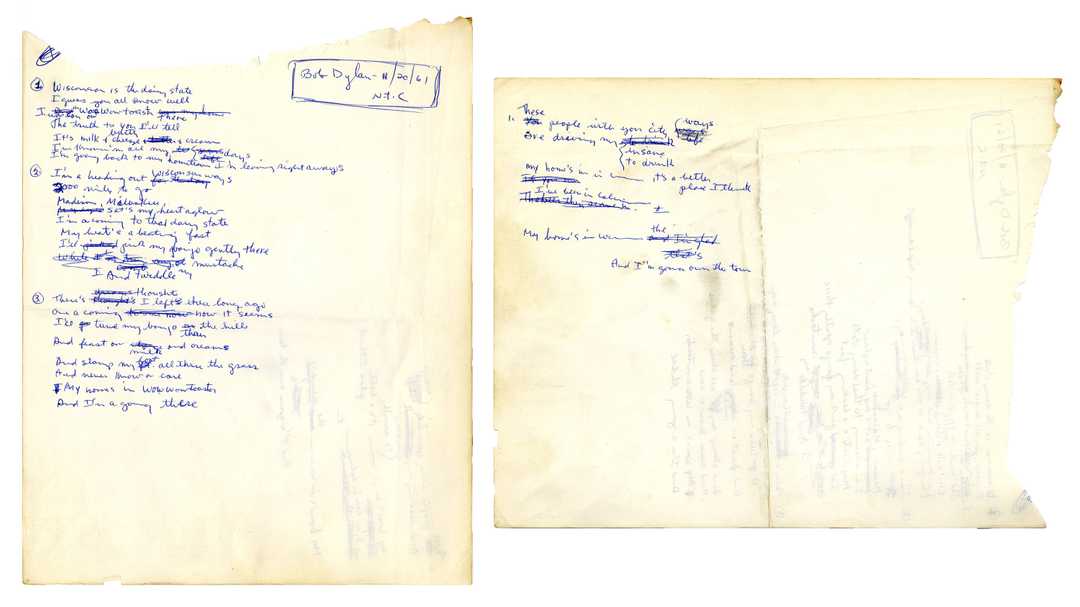
The Dylan lyrics come from one of Dylan’s notebooks – a notebook of the type that was used for the New Basement Tapes series.
These lines which consist of three verses have the same title as the state song, including the comma, and were written in 1961, so not too long after he first signed for Columbia. Apparently the lyrics in their original form were offered at auction in 2017, but then were sold privately. However Trapper Schoepp saw the lyrics and then created the song, with a reference back to the state anthem.
Speaking of this he said, “I imagined this drifter being rocked to sleep in a train car to this three-four waltz rhythm. And he’s just hearing this song in his head ‘On, Wisconsin’ that’s bringing him back home.
“The words are playful and bring to mind some early Woody Guthrie lyrics and other folk songs Dylan might have been listening to in his early 20s. I have to give a nod to Quinn Scharber, who played the clean jazzy lead guitar parts, which puts the song in the ’50s ballad territory.”
There is on line a copy of the notebook lyrics – reproduced here. I’m sorry they are not clear – that is the best I can do with my limited technical ability.
Schoepp then recorded the song and forwarded it to Bob Dylan’s publishing company. He reports what happened then as…
“So I’m laying in bed one night, and my manager sends me an email that simply reads, ‘Dylan has it now.’ I immediately got pretty excited about that.”
The management team had, it seems, given the ok to the song and forwarded to Bob for final approval. He gave it meaning the record could be released as a co-written song.
It now appears on Primetime Illusion – an album that focuses on modern city life.
Here’s a live version with a spoken introduction about the origins.
You’ll find an index to our latest posts arranged by themes and subjects on the home page. You can also see details of our main sections on this site at the top of this page under the picture.
The index to the 500+ Dylan compositions reviewed is now on a new page of its own. You will find it here. It contains reviews of every Dylan composition that we can find a recording of – if you know of anything we have missed please do write in.
We also have a discussion group “Untold Dylan” on Facebook. Just type the phrase “Untold Dylan” in, on your Facebook page or follow this link
And please do note The Bob Dylan Project, which lists every Dylan song in alphabetical order, and has links to licensed recordings and performances by Dylan and by other artists, is starting to link back to our reviews.
“One of my deficiencies is my voice sounds sincere,” Paul Simon says in the interview with Rolling Stone (April 2011). “I’ve tried to sound ironic. I don’t. I can’t. Dylan, everything he sings has two meanings. He’s telling you the truth and making fun of you at the same time. I sound sincere every time.”
Simon is a bit too modest about the limitations of the colour of his singing voice, but that much is true: the irony, the sneering and the sarcasm that Dylan especially in the mercurial years ’65 -’66 manages to deliver in his singing, fall outside Simon’s range. On the other hand, he is a grandmaster, similar to Randy Newman, in the field of supercooled understatements, dry humor and feigned naivety. “50 Ways To Leave Your Lover”, “Paranoia Blues”, “Have A Good Time” … Paul Simon’s palette really does have more colours than just sincere.
He does not reveal where he ‘tried to sound ironic’, but Simon refers in his next breath to Dylan, so the link with “A Simple Desultory Phillipic” (1965 and 1966) is soon made. Whether he sounds ironic there, well, that is debatable, but at the very least he does his utmost to sound like Dylan. In any case, it is a Dylan pastiche for which time has been kind. At the time it was somewhat faint, misunderstood (ironically as a despicable attempt to free ride on Dylan’s success) and occasionally appreciated with some kindness, but in the twenty-first century, fan circles and biographers look back with more love. Sometimes a little too himmelhochjauchzend (Shelton calls it a ‘vicious burlesque’, AllMusic’s Matthew Greenwald thinks it is ‘hilarious’, on fan sites fans even praise it as ‘one of the best political songs ever’ and ‘great and hilarious’), but the song certainly is funny.
There are two versions. The first is from Simon’s London period, is acoustic and clearly inspired by Bringing It All Back Home. Simon copies “It’s Alright Ma (I’m Only Bleeding)” on his guitar and rattles verses over it like:
I was Union Jacked, Kerouac’d John Birched, stopped and searched Rolling Stoned and Beatled till I’m blind I’ve been Ayn Randed, nearly branded Communist ‘cos I’m lefthanded: That’s the hand I use, well, never mind!
The recording ends up on the peculiar solo album The Paul Simon Songbook (1965), recorded in London without Art Garfunkel, which quickly had to meet the sudden demand for a folky Paul Simon. It is a rattling, shabby jumble of songs from the flopped Wednesday Morning 3.A.M. (“The Sounds Of Silence”, for example), new songs and songs that will be re-recorded a year later for Simon & Garfunkel’s breakthrough album Parsley, Sage, Rosemary And Thyme.
The latter category includes “A Simple Desultory Phillipic”. For that second version, Simon reworks the lyrics; he changes a lot of names. The first couplet now starts with:
I been Norman Mailered, Maxwell Taylored I been John O’Hara’d, McNamara’d
But that is not the most radical change; drastically revived is the musical frame. Dylan has released Highway 61 and Blonde On Blonde and that inspires Paul Simon to the original intervention to update the music; he copies the mercury sound and this time chooses as a template for the music: “From A Buick 6”. A challenge, because Simon is of course notorious for his sheer neurotic production perfection, but it has to be said: for once it sounds pretty gritty – by his standards.
On a side note, following Dylan’s success, producer Tom Wilson constructs a ‘folk rock’ remix of the flopped Sounds Of Silence (behind Simon’s back, incredibly). It is a huge world hit, in some reference works even (somewhat disputably) celebrated as ‘the quintessential folk rock release’. The astronomical sales figures lead to the hasty reunification of Simon and Garfunkel and ultimately to the elevation of the duo to pop legends.
“From A Buick 6” is sometimes dismissed as filler, as a nice little in-between on an album full of eternal classics. True, between songs like Rolling Stone, It Takes A Lot and Thin Man, the Buick shines less brilliantly than she would do alone, somewhere on an abandoned parking deck in the moonlight. Disconnectung the song from that overwhelming album side A, however, does more justice to “From A Buick 6”: one of those quicksilver pearls from the heyday of a genius artist, a bittersweet, rude blues rock full of semi-familiar references and freak metaphors.
The title, like most songs on Highway 61, has no direct relationship with the text. The Buick 6 series was produced from 1914 to 1930, so at most that title has a kind of emotional link with the roots of the song’s music. And at home the Zimmermans used to have a Buick; in Chronicles the bard remembers family trips to Duluth with the ‘old Buick Roadmaster’, the car in which Dylan has learned to drive, the brand to which he remains faithful in later years. Thus, the poet might associate a Buick 6 with something like ‘old and familiar’ or ‘of lasting value’.
The song itself is loosely based on “Milk Cow Blues” by Sleepy John Estes from 1930, a song from which Dylan often draws. Killing you by degrees, for example, returns in “Where Are You Tonight?”, Some said disease, some said it was a degree’in echoes in the opening of “Legionnaire’s Disease“, and the first lines of “From A Buick 6” are inspired by Estes’ classic too:
Now asks sweet mama
Lemme be her kid
She says, ‘I might get boogied
Like to keep it hid’
Apart from that, there is also the content similarity: both blues songs thematize adultery. But the poet Dylan chooses – of course – hallucinatory images and more colourful metaphors than Estes.
Dylan’s I-person has a graveyard woman at home, a lifeless homebody, who takes care of the children while he paints the town red with his soulful mama, with a dazzling lady who is brimming with life. Her special quality is her ability to re-energize him when he is down and out. The sadness that can bother the narrator, the poet does not express with the usual blues clichés like ‘down and out’ of ‘feelin’ blue’ or ‘I’m so lonesome’, but with sparkling imagery like lost on the river bridge – a beautiful and completely original image for the lonely and forlorn state of a man who is torn between a life on the right bank, with the mother of his children, or on the left bank, with the woman who makes him happy.
Nevertheless, the song leads a rather obscure existence. Dylan himself hardly ever plays it (twice, both times in ’65), there are not too many covers and the film world also ignores the song. With one exception: the catchy, charming social drama Kisses, a masterful Irish film from 2008. Two young teenagers in love run away and experience a ferocious, frightening and enchanting night in Dublin. The boy is called Dylan and Bob Dylan is (therefore) a thread in the film. “From A Buick 6” is chosen as soundtrack to the scene in which the two, after sharing a half bottle of beer, run rowdy and rioting through the city.
Fortunately, among the few covers there are some very nice ones.
On the remastered version of Johnny Winters’ Still Alive And Well (1973), the song is a bonus track, in a version that one can expect from the albino guitar god: dirty, raw and no-nonsense.
The talented Chuck Prophet writes beautiful songs (for, among others, Solomon Burke, Heart and Kim Carnes), has success in the 80’s with his band Green On Red and as a solo artist does not shy away from experimenting. “From A Buick 6” has been on his setlist for years, always catchy, but is most remarkable when he does it almost entirely alone; carried by a particularly attractive guitar lick, accompanied by a rhythm box and more declamating than singing through a voice distortion. In the background, wife Stephanie Finch pushes the keys of her wonder organ – maybe that should have been shoved a bit further into the background.
Veteran Gary U.S. Bonds is responsible for one of the best covers, though we owe it to Bruce Springsteen, who, together with Steven Van Zandt, directs the resurrection of Gary. The duo writes songs, selects covers, plays along and produces Bonds’ comeback album Dedication (1981), one of the most successful comeback albums in pop history. Bonds, Little Steven and The Boss approach “From A Buick 6” as a venerable, monumental pop classic and that works quite well; Dylan’s in-between snack suddenly has the allure of an “I Heard Through The Grapevine” or a “Twist And Shout”.
https://www.youtube.com/watch?v=HV7qIwzVyVY
The cover can also be found on the very nice collection How Many Roads; Black America Sings Bob Dylan (2010).
But the most loving, affectionate, authentic and moving rendition is produced by the Canadian treasure Ken Hamm, solo on his sheet-metal Dobro on his 1998 album Galvanized! Incidentally, the album contains more aha moments for the Dylan fan. Besides a beautiful “Duncan And Brady” also interpretations of blues classics like “From Four Until Late” and “32-20 Blues”, of songs that descended into Dylan’s oeuvre, into “Going Going Gone” and in “Call Letter Blues”, for example.
Mr. Hamm is really Bringing It All Back Home, though.
What else is on the site
You’ll find an index to our latest posts arranged by themes and subjects on the home page. You can also see details of our main sections on this site at the top of this page under the picture.
The index to the 500+ Dylan compositions reviewed is now on a new page of its own. You will find it here. It contains reviews of every Dylan composition that we can find a recording of – if you know of anything we have missed please do write in.
We also have a discussion group “Untold Dylan” on Facebook. Just type the phrase “Untold Dylan” in, on your Facebook page or follow this link
And please do note The Bob Dylan Project, which lists every Dylan song in alphabetical order, and has links to licensed recordings and performances by Dylan and by other artists, is starting to link back to our reviews.
Which side of the big Titanic metaphor is singer/songwriter Bob Dylan on?
Do his song lyrics reflect a Hermetic view of the cosmos, or a Gnostic one? It’s a question many an examiner of Dylan’s music ask, but few forward a convincing answer. And no wonder since the two philosophical points of view have become so entangled with one another over the centuries.
Basically, most followers of the Hermetic school hold that there is an Absolute principle governing the Universe, and that it’s discoverable through reason and intuition; that is to say, science and religion are not really incompatible: there is a unitary plan to be found within the workings of the Cosmos.
Many of the orthodox religions, including the Abrahamic ones, call it “God’s plan.” Whether Moses, Jesus, or Mohammed, they be messengers sent from the transcendental God behind all of Creation to assert that physical matter is a divine inspiration designed for the benefit of mankind.
At first, earth, air, water, fire are conceived by humans to be the basic elements of the Universe, and then the development of the ‘science’ of alchemy and magical fluids shifts the focus more and more to man’s reasoning ability. For example, preRomantic poet William Blake seeks to balance modern Reason with earlier Spiritualism.
Later, Transcendental Romanic poets sense the presence of a vitalistic spirit pervading the physical world. Optimism, symbolized by light, and founded on a better understanding of the Oneness of the Universe becomes the order of the day. Science be not a demon, nor sexual desire a sin.
On the other hand, most forms of mystical Gnosticism, at least for the unenlightened, place a dark cloud over the sun. There is a transcendental God of sorts; however, the Absolute One is even more distant than the Supreme Clock-Maker Being conjectured by the Deists of the Enlightenment Age. Not only is the Monad far removed from mankind, but fragmented, and unknowable to all but a few lucky ones – interplanetary traveller Emanual Swedenborg, with his neoGnostic doctrines, being one of them.
According to these Gnostics, the ‘spiritual’ world of goodness is basically closed off to mankind because she or he is trapped in physical existence – confused, and ignorant, if not downright evil and sexually obsessed.
Knowledge for the most part becomes existential, and pessimistic. Why? Because the Creator of the physical world is far from a benevolent God – instead, He’s a demiurge.
To make matters worse, getting in touch with the goodness of the Absolute Monad with help from the lucky ones who have broken through to the Other Side ~ who are in communication with the shape-shifting, and often mythological, messengers emanating from the Male/Female Monad ~ is extemely difficult for most earth-bound human beings to achieve.
At times, Bob Dylan, or at least his persona, with the help of the right kind of female essence, displays a Hermetic Transcendentalist side:
If not for youMy sky would fallRain would gather tooWithout your love, I'd be nowhere at allOh, what would I doIf not for you
(Bob Dylan: If Not For You)
At other times, Dylan recognizes a much darker Gnostic side:
Idiot WindBlowing through the buttons of our coatBlowing through the letters that we wroteIdiot WindBlowing through the dust upon our shelvesWe're idiots, babeIt's a wonder we can even feed ourselves
(Bob Dylan: Idiot Wind)
Common to Bob Dylan (and poet William Blake) is the use of the figurative device known as ‘anaphora’ – the repetition of the same words at the beginning of successive lines of a poem or song.
In conclusion, Bob Dylan mixes messages in his magical medicine bottle that float back and forth between the positive Hermetic and the negative Gnostic poles of musical electricity.
You’ll find an index to our latest posts arranged by themes and subjects on the home page. You can also see details of our main sections on this site at the top of this page under the picture.
The index to the 500+ Dylan compositions reviewed is now on a new page of its own. You will find it here. It contains reviews of every Dylan composition that we can find a recording of – if you know of anything we have missed please do write in.
We also have a discussion group “Untold Dylan” on Facebook. Just type the phrase “Untold Dylan” in, on your Facebook page or follow this link
And please do note The Bob Dylan Project, which lists every Dylan song in alphabetical order, and has links to licensed recordings and performances by Dylan and by other artists, is starting to link back to our reviews.
“I Heard It Through The Grapevine” is the first song of the legendary Motown duo Barrett Strong and Norman Whitfield and an indestructible classic right away. No chance hit either; they write dozens of songs, and among them there are quite a few monster hits and masterpieces. “Papa Was A Rolling Stone”, “War (What Is It Good For)”, “Just My Imagination”, “Wherever I Lay My Hat (That’s My Home)”, just to name a few.
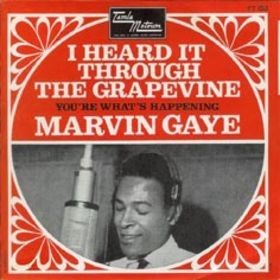
Initially, Grapevine is written for and in August ’66 recorded by The Miracles, but only the third version, with Gladys Knight & The Pips (September ’67), will be released on single and it reaches number two on the Billboard Chart. In the meantime, in the spring of 1967, Marvin Gaye records his now classic version for his breakthrough album In The Groove. Diskjockeys continue to run Gaye’s album track and finally, in October ’68, Motown decides to release that version as a single too. The song immediately rises to number one and stays there for nine weeks, until the end of January ’69. It is Motown’s biggest hit so far, scores high in the various All Time Best Songs lists and is inevitable in documentaries and films about the late 60s (although often the driven, drawn-out cover by Creedence Clearwater Revival is chosen) .
When Dylan, in his hotel room at the Ramada Inn in February ’69, quickly knocks together a couple of songs for the next recording day in Nashville, “I Heard It Through The Grapevine” still echoes through the streets, cafes and hotel lobbies. And with that, established Dylanologists such as Clinton Heylin and Tony Attwood argue, the inspiration for the undervalued “Tell Me That It Isn’t True” has been explained.
Definitely thematically, but also in terms of content, the similarities seem undeniable. Just compare the opening lines of the world hit,
I bet you’re wonderin’ how I knew ‘Bout your plans to make me blue
to Dylan’s words:
I have heard rumors all over town They say that you’re planning to put me down
… and the link is clear. Still, it is unlikely that Grapevine is the real source of inspiration – at best it is the trigger to the song that is much deeper in Dylan’s genes, to the artist who is much closer to him, to Hank Williams’ “You Win Again”.
Dylan’s admiration for Hank Williams is devout. In the autobiography Chronicles, he expresses his admiration for Luke the Drifter without restraint:
“In time, I became aware that in Hank’s recorded songs were the archetype rules of poetic songwriting. The architectural forms are like marble pillars and they had to be there. Even his words — all of his syllables are divided up so they make perfect mathematical sense. You can learn a lot about the structure of songwriting by listening to his records, and I listened to them a lot and had them internalized.”
Agreed, perhaps an all too sophisticated word choice, and that forms likemarble pillars is not entirely coherent, but his meaning is clear: to Dylan, Hank Williams belongs to the Really, Really Great Ones, in terms of status comparable with Woody Guthrie and Elvis.
In the hundred episodes of his radio program Theme Time Radio Hour Hank is frequently played (eight times), never without obeisances: “One of the greatest songwriters who ever lived,” ttrh 17, and: “Made some of the most beautiful songs about living in a world of pain,” ttrh 7. And he loves to play them, too. From the Basement Tapes Complete we know Dylan’s version of “Be Careful Of Stones That You Throw”, the song Dylan learned from Hank Williams’ alter ego Luke the Drifter, and of course “You Win Again”.
“You Win Again” is a bitter country blues that Williams records one day after his divorce from Audrey Williams and expresses the betrayal that Hank feels. “The songs cut that day after Hank’s divorce seem like pages torn from his diary,” biographer Colin Escott says.
The opening words of this particular song resonate much more clearly than those of Grapevine in “Tell Me That It Is Not True”:
The news is out, all over town
That you’ve been seen, a-runnin’ ’round
His adulation of Hank Williams in Chronicles illustrates the impact of these words: “When he sang ‘the news is out all over town,’ I knew what news that was, even though I didn’t know.” And one line hereafter we see that Dylan is now making the same associative leap as in 1969: “I’d learn later that Hank had died in the backseat of a car on New Year’s Day, kept my fingers crossed, hoped it wasn’t true.”
In interviews from that time Dylan emphasizes that these songs, the songs on Nashville Skyline, come from within:
“The songs reflect more of the inner me than the songs of the past. They’re more to my base than, say John Wesley Harding. There I felt everyone expected me to be a poet so that’s what I tried to be. But the smallest line in this new album means more to me than some of the songs on any of the previous albums I’ve made.”
(interview in March ’69 with Hubert Saal for Newsweek)
And in the Rolling Stone interview with Jan Wenner that takes place in May, Dylan tells enough humbug (“When I stopped smoking my voice changed… So drastically, I couldn’t believe it myself”), but credible is the statement that he arrives in Nashville with only a few songs in his pocket, and dashes off the other songs on the spot. Clinton Heylin, who is completely on the wrong track by supposing that “Tell Me That It Isn’t True” is a parody of “I Heard It Through The Grapevine”, analyzes accurately again that the song belongs to the songs which, like a Basement Tape, in a short creative flash bubble up out of nowhere. Apart from Dylan’s own words and the studio logs, the simplicity of the text also appears to support that assumption.
Indeed, there is no trace of Blonde On Blonde’s poetry, not an inch of John Wesley Harding’s depths. Clichés from the country idiom, rhymes like the ones that have been bouncing off these studio walls in Nashville thousands of times, although the poet seemingly deliberately, sometimes, turns to irony: he’s tall, dark and handsome (it’s not too realistic that a betrayed lover describes his rival as an irresistible Cary Grant).
Nevertheless, it is a beautiful, if not: professional song and it is not entirely understandable that its status has remained so far behind “I Threw It All Away” and “Tonight I’ll Be Staying Here With You”. The master himself also ignores the song for a long time; it takes thirty-one years, until March 2000, before he plays it on stage for the first time. But then Dylan actually seems to recognize the beauty of this old shelf warmer. “Tell Me That It Isn’t True” will remain on the setlist until 2005 and is finally adequately rehabilitated after some eighty performances.
Satisfactory, but too late for an overall revaluation. The rest of the music world neglects this unsung Dylan pearl, so this work belongs to the rather select club Dylan songs of which hardly any covers have appeared. From Beck circulates a mediocre living room recording and he is the only artist from the Premier League that plays the song at all.
The Rosewood Thieves, folk rockers from New York, the indie rock band Kind Of Like Spitting (on Professional Results, 2014) and the remarkable Jolie Holland are worth mentioning from the lower echelons. Jolie Holland, who is rightly classified as New Weird America, is blessed with a smooth, drawling vocal style and repeats her idiosyncratic homage to Dylan on her album Wildflower Blues (2017); there she conjures up Dylan’s forgotten “Minstrel Boy”.
Just like Jolie Holland, Richard Janssen from Utrecht has a faible for Dylan’s orphaned disposables. In 1998, for a so-called 2 Meter Session, he records a beautiful “If Dogs Run Free”. Ten years earlier, with his Fatal Flowers, one of the best Dutch bands of the 80s, he records the most beautiful cover of “Tell Me That It Isn’t True”, also for a 2 Meter Session on vara Radio. The Fatal Flowers are in the history books thanks to the very nice hit “Younger Days”, but the other songs also stand the test of time well. The recording of “Tell Me That It Isn’t True” is successful enough as to be selected in 2002 for the nostalgic collection album Younger Days – The Definitive Fatal Flowers.
He truly was tall, dark and handsome, our Richard Janssen.
You’ll find an index to our latest posts arranged by themes and subjects on the home page. You can also see details of our main sections on this site at the top of this page under the picture.
The index to the 500+ Dylan compositions reviewed is now on a new page of its own. You will find it here. It contains reviews of every Dylan composition that we can find a recording of – if you know of anything we have missed please do write in.
We also have a discussion group “Untold Dylan” on Facebook. Just type the phrase “Untold Dylan” in, on your Facebook page or follow this link
And please do note The Bob Dylan Project, which lists every Dylan song in alphabetical order, and has links to licensed recordings and performances by Dylan and by other artists, is starting to link back to our reviews.
‘I heard the roar of a wave that could drown the whole world’
I’m writing this at dawn on January 3. There’s a new moon, bright and hard, with the shadow of the old clearly seen. Venus standing off to one side in stark clarity. It’s deceptively quiet here, in the wooded valley where we live, but there’s a planet out there facing another year of madness and peril. As Dylan says, ‘it’s tough out there…’ I look around for the fortune telling lady but I don’t see her.
Of all the perils facing us in 2019 and beyond, global warming is the most overwhelming to contemplate. I have trouble with global warming, not with accepting the scientific consensus and the reality of it, but coming to grips with my life in terms of it.
‘I think when my back was turnedthe whole world behind me burned’
Psychologists and social commentators have identified a new syndrome they call climate-change melancholy, a debilitating mix of pessimism, helplessness and anger. It goes with a ‘what’s the use of anything?’ mood; it’s all going down in the flood or up inflame.
‘The air burnsand I’m trying to think straight’
But I can’t think straight. Meaninglessness is de rigueur. “People are crazy and times are strange”. Why do anything at all; we ain’t goin nowhere. High water everywhere. And what’s with all this Bob Dylan stuff? Shouldn’t I dedicate my meagre writing talents to a worthy climate change blog that’s trying to make a difference, quit this slumming it with Bob Dylan, do something useful to the world?
Isn’t this ratting around in another man’s songs a privileged indulgence, along with cinnamon lattes on New Year’s morning and regrets over lost love? What good am I?
The air is getting hotterThere’s a rumbling in the sky
That’s right! And I’m sitting here twiddling my thumbs, so to speak, playing over and over my latest Dylan performance obsession, his 2018 brooding version of Cry A While. A nasty, back-stabbing, double-crossing kind of song, with these grand, heavy, marching chords, rebooting my brain before the sun comes up. It must be someone else’s turn to cry:
https://www.youtube.com/watch?v=t7_kXM4fTwQ
And maybe that’s the point; for all that ‘darkness at the break of noon’ pessimism there is a resilience in a good Bob Dylan song, a celebration of our capacity to bounce back.
In the grim days of the cold war, following the Cuba crisis, a brave young voice of defiance could sing, ‘but it’s all right ma, it’s life and life only,’ or ‘it’s all right ma, I can make it.’ While ‘It’s all right Ma’ is a devastating attack on all things false and phoney, there is an affirmation in it. For a kid just five years younger than Bob, it was a message of hope and resistance. And later, in the seventies, when a whole lot of shit caught up with our generation, Dylan reminded us that no matter how much blood there is on the tracks you just keep on keeping on. Look at the inbuilt resilience of spirit in Buckets of Rain (my line arrangement):
Life is sadLife is bustAll you can doIs do what you mustYou do what you must doAnd you do it well
That says it all. When it comes to climate change melancholy, Bob Dylan is my medicine. It’s like what they say about the blues. Those old blues singers that Dylan loves so much didn’t sing the blues to make themselves sad, but as a cure to their sadness. They sang to uplift themselves. The blues is lit by humour and stoical resistance, full of complaints about whisky and women, and Dylan picks up on that beautifully.
The ancient Greeks coined the term “catharsis”, which refers to the elevating effect of a good tragedy. Catharsis is a kind of emotional discharge.
Dictionary.com defines catharsis as ‘the purging of the emotions or relieving of emotional tensions, especially through certain kinds of art, as tragedy or music.’ In short, listening to Dylan is inspirational. Even the darkest of songs, like Senor, give me courage to face the sun coming up and the unbearable light it brings to the world. Gives me courage to face the year, the madman cavorting the White House and other obscenities too numerous to mention.
‘Well, the road is rocky and the hillside's mudUp over my head nothing but clouds of blood…’
Of course. Reality as always has too many heads, and we must do what we must do and keep walking the road, even the darkest part.
when the cities are on firewith the burning death of menjust remember that death is not the end
You’ll find an index to our latest posts arranged by themes and subjects on the home page. You can also see details of our main sections on this site at the top of this page under the picture.
The index to the 500+ Dylan compositions reviewed is now on a new page of its own. You will find it here. It contains reviews of every Dylan composition that we can find a recording of – if you know of anything we have missed please do write in.
We also have a discussion group “Untold Dylan” on Facebook. Just type the phrase “Untold Dylan” in, on your Facebook page or follow this link
And please do note The Bob Dylan Project, which lists every Dylan song in alphabetical order, and has links to licensed recordings and performances by Dylan and by other artists, is starting to link back to our reviews.
Recently, with the help of Jochen I started musing on songs that Dylan has commented on – songs that he didn’t write but which he particularly likes. So far I’ve looked at two of them in these articles
Jochen also reminded me of Lonely Avenue by Ray Charles, which in turn took me back to the story that Bob Dylan’s voice was going to be available on car satnav systems. I don’t know if that ever happened, but the notion of always turning onto Lonely Avenue was one that a lot of commentators latched on to at the time.
Lonely Avenue has a vital place within rhythm n blues music as it was the first Doc Pomus (real name Jerome Felder) song to gain attention across the US and Europe. Indeed there is a biography of Doc Pomus called “Lonely Avenue”. He’s one of the songwriters whose life was so varied and wild it is hard to believe it is all true, but I’ll leave you to find that out for yourself. Here it is the music that concerns me.
But you’ll probably know Pomus’ music from such classics as Save the Last Dance for Me, This Magic Moment, A Teenager in Love etc etc, and it is often mentioned that Bob Dylan visited Doc Poums.
Here’s the Ray Charles version of Lonely Avenue…
https://youtu.be/FUE3Z-LoWyQ
In one way, loving this song is pretty much essential for anyone brought up on R&B from the 1950s, and listening to it again now the openness of the song immediately strikes one.
There is no escape from the beat it just pounds on and on and on and on 1 – 2 – 3 – 4 – there is no way around this. It symbolises the room without sunlight. It is relentless in pushing across the image of the man isolated, alone, feeling desperate: the ultimate blues of the 1920s transmuted into the blues style of the 1950s, sung, of course, by a man with a most brilliant blues singing voice.
The backing by the female singers works perfectly too, giving us the echo of woman he has lost still in the room but not there. It would be so easy to overdo that, but it is timed perfectly. Here are the lyrics…
And if you are listening and reading at the same – note how in verse two the melody doesn’t change at all, although the chords move on. A perfect clash
Now my room has got two windows
But the sunshine never comes through
You know it’s always dark and dreary
Since I broke off, baby with you
I live on a lonely avenue
My little girl wouldn’t say I do
Well, I feel so sad and blue
And it’s all because of you
I could cry, I could cry, I could cry
I could die, I could die, I could die
Because I live on a lonely avenue
Lonely avenue
Now my covers they feel like lead
And my pillow it feels like stone
Well, I’ve tossed and turned so every night
I’m not used to being alone
I live on a lonely avenue
My little girl wouldn’t say I do
Well, I feel so sad and blue
And it’s all because of you
I could cry, I could cry, I could cry
I could die, I could die, I could die
Because I live on a lonely avenue
Lonely avenue
Lonely avenue
Lonely avenue
Now I’ve been so sad and lonesome
Since you’ve left this town
You know if I could beg or borrow the money
Child, I would be a highway bound
I live on a lonely avenue
My little girl wouldn’t say I do
Well, I feel so sad and blue
You know its all because of you
This is pure, relentless emotion of the bleakest kind, helped very much by the way the melody works. And the bleakness is enhanced by the repetition not just of the chorus but also of the second verse
I live on a lonely avenue My little girl wouldn’t say I do Well, I feel so sad and blue And it’s all because of you
There is also the way the song just starts without any preface – we are straight in there, the image is solid and there is no escape. Bang, we’re stuck in the room without the door having opened.
And it would have been tempting I guess to have a fade out at the end – but the producer didn’t do this – he ended the song with a chord – I think it is a 13th but I fear my ears are no longer sharp enough to be sure. But whatever it is it symbolises the discord of the man’s life.
If ever there was a song that has the sound that represents the lyrics this is it – at every level. The beat that is relentless at the start just represents the monotony of the singer’s life in a way that envelops the listener. There is no escape; this is the world.
Of course Dylan would never write a song like this – but I can absolutely see why he still remembers it all these years later. It works to perfection. It simply hits you and then wraps the listening up inside it.
There really is no escape.
Here’s the remastered version
What else is on the site
You’ll find an index to our latest posts arranged by themes and subjects on the home page. You can also see details of our main sections on this site at the top of this page under the picture.
The index to the 500+ Dylan compositions reviewed is now on a new page of its own. You will find it here. It contains reviews of every Dylan composition that we can find a recording of – if you know of anything we have missed please do write in.
We also have a discussion group “Untold Dylan” on Facebook. Just type the phrase “Untold Dylan” in, on your Facebook page or follow this link
And please do note The Bob Dylan Project, which lists every Dylan song in alphabetical order, and has links to licensed recordings and performances by Dylan and by other artists, is starting to link back to our reviews.
The Victorian perspective of poet and writer Rudyard Kipling has a lasting influence on Western culture:
If you can keep your head when all about you

Are losing theirs, and blaming it on you

If you can trust yourself when all men doubt you

But make allowance for their doubting too ....

.... you'll be a man, my son
(Rudyard Kipling: If)
Bob Dylan grows up in days when men are depicted as men; women as women:
Trust yourself

Trust yourself to do the things that only you know best

Trust yourself

Trust yourself to do what's right, and not be second-guessed
The rhythmical waves of Kipling’s ideal values ripple yet through the song lyrics of singer/songwriter Bob Dylan:
Of all of them blackfaced crew

The finest man I knew

Was our regimental 'bhisti', Gunga Din

He was Din, Din, Din

You limpin', lump o' brick-dust, Gunga Din
(Rudyard Kipling: Gunga Din)
Bob Dylan adds the name of a latter-day member – Roger McGuinn of the Byrds:
Clouds so swift, and the rain fallin' in

Gonna see a movie called 'Gunga Din'

Pack up your money, pull up your tent, McGuinn

You ain't goin' nowhere
Other lines by the disillusioned Victorian poet have already been mentioned:
We have done with hope and honour; we are lost to love and truth

We are dropping down the ladder rung by rung

And the measure of our torment is the measure of our youth

God help us, for we knew the worst too young
(Rudyard Kipling: Gentlemen-Rankers)
Kipling knows his Keats:
More happy love! more happy, happy love!

For ever warm and still to be enjoyed

For ever panting, and forever young

All breathing passion from above
(John Keats: Ode On A Grecian Urn)
And Dylan his Keats, and his Kipling:
May you build a ladder to the stars

And climb on every rung

May you stay

May you stay forever young ...

May you grow up to be righteous

May you grow up to be strong

May you always know the truth

An see the lights surrounding you
We're poor little lambs who've lost our way

Baa! baa! baa!

We're little black sheep who've gone astray

Baa-aa-aa!

Gentlemen-rankers out on the spree

Damned from here to eternity
(Rudyard Kipling: Gentlemen-Rankers)
To wit:
Baa, baa, black sheep

Have you any wool?

Yes sir, yes sir

Three bags full
(Nursery rhyme: Baa Baa Black Sheep)
And Dylan too:
And the mountains are filled with lost sheep

Ring them bells for the blind and the deaf

Ring them bells for all of us who are left

Ring them bells for the chosen few
Whether the sheep are Jewish or Calvinist, we’re not sure!
In the burlesque adventure movie ‘Gunga Din’, based on Kipling’s poem by the same name, the water-bearer Gunga Din (Sam Jaffe) dies a hero’s death – saves Sergeant Cutter, played by Cary Grant.
What else is on the site
You’ll find an index to our latest posts arranged by themes and subjects on the home page. You can also see details of our main sections on this site at the top of this page under the picture.
The index to the 500+ Dylan compositions reviewed is now on a new page of its own. You will find it here. It contains reviews of every Dylan composition that we can find a recording of – if you know of anything we have missed please do write in.
We also have a discussion group “Untold Dylan” on Facebook. Just type the phrase “Untold Dylan” in, on your Facebook page or follow this link
And please do note The Bob Dylan Project, which lists every Dylan song in alphabetical order, and has links to licensed recordings and performances by Dylan and by other artists, is starting to link back to our reviews.
The world is a play scene
Each plays his role and gets his share
In the Dutch speaking world well-known poetry verses from Joost van den Vondel from 1637, but even at that time they were not original. Forty years earlier, for example, Shakespeare writes in As You Like It:
All the world’s a stage, And all the men and women merely players; They have their exits and their entrances, And one man in his time plays many parts
… with which the English bard actually ruminates what he already said a few years earlier in The Merchant Of Venice:
I hold the world but as the world, Gratiano;
A stage where every man must play a part.
And before that Erasmus already asked: “For what else is the life of man but a kind of play in which men in various costumes perform until the director motions them off the stage?” (Praise of Folly, 1511), but Shakespeare probably owes the fatalistic wisdom to Petronius. His quod fere totus mundus exerceat histrionem (‘almost the whole world are players’, 1st century AD) is the motto above the front door of Shakespeare’s theatre, The Globe.
Dylan’s derivative, only a pawn in the game, is a slightly more cynical variant of this fairly pessimistic metaphor. After all, it denies the greatest gift from the Creator, the existence of a Free Will. That comparable, but more vicious image of a gaming piece pushed back and forth by higher powers is not too revolutionary in itself (the comparison with chess is quite obvious, especially in war dramas and in spy novels), but in this context , in a sociological indictment, a rather brilliant and haunting find.
The motivation for writing “Only A Pawn In Their Game” is known and is explicitly mentioned in the first lines;
A bullet from the back of a bush took Medgar Evers’ blood
A finger fired the trigger to his name
June 12, 1963, while getting out of his car at home, the black civil rights activist Medgar Evers is cowardly shot in the back by the white racist Byron De La Beckwith. He dies in the hospital a little later.
At this point in his career, Dylan does not yet have an allergic reaction to labels like ‘protest singer’ and ‘champion of the Civil Rights movement’, to his reputation as a socially inspired activist, so that same week he writes his song about the crime. Three weeks later he sings it for the first time publicly, during a political meeting in Mississippi.
The event ensures attention from the New York Times (July 7, 1963, page 43). With quite a few editorial errors, unfortunately. Under the heading ‘NORTHERN FOLK SINGERS HELP OUT AT NEGRO FESTIVAL IN MISSISSIPPI’ it says that Pete Seeger is accompanied by Theodore Bikel and one Bobby Dillon, ‘who, like Mr. Seeger, are white’. Apparently, one of the most memorable songs of that day is “Only A Pawn In Their Game”, but it is attributed to a ‘local singer’:
Joining Mr Seeger in leading the songfest, in which most of the audience joined at one time or another, were Theodore Bikel and Bobby Dillon, who, like Mr. Seeger, are white. There was also a Negro trio, the Freedom Singers, from Albany, Ga. All paid their own expenses for the trip and sang without a fee. One of the more popular songs presented by a local singer was one dedicated to Medgar W. Evers, the Mississippi field secretary of the National Association for the Advancement of Colored People, who was slain last month in Jackson, Mississippi. A Greenwood man, Byron de La Beckwith, has been indicted in the shooting. The refrain of the song was that the man who shot Mr Evers didn’t know what he was doing and should be forgiven: “He’s only a pawn in their game.”
… and the content analysis is not too sharp either. In the refrain it is said that the killer ‘didn’t know what he was doing’ and that he ‘should be forgiven’, the reporter from New York thinks. A trainee, presumably.
The special power of this song is in fact that the poet manages to write an individual-transcending ballad about a despicable, hateful murder. Finger-pointing, perhaps, but the poet does not point his finger at a cruel killer, at a tragic victim of circumstances or at a pitiful casualty, as in topical songs like “The Death Of Emmett Till”, “Ballad Of Hollis Brown” or “The Lonesome Death Of Hattie Carroll”. In this song both the victim and the assassin remain a symbol, an archetype. The listener will not learn anything about Medgar Evers; the murderer does not shoot an individual, but a name – he does not know his victim either, only knows what he symbolizes. After the first two lines, the following forty-two lines concentrate on the killer’s fate, who remains nameless (‘he ain’t got no name’). The poet presents him as an archetype, too. This is an exchangeable pawn that follows the rules of the game, without having control over it – that is why not he is the one to blame, but this society is, this culture, this set of values and norms.
It is an intelligent, sharp sociological analysis, as recognized by traveling companion Pete Seeger too (in Mojo 100 Greatest Dylan Songs #49, September 2005):
“The song says just putting the murderers in jail was not enough. It was about ending the whole game of segregation. It was the first song I heard that connected the position of the black field hands with that of the poor whites in the south.”
This ability to recognize an incident as a symptom, and to use it as an illustration of social criticism, is one of the things Dylan has just learned from Bertolt Brecht. As we can conclude from his own Chronicles and from Suze Rotolo’s A Freewheelin’ Time, the play Brecht On Brecht has made an overwhelming impression on the young bard. To the song “Pirate Jenny” alone, Dylan dedicates five pages in his autobiography, claiming that from now on he tries to write songs “totally influenced by Pirate Jenny”. But he also paid attention to the rest of the performance. Brecht On Brecht is a kind of ‘best of Bertolt Brecht’, skilfully put together by the legendary dramaturge and Brecht expert George Tabori. Apart from songs, the piece consists of excerpts from plays, poems and essays. And Dylan will have nodded in agreement with wisdoms like
When nothing is right in the right places , you’ve got disorder.
and
I am a playwright. I show you
What I have seen. In man’s markets
I have seen how man is bought and sold.
This is what I show you, I the playwright.
… just like Dylan, probably consciously, absorbed Brecht’s style of poetry; Brecht keeps the listener awake by Verfremdungseffekte (‘estrangement effects’), frustrating the expectations of the listener. Stylistically, the German lyricist and playwright achieves this with tricks copied by the song poet Dylan here: by occasionally not rhyming, by varying the number of verse lines per verse and by deliberately changing the meter at unexpected moments.
Technically it is therefore a ‘difficult’ song and it is consequently almost never covered. The braveheart who dares to do it, does it either a capella, or tries to smoothen the song, tries to ‘correct’ it with a bit of tampering. The obscure Lenny Nelson Project, for example (1988), and a sympathetic Alison Lewis during a Medgar Evers commemoration in 2014, and the best one, Black Crowe Rich Robinson on the soundtrack for the remarkable documentary film The People Speak (2009) – by occasionally skipping or adding a syllable, especially in the first two lines of each verse, they manage to ‘balance’ the verse lines.
Uncomfortable, just as the song is meant to be, of course. A narrative, social criticism, intelligent, angular, uncomfortable … “Only A Pawn In Their Game” is definitely the most Brechtian song in Dylan’s oeuvre, even more than the “Pirate Jenny” carbon copy “When The Ship Comes In”. And when Dylan plays the song on August 28 during the March on Washington, where Dr. Martin Luther King gives his famous I have a dream speech, all the world is his stage.
You’ll find an index to our latest posts arranged by themes and subjects on the home page. You can also see details of our main sections on this site at the top of this page under the picture.
The index to the 500+ Dylan compositions reviewed is now on a new page of its own. You will find it here. It contains reviews of every Dylan composition that we can find a recording of – if you know of anything we have missed please do write in.
We also have a discussion group “Untold Dylan” on Facebook. Just type the phrase “Untold Dylan” in, on your Facebook page or follow this link
And please do note The Bob Dylan Project, which lists every Dylan song in alphabetical order, and has links to licensed recordings and performances by Dylan and by other artists, is starting to link back to our reviews.
“Baby coming back from the dead” is a song that doesn’t get a listing in Heylin at all, but is reported as being recorded in 1985. It turned up on the bootleg album “After the Empire” in full glorious engineered sound.
Those who know about such things suggest (as the bootleg name indeed says) this was made after Empire Burlesque, and recorded at Cherokee Studios in May 1985.
This recording shows Dylan doing what most rock bands do (or at least the ones I have known – and I should add none of them mega famous) – working on ideas simply by playing them over and over and seeing where it all goes. It is the sort of song that many a band would have loved to use as an opener at a gig just to get the audience warmed up and bopping away. And the sort of sound many of them would have died to get.
Certainly the sound production is excellent, and Dylan clearly liked the notion of this 12 bar blues as they kept it going for eight minutes and even managed to end all together.
Despite the fact that the main lyrics are just two lines, the moment where the band takes it really low (Dylan saying the classic “easy now” at one point) and then rebounds near the end of the piece, is truly exciting. It shows exactly what can be got from one simple idea when you have the best musicians behind you who will do exactly what their leader says.
Although it has been hinted at, no one really knew (before the release of this collection) what Dylan was really doing in the studio around this time. As the listing below shows, the recording of songs for his two albums was mixed up (rather than just recording one album, going on tour, and then recording the next). And looking at the songs composed by Dylan around this time it is clear that he was seeking new directions all the way through.
The fashion of music crticis (for such people did exist in 1985, generally coming out at night and skulking around in the shadows before writing negative reviews of whatever gig they could get a free ticket for) was to suggest that Dylan was yesteryear’s news, a man struggling to regain his cutting edge. But as everyone realised after the internet was invented, it was the critics themselves who were yesterday’s news.
Certainly when we look at the new songs that can be placed as being written in 1985, being “past it” was anything but the truth in terms of Dylan, and I think for quite a few of us, the rejection of Dylan as having any relevance to the 1980s by the media was a major factor in alienating us from that media. Thus it was, it turned out, the media that was increasingly irrelevant not Bob Dylan.
Others who know far more than me about such matters have suggested that Bob Dylan was (rather obviously) on vocal and guitar, along with Vito San Filippo (bass), Raymond Lee Pounds (drums), Carolyn Dennis, Madelyn Quebec, Elisecia Wright (backup vocals). Who was on keyboards is not known – or at least I haven’t seen anything that looks like more than pure speculation on the issue.
It is also said in some reviews that Dylan lacked judgement in not taking some of the ideas from this collection forward – and indeed it is a tragedy that we never got to hear this particular song live at gigs, or indeed have a chance to hear it before the bootleg version came out.
But I would argue that when you are being panned by the critics as Dylan was, it is very hard to know what to do next even for an absolute genius like Dylan. For this was not the only song that was given a knock out performance just once (in this case in the studio) – we might also think back to “I once knew a man” which was performed on TV the once in 1984, and then left. He was creating them, playing them, and moving on.
It is also possible to forget what a varied collection of songs Dylan wrote or co-wrote that year. Here’s the list that I have for the year – with this song to placed somewhere within.
Now not all of these are great works of art at all, but it does contain what is for me one of the great Dylan compositions (“Dark Eyes”) and also one of the very greatest co-compositions (“Well Well Well”).
Those two alone would be enough to make any other writer remembered – for Dylan they tend to be forgotten because the media has decided this was a bad Dylan year.
I’ve no idea when in the year this song was written, so when I update the Dylan compositions in the 80s file I will just have to place it somewhere that feels about right in 1985 and mark it as a guess. But guess or no, this is certainly a load of fun which any singer songwriter could be very proud of indeed, and most would make a regular fixture as a song in their eternal come back tours.
Fortunately for us Dylan never had comeback tours as he simply never went away.
What else is on the site
You’ll find an index to our latest posts arranged by themes and subjects on the home page. You can also see details of our main sections on this site at the top of this page under the picture.
The index to the 500+ Dylan compositions reviewed is now on a new page of its own. You will find it here. It contains reviews of every Dylan composition that we can find a recording of – if you know of anything we have missed please do write in.
We also have a discussion group “Untold Dylan” on Facebook. Just type the phrase “Untold Dylan” in, on your Facebook page or follow this link
And please do note The Bob Dylan Project, which lists every Dylan song in alphabetical order, and has links to licensed recordings and performances by Dylan and by other artists, is starting to link back to our reviews.
When singer/songwriter Bob Dylan sources a poem to augment his song lyrics, he often pays a tribute to the author of that poem. Whether consciously or subconsciously, Dylan ‘twists’ a rhyme from the poem into his song. That is, he fidddles with a rhyme that appears in the original poem.
A blatant example:
Well, my sense of humanity is going down the drain Behind every beautiful thing, there’s been some kind of pain (Bob Dylan: Not Dark Yet)
Dylan varies ‘drains’/ ‘pains’ a bit:
My heart aches, and a drowsy numbness pains
My sense, as though of hemlock I had drunk
Or empied some dull opiate to the drains
(John Keats: Ode To A Nightingale)
The rhyme ‘long’/’wrong’ echoes ‘long’/’song’ found in the poem quoted below:
You have heard the song
How long, how long?
(Rudyard Kiplng: L’Envoi)
Jochen Markhorst notes that the song “I Don’t Believe You” closely follows the rhyme scheme of the poem “L’Envoi” (“abccbdeffe” – near rhymes notwithstanding):
I can’t understand (a)
She let go of my hand (a)
And left me here facing the wall (b)
I sure like to know (c)
Why she did go (c)
But I can’t get close to her at all (b)
Though we kissed in the wild blazing night-time (d)
She said she would never forget (e)
But the morning is clear (f)
It’s like I ain’t here (f)
She just acts like we never have met (e)
(Bob Dylan: I Don’t Believe You)
Now the poem ~ for the sake of clarity, its structuring is unlocked:
There be triple ways to take (a)
Of the eagle and the snake (a)
Or the way of a man with a maid (b)
But the fairest was to me (c)
Is a ship’s upon the sea (c)
In the heel of the North-East Trade (b)
Can you hear the crash on her bows, dear lass (d)
And the drum of the racing screw (e)
As she ships it green on the old trail (f)
Our own trail, the out trail (f)
As she lifts and ‘scends on the Long Trail – the trail that is always new? (e)
(Rudyard Kipling: L’Envoi)
Again, the song lyrics – Indeed, Dylan on one level might even be talking about tangling with Kipling’s Victorian poem the night before:
It’s all new to me (a)
Like some mystery (a)
It could even be like a myth (b)
It’s hard to think on (c)
That she’s the same one (c)
That last night I was with (b)
From darkness, dreams are deserted (d)
Am I still dreaming yet? (e)
I wish she’s unlock (f)
Her voice once and talk (f)
‘Stead of acting like we never have met (e)
(Bob Dylan: I Don’t Believe You)
The ‘Kipling’ poem has a Tennyson ‘Ulysses’ tilt to it:
Fly forward my heart, O my heart (a)
From the Foreland to the Start (a)
We’re steaming all-too slow (b)
And it’s twenty thousand mile (c)
To our little lazy isle(c)
Where the trumpets-orchids blow (b)
We have heard the call of the off-shore wind (d)
And the voice of the deep-sea rain (e)
You have heard the song (f)
How long, how long? (f)
Pull out on the trail again (e)
(Rudyard Kipling: L’Envoi)
It’s well-known that Bob Dylan sings traditional folk songs, and reads the works of poets, especially those who write in the vernacular:
Tell Ol’ Bill when he comes home
Anything is worth a try
Tell him that I’m not alone
That the hour has come to do or die (Bob Dylan: Tell Ol’ Bill)
The Dylanesque Rhyme Twist be ‘die’/’try’ for ‘die’/’why’:
Someone had blundered
Theirs not to make reply
Theirs not to reason why
Theirs but to do and die
Into the Valley of Death
Rode the the six hundred
(Lord Tennyson: The Charge Of The Light Brigade)
What else is on the site
You’ll find an index to our latest posts arranged by themes and subjects on the home page. You can also see details of our main sections on this site at the top of this page under the picture.
The index to the 500+ Dylan compositions reviewed is now on a new page of its own. You will find it here. It contains reviews of every Dylan composition that we can find a recording of – if you know of anything we have missed please do write in.
We also have a discussion group “Untold Dylan” on Facebook. Just type the phrase “Untold Dylan” in, on your Facebook page or follow this link
And please do note The Bob Dylan Project, which lists every Dylan song in alphabetical order, and has links to licensed recordings and performances by Dylan and by other artists, is starting to link back to our reviews.
Herodotus tells in Book III of his Histories about the power-lusting empire-builder Cambyses, the king who wanted to expand his Persian empire. In the south of Egypt he recruits Ethiopian-speaking Ichthyophagi, ‘fish eaters’ from the Elephantine Island on the Nile, who have to explore the area in Ethiopia. Loaded with gifts, they introduce themselves as messengers to the king of the Ethiopians, “the greatest and most beautiful of all men,” who effortlessly sees through them as spies. Nevertheless, the king introduces them to the secret of the beauty and the long, long life of the Ethiopians:
When the Icthyophagi showed wonder at the number of the years, he led them to a fountain, wherein when they had washed, they found their flesh all glossy and sleek, as if they had bathed in oil – and a scent came from the spring like that of violets. The water was so weak, they said, that nothing would float in it, neither wood, nor any lighter substance, but all went to the bottom. If the account of this fountain be true, it would be their constant use of the water from it which makes them so long-lived.
(Book III, Thalia, chapter 23)
A-ha. So the source of rejuvenation is a Fountain of Eternal Youth. Herodotus is a serious scientist, the ‘father of historiography’, his mention does carry some weight. So from Alexander the Great crossing the Land Of Darkness, to the Spanish conquistadores searching for the mythical islands of Bimini, to the illusionist David Copperfield in the twenty-first century: humankind continues to search for that mythical spring. Forever young is and remains an irresistible ideal.
Immortality less so. Myths like those of the Flying Dutchman and Ahasverus, the Wandering Jew, teach that not being able to die is a curse, a punishment from a god or a devil. Dylan also teaches that lesson in “Seven Curses”. The seventh, the most horrible cursing that befalls the false judge is: seven deaths shall never kill him.
Hence, in the song “Forever Young” the narrator is not wishing this frightening immortality for his child, but he expresses the wish that he may remain ‘young’ in a metaphorical sense; free from weakness, sourness, cynicism, from being washed out and from fatigue, free from, in short, the decay we blame on aging.
https://www.youtube.com/watch?v=NuYqL-uzMes
Familiar, age-old blessings. Every parent will recognize them, and similar blessings can be found in the Old Testament. And most of all, they are sweet, unambiguous and optimistic – far from anything the cynical, super cool hipcat Dylan from 1965 could have written.
It seems to be a somewhat sensitive area to the poet himself, too. As demonstrated by the unique maneuver to put a second, slightly less sweet version on the album. And according to legend, we also owe the acetic acid of the bicarbonatic “Dirge” indirectly to the sweetness of “Forever Young”.
A female friend of Dylan’s childhood buddy Lou Kemp, a Martha, is said to have said after hearing the test recordings of “Forever Young”: “Are you getting mushy in your old age?”
It is an apocryphal story and at first glance not too credible. This takes place in November 1973, when Dylan has been hardened for years and years by harsh, global and often unsubstantiated criticism, when Dylan has already been chastised by complete concert halls, has been written off for thousands of pages in leading magazines and publicly been called to account in Baez songs, by Bowie and whonot.
It is, all in all, not very likely that some superficial bullying by a single silly little dimwit could touch Dylan. On the other hand, producer Fraboni also mentions the ‘Martha incident’ and he remembers his horror when Dylan decides to cancel the album highlight “Forever Young” altogether. After Fraboni’s dismay, Dylan wants to at least record a different, bolder version of “Forever Young” and eventually, after much squabbling, agrees with that strange – and in Dylan’s oeuvre unique – compromise to put both versions on the record. From that witness report can be concluded, therefore, that this unknown girl has managed to strike a sensitive nerve, that Dylan too does not feel completely at ease with the mushiness of the song.
It does not affect the popularity of the song. “Forever Young” is one of Dylan’s most covered songs, a favourite with both fans and non-fans, and – despite that alleged embarrassment – is in Olof Björner’s list of songs performed over 500 times.
Explicit is also the greed with which the International Trade House Dylan & Co. Inc. claims the copyrights, as is evident from the slightly shameful sabre rattling around Rod Stewart’s ‘cover’.
When Stewart, together with two of his band members, writes his “Forever Young” in 1988, he realizes that it is very similar to Dylan’s song. He is familiar with the legal assertiveness and willingness to claim of Dylan’s management, so Stewart is so wise as to test the waters first and sends a test pressing to New York. Generously, Stewart is granted 50% of the royalties.
It is an uncomfortable, because ambiguous, phenomenon, that claim behaviour of Dylan. After all, he himself is the greatest thief of all, a self-proclaimed thief of thoughts, who plunders the work of others in all areas – literary, in his visual arts and in his song art. But Hootie & The Blowfish has to pay a lot when the band quotes from Dylan songs in the world hit “I Only Want Be With You”, Apple has to settle in 1994 for the use of the brand name ‘Dylan’ when the company uses that name for a programming language (even though Dylan, bizarrely enough, nicked the name himself) and now Stewart has to deliver for “Forever Young”.
Another raffled edge this issue gets when Rod Stewart is sued in 2015 by the heirs of Armetia ‘Bo Carter’ Chatmon, for his cover of the song “Corrina, Corrina”. In the indictment filed in Atlanta, Stewart is accused of knowingly infringing copyright or not having taken the trouble to check whether the song belongs to the public domain.
Dylan plays the same song on The Freewheelin’, and even unconcerndly steals the song, in words and writing, by registering it to his name. In quite misty terms, by the way: the label on the record reads ‘adapted and arranged: B. Dylan’, on his website and in Lyrics is stated ‘written by: Bob Dylan (arr.)’, And in 1994 the copyright is, as is the custom, renewed.
For unknown reasons, this is ignored by the Chatmon / Carter heirs. When the case against Rod Stewart fails, they try again a year later, October 13, 2016. This time in Tennessee and this time against Eric Clapton (who recorded the song as “Alberta, Alberta”), but the heirs eventually, on June 27, 2018, again come away empty-handed.
The remarkable thing is that the much more impertinent, unashamed, much earlier Dylan remains untouched. Perhaps we can see here demonstrated the profound truth from Eugene O’Neill’s Emperor Jones (1920):
For de little stealin’ dey gits you in jail soon or late. For de big stealin’ dey makes you Emperor and puts you in de Hall o’ Fame when you croaks,
… the aphorism Dylan also, very appropriately, steals. Paraphrased, for “Sweetheart Like You” (Steal a little and they throw you in jail / Steal a lot and they make you a king).
Regardless. “Forever Young” is a beautiful, fragile song that has a moving power in almost any performance, by almost any artist. Johnny Cash, Norah Jones, Eddie Vedder, The Pretenders, Deacon Blue … oh well, every true artist who knows how to avoid pathos and melodrama hits the mark.
Special added value the song receives when the eternally young Pete Seeger contributes it to Chimes of Freedom: the Songs of Bob Dylan Honoring 50 Years of Amnesty International (2012), at the age of ninety-two.
The producers have to travel to Seeger’s hometown of Beacon, New York, because the elderly singer wants his choir of local school children, The Rivertown Kids, singing along. The recording, beautifully orchestrated, with the fragile talk-singing, elderly folk legend is perhaps not the most beautiful, but undeniably the most moving version of “Forever Young”. And a strong indication that the Fountain of Eternal Youth is probably not to be found in Ethiopia, not on the mythical islands of Bimini and not in an Asian Land of Darkness, but somewhere along the banks of the Hudson, near Beacon, New York.
Forever Young by Joan Baez. Suggested in our Greatest Cover recordings list.
What else is on the site
You’ll find an index to our latest posts arranged by themes and subjects on the home page. You can also see details of our main sections on this site at the top of this page under the picture.
The index to the 500+ Dylan compositions reviewed is now on a new page of its own. You will find it here. It contains reviews of every Dylan composition that we can find a recording of – if you know of anything we have missed please do write in.
We also have a discussion group “Untold Dylan” on Facebook. Just type the phrase “Untold Dylan” in, on your Facebook page or follow this link
And please do note The Bob Dylan Project, which lists every Dylan song in alphabetical order, and has links to licensed recordings and performances by Dylan and by other artists, is starting to link back to our reviews.
“Nowhere to go” also known as “When everybody comes to town” is listed in many places as a Bob Dylan – George Harrison co-composition which was in the long list of songs to go onto All Things Must Pass, but then not used.
It exists only as a demo from the time Harrison made recordings of all the songs he was considering for the album. The Dylan Harrison composition that was used was “I’ll have you any time”. This song is not mentioned under either title in Heylin’s work on Dylan’s compositions.
The recording was made at Bob Dylan’s home in Greenwich Village in April 1970, although there are suggestions that the piece was written in 1969.
The song was included in a bootleg album called “Beware of ABKCO” a title which links the song “Beware of Darkness” and the fraught relationship the Beatles had with the publishing corporation Abkco – who at one stage sued the Beatles and in which one of the cases was settled by the group paying the publishing of $4 million.
Commenting on the period of writing this song Harrison noted that Bob Dylan was being very quiet and seemed very low on confidence at the time but things improved when the two musicians began playing music together around Thanksgiving. (There are details of the occasion in the book “I me mine” by Harrison).
Simon Leng has suggested that Harrison showed Dylan a few chords that Dylan was not using in his songs and out of that conversation this song was created.
In this telling of events Harrison has been talking to Dylan, asking to be allowed into the private world Dylan had created around himself (“Let me in here”) to which Dylan replies “All I have is yours”
And from here somehow the two composers, through exchanging lyrics and chords subsequently emerged with this second song.
However to me (and as always this is just my thought on the matter) the chord sequence seems to have been pushed and pushed further and further to include as many unexpected chords as possible so that the song itself loses its coherence. There is no rule that says you can’t have a dozen or more different chords in a verse, but pop and rock music was based on just three chords and the further away from that one gets the more one has to work to create a coherence that can be grasped by a pop/rock audience. That doesn’t mean three chords is all we have but it does suggest that a certain caution is needed if one wants to keep the elements of popular music in what one is writing.
The chords we have here in the verse are…
G#m G F#m Am E C#7
F#m F E F#m Am
It is indeed even hard to know which key the song is in. As I say there is nothing in the rule book that says you can’t do this, because there is no rule book – but then on the other hand “Blowin in the Wind” only has three chords (although a fourth is sometimes added in performances).
Here are the lyrics of Nowhere to Go.
Get tired of being pushed around Trampled to the ground Every times somebody comes to townI get tired of policemen on the prowl Looking on my bowel Every times somebody’s getting highNowhere to go There’s no place to hide my self Nowhere I know they don’t know And I know it
I get tired of being beatle jeff Talking to the deaf Every times some whistle’s getting in blown
Nowhere to go There’s no place to hide myself Nowhere I know they don’t know And I know it
I get tired of being beatle ted Talking to the dead Every times some booby’s getting blown
Nowhere to go There’s no place to hide my self Nowhere I know they don’t know And I know it
Nowhere to go There’s nowhere to hide my self Nowhere I know they don’t know And I know it
It really does sound to me like a quick Dylan lyric with Harrison throwing in every chord that might fit, and that doesn’t always work. At least not for me.
What else is on the site
You’ll find an index to our latest posts arranged by themes and subjects on the home page. You can also see details of our main sections on this site at the top of this page under the picture.
The index to the 500+ Dylan compositions reviewed is now on a new page of its own. You will find it here. It contains reviews of every Dylan composition that we can find a recording of – if you know of anything we have missed please do write in.
We also have a discussion group “Untold Dylan” on Facebook. Just type the phrase “Untold Dylan” in, on your Facebook page or follow this link
And please do note The Bob Dylan Project, which lists every Dylan song in alphabetical order, and has links to licensed recordings and performances by Dylan and by other artists, is starting to link back to our reviews.
“Once the record was released, I heard all the Dylan comparisons, so I steered away from it. But the lyrics and spirit of Greetings came from an unself-conscious place.”
(Springsteen on his first LP Greetings From Ashbury Park in his autobiography Born To Run, 2016)
It is August 1972 and Springsteen just told us that Columbia Records boss Clive Davis has not yet been able to discover radio-friendly hits in the material for the debut album.
“I drove to the beach and wrote ‘Spirit In The Night’, went home, packed my rhyme dictionary and wrote ‘Blinded By The Light’, the two best songs on the album.”
Both songs are picked up by Manfred Mann and especially “Blinded By The Light”, a huge world hit, not only establishes Springsteen’s name as songwriter, but also places a tick in the ‘Second Dylan’ checkbox; after all, Manfred Mann is the undisputed Grandmaster of the Dylan covers and from now on seems to be concentrating on Springsteen covers.
“Spirit In The Night” is the most fascinating song on that album, an audience’s favourite to this day, and the primal model for what music historians in the coming centuries will label as an archetypal Springsteen song.
A mini-novella, exuberant, fragmentary narrative style, baroque named main characters (Crazy Janey, Killer Joe, Hazy Davy, Wild Billy), cars, Saturday night, the masterly symbiosis of lyrics and music, and the superior sense of rhythm (Crazy Janey and her mission man were back in the alley trading hands): this song is the template for later masterpieces like “Born To Run”, “4th Of July” and “Thunder Road”. And for Dylan’s “Tweeter And The Monkey Man”, of course.
Springsteen’s own analysis with regard to the realization of “Spirit In The Night” is conspicuously worded. The song comes from an ‘unself-conscious place‘ (Springsteen himself uses the superfluous hyphen). That seems a somewhat clumsy punctuation choice to include associations with ‘unconscious’ or perhaps ‘subconscious’, but Bruce apparently wants to stress the nuance ‘open-minded, bold’.
This is quite similar to the way in which Dylan tries to express the process of songwriting in his early years. In several interviews, Dylan claims that the songs in the 60s rise from his’ unconscious’, that he loses that ability, and that in ’74, shortly before Blood On The Tracks, he learns to do consciously what I used to be able to do unconsciously. Even more striking, the poet puts in the television interview at CBS with Ed Bradley in 2004:
BD: I don’t know how I got to write those songs. EB: What do you mean you don’t know how? BD: All those early songs were almost magically written. Ah… “Darkness at the break of noon, shadows even the silver spoon, a handmade blade, the child’s balloon…” Well, try to sit down and write something like that.
Now, the origin of “Spirit Of The Night” can be traced. Springsteen himself indicates that in those days he listens a lot to the LP Cahoots of The Band, and that album includes Robbie Robertson’s song “The Moon Struck One”. The parallels are unmistakable:
Little John was stung by a snake over by the lake
And it looked like he’s really, really hurt, he was lyin’ in the dirt
… Springsteen turns it into:
Well now Hazy Davy got really hurt, he ran into the lake in just his socks and a shirt
Me and Crazy Janey was makin’ love in the dirt
And the choice for the name ‘Crazy Janey’ suggests that The Boss is at least vaguely familiar with the Crazy Jane poems of the Irish master W.B. Yeats, collected in the aptly titled collection Words For Music Perhaps (1932).
Browsing through that collection yields more aha-moments. Yeats’ Crazy Jane is romantically involved with The Bishop (the mission man), sub-characters appear to be created for a future Springsteen song: Jack the Journeyman, the solid man and the coxcomb, Old Tom the Lunatic and Holy Joe the beggar-man.
Traces of fellow Nobel laureate W.B. Yeats in Dylan songs are every now and then found by Dylanologists, but are usually quite indirect, substantiating Dylan’s own account from a 1965 interview (“I haven’t read Yeats”). Here too, Yeats’ influence only very indirectly seeps into a Dylan song, in this case into a Traveling Wilbury song, the Springsteen homage “Tweeter And The Monkey Man”.
It is a sympathetic subgenre in Dylan’s oeuvre, the homage. On his first album he pays his tribute unequivocally (“Song To Woody”) as he can do in later years too, once in a while (“Lenny Bruce”, 1981), but he usually wraps his honouring more subtly. For example through style paraphrase (“Clothes Line Saga”, the nod to Bobbie Gentry’s “Ode To Billie Joe”), by copying sound and melody (like “Sugar Baby”, the reverence to Gene Austin), but most often by littering a song with textual references, such as the loving greetings to Wilbert Harrison’s “Kansas City” in “High Water (For Charley Patton)”, to John Lennon (“Roll On, John”) and here to The Boss in this “Tweeter And The Monkey” Man”.
The many winks in the song are eagerly listed on the various fanfora. Stolen Car, Thunder Road, Jersey Girl, The River, Mansion On The Hill … with some tolerance more than ten references to Springsteen songs can be found in Dylan’s song. Co-author Tom Petty confirms, smiling, in a Rolling Stone interview, 2003:
“It was not meant to mock [Springsteen] at all,” said Petty. “It started with Bob Dylan saying, ‘I want to write a song about a guy named Tweeter. And it needs somebody else.’ I said, ‘The Monkey Man.’ And he says, ‘Perfect, ‘Tweeter and the Monkey Man.” And he said, ‘Okay, I want to write the story and I want to set it in New Jersey.’ I was like, ‘OK, New Jersey.’ And he was like, ‘Yeah, we could use references to Bruce Springsteen titles.’ He clearly meant it as praise.”
A slightly more romantic story tells that Tom Petty and Dylan visit a Springsteen concert at the Memorial Sports Arena in Los Angeles at the end of April 1988. One of the songs played is “Part Man, Part Monkey” (baby, that’s me) and those words, plus the massive presence of Clarence Clemons with his honky hooter, inspire Tweeter and Monkey Man.
The references then are the ornaments for a cinematic story in the best Springsteen tradition, an action thriller about a triangular relationship, with petty crime, car chases, shootings, a fatal finale and a film noirish, melancholic coda in black and white. Word choice, rhythm and narrative style, however, have a Dylanesque touch, resulting in a peculiar mirror effect: Dylan who writes a Dylanesque Springsteen song. Only the chorus,
And the walls came down, all the way to hell
Never saw them when they’re standing, never saw them when they fell,
…with that biblical image of collapsing walls, the road to hell and the aphoristic quality of the antithesis in the second verse, is full-blooded Dylan. And the confounding shuffling of personal pronouns is a typical Dylan idiosyncrasy. Tweeter goes to Vietnam as a she, but is apparently a transsexual; in the eighth verse Jan says about Tweeter: I knew him long before he ever became a Jersey Girl.
Some legitimate fame the cover of the Canadian punk rockers from Headstone receives, due to their grunge-like, exciting energy, which roughly rubs off the rather dated, smoother 80’s varnish of the original (and casually reassigns Tweeters gender).
The adaptation by Dutch cabaret artist Freek de Jonge for A Tribute To Bob Dylan, 2014 in the Concertgebouw Amsterdam, “Libelle En Mug” (“Dragonfly And Gnat”), is humorous and pleasantly disrespectful:
Annie kende Abraham van een zuster van haar neef
Die verkering met een vent had die voor Libelle schreef
Dus noemde Annie Bram Libelle en Abraham Annie Mug
Omdat ze altijd ergens jeuk had en meestal op haar rug
(Annie knew Abraham through a sister of her cousin
Who was dating some guy who wrote for ‘Dragonfly’
So Annie called Bram Dragonfly and Abraham Annie Gnat
Because she always had some itching and usually on her back)
Curiosity attraction has Roy Orbison Jr., who includes precisely this song, the only song on Traveling Wilbury’s Vol. I to which his father does not contribute, in his repertoire. A safe, unremarkable interpretation, by the way.
Enjoyable are the live performances of co-owner Tom Petty with his Heartbreakers, but they stay very loyal to the original – including a Petty who seems to want to imitate the singing style of Dylan; thus adapting the role of the Monkey Man.
You’ll find an index to our latest posts arranged by themes and subjects on the home page. You can also see details of our main sections on this site at the top of this page under the picture.
The index to the 500+ Dylan compositions reviewed is now on a new page of its own. You will find it here. It contains reviews of every Dylan composition that we can find a recording of – if you know of anything we have missed please do write in.
We also have a discussion group “Untold Dylan” on Facebook. Just type the phrase “Untold Dylan” in, on your Facebook page or follow this link
And please do note The Bob Dylan Project, which lists every Dylan song in alphabetical order, and has links to licensed recordings and performances by Dylan and by other artists, is starting to link back to our reviews.
The dramatic romantic comedy movie “Picnic”, starring William Holden and Kim Novac, influences a number of Bob Dylan’s song lyrics.
A coincidence perhaps, but “Talkin’ Bear Mountain Picnic Massacre Blues” could be one. The satirical song is based on a New York newspaper item, but it sums up the plot of the movie quite nicely. The film centres on a Labor Day picnic – mixed with paper-bagged alcohol – that takes place in a small town in Kansas; in the movie, the ‘massacre’ is mostly psychological, not physical:
Holden is a drifter, a Jack Of Hearts archetype (Holden also stars in “Rachael And The Stranger”). He hops a freight train, gets off at the Kansas town in the hopes of getting a job from an old college buddy who’s a ‘Diamond Jim’ type, made it big in the grain business:
He’s courting Madge, the beautiful Novac, the picnic’s chosen Queen, and a real man-killer Lily ~ whether she likes it or not. Madge has a younger
plain-looking sister named Millie who has memorized the Sonnets of Shakespeare:
Maggie and Milly, and Molly and May
Went down to the beach to play one day
(e e Cummings: Maggie and Milly And Molly And May)
Madge and Millie’s mother, whose husband left her, wants the older daughter to marry Holden’s pal because he’s wealthy, but she falls for the shiftless drifter because she’s a dreamer. Madge and he kiss and her ear-ring accidently scratches the drifter’s face:
In the movie, the leather boots of Holden’s drunkard father serve as a symbol for the independent man who follows his own path regardless of the consequences; Holden takes the boots off of his dead father’s feet, and puts them on:
The middle-aged ‘old maid’ school teacher in “Picnic” is named Rosemary. She drinks some alcohol at the Labor Day picnic, pushes herself on muscle-bound Holden; he rips not her bodice, she rips his shirt instead. She turns on Holden when he rejects her, accuses him of trying to take advantage of Madge’s younger sister:
Someone’s got it in for me They’re planting stories in the press Whoever it is, I wish they’d cut it out quick (Bob Dylan: Idiot Wind)
“Cut it out quick” – a clever double-edged pun if there ever was one.
Holden’s pal turns on him too – accuses him of stealing his car. Madge and the drifter have gotten it on, she doesn’t love the grain elevator man:
Cops are called, and the drifter escapes, but he manages to tell Madge that she’s changed his life before he hops a freight heading for Tulsa, Oklahoma:
You understand That my heart can’t go beating without you Well, your loveliness has wounded me I’m reeling from the blow (Bob Dylan: Can’t Wait)
Millie says to her sister – “Go with him, Madge, for once in your life do something bright.” Madge stabs the grain man in the back (so to speak), and grabs a bus for Tulsa:
Not that different from Rosemary, Madge, the Lily, be:
Was lookin’ to do just one good deed before she died She was gazin’ to the future, riding on the Jack of Hearts
(Bob Dylan: Lily, Rosemary, And The Jack Of Hearts)
They don’t make movies or songs like that anymore.
You’ll find an index to our latest posts arranged by themes and subjects on the home page. You can also see details of our main sections on this site at the top of this page under the picture.
The index to the 500+ Dylan compositions reviewed is now on a new page of its own. You will find it here. It contains reviews of every Dylan composition that we can find a recording of – if you know of anything we have missed please do write in.
We also have a discussion group “Untold Dylan” on Facebook. Just type the phrase “Untold Dylan” in, on your Facebook page or follow this link
And please do note The Bob Dylan Project, which lists every Dylan song in alphabetical order, and has links to licensed recordings and performances by Dylan and by other artists, is starting to link back to our reviews.
It is primarily because there are very few Dylan songs left to review that I’m including a few songs now that may or may not have had any real input in terms of songwriting from Bob Dylan. And whose contribution to civilisation, or come to that to the overthrow of civilisation as we know it, is perhaps not that great.
This is particularly the case with the Allen Ginsberg pieces which don’t come with any clear indication as to what part Bob Dylan played in their creation, and which to me seem to be rather minor contributions to the artistic expression of Western civilisation – or anti-western civilisation come to that.
Jimmy Berman Rag is credited sometimes with Bob Dylan being on vocals and guitar, with a suggestion in some quarters that Bob was a part composer. He may have been on guitar, but it don’t sound like Dylan to me, and it doesn’t read like Dylan lyrics either.
There has been a comment posted on Expecting Rain asking for more information on the piece but no one took up the request which makes me think that there is nothing more to be known. After all if the readers of Expecting Rain don’t know…
The song was first released on Ginsberg’s 1974 album Disconnected and there is a serious consideration of the work on the popmatters website, in which the writer has found a way into the music that totally escapes me. The central notion is that “it’s an alternately amusing and troubling collection of ideas” – and that’s what I just don’t see.
And in case you need them, here are the lyrics…
Who’s that Jimmy Berman? I heard you drop his name
What has he got to say? What papers is he sellin’?
I don’t know if he’s the guy I met or ain’t the same
Well, that Jimmy Berman was a boy that is worth tellin’
Jimmy Berman on the corner sold the New York Times
Jimmy Berman in New York he had a long, long climb
Started as a shoeshine boy, ended on Times Square
Jimmy Berman, what’s that rose you got settin’ in your hair?
Jimmy Berman what’s your sex, why you hang ‘round here all day?
Jimmy Berman what’s up next, oh what do you play?
Who you wanna sleep with night, Jimmy boy? Would you like come with me?
Jimmy Berman, O my love, O what misery
Jimmy Berman, do you feel the same as what I do?
Jimmy Berman, won’t you come home and make love with me too?
Jimmy Berman, I’ll take my clothes off, lay me down in bed
Jimmy Berman, drop your pants, I’ll give you some good head
Eighteen-year-old Jimmy, the boy is my delight
Eighteen-year-old Jimmy, I love him day and night
Now I know I’m getting kinda old to chase poor Jimmy’s tail
But I won’t tell you other, love, it’d be too long a tale
Jimmy Berman, please love me, I throw myself at your feet
Jimmy Berman, I’ll give you money, oh, won’t that be neat?
Jimmy Berman, just give me your heart and yeah! your soul
Jimmy Berman, please come home with me, I would be whole
Jimmy Berman on the street, waiting for his god
Jimmy Berman as I pass gives me a holy nod
Jimmy Berman he has watched and seen the strangers pass
Jimmy Berman he gave up, he wants no more, alas
Jimmy Berman does yoga, he smokes a little grass
Jimmy Berman’s back is straight, he knows what to bypass
Jimmy Berman don’t take junk, he don’t shoot speed in his eye
Jimmy Berman’s got a healthy mind and Jimmy Berman is ours
Jimmy Berman, Jimmy Berman, I will say goodbye
Jimmy Berman, Jimmy Berman, love you till I die
Jimmy Berman, Jimmy Berman, wave to me as well
Jimmy Berman, Jimmy Berman, please abolish Hell
Such commentaries as I have been able to find suggest the song was improvised on the spot – and maybe that is so. But are there people who having listened to this once will go back and play it again? Or isn’t that the point?
Maybe I am just affected by writing these reviews – when writing them I listen to each song over and over and I have to say after several listens to this piece I really do believe I have had enough. It’s not so much that I am going back to New York City because I’ve had enough or that I don’t want to play this song again, rather I feel like I don’t want to list any song again. Ever.
But of course this is a blog – if you are getting something out of this song, or if you feel there is real evidence of a Bob Dylan input here, please do write in and say.
What else is on the site
You’ll find an index to our latest posts arranged by themes and subjects on the home page. You can also see details of our main sections on this site at the top of this page under the picture.
The index to the 500+ Dylan compositions reviewed is now on a new page of its own. You will find it here. It contains reviews of every Dylan composition that we can find a recording of – if you know of anything we have missed please do write in.
We also have a discussion group “Untold Dylan” on Facebook. Just type the phrase “Untold Dylan” in, on your Facebook page or follow this link
And please do note The Bob Dylan Project, which lists every Dylan song in alphabetical order, and has links to licensed recordings and performances by Dylan and by other artists, is starting to link back to our reviews.
It is a beautiful story, even though it is a true story. On a Thursday evening in July 1975, Dylan visits a performance by his old Greenwich Village buddy Ramblin’ Jack Elliott, playing in the famous nightclub The Bitter End (which is briefly called The Other End in those days) on Bleecker Street. Elliott spots him, starts playing “With God On Our Side” and asks after a few lines if Bob might want to assist him. Pleasantly surprised, the hundred-headed audience sees Dylan taking the stage, grabbing a guitar and playing along with “Pretty Boy Floyd” and “How Long Blues”.
He seems a little nervous, declines a first invitation to sing something, but then he exchanges his rattling guitar (he has troubles adjuisting the capo) with Ramblin’ Jack’s and then starts to sing. “After a couple of lines, we realized he was performing a new song,” eyewitness Joe Kivak writes, “with each line getting even better than the last. The song was Abandoned Love, and it still is the most powerful performance I’ve ever heard.”
Someone in the audience is so thoughtful as to make a sneaky recording that soon becomes extremely popular in bootleg circles, proving that Kivak hardly exaggerates; it is an enthusiastic, sparkling performance of an extremely beautiful song. It really must be the highlight of the upcoming LP.
A few weeks later, July 31, it is one of the last songs he records for that new LP, Desire, along with two other love songs: “Isis” and “Sara”. In terms of lyrics, hardly anything has changed, but the sparkle has disappeared. The melody is of course still enchanting, the accompaniment at the high Desire level, the production crisp (unfortunately including that dated bathroom reverbeo in vocals and percussion), but compared to the live recording, a mattness has crept in, Dylan sings perfunctively. He dismisses the recording, which will appear on Biograph ten years later, for Desire. Perhaps the master also misses the pearl gloss of the gig on 3 July, or maybe he thinks a song about the end of a Great Love should have been on predecessor Blood On The Tracks – or is the content too intimate? After that one time he will never play it again, in any case.
That intimacy then would concern the candor about the end of the marriage with Sara, which indeed fairly effortlessly can be distilled from the lyrics. In the first half of the 70s, Dylan serves his followers and fans with a-typical openness. Songs like “Wedding Song”, “Idiot Wind” and “You’re Gonna Make Me Lonesome When You Go” are compared to earlier and later work remarkably undisguised, stripped of the usual misty ambiguity, and provide more than ever insight into the man’s soul stirrings. Grist to the mill of the exegetes with less cryptoanalytic talent, anyway.
“Abandoned Love” is a highlight in that subgenre. The underlying melancholy, regret, heartache and despair are clear, yet wrapped in Dylanesque metaphors and poetic emblems. The admiring witness of the first hour is right; already the first sentence is of great beauty. I can hear the turning of the key has a compelling rhythm, a strong evocative power and a catchy symbolic charge. And after this, sure enough, every line gets even better. The narrator does not spare himself; he is deceived by the clown in me, driven by misplaced vanity and now torn by the old and familiar conflict between head and heart. Sure, intellectually he understands it is over, but then: my heart is a-tellin ‘me I love ya still.
The biographical interpreter starts focusing the third time the protagonist professes his love in so many words: my heart is telling me I love ya but you’re strange. We now know that the I person is thematizing the abandonment of a Great Love, a Great Love with whom he also has children – yes, this is really inspired by the upcoming former Mrs. Dylan. Who is, it must be said now, perhaps a bit strange.
The observation does not stand alone. On comparing various Sara observations from different sources, one cannot escape the notion, besides all the respectful and affectionate descriptions: she indeed is a bit weird. Marianne Faithfull is not the only one who registers that she does not say much (in her highly humorous, touching and disconcerting autobiography from 1994) and describes her as solid as marble.
Levon Helm, the drummer of The Band, also senses something ethereal: a Brazilian Madonna (in his memoirs This Wheel’s On Fire). Sara connoisseur Joan Baez devotes quite a lot of words to her love rival in And A Voice To Sing With, and the sympathy that Baez seems to feel is predominant. Between the lines, however, she sprinkles asides and remarks that together do paint an image of quite a peculiar little lady. More than once Sara’s gaze is quizzical or surprised, often in combination with foggy. She is “too frail to be a mom,” “ill-equipped to handle the practical matters of everyday,” and Baez must help her with banal necessities such as finding towels and how to make coffee. However, Baez thinks Sara’s eccentric, poetic phobia is enviable: Sara is afraid to stand on a bridge over still water. It even animates Joan to a song about her (“Still Waters At Night”, on the disappointing Gulf Winds, 1976).
Likewise, in the Dylan songs in which Sara is sung, the bard always puts in a few words that suggest that his adored one can be somewhat detached or vulnerable. She is a Sphinx and hard to define (“Sara”), she apparently has no wishes, because she’s got everything she needs (“She Belongs To Me”), she is like some raven with a broken wing and speaks like silence (“Love Minus Zero / No Limit”), has a ghostlike soul and a face like glass (“Sad-Eyed Lady Of The Lowlands”). In any case, Sara inspires Dylan to his most beautiful love songs, that much is clear. And the sideways remarked eccentricities all fit well with that one subclause after that declaration of love, I love ya but you’re strange.
However, the rejection of this little masterpiece may not be due to unease about the content. The text’s style is unsteady, and that may bother the poet Dylan. The text-internal tension between clear, classic lines of verse like Everybody’s wearing a disguise or clichéd pathos like The treasure can’t be found by men who search on the one hand and symbol-charged, ambiguous imagery like My patron saint is a-fighting with a ghost or the breathtaking power of Send out for St. John the Evangelist / All my friends are drunk, they can be dismissed (rejected lines from the first version) on the other hand, almost tangibly illustrates the crossroads on which the poet is now standing. It is a final eruption of the lucid poetry on Blood On The Tracks and a first glance at the heavy, hermetic lyricism of Street Legal.
After the release of that underwhelming studio recording from July ’75 on the sales success Biograph (1985), “Abandoned Love” also penetrates into the repertoire of eager colleagues. The Everly Brothers act fast (on Born Yesterday, 1985) with a rather corny, Celtic coloured version. It sounds more authentic with the full-blooded Irishman Séan Keane (All Heart No Roses, 1994), but the drabness is just as intolerable. The interpretation by Alistair Moock is already easier to digest, although his singing style pushes the song in the direction of “Streets Of London”. George Harrison changes the opening line for puzzling reasons into I can see the turning of the key, and delivers a beautifully arranged cover – but no; old George’s voice has never been wild or mercury, only thin, unfortunately. And the 80s sauce over the production does not do much good either. By the way, Harrison records it in the fall of 1984, well before Biograph‘s release; presumably his friend Dylan has pointed out to him the existence of the song.
The most beautiful covers are the various live versions from the Californian Chuck Prophet, the master guitarist and singer-songwriter who never really breaks through. Prophet produces distinctive, quirky Dylan covers (his “From A Buick 6” is a highlight), but refrains himself with “Abandoned Love”, in a faithful, loving, driving arrangement that, in part due to the guitar tsunami, towers high over the other covers.
Still, to the maestro’s embryonic, original pub recording from July ’75 no one comes close – not even Dylan himself.
You’ll find an index to our latest posts arranged by themes and subjects on the home page. You can also see details of our main sections on this site at the top of this page under the picture.
The index to the 500+ Dylan compositions reviewed is now on a new page of its own. You will find it here. It contains reviews of every Dylan composition that we can find a recording of – if you know of anything we have missed please do write in.
We also have a discussion group “Untold Dylan” on Facebook. Just type the phrase “Untold Dylan” in, on your Facebook page or follow this link
And please do note The Bob Dylan Project, which lists every Dylan song in alphabetical order, and has links to licensed recordings and performances by Dylan and by other artists, is starting to link back to our reviews.
Usually containing the word ‘like’ or ‘as’, a simile is a trope that creates a vivid comparison between an object (or action), and a different thing that has some similar aspect.
Bob Dylan constructs lots of similes – below, he presents a woman who firmly attaches herself to a man:
Get away from all these demagogues And these bad luck women stick like glue It’s either one or the other, or neither of the two (Bob Dylan: Nettie Moore)
Dylan’s quoted words can be interpreted – decoded – as making fun of the literary scholar’s inability to define and clearly separate one figure of speech from another. Indeed, the singer/songwriter earlier pens a similar warning about the ability of metaphors to multiply uncontrollably, entitled ‘The Trouble With Tropes’, but the coded message never gets received nor recorded by Captain (Bill Shatner) Kirk on the USS Enterprise:
Buffalo Bill wouldn’t have known what to do If he got just one look, one good look at you And I don’t know what to do either Just want to tell you, “it’s neither” Tom say, “Don’t take her” Judas said, “Leave’er her” (Bob Dylan: Golden Tom, Silver Judas)
In the song lyrics below, a simile (blossom soft as snow) meets up with a hyperbole (a river of tears); a personification (trailing moss); an alliteration (mystic, moss); and vowel assonance (keep, sea, tear):
The trailing moss, and mystic glow The purple blossom soft as snow My tears keep flowing to the sea (Bob Dylan: Moonlight)
The above moon verse – a tribute to the neo-Transcententalist poet below:
Here is no question of whiteness
White as can be, with a purple mole
At the centre of each flower
(William Carlos Williams)
Bobby ventures down into the basement; he deliberately mixes up the metaphoric medicine. In the lyrics that follow, the women is depicted as a saint swirling in smoke; she’s poisonous, like mercury, to one’s artistic health:
With your mercury mouth in the missionary times And your eyes like smoke, and your prayers like rhymes And your silver cross, and your voice like chimes Oh, who do they think could bury you? (Bob Dylan: Sad- Eyed Lady Of The Lowlands)
Similes that Dylan employs are not as bright nor as pure white as the ones used by those Romantic Transcendentalists who find in Nature a mystical spirit of vitality:
Through the darkness on the pathways of life Each invisible prayer is like a cloud in the air Tomorrow keeps turning around and around We live and we die, we know not why (Bob Dylan: When The Deal Goes Down)
More gleeful is the following simile:
I wandered lonely as a cloud
That floats over vales and hills
When all at once I saw a crowd
A host, of golden daffodils
(William Wordsworth: Daffodils)
Mixing similes together can have a humourous effect – if you’re a hungry as a pig, a farm animal that eats almost anything, then you should eat one even though it looks like a dachshund:
Well, I asked for something to eat I’m as hungry as a hog So I get brown rice, seaweed And a dirty hot dog (Bob Dylan: On Road Again)
What else is on the site
You’ll find an index to our latest posts arranged by themes and subjects on the home page. You can also see details of our main sections on this site at the top of this page under the picture.
The index to the 500+ Dylan compositions reviewed is now on a new page of its own. You will find it here. It contains reviews of every Dylan composition that we can find a recording of – if you know of anything we have missed please do write in.
We also have a discussion group “Untold Dylan” on Facebook. Just type the phrase “Untold Dylan” in, on your Facebook page or follow this link
And please do note The Bob Dylan Project, which lists every Dylan song in alphabetical order, and has links to licensed recordings and performances by Dylan and by other artists, is starting to link back to our reviews.