Another song from the New Basement Tapes – you can find the full listing of the songs and links to all the reviews (which at the moment are not complete) by going to Dylan songs of the 60s and then scrolling down the page to 1967. Because we can’t properly date these songs they are listed together at the start of that year.
Anyway, this is a Dylan (lyrics) Elvis Costello (music) composition, produced by T Bone Burnett, and the album version has Costello singing and playing acoustic, with Jim James and Taylor Goldsmith also on acoustic guitar and vocal. Marcus Mumford on brushes and vocal and Jay Bellerose on percussion.
Here is the album version
And the lyrics, which as you will see below, have given me a bit of a knotty problem to unravel. I’m sure you can do better than me.
They say that today makes up for what yesterday lacked
And it must be some old day and that is a fact
Can’t talk to nobody, don’t know just how they’ll react
Weigh the silver and gold
Be precise and exact
How can today make up for yesterday
For if we break up, I guess you would stay
Buffalo Bill wouldn’t have known what to do
If he got a just one look, just one good look at you
And I don’t know what to do either
Just want to tell you it’s neither
Tom said “Don’t take her”
Judas said “Leave her”
How can today make up for yesterday
For if we break up, I guess you would stay
So golden Tom said to poor Silver Judas
“It’s so hard to say who’s the worst of the two of us
So don’t brood
There’s no fraud in this feud
I don’t know, I don’t know, I don’t know what to do”
How can today make up for yesterday
For if we break up, I wish you would stay
Musically the piece is very straightforward with the C, G, A minor, E minor sequence happening over and over.
The melody is stretched by Costello into unexpected places, only to take on a new twist completely in the chorus as over the word “stay” we get a totally unexpected modulation from C major to G major (via the chord of D) and then we are straight back to where we were.
For me, musically, that modulation is by far the most memorable and interesting part of the music. That’s not to say that I don’t like the rest, but if Costello had not put in that D major then I would have thought, “hmm, not too sure what he’s doing here.” With that one chord, all changes.
Here’s another recording
As for the lyrics, weighing silver and gold is an old testament phrase (Ezra 8:33)
In John 11.25 we get Jesus talking to Judas, and offering reasons why he should leave Mary alone: “Leave her alone, so that she may keep it for the day of my burial. For the poor you always have with you, but you do not always have me.”
And thus we get to the 30 pieces of silver – the money given to Judas in return for betraying Jesus, before the last supper according to Matthew 26:15. It symbolises betrayal, or at the very least, compromising a friendship.
And I guess what Bob is saying is that having been betrayed, how can that ever be made good – how can today’s repentence make up for that betrayal yesterday? It is always there, it is always with you.
As for Buffalo Bill, during his travelling show days he employed many Native Americans, and described them as “the former foe, present friend, the American” and once said that “every Indian outbreak that I have ever known has resulted from broken promises and broken treaties by the government.”
Am I getting close to what Dylan was talking about? It is hard for me as a non-American to get to grips with the American past and I may well be going all over the place, but I guess it is simply a set of reflections on betrayal – the betrayal of Christ by Judas, the betrayal of the native Americans by the government, the betrayal of the singer by his girlfriend. Can we ever undo the wrongs we did yesterday?
Probably not.
Here’s another version…
What else is on the site
You’ll find an index to our latest posts arranged by themes and subjects on the home page. You can also see details of our main sections on this site at the top of this page under the picture.
The index to the 500+ Dylan compositions reviewed is now on a new page of its own. You will find it here. It contains reviews of every Dylan composition that we can find a recording of – if you know of anything we have missed please do write in.
We also have a discussion group “Untold Dylan” on Facebook. Just type the phrase “Untold Dylan” in, on your Facebook page or follow this link
And please do note The Bob Dylan Project, which lists every Dylan song in alphabetical order, and has links to licensed recordings and performances by Dylan and by other artists, is starting to link back to our reviews
The Men In Black and a bunch of evil aliens are searching for ‘The Light’ of the planet Zartha, which eventually turns out to be a semi-divine creature in an attractive human form: Laura Vasquez, played by Rosario Dawson. That is tough luck for Agent Will Smith, who has an understandable crush on Laura. Laura, too, has a hard time saying goodbye, and instantly rain rustles down gently. Agent K, Tommy Lee Jones, knows why:
“You are a Zarthan. When you get sad, it always seems to rain.”
“Lots of people get sad when it rains,” Laura argues.K clarifies, pitying: “It rains because you’re sad, baby.”
Rain is an indestructible metaphor to the esteemed ladies and gentlemen poets. And as a rule it symbolizes suffering and calamity; even in the Bible, where decors are generally arid, dry and destitute, rain usually means misery. The Lord drowns the whole world in forty days and nights of rain, lets fire, sulfur and hailstones rain down, rains lash sassy Egyptians, it rains powder and dust upon idolaters, but paradoxically God thunders, when He is very, very angry, that He will shut up heaven that there be no rain.
The negative connotation penetrates world literature and of course also the work of the songwriters. It rains in the heart of Buddy Holly (“Raining In My Heart”, 1959, written by the Bryant couple), the “Rain” of The Beatles causes people to flee, Sinatra’s life is a cold rainy day after the departure of his sweetheart, (“Here’s That Rainy Day”) and the Gershwin brothers comfort and console that every dream home has its heartache (“Some Rain Must Fall”, 1921).
It also rains in Dylan’s catalog. Dozens of times. In the early years, the poet usually brings it down to sharpen a dark, threatening and sometimes even gruesome content. The heavy rain in “A Hard Rain’s A-Gonna Fall”, of course, the body of Emmett Till is dragged to the river through a bloody, red rain, the Walls Of Red Wing are all the more despondent when the rain hits heavily on the roofs and filthy, pouring rain pierces Hollis Brown.
In the mid-sixties, Dylan succumbs to the age-old, familiar connection of rain with heartbreak and related amorous misery. The protagonist from “Just Like A Woman” is in the rain, cats and dogs would come down if not for you, the converted Christian leaves his so-called friends lonely and alone in the pouring rain (“I Believe In You”), he is rolling through the rain when his lover has left him (“Dirt Road Blues”).
The narrator in “You’re A Big Girl Now” is back in the rain. That, plus the little girl – big girl mirroring, leads the listener involuntarily back to eight years earlier, to the I-figure from “Just Like A Woman”, who is in the rain after yet another stranded love affair. Then, after Sad-Eyed Sara, the sun shines for the singer – up until Blood On The Tracks, the album on which Dylan is back in the rain and, by his own account, expresses pain.
Dylan confesses this shortly after the release of the album, in the radio interview with old friend Mary Travers (Peter, Paul and Mary), April 26, 1975: “A lot of people tell me they enjoy that album. It’s hard for me to relate to that. I mean, you know, people enjoying the type of pain.”
That statement is in line with son Jakob’s famous quote in The New York Times, May 2010: “When I’m listening to ‘Subterranean Homesick Blues’, I’m grooving along just like you. But when I’m listening to ‘Blood on the Tracks’, that’s about my parents.”
Jakob’s most quoted words, though meanwhile the nuance is lost that it is only an indirect quotation. It is true that it is printed in that interview with Jakob, but precisely this quote only appears in an intermezzo in which journalist DeCurtis notes what Andrew Slater, the former manager of Jakob’s band The Wallflowers, has told him about what Jakob supposedly said years earlier. It is hearsay, not words that the journalist has recorded from the mouth of Jakob Dylan.
Still, pain. The sharpest and most poignant that pain seems to be expressed in the final lines of “You’re A Big Girl Now”, in
I’m going out of my mind, oh, ohWith a pain that stops and startsLike a corkscrew to my heartEver since we’ve been apart
The corkscrew metaphor is masterful. Only the harshest reviewer can hold back the tears here and the image resonates; it is a frequently cited verse line among biographers, reviewers and fans. In doing so, everyone follows Jakob’s alleged observation and Dylan’s own outpouring: the poet provides a rare, candid insight into the innermost workings of his soul, the man Bob Dylan reveals the pain he feels in losing his marital happiness, in losing Sara.
Sixteen years later, this openness is bothering him and he tries to draw the curtain again. Dylan’s tirade in the book accompanying the collection Biograph clashes head-on with Jakob’s statement and Dylan’s own commentary from 1975. Completely foolish is the thought that he would tell something from his own life. If you think so, you are nuts, he fulminates:
“I read that this was supposed to be about my wife. I wish somebody would ask me first before they go ahead and print stuff like that. I mean, it couldn’t be about anybody else but my wife, right? Stupid and misleading jerks these interpreters sometimes are … I don’t write confessional songs. Emotions got nothing to do with it. It only seems so, like it seems that Laurence Olivier is Hamlet… well, actually I did write one once and it wasnt very good – it was a mistake to record it and I regret it… back there somewhere on maybe my third or fourth album.”
Dylan refers to the painful song “Ballad In Plain D“, the vicious, nasty attack against Suze Rotolo and especially her sister Carla. This mea culpa at the end, however, hardly distracts from the main idea of this comment: suddenly the poet claims that he would never ever write about his own marriage – or about other private disputes.
For the Biograph collection box, Dylan has opted for a New York recording of “You’re A Big Girl Now”. That is a chillingly beautiful recording from September ’74, scantily instrumented, but with the tasteful, restrained organ by Paul Griffin, the virtuoso who so often manages to press the right key on Dylan recordings (the piano parts on “One Of Us Must Know” and “Like A Rolling Stone”, for example) and with the steel guitar of Buddy Cage, the master of New Riders Of The Purple Sage. The recording sessions clearly inspire Cage: on the next New Riders album there is a nice cover of “Farewell Angelina” (Oh, What A Mighty Time, produced by Bob Johnston).
When the recordings in New York have been completed and the album is ready to be pressed, Dylan goes to his family in Minnesota for Christmas. Brother David hears the pressings and has criticism which the maestro supports.
The release is hastily postponed, and on 27 and 30 December 1974 Dylan re-records five of the ten songs with local musicians under the direction of David Zimmerman – including “You’re A Big Girl Now”.
The accompaniment on the Minneapolis version is less desolate, even opens with an elegant, almost sweet guitar mosaic, but that contrasts beautifully with Dylan’s distraught recital – it is indeed difficult to choose between the two versions. Brother David may have stumbled over the uniformity of the ten tracks, not so much over the beauty of the individual tracks. Bootlegs like Blood On The Outtakes and Blood On The Tapes, and the official release More Blood, More Tracks feed that thought; ten songs in a row where the sound is predominantly dictated by Dylan’s guitar and the bass of Tony Brown, does not detract from the otherwise undisputed splendor of the songs, but the impact of the album as a whole is affected (not to mention the incessant tickling of Dylan’s cufflinks against his guitar).
The lyrics have a peculiar magic. The many acetous literators who, after the awarding the Nobel Prize, argue that a song is not literature because it can not exist without the performance, are usually painfully ill-taught. Apart from the fact that one may also claim the same about the Nobel Prize-winning theater writers: the majority of Dylan’s lyrics are powerful enough to stimulate, touch or move even without the performance, easily survive on naked paper. But every now and then it does need the performance, like here, at “You’re A Big Girl Now”.
A few sparkling direct hits the lyrics certainly contain. The opening lines, for example, which immediately stimulate the listener and the reader;
Our conversation was short and sweetIt nearly swept me off-a my feet
These words promise the story of a man who has fallen madly in love. To be swept off my feet is the ecstatic variant to express ‘confusion’ – in a positive, amorous sense. In the following lines, however, it suddenly becomes clear that the conversation was an exit conversation, that the narrator has been dumped and that he has lost the ground under his feet. The aforementioned corkscrew metaphor is another literary bull’s eye, but otherwise … on paper the lyrics indeed reek of melodrama and overdone pathos, with clichéd exclamations like I’m going out of mind or I can change, I swear.
But then: the performance. Dylan the singer expresses a pain and a regret in his words, which also bestow an authenticity, truthfulness and loneliness upon the less stimulating fragments – it may not be Nobelworthy literature, but Art with a capital A it certainly is.
The song has a beautiful melody, the notes are in the right place to enhance the dramatic, melancholy lyrical content, but still: that performance is decisive, as the the many unsuccessful covers demonstrate. The astute quote from T.S. Eliot (immature poets imitate, mature poets steal) also applies to musicians. The artists who try to imitate Dylan’s heartache (Lloyd Cole, My Morning Jacket, to name but two of the better-known) are whining, ruin a work of art. The colleagues who understand that they should not try to imitate Dylan, swing in the other direction, concentrate on the beauty of the composition and deliver a shiny, but flat, emotionless interpretation. Mary Lee’s Corvette, for example (on her otherwise beautiful integral live performance of Blood On The Tracks, 2002), and even the grandmaster of the Dylan interpreters, the Texan Jimmy LaFave, is brilliant, but sterile (Austin Skyline, 1992).
The most enjoyable are the artists who only cherry pick the best bits, and stay far away from the pangs of love. The collective Zita Swoon from Antwerp (who already produced a attractive “Series Of Dreams”) performs live a dreamy, hushed version which puts emphasis on the music, not on the lyrics. This is even more true for Dave’s True Story, a jazz/pop band from New York that chooses a Steely Dan approach on their fascinating tribute project Simple Twist Of Fate (2005), an album with seven jazzy Dylancovers. Only “It’s All Over Now, Baby Blue” really does not fit in with the languid, nonchalant jazz arrangement, but the combo does produce, by far, the most beautiful cover of “You’re A Big Girl Now”. Two of them, even – the radio edit is slightly more compelling. Opening with a rustling cymbal – I’m back in the rain.
What else is on the site
You’ll find an index to our latest posts arranged by themes and subjects on the home page. You can also see details of our main sections on this site at the top of this page under the picture.
The index to the 500+ Dylan compositions reviewed is now on a new page of its own. You will find it here. It contains reviews of every Dylan composition that we can find a recording of – if you know of anything we have missed please do write in.
We also have a discussion group “Untold Dylan” on Facebook. Just type the phrase “Untold Dylan” in, on your Facebook page or follow this link
And please do note The Bob Dylan Project, which lists every Dylan song in alphabetical order, and has links to licensed recordings and performances by Dylan and by other artists, is starting to link back to our reviews
Frederich Nietzsche, a Dionysian neoRomantic in many ways, depicts contemporary society as possessing a ‘herd mentality’, a pessimistic place of conformity that puts any hopes of meritorious reward off until the aferlife -a ‘slave morality’ exists amid the masses, a supposedly God-bestowed morality that’s really based on emotional resentment, and views the lion-like rich and powerful as ‘evil’ – the latter, including the greats of art, possess a ‘master morality’ that portrays feeble sheep as deserving of their position because they are morally ‘bad’.
Along comes shepherdess Ayn Rand, a grandchild of the secular Age of Enlightenment that casts God outside of the Universe. There be no room for two-tiered Nietzschean morality with its potential to fall into the hell-hole of nihilism and hedonism: morality is objective when viewed through the lens of Reason that’s unimpaired by any of the thoughts of ‘the collective’ (such as presented by the likes of the Transcendental Romantic poets) – according to Rand, the senses present to us a world that’s ruled by the self-interest of the solidary ‘individual’, and any altuistic thoughts wrought by the emotions interfere with the evolutionary progress of the creative human being:
Achievemnt of your happiness is the only moral purpose
of your life, and that happiness, not pain or mindless self-indulgence
is the proof of your moral integrity, since it is the proof of your
loyalty to the achievement of your values
(Ayn Rand: Life, Happiness, Integrity, Achievement)
In the following lyrics, singer/songwriter Bob Dylan presents Ayn Rand’s view of any collective stifling the creative individual:
No, I ain’t gonna work on Maggie’s Farm no more Well, I try my best to be just like I am But everybody wants you to be just like them They say sing while you slave, and I just get bored I ain’t gonna work on Maggie’s Farm no more (Bob Dylan: Maggie Farm)
PreRomantic Gnostic poet William Blake counters the secular slant of Enlightenment thinkers whom he says fragment the unity of the individual psyche by placing reason (Urizen) above emotion (Luvah) in their structuring of the institutions of society – human behaviour is still defined by the rational secularists in terms of what’s “evil” and what’s “good”:
Every substance is clothed, they name the good and evil
From them they make an abstract, which is a negation
Not only of the substance from which it is derived
A murderer of its own body, but also a murderer
Of every divine member: it is the reasoning power
An abstract objecting power, that negatives everything
This is the spectre of man: the holy reasoning power
(William Blake: The Emanation Of The Giant Albion)
Dylan likewise derides the binding of the energy of youthful individuals, but he does not hold Ayn Rand’s negative view of the emotions; instead, Dylan takes an optimistic viewpoint, like Blake, of the benefits derived, not just from the head, but from the emotional desires that dwell within the human heart.
No words more Blakean were ever spoken – except by William Blake himself – than those below:
Yes, my guard stood hard when abstract thoughts, too noble to neglect Deceived me into thinking that I had something to protect Good and bad, I defined these words quite clear, no doubt, somehow Ah, but I was so much older then, I’m younger than that now (Bob Dylan: My Back Pages)
Expressed in many of the song lyrics of Bob Dylan is the recognition that personal emotions allows a freedom-loving individual to be a slave to another since following one’s emotional desires fulfills one’s happiness – at least for a while:
Come baby, shake me, come baby, take me, I would be satisfied Come baby, hold me, come baby, help me, my arms are open wide I could be unravelling wherever I’m travelling, even to foreign shores But I will always be emotionally yours (Bob Dylan: Emotionally Yours)
In the song lyrics above, Bob Dylan, like Hamlet, does not dismiss the possibility of a Christian afterlife:
But the dread of something after death
The undiscovered country from whose bourn
No traveller returns
(William Shakespeare: Hamlet, Act III, sc.I)
Emotional pain and suffering, Dylan considers to be unavoidable as one travels the road of life:
Suddenly I turned around and she was standing there With silver bracelets on her wrists and flowers in her hair She walked up to me gracefully and took my crown of thorns ‘Come in’, she said, “I’ll give ya shelter from the storm” (Bob Dylan: Shelter From The Storm)
Dylan’s lyrics are so very often double-edged: one can be bound by iron bracelets, and by silver ones too.
What else is on the site
You’ll find an index to our latest posts arranged by themes and subjects on the home page. You can also see details of our main sections on this site at the top of this page under the picture.
The index to the 500+ Dylan compositions reviewed is now on a new page of its own. You will find it here. It contains reviews of every Dylan composition that we can find a recording of – if you know of anything we have missed please do write in.
We also have a discussion group “Untold Dylan” on Facebook. Just type the phrase “Untold Dylan” in, on your Facebook page or follow this link
And please do note The Bob Dylan Project, which lists every Dylan song in alphabetical order, and has links to licensed recordings and performances by Dylan and by other artists, is starting to link back to our reviews
May I say from the start I utterly love this song and since discovering it, have played it over and over, time and time again.
The lyrics are, by Dylan’s standards, simple, but it is what the composer/s of the music have done by refusing to allow the music to follow the simple lay out of the lyrics, that makes this recording so utterly wonderful.
Never once doing the obvious but finding endless twists and turns in the music while endlessly placing what I feel is an all-important emphasis on the fact that it is Kansas that the song is about, makes this a brilliant composition. And not just because Dylan needed to make it about a city, but because it was important that it was Kansas. Or at least it was important that it was about THIS place, not somewhere else.
On this recording Johnny Depp plays guitar (Elvis Costello being involved in a gig with The Roots on the day of the recording.) Johnny Depp also appeared on stage for what I think was the one and only live performance of the song in LA. (I may have got that wrong – correct me if so).
As for the compositional credits these are given to Bob Dylan for the lyrics (obviously), and Marcus Mumford and Taylor Goldsmith for the music. If you missed this song upon its release stop everything and just play it.
Then play it again.
And again.
Of this song T Bone Burnett said, “In 1967, he had gone, in five years, from being an obscure folk singer to an international rock ‘n’ roll icon of the highest magnitude. And, in the process, his original supporters turned on him and it seems like he’s saying: ‘Just how long can I keep singing the same old song?'”
“There’s a great line: ‘You invite me into your house, then you say you got to pay for what you break.’ I think that resonated very strongly with Marcus, because he has had a similar trajectory. He came out of the box very strong, became internationally successful and suffered an extreme backlash. Kansas City is his song as well.”
Concerning this song Marcus Mumford is quoted in Mojo magazine as saying that he took some liberties with the original. In ‘Kansas City’ he says “the last verse of that song is stolen from another song we had. I was just reading through the lyrics and I thought, ‘Ooh, that works.’ So I asked T Bone and he said, ‘We can do whatever we want, man,’ in true T Bone style.”
Also commenting on the piece, T-Bone Burnett in an interview confirmed his view that Dylan was saying, “I played these songs, and you want me to keep playing them. But I’m not going to do that. I’m going back to the blues. I’m going to Kansas City.”
This notion leads to the view that many have offered that the Basement Tapes, John Wesley Harding, and Nashville Skyline are albums that deliberately set out to focus on the origins of American music rather than the new approaches that were dominating rock. It is also pointed out during the constant touring years Kansas has been a regular venue.
Such theories are of course just that: theories. They are possible, but so is it possible that Kansas City was just a name that scanned in a way that many other places would not. And as many songwriters have found, once you start using a reference point (be it a place or a person or an image or a colour or whatever) it can keep coming back as a continuity in song after song or book after book or painting after painting. And there’s nothing amiss with that – it gives the creator and the recipient a sense of constancy in an ever changing landscape.
But whatever theory you follow, or whether you follow none at all, do listen to this song – even if you have heard it 1000 times before.
I listen to you time and time again While you tell me just what’s right And you tell me a thousand things a day Then sleep somewhere’s else at night I’m going back to Kansas City
And I love you dear, but just how long Can I keep singing the same old song And I love you dear, but just how long Can I keep singing the same old song I’m going back to Kansas City
And you call me to come, then I do And you say you made some mistake You invite me into your house Then you say you gotta pay for what you break I’m going back to Kansas City
And I love you dear, but just how long Can I keep singing the same old song And I love you dear, but just how long And I keep singing the same old song I’m going back to Kansas City
Gypsy woman, you know every place I go Even a thousand miles away from home You don’t care if I’m asleep or I’m awake This fickle heart just turn to stone I’m going back to Kansas City
And I love you dear, but just how long Can I keep singing the same old song And I love you dear, but just how long Can I keep singing the same old song I’m going back to Kansas City
And I love you dear, but just how long Can I keep singing the same old song And I love you dear, but just how long Can I keep singing the same old song I’m going back to Kansas City
What else is on the site
You’ll find an index to our latest posts arranged by themes and subjects on the home page. You can also see details of our main sections on this site at the top of this page under the picture.
The index to the 500+ Dylan compositions reviewed is now on a new page of its own. You will find it here. It contains reviews of every Dylan composition that we can find a recording of – if you know of anything we have missed please do write in.
We also have a discussion group “Untold Dylan” on Facebook. Just type the phrase “Untold Dylan” in, on your Facebook page or follow this link
And please do note The Bob Dylan Project, which lists every Dylan song in alphabetical order, and has links to licensed recordings and performances by Dylan and by other artists, is starting to link back to our reviews
“There’s a code in the lyrics,” Dylan says in 1978 about Blood On The Tracks in the interview with Jonathan Cott. The odd duck out among those encrypted, coded texts that supposedly dominate the album is “You’re Gonna Make Me Lonesome When You Go”. Thematically (Love & Loss) the song remains in the tracks, but despite the title the song is not about loss, farewell or pain. It does express bittersweet melancholy, but an enamoured cheerfulness prevails. That focus is primarily due to the musical accompaniment, of course – especially thanks to the tempo and the harmonica Dylan elevates the song to jittery joy. And secondly to the reason: the poet is in love.
Equally different is the relative unequivocalness. Dylan usually denies the more coherent interpretations, especially the biographical ones. Therein he goes quite far.
“Sara” is not necessarily about Sara, he states with a straight face in the same interview. For this song such a denial would be at least as absurd: Ellen Bernstein, no doubt.
In 1974, the married Dylan has a rather open, short love affair with the 24-year-old Ellen Bernstein, an employee at Columbia Records. When she hears this list of place names, she is probably the first listener in the world to realize that “You’re Gonna Make Me Lonesome When You Go” is about her. I’ll look for you in old Honolulu, San Francisco, Ashtabula … Ellen was born in Ashtabula and then lived in Honolulu and San Francisco. And she also knows where the Queen Anne’s lace reference comes from. Ellen stays with Dylan at his farm in Minnesota and during a walk through the purple clover (trifolium pratense) she reveals that all too majestic name for wild carrot (daucus carota).
Not only the name, but also the myths surrounding and etymology of Queen Anne’s Lace, probably charm the bard. The safest assumption is that the predilection for lace of the English Queen Anne (1665-1714) led to the naming; the network of the many, delicate little flowers does indeed look a bit like lace. By the way, Anne was the great-granddaughter of King James I, the king to whom we owe the famous Bible translation KJV, King James Version, which is open on a stand in the middle of Dylan’s study.
More romantic is the theory that the name refers to Anne Boleyn, who was beheaded by order of King Henry VIII in 1536, wearing a lace collar. The purple-pink floral heart in the middle, surrounded by that ‘lace’, represents Boleyn’s decapitated neck, is the idea.
And the botanical works never omit the warning that we must watch out for the poisonous twin sister of this wild carrot, for conium maculatum: poison hemlock, the poison that Socrates took after he was sentenced to death for wickedness – again one of those fun facts that will appeal to an obfuscater and masquerade fan like Dylan.
Apart from the music, the pastoral landscape descriptions, the melancholy and the absence of bitter cynicism and/or dylanesque scorn ensure a sunny couleur locale. The relationship is already over, but the narrator still feels a fond afterglow. Very different, apparently, this affair. Previous love relationships were all like “Verlaine and Rimbaud”, so relationships with extreme highs and lows, with devastating love and bloody hatred – but this amourette is by no means comparable, “there’s no way I can compare all those scenes to this affair”.
That is a sweet little lie; to the moonlight and roses of those earlier loves, this summer with Bernstein is perfectly comparable. The decor for example. In Dylan’s rare (past) love lyric without viciousness, bitter words and cynicism, we are invariably in an idyllic countryside. That earlier Girl from the North Country (Bernstein is also a North Country Girl, Ashtabula is located on Lake Erie, on the opposite bank is Canada) was idealized in a radiant, crisp snowy landscape, with “Tough Mama” Dylan is tumbling in a flower meadow, the adored in “New Morning” is sung between frisking bunnies and woodchucks, babbling brooks in the summer sun. Long hair every immaculate loved one also has, and flowers usually adorn the idyll.
The same goes for Dylan’s continual preoccupation with time. It is a constant in his work anyway, and also in his love lyric the narrator always refers to the distorting effect love has on his sense of time. In “Boots Of Spanish Leather” he wants his time to be more easy passin’, Ramona captures the minutes with her magnetic movements, “time” is the ultimate sacrifice he promises his beloved in “Pledging My Time“, without her, life is a eternal winter (“If Not For You”), time passes slowly when you’re searching for love (“Time Passes Slowly”) and passes so quickly when she is with you (“New Morning”), and also here, In “You’re Gonna Make Me Lonesome When You Go” her absence at first has a delaying effect (so slow) and later, when she is there, she makes him forget the time (never realize the time). Very similar, in short, with all those earlier love stories of the narrator.
On one level, however, it is indeed different from all those other occassions: on an orthographic level. This is the only song in which Dylan, also in the official Lyrics, spells the word combination you’re as yer. Not in the title, remarkably enough, otherwise consistent. Only in the poem Last Thoughts On Woody Guthrie (1963) Dylan also writes yer, but as a spelling of your (and also inconsistently) – you’re is spelled correctly. Of course, Dylan usually sings “yer”, in order to rhyme with her (like in “I Wanna Be Your Lover”: I don’t wanna be hers, I wanna be yours) and in manuscripts and typoscripts we sometimes see “y’r” or other variants, but in the official publications, in the song collections and on the website, it is always proper and civilized you’re and your. It is a thing, for a moment, when a good-natured, ironic Lennon sings his “Yer Blues” on White Album (1968), with that famous Dylan reference (I feel so suicidal, just like Dylan’s Mr. Jones), but that does not move Dylan to spelling phonologically either.
This one time it is probably an insider’s wink to Miss Bernstein. After all, she also is from that corner of the United States and yer is typical of the dialect over there. Just like furget it, furever, git and gitting (from “to get”) and hunnert (“hundred”).
Alright then, in this one single sub-area, on an orthographic level, this affair is unique, incomparable with all those earlier Verlaine-and-Rimbaud-like relations.
The version recorded in New York in September ’74 belongs to the five songs that have endured the critical ears of Dylan himself and his brother David, so it does not have to be re-recorded in Minneapolis, in December. Maybe that’s a pity. Presumably, a re-recording would have been more melancholy, slower and frugal. That alternative is to be found in many covers. “You’re Gonna Make Me Lonesome” is picked up by a lot of colleagues and roughly we see a dichotomy: one half follows the music and delivers a danceable up-tempo country version, the other half is guided by the lyrics and produces a slightly sad pop ballade.
The country faction includes a surprising Miley Cyrus, who in 2012, shortly before her downfall, radiates on Amnesty’s Chimes Of Freedom. That version inspires half a generation of female country artists (Danielle Lowe, Emily Morgan), who no longer surprise. However, they are all indebted to the superior Shawn Colvin (1994, Cover Girl).
Hints of such a fictional, missed Minneapolis recording can be found with a touching Mary Lou Lord (2000)
And there are the devout Dylan tributers Andy Hill & Renee Safier (on It Takes A Lot To Laugh, 2001), but the most beautiful tear jerker is from the incidental duo Tom Corwin & Tim Hockenberry (on Mostly Dylan, 2005), including a guitar that gently weeps.
A fascinating hybrid of these two varieties comes from Romania. Translated, unfortunately (“Ma Lasi Prea Singur Daca Vei Pleca”, 1999), Alexandru Andries beautifully blends an upbeat country-like shuffle with Slavic melancholy.
Hors concours, finally, the enchanting Madeleine Peyroux, jazzy, cool and sexy, shines on Careless Love, 2004. There is no way to compare all those covers to this affair.
What else is on the site
You’ll find an index to our latest posts arranged by themes and subjects on the home page. You can also see details of our main sections on this site at the top of this page under the picture.
The index to the 500+ Dylan compositions reviewed is now on a new page of its own. You will find it here. It contains reviews of every Dylan composition that we can find a recording of – if you know of anything we have missed please do write in.
We also have a discussion group “Untold Dylan” on Facebook. Just type the phrase “Untold Dylan” in, on your Facebook page or follow this link
And please do note The Bob Dylan Project, which lists every Dylan song in alphabetical order, and has links to licensed recordings and performances by Dylan and by other artists, is starting to link back to our reviews
Bob Dylan, Fyodor Dostoevsky, And Alexander Pope: Give Me Somthing, Not Nothing
by Larry Fyffe
One interpretation of the song below is that Bob Dylan takes on the persona of a bespectacled student assigned to write a brief book report on Fyodor Dostoevsky’s long novel ‘Crime And Punishment’, the report to be written from the point of view of the main character. Student Dylan does his assignment though he gets some minor details wrong.
Fyodor Dostoevsky depicts modern Russia as succumbing to a ‘nihlistic’ culture of Existentialism – God be dead, and traditional Christian morality is being lost; the essence of Russia is fading away, now with cities dirty, and young people stranded at the crossroad with no pre-existing values to guide them; there’s too much of nothing.
Bob Dylan’s book report:
Well, I knew I was young enough And I knew there was nothing to it ‘Cause I’d already seen it done enough And I knew there was nothing to it (Bob Dylan/Jim James: Nothing To It)
In the novel, Rodion, an improvised ex-student, sees around him no social group worth joining, and decides it’s his responsibility to do something about his predicament on his own – he thinks about murdering an unscrupulous pawnbroker to get money so that he can do charitable deeds:
The was no organization I wanted to join So I stayed by myself and took out a coin There I sat with my eyes in my hand Just contemplating killing a man
Conflicted though he be, Rodion envisions himself a victim of circumstance – it’s not really his fault; any action is excusable:
For greed is the one thing I couldn’t stand If I was you I’d put back what I took A guilty man’s got a guilty look Heads I will, and tails I won’t As long as the call won’t be my own
That the pawnbroker wears a silver cross, but does not put Christian charity into practice allows Rodion to justify his actions – his virtuous friend Sonya turns to prostitution to help her family:
Well, you don’t have to turn your pockets inside out But I sure you can give me something Well you don’t have to go into your bank account But I am sure you can give me something
The book report is left incomplete by the student persona in that Rodion is lucky to get away with his crime: he bungles the robbery after killing a witness, and his conscience bothers him terribly after the double murder – that is, until Sonya convinces him to confess.
Symbols play be a important role in Dylan’s song lyrics – the ‘coin’ represents luck – good or bad – one of many factors that affect one’s life. Poet Alexander Pope agrees. The master of the high burlesque, an imitative technique that portrays common routine, such as a middle class business activity, in an eleveled manner:
In Classical Mythology, the maiden Europa is carried away by Jove (Zeus) disguised as a bull (a rising stock market), and the jealous wife of Jove turns another maiden, after which the greatest of gods lusts, into a bear (a falling stock market).
Bob Dylan, under the influence of poems by Pope, low burlesques the Book of Genesis:
He saw an animal that liked to growl Big furry paws and he liked to howl Great big furry back, and furry hair ‘Ah, think that I’ll call it a Bear’ …. He saw an animal that liked to snort Horns on his head, and they weren’t too short It looked like there was nothin’ that he couldn’t pull ‘Ah, think that I’ll call it a Bull’ (Bob Dylan: Man Gave Names To All The Animals)
What else is on the site
You’ll find an index to our latest posts arranged by themes and subjects on the home page. You can also see details of our main sections on this site at the top of this page under the picture.
The index to the 500+ Dylan compositions reviewed is now on a new page of its own. You will find it here. It contains reviews of every Dylan composition that we can find a recording of – if you know of anything we have missed please do write in.
We also have a discussion group “Untold Dylan” on Facebook. Just type the phrase “Untold Dylan” in, on your Facebook page or follow this link
And please do note The Bob Dylan Project, which lists every Dylan song in alphabetical order, and has links to licensed recordings and performances by Dylan and by other artists, is starting to link back to our reviews
Down on the bottom is the opening song of the New Basement Tapes collection of songs created by various artists using lyrics from a Bob Dylan notebook which is thought to have dated from 1967.
In this case the prime collaborator is Jim James of My Morning Jacket. And this was not just the first song on the album but also the first song performed in concert by the band and indeed it was the first song that was recorded by the band.
The phrase “Down on the bottom” was of course re-used by Dylan in Not Dark Yet: “I’ve been down on the bottom of a world full of lies. I ain’t looking for nothing in anyone’s eyes,” and we have also had “You been down to the bottom with a bad man, babe. But you’re back where you belong” from Baby Stop Crying.
And of course we have “Been in trouble” as in “I was raised in the country, I been workin’ in the town, I been in trouble ever since I set my suitcase down” as per Mississippi.
Down on the bottom Down to the last drop in the cup Down on the bottom No place to go but up
Always been in trouble Nearly all my life Always been in trouble Struggle, scorn and strife
Go find me my bluebird Flying so high up above Go find me my bluebird Go find me somebody to love
Down on the bottom Down to the last drop in the cup Down on the bottom No place to go but up
Always been in trouble Nearly all my life Always been in trouble Struggle, scorn and strife
Go find me my bluebird Flying so high up above Go find me my bluebird Go find me somebody to love
It is not a typical Dylan song at all, in my view – it is completely atmospheric – a statement about being down and out, the typical blues concept. But it lacks the essential Dylan-ness that would elevate it to a different level, which of course is what Bob subsequently did with these other songs, and with all the blues songs that he has recorded across the decades.
But I am not suggesting that Dylan went back and looked at his notebook to find the phrase when writing “Not Dark Yet” etc – it is too common a phrase for that. I suspect it just hung around in his memory, because it is just what the blues is. Being down on the bottom.
And now here is the bonus because Elvis Costello separately wrote his own music to the song, and we have a recording of that too…
We’re currently working through the whole of the songs from the New Basement Tapes, and updating the index of songs in the 1967 section of the page “Dylan songs of the 1960s”
So if you are reading this account sometime after it has been published (November 2018) and want to see the commentaries of other songs from the album do visit the 1960s page and scroll down to see how far we have got.
What else is on the site
You’ll find an index to our latest posts arranged by themes and subjects on the home page. You can also see details of our main sections on this site at the top of this page under the picture.
The index to the 500+ Dylan compositions reviewed is now on a new page of its own. You will find it here. It contains reviews of every Dylan composition that we can find a recording of – if you know of anything we have missed please do write in.
We also have a discussion group “Untold Dylan” on Facebook. Just type the phrase “Untold Dylan” in, on your Facebook page or follow this link
And please do note The Bob Dylan Project, which lists every Dylan song in alphabetical order, and has links to licensed recordings and performances by Dylan and by other artists, is starting to link back to our reviews
To today’s readers, Charles Dickens (1812-1870) has a sometimes painful preoccupation with physical abnormalities. His novels are teeming with disfigured and flawed people, but at least there is often – but not always – a function. Handicaps with children and the poor elicit a sympathy with the reader (Tiny Tim in A Christmas Carol and the faithful, crippled servant Phil Squod in Bleak House, for example), with bad guys the body defects serve as external manifestations of inner depravity or as a justified punishment for moral failure.
In Our Mutual Friend the parasite Silas Wegg has only one leg, the sycophant Uriah Heep in David Copperfield is spastic, the monstrous Quilp (The Old Curiosity Shop) is a malicious dwarf with a hump. It is only a small selection; it is a coming and going of canes, crutches, growth disorders, spasms and convulsions.
Dickens’ letters show that defects and malformations really fascinate him. It looks like he has a tendency to laugh at them – often he mentions a physical defect only to achieve a comical effect. In a letter from 1839 to one W.C Macready he writes:
“With the same perverse and unaccountable feeling which causes a heartbroken man at a dear friend’s funeral to see something irresistibly comical in a red-nosed or one-eyed undertaker, I receive your communication with ghostly facetiousness.”
https://www.youtube.com/watch?v=xHwjawG7_SU
The one-eyed undertaker in “Shelter From The Storm” (l. 27) is one of the much-discussed images from one of Dylan’s most beautiful songs, but he is never seen as irresistibly comical. Many Dylan fans consider the song a personal favourite and that leads to abundant convictions, unwavering opinions and assertiveness in the Drain of the Western Civilization, in the ‘discussion groups’.
The one-eyed funeral director is a gun and a metaphor for Death. No, a syringe of course, the song is about heroin use. It is “clearly a reference to Bakuu-Met, the one-eyed Persian God of Death”. It is the penis and the I-person visits a prostitute. One comic relief still offers, unintentionally, a Flemish analyst:
“People with one eye haven’t got depth-view. They only see two dimensions to exaggerate a little. In everyday -live -outside -intimacy these things/people blow the horn. Undertakers are (in my experience) typically of those one-eyed types.”
Jeroen from Antwerp thinks that the word undertakers means ‘entrepreneurs’ and thus continues a fine tradition; “We are a nation of undertakers,” said a pedantic Dutch prime minister Den Uyl once, in the 1970s, to a group of undoubtedly baffled entrepreneurs from America.
The interpreters with more knowledge of English offer surprisingly, often very coherent, but completely divergent interpretations. One sees the song as the monologue of a returning Vietnam veteran or a Holocaust survivor, another as the reflection of a drug addict over his addiction, a third hears the autobiographical wrestling of a husband whose wife eludes him and another recognizes the report of the died soul before the throne of God – and lo and behold, even within the limitation of such a one-dimensional reading, many analysts manage to produce remarkably coherent, line-by-line interpretations.
Agreed, here and there some flexibility is required. God is a woman, in the 1960s blackness became a virtue (?) and not a word was spoken between us refers to the language barrier between American soldiers and Vietnamese villagers, but apart from a few really desperate jumps, those interpretations are quite fitting. And all of them equally right and wrong, of course. What they have in common is: they trivialise a sparkling poetic highlight by degrading it to epic, to a story. In doing so, the exegetes deny the lyrical enchantment of “Shelter From The Storm”; that the song expresses feelings, that the song moves, not because it tells such a catchy or gripping story, but through the beauty of the evoked images of despair, consolation, redemption and hope.
It would also be atypical, in the poet Dylan’s oeuvre. He does not do it too often, but if Dylan wants to tell a story, then he is absolutely clear about it. He either calls such a narrative song a ballad (“The Ballad of Hollis Brown”), or he leaves no misunderstanding about the identity of the main characters (“Hurricane”), or he explicitly mentions the historical event (“Tempest”), or he chooses a cinematic narrative style including direction instructions, dialogues and decor descriptions (“Lily, Rosemary And The Jack Of Hearts”).
Characteristic of his lyrical work is the suggestion of epic, though. In “Hard Rain” the poet achieves that suggestion by the question-and-answer structure, in “Visions Of Johanna” by opening with a cinematic wide-shot and here in “Shelter From The Storm” by word choice. Subtly inserted signifiers such as ‘Twas in …’, ‘up to that point’, ‘suddenly’, ‘now’ and ‘someday’ insinuate a linear cause-and-effect story plus summary conclusion, as well as the structure of the refrain promises epic, narrative art: “Come in,” she said, “I’ll give you shelter from the storm”. Direct speech, two everyday platitudes (come in and shelter from the storm), neatly connected by she said … yes, this really does seem to be a patch from some tale.
Incidentally, the textual adjustments and corrections of the poet seem to confirm that he wants to avoid biographical interpretation. In the first versions we hear an extra verse:
Now the bonds are broken, but they can be retiedby one more journey to the woods, the holes where spirits hide.It’s a never-ending battle for a peace that’s always torn.
“Come in,” she said, “I’ll give you shelter from the storm.
‘The relation is damaged, but can be restored’ … with outpourings like that the writer leaves little room for interpretation, this is getting indiscreet – and that, indiscretion, is precisely what Dylan wants to avoid. It might be true that his marriage with Sara is currently showing surface cracks, but the artist allows reflections only in universal, generally applicable terms.
He does not write ‘confessional songs’ and even wants to avoid the suspicion of it – and so he deletes such a verse. The same applies to smaller interventions (he changes she gave me a lethal dose into they gave me a lethal dose, for example).
It does not help, not in the longer term either. To this day, the biographical interpretation, also among professional Dylanologists, is the most popular. And in doing so, son Jakob is always quoted, who is said to once have stated that “I hear my parents talking” when he listens to Blood On The Tracks.
The Vietnam, Holocaust and Second World War interpreters are guided by the first images that the song evokes. They indeed invite to war associations. Toil and blood Dylan borrows from Churchill’s first speech as prime minister, in The House of Commons on 13 May 1940: I have nothing to offer but toil, blood and sweat.
The opening words also have something British; “Twas in another lifetime” reminds of Dickens’ opening of A Tale Of Two Cities (“It was the best of times, it was the worst of times”) and that sublime second line when blackness was a virtue and the road was full of mud. inevitably summons up war scenes.
In the third line, however, the poet takes a turn to the Bible. Distinctive jargon as ‘void of form’ and ‘wilderness’ comes from Genesis. Again: not to be missed. Already the second line from the Bible is And the earth was without form, and void (Gen. 1:2), in the further course of Genesis the term wilderness occurs seven times.
Together, it is a chilling portrait of the disheartening emptiness from which the desperate I-person is saved. And that is not all; the song is a necklace with ten sparkling gems – each verse being more beautiful than the next.
The artifice of the first verse, connecting war rhetoric with Biblical idiom, returns a few times, with the same strength. Interpreters of course notice that the first person chronicler identifies himself with Jesus (he wears a crown of thorns, his clothes are gambled away), but again deny the lyrical power of the chosen images: they are metaphors. The protagonist does not say ‘I am Jesus’, but she freed me from my crown of thorns, in other words: she eased my pain.
Here and there we see signs that Dylan’s associative spirit has led the pen, that he has let the stream of consciousness flow again. The deputy walks on hard nails revives “I Walk On Guilded Splinters” from Dr. John, and one of the best known lines, beauty walks a razor’s edge is a beautiful contamination of Byron’s She walks in beauty and the expression walking on a razor’s edge.
Noteworthy, especially given the classic standing of “Shelter From The Storm”, is the fact that there still seem to be some errors, both in the official publication of the lyrics (Lyrics 1961-2012, for example) and on Dylan’s site bobdylan.com. That weird grammatical archaism in not a word was spoke between us and the transcription of futile horn, in particular. The various studio versions sound more like feudal horn, the live version on Hard Rain leaves little doubt; Dylan really sings a d. A feudal horn does sound a lot tougher, more warlike than a futile horn, of course – although futile can also mean ‘fruitless, in vain’ and then in any case, with respect to content, fits the previous nothing really matters much. Remarkable, but not too important. The one-eyed mortician who blows a horn remains an ominous, Hieronymus Bosch-like image either way.
The mythical status of the song does not discourage. Even among the professionals there are dozens of artists having a go at a cover and that is brave. It is a fairly long song, with no variation in the accompaniment (from the beginning to the end the same three chords), so in order to enthral the listener from start to finish, quite a lot of performance skills are required.
Predictably, even the usual suspects fail more often than they succeed. Barb Jungr flees to an unsophisticated jazz arrangement and ditto vocals, Jimmy LaFave does not know how to hold the attention and even Manfred Mann, who often likes to play the song, is sterile and unimaginative this time.
Much more successful is the version by Rodney Crowell with Emmylou Harris. Sultry, sober and perfectly restrained, but he does cheat a little: Crowell transposes a few couplets to a different key and thus actually adds chords. Forgiveable – it is a beautiful rendition, thanks also to Emmylou (on The Outsider, 2005).
A division and a lot of speeds lower Steve Adey runs his slow laps. The English minimalist sounds like a copy of John Cale and his dragging covers can turn out to be sleep-inducing, but this hypnotic version of “Shelter From The Storm” works perfectly. On a monotonous sequence of three piano chords, halfway a cello draws long, languid lines and a crisp guitar occasionally sparkles bright accents. Depressing, yes. And very compelling (All Things Real, 2006).
The approval of the master himself only Cassandra Wilson receives, even before he has heard her version. In the Time Magazine interview with John Farley, September 2001, Dylan sings, unrequited, her qualities:
“Among the few contemporary acts that excite him is jazz singer Cassandra Wilson. ‘She is one of my favorite singers today,’ says Dylan. ‘I heard her version of Death Letter Blues—gave me the chills. I love everything she does.’ He says he would like to see her cover some of his songs.
Cassandra does not give him a chance to change his mind. Immediately on her next album, Belly Of The Sun (2002), she performs a chillingly beautiful version of “Shelter From The Storm”, full of pent-up suspense, a slightly hoarse, muffled and most of all sensitive, lyrical execution.
Sending enough chills down Dylan’s spine to turn him into a Dickens sub-character, undoubtedly.
You’ll find an index to our latest posts arranged by themes and subjects on the home page. You can also see details of our main sections on this site at the top of this page under the picture.
The index to the 500+ Dylan compositions reviewed is now on a new page of its own. You will find it here. It contains reviews of every Dylan composition that we can find a recording of – if you know of anything we have missed please do write in.
We also have a discussion group “Untold Dylan” on Facebook. Just type the phrase “Untold Dylan” in, on your Facebook page or follow this link
And please do note The Bob Dylan Project, which lists every Dylan song in alphabetical order, and has links to licensed recordings and performances by Dylan and by other artists, is starting to link back to our reviews
One of the most captivating things within this blog is the holistic perspective adopted. And one of its most striking features, enabling one to look at Bob Dylan as a universe of its own with many different facets, is the possibility it offers of finding recurrent motifs and subjects as we move within this Dylan universe.
For example the page A classification of Dylan’s songs gives an insight into what could be a real categorization of various phenomena observed.
And this is something I myself have considered as a way of presenting Bob Dylan’s songs in Polish when sequencing the Polish double album and the 132-song book. What I knew I had to do was to present Bob Dylan as an artist who has maintained a highest level of strong lyric mastery throughout his career. As someone whose early songs can be rivaled by the late ones, and indeed those in between.
Besides, I wanted to see how songs from different phases and periods communicate. How “lost puppy love” songs can be equaled by or compared to “lost senile love”. How has the “waste land” songs” imagery changed from A Hard Rain’s a-Gonna Fall to Tweedle Dee & Tweedle Dum.
When sequencing the album, as I already wrote earlier on, I opted for two faces of Dylan. One is “public”, the other “intimate”.
The first, “public” disc, called Oj tam, stara (=It’s Alright, Ma) consists of 14 songs: Subterranean Homesick Blues, Man Gave Names to All the Animals, The Times They Are a-Changin’, Maggie’s Farm, Tempest, Blowin’ in the Wind, Masters of War, Black Diamond Bay, Jokerman, A Hard Rain’s a-Gonna Fall, It’s Alright, Ma (I’m Only Bleeding), Gotta Serve Somebody, Ballad of a Thin Man, Like a Rolling Stone.
The “intimate” disc, entitled A mimo to był sam (=All the While He Was Alone), has 15 songs altogether: To Ramona, Tangled Up in Blue, Romance in Durango, Love Minus Zero/No Limit, Ain’t Talkin’, Isis, Father of Night, Mr. Tambourine Man, Time Passes Slowly, Love Sick, Soon after Midnight, Highlands, When the Ship Comes In, Señor (Tales of Yankee Power), Every Grain of Sand.
But with my anthology of printed translations, the idea was far more sophisticated or perhaps far more crazy, depending on your tastes. Because here we enter a territory of interpretation and basic question “what does this or that song mean to me, what does it tell me, how does it resonate within me?” This is the realm of absolute subjectivity.
If we can speak of individual handwriting, penmanship, I dare say we could suggest also an individual, peculiar reading style. A mirrored phenomenon of fingerprints – “worldprints” the world (i.e. a Dylan song) leaves inside one’s mind.
So, my Dylan book is divided into twelve “chapters”.
Oj tam, stara (=It’s Alright, Ma) – “this ain’t a good place to be”
Subterranean Homesick Blues [you can already see I liked to start with this song…]; I Dreamed I Saw St. Augustine; Bob Dylan’s 115th Dream; Highway 61 Revisited; Mississippi; A Hard Rain’s a-Gonna Fall; Desolation Row; Trouble; Tweedle Dee & Tweedle Dum; Stuck Inside of Mobile with the Memphis Blues Again; Tombstone Blues; Slow Train; Man of Peace; It’s Alright, Ma (I’m Only Bleeding)
Jak błądzący łach (=Like a Rolling Song) – personal revenge and/or disillusionment
Ballad of a Thin Man; Positively 4th Street; Foot of Pride; Tears of Rage; Like a Rolling Stone; It’s All Over Now, Baby Blue; Jokerman
Gdyby nie ty (=If Not for You) – pure love/romance
I’ll Be Your Baby Tonight; You’re Gonna Make Me Lonesome When You Go; If Not for You; If You Gotta Go, Go Now; Baby, Stop Crying; Love Minus Zero/No Limit; Lay Lady Lay; Never Say Goodbye; Meet Me in the Morning; Forever Young, Down Along the Cove; Buckets of Rain
Jest mi miłość (=Love Sick) – bittersweet love
From a Buick 6; She Belongs to Me; Dark Eyes; Time Passes Slowly; Love Sick; Queen Jane Approximately; Pledging My Time; Wedding Song; It Takes a Lot to Laugh, It Takes as Train to Cry; Sad-Eyed Lady of the Lowlands; Beyond Here Lies Nothin’
Sny o Johannie (=Visions of Johanna) – love lost, tenderness lingers on
If You See Her, Say Hello; One Too Many Mornings; Tangled Up in Blue; Girl from the North Country; You’re a Big Girl Now; To Ramona; Simple Twist of Fate; Visions of Johanna; Million Miles; Shelter from the Storm
Nie myśl już, jest jak jest (=Don’t Think Twice, It’s All Right) – bitter farewell
Boots of Spanish Leather; Brownsville Girl; Just like a Woman; All I Really Want to Do; Idiot Wind; Dirt Road Blues; Standing in the Doorway; When the Night Comes Falling from the Sky; Odds and Ends; Don’t Think Twice, It’s All Right; It Ain’t Me, Babe
Burza (=Tempest) – stories of fate
Mr. Tambourine Man; Under the Red Sky; Black Diamond Bay; Tempest; 10,000 Men; Señor (Tales of Yankee Power); Blind Willie McTell
Ten, co czarny miał płaszcz (=Man with the Long Black Coat) – allegories, myths and legends
As I Went Out One Morning; The Ballad of Frankie Lee and Judas Priest; Man with the Long Black Coat; All Along the Watchtower; Isis; Lily, Rosemary and the Jack of Hearts; Romance in Durango; Clothes Line Saga; The Wicked Messenger
Samotna śmierć Hattie Carroll (=The Lonesome Death of Hattie Carroll) – justice reclaimed
With God on Our Side; North Country Blues; Hurricane; Ballad of Hollis Brown; Masters of War; Blowin’ in the Wind; I Shall Be Released; Only a Pawn in Their Game; The Lonesome Death of Hattie Carroll; The Times They Are a-Changin’; John Wesley Harding
Blues banity (=Outlaw Blues) – individual rebellion
Gotta Serve Somebody; I Am a Lonesome Hobo; Maggie’s Farm; On the Road Again; When the Ship Comes In; Drifter’s Escape; Rainy Day Women #12 & 35; You Ain’t Goin’ Nowhere; Something’s Burning, Baby; Outlaw Blues; Soon after Midnight; Just like Tom Thumb’s Blues; What Was It You Wanted; Pay in Blood; Restless Farewell
W ogrodzie (=In the Garden) – prayers ‘n sermons
Man Gave Names to All the Animals; God Knows; I Pity the Poor Immigrant; Covenant Woman; When He Returns; Death Is Not the End; Knockin’ on Heaven’s Door; Every Grain of Sand; In the Garden; Gonna Change My Way of Thinking; Father of Night
Ostatnie zapiski(=My Back Pages) – looking back on life and the world
Things Have Changed; Duquesne Whistle; Ain’t Talkin’; Dear Landlord; Series of Dreams; Not Dark Yet; Going, Going, Gone; Shot of Love; Thunder on the Mountain; Highlands; My Back Pages; Gates of Eden, Sugar Baby; Changing of the Guards
Now, I don’t mean to argue my selection and categorization is perfect. Far from that. I’d gladly assume anybody could take all the above songs and shuffle them into a completely another set of “chapters”, based on different perspectives and understandings, where, for instance, Idiot Wind could be a neighbour to, say, It’s Alright, Ma, while What Was It You Wanted and Every Grain of Sand would be near-twins.
Right now, I’m working on a sequel to my first anthology. It would comprise not only lyrics but liner poem-prose and maybe some lectures. On va voir, as the Frenchmen in Argentina (and elsewhere) use to say. But this time, if my work is accomplished, I’d divide this next anthology into just three chapters (the jacket notes and lectures would be either sandwiched by them or sent to an extra chapter or appendix). These “chapters” would be Transgression, Condemnation and Redemption. So far, I filled them as follows (with no particular order):
I Shall Be Free [3 versions]; Billy[5 versions]; I and I; One of Us Must Know (Sooner or Later); One More Cup of Coffee (Valley Below); Dead Man, Dead Man; Obviously 5 Believers; My Wife’s Home Town; Handy Dandy; Song to Woody; 4th Time Around; (You’ve Been) Hiding Too Long; Went to See the Gypsy; Spanish Harlem Incident
Tin Angel; Tomorrow Is a Long Time; T.V. Talkin’ Song; Watching the River Flow, Caribbean Wind [6 versions]; Rambling Gambling Willie; Dirge; Tweeter and the Monkey Man; Most Likely You Go Your Way (And I’ll Go Mine); I’m Not There; ‘Cross the Green Mountain; Political World; Abandoned Love; Seven Curses; I Feel a Change Comin’ On; It’s All Good; Tangled Up in Blue [5 new versions]; Most of the Time [3 versions]
Precious Angels; Ring Them Bells; Saved; Tonight I’ll Be Staying Here with You; Chimes of Freedom; High Water (For Charley Patton); If Dogs Run Free; Love Is Just a Four-Letter Word; Maybe Someday; Seven Days; This Wheel’s on Fire; Beyond the Horizon
Any suggestions? Should I think of something totally different? If you give a damn, of course.
What else is on the site
You’ll find an index to our latest posts arranged by themes and subjects on the home page. You can also see details of our main sections on this site at the top of this page under the picture.
The index to the 500+ Dylan compositions reviewed is now on a new page of its own. You will find it here. It contains reviews of every Dylan composition that we can find a recording of – if you know of anything we have missed please do write in.
We also have a discussion group “Untold Dylan” on Facebook. Just type the phrase “Untold Dylan” in, on your Facebook page or follow this link
And please do note The Bob Dylan Project, which lists every Dylan song in alphabetical order, and has links to licensed recordings and performances by Dylan and by other artists, is starting to link back to our reviews
Singer/songwriter Bob Dylan naturally distances himself from Ezra Pound and his Imaginistic poems because of the American poet’s association with Fascism. Instead, he looks to Antonin Artaud, a French poet and dramatist who goes further than Canadian media analyst Marshall McLuhan.
Artaud contends that neither spoken language, aimed at the ear, nor written language, aimed at the eye, is adequate to capture the shock and cruelty of human existence – humans be trapped in their bodies, a physical cage of limited duration from which their ‘spiritual’ minds yearn to escape.
Marked by the emblems, totems, and symbols like the writings of Charles Baudelaire, Arthur Rimbaud, Edgar Allan Poe, Frederich Nietzsche, William Blake, Ezra Pound, William Shakespeare and the Bible, Antonin Artaud’s poetry involves the sense of taste; touch; smell; sight; sound; motion; stillness; and time (past, present and future) that the conscious and subconcious human mind mixes together. Artaud embraces the external world of chaos, and, in his poetry, he draws upon discordant rhythm and Vorticist imagery to present a surrealistic world of synchronicity, unbound from the chains of conventional language:
Spin the eddies of the sky inside these black petals
Shadows have covered the earth that bears us
Open a pathway to the plough amongst the stars
Enlighten us, escort us with your host
Silver legions, on the mortal course
Which we strive towards at the core of night
(Antonin Artaud: Black Garden)
The Plough is the constellation also known as the Big Dipper.
Ezra Pound give us a whirling image of William Blake, a negative pictorial since Pound contends that the preRomantic poet seeks tranquility behind the locked gates of an imagined Eden, and advocates finding a proper balance among the elemental fluids of earth, air, fire, and water within his body as Blake’s blown about like a rose “in the howling storm” of physical existence:
And the running form, naked, Blake
Shouting, whirling his arms, the swift limbs
Howling against evil
His eyes rolling
Whirling like flaming cart-wheels
And his head held backward to gaze on the evil
As he ran from it
To be hid by the steel mountain
(Ezra Pound: Canto XVI)
In the verse above, Pound undresses Blake, says that he, like the later Romantic Transcendentalists, cloaks himsef in what Frederich Nietzsche labels the ‘morality of slaves’ whereby the Christian ethos of compassion demands that corrupt institutions like slavery be abolished, and masterful ‘over-men’ be labelled ‘evil’.
Ezra Pound undoes himself by showing favour to Italian Fascism and German Nazism, severe authoritarian creeds said by many literary scholars to have corrupted Nietzsche’s original intent of providing spiritual support for creative Dionysian individualism, artists who launch their their metaphorical ships upon unknown waters, far from the mundane shores of contemporary society in search of everlasting Beauty – even though Beauty may turn out to be a Beast:
Tell her that sheds
Such treasure in the air
Recking naught else but that her graces give
Life to the moment
I would bid them live
As roses might, in magic amber laid
Red overwrought with orange and all made
One substance and one colour
Braving time
(Ezra Pound: Envoi)
Bob Dylan gives Frederich Nietzsche the benefit of doubt, and displays, not Pound’s, but Antonin Artaud’s Gnostic and alchemical union of the creative energies of Nietzsche, Pound, Rimbaud, Baudelaire, Poe, and Blake:
I say what I have seen, and what I believe
Whoever says that I have not seen what I’ve seen
I will now tear their heads off
Because I am the Beast who cannot be forgiven
And it will be that way until Time is no longer Time
Neither Heaven nor Hell, if they exist
Can combat the brutality that they have forced on me
Perhaps in order that I will serve them. Who knows?
(Antonin Artaud: Apocalypse)
Highly influenced is Bob Dylan by the French Postmodernist’s plays and poems – he replies:
But you gonna have to serve somebody, yes you are You’re gonna have to serve somebody Well, it may be the Devil, it may be the Lord But you’re gonna have to serve somebody (Bob Dylan: Gotta Serve Somebody)
Artaud foresees no Blakean balance in the offering:
The fire in the water, the air in the earth
The water in the air, and the earth in the sea
They are not maddened enough
They are not unleashed enough, one against the other
And the more furious they are, and the more enraged
The closer and more intimate they become
There where the mother eats her sons, power eats power
Without war, no stability
(Antonin Artaud: Apocalypse)
As with Antonin Artaud, so with Bob Dylan – action speaks louder than words, whether written or spoken:
There’s smoke on the water, it’s been there since June Tree trunks uprooted beneath the high crescent moon Somebody is out there beating on a dead horse She never said nothing, there was nothing she wrote She gone with the man in he long black coat (Bob Dylan: Man In A Long Black Coat)
https://www.youtube.com/watch?v=LfGRvwBn7VU
What else is on the site
You’ll find an index to our latest posts arranged by themes and subjects on the home page. You can also see details of our main sections on this site at the top of this page under the picture.
The index to the 500+ Dylan compositions reviewed is now on a new page of its own. You will find it here. It contains reviews of every Dylan composition that we can find a recording of – if you know of anything we have missed please do write in.
We also have a discussion group “Untold Dylan” on Facebook. Just type the phrase “Untold Dylan” in, on your Facebook page or follow this link
And please do note The Bob Dylan Project, which lists every Dylan song in alphabetical order, and has links to licensed recordings and performances by Dylan and by other artists, is starting to link back to our reviews
Particular thanks to Michael Goldberg’s Culture Blog “Days of the Crazy Wild” for insights into this song.
This is another song from the Lost on the River collection of Dylan lyrics that were left in notebooks and handed over to T Bone Burnett, who gathered the guys together to turn the sketches into songs under the overarching title, “The New Basement Tapes”
This is a singularly beautiful song with an absolutely gorgeous melody and a classic unforgettable line to conclude each verse:
Six months in Kansas City Down on Liberty Street
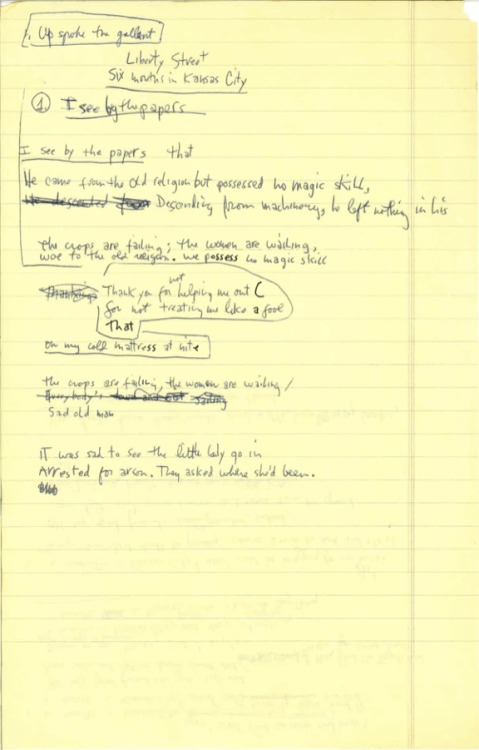
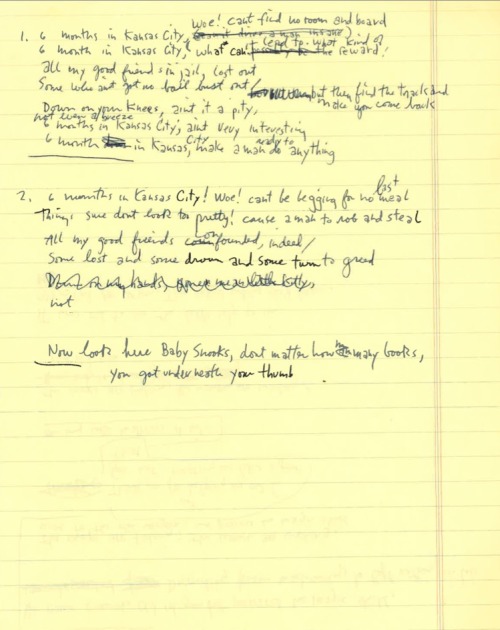
Dylan would never have written a melody like this – and having heard this it is hard to imagine what he would have done with the song if he had continued. But also we have to note that he did not write exactly these lyrics – they have been edited and shuffled around, on the perfectly reasonable basis that they were not completed when Dylan abandoned the notebook.
The notes relating to this song give us the names of Elvis Costello, Bob Dylan and Kenji Muroya as the lead creators. Here are the lyrics as they appear on the track
He came from the old religion
But possessed no magic skill
Descending from machinery
He left nothing in his will
The crops are failing
The women wailing
It’s in the paper at your feet
Six months in Kansas City
Down on Liberty Street
It was sad to see it
That little lady going in
Arrested for arson
Once they’d asked her where she’d been
Down on her knees
Not even a breeze
Another victim of the heat
Six months in Kansas City
Down on Liberty Street
Things sure don’t look too pretty
Cause a man to rob and steal
I got a full six more months out here
Can’t be begging for my meals
Now look here Baby Snooks
Doesn’t matter what books
You keep underneath your seat
Six months in Kansas City
Down on Liberty Street
Musically there is nothing Dylan-esque here at all. The modulation to the dominant in lines three and four is completely un-Dylan like. But of course it works perfectly, and no one said the guys had to be writing as Dylan would have written.
While I guess most of America would get the reference to Baby Snooks I have to admit it meant nothing to me – nor any of my English friends of a certain age (just a bit younger than Bob himself). But in case you are interested, Baby Snooks was a comic strip that turned into a radio show – Baby Snooks being the child of the NewlyWeds – the title of the original series. The radio series ran through the late 1930s, 1940s and early 1950s.
To the best of my knowledge it was not aired in the UK – although we did get quite a few American series on radio in the post-war years. If it did reach England, it was a show my parents chose not to tune into.
If you wish to you can start disentangling these lyrics from the copy of the page that Dylan left below – but the re-working should be no surprise – it is what Bob has done over and over again himself with his songs. So why not here?
So lines in the original notes are moved around, and amended – just as the composer would have done had he been completing the song.
The press release notes:
“Liberty Street” was one of the last songs I put together for the record. We didn’t see the lyrics for this song until we got into the studio. Bob Dylan has a way of saying lines like ‘Six months in Kansas City down on Liberty Street’ and it having an immediate, yet sometimes ineffable, power. When I started putting these words to music, the structure of the words dictated the way the chords rolled out so it came together really fast. And the recording of it was our first take.”
It may not be very Dylan, but sure is a lovely tune.
You’ll find an index to our latest posts arranged by themes and subjects on the home page. You can also see details of our main sections on this site at the top of this page under the picture.
The index to the 500+ Dylan compositions reviewed is now on a new page of its own. You will find it here. It contains reviews of every Dylan composition that we can find a recording of – if you know of anything we have missed please do write in.
We also have a discussion group “Untold Dylan” on Facebook. Just type the phrase “Untold Dylan” in, on your Facebook page or follow this link
And please do note The Bob Dylan Project, which lists every Dylan song in alphabetical order, and has links to licensed recordings and performances by Dylan and by other artists, is starting to link back to our reviews
They are bad to the bone, the Three Witches in Shakespeare’s Macbeth. In the opening scene they forge their conspiracy, in the course of the drama they turn Macbeth’s head, make misleading predictions and summon treacherous spirits. But they themselves can also crawl and tremble: when their supreme boss Hecate, the goddess of witchcraft, crossroads, poison plants and related misery, learns that the ladies on their own bring calamity, she furiously calls them to account. “Meet me in the morning,” she thunders, “in Hell, by the River of Woe, at the pit of Acheron.”
Although the honey in Dylan’s song does not have to go to Hell, she must also report at dawn, at the at least equally difficult to reach intersection “56th and Wabasha”. In Dylan’s birth state Minnesota there is indeed a Wabasha, and Wabasha Streets can also be found (in St. Paul, for example), but a crossing with a 56th does not exist. The poet chooses this combination only because of the pleasant consonance of these syllables, that is clear.
The intended destination is not a bait – taking the adored one to a wet and cold Kansas is not exactly the promise of a Shangri-La. The protagonist waits therefore in vain, lonely and alone in the next verse, in that darkest hour just before sunrise. The dawn is announced by a desolate crowing rooster in the distance, apparently feeling as miserable as the narrator. A verse later the birds fly low – it is going to rain, too.
No matches in his pocket and the station is still closed; neither heat nor shelter for our tragic hero, here at that abandoned intersection of Wabasha and 56th. He is still there at sunset. No deprivation, hailstorm, nor hound dogs who chase him through the barbed wire, depress him deeper than this desolation, the desolation that makes his heart sink in his shoes.
At first glance a conventional My Baby Left Me blues theme, but it is certainly not a conventional blues text. The form is classical enough. Repeating the first verse line is common in the blues, as is the rhyme scheme, but everything else is unconventional, or at least unusual in the blues canon and in music at all.
Embedded is the story of the unhappy lover in a ’round’ frame. The lament starts at sunrise and ends at sunset. Dylan borrows this perhaps from Rimbaud, who, in his Illuminations (XVI and XXXIV, for example) and in various poems, frames his exurbant poetry tightly between dawn and dusk (or vice versa). And Rimbaud did not invent that, of course. William Blake loves the day / night structure, Goethe regularly uses it (Willkommen und Abschied, for example) and well, already in Sophocles’ Oedipus the Sphinx means ‘a whole life’ with her riddle that runs from morning till night.
Within this framework, Dylan interlaces the lyrical painting of man’s suffering with his characteristic poetry of, as expressed by the secretary of the Nobel Prize committee, sampled tradition and pictorial thinking. The darkest hour before dawn from the second verse, for example, is perhaps a tribute to Clarence ‘Gatemouth’ Brown’s “Just Before Dawn“, Zappa’s all-time favorite guitar player.
Dylan is also a fan; he puts Gatemouth three times on the playlist of his radio show. More likely, however, Dylan’s reverence is meant for Ralph Stanley of The Stanley Brothers, who come in no less than five times in Theme Time Radio Hour. The Stanley brothers experienced a brief renaissance after Ralph’s beautiful a-capella version of the classic “O, Death” in the Coen film O Brother, Where Art Thou (2000). It even earned him a Grammy.
Dylan has known the Stanleys much longer and certainly also their gospel classic “The Darkest Hour Is Just Before Dawn”:
The sun is slowly sinkin'

The day's almost gone

Still darkness falls around us

And we must journey on

The darkest hour is just before dawn

The narrow way leads home

Lay down your soul at Jesus' feet

The darkest hour is just before dawn
The song resonates. Not only because of that deep dark hour before dawn – the opening line echoes into the closing sequence of “Meet Me In The Morning”, the biblical narrow way later inspires a whole song on Tempest(2012).
Dylan produces, in short, sparkling antique poetry in a song text that is much more than a run-of-the-mill blues lamento.
In a sense, this also applies to the musical accompaniment. An ordinary blues scheme, pressed into a similarly trivial blues stub, yet Dylan, or rather: the band, lifts it above a common blues.
That band is led by maestro Eric Weissberg, who has scored a world hit a year and a half before this with the soundtrack for the film Deliverance (1972). A rightly acclaimed thriller with star actors Burt Reynolds and Jon Voight on a career peak, about four city friends who during a weekend trip through nature get into conflict with backward, inbred hillbillies. The film causes a stir with a controversial male rape scene, but the most memorable scene is Dueling Banjos, the scene in which, after a hesitant start, one of the citymen with his guitar loses a splashing musical duel to a retarded, but virtuoso banjo playing peasant boy. The rest of the soundtrack is also provided by Weissberg plus companions, and is just as attractive as the hit.
The folky bluegrass atmosphere bring the men with them to New York, when Dylan invites them in the studio to record Blood On The Tracks. Here, in this song, it proves to be a golden combination, almost as fortunate as it was with the Nashville Cats at Blonde On Blonde. With Weissberg and his followers the potentially sharp, urban blues is transferred to the veranda, to the veranda of J.J. Cale to be precise.
A special star role is for steel guitarist Buddy Cage, who plays the solo on the last verse. It is an overdub, and the story behind the recording has become almost mythical. That story is recorded by Andy Gill and Kevin Odegard in A Simple Twist or Fate: Bob Dylan and the Making of Blood on the Tracks (2004).
Buddy Cage is by no means a minor player, he replaces Jerry Garcia in the New Riders Of The Purple Sage for example, but he does not have it easy, that September evening in 1974:
“Let me do it two or three times, and you’ll have it – I’m that quick – and he can plug them in wherever he wants, the choices would be up to him and Bob. But that’s not what Dylan wanted, apparently: He ended up flashing the light time after time after time, and I found myself having to do six or seven takes.”
Worse still, there was little guidance as to what was wrong with the interrupted takes.
“Not only was my wrist getting tired, but there was no conversation, no instructions, no nothing,” Cage recalls, “just `Do it again, do it again.’ I was getting really uncomfortable. Then finally the door to the control room opened, and Dylan comes striding out, walks straight up to my steel, and sticks the toes of his cowboy boots under my pedal bar. I don’t know why he did that — maybe for emphasis. Anyway, he does that and says, ‘The first five verses is singin’ — you don’t play; the last verse is playin’ — you play!’ plunks his toes out from under my pedal steel bar, turns, and strides back into the control room.”
Behind the glass window it is getting pretty crowded, Cage tells. Producer Phil Ramone, Dylan, Mick Jagger happens to be there, John Hammond and another five or six curious people. Cage feels humiliated, but recovers:
“I thought, ‘Well, you little fuck, I’m taller than you, and you’re not gonna get away with that!’ Phil came on the phones then – he was clearly uncomfortable too – and he said, ‘You wanna practice one?’ and I said, ‘No – print it!’ So the red light came on and I just did one take.”
Cage plays lightly over the sung verses and then nails the searing break through the song’s closing stages. He knows he nailed it, does not feel like a further humilation or intervention, does not even wait for the track to finish, but abruptly walks away, striding into the control room. The first one he sees there is Dylan.
“When I busted into the control room, he was laughin’ his a** off! I looked at Ramone, and he was shakin’ his head, sayin’, ‘That was beautiful!’ John Hammond said, ‘Man, that was unbelievable!’ I just looked at Dylan and said, ‘ **** you!’ and he just laughed — he said, ‘Well, we got it!'”
It was a performance by Dylan, designed to bring the best out of Cage.
“He felt that was the way to get to me, and he broke the ice,” says Cage, who instantly realized what Dylan had done. “It was wonderful! I was really grateful.”
The colleagues agree. Steve Elliot opts for a melancholic, folky interpretation (on the beautiful tribute project May Your Song Always Be Sung, 2003), soberly set with two acoustic guitars. Much more violence produces the opulently hairstyled guitarist Jason Becker, who excels in virtuoso heavy metal – until tragedy strikes; in 1990 the terrible disease ALS is diagnosed. A few years later Becker can not talk anymore and he can not move anything except his eyes, but he remains musically active. His “Meet Me In The Morning“is, by his standards, a rather quiet version, to be found on the otherwise instrumental LP Perspective (1996), the first ever record of an ALS patient.
Melancholy and compelling is the blood-curdling live version by David Gray. The song is often on his set list in 2009 and 2010, the recording of March 29, 2010 from the Center For The Arts in Eagle Rock is one of the finest.
The many other covers – Black Crows, Carolyn Wonderland, Texas Diesel, Sloan Wainwright, just to name a few – are all beautiful, or at least pleasant. Remarkably enough, Sinéad O’Connor, who seldom misses the mark at a Dylan cover, sings one of the less successful versions (2012). Fantastic harmonica accompaniment, though.
Most of all, however, Dylan himself will be struck by the cover from a legendary blues hero: Freddie King on his last album, Larger Than Life from 1975, and, even more powerful and more frenzied, the version on the posthumously released live-album Texas Flyer (2010), recorded shortly before his death. That recognition may have touched the Bard even more than a Nobel Prize.
You’ll find an index to our latest posts arranged by themes and subjects on the home page. You can also see details of our main sections on this site at the top of this page under the picture.
The index to the 500+ Dylan compositions reviewed is now on a new page of its own. You will find it here. It contains reviews of every Dylan composition that we can find a recording of – if you know of anything we have missed please do write in.
We also have a discussion group “Untold Dylan” on Facebook. Just type the phrase “Untold Dylan” in, on your Facebook page or follow this link
And please do note The Bob Dylan Project, which lists every Dylan song in alphabetical order, and has links to licensed recordings and performances by Dylan and by other artists, is starting to link back to our reviews
According to preRomantic poet William Blake, taking his cue from ancient Greek ‘psychology’ (based on the elements of earth, wind, fire, and water), contempory Western society is out of tune with the Universe because the air, its ‘spirit’, succumbs to the domination of sexless Reason, known as the Age of the Enlightenment.
Jump ahead in time a bit, and Marshall McLuhan expands on William Blake’s ‘psychology’: McLuhan concludes that with the invention of mass-producing printing press, the sensual concentration is on the eye – the new technology creates a media that focuses on structuring a consumer-oriented here-and-now.
Says McLuhan, then along comes the Electronic Age – the telegraph, the telephone, the television – everything moves fast – the ear is back, but there’s still no connection with the past, and everybody and everything gets blown away; there’s no time left for you and there’s no time left for me.
However, argued it can be that up jumps a bunch of contemporary artists who rebel against the status quo – not in the manner of Romantic print-media writers because straight-line Reason’s been shattered, and broken to bits. Rather the artists rally against those who control contemporary culture, and they attempt to seize Big Brother’s ‘deconstructive’ electronic weapons for themselves.
The artist find himself in oxymoronic times where he tries to be a trusted daddy, a Shakespeare in the bowling alley – atrempting to gain immortality:
In death, you face life with a child and a wife
Who sleepwalks through your dreams into walls
You’re a soldier of mercy, you’re cold and you curse
There’s a lonely crowd outside walking on the quick-moving city streets; everybody knows they’re a disposable pawn in a Big Man’s game:
Loneliness, tenderness, high society, notoriety
You fight for the throne and you travel alone
Unknown as you slowly sink
And there’s no time to think
Everything’s mixed-up confusion; evolutionists spar withm evangelists on the Big Screen of the Apes; Tweeter and the Monkey Man shoot it out on television; and down in the Valley of Sponsors lives the Jolly Green Giant:
Memory, ecstasy, tyranny, hypocrisy
Betrayed by a kiss on a cool night of bliss
In the valley of the missing link
And you have no time to think
Everyone’s watching the rocknroll picture-show, and arrows are flying everywhere; poor Cock Robin’s found dead under his piano; somebody’s gotta take the fall:
Socialism, hypnotism, patriotism, materialism
Fools making laws for the breaking of jaws
And the sound of the keys as they clink
And there’s no time to think
The builder of the song lyrics provides Louise (by the way, she’s lost her box of rain) with a bridge to babble on:
The bridge that you travel on goes to Babylon, girl
With the rose in her hair
Starlight in the East, and you’re finally released
You’re stranded with nothing to share
Ah, yes, the artist shows no fear, blown away as he is by the idiot winds of the New Age, as he ponders where all ‘Les Fleurs du Mal’ of Baudelaire have gone:
Loyality, unity, epitome, rigidity
You turn around for one real last glimpse of Camille
‘Neath the moon shinin’ bloody and pink
And there’s no time to think
Alexandre Dumas, junior, writes a French romantic novel about Camille, a courtesan (who wears a red camellia flower when unavailable for sex), who falls in love with Armand Duval; his father convinces her that she must be reasonable and leave his son for the sake of the family’s reputation; Armand thinks she’s run off with another man.
Now it’s modern times with no direction home, conformity rules – standing up against authority is no longer valued; over are the days of draftees rebelling against President Kennedy’s command not to ask what your country can do for you – you’re like John Brown who goes off to war, asking what you can do for your country:
Bullets can harm you, and death can disarm you
But no you will not be deceived
Stripped of all virtue as you crawl through the mud
You’ll find an index to our latest posts arranged by themes and subjects on the home page. You can also see details of our main sections on this site at the top of this page under the picture.
The index to the 500+ Dylan compositions reviewed is now on a new page of its own. You will find it here. It contains reviews of every Dylan composition that we can find a recording of – if you know of anything we have missed please do write in.
We also have a discussion group “Untold Dylan” on Facebook. Just type the phrase “Untold Dylan” in, on your Facebook page or follow this link
And please do note The Bob Dylan Project, which lists every Dylan song in alphabetical order, and has links to licensed recordings and performances by Dylan and by other artists, is starting to link back to our reviews
Spanish Mary is a song that one might associate very much with Dylan’s writing around the time of When the ship comes in (1963) although we are told that the notebook that includes the song comes from 1967. Assuming 1967 is right (and I have no evidence to suggest that all the learned and excellent musicians who have put the New Basement Tapes project together got the date of the notebook containing the lyrics wrong) then we have Dylan looking back whistfully to the way in which he wrote songs before.
As I have noted in previous reviews from this album, the songs consist of lyrics Dylan wrote but never turned into songs, which were then completed and performed by Elvis Costello, Jim James, Marcus Mumford, Rhiannon Giddens.
Because for this song we have a copy of the notebook we can see some of the changes Dylan made along the way as where “Upon their ship quite scary” becomes “no longer could they tarry,” and so on.
The music created to accompany the song seems to me to be very closely related to “The Twa Sisters” which seems fair enough because Dylan’s Percy’s Song (also from 1963, the “When the ship” year, uses the same sort of approach.
Here are the lyrics that Bob left…
“Spanish Mary”
There were three sailors, bold and true With cargo they did carry They sailed away on the ocean blue For the love of Spanish Mary
So deeply now were they disturbed No longer could they tarry Swoon and swerve For the love of Spanish Mary
In Kingston Town of high degree The buffoon, the fool, the fairy All paid the dues and inquired to me For the love of Spanish Mary
Beggar man, beggar man tell me no lie Is it a mystery to live or is it a mystery to die?
I seek ye not to ask of you It was in Kingston Town indeed It is said they stopped but not for greed But for the love of Spanish Mary
I remember well, they came one day The buffoon, the fool, the fairy They asked of me what could I say For the love of Spanish Mary’
Tis not of me to talk absurd No rumour do I carry No, I’ll not give you one word But for the love of Spanish Mary
Beggar man, beggar man tell me no lie Is it a mystery to live or is it a mystery to die?
It truly is an atmospheric piece, beautifully realised in my opinion as the music aims to enhance the images contained within the lyrics.
But there is a problem. Not a problem that takes anything from the beauty of the realisation, but a problem with realising the song in a musical form. This is the couplet that appears twice:
Beggar man, beggar man tell me no lie Is it a mystery to live or is it a mystery to die?
What on earth was Dylan intending to do with that? It’s very difficult to say, since it is so very unlike Dylan to put in a couplet of that nature twice within a song that is otherwise in an utterly standard strophic (ie verse-verse-verse) format.
The first of these two line inserts heralds a change in the rhyming scheme – another oddity for a Dylan song. Although Dylan is very liberal with the rhymes, up to this point he is running with a conventional rhyme scheme A B A B (the first and third lines rhyming with each other, and separately the second and fourth rhyming with each other). It is standard stuff, and none the worse for that.
But after the first “beggar man” couplet we get something quite different
I seek ye not to ask of you It was in Kingston Town indeed It is said they stopped but not for greed But for the love of Spanish Mary
which can only be written as A B B C. Then we are back to the original form, until the repeat of the Beggar Man.
Does it matter at all, or am I being pedantic? I think it matters in the sense that the format and style are 100% traditional, but with these two sudden leaps in a different direction – the break in the rhyming scheme and the two “beggar man” lines – something quite different is happening.
Each jolts the listener who is carefully paying attention to the song – and there is no harm in that at all – jolts can be good. But a jolt of this nature needs to be done with a purpose and in a way that allows the music to continue while the jolt occurs.
If we think for a moment of Visions of Johanna, with the extra line added to the last verse, the listener may not appreciate at first that there is an extra line, but if taking in the whole feel of the song most listeners appreciate that something odd has happened. This “something” works in Johanna, because the change stresses the build up towards “as my conscience explodes”. (Incidentally the official Dylan site’s version of the lyrics hides this by randomly changing the line breaks, making it look as if each verse has differing numbers of lines, but it really is a nine line verse throughout with a tenth added in the final verse).
So we really do have a lyric that is, I am sure, not yet complete, and one which Dylan couldn’t immediately see how to resolve. He wanted the question to be asked, and indeed to be asked twice, but he hadn’t yet found a way to get the question fitted into the rest of the story. Nor indeed is there a clear route back into the story after the first asking of the question – hence the break in the rhyming pattern.
Of course a master of words such as Dylan could have solved it given time, but he was being drawn in one hundred directions, and I rather suspect that if Dylan did think of these lines at all, he thought only that he might come back to them another day.
—–
This is the fourth of these songs that we have reviewed so far the others being
You’ll find an index to our latest posts arranged by themes and subjects on the home page. You can also see details of our main sections on this site at the top of this page under the picture.
The index to the 500+ Dylan compositions reviewed is now on a new page of its own. You will find it here. It contains reviews of every Dylan composition that we can find a recording of – if you know of anything we have missed please do write in.
We also have a discussion group “Untold Dylan” on Facebook. Just type the phrase “Untold Dylan” in, on your Facebook page or follow this link
And please do note The Bob Dylan Project, which lists every Dylan song in alphabetical order, and has links to licensed recordings and performances by Dylan and by other artists, is starting to link back to our reviews
In 2017 he releases his 21st studio album, simply titled Robyn Hitchcock. It rightly receives good to enthusiastic reviews, is filled with beautiful songs, psychedelic pop and even a country song (“I Pray When I’m Drunk”), and respected names like Grant Lee Phillips (from Grant Lee Buffalo), Pat Sansone (from Wilco) and the praised country greatness and Dylan interpreter Gillian Welch participate.
However, the first question from interviewer Tom Lanham (San Francisco Examiner, 23 July 2017) is not about the music, but about the cover, and more specifically about the cat that Robyn holds on his arm.
You’re holding a fluffy Persian on your new album cover. So you’re a cat person?
“Yes, And she’s my late cat, unfortunately, Tiny. Tiny Montgomery, and she only lived six months. She had a rare feline stomach disorder, and they couldn’t save her. And it was horrible — it’s the death that has affected me most in my life. I was more upset by Tiny dying than my father passing.”
The British eccentric makes a name with the weird, jumpy and irresistible band The Soft Boys, who recorded their first album in ’76 in Hitchcock’s living room, Give It To The Soft Boys. The title of the first single does justice to the oeuvre:”(I Want To Be An) Anglepoise Lamp.”
Their best album, A Can Of Bees (1979), has song titles like “The Pigworker”, “Leppo And The Jooves”, “Ugly Nora” and “Wading Through A Fan”. The picture is clear: songwriter Robyn Hitchcock floats somewhere between John ‘I Am The Walrus’ Lennon, the Basement Tapes and Syd Barrett. The band peaks slightly too early to really break through, but successful bands like R.E.M. and The Replacements later make no secret of their indebtedness to and their admiration for the inspirational Soft Boys.
As a solo artist, Hitchcock, in his turn, remains faithful to his examples. In addition to his quirky, absurd and infectious own songs, he also builds up a nice reputation as a cover artist of Syd Barrett, Lennon and especially Bob Dylan. His double album Robyn Sings (2002) consists exclusively of Dylancovers – sixteen more and less successful covers of mainly the usual suspects like “Tangled Up In Blue” and “Like A Rolling Stone”, and a few more original choices (“Dignity”, “Tell Me, Momma”).
On the stage, he just as easily reaches for the stale, lowest shelf warmers: “The Ballad Of Frankie Lee And Judas Priest” for intance, and “Tryin ‘To Get To Heaven”, songs that hardly anyone, including Dylan himself, has in the repertoire. In addition, he naturally plays neglected Basement pearls, such as “Nothing Was Delivered” and “Open The Door, Homer”.
It goes deeper than just admiration, Robyn reveals in a radio interview in 2009, it is a raison d’être:
“I followed Dylan into this business when I was fifteen, I wanted to write songs, I wanted to write “Million Dollar Bash“ or “Sad-Eyed Lady Of The Lowands“ or “Visions Of Johanna“.”
And fifty years after the awakening of the adolescent Robyn, the songs of The Basement Tapes are evidently still so deep under his skin that he calls his regretted cat “Tiny Montgomery”.
The song order on The Basement Tapes Complete (2014) seems to be largely chronological, ‘based on the numbering system of Garth Hudson’. By that logic, “Tiny Montgomery” is one of the earlier songs and marks the point where Dylan’s creative vein regains its connection with the source from which also a “Farewell Angelina” or a “Memphis Blues Again” rise – the six originals before this song (“Edge Of The Ocean” for example, and “Under Control”) are compared with this still searching and rather rudderless.
For that connection, the poet apparently has also been scrolling through his own, officially still unpublished Tarantula. Word choice (obsolete idiom as squeeze, scratch, suck, pick, drip, base and legged) and the compelling rhythm of accumulated short words (just like Tarantula, “Tiny Montgomery” is characterised by mainly monosyllabic and virtually no words of more than two syllables) can be found pretty much one-on-one in Tarantula and are truly Dylanesque again, completely in line with the mid-60s work of Dylan.
The content is subordinate. The approach seems scatological, Tiny Montgomery being a self-invented nickname for the man’s penis. Initially, Dylan’s associative, and from the sound of it, slightly fuddled mind drives him there, towards ambiguous coarseness. All the boys and girls are going to ‘get their bang’, Tiny ‘shakes his thing’ and is coming. But already in the second verse the bard leaves that track, apparently images of an old black-and-white gangster film come to the fore, and he sings a ‘Half-track Frank’ and his buddy ‘Skinny Moo’ who escape from prison by means of a crowbar, no, make that a crow and a buzzard, the two jailbirds are determined ornithologically – with the help of the bird book, indeed.
Accordingly, hopping from association to suggestion, it might unfold when a relaxed Dylan lets the écriture automatique flow again, when The Band lays down a nice weary tune on two chords and the glasses are filled. When publishing the lyrics, among others in Writings & Drawings, Dylan does change a few trifles (Half-track Frank is actually called T-Bone Frank, for example), but that does not change the improvised, surrealistic impression that Tiny makes.
Real recognition there is from the third verse, when the poet approaches the ideal of Alexander Pope in his Peri Bathous (1728):
A master of this will say,
Mow the beard,Shave the grass,Pin the plank,Nail my sleeve.
A master in catachresis, Pope means in his essay, in which he actually intends to ridicule poetry writing contemporaries – but he does it so masterfully that he ends up writing a kind of manual for comical and / or effective use of literary figures of speech. With his explanation and the examples of the catachresis, the ‘wrong-use’, Pope lays down a theoretical basis for style errors that will later become stylistic figures to surrealists, dadaists, beat poets and Dylan.
Dylan opens that part in his brain roughly from “Subterranean Homesick Blues” (Maggie comes fleet foot / Face full of black soot / Talkin’ that the heat pit / Plants in the bed), explores it further in “Farewell, Angelina” and especially “It’s All Over Now, Baby Blue” (with ‘wrong’ but completely familiar sounding word combinations like seasick sailors, empty-handed painter and the saints are coming through) and excels in “Sad-Eyed Lady Of The Lowlands”, where almost every line contains such an abusio, such an associative metaphor (matchbook songs, warehouse eyes, geranium kiss).
But in “Tiny Montgomery” Dylan comes closest to the source, to that template from the eighteenth century by Alexander Pope:
Scratch your dadDo that birdSuck that pig
or
Gas that dogTrick on inHonk that stink
… word combinations that avoid the reversals of Pope’s example, but are rhythmically and on a (non-)semantic level almost a copy of them.
The last words of the last verse suggest that Dylan has thought about structure: with the hardly ambiguous three-legged man and hot-lipped hoe he does return nicely to the scabrous opening lines, and thus makes the whole thing neatly round – it almost looks like a real poem.
The song is part of the set of songs that are offered, through music publisher Feldman, to eager fellow musicians, in that legendary summer of ’67. Grateful, the colleagues run off with “This Wheel’s On Fire” (Brian Augers and Julie Driscoll), with “Quinn The Eskimo” (Manfred Mann), with “Million Dollar Bash” (Fairport Convention) and the other songs, but “Tiny Montgomery” is left behind – no one sees any benefit or, for that matter, beauty in the song.
It is not until 1972, when he is a contributing and acting producer for the hairy quartet Coulson, Dean, McGuinness, Flint, that Manfred Mann remembers the song again. He convinces the men who, for their crisp debut album Lo And Behold, edit seven, at that time still unknown Basement songs, and with that the first serious cover, five years after the creation of the original, is a fact.
It is, like all covers on that beautiful album, a very successful operation. However, the unshaven four cheat a little (the chorus is transposed, so the cover has more chords and as a result more variation than the original), but that is actually an excellent find; unlike Dylan, the men do not aim for a comical effect, they do not wish to re-work a novelty song, but they want to render it into a cheerfully pounding, infectious rock song.
That works out great, but they themselves seem to have doubts. In the first instance “Tiny Montgomery” is rejected for the record and stashed away as a B-side on the single “Lay Down Your Weary Tune”. But with the reissue in 2007, it is – fortunately – saved from oblivion.
With Gillian Welch and David Rawlings, Robyn Hitchcock plays the song in 2007 (in Nashville, at the Belcourt Theater) and they do it beautifully. Meanwhile, however, it has been removed from his playlist – but that of course has everything to do with the short life and the tragic fate of his beloved long-haired Persian Tiny Montgomery. Robyn does not want to burst into tears on the stage, obviously.
Footnote from Tony: in this case we are stuck for recorded versions available on the internet to accompany this article. There is a version by Invisible Republic on Spotify (at least it appears on Spotify in the UK) and Robbie Fulks has done a live version. These are not the versions mentioned in the article – sadly we cannot find these on the internet and are included simply because I found them, not because of their excellence.
There is, as already pointed out, a school of academists who maintain that a goodly portion of Bob Dylan’s song lyrics are actually written by Christopher Marlowe. This error stems from the fact that a number of themes in Dylan’s tales of love do show the influence of Marlowe’s ‘Hero And Leander’.
According to other academics, it’s Ovid to whom Dylan alludes:
Now I wish Daedalus might give me bold wings
(Ovid: Heroides XVIII – Leander To Hero)
To wit: it’s a dark and stormy night on the Hellespont, and Leander wishes hat he had wings so he could fly over the rough waters to Sestos and Hero, a theme echoed in folk song:
If I had wings like Noah’s dove
I’d fly the river to the one I love
Fare thee well, my honey
(Bob Dylan: Dink’s Song~traditional)
Allusions to Ovid (from ‘Tristra’ mostly) abound in Bob Dylan’s song lyrics:
Ain’t Talkin’ – ‘Every nook and cranny had its tears’
Beyond Here Lies Nothing – ‘Beyond here lies nothing but the moon and stars’
Spirit On The Water – ‘Can’t believe theses things would ever fade from your mind’
The Levee’s Gonna Break – ‘Some people have hardly enough skin to cover their bones’
Working Man’s Blues#2 – ‘No one can ever claim/That I ever took up arms against you’
The school of academics that contends most of Bob Dylan’s song lyrics are outright penned by William Shakespeare (whom Dylan says he met) have firm ground to stand on. Any tributes paid by Bob Dylan to Ovid’s ‘Leander To Hero’, or Marlowe’s ‘Hero And Leander’, they say are actually written by none other than the Bard himself – as evidenced by:
Leander, he would have lived many a fair
year, though Hero had turned nun, if it had not been
for a hot midsummer night; for, good youth, he went
but forth to wash him in the Hellespont and being
taken with the cramp was drowned and the foolish
coroners of that age found it was ‘Hero of Sestos.’
But these are all lies: men have died from time to
time and worms have eaten them, but not for love.
(William Shakespeare: As You Like It, Act IV, sc.1)
Hero commits suicide in the Greek myth when she learns of her lover’s drowning. However, the dark attitude expressed by the Bard matches more the cynicism that runs throughout many of Dylan’s song lyrics. That is, Dylan satirically piles up dead lovers on top of one another due to love gone wrong like Juliet who stabs herself after Romeo poisons himself upon thinking that she is dead:
She touched his lips and kissed his cheek He tried to speak but his breath was weak ‘You died for me, now I’ll die for you’ She put the blade to her heart and she ran it through (Bob Dylan: Tin Angel)
According to these academics, when Shakespeare writes song lyrics for Dylan, the Bard goes out of his way to cover up his tracks:
Othello told Desdemona, ‘I’m cold, cover me with a blanket By the way, what happened to that poisoned wine?’ She says, ‘I gave it to you, you drank it’ (Bob Dylan: Poor Boy)
In ‘Othello’, after he’s deceived into smothering Desdemona, Shakespeare has Othello stabbing himself to death, but in the above lyrics, it’s Othello who drinks poison as does Romeo. It’s very confusing, but all’s well that ends well – Shakespeare’s fingerprints are left all over the scene of the crime.
Noted elsewhere and by others are lyrics that Shakespeare pens especially for Dylan, but puts in his plays as well:
Well, I’m scufflin’ and shufflin’, and walkin’ on briars And I’m not even acquainted with my own desires (Bob Dylan: Bye And Bye)
As in:
I do beseech your grace
Let me the knowledge of my fault bear with me
If with myself I hold intelligence
Or have acquaintance with my own desires
(William Shakespeare: As You Like It, Act I, sc.3)
Missed by all and sundry readers is that Shakespeare even smuggles Bob Dylan as an actor into one of his own plays under the name of Sir Robert (Brakenbury), the Lieutenant of the Tower:
Sorrow breaks seasons and reposing hours
Makes the night morning, and the noon-time night
(William Shakespeare: Richard III, Act I, sc. 4)
In a song, Dylan more or less repeats the same line given to him as Sir Robert to speak in the aforementioned play:
Dear reader, remember, you can only learn secrets like this about
time-travelling Robert Zimmerman on the Untold Dylan site.
What else is on the site
You’ll find an index to our latest posts arranged by themes and subjects on the home page. You can also see details of our main sections on this site at the top of this page under the picture.
The index to the 500+ Dylan compositions reviewed is now on a new page of its own. You will find it here. It contains reviews of every Dylan composition that we can find a recording of – if you know of anything we have missed please do write in.
We also have a discussion group “Untold Dylan” on Facebook. Just type the phrase “Untold Dylan” in, on your Facebook page or follow this link
And please do note The Bob Dylan Project, which lists every Dylan song in alphabetical order, and has links to licensed recordings and performances by Dylan and by other artists, is starting to link back to our reviews
“Nothing to it” is a song from “The New Basement Tapes ” the collection of lyrics jotted in a notebook in the 1960s, with music now added by a collection of the highly talented, and released as “Lost on the River”. The lead activist in all this being T Bone Burnett who put the band together and recorded the materials with, of course, Mr Dylan’s permission.
Nothing To It has lead vocals by Jim James (of My Morning Jacket) and it opens side 2 of the vinyl version of the album. Burnett said at the time of the release of the album that he wanted to bring together a set of “music archaeologists… artists who know how to dig without breaking the thing they are digging.”
This sort of thing has been done before of course – most notably with the 1998 album Mermaid Avenue in which Billy Bragg and the band Wilco in which the unrecorded Woody Guthrie songs which have survived only as lyrics were recorded – a project undertaken with Woody Guthrie’s daughter’s blessing.
“Nothing to it” is the second song from the album I’m looking at, and it is curious as the storyteller in the song (not to be confused with Bob himself) reflects on nihilism – having seen it all and done it all, with “no organisation I wanted to join” he contemplates murdering a thief.
Quite what the thief stole (and whether it was a petty crime or a theft on the international stage) we don’t know. But the singer feels he can be judge and jury, and he’s going to win whatever happens.
Towards the end of the song the lyrics seem (to me – and of course it is just to me) to lose their coherence, as the issue of the murder is lost and instead the singing appears to be begging. But maybe there is a link that I haven’t quite got.
You can of course decide (and write in and correct me) – there’s a video of the song below. But first here are the lyrics.
Nothing To It
Written by Bob Dylan and Jim James
Well I knew I was young enough
And I knew there was nothing to it
‘cause I’d already seen it done enough
And I knew there was nothing to it
There was no organization I wanted to join
So I stayed by myself and took out a coin
There I sat with my eyes in my hand
Just contemplating killing a man
(For greed was one thing I just couldn’t stand)
If I was you I’d put back what I took
A guilty man’s got a guilty look
Heads I will and tails I won’t
As long as the call be won’t be my own
Well you don’t have to turn your pockets inside out
But I’m sure you can give me something
Well you don’t have to go into your bank account
But I’m sure you can give me something
Well I knew I was young enough
And I knew there was nothing to it
‘cause I’d already seen it done enough
And I knew there was nothing to it
Well I knew I was young enough
And I knew there was nothing to it
And I’d already seen it done enough
And I knew there was nothing to it
And I knew there was nothing to it
The band for the recording is made up of…
Jim James – Lead Vocal, Electric Guitar, Synthesizer
Elvis Costello – Bass, Vocal
Rhiannon Giddens – Vocal
Taylor Goldsmith – Piano
Marcus Mumford – Electric Guitar, Vocal
Jay Bellerose – Drums
Carla Azar – Drums
You’ll find an index to our latest posts arranged by themes and subjects on the home page. You can also see details of our main sections on this site at the top of this page under the picture.
The index to the 500+ Dylan compositions reviewed is now on a new page of its own. You will find it here. It contains reviews of every Dylan composition that we can find a recording of – if you know of anything we have missed please do write in.
We also have a discussion group “Untold Dylan” on Facebook. Just type the phrase “Untold Dylan” in, on your Facebook page or follow this link
And please do note The Bob Dylan Project, which lists every Dylan song in alphabetical order, and has links to licensed recordings and performances by Dylan and by other artists, is starting to link back to our reviews
“Everything Is Broken,” says Sam Shepard in an interview with Village Voice in 1992, “that’s a great song.”
When Shepard dies in 2017, the media commemorate the talented playwright, acclaimed screenwriter and celebrated actor, but in Dylan circles the passing of the writer of the beautiful Rolling Thunder Logbook is mourned: the co-writer of Renaldo & Clara and the co-author of one of the best Dylan songs from the 80s, “Brownsville Girl”.
There are more Dylan-Shepard connections, and the most intriguing is Shepard’s article True Dylan, published in Esquire in July 1987. Set up as an interview, but designed by the author as a one-act play, as he has it reprinted in his collection Fifteen One-Act Plays with a new title (‘Short Life Of Trouble’).
It is perhaps the best interview ever published on Dylan. Not so much in terms of content (what Dylan tells about his love for Hank Williams, polka music in Duluth, Woody Guthrie in the hospital … we all know that, from Chronicles, from previous interviews, from biographies). But Shepard’s piece is irresistible especially because of the portrait that the brilliant playwright paints here.
We are at Dylan’s home, the bard seems completely at ease, is completely himself, he conducts telephone conversations with daughter Maria within earshot, and the playwright has the talent, the eye and the ear to make the reader almost physically present.
About the weeks after the famous motorcycle accident in ’66, for example, we have read and heard enough, but not in these terms:
“Spent a week in the hospital, then they moved me to this doctor’s house in town. In his attic. Had a bed up there in the attic with a window looking’ out. Sarah stayed there with me. I just remember how bad I wanted to see my kids. I started thinking’ about the short life of trouble. How short life is. I’d just lay there listening’ to birds chirping. Kids playing in the neighbour’s yard or rain falling by the window. I realized how much I’d missed. Then I’d hear the fire engine roar, and I could feel the steady thrust of death that had been constantly looking over its should at me. (Pause) Then I’d just go back to sleep.”
https://www.youtube.com/watch?v=FoqMxGnQY8I
It is likely that Shepard has manipulated the text of the interview. In the piece he even gets permission, in so many words, to invent whatever he wants. The final product is too beautiful, too ’round’, too composed to be a credible, truthful representation of the conversation, but perhaps therefore all the more revealing. The leitmotif of the dialogue is damaged, just as it is the theme of Shepard’s stage work and film scripts, as we also know from one of his Great Masterpieces, the script for Paris, Texas (1984). So there is a certain consistency in Shepard’s choice of “Everything Is Broken” as an example of a great Dylan song.
Dylan himself spends quite a lot of time on the words on “Everything Is Broken” in his autobiography Chronicles and the context suggests that this song indeed expresses a personal mentality of the poet. It is mentioned in the fourth chapter, in Oh Mercy, and Dylan’s remarks to the songs are introduced by a litany.
It is 1987 and everything is broken. His hand is mangled to the bone, the garden is overgrown, Dylan feels tired, wrung out, an empty burned-out wreck, on the bottom, everything was smashed. And so it goes on and on. Page after page the autobiographer gloomily grumbles over this point in his life, in his career that he has now reached and he describes with poetic urgency, in one after another remarkable metaphor (“even spontaneity had become a blind goat”) the depressing darkness that rules before he records the album Oh Mercy with Daniel Lanois.
“Everything Is Broken”, says Dylan, “was made up of quick choppy strokes. The semantic meaning is all in the sounds of the words.”
The latter is a mysterious addition, with the suspicion that the poet does not know exactly what the word semantic means. In words such as Broken lines, broken strings / Broken threads, broken springs, a very distinct sense of language is required in order to actually derive the meaning from the sound. Does “threads” really sound like what it means, threads, wires? Or “strings” like cords, strings? We have caught Dylan previously on a linguistic feeling, on a sense of language bordering on synesthesia, so who knows? To him it may sound that way.
At least as remarkable is the deleted verse that the master quotes here:
Broken strands of prairie grass

Broken magnifying glass

I visited the broken orphanage and rode upon the broken bridge

I’m crossin’ the river goin’ to Hoboken

Maybe over there, things ain’t broken
Remarkable, not only because it is so stylistically different from the rest, with those sudden, misty, Dylanesque images, but also because suddenly an optimistic spark flashes: maybe things are not broken on the other side of the river.
About thirty pages later, the song returns once more when Dylan tells about the recording session. Producer Daniel Lanois thinks the song is just a throw-away, Dylan suspects, but he himself is completely satisfied. And then another typical, confusion creating bonus comment follows:
“Critics usually didn’t like a song like this coming out of me because it didn’t seem to be autobiographical. Maybe not, but the stuff I write does come from an autobiographical place. [Lanois] was looking for songs that defined me as a person, but what I do in the studio doesn’t define me as a person.”
With these words Dylan succeeds (once again), to both open and close the door to autobiographical interpretation. My songs do come “from an autobiograpical place”, but do not “define me as a person”, do not characterize me.
So there are some marginal comments to be made. In the previous dozens of pages, Dylan has painted his emotional state of being in the year and a half before “Everything Is Broken” and only one characterization fits: kaputt. Lost in the rain of Juarez. A protagonist from a piece by Sam Shepard. Just like almost all the lyrics on the album express abandonment, dissolution and gloominess. In light of this, of his own testimonies about his mental attitude, it is not such a bold assumption to see “Everything Is Broken” as a characterization of the poet himself.
Dylan gets back on his feet, fortunately. The chapter Oh Mercy ends positively, with admiring words for Lanois and with the notion that they will work together again ten years later, in a rootin’ tootin’ way; nicely and pleasantly.
The pounding, swampy Creedence-like approach of Lanois and Dylan is appreciated by colleagues. Even Ben Sidran, the rock and jazz pianist who has produced a lot of challenging, idiosyncratic Dylan covers, remains reasonably within bounds this time (Dylan Different, 2009).
Bettye LaVette, the veteran who has done great Dylan covers in the past, seems to want to do a Tina Turner parody, but it is nevertheless a beautiful, soulful rendition (Thankful ‘N’ Thoughtful, 2012).
A lot of slide-guitars and greasy basses, of course: Tim O’Brien, R.L. Burnside, Kenny Wayne Shepherd and Larry Norman (“the Bob Dylan of Christian music”) are all perfectly comparable in terms of arrangement, tempo, instrumentation and sound – and all equally irresistible. Although … Larry Norman shuffles and jumbles up the words – which gives an original added value to a song called “Everything Is Broken”.
From the same Delta sound category the two most beautiful covers derive, scoring extra points because the artists both come from the immediate vicinity of the master. Billy Burnette played in Dylan’s band and has rock ‘n’ roll history in his genes. His sultry, heavy version is to be found on the fine album Memphis In Manhattan (2006).
Even more intensively, in the studio, Duke Robillard worked with Dylan. The Fabulous Thunderbird enriches hundreds of records with his playing as a session guitarist, helps Dylan and Lanois on Time Out Of Mind and also records piles of solo albums in between. The beautiful double album World Full Of Blues (2007) has a few highlights (the “Bounce For Billy” inspired by Charlie Parker, for example) and “Everything Is Broken” one of them. The guitars, of course, and the harmonica are the strongest points, but Robillard also suprisingly scores in terms of vocals – much less flat than elsewhere, in any case.
It is, as Sam Shepard said, a great song.
What else is on the site
You’ll find an index to our latest posts arranged by themes and subjects on the home page. You can also see details of our main sections on this site at the top of this page under the picture.
The index to the 500+ Dylan compositions reviewed is now on a new page of its own. You will find it here. It contains reviews of every Dylan composition that we can find a recording of – if you know of anything we have missed please do write in.
We also have a discussion group “Untold Dylan” on Facebook. Just type the phrase “Untold Dylan” in, on your Facebook page or follow this link
And please do note The Bob Dylan Project, which lists every Dylan song in alphabetical order, and has links to licensed recordings and performances by Dylan and by other artists, is starting to link back to our reviews
I started to review “Gone but not forgotten” but stopped because I was having such a problem with the words. Larry and Aaron worked on the lyrics and came up with this – something it was necessary for “Untold” to do because no one else has tried. Not even the official Dylan site.
(Dear Official Bob Dylan site, if you use our version would you like to give Larry and Aaron a credit – oh and maybe mention Untold Dylan too?. But get their names right – its Larry Fyffe and Aaron Gailbraith – Aaron having spotted the song and alerted Untold to it. Got that? Good.)
[Alternative versions of unclear lines are in square brackets]
Now the point of running this again, rather than leaving the lyrics as an addendum to my very brief review last time is that to me (and as always it is just to me) the song makes much, much more sense with the lyrics printed out than it does without – simply because to my English ears much of the singing was unintelligible.
And of course it is the lyrics that we are here for – because Dylan wrote them. But now with lyrics and music we can, I believe, really appreciate this song.
For the first verse I have also added in brackets the guitar chords as I hear them
Gone but not forgotten [Am Gm Am Gm]
Cryin’ wouldn’t make her stay [Am Gm C]
Oh, she left me early one mornin’ [Am Gm Am Gm]
Just got up and walked away [Am Gm C]
Nineteen bird dogs, and one old measly hound
take all twenty of them to track my baby down, [six and twenty others to track my baby down]
two trains running neither of them going where I have to go [She says, ‘Honey, neither of’em goin’ where I have to go]
one going to Houston, one going to San Antonio [One goin’ to Navy, two of’em goin’ to San Antanio’]
She’s gone but not forgotten
Cryin’ wouldn’t make her stay
Oh, she left me early one mornin’
Just got up and walked away
Ain’t no difference any name of the women I meet
Some live on the first floor, some live right above the street
Some walk in high heels
Some others in their stocking feet
Lookin out my window
While the rain falls three days straight
sometimes I wonder how long my baby’s gonna make me wait
Gone but not forgotten
Cryin’ wouldn’t make her stay
Oh, she left me early one mornin’
Just got up and walked away
I can’t sleep
Till my heart has a beat
Don’t want to talk to nobody, oh no
Ain’t got no appetite to eat
Gone but not forgotten
Cryin’ wouldn’t make her stay
Oh, she left me early one mornin’
Just got up and walked away
Hope you enjoyed that. As I say, no one else seems to have considered it. My eternal thanks to Aaron and Larry.
The original review with more information on the origins of the song appears at
You’ll find an index to our latest posts arranged by themes and subjects on the home page. You can also see details of our main sections on this site at the top of this page under the picture.
The index to the 500+ Dylan compositions reviewed is now on a new page of its own. You will find it here. It contains reviews of every Dylan composition that we can find a recording of – if you know of anything we have missed please do write in.
We also have a discussion group “Untold Dylan” on Facebook. Just type the phrase “Untold Dylan” in, on your Facebook page or follow this link
And please do note The Bob Dylan Project, which lists every Dylan song in alphabetical order, and has links to licensed recordings and performances by Dylan and by other artists, is starting to link back to our reviews
There has been an ongoing debate among academic scholars, and for some time now, that Bob Dylan, well known for his travels in space and time, is the author of only a few of the lyrics that he sets to music.
Basically, there are two contending schools of thought. The first school steadfastly holds that Christopher Marlowe authors most of Bob Dylan’s song lyrics; the second school is equally sure that William Shakespeare pens most. This article will attempt to settle the matter once and for all.
The first school of academics maintain that Bob Dylan, in his Nobel lecture, deliberately takes attention away from their contender, Marlowe, because Bob does not want it known that he has his songs written by someone else:
“John Donne …. wrote these words: ‘The Sestos and Abydos of her breasts. Not of two lovers, but two loves, the nest.’ I don’t know what it means. But it sounds good. And you want your songs to sound good”.
These academics declare that Dylan is simply laying down a trail of smelly red herrings to throw scholarly bloodhounds off the scent – that Dylan knows full well that the geographical names refer to the respective homes of Hero and Leander, the latter swimming the Hellespont, guided by a torch from her tower, in order to seduce the beautiful Hero who has sworn herself to chastity.
These literary analysts make the point that it be Marlowe who pens the following words:
Sea borderers, disjoined by Neptune’s might
The one Abydos, the other Sestos hight ….
It lies not in our power to love or hate
For will in us is over-ruled by fate ….
Whoever loved that loved not at first sight
(Christopher Marlowe: Hero And Leander)
https://www.youtube.com/watch?v=4GMAaBagLuo
The same scholars also state that Marlowe, with Hero in mind, pens the words to the song below:
You’re the queen of my flesh, girl, you’re my woman, you’re my delight You’re the lamp of my soul, girl, and you torch up the night (Bob Dylan: Precious Angel)
But I say: “Maybe, but maybe not”. Let’s examine the second school of academic thought on the matter at hand. This school notes that, in his Nobel lecture, it is William Shakespeare whom Bob Dylan attempts to draw attention away from: “The words of Shakespeare were meant to be acted on the stage. Just as lyrics are meant to be sung, not read on a page.”
Marlowe, I say, is suspect because he may well have been an atheist. Not so Shakespeare. The Bard’s characteristic phraseology often appears in Dylan’s song lyrics; too much so to be merely coincidental:
Life’s but a walking shadow, a poor player
That struts and frets his hour upon the stage
And then is heard no more. It is a tale
Told by an idiot, full of sound and fury
Signifying nothing
(William Shakespeare: Macbeth, Act V, scene 5)
To wit, Shakespeare is the one who actually pens the tell-tale throbbing Edgar Allan Poe-like lyrics that appear below – the ‘walking shadow’ gives the writer away:
Forgetful heart Like a walking shadow in my brain All night long I lay awake and listen to the sound of pain (Bob Dylan et al: Forgetful Heart)
The academics who contend the Bard ghost writes the lyrics for Dylan’s songs point out that Shakespeare’s not shy about slipping in an ad here and there for his own plays – like ‘Hamlet’, with his girlfriend Orphelia, for instance:
Ophelia, she’s ‘neath the window, for her I feel so afraid On her twenty-second birthday, she is already an old maid To her death is quite romantic, she wears an iron vest Her profession’s her religion, her sin is her lifelessness (Bob Dylan: Desolation Row)
https://www.youtube.com/watch?v=E9KGU6sS8Xg
The ability to time-travel has its benefits, and whereas Bob Dylan is able to convince William Shakespeare to jot down a bunch of song lyrics to set music to, who among us would fault him?
In a number of his Sonnets, Shakespeare employs the word ‘decay’:
Situation just gonna get rougher Why do we needlessly suffer? Let’s call it a day Go on separate ways Before we decay (Bob Dylan: We Better Talk This Over)
What else is on the site
You’ll find an index to our latest posts arranged by themes and subjects on the home page. You can also see details of our main sections on this site at the top of this page under the picture.
The index to the 500+ Dylan compositions reviewed is now on a new page of its own. You will find it here. It contains reviews of every Dylan composition that we can find a recording of – if you know of anything we have missed please do write in.
We also have a discussion group “Untold Dylan” on Facebook. Just type the phrase “Untold Dylan” in, on your Facebook page or follow this link
And please do note The Bob Dylan Project, which lists every Dylan song in alphabetical order, and has links to licensed recordings and performances by Dylan and by other artists, is starting to link back to our reviews