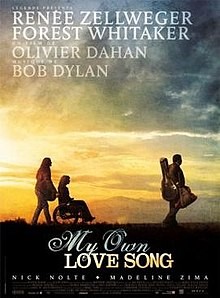
Precious Angel. Unpopular, otherwise brilliant.

by Jochen Markhorst

A professionally made, quite moving road movie, My Own Love Song from 2010, with excellent acting by mainstream stars such as Renee Zellweger and Forest Whitaker, but still unsuccessful. Most reviewers are very reluctant in awarding stars, points or thumbs and accuse the film of a too high dose of imposed sentimentality. The visitor numbers are disappointing.

The French director Oliver Dahan, who has just won another Oscar (for the Edith Piaf film La Vie En Rose, 2007) has surprisingly been able to attract Dylan for the soundtrack. Dahan is shameless and does not, as Dylan is used to, ask for one single song to be played over the credits, no, he wants a whole thread of new Dylan songs throughout the film and therefore asks, in a letter, sans gêne, for “ten to twelve songs”.

In the 2014 Rolling Stone interview with writer Douglas Brinkley, Dylan tells, still amused, about that episode:

“At first this was unthinkable,” Dylan recounts. “I mean, I didn’t know what [Dahan] was actually saying. [In faux French accent] ‘Could you write uh, 10, 12 songs?’ Ya know? I said, ‘Yeah, really? Is this guy serious?’ But he was so audacious! Usually you get asked to do, like, one song, and it’s at the end of the movie. But 10 songs?” Dylan continues, “Dahan wanted to put these songs throughout the movie and find different reasons for them. I just kind of gave the guy the benefit of the doubt that he knew what he was doing.”

But it doesn’t save the movie. A real hit á la “Knockin’ On Heaven’s Door” is not included, unfortunately. For the apotheosis, Dylan delivers “Life Is Hard”, which ends up at Together Through Life (2009), just like the other songs he apparently can dash off for Dahan, but are not very memorable either. Fortunately he also allows the use of a few oldies: “What Good Am I?”, “I Believe In You” and “Precious Angel”, sung by Zellweger.

It is one of the most problematic songs on Slow Train Coming, “Precious Angel”. The music is beyond criticism; heavenly melodies, catchy chorus with a Dylanesque reuse of an antique song (in this case “The Midnight Special”), guitarist Mark Knopfler at its very best, fantastic wind players, crackling, glowing production by the old master Jerry Wexler and a virtuoso singing Dylan, who is in full swing on this first gospel album. No problems so far. On the contrary.

But then the lyrics. At another highlight of the record, “I Believe In You”, the listener can still avoid the gospel; with a little blink of an eye that particular song can be heard as a “generic” love song. With “Precious Angel” that works for at most half a couplet. It starts in any case as a declaration of love to a woman of flesh and blood. And not even a fictional lady. This is the record on which Dylan abandons an earlier creed and suddenly writes confessional lyrics, writes songs in which the narrator and the writer coincide, in which Je is suddenly no longer un autre. And it is quite easy to deduce from Dylan’s biography that Mary Alice Artes is being sung, which he also almost literally reveals on stage (Seattle, January 14, ‘80).

It is a frame story; Dylan tells what a lady told him about a conversation she supposedly had with a taxi driver. The taxi driver had started talking about Dylan’s conversion:

She was riding in a cab once and, … it was in a big city. Cab driver turned around in the cab and said, “Did you hear Bob Dylan’s a Christian now?” And this girl said. “Oh, I think I have heard that. How does that relate to you? Are you a Christian?” And the driver said, “No, but I been following Bob now for a long time.” And the lady said, “Well, what you think of his new thing?” And he said, “Well, I think they’re real good, but I tell you I think that if I could meet that person who brought Bob Dylan to the Lord I think I might become a Christian too.” And this here song, this is all about that certain person.

We still remember Mary Alice Artes from the credits on Street Legal (1978), to which she apparently contributed as “Queen Bee”. What Dylan means by that is enigmatic. As a rule, Queen Bee is an unflattering indication of the most popular girl in school, who holds onto her position as queen bee in the hive with untouchable self-assurance, psychic terror and a platoon of lackeys. Queen Bitch is a synonym, so swishy in satin and tat, according to a sardonic Bowie (on Hunky Dory, 1971).

Dylan, however, is very fond of Artes. According to the Ottowa Journal of September 1, 1978, she is with Dylan in Minnesota, after the European tour, he follows her to the Vineyard Christian Fellowship and one source claims to know that he proposed, with ring and all. The song “The Groom’s Still Waiting At The Altar” (1981) then is the poetic representation of the rejection. In any case, it cannot be reconciled with the condescending function assignment Supreme Bitch. A few people therefore guess that the somewhat horny, enamoured and playful Dylan, who has just recorded the slightly scabrous “New Pony”, makes an insider joke for Mary Alice; the “B” would stand for “boobies” and Dylan is therefore allowing himself to an allusion to a physical quality of his adored one.

We probably won’t find out any more. Mary Alice Artes is an unspectacular supporting actress in rightfully forgotten B movies (some excerpts of the toe-curling She Came To The Valley can still be found on YouTube). Her claim to fame is limited to her time with Dylan, after which she again disappears from the scene.

But here in “Precious Angel” she is still radiantly present. She is the one who leads the blinded singer to the light, and deep in the Bible Dylan finds a kindred spirit, a congeniality even: their ancestors, long ago, were fellow slaves. In the service of the pharaoh, in Moses’ time, the slaves are both Ethiopian ancestors of the African-American Mary Alice and Hebrew ancestors of the Jewish Bobby Zimmerman. “We are covered in blood, girl, you know that our ancestors were slaves.”

And the fact that the Jew Moses married a black woman (Numbers 12:1 “for he had married an Ethiopian woman”) makes us more than soul mates – you are even my flesh.

If only the poet had left it at that, at this declaration of love and the John Wesley Hardin-like biblical references – the song could still have been on the playlist after 1980. But it goes wrong early in the text. The “spiritual war” in line 5 already predicts a frying pan and in the following line we jump into the fire: either you believe or you are an unbeliever, there ain’t no neutral ground.

A bit unsettling. This is the final step before fundamentalism, intolerance and fanaticism. It is not a one-time slip of the pen either; also in “Gonna Change My Way Of Thinking” Dylan expresses similar dogmatic certainties. Fortunately, the poet does not persist in this. In the next two evangelical records, the sharpest edges are gone, and in the interview with Paul Zollo, April 1991, Dylan looks back with little pride on “Precious Angel”: It’s just too much and not enough. The memory even provokes an indirect, half-hearted regret: “Somebody told me that Tennyson often wanted to rewrite his poems once he saw them in print.”

The irreconcilability in that first verse and the flaming hate rhetoric in the second verse (borrowed from Revelation 9:6, “And in those days shall men seek death, and shall not find it; and shall desire to die, and death shall flee from them”) are responsible for the unpopularity of the otherwise brilliant song. Dylan himself never performs it again, it is rarely covered, even in gospel circles.

The popular Christian dance band World Wide Message Tribe deserves purgatory for their rape of the song (1998). There is an inconceivably unsuccessful living room recording by the Irish phenomenon Sinéad O’Connor, which, remarkably enough, she herself posts on YouTube and actually only the Renee Zellweger version from the film approaches the beauty of the original.

For cinematographic reasons, that version is limited to one verse and one chorus and that really is a shame; beautifully, intimately arranged and surprisingly well sung by the actress, who seems to sing the second voice too. The fragment adorns a silent film scene, in which Zellweger in her wheelchair is illuminated by the light of fireworks, you torch up the night.

Her eyes slowly fill with tears.

Renee Zellweger:

https://www.youtube.com/watch?v=343mqZxRc5A

What else is on the site

You’ll find some notes about our latest posts arranged by themes and subjects on the home page.  You can also see details of our main sections on this site at the top of this page under the picture.

The index to all the 590 Dylan compositions and co-compositions that we have found on the A to Z page.

We also have a very lively discussion group “Untold Dylan” on Facebook with over 2000 active members.  (Try imagining a place where it is always safe and warm).  Just type the phrase “Untold Dylan” in, on your Facebook page or follow this link 

If you are interested in Dylan’s work from a particular year or era, your best place to start is Bob Dylan year by year.

On the other hand if you would like to write for this website, please do drop me a line with details of your idea, or if you prefer, a whole article.  Email Tony@schools.co.uk

And please do note   The Bob Dylan Project, which lists every Dylan song in alphabetical order, and has links to licensed recordings and performances by Dylan and by other artists, is starting to link back to our reviews

Posted in Uncategorized | 1 Comment

Pressing On; pass the angel with four faces

By Larry Fyffe

The  Romantic Transcendentalists saved God, cast out as He was from the Universe by the Rationalist thinkers of the Enlightenment. According to many of the Romantics, God’s presence still pervades the material world; his love for all mankind is still felt by those inclined to get in touch with Nature, especially its organic aspects. Notwithstanding all the trials and tribulations that afflict Mankind on Earth, male and female, black-skinned people and white, are all part of an Absolute Oneness.

So indicates the Old Testament:

But the stranger that dwelleth with you
Shall be unto you as one born among you
And thou shalt love him as thyself
For ye were strangers in the land of Egypt
I am the the Lord your God
(Leviticus 19:34)

Nevertheless, the Judeo-Christian Bible muddies the water – it contains remnants of Gnostic thought that be not so optimistic in outlook; depicted is a material world, a dark place from which, for most human beings, there be no escape. Swarming above this material world at various levels are spirits, mostly dark ones – floating angels who interact with the material world, including some pairs who are mirror images of other pairs like Archangel Samael and his mate Lolith; and earth-bound Adam and his mate Eve.

Other spirits are described in the figurative language associated with Gnosticism:

As for the likeness of their faces, they four had
The face of a man, and the face of a lion on the right side
And they four had the face of an ox on the left side
They four also had the face of an eagle
(Ezekiel 1:10)

Lying within the bodies of all humans be varying degrees of these emanations from a faraway Absolute One.

Gnostic remnants expressed in the sexually suggestive, figurative language in the biblical verse below:

The wild beasts of the desert shall also meet
With the wild beasts of the island
And the satyr shall cry to his fellow
The screech owl shall also rest there
And find herself a place of rest
(Isaiah 34:14)

Melancholic poet John Keats, who influences Edgar Allan Poe, takes such a view (Keats’ depiction of ‘Lamia’ is not unlike  ‘Lilith’ of Jewish lore), and he has little time for the social reformist Transcendentalist point of view since Death, the Eternal Footman, waits for us all. Keats is out to seek self-knowledge in order to save himself as best he can while in a world that appears to be beyond saving.

To quite a degree, Keats’ Gothic Romantic poetry influences the writings of musician Bob Dylan; as do the writings of Decadent Oscar Wilde:

There's not even room enough to be anywhere
It's not dark yet, but it's getting there
Well my sense of humanity is going down the drain
Behind every beautiful thing there's some kind of pain
(Bob Dylan: Not Dark Yet)

Gnostic aspects of the Holy Bible be a monkey on the back of literalist-prone interpreters, like Kees de Gaaf, who attempt to analyze the song lyrics of Bob Dylan:

Beat a path of retreat up them spiral stair cases
Pass the tree of smoke, pass the angel with four faces
Begging God for mercy, and weeping in unholy places
Angelina, oh, Angelina, oh, Angelina
(Bob Dylan: Angelina)

But hold your breath, dear reader – the firefighters from the Untold Dylan Fire Department will be right along to clear the smoke from off the muddied waters of modern Babylon:

Peace will come
With tranquillity on the wheels of fire
But will bring us no reward when her false idols fall
And cruel death surrenders with its pale ghost retreating
Between the King and Queen of Swords
(Bob Dylan: Changing Of The Guards)


Posted in Uncategorized | Leave a comment

Dylan in 1966: what was Bob writing about, and how did it compare with previous years?

By Tony Attwood

We have 22 songs written by Dylan in 1966 with the last half dozen created, seemingly spontaneously, in a hotel room for which not all the meanings are completely clear (not that they are in some of the more rehearsed songs either).

There is quite a rebellious, negative streak in these songs, as well as the songs, the meaning of which we could debate forever and not agree upon the topics.   Below is my take, but I am not trying to say this is a definitive analysis which anyone else should follow.  It is simply my attempt to trace the subjects Bob was writing about through each year.

But I am not sure anyone has tried this approach before, of giving the shortest possible description of the theme of each of Dylan’s songs.   However I think it is worth trying (if for no reason other than to get others to improve on this attempt) because through doing this what we can begin to see is an approximation of the subject matter that interested Bob, both year by year and also across the years as time passed.

So to begin, a list of the songs, and a simple description of the subject matter (although “simple” defeated me with Sad Eyed Lady).

  1. Stuck Inside of Mobile with the Memphis Blues Again (surrealism)
  2. Sad Eyed Lady of the Lowlands   (description of Bob’s wife; the interplay of sounds and words? – very difficult to classify, but I’ve put it under love.)
  3. Tell Me Momma (farewell to folk music; moving on)
  4. Fourth Time Around (love, lost love, moving on)
  5. Leopard skin pill-box hat (randomness)
  6. One of us must know (lost love)
  7. She’s your lover now (disdain)
  8. Absolutely Sweet Marie (surrealism)
  9. Just like a woman (lost love)
  10. Pledging my time (love)
  11. Most likely you go your way and I’ll go mine (lost love)
  12. Temporary Like Achilles (lost love)
  13. Rainy Day Women (going against the tide, being a rebel, doing the unexpected)
  14. Obviously Five Believers  (depression, being alone)
  15. I want you (love)
  16. Definitively Van Gough (surrealism)
  17. Don’t tell him. (hotel song, lyrics unclear)
  18. What kind of friend is this? (disdain)
  19. If you want my love (love)
  20. If I was a king (love?)
  21. I can’t leave her behind (lost love)
  22. On a rainy afternoon (love?)

Which gives us in terms of the subject matter of this year (at least as far as I can see) putting each song into one category…

  • Surrealism: 3
  • Art (Farewell to folk music): 1
  • Moving on: 1
  • Randomness: 1
  • Lost love 5
  • Disdain: 2
  • Love: 6
  • Rebellion: 1
  • Depression: 1

Now adding these to the categories nominated for songs via earlier articles (there is an index to all the articles in this series at the end) I’ve finally put the categories into a sort of alphabetical order to make it slightly easier to carry forward each year.  The first number is the total for all previous years, the second number is the total for this year of 1966, and then rather obviously after the equals sign, the total to date.

  • Art: 2 + 1 = 3
  • Blues: 7
  • Death: 3
  • Depression: 1
  • Disdain: 4 + 2 = 6
  • Future will be fine: 2
  • Gambling: 1
  • How we see the world: 3
  • Humour, satire, talking blues: 13
  • Individualism: 6
  • Lost love / moving on: 19 + 5 = 24
  • Love, desire: 11 +6 = 17
  • Nothing changes: 4
  • Patriotism: 1
  • Personal commentary: 2
  • Protest (war, poverty, society): 20
  • Randomness: 1
  • Rebellion: 1
  • Religion, second coming: 2
  • Social commentary / civil rights: 6
  • Surrealism, Dada: 11 + 3 = 14
  • Travelling on, songs of leaving, songs of farewell, moving on: 15+ 1 = 16
  • Tragedy of modern life: 3

Selecting the most popular categories of all the songs Dylan had written up to this point we get…

  • Lost love, moving on: 24
  • Protest (war, poverty, society): 20
  • Love, desire: 17
  • Travelling on, songs of leaving etc: 16
  • Surrealism, Dada: 14
  • Humour, satire, talking blues: 13

Here are the articles in this series to date

I’m hoping to continue the series in the coming days.

Posted in Uncategorized | Leave a comment

Another missing Dylan song found: “I rode out one morning”

By Tony Attwood

This song was recorded on 12 April 1963 and is one that until now we have missed.  It appears on what is known as the “Fourth McKenzie Tape”.  No credits are given so we are presuming the lyrics and music are by Bob Dylan.

That makes it song number 594 in our listings of Bob Dylan titles.   In case you missed our other recent discoveries they were:

Responsibility – a co-composition with Helena Keys and Tell me the truth one time again with the same artist.  As we noted in the article about that series of songs, many others have been listed both in Expecting Rain and by Heylin, but recordings have not emerged.

And of course without a recording there’s nothing much that we can do.

Now each time we’ve found a new song in the last couple of years I have suggested that surely this must be the end – our list must now be complete.  And I do that because I don’t know anyone else who is competing with us on this task.   We are, for example, not helped by the official list of Dylan compositions on BobDylan.com.

And yet despite these problems we keep edging forward and here we have another one: “I rode out one morning”, which is very much NOT to be confused with “As I went out one morning” from John Wesley Harding.

This recording is of course not Dylan, but I can’t find a Dylan version that I can copy.

https://youtu.be/Uz0IYr54Tnc

Eyolf Østrem, in reporting the songs says that “the melody is certainly the model to Farewell Angelina.”  And of course he is right for the man has ears of… well whatever creature has perfect musical perception.   He also tells us “The guitar is tuned to a variant tuning of D-A-d-g-b-e’ with the capo on the second fret.

I’m taking the absolute liberty of reproducing his lyrics and chords

 D                               G/d       D
I rode out one morning, tryin' to make me a friend
       D                    G/d
I rode down to the city, no one to refend [to be found?/could I find?]
                                    G/d         D
But my hands they were dirty and my hair it was messed
      D                             G/d        D
And I came from the east and I went out to the west.

It's a hard, it's a hard, it's a hard ground to walk
It's hard as the nail, it's hard as the rock,
It's hard as the sail that stands to the wind
But they're all not as hard as the love that I'm in.

Our old friend Haiku 61 took a look at this piece and came up with

Man can’t find a “friend,”
Like, “ladyfriend.” He’s dirty,
He’ll need a bath first.

This is very much a song of moving on – the theme that Bob loved so much in his early days, this time emphasising not so much the psychological need to keep moving on of the “One too many mornings” type but the pain of loneliness.

There is an interesting contrast in the second verse (or maybe it was going to be the chorus) in which he makes it clear that the moving on is not just a lifestyle choice but caused by the loss of his lover.  And of course the use of a phrase that he had already used to some effect in an earlier song in 1962.

What was it now?  Something about Hard Rain falling.   Was he really going to use it again?

It’s a hard, it’s a hard, it’s a hard ground to walk
It’s hard as the nail, it’s hard as the rock,
It’s hard as the sail that stands to the wind
But they’re all not as hard as the love that I’m in.

So we really are not yet at walking out on the lover in order to keep on keeping on.  Besides which the guys jumping the railway trains didn’t particularly care that they were dirty.This is very much Bob, the composer learning his trade sorting out a few issues in terms of how compositions work.  But nevertheless something I am so glad that we have, as it really does help us all understand the process of Bob’s working in the early days.

What else is on the site

You’ll find some notes about our latest posts arranged by themes and subjects on the home page.  You can also see details of our main sections on this site at the top of this page under the picture.

The index to all the 594 Dylan compositions and co-compositions that we have found on the A to Z page.

We also have a very lively discussion group “Untold Dylan” on Facebook with over 2000 active members.  (Try imagining a place where it is always safe and warm).  Just type the phrase “Untold Dylan” in, on your Facebook page or follow this link 

If you are interested in Dylan’s work from a particular year or era, your best place to start is Bob Dylan year by year.

On the other hand if you would like to write for this website, please do drop me a line with details of your idea, or if you prefer, a whole article.  Email Tony@schools.co.uk

And please do note   The Bob Dylan Project, which lists every Dylan song in alphabetical order, and has links to licensed recordings and performances by Dylan and by other artists, links back to our reviews

Posted in Uncategorized | 4 Comments

A Bob Dylan Proto-Song


By Larry Fyffe

Our researchers at the Untold Dylan Archives Library have dusted off a copy of songwriter Bob Dylan’s first sketchy plot for an allegorIcal song that’s labelled: “Lily, Rosmary, And The Jack Of Hearts”. It’s obviously influenced by the writings of Jewish mystics.

https://youtu.be/cs4uRJnslLg

The copy shows a list of the main characters for the song along with a short description of their motivations ….and some tentative verses.

Following is a summary of Bob’s notes.

Big Jim: represents a satanic archangel in the Spiritual World who rebels because he’s jealous that Adam in the Material World now gets all of JOH’s (Jehovah’s) attention. Big Jim seeks revenge by causing trouble down in the Garden of Eden after he’s kicked out of Heaven by JOH, sr.

Next, a verse’s written down:

Big Jim was no one's fool, he owned the town's only diamond mine
He made his usual entrance, looking so dandy and so fine
With his snake-skin suit, and silver cane, and every hair in place
He took what ever he wanted, and laid it all to waste
But his serpent tongue, and his silver cane, were no match for the Jack Of Hearts

Followed by:

Lily: represents Lilith, Jehovah’s co-creation alongside of good-looking Adam; she likes him too much. But she hooks up with Big Jim after JOH, sr. grants his earth-made son’s request for a more submissive wife – jitterbug Lilith is displaced by laid-back Eve.

Then another proposed  verse:

A demon lover before God's gift of Rosemary
Around Jack's heart a golden hair has weaved
She's not about to bear the child they've conceived
Lily does what she has to do, she flies from the garden tree
No ,no, babe, it ain't me  that you're looking for

And there’s more:

Rosemary: represents Eve; she likes Adam quite a bit, but she’s easily seduced – by Diamond Jim; he’s wearing a long black snake-skin coat, and gives her a ring shaped like an apple that sparkles every time he speaks.

Dylan scratches down a note in the margin at this point – ‘It’s not really Big Jim, but Lily-in-disguise with diamonds; she’s determined to spoil the rose setting; to get Eve thrown out of Eden just like Satan gets thrown out of Heaven”.

Another verse:

Rosemary started thinking hard, seeing her reflection in the night
She was tired of the inattention, tired of playing the role of Big Jim's wife
She had done a bad thing, she'd been been taken in by him
She wanted to do just one good thing before she died
She didn't even care that the Jack Of Hearts had lied

The comments continue on:

The Jack Of Hearts: represents Adam, he’s JOH, junior;  with his little pen, he writes out a plan, hatched by his heavenly father, that will rid the town of Big Jim.

To wit: Down the hallway of the local casino, Lily is to make out with Jack; Jim, of course, will try to shoot him, but Rosemary will have already taken the bullets out of his gun. Then Big Jim will be stabbed in the back. But only Jehovah up above will know who’s done it.

One more verse is written down:

'Cept God, no one knew the circumstance, it happened mighty quick
The door to the dressing room opened, and a cold revolver clicked
Big Jim was standing there, you could say he's quite surprised
Rosemary was with him, standing by his side
But she was winking at the Jack Of Hearts

And then a final note:

"The next day sad-eyed Rosie gets hung up on the cross."

What else is on the site

You’ll find some notes about our latest posts arranged by themes and subjects on the home page.  You can also see details of our main sections on this site at the top of this page under the picture.

The index to all the 590 Dylan compositions and co-compositions that we have found on the A to Z page.

We also have a very lively discussion group “Untold Dylan” on Facebook with over 2000 active members.  (Try imagining a place where it is always safe and warm).  Just type the phrase “Untold Dylan” in, on your Facebook page or follow this link 

If you are interested in Dylan’s work from a particular year or era, your best place to start is Bob Dylan year by year.

On the other hand if you would like to write for this website, please do drop me a line with details of your idea, or if you prefer, a whole article.  Email Tony@schools.co.uk

And please do note   The Bob Dylan Project, which lists every Dylan song in alphabetical order, and has links to licensed recordings and performances by Dylan and by other artists, is starting to link back to our reviews
Posted in Uncategorized | 2 Comments

The Mystery of “Can’t Wait” in Germany: three new versions of one old song

By mr tambourine man and Tony Attwood

“Can’t Wait” on Time out of Mind is a blues song, primarily rotating around two chords with a couple of extras put in at the end.  It tells how waiting is within the essence of a blues experience – and in this case the singer has had enough of waiting.  Waiting is what the bad times are all about; but no more, this is the end. The waiting is over.  He’s had enough.

But of course that “Time out of mind” recording was not the only “Can’t Wait”, because not only is there the other recorded “Can’t Wait” – the “Tell Tale Signs” Can’t-Wait, which is so different from the “Time Out of Mind” version – there are also at least three more versions which are very, very different from the originals.  And they each have something rather curious in common.

Although the two recorded versions certainly have different lyrics, they both work the theme of loss and emptiness. But they do it in such different ways that really they are utterly different approaches to the same concept.  In “Time out of Mind” we get the singer’s utter sense of desperation and loss, in “Tell Tale Signs” it is a blame game, and the blame is being dished out wholesale.

So it maybe isn’t too surprising that when Dylan has taken the song on the road, he’s revelled in the fact that he has not one but two songs – which in the world of Dylan implies that there are probably several more versions of the song lurking underneath, if only we can find them.

And find them in terms of musical arrangement, is indeed what mr tambourine man’s videos have done by bringing together the three completely different versions of “Can’t Wait” that have been performed in the German city of Erfurt.  And when we say “completely different” we mean not just different from each other, but utterly different from the two recordings cited above.

All three appear on this video – you might want to let it play while reading the rest of the article…

https://youtu.be/d3511f4bOgA

By way of background it is important to know that Bob Dylan has played Erfurt just these three times – and the first very curious thing we find here is that on all three occasions “Can’t Wait” was played in the city.

Of course it could be a coincidence, and to see if that notion can be justified we can have a look at what other songs were played on all three occasions the band went to the city.

In fact there was just one omnipresent song: “Like a Rolling Stone” – which has been played 2075 times on the tour, so it’s not too unlikely that it should be on the agenda at any particular venue.

And yes it can be argued that “Can’t Wait” in three different versions just happened to be on the set list in that city by chance, but that seems very, very unlikely.

Still, we need to look and so to try and justify this thought that it was a coincidence that one city was given “Can’t Wait” three times.  And upon looking, what we find is that in 2005 “Can’t Wait” got four outings, and after its final performance of that year it would not be played again until 2008.  Then after the three performances that year Bob played it again in 2009… in Erfurt.

Beyond that we had a long gap with very few outings until “Can’t Wait” turned up in Stockholm in 2019, about two weeks before the Erfurt 2019 show.  A run through before the main event perhaps.

So it seems we are indeed looking for a link between this song and the city of Erfurt, which means we now need to ask, “what do we know of Erfurt?” Can we find a clue in the city which gives us something on which to base our understanding of what Dylan is doing with this song in this city?

All about Erfurt

Erfurt was founded by Saint Boniface in the 8th century and became the economic centre of the Hanseatic League, was part of the Holy Roman Empire, then part of Prussia, then the GDR.  And is now of course part of Germany.

Martin Luther studied at the university in the city before entering the monastery.  The philosopher Meister Eckhart, the composer Johann Pachelbel (whose work most of us who studied classical music will know through having played his Canon) and Max Weber the sociologist all come from the city.  Is there a clue in that history?  Curiously there might be.

But  first, let’s think further about “Can’t Wait” itself. Bob has played it over 200 times which puts it in the same league (in terms of performances) as Blind Willie McTell, Gates of Eden, Visions of Johanna, It takes a lot to laugh, I and I, and Mama you been on my mind.   Which is to say, it’s in the top 100 when measured by performances.  In the top 15% of Dylan compositions that get performed by the maestro.

And it certainly is mainstream Dylan because at the heart of the song there is one of those absolute classic Dylan lines which Dylan created and then let slip away

You think you’ve lost it all there’s always more to lose

But – and this is an oddity it itself – that brilliant line only turns up in the Tell Tale Signs version.  So we have to drop that point.  Bob never sang that line in the German performances we are considering.

However what we do have is mainstream Bob Dylan and the blues – in three different versions.  Let’s see where they go.

The 2005 edition has a bounce and a descending bass twice – once on each of the two chords (which for the blues is quite unusual).  It’s a clever musical trick because it emphasises the falling off the edge of the world due to the loss of the love.  The arrangement works wonderfully as well as we never lose that unusual descending bass.  It doesn’t intrude, but it doesn’t get lost in the sparseness of the arrangement either.   It gives us the emptiness and the bleakness, but with an extra bounce – which takes a lot of doing.

OK so now we’ve established what we have got, let’s see what the connection is with the inhabitants of this fine city where these performances took place.  Let us go to Pachelbel’s Canon.

Do you hear a connection?  OK probably not, it’s probably just Tony doing his music thing,  and I (Tony) maybe can hear it because I played the piece it as a young classical musician learning my way.  But it is there once you hear Dylan’s descending bass.  I know I’m taking a long shot, but there a certain musical link between what Bob has done to this piece, and what happens in the Canon composed by this city’s most famous musician of all time.

But before you close this file in dismay at the preposterousness of suggesting a Dylan blues is based on a famous classical piece, let us move us on to 2009.  On mr tambourine man’s recordings above it starts at 5’30”. And yep, there is that bounce again, but this time it is ascending, not descending, and played on the lead guitar not the bass.

What did Bob do here?  Did he sit down with the tapes of the 2005 gig, listen to that song and say “hey guys lets do it upside down”?  And then for no particular reason decided that every now and then he would sing lines with an accent on each and every beat?

Maybe he did.  And musically that is rather odd.  But it sure makes for a good piece of music.

Now hop along to 10’20” and if you’re not bemused enough already, that’s good, because what we’ve got is an element of the ascending line from the second version but played on the bass (as the line was in the first version).

It is hard to imagine that Bob could have arranged these second and third versions without reference back to the first.  We can’t know if he listened to the recording of the first and second gig to create the third version, but he certainly could remember what the band did.  And it would have been a hell of a lot easier if he did have a tape of the show.

Either way, this last version has a further kick, for around 12’50” the whole event stops for no particular reason to give us a reminder of the sort of speed the original was taken at, before we get going again and the instrumentalists now give us both the ascending and descending scales.

Does the music of the third version make any sense in relation to the lyrics?   In effect without reference to the music (rather than the lyrics) of the first two versions no it doesn’t.  Not in the slightest.   It can only be fully appreciated historically by reference to the music – and what are the chances of many in the audience doing that?  Very slight I’d say.   They were listening to a live concert.

But then, Bob was never one to give us too many clues along the way.

In 2019 he started playing “Can’t Wait” again, having played it fewer than 10 times a year from 2000 onwards.  So far it has had 40 outings including some really passionate performances such as Hyde Park 2019, The Beacon 2019, which can compare with Milan 2011, Worcester 2008 (available on mr tambourine video channel), Erfurt 2009 (included in this video), Portsmouth 2000 etc.

Dylan really enjoys singing this with a lot of passion in all the years he played it.

There is of course one other possible reason for what we might call the “Erfurt Effect”, and that there is in Erfurt someone who knows Bob, and who particularly likes that song.  Someone who is so special to Bob that he would go out of his way to create a completely new arrangement of that person’s favourite song.  And quite possibly, having gone to all that trouble, he might well think, “That works rather well,” and so kept it in the show.

We’d like to think so.

What else is on the site

You’ll find some notes about our latest posts arranged by themes and subjects on the home page.  You can also see details of our main sections on this site at the top of this page under the picture.

The index to all the 590 Dylan compositions and co-compositions that we have found on the A to Z page.

We also have a very lively discussion group “Untold Dylan” on Facebook with over 2000 active members.  (Try imagining a place where it is always safe and warm).  Just type the phrase “Untold Dylan” in, on your Facebook page or follow this link 

If you are interested in Dylan’s work from a particular year or era, your best place to start is Bob Dylan year by year.

On the other hand if you would like to write for this website, please do drop me a line with details of your idea, or if you prefer, a whole article.  Email Tony@schools.co.uk

And please do note   The Bob Dylan Project, which lists every Dylan song in alphabetical order, and has links to licensed recordings and performances by Dylan and by other artists, is starting to link back to our reviews
 

Posted in Uncategorized | 3 Comments

Stuck Inside of Mobile with the Memphis Blues in the Night

by Jochen Markhorst

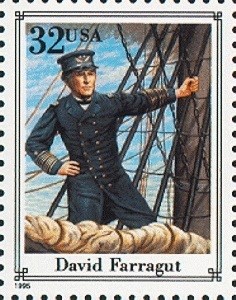
The USS Tecumseh, a monitor ship of the Northern Navy, strikes a mine and sinks within minutes. Behind it is the formidable, heavily armed three-masted sloop-of-war USS Brooklyn. Captain James Alden is warned for “a row of suspicious looking buoys” directly under the bow, stops and starts to manoeuver backwards. Lashed to the rigging of his flagship, the USS Hartford, commanding rear admiral David Farragut sees the event and he curses his ships forward again:

“Damn the torpedoes! Full speed ahead!”

 Fortis Fortuna adiuvat, Fortune favours the brave; the rest of the fleet sails in one piece through the minefield, defeats the Confederates and goes ashore. The Battle in the Bay of Mobile, August 5, 1864, is decided, a few days later the city itself falls.

A hundred years later, thanks to the port, shipyards and steel, Mobile has developed into a modern, prosperous town, but it remains Southern. In the whole of the twentieth century it is mainly in the news with yet another racist incident – in February 1966, when Dylan records Memphis Blues Again, Mobile still has a backward, redneck image; you really rather be in Memphis.

The yearning for Memphis is at least as old as the blues music itself. One of the very first songs with the word blues in the title is “The Memphis Blues” by W.C. Handy from 1909, which is worded in 1912 by George A. Norton, who longs for Memphis, just because Handy plays this song:

There’s nothing like the Handy Band that played the Memphis Blues so grand.
Oh play them Blues.
That melancholy strain, that ever haunting refrain

Is like a sweet old sorrow song

Norton’s ode is perhaps the first, but certainly not the last. Chuck Berry, Muddy Waters, Jerry Lee Lewis and hundreds of other artists sing the largest city in Tennessee. The website of the Memphis Rock ‘n’ Soul Museum keeps the score: today there are more than 1000 recordings on the list.

Dylan knows all about it. Episode 31 of his Theme Time Radio Hour (November 29, 2006) is dedicated to Tennessee, more than half of the playlist is about Memphis.

Direct inspiration, however, seems to come from Sinatra, or rather: from the granite monument “Blues In The Night”.

“Blues In The Night” is somewhere in the front of The Great American Songbook. Even composer Harold Arlen, usually a modest man who can’t be caught patting his own back, gets excited again when his biographer Edward Jablonski asks about this song: “I knew it was strong, strong, strong!” (Rhythm, Rainbow And Blues, 1996 ). He even takes, very unusual, credit for a part of Johnny Mercer’s lyrics:

“It sounded marvellous once I got to the second stanza but that first twelve was weak tea. On the third or fourth page of his work sheets I saw some lines—one of them was ‘My momma done tol’ me, when I was in knee pants.’ I said, ‘Why don’t you try that?’ It was one of the very few times I’ve ever suggested anything like that to John.”

(in Alec Wilder’s American Popular Song, 1972)

Dylan is a fan of lyricist Johnny Mercer, and especially of this song, although in Chronicles he still seems to think it’s all Harold Arlen:

“Arlen had written “The Man That Got Away” and the cosmic “Somewhere Over the Rainbow”, another song by Judy Garland. He had written a lot of other popular songs, too — the powerful “Blues in the Night”, “Stormy Weather”, “Come Rain or Come Shine”, “Get Happy”, In Harold’s songs, I could hear rural blues and folk music. There was an emotional kinship there.”

Of course; Woody Guthrie, Hank Williams, Hank Snow… they are all deeper under his skin, “but I could never escape from the bittersweet, lonely, intense world of Harold Arlen.”

Copywriter Johnny Mercer does not get explicit credits from the bard, but indirectly more than once. From this song, from “Blues In The Night”, the Dylan fan recognizes

Now the rain’s a-fallin’
Hear the train a-callin

… of which echoes descend in “A Hard Rain’s A-Gonna Fall” and in “Dusty Old Fairgrounds”, and the chorus

The evenin’ breeze’ll start the trees to cryin’
And the moon’ll hide it’s light
When you get the blues in the night
Take my word, the mockingbird’ll sing the saddest kind of song
He knows things are wrong, and he’s right

… reveals where Dylan borrowed that atypical combination of moon and mockingbird from “I’ll Be Your Baby Tonight” (and that last line comes very close to “You’re Gonna Make Me Lonesome”, first verse – when something’s not right, it’s wrong). and the fourth verse opens with

From Natchez to Mobile
From Memphis to St. Joe

…which should sound familiar too.

With some cut and paste work, in short, the classic “Blues In The Night” can be reconstructed in its entirety from Dylan’s Collected Works.

The refrain of “Stuck Inside of Mobile with the Memphis Blues Again” is therefore a not too complex, yet fresh version of an old romantic cliché: it expresses the classic Sehnsucht, the desire for an unattainable ideal. Dylan then enriches this with a sharp edge, by securing the languid I-person like a Tantalos, at a distance of about 380 mile from that heavenly Memphis.

The couplets are not so unambiguous. Here sparkles the psychedelic Dylan, the wordsmith of “Desolation Row” and “Tombstone Blues”, who gazes through his sciopticon and twirls the impressions with a magic pen on his hotel stationary. Thus, the poet grants us nine completely unrelated, impressionistic fragments from a colourful life. Some of them are traceable, perhaps.

The bloodthirsty railway staff from the third verse lends Dylan from the old folksong “I Wish I Was A Mole In The Ground”: 

No, I don’t like a railroad man.
‘Cause a railroad man, they’ll kill you when he can,
And drink up your blood like wine.

And to author Peter Coyote we owe the observation that sheds light on the following enigmatic rules (An’ he just smoked my eyelids / An’ punched my cigarette): Dylan’s manager Albert Grossman has a rather peculiar way of holding his cigarette – the hand clenched into a fist, the cigarette wedged between the little finger and ring finger:

“Albert was droning on with a cigarette jutting out of his fist, oblivious to the Rosetta stone accuracy of Dylan’s observations on the speakers behind him. I was transfixed by the literalness and specificity of the images. I felt like I was hearing a headline, and decided at that moment, that for all his surrealistic affectations, Dylan was a very literal chronicler of an absurd world. It was not his lyrics, but his subject matter which was bizarre, and much could be learned by paying attention.”

Like this, every couplet opens the gate for grateful Dylan exegetes, with that parade of obscure, eccentric passers-by (neon madmen and a dismayed priest), exotic decors (a honky-tonk lagoon under the Panamanian moon) and weird props (railroad gin and a stolen post office). And, as usual in these days, all the stops are being pulled out.

Quite tiresome then are the attempts to deduce an epic, coherent story from the poetic fragments. The decline of a patient in a rehab clinic, a journey through the Purgatory of a soul looking for Paradise, something with Vietnam … especially on expectingrain.com, there is a lot of despair. The puzzlers who search for their crypto-analysis in the lyrical corner are more tolerable. The interpretations that assume Dylan captures in words the impression his tumultuous life now makes on him, do cut some ice. A lot of images and descriptions can be traced back to associative word play, to the catachreses that Dylan loves so much in this phase of his artistry.

The meaningless, but quite melodic sounding honky-tonk lagoon is a deliberate abusio, a “misuse” of the term honky-tonk saloon, for example. Neon madmen seems to be a traceable impression of the advertising boys on Madison Avenue, who, incidentally, despite what the successful television series suggests, were not called Mad Men at all. But Dylan’s Chelsea Hotel is a five minutes walk from Madison Avenue with its admen. In 1965, a language-sensitive word artist like Dylan effortlessly plucks that word play from the air.

In any case, it is irrelevant to the enjoyment of Dylan’s art, to know what Dylan “actually” tells, which images would be meant as a metaphor for which biographical fact and who would hide behind the ragman or the senator. Moreover; many of the code crackers trivialise the poetry – unintentionally, we may assume – with their attempts to clarify; but after all, a jewel shines more beautifully in the semi-darkness than in full daylight.

And a jewel it is. For those same fans on expectingrain it often is a favourite song and also with professionals like Sean Wilentz, Frank Black (from The Pixies) and Michael Gray, the song ranks high. Even organist Al Kooper, who usually looks back rather objectively, with witty self-mockery and irony, at his contributions, is still enthusiastic: “I heard it again recently and went, Wow! Usually I go Oww!”. After which he, very gentlemanlike, gives the most credits to guitarist Joe South.

The poetic mosaic indeed is beautifully packaged. The final version on Blonde On Blonde is, thanks to that irresistible thin wild mercury sound, unbeatable. The official release of the rejected versions (The Cutting Edge, 2015) only confirms that the chemistry of Dylan and the Nashville cats is building a rock-historic Mount Everest in the spring of ’66; higher is not possible. The attempt by Cat Power for the I’m Not There soundtrack (2007) is quite fun, the version of the North Mississippi Allstars (on Uncut’s tribute Happy Birthday Bob, 2011) is beautiful and the Spanish flamenco by Kiko Veneno (1995) charming and exciting, but still – they remain well below that summit, all of them.

Well alright, the Old Crow Medicine Show is, as usual, pretty irresistible with their bluegrassy, cajun Tex-Mex, cowpunky, damn-the-torpedoes approach on 50 Years of Blonde on Blonde (2016).

What else is on the site

You’ll find some notes about our latest posts arranged by themes and subjects on the home page.  You can also see details of our main sections on this site at the top of this page under the picture.

The index to all the 592 Dylan compositions and co-compositions that we have found on the A to Z page.

We also have a very lively discussion group “Untold Dylan” on Facebook with over 2000 active members.  (Try imagining a place where it is always safe and warm).  Just type the phrase “Untold Dylan” in, on your Facebook page or follow this link 

If you are interested in Dylan’s work from a particular year or era, your best place to start is Bob Dylan year by year.

On the other hand if you would like to write for this website, please do drop me a line with details of your idea, or if you prefer, a whole article.  Email Tony@schools.co.uk

And please do note   The Bob Dylan Project, which lists every Dylan song in alphabetical order, and has links to licensed recordings and performances by Dylan and by other artists, links back to our reviews

Posted in Uncategorized | 1 Comment

The Symbolism Of The Oak (Part II)


See also Bob Dylan and the Oak Tree

by Larry Fyffe

In the following poem, behind an allegorical oak tree, Eve-like Christabel encounters a female snake-demon in the night. Disguised in a white robe as the beautiful bejewelled Geraldine, the Lilith archetype is determined to break down the traditional roles assigned to women and men. She seduces the Christian belle:

She  folded her arms beneath her cloak
And stole to the other side of the oak
Who sees she there?
There she sees a damsel bright
Drest in a silken robe of white
That shadowy in the moonlight shone ...
And wildly glittered here and there
The gems entangled in her hair
(Samuel Coleridge: Christabel)

Though Coleridge be essentially an orthodox Christian, the opium-addicted writer often puts a Gothic spin on his poetry. In the canonized Judeo-Christian Bible, the older word ‘Lilith’ gets replaced by the English word ‘screech owl’. Nor does the potential power possessed by women get good press by Coleridge:

The screech owl also shall rest there
And find herself a place to rest
(Isaiah 34:14)

The poem below unleashes the story of the rebellious Lilith – her sexual desires seen as a threat to male dominance:

Of Adam's first wife Lilith, it is told
(The witch he loved before the gift of Eve)
That, ere the snake's, her sweet tongue could deceive
And her enchanted hair was the first gold
And still she sits, young while the earth is old
(Dante Rossetti: The Lady Lilith)

Though somewhat double-edged and ambiguous, the allegorical song lyrics below portray the cutting off of the enchanted hair of Lilith by patriarchal authority which is represented by Jupiter.  A messenger warns of the danger she poses to the morals of male youth, youth here represented by Apollo. The orthodox priest carries with him the image of a ‘dark nightingale’, a representation of Lilith, a warning that she’s as sexually seductive as the Whore of Babylon:

They shaved her head
She was drawn between Jupiter and Apollo
A messenger arrived with a dark nightingale
I seen her on the stairs, and could not help but follow
Follow her down past the fountain where they lifted her veil
(Bob Dylan: Changing Of The Guards)

The narrative poem lkabove is akin to the biblical story of Delilah, a Philistine women who seduces the Nazarite Samson into revealing the source of his strength. Best it would have been for Samson to stick with his own kind rather than getting mixed up with a stranger:

And she made him sleep upon her knees
And she called for a man to shave off the seven locks of his head
And she began to afflict him
And the strength went from him
(Judges16:19)

Orthodox thought presents a figurative female figure like Lilith as being in league with the Devil. But, in the song below, the experience of life tells a different story:

Took an untrodden path once
Where the swift don't win the race
It goes to the worthy
Who can divide the word of truth
Took a stranger to teach me
To look into justice's beautiful face
And see an eye for an eye
And a tooth for a tooth
(Bob Dylan: I And I)

https://youtu.be/szPDvIIpTbY

That is to say, to live in an oaken house that is overly restrictive in what is considered good, and what is considered evil, is bound to be broken, is bound to fall:

Gentlemen, he said
I don't need your organization, I've shined your shoes
I've moved your mountains, and marked your cards
But Eden is burning, either get ready for elimination
Or else your heart must have the courage for the changing of the guards
(Bob Dylan: Changing Of The Guards)

Posted in Uncategorized | 6 Comments

Dylan and the half truth: an analysis of the subject matter of Dylan’s lyrics 1959-1965


by Tony Attwood

What exactly are Dylan’s songs about?  Is there one theme (as for example propagated by those writers who have argued that they are all about religion), multiple themes (love, moving on, social justice etc), songs in which nothing that can be directly related to reality (the more surreal songs for example such as Tombstone Blues), or just a mixture of all types of subject matter?

It was without much hope of finding an absolute answer I started drawing together the list of the 593 songs that we have on this site which Bob Dylan has written or co-written, to see if I can offer any sort of insight into the theme or themes that have occupied Bob Dylan since he started song writing.

The series is far from concluded – in fact I have hardly started, and have only reviewed the years up to 1965, but that is starting to give me an insight into just how complex a subject this is going to be.

In fact I have made several attempts since launching this website in 2008 at classifying Dylan’s song lyrics into styles and subject matter, and each time have stopped as I have become overwhelmed by confusion.  And maybe that is right, for as Jochen reminded us recently, “Donald Fagen [of Steely Dan] repeatedly assures that the bard is the source of inspiration for their poetic and impenetrable texts. ‘No one in the pop medium had ever used that breadth of subject matter or surrealistic and dream language,’ he says in the Wall Street Journal (“Rock’s Reluctant Front Man”, July 8, 2011).”

I think there’s a lot in that comment, although as I have continued my quest for meanings and themes in the 593 Dylan compositions and co-compositions we have found, the main comments I get back are from people telling me either that I am quite wrong, or that I should chill out and not worry and just accept the songs as they are – neither of which comment is particularly helpful for anyone who wants to understand Dylan’s lyrics a little more.

Although to be clear, it doesn’t actually worry me if (f0r example), “Went to see the gypsy” is about Elvis Presley, or is simply the musical equivalent of a short story about a curious performer in a big hotel, but rather, my starting point is a deep fascination with the range of subject matter that appears to turn up in Dylan’s work.

Of course, although Dylan can be very obscure, Dylan himself has given us the occasional insight, as when he said to Bill Flanagan in 1986,

“A lot of times you’ll just hear things and you’ll know that these are the things that you want to put in your song. Whether you say them or not. They don’t have to be your particular thoughts. They just sound good, and somebody thinks them. Half my stuff falls along those lines. Somebody thinks them. I’m sure, when I’m singing something, that I’m not just singing it to sing it. I know that I’ve read it. Somebody’s said it. I’ve heard a voice say that. A song like Don’t Fall Apart On Me Tonight sort of falls into that category: I’ll take you to a mountaintop and build you a house out of stainless steel. That kind of stuff just passes by. A guy’s getting out of bed saying don’t talk to me; it’s leaving time. I didn’t originate those kinds of thoughts. I’ve felt them, but I didn’t originate them. They’re out there, so I just use them.”

And I must say I find that explanation very attractive, although just writing, “I’ve heard a voice say that,” as the explanation for the meaning of a song lacks a certain depth.

But of course it doesn’t mean that every song is like this.  “Day of the Locusts” has the giveaway line about the degree in it, so we can accept that it was about his getting his honorary doctorate.  And whether “Don’t think twice” is about an actual relationship or just about breaking up a relationship doesn’t really matter too much – it is a song of leaving, and that is the point.  “Look out your window and I’ll be gone” is the giveaway, and songs of leaving are very common in Dylan’s output.

What does strike me however is the way that Dylan can slip in and out of various different modes of thought between songs and within songs.  Soon after talking about “a lot of times you just hear things,” he also said, “Not a whole lot of real thought goes into this stuff.”

So now we have two issues.   Dylan picks up words, phrases and ideas most of the time, and uses them without too much thought.  Second, the meanings we find are created by ourselves.

That is not to denigrate his work, but rather to reflect upon how it happens.   If we could interview William Shakespeare now and have him say much the same, reflecting that, “All the world’s a stage” was just a phrase he picked up somewhere, would he suddenly become less than the greatest playwright of that age – perhaps of all time?  Probably not, although Shakespeare would be right.   Juvenal, in the second century, wrote in “Satire 3”: “All of Greece is a stage, and every Greek’s an actor.”  Shakespeare just enlarged the stage a bit.

Yet it doesn’t matter too much, because what’s important is not just the line but the whole set of images and feelings given in the piece.   Dylan is no less a writer by having picked up ideas along the way.

But we do have curious moments – not least with the religious period.  Starting with the album, “Slow Train Coming” Dylan for once did seem to preach overtly – although I’ve always been curious about the fact that the song that seemingly launched the change as the title piece of the album, actually has no overt reference to Christianity at all in its lyrics.  More its a condemnation of the political and economic state of America – or at least that is how it seems to me.

All that foreign oil controlling American soil
Look around you, it’s just bound to make you embarrassed
Sheiks walkin’ around like kings
Wearing fancy jewels and nose rings
Deciding America’s future from Amsterdam and to Paris
And there’s a slow, slow train comin’ up around the bend

Mind you that is Dylan for you.  As I have mentioned so many times on this site, “Times they are a changin” is not a protest song in the conventional sense at all.  There is no call to arms, no demand for the young to rise up and overthrow the rotten old regime.  It just says, “change is happening and can’t be stopped.”   Which is undoubtedly true, but not actually very helpful as a guide to what we should do about it.

The other odd fact from the religious period is that although we all could hear quite clearly that Dylan had been converted, and thus didn’t need to lyrics explained, this was the period in which he lectured us on his views while on tour.  Quite a paradox – especially as many in the audience didn’t actually seem very interested in listening.

Yet as that period drifted to an end we were back with songs that were full of exquisite phraseology and gorgeous musical moments such as Caribbean Wind, and which then never made it onto the mainstream album of the day.  How perverse this man has been.

But let’s go back to the 1960s – not least because with the 1960s I’ve made a start on seeing what the themes were in Bob’s writing which is indexed (as far as I have got) under the grand heading “The songs of Bob Dylan written in the 60s.”

What you will find there are 12 articles covering the first half of the decade, which I am not suggesting you necessarily want to plough through, but rather which points out the complexity of trying to analyse what Dylan was writing about, in general terms.  By which I mean, we can by and large work out what each song means, or at least what genre it falls into, but getting an overall picture is more difficult.

What I have then done is tried to compact Dylan’s work into categories.  I did try to get the number of categories as small as possible, but I still end up with around 20 thematic approaches.

Now of course the immediate response of some fans is to say “don’t do it” – claiming that Dylan is unclassifiable and that grouping the songs like this either diminishes the output, or my efforts simply contain mistakes.  Or both.   But I have plodded on this far, because it interests me.  If others think it is wrong, fair enough, but I find it insightful.   Here’s how far I’ve got, for songs up to 1965.  You can find a similar set of details for each year covered thus far.  To be clear, I’m only listing here the songs that were added to the subject area in 1965.

Surrealism / Dada  (note this was a new category started in 1965: 11 in all)

  1. Visions of Johanna
  2. I wanna be your lover
  3. Jet Pilot
  4. Ballad of a thin man
  5. Queen Jane Approximately
  6. Just like Tom Thumb’s Blues
  7. Highway 61 Revisited
  8. Tombstone Blues
  9. Sitting on a barbed wire fence
  10. Outlaw Blues
  11. Subterranean Homesick Blues

The Blues (5 in 1962, 0 in 1963, 1 in 1964, 1 in 1965). Total: 7

  1. Highway 61 Revisited (The world makes no sense, except maybe the blues; Dada.  It’s not a blues in itself, but it is about the blues.)

Love / desire (3 in 1962, 0 in 1963, 2 in 1964, 6 in 1965).  Total: 11

  1. Long distance operator (Panic because he can’t get through on the phone)
  2. I wanna be your lover (It’s a surreal world that makes no sense; Dada)
  3. From a Buick 6 (I got this woman who does everything)
  4. She Belongs to Me (Love)
  5. Love Minus Zero (Love)
  6. Love is just a four letter word (Is love real?)

Lost love / moving on (7 in 1962, 5 in 1963; 4 in 1964, 7 in 1965. Total: 19

  1. Medicine Sunday (Moving on – although the song is only a fragment so it is hard to say)
  2. On the Road Again (Moving on, the artist vs society; Dada)
  3. Maggie’s Farm (Moving on, the artist vs society; Dada)
  4. It takes a lot to laugh it takes a train to cry (I’m so tired of all this moving on)
  5. Sitting on a barbed wire fence (Moving on, nothing makes sense; Dada)
  6. California (Blues, moving on)
  7. Outlaw Blues (Moving on, The artist vs society; Dada)

Travelling on / songs of leaving / songs of farewell (8 in 1962, 5 in 1963, 4 in 1964, 2 in 1965  Total: 15

  1. It’s all over now baby blue (Song of Farewell)
  2. Farewell Angelina (Song of leaving)

Humour / satire / talking blues (7 in 1962, 2 in 1963, 3 in 1964. 1 in 1965. Total: 13

  1. Bob Dylan’s 115th Dream (Beat poetry as rock music; new talking blues, humour; Dada)

Protest (war, poverty, society…) (6 in 1962, 10 in 1963, 3 in 1964, 1 in 1965.  Total: 20

  1. Desolation Row (Political protest; It’s not the world, it’s how you see the world)

The songs of disdain (0 in 1962/4, 4 in 1965.  Total: 4

  1. Can you please crawl out your window? (Song of Disdain)
  2. Positively Fourth Street (Song of Disdain)
  3. Like a Rolling Stone (Song of Disdain)
  4. Why do you have to be so frantic (Lunatic Princess). (Song of disdain)

The most popular themes.  

Here’s how that running total looked at the end of this year for the subject matter that occupied Bob the most in these early years as a songwriter…  You can of course argue that the “moving on” songs are in the same category as “travelling on” – and that exemplifies the problem here.  The judgements are subjective.  If this is of any help to anyone, it is simply through providing one way of analysing Bob’s work.

  • Protest (war, poverty, society…): 20 songs so far
  • Lost love / moving on 19 songs: so far
  • Travelling on / songs of leaving: 15 songs so far
  • Humour / satire / talking blues: 13 songs so far
  • Surrealism / dada: 11 songs, all composed in this year.

Previous themes

Here is a list of the other categories I have created for previous years, but for which in my estimation, Dylan did not compose a song in 1965

  • Gambling (1 in 1962, 0 in 1963, 0 in 1964).  Total: 1)
  • It’s just how we see the world (1 in 1962, 0 in 1963, 2 in 1964.)  Total: 3)
  • Personal commentary – do the right thing (2 in 1962, 0 in 1963, 0 in 1964.  Total: 2)
  • The future will be fine (1 in 1962, 0 in 1963, 1 in 1964.  Total: 2)
  • The tragedy of modern life (3 in 1962, 0 in 1963, 0 in 1964. Total: 3.)
  • Death (3 in 1962, 1 in 1963, 0 in 1964: Total: 3.)
  • Patriotism (1 in 1962, 0 in 1963, 0 in 1964.  Total 1.)
  • Social commentary / civil rights (4 in 1962, 2 in 1963, 0 in 1964.  Total 6.)
  • Individualism (1 in 1962, 0 in 1963, 5 in 1964.  Total: 6)
  • Personal commentary – do the right thing (2 in 1962, 0 in 1963, 0 in 1964.  Total 2.)
  • Nothing changes (3 in 1962, 1 in 1963, 0 in 1964.  Total 4)
  • The future will be fine (1 in 1962, 0 in 1963, 1 in 1964.  Total 2.)
  • The second coming / religion (1 in 1962, 1 in 1963, 0 in 1964.  Total 2)
  • Justice (0 in 1962, 2 in 1963, 0 in 1964.  Total 2)
  • Art (0 in 1962, 2 in 1963, 0 in 1964.  Total 2)

I am hoping to keep this little project running, and you never know.  It might actually offer some deeper illumination as we proceed.

—————

What else is on the site

You’ll find some notes about our latest posts arranged by themes and subjects on the home page.  You can also see details of our main sections on this site at the top of this page under the picture.

The index to all the 592 Dylan compositions and co-compositions that we have found on the A to Z page.

We also have a very lively discussion group “Untold Dylan” on Facebook with over 2000 active members.  (Try imagining a place where it is always safe and warm).  Just type the phrase “Untold Dylan” in, on your Facebook page or follow this link 

If you are interested in Dylan’s work from a particular year or era, your best place to start is Bob Dylan year by year.

On the other hand if you would like to write for this website, please do drop me a line with details of your idea, or if you prefer, a whole article.  Email Tony@schools.co.uk

And please do note   The Bob Dylan Project, which lists every Dylan song in alphabetical order, and has links to licensed recordings and performances by Dylan and by other artists, links back to our reviews

Posted in Uncategorized | Leave a comment

Bob Dylan & Willie & Greencards in Lakewood NJ 6/15/

By Jane Gilday

by Jane Gilday
To Be Alone With You
She Belongs to Me
Cry A While
Just Like A Woman
It's Alright, Ma (I'm Only Bleeding)
Highway 61 Revisited
Queen Jane Approximately
Cold Irons Bound
Girl Of The North Country
Tweedle Dee & Tweedle Dum
Ballad Of A Thin Man
Summer Days
The encore:

Don't Think Twice, It's All Right
Like A Rolling Stone
Lakewood long-ago-once-resort town
Pastel hotels gone corkscrew seedy
Mookie of the NY Mets lived there
where Springsteen 88 and 9 intersect
where Ma would send me for BBQ chicken,
giving me a twenty whose change I could keep,
town where I bought my red Fender bass,
2 blocks from the site of my Dad's Irish wake
4 miles from the Greenwood graves of my folks,
Lakewood the town where I heard Bob sing
and play his Hohner like Lester Young looked
in a Porkpie Whitman Chaplin suit
from beyond the toy piano.

The Ides of June two thousand and five,
today must be my lucky day.
Loving the songs since sixty-four
but never once seeing he who sings them,
a friend calls up: "I forgot your birthday,
here's the money for a ticket to Dylan."

Bob and Willie are touring the Diamonds
with green Outbackers doing High Lonesome
American poets and minor league towns
ain't nobody can sing like they
ain't nobody can sing like they.

Arrived in Lakewood after driving through ghosts,
one thought fills me seeing the ballpark:
"Bob is here, Bob is here, holy shit Bob is here."
It's real but still I don't hardly believe it.
Like Stephen Foster comes over to jam
bringing along Bo Diddley.
Things you never imagine.

Gimme the chill bumps lemme tell you
Daddy loved Willie. His last years on Earth
at family dinners Blue Skies would play
surrounded by kids and the kids of the kids
Daddy would beam as Willie let forth
with that voice carved fine
as turkey in corn,
worn as born and warmer.

Lemme tell you things about chill bumps.

The Greencards start up,
it's like batting practice
the stands half full people are eating
nachos and dogs and beer and more beer
the play of a fiddle and excellent sound
Tea for Texas and whoop-ass ancients
made new on the strings' regime.

That Clinch Mountain two-step
that backstep clip-clop
that Maybelle flex
the one and the five
twining like flowers
on sunnyside slopes
A Monroe doctrine
worth singing about.

What a mix of people are here.
6 pack gals in cowgirl boots
2 inch roots in outlaw halters
beer belly boys with Waylon buckles
stroll the concourse with rainbow types
rasta tie-die ganja eyes
Family paisans with kids under twelve
free admission standard magnetic
rolling rock thunder roadhouse under
the lights tonight in Jersey,
Lakewood in The Pines.

The Jersey Devil may be down the road
a piece here on the pineland's edge
but the stadium feels pastoral and right
Circus tent Chataugua show
A roar goes up, Willie's below.

Nelson's a name like Williams or Rodgers
plain as dirt like Jimmie or Hank
Like Will, Amelia or Uncle Dave
been long on the old plank road.

Willie's a voice as creased as his face
as long as a Cherokee braid
twisted and worn as a beat-up guitar
all full of holes from the shook up things
worn down to essentials, cedar and gut
rosewood and fretting deep in the night.
Some pal named Paul slapping the time
while the kids and Pa get down in the pocket,
boy on the harp is making it weep.

The wrong guy from Texas
pulls strings in D.C.
The right guy from Texas
is touring bush leagues.
The Spirit loves jokes.
It's clear from these scripts.

Willie's corny,
incredibly hip,
the opposite of
shouting "FIRE"!
in a crowded theatre.

Crowd is restless, ballpark food
crowd the overpass
which performers go under
they wanna see bob
stroll to work
walkie talkie men
hollering people
"bob ain't gonna come
til ya get off the overpass"

the people move
but not by much.

Every light in the place goes dark
and people scream and the roar is big
in pitch black rows and aisles.
announcer's vaudeville voice blares:
"ladies and gentlemans he invented folk rock
turned the beatles on, discovered folk music,
met woody guthrie, got married
got divorced, invented country rock
after inventing folk rock then
he met jesus then he got divorced
then invented country-rock protest
hamonica solos in a neck brace
on carreening motorcycles
then fell into a morass of booze
and dope then fell out of a morass
of booze and dope then came back
timely out of his mind
ladies and gentlemans
BOB DYLAN!

Jack Fate declares to Sweetheart
"I need some boys kin play"

Well, Bob got them boys,
the very ones
kin play
in waco greasy suits
dunno his name
the guitar next to bob
does the chuck berry chug-a-lug riff
it's like keith minus that UK cool
being iowa and american
from maize & arrowhead meadows
and this is american jazzland rockhound shit
who would have expected
and
BOOM

TO BE ALONE WITH YOU!

it's bob berry and hank dylan
not to mention carl orbison
and elvis perkins
in east st. louis
on memphis street
and they're all hairdressers
with more girlfriends than the other guys
they've stolen style like spade coolie's
network eightball broadcast on the bakersfield run
this here truck stop special music
diesel fumed across the divide
where leo fender tinkers with RCA
tubes so that love can be sung plain
both dirty and innocent
or homespun clean
everyone wants to be alone
with someone of a like mind
where and when things get wet
and this is such cookin' music
and i'm laughing out loud cause
nobody told me there'd be noise like this
bob is banging piano
and i can hear it clear
the ivories of
lower midrange where
every harmonic beneeds the song
anchored with tony's bass
and that kickass drummer
in a paris beret
so the twang boys
can mountain dew they some
the grand ole' opry dead of slick
so long live mickey stuff like this
everybody in the park
feels like they're alone with bob
tonight's good god amighty
ain't love grand and yo!

bob is wearing orthodox amish
homespun black with breast-pocket dangles
and a flat brim hat
all the better to rabbi shuffle
and blow harp like never before
bison traces olay!
clear and clarion trumpeting
reedy and swiss and polka 2-beat
and building and building then
building some more
before
going all out
skywalking dots
thoughtfully moving
miles minus
all the doo dad bop
masters do it with
only 8 notes

she got everything she needs
and bob is playing with the melody
the inflections, the lilt,
soft singing
old man tender
not rancid or bitter
of course she belongs to him
love songs in ballparks
might as well be magic
these things require craft
and skillfull careless
and bowing down on sundays
upsinging and shit why not?
most good things are up
and this world has too much
down.

enough down to make ya cry
a while and thensome
the both-ways backbeat
second-line stumble
of boys that kin play
some blues beyond
the rote route
blues has become

blues is a woman
just like a woman
and bob is tender again
nobody feels any
PAIN is a question
inflected like it should be
pain not just a word
to rhyme with rain
blues is zippered up
came and went
he never called again
baby got no daddy
at home and rent's overdue
blues is tonight with country
descent into a well of sound
where prayers and tears
swim together with sorrow,
regret and enough empathy
to quench a love thirst.

i can't even write about all this
nor do the disservice
people don't write novels about clouds
or troutstreams or hillsides
but they try
and that harmonica keeps trying
like bells work against stained guilt
in empty rooms after check-out,
in poor rooms with fans
and all the money in the world
can't help ya flee being human
the flypaper hangs from the pull chain
one 60 watt bulb got the flickers tonight.

short hand and mores' code.
to reinvent all the inventions
to die before going senile
to trod the boards
and let it rip.
bob's doing all this
willing and avid nightly
the st. james book
the whitman hotel's
bedside attraction with cable
or mormon best western urges
to take them tablets and look at them
closely since nobody else pays attention
put it all to music and make it last
strumming or honoring domino,
minnesota fats, the hustle of green
rocky roads and bullrushed babes
where children float hidden
away from pharoah's barge
in france or harrar
now or then.

this american type writer poet
who sings with a band
of cowboy humbucking strangers
is asking queen jane and ma
or anyone with ears
to dance on death's shadow
where shades of homer run free
from base to higher ground
as the pitchmen sell shirts
and logos means you heard
something you wanna wear a while

hart crane is still drowning
and 10 people heard howl
woody is crippled or in jail
so who keeps going?
and if not, why not?
rosetta tharp wasn't doing it
just for the damn fun
though that sure helps a lot
when pa is still obessed with
burning altar boys just because
he gotta bad mood about skulls
and bones and gimme some dinner.

bob's mask isn't there
when his fingers push the keys
it's clearly 'sing it and they will come'
he's so anonymous it hurts
everybody else is dancing with mariah
mussolini on soprano icon road
near survival traffic island
with gap genes on backwards
getting mauled with plenty
so someone has to honor
the human heartbeat's
angelic apple dance
of twain vines and river salt
sea mist and mud chanteys

if you can take one dust mote
one hazel summer night sky
one more bit of rock
and stir it well
the dance might still be gracious
and amazing tho most are indoors
amazoning themselves to the casket

the old man and the c note
containing runaway dreams
seized and stolen and given
because the spirit sang to
who it chose to
while the moon knelt down
so low.

this ridiculous shit is still rolling
time's suspended been here for weeks
the stasis of great momentum
the simple stroke of graphite
on a napkin over hoagies
midwestern counter punch
to the city's heap big dirt
paying expenses daily
for tabloidal noiseballs
gossiping about asses.

i am so happy because
all that has vanished
in lakewood tonight
bob's band is cracking fierce
too much higher primate business

i focus on tony and oh thank god
no slap happy funk junk
his bass can oom-pah
or stride or nail the one

bob could sing the alphabet
over bedrock like that
and does
alpha omega
and tennessee walls
of pride torn down
it takes Lot to be patient
and a cliffwalker to listen

the streams in the pinelands flow red
from tannin and the water tastes of cedar
captain kidd buried treasure there
and bog iron was in washington's barrels
soon to be in king george's cheeks,
jersey gnats and mosquitoes
are not fooling
but nobody cares.
bob is still going
summer days
summer nights
like this

screw that George Will crap
like Our Grand Experiment In Democracy.
Our hoedown experiment in Live Let Live
is the truer stuff
hick opera with jumbled roots
  1. jones still don't get it and never will
afeared to get in trouble
with the scout troop masters
and their merit badgers of water gone to
bad blood, bad stock and surety.

gonna need somebody on your bond.
bob is paroling the open ears.
girl of the north country
breaks my heart
sung like it still hurts
and always will
this guy is not photo opportunities
on carrier pigeon marked decks or
jetstream vacation commando centers
where humans are units and obstacles
in the path of central planning

girl of the north country
you can smell fresh wash
on lines strung under clear heavens
and the gummy hot macadam
given way to autumn's riot weeds
every color a cider of barrelhousing
with the sense of vast always there
and not forgotten or
trash heaped unto civility
or saturday in town
when town was still town
and not a bypass mart
of foreclosured tumbledown.

girl of the north country
vagabond denim pinball
machinery for grain
and gravy scuppers in parlors
linens and sundries
and drive in dreams
sunbeams on oak and cherry
once was a true love of mine
are the sweetest words
tho sad and going sadder
because the true in them
was not cast aside for casinoed
routines and synthetica grins
as the bombs go bursting in air
until otherwise notified
or entombed.

leaving the ballpark,
'hard reign' japanese on.
i turned it off fast.
needed silence
to drive on home
thinking since then
all about this.

chill bumps
and grandmas.
about this always
all about this.

What else is on the site

You’ll find some notes about our latest posts arranged by themes and subjects on the home page.  You can also see details of our main sections on this site at the top of this page under the picture.

The index to all the 590 Dylan compositions and co-compositions that we have found on the A to Z page.

We also have a very lively discussion group “Untold Dylan” on Facebook with over 2000 active members.  (Try imagining a place where it is always safe and warm).  Just type the phrase “Untold Dylan” in, on your Facebook page or follow this link 

If you are interested in Dylan’s work from a particular year or era, your best place to start is Bob Dylan year by year.

On the other hand if you would like to write for this website, please do drop me a line with details of your idea, or if you prefer, a whole article.  Email Tony@schools.co.uk

And please do note   The Bob Dylan Project, which lists every Dylan song in alphabetical order, and has links to licensed recordings and performances by Dylan and by other artists, links back to our reviews


Posted in Uncategorized | 1 Comment

It Takes A Lot To Laugh, It Takes Chris Smither to make me cry

by Jochen Markhorst

The bootlegger who is responsible for the beautiful CD “Memphis Blues Again” by Steely Dan (1995), a live recording from 1974, has historical awareness. The first record of Donald Fagen and Walter Becker’s band owes its title to a Dylan song: Can’t Buy A Thrill is the second line of Dylan’s own blues classic “It Takes A Lot To Laugh, It Takes A Train To Cry”. There are more Dylan references and influences in the work of Steely Dan (the dylanesque put-down “Reelin’ In The Years”, for example) and Donald Fagen repeatedly assures that the bard is the source of inspiration for their poetic and impenetrable texts. “No one in the pop medium had ever used that breadth of subject matter or surrealistic and dream language,” he says in the Wall Street Journal (“Rock’s Reluctant Front Man”, July 8, 2011).

He therefore immediately jumps up when the Rolling Stone publishes an interview (July 2013) in which Fagen says nasty things about his hero, at least: about the qualities of his concerts in the 21st century and the blues content of recent albums.

“I’ve been to Bob Dylan shows where I essentially walked out in the middle. I just didn’t like it. Usually there’s a good reason why those songs shouldn’t be done. (…) He has about a dozen minor-key drone tunes with three chords. I find that very tedious. (…) It’s songs with 512 verses and no melody. It’s more than I can bear, really.”

When it is published, Fagen chokes on his coffee. Without delay he produces a sharp, long, written reply in which he once again asserts that he is a fan, how much Dylan does mean to him and how he manages to surprise us over and over again for so long.

“Greene brought up Bob Dylan. Because I could tell that Greene loved Dylan as much as I did, I let down my guard, and we started in with the classic fan talk, picking apart his recent work and mourning the fact that his erstwhile astonishing voice has now been reduced to a croak. (…)

“For a moment, forgetting I was talking to a reporter, I started joking about the recent albums that always seem to have several, long blues-based tunes in minor keys. The lyrics are always great, but the tunes have limited musical interest, perhaps because Dylan needs to accommodate his damaged voice. Because Bob has meant so much to us for so long, because he’s astonished us for so long, maybe we feel we can kid him as if he were family.
Big mistake.”

He does not mention the fact that he, as a devout fan, has bought Dylan’s old home in Woodstock. Even better is the story that writer Jenell Kesler digs up, the story that Fagen applied as a keyboard player for Dylan’s backing band in 1981. After Fagen has responded “to a small ad in a Los Angeles newspaper,” an enthusiastic Rob Stoner, Dylan’s bass player and musical leader, calls him up and promises to present him to Dylan, but never calls back again.

Great story, but Kesler has probably been fooled; in 1981, Stoner had long since said goodbye to Dylan and his band.

Elsewhere, the Steely Dan foreman tells that the love has begun with Bringing It All Back Home, and “It Takes A Lot To Laugh” is apparently such a knockout that the song is honoured in the title of the first album. The duo, which calls their band after a dildo from William Burrough’s Naked Lunch, is charmed by the mistiness wrapped in crystal clear words, but especially from the sexual ambiguities in Dylan’s song. With some susceptibility to Freudian symbolism, the listener here hears the lamentation of a failing lover, tormented by the premature petite morte; he “dies” when he has just climbed the hill, the beloved “comes after him”, the train being a metaphor for the act, certainly in the blues idiom, just as popular as juicy citrus fruits and open back doors.

Part of the attraction of the lyrics is the elusiveness, the “surrealistic dream language,” as Fagen calls it. Dylan interlaces the blues clichés with Shakespearian text fragments and private associations. “Now the wintertime is coming” recalls Richard III (“Now is the winter of our discontent”), the “Double E” refers to the EE line, the Broadway Local, which in the 60s stops a block and a half from Dylan’s West 4th apartment (just like the “D” train from “Visions Of Johanna”, by the way).

The golden oldie “Rocks And Gravel”, which is on his playlist in 1962, plays through Dylan’s mind as he writes these words; there he sings about that Mobil and K.C. line, there the singer sighs don’t the clouds look lonesome shining across the sea and the lines Don’t my gal look good / When she’s coming after me are almost literally maintained. They are not his own words; although “Rocks And Gravel” is – quite questionably – in Dylan’s name, the song itself is a rip-off from Leroy Carr’s “Alabama Woman Blues” (1930).

Remarkably, the text is initially, in the version still called “Phantom Engineer” and recorded a month and a half before the album version on Highway 61 Revisited, more original, in terms of choice of words more in line with, for example, a “Desolation Row” or a “Just Like Tom Thumb’s Blues”. Especially the third verse:

Well I just been to the baggage room
where the engineer he’s been tossed
Oh, I stamped on 40 compasses,
God knows what they cost

Musically, the song also undergoes a transformation in the weeks following that recording, but that transformation is more successful than the text revisions. When an enthusiastic producer Tom Wilson hears the first attempts, it is still a fast, sharp and, above all, much more common Chicago blues. The like of which John Mayall’s Bluesbreakers in London (with a young Clapton, on unfortunately lost recordings) can handle just as effortlessly as the Paul Butterfield Blues Band at the Newport Folk Festival. Only when Dylan switches to a slow, acoustic approach at the end of July ’65 does the extraordinary beauty come to the surface and, with its mildly sad mood, is it a welcome outsider on Highway 61.

This also applies to the remarkable title. Just like most titles on Highway 61 Revisited, it has no direct relationship with the lyrics, but a transcending, added value. Here even stronger than with “Just Like Tom Thumb’s Blues” or “From A Buick 6”; It takes a lot to laugh, it takes a train to cry is a non-existent proverb that can stand on its own, has an aphoristic power like the times they are a-changin’ or the answer is blowin’ in the wind.

Dylan probably dashes off the one-liner thoughtlessly. His superior sense of language and instinct for rhyme & reason rarely abandons him, as it does not this time – the “proverb” suggests a somewhat old-fashioned, but nevertheless cast-iron, universal wisdom. Perhaps inspired by the Lebanese-American writer Kahlil Gibran:

“It takes a minute to have a crush on someone, an hour to like someone, and a day to love someone… but it takes a lifetime to forget someone.”

Dylan has undoubtedly browsed through Gibrans bestseller The Prophet (1923) and acknowledges his love for his poetry in the interview with Bob Cohen (1968):

“Gibran, the words are all mighty but the strength is turned into that of a contrary direction. There used to be this disk jockey, Rosko…Sometimes…Rosko would be reciting this poetry of Khalil Gibran. It was a radiant feeling, coming across it on the radio.”

It touches Dylan’s aphorism. “It may take a while before you are happy with someone, but one departing train is enough to become unhappy”, something like that – the amorous variant of trust arrives walking and departs riding.

The master himself is also fond of the song. “It Takes A Lot To Laugh” remains on his set list for more than forty years and he performs it some two hundred times. It is just as popular with colleagues. When George Harrison manages to pull him off the veranda for the Concert For Bangladesh (1971), he pleads for this song, among other things. The “supergroup” of Al Kooper, Stephen Stills and Mike Bloomfield has already promoted the song to the American Songbook on the legendary album Super Session (1968) and since then it belongs to the canon; hundreds of artists have it in the repertoire.

Most opt for slower interpretations than the Highway 61 original and seize the opportunity to let a guitar excel. The live versions of Fairport Convention (Cropredy 1997 and 2002), with a great Richard Thompson, are highlights in that category, even better than the exercise by guitar god Eddie Van Halen. The Dutch ladies of Ygdrassil provide a beautiful two-part, muted cover on their album Nice Days Under Darkest Skies (2002). Perhaps the slowest, introduced with melancholy steam whistle, comes from the heart-breaking Higher Animals (2012).

At least as melancholy, but much bluesier, is David Bromberg, who is so appreciated by Dylan, on Try Me One More Time (2007), but the performance of the incomparable Chris Smither, who previously impressed with “Visions Of Johanna”, overshadows everything and everyone. It is an extremely subdued, driving and soulful interpretation, sparingly instrumented, in which the focus remains on the song, not on an ambitious guitar or compelling vocals. To be found on the very beautiful album Time Stands Still (2009).

Donald Fagen, meanwhile, fears that Dylan still blames him for the criticism. In the Showbizz 411 of October 27, 2016, Roger Friedman quotes the front man: “He’s mad at me. He even mentioned us in a speech.”

Fagen refers to the MusiCares speech, in which Dylan indeed does mention Steely Dan. Fairly neutral, by the way. Dylan is disappointed that his idol Billy Lee Riley (“Red Hot”) is not included in the Rock And Roll Hall Of Fame:

“Metallica is. Abba is. Mamas and the Papas – I know they’re in there. Jefferson Airplane, Alice Cooper, Steely Dan – I’ve got nothing against Metal, Soft Rock, Hard Rock, Psychedelic Pop. I got nothing against any of that stuff. But after all, it is called the Rock and Roll Hall of Fame. Billy Lee Riley is not there. Yet. And it’s taking too long.”

In the “Post-MusiCares Conversation” Bill Flanagan addresses the orator. And sticks up for Steely Dan. They sure could rock, wouldn’t you say? What about songs like “Show Biz Kids” and “My Old School”?

Sure, Dylan says, I don’t want to belittle Steely Dan. But compare their records with Willy Deville’s “In The Heat of the Moment”, “Steady Driving Man” or “Cadillac Walk”. There is a difference.

Incidentally, Donald Fagen, in interviews as a notorious liar and misleader as Dylan is, sometimes produces a totally different title explanation with regard to that first album title. Like in a Rolling Stone interview with Judith Sims, April 23, 1973.

Walter Becker is in California, calls Fagen and tells, one arrogant New Yorker to the other haughty Brooklyner: “You can’t buy a thrill in California.”

What else is on the site

You’ll find some notes about our latest posts arranged by themes and subjects on the home page.  You can also see details of our main sections on this site at the top of this page under the picture.

The index to all the 590 Dylan compositions and co-compositions that we have found on the A to Z page.

We also have a very lively discussion group “Untold Dylan” on Facebook with over 2000 active members.  (Try imagining a place where it is always safe and warm).  Just type the phrase “Untold Dylan” in, on your Facebook page or follow this link 

If you are interested in Dylan’s work from a particular year or era, your best place to start is Bob Dylan year by year.

On the other hand if you would like to write for this website, please do drop me a line with details of your idea, or if you prefer, a whole article.  Email Tony@schools.co.uk

And please do note   The Bob Dylan Project, which lists every Dylan song in alphabetical order, and has links to licensed recordings and performances by Dylan and by other artists, links back to our reviews

Posted in Uncategorized | 1 Comment

Bob Dylan And The Mule Symbol

By Larry Fyffe  

Surreal symbolism is no stranger to singer Bob Dylan:

Oh, jewels and binoculars hang from the head of the mule
But these visions of Johanna, they make it all seem so cruel

(Bob Dylan: Visions Of Johanna)

Mules are misused as a metaphor for a stupid person; a male mule, though most often sterile, doesn’t know that, and carries on humping regardless; thusly, the ‘jack’ is employed as a metaphor for a devilish guy who’s always on the ‘make’ with little regard for moral considerations when doing so – gals who feel trapped in a relationship being good targets:

Now if you come home, and your food ain't cooked
And she give you a dirty look
Man that's all
Another mule is kicking at your stall

(Fats Domino: Another Mule ~ Bartholomew)

Bob Dylan uses variations on the theme above in some of the songs that he writes – seems that the jack, the narrator below, though he feels somewhat trapped, accepts domestication in exchange for sex, or so the lyrics can be interpreted:

However, who Rosie be isn’t all that clear:

Well, the devil's in the alley, mule's in the stall
Say anything you want to, I've heard it all
I was thinking about the things that Rosie said
I was dreaming I was sleeping in Rosie's bed

(Bob Dylan: Mississippi)

There’s this rather vulgar version of a song in which Rose accommodates the mule because the ‘john’ gets her to where she wants to go:

I'm going down to Rose Marie
She never does me wrong
She puts it to me plain as day
And gives it to me for a song
It's a wicked life, but what the hell ....
Rosie Marie, she likes to go to big places
And just sit there waiting for me to come

(Bob Dylan: Going To Acapulco)

On the other hand, the motherly female figure below is depicted as being quite spiritual – unlike the hedonistic ‘jack of hearts’; perhaps from her, he might learn to be more caring of the needs of others:

Rid yourself of mortal sin
And tell the truth one time
And find truth within
Saw you hanging with that group
Their minds made up of boiled soup

(Helena Springs: Tell The Truth One Time ~ Dylan/Springs)

In the following lyrics, the human female is presented as a Mary Madonna type:

Now you stand with your thief, you're on his parole
With your holy medallion in your fingertips now that fold
And your saintlike face, and your ghostlike soul
Oh, who among them could ever think he could destroy you?

(Bob Dylan: Sad-Eyed Lady Of The Lowlands)

Meanwhile, King Solomon of modern times drives around in a gold-plated chariot; the Rose of Sharon he leaves behind with memories of his mulish behaviour:

Time regards a pretty face like time regards a fool
You drive off in in your Cadillac
And leave me with the mule
In order to keep up with you, I must go back to school

(Helena Springs: More Than Flesh And Blood Can Take ~ Dylan/Spings)

In the following song, the narrator knows where it’s at, and considers himself no fool:

Well I'm driving in the flats in a Cadillac car
The girls all say, "You're a worn out star'
My pockets are loaded, and I'm spending every dime
How can you say you love someone else
When you know it's me all the time

(Bob Dylan: Summer Days)

In a re-telling by the following postmodernist allegory of the Book of Genesis, Eve prefers the mysterious man dressed up in the dusty black skin of a snake rather than the oh-so-boring, mule-headed Adam, naked though he may be:

Somebody is out there beating a dead horse
She never said nothing, there was nothing she wrote
She gone with the man in the long black coat

(Bob Dylan: The Man In The Long Black Coat)

https://youtu.be/LfGRvwBn7VU

Moving right along, the serpent in the Garden of Eden is said by some interpreters of the Bible to be Adam’s first ‘wife’.  In disguise, she’s getting revenge for Adam wanting her as a servant rather than accepting her as a sexual equal in that she’s co-created along side the male human by a hermaphroditic God:

So God created Man in his own image
In the image of God created He him
Male and female created He them

(Genesis 1:27)

That female’s name is ‘Night’, ‘Lilith’, or ‘Lily”, while the ‘Eve’ of biblical canon is considered to be the second wife of Adam – she’s made from his rib. Poet John Keats likens the dark gnostic lady (mentioned previously in another article) to the snake-headed ‘Lamia’ of ancient mythology.

Johnny’s been down in Bob Dylan’s basement boiling up the soup.

What else is on the site

You’ll find some notes about our latest posts arranged by themes and subjects on the home page.  You can also see details of our main sections on this site at the top of this page under the picture.

The index to all the 590 Dylan compositions and co-compositions that we have found on the A to Z page.

We also have a very lively discussion group “Untold Dylan” on Facebook with over 2000 active members.  (Try imagining a place where it is always safe and warm).  Just type the phrase “Untold Dylan” in, on your Facebook page or follow this link 

If you are interested in Dylan’s work from a particular year or era, your best place to start is Bob Dylan year by year.

On the other hand if you would like to write for this website, please do drop me a line with details of your idea, or if you prefer, a whole article.  Email Tony@schools.co.uk

And please do note   The Bob Dylan Project, which lists every Dylan song in alphabetical order, and has links to licensed recordings and performances by Dylan and by other artists, links back to our reviews

Posted in Uncategorized | 5 Comments

“Responsibility” a recovered fragment of a lost Dylan song

by Tony Attwood

“Responsibility” is another Helena Springs song that is listed as being a co-composition with Bob Dylan.   The  background to these recordings can be found here along with a full list of them, in our review “Bob and Helana” which looks at “Tell me the truth one time.”

To hear “Responsibility” – jump to 5.07.42 (five hours, seven minutes 42 seconds) – it is right near the end of the who sequence of songs.

https://m.youtube.com/watch?v=Narvah_Cy80

So, it is listed as being a co-composition with Bob Dylan and quite clearly the song has been worked out and rehearsed prior to this recording – but we are still at an early version, perhaps laying down a rough recording of the piece so that it can be considered later and if required, a more fulsome arrangement can be made.

But it seems it was not required, and no further need was found for the song.

The band does get through a rather uninspiring instrumental break and Helena does her best with the material which relies so heavily on the repetition of the title word as a chorus – but really it is unfair on everyone.

For as things stand there is not enough within the song to consider how it might go further, and my personal guess is that it really couldn’t go much further.   The chorus of the word “Responsibility” is just too unexceptional, too unexciting too… well everything, to take it further.

As a result the boppy accompaniment is put in place, but it seems to have no relationship to the lyrics.  Telling a person that he or she is not taking responsibility but is “shooting off your mouth” is a possible starting point for a song (but then it doesn’t really fit with such a bouncy piece of music.)   If we think of other songs of disdain, which I guess this is, we think of openings like “You’ve got a lot of nerve…” and then think of the melody and accompaniment.  Then we are in a different landscape.

And that I guess is why it was abandoned.  It is presented as the final track on the massive collection of Rundown Rehearsal Tapes.   I doubt that anyone particularly remembers it for the simple reason it is so unmemorable both in melody, lyrics and accompaniment – and to work a song really needs one of those three elements to shine through like a burning light.

It doesn’t, and is merely remembered as another Dylan co-composition.  Actually I suspect even Bob wouldn’t remember it.

What else is on the site

You’ll find some notes about our latest posts arranged by themes and subjects on the home page.  You can also see details of our main sections on this site at the top of this page under the picture.

The index to all the 590 Dylan compositions and co-compositions that we have found on the A to Z page.

We also have a very lively discussion group “Untold Dylan” on Facebook with over 2000 active members.  (Try imagining a place where it is always safe and warm).  Just type the phrase “Untold Dylan” in, on your Facebook page or follow this link 

If you are interested in Dylan’s work from a particular year or era, your best place to start is Bob Dylan year by year.

On the other hand if you would like to write for this website, please do drop me a line with details of your idea, or if you prefer, a whole article.  Email Tony@schools.co.uk

And please do note   The Bob Dylan Project, which lists every Dylan song in alphabetical order, and has links to licensed recordings and performances by Dylan and by other artists, links back to our reviews

Posted in Uncategorized | 7 Comments

Bob Dylan’s Hibbing from Edlis Cafe: book review

By Tony Attwood

I’ll come straight out and say I love this book. But you need to be aware…  Books from Edlis Cafe are different – for they are taken from the Edlis projects on the internet.

So if you want to get a flavour of what this is all about go and visit their Facebook group – it is one of the very few Bob Dylan Facebook pages I would ever recommend other than our own.

And the point here is there is such a rich variety of information and material collected on their Facebook pages that having all that information it in book form is essential, allowing easier reading of the article and much better surveillance of the pictures than you can get on the internet.  In fact the book is worth its cost just for the Robert Shelton interview with Dylan’s “mom and dad”.

Since my copy arrived each time I have been working I have had the book open on my desk, just below the computer screen, turning the picture pages over and over to get what I hope is an ever deeper awareness of the town in which Bob grew up.   Of course I know about it from other volumes – but here I feel I am brought much closer to the world Bob knew as a kid.

Maybe it is because I am English and thus have no background in the American traditions and histories that are included in these pictures and stories that the impact on me is so great, but I am looking at a world that is quite alien to me, and yet it is one which I have glimpsed through occasional lines in Bob’s songs.

But there is also the fact that with this volume I can look at the store that Bob worked in as a youngster, and my mind drifts into thinking about whether other young lads of his sort of age meandered into the shop and bought stuff and were served by Bob, and now looking back think, “yes I did go in there, and there was that guy about my age, and oh my that must have been Bob Dylan.  I wonder if he remembers me…”

OK, its a nerdy thought, but for some of us such memories are powerful and important.  For this is a story of a world coming and going.  A story of youngsters travelling 15 miles to another town to meet up with the DJ who played the music they liked.  Of a time when and a town where racism was overt and legal.  There are contradictions between the memories of his family members and others who knew him and there are pictures, pictures, pictures.

Yes at times it feels muddled, but that is right, because in the real world that is exactly how our memories become.   The photographs tell only part of the reality.

It is over 280 pages of A4 size packed with pictures and text and it is wonderful.  Maybe one day it will come off my desk and go onto the bookshelves with all the other Dylan books, but that will a sad day, because it will mean I have not only studied the book to death but also because by then I will know it off by heart, and have no more to learn and re-learn.  I will no longer be enjoying the true reflection of looking back all these years to one’s childhood.

The book is available on Amazon.  In the UK that means you can get it here, but in the rest of the world just go onto your local Amazon and type in Edlis Cafe Bob Dylan’s Hibbing.

And if you don’t want it, buy it for a Dylan fan who is interested in where he came from.  They will love you even more than they do already.

What else is on the site

You’ll find some notes about our latest posts arranged by themes and subjects on the home page.  You can also see details of our main sections on this site at the top of this page under the picture.

The index to all the 590 Dylan compositions and co-compositions that we have found on the A to Z page.

We also have a very lively discussion group “Untold Dylan” on Facebook with over 2000 active members.  (Try imagining a place where it is always safe and warm).  Just type the phrase “Untold Dylan” in, on your Facebook page or follow this link 

If you are interested in Dylan’s work from a particular year or era, your best place to start is Bob Dylan year by year.

On the other hand if you would like to write for this website, please do drop me a line with details of your idea, or if you prefer, a whole article.  Email Tony@schools.co.uk

And please do note   The Bob Dylan Project, which lists every Dylan song in alphabetical order, and has links to licensed recordings and performances by Dylan and by other artists, links back to our reviews

Posted in Uncategorized | 3 Comments

Million Dollar Bash: from a broken party to an English country garden

by Jochen Markhorst

The most notorious Million Dollar Bash in recent decades is the party that was cancelled: the Fyre Festival in the Bahamas, on the island paradise of Great Exuma. The failure is spectacular. In the run-up to the luxurious, decadent, multi-day “Festival Of The Century”, social media influencers such as Kendall Jenner are paid (and not insignificantly, as the court case reveals: $275,000) to promote the party and that pays off: tickets for thousands of dollars are easily sold. 28 April 2017, the Furious Fiesta is gonna break loose, but a debacle it shall be.

The terrain is not ready, the spacious, expensive accommodations are shabby tents, there is insufficient food and water, the top artists are not contracted and the rushed cancellation, on Day One, leads to an apocalyptic, Lord Of The Flies-like chaos on and around the airport: to make matters worse, the organisation cannot get everyone back home.

The aftermath is just as sensational. Millions of dollars claims, lawsuits, imprisonment… in January 2019 two documentaries about this fiasco, produced separately, are broadcasted (Fyre Fraud and on Netflix Fyre: The Greatest Party That Never Happened), both struggling to turn the multitude of tumult into a manageable reconstruction.

On the preceding evening, when quite a few guests have already arrived, a “spontaneous beach party” is organized, in which hastily mobilised members of a local band have to take care of the music. They are forced to continue playing for hours and are ultimately the only act of the festival. The set list is unknown. But “Million Dollar Bash” would have been the obvious choice. Even with prophetic value, already in the opening lines:

Well, that big dumb blonde
With her wheel in the gorge
And Turtle, that friend of theirs
With his checks all forged 

No shortage of big dumb blondes, there on Great Exuma, the wheel in the gorge serving as an original metaphor for the derailment of the event and Turtle forging checks is organizer McFarland who in October 2018 is sentenced to six years in prison for his Million Dollar Fraud.

Fortunately, the million-dollar party of Dylan and the guys from The Band, in that basement of the Big Pink in West Saugerties, is a lot less pumped up, much more colourful and much more successful anyway. And funnier too.

At least, Dylan and The Band apparently think it’s a novelty song, a cabaret-like song that is based on humour. In his autobiography (Testimony, 2016) Robbie Robertson tells how while he was away for a couple of errands, the others quickly recorded “Yea Heavy And A Bottle Of Bread” and “Million Dollar Bash”.

“We smoked a J and laughed ourselves to pieces at these recordings. Bob said, “Okay, who would be good to do those songs?” We suggested everybody from Brook Benton to Marty Robbins. “No…Little Jimmy Dickens, don’t you think?” I offered.  Garth made some toots and whistles come out of his organ.”

The link with Marty Robbins and with Brook Benton (because of “Boll Weevil” perhaps?) is not entirely traceable, but Little Jimmy Dickens, the small country celebrity who makes a name for himself with humorous songs such as “May The Bird Of Paradise Fly Up Your Nose” and “Truck Load Of Starvin’ Kangaroos” is indeed a candidate for a novelty song. But still – are these really novelty songs? Both songs have neither head nor tail, lack a pointe, and indeed lack any other kind of smasher, like a dialogue with goofy voices (“What’s The Use Of Getting Sober”) or stuttering (“K-K-K-Katy”) or silly sound effects (“Beep Beep”) – Little Jimmy probably would have kindly declined.

Robertson’s association is probably triggered by the two references in “Million Dollar Bash”, the references to “Yakety Yak” and to “Along Came Jones”, two well-known novelty hits from The Coasters, both written by the grandmasters Leiber and Stoller, by the way.

However, those references do not justify the stamp “novelty”. Like Yea Heavy, the lyrics of “Million Dollar Bash” are an unrelated accumulation of meaningless, nonsense observations, loosely held together by a refrain line and a chorus. The poet Dylan does, however, succeed in suggesting epic; the song seems to be a report of a party that gradually gets out of hand. “Everyone will be there,” the first verse promises, in between the poet points to guests like Turtle and Silly Nelly in a tone as if everyone knows who they are and he mentions, just like in “Clothes Line Saga” banalities (“Jones emptied the trash”, “I looked at my wrist”) which, by mere mentioning it, suggest symbolism or depth – which is not there, of course.

Just like with Yea Heavy, the creative process does still fascinate: where do those half-known sentences, names, images originate?

Partly from the language itself, apparently. The associative mind of the language virtuoso Dylan automatically jumps from alliteration to rhyme to alliteration in such a shuffling, strolling verse: checks – cheese – chunk – cash – bash, for example, just as every sixth line is dictated only by the restriction that a rhyme on bash must be done. Thus leading to emptied the trash or then push and then crash.

Harder to trace are striking content data, like those names. Silly Nelly? “Nelly” is an almost extinct name in the United States; according to the Social Security Administration, the name has not been in the Top 1000 of most popular names since 1900. Literally the name does not seem to inspire either. Few Nellies. The storyteller in Wuthering Heights (1847), housekeeper Nelly, is called silly one time (by main character Cathy; you’re silly, Nelly), but it’s unlikely that Dylan has struggled through that novel, let alone that it would have a lasting influence on his creative vein.

In songs yes, the name does live on in songs. Especially in old songs, by the way. “Nelly Bly” for example, from the Bob Dylan of the nineteenth century, Stephen Foster, the same Nelly who makes a guest appearance in “Frankie And Johnny” (There sat her lover man Johnny / Makin’ love to Nelly Bly). And Dylan can undoubtedly also sing along with Shel Silverstein’s “Hey Nelly Nelly”.

That song he knows via Judy Collins, who sings it on her third album (with the sparkling title Judy Collins # 3). Collins records the album in March 1963 and makes the young Dylan’s ears burn by covering his “Masters Of War” and “Farewell”. The same album opens with “Anathea”, the song that Dylan will transform into the masterful “Seven Curses”, and contains Judy’s versions of “Deportee” and “The Bells Of Rhymney” – songs that will appear on Dylan’s set list too. Judy Collins # 3 and with that “Hey Nelly Nelly”, that much is clear, is under Dylan’s skin.

But Nelly was there earlier, as shown by the Gaslight Tapes, the recordings from Dylan in October ’62 in the Gaslight Café, New York. Dylan plays the age-old “The Cuckoo Is A Pretty Bird” (also called “The Evening Meeting”, or “The Coo Coo Bird”, or “Going To Georgia”, and some more title variations) which he knows from Clarence Ashley’s rendition. And here the song poet changes, for no apparent reason, the line So I can see Willie / As he goes on by into So I can see Nelly / As she goes on by.

Still – not too popular, Nelly. Neither in Dylan’s oeuvre (one more Nellie, in “Wanted Man”), nor in songs at all. Not comparable with the quantity of Marys (and the variants Marie, Maria, Rosemary and Rose Marie), in any case.

Dylanesque, in conclusion, are the casually infused catachreses, the abusios, the familiar sounding word combinations that are nevertheless completely original, or simply incorrect. The louder they come, the harder they crack is one of those, and I get up in the mornin’ but it’s too early to wake. We know the style figure from the glory years ’65 -’66, as strongholds of poetic explosions like “Farewell Angelina” and “It’s All Over Now, Baby Blue”, but on a lazy afternoon in the late summer of 1967 the bard shakes them with obvious ease, carelessly improvising, out of his sleeve.

The song is popular. “Million Dollar Bash” is in the Lucky Dip Bag from which the British lucky dogs like Manfred Mann (“Quinn The Eskimo”) and Brian Auger and the Trinity (“This Wheel’s On Fire”) may grab, and Fairport Convention takes off with the party number. Bass player Ashley Hutchings, who by the way will record the most beautiful version of Dylan’s rejected masterpiece “Angelina” in 1988, remembers the first encounter with that selection of Basement Tapes somewhere in a London office, thirty-six years later:

“’Most of the group went in there, sat around, and put these vinyl, white-label copies on,’ recalls bassist Ashley Hutchings. ‘And this strange, kind of mish-mash of styles and drawled lyrics came out of the speakers. It sounded kind of subterranean; there was this strange cloak of weirdness covering them. We loved it all. We would have covered all the songs if we could.”

(The Observer, 20 June 2004)

But they have to choose, and eventually “Million Dollar Bash” becomes one of the highlights of the beautiful album Unhalfbricking. The song is also a keeper on the set list; the 1997 Cropredy version is irresistible.

A little earlier the cover of Stone Country, the first band of country rock pioneer Steve Young, is released, shortly before he writes his immortal “Seven Bridges Road” as a solo artist. In addition to a very nice LP (Stone Country), the forgotten band also releases four singles in 1968, one of which is a “Basement-single”: “This Wheel’s On Fire” (May ’68). The B-side is a very nice, Buffalo Springfield-like version of “Million Dollar Bash” – both songs are in 2007 as bonus tracks on the re-release of that sole album.

An equally charming psychedelic 1960s allure has The Mixed Bag – another B side, on the rightly-forgotten Tim Rice-produced single “Potiphar” from the Andrew Lloyd Webber musical Joseph and The Amazing Technicolour Dreamcoat (1969).

Gunga Din, The Beards, Crust Brothers… the song remains popular in the twenty-first century and actually every cover is fun. One of the nicest of this century is on the sympathetic Garth Hudson Presents A Canadian Celebration Of The Band, on the re-release in 2011, the version with Steve Leckie and Thin Buckle. 

My, how such a Canadian Celebration in Garth Hudson’s shed sounds infinitely more festive than a Fyre Festival in the Bahamas.

What else is on the site

You’ll find some notes about our latest posts arranged by themes and subjects on the home page.  You can also see details of our main sections on this site at the top of this page under the picture.

The index to all the 590 Dylan compositions and co-compositions that we have found on the A to Z page.

We also have a very lively discussion group “Untold Dylan” on Facebook with over 2000 active members.  (Try imagining a place where it is always safe and warm).  Just type the phrase “Untold Dylan” in, on your Facebook page or follow this link 

If you are interested in Dylan’s work from a particular year or era, your best place to start is Bob Dylan year by year.

On the other hand if you would like to write for this website, please do drop me a line with details of your idea, or if you prefer, a whole article.  Email Tony@schools.co.uk

And please do note   The Bob Dylan Project, which lists every Dylan song in alphabetical order, and has links to licensed recordings and performances by Dylan and by other artists, links back to our reviews


Posted in Uncategorized | 3 Comments

Hank and Bob and Chris and Anna: memories of Dylan in 2009

By Chris Jolliffe

It was pouring and the forecast was for rain all evening, but Anna and I were committed.   I’d sold her on the idea of going to see Bob Dylan, in spite of her avowed lack of desire to do so (perhaps my grandest understatement ever), arguing that someday she’d be glad to have seen such a musical giant.  So we drove into the wind and the rain to Pawtucket, Rhode Island, home of the Boston Red Sox farm team, to see the show.

McCoy Stadium Pan.jpg

(The pic above taken from Wikipedia, is obviously not of the Dylan show in progress).

Pawtucket is a working class town, a low sprawl of light industry and residential neighborhoods.  McCoy Stadium, hearkening back to the 1940s, is an old school Triple A ball yard like God intended it.  Even in the rainy mist it was redolent of hot summer evenings and the sound of hardballs on wooden bats and leather gloves.  As we approached the stadium on foot, $20 lighter after a disturbingly informal wallet-to-wallet gathering of a parking fee in what appeared to be someone’s backyard, the clanging of electric guitars was clearly audible.  Willie Nelson’s unvarnished voice rang out, bouncing off the bleachers.  He was doing a straight up medley of Hank William’s songs.  The rain was lifting and as we walked it took only the slightest suspension of disbelief to imagine that the year was 1947, and that voice, singing Move It On Over, Hank himself; on that day’s sports page Ted Williams working on his consecutive on-base streak.

We threaded the residential blocks toward the music, passing parked tour buses with their high tires and tantalizing opaque windows.  Two days from now Dylan would be picked up by the police in a New Jersey neighbor not unlike this one after neighbors phoned in reports of a shady character lurking in a hooded sweat shirt.  Dylan wasn’t carrying ID and when asked his name, might as well have identified himself as Zimmie for all it mattered to the 24 year old officer who had posed the question.   Dylan led the police back to his tour bus and made, I imagine, a compelling case that he was “somebody”, although I’m not sure how that exonerated him from lurking in a hooded sweatshirt.

By the time we passed through the entrance gates Willie’s set was over.  We stepped into view of the playing field, and even in this modest stadium, I was predictably transported back 45 years to my first professional baseball game at Dodger Stadium.   That first grassy glimpse of the stretching outfield and crisp white foul lines have permanently set the bar for me on wide open inspiration.  We found a couple of seats half way up the bleachers just beyond third base.  The stage was in center field.  Had this been Fenway Park these would have been seats to die for.  As far as seats for a Dylan concert, not so much.  We could have moved down to the field closer to the music, but I was willing to concede recognition of facial features in exchange for a modicum of physical comfort.

John Mellencamp, played a serviceable set; his all American songs could have been written expressly for this archetypal setting.  I enjoyed it but the knowledge that I was incurring low level permanent ear drum damage took a slight toll on my appreciation.   Anna had already given up on finding some musical common ground and at the end of Mellencamp’s set was chafing at the bit for deliverance from her Dad’s music.

Dylan was brought on with his customary tongue in cheek bombastic introduction and launched into his set with one of his lesser-known songs, Cat’s In The Well.  Although Anna may have been one up on that New Jersey cop in her ability to recognize the name Bob Dylan, there was, nonetheless, not a single song he played that night which she recognized, or frankly, could have recognized.  These days even fans sometimes have to wait a verse or two into some of his songs before they can identify them.  It’s a common complaint that he’s messing with his holy classics.  The whole argument, in my view, is nonsense.   Dylan’s fidelity to his own truth of how his songs should be played is, and always has been, his greatest gift to the world.

Floating on a heart rending version of This Wheels On Fire, I took a phone picture of the stage and punched out a text message to my brother, knowing that a few weeks from now he was going to be taking his son,  even younger than Anna, to see Dylan on this baseball stadium tour.

During a break between songs I eavesdropped on a fan directly behind me who was pontificating with gusto, apparently feeling the need to show off his Dylan chops to the guy next to him.

“Blonde On Blonde, 1965, Nashville musicians.”

“Blood On The Tracks was recorded on Rosh Hashanah. “

It was a bit annoying, but at least he seemed to have his facts straight.

“Robbie Robertson was his greatest foil.”

“He didn’t sell out at Newport in 1965”.

I felt compelled to sneak glimpse over my shoulder at the person issuing this blitzkrieg of disjointed minutia and realized that there was nobody next to him.  He wasn’t talking to anybody, just talking.  A few minutes later somebody came down the aisle, took him by the elbow and led him away.

Dylan stood fast in the spotlight.   It was dark now and it had started to drizzle.  If you looked up into the stadium lights you could get the idea that it was pouring, but the lights always make the rain look worse than it actually is.  Still, if this had been a baseball game, a rain delay might be in the wings.

We left early, not that I wasn’t enjoying the show, but I had promised Anna I wouldn’t make this into an ordeal for her.  We got lost in the darkened neighborhoods trying to find the car and had to retrace our steps back to the stadium to reorient.  We traced the right field fence, trying to find the same exit we’d come in at 3 hours earlier, and all at once we found ourselves right down by the stage with the rabble on the high volume flats.  Dylan was playing Po’ Boy, a song which for me represents a stroke of his melodic lyricism, a vanishing commodity which I cherish, perhaps more than any of his other qualities.  Even this amped up version of the song had that sweet lilt.  Such moments inexplicably lift my spirits.   Feeling pressured by Anna to get us out of here I tried to redirect my attention to the outfield fence in search of the exit, but my focus was scrambled by the song’s beauty and I missed it again.

Eventually we found the car and drove home, tired and only a bit damp.  I still believe that someday Anna will be glad that she went.


If you have memories of a concert of Dylan’s from the past that has some special meanings for you, and you’d like to share them with Untold Dylan, we’d love to receive them.  Please send the article as a Word file (or a Google Doc file) to Tony@schools.co.uk    By all means add photos as separate files – ideally jpg (adding a note of where they should appear) but please not photos taken from other sites as they might be copyright.  And of course if you have published something to youtube do give that reference too so we can link  to that.


What else is on the site

You’ll find some notes about our latest posts arranged by themes and subjects on the home page.  You can also see details of our main sections on this site at the top of this page under the picture.

The index to all the 590 Dylan compositions and co-compositions that we have found on the A to Z page.

We also have a very lively discussion group “Untold Dylan” on Facebook with over 2000 active members.  (Try imagining a place where it is always safe and warm).  Just type the phrase “Untold Dylan” in, on your Facebook page or follow this link 

If you are interested in Dylan’s work from a particular year or era, your best place to start is Bob Dylan year by year.

On the other hand if you would like to write for this website, please do drop me a line with details of your idea, or if you prefer, a whole article.  Email Tony@schools.co.uk

And please do note   The Bob Dylan Project, which lists every Dylan song in alphabetical order, and has links to licensed recordings and performances by Dylan and by other artists, links back to our reviews


Posted in Uncategorized | 1 Comment

“Liverpool Gal” the lost early recording of Dylan’s song now found

By Tony Attwood

When we started the search for a copy of “Liverpool Gal” we knew there was a very early recording around somewhere but just couldn’t find it.  So we advertised for any reader on this site who would take on the job of recording the song, from the information we had.

The result was twofold – one part was that one of our readers produced his own version, and the other was that Aaron traced more information on the original recording from an anonymous source.

Dear Anon, thank you so much.   Here it is…

As we have noted Dylan has not copywrited the song – which is unusual – and the only recording from around the time of its conception was made at Tony Glover’s Minneapolis home in 1963.

But the references to snow in London are most certainly real at this time and that gives us the opening clue to the fact that this work was based on a real situation.

Of course, we don’t know who the Liverpool gal was, although many have speculated, but we can see the song’s importance as coming from a time when Dylan was starting to based his music around folk songs from the British Isles.   It was something that was dominant through to “Restless Farewell” as we have noted elsewhere.

Here many commentators cite as the source “The Lake s of Pontcha rt ra in” with the story of the lonely traveller who meets the fair maid who he then leaves but he remembers her forever.  It is the very stuff of this folk tradition which formed the basis later for “Girl From the North Country,” and “One too many mornings.”   The physical songs of moving on, which I have written something about in my reviews of Dylan’s themes year by year, combining with emotional expression.

In this case however Dylan’s writing about the girl in the song is clearer than normal – she is more real, whereas normally it is the moving on that is the fundamental reality of the song and because of this the song becomes more potent.  Where the moving on is the dominant power, the people left behind are just people left behind.  But not this time – he still has to go, but that woman never leaves his mind.

And this is emphasised by the fact that the woman understands.  And that is a poignant force – because those who do not experience the need to keep on moving on find it near impossible to understand how one can leave behind the person one leaves, just to keep on moving on.

But here there is no begging for her him not to leave.  She gets it too.

So who was she?  The most popular thought is that she could have been Pauline Boty, generally regarded as the founder of the British Popart movement.  The current wikipedia entry for her says that her “paintings and collages often demonstrated a joy in self-assured femininity and female sexuality, and expressed overt or implicit criticism of the “man’s world” in which she lived.”     She was born 6 March 1938 and died 1 July 1966.  The Guardian has a good piece about her online.

And here we have another version, provided as a result of our appeal for copies of the song.

And one more

What else is on the site

You’ll find some notes about our latest posts arranged by themes and subjects on the home page.  You can also see details of our main sections on this site at the top of this page under the picture.

The index to all the 590 Dylan compositions and co-compositions that we have found on the A to Z page.

We also have a very lively discussion group “Untold Dylan” on Facebook with over 2000 active members.  (Try imagining a place where it is always safe and warm).  Just type the phrase “Untold Dylan” in, on your Facebook page or follow this link 

If you are interested in Dylan’s work from a particular year or era, your best place to start is Bob Dylan year by year.

On the other hand if you would like to write for this website, please do drop me a line with details of your idea, or if you prefer, a whole article.  Email Tony@schools.co.uk

And please do note   The Bob Dylan Project, which lists every Dylan song in alphabetical order, and has links to licensed recordings and performances by Dylan and by other artists, links back to our reviews

Posted in Uncategorized | 15 Comments

The RAZ (Robert Allen Zimmerman)

The RAZ (Robert Allen Zimmerman)

By Larry Fyffe

Now look at all you jugglers, and you clowns
Carrying Siamese cats on your shoulders, jumping up and down
Sucking up all that juice, thinking you got it made
And patting each other on the back
And hipping each other on who’s the greatest cat in town

President Kennedy he’s calling me up
So’s my friend Brigette Bardot
Anita Ekberg
Sophia Loren
Ernest Borgnine
An’ little Bo Beep from up on top of the hill

All them other hills will give you a song to straighten you out
I went back there for ya to get me straight
And all the cats around told me they didn’t know who I was talkin’ about

But I’m gonna put a cat on you
The coolest, whippingest,  wailingness, swingingest cat
That’s ever been down in the well
The strummingest cat that ever stepped on this green and pleasant land

And they called this here cat
The RAZ
He’s a carpenter kitty

Now the RAZ was the kind of cat
That came on so cool, so groovy
When he laid it down
Tambourine Man
It laid around!

Naturally all the rest of the cats said
“Man, look at that cat wail
He’s a-wailing up a shelter from the storm up there”
Hey, I’m telling you, he’s laying it down right
I’m trying to dig up what’s the cat’s tied on the tracks
Pushing him to give more miracle licks

And RAZ says, “Cool babies
Tell you what I’m gonna do
I ain’t takin’ two, four, six, eight of you cats
I’m gonna take all twelve of you studs
And  straighten you all out at the same time
Say, you cats, you cats, look like you’re pretty hip”

He says, “You buddy with me”
So the RAZ and his buddies they get off after midnight
Walk down the boulevards of broken cars
Where they bump into a little red bike with a bent frame
And RAZ say, “I don’t know what I would do
Without this love we call ours”

The RAZ looks at that little red bike with the bent frame
And he say ” What’s a-matter with you?”
And the little red bike say
“My frame is bent, RAZ”
And he looked right down in the window of the little bike’s soul
And he laid his hands on her Golden Loom
And he say, “Bend a little more”
And the RAZ straightened right out
And a little red arrow pierced his heart
Room-Boom!
And  RAZ say, “I’m taking you with me when I go”

And he say to his cat buddies
“Be like Blake, dig infinity!”
And they dug it. And when they dug it, Whap!
There was a flash of thunder
And when they looked there was a great big, swinging, smoked fish in one hand
And in the other a lazy, gone-crazy loaf of honey-tasting sweetbread

Why these poor cats flipped
The RAZ never did nothing simple
Not under the moon and stars
When he laid it down, he laid it!

Everyone’s talking ’bout the RAZ
What a great cat he is
How he’s swinging the glory of love
How he stomps on the money-changers’ charts
And knocking on the corners of heaven’s door
How he put it down to one Cat, dug it
Didn’t dig it
Put it down twice, dug it
Didn’t dig it
Put it down a third, dug it
Boom
Walked away with the answer still blowing in the wind
Now, they’re pulling on the tails of RAZ’s long black coat
Waiting for him to save everybody in his wife’s home town

Posted in Uncategorized | Leave a comment

“Liverpool Gal”: Our own recording of this Dylan song by Matthew Gordon

Commentary by Tony Attwood, recording by Matthew Gordon

Liverpool Gal was recorded by Dylan in July 1962 and a recording was made by Tony Glover – and according to Heylin was written the previous May.  So that places it just before the third album.  Apparently it was however not registered for copywrite purposes.

The song is based around the folk song “When first unto this country” which Dylan performed in 1989 and 1991 on tour.  The message of the song is fairly standard – the outsider coming to the big city and not knowing anyone.

The Tony Glover recording has been kept in private hands for some time, and so we asked for anyone of our readers who was brave enough to take the song Liverpool Gal by Bob Dylan and record it for this site.

Which is quite a thing to ask, and I must admit I doubted if anyone would take up the challenge – and Matthew did so.    I am so grateful to Matthew for doing this – I know we have a huge number of musicians reading this blog – but no one else seems to have wanted to take up the challenge.

Anyway we have our own recording supplied by a reader, and I am going to say, if you have a band or you are a solo artist and you want to provide your own recording of a Dylan song I’ll certainly put that up.  If we get any more what I’ll do is set them up on a page of their own.  Hopefully they will show everyone what can be done by fans.

So, Matthew, absolutely brilliant that you have taken up the challenge that no one else has done.  Thank you so much.  Congrats – on being the one and only Untold Dylan reader willing to take up the challenge.

As it happens, as a result of my previous comments we have now been given a copy of the earlier copy that has circulated, which I will publish in a later article.  But I think Matthew should have the limelight for now.  We supplied the lyrics and the chords, and the basis of the tune, and Matthew was the one person willing to take the task on.

Lyrics to the song

When first I came to London town
A stranger I did come
I'd walk the streets so silently
I did not know no-one
I was thinking thoughts and dreaming dreams
The kind when you roll along
But most of all I was thinking about
the land I'd left back home

I'd stand by the river Themes
with the wind blowing through my hair.
And who should come and stand by me
but a London gal so fair.
Her eyes were blue, her hair was brown
Her face was gentle and kind
For a second, well, I clear forgot
The land I left behind

As we began walking and talkin'
All through the English air
I did not know where we'd end up
'til we came to the top of a stair
As we lay round on a worn-out rug
the room it was so cold
And we talked for hours by the inside fire
'bout the outside world so old.

All through our sweet conversation
She thought my ways were so strange
But I know there was one thing about me
That she would try to change
And the night passed on with the drizzeling rain
There's one thing I found out
[A pair of sweet curls] I know too well,
Her love I know not much about 

And I awoke the next morning
And the rain had turned to snow
I looked out of her window
And I knew that I must go
I did not know how to tell her
I didn't know if I could
But she smiled a smile I'd never seen
To say she understood.

And thinking of her as I stood in the snow
How strange she appeared to be,
On the reason I was leaving,
she seemed no better than me.
I gazed all up at her window
where the snowy snow-flakes blowed
I put my hands in my pockets
And I walked 'long down the road.

So it's now I'm leaving London, boys
Well, the town I'll soon forget,
Likewise its winds and weather
Likewise some people I met
But there's one thing that's for certain
Sure as the sunshine down
I'll never forget that Liverpool Gal
Who lived in London Town.

And here is more from Matthew.  Matthew Gordon | CD Baby Music Store


What else is on the site

You’ll find some notes about our latest posts arranged by themes and subjects on the home page.  You can also see details of our main sections on this site at the top of this page under the picture.

The index to all the 590 Dylan compositions and co-compositions that we have found on the A to Z page.

We also have a very lively discussion group “Untold Dylan” on Facebook with over 2000 active members.  (Try imagining a place where it is always safe and warm).  Just type the phrase “Untold Dylan” in, on your Facebook page or follow this link 

If you are interested in Dylan’s work from a particular year or era, your best place to start is Bob Dylan year by year.

On the other hand if you would like to write for this website, please do drop me a line with details of your idea, or if you prefer, a whole article.  Email Tony@schools.co.uk

And please do note   The Bob Dylan Project, which lists every Dylan song in alphabetical order, and has links to licensed recordings and performances by Dylan and by other artists, links back to our reviews


Posted in Uncategorized | 6 Comments

The source of the artwork of Another Side of Bob Dylan

By Patrick Roefflaer

  • Released:                 August 8, 1964
  • Photographer:          Sandy Speiser
  • Liner Notes:              Bob Dylan
  • Art-director:               John Berg

On the evening of June 9, 1964, Bob Dylan had recorded fourteen original compositions. Eleven of those songs were selected to form his fourth album, called Another Side of Bob Dylan. Even as late as 1978, the singer showed himself unhappy with the title, for which he blamed producer Tom Wilson: “I thought it was just too corny,” he said, “I just felt trouble coming when they titled it that.”

A portrait of the singer was needed for the sleeve. So, sometime in early Summer, Columbia staff photographer Sandy Speiser and Bob Dylan met in the company’s recording studio on the seventh floor of 799 on Seventh Avenue, New York. This was probably after a mixing session for the album, as producer Tom Wilson can be seen in one of the outtakes from the photo session.

Speiser proposed to hit the street and see what happens – much in the same way his colleague Don Hunstein had done for the photograph on The Freewheelin’ Bob Dylan.

Based on what Dylan is wearing (a dark brown collarless coat over a mock-turtleneck shirt), some ten photographs of the session could be identified as coming from that same date.

As some of these pictures are printed in colour, either Sandy Speiser was carrying two cameras: one with a colour film and another with black-and-white, and was using them alternately, or – more likely – all these photos, including the album cover, were shot in colour.

Bob Egan is a New Yorker who keeps a very interesting website, called PopSpotsNYC, where he publishes the results of his research to find “The exact locations of album cover photos and other visuals of pop history”, mostly in New York City.

Thanks to Bob Egan’s detective work, we can follow the trajectory the three men took that day, almost step by step.

The starting point is the corner of Seventh Avenue and West 52nd Street, just outside the building where the Columbia studio is located. They cross the street and walk down 52nd Street, heading West, staying on the pavement on the left side.

First stop is a newsstand, where Tom Wilson buys a newspaper, as can be seen on two surviving colour pictures.

A bit further, just across the next intersection, an amusement centre is located on the south-west corner of 52nd Street and Broadway.

They go inside and Bob tries out a rifle-shooting game – at least three photos were taken.


Back outside, they notice a policeman, just around the corner, talking to a woman. Bob walks pass them, looking knowingly over his shoulder to the photographer.

While doing so, they pass the outside of the arcade centre.

A window where masks and joke items are displayed, is recognized as an interesting background.

One mask represents Jackie Kennedy, another the French president Charles De Gaulle. Dylan crouches in front of the window, for two more photos.

With Dylan still crouched on the sidewalk, Speiser then moves to the right of him to take some more pictures.

While doing this, Speiser notices a lamp pole, with a distinctive triangular street sign, as used then all along Broadway.

Dylan poses in front of the pole, smiling while looking to the right. Then he moves to the left, first somewhat contemplative-looking downward, and finally posing with his left foot on the bottom of the pole. And that’s the cover of Another Side of Bob Dylan.

Columbia’s art director John Berg, places the photo, printed in black-and-white, in the centre of a white square, with on the upper left, the album title and on the other side the CBS logo, plus the song titles.

‘Some Other Kind of Songs’, a long text by Dylan occupies the entire back of the cover

Note:

The photo with the masks, “Large Selection of Masks”, is considered in 2003 for the front of Volume 6 of the Bootleg Series: Live 1964 – Concert at Philharmonic Hall. Ultimately, a portrait from another session with Speiser is preferred.


Also in this series


What else is on the site

You’ll find some notes about our latest posts arranged by themes and subjects on the home page.  You can also see details of our main sections on this site at the top of this page under the picture.

The index to all the 590 Dylan compositions and co-compositions that we have found on the A to Z page.

We also have a very lively discussion group “Untold Dylan” on Facebook with over 2000 active members.  (Try imagining a place where it is always safe and warm).  Just type the phrase “Untold Dylan” in, on your Facebook page or follow this link 

If you are interested in Dylan’s work from a particular year or era, your best place to start is Bob Dylan year by year.

On the other hand if you would like to write for this website, please do drop me a line with details of your idea, or if you prefer, a whole article.  Email Tony@schools.co.uk

And please do note   The Bob Dylan Project, which lists every Dylan song in alphabetical order, and has links to licensed recordings and performances by Dylan and by other artists, and links back to our reviews


Posted in Uncategorized | Leave a comment