A number of songs by Bob Dylan are influenced by Memphis, Tennessee – in one way or another:
I went to my window. My window was propped
I went to my door. My door was locked
I stepped right back. I shook my head ….
I shot through the window. I broke the glass
(Memphis Jug Band: On The Road ~ Jones/Shade)
He’s heading out:
Well I took me a woman late last night
I’s three-fourth drunk, she looked all right
‘Till she started peeling off her onion gook
She took off her wig, said, “How do I look?”
I’s high flying, bare naked, out the window
(Bob Dylan: I Shall Be Free)
Down south to Tennessee:
I was thinking about Ma Rainey, wondering where could Ma Rainey be
I’ve been looking for Ma Rainey, even been in old Tennessee …
She was born in Georgia, travelled all over this world
And she’s the best blues singer, peoples, I ever heard …
When she made Bo Weavil Blues, I’m living way down the line
Every time I hear that record, I just couldn’t keep from crying
(Memphis Minnie: Ma Rainey)
https://youtu.be/0iyiJCfhDsQ
Dylan’s “other” is trying to make it all the way to Memphis:
I was thinking ’bout Alicia Keys, couldn’t keep from crying
When she was born in Hell’s Kitchen, I was living down the line
I’m wondering where in the world Alicia Keys could be
I been looking for her even clear through Tennessee
(Bob Dylan: Thunder On The Mountain)
Could get there by riverboat:
Oh, I thought I heard that steamboat whistle a-blow
And she blowed like she never blowed before ….
I’m afraid my little lover’s on that boat
And it will take her to the Lord knows where
(Shirkey and Harper: Steamboat Man)
Could be by train:
Listen to the Duquesne whistle blowing
Blowing like she never blowed before ….
Listen to that Duquesne whistle blowing
Blowing like my woman’s on board
(Bob Dylan: Duquesne Whistle ~ Dylan/Hunter)
Could be in a souped-up Ford:
Sometimes into Ashville, sometimes Memphis town
The Revenues chased him, but they couldn’t run him down
Each time they thought they had him, his engine would explode
He’d go by like they were standing still on ‘Thunder Road’
(Robert Mitchum: The Ballad Of Thunder Road ~ Mitchum/Raye)
Or in a blue Mustang:
This wheel’s on fire
Rolling down the road
Better notify my next of kin
This wheel shall explode
(Bob Dylan: This Wheel’s On Fire ~ Dylan/Danko)
Maybe he’ll get there, and maybe he don’t:
Mona tried to tell me
To stay away from the train line
She said that all the railroad men
Just drink your blood like wine …
Oh, Mama, can this really be the end
To be stuck inside of Mobile
With The Memphis blues again
(Bob Dylan: Stuck Inside Of Mobile With The Memphis Blues Again)
There’s always the telephone:
Help me, information, get in touch with my Marie
She’s the only one who’d call me from Memphis, Tennessee
Her home is on the south side, high up on a ridge
Just a half a mile from the Mississippi bridge
(Chuck Berry: Memphis Tennessee)
Some people will give you a hand, some won’t:
Long-distance operator
Please place this call, you know it’s not just for fun
I gotta get a message to my baby
You know, she’s not just anyone
(The Band ~ Bob Dylan)
Anyway, if Bobby doesn’t make it to the top of the hill, you know Brucey will:
Climb in back, heaven’s waiting down the tracks
Oh, oh, come take my hand
We’re riding out tonight to case the promised land
Oh, oh, Thunder Road
Oh, Thunder Road, oh, Thunder Road
Lying out there like a killer in the sun
Hey I know it’s late, but we can make it if we run ….
So Mary climb in
It’s a town full of losers, I’m pulling out of here to win
(Bruce Springsteen: Thunder Road)
What else is on the site
You’ll find some notes about our latest posts arranged by themes and subjects on the home page. You can also see details of our main sections on this site at the top of this page under the picture.
The index to all the 590 Dylan compositions and co-compositions that we have found on the A to Z page.
We also have a very lively discussion group “Untold Dylan” on Facebook with over 2000 active members. (Try imagining a place where it is always safe and warm). Just type the phrase “Untold Dylan” in, on your Facebook page or follow this link
If you are interested in Dylan’s work from a particular year or era, your best place to start is Bob Dylan year by year.
On the other hand if you would like to write for this website, please do drop me a line with details of your idea, or if you prefer, a whole article. Email Tony@schools.co.uk
And please do note The Bob Dylan Project, which lists every Dylan song in alphabetical order, and has links to licensed recordings and performances by Dylan and by other artists, including links to our reviews.
There are thousands and thousands of Dylan covers, and a small percentage of them are worth listening to. And a small percentage of this small percentage steps out of the shadow of Dylan’s own version and achieve what a cover should achieve; it enriches the original. Jimi Hendrix’s “All Along The Watchtower” is one of the best examples, and there really aren’t that many more examples, despite those thousands and thousands of attempts.
The cover artist has a greater chance of success, as a tour along the covers shows, with songs that never left the sketching phase. For the treasure hunter there are dozens of Dylan songs that the master himself never let mature in the rehearsal room, never performed on stage, never really refined or finished. There is of course a hard core of Dylan fans who stick to the slightly dramatic adage Nobody Sings Dylan Like Dylan, but the vast majority of the music-loving community is very happy with the beauty that artists like The Byrds, Jack Johnson, Derek Trucks or Sinéad O’Connor find in Dylan’s odds and ends.
The Basement Tapes are a true treasure trove in that category, which has been sufficiently proven. “Quinn The Eskimo” is little more than some droll little ditty until it is elevated by Manfred Mann to the monument that it has since become. “Clothes Line Saga” is a corny, deliberate monotonous joke and has long been forgotten, until The Roches’ sisters polish it up and reveal that the song contains a sparkling jewel. “Crash On The Levee”, “Please Mrs. Henry”, “This Wheel’s On Fire”… all of them raw gems with a deeper beauty that is only uncovered later by the colleagues (and occasionally also by Dylan himself).
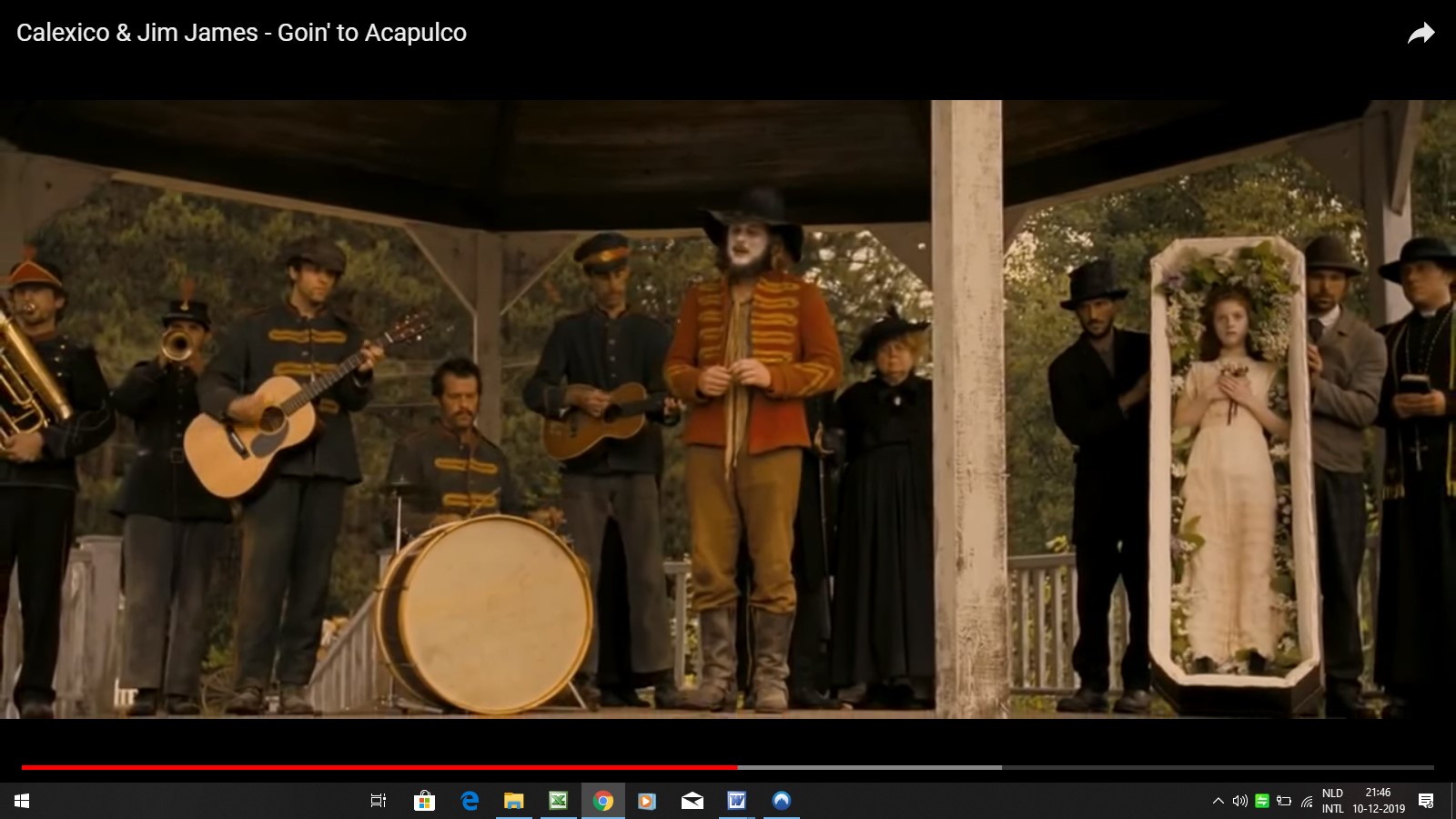
The height that The Roches and Manfred Mann are able to achieve is matched by Jim James, who, together with the men of Calexico, takes care of the wallflower “Goin” To Acapulco”. Their contribution to the Dylan film I’m Not There (2007) is one of the undisputed highlights, partly because director Todd Haynes places the song in a sensational, surrealistic context.
The Dylan character, in this excerpt played by Richard Gere, walks observingly into a village during the American Civil War. The atmosphere is chaotic. On the left and right, dozens of civilians, frantically dressed fairground customers and tired soldiers hurry somewhere. A giraffe walks stiffly through the image. The flow of people is concentrated in front of a music chapel, an ostrich strolls along. Then everything comes to a breathless halt when Jim James’s unearthly voice blares across the village: “I’m going down to Rose Marie’s.”
The stage of the chapel is filled with musicians who looted Sgt. Pepper and his Lonely Hearts Club Band’s wardrobe. The nostalgia seeps from their stage presentation and from the music they play. An older couple seeks comfort when two men raise an open coffin on the same stage; the corpse of a young woman, still a girl, who seems to be looking with eyes open, quite celestially, over the spectators to the Heavenly Kingdom. Solemn, sad attention binds the so diverse bystanders.
Director Haynes is, that much is clear, not only inspired by Greil Marcus’s weird old America, but apparently also by Dylan’s alienating statements about “Sad-Eyed Lady Of The Lowlands”. Still full of the mercury beauty of that song, Dylan hails it as “religious carnival music”.
A hard-to-follow qualification. Some religious symbolism and devout devotion may be found (but far too little to justify the label religious), and wherein the artist thinks to hear carnival is mysterious. Just as challenging as it is to get a clear picture Dylan’s mysterious classification; religious is a state of soul or spirit, carnival or funfair appeals to sensual, carnal pleasures.
But behold: when Jim James’ rendition, Dylan’s song and Haynes’ images come together, then we are there indeed: religious carnival music.
Most commentators point out the scabrous nature of the protagonist’s visit to Rose Marie, which then has the character of a visit to a prostitute; he “blows his plums”, “scratches his meat”, “gets something quick to eat” and “has some fun”. Not all of them are unambiguous, and some metaphors are rather eccentric, but the overall idea is pretty clear – he ain’t here for a cup of tea.
Dylan’s recital, however, adds a deeper dimension, and Jim James does reinforce it. The rendition is dramatic, rather a Job-like lamentation than the roar of an overexcited john. This is a lonely, unhappy soul seeking salvation. And he does not turn to some cheap harlot, but to Rose Marie, Maria, Our Lady with the Roses, who is always good for him. Probably the same Maria as in “Just Like A Woman” (Queen Mary, she’s my friend, I believe I’ll go see her again).
The poet does seem to steer in that direction, before publishing the lyrics, first in The Songs Of Bob Dylan 1966-1975 and later in Lyrics (1985), as he deletes, adds and scraps quite a lot from the most ambiguous passages. Thus the lines of text with the alcohol and the juicy fruit disappear,
I can blow my plums, and drink my rum,
and go on home and have my fun,
… and get replaced by
If the wheel don’t drop and the train don’t stop
I’m bound to meet the sun,
…with which the poet makes it a lot harder to discern filth. And a lot clearer that the protagonist is on his way to enlightenment. Likewise, the dubious meat scratching does not survive Dylan’s prudish second look;
I’m just the same as anyone else,
When it comes to scratching for my meat
… is rewritten into
I’m standing outside the Taj Mahal
I don’t see no one around,
… meaning that the wooer is suddenly no longer on the way to a house of pleasure, but is languishing lonely in front of the world’s most famous monument in memory of a lost love. On the other hand: the ambiguous goin’ to have some fun is maintained. In the chorus, the poet only changes soft gut into fat gut, for unclear reasons – both unusual expressions evoke an unsavoury abdominal girth.
The interventions are neither poetic nor narrative defensible, but the censor does succeed in increasing the ambiguity of the song. Now, on paper, “Goin’ To Acapulco” is already almost this religious carnival music, and Todd Haynes and Jim James provide the final push. Dylan the song composer delivers the beautiful melody and the misty poetry, Jim James the sacred, heartbreaking recital and Todd Haynes that mesmerizing setting, in which a multi-coloured group of birds of paradise and Biedermeiers is united in a grand, churchly devotion for something higher.
Credit also deserves the accompaniment. The men of Calexico equal the original with their modest, slow backing and still surpass the expressiveness with the use of wind instruments from the first chorus.
Even more than the Basement version, this cover inspires the professional confrères. The idiosyncratic Bonnie “Prince’ Billy, the most famous alter ego of Dylan fan Will Oldham, moves the entire song to Bourbon Street by dressing it in an attractive New Orleans jacket and turning the pace even further down, to a funeral march pace. To be found as a B-track on the beautiful EP Lay & Love (2006), which also features a uncommonly intimate, sober cover of “Señor”.
And Chris Robinson, the former frontman of the Black Crowes, who for years now is distinguishing himself with loving and glittering Dylan covers, plays a beautiful, dragging “Goin’ To Acapulco” a dozen times in 2015 and 2016 with his brethren of the Chris Robinson Brotherhood. Robinson seems to have the ambition to fill the empty space that the regretted Jerry Garcia has left behind. Not only in appearance – Robinson is gradually developing a large, full, fluffy beard that is starting to turn grey – but also with regard to the melodic and often long, drawn-out versions of well-known and less well-known Dylan songs. Robinson’s “Time Passes Slowly” is unsurpassed, for example. And also his Jerry Garcian tackling of Acapulco is memorable – most of his performances clock over fourteen minutes, and are compelling until the last, usually awkwardly dying away, second. The performance in San Rafael, December 30, 2016, where the Brotherhood fills a complete live set with Dylan and Grateful Dead covers, offers a wonderful rendition.
You’ll find some notes about our latest posts arranged by themes and subjects on the home page. You can also see details of our main sections on this site at the top of this page under the picture.
The index to all the 590 Dylan compositions and co-compositions that we have found on the A to Z page.
We also have a very lively discussion group “Untold Dylan” on Facebook with over 2000 active members. (Try imagining a place where it is always safe and warm). Just type the phrase “Untold Dylan” in, on your Facebook page or follow this link
If you are interested in Dylan’s work from a particular year or era, your best place to start is Bob Dylan year by year.
On the other hand if you would like to write for this website, please do drop me a line with details of your idea, or if you prefer, a whole article. Email Tony@schools.co.uk
And please do note The Bob Dylan Project, which lists every Dylan song in alphabetical order, and has links to licensed recordings and performances by Dylan and by other artists, links back to our reviews
Of course there were more songs than this written, and Expecting Rain provided a list
Baby Give It Up (Bob Dylan-Helena Springs)
Her Memory (Bob Dylan-Helena Springs-Ken Moore)
One More Time (Bob Dylan-Helena Springs)
Responsibility (Bob Dylan-Helena Springs)
Someone Else’s Arms (Bob Dylan-Helena Springs)
Tell Me The Truth One Time (Bob Dylan-Helena Springs)
What’s The Matter (Bob Dylan-Helena Springs)
Without You (Bob Dylan-Helena Springs)
Take It Or Leave It (Bob Dylan-Helena Springs)
Your Rockin’ Chair (Bob Dylan-Helena Springs) [Title uncertain?]
Heylin went further and added another five
Afternoon
Romance Blues
Satisfy Me
Brown Skin Girl
Miss Tea and Sympathy
and he states that over time all the songs were copyrighted.
However Dylan did not record them – at least in recordings we can find, and that includes the sound checks before concerts at which Dylan has regularly tried out new ideas and songs. What makes the matter of tracking these songs even more complicated is that Heylin also asserts that some songs changed their names along the way. “Brown skin girl” later becoming “Red Haired Girl” for example.
Obviously for us to be able to review a song we need to hear it, and so the list has been left as it was, but now Aaron has located a couple more tracks that seem to match songs on this list – “Tell Me the Truth One Time” and “Responsibility”
“Tell me the Truth One Time” appears on the recording below at five hours, 2 minutes 40 seconds (5.02.40 in digital) and goes on to 5.4.20. I’m sorry I don’t know how to edit this down so that just this song appears – if you know how to do that please do email the resultant edited version containing just the song to Tony@schools.co.uk and I’ll substitute the edit for the complete file. For now you’ll have to edge the cursor along the timeline at the foot of this video shot…
https://youtu.be/Narvah_Cy80
This is obviously a nearly completed song – the set of lyrics might not be totally worked out but the melody, chord sequence and great fun piano accompaniment that bounces along and emphasises the lyrics are all there.
But unfortunately, the recording is not complete – we can hear another verse start at the very end, but then the recording stops.
So why was the song abandoned? After all they’ve got the piano part bouncing along and although the lyrics are fairly standard “you done me wrong” we’ve got a good catchline in “Tell me the truth one time” which is varied at the end of each verse.
My feeling is that by the time we reach the fourth verse we’re feeling like we need a change – ideally a middle 8 (a secondary section of the music with a different chord sequence and different chord sequence). With such a strong musical accompaniment established and a clear melody and lyrical format, that would be the easiest thing to write in the song.
And that’s all that is needed. A rock band accompaniment, leaving the piano dominant, would not be hard to fit in, and the song would be there: a stonking good number for a Helena Springs gig and a song that might well be covered by other bands.
But the song stopped, and was seemingly either deliberately abandoned and simply forgotten, and that seems a shame.
I’m dating the song 1978 and adding it to the song to the list for that year, although without any knowledge where it comes within the collection that Dylan and Springs wrote.
I’ve made my usual inadequate attempt at the lyrics, but if you can improve on them that would be great.
Tell me what is wrong
Why can't we get along?
Tell me what is right
Tell me the truth one time then you lie all night

Your love is like a dying leaf
You bring me so much toil and grief
?
Tell me the truth one time I'll still remain

You leave me stranded on a hook
You were so blind you never looked
Rid your life of mortal sin
Tell me the truth one time and find the truth within

Saw you hanging with that group
Reminds me of that boiled soup
?
Tell me the truth one time and you'll still be late
What else is on the site
You’ll find some notes about our latest posts arranged by themes and subjects on the home page. You can also see details of our main sections on this site at the top of this page under the picture.
The index to all the 590 Dylan compositions and co-compositions that we have found on the A to Z page.
We also have a very lively discussion group “Untold Dylan” on Facebook with over 2000 active members. (Try imagining a place where it is always safe and warm). Just type the phrase “Untold Dylan” in, on your Facebook page or follow this link
If you are interested in Dylan’s work from a particular year or era, your best place to start is Bob Dylan year by year.
On the other hand if you would like to write for this website, please do drop me a line with details of your idea, or if you prefer, a whole article. Email Tony@schools.co.uk
And please do note The Bob Dylan Project, which lists every Dylan song in alphabetical order, and has links to licensed recordings and performances by Dylan and by other artists, and links back to our reviews
Even a cursory glance through the list of tracks reviewed on this site will bring up several that even the most ardent Dylan fan may not have heard of. With that in mind, I thought it might be fun to present some covers or remakes of some of these rarer songs for your enjoyment (alternatives to the alternatives if you like). Today I have four examples to highlight for you.
First up is one of Dylan’s rarest tracks, “Fur Slippers”. Dylan’s version was on an early running order for The Bootleg Series 1-3 but was bumped off to be replaced by something else. BB King recorded the track in 1999 and it was included on the “Shake, Rattle & Roll” tribute album.
What you might not be aware of is that The Crudup Brothers also covered the track on their 2000 album “Franktown Blues”. The brothers are the three sons of the legendary Arthur “Big Boy” Crudup and this would be their only album. The album contains mainly songs by their father so I’m at a loss to as to why they choose to include this track which is not one of Dylan’s finest pieces. As it is, I think it’s a decent enough cover of the track and better than BB King’s take.
Next up is an alternative version of The New Basement Tapes opening track Down on the bottom. The version on the album had music written by Jim James. Elvis Costello obviously had his eye on the track and wrote his own music for the lyrics, which he would perform in his solo shows from time to time.
A studio version was scheduled to come out on a charity compilation called “The Good Samaritan” in 2018, which as far as I’m aware never saw the light of day. The track eventually surfaced on a Record Store Day EP called “Purse” which included four tracks Elvis co-wrote with Burt Bacharach, Paul McCartney, Johnny Cash and this fine slow blues version of “Down On The Bottom” with Bob Dylan.
Now this next one is a song that I have grown to have an appreciation of, following Tony’s original review of the track. Steel Bars was co-written by Michel Bolton and originally appeared on his number 1 album “Time, Love & Tenderness”. Then just last year a new version appeared on his latest album “A Symphony Of Hits”. The new album sees Bolton performing new versions of some of his biggest hits backed by the Australian Philharmonic Orchestra.
I find this to be a superior version to the original, stripped as it is of some of the more overly produced elements and Bolton reins in some of his more histrionic singing. Whilst it’s still not a top tier Dylan track there are parts to this version which I really like.
Lastly, this is a bit of an interesting one. Does this count as a new Dylan co-composition or as a cover/remake of one? I’ll let you be the judge.
The track in question is called “Steel and Feathers (Don’t Ever)” and it is by Nikki Jean from her 2011 album “Pennies In A Jar”. The story goes that Nikki wrote with over 30 Hall Of Fame songwriters and released this album with tracks co-written by Thom Bell, Lamont Dozier, Burt Bacharach and Carole King amongst others.
Hidden in the track list is this track co-written with Dylan. Listening to the track one can hear the Dylan portion is clearly “Don’t ever take yourself away” – the original version found an official release on the “Hawaii 5-0” soundtrack album later that same year. Nikki took the tune and the chorus and added new verses to produce this track. As this was officially approved by Dylan does it make it a new Dylan track separate from “Don’t Ever Take YourselfAway” or is it a remake of it? Who knows, but it’s a fantastic track anyway!
Don't ever take yourself away
Don't ever take yourself to a place where I can't find you
Don't ever take yourself away
I will never leave you, I will never deceive you
I'll be right there walkin' behind you

Take your time, take my confession, take my crime
Take the halo, I'm hiding, in faith I got ridin' on you
Rob me blind, I'd still see the best in human kind
In the way you make this broken world all shiny and new

Don't ever take yourself away
Don't ever take yourself to a place where I can't find you
Don't ever take yourself away
I will never leave you, I will never deceive you
I'll be right there walkin' behind you

Take a cab to that little old diner and take a stab
At piecing together the steel and the feathers that make me
I've been told my hand is a hard one to hold
I fly or I sing but give me poison, I'll drink if you take me

Don't ever take yourself away
Don't ever take yourself to a place where I can't find you
Don't ever take yourself away
I will never leave you, I will never deceive you
I'll be right there walkin' behind you
Take my tears to water the flower garden

Take my years so we can grow
But don't ever take yourself away
Don't ever take yourself to a place where I can't find you
Don't ever take yourself away
I will never leave you, I will never deceive you
I'll be right there walkin' behind you
In case you like the song, here is a great version with the ever dependable Daryl Hall.
What else is on the site
You’ll find some notes about our latest posts arranged by themes and subjects on the home page. You can also see details of our main sections on this site at the top of this page under the picture.
The index to all the 590 Dylan compositions and co-compositions that we have found on the A to Z page.
We also have a very lively discussion group “Untold Dylan” on Facebook with over 2000 active members. (Try imagining a place where it is always safe and warm). Just type the phrase “Untold Dylan” in, on your Facebook page or follow this link
If you are interested in Dylan’s work from a particular year or era, your best place to start is Bob Dylan year by year.
On the other hand if you would like to write for this website, please do drop me a line with details of your idea, or if you prefer, a whole article. Email Tony@schools.co.uk
And please do note The Bob Dylan Project, which lists every Dylan song in alphabetical order, and has links to licensed recordings and performances by Dylan and by other artists, is starting to link back to our reviews
John Henry’s legendary, fatal and probably fictional race against the steam drill takes place sometime in the early 70s of the nineteenth century, between 1870 and 1872. During the construction of the Big Bend Tunnel in West Virginia the forerunner of the jackhammer, the steam drill, is used and proud John Henry claims that he and his nine-pound hammer are faster than such a new-fashioned steam-powered rock drilling machine. The race is set up, Henry wins, but exhausts himself to such an extent that he collapses and dies the day after.
Or it takes place five hundred miles to the south and ten years later, in 1882, at the tunnel construction through Curzey Mountain, Alabama. Or in 1887, at Oak Mountain. And Kentucky and Jamaica are mentioned too – like every good legend, this story is also available in many variations.
The veracity does not really matter for the impact of the story. A feature film, a musical, books, poems, a stamp, cartoons, orchestral and chamber music works, video games … since the end of the nineteenth century, the persona of John Henry has become ubiquitous in American culture. The probably best-known adaptation is the now antique folk song, for which Dylan also repeatedly expresses his admiration (in Chronicles, for example) and of which he explicitly acknowledges how influential the song is:
“If you sang “John Henry” as many times as me – John Henry was a steel-driving man / Died with a hammer in his hand / John Henry said a man ain’t nothin’ but a man / Before I let that steam drill drive me down / I’ll die with that hammer in my hand. If you had sung that song as many times as I did, you’d have written How many roads must a man walk down? too.”
(from the MusiCares speech, 2015)
Without “John Henry” I would not have been able to write “Blowin’ In The Wind” … it is hardly a trivial tune, apparently.
How indelible the influence is, is also evident from – ironically – “Tell Me, Momma”. Ironic, because that is the fierce, biting, hard rocker with which Dylan opens the electric part of the set in ’66, the song with which he snubs the orthodox folkies in the audience, the song that unleashes cursing, shouts and hollers in that part of his fan base.
As a result, and because of the often questionable sound quality, they do not hear the respectful reference to one of the crown jewels of folk music, right at the start, in the opening couplet:
Yes, you got your steam drill,
now you’re lookin’ for some kid
To get it to work for you
like your nine-pound hammer did
… in which the poet also implicitly expresses a farewell to traditional folk music. The person who swung the nine-pound hammer (Henry’s sledgehammer) is no longer there and now we are looking for someone who is able to use the steam drill; the metaphorical content (the transition from acoustic guitar to electric guitar) is not too inscrutable.
Just like steam drill is a key word for that folk monument, nine-pound hammer is the identifier from another folk classic that has been standing on Dylan’s pedestal for sixty years now: “Nine Pound Hammer”. He probably knows the song from The Stanley Brothers, and otherwise from The Greenbriar Boys, also known in the versions “Take This Hammer” and “Roll On, Buddy” … and Dylan sings the “Roll On, John” version thereof in ’62, which he will then rebuild half a century later into his ode to John Lennon on Tempest.
So “Tell Me, Momma” is not the blunt rejection of the folk music that fans and critics often see in it. Although even accessory Robbie Robertson seems to see only the song’s assertive side:
“We started using “Tell Me, Momma” as an opener, which meant not only were we going into hostile territory for our electric part of the show, but we were also starting the set with a funky, unfamiliar, aggressive, and not particularly melodic tune. Maybe it was a touch perverse, but I enjoyed coming out with a signpost song that said, I don’t need you to love me, I’m just going to play my damn music and maybe you’ll dig it.”
(Testimony, 2016)
The funky and aggressive content of the performance is largely due to Robertson’s contribution, who provides a truly great guitar part. The short, biting blows under the couplets are a mean upgrade from Scotty Moore’s part to Elvis’ “My Baby Left Me”, the solos, especially those in Australia, echo the funk of Curtis Mayfield and the soul of James Brown’s guitarist Billy Butler.
But true, the lyrics are pretty unclear. A studio recording does not exist, although Robertson seems to remember one:
Bob had booked Columbia Studios in New York to do some recording in January. (…)
After a couple of run-throughs, Bob was ready to record. We rambled though a song called “She’s Your Lover Now”. Then another new tune, “Tell Me, Momma”, with its salty punch line—“Baby, tell me, what’s wrong with you this time?”
… which should be the third Blonde On Blonde recording session, January 21, 1966 in New York. If that recording indeed exists, it never surfaced. The official lyrics, probably recorded in 1971, when copyright is filed, differ in an almost hilarious way from the lyrics we hear. The opening lines as they are written in Writings & Drawings, Lyrics and on the site are rightly mocked:
Ol’ black Bascom, don’t break no mirrors
Cold black water dog, make no tears
Or, even more insane, the third verse:
Ohh, we bone the editor, can’t get read
But his painted sled, instead it’s a bed
No, we will have to make do it with our own ears and the industrious puzzle work of the brave analysts who publish their findings on the fan forums and blogs.
Extra complicating, apart from the lack of audio quality, is the clumsy fact that Dylan apparently never really wrote lyrics for the song; he sings different words every night, particularly in the second and third verse.
Most decipherers do agree on the opening lines, though. Not “Ol” black Bascom” and not “Cold black water dog”, but:
Cold black glass don’t make no mirror
Cold black water don’t make no tears
… where it seems a little more likely that the first word is “Old”; “Old black glass” is a somewhat familiar concept (unlike “cold black glass”) and the mental leap to mirror is small – sooner or later the silver nitrate and copper sulphate in old mirrors will react with air and moisture particles, will oxidize, causing black stains. It has a metaphorical quality too, although that is mainly suggested; how the image can be integrated into this relational reckoning is not clear. “I no longer recognize myself in our relationship”?
And a relational reckoning, a put-down it surely is, as the understandable part and the chorus make clear:
But I know that you know that I know that you show
Something is tearing up your mind.
Tell me, momma,
Tell me, momma,
Tell me, momma, what is it?
What’s wrong with you this time?
… the sneering, vicious Dylan of “She’s Your Lover Now” and “Positively Fourth Street”, no doubt.
We also recognize the mid-60s Dylan in the ferocious, slightly lugubrious imagery in the second verse: both cemetery hips and graveyard lips have the same, disruptive quality as, for example, the guilty undertaker (“I Want You”), the graveyard woman (“From A Buick 6”) and the genocide fools (“Can You Please Crawl Out Your Window?”).
A morbid fascination can already be seen in Dylan’s earliest work, but there it is usually “real”; the songs are about actual graves, cemeteries, deaths (“Ballad For A Friend”, “Let Me Die In My Footsteps”, “Only A Hobo”).
In this phase of his artistry, the preference for the macabre evolves into a Baudelairian style characteristic; graves and cemeteries are no longer stage scenery, but metaphors. The susceptibility to it is undoubtedly triggered via the Beat Poets, via Ginsberg, Corso and especially Kerouac. Dylan sometimes literally borrows from Kerouac’s Desolation Angels (“her sin is her lifelessness” and the “perfect image of a priest” in “Desolation Row”, for example), and more often paraphrases. To name just one of many examples: the automobile graveyard from Dylan’s long “prose poem” Tarantula is automobile cemeteries at Kerouac.
And the influence extends to that preference for sinister imagery. The suburbs of New York full of commuters Kerouac calls “cemetery cities” (On The Road), the stew full of bones he gets in a Mexican prison cell “graveyard stew” (“Orizaba 210 Blues”, 41st Chorus).
“Tell Me, Momma” is, in short, a lost classic from one of the peak moments in Dylan’s long career, from the thin wild mercury period. And despite some wonderful live recordings, still more obscure than “She’s Your Lover Now” or “I’ll Keep It With Mine”, in the absence of a studio recording, whether completed or not, and a text that may or may not have been completed.
That mysterious status is confirmed by the lack of covers. Unusual, for a Dylan song from this golden phase, but there are virtually no covers. The Original Marauders produce a neat, but due to the toe-curling singing badly messed up version on their sympathetic, but failed, tribute project Now Your Mouth Cries Wolf from 1975.
And usual suspect Robyn Hitchcock on his equally sympathetic, and much more successful tribute Robyn Sings (2002), earns bonus points for his attempt to dig up this gold nugget, but finds only fool’s gold, pyrite. It shines, an early Beatlesque light, but it is not worth much – Hitchcock, too, will not be able to save the song from the darkness.
Alas, poor ol’ black Bascom, you cold black water dog.
What else is on the site
You’ll find some notes about our latest posts arranged by themes and subjects on the home page. You can also see details of our main sections on this site at the top of this page under the picture.
The index to all the 590 Dylan compositions and co-compositions that we have found on the A to Z page.
We also have a very lively discussion group “Untold Dylan” on Facebook with over 2000 active members. (Try imagining a place where it is always safe and warm). Just type the phrase “Untold Dylan” in, on your Facebook page or follow this link
If you are interested in Dylan’s work from a particular year or era, your best place to start is Bob Dylan year by year.
On the other hand if you would like to write for this website, please do drop me a line with details of your idea, or if you prefer, a whole article. Email Tony@schools.co.uk
And please do note The Bob Dylan Project, which lists every Dylan song in alphabetical order, and has links to licensed recordings and performances by Dylan and by other artists, and links back to our reviews
Seasons change. Spring turns to Summer, Summer to Autumn, Autumn to Winter. Childhood turns to Youth, Youth to Adulthood, Adulthood to Old Age. Realistic images are often taken by artists – who be themselves Romantically inclined – from the external seasons to serve as ‘objective correlatives’ that re-enforce the spiritual mood of the characters portrayed whether happy or sad; or indeed to emphasise the actual physical state of characters present in a particular work of art.
Artists wishing that time would stand still at a certain point in the ageing process turn not to Nature, but to man-made objects of art for corresponding images that remain, at least in relative terms, permanently fixed the same forever – as symbolized, for example, by a picture on an ancient urn:
Ah, happy, happy boughs! that cannot shed
Your leaves, nor ever bid the Spring adieu
And, happy melodies, unwearied
Forever piping songs for ever new
More happy love! more happy, happy love!
For ever warm, and still to be enjoyed
For ever panting, and for ever young
(John Keats: Ode On A Grecian Urn)
Wistful thinking on Keats’ part for sure. Singer/songwriter Bob Dylan settles for the hope of keeping a youthful spirit in spite of the inevitable process of physical aging:
May your hands always be busy
May your feet always be swift
May you have a strong foundation
When the winds of changes shift
May your heart always be joyful
May your song always be sung
May you stay forever young
(Bob Dylan: Forever Young)
Influenced by John Keats, satirist Oscar Wilde writes a story about a picture of a person named Dorian Gray in which the painted portrait of Gray ages; in real life, however, Gray remains forever young. Dorian goes on to lead a bad life; he stabs the artist to death who did the portrait because he blames him for causing the picture of Gray to become more and more hideous over time.
Not to be outdone, Bob Dylan claims, in a song, that he’s accused of shooting a man named Gray to death. Being a practical artist, Dylan then keeps a number of his own songs forever young by revising, to varying degrees, the lyrics of songs that he continues to perform.
An extreme case – the lyrics of ‘Gonna Change My Way Of Thinking’ at first speak of a possible permanence. Though the gates of Eden are guarded forever by a flaming sword, after the physical death of an individual on earth, a new spiritual life of happiness awaits him or her in Heaven if they’re lucky – the orthodox religious belief that Frederich Nietzsche calls the ‘morality of slaves’:
There's a kingdom called Heaven
A place where there is no pain of birth
Well the Lord created it, mister
About the time He made the earth
Then in a later version of the song, the lyrics speak of a time a-changing, and of a betrayal, not by a sword, but by a Judas kiss:
Jesus is calling, He's coming back to pick up his jewels
We're living by the golden rule, whoever got the gold rules ....
A brave man will kill you with a sword, a coward with a kiss
(Bob Dylan: Gonna Change My Way Of Thinking)
The latter version can easily be interpreted as rather cynical, and double-edged. Quoting as he does directly from Oscar Wilde’s ‘The Ballad From Reading Gaol”, Dylan questions with dark humour the hypocritical direction taken by the gold-seeking Christian churches of modern times as Geoffrey Chaucer does in his time, and Wilde in his day.
Done by their adding on many a supposition, true believers in church dogma (itself added to biblical scripture by various Judeo-Christian theologians over time) find assuredly that there’s little change in the meanings between the two versions of the song by Dylan ~ see: Kees de Gaaf, for example.
Below, however, is an imaginative word-picture painted by the Wilde Decadent, its mood correlated to realistic objects in external Nature akin to the style of the antiDeistic Transcendentalist Romantic poets like William Wordsworth and Walt Whitman than to that of the gloomy Gothic Romantics like Keats:
A delicate odour is borne on the wing in the morning breeze
The odour of leaves, and of grass, and of newly upturned earth
The birds are singing for joy of the Spring's glad birth
Hopping from branch to branch on the rocking trees
(Oscar Wilde: Magdalen Walks)
‘Magdalen’ being the name of a college that Oscar attended.
Bringing to mind a Transcendalist vision in song lyrics presented by the singer/songwriter, but a viewpoint that comes from the internal Imagination of the human Mind of the beholder rather than from some manifested guiding Absolute Spirit out there somewhere both within and without the physical Universe:
If not for you, the winter would hold no spring
Couldn't hear a robin sing
I wouldn't have a clue
If not for you
(Bob Dylan: If Not For You)
So it seems that man-made art can be a thing of beauty that lasts forever while some of it keeps its vitality everlasting by continuing to change.
Now that that’s all straightened out ….
What else is on the site
You’ll find some notes about our latest posts arranged by themes and subjects on the home page. You can also see details of our main sections on this site at the top of this page under the picture.
The index to all the 590 Dylan compositions and co-compositions that we have found on the A to Z page.
We also have a very lively discussion group “Untold Dylan” on Facebook with over 2000 active members. (Try imagining a place where it is always safe and warm). Just type the phrase “Untold Dylan” in, on your Facebook page or follow this link
If you are interested in Dylan’s work from a particular year or era, your best place to start is Bob Dylan year by year.
On the other hand if you would like to write for this website, please do drop me a line with details of your idea, or if you prefer, a whole article. Email Tony@schools.co.uk
And please do note The Bob Dylan Project, which lists every Dylan song in alphabetical order, and has links to licensed recordings and performances by Dylan and by other artists, is starting to link back to our reviews
Are you a talented singer or musician? Are you in a band? Then Untold Dylan needs your help! Welcome to “Bob Idol”!
First up, some context, followed by the details of what we are trying to do here.
As the (un)official Untold Dylan missing and lost songs bloodhound I’ve always got my feelers out searching for unknown and rare tracks. One such track I’ve been searching for, for about a year, is “Liverpool Gal”. Dylan wrote the track in December 1962 and performed it once at the home of David Whitaker in Minneapolis in July 1963. A tape apparently exists but has so far not surfaced officially or on bootleg. It is rumoured the song is about the artist Pauline Boty whom Dylan met in 1962 whilst in the UK to film Madhouse On Castle Street.
The track was performed once on BBC Radio Merseyside n 1992 by Ormskirk duo Lennon & Hyam, introduced by John Bauldie. It has been this version I have been searching for, even reaching out to Radio Merseyside for assistance, but all to no avail. Searching for the track taught me 3 things:
Lennon & Hyam have no internet presence whatsoever
A google search including the words Lennon and Liverpool bring up more than a couple of results!
The football (soccer) team Southend United currently have in their first team players with the last names of Lennon and Hyam!
This is all very interesting but brought me no closer to my goal!
Then a thought struck me, I have the lyrics, the chords and the melody, would this be enough to present to Tony to review for the site? Well, maybe, but isn’t it always better to have something to listen to in order to fully appreciate the track in question? And then a second thought struck me, I bet we have many talented singers and musicians amongst the readers on Untold Dylan who could put something together for us all to listen to!
So here is the offer: record your version of the track “Liverpool Gal” and post it to YouTube and then send the link to Tony at Tony@schools.co.uk and he and I will review any that we get and post them on Untold Dylan. The lyrics, chords and melody are listed at the end of this article.
Whilst we can’t offer any monetary reward, what you will receive is this:
Your version of the track will be included in Tony’s full review of the song
You will have contributed to the goal of the site to list to review every Dylan track
You will showcase your talents to the world and lastly
You will have introduced the world to this extremely rare and unknown Dylan song!
How will you present the song? That is up to you. It can be solo and acoustic as Dylan would have in 63, or you can use electric instrumentation of indeed have a whole band playing if you are part of such a group. Perhaps you could make something that would fit perfectly on Time Out Of Mind, or maybe something entirely different. Be as creative as you want to be!
If (and this is highly unlikely) we start to get so many versions we can’t put them all up, we’ll post a note at the top of this article and on the Facebook group. But normally such requests as this get very little response so the chances of that are slim.
Please remember to include your name and where you are from so we can credit you fully, also if you have a band, give your band’s name and all the musicians involved. It might be good if you also included a small note about your version, why you decided to do it the way you did etc.
Now, here are the lyrics, chords and melody
The melody is based upon The Lakes Of Pontchartrain. You might find it helpful to listen to a recording of that song – and helpfully Bob has recorded it
https://youtu.be/v5eBnKwW-fM
And if you want to compare with a more traditional version of the song here’s a link to one.
C . . /b . . Am . . F . .
When first I came to London town
C/g . . G . . F . G C . .
A stranger I did come
C /b Am F
I’d walk the streets so silently
C/g G F G C
I did not know no-one
Am . . Em . . F . G C . .
I was thinking thoughts and dreaming dreams
C . . Em . F . . G .
The kind when you roll along
. C /b Am F
But most of all I was thinking about
C/g G Am . . Em . . F . . G .
the land I’d left back home
I’d stand by the river Themes
with the wind blowing through my hair.
And who should come and stand by me
but a London gal so fair.
Her eyes were blue, her hair was brown
Her face was gentle and kind
For a second, well, I clear forgot
The land I left behind
As we began walking and talkin’
All through the English air
I did not know where we’d end up
’til we came to the top of a stair
As we lay round on a worn-out rug
the room it was so cold
And we talked for hours by the inside fire
’bout the outside world so old.
All through our sweet conversation
She thought my ways were so strange
But I know there was one thing about me
That she would try to change
And the night passed on with the drizzling rain
There’s one thing I found out
[A pair of sweet curls] I know too well,
Her love I know not much about *)
And I awoke the next morning
And the rain had turned to snow
I looked out of her window
And I knew that I must go
I did not know how to tell her
I didn’t know if I could
But she smiled a smile I’d never seen
To say she understood.
And thinking of her as I stood in the snow
How strange she appeared to be,
On the reason I was leaving,
she seemed no better than me.
I gazed all up at her window
where the snowy snow-flakes blowed
I put my hands in my pockets
And I walked ‘long down the road.
So it’s now I’m leaving London, boys
Well, the town I’ll soon forget,
Likewise its winds and weather
Likewise some people I met
But there’s one thing that’s for certain
Sure as the sunshine down
I’ll never forget that Liverpool Gal
Who lived in London Town.
In Scotland and parts of England, the black dog represents good luck. But elsewhere one of the more persistent myths about the black dog phenomenon concerns the instinctive fear that people are said have for it.
This is proven by animal shelter statistics: in many countries the chance that a black dog is taken by new owners is considerably smaller than with the different-coloured yapping tail-waggers. Research into this is inconclusive and therefore remains popular – for decades now there have been a number of academics every year who freshly start again tally marking in order to produce and defend with those figures usually weightless positions in theses. Especially in the anthrozoological faculties, obviously, but also the sociologists do participate diligently.
In the arts, the black dog is usually used to instill fear. Holmes’ Hound Of The Baskervilles is black (also in all 25 films since 1914), in Ian McEwan’s novel Black Dogs the Gestapo uses them as guard dogs and there they symbolize the evil what Western Civilization is capable of, the devil appears in Goethe’s Faust in the form of a black poodle, and when Breughel paints a black dog it is a bringer of bad luck and misery.
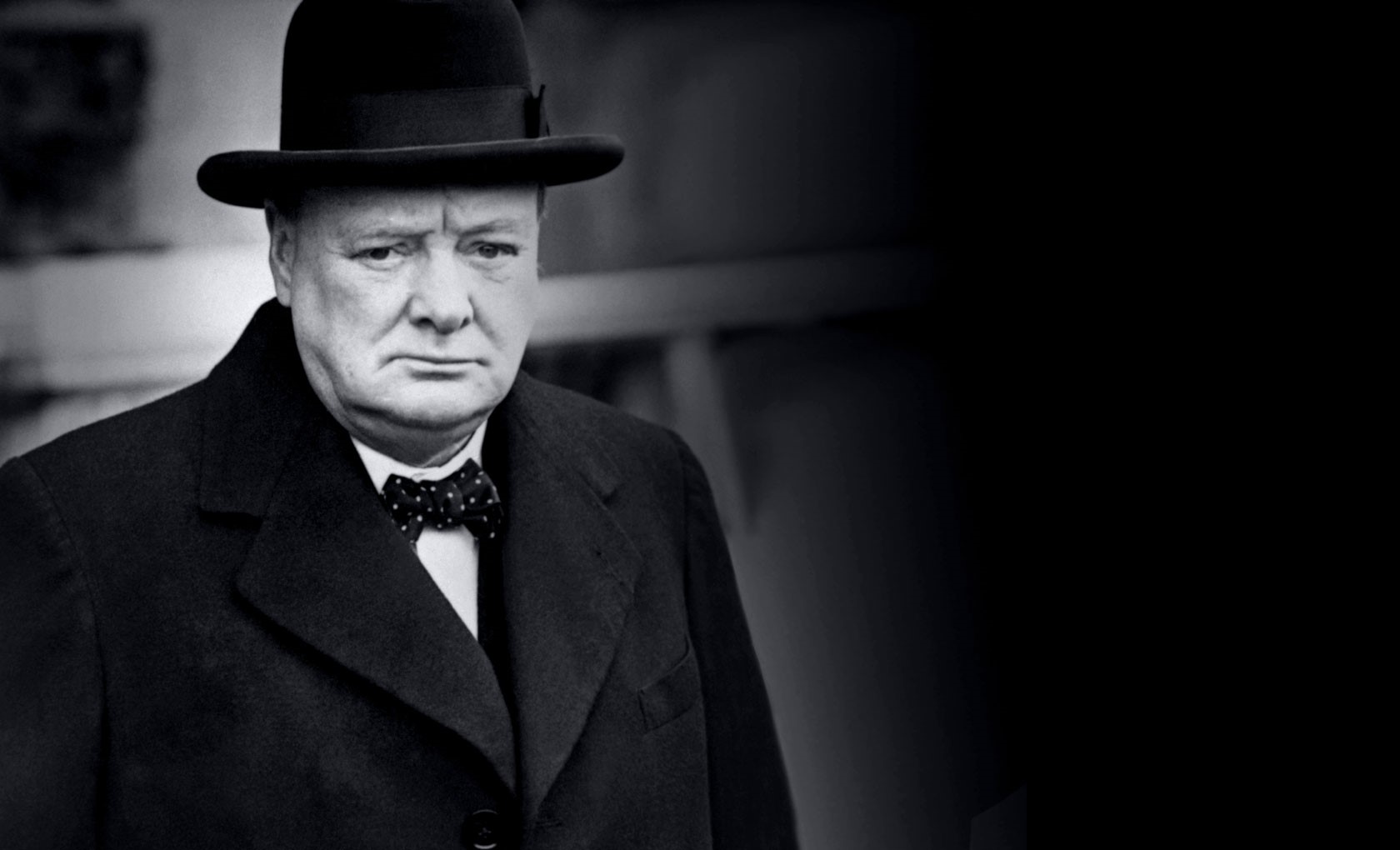
But much more poetic, and perhaps more famous, the Black Dog is known as a metaphor for depression. This interpretation is usually attributed to Churchill, who has indeed made it known by repeatedly referring to his own deep depression with the image of a black dog. “I think thist man might be useful to me,” he writes about a German psychiatrist, “if my black dog returns.”
However, the comparison is much older. As early as 1882, R.L. Stevenson (the Scottish author of Treasure Island) describes a melancholy figure as a man with “the black dog upon his back”, but Churchill probably got it from Samuel Johnson (1709-1784), from whose work Dylan sometimes draws (“Sweetheart Like You”, for example). Dr. Johnson, who, like Churchill, is a mentally unstable, literary genius, describes his “melancholy” as a black dog in various letters, suggesting that it is a common expression in the 18th century. And probably even longer; Horace knows already around 40 BC that a black dog brings bad luck and, somewhat roughly translated, will be your companion if “you hate your own company”.
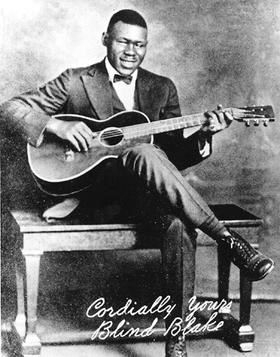
The black dog in “Obviously 5 Believers” belongs to the depression-bringing breed too. The song is initially called “Black Dog Blues”, before Dylan inserts the verse with the five believers and renames the song dadaesque, in line with titles such as “Absolutely Sweet Marie”, “4th Time Around” or “Temporary Like Achilles”. The original title the minstrel borrows from one of his old heroes, from Blind Blake, whom he will later honour more directly with a cover of his “You Gonna Quit Me Blues” (which will be the title song of Dylan’s album Good As I Been To You) .
Arthur “Blind” Blake (1896-1934) is one of the founding fathers of the blues and is in the same league as, for example, Blind Willie McTell and Charley Patton. And especially because of his phenomenal guitar playing; the integration of the ragtime piano sound is gratefully copied to this day by guitarists such as Mark Knopfler.
Blake’s first hit “Early Morning Blues” echoes through in Dylan’s opening words, and fragments of Blake songs are then heard in every subsequent verse, except in those surrealistic fifteen jugglers / five believers stophes. Although … “Fighting The Jug” comes close. Musically Dylan is less close to Blind Blake. Even though he (presumably) lived in Chicago for several years, Blake is not from the Chicago School, where the music of “Obviously 5 Believers” is clearly rooted. Maybe by accident; Robbie Robertson tells Cameron Crowe in 1985 that the Nashville studio musicians essentially just did their job, and this particular song happens to be an example where they changed the direction:
“I remember the Nashville studio musicians playing a lot of card games. Dylan would finish a song, we would cut the song and then they’d go back to cards. They basically did their routine, and it sounded beautiful. Some songs pushed it somewhere else, like Obviously Five Believers where we had four screaming guitar solos.”
… pushing it into the direction of a sharp, driven and energetic Chicago blues, that is. Simple enough, but less simple than Dylan himself seems to think. His slightly irritated outburst during the recordings is well-known: “Hey, what the f …,” he shouts at the second, prematurely interrupted take, “this is very easy man, this is very easy to do.”
Dylan apparently does not realize that he lets the experienced Nashville cats play a traditional twelve-bar blues, but that his couplets are only ten bars long; eight bars of vocals plus two bars instrumental is quite unusual (“Good Morning Little Schoolgirl” by Muddy Waters has a similar abnormality). Granted, not quantum mechanics, but still something to pay attention to. It’s the last recording session for Blonde On Blonde, it’s already past midnight – the sharpness is no longer there, understandably. Some complaining in the background and Dylan cuts it off: “Okay, let’s try it this time, I don’t want to spend no time with this song, man.”
Not too affectionate. Dylan already illustrates this disposability during the session: in each of the four takes the lyrics change, occasionally completely off the cuff ad-libbing some random words to fill up the line. After the recording, he ignores the song, it is not performed on stage and seems soon forgotten.
Until June ’85, when Dylan is a guest at a radio show that is broadcast nationwide. One of the songs that Bob himself has requested is “Obviously 5 Believers”, and host Bob Coburn is surprised:
Coburn: You wanted us to play “Obviously Five Believers”. Why? Why do you still want us to play that song? Dylan: I just like it. Coburn: You just like that song; here it is. Obviously Five Believers plays. Coburn: Some pretty nasty blues harmonica there Bob Dylan. “Obviously Five Believers” from Blonde On Blonde. Dylan: That’s not me though… Coburn: That’s not you, though? Who is it? Dylan: That’s Charlie McCoy.
But even in the years that follow, the song does not appear on the concerts’ playlists, and Dylan’s choice at the radio show seems to have been one of his smokescreens again… when the song suddenly pops up on the set list in May 1995. It is no ad hoc folly either: up until April 1997 the master performs it forty times. And he does indeed seem to enjoy it.
Despite this unexpected revival, however, the song remains a curiosity, and the same goes for the colleagues: there are not too many covers – actually only two noteworthy, both adding equally little to the original.
Top Jimmy and the Rhythm Pigs from Los Angeles release their debut album Pigus Drunkus Maximus in 1987, despite the adolescent title an infectious, exciting blues rock exercise. Striking are “Ballad Of A Thin Man” and Merle Haggard’s “Working Man Blues”, but the highlight is a steamy version of “Obviously 5 Believers”.
A bit more attractive, on more fronts, is Toni Price on her second album Hey (1995). The band is filthy and mean, no better or worse than Top Jimmy’s, but hey: the drawling, sensual vocals of the quite irresistible Texan lady really are a plus. An antidepressant, actually.
What else is on the site
You’ll find some notes about our latest posts arranged by themes and subjects on the home page. You can also see details of our main sections on this site at the top of this page under the picture.
The index to all the 590 Dylan compositions and co-compositions that we have found on the A to Z page.
We also have a very lively discussion group “Untold Dylan” on Facebook with over 2000 active members. (Try imagining a place where it is always safe and warm). Just type the phrase “Untold Dylan” in, on your Facebook page or follow this link
If you are interested in Dylan’s work from a particular year or era, your best place to start is Bob Dylan year by year.
On the other hand if you would like to write for this website, please do drop me a line with details of your idea, or if you prefer, a whole article. Email Tony@schools.co.uk
And please do note The Bob Dylan Project, which lists every Dylan song in alphabetical order, and has links to licensed recordings and performances by Dylan and by other artists, is starting to link back to our reviews
In life and in art, Decadent writer Oscar Wilde rebels against the established norms imposed by Victorian society. He’s celebrated for a time, but in the end suffers the consequences for doing so though he’s pardoned after he dies:
Yet each man kills the thing he loves
By each let it be heard
Some do it with a bitter look
Some with a flattering word
The coward does it with a kiss
The brave man with a sword
(Oscar Wilde: The Ballad Of Reading Gaol)
Singer/songwriter Bob Dylan picks up on the analogy – somewhat a gloomy if wistful look at human existence, gnostic-like . The darkness of life is compared to a prison with only a glimmer of light coming in through the barred window – whether literal or figurative, death be quick or it be slow, but awaits all:
I'll tell you something
Things you never had you'll never miss
A brave man will kill you with a sword
A coward with a kiss
(Bob Dylan: Gonna Change My Way Of Thinking)
https://youtu.be/8AztLb5mCdk
God’s wrath be usurped by robed priests of the Establishment in the movie ‘The Trials Of Oscar Wilde’, starring Peter Finch. The film ends with Wilde’s words from his mighty pen spoken over the final scene:
The coward does it with a kiss
The brave man with a sword
A theme expressed in the following song lyrics:
There's a lone soldier on the cross
Smoke pouring out of a boxcar door
You didn't know it, you didn't think it could be done
In the final end, he won the war
After losing every battle ....
You hurt the ones I love best, and cover up the truth with lies
One day you'll be in the ditch, flies buzzing around your eyes
Blood on your saddle
(Bob Dylan: Idiot Wind)
Satire flows freely from the Gothic pen of the poet Wilde:
And the wild regrets, and the bloody sweats
None knew as well as I
For he who lives more lives than one
More deaths than one must die
(Oscar Wilde: The Ballad Of Reading Gaol)
Burlesque double-dances as well from the lyrics of the singer/songwriter:
They say I shot a man named Gray
And took his wife to Italy
She inherited a million bucks
And when she died it came to me
I can't help it if I'm lucky
(Bob Dylan: Idiot Wind)
In the final end, decadent Oscar Wilde is figuratively saved from physical death by his exquisite art for art’s sake:
Behind every exquisite thing that has existed, there was something tragic
(Oscar Wilde: The Picture Of Dorian Gray)
And surely Bob Dylan by his song lyrics and music:
Behind every beautiful thing, there has been some kind of pain
(Bob Dylan: Not Dark Yet)
What else is on the site
You’ll find some notes about our latest posts arranged by themes and subjects on the home page. You can also see details of our main sections on this site at the top of this page under the picture.
The index to all the 590 Dylan compositions and co-compositions that we have found on the A to Z page.
We also have a very lively discussion group “Untold Dylan” on Facebook with over 2000 active members. (Try imagining a place where it is always safe and warm). Just type the phrase “Untold Dylan” in, on your Facebook page or follow this link
If you are interested in Dylan’s work from a particular year or era, your best place to start is Bob Dylan year by year.
On the other hand if you would like to write for this website, please do drop me a line with details of your idea, or if you prefer, a whole article. Email Tony@schools.co.uk
And please do note The Bob Dylan Project, which lists every Dylan song in alphabetical order, and has links to licensed recordings and performances by Dylan and by other artists, is starting to link back to our reviews
And a very happy Christmas indeed from and to everyone involved in Untold Dylan.
On behalf of everyone involved in the grand adventure that Untold Dylan has become I would like to thank you for reading some of our work, and for supporting what we do.
Untold Dylan is a website and a Facebook site built and developed by people from across Europe, Australasia and North America. It is for everyone a work of love; the advertisements we have and the occasional sponsored post on the site, simply help pay the bills for keeping the site online, and keeping it safe.
So on this Christmas Day I want to do something that I do not do nearly enough, which is to thank publically the writers who have so willingly made the site what it is by contributing series of articles on new and different topics.
I’ve never most of these guys, but I am rather thinking that I might just start a world tour to go and say a very particular thank you to each in turn and take each one in turn out for a meal. A sort of Rolling Untold Dylan Dinner. (I could then write it up and it would be the Rolling Untold Dylan Dinner Review).
So thank you to
Larry Fyffe in Canada
Jochen Markhorst in the Netherlands
Mike Johnson (Kiwipoet) in New Zealand
Aaron Galbraith in Virginia, USA
Filip Łobodziński in Poland
Joost Nillissen in the Netherlands
and of course to everyone else who has contributed thoughts, ideas, and individual articles. Without your input the site would be far less fun and far less valuable than it is.
Our very first article was a review of “Mississippi” published on 20 October 2008. Since then we have published over 1400 articles including (and this is where we like to think we’ve done something original) at least one review of every single song Bob Dylan has written or co-written. And we’ve even made an attempt to put them into the chronological order of writing.
In addition we have looked at numerous themes, ranging from Dylan’s harmonica playing to the best cover versions of his songs, from the poets and songwriters who have influenced Dylan through to the art work on Dylan’s albums, from translating Dylan into Polish through to the musicians Dylan himself professes to like and admire.
And here may I also add that there is no limit to the ideas and series that can be covered. We have series of articles on specific topics because in each case the writer has come along and suggested we do the series. And so off we go. If you have an idea for an article or a series of articles that we have not tackled, or which could be taken further, then please do write to me (my email address is at the end) and let’s discuss it.
And finally, but absolutely not least, a special thank you to Pat Sludden who encouraged me to start this venture, who very gently and kindly urged me to pick it up again when during a very dark time I stopped writing completely, and who is so active and helpful on our Facebook page.
I owe all you guys a huge debt, and if I actually do make it to Canada, the Netherlands, USA, Poland and/or New Zealand, the drinks are on me.
To join our Facebook group just type the phrase “Untold Dylan” on your Facebook page or follow this link
To suggest an article that you’d like to write, email tony@schools.co.uk
Happy Christmas, and above everything else, thank you for reading.
My interest in expanding the Dylan Year by Year series is to try and chart the lyrical themes that Dylan explored across time, noting (if possible) how certain themes and ideas took hold of him, and then were later left behind as he moved on. In short, to answer the question, “What did Bob Dylan write about each year?”
To explain a little further, everyone knows about the religious period, but years outside that two and a half year spell of writing Christian songs have, to my mind, mostly been examined either in terms of Dylan’s personal life, or his touring, or song by song. I’m trying to look for the ebb and flow of themes that interested Bob.
In my earlier piece Bob Dylan in 1965: the year Dylan invented two totally new forms of music I tried to outline the changes Dylan was making both to his own songwriting, and the whole notion of songwriting for the mass audience. A list of the other articles in this series is given at the end of this piece.
In this year Dylan composed 29 new songs that have survived. It was a return to the sort of productivity we had witnessed in 1962 (36 songs), and 1963 (30 songs). But more than this, this year contained the creation of some of the masterpieces that have ever since been associated with his name. Farewell Angelina, Subterranean Homesick Blues, Love Minus Zero, It’s all over now baby blue, Like a Rolling Stone, Desolation Row, Visions of Johanna…. I would suggest any one of these songs could have been the summit of a lifetime’s work for most popular songwriters – for Dylan, they just came pouring out in one year.
But what was the theme? What was Dylan’s subject matter? Those are the questions I have been toying around with thus far and as before we find Dylan operating in a whole range of areas through his lyrics and musical styles.
For each year thus far I have given each song the briefest of classifications, to try and help me see what Dylan’s key subject matter was.
Before the start of this year the key issues that Dylan was concerned within his writing were
Protest (war, poverty, society…): 19 songs so far
Travelling on / songs of leaving: 13 songs so far
Lost love / moving on 12 songs: so far
Humour / satire / talking blues: 12 songs so far
In this year here’s how I would categorise these songs… And of course this is just my choice, struggling as I am not to create so many categories that the process becomes meaningless.
Surrealism / Dada (a new category started this year: 11 in all)
At the top of the piece, I noted the key subject areas that are occupied Dylan’s mind in his earlier years of songwriting. Here’s how that running total looked at the end of this year
Protest (war, poverty, society…): 20 songs so far
Lost love / moving on 19 songs: so far
Travelling on / songs of leaving: 15 songs so far
Humour / satire / talking blues: 13 songs so far
Surrealism / dada: 11 songs, all composed in this year.
Here is a list of the other categories I have created for previous years, but for which in my estimation, Dylan did not compose a song in 1965
Gambling (1 in 1962, 0 in 1963, 0 in 1964). Total: 1)
It’s just how we see the world (1 in 1962, 0 in 1963, 2 in 1964.) Total: 3)
Personal commentary – do the right thing (2 in 1962, 0 in 1963, 0 in 1964. Total: 2)
The future will be fine (1 in 1962, 0 in 1963, 1 in 1964. Total: 2)
The tragedy of modern life (3 in 1962, 0 in 1963, 0 in 1964. Total: 3.)
Death (3 in 1962, 1 in 1963, 0 in 1964: Total: 3.)
Patriotism (1 in 1962, 0 in 1963, 0 in 1964. Total 1.)
Social commentary / civil rights (4 in 1962, 2 in 1963, 0 in 1964. Total 6.)
Individualism (1 in 1962, 0 in 1963, 5 in 1964. Total: 6)
Personal commentary – do the right thing (2 in 1962, 0 in 1963, 0 in 1964. Total 2.)
Nothing changes (3 in 1962, 1 in 1963, 0 in 1964. Total 4)
The future will be fine (1 in 1962, 0 in 1963, 1 in 1964. Total 2.)
The second coming / religion (1 in 1962, 1 in 1963, 0 in 1964. Total 2)
Justice (0 in 1962, 2 in 1963, 0 in 1964. Total 2)
Articles published so far in this series written by Patrick Roefflaer can be found at the end of the article.
Here we deal with the art work of Infidels
———————————–
Released October 27,1983
Photographer Sara Dylan
Drawing Bob Dylan
Art-director Lane/Donald
———————————–
About five months after the release of Infidels, Bob gives an interview to Rolling Stone. Kurt Lodger closes the conversation with a question about the cover: “I think a lot of people take you for a pretty gloomy character these days, just judging by your photos. Why reinforce that image by calling this latest album Infidels?”
The answer is very Dylanesk: “Well, there were other titles for it. I wanted to call it Surviving in a Ruthless World. But someone pointed out to me that the last bunch of albums I’d made all started with the letter s. So I said, “Well, I don’t wanna get bogged down in the letters.” And then Infidels came into my head one day. I don’t know what it means, or anything.
Lodger insists: “Don’t you think when people see that title, with that sort of dour picture on the front, they’ll wonder, “Does he mean us?”
“I don’t know. I could’ve called the album Animals, and people would’ve said the same thing. I mean, what would be a term that people would like to hear about themselves? […] I mean, I don’t know any more about it than anybody else really. I did it. I did the album, and I call it that, but what it means is for other people to interpret, you know, if it means something to them. Infidels is a word that’s in the dictionary and whoever it applies to… to everybody on the album, every character. Maybe it’s all about infidels.”
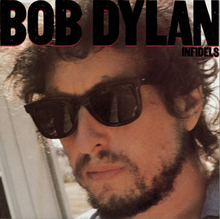
Tony Lane and Nancy Donald, who took care of the design of the cover, further reinforced the gloomy feeling by writing the name of the singer in large black letters, finished with a red shadow line at the bottom. The only decoration on the entire design is a thin grey (!) border.
The photo itself is a close up of Dylan’s head. He does not pose, but looks straight ahead. In his dark sunglasses we see the reflection of the white centre line on the black asphalt. It looks like the work of a paparazzi, who photographed a famous person, waiting in a stationary car.
There is no photographer mentioned on the cover, but Rod MacBeath suspects it is Sara Dylan who pressed the button. She also took the photo that adorns the inner cover. There Dylan is pictured, squatting on the Mount Olive, with Jerusalem in the background.
The reason for their presence there, is explained by Dylan to Mick Brown, during an interviews him for the Sunday Times: Dylan and his ex-wife went to Israel in September 1983 for the bar mitzvah of their eldest son, Jesse. “An idea from his grandmother,” he added with a smile.
According to Jewish tradition, this transitional ritual should have taken place shortly after the boy’s thirteenth birthday on January 6, 1979, but then Dad was too busy with an intensive three-month Bible study course at the School of Discipleship.
On the back of the cover is a self-made drawing of a man kissing a woman.
When Bob Coburn (on June 17, 1985 during a radio interview for Rockline KLOS-FM Los Angeles) asks him who is presenting the couple, Dylan answers vaguely: “‘Hmm, well, the woman is someone I knew. [Laughs] The man I think I was wishing to be me, I guess.”
Some say the drawing was originally planned for the front of the sleeve.
You’ll find some notes about our latest posts arranged by themes and subjects on the home page. You can also see details of our main sections on this site at the top of this page under the picture.
The index to all the 590 Dylan compositions and co-compositions that we have found on the A to Z page.
We also have a very lively discussion group “Untold Dylan” on Facebook with over 2000 active members. (Try imagining a place where it is always safe and warm). Just type the phrase “Untold Dylan” in, on your Facebook page or follow this link
If you are interested in Dylan’s work from a particular year or era, your best place to start is Bob Dylan year by year.
On the other hand if you would like to write for this website, please do drop me a line with details of your idea, or if you prefer, a whole article. Email Tony@schools.co.uk
And please do note The Bob Dylan Project, which lists every Dylan song in alphabetical order, and has links to licensed recordings and performances by Dylan and by other artists, is starting to link back to our reviews
Poet Thomas Hardy pities himself, or at least his persona, for losing some gal that he loves:
And when my love' s heart kindled
In hate of me
Wherefore I knew not, died I
One more degree ....
Yet is it that, though whiling
The time somehow
In walking, talking, smiling
I live not now
(Thomas Hardy: Dead Man Walking)
The theme’s carried on in a bluegrass song:
Ain't talkin', just walkin'
Down this highway of regret
Heart's burnin', still yearnin'
For the best girl this poor boy's ever met
(Stanley Brothers: Highway Of Regret ~ R. Stanley/D. Anthony)
Surfaces again in the song lyrics below:
Ain't talkin', just walkin'
My mule is sick, my horse is blind
Heart burnin', still yearnin'
Still thinkin' 'bout that gal I left behind
(Bob Dylan: Ain’t Talkin’)
https://youtu.be/Hx6fHd99SxA
Playwrite Thomas Hardy pities ordinary soldiers; deplores their masters – there be a pun on Napoleon Bonaparte’s name:
Onwards again
If Boney's come, 'tis best to be away
And if he's not, why we've a holiday
(Thomas Hardy: The Dynasts – Part One, Act II, sc.v)
Singer/songwriter Bob Dylan too makes fun of Napoleon’s last name:
You need a different kind of man, babe
One that can grab, and hold your heart
You need a different kind of man
You need Napoleon Bony-Part
(Bob Dylan: Hero Blues)
Thomas Hardy’s sentiment be basically anti-war; he tells the story of Napoleon’s snowy retreat from Moscow with this image of ‘The Grande Army’:
The caterpillar shape still creeps laboriously nearer .....
And there are left upon the ground behind it minute parts of itself
(Thomas Hardy: The Dynasts – Part Three, Act I, sc. ix)
Then there’s this rendition of a song by its writer that’s about a broken heart – it includes the following Napoleonic analogy:
All your seasick sailors, they are rowin' home
All your reindeer armies are all goin' home
The lover who just walked out of your door
Has taken all his blankets from the floor
(Bob Dylan: It’s All Over Now Baby Blue)
Emperor Napoleon serves the singer/songwriter well as a symbol for a person possessing a militaristic attitude:
Your daddy walks in wearin'
A Napoleon Bonaparte mask
Then you ask me why I don't live here
Honey, do you have to ask?
(Bob Dylan: On The Road Again)
(This recording was found on the internet with the note “Performed by David Lowe
9/4/13 The Rev’s House sessions III”)
And as a symbol of the mighty who have fallen (the Duke of Wellington beats Napoleon at Waterloo):
You used to be so amused
At Napoleon-in-rags, and the language that he used
Go to him now, he calls you, you can't refuse
When you ain't got nothin', you got nothin' to lose
Bob Dylan: Like A Rolling Stone)
There’s the ‘Titanic’, the world’s grandest metaphor for an Existentialist Universe:
Over the mirrors meant
To glass the opulent
The sea-worm crawls
Grotesque, slimed, dumb, and indifferent
(Thomas Hardy: The Convergence Of The Twain)
Mixing up the medicine, it’s a viewpoint that Bob Dylan acknowledges:
Wellington, he was sleepin'
His bed began to slide
His valiant heart was beatin'
He pushed the tables aside
(Bob Dylan: Tempest)
What else is on the site
You’ll find some notes about our latest posts arranged by themes and subjects on the home page. You can also see details of our main sections on this site at the top of this page under the picture.
The index to all the 590 Dylan compositions and co-compositions that we have found on the A to Z page.
We also have a very lively discussion group “Untold Dylan” on Facebook with over 2000 active members. (Try imagining a place where it is always safe and warm). Just type the phrase “Untold Dylan” in, on your Facebook page or follow this link
If you are interested in Dylan’s work from a particular year or era, your best place to start is Bob Dylan year by year.
On the other hand if you would like to write for this website, please do drop me a line with details of your idea, or if you prefer, a whole article. Email Tony@schools.co.uk
And please do note The Bob Dylan Project, which lists every Dylan song in alphabetical order, and has links to licensed recordings and performances by Dylan and by other artists, is starting to link back to our reviews
This article comes from the series “Songs about Dylan” – you can find details of other articles in this series via that link (and in case you lose the link it also appears in the list of series below the Dylan picture at the top of the screen).
Today let’s take a look at two tracks by two of the biggest superstars of the 70s, David Bowie and Elton John.
First up it’s Bowie with “Song For Bob Dylan”
The track appears on Bowie’s greatest album, “Hunky Dory”. It kinda gets lost amidst that album’s classic tracks such as “Changes”, “Oh, You Pretty Things” and, especially, “Life On Mars”. But it’s still a great song. Here are the second and third verses
You gave your heart to every bedsit room
At least a picture on my wall
And you sat behind a million pair of eyes
And told them how they saw
Then we lost your train of thought
The paintings are all your own
While troubles are rising
We'd rather be scared
Together than alone

Now hear this Robert Zimmerman
Though I don't suppose we'll meet
Ask your good friend Dylan
If he'd gaze a while
down the old street
Tell him we've lost his poems
So they're writing on the walls
Give us back our unity
Give us back our family
You're every nation's refugee
Dylan wrote in “Chronicles”:
“I found myself stuck in Woodstock, vulnerable and with a family to protect. If you looked in the press, though, you saw me being portrayed as anything but that. It was surprising how thick the smoke had become. It seems like the world has always needed a scapegoat—someone to lead the charge against the Roman Empire. But America wasn’t the Roman Empire and someone else would have to step up and volunteer…Now it had blown up in my face and was hanging over me. I wasn’t a preacher performing miracles. It would have driven anybody mad.”
In an interview in Melody Maker in 1976 Bowie said, “It was at that period that I said, ‘Okay, Dylan, if you don’t want to do it, I will.’ I saw that leadership void”. Bowie’s song begins by directly referencing “Song To Woody” and so sets himself up to be Dylan’s heir presumptive:
Next up it’s an unreleased Elton John track with lyrics by, as usual, Bernie Taupin. “The Day Bobby Went Electric”
It might have been Ibiza
But it could have been the coast of Spain
On a clapped-out continental radio
I thought I heard his name
But I was just another hippie then
With my copy of Rolling Stone
In a kickback full of hashish
That I was trying to smuggle home
chorus:And where were youWhen you knewWhere were youWhen you heardThe day that Bobby went electricHow did you receive the word
There was years of independence
Put a meaning on the words "hard rain"
In a rundown beachfront arcade I heard
How the times have changed
I was thrown in jail in Tangiers
With a couple from Montreal
Who'd been working their way to London
To see the plug-in at the Albert Hall
The day that Bobby went electric
I was struggling through my teens
And when he plugged in up at Newport
I was caught up in a dream
The track was demo’d for the excellent “Songs From The West Coast” album. I’m surprised that it wasn’t used on the album or as a B side as it would really fit in with the sound and theme of that album. Maybe one day he will finish it off and record it properly for an album. It certainly works for me.
Now it’s quiz time… In 1973 Elton performed on radio a jokey pub piano style medley of some Dylan tracks. Much like Vic Reeves on Shooting Stars doing his Club Singer bit, try and figure out what songs Elton is playing here!
If you don’t get the Vic Reeves reference, here’s a clip to help you out. Enjoy!
https://m.youtube.com/watch?v=MRwgNtv29ig
What else is on the site
You’ll find some notes about our latest posts arranged by themes and subjects on the home page. You can also see details of our main sections on this site at the top of this page under the picture.
The index to all the 590 Dylan compositions and co-compositions that we have found on the A to Z page.
We also have a very lively discussion group “Untold Dylan” on Facebook with over 2000 active members. (Try imagining a place where it is always safe and warm). Just type the phrase “Untold Dylan” in, on your Facebook page or follow this link
If you are interested in Dylan’s work from a particular year or era, your best place to start is Bob Dylan year by year.
On the other hand if you would like to write for this website, please do drop me a line with details of your idea, or if you prefer, a whole article. Email Tony@schools.co.uk
And please do note The Bob Dylan Project, which lists every Dylan song in alphabetical order, and has links to licensed recordings and performances by Dylan and by other artists, is starting to link back to our reviews
By literary standards, the autobiography of Keith Richards, Life (2009), is perhaps outweighed by Dylan’s memoirs, but on all other fronts both works are of a comparable, compelling level.
Attractive with both rock stars are the quirky choice of words, the attention to rhythm and sound of the sentences, and in terms of content especially the common thread: the deep, unconditional, all-embracing love for music.
Richards fully recognizes that his love of music has something neurotic, something obsessive:
“You might be having a swim or screwing the old lady, but somewhere in the back of the mind, you’re thinking about this chord sequence or something related to a song. No matter what the hell’s going on. You might be getting shot at, and you’ll still be “Oh! That’s the bridge!” And there’s nothing you can do; you don’t realize it’s happening. It’s totally subconscious, unconscious or whatever. The radar is on whether you know it or not. You cannot switch it off. You hear this piece of conversation from across the room, “I just can’t stand you anymore”… That’s a song. It just flows in.”
… very similar to the words that Dylan chooses to describe how he is always picking up songs:
“A lot of times you’ll just hear things and you’ll know that these are the things that you want to put in your song. Whether you say them or not. They don’t have to be your particular thoughts. They just sound good, and somebody thinks them. Half my stuff falls along those lines. Somebody thinks them. I’m sure, when I’m singing something, that I’m not just singing it to sing it. I know that I’ve read it. Somebody’s said it. I’ve heard a voice say that. A song like Don’t Fall Apart On Me Tonight sort of falls into that category: I’ll take you to a mountaintop and build you a house out of stainless steel. That kind of stuff just passes by. A guy’s getting out of bed saying don’t talk to me; it’s leaving time. I didn’t originate those kinds of thoughts. I’ve felt them, but I didn’t originate them. They’re out there, so I just use them.”
(interview with Bill Flanagan, 1985)
But Richards’ excessive talent does of course not lie with the poetic part of songs, but purely on the musical level. And his genesis as a songwriter is bit more cumbersome than Dylan’s, as he describes with amusing self-mockery and frankness. For eight, nine months he and Jagger are busy trying to write an acceptable song, he tells, until with “The Last Time” in January ’65, they finally, finally have a song they dare present to the other Stones – and that song is actually not much more than a rip-off from The Staple Singers’ “This May Be The Last Time”, which then becomes memorable mainly thanks to the lick Brian Jones adds.
Before that, Richards confesses with a grin, the Glimmer Twins write horrific songs, with titles such as “We Were Falling In Love” and “So Much In Love”. Some of those misfits end up with other artists, who sometimes manage to squeeze a small hit out of it. Gene Pitney with “That Girl Belongs To Yesterday”, for example, and Lulu with “Surprise, Surprise” (with Jimmy Page on guitar). But most of the time it leads to a flop or, as Keith says sardonically: “Our songwriting had this other function of hobbling the opposition while we got paid for it.” He mentions Cliff Richard, whose impressive stream of hits comes to an end when recording a Jagger / Richards song for the first time, the actually pretty nice song “Blue Turns To Gray” – Cliff’s first single that doesn’t reach the Top 10, but gets stuck somewhere in the Top 30.
“And when the Searchers did “Take It Or Leave It,” it torpedoed them as well.”
Keef is exaggerating a bit, but not that much. Sir Cliff’s Stones excursion is his thirty-fourth single and the fifth which does not reach the top positions – but still number 15. And the next three singles in 1966 reach, as usual, the Top 10 again.
The single from The Searchers is released on April 13, 1966 (two days before Aftermath, which contains the Stones version), when The Searchers have not had a Top 10 hit for more than a year. And that last big hit, “Goodbye My Love” in February ’65, is a final outburst after the steady stream of big hits in ’63 and ’64, after super hits like “Needles And Pins”, “When You Walk In The Room”, “Love Potion No. 9” and “Sweets For My Sweet”.
So by the time of that Stones song the career of The Searchers was already on a dead end, but indeed: after this it is definitely over. “Take It Or Leave It” reaches a meagre 31st place, the next single does not go further than 48 and the nineteen singles thereafter do not reach the hit parade.
A last album, Take Me For What I’m Worth (1965) is not doing too well either, but The Searchers do not give up. With many live performances, Greatest Hits collections, a few staff changes and re-releases (the biggest hits are re-recorded in 1972, stereo and re-released with reasonable success), the Mersey beatniks of the first hour keep themselves afloat.
In 1979 the time is considered ripe for a comeback: after fifteen years the men record an album with new material again. It will not be a success, neither artistically nor commercially. Record company Sire may be blamed some – virtually no marketing, tampering with track selection and track order on different releases – but The Searchers themselves also drop the ball.
Great songwriters the chaps never have been. On this album there are only two songs of their own – apparently everything the three songwriters of the band have come up with in fifteen years. Not very surprising, by the way; their strength has always been in finding and brightening up great, unknown songs. Unpublished songs from Jackie DeShannon and obscure B-sides from The Drifters, for example.
On this untitled comeback album they do try that same strategy. “Back To The War” is a still unknown song by John Hiatt (his own version will be released two years later on Two Bit Monsters), Tom Petty’s “Lost In Your Eyes” only the real fans know, from a bootleg recording (never officially recorded by Petty), and John David, hit supplier for artists such as Status Quo, Phil Everly, Cliff Richard and Alvin Stardust, contributes two songs.
But unfortunately: fool’s gold, every one of them. They are not particularly great songs and The Searchers do not have a Philosopher’s Stone to turn it into real gold.
The exception is the Dylan/Springs song “Coming From The Heart (The Road Is Long)”.
It is the third song from the collaboration of Dylan and Helena Springs, and perhaps the best one. In any case so good that Dylan is seriously studying it, performing it live once and, given the three takes we know from the bootleg Rundown Rehearsals, for a while even deeming it good enough for a possible studio recording.
The Searchers are undoubtedly attracted by the distinct riches of this atypical Dylan song. The opening, and the couplets too, promise a gospel-like hymn. In the chorus the song turns into a soulful pop ballad and The Searchers do justice to that richness. Their cover opens in an elegant and stately way, the chorus has the shine of a pop jewel and hereafter they polish up the gospel character – first with a successful choir and finally with a steaming, dynamic coda. Granted, not Mahalia Jackson, but still.
The second take of “Coming From The Heart” on the Rundown Rehearsals bootleg is beautiful and already breathes the same gospel atmosphere that The Searchers take even farther. Elvis bass player Jerry Scheff – prominently – joins in, but guitarist Billy Cross does not venture into the fills and licks of Scotty Moore. Which is remarkable; after all, Cross is an excellent rockabilly guitarist. Here, however, he opts for tasteful soul accompaniment and ditto solo, a la Steve ‘Soul Man’ Cropper.
The third and final take is not really a take, but a recording of the only time Dylan plays the song live, on October 31, 1978 in St. Paul. The introductory words suggest that the master still has high hopes: “This is a new song that we just wrote a while back. It’s gonna be recorded, but we’ll try it out on you.”
“It’s gonna be recorded”, so apparently the song is still on a to-do list. But alas, eighteen days later someone in San Diego throws a silver cross on stage and two months later Dylan has renounced the secular songs. Temporarily, fortunately. “Coming From The Heart” never returns, though.
At that one announcement in St. Paul, Dylan says “we just wrote a while back”. And here too, one initially assumes that Helena Springs contributed some lyrics – melodically it is a beautiful song and Helena may have put in her bit to that too, but the lyrics are really not too overwhelming – mostly Dylan-unworthy, frankly.
A long and winding road is a rather hackneyed cliché, especially if it has to communicate an image for a difficult phase of life. Tony Bennet’s “One For The Road”, The Beatles, “He Ain’t Heavy, He’s My Brother”, Ian & Sylvia’s “The French Girl” (which Dylan already sang in the Basement) … it’s only a small selection, and it is not very likely that a poet who during this period produces lyrics like “Where Are You Tonight?”, “No Time To Think” and “Slow Train” will dash off yet another long and winding road.
Not to mention awkward verses like Of all my loves you’ve been the closest / That’s ever been on my mind, or a toe-curling couplet like
Please, please give me indication
Stop and talk to me
Like a river that is flowing
My love will never cease to be
No, probably even Helena Springs thinks by now, a few decades later, matured and all: nâh.
The song has since become dusty and forgotten. There are no other covers. Maybe Keith Richards should do it, in the Elvis way, and finally learn that one Scotty Moore-lick:
“To this day there’s a Scotty Moore lick I still can’t get down and he won’t tell me. Forty-nine years it’s eluded me. He claims he can’t remember the one I’m talking about. It’s not that he won’t show me; he says, “I don’t know which one you mean.” It’s on “I’m Left, You’re Right, She’s Gone.” (…) It’s probably some simple trick. But it goes too fast, and also there’s a bunch of notes involved: which finger moves and which one doesn’t? (…) And Scotty’s a sly dog. He’s very dry. “Hey, youngster, you’ve got time to figure it out.” Every time I see him, it’s Learnt that lick yet?”
The Searchers: https://www.youtube.com/watch?v=9vPTC8A3xCk
You’ll find some notes about our latest posts arranged by themes and subjects on the home page. You can also see details of our main sections on this site at the top of this page under the picture.
The index to all the 590 Dylan compositions and co-compositions that we have found on the A to Z page.
We also have a very lively discussion group “Untold Dylan” on Facebook with over 2000 active members. (Try imagining a place where it is always safe and warm). Just type the phrase “Untold Dylan” in, on your Facebook page or follow this link
If you are interested in Dylan’s work from a particular year or era, your best place to start is Bob Dylan year by year.
On the other hand if you would like to write for this website, please do drop me a line with details of your idea, or if you prefer, a whole article. Email Tony@schools.co.uk
And please do note The Bob Dylan Project, which lists every Dylan song in alphabetical order, and has links to licensed recordings and performances by Dylan and by other artists, is starting to link back to our reviews
This article comes from a continuing series of reviews of Dylan’s compositions, and the themes he evolved in his writing, year by year. Previous articles in the series are…
By 1964 Bob Dylan was known as a protest singer, the voice of a generation, the songwriter of his age, and quite a few things more. Among his masterpieces already recognised as such he had composed maybe 15 masterpieces which anyone who studied the form would know about and recognise. In order of composition those 15 that I nominate were
These are songs that had been composed in under three years, of which the first four in particular, along with “Times” are surely known by most people who know anything about the era. And indeed Times itself is still quoted daily, with opening lines to newspaper and blog articles along the lines of “As Bob Dylan wrote, The Times They Are A-Changing, and ….” and off the piece goes. Do a daily search for articles from around the world on Bob Dylan and most days up will pop a fair sprinkling of those.
And it is this year that takes us to comparisons with America’s other great songwriter: Irving Berlin. On his death the New York Times wrote, “Irving Berlin set the tone and the tempo for the tunes America played and sang and danced to for much of the 20th century.”
Now, suddenly, we begin to find that Bob Dylan was setting the tone and tempo for the tunes that reminded America of where it had come from, how far it had fallen from its great ideals, and where it might yet go.
Both men wrote utter classics. By the time he was 30 Irving Berlin was an absolute legend. By the time he was 23 so was Dylan for he had written “Times they are a changin”, “Blowing in the wind”, “Don’t think twice,” and so on.
Curiously though although Berlin was nominated for Academy Awards eight times, he never got one. But he did write, “White Christmas” and “God Bless America”. Different men totally, but the two great pinnacles of American songwriting. Dylan was never going to write “Alexander’s Ragtime Band,” “Cheek to Cheek”, “There’s No Business Like Show Business”, “Blue Skies” and “Puttin’ On the Ritz.” but he started to get people to think about what lay beyond, rather than celebrating what’s here. And he got an Oscar, plus the Nobel Prize.
And certainly by 1964 people were realising that Bob had, in under three years, challenged the whole notion of what music could be about, while still using some of the themes of the past. He was about challenging the established view while not preaching a particular line. It was about lost love and hope for the future; a better world to come, maybe. And all done by one man with a guitar and harmonica.
It was a year which started with a song of hurting Guess I’m doing fine and ended up as a song of leaving and individualism (If you’ve gotta go, go now). (The additional song added at the end of the list of compositions, is of questionable date as it was evolved from the sleeve notes to the “Another Side” album and the date of writing those is uncertain).
In my earlier article, written long before I tried to pull all of Dylan’s lyrical themes together and make some sense of the pattern of his writing I used the title Bob Dylan in 1964: the overview. Adding new themes. And I think he did this with his first song of the new year Guess I’m doing fine. It’s far from a great piece, but it marks out a different element in Bob’s music.
But that was by way of introduction, because the next song of the year was the protest pieces Chimes of Freedom and It’s all right ma almost right at the end. And perhaps the even more important news was that he was still experimenting. He did not write “It’s all right ma” and think, “well I can’t go much further than that”, because he suddenly changed direction again and wrote If you’ve gotta go, go now before the year was done.
And it has just occasionally struck me, was Dylan talking to himself at that moment, saying, “You’ve just written the most profound song you’ll probably ever manage, so if you are going to stop writing now is a good time to do it. Cos if not, it’s going to be a long long ride.”
What else is on the site
You’ll find some notes about our latest posts arranged by themes and subjects on the home page. You can also see details of our main sections on this site at the top of this page under the picture.
The index to all the 590 Dylan compositions and co-compositions that we have found on the A to Z page.
We also have a very lively discussion group “Untold Dylan” on Facebook with over 2000 active members. (Try imagining a place where it is always safe and warm). Just type the phrase “Untold Dylan” in, on your Facebook page or follow this link
If you are interested in Dylan’s work from a particular year or era, your best place to start is Bob Dylan year by year.
On the other hand if you would like to write for this website, please do drop me a line with details of your idea, or if you prefer, a whole article. Email Tony@schools.co.uk
And please do note The Bob Dylan Project, which lists every Dylan song in alphabetical order, and has links to licensed recordings and performances by Dylan and by other artists, is starting to link back to our reviews
A number of poets consider that the Judeo-Christian God be rather vengeful in that He casts Adam and Eve out of eternal Eden, and punishes them with the prospect of unavoidable death simply because Eve takes a bite out of an apple.
Writer Thomas Hardy goes further. His bodily age advancing, Hardy addresses God, and criticizes the Almighty for allowing the human body to go that way while the longing for love, and the desire for sex still remain:
I look into my glass
And view my wasting skin
And say, "Would God it came to pass
My heart had shrunk as thin!"
(Thomas Hardy: Look Into My Glass)
Below, singer/songwriter Bob Dylan picks up this theme and runs with it (words vary a bit in other versions):
I'm driving in the flats in a Cadillac car
The girls all say, "You're a worn out star"
My pockets are loaded
But I'm spending every dime
How can you say you love somebody else
You know it's me all the time
(Bob Dylan: Summer Days)
Aside from Hardy’s rather sorrowful theme, Dylan comments above on his own determination to continue on performing live music before an audience of his fans who love him for doing just that.
Even at a young age, Bob Dylan’s aware of Thomas Hardy’s universal observation that relates to the human existential condition.
Expressed in symbolic terms (Hardy influences poet Robert Frost), the singer/songwriter endeavours to send out a warning of what’s to come:
Now the wintertime is coming
The windows are filled with frost
I went to tell everybody
But I could not get it across
Well I wanna be your lover, baby
I don't wanna be your boss
Don't say I never warned you
When your train gets lost
(Bob Dylan: It’s Takes A Lot To Laugh, It’s Takes A Train To Cry)
That the young songwriter has read the poetry of the aging Thomas Hardy, there is no doubt:
I leant upon a coppice gate
When frost was spectre-grey
And winter's dregs made desolate
The weakening eye of day .....
That I could think trembled through
His happy good-night air
Some blessed hope, whereof he knew
And I was unaware
(Thomas Hardy: The Darkling Thrush)
In the following song (words vary slightly in different versions thereof), Dylan refers to similar correlatives employed by Thomas Hardy (as well as by the French poet Paul Verlaine):
As I walked out tonight in the mystic garden
On a hot summer day, a hot summer lawn
"Excuse me, ma'am, I beg your pardon
There's no one here, the gardener's gone"
(Bob Dylan: Ain’t Talking)
https://youtu.be/Hx6fHd99SxA
Brings to mind the poem below:
I thought her behind my back
Yea, her long I had learned to lack
And I said, "I am sure you are standing behind me
Though how do you get into this old track?"
And there was no sound, but a fall of a leaf
As a sad response; and to keep down grief
I would not turn my head to discover
That there was nothing in my belief
(Thomas Hardy: The Shadow On The Stone)
The Victorian poet seeks to reconcile Charles Darwin’s biological Theory of Evolution with the dreams and desires of humankind – an idea that’s somewhat problematic, and it brings a smile to the face of the singer/songwriter as well as to those who have a more orthodox religious bent:
They got Charles Darwin trapped out there on Highway Five
Judge says to the High Sheriff, "I want him dead or alive
Either one, I don't care"
High water everywhere
(Bob Dylan: High Water)
What else is on the site
You’ll find some notes about our latest posts arranged by themes and subjects on the home page. You can also see details of our main sections on this site at the top of this page under the picture.
The index to all the 590 Dylan compositions and co-compositions that we have found on the A to Z page.
We also have a very lively discussion group “Untold Dylan” on Facebook with over 2000 active members. (Try imagining a place where it is always safe and warm). Just type the phrase “Untold Dylan” in, on your Facebook page or follow this link
If you are interested in Dylan’s work from a particular year or era, your best place to start is Bob Dylan year by year.
On the other hand if you would like to write for this website, please do drop me a line with details of your idea, or if you prefer, a whole article. Email Tony@schools.co.uk
And please do note The Bob Dylan Project, which lists every Dylan song in alphabetical order, and has links to licensed recordings and performances by Dylan and by other artists, is starting to link back to our reviews
This article continues from the article “Dylan, McGuinn, Hillman, Clark… part 1: Dylan and Roger McGuinn”
Moving on to Gene Clark, his second solo album, and in my opinion his masterpiece, “White Light” contains his moving take of “Tears Of Rage”. If you can find this album on Spotify or YouTube, you really must give it a listen, you will thank me for it. In the meantime, here is “Tears Of Rage”.
His 1984 album “Firebyrd” contained his piano led version of “Mr Tambourine Man” – for some reason titled as simply “Tambourine Man”. The album has also been issued as “This Byrd Has Flown”
A 1968 demo for “I Pity The Poor Immigrant” was eventually issued in 1990 on the compilation album “Flying High”
Here are a couple of live Dylan covers from Gene, each showcasing what an amazing singer he was. Makes me wish even more that I got to see him live. Please add a comment below if you were so lucky.
“Gates Of Eden” from 1985.
Lastly, “I Shall Be Released” from 1990. This one is particularly stunning.
Finally in this collection of artists we have Chris Hillman.
His first acquaintance with a Dylan tune was on the bluegrass album he recorded as a member of The Hillmen – the self-titled album “The Hillmen” was recorded in 1963 but was not released until 1969, no doubt to capitalize on Hillman’s Byrd’s success. It contained bluegrass versions of two Dylan originals “Fare Thee Well” and “When The Ship Comes In”.
Here is “Fare Thee Well”.
And now “When The Ship Comes In”.
After the Byrd’s split, Chris Hillman joined up with Gram Parsons and formed the Flying Burrito Brothers. During Parson’s tenure as lead singer they recorded Dylan’s “If You Gotta Go”. Following Parson’s departure, Hillman took over as band leader and delivered a fantastic version of “To Ramona”.
Besides all his various band’s projects (Byrds, Flying Burritos, Manassas, Desert Road Band etc) he has also released several fine solo and duo albums. His 1982 solo album “Morning Sky” includes a wonderful bluegrass version of “Tomorrow Is A Long Time”
Let’s finish up with two live performances from the complete trio when they reformed for a brief time as McGuinn, Clark, Hillmen in the late 70s to early 80s.
Firstly, here is “Chimes Of Freedom” from a 1978 concert.
Now let’s take things right back to where they started. Here they do a fine version of the Byrd’s first ever hit “Mr Tambourine Man” on Australian TV. All three gets to sing a verse. Also, nice t-shirt Roger!
I hope you enjoyed this somewhat unexplored look through the three ex-Byrd’s extensive solo back catalogue!
What else is on the site
You’ll find some notes about our latest posts arranged by themes and subjects on the home page. You can also see details of our main sections on this site at the top of this page under the picture.
The index to all the 590 Dylan compositions and co-compositions that we have found on the A to Z page.
We also have a very lively discussion group “Untold Dylan” on Facebook with over 2000 active members. (Try imagining a place where it is always safe and warm). Just type the phrase “Untold Dylan” in, on your Facebook page or follow this link
If you are interested in Dylan’s work from a particular year or era, your best place to start is Bob Dylan year by year.
On the other hand if you would like to write for this website, please do drop me a line with details of your idea, or if you prefer, a whole article. Email Tony@schools.co.uk
And please do note The Bob Dylan Project, which lists every Dylan song in alphabetical order, and has links to licensed recordings and performances by Dylan and by other artists, is starting to link back to our reviews
The article below, by Jochen Markhorst, is an extract from Jochen’s new book (in English this time),Blood On The Tracks which is now on sale via Amazon both on Kindle and as a paperback. Details of how to order both editions are given at the end of the article.
In 1979, the Guinness Book Of World Records officially recognized the Shortest Interview in the World, an interview conducted during a Dylan concert by Creem journalist Jeffrey Morgan, who is in the front row at the time of the “interview”.
Dylan: This next number is a song I once did with the Band. You remember the Band, don’t you? It was on an album called Planet Waves. It sold twelve copies. Morgan: WHY? Dylan: Get this guy outta here.
It’s October 1978, and Dylan makes that sour joke almost every night. With increasing sales figures, by the way; the first time there are only four sold (October 5, in Maryland), two days later already six, October 9 reports Dylan: “About ten of them have been sold. Ha, it sells better every day,” and the sales record is then set in Toronto on October 12, when there are no fewer than twelve copies sold.
He always says it halfway through the evening, with the announcement of “Going, Going, Gone”, one of the two songs from Planet Waves he performs that evening (the other is “Forever Young”).
The acidity is not entirely justified, but it is understandable. In the pre-sale the album broke Dylan’s record; more than half a million orders, enough for gold and the first place on the Billboard 200. After the release, however, sales stagnate, despite the – generally – positive reviews and the sold-out tour with The Band.
A year later, on top of that half a million, “only” a hundred thousand extra were sold. That initial success is mainly due to the excitement that the first real Dylan album in four years has been generating, not so much to the earth-shaking quality of the album – there won’t be too many fans among whom Planet Waves is in the Top 10 of best Dylan albums.
Even super fan Patti Smith withdraws. She will never belittle anything from her hero, but in her review (Creem, April ’74) she does take some sort of distance. “I’ve been following him like a good dog for too long now,” Smith writes, judging that the album is unbalanced, that The Band makes her nervous and that she is not very touched by the album, except for two songs: “I don’t care for the rest of the album.”
The two songs that fully justify the purchase of Planet Waves are the opposite of each other, Smith argues poetically. “Dirge” and “Wedding Song”.
“One black one white. One that swan dives and one that transcends. The death of friendship the birth of love. It’s a thin line between love and hate.”
The black one, Smith explains just to be sure, is “Dirge.” And she loves the musical accompaniment, the lyrics and especially the contrast with the white one, with “Wedding Song”. But “Dirge” she plays over and over. And well alright, “Going, Going, Gone” has beautiful lyrics and should be covered by Mick Jagger or Chuck Jackson.
The discomfort of Smith and many other reviewers mainly concerns the homeliness, the valentines and roses, the cosiness of most lyrics. The fans and the reviewers, in varying degrees of aversion, have been bothered by that since the final two songs on John Wesley Harding from 1967 (“Down Along The Cove” and “I’ll Be Your Baby Tonight”), it gets worse by the hundred percent score of unpretentious songs on successor Nashville Skyline (’69), with a crooning Dylan, to add insult to the injury, sung without any overtones of sarcasm or cynicism, and the embarrassment reaches the top of the end on New Morning (1970), with sweets like “If Not For You ”, skyrocketing confessions such as this dude thinks you’re grand (from “Winterlude”) and rural warblings as in “Sign On The Window” (Marry me a wife, catch a rainbow trout / Have a bunch of kids who call me “Pa” / That must be what it’s all about).
Now, completely evaporated it has not. The fans and critics still miss Dylan’s razor sharpness, his venom and his uppercuts, in “On A Night Like This”, “Hazel”, “Something There Is About You” and “You Angel You”. But some light on the horizon bring the instant classic “Forever Young”, the intense “Never Say Goodbye” and the irresistible “Tough Mama”. But most plus points are given to the two songs that are the harbinger of Blood On The Tracks, the songs demonstrating the deep truth of Dylan’s own adage from “She’s Your Lover Now” (1965): pain sure brings out the best in people.
Those two songs are the same songs Patti Smith picks out: “Going, Going, Gone” and “Dirge”.
————————————————————————–
Jochen’s book, as noted at the top of the page, is available in two editions. Here are the links…
You’ll find some notes about our latest posts arranged by themes and subjects on the home page. You can also see details of our main sections on this site at the top of this page under the picture.
The index to all the 590 Dylan compositions and co-compositions that we have found on the A to Z page.
We also have a very lively discussion group “Untold Dylan” on Facebook with over 2000 active members. (Try imagining a place where it is always safe and warm). Just type the phrase “Untold Dylan” in, on your Facebook page or follow this link
If you are interested in Dylan’s work from a particular year or era, your best place to start is Bob Dylan year by year.
On the other hand if you would like to write for this website, please do drop me a line with details of your idea, or if you prefer, a whole article. Email Tony@schools.co.uk
And please do note The Bob Dylan Project, which lists every Dylan song in alphabetical order, and has links to licensed recordings and performances by Dylan and by other artists, is starting to link back to our reviews
The poems of Guillaume Apollinaire, who is credited with coining the words ‘cubism’ and ‘surrealism’, are not all filled with dark humour; there be light-humoured poems as well. The Rimbardian fairy-tale-like poem by Apollinaire given below creates ancient mythological correspondences with the human condiction in modern times. Sigmund Freud does much the same thing.
Apollinaire, in his long poem, does so more directly than do the lyrics of singer/songwriter Bob Dylan in his song ‘Man Gave Names To All The Animals,’ which alludes to religion:
And Adam gave names to all cattle
And to every fowl of the air
And to every beast of the field
(Genesis 2: 20)
In ancient mythology, Orpheus plays a lyre made from a tortoise shell given to him by the Sun God, Apollo, whose sister is the Moon Goddess, Diana; Orpheus grows up in the Thrace region of Greece; Eurydice becomes his wife – she dies from a snakebite, and Orpheus fails to get her all the way out of Hades because he’s told not to look back at her, and he does.
Orpheus accompanies Jason on a sea journey in quest of the Golden Fleece, the skin from the Holy Ram of the Thunder God, Zeus, that’s guarded by a dragon. On the way back, Orpheus with his lyre drowns out the seductive voices of the dangerous Sirens. Winged Medusa, with her hair of poisonous snakes, turns men into stone who look at her face; she gives birth to Pegasus, a winged horse, ridden by the Greek hero who slays the monster that has a head of a lion, a body of a goat, and a tail of a serpent.
In his song lyrics, Bob Dylan refers to bears, bulls, cows, pigs, snakes, and sheep; Guillaume, in his poem, to lions, horses, serpents, tortoises, elephants, mice, and more.
Following are some verses of “The Beastiary Or Orpheus’ Procession” by Gùillaume Apollinaire (translated by Kline):
From magic Trace, O delirium!
My sure fingers sound the strings
The creatures pass to the sounds
Of my tortoise, and the songs I sing
(The Tortoise)

My harsh dreams knew the riding of you
My gold-chariot will be your lovely car
That for reins will hold tight to frenzy
My verses, the patterns of all poetry
(The Horse)

The fleece of this goat and even
That gold one which cost such pain
To Jason's not worth a sou towards
The tresses which I take
The Tibetan Goat)

You set yourself against beauty
And how many women have been
Victims of your cruelty!
Eve, Eurydice, Cleopatra
I know three or four more
(The Serpent)
Bob Dylan obliquely alludes to the story of Orpheus and Eurydice in the following song lyrics; the writer changes the artist into a woman who looks not back but to the present for inspiration to create art:
She's got everything she needs
She's an artist, she don't look back
She can take the dark out of the night-time
And paint the daytime black
(Bob Dylan: She Belongs To Me)
Apollinaire looks back to ancient mythology; he brings into the present in order to objectify human emotions and sexuality in the context of modern times.
The story of Medusa is called upon:
Medusas, miserable heads
With hairs of violet
You enjoy the hurricane
And I enjoy the very same
(Guillaume Apollinaire: The Jellyfish)
In the following song lyrics, there’s an allusion thereto as well, but it’s not so direct:
See the primitive wallflower freeze
When the jelly-faced women all sneezed
(Bob Dylan: Visions Of Johanna)
There also be a well-hidden mythological allusion to Venus, the Goddess of Love, giving her shield, adorned with a goose, to her son:
Train wheels runnin' through the back of my memory
When I ran on the hilltop following a pack of wild geese
(Bob Dylan: When I Paint My Masterpiece)
Referencing:
And there the silvery goose flying through the gilded
Colonnades cackled that the Gauls were at the gate
(Virgil: The Aeneid)
Religion is not left untouched by Guillaume Apolinaire’s sexually suggestive humour:
Dove, both love and spirit
Who engendered Jesus Christ
Like you I love Mary
And so with her I marry
(Guillaume Apollinaire: The Dove)
The singer/singer, as mentioned, messes around with stories in the Judeo-Christian holy book:
Hot chili peppers in the blistering sun
Dust on my face, and my cape
Me and Magdalena on the run
I think this time we shall escape
(Bob Dylan: Romance In Durango ~ Dylan/Levy)
https://youtu.be/-NBWMK0CV0Y
What else is on the site
You’ll find some notes about our latest posts arranged by themes and subjects on the home page. You can also see details of our main sections on this site at the top of this page under the picture.
The index to all the 590 Dylan compositions and co-compositions that we have found on the A to Z page.
We also have a very lively discussion group “Untold Dylan” on Facebook with over 2000 active members. (Try imagining a place where it is always safe and warm). Just type the phrase “Untold Dylan” in, on your Facebook page or follow this link
If you are interested in Dylan’s work from a particular year or era, your best place to start is Bob Dylan year by year.
On the other hand if you would like to write for this website, please do drop me a line with details of your idea, or if you prefer, a whole article. Email Tony@schools.co.uk
And please do note The Bob Dylan Project, which lists every Dylan song in alphabetical order, and has links to licensed recordings and performances by Dylan and by other artists, is starting to link back to our reviews