Already in the first English translation of Grimm’s Fairy Tales, 1823 by Edgar Taylor, the bloody, cruel originals are watered down. Later, in the twentieth century the edifying theories of influential child psychologists like Bruno Bettelheim and especially the cutifying treatments by Disney, threaten the horror content of the source texts.
These source texts are the fairy tales as collected and recorded by Jakob and Wilhelm Grimm in the beginning of the nineteenth century. In Kinder- und Hausmärchen (1812) the blood splatters against the walls, the evil undergoes the most lugubrious punishments and we do not care about a few corpses less or more. The feet of Cinderella’s step-sisters, for example, are fairly spared in Taylor’s translation. The first step sister has to sacrifice only one toe to fit in the shoe (“So the silly girl cut off her toe”), and the second step sister gets the foot wrung into the shoe by her angry stepmother with bare hands – although, granted, some blood flows (“But her mother squeezed it in till the blood came”).
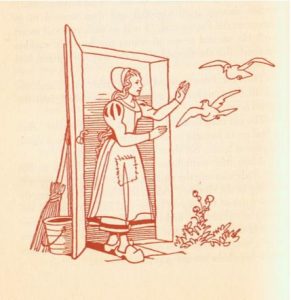
The Grimm Brothers do not worry about the delicate children’s souls. Without any fuss the first daughter’s toes are all cut off and equally resolutely number two’s heel is chopped off – at any cost one of them has to fit in that shoe. Plus, in Grimm’s version the ladies are severely punished, too. Driven by opportunism, the vicious stepsisters limp into the wedding-party of Cinderella and her prince on the last page. They soon regret it; the pigeons attack both shrews and peck out their eyes.
But Taylor insipidly confines himself to one single toe, deletes that gruesome ending altogether and puts an end to the fairy tale well before the wedding, when the prince leaves Cinderella’s home for the third time, this time with the right bride behind him on his horse. In other translations and adaptations it gets even sweeter; Cinderella forgives her stepsisters and on the wedding ball they are coupled to two distinguished gentlemen.
Halfway through the twentieth century, translators E.V. Lucas, Lucy Crane and Marian Edwards return to the blood and the horror, and they get away with it. Some poetic liberties on their return to the source the ladies still grant themselves. In the rhyme that the birds chirp to warn the prince against deception, for instance. Twice the prince rides with a wrong bride past the hazel with Cinderella’s feathered friends, and both times the pigeons call:
Rucke di guck, rucke di guck,
Blut ist im Schuck:
der Schuck ist zu klein,
die rechte Braut sitzt noch daheim.
To the first translator, Edgar Taylor, that is way too scary and he composes bloodlessly:

Back again! back again! look to the shoe!

The shoe is too small, and not made for you!

Prince! prince! look again for thy bride,

For she's not the true one that sits by thy side.
But later, the female trio translaters is not that anxious and almost literally interpretes:
Prithee, look back, prithee, look back,

there's blood on the track.

The shoe is too small;

at home, the true bride is waiting thy call
This translation, with illustrations by Fritz Kredel, hits the American market in 1945 and is an instant sales success. Not very surprising; after the Bible, Kinder- und Hausmärchen is the best-selling book of all time. On the bookshelf in Woodstock, where the young family of Bob and Sara Dylan lives, is probably the reprint from 1965.
To the puzzlers who think Blood On The Tracks is the Big Ultimate Dylan Divorce and Heartbreak Album (buddha), the similarity between the Cinderella quote and the title of the album is attractive. The blood on the path represents that the prince is on the way with the wrong maiden and that he must get rid of her. Bingo, these exegetes think. By 1974 Bob Dylan reaches the conclusion that his marriage with Sara is on a dead end, he lays his soul on the table in songs like “Simple Twist Of Fate”, “You’re A Big Girl Now” and especially “Idiot Wind ” and calls the album I Am On The Road With The Wrong Woman.
The popular, widespread notion that Blood On The Tracks is autobiographical and thematises the dilapidated state of his marriage, annoys Dylan. He admits early, in a radio interview with Mary Travers (Mary from Peter, Paul and Mary) in April ’75, that the songs express pain. In his own words, he is surprised that people enjoy the album so much: “It’s hard for me to relate to that. I mean, you know, people enjoying the type of pain, you know.” And there is the first defensive reaction, when Travers half-heartedly suggests that it could be autobiographical:
MT: Well, perhaps maybe the word “enjoy” is the wrong word. Maybe a better word is to say that you’re moved. I was moved by the album. You know, there were things that I could relate to in that album that grew as sense to me. You made sense to me on that album. I felt that it was a much more, well, for me, I felt it was much more “first person” as opposed to third person.
BD: Well, it makes it more clearly defined, but it still doesn’t necessarily make it any better than, than, doing it, ‘cause you can do it in second, third, fourth person too, you know, it’s all the same, sure it is. Um. I know what you mean though.
Not quite coherent (the ‘fourth person’ does not exist, not in any grammar), but the drift of Dylan’s reply is clear: whenever an ‘I’ speaks, you may also fill in a ‘you’ or a ‘he’, that does not make any difference. And implicitly: this is not about me, Bob Dylan. Je est un autre, says Rimbaud, and Dylan fully subscribes to that statement, also in so many words, in his autobiography Chronicles (“When I read those words the bells went off”).
On the other hand, the bard provides ammunition more than once, especially in longer interviews with journalists with whom he seems to feel at ease. As with Craig McGregor, March 1978 in Australia:
CM: I meant more, you write songs about Sara – I wonder whether you can channel your private emotions into your music, that’s one of the reasons you’re able to write songs. You suffer, and that comes out into your songs.
BD: (Pause) That particular song, well… some songs you figure you’re better off not to have written. There’s a few of them layin’ around.
Initially the men talk about the closing song of Desire, about “Sara”, the song of which Dylan at other times asserts with dry eyes that it is not about Sara, but here Dylan admits almost carelessly that it happens to him more than once – that he incorporates his own experiences and private feelings into his songs.
In the years that follow, Dylan grows increasingly assertive and explicit when confronted with the interpretation that the album is about himself and his marital affairs. This culminates in the booklet in the Biograph collection box (1985), in which he even starts cursing: these ‘fools’, these ‘stupid and misleading jerks’ who, with their ‘unimaginative mentality’ think that it is about him and his wife. After that he again asserts that he does not write confessional songs.
He does not convince the Dylanologists. And his son Jakob does not make it easier in an interview, May 2005 with Anthony DeCurtis for The New York Times:
When I’m listening to “Subterranean Homesick Blues,” I’m grooving along just like you. But when I’m listening to “Blood on the Tracks,” that’s about my parents.
Words that resonate, in the Dylan community, and still Jakob’s most quoted words. But it is not entirely pure. In the process of the quotation being eagerly pumped around, this ‘proof’ that Blood On The Tracks indeed ís autobiographical, the nuance is lost that it is an indirect quotation. It is true that it is printed in that interview with Jakob, but precisely this quote only appears in an intermezzo in which journalist DeCurtis notes what Andrew Slater, the former manager of Jakob’s band The Wallflowers, has told him about what Jakob supposedly said years earlier. It is hearsay, not words that the journalist has recorded from the mouth of Jakob Dylan.
If we assume that Blood On The Tracks is not an encrypted, indiscreet ego document, the question about the title will remain open. Very open; the word track has four or five different meanings, each one opening a new range of interpretation possibilities.
Dylan’s fascination for trains suggests that he himself thinks of the meaning ‘rails, train track’ when using the word tracks. From his first album on, it is a coming and going of trains, tramps walking along the tracks, conductors, wagons, steam whistles and stations. In the roughly three hundred songs that Dylan wrote before Blood On The Tracks, thirty trains pass by and there are as many train-related references (station master, down the line, coachman, railroad tracks, railroad men, railroad gate and railroad gin, to name a few), so Dylan’s self-reflection in the radio interview with Elliot Mintz, 1991, does have some ground: “That’s just my hang up, you know, trains.”
Chekhov might be a clue, on condition that we take Dylan’s hint from Chronicles seriously:
Eventually I would even record an entire album based on Chekhov short stories – critics thought it was autobiographical – that was fine.
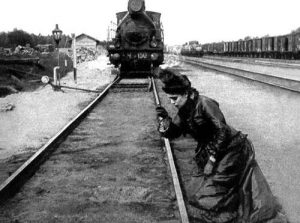
The most famous Blood On The Train Tracks is the blood of Anna Karenina. But alas; that is Tolstoy, and neither does it flow in a short story. In Chekhov’s work dozens of trains pass by, but apart from a single reference in an insignificant sideline, never with bloody consequences. And that one referral is once again based on the tragic fate of the unfortunate Anna Karenina (in The Duel, 1891).
But then again, Dylan has of course built a solid reputation of screwing up the names of writers and their works. In Chronicles, for example, he mentions Pericles’ Ideal State Of Democracy (the statesman and general Pericles did not write books at all) and he casually cites “Sophocles’ book on the nature and function of the gods” – in reality Sophocles only wrote tragedies. And likewise in interviews we come across such, intentional or unintentional, slips. As in the same interview with Craig McGregor (New Musical Express), in March 1978:
CM: Listening to Tangled Up In Blue, I got the feeling it’s like an autobiography; a sort of funny, wry, compressed novel…
BD: Yeah, that’s the first I ever wrote that I felt free enough to change all the… what is it, the tenses around, is that what it is?
CM: The person…
BD: The he and the she and the I and the you, and the we and the us – I figured it was all the same anyway – I could throw them all in where they floated right – and it works on that level.
CM: It’s got those nice lines at the end, about “There was music in the cafés at night / And revolution in the air” and “Some are mathematicians, some are carpenters wives / I don’t know how it all got started, I don’t know / what they do with their lives.”
BD: I like that song. Yeah, that poet from the 13th century.
CM: Who was that?
BD: Plutarch. Is that his name?
True, Plutarch sometimes resides in Rome, becomes a Roman citizen in later years and is known by his Latin name, but: he is a Greek and lives in the first century. Even the job title ‘poet’ is not correct; Plutarch does not write poems, but biographies and philosophical essays, in Greek, by the way. With that malapropism, Dylan at the same time puts into perspective the research of the descriptors that scroll back and forth in the works of Dante and Petrarch (who live in the fourteenth century, really) to find a line to “Tangled Up In Blue”. Matching the atmosphere of the song and the words And every one of them words rang true / And glowed like burnin’ coal sooner brings Boccaccio to mind, actually, but just as little luck there: wrong century again (1313-1375).
Inaccuracies and false scents enough, all in all, to not take Dylan’s own reference to ‘the short stories of Chekhov’ too literally. He could just as well have meant ‘Russian literature from previous centuries’ or ‘Tolstoy’, and therefore the album title could have been inspired by the reading of Anna Karenina. Not entirely incongruous; Anna’s jump before the train is driven by frustrated love and jealousy, two leading motifs in the songs on Blood On The Tracks.
A third meaning of tracks is grist to the mill to a poet who, according to Joan Baez, is ‘so good at keeping things vague’: album tracks, the individual songs on a record. With this semantic charge, Dylan uses the word track just as often meaning ‘song’; in Chronicles alone he means eight times ‘song recording’ when he writes a track, and in the published interviews we also encounter it dozens of times as a synonym for ‘song’.
In that case Blood On The Tracks becomes something like ‘there is blood in these songs, my heart and soul lie in these songs’, which of course is a welcome interpretation for the autobiographical signifiers.
Not at all unambiguous, all in all, this polysemic album title. Considering the long list of Dylan’s album titles, the poetic vagueness of a title like Blood On The Tracks is not necessarily a trademark of the bard, but it is not exceptional either. We know that since his fifth album, Bringing It All Back Home (1965), Dylan is allowed to come up with the titles himself (until that time the boys and girls from CBS’ marketing department consider it their task) and we know that Dylan cares:
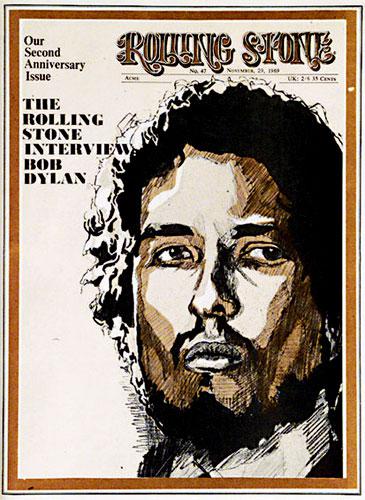
Well, I always like to tie the name of the album in with some song. Or if not some song, some kind of general feeling. I think that just about fit because it was less in the way, and less specific than any of the other ones there. Certainly couldn’t call the album Lay Lady Lay. I wouldn’t have wanted to call it that, although that name was brought up. It didn’t get my vote, but it was brought up.
(Rolling Stone interview, november 1969)
Since 1965, Dylan has recorded about 30 official, regular studio albums and given them a name. Half of them are linked to a song title (Highway 61 Revisited, Slow Train Coming, Tempest), some names indeed express a traceable ‘general feeling’ (Self Portrait, Bringing It All Back Home) and with a dozen titles Dylan is admittedly ‘less specific’, but the title is still ‘in the way’, the chosen title is an extra challenge to interpret the album and the songs. Blonde On Blonde is the first example and in the 70s Dylan succumbs three times for the temptation to put an alienating, misty icing on the cake: Desire, Street Legal and this Blood On The Tracks.
Despite this mistiness, the word combination gradually penetrates the public’s collective memory. A British collection of stories about criminal activities on the railroad is called Blood On The Tracks (David Brandon and Alan Brooke, 2017), as well as the first episode of Unravel, an Australian podcast by investigative journalists on unsolved crimes (2018), the first thriller in the Sidney Rose Parnell series by writer Barbara Nickless (2016), the fifteenth episode of the TV series Werewolf (1987), various artworks by musicians, painters and sculptors, research reports by molecular biologists and medical specialists, an episode from the game version of Guardians Of The Galaxy, and so on. Brian S. Willson, the Vietnam veteran and peace activist who, in a demonstration on the tracks in front of a munitions transport, remains demonstratively seated, gets run over and loses both legs in 1987, shows a macabre sort of mental toughness by calling his memoirs Blood On The Tracks (2011).
The title is, in short, starting to get disengaged from Dylan’s masterpiece. The fanatical teenagers who chase the Silver Blood On The Tracks Trophy in the Tell-Tale Series of the Guardians game at their Xbox will largely be unfamiliar with “Idiot Wind”. The zealous cell biology students who plough through their professor’s neuroscientific study, Blood On The Tracks by Konstantinos Meletis, 2003, probably will not be able to sing along with “Buckets Of Rain”.
But that the timeless masterpiece of the Nobel Prize winner will cross their paths sooner or later, is certain. That does not take more than a simple twist or fate.
What else is on the site?
You’ll find an index to our latest posts arranged by themes and subjects on the home page. You can also see details of our main sections on this site at the top of this page under the picture.
The index to the 500+ songs reviewed is now on a new page of its own. You will find it here. It contains reviews of every Dylan composition that we can find a recording of – if you know of anything we have missed please do write in.
We also now have a discussion group “Untold Dylan” on Facebook. Just type the phrase “Untold Dylan” in, on your Facebook page or follow this link
And please do note The Bob Dylan Project, which lists every Dylan song in alphabetical order, and has links to licensed recordings and performances by Dylan and by other artists, is starting to link back to our reviews.